💧 بنك الأسئلة: حالات المادة
💧 Question Bank: States of Matter
الموائع والضغط، قوانين الغازات، ضغط المائع ومبدأ باسكال، دافعة أرخميدس، معادلتا الاستمرارية وبرنولي، التوتر السطحي، التمدد الحراري
Fluids and Pressure, Gas Laws, Fluid Pressure and Pascal’s Principle, Archimedes’ Principle, Continuity and Bernoulli Equations, Surface Tension, Thermal Expansion
⏱️ 33 سؤال اختيار من متعدد بتصحيح فوري بمستويات متدرجة، و3 مسائل مقالية محلولة⏱️ 33 multiple-choice questions of graded difficulty with instant feedback, plus 3 solved essay problems
\[1\,\star\]
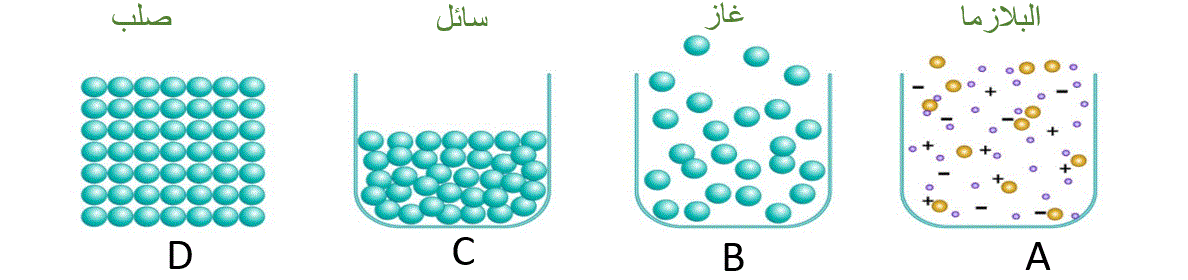
الموائع التي تمت دراستها: من الممكن تصنيف المواد التالية من ضمنها (الأشكال A: بلازما، B: غاز، C: سائل، D: صلب):Which of the following materials can be classified as fluids (A: plasma, B: gas, C: liquid, D: solid)?
B و AB and A
C و BC and B
C و DC and D
D و AD and A
الحلSolution
📌 الموائع هي المواد التي ليس لها شكل معين بل تأخذ شكل الإناء الحاوي لها، وتتميز بقدرتها على الانسياب.
📌 الموائع نوعان: قابلة للانضغاط مثل الغازات (B)، وغير قابلة للانضغاط مثل السوائل (C). أما الصلب (D) فله شكل ثابت.
📌 الجواب: C و B.
✅ C و B (B)
📌 Fluids are substances with no definite shape that take the shape of their container and are able to flow.
📌 Fluids are of two types: compressible, such as gases (B), and incompressible, such as liquids (C). The solid (D) has a fixed shape.
📌 The answer is C and B.
✅ C and B (B)
\[2\,\star\]
أربعة متوازيات مستطيلات لها الوزن نفسه وُضعت على سطح من الرمل. أيّ مكعب يحدث أكبر مقدار من الضغط على سطح الرمل؟Four blocks of the same weight are placed on a sand surface. Which block exerts the greatest pressure on the sand?

المكعب ABlock A
المكعب BBlock B
المكعب CBlock C
المكعب DBlock D
الحلSolution
📌 \(p=\dfrac{F}{A}\): العلاقة بين الضغط والمساحة عكسية؛ كلما قلّت مساحة السطح زاد الضغط بثبات القوة.
📌 المكعب C واقف على أصغر وجه له (أصغر مساحة تلامس مع الرمل) فيحدث أكبر ضغط.
✅ المكعب C (C)
📌 \(p=\dfrac{F}{A}\): pressure and area are inversely related; the smaller the contact area, the greater the pressure for the same force.
📌 Block C stands on its smallest face (the smallest contact area with the sand), so it exerts the greatest pressure.
✅ Block C (C)
\[3\,\star\]
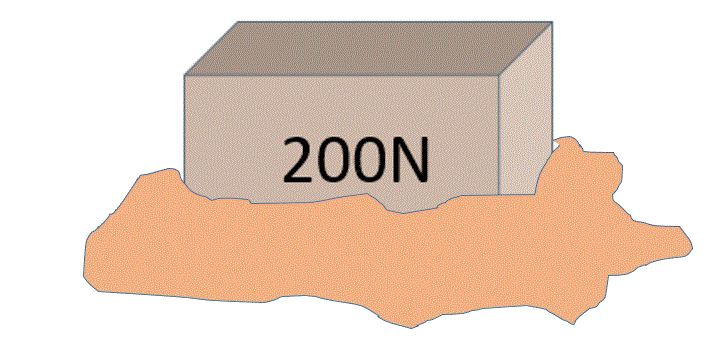
جسم وزنه \(200\,N\) وُضع على سطح رملي مساحته \(0.2\,m^2\). الضغط الذي يؤثر به الجسم على الرمل يساوي:An object of weight \(200\,N\) is placed on a sand surface of area \(0.2\,m^2\). The pressure it exerts on the sand is:
\(p=1000\,Pa\)\(p=1000\,Pa\)
\(p=1400\,Pa\)\(p=1400\,Pa\)
\(p=800\,Pa\)\(p=800\,Pa\)
\(p=1200\,Pa\)\(p=1200\,Pa\)
الحلSolution
\(p=\dfrac{F}{A}=\dfrac{200}{0.2}=1000\,Pa\).
✅ \(p=1000\,Pa\) (A)
\(p=\dfrac{F}{A}=\dfrac{200}{0.2}=1000\,Pa\).
✅ \(p=1000\,Pa\) (A)
\[4\,\star\]
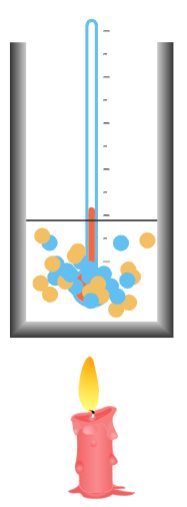
عينة من غاز الأوكسجين حجمها \(V=0.2\,m^3\) ودرجة حرارتها \(T=270\,K\) وُضعت داخل إناء عند ضغط ثابت، ثم تغيرت درجة حرارتها حتى أصبح حجمها \(V=0.27\,m^3\). درجة حرارة العينة عندئذ:A sample of oxygen gas of volume \(V=0.2\,m^3\) and temperature \(T=270\,K\) is in a container at constant pressure. Its temperature changes until the volume becomes \(V=0.27\,m^3\). The new temperature is:
\(T_2=320.5\,K\)\(T_2=320.5\,K\)
\(T_2=380.4\,K\)\(T_2=380.4\,K\)
\(T_2=364.5\,K\)\(T_2=364.5\,K\)
\(T_2=200\,K\)\(T_2=200\,K\)
الحلSolution
📌 عند ضغط ثابت (قانون شارل): \(\dfrac{V_1}{T_1}=\dfrac{V_2}{T_2}\).
\(T_2=\dfrac{V_2\,T_1}{V_1}=\dfrac{0.27\times270}{0.2}=364.5\,K\).
✅ \(T_2=364.5\,K\) (C)
📌 At constant pressure (Charles's law): \(\dfrac{V_1}{T_1}=\dfrac{V_2}{T_2}\).
\(T_2=\dfrac{V_2\,T_1}{V_1}=\dfrac{0.27\times270}{0.2}=364.5\,K\).
✅ \(T_2=364.5\,K\) (C)
\[5\,\star\star\]
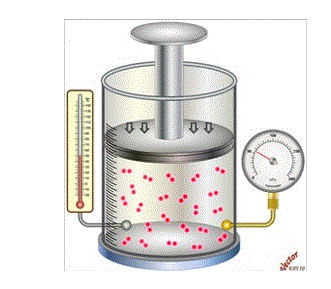
عينة من الغاز حجمها \(V=0.003\,m^3\) ودرجة حرارتها \(T=290\,K\) وضغطها \(P=1.2\times10^5\,Pa\). عدد المولات التي تحتويها العينة (علمًا أن \(R=8.31\,J/(mol\cdot K)\)):A gas sample has volume \(V=0.003\,m^3\), temperature \(T=290\,K\) and pressure \(P=1.2\times10^5\,Pa\). The number of moles in the sample is (\(R=8.31\,J/(mol\cdot K)\)):
\(n=0.15\,mol\)\(n=0.15\,mol\)
\(n=0.26\,mol\)\(n=0.26\,mol\)
\(n=0.37\,mol\)\(n=0.37\,mol\)
\(n=0.42\,mol\)\(n=0.42\,mol\)
الحلSolution
📌 معادلة الغاز المثالي: \(PV=nRT\).
\(n=\dfrac{PV}{RT}=\dfrac{1.2\times10^5\times0.003}{8.31\times290}=0.15\,mol\).
✅ \(n=0.15\,mol\) (A)
📌 The ideal gas equation: \(PV=nRT\).
\(n=\dfrac{PV}{RT}=\dfrac{1.2\times10^5\times0.003}{8.31\times290}=0.15\,mol\).
✅ \(n=0.15\,mol\) (A)
\[6\,\star\]
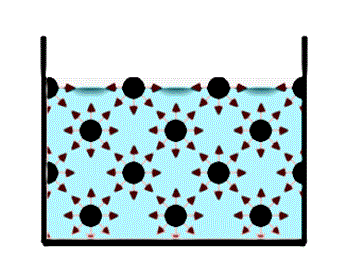
التوتر السطحي في السوائل ناتج عن:Surface tension in liquids is caused by:
قوى التلاصق بين جزيئات السائل وجدران الوعاءadhesive forces between the liquid molecules and the container walls
قوى التماسك بين الجزيئات على سطح السائلcohesive forces between the molecules at the liquid surface
قوى التماسك بين الجزيئات داخل السائلcohesive forces between the molecules inside the liquid
الطاقة الحركية التي تملكها جزيئات السائلthe kinetic energy of the liquid molecules
الحلSolution
📌 الجزيئات الموجودة على سطح السائل تتعرض لقوى جذب كبيرة تُدعى قوى التماسك في اتجاه داخل السائل.
📌 هذه القوى تجعل سطح السائل يميل إلى التقلص ليصغر في المساحة، مسببةً ما يُعرف بالتوتر السطحي.
✅ قوى التماسك بين الجزيئات على سطح السائل (B)
📌 The molecules at the surface of a liquid experience large attractive forces called cohesive forces directed into the liquid.
📌 These forces make the surface tend to contract to the smallest area, producing what is known as surface tension.
✅ cohesive forces between the molecules at the liquid surface (B)
\[7\,\star\]
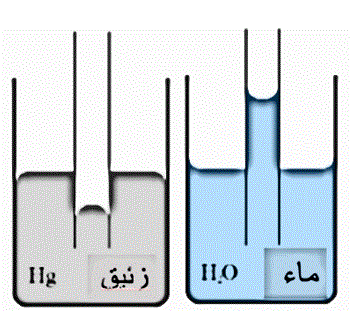
غُمر أنبوب شعري مفتوح الطرفين في كوب فيه ماء وآخر فيه زئبق كما في الشكل (ارتفع الماء في الأنبوب وانخفض الزئبق). أحد الإجابات التالية يعبّر بشكل صحيح عن الشكل:An open-ended capillary tube is dipped into a cup of water and another of mercury as shown (the water rises in the tube and the mercury is depressed). Which of the following correctly describes the figure?
في الماء قوى التماسك أكبر من قوى التلاصقIn water, cohesive forces are greater than adhesive forces
في الماء قوى التماسك تساوي قوى التلاصقIn water, cohesive forces equal adhesive forces
في الزئبق قوى التماسك أكبر من قوى التلاصقIn mercury, cohesive forces are greater than adhesive forces
في الزئبق قوى التماسك تساوي قوى التلاصقIn mercury, cohesive forces equal adhesive forces
الحلSolution
📌 الماء يرتفع في الأنبوب الشعري ويكون سطحه مقعرًا لأن قوى التلاصق بين الماء والزجاج أكبر من قوى التماسك بين جزيئات الماء.
📌 الزئبق ينخفض في الأنبوب ويكون سطحه محدبًا لأن قوى التماسك بين جزيئات الزئبق أكبر من قوى التلاصق بينه وبين الزجاج.
📌 الخيار الصحيح الوحيد هو الخاص بالزئبق.
✅ في الزئبق قوى التماسك أكبر من قوى التلاصق (C)
📌 Water rises in the capillary tube and its surface is concave because the adhesive force between water and glass is greater than the cohesive force between water molecules.
📌 Mercury is depressed in the tube and its surface is convex because the cohesive forces between mercury molecules are greater than the adhesive forces between mercury and glass.
📌 The only correct statement is the one about mercury.
✅ In mercury, cohesive forces are greater than adhesive forces (C)
\[8\,\star\]
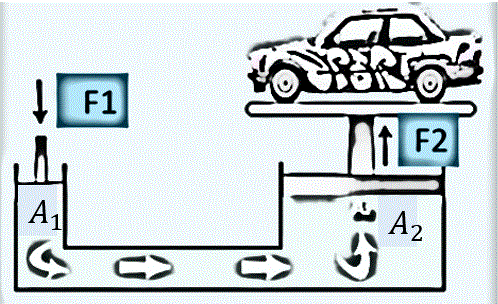
رافعة سيارات مساحة مكبسها الصغير \(0.1\,m^2\) ومساحة مكبسها الكبير \(1.2\,m^2\) وُضعت سيارة وزنها \(7000\,N\) فوق المكبس الكبير. أقل قوة يجب تطبيقها على المكبس الصغير لرفع السيارة:A car lift has a small piston of area \(0.1\,m^2\) and a large piston of area \(1.2\,m^2\). A car weighing \(7000\,N\) is placed on the large piston. The minimum force needed on the small piston to lift the car is:
\(F_1=583.3\,N\)\(F_1=583.3\,N\)
\(F_1=467.2\,N\)\(F_1=467.2\,N\)
\(F_1=824.1\,N\)\(F_1=824.1\,N\)
\(F_1=650.4\,N\)\(F_1=650.4\,N\)
الحلSolution
📌 مبدأ باسكال: \(\dfrac{F_1}{A_1}=\dfrac{F_2}{A_2}\).
\(F_1=\dfrac{F_2A_1}{A_2}=\dfrac{7000\times0.1}{1.2}=583.3\,N\).
✅ \(F_1=583.3\,N\) (A)
📌 Pascal's principle: \(\dfrac{F_1}{A_1}=\dfrac{F_2}{A_2}\).
\(F_1=\dfrac{F_2A_1}{A_2}=\dfrac{7000\times0.1}{1.2}=583.3\,N\).
✅ \(F_1=583.3\,N\) (A)
\[9\,\star\]
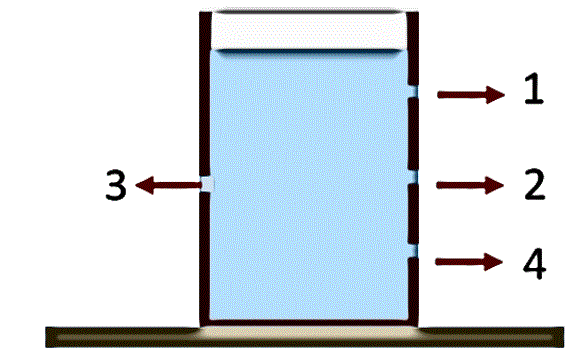
في خزان مملوء بالماء أربع فتحات كما في الشكل. من أي الفتحات يندفع الماء بأكبر سرعة ويكون الضغط عندها أكبر ما يمكن؟A tank full of water has four openings as shown. Through which opening does the water exit with the greatest speed, where the pressure is greatest?
الفتحة 1Opening 1
الفتحة 2Opening 2
الفتحة 3Opening 3
الفتحة 4Opening 4
الحلSolution
📌 ضغط المائع \(P=\rho gh\): كلما زاد العمق \(h\) زاد الضغط.
📌 الفتحة 4 هي الأعمق، فالضغط عندها أكبر ما يمكن ويخرج منها الماء بأسرع ما يمكن. أما الفتحتان 2 و3 فلهما العمق نفسه فالضغط عندهما متساوٍ.
✅ الفتحة 4 (D)
📌 The fluid pressure is \(P=\rho gh\): the greater the depth \(h\), the greater the pressure.
📌 Opening 4 is the deepest, so the pressure there is greatest and the water leaves it fastest. Openings 2 and 3 are at the same depth so their pressures are equal.
✅ Opening 4 (D)
\[10\,\star\star\]
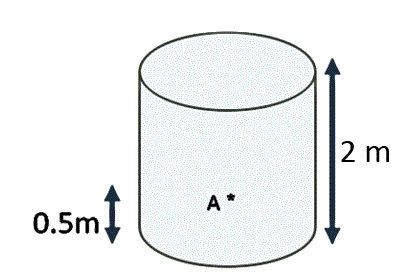
أسطوانة مفتوحة من الأعلى فيها ماء كثافته \(\rho=1000\,kg/m^3\) وارتفاع الماء فيها \(h=2\,m\). الضغط الكلي عند النقطة A التي تبعد \(0.5\,m\) عن قاعدة الأسطوانة (الضغط الجوي \(p_0=1.1\times10^5\,Pa\)):An open-topped cylinder contains water of density \(\rho=1000\,kg/m^3\) to a height \(h=2\,m\). The total pressure at point A, \(0.5\,m\) above the bottom of the cylinder, is (atmospheric pressure \(p_0=1.1\times10^5\,Pa\)):
\(p_{tot}=1.149\times10^5\,Pa\)\(p_{tot}=1.149\times10^5\,Pa\)
\(p_{tot}=1.56\times10^5\,Pa\)\(p_{tot}=1.56\times10^5\,Pa\)
\(p_{tot}=1.247\times10^5\,Pa\)\(p_{tot}=1.247\times10^5\,Pa\)
\(p_{tot}=1.832\times10^5\,Pa\)\(p_{tot}=1.832\times10^5\,Pa\)
الحلSolution
📌 النقطة A تخضع لضغط المائع \(\rho gh\) وضغط الهواء الجوي \(p_0\): \(P_{tot}=p_0+\rho gh\).
📌 العمق \(h\) هو بُعد النقطة عن السطح: \(h=2-0.5=1.5\,m\).
\(P_{tot}=1.1\times10^5+1000\times9.81\times1.5=1.247\times10^5\,Pa\).
✅ \(p_{tot}=1.247\times10^5\,Pa\) (C)
📌 Point A is subject to the fluid pressure \(\rho gh\) and the atmospheric pressure \(p_0\): \(P_{tot}=p_0+\rho gh\).
📌 The depth \(h\) is the distance of the point below the surface: \(h=2-0.5=1.5\,m\).
\(P_{tot}=1.1\times10^5+1000\times9.81\times1.5=1.247\times10^5\,Pa\).
✅ \(p_{tot}=1.247\times10^5\,Pa\) (C)
\[11\,\star\]
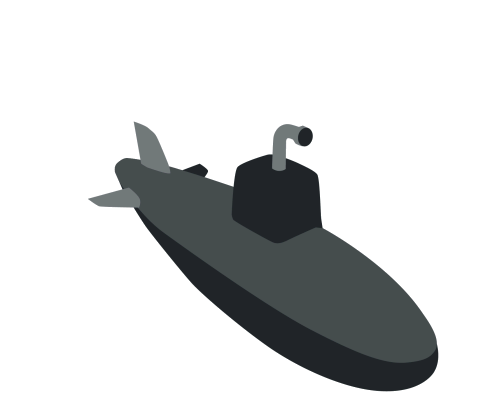
غواصة على عمق \(500\,m\) تحت سطح البحر قيس الضغط على جدرانها فكان \(p_{tot}=5.14\times10^6\,Pa\)، والضغط الجوي \(p_0=1.1\times10^5\,Pa\). كثافة ماء البحر:A submarine is at a depth of \(500\,m\) below sea level. The pressure on its walls is \(p_{tot}=5.14\times10^6\,Pa\) and atmospheric pressure is \(p_0=1.1\times10^5\,Pa\). The density of seawater is:
\(\rho=1000\,kg/m^3\)\(\rho=1000\,kg/m^3\)
\(\rho=1025\,kg/m^3\)\(\rho=1025\,kg/m^3\)
\(\rho=1075\,kg/m^3\)\(\rho=1075\,kg/m^3\)
\(\rho=1050\,kg/m^3\)\(\rho=1050\,kg/m^3\)
الحلSolution
📌 \(P_{tot}=p_0+\rho gh\).
\(\rho=\dfrac{P_{tot}-p_0}{gh}=\dfrac{5.14\times10^6-1.1\times10^5}{500\times9.81}=1025\,kg/m^3\).
✅ \(\rho=1025\,kg/m^3\) (B)
📌 \(P_{tot}=p_0+\rho gh\).
\(\rho=\dfrac{P_{tot}-p_0}{gh}=\dfrac{5.14\times10^6-1.1\times10^5}{500\times9.81}=1025\,kg/m^3\).
✅ \(\rho=1025\,kg/m^3\) (B)
\[12\,\star\]
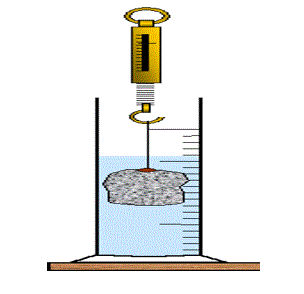
قطعة معدنية وُضعت في سائل فغاصت وأزاحت منه حجمًا \(V=0.0002\,m^3\). إذا كانت كثافة السائل \(\rho=2600\,kg/m^3\) فإن دافعة أرخميدس تساوي:A metal piece placed in a liquid sinks and displaces a volume \(V=0.0002\,m^3\). If the liquid density is \(\rho=2600\,kg/m^3\), the buoyant force (Archimedes) is:
\(F_B=50.9\,N\)\(F_B=50.9\,N\)
\(F_B=5.1\,N\)\(F_B=5.1\,N\)
\(F_B=1.8\,N\)\(F_B=1.8\,N\)
\(F_B=5.8\,N\)\(F_B=5.8\,N\)
الحلSolution
📌 \(F_B=\rho_{fluid}\,V_{displaced}\,g\): كثافة السائل × حجم السائل المزاح × عجلة الجاذبية.
\(F_B=2600\times0.0002\times9.81=5.1\,N\).
✅ \(F_B=5.1\,N\) (B)
📌 \(F_B=\rho_{fluid}\,V_{displaced}\,g\): fluid density × displaced volume × gravitational acceleration.
\(F_B=2600\times0.0002\times9.81=5.1\,N\).
✅ \(F_B=5.1\,N\) (B)
\[13\,\star\star\]
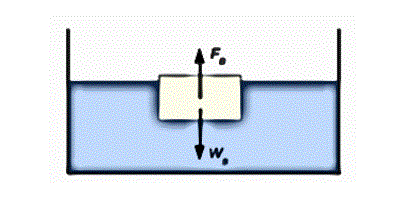
مكعب خشبي حجمه \(V=0.002\,m^3\) وُضع في حوض ماء كثافته \(\rho=1000\,kg/m^3\) فطفا، وبقي منه فوق سطح الماء حجم \(0.0005\,m^3\). دافعة أرخميدس تساوي:A wooden cube of volume \(V=0.002\,m^3\) is placed in water of density \(\rho=1000\,kg/m^3\) and floats with a volume \(0.0005\,m^3\) above the surface. The buoyant force is:
\(F_B=14.7\,N\)\(F_B=14.7\,N\)
\(F_B=19.6\,N\)\(F_B=19.6\,N\)
\(F_B=12.5\,N\)\(F_B=12.5\,N\)
\(F_B=4.9\,N\)\(F_B=4.9\,N\)
الحلSolution
📌 حجم السائل المزاح = الحجم المغمور: \(V=0.002-0.0005=0.0015\,m^3\).
\(F_B=1000\times0.0015\times9.81=14.7\,N\).
✅ \(F_B=14.7\,N\) (A)
📌 The displaced volume equals the submerged volume: \(V=0.002-0.0005=0.0015\,m^3\).
\(F_B=1000\times0.0015\times9.81=14.7\,N\).
✅ \(F_B=14.7\,N\) (A)
\[14\,\star\]
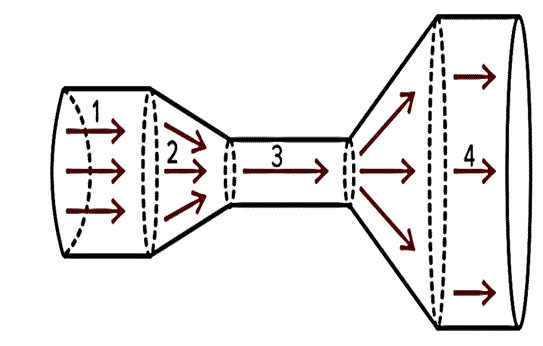
في الأنابيب الأفقية وحسب قانون برنولي، أقل قيمة للضغط تكون في الجزء:In horizontal pipes, according to Bernoulli's law, the lowest pressure is in section:
11
22
33
44
الحلSolution
📌 يقل الضغط كلما زادت سرعة جريان المائع.
📌 الجزء 3 مساحة مقطعه أصغر ما يمكن فسرعة المائع فيه أكبر ما يمكن (معادلة الاستمرارية \(A_1v_1=A_2v_2\)) فيكون الضغط عنده أقل ما يمكن.
✅ C
📌 The pressure decreases as the speed of the flowing fluid increases.
📌 Section 3 has the smallest cross-sectional area, so the fluid speed is greatest there (continuity equation \(A_1v_1=A_2v_2\)) and the pressure is lowest.
✅ C
\[15\,\star\star\star\]
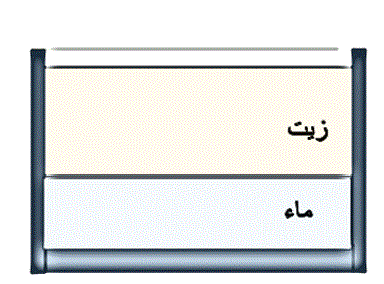
حوض فيه ماء وزيت لا يمتزجان: كثافة الزيت \(800\,kg/m^3\) وارتفاعه \(h=0.3\,m\)، وكثافة الماء \(1000\,kg/m^3\) وارتفاعه \(h=0.2\,m\). الضغط الناتج من المائعين فقط على قعر الإناء:A tank contains immiscible water and oil: the oil has density \(800\,kg/m^3\) and height \(h=0.3\,m\), the water has density \(1000\,kg/m^3\) and height \(h=0.2\,m\). The pressure due to the fluids only at the bottom of the tank is:
\(p=2354.4\,Pa\)\(p=2354.4\,Pa\)
\(p=4316.4\,Pa\)\(p=4316.4\,Pa\)
\(p=1962\,Pa\)\(p=1962\,Pa\)
\(p=5641.8\,Pa\)\(p=5641.8\,Pa\)
الحلSolution
📌 قعر الإناء يخضع لضغط الزيت وضغط الماء معًا: \(p=\rho_1gh_1+\rho_2gh_2\).
\(p=800\times9.81\times0.3+1000\times9.81\times0.2=2354.4+1962=4316.4\,Pa\).
✅ \(p=4316.4\,Pa\) (B)
📌 The bottom is subject to the pressure of the oil and of the water together: \(p=\rho_1gh_1+\rho_2gh_2\).
\(p=800\times9.81\times0.3+1000\times9.81\times0.2=2354.4+1962=4316.4\,Pa\).
✅ \(p=4316.4\,Pa\) (B)
\[16\,\star\]
البلازما هي الحالة الرابعة للمادة، وتنتج من ارتفاع درجة حرارة المادة الغازية فتتأين وتفقد إلكترونات. أحد الخيارات التالية لا يحتوي على البلازما:Plasma is the fourth state of matter; it forms when a gas is heated so much that it ionizes and loses electrons. Which of the following does not contain plasma?
المصابيح الكهربائية (ذات الفتيلة)incandescent (filament) bulbs
المصابيح الفلوريةfluorescent lamps
الشمسthe Sun
مصابيح النيونneon lamps
الحلSolution
📌 مصباح النيون والمصابيح الفلورية يحتويان غازًا متأينًا (بلازما)، والشمس كرة من البلازما.
📌 المصباح الكهربائي العادي يتوهج بسبب فتيلة صلبة ساخنة وليس غازًا متأينًا، فلا بلازما فيه.
✅ المصابيح الكهربائية (ذات الفتيلة) (A)
📌 Neon and fluorescent lamps contain ionized gas (plasma), and the Sun is a ball of plasma.
📌 An ordinary bulb glows because of a hot solid filament, not an ionized gas, so it contains no plasma.
✅ incandescent (filament) bulbs (A)
\[17\,\star\]
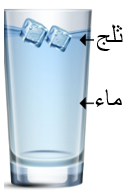
المواد عادةً يزداد حجمها وتقل كثافتها عند التسخين، ويقل حجمها وتزداد كثافتها عند التبريد. أما عند تبريد الماء من 4°C إلى 0°C فتقل كثافة الثلج، والسبب:Materials usually expand and lose density when heated, and contract and gain density when cooled. When water is cooled from 4°C to 0°C, however, the density of the ice decreases. The reason is:
حجم الماء يقل عندما يتحول إلى جليدthe volume of the water decreases when it turns to ice
الروابط بين جزيئات الثلج قوية ومتقاربةthe bonds between ice molecules are strong and close
حجم الماء لا يتغير عند التحول إلى جليدthe volume of water does not change when it turns to ice
الروابط بين جزيئات الثلج ضعيفة ومتباعدةthe bonds between ice molecules are weak and spread apart
الحلSolution
📌 مع انخفاض درجة الحرارة تبدأ روابط الهيدروجين الأضعف في فصل ذرات الأكسجين بعضها عن بعض، فتتشكل بنية بلورية سداسية مفتوحة.
📌 روابط الثلج ضعيفة والجزيئات متباعدة، فيشغل الجليد مساحة أكبر بنحو 9% من السائل، فتقل كثافته بالنسبة نفسها تقريبًا، ولهذا يطفو الجليد على الماء.
✅ الروابط بين جزيئات الثلج ضعيفة ومتباعدة (D)
📌 As the temperature falls, the weak hydrogen bonds begin to hold the oxygen atoms apart, forming an open hexagonal crystal structure.
📌 In ice the bonds are weak and the molecules are spaced apart, so ice occupies about 9% more volume than the liquid and its density is about 9% lower, which is why ice floats on water.
✅ the bonds between ice molecules are weak and spread apart (D)
\[18\,\star\]
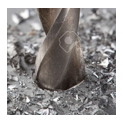
عند استخدام مثقب لعمل ثقب دائري في صفيحة من الألمنيوم، إذا سُخنت الصفيحة فإن حجم الثقب:A circular hole is drilled in an aluminium sheet. If the sheet is heated, the size of the hole will:
سوف ينقصdecrease
سوف يزداد ثم ينقصincrease and then decrease
سوف يزدادincrease
سوف ينقص ثم يزدادdecrease and then increase
الحلSolution
📌 عند التسخين يتمدد الألمنيوم في كل الاتجاهات، والثقب يتمدد كما لو كان مملوءًا بالمادة نفسها.
📌 لذلك تزداد أبعاد الثقب مع ارتفاع درجة الحرارة ولا تنقص.
✅ سوف يزداد (C)
📌 When heated, the aluminium expands in all directions, and the hole expands as if it were filled with the same material.
📌 So the dimensions of the hole increase as the temperature rises, and do not decrease.
✅ increase (C)
\[19\,\star\]
تؤثر قوة مقدارها \(600\,N\) عموديًا على مساحة \(0.3\,m^2\). الضغط الناتج:A force of \(600\,N\) acts perpendicularly on an area of \(0.3\,m^2\). The resulting pressure is:
\(180\,Pa\)\(180\,Pa\)
\(2000\,Pa\)\(2000\,Pa\)
\(1800\,Pa\)\(1800\,Pa\)
\(200\,Pa\)\(200\,Pa\)
الحلSolution
\(p=\dfrac{F}{A}=\dfrac{600}{0.3}=2000\,Pa\).
✅ \(2000\,Pa\) (B)
\(p=\dfrac{F}{A}=\dfrac{600}{0.3}=2000\,Pa\).
✅ \(2000\,Pa\) (B)
\[20\,\star\]
وحدة الباسكال \(Pa\) (وحدة قياس الضغط) تكافئ:The pascal \(Pa\) (the unit of pressure) is equivalent to:
\(N/m\)\(N/m\)
\(N\cdot m\)\(N\cdot m\)
\(N\cdot s\)\(N\cdot s\)
\(N/m^2\)\(N/m^2\)
الحلSolution
📌 \(p=\dfrac{F}{A}\) فوحدته \(\dfrac{N}{m^2}\) وتُسمّى الباسكال.
✅ \(N/m^2\) (D)
📌 \(p=\dfrac{F}{A}\) so its unit is \(\dfrac{N}{m^2}\), called the pascal.
✅ \(N/m^2\) (D)
\[21\,\star\]
ينص مبدأ باسكال على أن:Pascal's principle states that:
القوة المؤثرة على مائع محصور تنتقل بالمقدار نفسه إلى كل نقطةthe force applied to a confined fluid is transmitted equally to every point
الضغط المؤثر على مائع محصور ينتقل بالمقدار نفسه إلى جميع أجزاء المائع وجدران الوعاءpressure applied to a confined fluid is transmitted undiminished to every part of the fluid and the walls of the container
ضغط المائع يقل كلما زاد العمقfluid pressure decreases with depth
الجسم المغمور يخضع لقوة دفع تساوي وزنهa submerged body experiences a buoyant force equal to its weight
الحلSolution
📌 الضغط (وليس القوة) المؤثر على مائع محصور ينتقل كاملًا إلى جميع أجزائه؛ ولذلك تُعطي المكابس الهيدروليكية قوة أكبر على المكبس الأكبر مساحة.
✅ الضغط المؤثر على مائع محصور ينتقل بالمقدار نفسه إلى جميع أجزاء المائع وجدران الوعاء (B)
📌 It is the pressure (not the force) applied to a confined fluid that is transmitted undiminished to all its parts; this is why hydraulic presses give a larger force on the larger piston.
✅ pressure applied to a confined fluid is transmitted undiminished to every part of the fluid and the walls of the container (B)
\[22\,\star\star\]
ضُغط غاز في أسطوانة عند درجة حرارة ثابتة من حجم \(2\,L\) إلى حجم \(0.5\,L\)، فإذا كان ضغطه الابتدائي \(1\times10^5\,Pa\) فإن ضغطه النهائي:A gas in a cylinder is compressed at constant temperature from \(2\,L\) to \(0.5\,L\). If its initial pressure is \(1\times10^5\,Pa\), its final pressure is:
\(2.5\times10^4\,Pa\)\(2.5\times10^4\,Pa\)
\(4\times10^5\,Pa\)\(4\times10^5\,Pa\)
\(5\times10^5\,Pa\)\(5\times10^5\,Pa\)
\(1\times10^5\,Pa\)\(1\times10^5\,Pa\)
الحلSolution
📌 عند ثبوت درجة الحرارة (قانون بويل): \(P_1V_1=P_2V_2\).
\(P_2=\dfrac{P_1V_1}{V_2}=\dfrac{1\times10^5\times2}{0.5}=4\times10^5\,Pa\).
✅ \(4\times10^5\,Pa\) (B)
📌 At constant temperature (Boyle's law): \(P_1V_1=P_2V_2\).
\(P_2=\dfrac{P_1V_1}{V_2}=\dfrac{1\times10^5\times2}{0.5}=4\times10^5\,Pa\).
✅ \(4\times10^5\,Pa\) (B)
\[23\,\star\star\]
غاز حجمه \(0.5\,m^3\) عند \(250\,K\) سُخّن عند ضغط ثابت إلى \(300\,K\). حجمه الجديد:A gas of volume \(0.5\,m^3\) at \(250\,K\) is heated at constant pressure to \(300\,K\). Its new volume is:
\(0.417\,m^3\)\(0.417\,m^3\)
\(0.55\,m^3\)\(0.55\,m^3\)
\(0.75\,m^3\)\(0.75\,m^3\)
\(0.6\,m^3\)\(0.6\,m^3\)
الحلSolution
📌 قانون شارل (الضغط ثابت): \(\dfrac{V_1}{T_1}=\dfrac{V_2}{T_2}\). ويجب أن تكون درجة الحرارة بالكلفن.
\(V_2=\dfrac{0.5\times300}{250}=0.6\,m^3\).
✅ \(0.6\,m^3\) (D)
📌 Charles's law (constant pressure): \(\dfrac{V_1}{T_1}=\dfrac{V_2}{T_2}\). The temperature must be in kelvin.
\(V_2=\dfrac{0.5\times300}{250}=0.6\,m^3\).
✅ \(0.6\,m^3\) (D)
\[24\,\star\star\]
مولان من غاز مثالي في إناء حجمه \(0.05\,m^3\) عند درجة حرارة \(300\,K\). ضغط الغاز (\(R=8.31\,J/(mol\cdot K)\)):Two moles of an ideal gas are in a vessel of volume \(0.05\,m^3\) at \(300\,K\). The pressure of the gas is (\(R=8.31\,J/(mol\cdot K)\)):
\(9.97\times10^4\,Pa\)\(9.97\times10^4\,Pa\)
\(1.66\times10^3\,Pa\)\(1.66\times10^3\,Pa\)
\(4.99\times10^4\,Pa\)\(4.99\times10^4\,Pa\)
\(2.49\times10^5\,Pa\)\(2.49\times10^5\,Pa\)
الحلSolution
\(P=\dfrac{nRT}{V}=\dfrac{2\times8.31\times300}{0.05}=9.97\times10^{4}\,Pa\).
✅ \(9.97\times10^4\,Pa\) (A)
\(P=\dfrac{nRT}{V}=\dfrac{2\times8.31\times300}{0.05}=9.97\times10^{4}\,Pa\).
✅ \(9.97\times10^4\,Pa\) (A)
\[25\,\star\star\]
ضغط الماء وحده (بدون الضغط الجوي) عند عمق \(10\,m\) (\(\rho=1000\,kg/m^3,\ g=9.81\,m/s^2\)):The pressure of the water alone (without atmospheric pressure) at a depth of \(10\,m\) (\(\rho=1000\,kg/m^3,\ g=9.81\,m/s^2\)) is:
\(9.81\times10^4\,Pa\)\(9.81\times10^4\,Pa\)
\(9.81\times10^3\,Pa\)\(9.81\times10^3\,Pa\)
\(1.98\times10^5\,Pa\)\(1.98\times10^5\,Pa\)
\(9.81\times10^5\,Pa\)\(9.81\times10^5\,Pa\)
الحلSolution
\(P=\rho gh=1000\times9.81\times10=9.81\times10^{4}\,Pa\).
✅ \(9.81\times10^4\,Pa\) (A)
\(P=\rho gh=1000\times9.81\times10=9.81\times10^{4}\,Pa\).
✅ \(9.81\times10^4\,Pa\) (A)
\[26\,\star\star\]
رافعة هيدروليكية مساحة مكبسها الصغير \(0.05\,m^2\) والكبير \(0.5\,m^2\). إذا أثرت قوة \(300\,N\) على المكبس الصغير فإن القوة على المكبس الكبير:A hydraulic lift has a small piston of area \(0.05\,m^2\) and a large piston of area \(0.5\,m^2\). If a force of \(300\,N\) acts on the small piston, the force on the large piston is:
\(30\,N\)\(30\,N\)
\(600\,N\)\(600\,N\)
\(1500\,N\)\(1500\,N\)
\(3000\,N\)\(3000\,N\)
الحلSolution
📌 \(\dfrac{F_1}{A_1}=\dfrac{F_2}{A_2}\).
\(F_2=F_1\dfrac{A_2}{A_1}=300\times\dfrac{0.5}{0.05}=3000\,N\).
✅ \(3000\,N\) (D)
📌 \(\dfrac{F_1}{A_1}=\dfrac{F_2}{A_2}\).
\(F_2=F_1\dfrac{A_2}{A_1}=300\times\dfrac{0.5}{0.05}=3000\,N\).
✅ \(3000\,N\) (D)
\[27\,\star\star\]
جسم حجمه \(0.003\,m^3\) مغمور كليًا في الماء (\(\rho=1000\,kg/m^3\)). دافعة أرخميدس عليه:A body of volume \(0.003\,m^3\) is completely submerged in water (\(\rho=1000\,kg/m^3\)). The buoyant force on it is:
\(2.94\,N\)\(2.94\,N\)
\(294\,N\)\(294\,N\)
\(29.4\,N\)\(29.4\,N\)
\(9.81\,N\)\(9.81\,N\)
الحلSolution
\(F_B=\rho Vg=1000\times0.003\times9.81=29.4\,N\).
✅ \(29.4\,N\) (C)
\(F_B=\rho Vg=1000\times0.003\times9.81=29.4\,N\).
✅ \(29.4\,N\) (C)
\[28\,\star\star\star\]
قطعة خشب كثافتها \(600\,kg/m^3\) تطفو في الماء (\(1000\,kg/m^3\)). النسبة المئوية لحجمها المغمور:A piece of wood of density \(600\,kg/m^3\) floats in water (\(1000\,kg/m^3\)). The percentage of its volume that is submerged is:
40%40%
100%100%
16.7%16.7%
60%60%
الحلSolution
📌 عند الطفو تتساوى دافعة أرخميدس مع الوزن: \(\rho_{water}V_{sub}g=\rho_{wood}V\,g\).
\(\dfrac{V_{sub}}{V}=\dfrac{\rho_{wood}}{\rho_{water}}=\dfrac{600}{1000}=0.6\) أي 60%.
✅ 60% (D)
📌 When floating the buoyant force equals the weight: \(\rho_{water}V_{sub}g=\rho_{wood}V\,g\).
\(\dfrac{V_{sub}}{V}=\dfrac{\rho_{wood}}{\rho_{water}}=\dfrac{600}{1000}=0.6\), i.e. 60%.
✅ 60% (D)
\[29\,\star\star\]
يجري ماء في أنبوب مساحة مقطعه \(0.02\,m^2\) بسرعة \(2\,m/s\) ثم يضيق إلى مقطع مساحته \(0.005\,m^2\). سرعة الماء في الجزء الضيق:Water flows at \(2\,m/s\) in a pipe of cross-section \(0.02\,m^2\) that narrows to \(0.005\,m^2\). The speed of the water in the narrow part is:
\(8\,m/s\)\(8\,m/s\)
\(0.5\,m/s\)\(0.5\,m/s\)
\(2\,m/s\)\(2\,m/s\)
\(4\,m/s\)\(4\,m/s\)
الحلSolution
📌 معادلة الاستمرارية: \(A_1v_1=A_2v_2\).
\(v_2=\dfrac{A_1v_1}{A_2}=\dfrac{0.02\times2}{0.005}=8\,m/s\).
✅ \(8\,m/s\) (A)
📌 The continuity equation: \(A_1v_1=A_2v_2\).
\(v_2=\dfrac{A_1v_1}{A_2}=\dfrac{0.02\times2}{0.005}=8\,m/s\).
✅ \(8\,m/s\) (A)
\[30\,\star\star\star\]
في الأنبوب الأفقي نفسه (السؤال السابق، ماء كثافته \(1000\,kg/m^3\)) إذا زادت السرعة من \(2\,m/s\) إلى \(8\,m/s\) فإن انخفاض الضغط عند الجزء الضيق:In the same horizontal pipe (previous question, water of density \(1000\,kg/m^3\)) the speed rises from \(2\,m/s\) to \(8\,m/s\). The pressure drop in the narrow part is:
\(3\times10^4\,Pa\)\(3\times10^4\,Pa\)
\(3.2\times10^4\,Pa\)\(3.2\times10^4\,Pa\)
\(6\times10^4\,Pa\)\(6\times10^4\,Pa\)
\(6\times10^3\,Pa\)\(6\times10^3\,Pa\)
الحلSolution
📌 معادلة برنولي لأنبوب أفقي: \(P_1+\tfrac12\rho v_1^2=P_2+\tfrac12\rho v_2^2\).
\(P_1-P_2=\tfrac12\rho(v_2^2-v_1^2)=\tfrac12\times1000\times(64-4)=3\times10^{4}\,Pa\).
✅ \(3\times10^4\,Pa\) (A)
📌 Bernoulli's equation for a horizontal pipe: \(P_1+\tfrac12\rho v_1^2=P_2+\tfrac12\rho v_2^2\).
\(P_1-P_2=\tfrac12\rho(v_2^2-v_1^2)=\tfrac12\times1000\times(64-4)=3\times10^{4}\,Pa\).
✅ \(3\times10^4\,Pa\) (A)
\[31\,\star\]
يرتفع الماء في الأنبوب الشعري الزجاجي الضيق بسبب أن:Water rises in a narrow glass capillary tube because:
قوى التماسك بين جزيئات الماء أكبر من قوى التلاصقthe cohesive forces between water molecules are greater than the adhesive forces
كثافة الماء أقل من كثافة الزجاجthe density of water is less than that of glass
قوى التلاصق بين الماء والزجاج أكبر من قوى التماسك بين جزيئات الماءthe adhesive forces between water and glass are greater than the cohesive forces between water molecules
الضغط الجوي داخل الأنبوب أقل منه خارجه فقطatmospheric pressure inside the tube is just lower than outside
الحلSolution
📌 جزيئات الماء تنجذب إلى الزجاج بقوة أكبر من انجذاب بعضها إلى بعض فيرتفع الماء على جدار الأنبوب ويكون سطحه مقعرًا، ويكون الارتفاع أكبر كلما كان الأنبوب أضيق.
✅ قوى التلاصق بين الماء والزجاج أكبر من قوى التماسك بين جزيئات الماء (C)
📌 Water molecules are attracted to the glass more strongly than to one another, so the water climbs the wall of the tube and its surface is concave; the narrower the tube, the higher it rises.
✅ the adhesive forces between water and glass are greater than the cohesive forces between water molecules (C)
\[32\,\star\star\]
قضيب فولاذي طوله \(2\,m\) سُخّن فارتفعت درجة حرارته \(50^\circ C\). إذا كان معامل التمدد الطولي للفولاذ \(1.2\times10^{-5}\,^\circ C^{-1}\) فإن الزيادة في طوله:A steel rod of length \(2\,m\) is heated so that its temperature rises by \(50^\circ C\). If the linear expansion coefficient of steel is \(1.2\times10^{-5}\,^\circ C^{-1}\), the increase in its length is:
\(12\,mm\)\(12\,mm\)
\(0.12\,mm\)\(0.12\,mm\)
\(2.4\,mm\)\(2.4\,mm\)
\(1.2\,mm\)\(1.2\,mm\)
الحلSolution
\(\Delta L=\alpha L_0\Delta T=1.2\times10^{-5}\times2\times50=1.2\times10^{-3}\,m=1.2\,mm\).
✅ \(1.2\,mm\) (D)
\(\Delta L=\alpha L_0\Delta T=1.2\times10^{-5}\times2\times50=1.2\times10^{-3}\,m=1.2\,mm\).
✅ \(1.2\,mm\) (D)
\[33\,\star\star\]
جسم كتلته \(0.5\,kg\) وحجمه \(0.0004\,m^3\). كثافته وسلوكه عند وضعه في الماء (\(1000\,kg/m^3\)):A body has mass \(0.5\,kg\) and volume \(0.0004\,m^3\). Its density and its behaviour in water (\(1000\,kg/m^3\)) are:
\(1250\,kg/m^3\) ويطفو\(1250\,kg/m^3\) and it floats
\(800\,kg/m^3\) ويغوص\(800\,kg/m^3\) and it sinks
\(800\,kg/m^3\) ويطفو\(800\,kg/m^3\) and it floats
\(1250\,kg/m^3\) ويغوص\(1250\,kg/m^3\) and it sinks
الحلSolution
\(\rho=\dfrac{m}{V}=\dfrac{0.5}{0.0004}=1250\,kg/m^3\).
📌 كثافة الجسم أكبر من كثافة الماء، فيغوص.
✅ \(1250\,kg/m^3\) ويغوص (D)
\(\rho=\dfrac{m}{V}=\dfrac{0.5}{0.0004}=1250\,kg/m^3\).
📌 The density of the body is greater than that of water, so it sinks.
✅ \(1250\,kg/m^3\) and it sinks (D)
📝 المسائل المقالية
📝 Essay Problems
\[1\,\star\star\]
(أ) عينة من غاز الأرجون حجمها \(V=0.3\,m^3\) ودرجة حرارتها \(T=280\,K\) وضغطها \(P=1.1\times10^5\,Pa\) سُخّنت إلى \(T=350\,K\) وزِيد الضغط حتى أصبح \(P=2\times10^5\,Pa\). احسب الحجم الجديد للغاز.
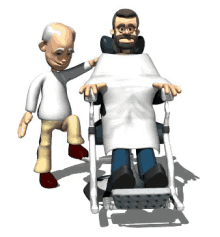
(ب) يرفع حلاق كرسيًا يجلس عليه زبون بتطبيق قوة \(100\,N\) على مكبس هيدروليكي مساحته \(0.01\,m^2\)، والكرسي متصل بمكبس مساحته \(0.1\,m^2\). إذا كانت كتلة الكرسي \(5\,kg\) فاحسب كتلة الزبون.(a) A sample of argon gas has volume \(V=0.3\,m^3\), temperature \(T=280\,K\) and pressure \(P=1.1\times10^5\,Pa\). It is heated to \(T=350\,K\) and the pressure is increased to \(P=2\times10^5\,Pa\). Calculate the new volume of the gas.
(b) A barber lifts a chair with a customer by applying a force of \(100\,N\) on a hydraulic piston of area \(0.01\,m^2\). The chair is connected to a piston of area \(0.1\,m^2\). If the chair has a mass of \(5\,kg\), calculate the mass of the customer.
.....................................................................
الحلSolution
📌 (أ) الكمية الثابتة من الغاز: \(\dfrac{P_1V_1}{T_1}=\dfrac{P_2V_2}{T_2}\).
\(V_2=\dfrac{P_1V_1T_2}{T_1P_2}=\dfrac{1.1\times10^5\times0.3\times350}{280\times2\times10^5}=0.206\,m^3\approx0.21\,m^3\).
📌 (ب) مبدأ باسكال: \(\dfrac{F_1}{A_1}=\dfrac{F_2}{A_2}\) حيث \(F_2\) وزن الكرسي والزبون معًا: \(\dfrac{100}{0.01}=\dfrac{m_2\times9.81}{0.1}\).
\(m_2=\dfrac{10^4\times0.1}{9.81}\approx102\,kg\) (كتلة الزبون والكرسي).
📌 كتلة الزبون = \(102-5\approx97\,kg\).
✅ (أ) \(V_2\approx0.21\,m^3\)، (ب) \(m\approx97\,kg\)
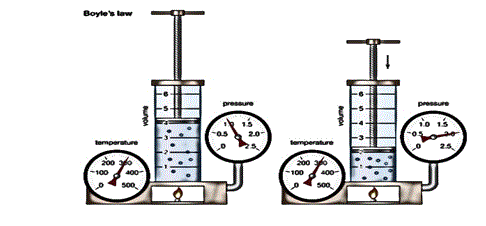
📌 (a) For a fixed amount of gas: \(\dfrac{P_1V_1}{T_1}=\dfrac{P_2V_2}{T_2}\).
\(V_2=\dfrac{P_1V_1T_2}{T_1P_2}=\dfrac{1.1\times10^5\times0.3\times350}{280\times2\times10^5}=0.206\,m^3\approx0.21\,m^3\).
📌 (b) Pascal's principle: \(\dfrac{F_1}{A_1}=\dfrac{F_2}{A_2}\) where \(F_2\) is the weight of the chair and customer together: \(\dfrac{100}{0.01}=\dfrac{m_2\times9.81}{0.1}\).
\(m_2=\dfrac{10^4\times0.1}{9.81}\approx102\,kg\) (customer and chair together).
📌 Mass of the customer = \(102-5\approx97\,kg\).
✅ (a) \(V_2\approx0.21\,m^3\), (b) \(m\approx97\,kg\)
\[2\,\star\star\]
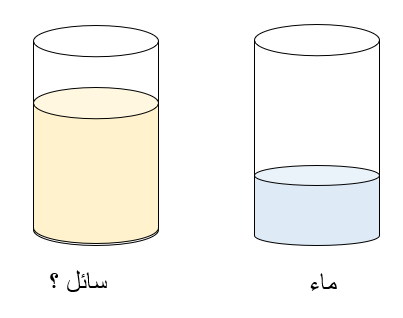
حوض يحتوي على ماء كثافته \(\rho=1000\,kg/m^3\) وارتفاع الماء فيه \(h=0.4\,m\)، وحوض ثانٍ يحتوي على سائل مجهول كثافته نصف كثافة الماء.
(أ) ما ارتفاع السائل المجهول اللازم ليكون ضغط السائلين على قعر الإناءين متساويًا؟
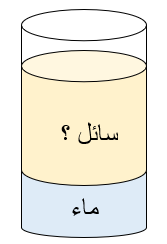
(ب) وُضع السائلان فوق بعضهما في إناء واحد (الماء في الأسفل). احسب الضغط الناتج من السائلين على قعر الإناء.A tank contains water of density \(\rho=1000\,kg/m^3\) to a height \(h=0.4\,m\). A second tank contains an unknown liquid of half the density of water.
(a) What height of the unknown liquid gives the same fluid pressure at the bottom as the water?
(b) The two liquids are placed one on top of the other in one container (water at the bottom). Calculate the pressure due to the two liquids at the bottom.
.....................................................................
الحلSolution
📌 كثافة السائل المجهول \(\rho_2=\dfrac{1000}{2}=500\,kg/m^3\).
📌 (أ) لتساوي الضغطين: \(\rho_1gh_1=\rho_2gh_2\) أي \(1000\times0.4=500\times h_2\) فيكون \(h_2=0.8\,m\).
📌 (ب) الضغط الكلي مجموع ضغطي السائلين: \(P=\rho_1gh_1+\rho_2gh_2=1000\times9.81\times0.4+500\times9.81\times0.8=3924+3924=7848\,Pa\).
✅ (أ) \(h_2=0.8\,m\)، (ب) \(P=7848\,Pa\)
📌 The density of the unknown liquid is \(\rho_2=\dfrac{1000}{2}=500\,kg/m^3\).
📌 (a) For equal pressures: \(\rho_1gh_1=\rho_2gh_2\), i.e. \(1000\times0.4=500\times h_2\) so \(h_2=0.8\,m\).
📌 (b) The total pressure is the sum of the two: \(P=\rho_1gh_1+\rho_2gh_2=1000\times9.81\times0.4+500\times9.81\times0.8=3924+3924=7848\,Pa\).
✅ (a) \(h_2=0.8\,m\), (b) \(P=7848\,Pa\)
\[3\,\star\star\]
مكعب كتلته \(m=3\,kg\) وكثافته \(\rho=1500\,kg/m^3\) غُمر كليًا في ماء كثافته \(1000\,kg/m^3\) (\(g=9.81\,m/s^2\)).
(أ) احسب دافعة أرخميدس ومحصلة القوى المؤثرة على الجسم.
(ب) قارن بين كثافة الجسم وكثافة الماء. ماذا تستنتج؟A cube of mass \(m=3\,kg\) and density \(\rho=1500\,kg/m^3\) is completely immersed in water of density \(1000\,kg/m^3\) (\(g=9.81\,m/s^2\)).
(a) Calculate the buoyant force and the net force acting on the body.
(b) Compare the density of the body with that of water. What do you conclude?
.....................................................................
الحلSolution
\(V=\dfrac{m}{\rho}=\dfrac{3}{1500}=2\times10^{-3}\,m^3\) وهو حجم السائل المزاح.
📌 (أ) \(F_B=\rho_{water}Vg=1000\times2\times10^{-3}\times9.81=19.62\,N\).
📌 المحصلة: \(F_{net}=mg-F_B=3\times9.81-19.62=9.81\,N\) نحو الأسفل.
📌 (ب) \(\rho_{body}\gt \rho_{water}\) فالوزن أكبر من دافعة أرخميدس، لذلك يغوص الجسم.
✅ \(F_B=19.62\,N\)، \(F_{net}=9.81\,N\) للأسفل، والجسم يغوص
\(V=\dfrac{m}{\rho}=\dfrac{3}{1500}=2\times10^{-3}\,m^3\), which is the displaced volume.
📌 (a) \(F_B=\rho_{water}Vg=1000\times2\times10^{-3}\times9.81=19.62\,N\).
📌 Net force: \(F_{net}=mg-F_B=3\times9.81-19.62=9.81\,N\) downward.
📌 (b) \(\rho_{body}\gt \rho_{water}\) so the weight exceeds the buoyant force and the body sinks.
✅ \(F_B=19.62\,N\), \(F_{net}=9.81\,N\) downward, the body sinks
لاحظت خطأ؟ أو عندك سؤال عن أحد الأسئلة؟ اكتبه بالتعليقات وحدد رقم السؤال بالضبط.
Noticed an error? Or have a question about one of the questions? Write it in the comments and specify the exact question number.