📈 بنك الأسئلة: تمثيل الحركة في بعد واحد
📈 Question Bank: Representing Motion in One Dimension
المسافة والإزاحة، السرعة العددية والمتجهة، التمثيل النقطي، ومنحنيات الموقع مع الزمن ومعادلة الحركة
Distance and Displacement, Speed and Velocity, the Dot Model, Position–Time Graphs and the Equation of Motion
⏱️ 38 سؤال اختيار من متعدد بتصحيح فوري بمستويات متدرجة، و3 مسائل مقالية محلولة⏱️ 38 multiple-choice questions of graded difficulty with instant feedback, plus 3 solved essay problems
\[1\,\star\]
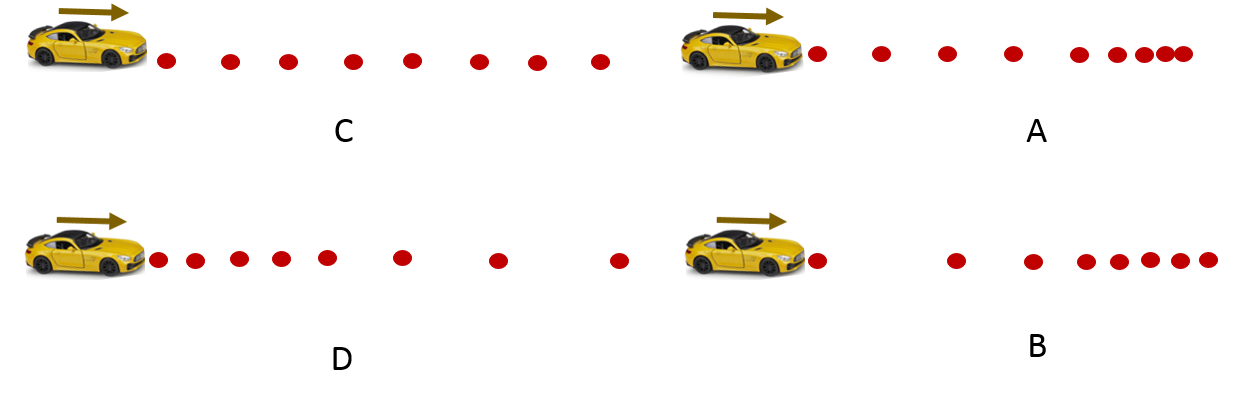
سيارة تتحرك بسرعة ثابتة ثم زادت سرعتها، أحد الرسوم التالية يمثل التمثيل الجسيمي (النقطي) لحركة السيارة:A car moves at constant speed then increases its speed. Which figure represents the particle (dot) model of the car’s motion?
AA
BB
CC
DD
الحلSolution
📌 في التمثيل النقطي تُرسم نقطة للجسم كل فترة زمنية متساوية. السرعة الثابتة ⇒ مسافات متساوية بين النقاط، وزيادة السرعة ⇒ مسافات تتزايد.
📌 الرسم D فقط تبدأ فيه النقاط بمسافات متساوية ثم تزداد المسافات بين النقاط المتتالية.
✅ D
📌 In the dot model a dot is drawn for the object at equal time intervals. Constant speed ⇒ equal spacing; increasing speed ⇒ growing spacing.
📌 Only figure D starts with equally spaced dots and then the spacing between successive dots increases.
✅ D
\[2\,\star\]
تحرك أحمد نحو الشرق مسافة \(80\,m\) ثم تابع سيره بالاتجاه نفسه مسافة \(50\,m\) ثم غيّر اتجاهه وقطع مسافة \(160\,m\) غربًا. المسافة والإزاحة المقطوعتان:Ahmed walked east \(80\,m\), then continued in the same direction \(50\,m\), then turned and walked \(160\,m\) west. The distance and displacement are:

\(S=290\,m,\ \Delta X=30\,m\) غربًا\(S=290\,m,\ \Delta X=30\,m\) west
\(S=30\,m,\ \Delta X=290\,m\) شرقًا\(S=30\,m,\ \Delta X=290\,m\) east
\(S=290\,m,\ \Delta X=30\,m\) شرقًا\(S=290\,m,\ \Delta X=30\,m\) east
\(S=30\,m,\ \Delta X=290\,m\) غربًا\(S=30\,m,\ \Delta X=290\,m\) west
الحلSolution
📌 المسافة مجموع أطوال المسارات: \(S=80+50+160=290\,m\).
📌 الإزاحة (شرقًا موجب): \(\Delta X=80+50-160=-30\,m\) أي \(30\,m\) غربًا.
✅ \(S=290\,m,\ \Delta X=30\,m\) غربًا (A)
📌 The distance is the sum of the path lengths: \(S=80+50+160=290\,m\).
📌 The displacement (east positive): \(\Delta X=80+50-160=-30\,m\), i.e. \(30\,m\) west.
✅ \(S=290\,m,\ \Delta X=30\,m\) west (A)
\[3\,\star\]
تحرك أحمد من الموقع \(-4\,m\) إلى الموقع \(+8\,m\) ثم غيّر اتجاهه وتحرك إلى الموقع \(-2\,m\). المسافة والإزاحة المقطوعتان:Ahmed moved from position \(-4\,m\) to \(+8\,m\), then turned and moved to position \(-2\,m\). The distance and displacement are:

\(S=12\,m,\ \Delta X=+6\,m\)\(S=12\,m,\ \Delta X=+6\,m\)
\(S=22\,m,\ \Delta X=+2\,m\)\(S=22\,m,\ \Delta X=+2\,m\)
\(S=18\,m,\ \Delta X=+2\,m\)\(S=18\,m,\ \Delta X=+2\,m\)
\(S=22\,m,\ \Delta X=-2\,m\)\(S=22\,m,\ \Delta X=-2\,m\)
الحلSolution
📌 المسافة: \(S=|8-(-4)|+|-2-8|=12+10=22\,m\).
📌 الإزاحة: \(\Delta X=X_f-X_i=-2-(-4)=+2\,m\).
✅ \(S=22\,m,\ \Delta X=+2\,m\) (B)
📌 Distance: \(S=|8-(-4)|+|-2-8|=12+10=22\,m\).
📌 Displacement: \(\Delta X=X_f-X_i=-2-(-4)=+2\,m\).
✅ \(S=22\,m,\ \Delta X=+2\,m\) (B)
\[4\,\star\]
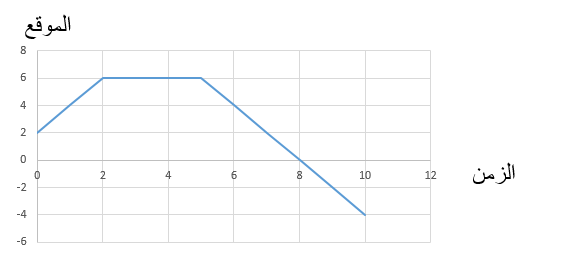
رُسمت العلاقة بين الموقع والزمن لدراجة كما في الشكل. المسافة المقطوعة خلال كامل الفترة تعادل:The position–time graph of a bicycle is shown. The distance traveled during the whole period is:
\(S=18\,m\)\(S=18\,m\)
\(S=12\,m\)\(S=12\,m\)
\(S=16\,m\)\(S=16\,m\)
\(S=14\,m\)\(S=14\,m\)
الحلSolution
📌 من الرسم: الموقع من \(2\) إلى \(6\,m\) (يزداد \(4\,m\))، ثم ثابت، ثم يتناقص من \(6\) إلى \(-4\,m\) (بمقدار \(10\,m\)).
📌 \(S=4+0+10=14\,m\).
✅ \(S=14\,m\) (D)
📌 From the graph: the position goes from \(2\) to \(6\,m\) (up \(4\,m\)), then stays constant, then falls from \(6\) to \(-4\,m\) (by \(10\,m\)).
📌 \(S=4+0+10=14\,m\).
✅ \(S=14\,m\) (D)
\[5\,\star\]
من الرسم البياني نفسه (الموقع–الزمن لدراجة)، الإزاحة خلال كامل الفترة تعادل:From the same graph (position–time of a bicycle), the displacement during the whole period is:
\(\Delta X=-10\,m\)\(\Delta X=-10\,m\)
\(\Delta X=-6\,m\)\(\Delta X=-6\,m\)
\(\Delta X=-8\,m\)\(\Delta X=-8\,m\)
\(\Delta X=-12\,m\)\(\Delta X=-12\,m\)
الحلSolution
📌 الموقع الابتدائي \(2\,m\) والنهائي \(-4\,m\): \(\Delta X=X_f-X_i=-4-2=-6\,m\).
✅ \(\Delta X=-6\,m\) (B)
📌 The initial position is \(2\,m\) and the final one \(-4\,m\): \(\Delta X=X_f-X_i=-4-2=-6\,m\).
✅ \(\Delta X=-6\,m\) (B)
\[6\,\star\star\]
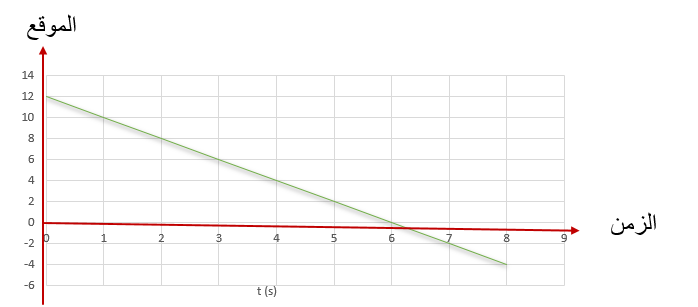
يبين الخط البياني العلاقة بين الموقع والزمن لعدّاء. السرعة المتجهة المتوسطة تعادل:The graph shows the position–time relationship of a runner. The average velocity is:
\(v=4\,m/s\)\(v=4\,m/s\)
\(v=2\,m/s\)\(v=2\,m/s\)
\(v=-2\,m/s\)\(v=-2\,m/s\)
\(v=-4\,m/s\)\(v=-4\,m/s\)
الحلSolution
📌 من الرسم: الموقع \(12\,m\) عند \(t=0\) و\(-4\,m\) عند \(t=8\,s\).
📌 \(v_{avg}=\dfrac{\Delta X}{\Delta t}=\dfrac{-4-12}{8}=-2\,m/s\) (الإشارة السالبة: الحركة بالاتجاه السالب).
✅ \(v=-2\,m/s\) (C)
📌 From the graph: the position is \(12\,m\) at \(t=0\) and \(-4\,m\) at \(t=8\,s\).
📌 \(v_{avg}=\dfrac{\Delta X}{\Delta t}=\dfrac{-4-12}{8}=-2\,m/s\) (the negative sign: motion in the negative direction).
✅ \(v=-2\,m/s\) (C)
\[7\,\star\]
من الخط البياني نفسه (الموقع–الزمن لعدّاء)، مقدار السرعة (السرعة العددية) يعادل:From the same graph (position–time of a runner), the speed (magnitude of the velocity) is:
\(v=8\,m/s\)\(v=8\,m/s\)
\(v=6\,m/s\)\(v=6\,m/s\)
\(v=2\,m/s\)\(v=2\,m/s\)
\(v=4\,m/s\)\(v=4\,m/s\)
الحلSolution
📌 السرعة العددية هي مقدار ميل الخط: \(\left|\dfrac{-4-12}{8-0}\right|=2\,m/s\).
✅ \(v=2\,m/s\) (C)
📌 The speed is the magnitude of the slope: \(\left|\dfrac{-4-12}{8-0}\right|=2\,m/s\).
✅ \(v=2\,m/s\) (C)
\[8\,\star\]
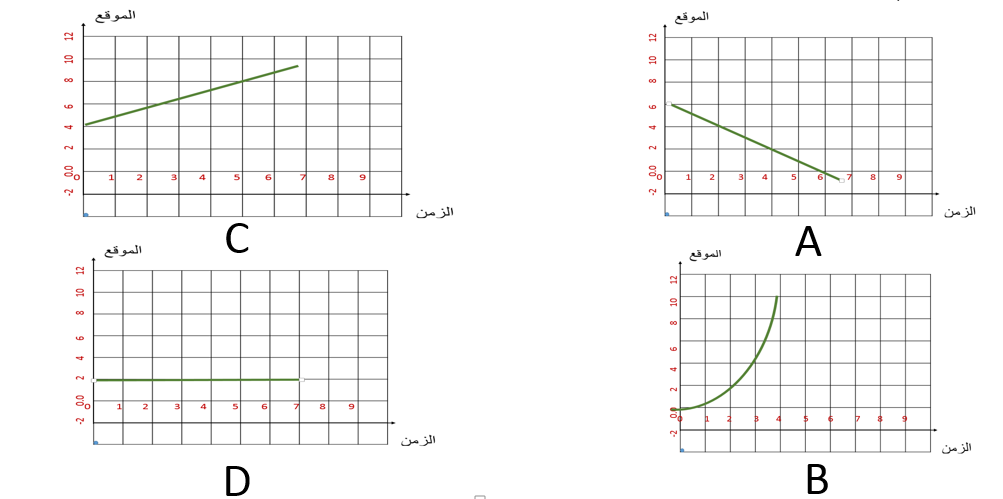
الخطوط البيانية تبيّن العلاقة بين الموقع والزمن. أي خط يمثل حركة جسم بسرعة ثابتة بالاتجاه السالب؟The position–time graphs are shown. Which line represents motion at constant velocity in the negative direction?
الخط ALine A
الخط BLine B
الخط CLine C
الخط DLine D
الحلSolution
📌 السرعة الثابتة ⇒ خط مستقيم، والاتجاه السالب ⇒ الميل سالب (الموقع يتناقص مع الزمن).
📌 الخط A هو المستقيم المائل إلى الأسفل. (C مستقيم صاعد، D أفقي أي ساكن، B منحنٍ أي سرعة متغيرة).
✅ الخط A (A)
📌 Constant velocity ⇒ a straight line, and the negative direction ⇒ a negative slope (the position falls with time).
📌 Line A is the straight line sloping downward. (C rises, D is horizontal i.e. at rest, B is curved i.e. changing velocity).
✅ Line A (A)
\[9\,\star\star\]
رُسمت العلاقة بين الموقع والزمن لثلاث دراجات A وB وC. أي العبارات التالية صحيحة؟The position–time graphs of three bicycles A, B and C are shown. Which statement is correct?
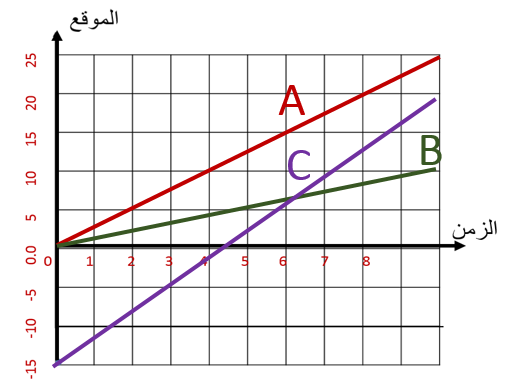
الدراجة A هي الأسرعBicycle A is the fastest
الدراجة C هي الأسرعBicycle C is the fastest
الدراجة B هي الأسرعBicycle B is the fastest
الدراجات الثلاث لها السرعة نفسهاAll three have the same speed
الحلSolution
📌 السرعة العددية هي مقدار ميل الخط. الخط C هو الأشد انحدارًا (يتغير موقعه من \(-15\) إلى \(20\,m\) تقريبًا خلال نحو \(9\,s\))، أي ميله نحو \(3.8\,m/s\).
📌 أما A فميله نحو \(2.6\,m/s\) وB نحو \(1.1\,m/s\)، فالدراجة C هي الأسرع.
✅ الدراجة C هي الأسرع (B)
📌 The speed is the magnitude of the slope. Line C is the steepest (its position goes from \(-15\) to about \(20\,m\) in about \(9\,s\)), a slope of about \(3.8\,m/s\).
📌 A has a slope of about \(2.6\,m/s\) and B about \(1.1\,m/s\), so bicycle C is the fastest.
✅ Bicycle C is the fastest (B)
\[10\,\star\]
تحرك ماجد من عجمان إلى أم القيوين ثم غيّر اتجاهه وتوجه إلى الشارقة مارًّا بعجمان (كما في الشكل). المسافة والإزاحة المقطوعتان:Majed moved from Ajman to Umm Al Quwain, then turned and went to Sharjah passing through Ajman (as in the figure). The distance and displacement are:

\(S=42\,km,\ \Delta X=12\,km\) نحو اليمين\(S=42\,km,\ \Delta X=12\,km\) to the right
\(S=27\,km,\ \Delta X=15\,km\) نحو اليمين\(S=27\,km,\ \Delta X=15\,km\) to the right
\(S=42\,km,\ \Delta X=12\,km\) نحو اليسار\(S=42\,km,\ \Delta X=12\,km\) to the left
\(S=27\,km,\ \Delta X=15\,km\) نحو اليسار\(S=27\,km,\ \Delta X=15\,km\) to the left
الحلSolution
📌 المسافة: \(15+(15+12)=42\,km\).
📌 الإزاحة من عجمان (البداية) إلى الشارقة (النهاية) \(12\,km\) باتجاه اليمين (الاتجاه الذي توجد فيه الشارقة في الشكل).
✅ \(S=42\,km,\ \Delta X=12\,km\) نحو اليمين (A)
📌 Distance: \(15+(15+12)=42\,km\).
📌 The displacement from Ajman (start) to Sharjah (end) is \(12\,km\) to the right (the side of Sharjah in the figure).
✅ \(S=42\,km,\ \Delta X=12\,km\) to the right (A)
\[11\,\star\star\]
يبين الخط البياني العلاقة بين الموقع والزمن لدراجة. المسافة والإزاحة المقطوعتان:The position–time graph of a bicycle is shown. The distance and displacement are:
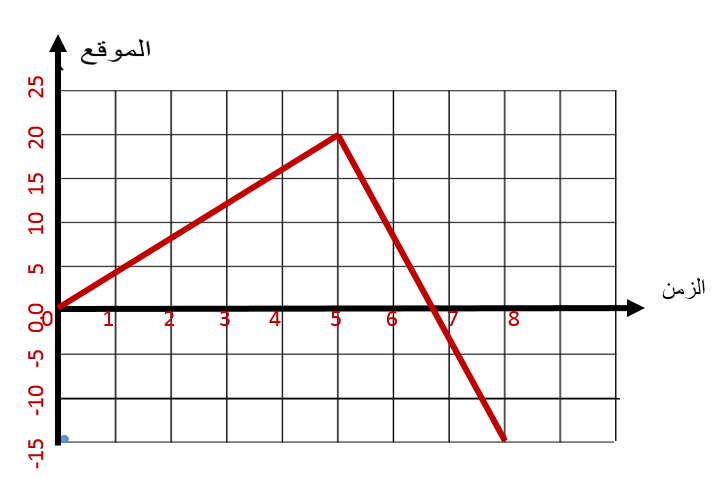
\(S=30\,m,\ \Delta X=-30\,m\)\(S=30\,m,\ \Delta X=-30\,m\)
\(S=55\,m,\ \Delta X=-15\,m\)\(S=55\,m,\ \Delta X=-15\,m\)
\(S=30\,m,\ \Delta X=-15\,m\)\(S=30\,m,\ \Delta X=-15\,m\)
\(S=55\,m,\ \Delta X=-25\,m\)\(S=55\,m,\ \Delta X=-25\,m\)
الحلSolution
📌 من الرسم: الموقع من \(0\) إلى \(20\,m\) عند \(t=5\,s\)، ثم إلى \(-15\,m\) عند \(t=8\,s\).
📌 \(S=20+(20+15)=55\,m\)، و\(\Delta X=-15-0=-15\,m\).
✅ \(S=55\,m,\ \Delta X=-15\,m\) (B)
📌 From the graph: the position goes from \(0\) to \(20\,m\) at \(t=5\,s\), then to \(-15\,m\) at \(t=8\,s\).
📌 \(S=20+(20+15)=55\,m\) and \(\Delta X=-15-0=-15\,m\).
✅ \(S=55\,m,\ \Delta X=-15\,m\) (B)
\[12\,\star\star\]
يبين الخط البياني العلاقة بين الموقع والزمن لدراجتين. عند أي لحظة تكون سرعتاهما متساويتين (ميلا الخطين متساويان)؟The position–time graph of two bicycles is shown. At which instant are their speeds equal (the two slopes are equal)?
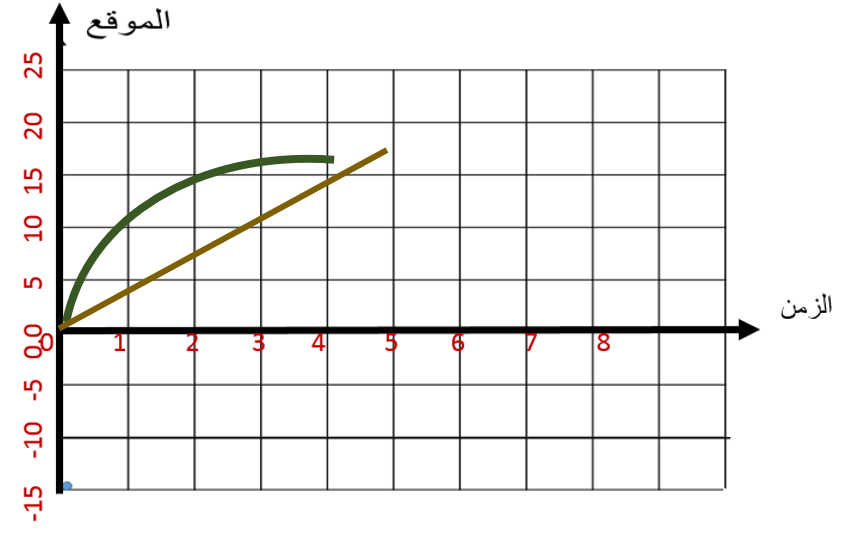
\(t=1\,s\)\(t=1\,s\)
\(t=4\,s\)\(t=4\,s\)
\(t=3\,s\)\(t=3\,s\)
\(t=2\,s\)\(t=2\,s\)
الحلSolution
📌 الدراجة الأولى (الخط المستقيم) سرعتها ثابتة ميلها نحو \(3.5\,m/s\). أما الثانية (المنحنى) فميلها يتناقص مع الزمن من قيمة كبيرة إلى الصفر تقريبًا عند \(t=4\,s\).
📌 يتساوى ميل المماس للمنحنى مع ميل المستقيم قرب \(t=2\,s\) (عند \(1\,s\) ميله أكبر بكثير وعند \(3\,s\) أصغر بكثير).
✅ \(t=2\,s\) (D)
📌 The first bicycle (the straight line) has a constant velocity with a slope of about \(3.5\,m/s\). The second (the curve) has a slope that falls with time from a large value to about zero at \(t=4\,s\).
📌 The slope of the tangent to the curve equals the slope of the line near \(t=2\,s\) (at \(1\,s\) it is much larger, at \(3\,s\) much smaller).
✅ \(t=2\,s\) (D)
\[13\,\star\]
الخط البياني التالي يبين العلاقة بين الموقع والزمن لجسم يتحرك على خط مستقيم. ميل هذا الخط البياني يمثل:The graph shows the position–time relationship of an object moving along a straight line. The slope of this graph represents:
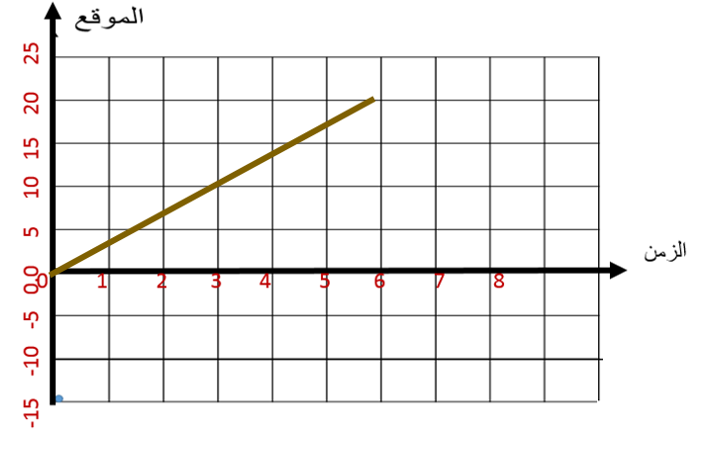
السرعة المتجهة المتوسطةThe average velocity
الإزاحة المقطوعةThe displacement
التسارعThe acceleration
المسافة المقطوعةThe distance traveled
الحلSolution
📌 ميل منحنى (الموقع–الزمن) \(=\dfrac{\Delta X}{\Delta t}\) وهو السرعة المتجهة المتوسطة (وإذا كان الخط مستقيمًا فهي السرعة المتجهة الثابتة).
✅ السرعة المتجهة المتوسطة (A)
📌 The slope of a position–time graph is \(\dfrac{\Delta X}{\Delta t}\), the average velocity (and for a straight line it is the constant velocity).
✅ The average velocity (A)
\[14\,\star\star\star\]
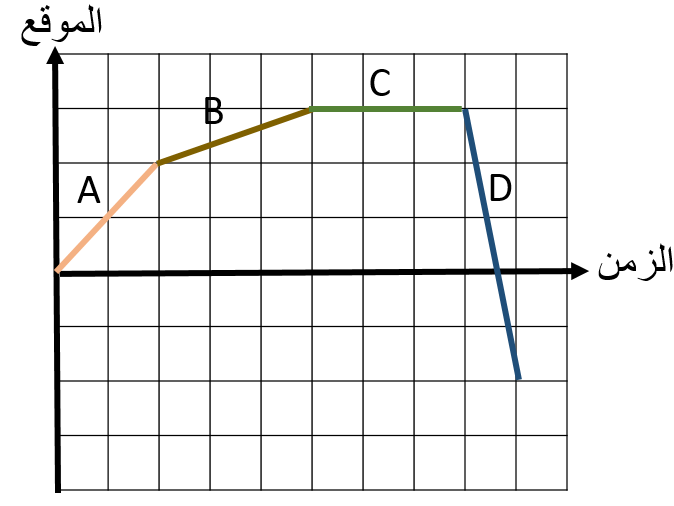
يبين الخط البياني العلاقة بين الموقع والزمن لدراجة في مراحل مختلفة بسرعات مختلفة. في أي مرحلة تتحرك الدراجة بأكبر سرعة (عددية)؟The position–time graph of a bicycle in different stages at different speeds is shown. In which stage does the bicycle move with the greatest speed?
AA
BB
CC
DD
الحلSolution
📌 السرعة العددية هي مقدار ميل الخط في كل مرحلة. الخط D هو الأشد انحدارًا (باتجاه سالب)، فسرعته العددية هي الأكبر.
📌 (C أفقي أي ساكنة، وميلا A وB موجبان لكن أصغر.)
✅ D
📌 The speed is the magnitude of the slope in each stage. Line D is the steepest (in the negative direction), so its speed is the greatest.
📌 (C is horizontal, i.e. at rest, and A and B have positive but smaller slopes.)
✅ D
\[15\,\star\star\]
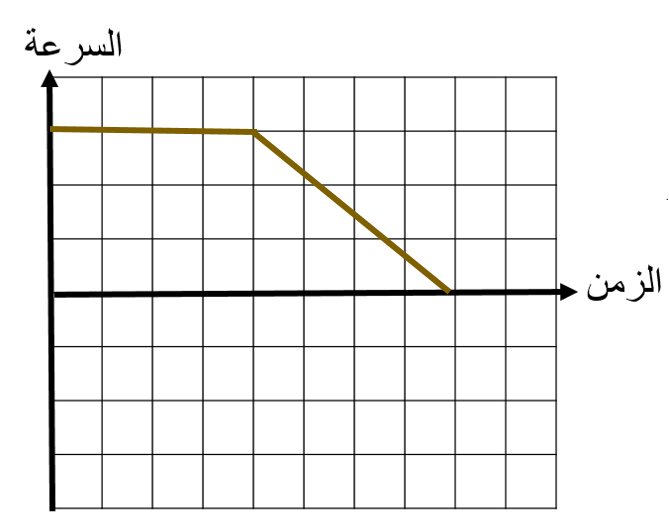
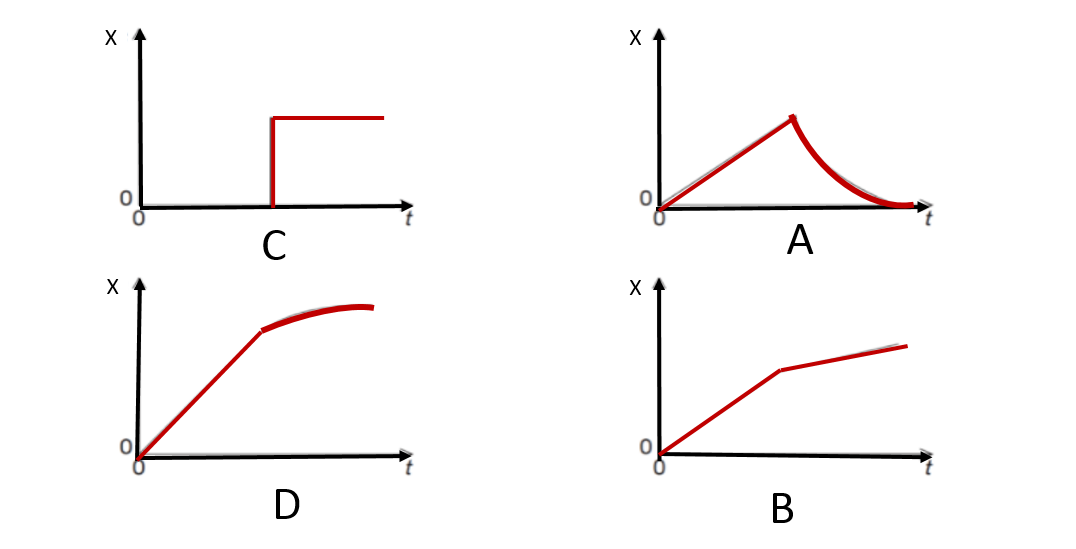
سيارة تتحرك على خط مستقيم، والرسم يبين العلاقة بين السرعة والزمن: سرعة ثابتة ثم تناقص منتظم حتى الصفر. أي الخطوط التالية يمثل العلاقة بين الموقع والزمن؟A car moves in a straight line; the velocity–time graph shows a constant velocity followed by a uniform decrease to zero. Which position–time graph matches this motion?
AA
BB
CC
DD
الحلSolution
📌 في المرحلة الأولى السرعة ثابتة موجبة ⇒ الموقع يزداد على خط مستقيم (ميل ثابت).
📌 في المرحلة الثانية تتناقص السرعة حتى الصفر ⇒ يتناقص ميل منحنى الموقع تدريجيًا حتى يصبح أفقيًا (موقع يزداد بمعدل متناقص ثم يتوقف).
📌 هذا ما يمثله الشكل D.
✅ D
📌 In the first stage the velocity is constant and positive ⇒ the position increases along a straight line (constant slope).
📌 In the second stage the velocity falls to zero ⇒ the slope of the position curve decreases gradually until it is horizontal (the position increases at a decreasing rate, then stops).
📌 This is what figure D shows.
✅ D
\[16\,\star\star\star\]
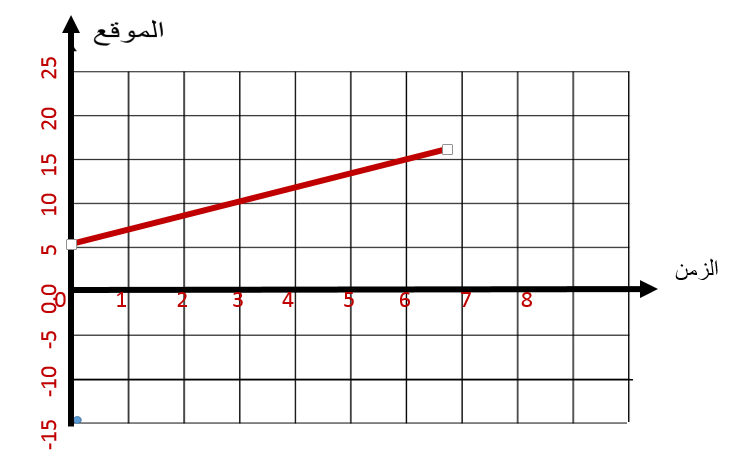
يبين الخط البياني العلاقة بين الموقع والزمن لطالب. أي المعادلات التالية تعبّر عن حركة الطالب (بالوحدات الدولية)؟The position–time graph of a student is shown. Which equation describes the student’s motion (SI units)?
\(x=1.67t+5\)\(x=1.67t+5\)
\(x=5t+1.67\)\(x=5t+1.67\)
\(x=2t+5\)\(x=2t+5\)
\(x=5t+2\)\(x=5t+2\)
الحلSolution
📌 الخط مستقيم: \(x=x_0+vt\). نقطة التقاطع مع محور الموقع \(x_0=5\,m\).
📌 الميل: من النقطة \((0,5)\) إلى النقطة \((6,15)\): \(v=\dfrac{15-5}{6}=1.67\,m/s\).
✅ \(x=1.67t+5\) (A)
📌 The line is straight: \(x=x_0+vt\). The intercept on the position axis is \(x_0=5\,m\).
📌 The slope: from \((0,5)\) to \((6,15)\): \(v=\dfrac{15-5}{6}=1.67\,m/s\).
✅ \(x=1.67t+5\) (A)
\[17\,\star\star\]
قطار يتحرك نحو الغرب بسرعة متجهة متوسطة \(v=-25\,m/s\). الإزاحة التي يقطعها خلال \(\Delta t=10\,min\):A train moves west with an average velocity \(v=-25\,m/s\). The displacement during \(\Delta t=10\,min\) is:
\(\Delta X=7.5\times10^{4}\,m\) شرقًا\(\Delta X=7.5\times10^{4}\,m\) east
\(\Delta X=1.5\times10^{4}\,m\) غربًا\(\Delta X=1.5\times10^{4}\,m\) west
\(\Delta X=2\times10^{4}\,m\) غربًا\(\Delta X=2\times10^{4}\,m\) west
\(\Delta X=3.5\times10^{4}\,m\) شرقًا\(\Delta X=3.5\times10^{4}\,m\) east
الحلSolution
📌 نحوّل الزمن إلى ثوانٍ: \(\Delta t=10\times60=600\,s\).
📌 \(\Delta X=v\,\Delta t=-25\times600=-15000\,m=-1.5\times10^{4}\,m\) أي غربًا.
✅ \(\Delta X=1.5\times10^{4}\,m\) غربًا (B)
📌 Convert the time to seconds: \(\Delta t=10\times60=600\,s\).
📌 \(\Delta X=v\,\Delta t=-25\times600=-15000\,m=-1.5\times10^{4}\,m\), i.e. westward.
✅ \(\Delta X=1.5\times10^{4}\,m\) west (B)
\[18\,\star\star\]
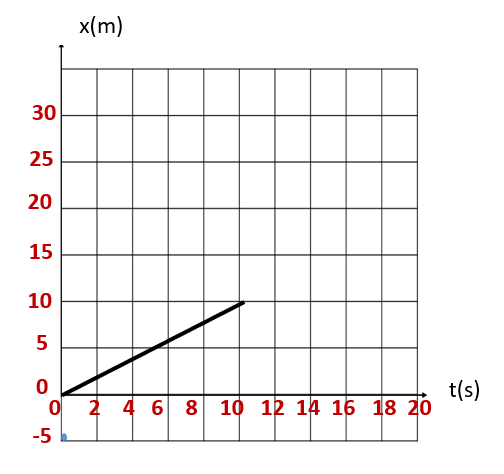
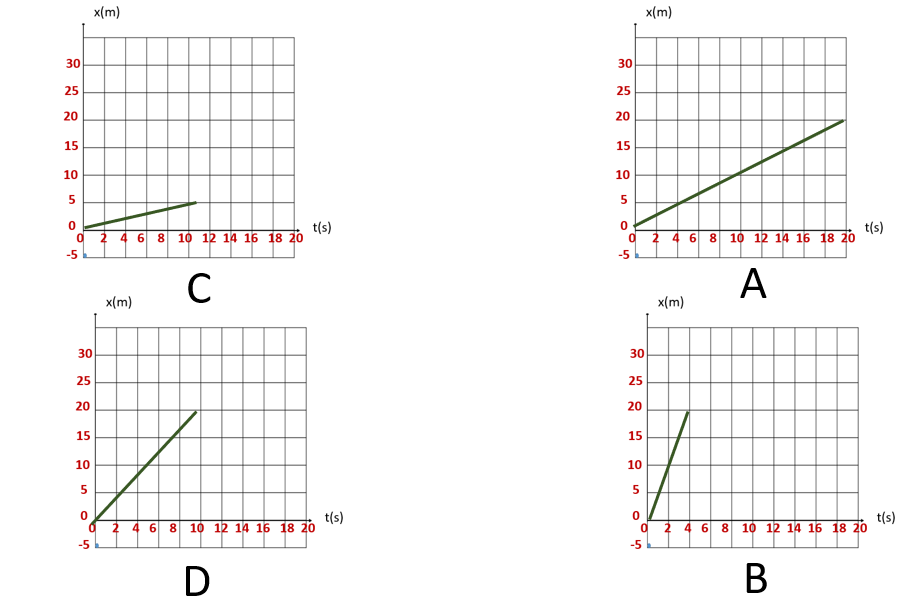
رُسم العلاقة بين الموقع والزمن لقرد يتحرك بسرعة ثابتة (الشكل الأول). إذا ضاعف القرد سرعته فأي خط بياني يحقق ذلك؟The position–time graph of a monkey moving at constant velocity is shown (first figure). If the monkey doubles its speed, which graph represents this?
AA
BB
CC
DD
الحلSolution
📌 الخط الأصلي يصل إلى \(10\,m\) عند \(10\,s\): ميله \(1\,m/s\).
📌 مضاعفة السرعة تعني ميلًا \(2\,m/s\): أي \(20\,m\) عند \(10\,s\)، وهو الخط D (الخط A ميله 1 أيضًا، وC ميله 0.5، وB ميله نحو 5).
✅ D
📌 The original line reaches \(10\,m\) at \(10\,s\): its slope is \(1\,m/s\).
📌 Doubling the speed means a slope of \(2\,m/s\): \(20\,m\) at \(10\,s\), which is line D (A also has slope 1, C has 0.5, and B about 5).
✅ D
\[19\,\star\star\]
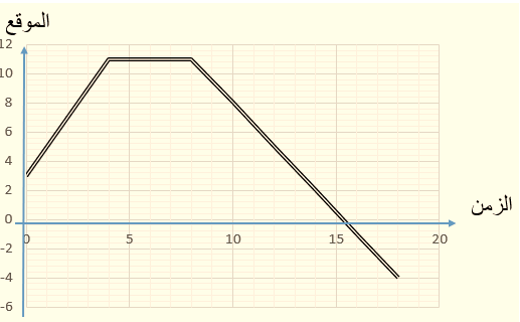
رُسمت العلاقة بين الموقع والزمن لدراجة. مقدار السرعة المتجهة المتوسطة خلال كامل الفترة يعادل:The position–time graph of a bicycle is shown. The magnitude of the average velocity during the whole period is:
\(0.39\,m/s\)\(0.39\,m/s\)
\(0.67\,m/s\)\(0.67\,m/s\)
\(0.85\,m/s\)\(0.85\,m/s\)
\(0.12\,m/s\)\(0.12\,m/s\)
الحلSolution
📌 من الرسم: الموقع الابتدائي \(3\,m\) (عند \(t=0\)) والنهائي \(-4\,m\) (عند \(t=18\,s\)).
📌 \(v_{avg}=\dfrac{\Delta X}{\Delta t}=\dfrac{-4-3}{18}=-0.39\,m/s\)، ومقداره \(0.39\,m/s\). (لاحظ الفرق عن السرعة العددية المتوسطة \(\dfrac{S}{t}=\dfrac{8+15}{18}=1.28\,m/s\)).
✅ \(0.39\,m/s\) (A)
📌 From the graph: the initial position is \(3\,m\) (at \(t=0\)) and the final one \(-4\,m\) (at \(t=18\,s\)).
📌 \(v_{avg}=\dfrac{\Delta X}{\Delta t}=\dfrac{-4-3}{18}=-0.39\,m/s\), and its magnitude is \(0.39\,m/s\). (Note the difference from the average speed \(\dfrac{S}{t}=\dfrac{8+15}{18}=1.28\,m/s\)).
✅ \(0.39\,m/s\) (A)
\[20\,\star\star\]
في سباق الدراجات كان راشد على بعد \(120\,m\) شرق نقطة البداية وتابع حركته بالاتجاه نفسه بسرعة ثابتة \(v=15\,m/s\). بعد \(12\,s\) يكون موقعه بالنسبة لنقطة البداية:In a bicycle race Rashid is \(120\,m\) east of the start and continues in the same direction at constant speed \(v=15\,m/s\). After \(12\,s\) his position relative to the start is:
\(X_f=340\,m\)\(X_f=340\,m\)
\(X_f=180\,m\)\(X_f=180\,m\)
\(X_f=300\,m\)\(X_f=300\,m\)
\(X_f=260\,m\)\(X_f=260\,m\)
الحلSolution
📌 \(X_f=X_i+vt=120+15\times12=120+180=300\,m\).
✅ \(X_f=300\,m\) (C)
📌 \(X_f=X_i+vt=120+15\times12=120+180=300\,m\).
✅ \(X_f=300\,m\) (C)
\[21\,\star\star\]
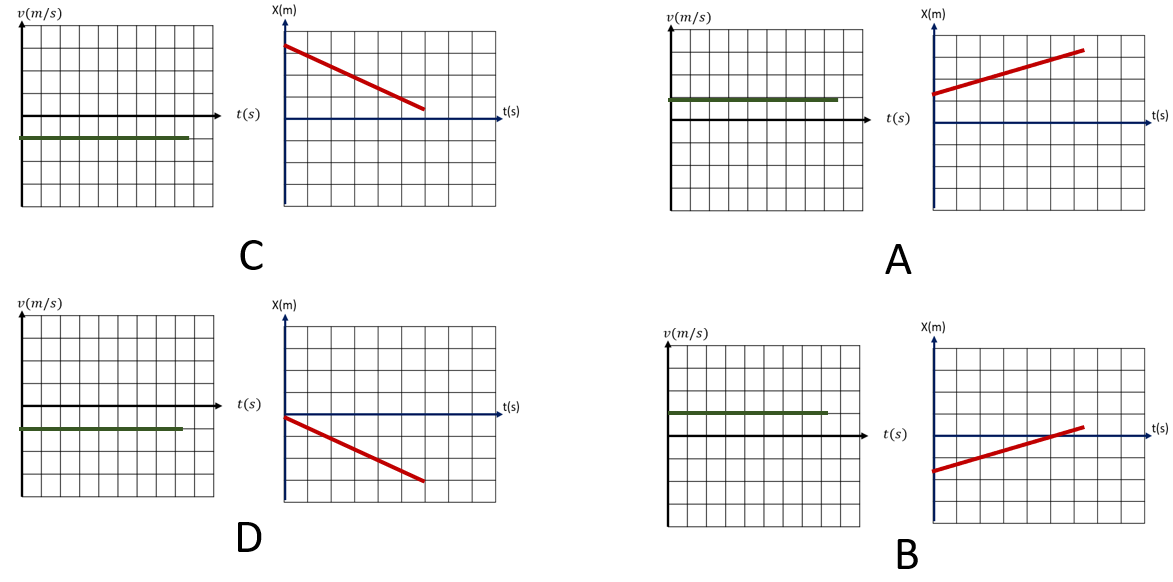
أربعة طلاب يتحركون بسرعة ثابتة بالاتجاه الموضح، ورُسمت العلاقة (السرعة–الزمن) و(الموقع–الزمن) لأربع حركات A وB وC وD. أي الرسمين يمثل حركة الطالب رقم 4؟Four students move at constant velocity in the direction shown; velocity–time and position–time graphs are drawn for four motions A, B, C and D. Which pair represents student number 4?

AA
BB
CC
DD
الحلSolution
📌 الطالب 4 يقع يسار نقطة الأصل أي موقعه الابتدائي سالب، ويتحرك نحو اليمين أي بسرعة موجبة ثابتة.
📌 المطلوب إذن: سرعة موجبة ثابتة (خط أفقي فوق المحور) وموقع يبدأ من قيمة سالبة ويتزايد: هذا هو الزوج B.
✅ B
📌 Student 4 is to the left of the origin, i.e. his initial position is negative, and he moves to the right, i.e. with a constant positive velocity.
📌 So we need a constant positive velocity (a horizontal line above the axis) and a position starting from a negative value and increasing: this is pair B.
✅ B
\[22\,\star\]
بدأ راشد حركته من الموقع \(-3\,m\) بسرعة ثابتة \(2\,m/s\) باتجاه المحور الموجب. يكون موقعه بعد \(t=4\,s\):Rashid starts from position \(-3\,m\) with constant velocity \(2\,m/s\) in the positive direction. His position after \(t=4\,s\) is:

\(X=8\,m\)\(X=8\,m\)
\(X=5\,m\)\(X=5\,m\)
\(X=6\,m\)\(X=6\,m\)
\(X=4\,m\)\(X=4\,m\)
الحلSolution
📌 \(X=X_0+vt=-3+2\times4=5\,m\).
✅ \(X=5\,m\) (B)
📌 \(X=X_0+vt=-3+2\times4=5\,m\).
✅ \(X=5\,m\) (B)
\[23\,\star\star\]
تحرك أحمد على المحور الأفقي بالترتيب \(A\Rightarrow D\Rightarrow B\Rightarrow C\) ونقطة الأصل عند D كما في الشكل. الموقع الابتدائي والنهائي والمسافة:Ahmed moved along the horizontal axis in the order \(A\Rightarrow D\Rightarrow B\Rightarrow C\) with the origin at D, as in the figure. The initial position, final position and distance are:
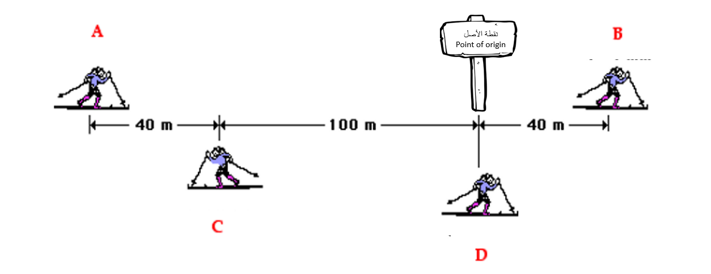
\(X_i=-140\,m,\ X_f=-100\,m,\ S=320\,m\)\(X_i=-140\,m,\ X_f=-100\,m,\ S=320\,m\)
\(X_i=-140\,m,\ X_f=-100\,m,\ S=40\,m\)\(X_i=-140\,m,\ X_f=-100\,m,\ S=40\,m\)
\(X_i=0,\ X_f=40\,m,\ S=320\,m\)\(X_i=0,\ X_f=40\,m,\ S=320\,m\)
\(X_i=-140\,m,\ X_f=-40\,m,\ S=320\,m\)\(X_i=-140\,m,\ X_f=-40\,m,\ S=320\,m\)
الحلSolution
📌 من الشكل: A تبعد \(140\,m\) يسار نقطة الأصل D، وC تبعد \(100\,m\) يسارها، وB على بعد \(40\,m\) يمينها. إذن \(X_i=-140\,m\) و\(X_f=-100\,m\).
📌 المسافة: \(A\to D=140\)، \(D\to B=40\)، \(B\to C=40+100=140\)؛ المجموع \(S=320\,m\).
✅ \(X_i=-140\,m,\ X_f=-100\,m,\ S=320\,m\) (A)
📌 From the figure: A is \(140\,m\) to the left of the origin D, C is \(100\,m\) to its left, and B is \(40\,m\) to its right. So \(X_i=-140\,m\) and \(X_f=-100\,m\).
📌 The distance: \(A\to D=140\), \(D\to B=40\), \(B\to C=40+100=140\); total \(S=320\,m\).
✅ \(X_i=-140\,m,\ X_f=-100\,m,\ S=320\,m\) (A)
\[24\,\star\]
انتقل دراج من الموقع \(-6\,m\) إلى الموقع \(+10\,m\) في اتجاه واحد دون أن يغيّر اتجاهه. إزاحته والمسافة التي قطعها:A cyclist moves from position \(-6\,m\) to position \(+10\,m\) in one direction without turning back. His displacement and the distance he traveled are:
\(\Delta X=4\,m,\ S=16\,m\)\(\Delta X=4\,m,\ S=16\,m\)
\(\Delta X=16\,m,\ S=4\,m\)\(\Delta X=16\,m,\ S=4\,m\)
\(\Delta X=16\,m,\ S=16\,m\)\(\Delta X=16\,m,\ S=16\,m\)
\(\Delta X=-16\,m,\ S=16\,m\)\(\Delta X=-16\,m,\ S=16\,m\)
الحلSolution
📌 \(\Delta X=X_f-X_i=10-(-6)=16\,m\).
📌 لم يغيّر اتجاهه فالمسافة تساوي مقدار الإزاحة: \(S=16\,m\).
✅ \(\Delta X=16\,m,\ S=16\,m\) (C)
📌 \(\Delta X=X_f-X_i=10-(-6)=16\,m\).
📌 He did not turn back, so the distance equals the magnitude of the displacement: \(S=16\,m\).
✅ \(\Delta X=16\,m,\ S=16\,m\) (C)
\[25\,\star\]
مشى رجل \(30\,m\) شرقًا ثم \(50\,m\) غربًا (الشرق هو الاتجاه الموجب). المسافة والإزاحة:A man walks \(30\,m\) east then \(50\,m\) west (east is the positive direction). The distance and displacement are:
\(S=20\,m,\ \Delta X=80\,m\)\(S=20\,m,\ \Delta X=80\,m\)
\(S=80\,m,\ \Delta X=20\,m\)\(S=80\,m,\ \Delta X=20\,m\)
\(S=80\,m,\ \Delta X=-20\,m\)\(S=80\,m,\ \Delta X=-20\,m\)
\(S=20\,m,\ \Delta X=-80\,m\)\(S=20\,m,\ \Delta X=-80\,m\)
الحلSolution
📌 \(S=30+50=80\,m\).
📌 \(\Delta X=30-50=-20\,m\) أي \(20\,m\) غربًا.
✅ \(S=80\,m,\ \Delta X=-20\,m\) (C)
📌 \(S=30+50=80\,m\).
📌 \(\Delta X=30-50=-20\,m\), i.e. \(20\,m\) westward.
✅ \(S=80\,m,\ \Delta X=-20\,m\) (C)
\[26\,\star\star\]
يبين الشكل العلاقة بين الموقع والزمن لجسم. السرعة المتجهة للجسم:The figure shows the position–time graph of an object. The velocity of the object is:
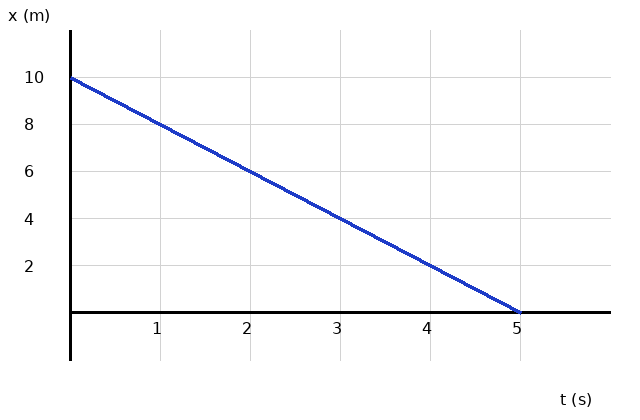
\(v=+2\,m/s\)\(v=+2\,m/s\)
\(v=-5\,m/s\)\(v=-5\,m/s\)
\(v=+5\,m/s\)\(v=+5\,m/s\)
\(v=-2\,m/s\)\(v=-2\,m/s\)
الحلSolution
📌 من الرسم: الموقع \(10\,m\) عند \(t=0\) و\(0\) عند \(t=5\,s\).
📌 \(v=\dfrac{0-10}{5-0}=-2\,m/s\) (يتحرك نحو نقطة الأصل بالاتجاه السالب).
✅ \(v=-2\,m/s\) (D)
📌 From the graph: the position is \(10\,m\) at \(t=0\) and \(0\) at \(t=5\,s\).
📌 \(v=\dfrac{0-10}{5-0}=-2\,m/s\) (moving toward the origin in the negative direction).
✅ \(v=-2\,m/s\) (D)
\[27\,\star\star\]
تُعطى حركة جسم بالمعادلة \(x=4-3t\) (بالوحدات الدولية). الموقع الابتدائي والسرعة المتجهة:The motion of an object is given by \(x=4-3t\) (SI units). The initial position and the velocity are:
\(x_0=-3\,m,\ v=4\,m/s\)\(x_0=-3\,m,\ v=4\,m/s\)
\(x_0=4\,m,\ v=3\,m/s\)\(x_0=4\,m,\ v=3\,m/s\)
\(x_0=4\,m,\ v=-3\,m/s\)\(x_0=4\,m,\ v=-3\,m/s\)
\(x_0=-4\,m,\ v=-3\,m/s\)\(x_0=-4\,m,\ v=-3\,m/s\)
الحلSolution
📌 بمقارنة المعادلة بـ \(x=x_0+vt\): الحد الثابت هو الموقع الابتدائي \(x_0=4\,m\)، ومعامل \(t\) هو السرعة \(v=-3\,m/s\).
✅ \(x_0=4\,m,\ v=-3\,m/s\) (C)
📌 Comparing with \(x=x_0+vt\): the constant term is the initial position \(x_0=4\,m\) and the coefficient of \(t\) is the velocity \(v=-3\,m/s\).
✅ \(x_0=4\,m,\ v=-3\,m/s\) (C)
\[28\,\star\star\]
عدّاء يقطع \(100\,m\) شرقًا في \(20\,s\) ثم يعود \(100\,m\) غربًا إلى نقطة البداية في \(30\,s\). سرعته العددية المتوسطة وسرعته المتجهة المتوسطة خلال الرحلة كلها:A runner covers \(100\,m\) east in \(20\,s\) and then returns \(100\,m\) west to the starting point in \(30\,s\). His average speed and average velocity for the whole trip are:
\(0\) و \(4\,m/s\)\(0\) and \(4\,m/s\)
\(4\,m/s\) و \(4\,m/s\)\(4\,m/s\) and \(4\,m/s\)
\(4\,m/s\) و \(0\)\(4\,m/s\) and \(0\)
\(2\,m/s\) و \(2\,m/s\)\(2\,m/s\) and \(2\,m/s\)
الحلSolution
📌 المسافة \(S=200\,m\) والزمن \(t=50\,s\): السرعة العددية المتوسطة \(\dfrac{200}{50}=4\,m/s\).
📌 عاد إلى نقطة البداية فالإزاحة \(\Delta X=0\) وبالتالي السرعة المتجهة المتوسطة تساوي صفرًا.
✅ \(4\,m/s\) و \(0\) (C)
📌 The distance is \(S=200\,m\) and the time \(t=50\,s\): average speed \(\dfrac{200}{50}=4\,m/s\).
📌 He returned to the start so the displacement is \(\Delta X=0\) and the average velocity is zero.
✅ \(4\,m/s\) and \(0\) (C)
\[29\,\star\star\]
يبين الشكل العلاقة بين الموقع والزمن لجسم خلال \(8\,s\). السرعة العددية المتوسطة (المسافة ÷ الزمن) خلال كامل الفترة:The figure shows the position–time graph of an object over \(8\,s\). The average speed (distance ÷ time) over the whole period is:
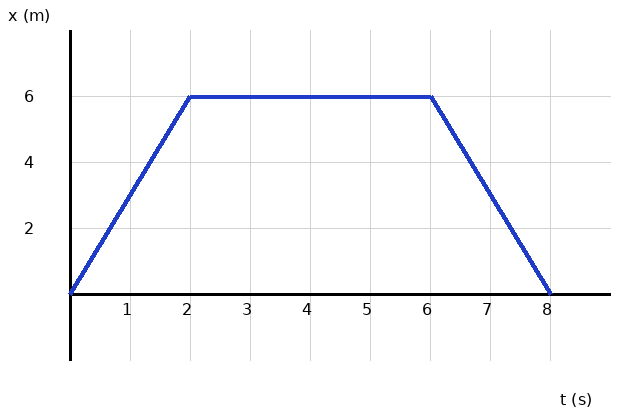
\(0\)\(0\)
\(1.5\,m/s\)\(1.5\,m/s\)
\(3\,m/s\)\(3\,m/s\)
\(0.75\,m/s\)\(0.75\,m/s\)
الحلSolution
📌 من الرسم: يتحرك من \(0\) إلى \(6\,m\) (خلال \(2\,s\))، ثم يقف حتى \(6\,s\)، ثم يعود إلى \(0\) (خلال \(2\,s\)).
📌 المسافة \(S=6+0+6=12\,m\)، فالسرعة العددية المتوسطة \(\dfrac{12}{8}=1.5\,m/s\) (أما السرعة المتجهة المتوسطة فتساوي صفرًا لأن الإزاحة صفر).
✅ \(1.5\,m/s\) (B)
📌 From the graph: it goes from \(0\) to \(6\,m\) (in \(2\,s\)), rests until \(6\,s\), then returns to \(0\) (in \(2\,s\)).
📌 The distance is \(S=6+0+6=12\,m\), so the average speed is \(\dfrac{12}{8}=1.5\,m/s\) (the average velocity is zero since the displacement is zero).
✅ \(1.5\,m/s\) (B)
\[30\,\star\star\]
في الرسم البياني نفسه (الشكل السابق)، في أي فترة زمنية يتحرك الجسم بالاتجاه السالب؟In the same graph (previous figure), during which time interval does the object move in the negative direction?
من \(6\) إلى \(8\,s\)from \(6\) to \(8\,s\)
من \(0\) إلى \(2\,s\)from \(0\) to \(2\,s\)
من \(2\) إلى \(6\,s\)from \(2\) to \(6\,s\)
من \(0\) إلى \(8\,s\)from \(0\) to \(8\,s\)
الحلSolution
📌 الحركة بالاتجاه السالب تعني ميلًا سالبًا (الموقع يتناقص): يحدث ذلك فقط بين \(6\,s\) و\(8\,s\). بين \(0\) و\(2\,s\) الميل موجب، وبين \(2\) و\(6\,s\) الميل صفر (ساكن).
✅ من \(6\) إلى \(8\,s\) (A)
📌 Motion in the negative direction means a negative slope (the position decreases): this happens only between \(6\,s\) and \(8\,s\). From \(0\) to \(2\,s\) the slope is positive and from \(2\) to \(6\,s\) it is zero (at rest).
✅ from \(6\) to \(8\,s\) (A)
\[31\,\star\star\star\]
سيارتان على خط مستقيم: A عند الموقع \(x=0\) تتحرك بسرعة \(+20\,m/s\)، وB عند الموقع \(x=300\,m\) تتحرك بسرعة \(-10\,m/s\) (نحو A) في اللحظة نفسها. بعد كم ثانية تلتقيان وفي أي موقع؟Two cars on a straight line: A at \(x=0\) moving at \(+20\,m/s\) and B at \(x=300\,m\) moving at \(-10\,m/s\) (toward A) at the same instant. After how many seconds do they meet and at what position?
\(t=15\,s,\ x=300\,m\)\(t=15\,s,\ x=300\,m\)
\(t=10\,s,\ x=200\,m\)\(t=10\,s,\ x=200\,m\)
\(t=10\,s,\ x=100\,m\)\(t=10\,s,\ x=100\,m\)
\(t=30\,s,\ x=200\,m\)\(t=30\,s,\ x=200\,m\)
الحلSolution
📌 المعادلتان: \(x_A=20t\) و\(x_B=300-10t\). يلتقيان عندما \(x_A=x_B\).
📌 \(20t=300-10t\Rightarrow30t=300\Rightarrow t=10\,s\)، والموقع \(x=20\times10=200\,m\).
✅ \(t=10\,s,\ x=200\,m\) (B)
📌 The equations: \(x_A=20t\) and \(x_B=300-10t\). They meet when \(x_A=x_B\).
📌 \(20t=300-10t\Rightarrow30t=300\Rightarrow t=10\,s\), and the position is \(x=20\times10=200\,m\).
✅ \(t=10\,s,\ x=200\,m\) (B)
\[32\,\star\star\star\]
يبين الشكل العلاقة بين الموقع والزمن لجسمين A وB. لحظة التقائهما وموقع الالتقاء:The figure shows the position–time graphs of two objects A and B. The time and position at which they meet are:
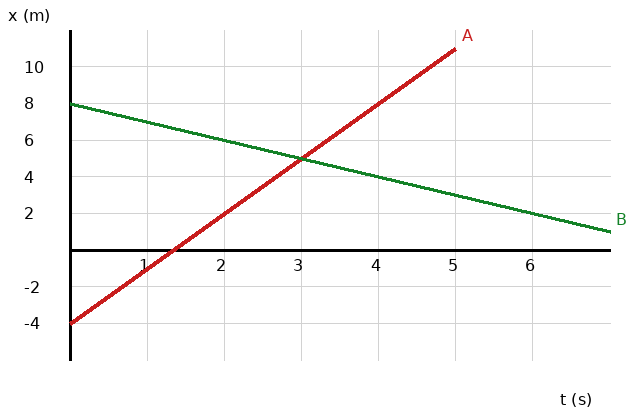
\(t=4\,s,\ x=8\,m\)\(t=4\,s,\ x=8\,m\)
\(t=3\,s,\ x=8\,m\)\(t=3\,s,\ x=8\,m\)
\(t=2\,s,\ x=2\,m\)\(t=2\,s,\ x=2\,m\)
\(t=3\,s,\ x=5\,m\)\(t=3\,s,\ x=5\,m\)
الحلSolution
📌 من الرسم: A يبدأ من \(-4\,m\) وميله \(+3\,m/s\): \(x_A=-4+3t\). وB يبدأ من \(8\,m\) وميله \(-1\,m/s\): \(x_B=8-t\).
📌 \(-4+3t=8-t\Rightarrow4t=12\Rightarrow t=3\,s\)، \(x=8-3=5\,m\) (نقطة تقاطع الخطين).
✅ \(t=3\,s,\ x=5\,m\) (D)
📌 From the graph: A starts at \(-4\,m\) with slope \(+3\,m/s\): \(x_A=-4+3t\). B starts at \(8\,m\) with slope \(-1\,m/s\): \(x_B=8-t\).
📌 \(-4+3t=8-t\Rightarrow4t=12\Rightarrow t=3\,s\), \(x=8-3=5\,m\) (the intersection of the lines).
✅ \(t=3\,s,\ x=5\,m\) (D)
\[33\,\star\star\star\]
تحرك جسم من نقطة الأصل بسرعة \(+5\,m/s\) مدة \(4\,s\) ثم بسرعة \(-3\,m/s\) مدة \(6\,s\). موقعه النهائي والمسافة التي قطعها:An object leaves the origin with velocity \(+5\,m/s\) for \(4\,s\) and then with velocity \(-3\,m/s\) for \(6\,s\). Its final position and the distance traveled are:
\(x=38\,m,\ S=2\,m\)\(x=38\,m,\ S=2\,m\)
\(x=2\,m,\ S=38\,m\)\(x=2\,m,\ S=38\,m\)
\(x=2\,m,\ S=2\,m\)\(x=2\,m,\ S=2\,m\)
\(x=-2\,m,\ S=38\,m\)\(x=-2\,m,\ S=38\,m\)
الحلSolution
📌 المرحلة الأولى: \(\Delta x_1=5\times4=+20\,m\)، والثانية: \(\Delta x_2=-3\times6=-18\,m\).
📌 الموقع النهائي \(x=20-18=2\,m\)، والمسافة \(S=20+18=38\,m\).
✅ \(x=2\,m,\ S=38\,m\) (B)
📌 First stage: \(\Delta x_1=5\times4=+20\,m\); second stage: \(\Delta x_2=-3\times6=-18\,m\).
📌 The final position is \(x=20-18=2\,m\) and the distance is \(S=20+18=38\,m\).
✅ \(x=2\,m,\ S=38\,m\) (B)
\[34\,\star\]
الخط البياني للموقع مقابل الزمن لجسم ما خط أفقي. هذا يعني أن الجسم:The position-versus-time graph of an object is a horizontal line. This means the object is:
ساكن (سرعته صفر)at rest (zero velocity)
يتحرك بسرعة ثابتةmoving with constant velocity
يتحرك بتسارع ثابتmoving with constant acceleration
يعود إلى نقطة البدايةreturning to the starting point
الحلSolution
📌 الخط الأفقي ميله صفر، أي أن الموقع لا يتغير مع الزمن، فالسرعة تساوي صفرًا والجسم ساكن.
✅ ساكن (سرعته صفر) (A)
📌 A horizontal line has zero slope, so the position does not change with time: the velocity is zero and the object is at rest.
✅ at rest (zero velocity) (A)
\[35\,\star\star\]
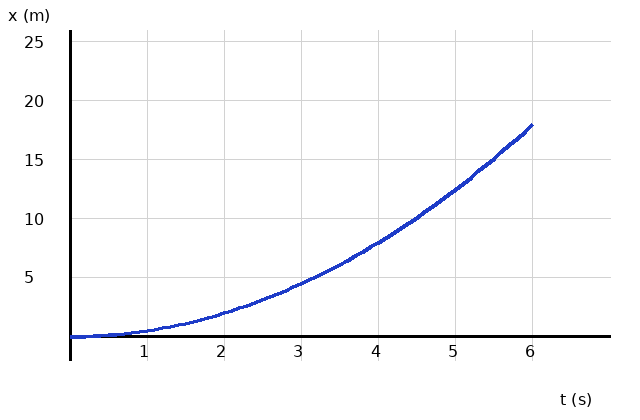
رُسم الموقع مقابل الزمن لجسم فكان منحنى ميله يزداد مع الزمن كما في الشكل. هذا يدل على أن الجسم:The position-versus-time graph of an object is a curve whose slope increases with time, as in the figure. This shows that the object:
يتحرك بسرعة ثابتةmoves with constant velocity
ساكنis at rest
تتزايد سرعته مع الزمنspeeds up
تتناقص سرعته مع الزمنslows down
الحلSolution
📌 ميل منحنى الموقع هو السرعة. الميل في هذا الرسم يتزايد مع الزمن (المنحنى يزداد انحدارًا) ⇒ السرعة تتزايد.
✅ تتزايد سرعته مع الزمن (C)
📌 The slope of a position curve is the velocity. Here the slope grows with time (the curve gets steeper) ⇒ the velocity increases.
✅ speeds up (C)
\[36\,\star\]
سيارة تتحرك بسرعة \(72\,km/h\). هذه السرعة بوحدة \(m/s\) تساوي:A car moves at \(72\,km/h\). This speed in \(m/s\) is:
\(72\,m/s\)\(72\,m/s\)
\(259\,m/s\)\(259\,m/s\)
\(12\,m/s\)\(12\,m/s\)
\(20\,m/s\)\(20\,m/s\)
الحلSolution
📌 \(1\,km/h=\dfrac{1000}{3600}=\dfrac{1}{3.6}\,m/s\)، إذن \(72\div3.6=20\,m/s\).
✅ \(20\,m/s\) (D)
📌 \(1\,km/h=\dfrac{1000}{3600}=\dfrac{1}{3.6}\,m/s\), so \(72\div3.6=20\,m/s\).
✅ \(20\,m/s\) (D)
\[37\,\star\star\]
قطعت حافلة \(150\,km\) في ساعتين ونصف. سرعتها العددية المتوسطة بوحدة \(km/h\):A bus travels \(150\,km\) in two and a half hours. Its average speed in \(km/h\) is:
\(75\,km/h\)\(75\,km/h\)
\(375\,km/h\)\(375\,km/h\)
\(60\,km/h\)\(60\,km/h\)
\(50\,km/h\)\(50\,km/h\)
الحلSolution
📌 الزمن \(t=2.5\,h\): \(v=\dfrac{S}{t}=\dfrac{150}{2.5}=60\,km/h\).
✅ \(60\,km/h\) (C)
📌 The time is \(t=2.5\,h\): \(v=\dfrac{S}{t}=\dfrac{150}{2.5}=60\,km/h\).
✅ \(60\,km/h\) (C)
\[38\,\star\star\star\]
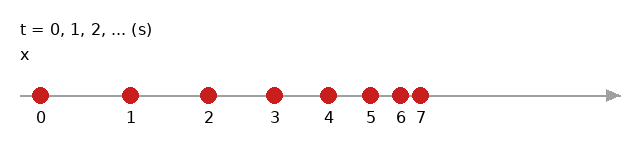
الشكل يبين التمثيل النقطي لحركة جسم يتحرك نحو اليمين (نقطة كل ثانية). ماذا نستنتج من تناقص المسافة بين النقاط المتتالية؟The figure shows the dot model of an object moving to the right (a dot every second). What do we conclude from the decreasing distance between successive dots?
الجسم تتناقص سرعته (يتباطأ) وهو لا يزال يتحرك نحو اليمينThe object is slowing down while still moving to the right
الجسم يتحرك بسرعة ثابتةThe object moves at constant velocity
الجسم تزداد سرعتهThe object is speeding up
الجسم ساكنThe object is at rest
الحلSolution
📌 النقاط تُرسم كل فترة زمنية متساوية، فتناقص المسافة بين نقطتين متتاليتين يعني أن الجسم يقطع مسافة أقل في الزمن نفسه، أي أن سرعته تتناقص.
📌 والحركة تبقى نحو اليمين (الإزاحات كلها موجبة) لكن بسرعة متناقصة (تباطؤ).
✅ الجسم تتناقص سرعته (يتباطأ) وهو لا يزال يتحرك نحو اليمين (A)
📌 The dots are drawn at equal time intervals, so a shrinking gap means the object covers less distance in the same time: its speed decreases.
📌 It still moves to the right (all the displacements are positive) but with decreasing speed (slowing down).
✅ The object is slowing down while still moving to the right (A)
📝 المسائل المقالية
📝 Essay Problems
\[1\,\star\]
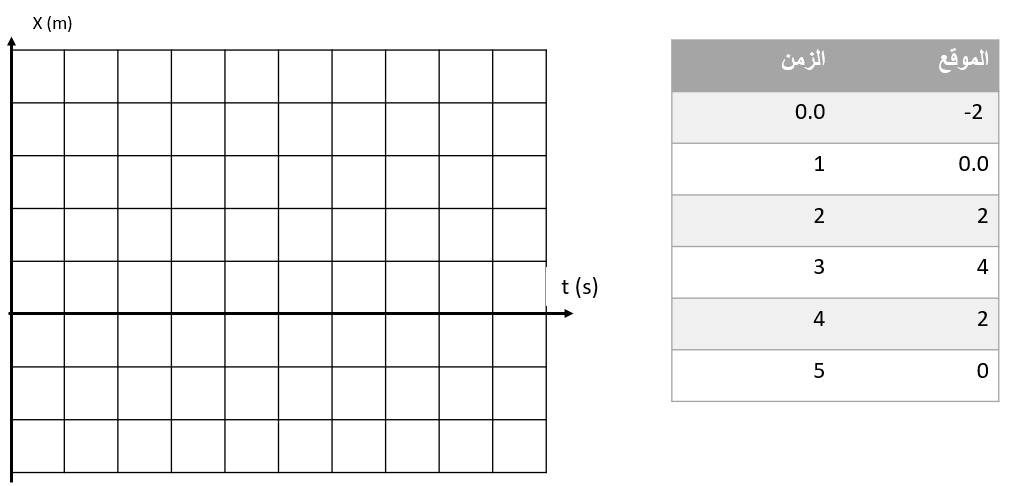
تحرك أحمد وتم رصد حركته ووضعت البيانات في الجدول. ارسم الخط البياني للعلاقة بين الموقع والزمن، ثم احسب المسافة المقطوعة والإزاحة والسرعة المتجهة المتوسطة.Ahmed moved and his motion was recorded in the table. Draw the position–time graph, then calculate the distance traveled, the displacement and the average velocity.
.....................................................................
الحلSolution
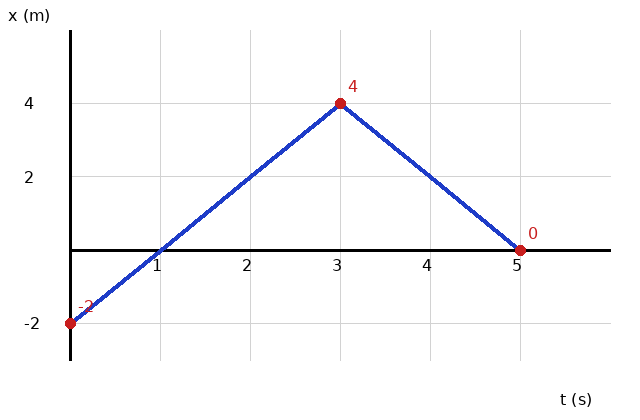
📌 نمثل النقاط \((t,x)\): \((0,-2),(1,0),(2,2),(3,4),(4,2),(5,0)\) ونصل بينها بخطوط مستقيمة (الشكل أدناه).
📌 المسافة: يزداد الموقع من \(-2\) إلى \(4\,m\) (بمقدار \(6\,m\)) ثم يتناقص إلى \(0\) (بمقدار \(4\,m\)): \(S=6+4=10\,m\).
📌 الإزاحة: \(\Delta X=X_f-X_i=0-(-2)=+2\,m\).
📌 السرعة المتجهة المتوسطة: \(v_{avg}=\dfrac{\Delta X}{\Delta t}=\dfrac{2}{5}=+0.4\,m/s\) (والسرعة العددية المتوسطة \(\dfrac{10}{5}=2\,m/s\)).
✅ \(S=10\,m\)، \(\Delta X=+2\,m\)، \(v_{avg}=+0.4\,m/s\)
📌 We plot the points \((t,x)\): \((0,-2),(1,0),(2,2),(3,4),(4,2),(5,0)\) and join them with straight lines (figure below).
📌 Distance: the position rises from \(-2\) to \(4\,m\) (by \(6\,m\)) then falls to \(0\) (by \(4\,m\)): \(S=6+4=10\,m\).
📌 Displacement: \(\Delta X=X_f-X_i=0-(-2)=+2\,m\).
📌 Average velocity: \(v_{avg}=\dfrac{\Delta X}{\Delta t}=\dfrac{2}{5}=+0.4\,m/s\) (and the average speed is \(\dfrac{10}{5}=2\,m/s\)).
✅ \(S=10\,m\), \(\Delta X=+2\,m\), \(v_{avg}=+0.4\,m/s\)
\[2\,\star\star\]
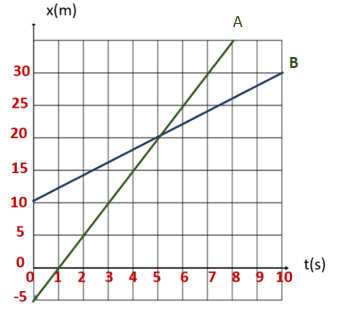
يبين الخط البياني العلاقة بين الموقع والزمن لعدّاءين A وB. (أ) في أي لحظة وفي أي موقع يلتقيان؟ (ب) ما موقع A عند \(t=7.5\,s\)؟ (ج) ما سرعة B؟ (د) إذا ضاعف A سرعته وانطلق من نقطة الأصل فارسم الخط البياني الجديد.The graph shows the position–time relationship of two runners A and B. (a) At what time and position do they meet? (b) What is the position of A at \(t=7.5\,s\)? (c) What is the velocity of B? (d) If A doubles his speed and starts from the origin, draw the new graph.
.....................................................................
الحلSolution
📌 (أ) يلتقيان عند تقاطع الخطين: \(t=5\,s\) عند الموقع \(x=20\,m\).
📌 سرعة A من الرسم: من \((1,0)\) إلى \((5,20)\): \(v_A=\dfrac{20}{4}=5\,m/s\)، فمعادلته \(x_A=5t-5\).
📌 (ب) \(x_A(7.5)=5(7.5)-5=32.5\,m\).
📌 (ج) B يبدأ من \(10\,m\) ويصل إلى \(30\,m\) عند \(t=10\,s\): \(v_B=\dfrac{30-10}{10}=2\,m/s\) (معادلته \(x_B=10+2t\)).
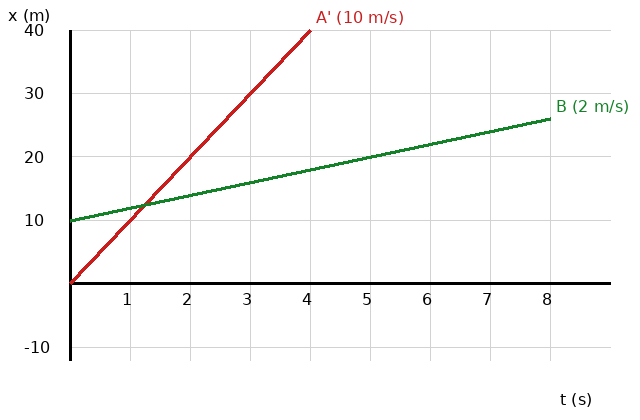
📌 (د) السرعة الجديدة لـ A تساوي \(2\times5=10\,m/s\) من نقطة الأصل: \(x_{A'}=10t\)، أي خط مستقيم من نقطة الأصل ميله \(10\) (الشكل أدناه).
✅ \(t=5\,s,\ x=20\,m\)، \(x_A(7.5)=32.5\,m\)، \(v_B=2\,m/s\)
📌 (a) They meet where the lines cross: \(t=5\,s\) at position \(x=20\,m\).
📌 The velocity of A from the graph: from \((1,0)\) to \((5,20)\): \(v_A=\dfrac{20}{4}=5\,m/s\), so its equation is \(x_A=5t-5\).
📌 (b) \(x_A(7.5)=5(7.5)-5=32.5\,m\).
📌 (c) B starts at \(10\,m\) and reaches \(30\,m\) at \(t=10\,s\): \(v_B=\dfrac{30-10}{10}=2\,m/s\) (equation \(x_B=10+2t\)).
📌 (d) The new speed of A is \(2\times5=10\,m/s\) from the origin: \(x_{A'}=10t\), a straight line through the origin with slope \(10\) (figure below).
✅ \(t=5\,s,\ x=20\,m\), \(x_A(7.5)=32.5\,m\), \(v_B=2\,m/s\)
\[3\,\star\star\star\]
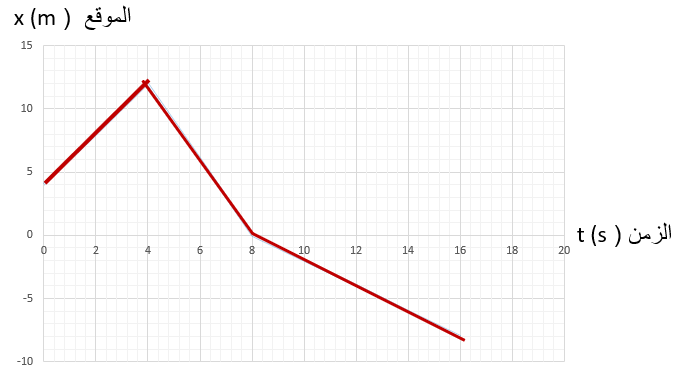
رُسمت العلاقة بين الموقع والزمن لدراجة هوائية كما في الشكل. (أ) احسب المسافة المقطوعة خلال كامل الفترة. (ب) احسب السرعة العددية المتوسطة والسرعة المتجهة المتوسطة خلال الثواني الثماني الأولى. (ج) احسب السرعة المتجهة المتوسطة من \(8\,s\) إلى \(16\,s\).The position–time graph of a bicycle is shown. (a) Calculate the distance traveled during the whole period. (b) Calculate the average speed and the average velocity during the first eight seconds. (c) Calculate the average velocity from \(8\,s\) to \(16\,s\).
.....................................................................
الحلSolution
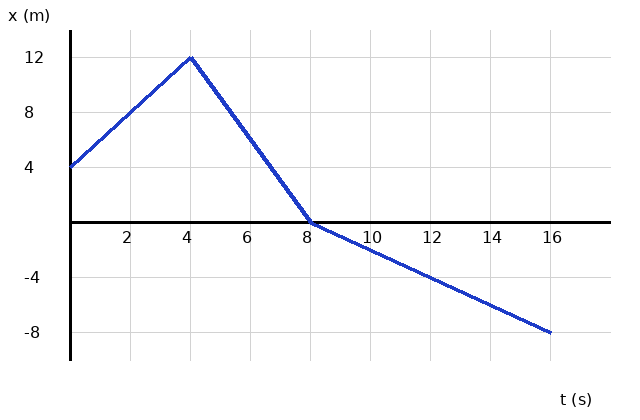
📌 من الرسم: \(x=4\,m\) عند \(t=0\)، \(12\,m\) عند \(t=4\,s\)، \(0\) عند \(t=8\,s\)، \(-8\,m\) عند \(t=16\,s\).
📌 (أ) \(S=|12-4|+|0-12|+|-8-0|=8+12+8=28\,m\).
📌 (ب) في أول 8 ثوانٍ: المسافة \(8+12=20\,m\) فالسرعة العددية المتوسطة \(\dfrac{20}{8}=2.5\,m/s\)؛ والإزاحة \(0-4=-4\,m\) فالسرعة المتجهة المتوسطة \(\dfrac{-4}{8}=-0.5\,m/s\).
📌 (ج) من \(8\) إلى \(16\,s\): \(v_{avg}=\dfrac{-8-0}{16-8}=-1\,m/s\) (بالاتجاه السالب).
✅ \(S=28\,m\)، \(2.5\,m/s\) و\(-0.5\,m/s\)، \(-1\,m/s\)
📌 From the graph: \(x=4\,m\) at \(t=0\), \(12\,m\) at \(t=4\,s\), \(0\) at \(t=8\,s\), \(-8\,m\) at \(t=16\,s\).
📌 (a) \(S=|12-4|+|0-12|+|-8-0|=8+12+8=28\,m\).
📌 (b) In the first 8 s: the distance is \(8+12=20\,m\) so the average speed is \(\dfrac{20}{8}=2.5\,m/s\); the displacement is \(0-4=-4\,m\) so the average velocity is \(\dfrac{-4}{8}=-0.5\,m/s\).
📌 (c) From \(8\) to \(16\,s\): \(v_{avg}=\dfrac{-8-0}{16-8}=-1\,m/s\) (in the negative direction).
✅ \(S=28\,m\), \(2.5\,m/s\) and \(-0.5\,m/s\), \(-1\,m/s\)
لاحظت خطأ؟ أو عندك سؤال عن أحد الأسئلة؟ اكتبه بالتعليقات وحدد رقم السؤال بالضبط.
Noticed an error? Or have a question about one of the questions? Write it in the comments and specify the exact question number.