🌈 بنك الأسئلة: تداخل الضوء والحيود
🌈 Question Bank: Light Interference and Diffraction
شروط التداخل والمنابع المترابطة، تجربة يونغ، الأغشية الرقيقة، حيود الشق المفرد، محزوز الحيود
Conditions of Interference and Coherent Sources, Young’s Experiment, Thin Films, Single-Slit Diffraction, the Diffraction Grating
⏱️ 41 سؤال اختيار من متعدد بتصحيح فوري بمستويات متدرجة، و4 مسائل مقالية محلولة بالرسم⏱️ 41 multiple-choice questions of graded difficulty with instant feedback, plus 4 solved essay problems with drawings
\[1\,\star\]
في تجربة التداخل استخدم طالب مصباحين يصدران ضوءًا أخضر فلم يحصل على أهداب تداخل. السبب يعود إلى أن:In an interference experiment a student used two lamps emitting green light but did not obtain interference fringes. The reason is that:
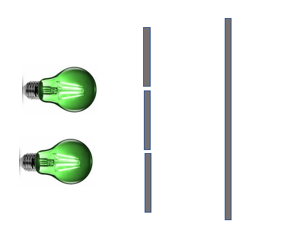
المنبعين يصدران أمواجًا لها أطوال موجية مختلفةthe two sources emit waves of different wavelengths
المنبعين يصدران أمواجًا مختلفة في الطاقةthe two sources emit waves of different energies
المنبعين يصدران أمواجًا غير مترابطةthe two sources emit incoherent waves
المنبعين يصدران أمواجًا لها سعة مختلفةthe two sources emit waves of different amplitudes
الحلSolution
📌 من كل نقطة في المصباح تصدر ملايين الأمواج كل ثانية بأطوار عشوائية متغيرة، فالمصباحان منبعان غير مترابطين (فرق الطور بينهما غير ثابت).
📌 لذلك تتغير أهداب التداخل عند كل نقطة من الحاجز بسرعة كبيرة وبشكل غير مستقر فلا نلاحظ أهدابًا ثابتة.
✅ المنبعين يصدران أمواجًا غير مترابطة (C)
📌 Millions of waves leave every point of a lamp each second with random, changing phases, so the two lamps are incoherent sources (the phase difference between them is not constant).
📌 So at every point of the screen the interference pattern changes extremely fast and unsteadily, and no steady fringes are seen.
✅ the two sources emit incoherent waves (C)
\[2\,\star\]
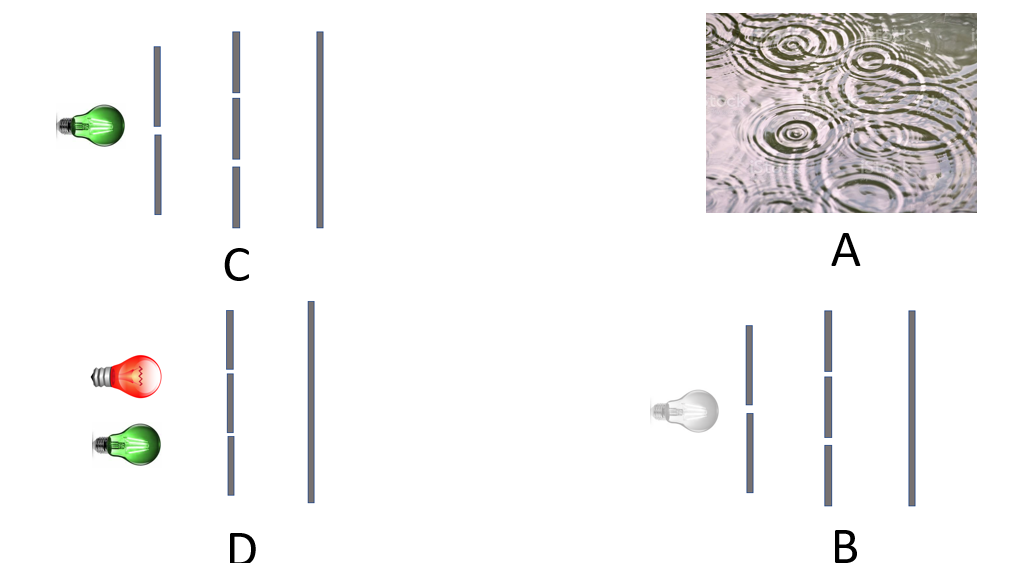
أي الأشكال التالية يعبّر عن منابع مترابطة للأمواج وتظهر فيه أهداب التداخل واضحة؟Which of the following figures represents coherent wave sources and shows clear interference fringes?
AA
BB
CC
DD
الحلSolution
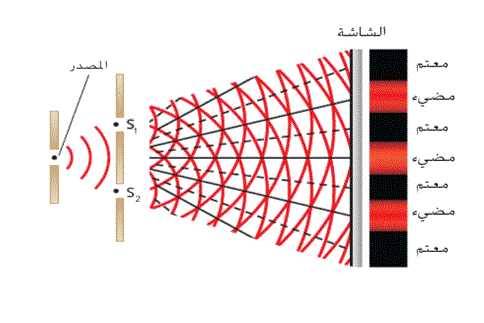
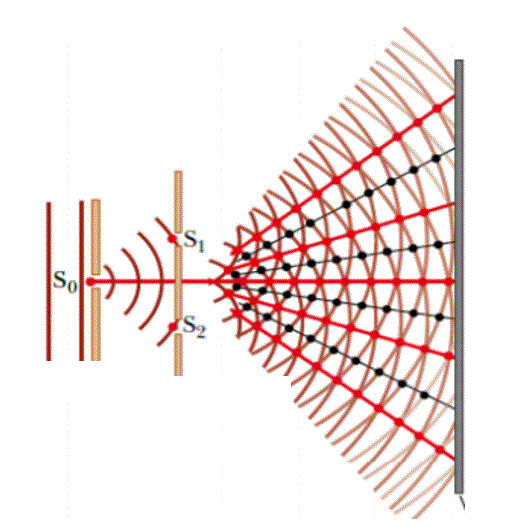
📌 يشترط للمنابع المترابطة: ضوء وحيد اللون (طول موجي واحد) وفرق طور ثابت، وأسهل طريقة أن نشتقّ المنبعين من منبع واحد (شقان أمام مصباح واحد).
📌 الشكل C: مصباح أخضر واحد وشقان فيظهر التداخل. A: أمواج الماء من منبعين عشوائيين. B: ضوء أبيض (مركّب الألوان). D: مصباحان مختلفان.
✅ C
📌 Coherent sources require monochromatic light (a single wavelength) and a constant phase difference, and the easiest way is to derive the two sources from a single source (two slits in front of one lamp).
📌 Figure C: one green lamp and two slits, so interference appears. A: water waves from random sources. B: white light (many colours). D: two different lamps.
✅ C
\[3\,\star\]
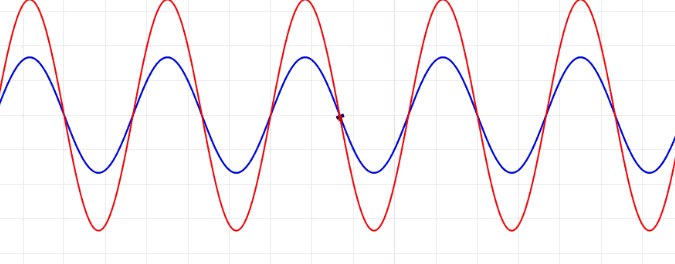
عند التقاء موجتين في الوسط نفسه نحصل على موجة جديدة سعتها أكبر من سعة أي من الموجتين. نسمّي هذا التفاعل:When two waves meet in the same medium and a new wave is produced whose amplitude is greater than that of either wave, this interaction is called:
التداخل الهدّامdestructive interference
انعكاس الأمواجreflection of waves
انكسار الأمواجrefraction of waves
التداخل البنّاءconstructive interference
الحلSolution
📌 التداخل البنّاء: التقاء قمة مع قمة (أو قاع مع قاع) فتنتج موجة سعتها أكبر من أي من الموجتين. التداخل الهدّام: التقاء قمة مع قاع فتنتج موجة سعتها أقل أو تختفي.
✅ التداخل البنّاء (D)
📌 Constructive interference: a crest meets a crest (or a trough meets a trough) giving a wave of larger amplitude than either wave. Destructive interference: a crest meets a trough, giving a smaller amplitude or none at all.
✅ constructive interference (D)
\[4\,\star\star\]
يسقط ضوء متماسك طوله الموجي \(\lambda\) على شقين، فيظهر نمط تداخل على شاشة بعيدة، ويوجد عند النقطة \(P\) هدبة مضيئة بينها وبين الهدبة المركزية هدبتان مظلمتان. فرق المسار بين المنبعين عند \(P\):Coherent light of wavelength \(\lambda\) falls on two slits and an interference pattern appears on a distant screen. At the point \(P\) there is a bright fringe with two dark fringes between it and the central fringe. The path difference of the two sources at \(P\) is:
\(\dfrac{3\lambda}{2}\)\(\dfrac{3\lambda}{2}\)
\(\lambda\)\(\lambda\)
\(3\lambda\)\(3\lambda\)
\(2\lambda\)\(2\lambda\)
الحلSolution
📌 نعدّ من الهدبة المركزية: فرق المسار \(0\) (مضيئة)، \(\tfrac\lambda2\) (مظلمة 1)، \(\lambda\) (مضيئة)، \(\tfrac{3\lambda}2\) (مظلمة 2)، \(2\lambda\) (مضيئة).
📌 الهدبة المضيئة التي يسبقها هدبتان مظلمتان هي الثانية: \(\Delta x=2\lambda\).
✅ \(2\lambda\) (D)
📌 Counting from the central fringe: path difference \(0\) (bright), \(\tfrac\lambda2\) (dark 1), \(\lambda\) (bright), \(\tfrac{3\lambda}2\) (dark 2), \(2\lambda\) (bright).
📌 The bright fringe preceded by two dark fringes is the second one: \(\Delta x=2\lambda\).
✅ \(2\lambda\) (D)
\[5\,\star\]
إذا أثرت الشحنة الأولى على الثانية بقوة كهربائية \(10\,N\) نحو اليمين فإن القوة التي تؤثر بها الشحنة الثانية على الأولى:If the first charge exerts an electric force of \(10\,N\) on the second charge toward the right, the force exerted by the second charge on the first is:
\(F_{21}=10\,N\) نحو اليسار\(F_{21}=10\,N\) toward the left
لا يمكن تحديدها لعدم معرفة مقدار الشحنتينcannot be determined without knowing the magnitudes of the charges
\(F_{21}=10\,N\) نحو اليمين\(F_{21}=10\,N\) toward the right
لا يمكن تحديدها لعدم معرفة نوع الشحنتينcannot be determined without knowing the type of the charges
الحلSolution
📌 قانون نيوتن الثالث: لكل فعل رد فعل مساوٍ له في المقدار ومعاكس له في الاتجاه، مهما كان نوع القوة (تجاذب أو تنافر) ومهما كانت مقادير الشحنتين.
\(F_{12}=-F_{21}\) فالقوة \(10\,N\) نحو اليسار.
✅ \(F_{21}=10\,N\) نحو اليسار (A)
📌 Newton's third law: every action has an equal and opposite reaction, whatever the type of force (attraction or repulsion) and whatever the magnitudes of the charges.
\(F_{12}=-F_{21}\) so the force is \(10\,N\) toward the left.
✅ \(F_{21}=10\,N\) toward the left (A)
\[6\,\star\star\]
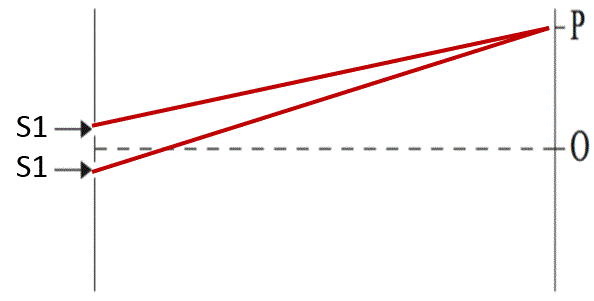
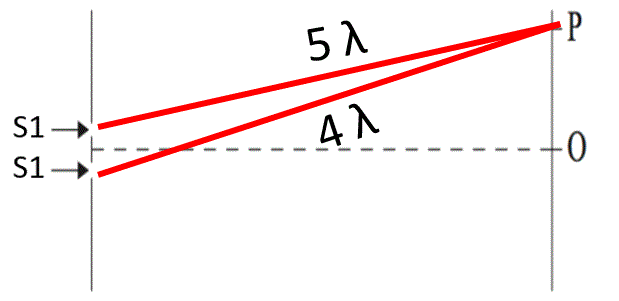
في النموذج المقابل للتداخل تقع النقطة \(P\) على الحاجز، وعدد الأمواج التي يرسلها المنبع الأول إليها \(4\lambda\) والثاني \(5\lambda\). نوع ورتبة التداخل عند هذه النقطة:In the model shown, the point \(P\) is on the screen, and the first source sends it \(4\lambda\) of waves and the second \(5\lambda\). The type and order of the interference at this point are:
هدبة مضيئة ورتبتها الأولىa bright fringe of order 1
هدبة مضيئة ورتبتها الثانيةa bright fringe of order 2
هدبة مظلمة ورتبتها الثانيةa dark fringe of order 2
هدبة مظلمة ورتبتها الأولىa dark fringe of order 1
الحلSolution
📌 فرق المسار \(\Delta x=5\lambda-4\lambda=\lambda\).
📌 فرق المسار صفر أو عدد صحيح من الأطوال الموجية ← تداخل بنّاء (هدبة مضيئة) ورتبتها \(m=1\) لأن \(\Delta x=1\cdot\lambda\).
✅ هدبة مضيئة ورتبتها الأولى (A)
📌 The path difference is \(\Delta x=5\lambda-4\lambda=\lambda\).
📌 A path difference of zero or a whole number of wavelengths gives constructive interference (a bright fringe), of order \(m=1\) because \(\Delta x=1\cdot\lambda\).
✅ a bright fringe of order 1 (A)
\[7\,\star\]
ضوء يسقط على شقين المسافة بينهما \(1.2\times10^{-4}\,m\) فظهرت الهدبة المضيئة الأولى على بعد \(2.3\,mm\) من الهدبة المركزية، وبعد الشاشة عن الشقين \(0.5\,m\). الطول الموجي للضوء:Light falls on two slits \(1.2\times10^{-4}\,m\) apart. The first bright fringe appears \(2.3\,mm\) from the central fringe and the screen is \(0.5\,m\) from the slits. The wavelength of the light is:
\(\lambda=7\times10^{-7}\,m\)\(\lambda=7\times10^{-7}\,m\)
\(\lambda=5.5\times10^{-7}\,m\)\(\lambda=5.5\times10^{-7}\,m\)
\(\lambda=4.8\times10^{-7}\,m\)\(\lambda=4.8\times10^{-7}\,m\)
\(\lambda=6\times10^{-7}\,m\)\(\lambda=6\times10^{-7}\,m\)
الحلSolution
📌 للهدبة المضيئة الأولى \(\lambda=\dfrac{y\,d}{L}\) (\(y\) بعد الهدبة عن خط الوسط).
\(\lambda=\dfrac{2.3\times10^{-3}\times1.2\times10^{-4}}{0.5}=5.5\times10^{-7}\,m\).
✅ \(\lambda=5.5\times10^{-7}\,m\) (B)
📌 For the first bright fringe \(\lambda=\dfrac{y\,d}{L}\) (\(y\) is the distance of the fringe from the central line).
\(\lambda=\dfrac{2.3\times10^{-3}\times1.2\times10^{-4}}{0.5}=5.5\times10^{-7}\,m\).
✅ \(\lambda=5.5\times10^{-7}\,m\) (B)
\[8\,\star\]
في تجربة الشقين أي العبارات التالية صحيحة؟In the double-slit experiment, which of the following statements is correct?
كلما زاد البعد بين المنبعين قلّ عدد أهداب التداخلthe greater the distance between the sources the fewer the interference fringes
المنبعان غير مترابطينthe two sources are incoherent
يزداد البعد بين الأهداب بزيادة الطول الموجيthe distance between the fringes increases with the wavelength
الهدبة المركزية قد تكون مضيئة أو مظلمة بحسب الضوء المستخدمthe central fringe may be bright or dark depending on the light used
الحلSolution
📌 البعد بين الأهداب \(\Delta y=\dfrac{\lambda L}{d}\) فهو يتناسب طرديًا مع \(\lambda\) (فهو أكبر للأحمر منه للأزرق).
📌 والخيارات الأخرى خاطئة: زيادة \(d\) تُقرّب الأهداب وتزيد عددها، والمنبعان مترابطان، والهدبة المركزية مضيئة دائمًا (فرق المسار صفر).
✅ يزداد البعد بين الأهداب بزيادة الطول الموجي (C)
📌 The fringe separation is \(\Delta y=\dfrac{\lambda L}{d}\), directly proportional to \(\lambda\) (larger for red than for blue).
📌 The other options are wrong: increasing \(d\) brings the fringes closer and increases their number, the sources are coherent, and the central fringe is always bright (zero path difference).
✅ the distance between the fringes increases with the wavelength (C)
\[9\,\star\]
في تجربة شقي يونغ استُخدم ليزر أحمر طوله الموجي \(\lambda=6.5\times10^{-7}\,m\) وبعد الشاشة \(0.6\,m\)، فرُصدت الهدبة المضيئة الثالثة على بعد \(5\,mm\) من الهدبة المركزية. البعد بين المنبعين:In Young's experiment a red laser of wavelength \(\lambda=6.5\times10^{-7}\,m\) is used with the screen \(0.6\,m\) away, and the third bright fringe is observed \(5\,mm\) from the central fringe. The separation of the two sources is:
\(d=2.34\times10^{-4}\,m\)\(d=2.34\times10^{-4}\,m\)
\(d=0.6\times10^{-4}\,m\)\(d=0.6\times10^{-4}\,m\)
\(d=2.5\times10^{-4}\,m\)\(d=2.5\times10^{-4}\,m\)
\(d=1.1\times10^{-4}\,m\)\(d=1.1\times10^{-4}\,m\)
الحلSolution
📌 للهدبة المضيئة رقم \(m\): \(y=\dfrac{m\lambda L}{d}\) ومنها \(d=\dfrac{m\lambda L}{y}\) مع \(m=3\).
\(d=\dfrac{3\times6.5\times10^{-7}\times0.6}{5\times10^{-3}}=2.34\times10^{-4}\,m\).
✅ \(d=2.34\times10^{-4}\,m\) (A)
📌 For the bright fringe number \(m\): \(y=\dfrac{m\lambda L}{d}\) so \(d=\dfrac{m\lambda L}{y}\) with \(m=3\).
\(d=\dfrac{3\times6.5\times10^{-7}\times0.6}{5\times10^{-3}}=2.34\times10^{-4}\,m\).
✅ \(d=2.34\times10^{-4}\,m\) (A)
\[10\,\star\star\]
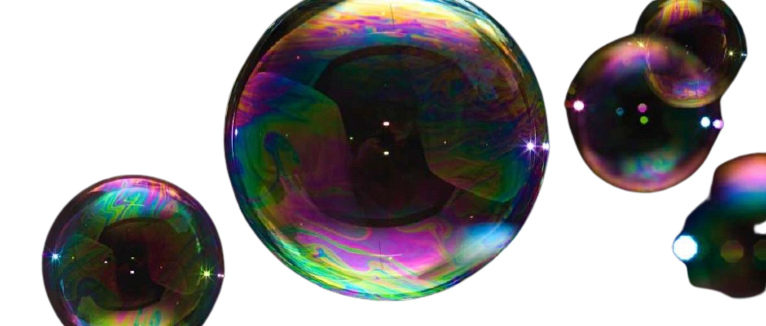
غشاء رقيق (فقاعة صابون) أقل سمك له \(0.975\times10^{-7}\,m\) ومعامل انكساره \(n=1.33\) والهواء من الجهتين. الطول الموجي للضوء الذي يحدث عنده تداخل بنّاء من الرتبة الأولى عند هذا السمك:A thin film (a soap bubble) has a minimum thickness of \(0.975\times10^{-7}\,m\) and refractive index \(n=1.33\) with air on both sides. The wavelength of light that gives first-order constructive interference at this thickness is:
\(\lambda=5.2\times10^{-7}\,m\)\(\lambda=5.2\times10^{-7}\,m\)
\(\lambda=6.6\times10^{-7}\,m\)\(\lambda=6.6\times10^{-7}\,m\)
\(\lambda=4.7\times10^{-7}\,m\)\(\lambda=4.7\times10^{-7}\,m\)
\(\lambda=6.1\times10^{-7}\,m\)\(\lambda=6.1\times10^{-7}\,m\)
الحلSolution
📌 الشعاع المنعكس عن السطح العلوي ينقلب طوره (من هواء إلى وسط أكبر معامل انكسار) والمنعكس عن السطح السفلي لا ينقلب؛ فللتداخل البنّاء: \(2nt=\left(m+\tfrac12\right)\lambda\) (للرتبة الأولى \(m=0\)).
\(\lambda=\dfrac{4nt}{1}=4\times1.33\times0.975\times10^{-7}=5.2\times10^{-7}\,m\).
✅ \(\lambda=5.2\times10^{-7}\,m\) (A)
📌 The ray reflected from the top surface is inverted (air to a medium of larger index) and the one from the bottom surface is not; so for constructive interference: \(2nt=\left(m+\tfrac12\right)\lambda\) (first order \(m=0\)).
\(\lambda=\dfrac{4nt}{1}=4\times1.33\times0.975\times10^{-7}=5.2\times10^{-7}\,m\).
✅ \(\lambda=5.2\times10^{-7}\,m\) (A)
\[11\,\star\]
في الأغشية الرقيقة ينقلب طور الموجة المنعكسة (انقلاب بمقدار نصف طول موجة) إذا سقط الضوء:In thin films the reflected wave is inverted (a shift of half a wavelength) when the light passes:
من وسط معامل انكساره أكبر إلى وسط معامل انكساره أقلfrom a medium of higher refractive index to one of lower refractive index
من الماء إلى الهواءfrom water to air
من وسط سرعة الضوء فيه أقل إلى وسط سرعة الضوء فيه أكبرfrom a medium where light is slower to a medium where it is faster
من وسط معامل انكساره أقل إلى وسط معامل انكساره أكبرfrom a medium of lower refractive index to one of higher refractive index
الحلSolution
📌 ينقلب الطور عند الانعكاس عن سطح وسط معامل انكساره أكبر (كانعكاس نبضة الحبل عن طرف ثابت).
📌 أما الانعكاس عند الانتقال إلى وسط معامل انكساره أقل (أو سرعة الضوء فيه أكبر) فلا ينقلب الطور.
✅ من وسط معامل انكساره أقل إلى وسط معامل انكساره أكبر (D)
📌 The phase is inverted on reflection from the surface of a medium of larger refractive index (like a rope pulse reflecting from a fixed end).
📌 Reflection when going into a medium of smaller index (or where light is faster) causes no inversion.
✅ from a medium of lower refractive index to one of higher refractive index (D)
\[12\,\star\star\]
وُضع غشاء رقيق من الزيت (\(n=1.45\)) على سطح ماء. أقل سمك للغشاء يظهر عنده الغشاء مظلمًا (تداخل هدّام) لضوء ساقط من الهواء طوله الموجي \(4.7\times10^{-7}\,m\):A thin oil film (\(n=1.45\)) lies on water. The minimum thickness at which the film looks dark (destructive interference) for light falling from air with wavelength \(4.7\times10^{-7}\,m\) is:
\(d=1.6\times10^{-7}\,m\)\(d=1.6\times10^{-7}\,m\)
\(d=3.6\times10^{-4}\,m\)\(d=3.6\times10^{-4}\,m\)
\(d=2.6\times10^{-6}\,m\)\(d=2.6\times10^{-6}\,m\)
\(d=2.7\times10^{-3}\,m\)\(d=2.7\times10^{-3}\,m\)
الحلSolution
📌 هواء ← زيت ← ماء: الانعكاس عن سطح الزيت العلوي ينقلب (هواء إلى زيت)، أما عن السطح السفلي (زيت إلى ماء، معامل أقل) فلا ينقلب. فللتداخل الهدّام: \(2d=m\dfrac{\lambda}{n}\).
📌 أقل سمك \(m=1\): \(d=\dfrac{\lambda}{2n}=\dfrac{4.7\times10^{-7}}{2\times1.45}=1.6\times10^{-7}\,m\).
✅ \(d=1.6\times10^{-7}\,m\) (A)
📌 Air → oil → water: reflection from the top surface of the oil is inverted (air to oil) but from the bottom (oil to water, smaller index) it is not. So for destructive interference: \(2d=m\dfrac{\lambda}{n}\).
📌 The minimum thickness has \(m=1\): \(d=\dfrac{\lambda}{2n}=\dfrac{4.7\times10^{-7}}{2\times1.45}=1.6\times10^{-7}\,m\).
✅ \(d=1.6\times10^{-7}\,m\) (A)
\[13\,\star\]
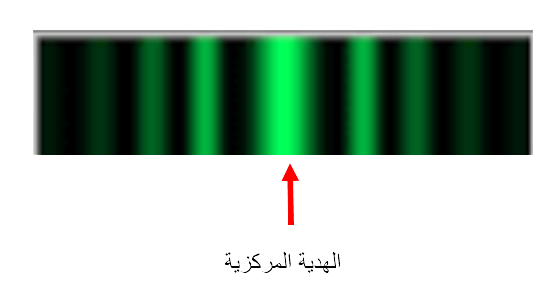
أُسقط ضوء وحيد اللون على فتحة صغيرة فحدث الحيود واستُقبل الضوء على حاجز. غُيّر لون الضوء دون أي تغيير آخر فلوحظ أن الهدبة المركزية ازدادت اتساعًا. هذا يدل على أنه:Monochromatic light falls on a small opening and diffraction occurs on a screen. The colour of the light is changed with nothing else changed, and the central fringe is seen to widen. This means that:
استُخدم ضوء ذو طاقة أعلىlight of higher energy was used
استُخدم ضوء ذو طول موجي أكبرlight of longer wavelength was used
استُخدم ضوء ذو تردد أكبرlight of higher frequency was used
استُخدم ضوء ذو طول موجي أقلlight of shorter wavelength was used
الحلSolution
📌 عرض الهدبة المركزية \(2X=\dfrac{2\lambda L}{d}\) يتناسب طرديًا مع الطول الموجي: كلما زاد \(\lambda\) زاد عرض الهدبة.
📌 الطول الموجي الأكبر يعني تردد وطاقة أقل (وليس أعلى).
✅ استُخدم ضوء ذو طول موجي أكبر (B)
📌 The central fringe width \(2X=\dfrac{2\lambda L}{d}\) is directly proportional to the wavelength: the larger \(\lambda\) is, the wider the fringe.
📌 A longer wavelength means a lower (not higher) frequency and energy.
✅ light of longer wavelength was used (B)
\[14\,\star\star\]
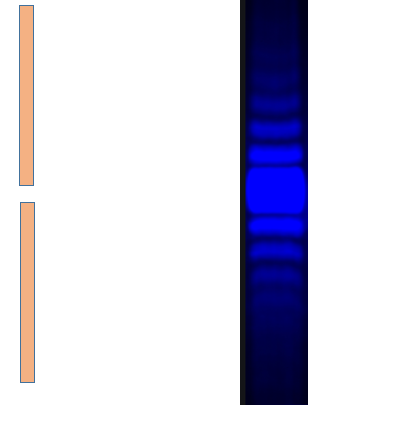
في تجربة حيود الشق المفرد استُخدم شق عرضه \(0.086\,mm\) وبعد الشاشة عن الشق \(0.72\,m\)، فكان عرض الهدبة المركزية \(8.5\,mm\). الطول الموجي للضوء المستخدم:In a single-slit diffraction experiment a slit \(0.086\,mm\) wide is used with the screen \(0.72\,m\) from the slit, and the central fringe is \(8.5\,mm\) wide. The wavelength of the light is:
\(\lambda=3.11\times10^{-7}\,m\)\(\lambda=3.11\times10^{-7}\,m\)
\(\lambda=4.63\times10^{-7}\,m\)\(\lambda=4.63\times10^{-7}\,m\)
\(\lambda=6.32\times10^{-7}\,m\)\(\lambda=6.32\times10^{-7}\,m\)
\(\lambda=5.1\times10^{-7}\,m\)\(\lambda=5.1\times10^{-7}\,m\)
الحلSolution
\(2X=\dfrac{2\lambda L}{d}\Rightarrow\lambda=\dfrac{2X\,d}{2L}=\dfrac{8.5\times10^{-3}\times0.086\times10^{-3}}{2\times0.72}\).
\(\lambda=5.1\times10^{-7}\,m\) (ضوء أخضر).
✅ \(\lambda=5.1\times10^{-7}\,m\) (D)
\(2X=\dfrac{2\lambda L}{d}\Rightarrow\lambda=\dfrac{2X\,d}{2L}=\dfrac{8.5\times10^{-3}\times0.086\times10^{-3}}{2\times0.72}\).
\(\lambda=5.1\times10^{-7}\,m\) (green light).
✅ \(\lambda=5.1\times10^{-7}\,m\) (D)
\[15\,\star\]
في تجربة الشق المفرد أُسقطت أربعة أضواء وحيدة اللون (أخضر، أحمر، أزرق، بنفسجي) على الشق بالتتابع. أكبر عرض للهدبة المركزية يكون للضوء:In a single-slit experiment four monochromatic lights (green, red, blue, violet) are directed at the slit in turn. The widest central fringe is for:

الأخضرgreen
الأحمرred
الأزرقblue
البنفسجيviolet
الحلSolution
\(2X=\dfrac{2\lambda L}{d}\): العلاقة طردية بين عرض الهدبة والطول الموجي، والأحمر أكبر الألوان المذكورة طولًا موجيًا.
✅ الأحمر (B)
\(2X=\dfrac{2\lambda L}{d}\): the fringe width is directly proportional to the wavelength, and red has the longest wavelength of those listed.
✅ red (B)
\[16\,\star\star\star\]
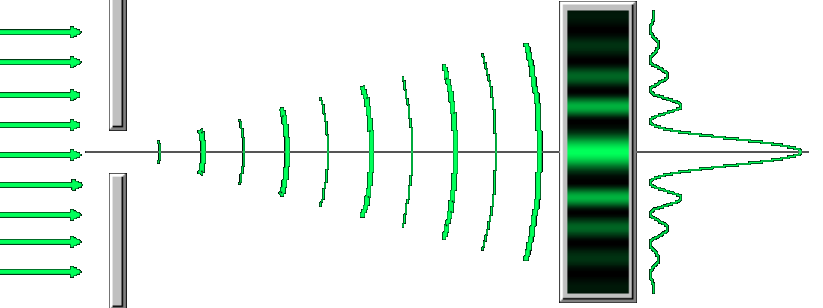
استُخدم ضوء أخضر طوله الموجي \(5.61\times10^{-7}\,m\) في تجربة شق أحادي عرضه \(d=0.07\,mm\) وبعد الشاشة عن الشق \(60\,cm\). عرض الهدبة المركزية:Green light of wavelength \(5.61\times10^{-7}\,m\) is used in a single-slit experiment with a slit \(d=0.07\,mm\) wide and the screen \(60\,cm\) away. The width of the central fringe is:
\(2X=2.18\times10^{-3}\,m\)\(2X=2.18\times10^{-3}\,m\)
\(2X=6.17\times10^{-3}\,m\)\(2X=6.17\times10^{-3}\,m\)
\(2X=9.6\times10^{-3}\,m\)\(2X=9.6\times10^{-3}\,m\)
\(2X=4.37\times10^{-3}\,m\)\(2X=4.37\times10^{-3}\,m\)
الحلSolution
📌 حوّل الوحدات: \(d=0.07\times10^{-3}\,m\) و\(L=0.6\,m\).
\(2X=\dfrac{2\lambda L}{d}=\dfrac{2\times5.61\times10^{-7}\times0.6}{0.07\times10^{-3}}=9.6\times10^{-3}\,m\) (لا تنسَ العامل \(2\) في البسط).
✅ \(2X=9.6\times10^{-3}\,m\) (C)
📌 Convert the units: \(d=0.07\times10^{-3}\,m\) and \(L=0.6\,m\).
\(2X=\dfrac{2\lambda L}{d}=\dfrac{2\times5.61\times10^{-7}\times0.6}{0.07\times10^{-3}}=9.6\times10^{-3}\,m\) (do not forget the factor \(2\) in the numerator).
✅ \(2X=9.6\times10^{-3}\,m\) (C)
\[17\,\star\]
محزوز حيود يحتوي على \(6000\) شق في كل سنتيمتر. المسافة بين شقين متتاليين:A diffraction grating has \(6000\) slits per centimetre. The distance between two successive slits is:
\(d=1.67\times10^{-7}\,m\)\(d=1.67\times10^{-7}\,m\)
\(d=1.67\times10^{-5}\,m\)\(d=1.67\times10^{-5}\,m\)
\(d=1.67\times10^{-6}\,m\)\(d=1.67\times10^{-6}\,m\)
\(d=1.67\times10^{-4}\,m\)\(d=1.67\times10^{-4}\,m\)
الحلSolution
\(d=\dfrac{\text{length in metres}}{\text{number of slits}}=\dfrac{0.01}{6000}=1.67\times10^{-6}\,m\).
✅ \(d=1.67\times10^{-6}\,m\) (C)
\(d=\dfrac{\text{length in metres}}{\text{number of slits}}=\dfrac{0.01}{6000}=1.67\times10^{-6}\,m\).
✅ \(d=1.67\times10^{-6}\,m\) (C)
\[18\,\star\]
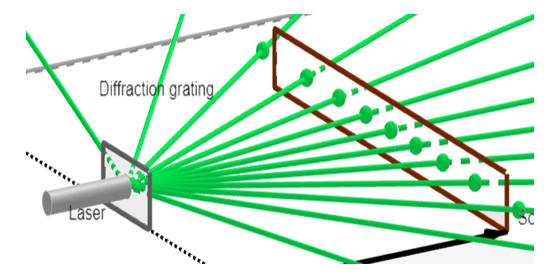
سُلّطت على محزوز حيود أربعة ألوان من الضوء بالتتابع (أحمر، أزرق، أخضر، أصفر). أقل عدد من الأهداب يظهر على الشاشة عند استخدام الضوء:Four colours of light (red, blue, green, yellow) are directed in turn at a diffraction grating. The smallest number of fringes appears on the screen with:
الأزرقblue
الأخضرgreen
الأصفرyellow
الأحمرred
الحلSolution
\(d\sin\theta=m\lambda\): العلاقة طردية بين الطول الموجي وبعد الهدبة عن خط الوسط، فالأحمر (أكبر طول موجي) تتباعد أهدابه أكثر.
📌 كلما زاد بعد الأهداب عن بعضها قلّ عددها على الشاشة (أعلى رتبة \(m\le d/\lambda\) أصغر).
✅ الأحمر (D)
\(d\sin\theta=m\lambda\): the distance of a fringe from the central line grows with the wavelength, so the red fringes are the most widely spaced.
📌 The farther apart the fringes are, the fewer of them fit on the screen (the highest order \(m\le d/\lambda\) is smaller).
✅ red (D)
\[19\,\star\star\]
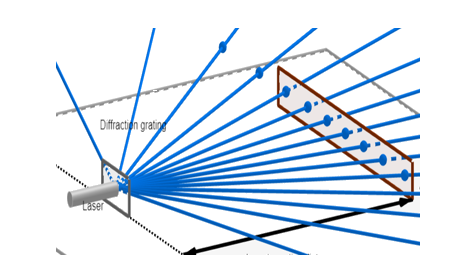
محزوز حيود فيه \(5000\) شق لكل سنتيمتر مرّ عليه ضوء وحيد اللون طوله الموجي \(4.5\times10^{-7}\,m\). الزاوية التي يصنعها الخط المار بالهدبة المضيئة الثالثة مع خط الوسط:A diffraction grating has \(5000\) slits per centimetre and monochromatic light of wavelength \(4.5\times10^{-7}\,m\) passes through it. The angle made with the central line by the line through the third bright fringe is:
\(\theta=33.8^{\circ}\)\(\theta=33.8^{\circ}\)
\(\theta=25.5^{\circ}\)\(\theta=25.5^{\circ}\)
\(\theta=51.7^{\circ}\)\(\theta=51.7^{\circ}\)
\(\theta=42.4^{\circ}\)\(\theta=42.4^{\circ}\)
الحلSolution
\(d=\dfrac{0.01}{5000}=2\times10^{-6}\,m\).
\(\sin\theta=\dfrac{m\lambda}{d}=\dfrac{3\times4.5\times10^{-7}}{2\times10^{-6}}=0.675\Rightarrow\theta=42.4^{\circ}\).
✅ \(\theta=42.4^{\circ}\) (D)
\(d=\dfrac{0.01}{5000}=2\times10^{-6}\,m\).
\(\sin\theta=\dfrac{m\lambda}{d}=\dfrac{3\times4.5\times10^{-7}}{2\times10^{-6}}=0.675\Rightarrow\theta=42.4^{\circ}\).
✅ \(\theta=42.4^{\circ}\) (D)
\[20\,\star\]
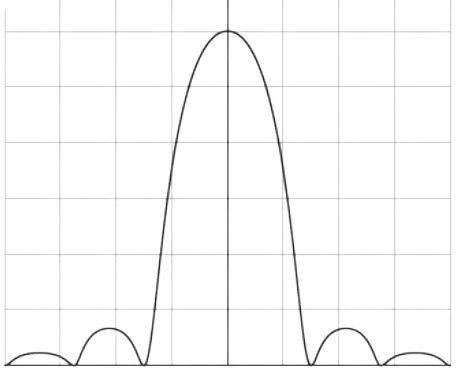
يبيّن الشكل توزيع شدة الضوء أحادي اللون المار عبر شق ضيق على الشاشة. عند تقليل عرض الشق، أي الرسوم الأربعة يوضح توزيع الشدة الجديد (بمقياس الرسم نفسه)؟The figure shows the intensity distribution of monochromatic light passing through a narrow slit onto a screen. When the slit width is reduced, which of the four graphs shows the new distribution (drawn to the same scale)?
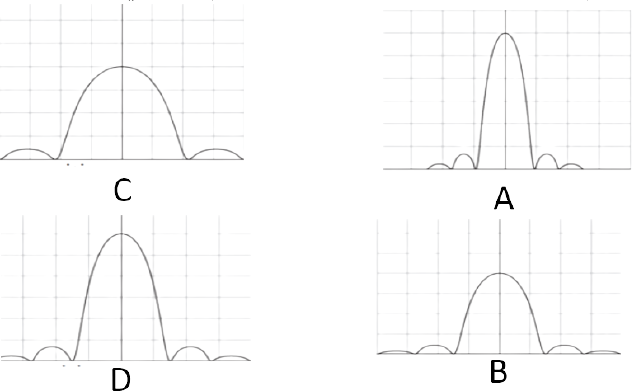
الرسم Agraph A
الرسم Bgraph B
الرسم Cgraph C
الرسم Dgraph D
الحلSolution
\(2X=\dfrac{2\lambda L}{d}\): عند تقليل عرض الشق \(d\) يزداد عرض الهدبة المركزية.
📌 ويتوزع الضوء على مساحة أكبر فتقل شدته: الرسم C (أعرض وأقل ارتفاعًا).
✅ الرسم C (C)
\(2X=\dfrac{2\lambda L}{d}\): when the slit width \(d\) is reduced, the central fringe becomes wider.
📌 The light is spread over a larger area so its intensity falls: graph C (wider and lower).
✅ graph C (C)
\[21\,\star\]
أي مما يلي يكون أكثر انحرافًا (حيودًا) عند وقوعه على شق عرضه \(1\,cm\)؟Which of the following is diffracted the most when it falls on a slit \(1\,cm\) wide?
الأشعة فوق البنفسجيةultraviolet rays
الميكروويفmicrowaves
الأشعة السينيةX-rays
الضوء الأحمرred light
الحلSolution
📌 الحيود أوضح كلما اقترب الطول الموجي من عرض الشق: \(2X=\dfrac{2\lambda L}{d}\propto\lambda\).
📌 الميكروويف طوله الموجي بين نحو \(1\,mm\) و\(30\,cm\) وهو الأكبر بين الخيارات (الأحمر نحو \(700\,nm\) والسينية أصغر بكثير).
✅ الميكروويف (B)
📌 Diffraction is clearer the closer the wavelength is to the slit width: \(2X=\dfrac{2\lambda L}{d}\propto\lambda\).
📌 Microwaves have wavelengths from about \(1\,mm\) to \(30\,cm\), the largest among the options (red is about \(700\,nm\) and X-rays are much smaller).
✅ microwaves (B)
\[22\,\star\star\]
سقط شعاع ضوء وحيد اللون على شق مفرد عرضه \(d\) واستُقبل على شاشة تبعد \(L\) عن الشق. أي التغييرات التالية، كل على حدة، يزيد عرض الحزمة المركزية؟A beam of visible monochromatic light falls on a single slit of width \(d\) and is received on a screen at a distance \(L\) from the slit. Which of the following changes, made separately, increases the width of the central fringe?
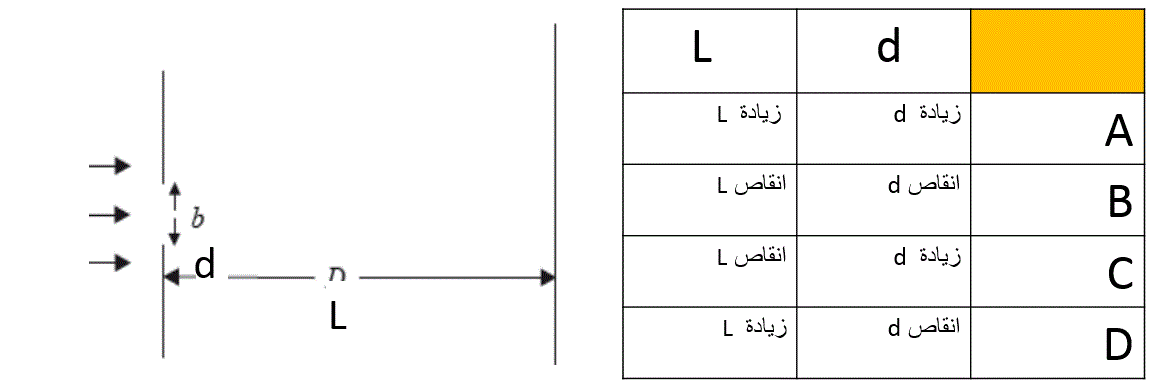
زيادة \(L\) وزيادة \(d\)increasing \(L\) and increasing \(d\)
إنقاص \(L\) وإنقاص \(d\)decreasing \(L\) and decreasing \(d\)
إنقاص \(L\) وزيادة \(d\)decreasing \(L\) and increasing \(d\)
زيادة \(L\) وإنقاص \(d\)increasing \(L\) and decreasing \(d\)
الحلSolution
\(2X=\dfrac{2\lambda L}{d}\): العرض يتناسب طرديًا مع \(L\) وعكسيًا مع \(d\).
📌 فيزداد العرض بزيادة \(L\) وإنقاص \(d\) (الصف D في الجدول).
✅ زيادة \(L\) وإنقاص \(d\) (D)
\(2X=\dfrac{2\lambda L}{d}\): the width is directly proportional to \(L\) and inversely proportional to \(d\).
📌 So the width grows when \(L\) is increased and \(d\) is decreased (row D of the table).
✅ increasing \(L\) and decreasing \(d\) (D)
\[23\,\star\star\]
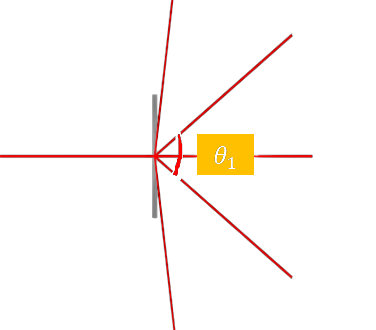
سقط ضوء أحادي اللون على محزوز حيود فتكونت أهداب تداخل، والزاوية \(\theta_1\) هي الزاوية بين الحزمتين المضيئتين الأوليين على جانبي الحزمة المركزية، والبعد بين شقين متتاليين \(d\). الطول الموجي للضوء:Monochromatic light falls on a diffraction grating and produces interference fringes. The angle \(\theta_1\) is the angle between the two first-order bright beams on either side of the central beam, and the distance between two successive slits is \(d\). The wavelength of the light is:
\(\lambda=\dfrac{\sin\theta_1}{d}\)\(\lambda=\dfrac{\sin\theta_1}{d}\)
\(\lambda=\dfrac{\sin(\theta_1/2)}{d}\)\(\lambda=\dfrac{\sin(\theta_1/2)}{d}\)
\(\lambda=d\,\sin\dfrac{\theta_1}{2}\)\(\lambda=d\,\sin\dfrac{\theta_1}{2}\)
\(\lambda=d\,\sin\theta_1\)\(\lambda=d\,\sin\theta_1\)
الحلSolution
📌 الزاوية بين الحزمة المركزية والحزمة الأولى هي نصف الزاوية بين الحزمتين الأوليين على الجانبين: \(\theta=\dfrac{\theta_1}{2}\).
📌 بتطبيق \(d\sin\theta=m\lambda\) مع \(m=1\): \(\lambda=d\,\sin\dfrac{\theta_1}{2}\).
✅ \(\lambda=d\,\sin\dfrac{\theta_1}{2}\) (C)
📌 The angle between the central beam and the first-order beam is half the angle between the two first-order beams on either side: \(\theta=\dfrac{\theta_1}{2}\).
📌 Applying \(d\sin\theta=m\lambda\) with \(m=1\): \(\lambda=d\,\sin\dfrac{\theta_1}{2}\).
✅ \(\lambda=d\,\sin\dfrac{\theta_1}{2}\) (C)
\[24\,\star\star\]
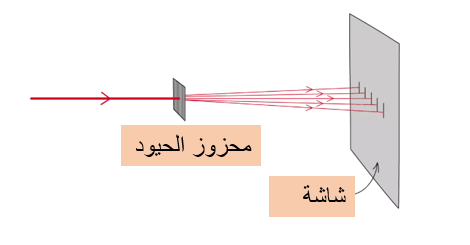
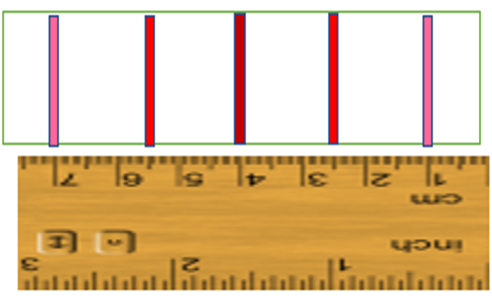
استُخدم ضوء طوله الموجي \(667\,nm\) على محزوز حيود وُضعت خلفه شاشة على بعد \(0.5\,m\) فظهرت الأهداب كما في الشكل (المسافة من الهدبة المركزية إلى الأولى \(1.5\,cm\)). عدد الشقوق في المتر الواحد:Light of wavelength \(667\,nm\) is used on a diffraction grating with a screen \(0.5\,m\) behind it, and the fringes appear as in the figure (the distance from the central fringe to the first one is \(1.5\,cm\)). The number of slits per metre is:
44977 شق44977 slits
23432 شق23432 slits
68786 شق68786 slits
98751 شق98751 slits
الحلSolution
📌 زاوية صغيرة فنأخذ \(\sin\theta\approx\tan\theta=\dfrac{x}{L}\)، والشرط للرتبة الأولى \(\dfrac{\lambda}{d}=\dfrac{x}{L}\).
\(d=\dfrac{\lambda L}{x}=\dfrac{667\times10^{-9}\times0.5}{1.5\times10^{-2}}=2.22\times10^{-5}\,m\).
\(N=\dfrac{1}{d}=\dfrac{1}{2.2233\times10^{-5}}\approx44977\ \text{slits/m}\).
✅ 44977 شق (A)
📌 The angle is small so \(\sin\theta\approx\tan\theta=\dfrac{x}{L}\), and the first-order condition is \(\dfrac{\lambda}{d}=\dfrac{x}{L}\).
\(d=\dfrac{\lambda L}{x}=\dfrac{667\times10^{-9}\times0.5}{1.5\times10^{-2}}=2.22\times10^{-5}\,m\).
\(N=\dfrac{1}{d}=\dfrac{1}{2.2233\times10^{-5}}\approx44977\ \text{slits/m}\).
✅ 44977 slits (A)
\[25\,\star\]
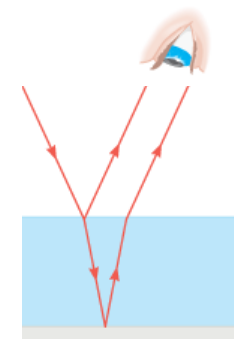
حتى يحدث تداخل واضح في الأغشية الرقيقة للضوء المرئي (طوله الموجي من رتبة \(10^{-7}\,m\)) يجب أن يكون سمك الغشاء من رتبة:For clear interference in thin films with visible light (wavelength of the order of \(10^{-7}\,m\)) the thickness of the film must be of the order of:
\(10^{-12}\,m\)\(10^{-12}\,m\)
\(10^{-6}\,m\)\(10^{-6}\,m\)
\(10^{-9}\,m\)\(10^{-9}\,m\)
\(10^{-2}\,m\)\(10^{-2}\,m\)
الحلSolution
📌 التداخل في الأغشية الرقيقة ينتج عن انعكاس الضوء على سطحين متقاربين: يجب أن يكون السمك قريبًا من الطول الموجي (من رتبة \(10^{-7}\)–\(10^{-6}\,m\)).
📌 سمك أصغر بكثير (ذرّي \(10^{-9}\)) لا يعطي فرق مسار مؤثرًا، وأكبر بكثير (مليمترات) تضيع معه الترابط بين الشعاعين فتختفي الألوان.
✅ \(10^{-6}\,m\) (B)
📌 Thin-film interference comes from reflections on two close surfaces: the thickness must be close to the wavelength (of the order of \(10^{-7}\)–\(10^{-6}\,m\)).
📌 A much smaller thickness (atomic, \(10^{-9}\)) gives no noticeable path difference, and a much larger one (millimetres) destroys the coherence of the two rays so the colours disappear.
✅ \(10^{-6}\,m\) (B)
\[26\,\star\star\]
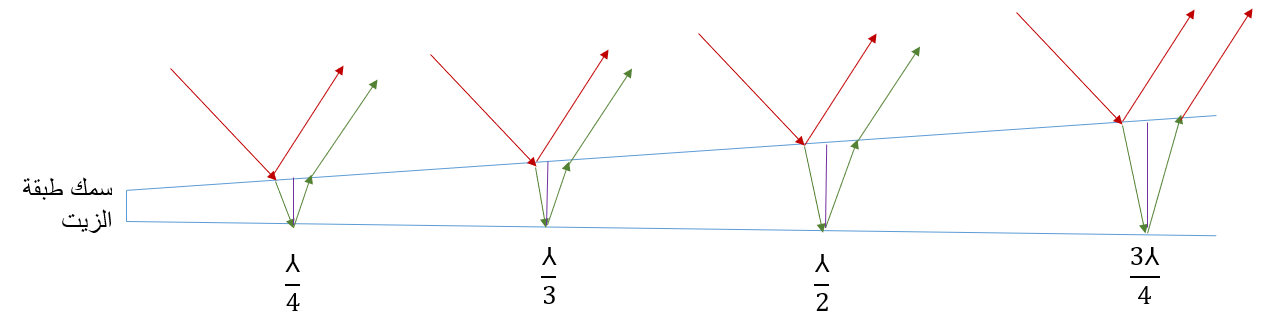
سقط ضوء من الهواء على طبقة رقيقة من الزيت سمكها متغير (إسفين) بترتيب الطول الموجي (انظر الشكل، السمك بدلالة الطول الموجي داخل الزيت \(\lambda\)). عند أي سمك يظهر الظلام (تداخل هدّام)؟ (الزيت على الماء)Light falls from air on a thin wedge-shaped oil layer whose thickness is of the order of the wavelength (see the figure, thickness in terms of the wavelength inside the oil \(\lambda\)). At which thickness does darkness (destructive interference) appear? (the oil lies on water)
\(X=\lambda/2\)\(X=\lambda/2\)
\(X=\lambda/4\)\(X=\lambda/4\)
\(X=3\lambda/4\)\(X=3\lambda/4\)
\(X=\lambda/3\)\(X=\lambda/3\)
الحلSolution
📌 الموجة المنعكسة عن السطح العلوي تنقلب (نصف طول موجة)، أما الداخلة والعائدة من السطح السفلي فتقطع \(2X\) ولا تنقلب (زيت ← ماء).
📌 تداخل هدّام: \(2X=m\lambda\) فأقل سمك \(X=\dfrac{\lambda}{2}\) حيث يصير فرق المسار الكلي موجة ونصفًا (موجة كاملة + نصف الموجة المنقلبة).
📌 الأسماك \(\lambda/4\) و\(3\lambda/4\) تعطي تداخلًا بنّاءً (لمعانًا)، و\(\lambda/3\) لا تحقق أيًّا منهما.
✅ \(X=\lambda/2\) (A)
📌 The wave reflected from the top surface is inverted (half a wavelength), while the one entering and returning from the bottom surface travels an extra \(2X\) and is not inverted (oil → water).
📌 Destructive interference: \(2X=m\lambda\) so the least thickness is \(X=\dfrac{\lambda}{2}\), when the total path difference is one and a half wavelengths (a full wavelength plus the half-wave inversion).
📌 The thicknesses \(\lambda/4\) and \(3\lambda/4\) give constructive interference (brightness) and \(\lambda/3\) satisfies neither.
✅ \(X=\lambda/2\) (A)
\[27\,\star\]
يشترط لحدوث تداخل واضح ثابت بين موجتين ضوئيتين أن يكون المنبعان:For clear, steady interference between two light waves the sources must be:
مختلفين في التردد ومتساويين في الطاقةof different frequencies and equal energies
مصباحين عاديين بلونين مختلفينtwo ordinary lamps of different colours
منبعين تتغير أطوارهما عشوائيًاtwo sources whose phases vary randomly
مترابطين (فرق الطور بينهما ثابت) ووحيدي اللون وبالتردد نفسهcoherent (constant phase difference), monochromatic and of the same frequency
الحلSolution
📌 المنبعان المترابطان لهما التردد نفسه وفرق طور ثابت، فتبقى مواضع القمم والقيعان ثابتة فتظهر الأهداب مستقرة.
✅ مترابطين (فرق الطور بينهما ثابت) ووحيدي اللون وبالتردد نفسه (D)
📌 Coherent sources have the same frequency and a constant phase difference, so the crest and trough positions stay fixed and steady fringes appear.
✅ coherent (constant phase difference), monochromatic and of the same frequency (D)
\[28\,\star\]
عند نقطة على الشاشة في تجربة الشقين كان فرق المسار بين الموجتين \(3\lambda\). نوع التداخل عندها:At a point on the screen in the double-slit experiment the path difference of the two waves is \(3\lambda\). The interference there is:
بنّاء (هدبة مضيئة من الرتبة الثالثة)constructive (a bright fringe of order 3)
هدّام (هدبة مظلمة من الرتبة الثالثة)destructive (a dark fringe of order 3)
بنّاء (هدبة مضيئة من الرتبة الأولى)constructive (a bright fringe of order 1)
لا يحدث تداخلno interference occurs
الحلSolution
📌 فرق المسار عدد صحيح من الأطوال الموجية \(\Delta x=m\lambda\) ← تداخل بنّاء، ورتبته \(m=3\).
✅ بنّاء (هدبة مضيئة من الرتبة الثالثة) (A)
📌 A path difference of a whole number of wavelengths \(\Delta x=m\lambda\) gives constructive interference, of order \(m=3\).
✅ constructive (a bright fringe of order 3) (A)
\[29\,\star\star\]
في تجربة شقي يونغ طول موجة الضوء \(600\,nm\) والمسافة بين الشقين \(0.3\,mm\) وبعد الشاشة \(1.5\,m\). البعد بين هدبتين مضيئتين متتاليتين:In Young's experiment the wavelength is \(600\,nm\), the slit separation \(0.3\,mm\) and the screen distance \(1.5\,m\). The distance between two successive bright fringes is:
\(0.3\,mm\)\(0.3\,mm\)
\(30\,mm\)\(30\,mm\)
\(1.2\,mm\)\(1.2\,mm\)
\(3\,mm\)\(3\,mm\)
الحلSolution
\(\Delta y=\dfrac{\lambda L}{d}=\dfrac{6\times10^{-7}\times1.5}{3\times10^{-4}}=3\times10^{-3}\,m=3\,mm\).
✅ \(3\,mm\) (D)
\(\Delta y=\dfrac{\lambda L}{d}=\dfrac{6\times10^{-7}\times1.5}{3\times10^{-4}}=3\times10^{-3}\,m=3\,mm\).
✅ \(3\,mm\) (D)
\[30\,\star\star\]
إذا ضوعفت المسافة بين الشقين في تجربة يونغ السابقة (وبقي كل شيء آخر ثابتًا) فإن البعد بين الهدبتين المضيئتين المتتاليتين:If the separation of the slits in the previous Young experiment is doubled (everything else unchanged), the distance between two successive bright fringes:
يتضاعف (\(6\,mm\))doubles (\(6\,mm\))
ينقص إلى النصف (\(1.5\,mm\))is halved (\(1.5\,mm\))
لا يتغيرdoes not change
يصبح أربعة أضعافbecomes four times as large
الحلSolution
\(\Delta y=\dfrac{\lambda L}{d}\propto\dfrac1d\) فمضاعفة \(d\) تنقص الفاصل إلى النصف (الأهداب أكثر عددًا وأضيق).
✅ ينقص إلى النصف (\(1.5\,mm\)) (B)
\(\Delta y=\dfrac{\lambda L}{d}\propto\dfrac1d\) so doubling \(d\) halves the separation (more numerous and narrower fringes).
✅ is halved (\(1.5\,mm\)) (B)
\[31\,\star\star\]
في التجربة السابقة موضع أول هدبة مظلمة بالنسبة للهدبة المركزية:In the previous experiment the position of the first dark fringe relative to the central fringe is:
\(3\,mm\)\(3\,mm\)
\(1.5\,mm\)\(1.5\,mm\)
\(0.75\,mm\)\(0.75\,mm\)
\(6\,mm\)\(6\,mm\)
الحلSolution
📌 للهدب المظلم \(\Delta x=\left(m-\tfrac12\right)\lambda\) فالأولى \(y=\dfrac{\lambda L}{2d}=\dfrac{\Delta y}{2}=1.5\,mm\) (تقع في منتصف المسافة بين الهدبتين المضيئتين الأولى والمركزية).
✅ \(1.5\,mm\) (B)
📌 For dark fringes \(\Delta x=\left(m-\tfrac12\right)\lambda\) so the first is at \(y=\dfrac{\lambda L}{2d}=\dfrac{\Delta y}{2}=1.5\,mm\) (midway between the central and the first bright fringe).
✅ \(1.5\,mm\) (B)
\[32\,\star\star\star\]
إذا غُمرت تجربة الشقين السابقة كلها في الماء (\(n=1.33\)) فإن البعد بين الأهداب المضيئة المتتالية:If the whole previous double-slit setup is immersed in water (\(n=1.33\)), the distance between successive bright fringes:
يصبح نحو \(2.26\,mm\) (أقل)becomes about \(2.26\,mm\) (smaller)
يصبح نحو \(4\,mm\) (أكبر)becomes about \(4\,mm\) (larger)
لا يتغيرdoes not change
يصبح صفرًاbecomes zero
الحلSolution
📌 التردد ثابت وسرعة الضوء في الماء أقل فيقصر الطول الموجي: \(\lambda_{water}=\dfrac{\lambda}{n}=\dfrac{600}{1.33}=451\,nm\).
\(\Delta y\propto\lambda\) فتصبح \(\dfrac{3}{1.33}=2.26\,mm\).
✅ يصبح نحو \(2.26\,mm\) (أقل) (A)
📌 The frequency is constant and light is slower in water, so the wavelength shortens: \(\lambda_{water}=\dfrac{\lambda}{n}=\dfrac{600}{1.33}=451\,nm\).
\(\Delta y\propto\lambda\) so it becomes \(\dfrac{3}{1.33}=2.26\,mm\).
✅ becomes about \(2.26\,mm\) (smaller) (A)
\[33\,\star\star\]
في تجربة الشقين ظهرت الهدبة المضيئة الخامسة على بعد \(12\,mm\) من المركز، وطول موجة الضوء \(500\,nm\) وبعد الشاشة \(2\,m\). المسافة بين الشقين:In a double-slit experiment the fifth bright fringe appears \(12\,mm\) from the centre, the wavelength is \(500\,nm\) and the screen is \(2\,m\) away. The slit separation is:
\(0.083\,mm\)\(0.083\,mm\)
\(2.4\,mm\)\(2.4\,mm\)
\(0.417\,mm\)\(0.417\,mm\)
\(0.12\,mm\)\(0.12\,mm\)
الحلSolution
\(d=\dfrac{m\lambda L}{y}=\dfrac{5\times5\times10^{-7}\times2}{12\times10^{-3}}=4.17\times10^{-4}\,m=0.417\,mm\).
✅ \(0.417\,mm\) (C)
\(d=\dfrac{m\lambda L}{y}=\dfrac{5\times5\times10^{-7}\times2}{12\times10^{-3}}=4.17\times10^{-4}\,m=0.417\,mm\).
✅ \(0.417\,mm\) (C)
\[34\,\star\star\]
شق مفرد عرضه \(0.2\,mm\) يسقط عليه ضوء \(500\,nm\) وبعد الشاشة \(2\,m\). عرض الهدبة المركزية:A single slit \(0.2\,mm\) wide is lit by \(500\,nm\) light and the screen is \(2\,m\) away. The width of the central fringe is:
\(5\,mm\)\(5\,mm\)
\(1\,mm\)\(1\,mm\)
\(10\,mm\)\(10\,mm\)
\(20\,mm\)\(20\,mm\)
الحلSolution
\(2X=\dfrac{2\lambda L}{d}=\dfrac{2\times5\times10^{-7}\times2}{2\times10^{-4}}=0.01\,m=10\,mm\).
✅ \(10\,mm\) (C)
\(2X=\dfrac{2\lambda L}{d}=\dfrac{2\times5\times10^{-7}\times2}{2\times10^{-4}}=0.01\,m=10\,mm\).
✅ \(10\,mm\) (C)
\[35\,\star\star\]
عند مرور ضوء أبيض عبر شق مفرد يكون نمط الحيود على الشاشة:When white light passes through a single slit the diffraction pattern on the screen is:
أهداب سوداء وبيضاء فقطonly black and white fringes
هدبة مركزية بيضاء تحيط بها أهداب ملوّنةa white central fringe surrounded by coloured fringes
هدبة مركزية حمراء فقطa red central fringe only
لا يظهر نمطno pattern appears
الحلSolution
📌 في المركز تتفق كل الأطوال الموجية في الطور (فرق المسار صفر) فتتحد وتعطي الأبيض.
📌 وخارج المركز تختلف مواضع أهداب كل لون (\(\propto\lambda\)) فتظهر أهداب ملوّنة (البنفسجي أقرب والأحمر أبعد).
✅ هدبة مركزية بيضاء تحيط بها أهداب ملوّنة (B)
📌 At the centre all wavelengths are in phase (zero path difference) and combine to give white.
📌 Away from the centre each colour's fringes lie at a different position (\(\propto\lambda\)), so coloured fringes appear (violet nearer, red farther).
✅ a white central fringe surrounded by coloured fringes (B)
\[36\,\star\star\]
محزوز فيه \(300\) شق لكل مليمتر يسقط عليه ضوء \(600\,nm\). زاوية الرتبة الأولى:A grating has \(300\) slits per millimetre and light of \(600\,nm\) falls on it. The first-order angle is:
\(10.4^{\circ}\)\(10.4^{\circ}\)
\(21.0^{\circ}\)\(21.0^{\circ}\)
\(5.2^{\circ}\)\(5.2^{\circ}\)
\(35.7^{\circ}\)\(35.7^{\circ}\)
الحلSolution
\(d=\dfrac{1\,mm}{300}=3.33\,\mu m\) و\(\sin\theta=\dfrac{\lambda}{d}=\dfrac{0.6}{3.33}=0.18\Rightarrow\theta=10.4^{\circ}\).
✅ \(10.4^{\circ}\) (A)
\(d=\dfrac{1\,mm}{300}=3.33\,\mu m\) and \(\sin\theta=\dfrac{\lambda}{d}=\dfrac{0.6}{3.33}=0.18\Rightarrow\theta=10.4^{\circ}\).
✅ \(10.4^{\circ}\) (A)
\[37\,\star\star\star\]
ضوءان طولاهما الموجيان \(450\,nm\) و\(650\,nm\) يسقطان على محزوز فيه \(500\) شق لكل مليمتر. الفرق بين زاويتي الرتبة الأولى للضوءين:Two lights of wavelengths \(450\,nm\) and \(650\,nm\) fall on a grating with \(500\) slits per millimetre. The difference between their first-order angles is:
\(13.0^{\circ}\)\(13.0^{\circ}\)
\(19.0^{\circ}\)\(19.0^{\circ}\)
\(3.0^{\circ}\)\(3.0^{\circ}\)
\(6.0^{\circ}\)\(6.0^{\circ}\)
الحلSolution
\(d=2\,\mu m\): \(\sin\theta_1=\dfrac{0.45}{2}=0.225\Rightarrow13.0^{\circ}\) و\(\sin\theta_2=\dfrac{0.65}{2}=0.325\Rightarrow19.0^{\circ}\).
📌 الفرق \(19.0^{\circ}-13.0^{\circ}=6.0^{\circ}\) (وهكذا يفصل المحزوز بين اللونين).
✅ \(6.0^{\circ}\) (D)
\(d=2\,\mu m\): \(\sin\theta_1=\dfrac{0.45}{2}=0.225\Rightarrow13.0^{\circ}\) and \(\sin\theta_2=\dfrac{0.65}{2}=0.325\Rightarrow19.0^{\circ}\).
📌 The difference is \(19.0^{\circ}-13.0^{\circ}=6.0^{\circ}\) (this is how the grating separates the two colours).
✅ \(6.0^{\circ}\) (D)
\[38\,\star\star\]
عند سقوط الضوء من الهواء على فقاعة صابون (غشاء رقيق معامل انكساره أكبر من الهواء) يحدث انقلاب في الطور للشعاع المنعكس عن:When light falls from air on a soap bubble (a thin film of refractive index greater than air), a phase inversion occurs for the ray reflected from:
السطح السفلي (صابون ← هواء) فقطthe bottom surface (soap → air) only
السطحين معًاboth surfaces
السطح العلوي (هواء ← صابون) فقطthe top surface (air → soap) only
لا ينقلب الطور عند أي سطحneither surface
الحلSolution
📌 الانعكاس عن سطح وسط معامل انكساره أكبر ينقلب (هواء ← صابون). أما الانعكاس عن السطح السفلي (صابون ← هواء) فلا ينقلب لأن معامل الهواء أقل.
✅ السطح العلوي (هواء ← صابون) فقط (C)
📌 Reflection from a medium of larger index is inverted (air → soap). Reflection from the bottom surface (soap → air) is not inverted because air has the smaller index.
✅ the top surface (air → soap) only (C)
\[39\,\star\star\star\]
غشاء صابون (\(n=1.33\)) في الهواء. أقل سمك يعطي تداخلًا بنّاء لضوء منعكس طوله الموجي \(560\,nm\):A soap film (\(n=1.33\)) hangs in air. The minimum thickness that gives constructive interference of reflected light of wavelength \(560\,nm\) is:
\(2.1\times10^{-7}\,m\)\(2.1\times10^{-7}\,m\)
\(1.05\times10^{-7}\,m\)\(1.05\times10^{-7}\,m\)
\(4.2\times10^{-7}\,m\)\(4.2\times10^{-7}\,m\)
\(5.6\times10^{-7}\,m\)\(5.6\times10^{-7}\,m\)
الحلSolution
📌 انقلاب واحد فقط (عن السطح العلوي) فللتداخل البنّاء \(2nt=\dfrac{\lambda}{2}\) لأقل سمك.
\(t=\dfrac{\lambda}{4n}=\dfrac{560\times10^{-9}}{4\times1.33}=1.05\times10^{-7}\,m\).
✅ \(1.05\times10^{-7}\,m\) (B)
📌 There is only one inversion (at the top surface), so for constructive interference \(2nt=\dfrac{\lambda}{2}\) for the least thickness.
\(t=\dfrac{\lambda}{4n}=\dfrac{560\times10^{-9}}{4\times1.33}=1.05\times10^{-7}\,m\).
✅ \(1.05\times10^{-7}\,m\) (B)
\[40\,\star\star\star\]
طُليت عدسة زجاجية (\(n=1.50\)) بطبقة رقيقة (\(n=1.38\)) لتقليل الانعكاس (طبقة مانعة للانعكاس) لضوء طوله الموجي \(550\,nm\). أقل سمك للطبقة:A glass lens (\(n=1.50\)) is coated with a thin layer (\(n=1.38\)) to reduce reflection (an anti-reflection coating) for light of wavelength \(550\,nm\). The minimum thickness of the layer is:
\(9.96\times10^{-8}\,m\)\(9.96\times10^{-8}\,m\)
\(1.99\times10^{-7}\,m\)\(1.99\times10^{-7}\,m\)
\(3.98\times10^{-7}\,m\)\(3.98\times10^{-7}\,m\)
\(5.5\times10^{-7}\,m\)\(5.5\times10^{-7}\,m\)
الحلSolution
📌 هواء ← طلاء ← زجاج: ينقلب الانعكاس عند السطحين معًا (كل منهما إلى وسط أكبر معامل) فلا يوجد انقلاب نسبي، ويحدث التداخل الهدّام عندما \(2nt=\dfrac{\lambda}{2}\).
\(t=\dfrac{\lambda}{4n}=\dfrac{550\times10^{-9}}{4\times1.38}=9.96\times10^{-8}\,m\).
✅ \(9.96\times10^{-8}\,m\) (A)
📌 Air → coating → glass: both reflections are inverted (each into a medium of larger index), so there is no relative inversion and destructive interference occurs when \(2nt=\dfrac{\lambda}{2}\).
\(t=\dfrac{\lambda}{4n}=\dfrac{550\times10^{-9}}{4\times1.38}=9.96\times10^{-8}\,m\).
✅ \(9.96\times10^{-8}\,m\) (A)
\[41\,\star\star\]
إذا غُطّي أحد الشقين في تجربة يونغ بحاجز معتم فإن النمط على الشاشة يصبح:If one of the slits in Young's experiment is covered by an opaque barrier, the pattern on the screen becomes:
أهداب تداخل متساوية أشد سطوعًاbrighter equal interference fringes
نمط حيود شق مفرد (هدبة مركزية عريضة وأهداب ضعيفة)a single-slit diffraction pattern (a wide central fringe with weak fringes)
شاشة مظلمة تمامًاa completely dark screen
بقعة مضيئة صغيرة بلا أهدابa small bright spot without fringes
الحلSolution
📌 لا يوجد منبعان متراكبان فلا تداخل بين شقين، وتبقى الموجات الثانوية من نقاط الشق الواحد فتعطي حيود الشق المفرد.
✅ نمط حيود شق مفرد (هدبة مركزية عريضة وأهداب ضعيفة) (B)
📌 There are no longer two superposed sources so there is no two-slit interference; only the wavelets from points of the single slit remain, giving single-slit diffraction.
✅ a single-slit diffraction pattern (a wide central fringe with weak fringes) (B)
📝 المسائل المقالية
📝 Essay Problems
\[1\,\star\]
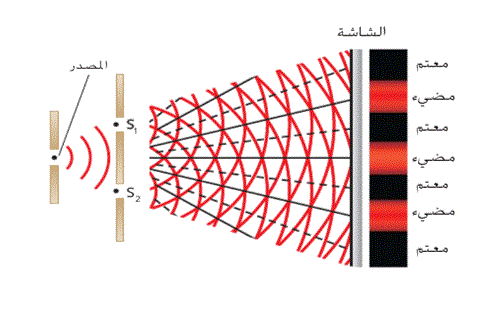
سقط ضوء على شقين المسافة بينهما \(1.2\times10^{-4}\,m\) فظهرت الهدبة المضيئة ذات الرتبة الأولى على بعد \(2.3\,mm\) من الهدبة المركزية، وكان بعد الشاشة عن الشقين \(0.5\,m\). احسب الطول الموجي للضوء المستخدم.Light falls on two slits \(1.2\times10^{-4}\,m\) apart. The first-order bright fringe appears \(2.3\,mm\) from the central fringe and the screen is \(0.5\,m\) from the slits. Find the wavelength of the light.
.....................................................................
الحلSolution
📌 للهدبة المضيئة الأولى \(\lambda=\dfrac{y\,d}{L}\) حيث \(y\) بعد الهدبة عن خط الوسط و\(d\) البعد بين الشقين و\(L\) بعد الشاشة.
\(\lambda=\dfrac{2.3\times10^{-3}\times1.2\times10^{-4}}{0.5}=5.5\times10^{-7}\,m\) (ضوء أخضر).
✅ \(\lambda=5.5\times10^{-7}\,m\)
📌 For the first bright fringe \(\lambda=\dfrac{y\,d}{L}\) where \(y\) is the distance of the fringe from the central line, \(d\) the slit separation and \(L\) the screen distance.
\(\lambda=\dfrac{2.3\times10^{-3}\times1.2\times10^{-4}}{0.5}=5.5\times10^{-7}\,m\) (green light).
✅ \(\lambda=5.5\times10^{-7}\,m\)
\[2\,\star\star\]
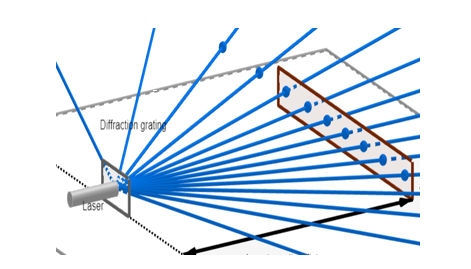
محزوز حيود فيه \(5000\) شق لكل سنتيمتر مرّ عليه ضوء وحيد اللون طوله الموجي \(4.5\times10^{-7}\,m\). احسب الزاوية التي يصنعها الخط المار بالهدبة المضيئة الثالثة مع خط الوسط.A diffraction grating has \(5000\) slits per centimetre and monochromatic light of wavelength \(4.5\times10^{-7}\,m\) passes through it. Find the angle made with the central line by the line through the third bright fringe.
.....................................................................
الحلSolution
\(d=\dfrac{0.01}{5000}=2\times10^{-6}\,m\).
\(d\sin\theta=m\lambda\Rightarrow\sin\theta=\dfrac{3\times4.5\times10^{-7}}{2\times10^{-6}}=0.675\).
\(\theta=\sin^{-1}0.675=42.4^{\circ}\).
✅ \(\theta=42.4^{\circ}\)
\(d=\dfrac{0.01}{5000}=2\times10^{-6}\,m\).
\(d\sin\theta=m\lambda\Rightarrow\sin\theta=\dfrac{3\times4.5\times10^{-7}}{2\times10^{-6}}=0.675\).
\(\theta=\sin^{-1}0.675=42.4^{\circ}\).
✅ \(\theta=42.4^{\circ}\)
\[3\,\star\star\star\]
استُخدم ضوء طوله الموجي \(667\,nm\) على محزوز حيود، ووُضعت شاشة على بعد \(0.5\,m\) فظهرت الأهداب كما في الشكل (المسافة بين الهدبة المركزية والأولى \(1.5\,cm\) مقيسة بالمسطرة). احسب عدد الشقوق في المتر الواحد.Light of wavelength \(667\,nm\) is used on a diffraction grating and a screen is placed \(0.5\,m\) away; the fringes appear as in the figure (the distance between the central fringe and the first is \(1.5\,cm\) as measured with the ruler). Find the number of slits per metre.
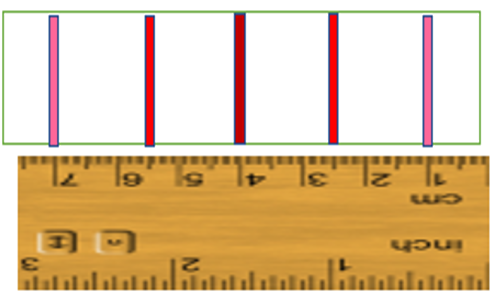
.....................................................................
الحلSolution
📌 الزاوية صغيرة: \(\sin\theta\approx\tan\theta=\dfrac{x}{L}=\dfrac{0.015}{0.5}=0.03\).
📌 للرتبة الأولى \(d\sin\theta=\lambda\): \(d=\dfrac{\lambda}{0.03}=\dfrac{667\times10^{-9}}{0.03}=2.22\times10^{-5}\,m\).
📌 عدد الشقوق في المتر \(N=\dfrac{1}{d}\approx44977\) شقًّا.
✅ \(N\approx44977\ \text{slits/m}\)
📌 The angle is small: \(\sin\theta\approx\tan\theta=\dfrac{x}{L}=\dfrac{0.015}{0.5}=0.03\).
📌 For the first order \(d\sin\theta=\lambda\): \(d=\dfrac{\lambda}{0.03}=\dfrac{667\times10^{-9}}{0.03}=2.22\times10^{-5}\,m\).
📌 The number of slits per metre is \(N=\dfrac{1}{d}\approx44977\) slits.
✅ \(N\approx44977\ \text{slits/m}\)
\[4\,\star\star\]
غشاء رقيق (فقاعة صابون) أقل سمك له \(0.975\times10^{-7}\,m\) ومعامل انكساره \(n=1.33\) والهواء من الجهتين. ما الطول الموجي للضوء الذي يحدث عنده تداخل بنّاء من الرتبة الأولى عند هذا السمك؟A thin film (a soap bubble) has a minimum thickness of \(0.975\times10^{-7}\,m\) and refractive index \(n=1.33\) with air on both sides. What is the wavelength of the light that gives first-order constructive interference at this thickness?
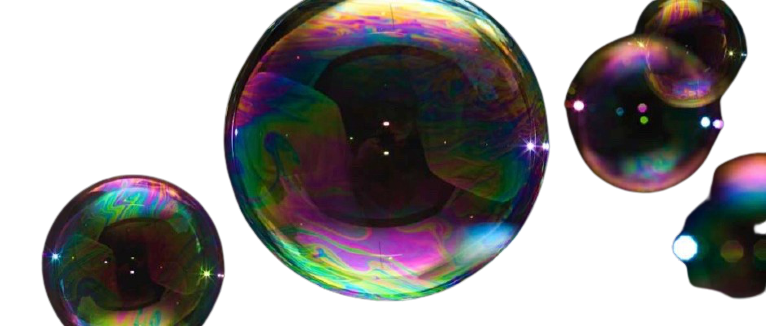
.....................................................................
الحلSolution
📌 ينقلب طور الشعاع المنعكس عن السطح العلوي فقط، فللتداخل البنّاء \(2t=\left(m+\tfrac12\right)\dfrac{\lambda}{n}\) (للرتبة الأولى \(m=0\)).
\(2\times0.975\times10^{-7}=\dfrac12\cdot\dfrac{\lambda}{1.33}\Rightarrow\lambda=4\times1.33\times0.975\times10^{-7}=5.2\times10^{-7}\,m\).
✅ \(\lambda=5.2\times10^{-7}\,m\)
📌 Only the ray reflected from the top surface is inverted, so for constructive interference \(2t=\left(m+\tfrac12\right)\dfrac{\lambda}{n}\) (first order \(m=0\)).
\(2\times0.975\times10^{-7}=\dfrac12\cdot\dfrac{\lambda}{1.33}\Rightarrow\lambda=4\times1.33\times0.975\times10^{-7}=5.2\times10^{-7}\,m\).
✅ \(\lambda=5.2\times10^{-7}\,m\)
لاحظت خطأ؟ أو عندك سؤال عن أحد الأسئلة؟ اكتبه بالتعليقات وحدد رقم السؤال بالضبط.
Noticed an error? Or have a question about one of the questions? Write it in the comments and specify the exact question number.