🔋 بنك الأسئلة: المكثفات
🔋 Question Bank: Capacitors
السعة والفاراد، المكثف المستوي والأسطواني والكروي، التوصيل على التوالي والتوازي، الطاقة المختزنة، والمواد العازلة
Capacitance and the Farad, Parallel-Plate, Cylindrical and Spherical Capacitors, Series and Parallel Connections, Stored Energy, and Dielectrics
⏱️ 52 سؤال اختيار من متعدد بتصحيح فوري بمستويات متدرجة، و4 مسائل مقالية محلولة⏱️ 52 multiple-choice questions of graded difficulty with instant feedback, plus 4 solved essay problems
\[1\,\star\]
إحدى الوحدات التالية تعادل وحدة الفاراد (\(F\)):Which of the following units is equivalent to the farad (\(F\))?
\(\dfrac{A^2\cdot s^2}{kg\cdot m^3}\)\(\dfrac{A^2\cdot s^2}{kg\cdot m^3}\)
\(\dfrac{A^2\cdot s^4}{kg\cdot m^2}\)\(\dfrac{A^2\cdot s^4}{kg\cdot m^2}\)
\(\dfrac{A^2\cdot s^3}{kg\cdot m^2}\)\(\dfrac{A^2\cdot s^3}{kg\cdot m^2}\)
\(\dfrac{A^2\cdot s^2}{kg\cdot m^2}\)\(\dfrac{A^2\cdot s^2}{kg\cdot m^2}\)
الحلSolution
📌 السعة \(C=\dfrac{Q}{V}\) فوحدتها \(F=\dfrac{C}{V}\)، والجهد \(V=\dfrac{J}{C}\) فإن \(F=\dfrac{C^2}{J}\).
📌 نعوّض \(C=A\cdot s\) و \(J=kg\cdot m^2/s^2\): \(F=\dfrac{(A\cdot s)^2}{kg\cdot m^2/s^2}=\dfrac{A^2\cdot s^4}{kg\cdot m^2}\).
✅ \(\dfrac{A^2\cdot s^4}{kg\cdot m^2}\) (B)
📌 Capacitance is \(C=\dfrac{Q}{V}\), so \(F=\dfrac{C}{V}\); since \(V=\dfrac{J}{C}\), then \(F=\dfrac{C^2}{J}\).
📌 Substitute \(C=A\cdot s\) and \(J=kg\cdot m^2/s^2\): \(F=\dfrac{(A\cdot s)^2}{kg\cdot m^2/s^2}=\dfrac{A^2\cdot s^4}{kg\cdot m^2}\).
✅ \(\dfrac{A^2\cdot s^4}{kg\cdot m^2}\) (B)
\[2\,\star\]
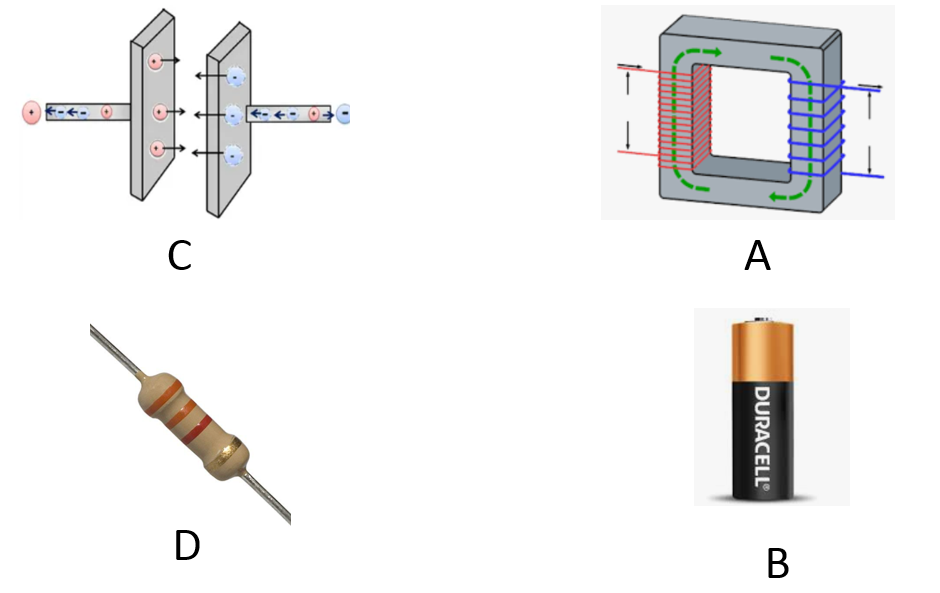
أي الأجهزة الكهربائية (A–D) في الصورة تعمل على تخزين الشحنات الكهربائية وتفريغها دفعة واحدة؟Which of the electrical devices (A–D) in the picture stores electric charge and releases it all at once?
AA
BB
CC
DD
الحلSolution
📌 المكثف يتكوّن من موصلين (لوحين) يفصل بينهما عازل، فيخزّن الشحنات على لوحيه ويفرّغها دفعة واحدة عند توصيله بدائرة. وهو الجهاز C.
📌 الجهاز A ملف حثي (يخزّن الطاقة في مجال مغناطيسي)، والجهاز B بطارية (تخزّن الطاقة كيميائيًا وتفرّغها ببطء)، والجهاز D مقاومة (تُبدّد الطاقة على شكل حرارة).
✅ C
📌 A capacitor consists of two conductors (plates) separated by an insulator; it stores charge on its plates and releases it all at once when connected to a circuit. This is device C.
📌 Device A is an inductor (stores energy in a magnetic field), B is a battery (stores chemical energy and releases it slowly), and D is a resistor (dissipates energy as heat).
✅ C
\[3\,\star\]
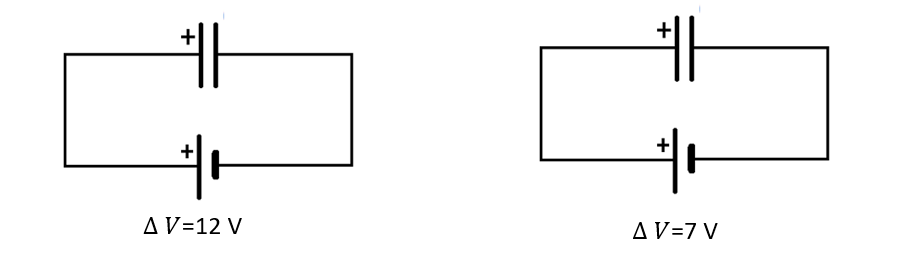
طُبّق فرق جهد \(12\,V\) بين طرفي مكثف فاكتسب شحنة \(3\,nC\). ثم غُيّر جهد المصدر إلى \(7\,V\) كما في الشكل. أحد الإجابات التالية تعبّر عن شحنة المكثف وسعته بعد تغيّر جهد المصدر:A potential difference of \(12\,V\) is applied across a capacitor, which acquires a charge of \(3\,nC\). The source voltage is then changed to \(7\,V\) as shown in the figure. Which answer gives the charge and capacitance of the capacitor after the voltage change?
\(q_2=2\times10^{-9}\,C,\;C=2.8\times10^{-10}\,F\)\(q_2=2\times10^{-9}\,C,\;C=2.8\times10^{-10}\,F\)
\(q_2=2.25\times10^{-9}\,C,\;C=3.2\times10^{-10}\,F\)\(q_2=2.25\times10^{-9}\,C,\;C=3.2\times10^{-10}\,F\)
\(q_2=1.75\times10^{-9}\,C,\;C=2.5\times10^{-10}\,F\)\(q_2=1.75\times10^{-9}\,C,\;C=2.5\times10^{-10}\,F\)
\(q_2=4\times10^{-9}\,C,\;C=5.7\times10^{-10}\,F\)\(q_2=4\times10^{-9}\,C,\;C=5.7\times10^{-10}\,F\)
الحلSolution
📌 سعة المكثف خاصية له ولا تتغير بتغيّر الجهد: \(C=\dfrac{Q_1}{V_1}=\dfrac{3\times10^{-9}}{12}=2.5\times10^{-10}\,F\).
📌 الشحنة الجديدة: \(q_2=CV_2=2.5\times10^{-10}\times7=1.75\times10^{-9}\,C\).
✅ \(q_2=1.75\times10^{-9}\,C,\;C=2.5\times10^{-10}\,F\) (C)
📌 The capacitance is a property of the capacitor and does not change with voltage: \(C=\dfrac{Q_1}{V_1}=\dfrac{3\times10^{-9}}{12}=2.5\times10^{-10}\,F\).
📌 The new charge: \(q_2=CV_2=2.5\times10^{-10}\times7=1.75\times10^{-9}\,C\).
✅ \(q_2=1.75\times10^{-9}\,C,\;C=2.5\times10^{-10}\,F\) (C)
\[4\,\star\star\]
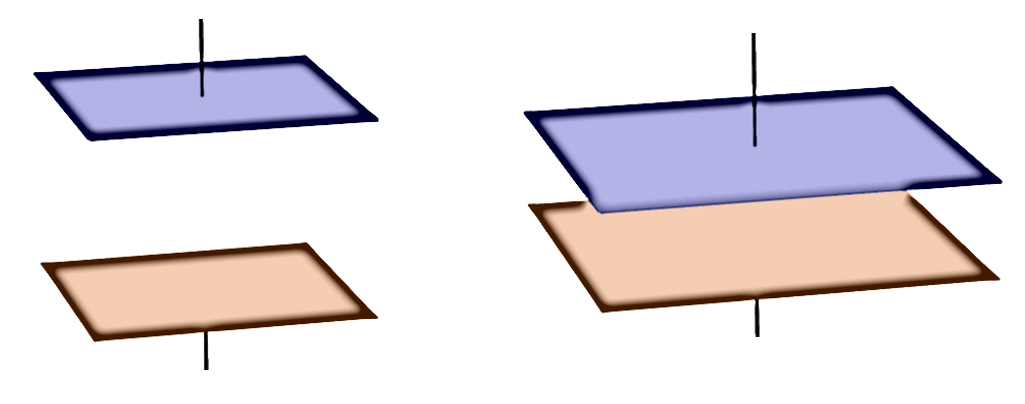
مكثف مستوٍ سعته \(6\,nF\). زيدت المساحة المشتركة بين لوحيه إلى الضعف وأُنقصت المسافة بينهما إلى النصف مع بقاء المادة العازلة نفسها. فإن سعة المكثف تصبح:A parallel-plate capacitor has a capacitance of \(6\,nF\). The common area of its plates is doubled and the distance between them is halved, with the same dielectric. The capacitance becomes:
\(C=24\,nF\)\(C=24\,nF\)
\(C=6\,nF\)\(C=6\,nF\)
\(C=12\,nF\)\(C=12\,nF\)
\(C=18\,nF\)\(C=18\,nF\)
الحلSolution
📌 للمكثف المستوي \(C=\dfrac{\epsilon_0\epsilon_rA}{d}\)، فالسعة تتناسب طرديًا مع المساحة وعكسيًا مع المسافة.
📌 \(C'=\dfrac{\epsilon_0\epsilon_r(2A)}{d/2}=4C=4\times6=24\,nF\).
✅ \(C=24\,nF\) (A)
📌 For a parallel-plate capacitor \(C=\dfrac{\epsilon_0\epsilon_rA}{d}\): capacitance is directly proportional to area and inversely proportional to distance.
📌 \(C'=\dfrac{\epsilon_0\epsilon_r(2A)}{d/2}=4C=4\times6=24\,nF\).
✅ \(C=24\,nF\) (A)
\[5\,\star\]
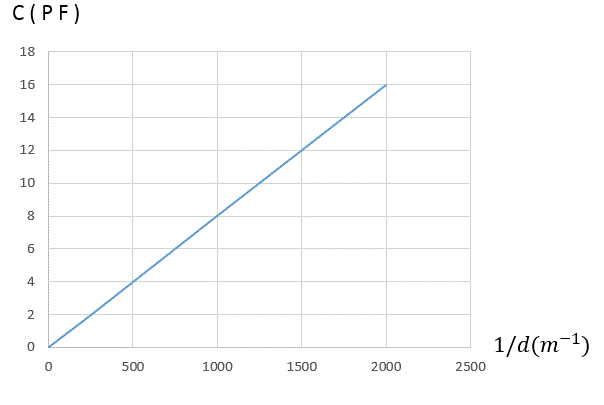
درس طالب العوامل المؤثرة في سعة مكثف مستوٍ فغيّر البعد بين اللوحين مع بقاء باقي العوامل ثابتة، ورسم العلاقة بين سعة المكثف ومقلوب البعد بين لوحيه فنتج الخط البياني الموضح. فإن المساحة المشتركة بين اللوحين تعادل (\(\epsilon_0=8.85\times10^{-12}\,F/m\)):A student studied the factors affecting the capacitance of a parallel-plate capacitor by changing the distance between the plates while keeping everything else constant, and plotted capacitance against the reciprocal of the distance, giving the graph shown. The common area of the plates is (\(\epsilon_0=8.85\times10^{-12}\,F/m\)):
\(A=9\,cm^2\)\(A=9\,cm^2\)
\(A=6\,cm^2\)\(A=6\,cm^2\)
\(A=2\,cm^2\)\(A=2\,cm^2\)
\(A=4\,cm^2\)\(A=4\,cm^2\)
الحلSolution
📌 \(C=\epsilon_0A\cdot\dfrac{1}{d}\)، فميل الخط المستقيم (السعة مقابل \(1/d\)) يساوي \(\epsilon_0A\).
📌 من الرسم: \(C=16\,pF\) عند \(1/d=2000\,m^{-1}\): \(\text{slope}=\dfrac{16\times10^{-12}}{2000}=8\times10^{-15}\,F\cdot m\).
📌 \(A=\dfrac{\text{slope}}{\epsilon_0}=\dfrac{8\times10^{-15}}{8.85\times10^{-12}}\approx9\times10^{-4}\,m^2=9\,cm^2\).
✅ \(A=9\,cm^2\) (A)
📌 \(C=\epsilon_0A\cdot\dfrac{1}{d}\), so the slope of the straight line (\(C\) versus \(1/d\)) equals \(\epsilon_0A\).
📌 From the graph: \(C=16\,pF\) at \(1/d=2000\,m^{-1}\): \(\text{slope}=\dfrac{16\times10^{-12}}{2000}=8\times10^{-15}\,F\cdot m\).
📌 \(A=\dfrac{\text{slope}}{\epsilon_0}=\dfrac{8\times10^{-15}}{8.85\times10^{-12}}\approx9\times10^{-4}\,m^2=9\,cm^2\).
✅ \(A=9\,cm^2\) (A)
\[6\,\star\star\]
درس طالب العوامل المؤثرة في سعة مكثف مستوٍ فغيّر المساحة المشتركة بين اللوحين مع بقاء باقي العوامل ثابتة، ورسم العلاقة بين سعة المكثف والمساحة فنتج الخط البياني الموضح. فإن البعد بين اللوحين يعادل (\(\epsilon_0=8.85\times10^{-12}\,F/m\)):A student studied the factors affecting the capacitance of a parallel-plate capacitor by changing the common area of the plates while keeping everything else constant, and plotted capacitance against area, giving the graph shown. The distance between the plates is (\(\epsilon_0=8.85\times10^{-12}\,F/m\)):
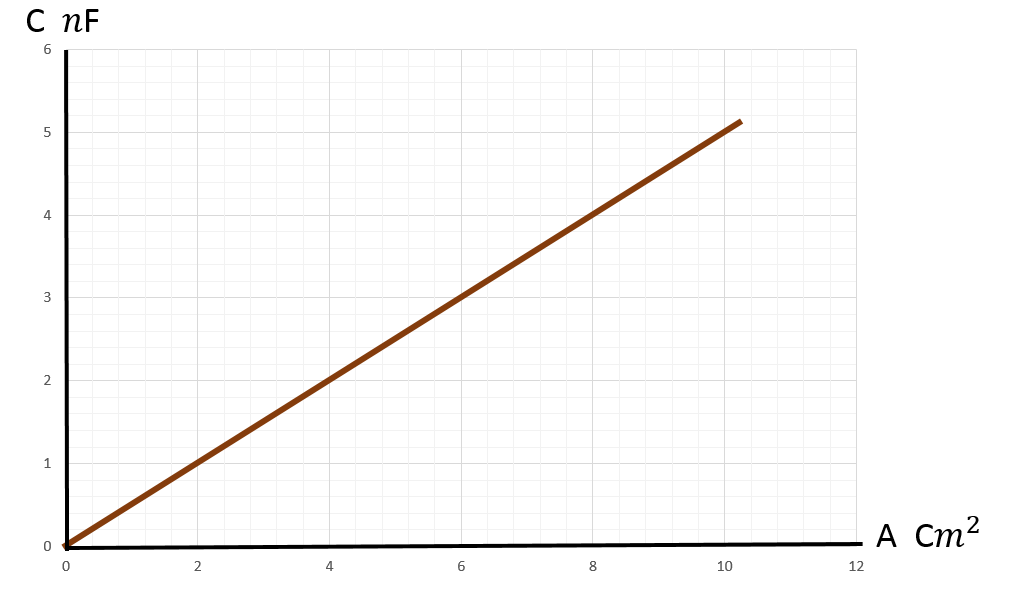
\(d=9.58\times10^{-7}\,m\)\(d=9.58\times10^{-7}\,m\)
\(d=5.26\times10^{-7}\,m\)\(d=5.26\times10^{-7}\,m\)
\(d=3.54\times10^{-6}\,m\)\(d=3.54\times10^{-6}\,m\)
\(d=1.77\times10^{-6}\,m\)\(d=1.77\times10^{-6}\,m\)
الحلSolution
📌 \(C=\dfrac{\epsilon_0}{d}A\)، فميل الخط (السعة مقابل المساحة) يساوي \(\dfrac{\epsilon_0}{d}\).
📌 من الرسم: \(C=2\,nF\) عند \(A=4\,cm^2\): \(\text{slope}=\dfrac{2\times10^{-9}}{4\times10^{-4}}=5\times10^{-6}\,F/m^2\).
📌 \(d=\dfrac{\epsilon_0}{\text{slope}}=\dfrac{8.85\times10^{-12}}{5\times10^{-6}}=1.77\times10^{-6}\,m\).
✅ \(d=1.77\times10^{-6}\,m\) (D)
📌 \(C=\dfrac{\epsilon_0}{d}A\), so the slope of the line (\(C\) versus \(A\)) equals \(\dfrac{\epsilon_0}{d}\).
📌 From the graph: \(C=2\,nF\) at \(A=4\,cm^2\): \(\text{slope}=\dfrac{2\times10^{-9}}{4\times10^{-4}}=5\times10^{-6}\,F/m^2\).
📌 \(d=\dfrac{\epsilon_0}{\text{slope}}=\dfrac{8.85\times10^{-12}}{5\times10^{-6}}=1.77\times10^{-6}\,m\).
✅ \(d=1.77\times10^{-6}\,m\) (D)
\[7\,\star\]
تُعدّ الأرض مكثفًا كرويًا ضخمًا نصف قطرها \(R=6.38\times10^6\,m\). فإنها تمتلك سعة قدرها (\(\epsilon_0=8.85\times10^{-12}\,F/m\)):The Earth is considered a huge spherical capacitor of radius \(R=6.38\times10^6\,m\). Its capacitance is (\(\epsilon_0=8.85\times10^{-12}\,F/m\)):
\(C=6\times10^{-4}\,F\)\(C=6\times10^{-4}\,F\)
\(C=4\times10^{-4}\,F\)\(C=4\times10^{-4}\,F\)
\(C=5\times10^{-4}\,F\)\(C=5\times10^{-4}\,F\)
\(C=7\times10^{-4}\,F\)\(C=7\times10^{-4}\,F\)
الحلSolution
📌 سعة الموصل الكروي المعزول: \(C=4\pi\epsilon_0R\).
📌 \(C=4\pi(8.85\times10^{-12})(6.38\times10^6)=7.1\times10^{-4}\,F\approx7\times10^{-4}\,F\).
✅ \(C=7\times10^{-4}\,F\) (D)
📌 The capacitance of an isolated spherical conductor: \(C=4\pi\epsilon_0R\).
📌 \(C=4\pi(8.85\times10^{-12})(6.38\times10^6)=7.1\times10^{-4}\,F\approx7\times10^{-4}\,F\).
✅ \(C=7\times10^{-4}\,F\) (D)
\[8\,\star\star\]
مكثف أسطواني طوله \(8\,cm\) يتكوّن من أسطوانتين متحدتي المحور نصف قطر الداخلية \(3\,cm\) ونصف قطر الخارجية \(6\,cm\)، وُصل ببطارية فرق جهدها \(12\,V\). فإن شحنة المكثف على إحدى الأسطوانتين تعادل (\(\epsilon_0=8.85\times10^{-12}\,F/m\)، والوسط العازل هو الهواء):A cylindrical capacitor of length \(8\,cm\) consists of two coaxial cylinders with an inner radius of \(3\,cm\) and an outer radius of \(6\,cm\). It is connected to a \(12\,V\) battery. The charge on one of the cylinders is (\(\epsilon_0=8.85\times10^{-12}\,F/m\), air between the cylinders):
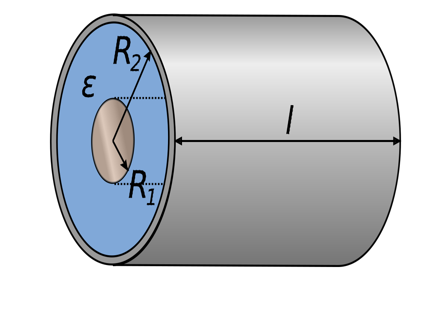
\(q=3.6\times10^{-11}\,C\)\(q=3.6\times10^{-11}\,C\)
\(q=5.2\times10^{-11}\,C\)\(q=5.2\times10^{-11}\,C\)
\(q=7.7\times10^{-11}\,C\)\(q=7.7\times10^{-11}\,C\)
\(q=2.1\times10^{-11}\,C\)\(q=2.1\times10^{-11}\,C\)
الحلSolution
📌 سعة المكثف الأسطواني: \(C=\dfrac{2\pi\epsilon_0L}{\ln(R_2/R_1)}\).
📌 \(C=\dfrac{2\pi(8.85\times10^{-12})(0.08)}{\ln(6/3)}=\dfrac{4.45\times10^{-12}}{0.693}=6.42\times10^{-12}\,F\).
📌 \(q=CV=6.42\times10^{-12}\times12=7.7\times10^{-11}\,C\).
✅ \(q=7.7\times10^{-11}\,C\) (C)
📌 Capacitance of a cylindrical capacitor: \(C=\dfrac{2\pi\epsilon_0L}{\ln(R_2/R_1)}\).
📌 \(C=\dfrac{2\pi(8.85\times10^{-12})(0.08)}{\ln(6/3)}=\dfrac{4.45\times10^{-12}}{0.693}=6.42\times10^{-12}\,F\).
📌 \(q=CV=6.42\times10^{-12}\times12=7.7\times10^{-11}\,C\).
✅ \(q=7.7\times10^{-11}\,C\) (C)
\[9\,\star\]
وُصلت ثلاثة مكثفات سعاتها \(2\,\mu F\) و \(4\,\mu F\) و \(6\,\mu F\) ببطارية كما في الشكل. أي الإجابات (A–D) في الجدول تعبّر بصورة صحيحة عن السعة المكافئة والجهد والشحنة؟Three capacitors of \(2\,\mu F\), \(4\,\mu F\) and \(6\,\mu F\) are connected to a battery as shown. Which answer (A–D) in the table correctly describes the equivalent capacitance, the voltages and the charges?
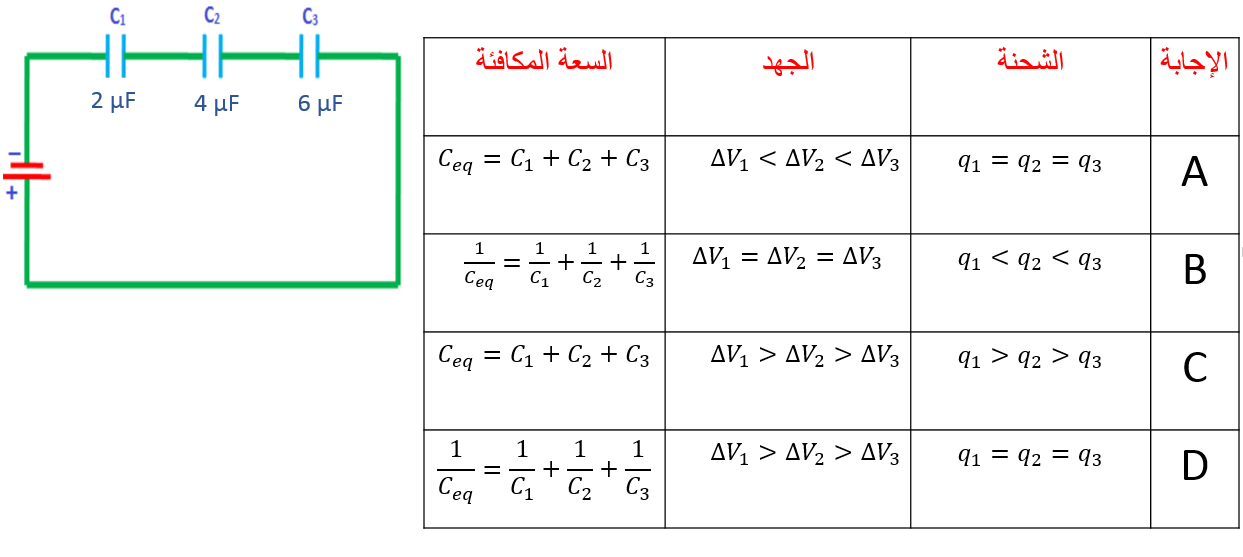
AA
BB
CC
DD
الحلSolution
📌 المكثفات الثلاثة على التوالي (على مسار واحد)، فتكون الشحنة نفسها على كل منها \(q_1=q_2=q_3\) ويكون \(\dfrac{1}{C_{eq}}=\dfrac{1}{C_1}+\dfrac{1}{C_2}+\dfrac{1}{C_3}\).
📌 بما أن \(V=\dfrac{q}{C}\) والشحنة واحدة، فالمكثف الأصغر سعة يكون عليه الجهد الأكبر: \(\Delta V_1\gt \Delta V_2\gt \Delta V_3\). فالإجابة D.
✅ D
📌 The three capacitors are in series (on a single path), so each carries the same charge \(q_1=q_2=q_3\) and \(\dfrac{1}{C_{eq}}=\dfrac{1}{C_1}+\dfrac{1}{C_2}+\dfrac{1}{C_3}\).
📌 Since \(V=\dfrac{q}{C}\) and the charge is the same, the smallest capacitor has the largest voltage: \(\Delta V_1\gt \Delta V_2\gt \Delta V_3\). The answer is D.
✅ D
\[10\,\star\]
وُصلت ثلاثة مكثفات سعاتها \(2\,\mu F\) و \(4\,\mu F\) و \(6\,\mu F\) ببطارية كما في الشكل. أي الإجابات (A–D) في الجدول تعبّر بصورة صحيحة عن السعة المكافئة والجهد والشحنة؟Three capacitors of \(2\,\mu F\), \(4\,\mu F\) and \(6\,\mu F\) are connected to a battery as shown. Which answer (A–D) in the table correctly describes the equivalent capacitance, the voltages and the charges?
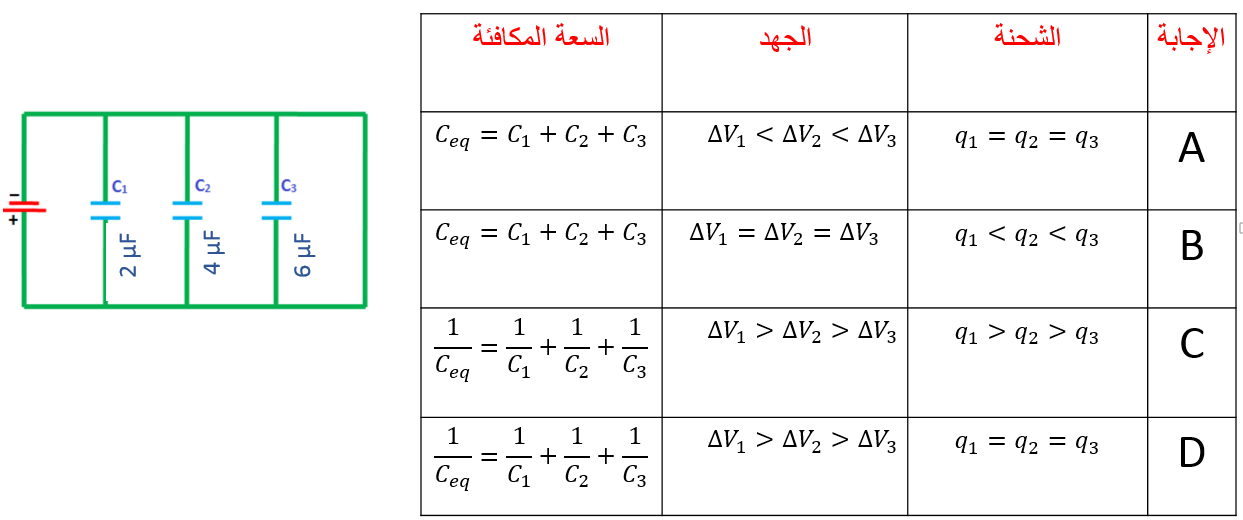
AA
BB
CC
DD
الحلSolution
📌 المكثفات الثلاثة على التوازي، فيكون لها فرق الجهد نفسه \(\Delta V_1=\Delta V_2=\Delta V_3\) وتكون \(C_{eq}=C_1+C_2+C_3\).
📌 \(q=CV\) والجهد واحد، فالمكثف الأكبر سعة يحمل الشحنة الأكبر: \(q_1\lt q_2\lt q_3\). فالإجابة B.
✅ B
📌 The three capacitors are in parallel, so they have the same potential difference \(\Delta V_1=\Delta V_2=\Delta V_3\) and \(C_{eq}=C_1+C_2+C_3\).
📌 \(q=CV\) with the same voltage, so the largest capacitor carries the largest charge: \(q_1\lt q_2\lt q_3\). The answer is B.
✅ B
\[11\,\star\]
السعة المكافئة لمجموعة المكثفات الموصولة كما في الشكل تعادل:The equivalent capacitance of the group of capacitors connected as shown is:
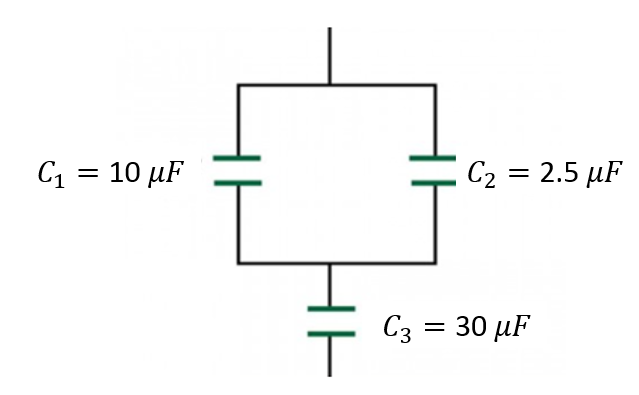
\(C_{eq}=3.45\,\mu F\)\(C_{eq}=3.45\,\mu F\)
\(C_{eq}=8.82\,\mu F\)\(C_{eq}=8.82\,\mu F\)
\(C_{eq}=6.53\,\mu F\)\(C_{eq}=6.53\,\mu F\)
\(C_{eq}=12.7\,\mu F\)\(C_{eq}=12.7\,\mu F\)
الحلSolution
📌 المكثفان \(C_1\) و \(C_2\) على التوازي: \(C_{12}=10+2.5=12.5\,\mu F\).
📌 ثم على التوالي مع \(C_3\): \(C_{eq}=\left(\dfrac{1}{12.5}+\dfrac{1}{30}\right)^{-1}=8.82\,\mu F\).
✅ \(C_{eq}=8.82\,\mu F\) (B)
📌 \(C_1\) and \(C_2\) are in parallel: \(C_{12}=10+2.5=12.5\,\mu F\).
📌 Then in series with \(C_3\): \(C_{eq}=\left(\dfrac{1}{12.5}+\dfrac{1}{30}\right)^{-1}=8.82\,\mu F\).
✅ \(C_{eq}=8.82\,\mu F\) (B)
\[12\,\star\]
السعة المكافئة لمجموعة المكثفات الموصولة كما في الشكل تعادل:The equivalent capacitance of the group of capacitors connected as shown is:
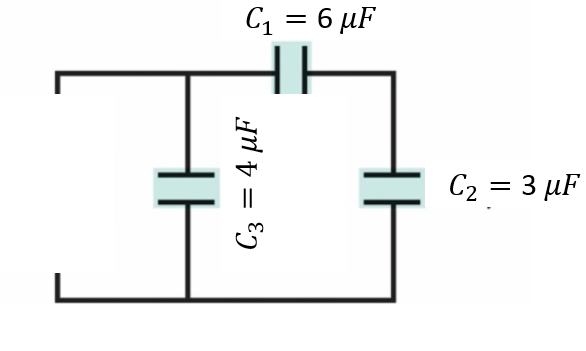
\(C_{eq}=8\,\mu F\)\(C_{eq}=8\,\mu F\)
\(C_{eq}=13\,\mu F\)\(C_{eq}=13\,\mu F\)
\(C_{eq}=2.7\,\mu F\)\(C_{eq}=2.7\,\mu F\)
\(C_{eq}=6\,\mu F\)\(C_{eq}=6\,\mu F\)
الحلSolution
📌 المكثفان \(C_1\) و \(C_2\) على التوالي: \(C_{12}=\left(\dfrac{1}{6}+\dfrac{1}{3}\right)^{-1}=2\,\mu F\).
📌 وهذا الفرع على التوازي مع \(C_3\): \(C_{eq}=C_{12}+C_3=2+4=6\,\mu F\).
✅ \(C_{eq}=6\,\mu F\) (D)
📌 \(C_1\) and \(C_2\) are in series: \(C_{12}=\left(\dfrac{1}{6}+\dfrac{1}{3}\right)^{-1}=2\,\mu F\).
📌 This branch is in parallel with \(C_3\): \(C_{eq}=C_{12}+C_3=2+4=6\,\mu F\).
✅ \(C_{eq}=6\,\mu F\) (D)
\[13\,\star\star\]
وُصلت ثلاثة مكثفات سعاتها \(C_1=3\,\mu F\) و \(C_2=9\,\mu F\) و \(C_3=18\,\mu F\) على التوالي ببطارية فرق جهدها \(6\,V\) كما في الشكل. فإن شحنة المكثف الثاني تعادل:Three capacitors \(C_1=3\,\mu F\), \(C_2=9\,\mu F\) and \(C_3=18\,\mu F\) are connected in series to a \(6\,V\) battery as shown. The charge on the second capacitor is:
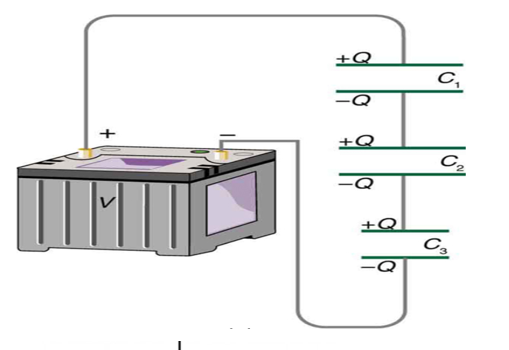
\(q_2=3.4\times10^{-5}\,C\)\(q_2=3.4\times10^{-5}\,C\)
\(q_2=0.8\times10^{-5}\,C\)\(q_2=0.8\times10^{-5}\,C\)
\(q_2=2.7\times10^{-5}\,C\)\(q_2=2.7\times10^{-5}\,C\)
\(q_2=1.2\times10^{-5}\,C\)\(q_2=1.2\times10^{-5}\,C\)
الحلSolution
📌 \(\dfrac{1}{C_{eq}}=\dfrac{1}{3}+\dfrac{1}{9}+\dfrac{1}{18}=\dfrac{9}{18}\Rightarrow C_{eq}=2\,\mu F\).
📌 الشحنة الكلية: \(Q=C_{eq}V=2\times10^{-6}\times6=1.2\times10^{-5}\,C\)، وعلى التوالي تتساوى شحنات المكثفات: \(q_2=1.2\times10^{-5}\,C\).
✅ \(q_2=1.2\times10^{-5}\,C\) (D)
📌 \(\dfrac{1}{C_{eq}}=\dfrac{1}{3}+\dfrac{1}{9}+\dfrac{1}{18}=\dfrac{9}{18}\Rightarrow C_{eq}=2\,\mu F\).
📌 Total charge: \(Q=C_{eq}V=2\times10^{-6}\times6=1.2\times10^{-5}\,C\); in series all capacitors carry the same charge: \(q_2=1.2\times10^{-5}\,C\).
✅ \(q_2=1.2\times10^{-5}\,C\) (D)
\[14\,\star\star\]
وُصلت ثلاثة مكثفات متساوية بأربع طرق مختلفة كما في الشكل (مرقّمة 1 إلى 4). فإن الترتيب الصحيح للسعة المكافئة من الأعلى إلى الأدنى هو:Three equal capacitors are connected in four different ways as shown (numbered 1 to 4). The correct order of the equivalent capacitance from highest to lowest is:
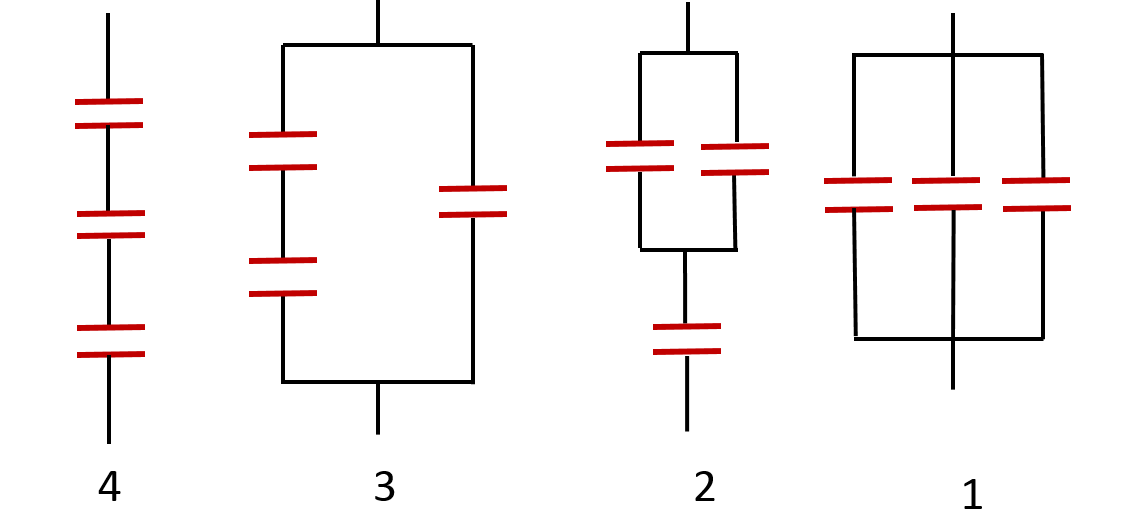
\(C_2\gt C_3\gt C_1\gt C_4\)\(C_2\gt C_3\gt C_1\gt C_4\)
\(C_1\gt C_3\gt C_2\gt C_4\)\(C_1\gt C_3\gt C_2\gt C_4\)
\(C_1\gt C_4\gt C_3\gt C_2\)\(C_1\gt C_4\gt C_3\gt C_2\)
\(C_4\gt C_2\gt C_3\gt C_1\)\(C_4\gt C_2\gt C_3\gt C_1\)
الحلSolution
📌 التوصيل 1 (الثلاثة على التوازي): \(C_1=3C\). التوصيل 3 (مكثفان على التوالي، وهما على التوازي مع الثالث): \(C_3=\dfrac{C}{2}+C=\dfrac{3C}{2}\).
📌 التوصيل 2 (مكثفان على التوازي، وهما على التوالي مع الثالث): \(C_2=\dfrac{2C\cdot C}{3C}=\dfrac{2C}{3}\). التوصيل 4 (الثلاثة على التوالي): \(C_4=\dfrac{C}{3}\).
📌 الترتيب: \(3C\gt \dfrac{3C}{2}\gt \dfrac{2C}{3}\gt \dfrac{C}{3}\Rightarrow C_1\gt C_3\gt C_2\gt C_4\).
✅ \(C_1\gt C_3\gt C_2\gt C_4\) (B)
📌 Connection 1 (all in parallel): \(C_1=3C\). Connection 3 (two in series, in parallel with the third): \(C_3=\dfrac{C}{2}+C=\dfrac{3C}{2}\).
📌 Connection 2 (two in parallel, in series with the third): \(C_2=\dfrac{2C\cdot C}{3C}=\dfrac{2C}{3}\). Connection 4 (all in series): \(C_4=\dfrac{C}{3}\).
📌 The order: \(3C\gt \dfrac{3C}{2}\gt \dfrac{2C}{3}\gt \dfrac{C}{3}\Rightarrow C_1\gt C_3\gt C_2\gt C_4\).
✅ \(C_1\gt C_3\gt C_2\gt C_4\) (B)
\[15\,\star\star\]
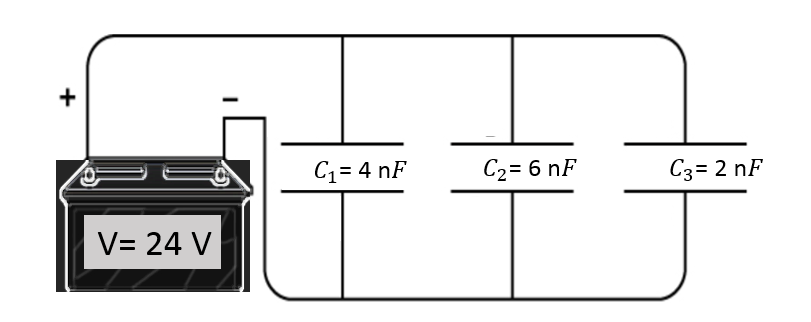
مجموعة مكثفات موصولة كما في الشكل سعاتها \(C_1=4\,nF\) و \(C_2=6\,nF\) و \(C_3=2\,nF\) وموصولة ببطارية فرق جهدها \(24\,V\). فإن الطاقة الكلية المختزنة في المجموعة تعادل:A group of capacitors \(C_1=4\,nF\), \(C_2=6\,nF\) and \(C_3=2\,nF\) is connected as shown to a \(24\,V\) battery. The total energy stored in the group is:
\(U=3.46\times10^{-6}\,J\)\(U=3.46\times10^{-6}\,J\)
\(U=1.32\times10^{-6}\,J\)\(U=1.32\times10^{-6}\,J\)
\(U=8.17\times10^{-6}\,J\)\(U=8.17\times10^{-6}\,J\)
\(U=6.25\times10^{-6}\,J\)\(U=6.25\times10^{-6}\,J\)
الحلSolution
📌 المكثفات الثلاثة على التوازي: \(C_{eq}=4+6+2=12\,nF\).
📌 \(U=\dfrac12C_{eq}V^2=\dfrac12(12\times10^{-9})(24)^2=3.46\times10^{-6}\,J\).
✅ \(U=3.46\times10^{-6}\,J\) (A)
📌 The three capacitors are in parallel: \(C_{eq}=4+6+2=12\,nF\).
📌 \(U=\dfrac12C_{eq}V^2=\dfrac12(12\times10^{-9})(24)^2=3.46\times10^{-6}\,J\).
✅ \(U=3.46\times10^{-6}\,J\) (A)
\[16\,\star\star\star\]
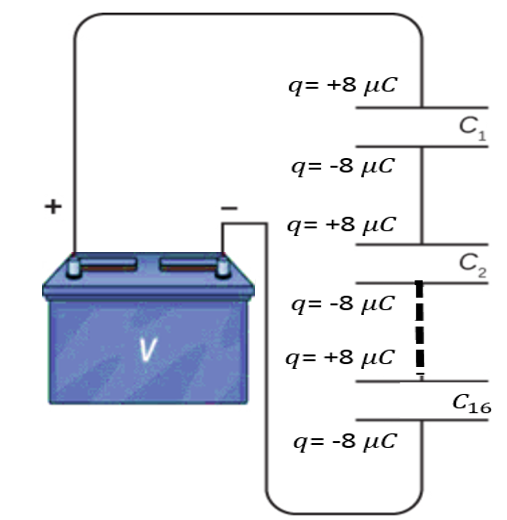
وُصلت مجموعة من 16 مكثفًا متساوية السعة على التوالي ببطارية كما في الشكل، فاكتسب كل مكثف شحنة \(q=8\,\mu C\)، وحُسبت الطاقة الكلية المختزنة في المجموعة فكانت \(U=1\times10^{-3}\,J\). فإن سعة كل مكثف تعادل:A group of 16 equal capacitors is connected in series to a battery as shown. Each capacitor acquires a charge \(q=8\,\mu C\) and the total stored energy is \(U=1\times10^{-3}\,J\). The capacitance of each capacitor is:
\(C=5.12\times10^{-7}\,F\)\(C=5.12\times10^{-7}\,F\)
\(C=3.2\times10^{-8}\,F\)\(C=3.2\times10^{-8}\,F\)
\(C=8.19\times10^{-6}\,F\)\(C=8.19\times10^{-6}\,F\)
\(C=2.41\times10^{-7}\,F\)\(C=2.41\times10^{-7}\,F\)
الحلSolution
📌 على التوالي تتساوى الشحنة في المكثفات، والطاقة الكلية مجموع طاقات المكثفات: \(U=16\times\dfrac{q^2}{2C}\).
📌 \(C=\dfrac{16q^2}{2U}=\dfrac{16(8\times10^{-6})^2}{2\times10^{-3}}=5.12\times10^{-7}\,F\).
📌 تحقق: \(C_{eq}=\dfrac{C}{16}=3.2\times10^{-8}\,F\)، \(V=\dfrac{2U}{Q}=\dfrac{2\times10^{-3}}{8\times10^{-6}}=250\,V\)، \(C_{eq}V=3.2\times10^{-8}\times250=8\,\mu C\) ✓.
✅ \(C=5.12\times10^{-7}\,F\) (A)
📌 In series every capacitor carries the same charge and the total energy is the sum of the energies: \(U=16\times\dfrac{q^2}{2C}\).
📌 \(C=\dfrac{16q^2}{2U}=\dfrac{16(8\times10^{-6})^2}{2\times10^{-3}}=5.12\times10^{-7}\,F\).
📌 Check: \(C_{eq}=\dfrac{C}{16}=3.2\times10^{-8}\,F\), \(V=\dfrac{2U}{Q}=\dfrac{2\times10^{-3}}{8\times10^{-6}}=250\,V\), \(C_{eq}V=3.2\times10^{-8}\times250=8\,\mu C\) ✓.
✅ \(C=5.12\times10^{-7}\,F\) (A)
\[17\,\star\star\]
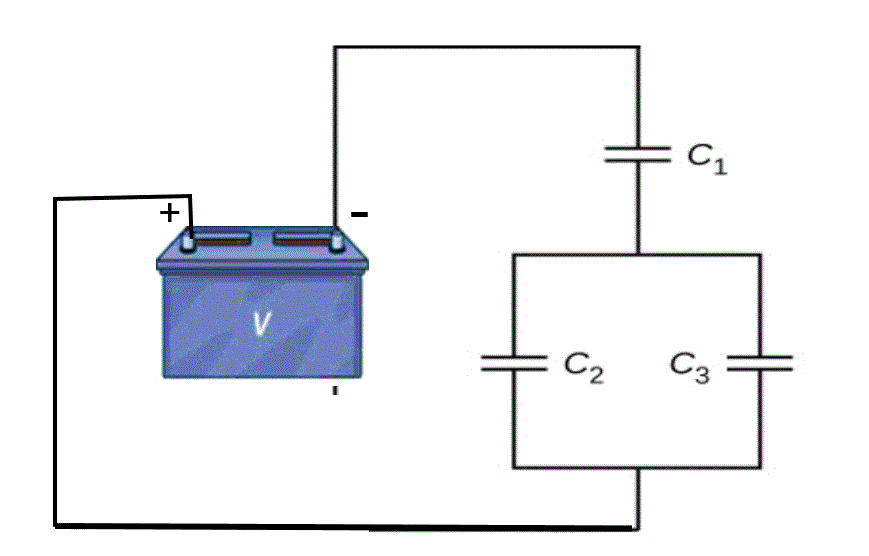
وُصلت ثلاثة مكثفات مختلفة السعة كما في الشكل. أحد الإجابات التالية يتطابق مع طريقة التوصيل:Three capacitors of different capacitances are connected as shown. Which of the following matches the connection?
\(q_1=q_2=q_3,\;V_1=V_2=V_3\)\(q_1=q_2=q_3,\;V_1=V_2=V_3\)
\(q_2=q_3,\;V_2=V_3\)\(q_2=q_3,\;V_2=V_3\)
\(q_1=q_2+q_3,\;V=V_1+V_2\)\(q_1=q_2+q_3,\;V=V_1+V_2\)
\(q_1=q_2+q_3,\;V=V_1+V_2+V_3\)\(q_1=q_2+q_3,\;V=V_1+V_2+V_3\)
الحلSolution
📌 المكثفان \(C_2\) و \(C_3\) على التوازي: لهما الجهد نفسه \(V_2=V_3\) ومجموع شحنتيهما \(q_2+q_3\).
📌 هذه المجموعة على التوالي مع \(C_1\): الشحنة المارة بـ \(C_1\) تساوي شحنة المجموعة \(q_1=q_2+q_3\)، وجهد البطارية \(V=V_1+V_2\).
✅ \(q_1=q_2+q_3,\;V=V_1+V_2\) (C)
📌 \(C_2\) and \(C_3\) are in parallel: they share the same voltage \(V_2=V_3\) and their charges add: \(q_2+q_3\).
📌 This group is in series with \(C_1\): the charge on \(C_1\) equals the group’s charge \(q_1=q_2+q_3\), and the battery voltage is \(V=V_1+V_2\).
✅ \(q_1=q_2+q_3,\;V=V_1+V_2\) (C)
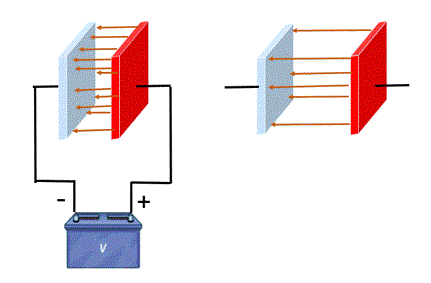
\[18\,\star\star\]
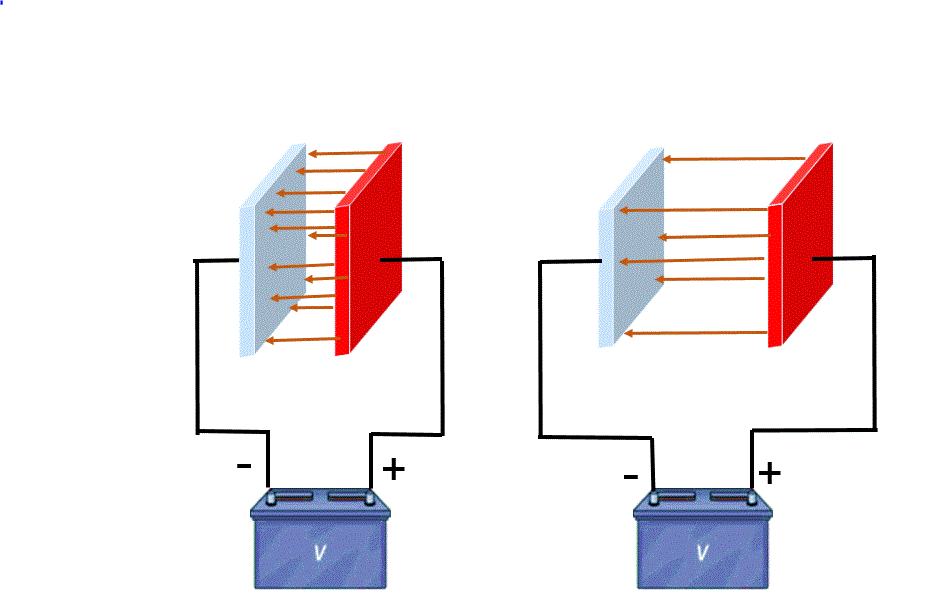
مكثف مستوٍ موصول ببطارية. زيدت المسافة بين لوحيه إلى الضعف مع بقاء باقي العوامل ثابتة (كما في الشكل). أحد الإجابات التالية صحيحة:A parallel-plate capacitor is connected to a battery. The distance between its plates is doubled while everything else stays constant (as shown). Which of the following is correct?
السعة ثابتة – الجهد يزداد للضعف – الشحنة تزداد للضعف – المجال ثابتCapacitance constant – voltage doubles – charge doubles – field constant
السعة تزداد للضعف – الجهد ثابت – الشحنة تزداد للضعف – المجال يزداد للضعفCapacitance doubles – voltage constant – charge doubles – field doubles
السعة تقل للنصف – الجهد يزداد للضعف – الشحنة تقل للنصف – المجال ثابتCapacitance halves – voltage doubles – charge halves – field constant
السعة تقل للنصف – الجهد ثابت – الشحنة تقل للنصف – المجال يقل للنصفCapacitance halves – voltage constant – charge halves – field halves
الحلSolution
📌 المكثف موصول بالبطارية، فالجهد بين لوحيه ثابت \(V\).
📌 \(C=\dfrac{\epsilon_0A}{d}\): عند مضاعفة \(d\) تقل السعة للنصف، و \(Q=CV\) فتقل الشحنة للنصف، و \(E=\dfrac{V}{d}\) فيقل المجال للنصف.
✅ السعة تقل للنصف – الجهد ثابت – الشحنة تقل للنصف – المجال يقل للنصف (D)
📌 The capacitor stays connected to the battery, so the voltage across it is constant \(V\).
📌 \(C=\dfrac{\epsilon_0A}{d}\): doubling \(d\) halves the capacitance; \(Q=CV\) so the charge halves; \(E=\dfrac{V}{d}\) so the field halves.
✅ Capacitance halves – voltage constant – charge halves – field halves (D)
\[19\,\star\star\]
وُصل مكثف ببطارية حتى تم شحنه، ثم فُصل عن البطارية. زيدت المسافة بين لوحيه إلى الضعف مع بقاء باقي العوامل ثابتة (كما في الشكل). أحد الإجابات التالية صحيحة:A capacitor is connected to a battery until fully charged, then disconnected from the battery. The distance between its plates is doubled while everything else stays constant (as shown). Which of the following is correct?
السعة تقل للنصف – الجهد ثابت – الشحنة تقل للنصف – المجال يقل للنصفCapacitance halves – voltage constant – charge halves – field halves
السعة تقل للنصف – الجهد يقل للنصف – الشحنة ثابتة – المجال يقل للنصفCapacitance halves – voltage halves – charge constant – field halves
السعة تقل للنصف – الجهد يزداد للضعف – الشحنة ثابتة – المجال ثابتCapacitance halves – voltage doubles – charge constant – field constant
السعة تزداد للضعف – الجهد ثابت – الشحنة تزداد للضعف – المجال يزداد للضعفCapacitance doubles – voltage constant – charge doubles – field doubles
الحلSolution
📌 المكثف مفصول عن البطارية، فالشحنة ثابتة \(Q\) (لا مسار تنتقل عبره الشحنة).
📌 تقل السعة للنصف عند مضاعفة \(d\)، و \(V=\dfrac{Q}{C}\) فيتضاعف الجهد.
📌 \(E=\dfrac{V}{d}=\dfrac{2V}{2d}=E\): المجال ثابت (يعتمد على الشحنة والمساحة فقط: \(E=\dfrac{Q}{\epsilon_0A}\)).
✅ السعة تقل للنصف – الجهد يزداد للضعف – الشحنة ثابتة – المجال ثابت (C)
📌 The capacitor is disconnected, so the charge \(Q\) is constant (there is no path for charge to leave).
📌 Doubling \(d\) halves the capacitance, and \(V=\dfrac{Q}{C}\) so the voltage doubles.
📌 \(E=\dfrac{V}{d}=\dfrac{2V}{2d}=E\): the field is constant (it depends only on charge and area: \(E=\dfrac{Q}{\epsilon_0A}\)).
✅ Capacitance halves – voltage doubles – charge constant – field constant (C)
\[20\,\star\star\star\]
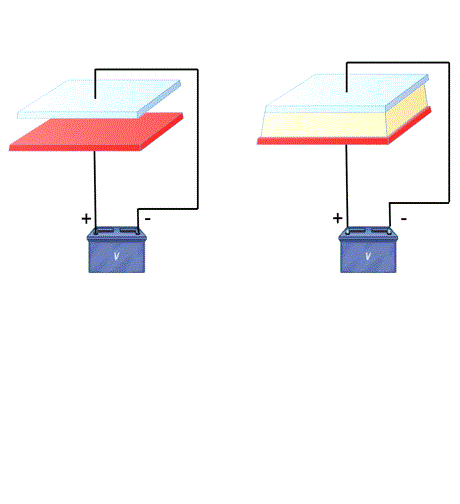
مكثف هوائي مستوي اللوحين موصول ببطارية. أُدخلت مادة عازلة بين لوحيه (كما في الشكل). أي الإجابات التالية تعبّر بصورة صحيحة عن التغيّرات الفيزيائية التي تحدث للمكثف؟A parallel-plate air capacitor is connected to a battery. A dielectric is inserted between its plates (as shown). Which answer correctly describes the physical changes in the capacitor?
السعة تزداد – الشحنة ثابتة – المجال يقل – الجهد يقل – طاقة الوضع تقلCapacitance increases – charge constant – field decreases – voltage decreases – stored energy decreases
السعة تزداد – الشحنة تزداد – المجال ثابت – الجهد ثابت – طاقة الوضع تزدادCapacitance increases – charge increases – field constant – voltage constant – stored energy increases
السعة تقل – الشحنة تزداد – المجال يزداد – الجهد ثابت – طاقة الوضع تزدادCapacitance decreases – charge increases – field increases – voltage constant – stored energy increases
السعة ثابتة – الشحنة تقل – المجال يقل – الجهد يقل – طاقة الوضع تقلCapacitance constant – charge decreases – field decreases – voltage decreases – stored energy decreases
الحلSolution
📌 المكثف موصول بالبطارية: الجهد ثابت \(V\). السعة تزداد بعامل \(K\): \(C_{new}=KC\).
📌 الشحنة تزداد: \(Q_{new}=C_{new}V=KQ\)، والمجال الكهربائي في الوسط \(E=\dfrac{V}{d}\) يبقى ثابتًا.
📌 طاقة الوضع \(U=\dfrac12CV^2\) تزداد بعامل \(K\) لأن \(V\) ثابت.
✅ السعة تزداد – الشحنة تزداد – المجال ثابت – الجهد ثابت – طاقة الوضع تزداد (B)
📌 The battery stays connected: the voltage \(V\) is constant. The capacitance increases by the factor \(K\): \(C_{new}=KC\).
📌 The charge increases: \(Q_{new}=C_{new}V=KQ\), and the field in the medium \(E=\dfrac{V}{d}\) stays constant.
📌 The stored energy \(U=\dfrac12CV^2\) increases by the factor \(K\) since \(V\) is constant.
✅ Capacitance increases – charge increases – field constant – voltage constant – stored energy increases (B)
\[21\,\star\star\star\]
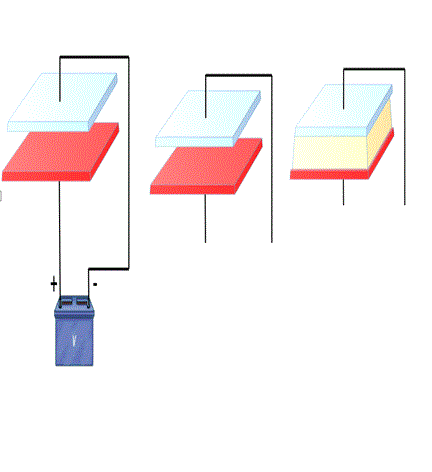
مكثف هوائي مستوي اللوحين وُصل ببطارية حتى تم شحنه ثم فُصل عنها. أُدخلت مادة عازلة بين لوحيه (كما في الشكل). أي الإجابات التالية تعبّر بصورة صحيحة عن التغيّرات الفيزيائية التي تحدث للمكثف؟A parallel-plate air capacitor is connected to a battery until fully charged, then disconnected. A dielectric is inserted between its plates (as shown). Which answer correctly describes the physical changes in the capacitor?
السعة تقل – الشحنة تزداد – المجال يزداد – الجهد ثابت – طاقة الوضع تزدادCapacitance decreases – charge increases – field increases – voltage constant – stored energy increases
السعة ثابتة – الشحنة تقل – المجال يقل – الجهد يقل – طاقة الوضع تقلCapacitance constant – charge decreases – field decreases – voltage decreases – stored energy decreases
السعة تزداد – الشحنة ثابتة – المجال يقل – الجهد يقل – طاقة الوضع تقلCapacitance increases – charge constant – field decreases – voltage decreases – stored energy decreases
السعة تزداد – الشحنة تزداد – المجال ثابت – الجهد ثابت – طاقة الوضع تزدادCapacitance increases – charge increases – field constant – voltage constant – stored energy increases
الحلSolution
📌 المكثف مفصول عن البطارية: الشحنة ثابتة \(Q\). السعة تزداد: \(C_{new}=KC\).
📌 \(V_{new}=\dfrac{Q}{KC}=\dfrac{V}{K}\) فيقل الجهد، و \(E_{new}=\dfrac{V_{new}}{d}=\dfrac{E}{K}\) فيقل المجال بين اللوحين.
📌 طاقة الوضع \(U=\dfrac{Q^2}{2C}\) تقل لأن \(Q\) ثابتة و \(C\) تزداد.
✅ السعة تزداد – الشحنة ثابتة – المجال يقل – الجهد يقل – طاقة الوضع تقل (C)
📌 The capacitor is disconnected: the charge \(Q\) is constant. The capacitance increases: \(C_{new}=KC\).
📌 \(V_{new}=\dfrac{Q}{KC}=\dfrac{V}{K}\) so the voltage decreases, and \(E_{new}=\dfrac{V_{new}}{d}=\dfrac{E}{K}\) so the field between the plates decreases.
📌 The stored energy \(U=\dfrac{Q^2}{2C}\) decreases because \(Q\) is constant and \(C\) increases.
✅ Capacitance increases – charge constant – field decreases – voltage decreases – stored energy decreases (C)
\[22\,\star\star\star\]
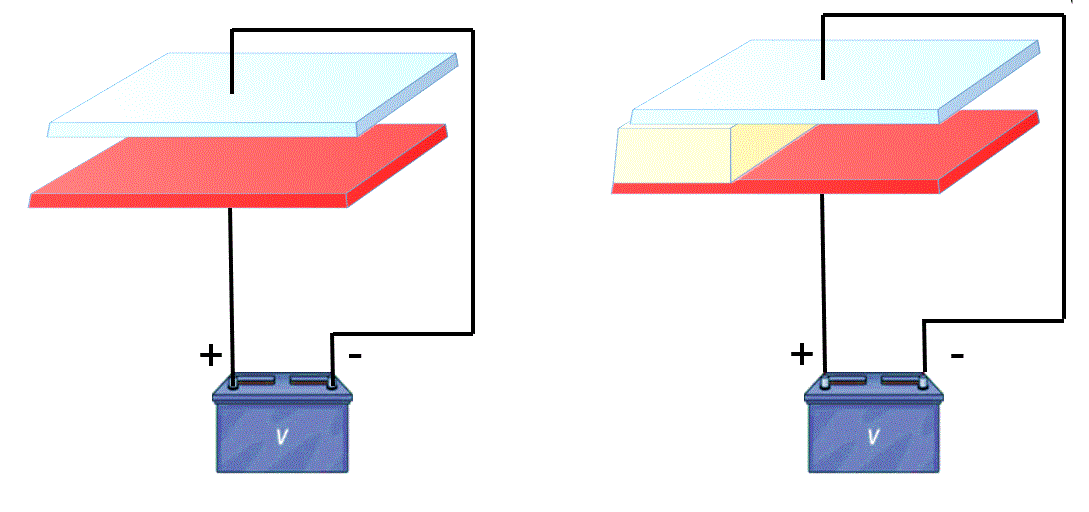
مكثف هوائي مستوي اللوحين سعته \(C=5\,nF\)، طول كل لوح \(2L\) وعرضه \(L\) والمسافة بين اللوحين \(d\). وُضعت بين اللوحين مادة عازلة ثابت عزلها \(K=5\) بطول \(0.5L\) وعرض \(L\) وارتفاع يساوي المسافة بين اللوحين كما في الشكل. فإن سعة المكثف تصبح:A parallel-plate air capacitor has capacitance \(C=5\,nF\); each plate has length \(2L\) and width \(L\), and the distance between the plates is \(d\). A dielectric with constant \(K=5\), of length \(0.5L\), width \(L\) and height equal to the plate separation, is placed between the plates as shown. The capacitance becomes:
\(C=25\,nF\)\(C=25\,nF\)
\(C=20\,nF\)\(C=20\,nF\)
\(C=15\,nF\)\(C=15\,nF\)
\(C=10\,nF\)\(C=10\,nF\)
الحلSolution
📌 نعامل المكثف كمكثفين على التوازي: جزء هوائي مساحته \(A_{air}=2L^2-0.5L^2=1.5L^2\) وجزء عازل مساحته \(A_d=0.5L^2\).
📌 \(C_{new}=\dfrac{\epsilon_0}{d}(A_{air}+KA_d)=\dfrac{\epsilon_0}{d}(1.5L^2+2.5L^2)=\dfrac{\epsilon_0}{d}(4L^2)\).
📌 وبما أن \(C=\dfrac{\epsilon_0}{d}(2L^2)=5\,nF\) فإن \(C_{new}=2C=10\,nF\).
✅ \(C=10\,nF\) (D)
📌 Treat it as two capacitors in parallel: an air part of area \(A_{air}=2L^2-0.5L^2=1.5L^2\) and a dielectric part of area \(A_d=0.5L^2\).
📌 \(C_{new}=\dfrac{\epsilon_0}{d}(A_{air}+KA_d)=\dfrac{\epsilon_0}{d}(1.5L^2+2.5L^2)=\dfrac{\epsilon_0}{d}(4L^2)\).
📌 Since \(C=\dfrac{\epsilon_0}{d}(2L^2)=5\,nF\), then \(C_{new}=2C=10\,nF\).
✅ \(C=10\,nF\) (D)
\[23\,\star\]
مكثف سعته \(5\,\mu F\) مشحون بفرق جهد \(10\,V\) بين لوحيه، فإن شحنته تعادل:A \(5\,\mu F\) capacitor is charged with a potential difference of \(10\,V\) across its plates. Its charge is:
\(Q=0.5\,\mu C\)\(Q=0.5\,\mu C\)
\(Q=50\,\mu C\)\(Q=50\,\mu C\)
\(Q=2\,\mu C\)\(Q=2\,\mu C\)
\(Q=15\,\mu C\)\(Q=15\,\mu C\)
الحلSolution
📌 \(Q=CV=5\times10^{-6}\times10=5\times10^{-5}\,C=50\,\mu C\).
✅ \(Q=50\,\mu C\) (B)
📌 \(Q=CV=5\times10^{-6}\times10=5\times10^{-5}\,C=50\,\mu C\).
✅ \(Q=50\,\mu C\) (B)
\[24\,\star\]
مكثف مستوٍ مساحة كل لوح فيه \(0.02\,m^2\) والمسافة بين اللوحين \(1\,mm\) والعازل بينهما هو الهواء، فإن سعته تعادل (\(\epsilon_0=8.85\times10^{-12}\,F/m\)):A parallel-plate air capacitor has plates of area \(0.02\,m^2\) separated by \(1\,mm\). Its capacitance is (\(\epsilon_0=8.85\times10^{-12}\,F/m\)):
\(C=1.77\times10^{-7}\,F\)\(C=1.77\times10^{-7}\,F\)
\(C=1.77\times10^{-13}\,F\)\(C=1.77\times10^{-13}\,F\)
\(C=1.77\times10^{-11}\,F\)\(C=1.77\times10^{-11}\,F\)
\(C=1.77\times10^{-10}\,F\)\(C=1.77\times10^{-10}\,F\)
الحلSolution
📌 \(C=\dfrac{\epsilon_0A}{d}=\dfrac{8.85\times10^{-12}\times0.02}{1\times10^{-3}}=1.77\times10^{-10}\,F\) (أي \(177\,pF\)).
✅ \(C=1.77\times10^{-10}\,F\) (D)
📌 \(C=\dfrac{\epsilon_0A}{d}=\dfrac{8.85\times10^{-12}\times0.02}{1\times10^{-3}}=1.77\times10^{-10}\,F\) (i.e. \(177\,pF\)).
✅ \(C=1.77\times10^{-10}\,F\) (D)
\[25\,\star\]
مكثف هوائي سعته \(4\,\mu F\) ملئ الفراغ بين لوحيه بمادة عازلة ثابت عزلها \(K=3\)، فإن سعته تصبح:An air capacitor of \(4\,\mu F\) has the space between its plates completely filled with a dielectric of constant \(K=3\). Its capacitance becomes:
\(C=12\,\mu F\)\(C=12\,\mu F\)
\(C=1.33\,\mu F\)\(C=1.33\,\mu F\)
\(C=7\,\mu F\)\(C=7\,\mu F\)
\(C=4\,\mu F\)\(C=4\,\mu F\)
الحلSolution
📌 ملء الفراغ بعازل يضرب السعة بثابت العزل: \(C=KC_0=3\times4=12\,\mu F\).
✅ \(C=12\,\mu F\) (A)
📌 Filling the gap with a dielectric multiplies the capacitance by the dielectric constant: \(C=KC_0=3\times4=12\,\mu F\).
✅ \(C=12\,\mu F\) (A)
\[26\,\star\star\]
مكثف سعته \(20\,\mu F\) مشحون بفرق جهد \(15\,V\)، فإن الطاقة المختزنة فيه تعادل:A \(20\,\mu F\) capacitor is charged to \(15\,V\). The energy stored in it is:
\(U=4.5\times10^{-3}\,J\)\(U=4.5\times10^{-3}\,J\)
\(U=2.25\times10^{-3}\,J\)\(U=2.25\times10^{-3}\,J\)
\(U=3\times10^{-4}\,J\)\(U=3\times10^{-4}\,J\)
\(U=1.5\times10^{-4}\,J\)\(U=1.5\times10^{-4}\,J\)
الحلSolution
📌 \(U=\dfrac12CV^2=\dfrac12(20\times10^{-6})(15)^2=2.25\times10^{-3}\,J\).
✅ \(U=2.25\times10^{-3}\,J\) (B)
📌 \(U=\dfrac12CV^2=\dfrac12(20\times10^{-6})(15)^2=2.25\times10^{-3}\,J\).
✅ \(U=2.25\times10^{-3}\,J\) (B)
\[27\,\star\star\]
مكثفان سعتاهما \(6\,\mu F\) و \(3\,\mu F\) موصولان على التوالي كما في الشكل، فإن سعتهما المكافئة تعادل:Two capacitors of \(6\,\mu F\) and \(3\,\mu F\) are connected in series as shown. Their equivalent capacitance is:
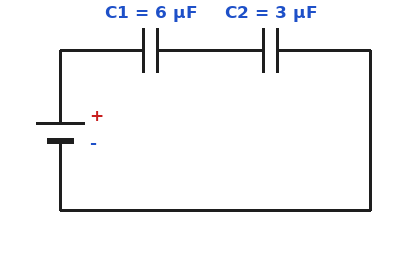
\(C_{eq}=2\,\mu F\)\(C_{eq}=2\,\mu F\)
\(C_{eq}=9\,\mu F\)\(C_{eq}=9\,\mu F\)
\(C_{eq}=4.5\,\mu F\)\(C_{eq}=4.5\,\mu F\)
\(C_{eq}=18\,\mu F\)\(C_{eq}=18\,\mu F\)
الحلSolution
📌 على التوالي: \(\dfrac{1}{C_{eq}}=\dfrac{1}{6}+\dfrac{1}{3}=\dfrac{1}{2}\).
📌 \(C_{eq}=2\,\mu F\) (أقل من أصغر سعة في المجموعة).
✅ \(C_{eq}=2\,\mu F\) (A)
📌 In series: \(\dfrac{1}{C_{eq}}=\dfrac{1}{6}+\dfrac{1}{3}=\dfrac{1}{2}\).
📌 \(C_{eq}=2\,\mu F\) (smaller than the smallest capacitor in the group).
✅ \(C_{eq}=2\,\mu F\) (A)
\[28\,\star\star\]
مكثفان سعتاهما \(5\,\mu F\) و \(7\,\mu F\) موصولان على التوازي ببطارية فرق جهدها \(10\,V\) كما في الشكل، فإن الشحنة الكلية المختزنة في المجموعة تعادل:Two capacitors of \(5\,\mu F\) and \(7\,\mu F\) are connected in parallel to a \(10\,V\) battery as shown. The total charge stored in the group is:
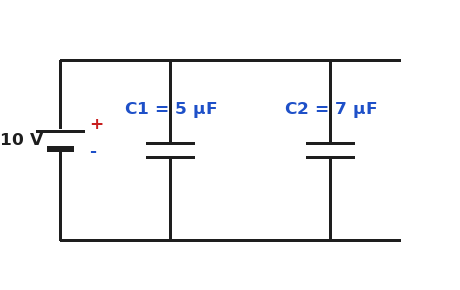
\(Q=120\,\mu C\)\(Q=120\,\mu C\)
\(Q=50\,\mu C\)\(Q=50\,\mu C\)
\(Q=70\,\mu C\)\(Q=70\,\mu C\)
\(Q=29\,\mu C\)\(Q=29\,\mu C\)
الحلSolution
📌 على التوازي: \(C_{eq}=5+7=12\,\mu F\).
📌 \(Q=C_{eq}V=12\times10=120\,\mu C\) (أو \(50+70=120\,\mu C\)).
✅ \(Q=120\,\mu C\) (A)
📌 In parallel: \(C_{eq}=5+7=12\,\mu F\).
📌 \(Q=C_{eq}V=12\times10=120\,\mu C\) (or \(50+70=120\,\mu C\)).
✅ \(Q=120\,\mu C\) (A)
\[29\,\star\star\]
مكثفان سعتاهما \(4\,\mu F\) و \(12\,\mu F\) موصولان على التوالي ببطارية فرق جهدها \(16\,V\) كما في الشكل، فإن فرق الجهد بين طرفي المكثف \(12\,\mu F\) يعادل:Two capacitors of \(4\,\mu F\) and \(12\,\mu F\) are connected in series to a \(16\,V\) battery as shown. The potential difference across the \(12\,\mu F\) capacitor is:
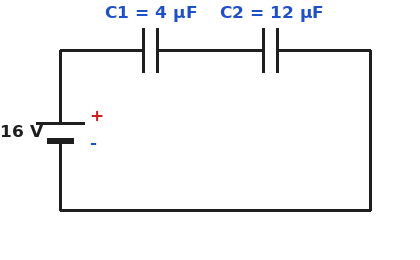
\(V=12\,V\)\(V=12\,V\)
\(V=8\,V\)\(V=8\,V\)
\(V=4\,V\)\(V=4\,V\)
\(V=16\,V\)\(V=16\,V\)
الحلSolution
📌 \(C_{eq}=\dfrac{4\times12}{4+12}=3\,\mu F\)، و \(Q=C_{eq}V=3\times16=48\,\mu C\) (الشحنة نفسها على كل منهما).
📌 \(V_{12}=\dfrac{Q}{C}=\dfrac{48}{12}=4\,V\).
✅ \(V=4\,V\) (C)
📌 \(C_{eq}=\dfrac{4\times12}{4+12}=3\,\mu F\) and \(Q=C_{eq}V=3\times16=48\,\mu C\) (the same charge on each).
📌 \(V_{12}=\dfrac{Q}{C}=\dfrac{48}{12}=4\,V\).
✅ \(V=4\,V\) (C)
\[30\,\star\star\]
مكثف مستوٍ سعته \(9\,nF\). زيدت المسافة بين لوحيه إلى ثلاثة أمثالها وأُدخلت بينهما مادة عازلة ثابت عزلها \(K=2\) تملأ الفراغ كله. فإن سعة المكثف تصبح:A parallel-plate capacitor has a capacitance of \(9\,nF\). The distance between its plates is tripled and a dielectric of constant \(K=2\) that fills the whole gap is inserted. The capacitance becomes:
\(C=3\,nF\)\(C=3\,nF\)
\(C=6\,nF\)\(C=6\,nF\)
\(C=18\,nF\)\(C=18\,nF\)
\(C=27\,nF\)\(C=27\,nF\)
الحلSolution
📌 \(C=\dfrac{K\epsilon_0A}{d}\): السعة تتناسب طرديًا مع \(K\) وعكسيًا مع \(d\).
📌 \(C'=\dfrac{2}{3}C=\dfrac{2}{3}\times9=6\,nF\).
✅ \(C=6\,nF\) (B)
📌 \(C=\dfrac{K\epsilon_0A}{d}\): capacitance is directly proportional to \(K\) and inversely proportional to \(d\).
📌 \(C'=\dfrac{2}{3}C=\dfrac{2}{3}\times9=6\,nF\).
✅ \(C=6\,nF\) (B)
\[31\,\star\star\]
طُبّق فرق جهد \(100\,V\) بين لوحي مكثف مستوٍ تبعد بينهما \(2\,mm\)، فإن مقدار المجال الكهربائي المنتظم بين اللوحين يعادل:A potential difference of \(100\,V\) is applied across a parallel-plate capacitor whose plates are \(2\,mm\) apart. The magnitude of the uniform electric field between the plates is:
\(E=50\,V/m\)\(E=50\,V/m\)
\(E=5\times10^{4}\,V/m\)\(E=5\times10^{4}\,V/m\)
\(E=2\times10^{-4}\,V/m\)\(E=2\times10^{-4}\,V/m\)
\(E=5\times10^{6}\,V/m\)\(E=5\times10^{6}\,V/m\)
الحلSolution
📌 \(E=\dfrac{V}{d}=\dfrac{100}{2\times10^{-3}}=5\times10^{4}\,V/m\) (نحوّل المسافة إلى المتر أولًا).
✅ \(E=5\times10^{4}\,V/m\) (B)
📌 \(E=\dfrac{V}{d}=\dfrac{100}{2\times10^{-3}}=5\times10^{4}\,V/m\) (convert the distance to meters first).
✅ \(E=5\times10^{4}\,V/m\) (B)
\[32\,\star\star\star\]
مكثف مستوٍ شحنته \(30\,\mu C\) عند فرق جهد \(6\,V\) فُصل عن البطارية، ثم زيدت المسافة بين لوحيه إلى الضعف. فإن الطاقة المختزنة فيه بعد ذلك تعادل:A parallel-plate capacitor holds \(30\,\mu C\) at \(6\,V\). It is disconnected from the battery and then the distance between its plates is doubled. The energy stored in it afterwards is:
\(U=180\,\mu J\)\(U=180\,\mu J\)
\(U=90\,\mu J\)\(U=90\,\mu J\)
\(U=45\,\mu J\)\(U=45\,\mu J\)
\(U=360\,\mu J\)\(U=360\,\mu J\)
الحلSolution
📌 الطاقة الابتدائية: \(U_0=\dfrac12QV=\dfrac12(30)(6)=90\,\mu J\)، وبعد الفصل تبقى الشحنة \(Q\) ثابتة.
📌 مضاعفة المسافة تُنصّف السعة \(C'=\dfrac{C}{2}\)، فتصبح \(U'=\dfrac{Q^2}{2C'}=2U_0=180\,\mu J\) (الشغل المبذول لإبعاد اللوحين يزيد الطاقة).
✅ \(U=180\,\mu J\) (A)
📌 Initial energy: \(U_0=\dfrac12QV=\dfrac12(30)(6)=90\,\mu J\); after disconnecting, the charge \(Q\) stays constant.
📌 Doubling the distance halves the capacitance \(C'=\dfrac{C}{2}\), so \(U'=\dfrac{Q^2}{2C'}=2U_0=180\,\mu J\) (the work done pulling the plates apart increases the energy).
✅ \(U=180\,\mu J\) (A)
\[33\,\star\star\star\]
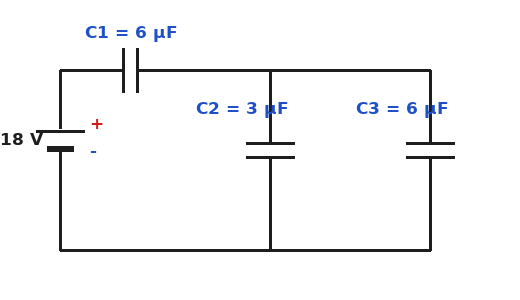
وُصلت ثلاثة مكثفات سعاتها \(C_1=6\,\mu F\) و \(C_2=3\,\mu F\) و \(C_3=6\,\mu F\) كما في الشكل. فإن السعة المكافئة للمجموعة تعادل:Three capacitors \(C_1=6\,\mu F\), \(C_2=3\,\mu F\) and \(C_3=6\,\mu F\) are connected as shown. The equivalent capacitance of the group is:
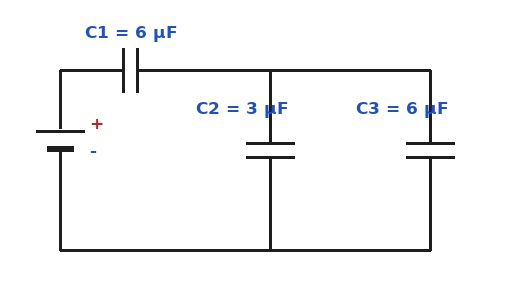
\(C_{eq}=3.6\,\mu F\)\(C_{eq}=3.6\,\mu F\)
\(C_{eq}=1.5\,\mu F\)\(C_{eq}=1.5\,\mu F\)
\(C_{eq}=15\,\mu F\)\(C_{eq}=15\,\mu F\)
\(C_{eq}=9\,\mu F\)\(C_{eq}=9\,\mu F\)
الحلSolution
📌 المكثفان \(C_2\) و \(C_3\) على التوازي: \(C_{23}=3+6=9\,\mu F\).
📌 وهما على التوالي مع \(C_1\): \(C_{eq}=\dfrac{6\times9}{6+9}=3.6\,\mu F\).
✅ \(C_{eq}=3.6\,\mu F\) (A)
📌 \(C_2\) and \(C_3\) are in parallel: \(C_{23}=3+6=9\,\mu F\).
📌 They are in series with \(C_1\): \(C_{eq}=\dfrac{6\times9}{6+9}=3.6\,\mu F\).
✅ \(C_{eq}=3.6\,\mu F\) (A)
\[34\,\star\star\star\]
في دائرة المكثفات الموضحة في الشكل (المسألة السابقة) وُصلت المجموعة ببطارية فرق جهدها \(18\,V\)، فإن شحنة المكثف \(C_2\) تعادل:The group of capacitors shown in the figure (previous question) is connected to an \(18\,V\) battery. The charge on the capacitor \(C_2\) is:
\(q_2=64.8\,\mu C\)\(q_2=64.8\,\mu C\)
\(q_2=43.2\,\mu C\)\(q_2=43.2\,\mu C\)
\(q_2=21.6\,\mu C\)\(q_2=21.6\,\mu C\)
\(q_2=54\,\mu C\)\(q_2=54\,\mu C\)
الحلSolution
📌 الشحنة الكلية: \(Q=C_{eq}V=3.6\times18=64.8\,\mu C\) وهي شحنة \(C_1\) وشحنة المجموعة \(C_{23}\) (توالي).
📌 جهد المجموعة المتوازية: \(V_{23}=\dfrac{Q}{C_{23}}=\dfrac{64.8}{9}=7.2\,V\).
📌 \(q_2=C_2V_{23}=3\times7.2=21.6\,\mu C\).
✅ \(q_2=21.6\,\mu C\) (C)
📌 Total charge: \(Q=C_{eq}V=3.6\times18=64.8\,\mu C\), which is the charge on \(C_1\) and on the group \(C_{23}\) (series).
📌 Voltage across the parallel group: \(V_{23}=\dfrac{Q}{C_{23}}=\dfrac{64.8}{9}=7.2\,V\).
📌 \(q_2=C_2V_{23}=3\times7.2=21.6\,\mu C\).
✅ \(q_2=21.6\,\mu C\) (C)
\[35\,\star\star\star\]
شُحن مكثف سعته \(6\,\mu F\) إلى \(10\,V\)، وشُحن مكثف آخر سعته \(3\,\mu F\) إلى \(20\,V\). ثم وُصل اللوح الموجب لكل منهما باللوح الموجب للآخر (واللوح السالب بالسالب)، فإن فرق الجهد النهائي بين لوحي كل منهما يعادل:A \(6\,\mu F\) capacitor is charged to \(10\,V\) and another capacitor of \(3\,\mu F\) is charged to \(20\,V\). The positive plate of each is then connected to the positive plate of the other (and negative to negative). The final potential difference across each is:
\(V=15\,V\)\(V=15\,V\)
\(V=30\,V\)\(V=30\,V\)
\(V=13.3\,V\)\(V=13.3\,V\)
\(V=0\)\(V=0\)
الحلSolution
📌 الشحنتان الابتدائيتان: \(Q_1=6\times10=60\,\mu C\) و \(Q_2=3\times20=60\,\mu C\)، ومجموعهما \(120\,\mu C\) (الألواح الموجبة معًا فتتجمّع الشحنات).
📌 يصبحان على التوازي: \(C=6+3=9\,\mu F\) فيكون \(V=\dfrac{Q}{C}=\dfrac{120}{9}=13.3\,V\).
✅ \(V=13.3\,V\) (C)
📌 Initial charges: \(Q_1=6\times10=60\,\mu C\) and \(Q_2=3\times20=60\,\mu C\); their sum is \(120\,\mu C\) (positive plates joined, so the charges add).
📌 They are now in parallel: \(C=6+3=9\,\mu F\) so \(V=\dfrac{Q}{C}=\dfrac{120}{9}=13.3\,V\).
✅ \(V=13.3\,V\) (C)
\[36\,\star\star\star\]
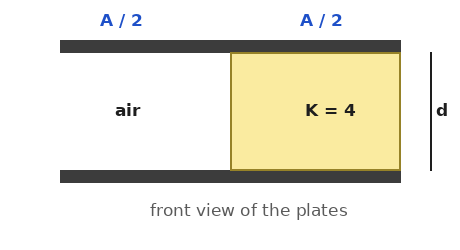
مكثف هوائي مستوٍ سعته \(8\,nF\) ملئ نصف المساحة بين لوحيه بمادة عازلة ثابت عزلها \(K=4\) (بكامل ارتفاع الفراغ) كما في الشكل. فإن سعته تصبح:A parallel-plate air capacitor of \(8\,nF\) has half of the area between its plates filled with a dielectric of constant \(K=4\) (full height of the gap) as shown. Its capacitance becomes:
\(C=20\,nF\)\(C=20\,nF\)
\(C=32\,nF\)\(C=32\,nF\)
\(C=16\,nF\)\(C=16\,nF\)
\(C=10\,nF\)\(C=10\,nF\)
الحلSolution
📌 يُعامل المكثف كمكثفين على التوازي، لكل منهما نصف المساحة: جزء هوائي \(C_1=\dfrac{8}{2}=4\,nF\) وجزء عازل \(C_2=K\cdot\dfrac{8}{2}=16\,nF\).
📌 \(C=C_1+C_2=4+16=20\,nF\).
✅ \(C=20\,nF\) (A)
📌 Treat it as two capacitors in parallel, each with half the area: an air part \(C_1=\dfrac{8}{2}=4\,nF\) and a dielectric part \(C_2=K\cdot\dfrac{8}{2}=16\,nF\).
📌 \(C=C_1+C_2=4+16=20\,nF\).
✅ \(C=20\,nF\) (A)
\[37\,\star\star\star\]
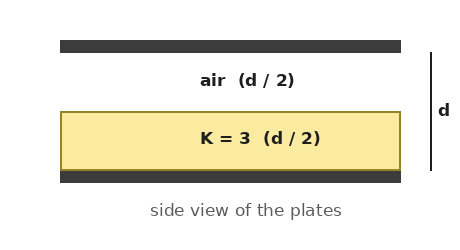
مكثف هوائي مستوٍ سعته \(6\,nF\) وُضع بين لوحيه لوح عازل ثابت عزله \(K=3\) بمساحة اللوحين نفسها وسماكته نصف المسافة بين اللوحين كما في الشكل. فإن سعة المكثف تصبح:A parallel-plate air capacitor of \(6\,nF\) has a dielectric slab of constant \(K=3\), with the same area as the plates and a thickness equal to half the gap, placed between the plates as shown. The capacitance becomes:
\(C=18\,nF\)\(C=18\,nF\)
\(C=12\,nF\)\(C=12\,nF\)
\(C=4.5\,nF\)\(C=4.5\,nF\)
\(C=9\,nF\)\(C=9\,nF\)
الحلSolution
📌 يُعامل المكثف كمكثفين على التوالي: جزء هوائي سمكه \(d/2\) سعته \(C_1=2C_0=12\,nF\) وجزء عازل سمكه \(d/2\) سعته \(C_2=2KC_0=36\,nF\).
📌 \(C=\dfrac{12\times36}{12+36}=9\,nF\).
✅ \(C=9\,nF\) (D)
📌 Treat it as two capacitors in series: an air part of thickness \(d/2\) with \(C_1=2C_0=12\,nF\) and a dielectric part of thickness \(d/2\) with \(C_2=2KC_0=36\,nF\).
📌 \(C=\dfrac{12\times36}{12+36}=9\,nF\).
✅ \(C=9\,nF\) (D)
\[38\,\star\star\star\]
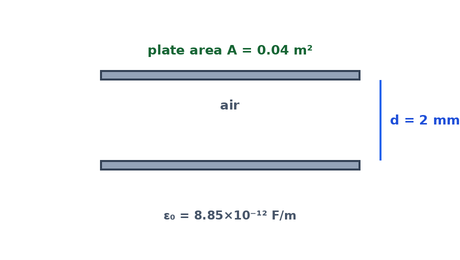
مكثف مستوٍ هوائي مساحة كل لوح فيه \(0.04\,m^2\) والمسافة بين اللوحين \(2\,mm\). فإن سعته (\(\varepsilon_0=8.85\times10^{-12}\,F/m\)):An air-filled parallel-plate capacitor has plates of area \(0.04\,m^2\) separated by \(2\,mm\). Its capacitance is (\(\varepsilon_0=8.85\times10^{-12}\,F/m\)):
\(177\,pF\)\(177\,pF\)
\(17.7\,pF\)\(17.7\,pF\)
\(1.77\,nF\)\(1.77\,nF\)
\(354\,pF\)\(354\,pF\)
الحلSolution
📌 \(C=\dfrac{\varepsilon_0A}{d}=\dfrac{8.85\times10^{-12}\times0.04}{2\times10^{-3}}=1.77\times10^{-10}\,F=177\,pF\)
✅ \(177\,pF\) (A)
📌 \(C=\dfrac{\varepsilon_0A}{d}=\dfrac{8.85\times10^{-12}\times0.04}{2\times10^{-3}}=1.77\times10^{-10}\,F=177\,pF\)
✅ \(177\,pF\) (A)
\[39\,\star\star\star\]
السعة المكافئة للمجموعة الموضحة في الشكل (\(6\,\mu F\) على التوالي مع مكثفين \(3\,\mu F\) على التوازي):The equivalent capacitance of the combination shown (\(6\,\mu F\) in series with two \(3\,\mu F\) capacitors in parallel) is:
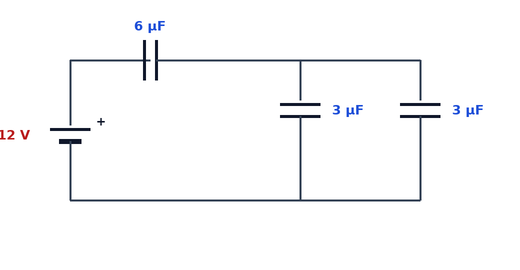
\(12\,\mu F\)\(12\,\mu F\)
\(6\,\mu F\)\(6\,\mu F\)
\(3\,\mu F\)\(3\,\mu F\)
\(2\,\mu F\)\(2\,\mu F\)
الحلSolution
📌 المكثفان المتوازيان: \(C_p=3+3=6\,\mu F\)
📌 مع المكثف \(6\,\mu F\) على التوالي: \(\dfrac1{C_{eq}}=\dfrac16+\dfrac16=\dfrac13\Rightarrow C_{eq}=3\,\mu F\)
✅ \(3\,\mu F\) (C)
📌 The parallel pair: \(C_p=3+3=6\,\mu F\)
📌 In series with the \(6\,\mu F\): \(\dfrac1{C_{eq}}=\dfrac16+\dfrac16=\dfrac13\Rightarrow C_{eq}=3\,\mu F\)
✅ \(3\,\mu F\) (C)
\[40\,\star\star\star\]
مكثفان \(4\,\mu F\) و\(6\,\mu F\) موصولان على التوالي ببطارية \(12\,V\) كما في الشكل. فإن فرق الجهد بين طرفي المكثف \(6\,\mu F\):Capacitors \(4\,\mu F\) and \(6\,\mu F\) are connected in series to a \(12\,V\) battery as shown. The potential difference across the \(6\,\mu F\) capacitor is:
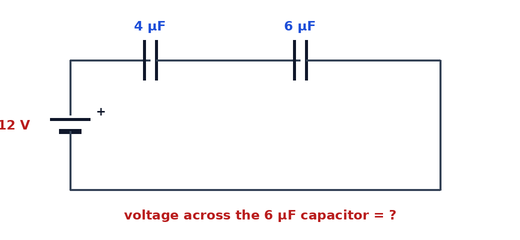
\(7.2\,V\)\(7.2\,V\)
\(4.8\,V\)\(4.8\,V\)
\(6\,V\)\(6\,V\)
\(2.4\,V\)\(2.4\,V\)
الحلSolution
📌 السعة المكافئة: \(C_{eq}=\dfrac{4\times6}{4+6}=2.4\,\mu F\) والشحنة المشتركة: \(Q=C_{eq}V=2.4\times12=28.8\,\mu C\)
📌 جهد المكثف الثاني: \(V_2=\dfrac{Q}{C_2}=\dfrac{28.8}{6}=4.8\,V\) (والأول \(7.2\,V\)).
✅ \(4.8\,V\) (B)
📌 The equivalent capacitance: \(C_{eq}=\dfrac{4\times6}{4+6}=2.4\,\mu F\) and the common charge: \(Q=C_{eq}V=2.4\times12=28.8\,\mu C\)
📌 The second capacitor: \(V_2=\dfrac{Q}{C_2}=\dfrac{28.8}{6}=4.8\,V\) (the first has \(7.2\,V\)).
✅ \(4.8\,V\) (B)
\[41\,\star\star\star\]
مكثف \(2\,\mu F\) موصول على التوازي مع مكثفين \(3\,\mu F\) و\(6\,\mu F\) على التوالي ببطارية \(12\,V\) كما في الشكل. فإن الطاقة الكلية المختزنة في المجموعة:A \(2\,\mu F\) capacitor is in parallel with a series pair of \(3\,\mu F\) and \(6\,\mu F\) across a \(12\,V\) battery as shown. The total energy stored in the combination is:
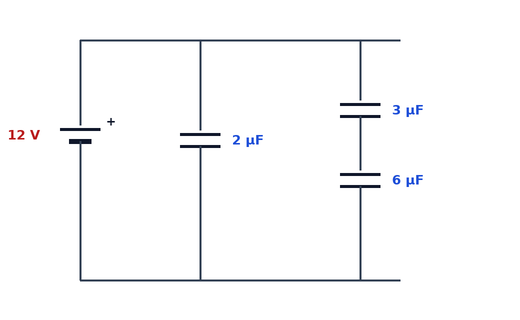
\(144\,\mu J\)\(144\,\mu J\)
\(576\,\mu J\)\(576\,\mu J\)
\(48\,\mu J\)\(48\,\mu J\)
\(288\,\mu J\)\(288\,\mu J\)
الحلSolution
📌 الفرع الآخر: \(C_s=\dfrac{3\times6}{9}=2\,\mu F\) والسعة المكافئة للمجموعة: \(C_{eq}=2+2=4\,\mu F\)
📌 الطاقة: \(U=\tfrac12C_{eq}V^2=\tfrac12(4\times10^{-6})(12)^2=288\,\mu J\)
✅ \(288\,\mu J\) (D)
📌 The other branch: \(C_s=\dfrac{3\times6}{9}=2\,\mu F\) and the equivalent capacitance: \(C_{eq}=2+2=4\,\mu F\)
📌 The energy: \(U=\tfrac12C_{eq}V^2=\tfrac12(4\times10^{-6})(12)^2=288\,\mu J\)
✅ \(288\,\mu J\) (D)
\[42\,\star\star\star\]
مكثف مشحون طاقته المختزنة \(100\,\mu J\) فُصل عن البطارية ثم أُدخلت بين لوحيه مادة عازلة ثابتها \(K=4\) تملأ الفراغ كما في الشكل. فإن طاقته المختزنة بعد ذلك:A charged capacitor storing \(100\,\mu J\) is disconnected from the battery and then a dielectric of constant \(K=4\) fills the gap as shown. The stored energy afterwards is:
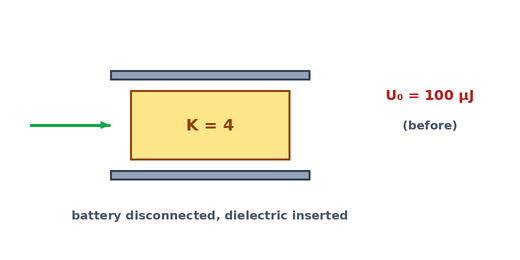
\(25\,\mu J\)\(25\,\mu J\)
\(400\,\mu J\)\(400\,\mu J\)
\(100\,\mu J\)\(100\,\mu J\)
\(50\,\mu J\)\(50\,\mu J\)
الحلSolution
📌 بعد فصل البطارية تبقى الشحنة ثابتة (\(Q\)) وتزداد السعة \(C'=KC\):
📌 \(U=\dfrac{Q^2}{2C}\Rightarrow U'=\dfrac{U}{K}=\dfrac{100}{4}=25\,\mu J\) (نقصت الطاقة لأن العازل يُسحب إلى الداخل).
✅ \(25\,\mu J\) (A)
📌 After disconnecting, the charge \(Q\) stays constant and the capacitance rises \(C'=KC\):
📌 \(U=\dfrac{Q^2}{2C}\Rightarrow U'=\dfrac{U}{K}=\dfrac{100}{4}=25\,\mu J\) (the energy drops because the dielectric is pulled in).
✅ \(25\,\mu J\) (A)
\[43\,\star\star\star\]
مكثف موصول ببطارية شحنته \(10\,\mu C\)، أُدخلت بين لوحيه مادة عازلة ثابتها \(K=2\) تملأ الفراغ مع بقاء البطارية موصولة كما في الشكل. فإن الشحنة الإضافية التي تعبر من البطارية:A capacitor connected to a battery holds \(10\,\mu C\). A dielectric of constant \(K=2\) fills the gap while the battery stays connected, as shown. The additional charge flowing from the battery is:
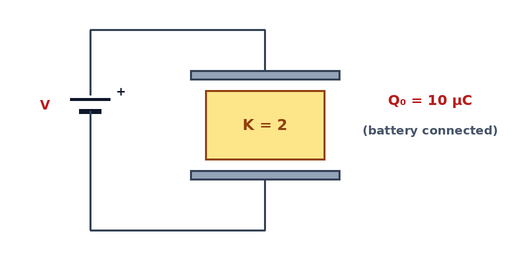
\(20\,\mu C\)\(20\,\mu C\)
\(10\,\mu C\)\(10\,\mu C\)
\(5\,\mu C\)\(5\,\mu C\)
\(0\)\(0\)
الحلSolution
📌 الجهد ثابت (البطارية موصولة) فالشحنة تتناسب مع السعة: \(Q'=KQ=2\times10=20\,\mu C\)
📌 الشحنة الإضافية: \(\Delta Q=20-10=10\,\mu C\)
✅ \(10\,\mu C\) (B)
📌 The voltage is constant (battery connected) so the charge is proportional to the capacitance: \(Q'=KQ=2\times10=20\,\mu C\)
📌 The additional charge: \(\Delta Q=20-10=10\,\mu C\)
✅ \(10\,\mu C\) (B)
\[44\,\star\star\star\]
مكثف \(4\,\mu F\) مشحون إلى \(10\,V\) وُصل بمكثف مماثل غير مشحون عند إغلاق المفتاح كما في الشكل. فإن الطاقة المفقودة في العملية:A \(4\,\mu F\) capacitor charged to \(10\,V\) is connected to an identical uncharged capacitor by closing the switch as shown. The energy lost in the process is:
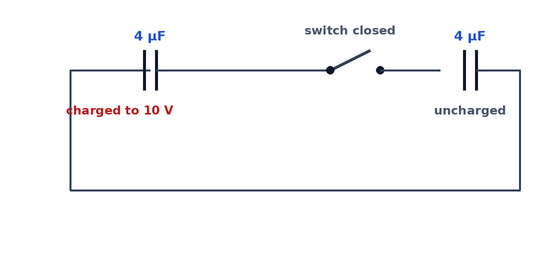
\(200\,\mu J\)\(200\,\mu J\)
\(50\,\mu J\)\(50\,\mu J\)
\(100\,\mu J\)\(100\,\mu J\)
\(0\)\(0\)
الحلSolution
📌 الطاقة الأولى: \(U_i=\tfrac12(4\times10^{-6})(10)^2=200\,\mu J\)
📌 الشحنة محفوظة على سعة \(8\,\mu F\): \(V_f=\dfrac{40}{8}=5\,V\) والطاقة النهائية \(U_f=\tfrac12(8)(5)^2=100\,\mu J\)
📌 المفقود: \(200-100=100\,\mu J\) (يتحول إلى حرارة وإشعاع في الشرارة).
✅ \(100\,\mu J\) (C)
📌 The initial energy: \(U_i=\tfrac12(4\times10^{-6})(10)^2=200\,\mu J\)
📌 Charge is conserved on \(8\,\mu F\): \(V_f=\dfrac{40}{8}=5\,V\) and the final energy \(U_f=\tfrac12(8)(5)^2=100\,\mu J\)
📌 Lost: \(200-100=100\,\mu J\) (converted to heat and radiation in the spark).
✅ \(100\,\mu J\) (C)
\[45\,\star\star\star\]
فرق الجهد بين لوحي مكثف \(200\,V\) والمسافة بينهما \(4\,mm\) كما في الشكل. فإن القوة الكهربائية المؤثرة في شحنة \(2\,nC\) بين اللوحين:The potential difference across a capacitor is \(200\,V\) with plate separation \(4\,mm\) as shown. The electric force on a \(2\,nC\) charge between the plates is:
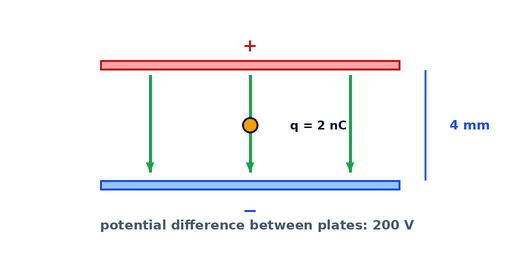
\(1.0\times10^{-6}\,N\)\(1.0\times10^{-6}\,N\)
\(4.0\times10^{-4}\,N\)\(4.0\times10^{-4}\,N\)
\(2.5\times10^{-5}\,N\)\(2.5\times10^{-5}\,N\)
\(1.0\times10^{-4}\,N\)\(1.0\times10^{-4}\,N\)
الحلSolution
📌 المجال بين اللوحين: \(E=\dfrac{V}{d}=\dfrac{200}{4\times10^{-3}}=5\times10^4\,V/m\)
📌 القوة: \(F=qE=2\times10^{-9}\times5\times10^4=1.0\times10^{-4}\,N\)
✅ \(1.0\times10^{-4}\,N\) (D)
📌 The field between the plates: \(E=\dfrac{V}{d}=\dfrac{200}{4\times10^{-3}}=5\times10^4\,V/m\)
📌 The force: \(F=qE=2\times10^{-9}\times5\times10^4=1.0\times10^{-4}\,N\)
✅ \(1.0\times10^{-4}\,N\) (D)
\[46\,\star\star\star\]
مكثف \(10\,\mu F\) موصول ببطارية \(12\,V\)، ضوعفت المسافة بين لوحيه مع بقاء البطارية موصولة كما في الشكل. فإن التغير في الطاقة المختزنة:A \(10\,\mu F\) capacitor stays connected to a \(12\,V\) battery while the distance between its plates is doubled as shown. The change in stored energy is:
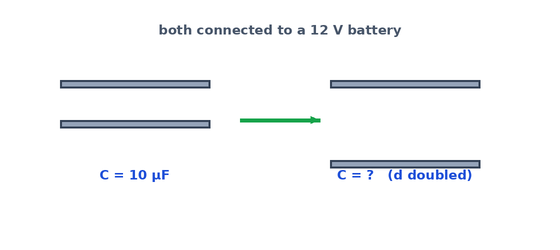
\(-360\,\mu J\)\(-360\,\mu J\)
\(+360\,\mu J\)\(+360\,\mu J\)
\(-720\,\mu J\)\(-720\,\mu J\)
\(0\)\(0\)
الحلSolution
📌 السعة تتناسب عكسيًا مع البعد: \(C'=\dfrac{C}{2}=5\,\mu F\)
📌 الجهد ثابت: \(\Delta U=\tfrac12(C'-C)V^2=\tfrac12(5-10)(10^{-6})(144)=-360\,\mu J\)
✅ \(-360\,\mu J\) (A)
📌 The capacitance is inversely proportional to the distance: \(C'=\dfrac{C}{2}=5\,\mu F\)
📌 The voltage is constant: \(\Delta U=\tfrac12(C'-C)V^2=\tfrac12(5-10)(10^{-6})(144)=-360\,\mu J\)
✅ \(-360\,\mu J\) (A)
\[47\,\star\star\star\]
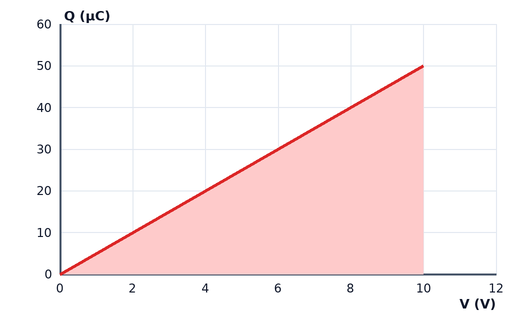
الرسم يبين العلاقة بين شحنة مكثف وفرق الجهد بين لوحيه. فإن الطاقة المختزنة فيه عند \(10\,V\):The graph shows the charge of a capacitor against the potential difference across it. The energy stored at \(10\,V\) is:
\(500\,\mu J\)\(500\,\mu J\)
\(250\,\mu J\)\(250\,\mu J\)
\(50\,\mu J\)\(50\,\mu J\)
\(125\,\mu J\)\(125\,\mu J\)
الحلSolution
📌 الطاقة = المساحة تحت منحنى \(Q\)–\(V\) (مثلث): \(U=\tfrac12QV=\tfrac12(50\times10^{-6})(10)\)
📌 \(U=250\,\mu J\) (والميل يعطي السعة \(C=5\,\mu F\)).
✅ \(250\,\mu J\) (B)
📌 Energy = the area under the \(Q\)–\(V\) graph (a triangle): \(U=\tfrac12QV=\tfrac12(50\times10^{-6})(10)\)
📌 \(U=250\,\mu J\) (and the slope gives the capacitance \(C=5\,\mu F\)).
✅ \(250\,\mu J\) (B)
\[48\,\star\star\star\]
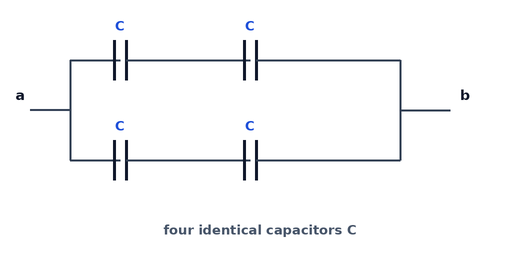
أربعة مكثفات متماثلة سعة كل منها \(C\) موصولة كما في الشكل (مجموعتان على التوالي موصولتان على التوازي). فإن السعة المكافئة بين النقطتين \(a\) و\(b\):Four identical capacitors of capacitance \(C\) are connected as shown (two series pairs in parallel). The equivalent capacitance between \(a\) and \(b\) is:
\(2C\)\(2C\)
\(\dfrac{C}{4}\)\(\dfrac{C}{4}\)
\(C\)\(C\)
\(4C\)\(4C\)
الحلSolution
📌 كل صف على التوالي: \(\dfrac{C}{2}\)
📌 الصفان على التوازي: \(C_{eq}=\dfrac C2+\dfrac C2=C\)
✅ \(C\) (C)
📌 Each row in series: \(\dfrac{C}{2}\)
📌 The two rows in parallel: \(C_{eq}=\dfrac C2+\dfrac C2=C\)
✅ \(C\) (C)
\[49\,\star\star\star\]
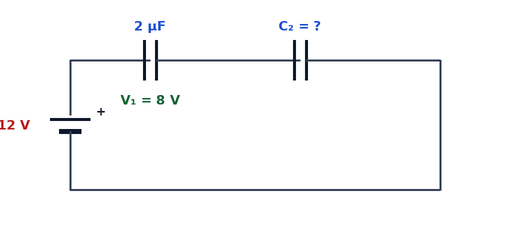
مكثف \(2\,\mu F\) موصول على التوالي مع مكثف مجهول \(C_2\) ببطارية \(12\,V\)، فإذا كان فرق الجهد على المكثف الأول \(8\,V\) كما في الشكل فإن \(C_2\):A \(2\,\mu F\) capacitor is in series with an unknown capacitor \(C_2\) across a \(12\,V\) battery, and the first capacitor has \(8\,V\) across it as shown. \(C_2\) is:
\(2\,\mu F\)\(2\,\mu F\)
\(8\,\mu F\)\(8\,\mu F\)
\(1\,\mu F\)\(1\,\mu F\)
\(4\,\mu F\)\(4\,\mu F\)
الحلSolution
📌 الشحنة مشتركة: \(Q=C_1V_1=2\times8=16\,\mu C\)
📌 جهد المكثف الثاني \(V_2=12-8=4\,V\): \(C_2=\dfrac{Q}{V_2}=\dfrac{16}{4}=4\,\mu F\)
✅ \(4\,\mu F\) (D)
📌 The charge is common: \(Q=C_1V_1=2\times8=16\,\mu C\)
📌 The second capacitor has \(V_2=12-8=4\,V\): \(C_2=\dfrac{Q}{V_2}=\dfrac{16}{4}=4\,\mu F\)
✅ \(4\,\mu F\) (D)
\[50\,\star\star\star\]
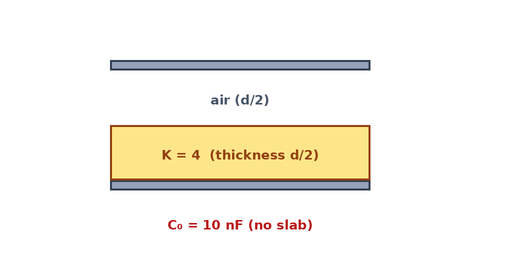
سعة مكثف مستوٍ هوائي \(C_0=10\,nF\). أُدخل بين لوحيه لوح عازل ثابته \(K=4\) سمكه نصف المسافة بين اللوحين ويغطي المساحة كلها كما في الشكل. فإن سعته الجديدة:A parallel-plate air capacitor has \(C_0=10\,nF\). A dielectric slab with \(K=4\) of thickness half the gap and covering the whole area is inserted as shown. The new capacitance is:
\(16\,nF\)\(16\,nF\)
\(25\,nF\)\(25\,nF\)
\(40\,nF\)\(40\,nF\)
\(12\,nF\)\(12\,nF\)
الحلSolution
📌 المجموعة مكثفان على التوالي: جزء هواء \(C_1=2C_0=20\,nF\) وجزء عازل \(C_2=2KC_0=80\,nF\)
📌 \(C=\dfrac{20\times80}{20+80}=16\,nF\)
✅ \(16\,nF\) (A)
📌 Two capacitors in series: an air part \(C_1=2C_0=20\,nF\) and a dielectric part \(C_2=2KC_0=80\,nF\)
📌 \(C=\dfrac{20\times80}{20+80}=16\,nF\)
✅ \(16\,nF\) (A)
\[51\,\star\star\star\]
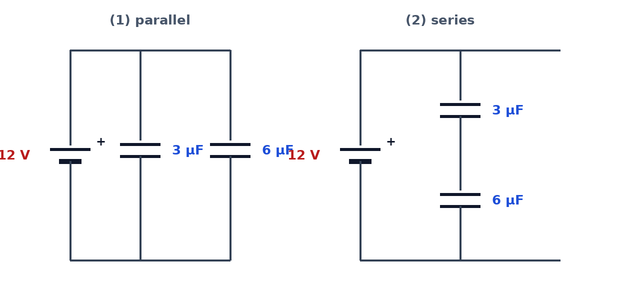
المكثفان \(3\,\mu F\) و\(6\,\mu F\) وُصلا بالبطارية نفسها \(12\,V\) مرة على التوازي (1) ومرة على التوالي (2) كما في الشكل. فإن النسبة بين الطاقة الكلية في الحالة (1) إلى الحالة (2):The capacitors \(3\,\mu F\) and \(6\,\mu F\) are connected to the same \(12\,V\) battery once in parallel (1) and once in series (2) as shown. The ratio of the total energy in case (1) to case (2) is:
\(2.25\)\(2.25\)
\(4.5\)\(4.5\)
\(9\)\(9\)
\(3\)\(3\)
الحلSolution
📌 الحالة (1): \(C_p=9\,\mu F\) والحالة (2): \(C_s=\dfrac{3\times6}{9}=2\,\mu F\)
📌 الجهد نفسه فالطاقة تتناسب مع السعة: \(\dfrac{U_1}{U_2}=\dfrac{9}{2}=4.5\)
✅ \(4.5\) (B)
📌 Case (1): \(C_p=9\,\mu F\) and case (2): \(C_s=\dfrac{3\times6}{9}=2\,\mu F\)
📌 The voltage is the same so the energy is proportional to the capacitance: \(\dfrac{U_1}{U_2}=\dfrac{9}{2}=4.5\)
✅ \(4.5\) (B)
\[52\,\star\star\star\]
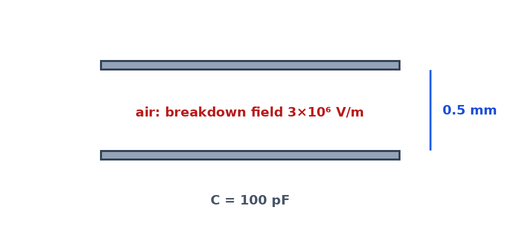
مكثف هوائي مستوٍ المسافة بين لوحيه \(0.5\,mm\) وسعته \(100\,pF\)، والمجال الأقصى الذي يتحمله الهواء قبل الانهيار \(3\times10^{6}\,V/m\). فإن أكبر فرق جهد يمكن تطبيقه:An air parallel-plate capacitor has plate separation \(0.5\,mm\) and capacitance \(100\,pF\), and the maximum field air can withstand before breakdown is \(3\times10^{6}\,V/m\). The largest potential difference that can be applied is:
\(1500\,V\)\(1500\,V\)
\(150\,V\)\(150\,V\)
\(6000\,V\)\(6000\,V\)
\(3000\,V\)\(3000\,V\)
الحلSolution
📌 المجال بين اللوحين \(E=V/d\) فالجهد الأقصى: \(V_{max}=E_{max}d=3\times10^6\times0.5\times10^{-3}=1500\,V\)
📌 والشحنة العظمى عندئذ: \(Q=CV=100\times10^{-12}\times1500=0.15\,\mu C\)
✅ \(1500\,V\) (A)
📌 The field between the plates is \(E=V/d\) so the maximum voltage: \(V_{max}=E_{max}d=3\times10^6\times0.5\times10^{-3}=1500\,V\)
📌 and the maximum charge then: \(Q=CV=100\times10^{-12}\times1500=0.15\,\mu C\)
✅ \(1500\,V\) (A)
📝 المسائل المقالية
📝 Essay Problems
\[1\,\star\star\]
مكثفان سعتاهما \(C_1=4\,\mu F\) و \(C_2=6\,\mu F\) موصولان على التوازي ببطارية فرق جهدها \(12\,V\)، ثم فُصلت البطارية وبقي المكثفان موصولين معًا. أُدخلت مادة عازلة ثابت عزلها \(K=2\) بين لوحي المكثف الأول فقط (تملأ الفراغ كله). احسب فرق الجهد النهائي بين لوحي كل مكثف.Two capacitors \(C_1=4\,\mu F\) and \(C_2=6\,\mu F\) are connected in parallel to a \(12\,V\) battery; the battery is then disconnected and the capacitors stay connected together. A dielectric of constant \(K=2\) is inserted between the plates of the first capacitor only (filling its gap completely). Calculate the final potential difference across each capacitor.
.....................................................................
الحلSolution
📌 الشحنة الكلية قبل إدخال العازل: \(Q=(C_1+C_2)V=(4+6)\times12=120\,\mu C\)، وتبقى ثابتة بعد فصل البطارية.
📌 تصبح سعة المكثف الأول \(C_1'=KC_1=2\times4=8\,\mu F\)، والسعة المكافئة \(C_{eq}=8+6=14\,\mu F\).
📌 \(V_f=\dfrac{Q}{C_{eq}}=\dfrac{120}{14}=8.57\,V\) (الجهد نفسه على المكثفين لأنهما على التوازي).
✅ \(V=8.57\,V\)
📌 Total charge before inserting the dielectric: \(Q=(C_1+C_2)V=(4+6)\times12=120\,\mu C\), and it stays constant after the battery is disconnected.
📌 The first capacitor becomes \(C_1'=KC_1=2\times4=8\,\mu F\) and the equivalent capacitance is \(C_{eq}=8+6=14\,\mu F\).
📌 \(V_f=\dfrac{Q}{C_{eq}}=\dfrac{120}{14}=8.57\,V\) (the same voltage on both since they are in parallel).
✅ \(V=8.57\,V\)
\[2\,\star\star\]
شُحن مكثف سعته \(C_1=10\,\mu F\) بوصله ببطارية فرق جهدها \(20\,V\)، ثم فُصل عن البطارية ووُصل على التوازي (اللوح الموجب باللوح الموجب) بمكثف غير مشحون سعته \(C_2=30\,\mu F\). احسب فرق الجهد النهائي وشحنة كل مكثف.A capacitor \(C_1=10\,\mu F\) is charged by connecting it to a \(20\,V\) battery, then disconnected and connected in parallel (positive plate to positive plate) to an uncharged capacitor \(C_2=30\,\mu F\). Calculate the final potential difference and the charge on each capacitor.
.....................................................................
الحلSolution
📌 الشحنة الابتدائية: \(Q=C_1V=10\times20=200\,\mu C\)، وهي محفوظة (لا تتبدد الشحنة).
📌 بعد التوصيل على التوازي: \(C_{eq}=10+30=40\,\mu F\) و \(V_f=\dfrac{Q}{C_{eq}}=\dfrac{200}{40}=5\,V\).
📌 \(q_1=C_1V_f=10\times5=50\,\mu C\)، \(q_2=C_2V_f=30\times5=150\,\mu C\) (المجموع \(200\,\mu C\) ✓).
✅ \(V=5\,V\)، \(q_1=50\,\mu C\)، \(q_2=150\,\mu C\)
📌 Initial charge: \(Q=C_1V=10\times20=200\,\mu C\), which is conserved.
📌 After connecting in parallel: \(C_{eq}=10+30=40\,\mu F\) and \(V_f=\dfrac{Q}{C_{eq}}=\dfrac{200}{40}=5\,V\).
📌 \(q_1=C_1V_f=10\times5=50\,\mu C\), \(q_2=C_2V_f=30\times5=150\,\mu C\) (sum \(200\,\mu C\) ✓).
✅ \(V=5\,V\), \(q_1=50\,\mu C\), \(q_2=150\,\mu C\)
\[3\,\star\star\]
وُصلت ثلاثة مكثفات سعاتها \(C_1=3\,\mu F\) و \(C_2=6\,\mu F\) و \(C_3=2\,\mu F\) على التوالي ببطارية فرق جهدها \(12\,V\). احسب فرق الجهد بين طرفي كل مكثف.Three capacitors \(C_1=3\,\mu F\), \(C_2=6\,\mu F\) and \(C_3=2\,\mu F\) are connected in series to a \(12\,V\) battery. Calculate the potential difference across each capacitor.
.....................................................................
الحلSolution
📌 \(\dfrac{1}{C_{eq}}=\dfrac{1}{3}+\dfrac{1}{6}+\dfrac{1}{2}=\dfrac{2+1+3}{6}=1\Rightarrow C_{eq}=1\,\mu F\).
📌 على التوالي تتساوى الشحنات: \(Q=C_{eq}V=1\times12=12\,\mu C\).
📌 \(V_1=\dfrac{12}{3}=4\,V\)، \(V_2=\dfrac{12}{6}=2\,V\)، \(V_3=\dfrac{12}{2}=6\,V\) (المجموع \(12\,V\) ✓).
✅ \(V_1=4\,V\)، \(V_2=2\,V\)، \(V_3=6\,V\)
📌 \(\dfrac{1}{C_{eq}}=\dfrac{1}{3}+\dfrac{1}{6}+\dfrac{1}{2}=\dfrac{2+1+3}{6}=1\Rightarrow C_{eq}=1\,\mu F\).
📌 In series the charges are equal: \(Q=C_{eq}V=1\times12=12\,\mu C\).
📌 \(V_1=\dfrac{12}{3}=4\,V\), \(V_2=\dfrac{12}{6}=2\,V\), \(V_3=\dfrac{12}{2}=6\,V\) (sum \(12\,V\) ✓).
✅ \(V_1=4\,V\), \(V_2=2\,V\), \(V_3=6\,V\)
\[4\,\star\star\star\]
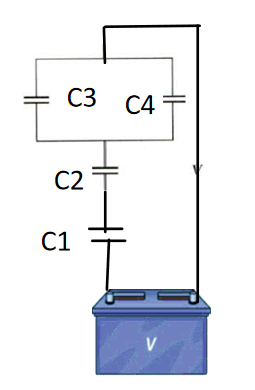
وُصلت أربعة مكثفات بطارية فرق جهدها \(12\,V\) كما في الشكل، حيث \(C_1=4\,\mu F\) و \(C_2=6\,\mu F\) و \(C_3=3\,\mu F\) و \(C_4=9\,\mu F\). احسب شحنة كل مكثف وفرق الجهد بين طرفيه.Four capacitors are connected to a \(12\,V\) battery as shown, where \(C_1=4\,\mu F\), \(C_2=6\,\mu F\), \(C_3=3\,\mu F\) and \(C_4=9\,\mu F\). Calculate the charge on each capacitor and the potential difference across it.
.....................................................................
الحلSolution
📌 المكثفان \(C_3\) و \(C_4\) على التوازي: \(C_{34}=3+9=12\,\mu F\)، وهذه المجموعة على التوالي مع \(C_2\) و \(C_1\).
📌 \(\dfrac{1}{C_{eq}}=\dfrac{1}{4}+\dfrac{1}{6}+\dfrac{1}{12}=\dfrac{3+2+1}{12}=\dfrac{1}{2}\Rightarrow C_{eq}=2\,\mu F\)، و \(Q=C_{eq}V=2\times12=24\,\mu C\).
📌 على التوالي: \(q_1=q_2=24\,\mu C\) و \(V_1=\dfrac{24}{4}=6\,V\)، \(V_2=\dfrac{24}{6}=4\,V\)، وجهد المجموعة المتوازية \(V_{34}=\dfrac{24}{12}=2\,V\) (المجموع \(6+4+2=12\,V\) ✓).
📌 \(q_3=C_3V_{34}=3\times2=6\,\mu C\) و \(q_4=C_4V_{34}=9\times2=18\,\mu C\) (المجموع \(24\,\mu C\) ✓).
✅ \(q_1=24\,\mu C,\,V_1=6\,V\)؛ \(q_2=24\,\mu C,\,V_2=4\,V\)؛ \(q_3=6\,\mu C,\,V_3=2\,V\)؛ \(q_4=18\,\mu C,\,V_4=2\,V\)
📌 \(C_3\) and \(C_4\) are in parallel: \(C_{34}=3+9=12\,\mu F\); this group is in series with \(C_2\) and \(C_1\).
📌 \(\dfrac{1}{C_{eq}}=\dfrac{1}{4}+\dfrac{1}{6}+\dfrac{1}{12}=\dfrac{3+2+1}{12}=\dfrac{1}{2}\Rightarrow C_{eq}=2\,\mu F\) and \(Q=C_{eq}V=2\times12=24\,\mu C\).
📌 In series: \(q_1=q_2=24\,\mu C\) and \(V_1=\dfrac{24}{4}=6\,V\), \(V_2=\dfrac{24}{6}=4\,V\), and the parallel group has \(V_{34}=\dfrac{24}{12}=2\,V\) (total \(6+4+2=12\,V\) ✓).
📌 \(q_3=C_3V_{34}=3\times2=6\,\mu C\) and \(q_4=C_4V_{34}=9\times2=18\,\mu C\) (sum \(24\,\mu C\) ✓).
✅ \(q_1=24\,\mu C,\,V_1=6\,V\); \(q_2=24\,\mu C,\,V_2=4\,V\); \(q_3=6\,\mu C,\,V_3=2\,V\); \(q_4=18\,\mu C,\,V_4=2\,V\)
لاحظت خطأ؟ أو عندك سؤال عن أحد الأسئلة؟ اكتبه بالتعليقات وحدد رقم السؤال بالضبط.
Noticed an error? Or have a question about one of the questions? Write it in the comments and specify the exact question number.