🧲 بنك الأسئلة: المغناطيسية (12A)
🧲 Question Bank: Magnetism (12A)
القطبان المغناطيسيان والمجال، القوة المغناطيسية على شحنة وعلى سلك، الحركة الدائرية والحلزونية، منقي السرعات ومطياف الكتلة، العزم المغناطيسي وتأثير هول
Magnetic Poles and Field, the Magnetic Force on a Charge and on a Wire, Circular and Helical Motion, Velocity Selector and Mass Spectrometer, Magnetic Torque and the Hall Effect
⏱️ 46 سؤال اختيار من متعدد بتصحيح فوري بمستويات متدرجة، و2 مسائل مقالية محلولة⏱️ 46 multiple-choice questions of graded difficulty with instant feedback, plus 2 solved essay problems
\[1\,\star\]
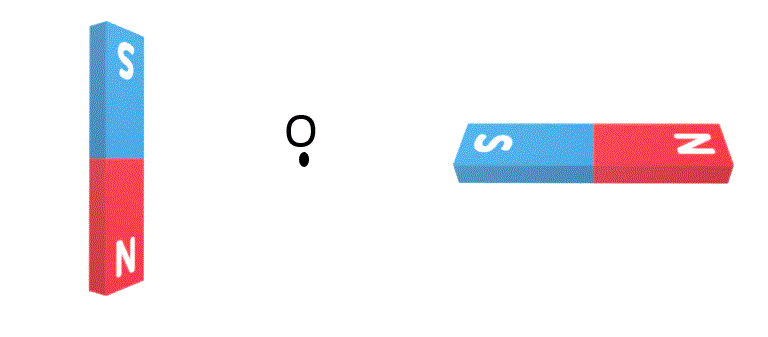
مغناطيسان وُضعا كما في الشكل. اتجاه المجال المغناطيسي الكلي عند النقطة \(O\) هو:Two magnets are placed as shown. The direction of the net magnetic field at the point \(O\) is:
\(\nearrow\) الشمال الشرقيnortheast \(\nearrow\)
\(\uparrow\) الشمالnorth \(\uparrow\)
\(\rightarrow\) الشرقeast \(\rightarrow\)
\(\nwarrow\) الشمال الغربيnorthwest \(\nwarrow\)
الحلSolution
📌 خطوط المجال خارج المغناطيس تخرج من القطب الشمالي N وتدخل القطب الجنوبي S. النقطة \(O\) تقع بجانب منتصف المغناطيس الرأسي (S أعلى وN أسفل) فمجاله عندها نحو الأعلى (شمالًا).
📌 وتقع \(O\) على امتداد المغناطيس الأفقي من جهة قطبه S فمجاله نحو القطب S أي نحو اليمين (شرقًا).
📌 المحصلة (شمال + شرق) باتجاه الشمال الشرقي.
✅ \(\nearrow\) الشمال الشرقي (A)
📌 Outside a magnet the field lines leave the N pole and enter the S pole. The point \(O\) lies beside the middle of the vertical magnet (S on top, N below) so its field there points up (north).
📌 \(O\) lies on the axis of the horizontal magnet beside its S pole, so its field points toward the S pole, i.e. right (east).
📌 The resultant (north + east) points northeast.
✅ northeast \(\nearrow\) (A)
\[2\,\star\]
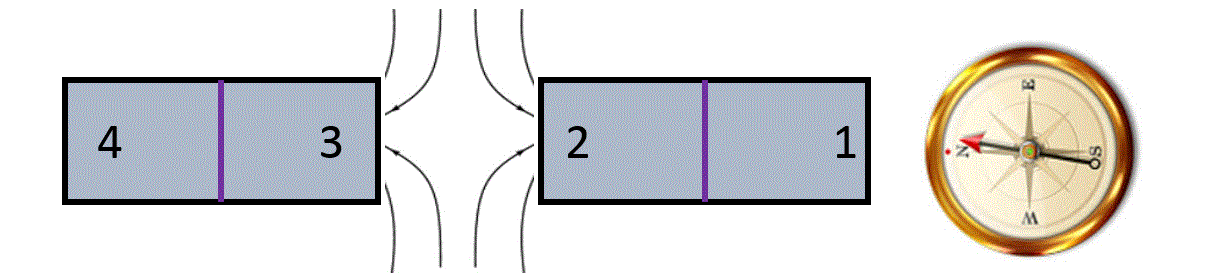
مغناطيسان وُضع كل منهما متجاورين وبجوارهما بوصلة كما في الشكل (خطوط المجال بين القطبين 3 و2 تتنافر). ترتيب الأقطاب من 1 إلى 4:Two magnets are placed side by side with a compass next to them as shown (the field lines between poles 3 and 2 bulge apart). The order of the poles from 1 to 4 is:
\(N_1\to S_2\to S_3\to N_4\)\(N_1\to S_2\to S_3\to N_4\)
\(N_1\to S_2\to N_3\to S_4\)\(N_1\to S_2\to N_3\to S_4\)
\(S_1\to N_2\to S_3\to N_4\)\(S_1\to N_2\to S_3\to N_4\)
\(S_1\to N_2\to N_3\to S_4\)\(S_1\to N_2\to N_3\to S_4\)
الحلSolution
📌 الطرف الأحمر من إبرة البوصلة هو قطبها الشمالي ويتجه نحو القطب الجنوبي للمغناطيس، فالقطب 1 هو S فيكون طرف مغناطيسه الآخر 2 هو N.
📌 خطوط المجال بين 2 و3 تتنافر، أي أن القطبين المتقابلين متشابهان: 3 هو N ومنه 4 هو S.
✅ \(S_1\to N_2\to N_3\to S_4\) (D)
📌 The red end of the compass needle is its north pole and it points toward the south pole of the magnet, so pole 1 is S and the other end of its magnet, pole 2, is N.
📌 The field lines between 2 and 3 repel each other, i.e. the facing poles are alike: 3 is N and hence 4 is S.
✅ \(S_1\to N_2\to N_3\to S_4\) (D)
\[3\,\star\star\]
أي وحدات القياس التالية تكافئ التسلا \(T\)؟Which of the following units is equivalent to the tesla \(T\)?
\(T=\dfrac{kg\cdot m^{2}}{A\cdot s}\)\(T=\dfrac{kg\cdot m^{2}}{A\cdot s}\)
\(T=\dfrac{kg}{A\cdot s^{2}}\)\(T=\dfrac{kg}{A\cdot s^{2}}\)
\(T=\dfrac{kg\cdot m}{A\cdot s^{2}}\)\(T=\dfrac{kg\cdot m}{A\cdot s^{2}}\)
\(T=\dfrac{kg\cdot m^{2}}{A\cdot s^{2}}\)\(T=\dfrac{kg\cdot m^{2}}{A\cdot s^{2}}\)
الحلSolution
📌 من \(F=qvB\) : \(B=\dfrac{F}{qv}=\dfrac{N}{C\cdot m/s}=\dfrac{N}{A\cdot m}\) (لأن \(C=A\cdot s\)).
📌 ونعوّض \(N=\dfrac{kg\cdot m}{s^{2}}\) فيكون \(T=\dfrac{kg\cdot m/s^{2}}{A\cdot m}=\dfrac{kg}{A\cdot s^{2}}\).
✅ \(T=\dfrac{kg}{A\cdot s^{2}}\) (B)
📌 From \(F=qvB\): \(B=\dfrac{F}{qv}=\dfrac{N}{C\cdot m/s}=\dfrac{N}{A\cdot m}\) (since \(C=A\cdot s\)).
📌 Substituting \(N=\dfrac{kg\cdot m}{s^{2}}\) gives \(T=\dfrac{kg\cdot m/s^{2}}{A\cdot m}=\dfrac{kg}{A\cdot s^{2}}\).
✅ \(T=\dfrac{kg}{A\cdot s^{2}}\) (B)
\[4\,\star\]
أحد الخيارات التالية لا يمثل صفات خطوط المجال المغناطيسي:Which of the following is not a characteristic of magnetic field lines?
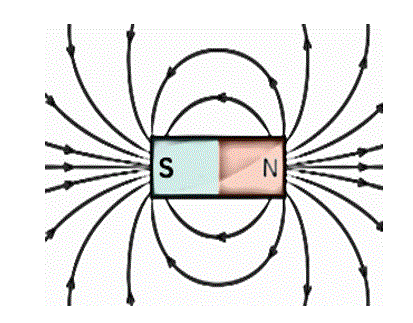
اتجاه المجال عند أي نقطة هو المماس لخط المجال عند تلك النقطةThe field direction at any point is tangent to the field line at that point
خطوط المجال تتقاطع عند الأقطابField lines intersect at the poles
تتكاثف خطوط المجال عند الأقطاب وتقل عند الوسطThe field lines are densest at the poles and sparse in the middle
خطوط المجال تتجه من القطب الجنوبي إلى الشمالي داخل المغناطيسInside the magnet the field lines go from the south pole to the north pole
الحلSolution
📌 خطوط المجال لا تتقاطع أبدًا (لأن للمجال اتجاهًا واحدًا عند كل نقطة)، وهي خطوط مغلقة تخرج من N وتدخل S خارج المغناطيس وتكمل داخله من S إلى N.
✅ خطوط المجال تتقاطع عند الأقطاب (B)
📌 Field lines never cross (the field has a single direction at each point); they are closed loops leaving N and entering S outside the magnet and continuing inside from S to N.
✅ Field lines intersect at the poles (B)
\[5\,\star\]
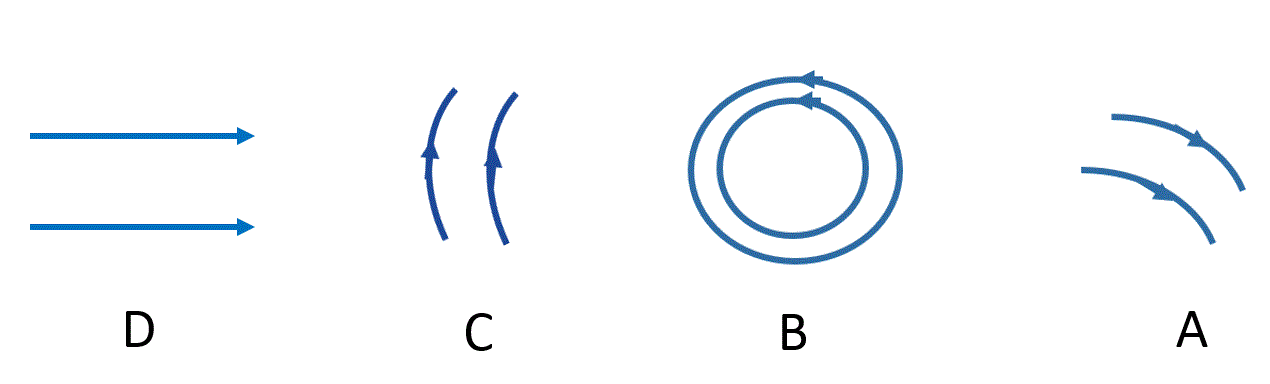
أيّ الخطوط التالية تمثل خطوط المجال المغناطيسي؟Which of the following lines represents magnetic field lines?
AA
BB
CC
DD
الحلSolution
📌 خطوط المجال المغناطيسي مغلقة (لا بداية لها ولا نهاية) بخلاف خطوط المجال الكهربائي التي تبدأ بالشحنة الموجبة وتنتهي بالسالبة.
📌 الشكل B هو الوحيد الذي يمثل حلقات مغلقة.
✅ B
📌 Magnetic field lines are closed loops (no beginning or end), unlike electric field lines that start on positive charges and end on negative ones.
📌 Figure B is the only one showing closed loops.
✅ B
\[6\,\star\]
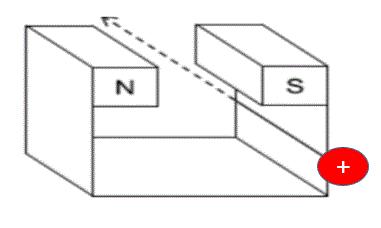
يتحرك بروتون بين قطبي مغناطيس كما في الشكل (المجال من N إلى S أفقيًا وسرعته على امتداد الفجوة نحو الخلف). ينحرف البروتون بتأثير القوة المغناطيسية:A proton moves between the poles of a magnet as shown (the field goes from N to S horizontally and the velocity is along the gap, backward). The proton is deflected by the magnetic force:
نحو الأعلىupward
باتجاه القطب الشماليtoward the north pole
نحو الأسفلdownward
باتجاه القطب الجنوبيtoward the south pole
الحلSolution
📌 قاعدة اليد اليمنى \(F=qv\times B\): القوة عمودية على كل من السرعة والمجال.
📌 المجال أفقي من N إلى S والسرعة أفقية نحو الخلف، فحاصل الضرب الاتجاهي رأسي؛ وبتطبيق القاعدة للشحنة الموجبة تكون القوة نحو الأسفل (والقوة لا تكون أبدًا باتجاه القطبين لأنها عمودية على المجال).
✅ نحو الأسفل (C)
📌 The right-hand rule \(F=qv\times B\): the force is perpendicular to both the velocity and the field.
📌 The field is horizontal from N to S and the velocity is horizontal backward, so the cross product is vertical; applying the rule for a positive charge the force is downward (never toward the poles, since it is perpendicular to the field).
✅ downward (C)
\[7\,\star\]
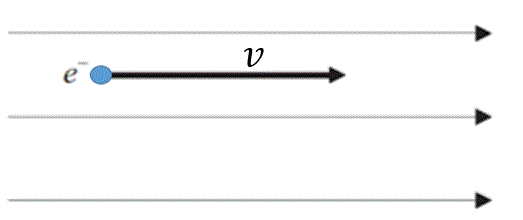
يتحرك إلكترون في منطقة مجال منتظم وفي لحظة الشكل يتحرك بالتوازي مع خطوط المجال. القوة المغناطيسية على الإلكترون:An electron moves in a uniform field and at the instant shown it moves parallel to the field lines. The magnetic force on the electron is:
نحو الشمالtoward the north
نحو الجنوبtoward the south
معدومة فيتابع حركته في خط مستقيمzero, so it continues in a straight line
عمودية على مستوى الصفحةperpendicular to the page
الحلSolution
📌 \(F=qvB\sin\theta\) والزاوية بين السرعة والمجال \(\theta=0^{\circ}\) فـ \(\sin0=0\) ولا توجد قوة مغناطيسية.
✅ معدومة فيتابع حركته في خط مستقيم (C)
📌 \(F=qvB\sin\theta\) and the angle between the velocity and the field is \(\theta=0^{\circ}\), so \(\sin0=0\) and there is no magnetic force.
✅ zero, so it continues in a straight line (C)
\[8\,\star\star\]
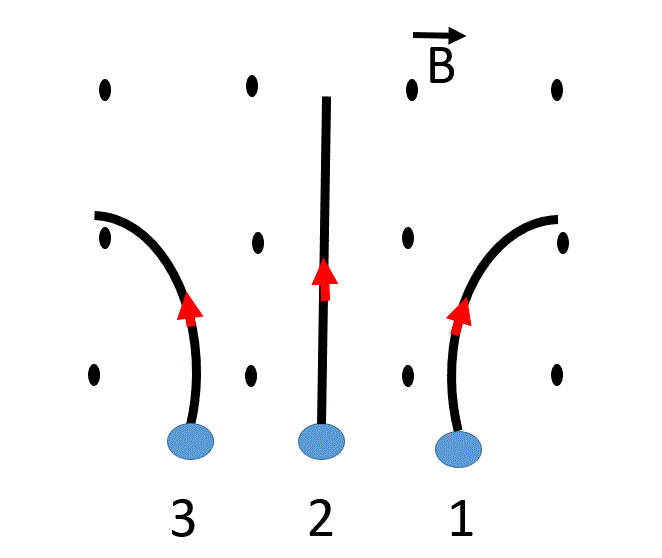
قُذفت ثلاثة جسيمات (بروتون وإلكترون ونيوترون) نحو الشمال في منطقة مجال منتظم عمودي على الصفحة نحو الخارج، فاتخذت المسارات 1 و2 و3 في الشكل. نوع كل جسيم:Three particles (a proton, an electron and a neutron) are projected northward into a uniform field pointing out of the page and take paths 1, 2 and 3 in the figure. The identity of each particle is:
(1) إلكترون (2) بروتون (3) نيوترون(1) electron, (2) proton, (3) neutron
(1) نيوترون (2) بروتون (3) إلكترون(1) neutron, (2) proton, (3) electron
(1) بروتون (2) إلكترون (3) نيوترون(1) proton, (2) electron, (3) neutron
(1) بروتون (2) نيوترون (3) إلكترون(1) proton, (2) neutron, (3) electron
الحلSolution
📌 النيوترون متعادل فلا تؤثر عليه القوة المغناطيسية ويتابع في خط مستقيم: المسار 2.
📌 للشحنة الموجبة: السرعة شمالًا والمجال للخارج فالقوة \(qv\times B\) نحو الشرق (اليمين) فينحني المسار 1 يمينًا: بروتون؛ والمسار 3 ينحني يسارًا: إلكترون.
✅ (1) بروتون (2) نيوترون (3) إلكترون (D)
📌 The neutron is neutral, so there is no magnetic force and it moves straight: path 2.
📌 For a positive charge: the velocity is north and the field out of the page, so the force \(qv\times B\) points east (right): path 1 curves right: the proton; path 3 curves left: the electron.
✅ (1) proton, (2) neutron, (3) electron (D)
\[9\,\star\star\]
جسيم وزنه \(0.005\,N\) وشحنته \(q=3\,nC\) قُذف عموديًا على مجال منتظم بسرعة \(2\times10^{6}\,m/s\) نحو الغرب، فاستمر في مساره الأفقي دون أن ينحرف بفعل الجاذبية. مقدار المجال المغناطيسي واتجاهه:A particle of weight \(0.005\,N\) and charge \(q=3\,nC\) is projected perpendicular to a uniform field at \(2\times10^{6}\,m/s\) westward and continues undeflected along its horizontal path despite gravity. The magnitude and direction of the field are:
\(B=0.83\,T\) نحو الشمال\(B=0.83\,T\) northward
\(B=0.42\,T\) نحو الشمال\(B=0.42\,T\) northward
\(B=0.83\,T\) نحو الجنوب\(B=0.83\,T\) southward
\(B=0.42\,T\) نحو الجنوب\(B=0.42\,T\) southward
الحلSolution
📌 لا انحراف فالقوة المغناطيسية تعادل الوزن وتعاكسه (نحو الأعلى): \(qvB=mg\).
\(B=\dfrac{mg}{qv}=\dfrac{0.005}{3\times10^{-9}\times2\times10^{6}}=0.83\,T\).
📌 الشحنة موجبة وسرعتها غربًا والقوة للأعلى: بتطبيق قاعدة اليد اليمنى يكون المجال نحو الجنوب.
✅ \(B=0.83\,T\) نحو الجنوب (C)
📌 No deflection, so the magnetic force equals the weight and opposes it (upward): \(qvB=mg\).
\(B=\dfrac{mg}{qv}=\dfrac{0.005}{3\times10^{-9}\times2\times10^{6}}=0.83\,T\).
📌 The charge is positive, its velocity west and the force upward: by the right-hand rule the field points south.
✅ \(B=0.83\,T\) southward (C)
\[10\,\star\star\]
دخل بروتون ونيوترون وإلكترون منطقة مجال منتظم بالسرعة نفسها وعموديًا على المجال. أي الخيارات (الجدول) يصف حركة الجسيمات الثلاثة؟
A: إلكترون يرسم مسارًا دائريًا صغيرًا، نيوترون يتابع طريقه، بروتون يرسم مسارًا دائريًا كبيرًا.
B: إلكترون يتابع طريقه، نيوترون مسار دائري كبير، بروتون مسار دائري صغير.
C: إلكترون مسار دائري كبير، نيوترون مسار دائري صغير، بروتون يتابع طريقه.
D: الثلاثة تسير في مسارات لولبية.A proton, a neutron and an electron enter a uniform field with the same speed, perpendicular to the field. Which option (table) describes the motion of the three?
A: electron a small circle, neutron straight, proton a large circle.
B: electron straight, neutron a large circle, proton a small circle.
C: electron a large circle, neutron a small circle, proton straight.
D: all three follow helical paths.
AA
BB
CC
DD
الحلSolution
📌 نصف قطر المسار \(r=\dfrac{mv}{|q|B}\) ولهما الشحنة نفسها بالمقدار: الأخف كتلة (الإلكترون) نصف قطره أصغر، والبروتون (أثقل بنحو 1836 مرة) نصف قطره أكبر.
📌 النيوترون متعادل فيتابع في خط مستقيم: الخيار A.
✅ A
📌 The radius \(r=\dfrac{mv}{|q|B}\) and both have the same charge magnitude: the lighter electron has the smaller radius, the proton (about 1836 times heavier) the larger.
📌 The neutron is neutral and moves straight: option A.
✅ A
\[11\,\star\star\]
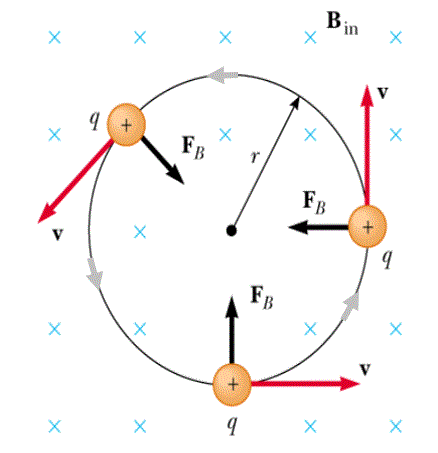
قُذف بروتون عموديًا على مجال منتظم شدته \(0.5\,T\) فاتخذ مسارًا دائريًا. الزمن الدوري لحركته الدائرية (\(q_p=1.6\times10^{-19}\,C,\ m_p=1.67\times10^{-27}\,kg\)):A proton is projected perpendicular to a uniform field of \(0.5\,T\) and takes a circular path. The period of its circular motion (\(q_p=1.6\times10^{-19}\,C,\ m_p=1.67\times10^{-27}\,kg\)) is:
\(t=2.56\times10^{-7}\,s\)\(t=2.56\times10^{-7}\,s\)
\(t=1.31\times10^{-7}\,s\)\(t=1.31\times10^{-7}\,s\)
\(t=3.4\times10^{6}\,s\)\(t=3.4\times10^{6}\,s\)
\(t=7.63\times10^{-7}\,s\)\(t=7.63\times10^{-7}\,s\)
الحلSolution
📌 \(T=\dfrac{2\pi r}{v}=\dfrac{2\pi m}{qB}\) (لا يعتمد على السرعة).
\(T=\dfrac{2\pi\times1.67\times10^{-27}}{1.6\times10^{-19}\times0.5}=1.31\times10^{-7}\,s\).
✅ \(t=1.31\times10^{-7}\,s\) (B)
📌 \(T=\dfrac{2\pi r}{v}=\dfrac{2\pi m}{qB}\) (independent of the speed).
\(T=\dfrac{2\pi\times1.67\times10^{-27}}{1.6\times10^{-19}\times0.5}=1.31\times10^{-7}\,s\).
✅ \(t=1.31\times10^{-7}\,s\) (B)
\[12\,\star\star\star\]
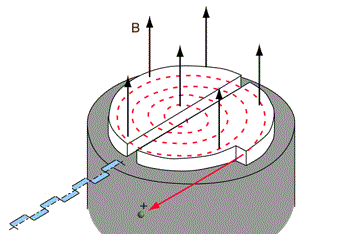
يخرج بروتون من مسرّع جسيمات فيه مجال مغناطيسي شدته \(0.6\,T\) بنصف قطر \(0.3\,m\). النسبة بين كمية حركته إلى طاقته الحركية لحظة الخروج:A proton leaves a particle accelerator containing a magnetic field of \(0.6\,T\) with a radius of \(0.3\,m\). The ratio of its momentum to its kinetic energy at that moment is:
\(\dfrac{p}{KE}=1.17\times10^{-7}\ s/m\)\(\dfrac{p}{KE}=1.17\times10^{-7}\ s/m\)
\(\dfrac{p}{KE}=5.42\times10^{-7}\ s/m\)\(\dfrac{p}{KE}=5.42\times10^{-7}\ s/m\)
\(\dfrac{p}{KE}=8.6\times10^{6}\ s/m\)\(\dfrac{p}{KE}=8.6\times10^{6}\ s/m\)
\(\dfrac{p}{KE}=3.45\times10^{6}\ s/m\)\(\dfrac{p}{KE}=3.45\times10^{6}\ s/m\)
الحلSolution
📌 \(\dfrac{p}{KE}=\dfrac{mv}{\tfrac12mv^{2}}=\dfrac{2}{v}\).
\(v=\dfrac{rqB}{m}=\dfrac{0.3\times1.6\times10^{-19}\times0.6}{1.67\times10^{-27}}=1.7\times10^{7}\,m/s\).
\(\dfrac{p}{KE}=\dfrac{2}{1.7\times10^{7}}=1.17\times10^{-7}\ s/m\).
✅ \(\dfrac{p}{KE}=1.17\times10^{-7}\ s/m\) (A)
📌 \(\dfrac{p}{KE}=\dfrac{mv}{\tfrac12mv^{2}}=\dfrac{2}{v}\).
\(v=\dfrac{rqB}{m}=\dfrac{0.3\times1.6\times10^{-19}\times0.6}{1.67\times10^{-27}}=1.7\times10^{7}\,m/s\).
\(\dfrac{p}{KE}=\dfrac{2}{1.7\times10^{7}}=1.17\times10^{-7}\ s/m\).
✅ \(\dfrac{p}{KE}=1.17\times10^{-7}\ s/m\) (A)
\[13\,\star\star\]
مجال مغناطيسي منتظم شدته \(5\times10^{-2}\,T\) نحو الشرق قُذف فيه إلكترون بسرعة \(4\times10^{6}\,m/s\) بزاوية \(60^{\circ}\) فوق محور الشرق. نصف قطر مساره الدائري:A uniform magnetic field of \(5\times10^{-2}\,T\) points east and an electron is projected into it at \(4\times10^{6}\,m/s\) at \(60^{\circ}\) above the east axis. The radius of its circular path is:
\(r=1.6\times10^{-4}\,m\)\(r=1.6\times10^{-4}\,m\)
\(r=3.9\times10^{-4}\,m\)\(r=3.9\times10^{-4}\,m\)
\(r=2.77\times10^{-4}\,m\)\(r=2.77\times10^{-4}\,m\)
\(r=4.55\times10^{-4}\,m\)\(r=4.55\times10^{-4}\,m\)
الحلSolution
📌 المركبة الموازية للمجال لا تؤثر في الدوران؛ الدوران بسبب المركبة العمودية \(v_{\perp}=v\sin60^{\circ}=3.46\times10^{6}\,m/s\).
\(r=\dfrac{mv_{\perp}}{eB}=\dfrac{9.11\times10^{-31}\times3.46\times10^{6}}{1.6\times10^{-19}\times0.05}=3.9\times10^{-4}\,m\).
✅ \(r=3.9\times10^{-4}\,m\) (B)
📌 The component parallel to the field does not affect the rotation; the rotation is due to the perpendicular component \(v_{\perp}=v\sin60^{\circ}=3.46\times10^{6}\,m/s\).
\(r=\dfrac{mv_{\perp}}{eB}=\dfrac{9.11\times10^{-31}\times3.46\times10^{6}}{1.6\times10^{-19}\times0.05}=3.9\times10^{-4}\,m\).
✅ \(r=3.9\times10^{-4}\,m\) (B)
\[14\,\star\star\star\]
في المسألة السابقة (الإلكترون بسرعة \(4\times10^{6}\,m/s\) بزاوية \(60^{\circ}\) في مجال \(5\times10^{-2}\,T\)) المسافة التي يتقدمها الإلكترون على امتداد المجال خلال دورة كاملة:In the previous problem (the electron at \(4\times10^{6}\,m/s\) at \(60^{\circ}\) in a field of \(5\times10^{-2}\,T\)) the distance the electron advances along the field during one full revolution is:
\(X=2.6\times10^{-3}\,m\)\(X=2.6\times10^{-3}\,m\)
\(X=1.4\times10^{-3}\,m\)\(X=1.4\times10^{-3}\,m\)
\(X=4.8\times10^{-3}\,m\)\(X=4.8\times10^{-3}\,m\)
\(X=9.6\times10^{-4}\,m\)\(X=9.6\times10^{-4}\,m\)
الحلSolution
📌 المسار لولبي: الإزاحة على امتداد المجال في دورة كاملة (الخطوة) \(X=v_{\parallel}\,T\) حيث \(v_{\parallel}=v\cos60^{\circ}=2\times10^{6}\,m/s\).
\(T=\dfrac{2\pi m}{eB}=\dfrac{2\pi\times9.11\times10^{-31}}{1.6\times10^{-19}\times0.05}=7.16\times10^{-10}\,s\).
\(X=2\times10^{6}\times7.16\times10^{-10}=1.4\times10^{-3}\,m\).
✅ \(X=1.4\times10^{-3}\,m\) (B)
📌 The path is helical: the advance along the field in one revolution (the pitch) is \(X=v_{\parallel}\,T\) where \(v_{\parallel}=v\cos60^{\circ}=2\times10^{6}\,m/s\).
\(T=\dfrac{2\pi m}{eB}=\dfrac{2\pi\times9.11\times10^{-31}}{1.6\times10^{-19}\times0.05}=7.16\times10^{-10}\,s\).
\(X=2\times10^{6}\times7.16\times10^{-10}=1.4\times10^{-3}\,m\).
✅ \(X=1.4\times10^{-3}\,m\) (B)
\[15\,\star\star\]
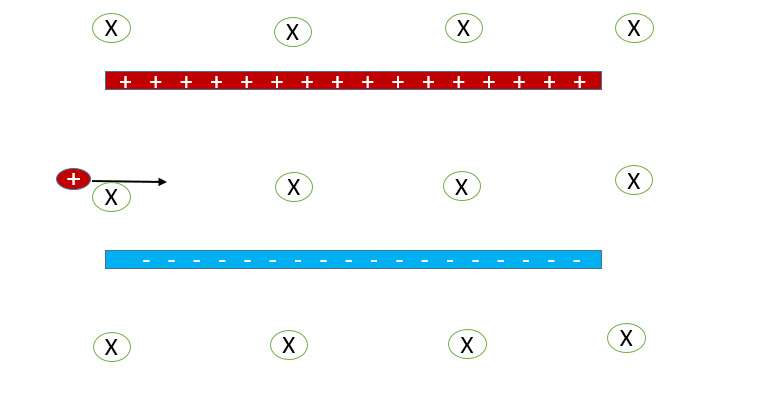
يدخل جسيم ألفا (شحنته شحنة بروتونين) منقي السرعات في مطياف الكتلة فلا ينحرف. النسبة بين المجال المغناطيسي والمجال الكهربائي داخل الحجرة \(B/E=0.0025\,T\cdot C/N\). سرعة الجسيم:An alpha particle (charge of two protons) enters the velocity selector of a mass spectrometer and is not deflected. The ratio of the magnetic field to the electric field inside the chamber is \(B/E=0.0025\,T\cdot C/N\). The speed of the particle is:
\(v=0.15\,m/s\)\(v=0.15\,m/s\)
\(v=0.0025\,m/s\)\(v=0.0025\,m/s\)
\(v=150\,m/s\)\(v=150\,m/s\)
\(v=400\,m/s\)\(v=400\,m/s\)
الحلSolution
📌 دون انحراف: \(qE=qvB\Rightarrow v=\dfrac{E}{B}\) (لا تعتمد السرعة على الشحنة).
\(v=\dfrac{1}{0.0025}=400\,m/s\).
✅ \(v=400\,m/s\) (D)
📌 No deflection: \(qE=qvB\Rightarrow v=\dfrac{E}{B}\) (the speed does not depend on the charge).
\(v=\dfrac{1}{0.0025}=400\,m/s\).
✅ \(v=400\,m/s\) (D)
\[16\,\star\star\star\]
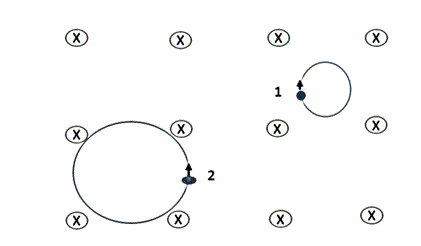
جسيمان لهما الكتلة نفسها والشحنة نفسها بالمقدار قُذفا عموديًا على مجال منتظم للداخل كما في الشكل؛ أحدهما يدور مع عقارب الساعة والآخر عكسها. صفات الجسيمين:Two particles of the same mass and the same charge magnitude are projected perpendicular to a uniform field into the page as shown; one rotates clockwise, the other counterclockwise. The properties of the two particles are:
\(q_1(+)\quad q_2(-)\quad v_2\gt v_1\)\(q_1(+)\quad q_2(-)\quad v_2\gt v_1\)
\(q_1(-)\quad q_2(+)\quad v_2\gt v_1\)\(q_1(-)\quad q_2(+)\quad v_2\gt v_1\)
\(q_1(-)\quad q_2(+)\quad v_1\gt v_2\)\(q_1(-)\quad q_2(+)\quad v_1\gt v_2\)
\(q_1(+)\quad q_2(-)\quad v_1\gt v_2\)\(q_1(+)\quad q_2(-)\quad v_1\gt v_2\)
الحلSolution
📌 الشحنة الموجبة في مجال للداخل تدور عكس عقارب الساعة: الجسيم 2 موجب والجسيم 1 (يدور مع العقارب) سالب.
📌 \(r=\dfrac{mv}{|q|B}\) والكتلة والشحنة متساويتان فالأكبر نصف قطرًا هو الأسرع: دائرة الجسيم 2 أكبر فـ \(v_2\gt v_1\).
✅ \(q_1(-)\quad q_2(+)\quad v_2\gt v_1\) (B)
📌 A positive charge in a field into the page rotates counterclockwise: particle 2 is positive and particle 1 (clockwise) is negative.
📌 \(r=\dfrac{mv}{|q|B}\) with equal mass and charge, so the larger radius means the faster: the circle of particle 2 is larger so \(v_2\gt v_1\).
✅ \(q_1(-)\quad q_2(+)\quad v_2\gt v_1\) (B)
\[17\,\star\star\]
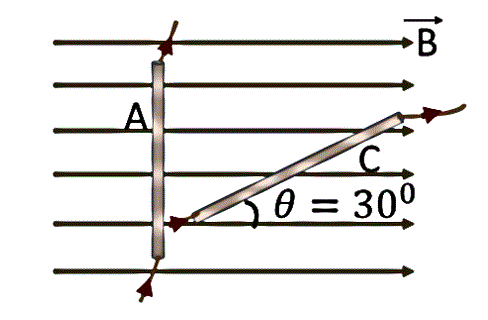
سلكان لهما الطول نفسه ويمر بهما التيار نفسه وُضعا في مجال منتظم كما في الشكل (السلك A عمودي على المجال والسلك C يصنع زاوية \(30^{\circ}\) معه). النسبة بين القوة على السلك C إلى القوة على السلك A:Two wires of the same length carrying the same current are placed in a uniform field as shown (wire A perpendicular to the field and wire C at \(30^{\circ}\) to it). The ratio of the force on wire C to that on wire A is:
\(\dfrac{F_C}{F_A}=2\)\(\dfrac{F_C}{F_A}=2\)
\(\dfrac{F_C}{F_A}=4\)\(\dfrac{F_C}{F_A}=4\)
\(\dfrac{F_C}{F_A}=0.5\)\(\dfrac{F_C}{F_A}=0.5\)
\(\dfrac{F_C}{F_A}=0.25\)\(\dfrac{F_C}{F_A}=0.25\)
الحلSolution
📌 \(F=ILB\sin\theta\): للسلك A \(\sin90^{\circ}=1\) وللسلك C \(\sin30^{\circ}=0.5\).
\(\dfrac{F_C}{F_A}=\dfrac{0.5}{1}=0.5\).
✅ \(\dfrac{F_C}{F_A}=0.5\) (C)
📌 \(F=ILB\sin\theta\): for wire A \(\sin90^{\circ}=1\) and for wire C \(\sin30^{\circ}=0.5\).
\(\dfrac{F_C}{F_A}=\dfrac{0.5}{1}=0.5\).
✅ \(\dfrac{F_C}{F_A}=0.5\) (C)
\[18\,\star\star\]
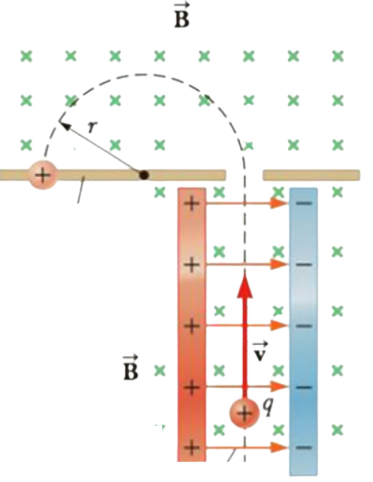
قُذف بروتون إلى حجرة مطياف كتلة فيها مجال منتظم \(B=0.4\,T\) بسرعة \(v=6\times10^{6}\,m/s\) فرسم نصف دائرة وارتطم بجدار حساس. بُعد نقطة الارتطام عن الفتحة التي دخل منها:A proton enters a mass-spectrometer chamber with a uniform field \(B=0.4\,T\) at \(v=6\times10^{6}\,m/s\), follows a semicircle and hits a sensitive wall. The distance of the impact point from the entry hole is:
\(d=0.26\,m\)\(d=0.26\,m\)
\(d=0.156\,m\)\(d=0.156\,m\)
\(d=0.31\,m\)\(d=0.31\,m\)
\(d=0.38\,m\)\(d=0.38\,m\)
الحلSolution
\(r=\dfrac{mv}{qB}=\dfrac{1.67\times10^{-27}\times6\times10^{6}}{1.6\times10^{-19}\times0.4}=0.156\,m\).
📌 نقطة الارتطام عند نهاية القطر لنصف الدائرة: \(d=2r=0.31\,m\) (وليس \(r\)).
✅ \(d=0.31\,m\) (C)
\(r=\dfrac{mv}{qB}=\dfrac{1.67\times10^{-27}\times6\times10^{6}}{1.6\times10^{-19}\times0.4}=0.156\,m\).
📌 The impact point is at the other end of the diameter of the semicircle: \(d=2r=0.31\,m\) (not \(r\)).
✅ \(d=0.31\,m\) (C)
\[19\,\star\]
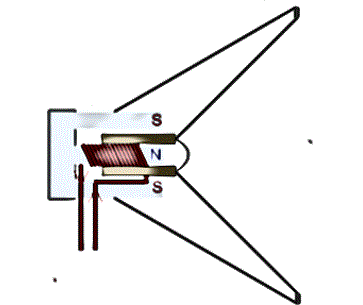
مكبر صوت مخروطي لُفّ عليه سلك نحاسي من 50 لفة نصف قطر اللفة \(2\,cm\) ويمر فيه تيار \(3\,mA\) في مجال مغناطيسي فتأثر بقوة \(0.02\,N\). أقل شدة للمجال تحقق ذلك:A cone speaker has a copper wire of 50 turns of radius \(2\,cm\) carrying \(3\,mA\) in a magnetic field and experiences a force of \(0.02\,N\). The smallest field strength that achieves this is:
\(B=2.45\,T\)\(B=2.45\,T\)
\(B=0.32\,T\)\(B=0.32\,T\)
\(B=3.11\,T\)\(B=3.11\,T\)
\(B=1.06\,T\)\(B=1.06\,T\)
الحلSolution
📌 طول السلك الكلي \(L=N\times2\pi r=50\times2\pi\times0.02=6.28\,m\).
📌 أقل مجال عندما يكون السلك عموديًا على المجال (\(\sin\theta=1\)): \(B=\dfrac{F}{IL}=\dfrac{0.02}{3\times10^{-3}\times6.28}=1.06\,T\).
✅ \(B=1.06\,T\) (D)
📌 The total wire length \(L=N\times2\pi r=50\times2\pi\times0.02=6.28\,m\).
📌 The smallest field occurs when the wire is perpendicular to the field (\(\sin\theta=1\)): \(B=\dfrac{F}{IL}=\dfrac{0.02}{3\times10^{-3}\times6.28}=1.06\,T\).
✅ \(B=1.06\,T\) (D)
\[20\,\star\star\]
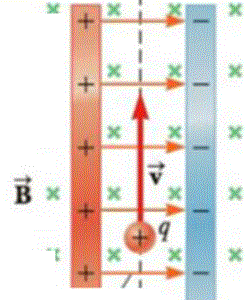
تتسارع حزمة بروتونات من السكون خلال فرق جهد \(1200\,V\) ثم تدخل منقي سرعات فيه مجال مغناطيسي \(0.3\,T\) عمودي على المجال الكهربائي. المجال الكهربائي الذي يجعل الحزمة لا تنحرف:A beam of protons is accelerated from rest through \(1200\,V\) then enters a velocity selector with a magnetic field of \(0.3\,T\) perpendicular to the electric field. The electric field that lets the beam pass undeflected is:
\(E=1.44\times10^{5}\,N/C\)\(E=1.44\times10^{5}\,N/C\)
\(E=3.65\times10^{5}\,N/C\)\(E=3.65\times10^{5}\,N/C\)
\(E=2.34\times10^{5}\,N/C\)\(E=2.34\times10^{5}\,N/C\)
\(E=4.54\times10^{5}\,N/C\)\(E=4.54\times10^{5}\,N/C\)
الحلSolution
\(qV=\tfrac12mv^{2}\Rightarrow v=\sqrt{\dfrac{2qV}{m}}=\sqrt{\dfrac{2\times1.6\times10^{-19}\times1200}{1.67\times10^{-27}}}=4.8\times10^{5}\,m/s\).
📌 دون انحراف: \(E=vB=4.8\times10^{5}\times0.3=1.44\times10^{5}\,N/C\).
✅ \(E=1.44\times10^{5}\,N/C\) (A)
\(qV=\tfrac12mv^{2}\Rightarrow v=\sqrt{\dfrac{2qV}{m}}=\sqrt{\dfrac{2\times1.6\times10^{-19}\times1200}{1.67\times10^{-27}}}=4.8\times10^{5}\,m/s\).
📌 Undeflected: \(E=vB=4.8\times10^{5}\times0.3=1.44\times10^{5}\,N/C\).
✅ \(E=1.44\times10^{5}\,N/C\) (A)
\[21\,\star\]
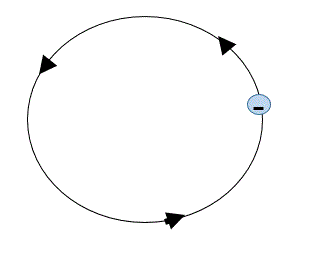
قُذف إلكترون في مجال منتظم فاتخذ مسارًا دائريًا عكس عقارب الساعة كما في الشكل. اتجاه المجال:An electron is projected into a uniform field and takes a counterclockwise circular path as shown. The direction of the field is:
عمودي نحو الداخلperpendicular into the page
يوازي الورقة نحو الأعلىparallel to the page, upward
يوازي الورقة نحو الأسفلparallel to the page, downward
عمودي نحو الخارجperpendicular out of the page
الحلSolution
📌 الشحنة الموجبة تدور عكس عقارب الساعة عندما يكون المجال للداخل، أما الإلكترون (سالب) فيدور عكس ذلك: يدور عكس العقارب إذا كان المجال للخارج.
✅ عمودي نحو الخارج (D)
📌 A positive charge rotates counterclockwise when the field is into the page, an electron (negative) rotates the opposite way: it rotates counterclockwise if the field is out of the page.
✅ perpendicular out of the page (D)
\[22\,\star\]
في مطياف الكتلة تتابع الأيونات طريقها نحو الكاشف لأنها:In a mass spectrometer the ions continue toward the detector because they:
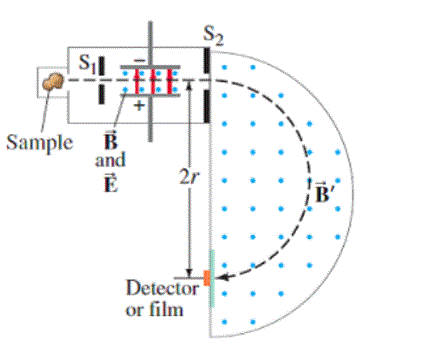
تتأثر بقوة المجال الكهربائي فقطare affected only by the electric force
تتأثر بقوة المجال المغناطيسي فقطare affected only by the magnetic force
تتأثر بقوتين متساويتين ومتعاكستينare affected by two equal and opposite forces
تتأثر بقوتين متساويتين ومتعامدتينare affected by two equal and perpendicular forces
الحلSolution
📌 في منقي السرعات تتساوى القوة الكهربائية \(qE\) والقوة المغناطيسية \(qvB\) وتتعاكسان فتنعدم المحصلة وتتابع الأيونات بسرعة ثابتة.
✅ تتأثر بقوتين متساويتين ومتعاكستين (C)
📌 In the velocity selector the electric force \(qE\) and the magnetic force \(qvB\) are equal and opposite so the net force vanishes and the ions continue at constant velocity.
✅ are affected by two equal and opposite forces (C)
\[23\,\star\star\]
سلك أفقي طوله \(40\,cm\) ووزنه \(0.3\,N\) يُترك لينزلق دون احتكاك على سكتين رأسيتين في مجال \(B=0.5\,T\) عمودي نحو الداخل. وُصلت السكتان بمصدر فانزلق السلك بسرعة ثابتة. مقدار التيار واتجاهه:A horizontal wire of length \(40\,cm\) and weight \(0.3\,N\) slides without friction down two vertical rails in a field \(B=0.5\,T\) into the page. The rails are connected to a source and the wire slides at constant speed. The current’s magnitude and direction are:
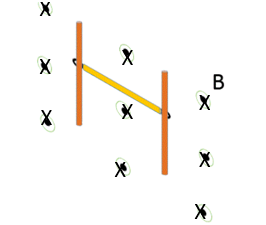
\(I=1.5\,A\) نحو اليمين\(I=1.5\,A\) to the right
\(I=1.5\,A\) نحو اليسار\(I=1.5\,A\) to the left
\(I=2.5\,A\) نحو اليمين\(I=2.5\,A\) to the right
\(I=2.5\,A\) نحو اليسار\(I=2.5\,A\) to the left
الحلSolution
📌 السرعة ثابتة فالقوة المغناطيسية (نحو الأعلى) تساوي الوزن: \(ILB=F_g\).
\(I=\dfrac{F_g}{LB}=\dfrac{0.3}{0.4\times0.5}=1.5\,A\).
📌 المجال للداخل والقوة للأعلى: \(F=IL\times B\) يتحقق عندما يكون التيار نحو اليمين.
✅ \(I=1.5\,A\) نحو اليمين (A)
📌 Constant speed, so the magnetic force (upward) equals the weight: \(ILB=F_g\).
\(I=\dfrac{F_g}{LB}=\dfrac{0.3}{0.4\times0.5}=1.5\,A\).
📌 With the field into the page and the force upward, \(F=IL\times B\) holds when the current is to the right.
✅ \(I=1.5\,A\) to the right (A)
\[24\,\star\star\star\]
أقل سرعة لبروتون في مجال الأرض المغناطيسي \(B=3\times10^{-5}\,T\) بحيث تؤثر عليه قوة مغناطيسية ومع ذلك يستمر في مساره الأفقي دون انحراف (\(q_p=1.6\times10^{-19}\,C,\ m_p=1.67\times10^{-27}\,kg,\ g=9.8\,m/s^{2}\)):The smallest speed of a proton in the Earth’s magnetic field \(B=3\times10^{-5}\,T\) such that a magnetic force acts on it yet it continues along a horizontal path without deflection (\(q_p=1.6\times10^{-19}\,C,\ m_p=1.67\times10^{-27}\,kg,\ g=9.8\,m/s^{2}\)) is:
\(v=4.8\times10^{-3}\,m/s\)\(v=4.8\times10^{-3}\,m/s\)
\(v=5.2\times10^{-3}\,m/s\)\(v=5.2\times10^{-3}\,m/s\)
\(v=2.1\times10^{-3}\,m/s\)\(v=2.1\times10^{-3}\,m/s\)
\(v=3.4\times10^{-3}\,m/s\)\(v=3.4\times10^{-3}\,m/s\)
الحلSolution
📌 للاستمرار في المسار الأفقي تُعادل القوة المغناطيسية (نحو الأعلى) وزن البروتون: \(qvB=mg\).
\(v=\dfrac{mg}{qB}=\dfrac{1.67\times10^{-27}\times9.8}{1.6\times10^{-19}\times3\times10^{-5}}=3.4\times10^{-3}\,m/s\).
✅ \(v=3.4\times10^{-3}\,m/s\) (D)
📌 To stay on the horizontal path the magnetic force (upward) balances the proton’s weight: \(qvB=mg\).
\(v=\dfrac{mg}{qB}=\dfrac{1.67\times10^{-27}\times9.8}{1.6\times10^{-19}\times3\times10^{-5}}=3.4\times10^{-3}\,m/s\).
✅ \(v=3.4\times10^{-3}\,m/s\) (D)
\[25\,\star\star\star\]
يتحرك إلكترون شرقًا بسرعة \(5\times10^{4}\,m/s\) ويؤثر عليه مجال مغناطيسي عمودي على حركته بقوة \(6\times10^{-16}\,N\) نحو الشمال. مقدار المجال واتجاهه:An electron moves east at \(5\times10^{4}\,m/s\) and a magnetic field perpendicular to its motion exerts a force of \(6\times10^{-16}\,N\) northward. The magnitude and direction of the field are:
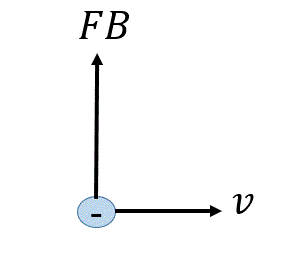
\(B=0.075\,T\) عمودي للداخل\(B=0.075\,T\) into the page
\(B=0.055\,T\) عمودي للخارج\(B=0.055\,T\) out of the page
\(B=0.075\,T\) عمودي للخارج\(B=0.075\,T\) out of the page
\(B=0.055\,T\) عمودي للداخل\(B=0.055\,T\) into the page
الحلSolution
\(B=\dfrac{F}{ev}=\dfrac{6\times10^{-16}}{1.6\times10^{-19}\times5\times10^{4}}=0.075\,T\).
📌 الاتجاه: للشحنة الموجبة شرقًا مع مجال للخارج تكون القوة \(qv\times B\) نحو الجنوب، وللإلكترون (سالب) تنعكس فتصبح نحو الشمال ✔. فالمجال للخارج.
✅ \(B=0.075\,T\) عمودي للخارج (C)
\(B=\dfrac{F}{ev}=\dfrac{6\times10^{-16}}{1.6\times10^{-19}\times5\times10^{4}}=0.075\,T\).
📌 Direction: for a positive charge moving east with the field out of the page the force \(qv\times B\) points south; for the electron (negative) it reverses to north ✔. So the field is out of the page.
✅ \(B=0.075\,T\) out of the page (C)
\[26\,\star\star\star\]
شحنة \(4\,\mu C\) قُذفت بسرعة \(v=(4\hat{x}+3\hat{y})\times10^{5}\,m/s\) في مجال منتظم \(B=0.3\,T\) باتجاه المحور \(+y\). مقدار القوة المغناطيسية واتجاهها:A charge of \(4\,\mu C\) is projected at \(v=(4\hat{x}+3\hat{y})\times10^{5}\,m/s\) into a uniform field \(B=0.3\,T\) along the \(+y\) axis. The magnitude and direction of the magnetic force are:
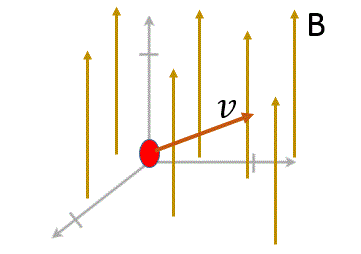
\(F=0.96\,N\) باتجاه \(-z\)\(F=0.96\,N\) along \(-z\)
\(F=0.48\,N\) باتجاه \(+z\)\(F=0.48\,N\) along \(+z\)
\(F=0.48\,N\) باتجاه \(-z\)\(F=0.48\,N\) along \(-z\)
\(F=0.96\,N\) باتجاه \(+z\)\(F=0.96\,N\) along \(+z\)
الحلSolution
📌 المركبة \(v_y\) موازية للمجال فلا تؤثر؛ المؤثرة \(v_x=4\times10^{5}\,m/s\) العمودية على \(B\).
\(F=qv_xB=4\times10^{-6}\times4\times10^{5}\times0.3=0.48\,N\).
📌 الاتجاه: \(\hat{x}\times\hat{y}=+\hat{z}\) فالقوة نحو \(+z\).
✅ \(F=0.48\,N\) باتجاه \(+z\) (B)
📌 The component \(v_y\) is parallel to the field and has no effect; only \(v_x=4\times10^{5}\,m/s\), perpendicular to \(B\), matters.
\(F=qv_xB=4\times10^{-6}\times4\times10^{5}\times0.3=0.48\,N\).
📌 Direction: \(\hat{x}\times\hat{y}=+\hat{z}\), so the force is along \(+z\).
✅ \(F=0.48\,N\) along \(+z\) (B)
\[27\,\star\]
سلك طوله \(0.2\,m\) في مجال منتظم \(0.5\,T\) (نحو الخارج) يمر فيه تيار \(3\,A\) كما في الشكل (باتجاه الشمال الشرقي). القوة على السلك مقدارًا واتجاهًا:A wire of length \(0.2\,m\) in a uniform field \(0.5\,T\) (out of the page) carries \(3\,A\) as shown (toward the northeast). The force on the wire in magnitude and direction is:
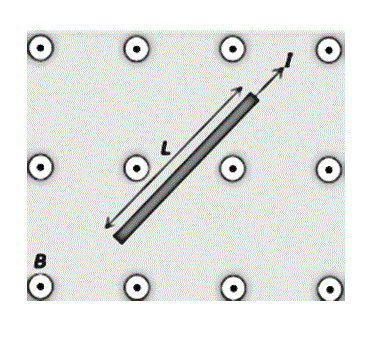
\(F=0.3\,N\) الشمال الغربي\(F=0.3\,N\) northwest
\(F=0.45\,N\) الشمال الغربي\(F=0.45\,N\) northwest
\(F=0.45\,N\) الجنوب الشرقي\(F=0.45\,N\) southeast
\(F=0.3\,N\) الجنوب الشرقي\(F=0.3\,N\) southeast
الحلSolution
\(F=ILB=3\times0.2\times0.5=0.3\,N\) (السلك عمودي على المجال).
📌 الاتجاه \(IL\times B\) مع تيار شمال شرقي ومجال للخارج: \((\hat{x}+\hat{y})\times\hat{z}=-\hat{y}+\hat{x}\) أي نحو الجنوب الشرقي.
✅ \(F=0.3\,N\) الجنوب الشرقي (D)
\(F=ILB=3\times0.2\times0.5=0.3\,N\) (the wire is perpendicular to the field).
📌 The direction \(IL\times B\) with a northeast current and the field out of the page: \((\hat{x}+\hat{y})\times\hat{z}=-\hat{y}+\hat{x}\), i.e. southeast.
✅ \(F=0.3\,N\) southeast (D)
\[28\,\star\]
عند كسر مغناطيس إلى قطع يصبح كل جزء مغناطيسًا له قطبان. السبب:When a magnet is broken into pieces each piece becomes a magnet with two poles. The reason is:
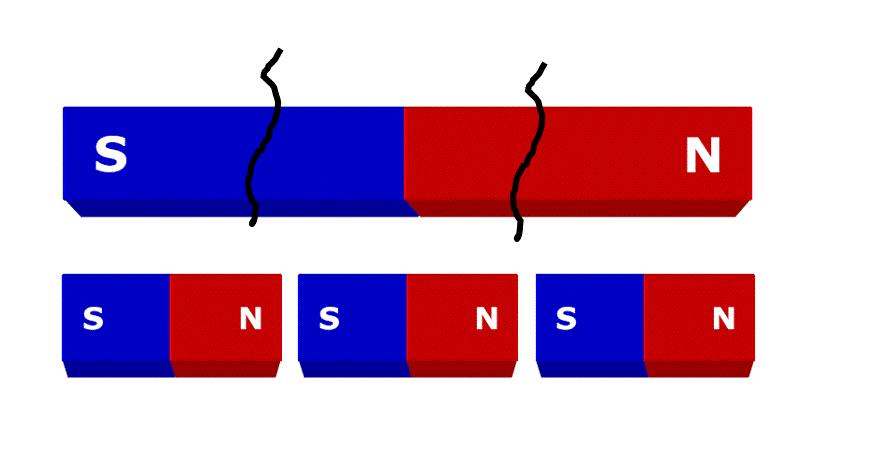
يحدث الكسر بين النطاقات ولا يمكن كسر نطاق لأنه صغير جدًاthe break occurs between domains; a single domain is too small to be broken
عند الكسر يحدث تجاذب للأقطاب المعاكسة فيتكوّن مغناطيس جديدat the break opposite poles attract and form a new magnet
عند الكسر تتكون نطاقات جديدة تساهم في تكوين الأقطابat the break new domains form that contribute to the poles
يتغير ترتيب النطاقات أثناء الكسر فتدور مكوّنة قطبينthe domains rearrange during the break and rotate to form two poles
الحلSolution
📌 المغناطيس مكوّن من نطاقات صغيرة جدًا كل منها مغناطيس مصغّر مرتّب في اتجاه واحد؛ والكسر يحدث بين النطاقات ولا يمكن كسر نطاق منفرد، فيبقى لكل قطعة قطبان (لا توجد أقطاب مغناطيسية منفردة).
✅ يحدث الكسر بين النطاقات ولا يمكن كسر نطاق لأنه صغير جدًا (A)
📌 A magnet consists of very small domains, each a tiny magnet aligned in one direction; the break occurs between domains and a single domain cannot be broken, so each piece keeps two poles (there are no isolated magnetic poles).
✅ the break occurs between domains; a single domain is too small to be broken (A)
\[29\,\star\]
ملف من 100 حلقة مربعة طول ضلع كل منها \(0.2\,m\) يمر فيه تيار \(3\,A\) وموضوع في مجال \(0.5\,T\). أكبر عزم دوران عليه:A coil of 100 square loops of side \(0.2\,m\) carries \(3\,A\) in a field of \(0.5\,T\). The maximum torque on it is:
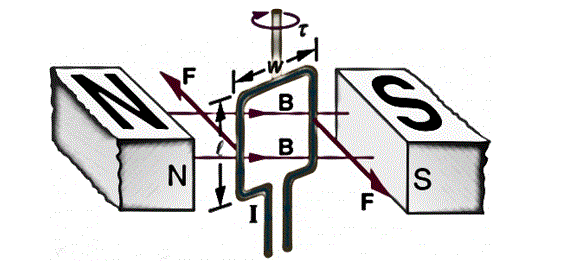
\(\tau_{max}=6\,N\cdot m\)\(\tau_{max}=6\,N\cdot m\)
\(\tau_{max}=10\,N\cdot m\)\(\tau_{max}=10\,N\cdot m\)
\(\tau_{max}=4\,N\cdot m\)\(\tau_{max}=4\,N\cdot m\)
\(\tau_{max}=8\,N\cdot m\)\(\tau_{max}=8\,N\cdot m\)
الحلSolution
📌 \(\tau_{max}=NIAB\) عندما يكون مستوى الملف موازيًا للمجال.
\(A=0.2^{2}=0.04\,m^{2}\Rightarrow\tau_{max}=100\times3\times0.04\times0.5=6\,N\cdot m\).
✅ \(\tau_{max}=6\,N\cdot m\) (A)
📌 \(\tau_{max}=NIAB\) when the plane of the coil is parallel to the field.
\(A=0.2^{2}=0.04\,m^{2}\Rightarrow\tau_{max}=100\times3\times0.04\times0.5=6\,N\cdot m\).
✅ \(\tau_{max}=6\,N\cdot m\) (A)
\[30\,\star\star\]
حلقة تيار دائرية نصف قطرها \(2\,cm\) ويمر بها تيار \(0.1\,A\) في مجال \(B=0.5\,T\) يصنع زاوية \(30^{\circ}\) مع العمود على سطحها. العزم المغناطيسي لثنائي القطب وعزم الدوران:A circular current loop of radius \(2\,cm\) carries \(0.1\,A\) in a field \(B=0.5\,T\) that makes \(30^{\circ}\) with the normal to its surface. The magnetic dipole moment and the torque are:
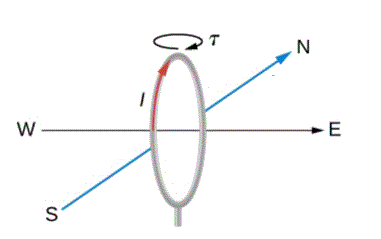
\(\mu=5.23\times10^{-4}\,A\!\cdot\!m^{2},\ \tau=4.6\times10^{-5}\,N\!\cdot\!m\)\(\mu=5.23\times10^{-4}\,A\!\cdot\!m^{2},\ \tau=4.6\times10^{-5}\,N\!\cdot\!m\)
\(\mu=1.25\times10^{-4}\,A\!\cdot\!m^{2},\ \tau=3.1\times10^{-5}\,N\!\cdot\!m\)\(\mu=1.25\times10^{-4}\,A\!\cdot\!m^{2},\ \tau=3.1\times10^{-5}\,N\!\cdot\!m\)
\(\mu=2.15\times10^{-4}\,A\!\cdot\!m^{2},\ \tau=2.3\times10^{-5}\,N\!\cdot\!m\)\(\mu=2.15\times10^{-4}\,A\!\cdot\!m^{2},\ \tau=2.3\times10^{-5}\,N\!\cdot\!m\)
\(\mu=3.86\times10^{-4}\,A\!\cdot\!m^{2},\ \tau=1.8\times10^{-5}\,N\!\cdot\!m\)\(\mu=3.86\times10^{-4}\,A\!\cdot\!m^{2},\ \tau=1.8\times10^{-5}\,N\!\cdot\!m\)
الحلSolution
\(\mu=IA=I\pi r^{2}=0.1\times\pi\times(0.02)^{2}=1.26\times10^{-4}\,A\cdot m^{2}\).
\(\tau=\mu B\sin\theta=1.26\times10^{-4}\times0.5\times\sin30^{\circ}=3.1\times10^{-5}\,N\cdot m\).
✅ \(\mu=1.25\times10^{-4}\,A\!\cdot\!m^{2},\ \tau=3.1\times10^{-5}\,N\!\cdot\!m\) (B)
\(\mu=IA=I\pi r^{2}=0.1\times\pi\times(0.02)^{2}=1.26\times10^{-4}\,A\cdot m^{2}\).
\(\tau=\mu B\sin\theta=1.26\times10^{-4}\times0.5\times\sin30^{\circ}=3.1\times10^{-5}\,N\cdot m\).
✅ \(\mu=1.25\times10^{-4}\,A\!\cdot\!m^{2},\ \tau=3.1\times10^{-5}\,N\!\cdot\!m\) (B)
\[31\,\star\star\star\]
في تجربة تأثير هول موصل أبعاده \(L=0.05\,m,\ d=0.02\,m,\ h=0.01\,m\) يمر فيه تيار في مجال \(B=0.8\,T\) فتولّد جهد هول \(\Delta V=2\,\mu V\) بين طرفيه عرضه \(d\). سرعة الانسياق لحاملات الشحنة:In a Hall-effect experiment a conductor of dimensions \(L=0.05\,m,\ d=0.02\,m,\ h=0.01\,m\) carries a current in a field \(B=0.8\,T\) producing a Hall voltage \(\Delta V=2\,\mu V\) across its width \(d\). The drift speed of the charge carriers is:
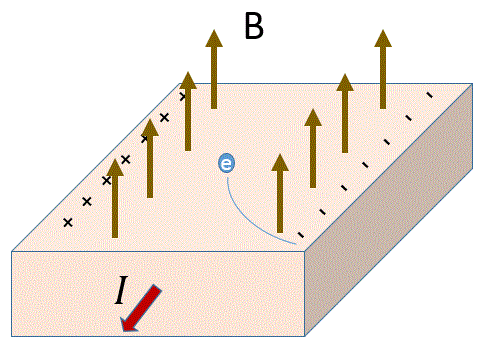
\(v_d=2.25\times10^{-4}\,m/s\)\(v_d=2.25\times10^{-4}\,m/s\)
\(v_d=3.18\times10^{-4}\,m/s\)\(v_d=3.18\times10^{-4}\,m/s\)
\(v_d=1.25\times10^{-4}\,m/s\)\(v_d=1.25\times10^{-4}\,m/s\)
\(v_d=0.8\times10^{-4}\,m/s\)\(v_d=0.8\times10^{-4}\,m/s\)
الحلSolution
📌 عند الاتزان تتساوى القوة الكهربائية الناتجة عن جهد هول والقوة المغناطيسية: \(qE_H=qv_dB\).
\(E_H=\dfrac{\Delta V}{d}=\dfrac{2\times10^{-6}}{0.02}=10^{-4}\,N/C\).
\(v_d=\dfrac{E_H}{B}=\dfrac{10^{-4}}{0.8}=1.25\times10^{-4}\,m/s\).
✅ \(v_d=1.25\times10^{-4}\,m/s\) (C)
📌 At equilibrium the electric force from the Hall voltage equals the magnetic force: \(qE_H=qv_dB\).
\(E_H=\dfrac{\Delta V}{d}=\dfrac{2\times10^{-6}}{0.02}=10^{-4}\,N/C\).
\(v_d=\dfrac{E_H}{B}=\dfrac{10^{-4}}{0.8}=1.25\times10^{-4}\,m/s\).
✅ \(v_d=1.25\times10^{-4}\,m/s\) (C)
\[32\,\star\]
قطبان مغناطيسيان شماليان (N وN) متقابلان. القوة بينهما:Two magnetic north poles (N and N) face each other. The force between them is:
تجاذبattraction
تنافرrepulsion
معدومةzero
تجاذب ثم تنافرattraction then repulsion
الحلSolution
📌 الأقطاب المتشابهة تتنافر والمختلفة تتجاذب.
✅ تنافر (B)
📌 Like poles repel and unlike poles attract.
✅ repulsion (B)
\[33\,\star\]
القطب المغناطيسي للأرض الواقع قرب القطب الجغرافي الشمالي هو قطب مغناطيسي:The magnetic pole of the Earth located near the geographic north pole is a magnetic:
شماليnorth pole
لا يوجد قطب هناكthere is no pole there
شمالي في الصيف وجنوبي في الشتاءnorth in summer and south in winter
جنوبيsouth pole
الحلSolution
📌 القطب الشمالي لإبرة البوصلة ينجذب إلى القطب المغناطيسي الجنوبي، ولذلك يشير إلى الشمال الجغرافي؛ فالقطب المغناطيسي القريب من الشمال الجغرافي هو قطب جنوبي مغناطيسيًا.
✅ جنوبي (D)
📌 The north pole of a compass needle is attracted to a magnetic south pole, which is why it points to geographic north; so the magnetic pole near geographic north is a magnetic south pole.
✅ south pole (D)
\[34\,\star\]
تتحرك شحنة إلكترون بسرعة \(2\times10^{6}\,m/s\) عموديًا على مجال \(0.5\,T\). القوة المغناطيسية عليه:An electron moves at \(2\times10^{6}\,m/s\) perpendicular to a field of \(0.5\,T\). The magnetic force on it is:
\(1.6\times10^{-13}\,N\)\(1.6\times10^{-13}\,N\)
\(3.2\times10^{-13}\,N\)\(3.2\times10^{-13}\,N\)
\(1.6\times10^{-19}\,N\)\(1.6\times10^{-19}\,N\)
\(0\)\(0\)
الحلSolution
\(F=evB=1.6\times10^{-19}\times2\times10^{6}\times0.5=1.6\times10^{-13}\,N\).
✅ \(1.6\times10^{-13}\,N\) (A)
\(F=evB=1.6\times10^{-19}\times2\times10^{6}\times0.5=1.6\times10^{-13}\,N\).
✅ \(1.6\times10^{-13}\,N\) (A)
\[35\,\star\star\]
يتحرك بروتون بسرعة \(4\times10^{5}\,m/s\) بزاوية \(30^{\circ}\) مع مجال منتظم \(0.2\,T\). القوة المغناطيسية عليه:A proton moves at \(4\times10^{5}\,m/s\) at \(30^{\circ}\) to a uniform field of \(0.2\,T\). The magnetic force on it is:
\(6.4\times10^{-15}\,N\)\(6.4\times10^{-15}\,N\)
\(1.28\times10^{-14}\,N\)\(1.28\times10^{-14}\,N\)
\(1.1\times10^{-14}\,N\)\(1.1\times10^{-14}\,N\)
\(0\)\(0\)
الحلSolution
\(F=qvB\sin\theta=1.6\times10^{-19}\times4\times10^{5}\times0.2\times0.5=6.4\times10^{-15}\,N\).
✅ \(6.4\times10^{-15}\,N\) (A)
\(F=qvB\sin\theta=1.6\times10^{-19}\times4\times10^{5}\times0.2\times0.5=6.4\times10^{-15}\,N\).
✅ \(6.4\times10^{-15}\,N\) (A)
\[36\,\star\star\]
سلك طوله \(0.5\,m\) يمر فيه تيار \(4\,A\) عموديًا على مجال \(0.3\,T\). القوة على السلك:A wire of length \(0.5\,m\) carrying \(4\,A\) perpendicular to a field of \(0.3\,T\). The force on the wire is:
\(0.06\,N\)\(0.06\,N\)
\(2.4\,N\)\(2.4\,N\)
\(0.6\,N\)\(0.6\,N\)
\(6\,N\)\(6\,N\)
الحلSolution
\(F=ILB=4\times0.5\times0.3=0.6\,N\).
✅ \(0.6\,N\) (C)
\(F=ILB=4\times0.5\times0.3=0.6\,N\).
✅ \(0.6\,N\) (C)
\[37\,\star\star\]
سلك أفقي يمر فيه تيار نحو الشرق في مجال منتظم أفقي نحو الشمال. القوة المغناطيسية على السلك:A horizontal wire carries a current toward the east in a horizontal uniform field pointing north. The magnetic force on the wire is:
نحو الأسفلdownward
نحو الأعلىupward
نحو الغربwestward
نحو الجنوبsouthward
الحلSolution
📌 نأخذ المحاور: شرق \(\hat{x}\)، شمال \(\hat{y}\)، أعلى \(\hat{z}\). القوة \(IL\times B\propto\hat{x}\times\hat{y}=+\hat{z}\) أي نحو الأعلى.
✅ نحو الأعلى (B)
📌 Take the axes: east \(\hat{x}\), north \(\hat{y}\), up \(\hat{z}\). The force \(IL\times B\propto\hat{x}\times\hat{y}=+\hat{z}\) points upward.
✅ upward (B)
\[38\,\star\star\]
إلكترون سرعته \(3\times10^{6}\,m/s\) يتحرك عموديًا على مجال \(1\times10^{-3}\,T\). نصف قطر مساره:An electron at \(3\times10^{6}\,m/s\) moves perpendicular to a field of \(1\times10^{-3}\,T\). The radius of its path is:
\(17\,cm\)\(17\,cm\)
\(1.7\,cm\)\(1.7\,cm\)
\(0.17\,cm\)\(0.17\,cm\)
\(1.7\,m\)\(1.7\,m\)
الحلSolution
\(r=\dfrac{mv}{eB}=\dfrac{9.11\times10^{-31}\times3\times10^{6}}{1.6\times10^{-19}\times10^{-3}}=1.7\times10^{-2}\,m=1.7\,cm\).
✅ \(1.7\,cm\) (B)
\(r=\dfrac{mv}{eB}=\dfrac{9.11\times10^{-31}\times3\times10^{6}}{1.6\times10^{-19}\times10^{-3}}=1.7\times10^{-2}\,m=1.7\,cm\).
✅ \(1.7\,cm\) (B)
\[39\,\star\star\star\]
تضاعفت سرعة جسيم مشحون يتحرك في مسار دائري داخل مجال مغناطيسي منتظم. ماذا يحدث لنصف قطر مساره ولزمنه الدوري؟The speed of a charged particle moving in a circular path in a uniform magnetic field is doubled. What happens to the radius of its path and to its period?
نصف القطر ثابت والزمن الدوري يتضاعفthe radius is unchanged and the period doubles
نصف القطر يتضاعف والزمن الدوري يتضاعفboth the radius and the period double
نصف القطر يتضاعف والزمن الدوري ثابتthe radius doubles and the period is unchanged
نصف القطر يقل للنصف والزمن الدوري ثابتthe radius is halved and the period is unchanged
الحلSolution
\(r=\dfrac{mv}{qB}\propto v\) فنصف القطر يتضاعف.
\(T=\dfrac{2\pi m}{qB}\) لا تحوي السرعة فالزمن الدوري لا يتغير.
✅ نصف القطر يتضاعف والزمن الدوري ثابت (C)
\(r=\dfrac{mv}{qB}\propto v\) so the radius doubles.
\(T=\dfrac{2\pi m}{qB}\) does not contain the speed so the period does not change.
✅ the radius doubles and the period is unchanged (C)
\[40\,\star\star\star\]
يتسارع بروتون من السكون خلال فرق جهد \(500\,V\) ثم يدخل مجالًا \(0.1\,T\) عموديًا عليه. نصف قطر مساره:A proton accelerates from rest through \(500\,V\) and then enters a field of \(0.1\,T\) perpendicularly. The radius of its path is:
\(32\,cm\)\(32\,cm\)
\(0.32\,cm\)\(0.32\,cm\)
\(3.2\,m\)\(3.2\,m\)
\(3.2\,cm\)\(3.2\,cm\)
الحلSolution
\(v=\sqrt{\dfrac{2qV}{m}}=\sqrt{\dfrac{2\times1.6\times10^{-19}\times500}{1.67\times10^{-27}}}=3.1\times10^{5}\,m/s\).
\(r=\dfrac{mv}{qB}=\dfrac{1.67\times10^{-27}\times3.1\times10^{5}}{1.6\times10^{-19}\times0.1}=0.032\,m\).
✅ \(3.2\,cm\) (D)
\(v=\sqrt{\dfrac{2qV}{m}}=\sqrt{\dfrac{2\times1.6\times10^{-19}\times500}{1.67\times10^{-27}}}=3.1\times10^{5}\,m/s\).
\(r=\dfrac{mv}{qB}=\dfrac{1.67\times10^{-27}\times3.1\times10^{5}}{1.6\times10^{-19}\times0.1}=0.032\,m\).
✅ \(3.2\,cm\) (D)
\[41\,\star\star\star\]
في منقي سرعات المجال الكهربائي \(2\times10^{4}\,N/C\) والمغناطيسي \(0.04\,T\). سرعة الأيونات التي تمر دون انحراف:In a velocity selector the electric field is \(2\times10^{4}\,N/C\) and the magnetic field \(0.04\,T\). The speed of the ions that pass undeflected is:
\(8\times10^{2}\,m/s\)\(8\times10^{2}\,m/s\)
\(2\times10^{5}\,m/s\)\(2\times10^{5}\,m/s\)
\(5\times10^{5}\,m/s\)\(5\times10^{5}\,m/s\)
\(5\times10^{3}\,m/s\)\(5\times10^{3}\,m/s\)
الحلSolution
\(v=\dfrac{E}{B}=\dfrac{2\times10^{4}}{0.04}=5\times10^{5}\,m/s\).
✅ \(5\times10^{5}\,m/s\) (C)
\(v=\dfrac{E}{B}=\dfrac{2\times10^{4}}{0.04}=5\times10^{5}\,m/s\).
✅ \(5\times10^{5}\,m/s\) (C)
\[42\,\star\star\star\]
ملف مربع من 50 لفة طول ضلعه \(10\,cm\) يمر فيه تيار \(2\,A\) ومستواه موازٍ لمجال \(0.4\,T\). عزم الدوران عليه:A square coil of 50 turns of side \(10\,cm\) carries \(2\,A\) and its plane is parallel to a field of \(0.4\,T\). The torque on it is:
\(0.4\,N\!\cdot\!m\)\(0.4\,N\!\cdot\!m\)
\(0.04\,N\!\cdot\!m\)\(0.04\,N\!\cdot\!m\)
\(4\,N\!\cdot\!m\)\(4\,N\!\cdot\!m\)
\(0\)\(0\)
الحلSolution
📌 مستوى الملف موازٍ للمجال أي العزم أكبر ما يمكن: \(\tau=NIAB=50\times2\times0.01\times0.4=0.4\,N\cdot m\).
✅ \(0.4\,N\!\cdot\!m\) (A)
📌 The plane is parallel to the field so the torque is maximum: \(\tau=NIAB=50\times2\times0.01\times0.4=0.4\,N\cdot m\).
✅ \(0.4\,N\!\cdot\!m\) (A)
\[43\,\star\star\star\star\]
في مطياف كتلة دخلت أيونات كربون \(C^{+}\) كتلتها 12 و14 وحدة كتلة ذرية بالسرعة نفسها عموديًا على المجال. النسبة \(r_{14}/r_{12}\):In a mass spectrometer carbon ions \(C^{+}\) of masses 12 and 14 atomic mass units enter with the same speed perpendicular to the field. The ratio \(r_{14}/r_{12}\) is:
\(1.17\)\(1.17\)
\(0.86\)\(0.86\)
\(1.0\)\(1.0\)
\(1.36\)\(1.36\)
الحلSolution
\(r=\dfrac{mv}{qB}\) فبثبات \(v,q,B\) يتناسب نصف القطر مع الكتلة.
\(\dfrac{r_{14}}{r_{12}}=\dfrac{14}{12}=1.17\).
✅ \(1.17\) (A)
\(r=\dfrac{mv}{qB}\) so for constant \(v,q,B\) the radius is proportional to the mass.
\(\dfrac{r_{14}}{r_{12}}=\dfrac{14}{12}=1.17\).
✅ \(1.17\) (A)
\[44\,\star\star\star\star\]
سلك أفقي كتلته \(20\,g\) وطوله \(0.5\,m\) موضوع عموديًا على مجال أفقي \(0.2\,T\). أقل تيار يجعل السلك معلقًا في الهواء (\(g=9.8\,m/s^{2}\)):A horizontal wire of mass \(20\,g\) and length \(0.5\,m\) is perpendicular to a horizontal field of \(0.2\,T\). The current that makes the wire float in the air (\(g=9.8\,m/s^{2}\)) is:
\(0.196\,A\)\(0.196\,A\)
\(19.6\,A\)\(19.6\,A\)
\(3.92\,A\)\(3.92\,A\)
\(1.96\,A\)\(1.96\,A\)
الحلSolution
📌 التعليق: \(ILB=mg\Rightarrow I=\dfrac{mg}{LB}\).
\(I=\dfrac{0.02\times9.8}{0.5\times0.2}=1.96\,A\).
✅ \(1.96\,A\) (D)
📌 Levitation: \(ILB=mg\Rightarrow I=\dfrac{mg}{LB}\).
\(I=\dfrac{0.02\times9.8}{0.5\times0.2}=1.96\,A\).
✅ \(1.96\,A\) (D)
\[45\,\star\star\star\star\]
قُذف بروتون بسرعة \(10^{6}\,m/s\) بزاوية \(60^{\circ}\) مع مجال منتظم \(0.2\,T\) فاتخذ مسارًا لولبيًا. خطوة اللولب (المسافة على امتداد المجال في دورة واحدة):A proton is projected at \(10^{6}\,m/s\) at \(60^{\circ}\) to a uniform field of \(0.2\,T\) and follows a helical path. The pitch of the helix (the distance along the field in one revolution) is:
\(0.16\,m\)\(0.16\,m\)
\(0.045\,m\)\(0.045\,m\)
\(0.33\,m\)\(0.33\,m\)
\(0.09\,m\)\(0.09\,m\)
الحلSolution
\(T=\dfrac{2\pi m}{qB}=\dfrac{2\pi\times1.67\times10^{-27}}{1.6\times10^{-19}\times0.2}=3.28\times10^{-7}\,s\).
\(v_{\parallel}=v\cos60^{\circ}=5\times10^{5}\,m/s\Rightarrow\text{pitch}=v_{\parallel}T=0.16\,m\).
✅ \(0.16\,m\) (A)
\(T=\dfrac{2\pi m}{qB}=\dfrac{2\pi\times1.67\times10^{-27}}{1.6\times10^{-19}\times0.2}=3.28\times10^{-7}\,s\).
\(v_{\parallel}=v\cos60^{\circ}=5\times10^{5}\,m/s\Rightarrow\text{pitch}=v_{\parallel}T=0.16\,m\).
✅ \(0.16\,m\) (A)
\[46\,\star\star\star\star\]
تردد دوران بروتون في مجال مغناطيسي \(1.5\,T\) (تردد السيكلوترون):The rotation frequency of a proton in a magnetic field of \(1.5\,T\) (the cyclotron frequency) is:
\(1.43\times10^{8}\,Hz\)\(1.43\times10^{8}\,Hz\)
\(3.6\times10^{6}\,Hz\)\(3.6\times10^{6}\,Hz\)
\(9.0\times10^{7}\,Hz\)\(9.0\times10^{7}\,Hz\)
\(2.29\times10^{7}\,Hz\)\(2.29\times10^{7}\,Hz\)
الحلSolution
\(f=\dfrac{qB}{2\pi m}=\dfrac{1.6\times10^{-19}\times1.5}{2\pi\times1.67\times10^{-27}}=2.29\times10^{7}\,Hz\) (لا يعتمد على السرعة).
✅ \(2.29\times10^{7}\,Hz\) (D)
\(f=\dfrac{qB}{2\pi m}=\dfrac{1.6\times10^{-19}\times1.5}{2\pi\times1.67\times10^{-27}}=2.29\times10^{7}\,Hz\) (independent of the speed).
✅ \(2.29\times10^{7}\,Hz\) (D)
📝 المسائل المقالية
📝 Essay Problems
\[1\,\star\star\star\]
دخل جسيم موجب الشحنة كتلته \(m=6\times10^{-8}\,kg\) وسرعته \(v=6\times10^{4}\,m/s\) وشحنته \(q=0.005\,C\) عموديًا على مجال منتظم شدته \(B=0.2\,T\) نحو الخارج كما في الشكل. (أ) احسب العجلة المركزية للجسيم. (ب) احسب نصف قطر المسار الدائري. (ج) ارسم المسار مطبقًا قاعدة تحديد اتجاه القوة.A positive particle of mass \(m=6\times10^{-8}\,kg\), speed \(v=6\times10^{4}\,m/s\) and charge \(q=0.005\,C\) enters perpendicular to a uniform field of \(B=0.2\,T\) pointing out of the page as shown. (a) Find the centripetal acceleration of the particle. (b) Find the radius of its circular path. (c) Draw the path using the force-direction rule.
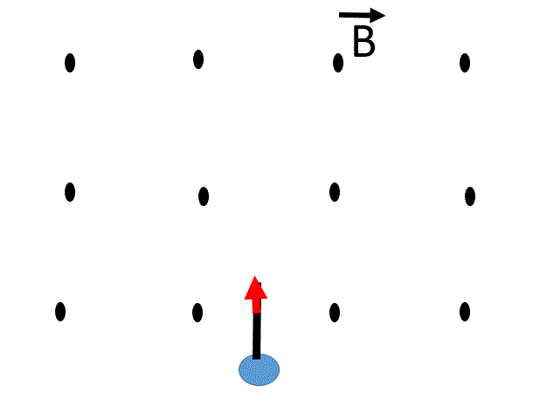
.....................................................................
الحلSolution
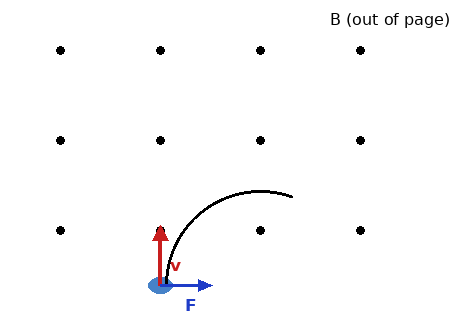
📌 (أ) القوة المغناطيسية \(F_B=qvB\sin90^{\circ}=0.005\times6\times10^{4}\times0.2=60\,N\)، وهي القوة المركزية فـ \(a_c=\dfrac{F_B}{m}=\dfrac{60}{6\times10^{-8}}=1\times10^{9}\,m/s^{2}\).
📌 (ب) \(r=\dfrac{mv}{qB}=\dfrac{6\times10^{-8}\times6\times10^{4}}{0.005\times0.2}=3.6\,m\).
📌 (ج) السرعة للأعلى والمجال للخارج فالقوة على الشحنة الموجبة نحو اليمين (\(\hat{y}\times\hat{z}=+\hat{x}\))، فيدور الجسيم في دائرة مركزها على يمين نقطة البدء (الشكل أدناه).
✅ \(a_c=10^{9}\,m/s^{2},\ r=3.6\,m\)
📌 (a) The magnetic force \(F_B=qvB\sin90^{\circ}=0.005\times6\times10^{4}\times0.2=60\,N\) is the centripetal force, so \(a_c=\dfrac{F_B}{m}=\dfrac{60}{6\times10^{-8}}=1\times10^{9}\,m/s^{2}\).
📌 (b) \(r=\dfrac{mv}{qB}=\dfrac{6\times10^{-8}\times6\times10^{4}}{0.005\times0.2}=3.6\,m\).
📌 (c) The velocity is up and the field out of the page, so the force on the positive charge is to the right (\(\hat{y}\times\hat{z}=+\hat{x}\)), and the particle circles about a centre to the right of the start (the figure below).
✅ \(a_c=10^{9}\,m/s^{2},\ r=3.6\,m\)
\[2\,\star\star\star\]
ثلاثة أسلاك لها الطول نفسه يمر بها التيار نفسه (اتجاهه موضح) في مجال منتظم نحو اليمين (الشكل): السلك 1 يوازي المجال، والسلك 2 عمودي عليه، والسلك 3 يصنع معه زاوية \(30^{\circ}\). أكمل الجدول (القوة على السلك 2 تساوي \(0.1\,N\)): مقدار القوة واتجاهها على كل سلك.Three wires of the same length carry the same current (direction shown) in a uniform field pointing right (the figure): wire 1 is parallel to the field, wire 2 perpendicular to it and wire 3 at \(30^{\circ}\) to it. Complete the table (the force on wire 2 is \(0.1\,N\)): the magnitude and direction of the force on each wire.
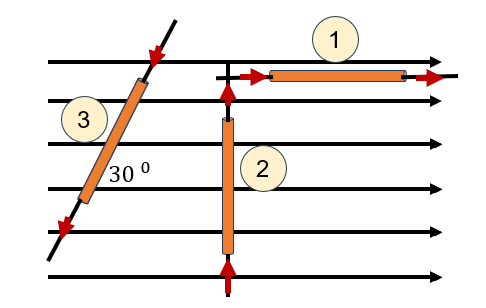
.....................................................................
الحلSolution
📌 السلك 1 يوازي المجال: \(\sin0^{\circ}=0\) فالقوة صفر (ولا اتجاه لها).
📌 السلك 2 عمودي على المجال: \(F_2=ILB=0.1\,N\). تيار نحو الأعلى ومجال نحو اليمين: \(\hat{y}\times\hat{x}=-\hat{z}\) فالقوة نحو الداخل.
📌 السلك 3 يصنع \(30^{\circ}\) مع المجال: \(F_3=ILB\sin30^{\circ}=0.1\times0.5=0.05\,N\)؛ والتيار فيه نحو الأسفل (مركبته الرأسية للأسفل) فالقوة نحو الخارج.
✅ \(F_1=0\)، \(F_2=0.1\,N\) (للداخل)، \(F_3=0.05\,N\) (للخارج)
📌 Wire 1 is parallel to the field: \(\sin0^{\circ}=0\) so the force is zero (no direction).
📌 Wire 2 is perpendicular to the field: \(F_2=ILB=0.1\,N\). Current upward and field to the right: \(\hat{y}\times\hat{x}=-\hat{z}\) so the force is into the page.
📌 Wire 3 makes \(30^{\circ}\) with the field: \(F_3=ILB\sin30^{\circ}=0.1\times0.5=0.05\,N\); its current points downward (its vertical component is down) so the force is out of the page.
✅ \(F_1=0\), \(F_2=0.1\,N\) (into the page), \(F_3=0.05\,N\) (out of the page)
لاحظت خطأ؟ أو عندك سؤال عن أحد الأسئلة؟ اكتبه بالتعليقات وحدد رقم السؤال بالضبط.
Noticed an error? Or have a question about one of the questions? Write it in the comments and specify the exact question number.