⚡ بنك الأسئلة: الكهرباء الساكنة وقانون كولوم
⚡ Question Bank: Static Electricity and Coulomb’s Law
الشحنة الكهربائية والتكهرب، الموصلات والعوازل والكشاف الكهربائي، الشحن بالحث والتأريض، قانون كولوم، ومحصلة القوى الكهربائية
Electric Charge and Charging, Conductors and Insulators, the Electroscope, Induction and Grounding, Coulomb’s Law, Net Electric Force
⏱️ 47 سؤال اختيار من متعدد بتصحيح فوري بمستويات متدرجة، وخمس مسائل محلولة، مع حل مفصل لكل سؤال⏱️ 47 multiple-choice questions of graded difficulty with instant feedback, and 5 solved problems, with a detailed solution for each
\[1\,\star\]
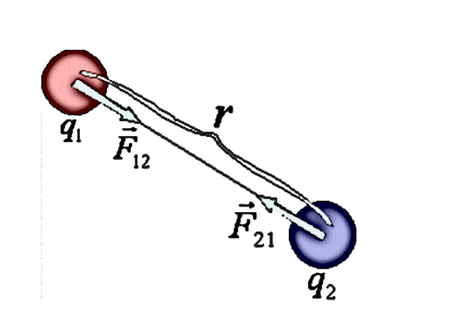
إذا أثّرت قوة كهربائية من الشحنة الأولى على الثانية مقدارها \(10\ N\) نحو اليمين فإن القوة التي تؤثر بها الشحنة الثانية على الأولى تعادل:If the first charge exerts an electric force of \(10\ N\) on the second charge to the right, the force the second exerts on the first is:
\(F_{21}=10\ N\) نحو اليسار\(F_{21}=10\ N\) to the left
لا نستطيع التحديد لعدم معرفة مقدار الشحنتينcannot be determined without knowing the magnitudes
\(F_{21}=10\ N\) نحو اليمين\(F_{21}=10\ N\) to the right
لا نستطيع التحديد لعدم معرفة نوع الشحنتينcannot be determined without knowing the types
الحلSolution
📌 قانون نيوتن الثالث: قوتا التفاعل متساويتان في المقدار ومتعاكستان في الاتجاه مهما كانت الشحنتان.
✅ \(F_{21}=10\ N\) نحو اليسار (A)
📌 Newton’s third law: the two interaction forces are equal in magnitude and opposite in direction whatever the charges.
✅ \(F_{21}=10\ N\) to the left (A)
\[2\,\star\]
بأي عامل تتغير القوة الكهربائية المتبادلة بين شحنتين إذا زاد مقدار إحداهما إلى الضعف وقل البعد بينهما إلى النصف؟By what factor does the electric force between two charges change if one charge is doubled and the distance is halved?
\(F_2=4F_1\)\(F_2=4F_1\)
\(F_2=16F_1\)\(F_2=16F_1\)
\(F_2=2F_1\)\(F_2=2F_1\)
\(F_2=8F_1\)\(F_2=8F_1\)
الحلSolution
\(F\propto\dfrac{q_1q_2}{r^2}\Rightarrow\dfrac{F_2}{F_1}=2\times\dfrac{1}{(1/2)^2}=2\times4=8\)
✅ \(F_2=8F_1\) (D)
\(F\propto\dfrac{q_1q_2}{r^2}\Rightarrow\dfrac{F_2}{F_1}=2\times\dfrac{1}{(1/2)^2}=2\times4=8\)
✅ \(F_2=8F_1\) (D)
\[3\,\star\]
شحنتان لهما المقدار نفسه والمسافة بينهما \(0.2\ m\) والقوة المتبادلة \(0.4\ N\)؛ مقدار كل شحنة:Two equal charges are \(0.2\ m\) apart and the mutual force is \(0.4\ N\); each charge is:
\(q=1.33\times10^{-6}\ C\)\(q=1.33\times10^{-6}\ C\)
\(q=1.77\times10^{-6}\ C\)\(q=1.77\times10^{-6}\ C\)
\(q=4.85\times10^{-6}\ C\)\(q=4.85\times10^{-6}\ C\)
\(q=8.62\times10^{-6}\ C\)\(q=8.62\times10^{-6}\ C\)
الحلSolution
\(F=\dfrac{kq^2}{r^2}\Rightarrow q=r\sqrt{\dfrac{F}{k}}=0.2\sqrt{\dfrac{0.4}{9\times10^9}}\)
\(q=1.33\times10^{-6}\ \mathrm{C}\)
✅ \(q=1.33\times10^{-6}\ C\) (A)
\(F=\dfrac{kq^2}{r^2}\Rightarrow q=r\sqrt{\dfrac{F}{k}}=0.2\sqrt{\dfrac{0.4}{9\times10^9}}\)
\(q=1.33\times10^{-6}\ \mathrm{C}\)
✅ \(q=1.33\times10^{-6}\ C\) (A)
\[4\,\star\]
كشاف كهربائي مشحون بشحنة موجبة قُرّب منه جسم فزاد انفراج ورقتيه؛ الجسم:A positively charged electroscope: a body is brought near and the leaves diverge more. The body is:
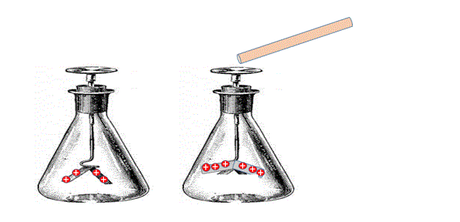
غير مشحونuncharged
مشحون بشحنة موجبةpositively charged
مشحون بشحنة سالبةnegatively charged
لا يمكن تحديد شحنته لعدم الملامسةits charge cannot be determined without contact
الحلSolution
📌 الجسم الموجب يدفع الشحنات الموجبة نحو الورقتين فيزداد انفراجهما؛ أما الجسم السالب فيقلل الانفراج.
✅ مشحون بشحنة موجبة (B)
📌 A positive body pushes positive charge to the leaves so the divergence increases; a negative body would decrease it.
✅ positively charged (B)
\[5\,\star\star\]
أحد الموصلات التالية زادت كتلته؛ علمًا بأن التقريب حدث في الصورتين A وB والتلامس في C وD:One of the following conductors increased in mass; approach took place in A and B and contact in C and D:
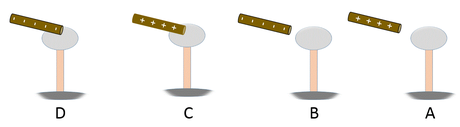
AA
BB
CC
DD
الحلSolution
📌 الكتلة تزداد (بمقدار ضئيل) عندما تنتقل إلكترونات فعلًا إلى الموصل بالملامسة؛ أما التقريب فيعيد توزيع الشحنات فقط.
✅ D
📌 The mass increases (slightly) only when electrons actually pass to the conductor by contact; approach merely redistributes charges.
✅ D
\[6\,\star\star\]
كشاف كهربائي متعادل قُرّب منه موصل مشحون بشحنة موجبة فانفرجت ورقتاه؛ فإن:A neutral electroscope; a positively charged conductor is brought near and its leaves diverge. Then:
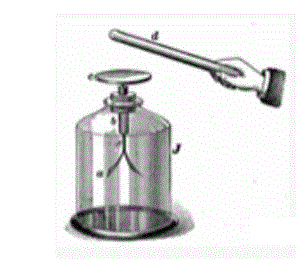
المقبض موجب والورقتان سالبتانthe knob is positive and the leaves negative
المقبض والورقتان موجبةthe knob and leaves are positive
المقبض سالب والورقتان موجبتانthe knob is negative and the leaves positive
المقبض والورقتان سالبةthe knob and leaves are negative
الحلSolution
📌 الشحنة الموجبة تجذب الإلكترونات إلى المقبض فيصبح سالبًا وتبقى الورقتان بشحنة موجبة فتتنافران (شحن بالحث).
✅ المقبض سالب والورقتان موجبتان (C)
📌 The positive charge attracts electrons to the knob so it becomes negative and the leaves are left positive and repel (induction).
✅ the knob is negative and the leaves positive (C)
\[7\,\star\star\]
موصلان متشابهان متعادلان متلامسان قُرّب منهما جسم موجب ثم فُصل الموصلان دون إبعاد الجسم؛ شحنتا الموصلين:Two identical neutral conductors in contact; a positive body is brought near, then the conductors are separated without removing the body. Their charges are:
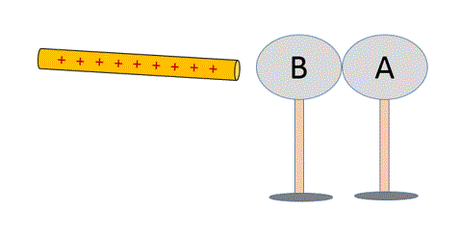
B موجب، A سالبB positive, A negative
B سالب، A سالبB negative, A negative
B سالب، A موجبB negative, A positive
B موجب، A موجبB positive, A positive
الحلSolution
📌 الجسم الموجب يجذب الإلكترونات إلى الموصل الأقرب B فيصبح سالبًا ويبقى A موجبًا، وعند الفصل تبقى الشحنتان.
✅ B سالب، A موجب (C)
📌 The positive body attracts electrons to the nearer conductor B which becomes negative while A is left positive; on separation the charges remain.
✅ B negative, A positive (C)
\[8\,\star\star\]
موصلان متشابهان متعادلان قُرّب منهما جسم سالب ثم وُصل B بالأرض ثم قُطع الاتصال وفُصل الموصلان دون إبعاد الجسم؛ شحنتاهما:Two identical neutral conductors; a negative body is brought near, B is connected to ground, the ground is removed and the conductors are separated while the body is still there. Their charges are:
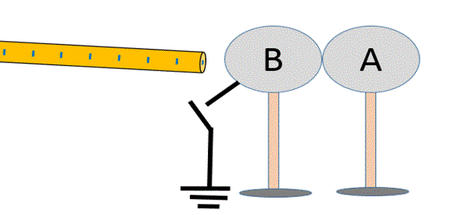
B سالب، A متعادلB negative, A neutral
B موجب، A موجبB positive, A positive
B سالب، A موجبB negative, A positive
B موجب، A متعادلB positive, A neutral
الحلSolution
📌 الجسم السالب يدفع الإلكترونات إلى الطرف البعيد A فتهرب إلى الأرض، فيبقى B موجبًا (محتجزًا بالحث) ويصبح A متعادلًا.
✅ B موجب، A متعادل (D)
📌 The negative body pushes electrons to the far end A and they escape to the ground, leaving B positive (held by induction) and A neutral.
✅ B positive, A neutral (D)
\[9\,\star\star\]
موصلان متشابهان متعادلان قُرّب منهما جسم موجب ثم وُصلا بالأرض ثم قُطع الاتصال وأُبعد الجسم ثم فُصل الموصلان؛ شحنتاهما:Two identical neutral conductors; a positive body is brought near, they are grounded, the ground is removed, the body is removed and then the conductors are separated. Their charges are:
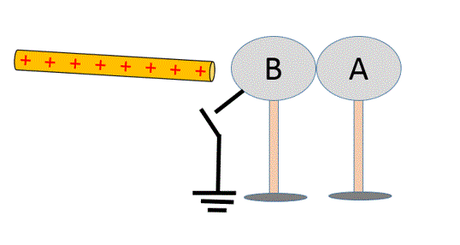
B سالب، A موجبB negative, A positive
B سالب، A سالبboth B and A negative
B موجب، A متعادلB positive, A neutral
B متعادل، A موجبB neutral, A positive
الحلSolution
📌 أثناء التأريض تدخل إلكترونات من الأرض فيكتسب المجموعة شحنة سالبة، وبعد إبعاد الجسم تتوزع بالتساوي فيحمل كلٌّ منهما شحنة سالبة.
✅ B سالب، A سالب (B)
📌 During grounding electrons flow in from the ground so the pair gains a net negative charge, which spreads equally over the identical conductors after the body is removed.
✅ both B and A negative (B)
\[10\,\star\star\]
بأي عامل يتغير البعد بين شحنتين إذا زادت القوة المتبادلة إلى ثلاثة أضعاف مع ثبات باقي العوامل؟By what factor does the distance change if the force becomes three times with everything else constant?
\(r_2=3r_1\)\(r_2=3r_1\)
\(r_2=0.577r_1\)\(r_2=0.577r_1\)
\(r_2=9r_1\)\(r_2=9r_1\)
\(r_2=0.11r_1\)\(r_2=0.11r_1\)
الحلSolution
\(F\propto\dfrac{1}{r^2}\Rightarrow\dfrac{r_2}{r_1}=\sqrt{\dfrac{F_1}{F_2}}=\dfrac{1}{\sqrt3}=0.577\)
✅ \(r_2=0.577r_1\) (B)
\(F\propto\dfrac{1}{r^2}\Rightarrow\dfrac{r_2}{r_1}=\sqrt{\dfrac{F_1}{F_2}}=\dfrac{1}{\sqrt3}=0.577\)
✅ \(r_2=0.577r_1\) (B)
\[11\,\star\star\star\]
في تجربة كولوم قيس انحراف الكرة A عندما كانت \(q_A=q_B\) والمسافة \(r\). إذا قللنا المسافة إلى النصف مع بقاء الانحراف (القوة) ثابتًا فبأي قيمة يجب تغيير شحنة B؟In Coulomb’s experiment the deflection of ball A was measured with \(q_A=q_B\) at distance \(r\). If the distance is halved while the deflection (force) is kept constant, by what must the charge of B be changed?
\(q_2=0.25q_1\)\(q_2=0.25q_1\)
\(q_2=2q_1\)\(q_2=2q_1\)
\(q_2=4q_1\)\(q_2=4q_1\)
\(q_2=0.5q_1\)\(q_2=0.5q_1\)
الحلSolution
\(F=\dfrac{kq_Aq_B}{r^2}:\ \dfrac{q_B'}{(r/2)^2}=\dfrac{q_B}{r^2}\Rightarrow q_B'=\dfrac{q_B}{4}=0.25\,q_B\)
✅ \(q_2=0.25q_1\) (A)
\(F=\dfrac{kq_Aq_B}{r^2}:\ \dfrac{q_B'}{(r/2)^2}=\dfrac{q_B}{r^2}\Rightarrow q_B'=\dfrac{q_B}{4}=0.25\,q_B\)
✅ \(q_2=0.25q_1\) (A)
\[12\,\star\star\]
موصل متعادل قُرّب منه جسم سالب دون ملامسة ثم لُمس بالأرض وقُطع الاتصال وأُبعد الجسم السالب؛ فإن الموصل:A neutral conductor; a negative body is brought near without touching, the conductor is touched to the ground, the ground is removed and the negative body is removed. The conductor:

بقي متعادلًاstayed neutral
شُحن بشحنة موجبةbecame positively charged
حدثت إعادة ترتيب للشحنات فقطonly had its charge redistributed
شُحن بشحنة سالبةbecame negatively charged
الحلSolution
📌 الإلكترونات هربت إلى الأرض أثناء التأريض فبقي الموصل بنقص في الإلكترونات: شحنة موجبة (شحن بالحث).
✅ شُحن بشحنة موجبة (B)
📌 Electrons escaped to the ground during grounding so the conductor is left short of electrons: positively charged (induction).
✅ became positively charged (B)
\[13\,\star\star\star\]
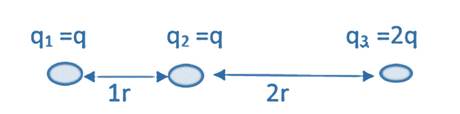
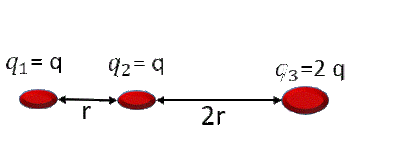
ثلاث شحنات من النوع نفسه على استقامة واحدة: \(q_1=q,\ q_2=q,\ q_3=2q\) والبعد \(r_{12}=r\) و\(r_{23}=2r\)؛ اتجاه القوة المحصلة على \(q_2\):Three like charges on a line: \(q_1=q,\ q_2=q,\ q_3=2q\) with \(r_{12}=r\) and \(r_{23}=2r\); the direction of the net force on \(q_2\) is:
نحو اليسارto the left
نحو اليمينto the right
بالاتجاه الشمالي الشرقيnorth-east
المحصلة معدومةthe net force is zero
الحلSolution
\(F_{12}=\dfrac{kq^2}{r^2}\ (\text{right}),\quad F_{32}=\dfrac{k(2q)q}{(2r)^2}=\dfrac{kq^2}{2r^2}\ (\text{left})\)
\(F_{net}=\dfrac{kq^2}{r^2}-\dfrac{kq^2}{2r^2}=\dfrac{kq^2}{2r^2}\ \to\text{ right}\)
✅ نحو اليمين (B)
\(F_{12}=\dfrac{kq^2}{r^2}\ (\text{right}),\quad F_{32}=\dfrac{k(2q)q}{(2r)^2}=\dfrac{kq^2}{2r^2}\ (\text{left})\)
\(F_{net}=\dfrac{kq^2}{r^2}-\dfrac{kq^2}{2r^2}=\dfrac{kq^2}{2r^2}\ \to\text{ right}\)
✅ to the right (B)
\[14\,\star\]
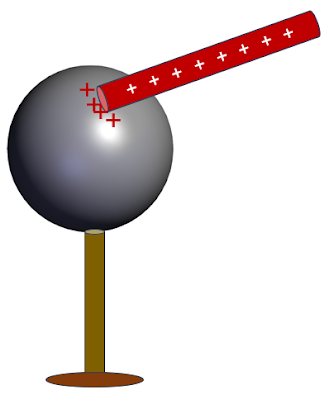
كرة لُمست بجسم مشحون فاكتسبت منطقة التلامس شحنة وبقي باقي الجسم متعادلًا؛ الكرة:A sphere is touched by a charged body; only the contact area acquires charge and the rest stays neutral. The sphere is:
فلزيةmetallic
من الجرافيتgraphite
نحاسيةcopper
زجاجيةglass
الحلSolution
📌 الشحنة لا تنتشر على العازل (الزجاج)، أما الفلزات والجرافيت موصلة فتتوزع الشحنة على سطحها كله.
✅ زجاجية (D)
📌 Charge does not spread over an insulator (glass), while metals and graphite are conductors and the charge spreads over the whole surface.
✅ glass (D)
\[15\,\star\star\]
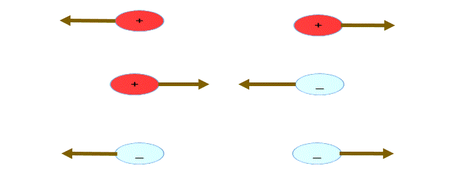
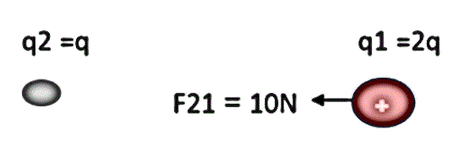
اعتمادًا على الشكل: \(q_1=2q\) موجبة وتتأثر بقوة \(F_{21}=10\ N\) نحو اليسار؛ نوع \(q_2\) والقوة التي تتأثر بها:From the figure: \(q_1=2q\) is positive and feels \(F_{21}=10\ N\) to the left; the type of \(q_2\) and the force it feels:
\(F_{12}=10\ N\to\) و\(q_2\) موجبة\(F_{12}=10\ N\to\) and \(q_2\) positive
\(F_{12}=10\ N\to\) و\(q_2\) سالبة\(F_{12}=10\ N\to\) and \(q_2\) negative
\(F_{12}=5\ N\leftarrow\) و\(q_2\) موجبة\(F_{12}=5\ N\leftarrow\) and \(q_2\) positive
\(F_{12}=5\ N\leftarrow\) و\(q_2\) سالبة\(F_{12}=5\ N\leftarrow\) and \(q_2\) negative
الحلSolution
📌 القوة على \(q_1\) نحو \(q_2\) فهي تجاذب: \(q_2\) سالبة. وقوة التفاعل المتبادلة متساوية: \(F_{12}=10\ N\) نحو اليمين (نحو \(q_1\)).
✅ \(F_{12}=10\ N\to\) و\(q_2\) سالبة (B)
📌 The force on \(q_1\) is towards \(q_2\) so it is attraction: \(q_2\) is negative. The mutual forces are equal: \(F_{12}=10\ N\) to the right (towards \(q_1\)).
✅ \(F_{12}=10\ N\to\) and \(q_2\) negative (B)
\[16\,\star\star\star\]
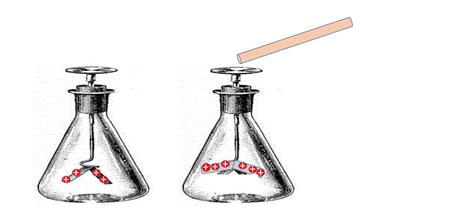
جسم مجهول الشحنة لامس كشافًا فانفرجت ورقتاه، ثم قُرّب جسم موجب فقل الانفراج؛ شحنة الجسم المجهول:An unknown body touched an electroscope and the leaves diverged; a positive body brought near makes the divergence decrease. The unknown body is:
موجبةpositive
فقد إلكتروناتhas lost electrons
سالبةnegative
غير مشحونneutral
الحلSolution
📌 الجسم الموجب يجذب الإلكترونات إلى المقبض فيقل الانفراج، وهذا لا يحدث إلا إذا كانت شحنة الكشاف سالبة، أي أن الجسم المجهول سالب.
✅ سالبة (C)
📌 The positive body pulls electrons to the knob which reduces the divergence only if the electroscope was negatively charged, so the unknown body is negative.
✅ negative (C)
\[17\,\star\star\star\]
مثلث متساوي الأضلاع على رءوسه الشحنات الموضحة؛ المتجه الذي يمثل القوة المحصلة على إلكترون في المركز:Charges are placed at the vertices of an equilateral triangle as shown; the vector representing the resultant force on an electron at the centre is:
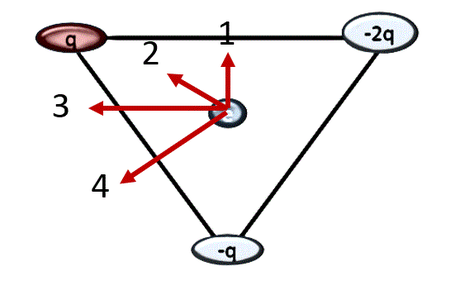
\(1\)\(1\)
\(2\)\(2\)
\(3\)\(3\)
\(4\)\(4\)
الحلSolution
📌 الإلكترون ينجذب نحو الشحنة الموجبة \(q\) ويتنافر مع \(-2q\) و\(-q\) فتكون المحصلة (بالتحليل) نحو اليسار، وهو المتجه 3.
✅ C
📌 The electron is attracted to the positive charge \(q\) and repelled by \(-2q\) and \(-q\) so the resultant (by components) points to the left, vector 3.
✅ C
\[18\,\star\star\star\]
ثلاث شحنات موجبة على استقامة واحدة \(q_1=2q\) و\(q_3=3q\) والقوة الكلية على الشحنة الثانية معدومة؛ النسبة \(r_1/r_2\) (حيث \(r_1\) بين الأولى والثانية):Three positive charges on a line \(q_1=2q\) and \(q_3=3q\) and the net force on the second charge is zero; the ratio \(r_1/r_2\) (\(r_1\) between the first and second) is:
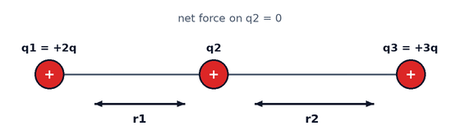
\(r_1/r_2=1.22\)\(r_1/r_2=1.22\)
\(r_1/r_2=0.57\)\(r_1/r_2=0.57\)
\(r_1/r_2=0.81\)\(r_1/r_2=0.81\)
\(r_1/r_2=1.41\)\(r_1/r_2=1.41\)
الحلSolution
\(\dfrac{kq_1q_2}{r_1^2}=\dfrac{kq_2q_3}{r_2^2}\Rightarrow\dfrac{r_1}{r_2}=\sqrt{\dfrac{q_1}{q_3}}=\sqrt{\dfrac{2}{3}}=0.82\approx0.81\)
✅ \(r_1/r_2=0.81\) (C)
\(\dfrac{kq_1q_2}{r_1^2}=\dfrac{kq_2q_3}{r_2^2}\Rightarrow\dfrac{r_1}{r_2}=\sqrt{\dfrac{q_1}{q_3}}=\sqrt{\dfrac{2}{3}}=0.82\approx0.81\)
✅ \(r_1/r_2=0.81\) (C)
\[19\,\star\star\]
أي الشحنات التالية يمكن أن تكون شحنة جسم علمًا بأن \(e=1.6\times10^{-19}\ C\)؟Which of the following could be the charge of an object, given \(e=1.6\times10^{-19}\ C\)?
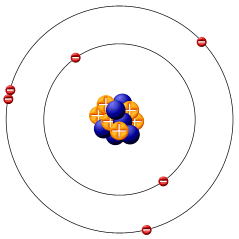
\(9\times10^{-19}\ C\)\(9\times10^{-19}\ C\)
\(5.2\times10^{-19}\ C\)\(5.2\times10^{-19}\ C\)
\(4.5\times10^{-19}\ C\)\(4.5\times10^{-19}\ C\)
\(8\times10^{-19}\ C\)\(8\times10^{-19}\ C\)
الحلSolution
📌 الشحنة كمية مكمّاة: \(q=ne\) حيث \(n\) عدد صحيح: \(8\times10^{-19}/1.6\times10^{-19}=5\).
✅ \(8\times10^{-19}\ C\) (D)
📌 Charge is quantised: \(q=ne\) with \(n\) an integer: \(8\times10^{-19}/1.6\times10^{-19}=5\).
✅ \(8\times10^{-19}\ C\) (D)
\[20\,\star\star\]
كشاف كهربائي قاعدته موصولة بالأرض قُرّب منه جسم سالب دون ملامسة؛ أي الأشكال يبين ما يحدث للكشاف؟An electroscope whose base is grounded; a negative body is brought near without touching. Which figure shows what happens?
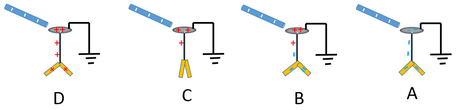
AA
BB
CC
DD
الحلSolution
📌 الإلكترونات المدفوعة بالجسم السالب تهرب إلى الأرض عبر القاعدة فلا يبقى فائض على الورقتين: تبقيان منطبقتين.
✅ C
📌 The electrons repelled by the negative body escape to the ground through the base so no excess remains on the leaves: they stay closed.
✅ C
\[21\,\star\star\star\]
أربع شحنات على رؤوس مربع \(q_1=-3q,\ q_2=-2q,\ q_3=-2q,\ q_4=+3q\) وبروتون في المركز؛ اتجاه القوة المحصلة على البروتون:Four charges at the corners of a square \(q_1=-3q,\ q_2=-2q,\ q_3=-2q,\ q_4=+3q\) and a proton at the centre; the direction of the net force on the proton is:
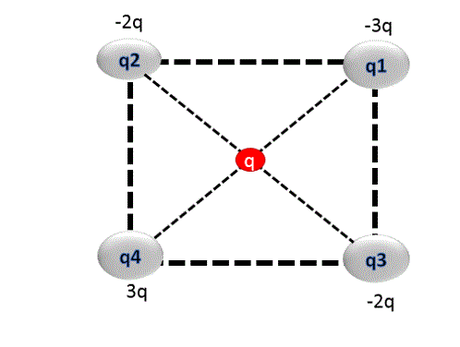
\(\nearrow\) نحو \(q_1\)\(\nearrow\) towards \(q_1\)
\(\nwarrow\) نحو \(q_2\)\(\nwarrow\) towards \(q_2\)
\(\searrow\) نحو \(q_3\)\(\searrow\) towards \(q_3\)
\(\swarrow\) نحو \(q_4\)\(\swarrow\) towards \(q_4\)
الحلSolution
📌 البروتون ينجذب إلى \(-3q\) (القطر الأكبر) ويتنافر مع \(+3q\) على الطرف المقابل: القوتان في الاتجاه نفسه نحو \(q_1\).
✅ \(\nearrow\) نحو \(q_1\) (A)
📌 The proton is attracted to \(-3q\) (the strongest) and repelled by \(+3q\) at the opposite corner: both forces point towards \(q_1\).
✅ \(\nearrow\) towards \(q_1\) (A)
\[22\,\star\star\]
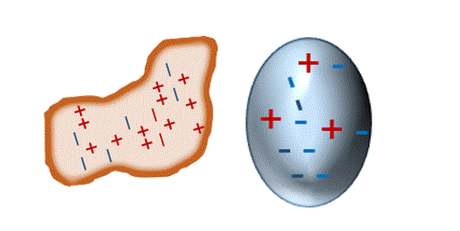
دُلك بالون بقطعة صوف فصار شحنته \(-2.4\times10^{-18}\ C\) (\(e=1.6\times10^{-19}\ C\))؛ قطعة الصوف:A balloon is rubbed with wool and acquires \(-2.4\times10^{-18}\ C\) (\(e=1.6\times10^{-19}\ C\)); the piece of wool:
اكتسبت 15 إلكترونًاgained 15 electrons
اكتسبت 2.4×10⁻¹⁸ إلكترونًاgained 2.4×10⁻¹⁸ electrons
فقدت 15 إلكترونًاlost 15 electrons
فقدت 2.4×10⁻¹⁸ إلكترونًاlost 2.4×10⁻¹⁸ electrons
الحلSolution
\(n=\dfrac{2.4\times10^{-18}}{1.6\times10^{-19}}=15\)
📌 اكتسب البالون 15 إلكترونًا من الصوف، فالصوف فقدها (شحنته +15e).
✅ فقدت 15 إلكترونًا (C)
\(n=\dfrac{2.4\times10^{-18}}{1.6\times10^{-19}}=15\)
📌 The balloon gained 15 electrons from the wool, so the wool lost them (its charge is +15e).
✅ lost 15 electrons (C)
\[23\,\star\]
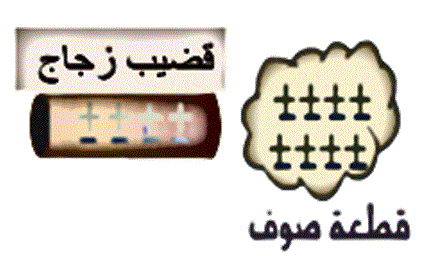
دُلك قضيب زجاجي بقطعة صوف فأصبح موجب الشحنة؛ فإن القضيب:A glass rod rubbed with wool becomes positively charged; the rod:
فقد بروتوناتlost protons
اكتسب بروتوناتgained protons
فقد إلكتروناتlost electrons
اكتسب إلكتروناتgained electrons
الحلSolution
📌 الذي ينتقل في التكهرب هو الإلكترونات؛ والقضيب الموجب فقد إلكترونات.
✅ فقد إلكترونات (C)
📌 It is electrons that move in charging; the positive rod has lost electrons.
✅ lost electrons (C)
\[24\,\star\]
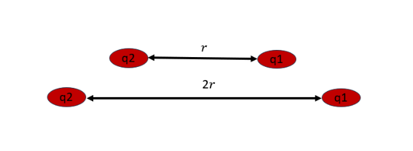
بأي عامل تتغير القوة الكهربائية بين شحنتين إذا زادت المسافة بينهما إلى الضعف؟By what factor does the electric force between two charges change if the distance between them is doubled?
\(F_2=0.25F_1\)\(F_2=0.25F_1\)
\(F_2=0.5F_1\)\(F_2=0.5F_1\)
\(F_2=2F_1\)\(F_2=2F_1\)
\(F_2=4F_1\)\(F_2=4F_1\)
الحلSolution
\(F\propto\dfrac{1}{r^2}\Rightarrow F_2=\dfrac{F_1}{2^2}=0.25F_1\)
✅ \(F_2=0.25F_1\) (A)
\(F\propto\dfrac{1}{r^2}\Rightarrow F_2=\dfrac{F_1}{2^2}=0.25F_1\)
✅ \(F_2=0.25F_1\) (A)
\[25\,\star\star\]
شحنتان مختلفتان في النوع \(q_1=2q,\ q_2=3q,\ r=0.1\ m,\ F=0.6\ N\)؛ مقدار كل شحنة:Two unlike charges \(q_1=2q,\ q_2=3q,\ r=0.1\ m,\ F=0.6\ N\); the magnitude of each charge is:
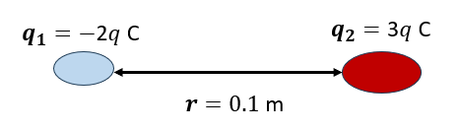
\(q_1=3.33\times10^{-7}C,\ q_2=4.99\times10^{-7}C\)\(q_1=3.33\times10^{-7}C,\ q_2=4.99\times10^{-7}C\)
\(q_1=6.66\times10^{-7}C,\ q_2=3.33\times10^{-7}C\)\(q_1=6.66\times10^{-7}C,\ q_2=3.33\times10^{-7}C\)
\(q_1=1.11\times10^{-7}C,\ q_2=1.66\times10^{-7}C\)\(q_1=1.11\times10^{-7}C,\ q_2=1.66\times10^{-7}C\)
\(q_1=6.66\times10^{-7}C,\ q_2=9.99\times10^{-7}C\)\(q_1=6.66\times10^{-7}C,\ q_2=9.99\times10^{-7}C\)
الحلSolution
\(F=\dfrac{k(2q)(3q)}{r^2}\Rightarrow q^2=\dfrac{0.6\times0.01}{6\times9\times10^9}=1.11\times10^{-13}\Rightarrow q=3.33\times10^{-7}\)
\(q_1=2q=6.66\times10^{-7}\ C,\quad q_2=3q=9.99\times10^{-7}\ C\)
✅ \(q_1=6.66\times10^{-7}C,\ q_2=9.99\times10^{-7}C\) (D)
\(F=\dfrac{k(2q)(3q)}{r^2}\Rightarrow q^2=\dfrac{0.6\times0.01}{6\times9\times10^9}=1.11\times10^{-13}\Rightarrow q=3.33\times10^{-7}\)
\(q_1=2q=6.66\times10^{-7}\ C,\quad q_2=3q=9.99\times10^{-7}\ C\)
✅ \(q_1=6.66\times10^{-7}C,\ q_2=9.99\times10^{-7}C\) (D)
\[26\,\star\star\star\]
ثلاث شحنات على استقامة واحدة \(q_1=-4\ \mu C,\ q_2=-3\ \mu C,\ q_3=+6\ \mu C\) والبعدان \(r_1=r_2=0.2\ m\)؛ القوة المحصلة على الشحنة الثانية:Three charges on a line \(q_1=-4\ \mu C,\ q_2=-3\ \mu C,\ q_3=+6\ \mu C\) with \(r_1=r_2=0.2\ m\); the net force on the second charge is:
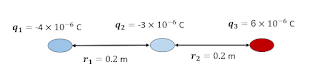
\(F=1.3\ N\)\(F=1.3\ N\)
\(F=6.7\ N\)\(F=6.7\ N\)
\(F=5.2\ N\)\(F=5.2\ N\)
\(F=2.7\ N\)\(F=2.7\ N\)
الحلSolution
\(F_{12}=\dfrac{9\times10^9(4\times10^{-6})(3\times10^{-6})}{0.2^2}=2.7\ \mathrm{N}\ (\text{repulsion, to the right})\)
\(F_{32}=\dfrac{9\times10^9(6\times10^{-6})(3\times10^{-6})}{0.2^2}=4.05\ \mathrm{N}\ (\text{attraction, to the right})\)
\(F_{net}=2.7+4.05=6.75\approx6.7\ \mathrm{N}\)
✅ \(F=6.7\ N\) (B)
\[27\,\star\]
جسم شحنته \(q=+1\ C\)؛ عدد الشحنات الأساسية فيه (\(e=1.602\times10^{-19}\ C\)):A body has charge \(q=+1\ C\); the number of elementary charges in it is (\(e=1.602\times10^{-19}\ C\)):
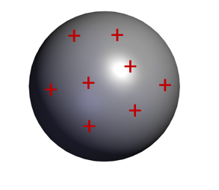
\(n=5.76\times10^{19}\)\(n=5.76\times10^{19}\)
\(n=6.24\times10^{18}\)\(n=6.24\times10^{18}\)
\(n=1.44\times10^{20}\)\(n=1.44\times10^{20}\)
\(n=8.26\times10^{21}\)\(n=8.26\times10^{21}\)
الحلSolution
\(n=\dfrac{q}{e}=\dfrac{1}{1.602\times10^{-19}}=6.24\times10^{18}\)
✅ \(n=6.24\times10^{18}\) (B)
\(n=\dfrac{q}{e}=\dfrac{1}{1.602\times10^{-19}}=6.24\times10^{18}\)
✅ \(n=6.24\times10^{18}\) (B)
\[28\,\star\star\]
كشاف كهربائي مشحون بشحنة سالبة قُرّب منه جسم سالب دون ملامسة؛ ورقتا الكشاف:A negatively charged electroscope; a negative body is brought near without touching; its leaves will:
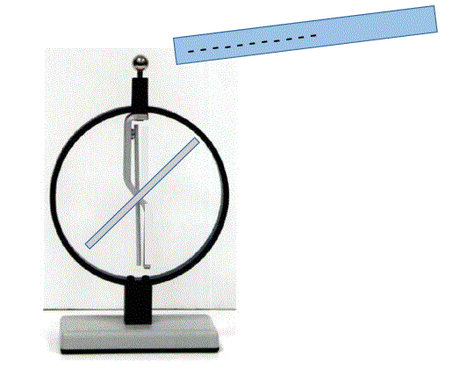
لا يتغير انفراجهماnot change their divergence
يقل انفراجهماdiverge less
يقل ثم يزداد انفراجهماdiverge less then more
يزداد انفراجهماdiverge more
الحلSolution
📌 الجسم السالب يدفع الإلكترونات من المقبض إلى الورقتين فيزداد فائض الشحنة السالبة عليهما فيزداد الانفراج.
✅ يزداد انفراجهما (D)
📌 The negative body pushes electrons from the knob to the leaves, increasing the excess negative charge there so they diverge more.
✅ diverge more (D)
\[29\,\star\]
يُستخدم جهاز الترسيب الكهروستاتيكي في:The electrostatic precipitator is used in:
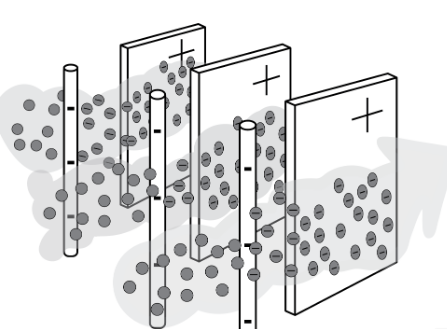
تنقية الغازات المنبعثة من المصانعcleaning the gases emitted by factories
طلاء السياراتpainting cars
طابعات الليزرlaser printers
استقبال الصواعقreceiving lightning
الحلSolution
📌 يشحن الجسيمات العالقة في الغاز ثم تنجذب إلى ألواح مشحونة بشحنة مخالفة فتُحجز.
✅ تنقية الغازات المنبعثة من المصانع (A)
📌 It charges the particles suspended in the gas which are then attracted to oppositely charged plates and trapped.
✅ cleaning the gases emitted by factories (A)
\[30\,\star\star\star\]
كاشف مشحون بشحنة سالبة لُمس بموصل فانطبقت ورقتاه ثم عاد الانفراج؛ هذا يدل على أن الموصل:A negatively charged electroscope is touched by a conductor; its leaves collapse and then diverge again. This shows that the conductor is:
موجب الشحنة (وأكبر من شحنة الكشاف)positively charged (and larger than the electroscope’s charge)
سالب الشحنةnegatively charged
متعادلneutral
متغير الشحنةof variable charge
الحلSolution
📌 انطباق الورقتين يعني تعادل الشحنة السالبة بشحنة موجبة، وعودة الانفراج يعني زيادة الشحنة الموجبة (الجسم الموجب أكبر).
✅ موجب الشحنة (وأكبر من شحنة الكشاف) (A)
📌 The collapse means the negative charge was neutralised by positive charge, and the renewed divergence means an excess of positive charge (the conductor’s charge was larger).
✅ positively charged (and larger than the electroscope’s charge) (A)
\[31\,\star\star\]
ثلاث شحنات من النوع نفسه على استقامة \(q_1=q,\ q_2=q,\ q_3=2q\) والبعدان \(r\) و\(2r\)؛ القوة المحصلة على \(q_2\):Three like charges on a line \(q_1=q,\ q_2=q,\ q_3=2q\) with spacings \(r\) and \(2r\); the net force on \(q_2\) is:
\(F=0\)\(F=0\)
\(F=\dfrac{kq^2}{2r^2}\) نحو اليمين\(F=\dfrac{kq^2}{2r^2}\) to the right
\(F=\dfrac{kq^2}{2r^2}\) نحو اليسار\(F=\dfrac{kq^2}{2r^2}\) to the left
\(F=\dfrac{kq^2}{4r^2}\) نحو اليمين\(F=\dfrac{kq^2}{4r^2}\) to the right
الحلSolution
\(F_{12}=\dfrac{kq^2}{r^2}\ (\to),\quad F_{32}=\dfrac{kq(2q)}{(2r)^2}=\dfrac{kq^2}{2r^2}\ (\leftarrow)\)
\(F_{net}=\dfrac{kq^2}{2r^2}\ (\to)\)
✅ \(F=\dfrac{kq^2}{2r^2}\) نحو اليمين (B)
\(F_{12}=\dfrac{kq^2}{r^2}\ (\to),\quad F_{32}=\dfrac{kq(2q)}{(2r)^2}=\dfrac{kq^2}{2r^2}\ (\leftarrow)\)
\(F_{net}=\dfrac{kq^2}{2r^2}\ (\to)\)
✅ \(F=\dfrac{kq^2}{2r^2}\) to the right (B)
\[32\,\star\star\]
رتّب خطوات شحن كشاف متعادل بشحنة سالبة دون ملامسة (بالحث) كما في الأشكال B وD وC وA:Arrange correctly the steps of charging a neutral electroscope negatively by induction using the figures A–D:
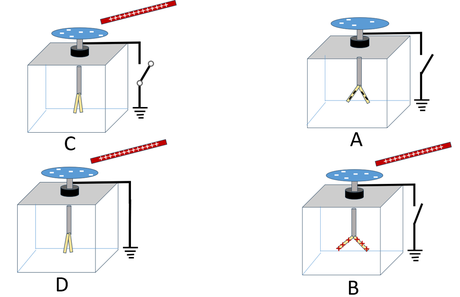
\(D\Rightarrow B\Rightarrow C\Rightarrow A\)\(D\Rightarrow B\Rightarrow C\Rightarrow A\)
\(C\Rightarrow B\Rightarrow A\Rightarrow D\)\(C\Rightarrow B\Rightarrow A\Rightarrow D\)
\(B\Rightarrow D\Rightarrow C\Rightarrow A\)\(B\Rightarrow D\Rightarrow C\Rightarrow A\)
\(B\Rightarrow C\Rightarrow D\Rightarrow A\)\(B\Rightarrow C\Rightarrow D\Rightarrow A\)
الحلSolution
📌 الترتيب الصحيح للشحن بالحث: تقريب الجسم المشحون، ثم التأريض، ثم قطع التأريض، ثم إبعاد الجسم المشحون.
✅ \(B\Rightarrow D\Rightarrow C\Rightarrow A\) (C)
📌 The correct order for induction charging: bring the charged body near, ground the electroscope, remove the ground, then remove the charged body.
✅ \(B\Rightarrow D\Rightarrow C\Rightarrow A\) (C)
\[33\,\star\star\]
شحنتان نقطيتان \(+2\ \mu C\) و\(-3\ \mu C\) تبعدان \(0.3\ m\) عن بعضهما؛ القوة المتبادلة بينهما (\(k=9\times10^9\)):Two point charges \(+2\ \mu C\) and \(-3\ \mu C\) are \(0.3\ m\) apart; the mutual force is (\(k=9\times10^9\)):
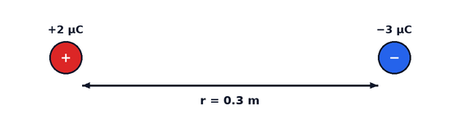
\(0.6\ N\) تنافر\(0.6\ N\) repulsion
\(0.6\ N\) تجاذب\(0.6\ N\) attraction
\(1.8\ N\) تجاذب\(1.8\ N\) attraction
\(0.2\ N\) تجاذب\(0.2\ N\) attraction
الحلSolution
\(F=\dfrac{kq_1q_2}{r^2}=\dfrac{9\times10^9(2\times10^{-6})(3\times10^{-6})}{0.09}=0.6\ \mathrm{N}\)
📌 الشحنتان مختلفتان في النوع فالقوة تجاذب.
✅ \(0.6\ N\) تجاذب (B)
\(F=\dfrac{kq_1q_2}{r^2}=\dfrac{9\times10^9(2\times10^{-6})(3\times10^{-6})}{0.09}=0.6\ \mathrm{N}\)
📌 The charges are unlike so the force is attraction.
✅ \(0.6\ N\) attraction (B)
\[34\,\star\star\star\]
شحنة \(+4\ \mu C\) وشحنة \(-1\ \mu C\) تبعدان \(0.3\ m\). أين تُوضع شحنة ثالثة لتكون في حالة اتزان (القوة عليها معدومة)؟A \(+4\ \mu C\) charge and a \(-1\ \mu C\) charge are \(0.3\ m\) apart. Where must a third charge be placed so that the force on it is zero?
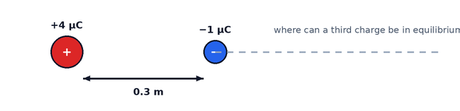
في منتصف المسافة بينهماat the midpoint between them
على بعد \(0.1\ m\) من الشحنة الموجبة بينهما\(0.1\ m\) from the positive charge, between them
على بعد \(0.2\ m\) من الشحنة السالبة وخارج المسافة بينهما\(0.2\ m\) from the negative charge, outside the segment
على بعد \(0.3\ m\) من الشحنة السالبة وخارج المسافة بينهما\(0.3\ m\) from the negative charge, outside the segment joining them
الحلSolution
📌 الشحنتان مختلفتان فالاتزان خارج المسافة بينهما وقرب الشحنة الأصغر. ليكن البعد \(x\) من السالبة: \(\dfrac{4}{(x+0.3)^2}=\dfrac{1}{x^2}\).
\(x+0.3=2x\Rightarrow x=0.3\ \mathrm{m}\)
✅ على بعد \(0.3\ m\) من الشحنة السالبة وخارج المسافة بينهما (D)
📌 The charges are unlike so equilibrium lies outside the segment, near the smaller charge. Let the distance be \(x\) from the negative one: \(\dfrac{4}{(x+0.3)^2}=\dfrac{1}{x^2}\).
\(x+0.3=2x\Rightarrow x=0.3\ \mathrm{m}\)
✅ \(0.3\ m\) from the negative charge, outside the segment joining them (D)
\[35\,\star\star\]
تضاعفت إحدى شحنتين ثلاث مرات وتضاعفت الأخرى مرتين وزاد البعد بينهما إلى ثلاثة أمثاله؛ النسبة \(F_2/F_1\):One of two charges is tripled, the other doubled, and the distance between them becomes three times; the ratio \(F_2/F_1\) is:
\(2/3\)\(2/3\)
\(6\)\(6\)
\(2/9\)\(2/9\)
\(1/3\)\(1/3\)
الحلSolution
\(\dfrac{F_2}{F_1}=\dfrac{3\times2}{3^2}=\dfrac{6}{9}=\dfrac23\)
✅ \(2/3\) (A)
\(\dfrac{F_2}{F_1}=\dfrac{3\times2}{3^2}=\dfrac{6}{9}=\dfrac23\)
✅ \(2/3\) (A)
\[36\,\star\star\star\]
ثلاث شحنات متماثلة \(q=+2\ \mu C\) على رؤوس مثلث متساوي الأضلاع طول ضلعه \(0.3\ m\)؛ مقدار القوة المحصلة على إحداها:Three identical charges \(q=+2\ \mu C\) sit at the vertices of an equilateral triangle of side \(0.3\ m\); the magnitude of the net force on one of them is:
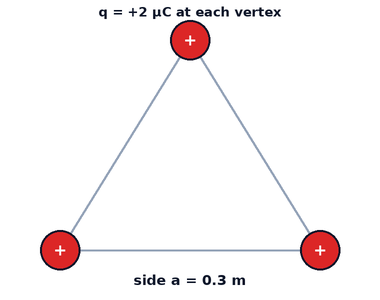
\(0.69\ N\)\(0.69\ N\)
\(0.40\ N\)\(0.40\ N\)
\(0.80\ N\)\(0.80\ N\)
\(1.20\ N\)\(1.20\ N\)
الحلSolution
\(F_0=\dfrac{kq^2}{a^2}=\dfrac{9\times10^9(2\times10^{-6})^2}{0.09}=0.4\ \mathrm{N}\)
📌 القوتان متساويتان بينهما زاوية \(60^\circ\): \(F=2F_0\cos30^\circ=\sqrt3F_0\).
\(F=\sqrt3\times0.4=0.69\ \mathrm{N}\)
✅ \(0.69\ N\) (A)
\(F_0=\dfrac{kq^2}{a^2}=\dfrac{9\times10^9(2\times10^{-6})^2}{0.09}=0.4\ \mathrm{N}\)
📌 The two forces are equal with a \(60^\circ\) angle between them: \(F=2F_0\cos30^\circ=\sqrt3F_0\).
\(F=\sqrt3\times0.4=0.69\ \mathrm{N}\)
✅ \(0.69\ N\) (A)
\[37\,\star\star\star\]
شحنتان \(+q\) و\(+4q\) تبعدان \(0.6\ m\). على أي بعد من \(+q\) (بينهما) تُوضع شحنة ثالثة لتكون القوة عليها معدومة؟Charges \(+q\) and \(+4q\) are \(0.6\ m\) apart. At what distance from \(+q\) (between them) must a third charge be placed so the force on it is zero?
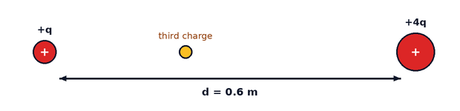
\(0.3\ m\)\(0.3\ m\)
\(0.4\ m\)\(0.4\ m\)
\(0.2\ m\)\(0.2\ m\)
\(0.15\ m\)\(0.15\ m\)
الحلSolution
\(\dfrac{kq\,q_0}{x^2}=\dfrac{k(4q)q_0}{(0.6-x)^2}\Rightarrow0.6-x=2x\)
\(x=0.2\ \mathrm{m}\)
✅ \(0.2\ m\) (C)
\(\dfrac{kq\,q_0}{x^2}=\dfrac{k(4q)q_0}{(0.6-x)^2}\Rightarrow0.6-x=2x\)
\(x=0.2\ \mathrm{m}\)
✅ \(0.2\ m\) (C)
\[38\,\star\star\]
في ذرة الهيدروجين يبعد الإلكترون عن البروتون \(5.3\times10^{-11}\ m\)؛ مقدار القوة الكهربائية بينهما:In the hydrogen atom the electron is \(5.3\times10^{-11}\ m\) from the proton; the electric force between them is:
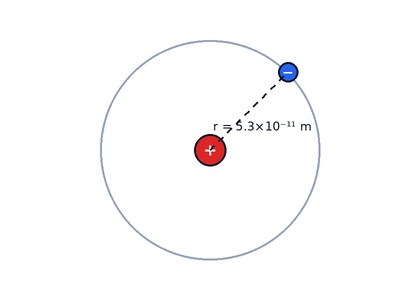
\(4.3\times10^{-8}\ N\)\(4.3\times10^{-8}\ N\)
\(8.2\times10^{-8}\ N\)\(8.2\times10^{-8}\ N\)
\(1.6\times10^{-19}\ N\)\(1.6\times10^{-19}\ N\)
\(3.6\times10^{-10}\ N\)\(3.6\times10^{-10}\ N\)
الحلSolution
\(F=\dfrac{ke^2}{r^2}=\dfrac{9\times10^9(1.6\times10^{-19})^2}{(5.3\times10^{-11})^2}=8.2\times10^{-8}\ \mathrm{N}\)
✅ \(8.2\times10^{-8}\ N\) (B)
\(F=\dfrac{ke^2}{r^2}=\dfrac{9\times10^9(1.6\times10^{-19})^2}{(5.3\times10^{-11})^2}=8.2\times10^{-8}\ \mathrm{N}\)
✅ \(8.2\times10^{-8}\ N\) (B)
\[39\,\star\star\star\]
كرتان متماثلتان موصلتان شحنتاهما \(+6\ \mu C\) و\(-2\ \mu C\) تبعدان \(0.2\ m\). لُمست إحداهما بالأخرى ثم أُعيدتا إلى البعد نفسه؛ القوة بينهما الآن:Two identical conducting spheres with charges \(+6\ \mu C\) and \(-2\ \mu C\) are \(0.2\ m\) apart. They are touched together and returned to the same distance; the force between them is now:
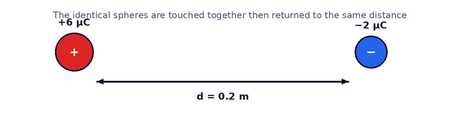
\(2.7\ N\) تجاذب\(2.7\ N\) attraction
\(0.9\ N\) تنافر\(0.9\ N\) repulsion
\(0.9\ N\) تجاذب\(0.9\ N\) attraction
\(2.7\ N\) تنافر\(2.7\ N\) repulsion
الحلSolution
\(q'=\dfrac{6-2}{2}=+2\ \mu\mathrm{C}\ (\text{each})\)
\(F=\dfrac{9\times10^9(2\times10^{-6})^2}{0.2^2}=0.9\ \mathrm{N}\ (\text{repulsion})\)
✅ \(0.9\ N\) تنافر (B)
\(q'=\dfrac{6-2}{2}=+2\ \mu\mathrm{C}\ (\text{each})\)
\(F=\dfrac{9\times10^9(2\times10^{-6})^2}{0.2^2}=0.9\ \mathrm{N}\ (\text{repulsion})\)
✅ \(0.9\ N\) repulsion (B)
\[40\,\star\star\star\]
ثلاث شحنات \(+1\ \mu C\) على ثلاثة رؤوس لمربع طول ضلعه \(0.1\ m\)؛ مقدار القوة على شحنة \(+1\ \mu C\) توضع على الرأس الرابع:Three \(+1\ \mu C\) charges sit at three corners of a square of side \(0.1\ m\); the force on a \(+1\ \mu C\) charge placed at the fourth corner has magnitude:
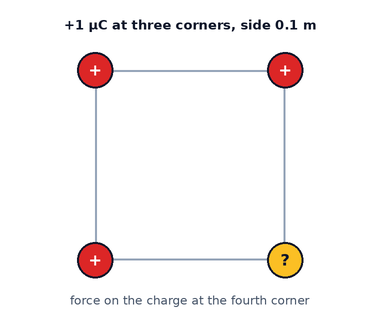
\(0.90\ N\)\(0.90\ N\)
\(1.27\ N\)\(1.27\ N\)
\(1.72\ N\)\(1.72\ N\)
\(2.25\ N\)\(2.25\ N\)
الحلSolution
\(F_{adj}=\dfrac{9\times10^9(10^{-6})^2}{0.1^2}=0.9\ \mathrm{N}\ (\text{each, perpendicular})\)
\(F_{diag}=\dfrac{9\times10^9(10^{-6})^2}{0.02}=0.45\ \mathrm{N}\)
\(F=0.9\sqrt2+0.45=1.72\ \mathrm{N}\ (\text{along the diagonal})\)
✅ \(1.72\ N\) (C)
\(F_{adj}=\dfrac{9\times10^9(10^{-6})^2}{0.1^2}=0.9\ \mathrm{N}\ (\text{each, perpendicular})\)
\(F_{diag}=\dfrac{9\times10^9(10^{-6})^2}{0.02}=0.45\ \mathrm{N}\)
\(F=0.9\sqrt2+0.45=1.72\ \mathrm{N}\ (\text{along the diagonal})\)
✅ \(1.72\ N\) (C)
\[41\,\star\star\]
كشاف كهربائي موجب الشحنة قُرّب من قرصه جسم سالب دون ملامسة؛ ورقتا الكشاف:A positively charged electroscope; a negative body is brought near its disc without touching. Its leaves:
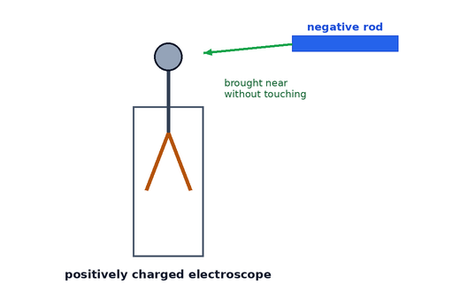
يزداد انفراجهماdiverge more
لا يتغير انفراجهماdo not change
تنطبقان وتبقيان منطبقتينcollapse and stay closed
يقل انفراجهماdiverge less
الحلSolution
📌 الجسم السالب يدفع الإلكترونات نحو الورقتين فيعادل جزءًا من شحنتهما الموجبة فيقل الانفراج.
✅ يقل انفراجهما (D)
📌 The negative body pushes electrons towards the leaves, neutralising part of their positive charge, so the divergence decreases.
✅ diverge less (D)
\[42\,\star\star\star\]
كرتان متماثلتان تحمل كلٌّ منهما \(n\) إلكترونًا فائضًا وتبعدان \(0.1\ m\) فتتنافران بقوة \(2.3\times10^{-2}\ N\)؛ عدد الإلكترونات الفائضة على كل كرة:Two identical spheres each carry \(n\) excess electrons and are \(0.1\ m\) apart repelling with a force of \(2.3\times10^{-2}\ N\); the number of excess electrons on each sphere is:
\(n\approx10^{9}\)\(n\approx10^{9}\)
\(n\approx10^{15}\)\(n\approx10^{15}\)
\(n\approx10^{12}\)\(n\approx10^{12}\)
\(n\approx10^{6}\)\(n\approx10^{6}\)
الحلSolution
\(q=r\sqrt{\dfrac{F}{k}}=0.1\sqrt{\dfrac{2.3\times10^{-2}}{9\times10^9}}=1.6\times10^{-7}\ \mathrm{C}\)
\(n=\dfrac{q}{e}=\dfrac{1.6\times10^{-7}}{1.6\times10^{-19}}=10^{12}\)
✅ \(n\approx10^{12}\) (C)
\(q=r\sqrt{\dfrac{F}{k}}=0.1\sqrt{\dfrac{2.3\times10^{-2}}{9\times10^9}}=1.6\times10^{-7}\ \mathrm{C}\)
\(n=\dfrac{q}{e}=\dfrac{1.6\times10^{-7}}{1.6\times10^{-19}}=10^{12}\)
✅ \(n\approx10^{12}\) (C)
\[43\,\star\star\star\]
يمثل الرسم القوة المتبادلة \(F\) بين شحنتين متساويتين مع \(1/r^2\)؛ مقدار كل شحنة:The graph shows the mutual force \(F\) between two equal charges against \(1/r^2\); the magnitude of each charge is:
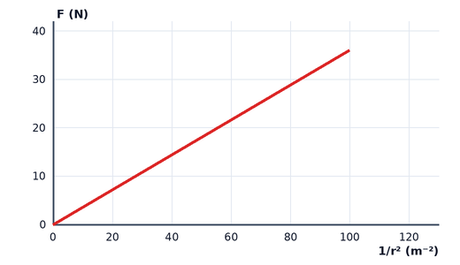
\(6.3\times10^{-6}\ C\)\(6.3\times10^{-6}\ C\)
\(3.6\times10^{-6}\ C\)\(3.6\times10^{-6}\ C\)
\(4\times10^{-11}\ C\)\(4\times10^{-11}\ C\)
\(6.3\times10^{-3}\ C\)\(6.3\times10^{-3}\ C\)
الحلSolution
📌 الميل = \(kq^2=\dfrac{36}{100}=0.36\ \mathrm{N\cdot m^2}\).
\(q=\sqrt{\dfrac{0.36}{9\times10^9}}=\sqrt{4\times10^{-11}}=6.3\times10^{-6}\ \mathrm{C}\)
✅ \(6.3\times10^{-6}\ C\) (A)
📌 The slope = \(kq^2=\dfrac{36}{100}=0.36\ \mathrm{N\cdot m^2}\).
\(q=\sqrt{\dfrac{0.36}{9\times10^9}}=\sqrt{4\times10^{-11}}=6.3\times10^{-6}\ \mathrm{C}\)
✅ \(6.3\times10^{-6}\ C\) (A)
\[44\,\star\star\star\]
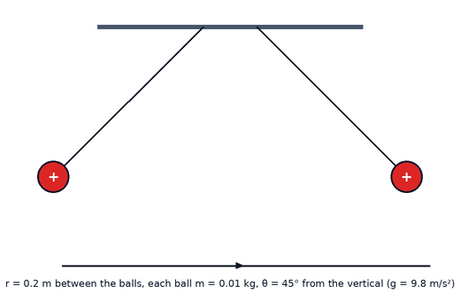
كرتان متماثلتان كتلة كل منهما \(0.01\ kg\) معلقتان بخيطين فتباعدتا وصنع كل خيط زاوية \(45^\circ\) مع الرأسي والمسافة بين مركزيهما \(0.2\ m\)؛ شحنة كل كرة (\(g=9.8\ m/s^2\)):Two identical balls of mass \(0.01\ kg\) hang on strings and repel so that each string makes \(45^\circ\) with the vertical and the centres are \(0.2\ m\) apart; the charge of each ball is (\(g=9.8\ m/s^2\)):
\(6.6\times10^{-7}\ C\)\(6.6\times10^{-7}\ C\)
\(3.3\times10^{-7}\ C\)\(3.3\times10^{-7}\ C\)
\(1.3\times10^{-6}\ C\)\(1.3\times10^{-6}\ C\)
\(6.6\times10^{-9}\ C\)\(6.6\times10^{-9}\ C\)
الحلSolution
\(\tan45^\circ=\dfrac{F}{mg}\Rightarrow F=mg=0.098\ \mathrm{N}\)
\(q=r\sqrt{\dfrac{F}{k}}=0.2\sqrt{\dfrac{0.098}{9\times10^9}}=6.6\times10^{-7}\ \mathrm{C}\)
✅ \(6.6\times10^{-7}\ C\) (A)
\(\tan45^\circ=\dfrac{F}{mg}\Rightarrow F=mg=0.098\ \mathrm{N}\)
\(q=r\sqrt{\dfrac{F}{k}}=0.2\sqrt{\dfrac{0.098}{9\times10^9}}=6.6\times10^{-7}\ \mathrm{C}\)
✅ \(6.6\times10^{-7}\ C\) (A)
\[45\,\star\star\star\]
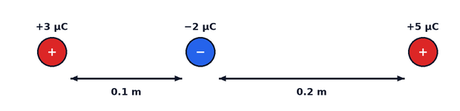
ثلاث شحنات على استقامة واحدة \(+3\ \mu C\) و\(-2\ \mu C\) و\(+5\ \mu C\) والبعدان \(0.1\ m\) و\(0.2\ m\)؛ القوة المحصلة على الشحنة الوسطى:Three charges on a line \(+3\ \mu C\), \(-2\ \mu C\) and \(+5\ \mu C\) with spacings \(0.1\ m\) and \(0.2\ m\); the net force on the middle charge is:
\(3.15\ N\) نحو الشحنة \(+5\ \mu C\)\(3.15\ N\) towards the \(+5\ \mu C\) charge
\(7.65\ N\) نحو الشحنة \(+3\ \mu C\)\(7.65\ N\) towards the \(+3\ \mu C\) charge
\(2.25\ N\) نحو الشحنة \(+5\ \mu C\)\(2.25\ N\) towards the \(+5\ \mu C\) charge
\(3.15\ N\) نحو الشحنة \(+3\ \mu C\)\(3.15\ N\) towards the \(+3\ \mu C\) charge
الحلSolution
\(F_L=\dfrac{9\times10^9(3\times10^{-6})(2\times10^{-6})}{0.1^2}=5.4\ \mathrm{N}\ (\text{attraction to the left})\)
\(F_R=\dfrac{9\times10^9(5\times10^{-6})(2\times10^{-6})}{0.2^2}=2.25\ \mathrm{N}\ (\text{attraction to the right})\)
\(F_{net}=5.4-2.25=3.15\ \mathrm{N}\ (\text{to the left})\)
✅ \(3.15\ N\) نحو الشحنة \(+3\ \mu C\) (D)
\(F_L=\dfrac{9\times10^9(3\times10^{-6})(2\times10^{-6})}{0.1^2}=5.4\ \mathrm{N}\ (\text{attraction to the left})\)
\(F_R=\dfrac{9\times10^9(5\times10^{-6})(2\times10^{-6})}{0.2^2}=2.25\ \mathrm{N}\ (\text{attraction to the right})\)
\(F_{net}=5.4-2.25=3.15\ \mathrm{N}\ (\text{to the left})\)
✅ \(3.15\ N\) towards the \(+3\ \mu C\) charge (D)
\[46\,\star\star\]
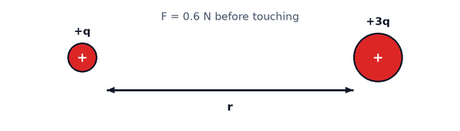
كرتان متماثلتان شحنتاهما \(+q\) و\(+3q\) بينهما قوة تنافر \(0.6\ N\). لُمست إحداهما بالأخرى ثم أُعيدتا إلى المسافة نفسها؛ القوة الآن:Two identical spheres with charges \(+q\) and \(+3q\) repel with \(0.6\ N\). They are touched together and returned to the same distance; the force is now:
\(0.8\ N\)\(0.8\ N\)
\(0.6\ N\)\(0.6\ N\)
\(0.45\ N\)\(0.45\ N\)
\(1.2\ N\)\(1.2\ N\)
الحلSolution
\(F\propto q_1q_2:\ q\times3q=3q^2\ \to\ 2q\times2q=4q^2\)
\(F'=0.6\times\dfrac43=0.8\ \mathrm{N}\)
✅ \(0.8\ N\) (A)
\(F\propto q_1q_2:\ q\times3q=3q^2\ \to\ 2q\times2q=4q^2\)
\(F'=0.6\times\dfrac43=0.8\ \mathrm{N}\)
✅ \(0.8\ N\) (A)
\[47\,\star\star\star\]
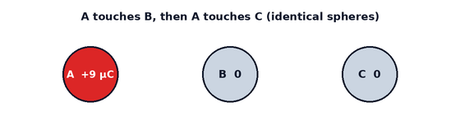
ثلاث كرات معدنية متماثلة: A شحنتها \(+9\ \mu C\) وB وC متعادلتان. لُمست A بـ B ثم بـ C؛ شحنة A النهائية:Three identical metal spheres: A has \(+9\ \mu C\) while B and C are neutral. A touches B and then C; the final charge of A is:
\(+3\ \mu C\)\(+3\ \mu C\)
\(+4.5\ \mu C\)\(+4.5\ \mu C\)
\(+1.5\ \mu C\)\(+1.5\ \mu C\)
\(+2.25\ \mu C\)\(+2.25\ \mu C\)
الحلSolution
\(A\to B:\ q=\dfrac{9+0}{2}=4.5\ \mu\mathrm{C}\)
\(A\to C:\ q=\dfrac{4.5+0}{2}=2.25\ \mu\mathrm{C}\)
✅ \(+2.25\ \mu C\) (D)
\(A\to B:\ q=\dfrac{9+0}{2}=4.5\ \mu\mathrm{C}\)
\(A\to C:\ q=\dfrac{4.5+0}{2}=2.25\ \mu\mathrm{C}\)
✅ \(+2.25\ \mu C\) (D)
📝 المسائل المقالية
📝 Essay Problems
\[1\,\star\star\star\]
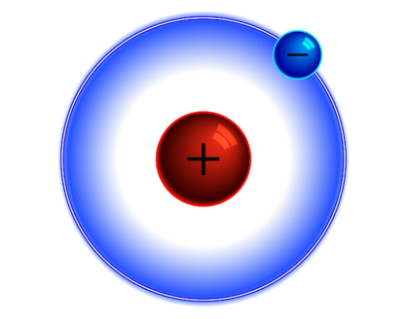
ذرة الهيدروجين: إلكترون وبروتون (\(m_e=9.1\times10^{-31}\ kg,\ m_p=1.67\times10^{-27}\ kg,\ q=\pm1.6\times10^{-19}\ C\)). أوجد النسبة بين القوة الكهربائية وقوة التجاذب الكتلي بين الإلكترون والبروتون (\(k=9\times10^9,\ G=6.67\times10^{-11}\)) ثم اذكر وجهي التشابه والاختلاف بين القوتين.The hydrogen atom has an electron and a proton (\(m_e=9.1\times10^{-31}\ kg,\ m_p=1.67\times10^{-27}\ kg,\ q=\pm1.6\times10^{-19}\ C\)). Find the ratio of the electric force to the gravitational force between them (\(k=9\times10^9,\ G=6.67\times10^{-11}\)) and state the similarities and differences between the two forces.
.....................................................................
الحلSolution
\(\dfrac{F_e}{F_g}=\dfrac{ke^2/r^2}{Gm_em_p/r^2}=\dfrac{ke^2}{Gm_em_p}\) (يُحذف \(r^2\)).
\(=\dfrac{9\times10^9\times(1.6\times10^{-19})^2}{6.67\times10^{-11}\times9.1\times10^{-31}\times1.67\times10^{-27}}\approx2.3\times10^{39}\).
📌 التشابه: كلاهما يتناسب عكسيًا مع مربع البعد، ويؤثر عن بعد، وقوتا التفاعل متساويتان ومتعاكستان (نيوتن الثالث).
📌 الاختلاف: الكهربائية تجاذب أو تنافر وتعتمد على الشحنة وعلى الوسط، أما الجاذبية فتجاذب دائمًا وتعتمد على الكتلة؛ والكهربائية أقوى بنحو \(10^{39}\) مرة في الذرة.
✅ \(F_e/F_g\approx2.3\times10^{39}\)
\(\dfrac{F_e}{F_g}=\dfrac{ke^2/r^2}{Gm_em_p/r^2}=\dfrac{ke^2}{Gm_em_p}\) (\(r^2\) cancels).
\(=\dfrac{9\times10^9\times(1.6\times10^{-19})^2}{6.67\times10^{-11}\times9.1\times10^{-31}\times1.67\times10^{-27}}\approx2.3\times10^{39}\).
📌 Similarities: both are inversely proportional to the square of the distance, act at a distance, and the two interaction forces are equal and opposite (Newton’s third law).
📌 Differences: the electric force may attract or repel and depends on charge and on the medium, whereas gravity always attracts and depends on mass; the electric force is about \(10^{39}\) times stronger in the atom.
✅ \(F_e/F_g\approx2.3\times10^{39}\)
\[2\,\star\star\star\]
شحنتان نقطيتان من النوع نفسه، مقدار الأولى \(q_1\) يساوي أربعة أمثال الثانية \(q_2\) وبينهما \(r=0.4\ m\)؛ فتأثرت \(q_1\) بقوة \(F_{21}=0.8\ N\) نحو اليمين. حدّد مقدار واتجاه القوة المؤثرة على \(q_2\) واحسب مقدار كل شحنة.Two like point charges: the first \(q_1\) is four times the second \(q_2\) and they are \(r=0.4\ m\) apart; \(q_1\) feels \(F_{21}=0.8\ N\) to the right. Find the magnitude and direction of the force on \(q_2\) and calculate each charge.

.....................................................................
الحلSolution
📌 قوتا التفاعل متساويتان ومتعاكستان: \(F_{12}=0.8\ N\) نحو اليسار.
\(F=\dfrac{k(4q_2)q_2}{r^2}\Rightarrow q_2^2=\dfrac{0.8\times0.16}{4\times9\times10^9}=3.56\times10^{-12}\).
\(q_2=1.89\times10^{-6}\ C,\qquad q_1=4q_2=7.54\times10^{-6}\ C\).
✅ \(q_2=1.89\,\mu C,\ q_1=7.54\,\mu C\) و\(F_{12}=0.8\ N\) نحو اليسار
📌 The interaction forces are equal and opposite: \(F_{12}=0.8\ N\) to the left.
\(F=\dfrac{k(4q_2)q_2}{r^2}\Rightarrow q_2^2=\dfrac{0.8\times0.16}{4\times9\times10^9}=3.56\times10^{-12}\).
\(q_2=1.89\times10^{-6}\ C,\qquad q_1=4q_2=7.54\times10^{-6}\ C\).
✅ \(q_2=1.89\,\mu C,\ q_1=7.54\,\mu C\) and \(F_{12}=0.8\ N\) to the left
\[3\,\star\star\star\]
ثلاث شحنات \(q_1=-3\ \mu C,\ q_2=+2\ \mu C,\ q_3=-4\ \mu C\) على استقامة واحدة، \(r_1=0.1\ m\) بين الأولى والثانية و\(r_2=0.2\ m\) بين الثانية والثالثة. احسب القوة المؤثرة على \(q_3\) وحدّد اتجاهها.Three charges \(q_1=-3\ \mu C,\ q_2=+2\ \mu C,\ q_3=-4\ \mu C\) lie on a line, \(r_1=0.1\ m\) between the first and second and \(r_2=0.2\ m\) between the second and third. Find the force on \(q_3\) and its direction.

.....................................................................
الحلSolution
\(F_{23}=\dfrac{9\times10^9(2\times10^{-6})(4\times10^{-6})}{0.2^2}=1.8\ \mathrm{N}\) تجاذب: نحو اليسار (نحو \(q_2\)).
\(F_{13}=\dfrac{9\times10^9(3\times10^{-6})(4\times10^{-6})}{0.3^2}=1.2\ \mathrm{N}\) تنافر: نحو اليمين (البعد \(0.1+0.2=0.3\ m\)).
\(F_{net}=1.8-1.2=0.6\ \mathrm{N}\) نحو اليسار.
✅ \(F=0.6\ N\) نحو اليسار (نحو \(q_2\))
\(F_{23}=\dfrac{9\times10^9(2\times10^{-6})(4\times10^{-6})}{0.2^2}=1.8\ \mathrm{N}\) attraction: to the left (towards \(q_2\)).
\(F_{13}=\dfrac{9\times10^9(3\times10^{-6})(4\times10^{-6})}{0.3^2}=1.2\ \mathrm{N}\) repulsion: to the right (distance \(0.1+0.2=0.3\ m\)).
\(F_{net}=1.8-1.2=0.6\ \mathrm{N}\) to the left.
✅ \(F=0.6\ N\) to the left (towards \(q_2\))
\[4\,\star\star\]
شحنتان من النوع نفسه، الأولى أربعة أمثال الثانية، وُضعتا على بعد \(0.4\ m\) فتأثرت الأولى بقوة \(0.8\ N\). احسب مقدار كل شحنة، ثم احسب القوة الجديدة إذا زاد البعد إلى أربعة أمثاله.Two like charges, the first four times the second, are \(0.4\ m\) apart and the first feels \(0.8\ N\). Find each charge, then the new force if the distance becomes four times.
.....................................................................
الحلSolution
📌 كما في المسألة السابقة: \(q_2=1.89\times10^{-6}\ C\) و\(q_1=7.54\times10^{-6}\ C\).
\(F\propto\dfrac1{r^2}\Rightarrow F'=\dfrac{0.8}{4^2}=0.05\ \mathrm{N}\).
✅ \(F'=0.05\ N\)
📌 As in the previous problem: \(q_2=1.89\times10^{-6}\ C\) and \(q_1=7.54\times10^{-6}\ C\).
\(F\propto\dfrac1{r^2}\Rightarrow F'=\dfrac{0.8}{4^2}=0.05\ \mathrm{N}\).
✅ \(F'=0.05\ N\)
\[5\,\star\star\star\]
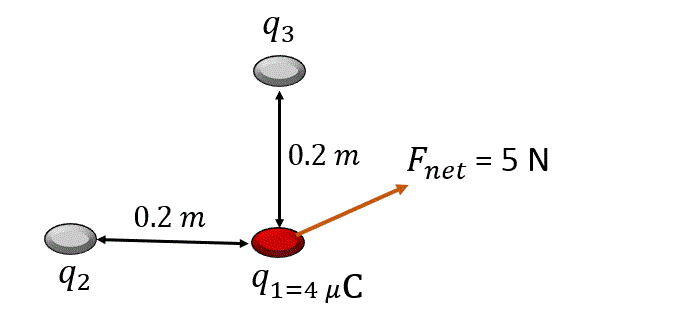
القوة المحصلة على \(q_1=4\ \mu C\) تساوي \(5\ N\) كما في الرسم، والقوة المؤثرة عليها من الشحنة الثالثة (الأعلى، تبعد \(0.2\ m\)) تساوي \(F_{31}=3\ N\) عموديًا. احسب مقدار الشحنة الثانية (تبعد \(0.2\ m\) على اليسار) ونوعها.The net force on \(q_1=4\ \mu C\) is \(5\ N\) as shown, and the force on it from the third charge (above it, \(0.2\ m\) away) is \(F_{31}=3\ N\) vertically. Find the magnitude and type of the second charge (\(0.2\ m\) to the left).
.....................................................................
الحلSolution
📌 المركّبتان متعامدتان: \(F_{21}=\sqrt{F_{net}^2-F_{31}^2}=\sqrt{25-9}=4\ \mathrm{N}\).
📌 المحصلة تتجه نحو اليمين أي بعيدًا عن \(q_2\): القوة تنافر، فالشحنة \(q_2\) من نوع \(q_1\) (موجبة).
\(q_2=\dfrac{F_{21}r^2}{kq_1}=\dfrac{4\times0.04}{9\times10^9\times4\times10^{-6}}=4.4\times10^{-6}\ \mathrm{C}\).
✅ \(q_2=+4.4\ \mu C\)
📌 The components are perpendicular: \(F_{21}=\sqrt{F_{net}^2-F_{31}^2}=\sqrt{25-9}=4\ \mathrm{N}\).
📌 The resultant points to the right, away from \(q_2\): the force is repulsive, so \(q_2\) has the same type as \(q_1\) (positive).
\(q_2=\dfrac{F_{21}r^2}{kq_1}=\dfrac{4\times0.04}{9\times10^9\times4\times10^{-6}}=4.4\times10^{-6}\ \mathrm{C}\).
✅ \(q_2=+4.4\ \mu C\)
لاحظت خطأ؟ أو عندك سؤال عن أحد الأسئلة؟ اكتبه بالتعليقات وحدد رقم السؤال بالضبط.
Noticed an error? Or have a question about one of the questions? Write it in the comments and specify the exact question number.