⚡ بنك الأسئلة: الطاقة الحرارية
⚡ Question Bank: Thermal Energy
درجات الحرارة ومقاييسها، كمية الحرارة والحرارة النوعية، الاتزان الحراري، الحرارة الكامنة، طرق انتقال الحرارة
Temperature Scales, Heat and Specific Heat, Thermal Equilibrium, Latent Heat, Modes of Heat Transfer
⏱️ 38 سؤال اختيار من متعدد بتصحيح فوري بمستويات متدرجة، ومسألة مقالية محلولة، مع حل مفصل لكل سؤال⏱️ 38 multiple-choice questions of graded difficulty with instant feedback, and 1 solved essay problem, with a detailed solution for each
\[1\,\star\]
جسم درجة حرارته \(T=50^{\circ}C\) خُفضت درجة حرارته إلى \(T=20^{\circ}C\). التغير في درجة الحرارة:A body at \(T=50^{\circ}C\) is cooled to \(T=20^{\circ}C\). The change in temperature is:
\(\Delta T=70^{\circ}C\)\(\Delta T=70^{\circ}C\)
\(\Delta T=-70^{\circ}C\)\(\Delta T=-70^{\circ}C\)
\(\Delta T=-30^{\circ}C\)\(\Delta T=-30^{\circ}C\)
\(\Delta T=30^{\circ}C\)\(\Delta T=30^{\circ}C\)
الحلSolution
📌 التغير = النهائية − الابتدائية: \(\Delta T=T_f-T_i=20-50=-30^{\circ}C\) (الإشارة السالبة تعني انخفاضًا).
✅ \(\Delta T=-30^{\circ}C\) (C)
📌 The change = final − initial: \(\Delta T=T_f-T_i=20-50=-30^{\circ}C\) (the negative sign means a decrease).
✅ \(\Delta T=-30^{\circ}C\) (C)
\[2\,\star\]
أي مما يلي يكافئ درجة الحرارة \(T=-100^{\circ}C\)؟Which of the following is equivalent to a temperature of \(T=-100^{\circ}C\)?
\(T_K=373\,K\)\(T_K=373\,K\)
\(T_K=273\,K\)\(T_K=273\,K\)
\(T_K=-373\,K\)\(T_K=-373\,K\)
\(T_K=173\,K\)\(T_K=173\,K\)
الحلSolution
\(T_K=T_C+273=-100+273=173\,K\).
✅ \(T_K=173\,K\) (D)
\(T_K=T_C+273=-100+273=173\,K\).
✅ \(T_K=173\,K\) (D)
\[3\,\star\star\]
سُخنت عينة من الماء كتلتها \(m=60\,g\) من \(18^{\circ}C\) إلى \(70^{\circ}C\). كمية الحرارة التي امتصها الماء (\(C_p=4180\,J/(kg\cdot K)\)):A sample of water of mass \(m=60\,g\) is heated from \(18^{\circ}C\) to \(70^{\circ}C\). The heat absorbed by the water (\(C_p=4180\,J/(kg\cdot K)\)) is:
\(Q=56175\,J\)\(Q=56175\,J\)
\(Q=24325\,J\)\(Q=24325\,J\)
\(Q=176547\,J\)\(Q=176547\,J\)
\(Q=13041\,J\)\(Q=13041\,J\)
الحلSolution
\(m=60\,g=0.06\,kg\) و\(\Delta T=70-18=52\,K\).
\(Q=mC_p\Delta T=0.06\times4180\times52=13\,041\,J\).
✅ \(Q=13041\,J\) (D)
\(m=60\,g=0.06\,kg\) and \(\Delta T=70-18=52\,K\).
\(Q=mC_p\Delta T=0.06\times4180\times52=13\,041\,J\).
✅ \(Q=13041\,J\) (D)
\[4\,\star\star\]
عينة من الحديد كتلتها \(2.5\,kg\) ودرجة حرارتها \(50^{\circ}C\) أُعطيت طاقة \(1.5\times10^{6}\,J\) في فرن. درجة حرارتها النهائية (\(C_p=450\,J/(kg\cdot K)\)):An iron sample of mass \(2.5\,kg\) at \(50^{\circ}C\) is given \(1.5\times10^{6}\,J\) in a furnace. Its final temperature (\(C_p=450\,J/(kg\cdot K)\)) is:
\(T_f=1383.3^{\circ}C\)\(T_f=1383.3^{\circ}C\)
\(T_f=1520.5^{\circ}C\)\(T_f=1520.5^{\circ}C\)
\(T_f=2320.6^{\circ}C\)\(T_f=2320.6^{\circ}C\)
\(T_f=908.7^{\circ}C\)\(T_f=908.7^{\circ}C\)
الحلSolution
\(\Delta T=\dfrac{Q}{mC_p}=\dfrac{1.5\times10^{6}}{2.5\times450}=1333.3\,K\).
\(T_f=50+1333.3=1383.3^{\circ}C\) (دون درجة انصهار الحديد \(\approx1538^{\circ}C\)).
✅ \(T_f=1383.3^{\circ}C\) (A)
\(\Delta T=\dfrac{Q}{mC_p}=\dfrac{1.5\times10^{6}}{2.5\times450}=1333.3\,K\).
\(T_f=50+1333.3=1383.3^{\circ}C\) (below the melting point of iron, \(\approx1538^{\circ}C\)).
✅ \(T_f=1383.3^{\circ}C\) (A)
\[5\,\star\star\]
سُخنت قطعة نحاس كتلتها \(0.2\,kg\) من \(10^{\circ}C\) إلى \(30^{\circ}C\). أُضيفت كمية الحرارة نفسها إلى قطعة حديد كتلتها \(0.3\,kg\). التغير في درجة حرارة الحديد (\(C_{Cu}=376\) و\(C_{Fe}=450\,J/(kg\cdot K)\)):A copper piece of mass \(0.2\,kg\) is heated from \(10^{\circ}C\) to \(30^{\circ}C\). The same amount of heat is added to an iron piece of mass \(0.3\,kg\). The temperature change of the iron (\(C_{Cu}=376\) and \(C_{Fe}=450\,J/(kg\cdot K)\)) is:
\(\Delta T=11.1^{\circ}C\)\(\Delta T=11.1^{\circ}C\)
\(\Delta T=20^{\circ}C\)\(\Delta T=20^{\circ}C\)
\(\Delta T=18.2^{\circ}C\)\(\Delta T=18.2^{\circ}C\)
\(\Delta T=13.9^{\circ}C\)\(\Delta T=13.9^{\circ}C\)
الحلSolution
\(Q_{Cu}=0.2\times376\times20=1504\,J\).
\(\Delta T_{Fe}=\dfrac{1504}{0.3\times450}=\dfrac{1504}{135}=11.1^{\circ}C\).
✅ \(\Delta T=11.1^{\circ}C\) (A)
\(Q_{Cu}=0.2\times376\times20=1504\,J\).
\(\Delta T_{Fe}=\dfrac{1504}{0.3\times450}=\dfrac{1504}{135}=11.1^{\circ}C\).
✅ \(\Delta T=11.1^{\circ}C\) (A)
\[6\,\star\]
الطاقة الحرارية اللازمة لتحويل 1 كيلوغرام من مادة من الحالة الصلبة إلى السائلة (أو العكس) دون تغير في درجة الحرارة تسمى:The thermal energy needed to change 1 kilogram of a substance from solid to liquid (or the reverse) without a change in temperature is called:
الحرارة الكامنة للتبخرlatent heat of vaporization
الحرارة الكامنة للانصهارlatent heat of fusion
السعة الحرارية النوعيةspecific heat capacity
الطاقة الحراريةthermal energy
الحلSolution
📌 الحرارة الكامنة للانصهار \(H_f\) هي الطاقة اللازمة لصهر \(1\,kg\) عند درجة حرارة ثابتة (نقطة الانصهار): \(Q=mH_f\).
✅ الحرارة الكامنة للانصهار (B)
📌 The latent heat of fusion \(H_f\) is the energy needed to melt \(1\,kg\) at a constant temperature (the melting point): \(Q=mH_f\).
✅ latent heat of fusion (B)
\[7\,\star\star\]
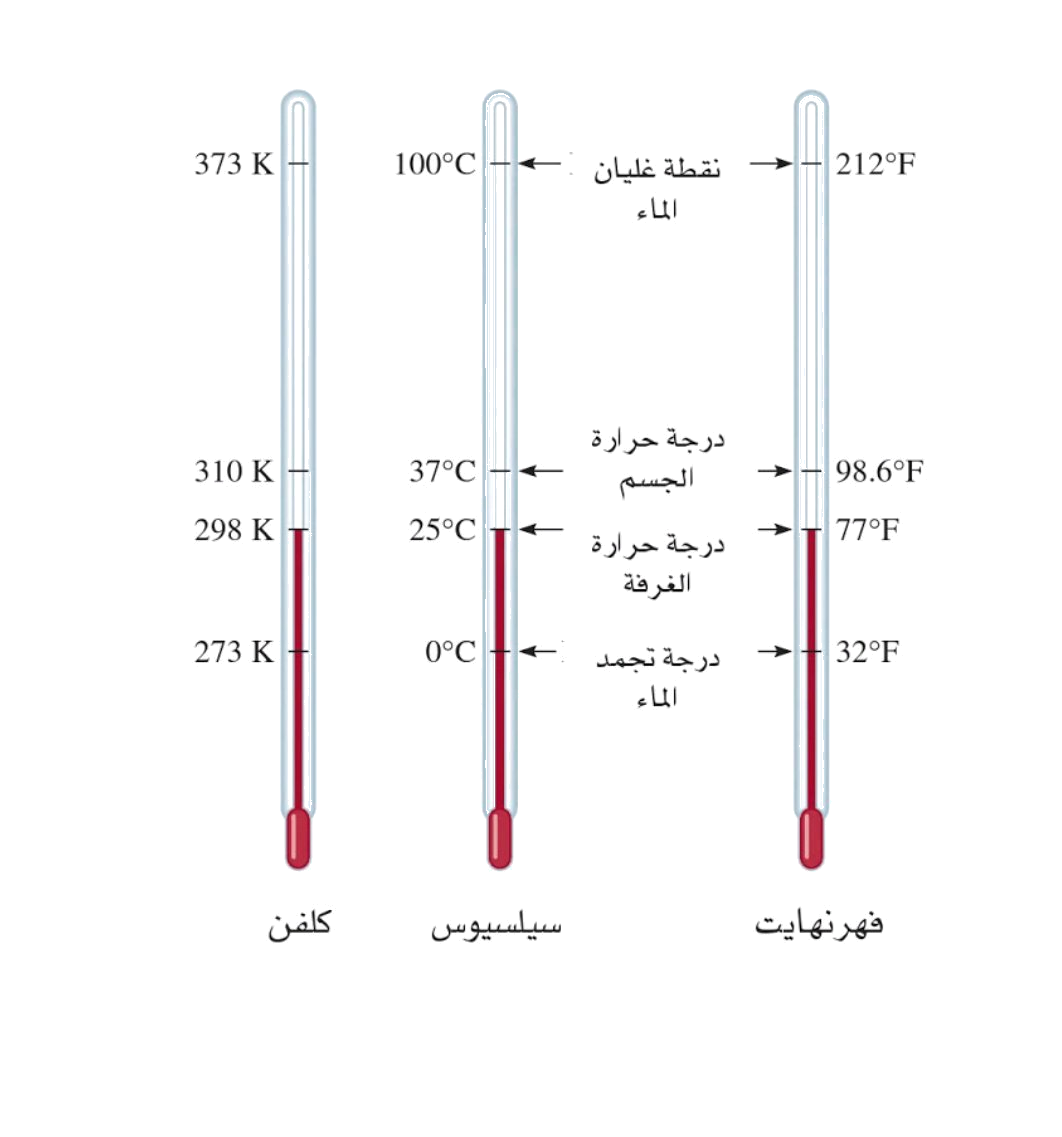
ثلاثة أجسام لها درجات الحرارة \(T_A=-40^{\circ}C\) و\(T_B=-40^{\circ}F\) و\(T_C=-40\,K\). أيها أعلى درجة حرارة؟Three objects have temperatures \(T_A=-40^{\circ}C\), \(T_B=-40^{\circ}F\) and \(T_C=-40\,K\). Which has the highest temperature?
الجسم Cobject C
الجسم Bobject B
الجسمان A وB (متساويان)objects A and B (equal)
الجسم Aobject A
الحلSolution
\(T_B=\dfrac{5}{9}(-40-32)=-40^{\circ}C\) فالجسمان A وB لهما الدرجة نفسها (التقاء المقياسين عند \(-40\)).
\(T_C=-40-273=-313^{\circ}C\) وهي أقل بكثير.
✅ الجسمان A وB (متساويان) (C)
\(T_B=\dfrac{5}{9}(-40-32)=-40^{\circ}C\) so A and B have the same temperature (the two scales meet at \(-40\)).
\(T_C=-40-273=-313^{\circ}C\) which is much lower.
✅ objects A and B (equal) (C)
\[8\,\star\star\]
كأس فيه ماء كتلته \(0.4\,kg\) ودرجة حرارته \(25^{\circ}C\) أُضيف إلى كأس آخر فيه ماء كتلته \(0.4\,kg\) ودرجة حرارته \(25^{\circ}C\) (دون فقد حرارة). درجة حرارة المزيج:A cup containing \(0.4\,kg\) of water at \(25^{\circ}C\) is poured into another cup containing \(0.4\,kg\) of water at \(25^{\circ}C\) (no heat loss). The temperature of the mixture is:
\(T_f=25^{\circ}C\)\(T_f=25^{\circ}C\)
\(T_f=52.6^{\circ}C\)\(T_f=52.6^{\circ}C\)
\(T_f=35.4^{\circ}C\)\(T_f=35.4^{\circ}C\)
\(T_f=40.8^{\circ}C\)\(T_f=40.8^{\circ}C\)
الحلSolution
📌 الماءان في درجة الحرارة نفسها فهما في اتزان حراري ولا ينتقل بينهما صافي طاقة: \(T_f=\dfrac{m_1T_1+m_2T_2}{m_1+m_2}=25^{\circ}C\).
✅ \(T_f=25^{\circ}C\) (A)
📌 The two waters are at the same temperature so they are in thermal equilibrium and there is no net energy transfer: \(T_f=\dfrac{m_1T_1+m_2T_2}{m_1+m_2}=25^{\circ}C\).
✅ \(T_f=25^{\circ}C\) (A)
\[9\,\star\]
في حالة الاتزان الحراري بين جسمين (دون فقد للطاقة) يكون معدل تدفق الطاقة بينهما:At thermal equilibrium between two bodies (no energy loss) the rate of energy flow between them is:
متساويًا في الاتجاهين (الصافي صفر)equal in the two directions (the net is zero)
أكبر باتجاه الجسم الباردgreater toward the cold body
أكبر باتجاه الجسم الساخنgreater toward the hot body
لا يمكن تحديده دون معرفة السعتين الحراريتينimpossible to decide without knowing the heat capacities
الحلSolution
📌 درجتا الحرارة متساويتان فمعدل انتقال الطاقة في أحد الاتجاهين يساوي معدلها في الاتجاه الآخر ولا يوجد تدفق صافٍ.
✅ متساويًا في الاتجاهين (الصافي صفر) (A)
📌 The temperatures are equal so the rate of energy transfer in one direction equals that in the other and there is no net flow.
✅ equal in the two directions (the net is zero) (A)
\[10\,\star\star\]
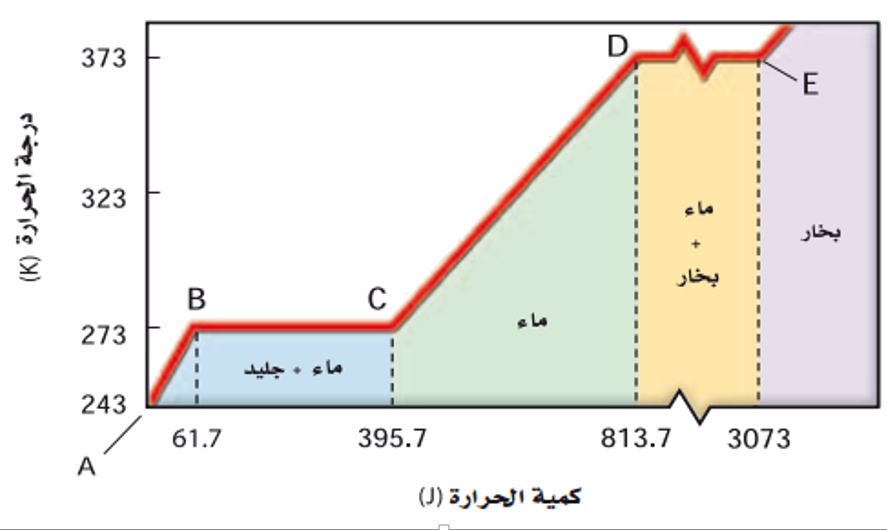
يبين الشكل منحنى الكمية الحرارية ودرجة الحرارة لجسم كتلته \(0.001\,kg\) سُخّن (من جليد إلى بخار). الحرارة الكامنة للانصهار:The figure shows the heat and temperature curve of an object of mass \(0.001\,kg\) that is heated (ice to steam). The latent heat of fusion is:
\(H_f=5.264\times10^{5}\,J/kg\)\(H_f=5.264\times10^{5}\,J/kg\)
\(H_f=6.67\times10^{4}\,J/kg\)\(H_f=6.67\times10^{4}\,J/kg\)
\(H_f=6.28\times10^{4}\,J/kg\)\(H_f=6.28\times10^{4}\,J/kg\)
\(H_f=3.34\times10^{5}\,J/kg\)\(H_f=3.34\times10^{5}\,J/kg\)
الحلSolution
📌 مرحلة الانصهار هي الجزء الأفقي \(B\Rightarrow C\) (الحرارة من \(61.7\) إلى \(395.7\,J\)) فتكون الطاقة المضافة \(Q=395.7-61.7=334\,J\).
\(H_f=\dfrac{Q}{m}=\dfrac{334}{0.001}=3.34\times10^{5}\,J/kg\).
✅ \(H_f=3.34\times10^{5}\,J/kg\) (D)
📌 The melting stage is the horizontal part \(B\Rightarrow C\) (the heat goes from \(61.7\) to \(395.7\,J\)) so the added energy is \(Q=395.7-61.7=334\,J\).
\(H_f=\dfrac{Q}{m}=\dfrac{334}{0.001}=3.34\times10^{5}\,J/kg\).
✅ \(H_f=3.34\times10^{5}\,J/kg\) (D)
\[11\,\star\]
أُعطيت كميات متساوية من مواد الطاقة الحرارية نفسها، والحرارة النوعية لها: الألمنيوم \(897\)، النحاس الأصفر \(376\)، الكربون \(710\)، النحاس \(385\) (\(J/(kg\cdot K)\)). أي منها ترتفع حرارته أكثر وتبرد أسرع؟Equal amounts of materials are given the same thermal energy; their specific heats are: aluminium \(897\), brass \(376\), carbon \(710\), copper \(385\) (\(J/(kg\cdot K)\)). Which one warms the most and also cools fastest?
النحاس الأصفرbrass
الألمنيومaluminium
الكربونcarbon
النحاسcopper
الحلSolution
\(\Delta T=\dfrac{Q}{mC_p}\): لنفس \(Q\) و\(m\) يكون التغير في درجة الحرارة أكبر للمادة الأصغر حرارة نوعية.
📌 أصغر قيمة هي \(376\) للنحاس الأصفر، فهو أيضًا يبرد أسرع عند فقد الطاقة نفسها.
✅ النحاس الأصفر (A)
\(\Delta T=\dfrac{Q}{mC_p}\): for the same \(Q\) and \(m\) the change in temperature is larger for the material with the smaller specific heat.
📌 The smallest value is \(376\) for brass, which also cools fastest when it loses the same energy.
✅ brass (A)
\[12\,\star\star\star\]
قطعة معدن كتلتها \(0.025\,kg\) عند \(90^{\circ}C\) أُضيفت إلى ماء كتلته \(0.05\,kg\) عند \(25^{\circ}C\) فاستقر المزيج عند \(29.8^{\circ}C\) (\(C_{water}=4200\,J/(kg\cdot K)\)). الحرارة النوعية للمعدن:A metal piece of mass \(0.025\,kg\) at \(90^{\circ}C\) is added to water of mass \(0.05\,kg\) at \(25^{\circ}C\) and the mixture settles at \(29.8^{\circ}C\) (\(C_{water}=4200\,J/(kg\cdot K)\)). The specific heat of the metal is:
\(C_p=840\,J/(kg\cdot K)\)\(C_p=840\,J/(kg\cdot K)\)
\(C_p=670\,J/(kg\cdot K)\)\(C_p=670\,J/(kg\cdot K)\)
\(C_p=468\,J/(kg\cdot K)\)\(C_p=468\,J/(kg\cdot K)\)
\(C_p=920\,J/(kg\cdot K)\)\(C_p=920\,J/(kg\cdot K)\)
الحلSolution
📌 الحرارة المفقودة من المعدن = الحرارة المكتسبة للماء: \(0.025\,C\,(90-29.8)=0.05\times4200\times(29.8-25)\).
\(1.505\,C=1008\Rightarrow C=670\,J/(kg\cdot K)\).
✅ \(C_p=670\,J/(kg\cdot K)\) (B)
📌 Heat lost by the metal = heat gained by the water: \(0.025\,C\,(90-29.8)=0.05\times4200\times(29.8-25)\).
\(1.505\,C=1008\Rightarrow C=670\,J/(kg\cdot K)\).
✅ \(C_p=670\,J/(kg\cdot K)\) (B)
\[13\,\star\]
الطاقة اللازمة لصهر \(0.5\,kg\) من الجليد عند \(0^{\circ}C\) (\(H_f=3.34\times10^{5}\,J/kg\)):The energy needed to melt \(0.5\,kg\) of ice at \(0^{\circ}C\) (\(H_f=3.34\times10^{5}\,J/kg\)) is:
\(Q=5.34\times10^{5}\,J\)\(Q=5.34\times10^{5}\,J\)
\(Q=6.68\times10^{5}\,J\)\(Q=6.68\times10^{5}\,J\)
\(Q=4.25\times10^{5}\,J\)\(Q=4.25\times10^{5}\,J\)
\(Q=1.67\times10^{5}\,J\)\(Q=1.67\times10^{5}\,J\)
الحلSolution
\(Q=mH_f=0.5\times3.34\times10^{5}=1.67\times10^{5}\,J\).
✅ \(Q=1.67\times10^{5}\,J\) (D)
\(Q=mH_f=0.5\times3.34\times10^{5}=1.67\times10^{5}\,J\).
✅ \(Q=1.67\times10^{5}\,J\) (D)
\[14\,\star\star\]
تحتاج مادة إلى طاقة \(Q=0.8\times10^{6}\,J\) لتحويل \(3\,kg\) منها من الصلب إلى السائل. أي مادة هي (حسب الحرارة الكامنة للانصهار)؟A substance needs \(Q=0.8\times10^{6}\,J\) to convert \(3\,kg\) of it from solid to liquid. Which substance is it (by its latent heat of fusion)?
الزئبق \(H_f=1.15\times10^{4}\,J/kg\)mercury \(H_f=1.15\times10^{4}\,J/kg\)
الحديد \(H_f=2.66\times10^{5}\,J/kg\)iron \(H_f=2.66\times10^{5}\,J/kg\)
الذهب \(H_f=6.3\times10^{4}\,J/kg\)gold \(H_f=6.3\times10^{4}\,J/kg\)
الميتانول \(H_f=1.09\times10^{5}\,J/kg\)methanol \(H_f=1.09\times10^{5}\,J/kg\)
الحلSolution
\(H_f=\dfrac{Q}{m}=\dfrac{0.8\times10^{6}}{3}=2.67\times10^{5}\,J/kg\) وهي أقرب إلى قيمة الحديد.
✅ الحديد \(H_f=2.66\times10^{5}\,J/kg\) (B)
\(H_f=\dfrac{Q}{m}=\dfrac{0.8\times10^{6}}{3}=2.67\times10^{5}\,J/kg\) which is closest to iron.
✅ iron \(H_f=2.66\times10^{5}\,J/kg\) (B)
\[15\,\star\star\]
قطعة ثلج كتلتها \(0.02\,kg\) عند \(-40^{\circ}C\) تُحوَّل إلى ماء عند \(40^{\circ}C\) (\(H_f=3.34\times10^{5}\)، \(C_{ice}=2000\)، \(C_{water}=4200\)). الطاقة اللازمة:An ice cube of mass \(0.02\,kg\) at \(-40^{\circ}C\) is converted to water at \(40^{\circ}C\) (\(H_f=3.34\times10^{5}\), \(C_{ice}=2000\), \(C_{water}=4200\)). The energy needed is:
\(Q=12463\,J\)\(Q=12463\,J\)
\(Q=54722\,J\)\(Q=54722\,J\)
\(Q=11640\,J\)\(Q=11640\,J\)
\(Q=14520\,J\)\(Q=14520\,J\)
الحلSolution
\(Q_1=0.02\times2000\times40=1600\,J\) (تسخين الجليد)،
\(Q_2=0.02\times3.34\times10^{5}=6680\,J\) (الانصهار)،
\(Q_3=0.02\times4200\times40=3360\,J\) (تسخين الماء) والمجموع \(11\,640\,J\).
✅ \(Q=11640\,J\) (C)
\(Q_1=0.02\times2000\times40=1600\,J\) (warming the ice),
\(Q_2=0.02\times3.34\times10^{5}=6680\,J\) (melting),
\(Q_3=0.02\times4200\times40=3360\,J\) (warming the water) and the total is \(11\,640\,J\).
✅ \(Q=11640\,J\) (C)
\[16\,\star\star\star\]
وعاء ألمنيوم كتلته \(0.5\,kg\) فيه ماء كتلته \(0.2\,kg\) سُخّنا معًا من \(20^{\circ}C\) إلى \(60^{\circ}C\) (\(C_{Al}=900\)، \(C_{water}=4200\,J/(kg\cdot K)\)). الطاقة المطلوبة:An aluminium container of mass \(0.5\,kg\) holding \(0.2\,kg\) of water is heated from \(20^{\circ}C\) to \(60^{\circ}C\) (\(C_{Al}=900\), \(C_{water}=4200\,J/(kg\cdot K)\)). The energy required is:
\(Q=33600\,J\)\(Q=33600\,J\)
\(Q=18000\,J\)\(Q=18000\,J\)
\(Q=51600\,J\)\(Q=51600\,J\)
\(Q=27300\,J\)\(Q=27300\,J\)
الحلSolution
\(Q_{Al}=0.5\times900\times40=18\,000\,J\) و\(Q_{water}=0.2\times4200\times40=33\,600\,J\).
\(Q=18\,000+33\,600=51\,600\,J\).
✅ \(Q=51600\,J\) (C)
\(Q_{Al}=0.5\times900\times40=18\,000\,J\) and \(Q_{water}=0.2\times4200\times40=33\,600\,J\).
\(Q=18\,000+33\,600=51\,600\,J\).
✅ \(Q=51600\,J\) (C)
\[17\,\star\star\star\]
قطعتا جليد كتلة كل منهما \(15\,g\) عند \(0^{\circ}C\) وُضعتا في كوب فيه ماء كتلته \(0.3\,kg\) عند \(20^{\circ}C\) (دون فقد حرارة). درجة حرارة المزيج النهائية (\(H_f=3.34\times10^{5}\)، \(C_{water}=4200\)):Two ice cubes of mass \(15\,g\) each at \(0^{\circ}C\) are placed in a cup holding \(0.3\,kg\) of water at \(20^{\circ}C\) (no heat loss). The final temperature of the mixture (\(H_f=3.34\times10^{5}\), \(C_{water}=4200\)) is:
\(T_f=9.15^{\circ}C\)\(T_f=9.15^{\circ}C\)
\(T_f=13.7^{\circ}C\)\(T_f=13.7^{\circ}C\)
\(T_f=7.6^{\circ}C\)\(T_f=7.6^{\circ}C\)
\(T_f=10.95^{\circ}C\)\(T_f=10.95^{\circ}C\)
الحلSolution
📌 كتلة الجليد \(0.03\,kg\): الماء يفقد عند تبريده إلى الصفر \(0.3\times4200\times20=25\,200\,J\) والجليد يحتاج للانصهار \(0.03\times3.34\times10^{5}=10\,020\,J\) فيذوب كله.
📌 الباقي \(15\,180\,J\) يوزع على كتلة \(0.33\,kg\): \(\Delta T=\dfrac{15\,180}{0.33\times4200}=10.95^{\circ}C\).
✅ \(T_f=10.95^{\circ}C\) (D)
📌 The ice has mass \(0.03\,kg\): cooling the water to zero releases \(0.3\times4200\times20=25\,200\,J\) while the ice needs \(0.03\times3.34\times10^{5}=10\,020\,J\) to melt, so it all melts.
📌 The remaining \(15\,180\,J\) is shared by \(0.33\,kg\): \(\Delta T=\dfrac{15\,180}{0.33\times4200}=10.95^{\circ}C\).
✅ \(T_f=10.95^{\circ}C\) (D)
\[18\,\star\star\]
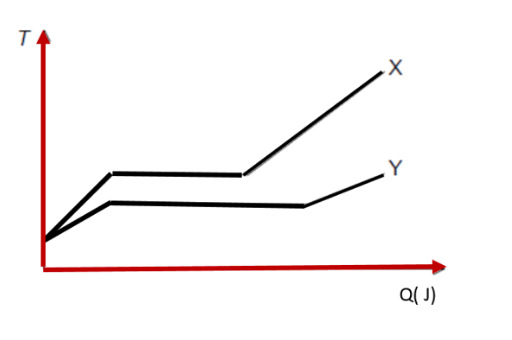
عينتان X وY من الكتلة نفسها صلبتان عند الدرجة نفسها أُعطيتا طاقة حرارية ورُسم منحنى درجة الحرارة مع الطاقة (الشكل). أي الخيارات تحقق معلومات الرسم؟Two solid samples X and Y of the same mass at the same temperature are given thermal energy and the graph of temperature against energy is drawn (figure). Which option agrees with the graph?
\(C_X\gt C_Y\) و\(H_{fY}\gt H_{fX}\)\(C_X\gt C_Y\) and \(H_{fY}\gt H_{fX}\)
\(C_X\gt C_Y\) و\(H_{fX}\gt H_{fY}\)\(C_X\gt C_Y\) and \(H_{fX}\gt H_{fY}\)
\(C_Y\gt C_X\) و\(H_{fX}\gt H_{fY}\)\(C_Y\gt C_X\) and \(H_{fX}\gt H_{fY}\)
\(C_Y\gt C_X\) و\(H_{fY}\gt H_{fX}\)\(C_Y\gt C_X\) and \(H_{fY}\gt H_{fX}\)
الحلSolution
📌 ميل الجزء الصلب في منحنى \(T\)–\(Q\) يساوي \(\dfrac{1}{mC}\): الميل الأكبر (للمادة X) يعني حرارة نوعية أصغر، فـ \(C_Y\gt C_X\).
📌 طول الجزء الأفقي (الانصهار) يساوي \(mH_f\): هو أطول للمادة Y فـ \(H_{fY}\gt H_{fX}\).
✅ \(C_Y\gt C_X\) و\(H_{fY}\gt H_{fX}\) (D)
📌 The slope of the solid part of a \(T\)–\(Q\) graph is \(\dfrac{1}{mC}\): the steeper slope (material X) means a smaller specific heat, so \(C_Y\gt C_X\).
📌 The length of the horizontal part (melting) equals \(mH_f\): it is longer for Y so \(H_{fY}\gt H_{fX}\).
✅ \(C_Y\gt C_X\) and \(H_{fY}\gt H_{fX}\) (D)
\[19\,\star\]
أي العبارات التالية غير صحيحة فيما يتعلق بالحرارة؟Which of the following statements about heat is NOT correct?
الحرارة شكل من أشكال الطاقةheat is a form of energy
تنتقل الحرارة من البارد إلى الساخن من تلقاء نفسها دون شغلheat flows from cold to hot by itself without work
تنتقل الحرارة من الساخن إلى الباردheat flows from hot to cold
الحرارة تجعل الجزيئات تتحرك أسرعheat makes the molecules move faster
الحلSolution
📌 تنتقل الحرارة تلقائيًا من الأعلى إلى الأقل درجة حرارة (القانون الثاني للديناميكا الحرارية).
📌 انتقالها من البارد إلى الساخن يحتاج شغلًا خارجيًا كما في الثلاجة والمكيف.
✅ تنتقل الحرارة من البارد إلى الساخن من تلقاء نفسها دون شغل (B)
📌 Heat flows spontaneously from the higher to the lower temperature (the second law of thermodynamics).
📌 Flow from cold to hot needs external work, as in a refrigerator or an air conditioner.
✅ heat flows from cold to hot by itself without work (B)
\[20\,\star\star\]
قطعة من رقائق الألمنيوم كتلتها \(50\,g\) بردت من \(100^{\circ}C\) إلى \(30^{\circ}C\) (\(C_{Al}=900\,J/(kg\cdot K)\)). الطاقة الحرارية المفقودة (بإشارتها):A piece of aluminium foil of mass \(50\,g\) cools from \(100^{\circ}C\) to \(30^{\circ}C\) (\(C_{Al}=900\,J/(kg\cdot K)\)). The thermal energy lost (with its sign) is:
\(Q=-1900\,J\)\(Q=-1900\,J\)
\(Q=-1650\,J\)\(Q=-1650\,J\)
\(Q=-3150\,J\)\(Q=-3150\,J\)
\(Q=-2550\,J\)\(Q=-2550\,J\)
الحلSolution
\(Q=mC_p\Delta T=0.05\times900\times(30-100)=-3150\,J\) (السالب يعني فقدان حرارة).
✅ \(Q=-3150\,J\) (C)
\(Q=mC_p\Delta T=0.05\times900\times(30-100)=-3150\,J\) (negative means heat is lost).
✅ \(Q=-3150\,J\) (C)
\[21\,\star\]
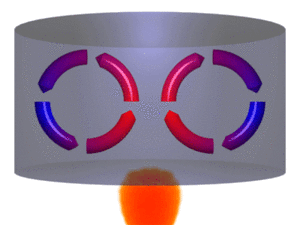
يرتفع الهواء الدافئ إلى أعلى ويحل محله الهواء البارد. هذا النمط من انتقال الحرارة يسمى:Warm air rises and cool air takes its place. This mode of heat transfer is called:
الحملconvection
التوصيلconduction
الإشعاعradiation
الاتزانequilibrium
الحلSolution
📌 الحمل انتقال للحرارة بحركة المائع (سائل أو غاز): يخف الهواء الدافئ فيرتفع ويهبط الأبرد الأكثف مكوّنًا تيارات حمل.
✅ الحمل (A)
📌 Convection is heat transfer by the motion of a fluid (liquid or gas): warm air becomes less dense and rises while the cooler, denser air sinks, forming convection currents.
✅ convection (A)
\[22\,\star\star\]
أنبوب نحاسي كتلته \(5\,kg\) ارتفعت درجة حرارته مع الماء من \(20^{\circ}C\) إلى \(85^{\circ}C\) (\(C_{Cu}=385\,J/(kg\cdot K)\)). الطاقة التي اكتسبها الأنبوب:A copper pipe of mass \(5\,kg\) warms with the water from \(20^{\circ}C\) to \(85^{\circ}C\) (\(C_{Cu}=385\,J/(kg\cdot K)\)). The energy gained by the pipe is:
\(Q=323\,425\,J\)\(Q=323\,425\,J\)
\(Q=565\,342\,J\)\(Q=565\,342\,J\)
\(Q=125\,125\,J\)\(Q=125\,125\,J\)
\(Q=314\,227\,J\)\(Q=314\,227\,J\)
الحلSolution
\(Q=5\times385\times(85-20)=125\,125\,J\).
✅ \(Q=125\,125\,J\) (C)
\(Q=5\times385\times(85-20)=125\,125\,J\).
✅ \(Q=125\,125\,J\) (C)
\[23\,\star\]
درجة حرارة مريض \(40^{\circ}C\). ما تكافؤها بمقياس فهرنهايت؟A patient's temperature is \(40^{\circ}C\). What is it on the Fahrenheit scale?
\(T=104^{\circ}F\)\(T=104^{\circ}F\)
\(T=92^{\circ}F\)\(T=92^{\circ}F\)
\(T=180^{\circ}F\)\(T=180^{\circ}F\)
\(T=72^{\circ}F\)\(T=72^{\circ}F\)
الحلSolution
\(T_F=\dfrac{9}{5}T_C+32=\dfrac{9}{5}(40)+32=104^{\circ}F\).
✅ \(T=104^{\circ}F\) (A)
\(T_F=\dfrac{9}{5}T_C+32=\dfrac{9}{5}(40)+32=104^{\circ}F\).
✅ \(T=104^{\circ}F\) (A)
\[24\,\star\]
درجة الحرارة \(25^{\circ}C\) تساوي بالكلفن:A temperature of \(25^{\circ}C\) equals, in kelvin:
\(248\,K\)\(248\,K\)
\(25\,K\)\(25\,K\)
\(-248\,K\)\(-248\,K\)
\(298\,K\)\(298\,K\)
الحلSolution
\(T_K=25+273=298\,K\).
✅ \(298\,K\) (D)
\(T_K=25+273=298\,K\).
✅ \(298\,K\) (D)
\[25\,\star\]
تغير درجة الحرارة بمقدار \(10^{\circ}C\) يكافئ تغيرًا بالكلفن مقداره:A change of \(10^{\circ}C\) in temperature corresponds to a change in kelvin of:
\(10\,K\)\(10\,K\)
\(283\,K\)\(283\,K\)
\(263\,K\)\(263\,K\)
\(18\,K\)\(18\,K\)
الحلSolution
📌 وحدة الدرجة السيلسيوسية تساوي وحدة الكلفن (يختلف الصفر فقط) فالفرق في الدرجات واحد: \(\Delta T_K=\Delta T_C=10\).
✅ \(10\,K\) (A)
📌 The Celsius degree and the kelvin are the same size (only the zero differs), so a temperature difference is the same number: \(\Delta T_K=\Delta T_C=10\).
✅ \(10\,K\) (A)
\[26\,\star\star\]
سُخّن \(2\,kg\) من الماء من \(20^{\circ}C\) إلى \(50^{\circ}C\) (\(C=4200\,J/(kg\cdot K)\)). الطاقة المكتسبة:A mass of \(2\,kg\) of water is heated from \(20^{\circ}C\) to \(50^{\circ}C\) (\(C=4200\,J/(kg\cdot K)\)). The energy gained is:
\(4.2\times10^{3}\,J\)\(4.2\times10^{3}\,J\)
\(8.4\times10^{3}\,J\)\(8.4\times10^{3}\,J\)
\(1.26\times10^{5}\,J\)\(1.26\times10^{5}\,J\)
\(2.52\times10^{5}\,J\)\(2.52\times10^{5}\,J\)
الحلSolution
\(Q=mC\Delta T=2\times4200\times30=2.52\times10^{5}\,J\).
✅ \(2.52\times10^{5}\,J\) (D)
\(Q=mC\Delta T=2\times4200\times30=2.52\times10^{5}\,J\).
✅ \(2.52\times10^{5}\,J\) (D)
\[27\,\star\star\]
جسم كتلته \(0.5\,kg\) اكتسب \(9000\,J\) فارتفعت حرارته \(40\,K\). حرارته النوعية:A body of mass \(0.5\,kg\) gains \(9000\,J\) and its temperature rises by \(40\,K\). Its specific heat is:
\(225\,J/(kg\cdot K)\)\(225\,J/(kg\cdot K)\)
\(450\,J/(kg\cdot K)\)\(450\,J/(kg\cdot K)\)
\(900\,J/(kg\cdot K)\)\(900\,J/(kg\cdot K)\)
\(180\,J/(kg\cdot K)\)\(180\,J/(kg\cdot K)\)
الحلSolution
\(C=\dfrac{Q}{m\Delta T}=\dfrac{9000}{0.5\times40}=450\,J/(kg\cdot K)\).
✅ \(450\,J/(kg\cdot K)\) (B)
\(C=\dfrac{Q}{m\Delta T}=\dfrac{9000}{0.5\times40}=450\,J/(kg\cdot K)\).
✅ \(450\,J/(kg\cdot K)\) (B)
\[28\,\star\star\]
السعة الحرارية \(mC\) لجسم كتلته \(0.2\,kg\) وحرارته النوعية \(900\,J/(kg\cdot K)\) تساوي:The heat capacity \(mC\) of a body of mass \(0.2\,kg\) and specific heat \(900\,J/(kg\cdot K)\) is:
\(4500\,J/K\)\(4500\,J/K\)
\(180\,J/K\)\(180\,J/K\)
\(1800\,J/K\)\(1800\,J/K\)
\(0.18\,J/K\)\(0.18\,J/K\)
الحلSolution
\(mC=0.2\times900=180\,J/K\) أي الطاقة اللازمة لرفع درجة حرارة الجسم كله \(1\,K\).
✅ \(180\,J/K\) (B)
\(mC=0.2\times900=180\,J/K\), i.e. the energy needed to raise the temperature of the whole body by \(1\,K\).
✅ \(180\,J/K\) (B)
\[29\,\star\star\star\]
مُزج \(0.2\,kg\) ماء عند \(80^{\circ}C\) مع \(0.3\,kg\) ماء عند \(20^{\circ}C\) (دون فقد حرارة). درجة حرارة المزيج:A mass of \(0.2\,kg\) of water at \(80^{\circ}C\) is mixed with \(0.3\,kg\) of water at \(20^{\circ}C\) (no heat loss). The temperature of the mixture is:
\(44^{\circ}C\)\(44^{\circ}C\)
\(50^{\circ}C\)\(50^{\circ}C\)
\(56^{\circ}C\)\(56^{\circ}C\)
\(38^{\circ}C\)\(38^{\circ}C\)
الحلSolution
📌 الحرارة المفقودة = المكتسبة: \(0.2(80-T)=0.3(T-20)\).
\(16-0.2T=0.3T-6\Rightarrow T=\dfrac{22}{0.5}=44^{\circ}C\).
✅ \(44^{\circ}C\) (A)
📌 Heat lost = heat gained: \(0.2(80-T)=0.3(T-20)\).
\(16-0.2T=0.3T-6\Rightarrow T=\dfrac{22}{0.5}=44^{\circ}C\).
✅ \(44^{\circ}C\) (A)
\[30\,\star\star\]
تبخير \(0.1\,kg\) من الماء عند \(100^{\circ}C\) يلزمه (\(L_v=2.26\times10^{6}\,J/kg\)):Evaporating \(0.1\,kg\) of water at \(100^{\circ}C\) requires (\(L_v=2.26\times10^{6}\,J/kg\)):
\(2.26\times10^{7}\,J\)\(2.26\times10^{7}\,J\)
\(2.26\times10^{4}\,J\)\(2.26\times10^{4}\,J\)
\(2.26\times10^{5}\,J\)\(2.26\times10^{5}\,J\)
\(4.2\times10^{4}\,J\)\(4.2\times10^{4}\,J\)
الحلSolution
\(Q=mL_v=0.1\times2.26\times10^{6}=2.26\times10^{5}\,J\) ودرجة الحرارة ثابتة أثناء التبخر.
✅ \(2.26\times10^{5}\,J\) (C)
\(Q=mL_v=0.1\times2.26\times10^{6}=2.26\times10^{5}\,J\) while the temperature stays constant during vaporization.
✅ \(2.26\times10^{5}\,J\) (C)
\[31\,\star\star\]
الطاقة اللازمة لصهر \(2\,kg\) من الجليد عند \(0^{\circ}C\) (\(H_f=3.34\times10^{5}\,J/kg\)):The energy needed to melt \(2\,kg\) of ice at \(0^{\circ}C\) (\(H_f=3.34\times10^{5}\,J/kg\)) is:
\(1.67\times10^{5}\,J\)\(1.67\times10^{5}\,J\)
\(3.34\times10^{5}\,J\)\(3.34\times10^{5}\,J\)
\(6.68\times10^{5}\,J\)\(6.68\times10^{5}\,J\)
\(1.67\times10^{6}\,J\)\(1.67\times10^{6}\,J\)
الحلSolution
\(Q=2\times3.34\times10^{5}=6.68\times10^{5}\,J\).
✅ \(6.68\times10^{5}\,J\) (C)
\(Q=2\times3.34\times10^{5}=6.68\times10^{5}\,J\).
✅ \(6.68\times10^{5}\,J\) (C)
\[32\,\star\star\star\]
تحويل \(0.1\,kg\) من الجليد عند \(0^{\circ}C\) إلى ماء عند \(20^{\circ}C\) يتطلب (\(H_f=3.34\times10^{5}\)، \(C=4200\)):Converting \(0.1\,kg\) of ice at \(0^{\circ}C\) into water at \(20^{\circ}C\) requires (\(H_f=3.34\times10^{5}\), \(C=4200\)):
\(33\,400\,J\)\(33\,400\,J\)
\(41\,800\,J\)\(41\,800\,J\)
\(8400\,J\)\(8400\,J\)
\(50\,200\,J\)\(50\,200\,J\)
الحلSolution
\(Q_{melt}=0.1\times3.34\times10^{5}=33\,400\,J\) ثم \(Q_{warm}=0.1\times4200\times20=8400\,J\).
\(Q=33\,400+8400=41\,800\,J\).
✅ \(41\,800\,J\) (B)
\(Q_{melt}=0.1\times3.34\times10^{5}=33\,400\,J\) then \(Q_{warm}=0.1\times4200\times20=8400\,J\).
\(Q=33\,400+8400=41\,800\,J\).
✅ \(41\,800\,J\) (B)
\[33\,\star\]
تسخن ملعقة معدنية موضوعة في كوب شاي ساخن عند طرفها الآخر بطريقة:A metal spoon standing in a cup of hot tea becomes hot at its other end by:
الحملconvection
التوصيلconduction
الإشعاعradiation
التبخرevaporation
الحلSolution
📌 التوصيل انتقال للحرارة خلال المادة الصلبة بتصادم الجسيمات والإلكترونات الحرة دون انتقال المادة نفسها، والمعادن موصلات جيدة.
✅ التوصيل (B)
📌 Conduction is the transfer of heat through a solid by collisions of particles and free electrons without the material itself moving; metals are good conductors.
✅ conduction (B)
\[34\,\star\]
تصل حرارة الشمس إلى الأرض عبر الفراغ بطريقة:The Sun's heat reaches the Earth through empty space by:
التوصيلconduction
الحملconvection
الاتزانequilibrium
الإشعاعradiation
الحلSolution
📌 الإشعاع انتقال للطاقة بالموجات الكهرومغناطيسية ولا يحتاج وسطًا مادّيًا.
✅ الإشعاع (D)
📌 Radiation is the transfer of energy by electromagnetic waves and needs no material medium.
✅ radiation (D)
\[35\,\star\star\]
أُعطيت كتلتان متساويتان من الماء والألمنيوم الطاقة الحرارية نفسها (\(C_{water}=4200\)، \(C_{Al}=900\)). أيهما ترتفع درجة حرارته أكثر؟Equal masses of water and aluminium are given the same thermal energy (\(C_{water}=4200\), \(C_{Al}=900\)). Which one rises more in temperature?
الماءwater
يرتفعان بالمقدار نفسهthey rise by the same amount
الألمنيومaluminium
لا يرتفع أي منهماneither rises
الحلSolution
\(\Delta T=\dfrac{Q}{mC}\): لـ \(Q\) و\(m\) متساويين تكون \(\Delta T\) أكبر للمادة الأصغر حرارة نوعية (الألمنيوم، أكبر بنحو \(4.7\) مرات).
✅ الألمنيوم (C)
\(\Delta T=\dfrac{Q}{mC}\): for equal \(Q\) and \(m\) the change \(\Delta T\) is larger for the smaller specific heat (aluminium, about \(4.7\) times larger).
✅ aluminium (C)
\[36\,\star\star\star\]
قطعة نحاس كتلتها \(0.1\,kg\) عند \(200^{\circ}C\) سقطت في \(0.5\,kg\) ماء عند \(20^{\circ}C\) (\(C_{Cu}=385\)، \(C_{water}=4200\)). درجة حرارة الاتزان تقريبًا:A copper piece of mass \(0.1\,kg\) at \(200^{\circ}C\) drops into \(0.5\,kg\) of water at \(20^{\circ}C\) (\(C_{Cu}=385\), \(C_{water}=4200\)). The equilibrium temperature is about:
\(110^{\circ}C\)\(110^{\circ}C\)
\(23.2^{\circ}C\)\(23.2^{\circ}C\)
\(45^{\circ}C\)\(45^{\circ}C\)
\(20.0^{\circ}C\)\(20.0^{\circ}C\)
الحلSolution
\(0.1(385)(200-T)=0.5(4200)(T-20)\).
\(7700-38.5T=2100T-42\,000\Rightarrow T=\dfrac{49\,700}{2138.5}=23.2^{\circ}C\).
✅ \(23.2^{\circ}C\) (B)
\(0.1(385)(200-T)=0.5(4200)(T-20)\).
\(7700-38.5T=2100T-42\,000\Rightarrow T=\dfrac{49\,700}{2138.5}=23.2^{\circ}C\).
✅ \(23.2^{\circ}C\) (B)
\[37\,\star\star\star\star\]
يتكثف \(0.05\,kg\) من بخار الماء عند \(100^{\circ}C\) ثم يبرد الماء الناتج إلى \(0^{\circ}C\) (\(L_v=2.26\times10^{6}\)، \(C=4200\)). الطاقة التي يفقدها:A mass of \(0.05\,kg\) of steam at \(100^{\circ}C\) condenses and the water formed cools to \(0^{\circ}C\) (\(L_v=2.26\times10^{6}\), \(C=4200\)). The energy it loses is:
\(1.34\times10^{5}\,J\)\(1.34\times10^{5}\,J\)
\(1.13\times10^{5}\,J\)\(1.13\times10^{5}\,J\)
\(2.1\times10^{4}\,J\)\(2.1\times10^{4}\,J\)
\(2.4\times10^{5}\,J\)\(2.4\times10^{5}\,J\)
الحلSolution
\(Q_{cond}=0.05\times2.26\times10^{6}=1.13\times10^{5}\,J\).
\(Q_{cool}=0.05\times4200\times100=2.1\times10^{4}\,J\) والمجموع \(1.34\times10^{5}\,J\).
✅ \(1.34\times10^{5}\,J\) (A)
\(Q_{cond}=0.05\times2.26\times10^{6}=1.13\times10^{5}\,J\).
\(Q_{cool}=0.05\times4200\times100=2.1\times10^{4}\,J\) and the total is \(1.34\times10^{5}\,J\).
✅ \(1.34\times10^{5}\,J\) (A)
\[38\,\star\star\]
درجة حرارة الجسم الطبيعية \(98.6^{\circ}F\) تكافئ بالسيلسيوس:The normal body temperature \(98.6^{\circ}F\) is equivalent, in Celsius, to:
\(66.6^{\circ}C\)\(66.6^{\circ}C\)
\(37^{\circ}C\)\(37^{\circ}C\)
\(47.0^{\circ}C\)\(47.0^{\circ}C\)
\(25^{\circ}C\)\(25^{\circ}C\)
الحلSolution
\(T_C=\dfrac{5}{9}(T_F-32)=\dfrac{5}{9}(98.6-32)=37^{\circ}C\).
✅ \(37^{\circ}C\) (B)
\(T_C=\dfrac{5}{9}(T_F-32)=\dfrac{5}{9}(98.6-32)=37^{\circ}C\).
✅ \(37^{\circ}C\) (B)
📝 المسائل المقالية
📝 Essay Problems
\[1\,\star\star\star\]
قطعة من الثلج كتلتها \(m=0.02\,kg\) ودرجة حرارتها \(-40^{\circ}C\) يراد تحويلها إلى ماء درجة حرارته \(40^{\circ}C\). (أ) في أي مرحلة تبقى درجة الحرارة ثابتة رغم إعطاء المادة طاقة حرارية؟ (ب) ماذا تسمى الطاقة اللازمة لتحويل مادة من الحالة الصلبة إلى السائلة؟ (ج) أين تُستغل هذه الطاقة؟ (د) احسب الطاقة الحرارية اللازمة لإتمام العملية (\(C_{ice}=2000\,J/(kg\cdot K)\)، \(H_f=3.34\times10^{5}\,J/kg\)، \(C_{water}=4200\,J/(kg\cdot K)\)).An ice cube of mass \(m=0.02\,kg\) at \(-40^{\circ}C\) is to be converted into water at \(40^{\circ}C\). (a) In which stage does the temperature stay constant although thermal energy is added? (b) What is the energy needed to change a substance from solid to liquid called? (c) Where is this energy used? (d) Calculate the thermal energy needed to complete the process (\(C_{ice}=2000\,J/(kg\cdot K)\), \(H_f=3.34\times10^{5}\,J/kg\), \(C_{water}=4200\,J/(kg\cdot K)\)).
.....................................................................
الحلSolution
📌 (أ) أثناء الانصهار عند \(0^{\circ}C\) تبقى الحرارة ثابتة رغم امتصاص الطاقة، لأن المادة تتحول من صلبة إلى سائلة.
📌 (ب) تسمى الحرارة الكامنة للانصهار \(H_f\).
📌 (ج) تُستغل في تحطيم الروابط بين الجزيئات (الشبكة البلورية للثلج) وليس في رفع درجة الحرارة، أي أنها تزيد الطاقة الكامنة للجزيئات لا طاقتها الحركية.
📌 (د) ثلاث مراحل: \(Q_1=mC_{ice}\Delta T=0.02\times2000\times40=1600\,J\) (تسخين الجليد إلى \(0^{\circ}C\))،
\(Q_2=mH_f=0.02\times3.34\times10^{5}=6680\,J\) (الانصهار عند \(0^{\circ}C\))،
\(Q_3=mC_{water}\Delta T=0.02\times4200\times40=3360\,J\) (تسخين الماء إلى \(40^{\circ}C\)).
📌 المجموع \(Q=1600+6680+3360=11\,640\,J\) (وأكبر مرحلة هي الانصهار).
✅ \(Q=11\,640\,J\)
📌 (a) During melting at \(0^{\circ}C\) the temperature stays constant although energy is absorbed, because the substance changes from solid to liquid.
📌 (b) It is called the latent heat of fusion \(H_f\).
📌 (c) It is used to break the bonds between molecules (the crystal lattice of ice) and not to raise the temperature, i.e. it increases the potential energy of the molecules, not their kinetic energy.
📌 (d) Three stages: \(Q_1=mC_{ice}\Delta T=0.02\times2000\times40=1600\,J\) (warming the ice to \(0^{\circ}C\)),
\(Q_2=mH_f=0.02\times3.34\times10^{5}=6680\,J\) (melting at \(0^{\circ}C\)),
\(Q_3=mC_{water}\Delta T=0.02\times4200\times40=3360\,J\) (warming the water to \(40^{\circ}C\)).
📌 The total is \(Q=1600+6680+3360=11\,640\,J\) (the melting stage is the largest).
✅ \(Q=11\,640\,J\)
لاحظت خطأ؟ أو عندك سؤال عن أحد الأسئلة؟ اكتبه بالتعليقات وحدد رقم السؤال بالضبط.
Noticed an error? Or have a question about one of the questions? Write it in the comments and specify the exact question number.