🏹 بنك الأسئلة: الحركة في بعدين
🏹 Question Bank: Motion in Two Dimensions
القذف الأفقي والقذف بزاوية، الإزاحة والسرعة والتسارع للمقذوف، السرعة النسبية، الحركة الدائرية المنتظمة، والتسارع والقوة المركزية
Horizontal and Angled Projectiles, Displacement, Velocity and Acceleration of Projectiles, Relative Velocity, Uniform Circular Motion, and Centripetal Acceleration and Force
⏱️ 23 سؤال اختيار من متعدد بتصحيح فوري، مع حل مفصّل لكل سؤال⏱️ 23 multiple-choice questions with instant feedback and a detailed solution for each
\[1\,\star\]
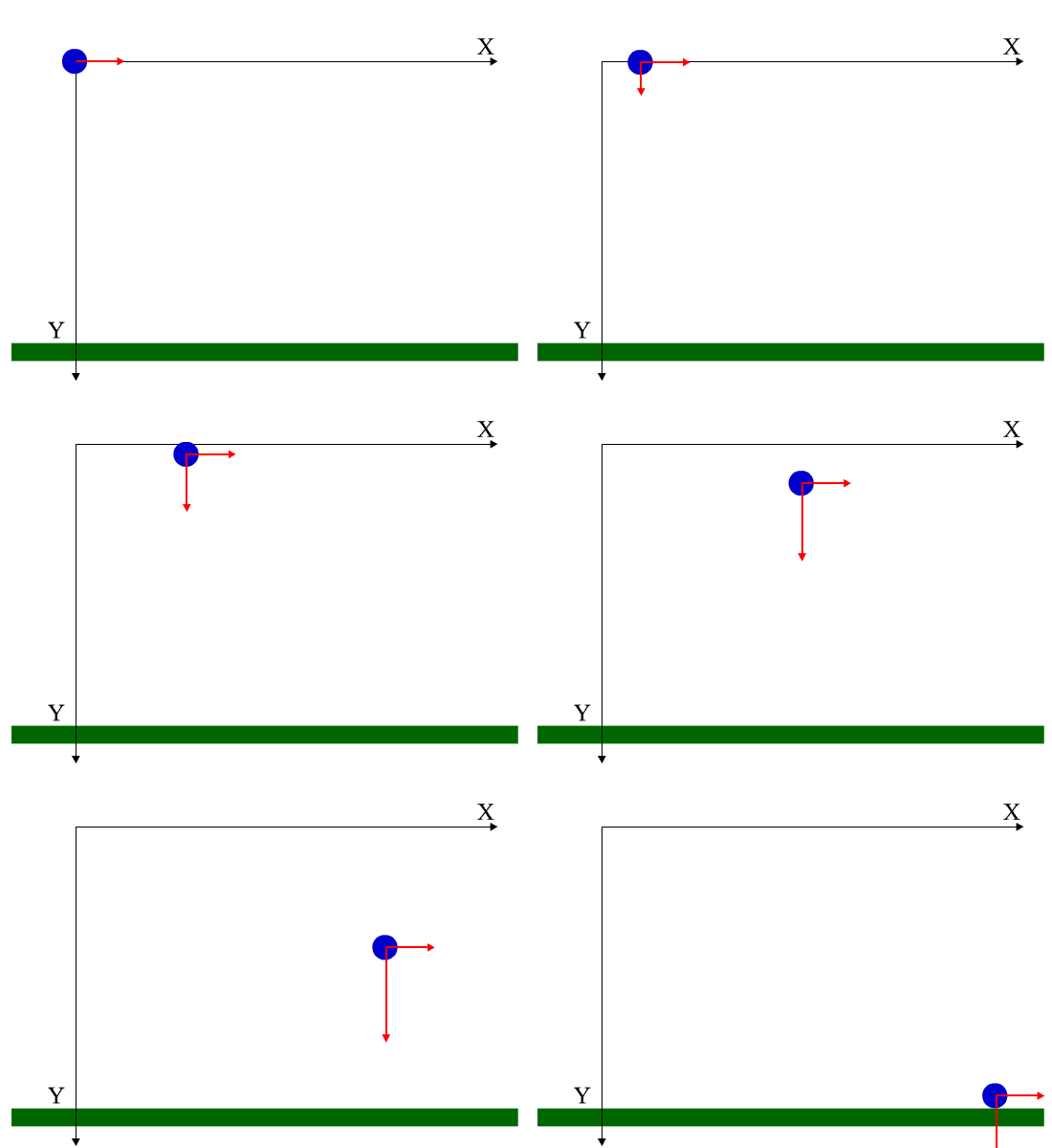
تم قذف كرة بشكل أفقي من سطح مبنى بسرعة أفقية مقدارها \(25\,m/s\)، فإن السرعة الابتدائية للجسم على المحور الأفقي وعلى المحور الرأسي تعادل:A ball is thrown horizontally from the top of a building with a horizontal speed of \(25\,m/s\). The initial velocity components along the horizontal and vertical axes are:
\(v_{0x}=25\,m/s,\ v_{0y}=0\,m/s\)\(v_{0x}=25\,m/s,\ v_{0y}=0\,m/s\)
\(v_{0x}=25\,m/s,\ v_{0y}=25\,m/s\)\(v_{0x}=25\,m/s,\ v_{0y}=25\,m/s\)
\(v_{0x}=12.5\,m/s,\ v_{0y}=12.5\,m/s\)\(v_{0x}=12.5\,m/s,\ v_{0y}=12.5\,m/s\)
\(v_{0x}=0\,m/s,\ v_{0y}=25\,m/s\)\(v_{0x}=0\,m/s,\ v_{0y}=25\,m/s\)
الحلSolution
📌 في القذف الأفقي تكون السرعة الابتدائية كلها أفقية: \(v_{0x}=25\,m/s\).
📌 لا توجد مركبة رأسية ابتدائية: \(v_{0y}=0\) (يبدأ السقوط الحر من السكون رأسيًا).
✅ \(v_{0x}=25\,m/s,\ v_{0y}=0\,m/s\) (A)
📌 In a horizontal launch the entire initial velocity is horizontal: \(v_{0x}=25\,m/s\).
📌 There is no initial vertical component: \(v_{0y}=0\) (the vertical motion starts like free fall from rest).
✅ \(v_{0x}=25\,m/s,\ v_{0y}=0\,m/s\) (A)
\[2\,\star\]
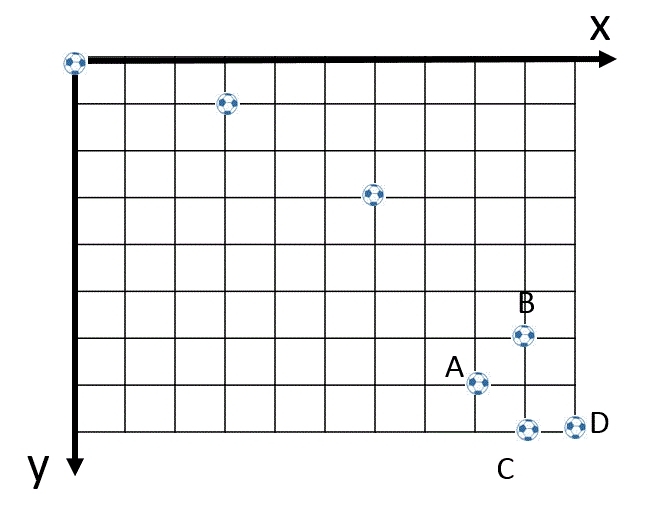
تم قذف كرة أفقيًا والتُقطت صورة للكرة كل \(1\,s\). فإن الموقع الصحيح للكرة بعد \(3\,s\) هو:A ball is thrown horizontally and photographed every \(1\,s\). The correct position of the ball after \(3\,s\) is:
AA
BB
CC
DD
الحلSolution
📌 أفقيًا السرعة ثابتة، فالإزاحة الأفقية تتناسب مع الزمن: الكرة الأولى عند 3 مربعات بعد 1 s فبعد 3 s تكون عند 9 مربعات (النقطتان B وC).
📌 رأسيًا سقوط حر من السكون: \(y=\tfrac12gt^2\propto t^2\)، فتصبح الإزاحة الرأسية بعد 3 s تسعة أضعاف إزاحتها بعد 1 s (نحو 8 مربعات).
📌 الموقع الذي يحقق الشرطين هو C.
✅ C
📌 Horizontally the speed is constant, so horizontal displacement is proportional to time: the first ball is 3 squares across after 1 s, so after 3 s it is 9 squares across (points B and C).
📌 Vertically it is free fall from rest: \(y=\tfrac12gt^2\propto t^2\), so the vertical displacement after 3 s is 9 times that after 1 s (about 8 squares).
📌 The position satisfying both conditions is C.
✅ C
\[3\,\star\]
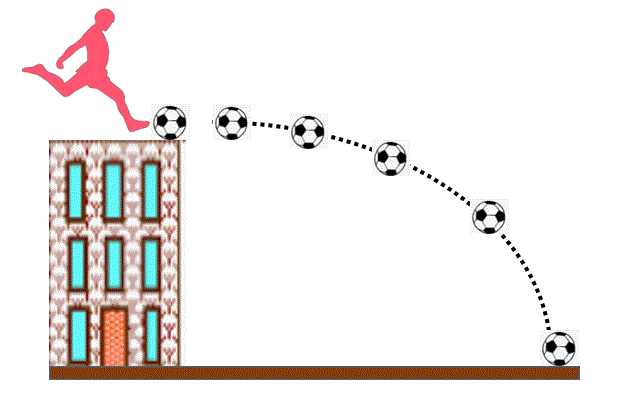
ركل لاعب كرة من سطح مبنى بسرعة أفقية فوصلت الكرة إلى الأرض بعد زمن قدره \(2.3\,s\)، فإن ارتفاع المبنى عن سطح الأرض يعادل (\(g=9.81\,m/s^2\)):A player kicks a ball horizontally from the top of a building and it reaches the ground after \(2.3\,s\). The height of the building is (\(g=9.81\,m/s^2\)):
\(h=32.5\,m\)\(h=32.5\,m\)
\(h=25.9\,m\)\(h=25.9\,m\)
\(h=46.7\,m\)\(h=46.7\,m\)
\(h=18.4\,m\)\(h=18.4\,m\)
الحلSolution
📌 الحركة الرأسية سقوط حر من السكون: \(h=\tfrac12gt^2\).
📌 \(h=\tfrac12\times9.81\times(2.3)^2\approx25.9\,m\).
✅ \(h=25.9\,m\) (B)
📌 The vertical motion is free fall from rest: \(h=\tfrac12gt^2\).
📌 \(h=\tfrac12\times9.81\times(2.3)^2\approx25.9\,m\).
✅ \(h=25.9\,m\) (B)
\[4\,\star\star\]
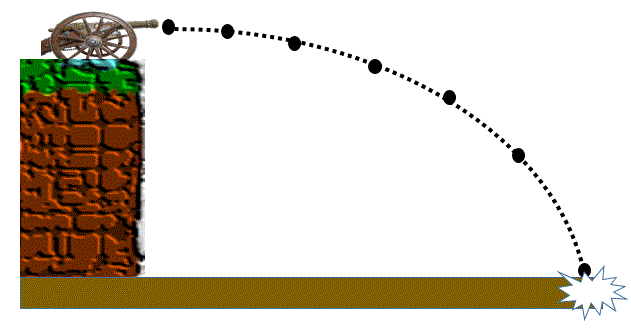
وُضع مدفع على قمة تل ارتفاعه \(45\,m\) عن سطح الأرض وأُطلقت قذيفة بشكل أفقي، فإن الزمن اللازم لوصول القذيفة إلى الأرض يعادل (\(g=9.81\,m/s^2\)):A cannon sits on a hill \(45\,m\) above the ground and fires a shell horizontally. The time for the shell to reach the ground is (\(g=9.81\,m/s^2\)):
\(t=2.5\,s\)\(t=2.5\,s\)
\(t=3.5\,s\)\(t=3.5\,s\)
\(t=4\,s\)\(t=4\,s\)
\(t=3\,s\)\(t=3\,s\)
الحلSolution
📌 زمن السقوط لا يعتمد على السرعة الأفقية: \(h=\tfrac12gt^2\Rightarrow t=\sqrt{\dfrac{2h}{g}}\).
📌 \(t=\sqrt{\dfrac{2\times45}{9.81}}\approx3.03\,s\approx3\,s\).
✅ \(t=3\,s\) (D)
📌 The fall time does not depend on the horizontal speed: \(h=\tfrac12gt^2\Rightarrow t=\sqrt{\dfrac{2h}{g}}\).
📌 \(t=\sqrt{\dfrac{2\times45}{9.81}}\approx3.03\,s\approx3\,s\).
✅ \(t=3\,s\) (D)
\[5\,\star\star\]
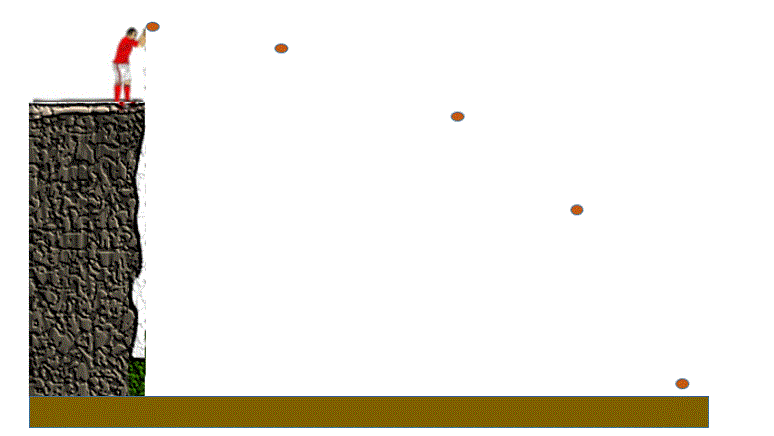
وقف طالب على سطح مرتفع ارتفاعه \(40\,m\) عن سطح الأرض وقذف حجرًا بسرعة أفقية \(10\,m/s\)، فإن أقصى مدى أفقي يصل إليه الحجر يعادل (\(g=9.81\,m/s^2\)):A student stands on a platform \(40\,m\) above the ground and throws a stone horizontally at \(10\,m/s\). The maximum horizontal range of the stone is (\(g=9.81\,m/s^2\)):
\(x=18.3\,m\)\(x=18.3\,m\)
\(x=24.6\,m\)\(x=24.6\,m\)
\(x=28.5\,m\)\(x=28.5\,m\)
\(x=22.8\,m\)\(x=22.8\,m\)
الحلSolution
📌 زمن السقوط: \(t=\sqrt{\dfrac{2h}{g}}=\sqrt{\dfrac{2\times40}{9.81}}\approx2.86\,s\).
📌 المدى الأفقي: \(x=v_{0x}t=10\times2.86\approx28.5\,m\).
✅ \(x=28.5\,m\) (C)
📌 Fall time: \(t=\sqrt{\dfrac{2h}{g}}=\sqrt{\dfrac{2\times40}{9.81}}\approx2.86\,s\).
📌 Horizontal range: \(x=v_{0x}t=10\times2.86\approx28.5\,m\).
✅ \(x=28.5\,m\) (C)
\[6\,\star\star\]
تُلقى صخرة أفقيًا من قمة جرف بسرعة \(15\,m/s\) فكان مداها الأفقي \(45\,m\)، فإن ارتفاع الجرف عن سطح الأرض يعادل (\(g=9.81\,m/s^2\)):A rock is thrown horizontally from the top of a cliff at \(15\,m/s\) and its horizontal range is \(45\,m\). The height of the cliff is (\(g=9.81\,m/s^2\)):
\(h=44.1\,m\)\(h=44.1\,m\)
\(h=56.3\,m\)\(h=56.3\,m\)
\(h=34.9\,m\)\(h=34.9\,m\)
\(h=22.2\,m\)\(h=22.2\,m\)
الحلSolution
📌 زمن الطيران من المدى: \(t=\dfrac{x}{v_{0x}}=\dfrac{45}{15}=3\,s\).
📌 \(h=\tfrac12gt^2=\tfrac12\times9.81\times3^2\approx44.1\,m\).
✅ \(h=44.1\,m\) (A)
📌 Flight time from the range: \(t=\dfrac{x}{v_{0x}}=\dfrac{45}{15}=3\,s\).
📌 \(h=\tfrac12gt^2=\tfrac12\times9.81\times3^2\approx44.1\,m\).
✅ \(h=44.1\,m\) (A)
\[7\,\star\star\star\]
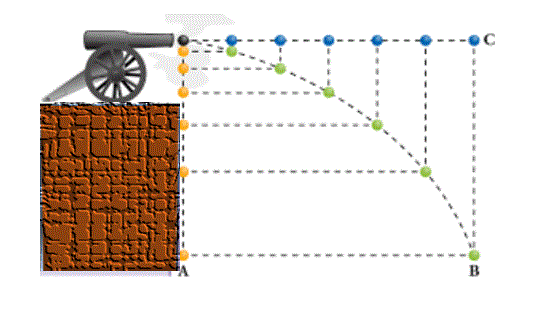
نُصب مدفع على سطح مبنى ارتفاعه \(50\,m\) عن سطح الأرض وقُذفت قذيفة بسرعة أفقية مقدارها \(90\,m/s\)، فإن سرعة ارتطام القذيفة بالأرض تعادل (\(g=9.81\,m/s^2\)):A cannon on the roof of a building \(50\,m\) high fires a shell with a horizontal speed of \(90\,m/s\). The speed with which the shell hits the ground is (\(g=9.81\,m/s^2\)):
\(v=121.3\,m/s\)\(v=121.3\,m/s\)
\(v=95.3\,m/s\)\(v=95.3\,m/s\)
\(v=143.2\,m/s\)\(v=143.2\,m/s\)
\(v=31.3\,m/s\)\(v=31.3\,m/s\)
الحلSolution
📌 المركبة الأفقية ثابتة: \(v_x=90\,m/s\).
📌 المركبة الرأسية عند الأرض: \(v_y=\sqrt{2gh}=\sqrt{2\times9.81\times50}\approx31.3\,m/s\).
📌 \(v=\sqrt{90^2+31.3^2}\approx95.3\,m/s\).
✅ \(v=95.3\,m/s\) (B)
📌 The horizontal component is constant: \(v_x=90\,m/s\).
📌 Vertical component at the ground: \(v_y=\sqrt{2gh}=\sqrt{2\times9.81\times50}\approx31.3\,m/s\).
📌 \(v=\sqrt{90^2+31.3^2}\approx95.3\,m/s\).
✅ \(v=95.3\,m/s\) (B)
\[8\,\star\]
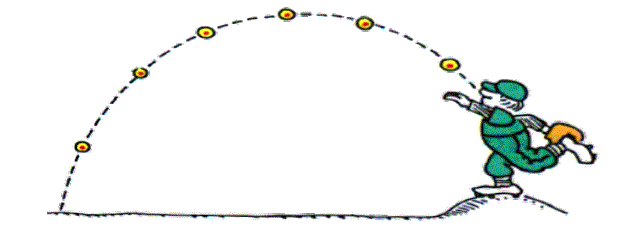
في القذف بزاوية، عندما يصل الجسم إلى أقصى ارتفاع فإن التسارع الذي يتحرك به الجسم يعادل:In angled projectile motion, when the body reaches its maximum height, its acceleration is:
\(a=4.9\,m/s^2\)\(a=4.9\,m/s^2\)
\(a=0\,m/s^2\)\(a=0\,m/s^2\)
\(a=-1.5\,m/s^2\)\(a=-1.5\,m/s^2\)
\(a=-9.81\,m/s^2\)\(a=-9.81\,m/s^2\)
الحلSolution
📌 بعد القذف لا تؤثر على المقذوف إلا قوة الجاذبية (إهمال مقاومة الهواء)، فالتسارع ثابت طوال الحركة: \(a=-g=-9.81\,m/s^2\) (إلى الأسفل).
📌 عند أقصى ارتفاع تنعدم السرعة الرأسية فقط، أما التسارع فلا ينعدم.
✅ \(a=-9.81\,m/s^2\) (D)
📌 After launch the only force on the projectile is gravity (air resistance neglected), so the acceleration is constant throughout: \(a=-g=-9.81\,m/s^2\) (downward).
📌 At the top only the vertical velocity is zero; the acceleration is not zero.
✅ \(a=-9.81\,m/s^2\) (D)
\[9\,\star\]
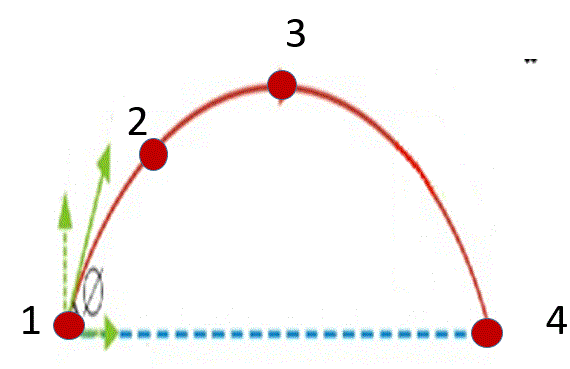
في القذف بزاوية، أقل سرعة يصل إليها المقذوف تكون عند الموقع:In angled projectile motion, the projectile has its smallest speed at position:
11
22
33
44
الحلSolution
📌 المركبة الأفقية \(v_x=v_i\cos\theta\) ثابتة، أما المركبة الرأسية فتنعدم عند أقصى ارتفاع.
📌 أقل سرعة عند أقصى ارتفاع (الموقع 3): \(v_{min}=v_i\cos\theta\).
✅ C
📌 The horizontal component \(v_x=v_i\cos\theta\) is constant, while the vertical component is zero at the top.
📌 The smallest speed is at the highest point (position 3): \(v_{min}=v_i\cos\theta\).
✅ C
\[10\,\star\]
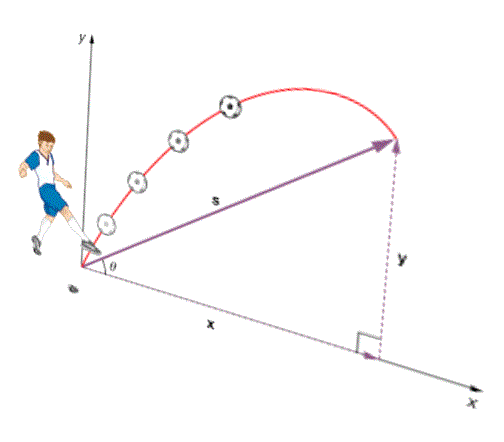
ركل أحمد كرة بسرعة \(20\,m/s\) بزاوية \(60^\circ\) مع الأفق، فإن أقصى ارتفاع تصل إليه الكرة يعادل (\(g=9.81\,m/s^2\)):Ahmed kicks a ball at \(20\,m/s\) at an angle of \(60^\circ\) to the horizontal. The maximum height reached by the ball is (\(g=9.81\,m/s^2\)):
\(h=15.3\,m\)\(h=15.3\,m\)
\(h=12.4\,m\)\(h=12.4\,m\)
\(h=18.6\,m\)\(h=18.6\,m\)
\(h=11.2\,m\)\(h=11.2\,m\)
الحلSolution
📌 المركبة الرأسية الابتدائية: \(v_{0y}=20\sin60^\circ=17.32\,m/s\).
📌 \(h=\dfrac{v_{0y}^2}{2g}=\dfrac{(17.32)^2}{2\times9.81}\approx15.3\,m\).
✅ \(h=15.3\,m\) (A)
📌 Initial vertical component: \(v_{0y}=20\sin60^\circ=17.32\,m/s\).
📌 \(h=\dfrac{v_{0y}^2}{2g}=\dfrac{(17.32)^2}{2\times9.81}\approx15.3\,m\).
✅ \(h=15.3\,m\) (A)
\[11\,\star\]
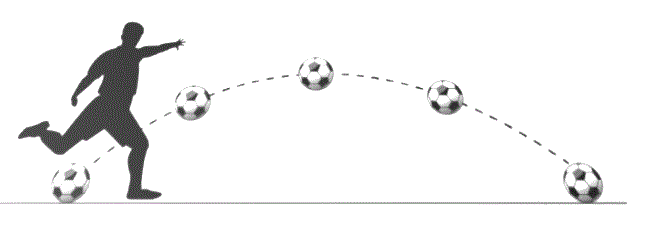
قُذفت كرة من سطح الأرض بسرعة \(20\,m/s\) بزاوية \(40^\circ\) مع الأفق، فإن سرعة الكرة عند أقصى ارتفاع تعادل:A ball is thrown from the ground at \(20\,m/s\) at \(40^\circ\) above the horizontal. The ball’s speed at its maximum height is:
\(v=18.4\,m/s\)\(v=18.4\,m/s\)
\(v=15.3\,m/s\)\(v=15.3\,m/s\)
\(v=20\,m/s\)\(v=20\,m/s\)
\(v=0\,m/s\)\(v=0\,m/s\)
الحلSolution
📌 عند أقصى ارتفاع تنعدم السرعة الرأسية وتبقى المركبة الأفقية فقط.
📌 \(v=v_x=20\cos40^\circ\approx15.3\,m/s\).
✅ \(v=15.3\,m/s\) (B)
📌 At the top the vertical velocity is zero and only the horizontal component remains.
📌 \(v=v_x=20\cos40^\circ\approx15.3\,m/s\).
✅ \(v=15.3\,m/s\) (B)
\[12\,\star\star\]
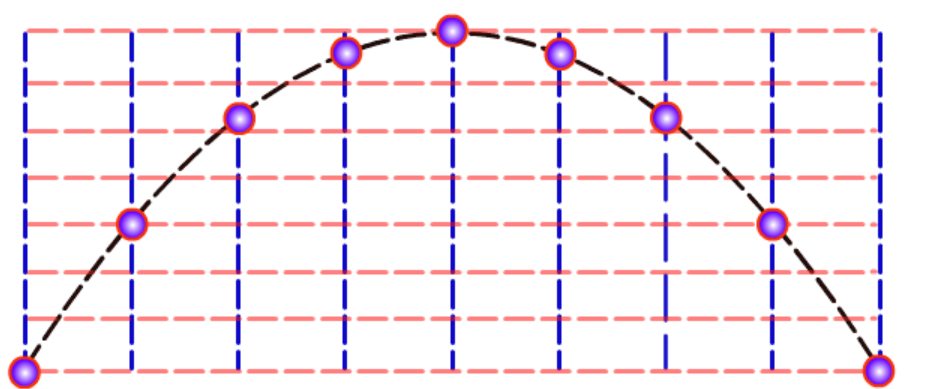
ضُربت كرة غولف من الأرض بسرعة ابتدائية \(30\,m/s\) بزاوية \(40^\circ\) مع الأفق، فإن زمن بقاء الكرة محلقة في الجو يعادل (\(g=9.81\,m/s^2\)):A golf ball is hit from the ground at an initial speed of \(30\,m/s\) at \(40^\circ\) above the horizontal. The time the ball stays in the air is (\(g=9.81\,m/s^2\)):
\(t=5.4\,s\)\(t=5.4\,s\)
\(t=2.4\,s\)\(t=2.4\,s\)
\(t=1.95\,s\)\(t=1.95\,s\)
\(t=3.9\,s\)\(t=3.9\,s\)
الحلSolution
📌 \(v_{0y}=30\sin40^\circ=19.28\,m/s\).
📌 زمن التحليق (الصعود والهبوط على المستوى نفسه): \(t=\dfrac{2v_{0y}}{g}=\dfrac{2\times19.28}{9.81}\approx3.9\,s\).
✅ \(t=3.9\,s\) (D)
📌 \(v_{0y}=30\sin40^\circ=19.28\,m/s\).
📌 Time of flight (rising and falling to the same level): \(t=\dfrac{2v_{0y}}{g}=\dfrac{2\times19.28}{9.81}\approx3.9\,s\).
✅ \(t=3.9\,s\) (D)
\[13\,\star\star\star\]
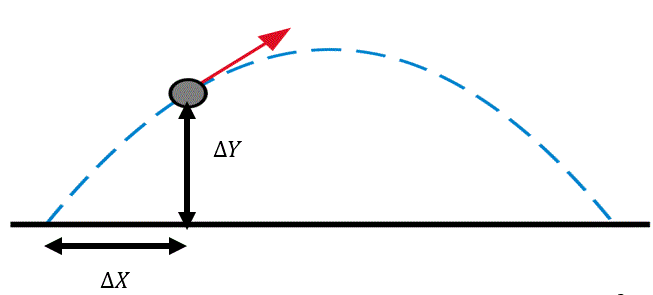
كُتبت معادلتا الإزاحة الأفقية والرأسية لمقذوف بزاوية عند موقع محدد كما في الشكل: \(\Delta X=36\,t\) و \(\Delta Y=48\,t-4.9\,t^2\). فإن السرعة الابتدائية التي قُذف بها الجسم تعادل:The horizontal and vertical displacement equations of an angled projectile are given: \(\Delta X=36\,t\) and \(\Delta Y=48\,t-4.9\,t^2\). The initial speed with which the body was launched is:
\(v=45\,m/s\)\(v=45\,m/s\)
\(v=65\,m/s\)\(v=65\,m/s\)
\(v=60\,m/s\)\(v=60\,m/s\)
\(v=55\,m/s\)\(v=55\,m/s\)
الحلSolution
📌 بمقارنتها بـ \(\Delta X=v_{0x}t\) و \(\Delta Y=v_{0y}t-\tfrac12gt^2\) نجد \(v_{0x}=36\,m/s\) و \(v_{0y}=48\,m/s\).
📌 \(v_i=\sqrt{36^2+48^2}=60\,m/s\).
✅ \(v=60\,m/s\) (C)
📌 Comparing with \(\Delta X=v_{0x}t\) and \(\Delta Y=v_{0y}t-\tfrac12gt^2\) gives \(v_{0x}=36\,m/s\) and \(v_{0y}=48\,m/s\).
📌 \(v_i=\sqrt{36^2+48^2}=60\,m/s\).
✅ \(v=60\,m/s\) (C)
\[14\,\star\star\]
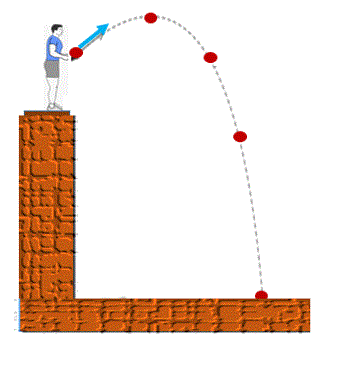
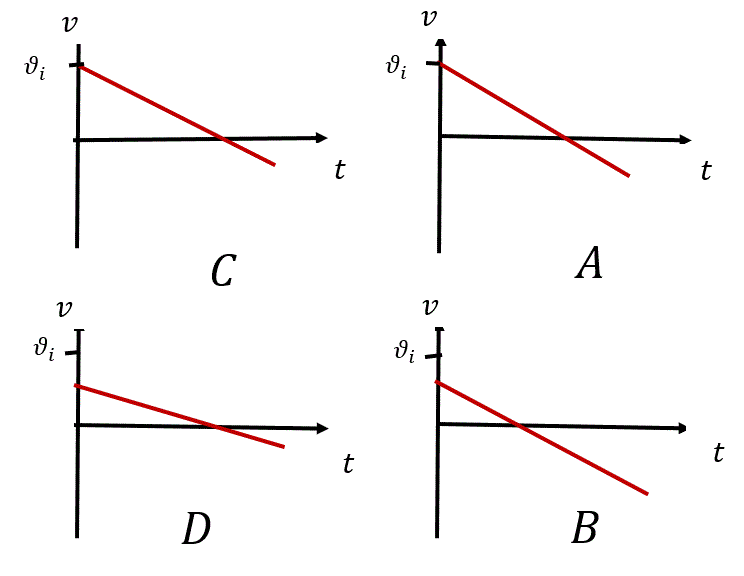
رُميت كرة بسرعة ابتدائية \(v_i\) بزاوية \(\theta\) فوق الأفق من قمة جرف كما في الشكل. أحد الخطوط البيانية التالية يعبّر عن العلاقة بين السرعة الرأسية والزمن:A ball is thrown with initial speed \(v_i\) at an angle \(\theta\) above the horizontal from the top of a cliff, as shown. Which of the following graphs describes the relationship between vertical velocity and time?
AA
BB
CC
DD
الحلSolution
📌 السرعة الرأسية الابتدائية \(v_{0y}=v_i\sin\theta\) أصغر من \(v_i\)، فيجب أن يبدأ الخط البياني من قيمة أدنى من العلامة \(v_i\) (يستبعد A وC).
📌 التسارع الرأسي ثابت \(-g\)، فالعلاقة \(v_y=v_{0y}-gt\) خط مستقيم متناقص يقطع محور الزمن عند أقصى ارتفاع ثم يصبح سالبًا أثناء النزول، وهذا ما يمثله الرسم B.
✅ B
📌 The initial vertical velocity \(v_{0y}=v_i\sin\theta\) is smaller than \(v_i\), so the graph must start below the \(v_i\) mark (ruling out A and C).
📌 The vertical acceleration is constant \(-g\), so \(v_y=v_{0y}-gt\) is a decreasing straight line that crosses the time axis at the top and becomes negative on the way down; this is graph B.
✅ B
\[15\,\star\]
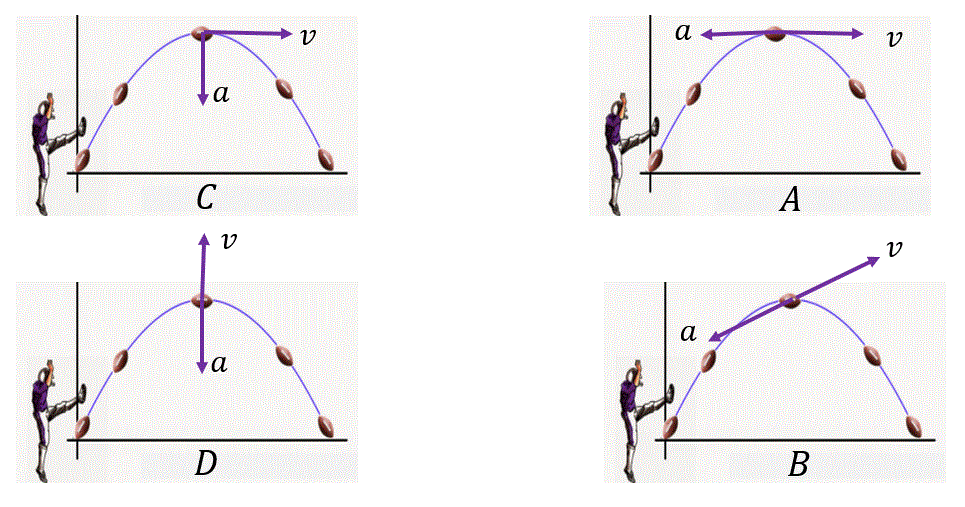
في القذف بزاوية، الشكل الصحيح لمتجه السرعة ولمتجه التسارع عند أقصى ارتفاع يعبّر عنه الشكل:In angled projectile motion, which figure shows the correct velocity vector and acceleration vector at the maximum height?
AA
BB
CC
DD
الحلSolution
📌 عند أقصى ارتفاع تكون السرعة أفقية فقط (مماس للمسار)، والتسارع \(g\) إلى الأسفل رأسيًا.
📌 هذا ما يمثله الشكل C: السرعة أفقية والتسارع رأسي للأسفل.
✅ C
📌 At the top the velocity is purely horizontal (tangent to the path) and the acceleration is \(g\), vertically downward.
📌 This is figure C: horizontal velocity and downward vertical acceleration.
✅ C
\[16\,\star\]
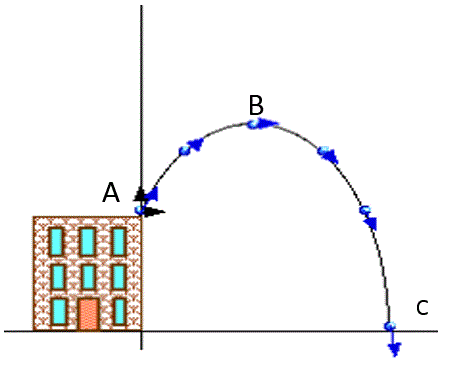
وقف طالب على سطح مبنى ورمى كرة بسرعة ابتدائية وبشكل يميل فوق الأفق بزاوية. فإن الموقع الذي يمكن أن تنعدم به السرعة الأفقية هو:A student stands on the roof of a building and throws a ball with an initial speed at an angle above the horizontal. The position where the horizontal velocity could become zero is:
AA
BB
CC
DD
الحلSolution
📌 لا توجد قوة أفقية مؤثرة (إهمال مقاومة الهواء)، فالمركبة الأفقية للسرعة ثابتة \(v_x=v_i\cos\theta\) ولا تنعدم في أي موقع.
📌 فالخيار الصحيح: لا يوجد (D).
✅ D
📌 No horizontal force acts (air resistance neglected), so the horizontal component \(v_x=v_i\cos\theta\) is constant and is zero at no position.
📌 Hence the correct choice: none (D).
✅ D
\[17\,\star\star\star\]
يرمي منجنيق حجرًا بسرعة ابتدائية \(40\,m/s\) بزاوية \(30^\circ\) فوق الأفق، فإن سرعة الحجر على ارتفاع \(8\,m\) تعادل (\(g=9.81\,m/s^2\)):A catapult launches a stone at \(40\,m/s\) at \(30^\circ\) above the horizontal. The speed of the stone at a height of \(8\,m\) is (\(g=9.81\,m/s^2\)):
\(v=38.0\,m/s\)\(v=38.0\,m/s\)
\(v=34.6\,m/s\)\(v=34.6\,m/s\)
\(v=20\,m/s\)\(v=20\,m/s\)
\(v=25.8\,m/s\)\(v=25.8\,m/s\)
الحلSolution
📌 المركبة الأفقية ثابتة: \(v_x=40\cos30^\circ=34.64\,m/s\).
📌 المركبة الرأسية عند ارتفاع 8 m: \(v_y^2=v_{0y}^2-2gy=20^2-2\times9.81\times8=243.0\).
📌 \(v=\sqrt{34.64^2+243.0}=\sqrt{1443}\approx38.0\,m/s\).
✅ \(v=38.0\,m/s\) (A)
📌 The horizontal component is constant: \(v_x=40\cos30^\circ=34.64\,m/s\).
📌 Vertical component at a height of 8 m: \(v_y^2=v_{0y}^2-2gy=20^2-2\times9.81\times8=243.0\).
📌 \(v=\sqrt{34.64^2+243.0}=\sqrt{1443}\approx38.0\,m/s\).
✅ \(v=38.0\,m/s\) (A)
\[18\,\star\star\]
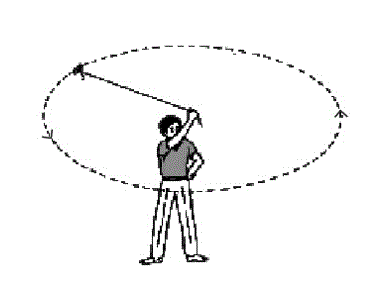
حجر كتلته \(0.4\,kg\) مربوط بخيط طوله \(0.6\,m\) أُدير بشكل أفقي كما في الشكل وبشكل دائري بسرعة خطية ثابتة مقدارها \(10\,m/s\)، فإن القوة المركزية المسببة للحركة الدائرية تعادل:A \(0.4\,kg\) stone tied to a \(0.6\,m\) string is whirled in a horizontal circle at a constant linear speed of \(10\,m/s\). The centripetal force causing the circular motion is:
\(F_c=54.3\,N\)\(F_c=54.3\,N\)
\(F_c=66.6\,N\)\(F_c=66.6\,N\)
\(F_c=23.4\,N\)\(F_c=23.4\,N\)
\(F_c=48.8\,N\)\(F_c=48.8\,N\)
الحلSolution
📌 نصف قطر الدائرة يساوي طول الخيط: \(r=0.6\,m\).
📌 \(F_c=\dfrac{mv^2}{r}=\dfrac{0.4\times10^2}{0.6}\approx66.6\,N\).
✅ \(F_c=66.6\,N\) (B)
📌 The circle’s radius equals the string length: \(r=0.6\,m\).
📌 \(F_c=\dfrac{mv^2}{r}=\dfrac{0.4\times10^2}{0.6}\approx66.6\,N\).
✅ \(F_c=66.6\,N\) (B)
\[19\,\star\]
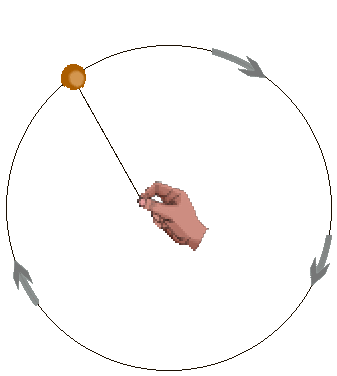
في الحركة الدائرية المنتظمة أحد العبارات التالية صحيحة:In uniform circular motion, which of the following statements is correct?
السرعة الخطية يتغير مقدارها واتجاههاThe linear velocity changes in both magnitude and direction
القوة المسببة للحركة الدائرية اتجاهها مماس للمسارThe force causing circular motion is directed tangent to the path
السرعة الخطية اتجاهها نحو المركزThe linear velocity is directed toward the center
التسارع المركزي ناتج عن تغير اتجاه السرعة الخطيةCentripetal acceleration results from the change in direction of the linear velocity
الحلSolution
📌 في الحركة الدائرية المنتظمة يبقى مقدار السرعة ثابتًا ويتغير اتجاهها فقط (مماس للمسار)، وهذا التغير في الاتجاه يولّد التسارع المركزي \(a_c=\dfrac{v^2}{r}\) نحو المركز.
📌 والقوة المركزية أيضًا نحو المركز وليست مماسية.
✅ التسارع المركزي ناتج عن تغير اتجاه السرعة الخطية (D)
📌 In uniform circular motion the speed is constant and only the direction (tangent to the path) changes; this change of direction produces the centripetal acceleration \(a_c=\dfrac{v^2}{r}\) toward the center.
📌 The centripetal force also points toward the center, not along the tangent.
✅ Centripetal acceleration results from the change in direction of the linear velocity (D)
\[20\,\star\]
يقف طفل على لعبة دوامة ويبعد عن مركز القرص مسافة \(2\,m\)، إذا كانت السرعة الخطية للطفل \(1.5\,m/s\) فإن التسارع المركزي للطفل يعادل:A child stands on a merry-go-round \(2\,m\) from the center of the disc. If the child’s linear speed is \(1.5\,m/s\), the child’s centripetal acceleration is:
\(a_c=3\,m/s^2\)\(a_c=3\,m/s^2\)
\(a_c=1.4\,m/s^2\)\(a_c=1.4\,m/s^2\)
\(a_c=1.12\,m/s^2\)\(a_c=1.12\,m/s^2\)
\(a_c=2.41\,m/s^2\)\(a_c=2.41\,m/s^2\)
الحلSolution
📌 \(a_c=\dfrac{v^2}{r}=\dfrac{(1.5)^2}{2}=\dfrac{2.25}{2}\approx1.12\,m/s^2\).
✅ \(a_c=1.12\,m/s^2\) (C)
📌 \(a_c=\dfrac{v^2}{r}=\dfrac{(1.5)^2}{2}=\dfrac{2.25}{2}\approx1.12\,m/s^2\).
✅ \(a_c=1.12\,m/s^2\) (C)
\[21\,\star\star\]
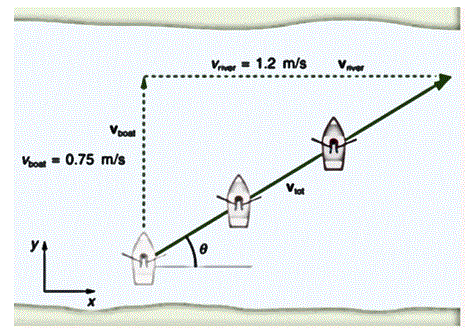
قارب يتحرك نحو الشمال في نهر بسرعة \(0.75\,m/s\) (بالنسبة للماء) والنهر يجري نحو الشرق بسرعة \(1.2\,m/s\)، فإن سرعة القارب بالنسبة لمراقب يقف على الأرض تعادل:A boat moves north through a river at \(0.75\,m/s\) (relative to the water) while the river flows east at \(1.2\,m/s\). The boat’s velocity relative to an observer on the ground is:
\(v_{be}=1.4\,m/s,\ \theta=32^\circ\) شمال الشرق\(v_{be}=1.4\,m/s,\ \theta=32^\circ\) north of east
\(v_{be}=1.9\,m/s,\ \theta=44^\circ\) شمال الشرق\(v_{be}=1.9\,m/s,\ \theta=44^\circ\) north of east
\(v_{be}=1.6\,m/s,\ \theta=53.1^\circ\) شرق الشمال\(v_{be}=1.6\,m/s,\ \theta=53.1^\circ\) east of north
\(v_{be}=1.2\,m/s,\ \theta=22.5^\circ\) شرق الشمال\(v_{be}=1.2\,m/s,\ \theta=22.5^\circ\) east of north
الحلSolution
📌 المركبتان متعامدتان: شرقًا \(1.2\,m/s\) وشمالًا \(0.75\,m/s\).
📌 \(v_{be}=\sqrt{1.2^2+0.75^2}\approx1.4\,m/s\).
📌 \(\theta=\tan^{-1}\dfrac{0.75}{1.2}\approx32^\circ\) شمال الشرق (من محور الشرق نحو الشمال).
✅ \(v_{be}=1.4\,m/s,\ \theta=32^\circ\) شمال الشرق (A)
📌 The two components are perpendicular: \(1.2\,m/s\) east and \(0.75\,m/s\) north.
📌 \(v_{be}=\sqrt{1.2^2+0.75^2}\approx1.4\,m/s\).
📌 \(\theta=\tan^{-1}\dfrac{0.75}{1.2}\approx32^\circ\) north of east (measured from the east axis toward the north).
✅ \(v_{be}=1.4\,m/s,\ \theta=32^\circ\) north of east (A)
\[22\,\star\]
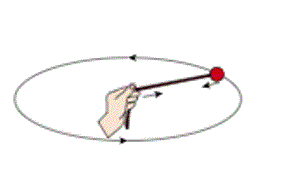
رُبط حجر بخيط طوله \(0.4\,m\) وأُدير في وضع أفقي فكان زمنه الدوري \(0.8\,s\)، فإن عجلته (تسارعه) المركزية تساوي:A stone is tied to a \(0.4\,m\) string and whirled in a horizontal circle with a period of \(0.8\,s\). Its centripetal acceleration is:
\(a_c=21.9\,m/s^2\)\(a_c=21.9\,m/s^2\)
\(a_c=24.7\,m/s^2\)\(a_c=24.7\,m/s^2\)
\(a_c=28.2\,m/s^2\)\(a_c=28.2\,m/s^2\)
\(a_c=19.6\,m/s^2\)\(a_c=19.6\,m/s^2\)
الحلSolution
📌 السرعة الخطية: \(v=\dfrac{2\pi r}{T}=\dfrac{2\pi\times0.4}{0.8}=\pi\,m/s\approx3.14\,m/s\).
📌 \(a_c=\dfrac{v^2}{r}=\dfrac{4\pi^2r}{T^2}=\dfrac{4\pi^2\times0.4}{0.64}\approx24.7\,m/s^2\).
✅ \(a_c=24.7\,m/s^2\) (B)
📌 Linear speed: \(v=\dfrac{2\pi r}{T}=\dfrac{2\pi\times0.4}{0.8}=\pi\,m/s\approx3.14\,m/s\).
📌 \(a_c=\dfrac{v^2}{r}=\dfrac{4\pi^2r}{T^2}=\dfrac{4\pi^2\times0.4}{0.64}\approx24.7\,m/s^2\).
✅ \(a_c=24.7\,m/s^2\) (B)
\[23\]
قوة الجذب المركزية المؤثرة على سيارة تسير في طريق أفقي دائري منحنٍ تتوقف على:The centripetal force acting on a car moving around a horizontal circular curve depends on:
قوة الاحتكاك بين إطارات السيارة والطريقThe friction force between the car’s tires and the road
وزن السيارة وقوة الفراملThe car’s weight and the braking force
القوة الطاردةThe “centrifugal force”
جميع ما سبقAll of the above
الحلSolution
📌 على الطريق الأفقي المنحني لا يوجد ما يوفّر القوة نحو المركز سوى قوة الاحتكاك السكوني بين الإطارات والطريق.
📌 أما «القوة الطاردة» فليست قوة حقيقية مؤثرة على السيارة في مرجع القصور، ولا علاقة للفرامل بالقوة المركزية.
✅ قوة الاحتكاك بين إطارات السيارة والطريق (A)
📌 On a flat curve nothing provides the force toward the center except the static friction between the tires and the road.
📌 The “centrifugal force” is not a real force on the car in an inertial frame, and the brakes have nothing to do with the centripetal force.
✅ The friction force between the car’s tires and the road (A)
لاحظت خطأ؟ أو عندك سؤال عن أحد الأسئلة؟ اكتبه بالتعليقات وحدد رقم السؤال بالضبط.
Noticed an error? Or have a question about one of the questions? Write it in the comments and specify the exact question number.