🚀 بنك الأسئلة: الحركة المتسارعة
🚀 Question Bank: Accelerated Motion
التسارع، منحنيات السرعة والموقع والتسارع مع الزمن، معادلات الحركة بتسارع ثابت، السقوط الحر، والقذف الرأسي
Acceleration, Velocity, Position and Acceleration Graphs, Equations of Uniformly Accelerated Motion, Free Fall, and Vertical Projection
⏱️ 43 سؤال اختيار من متعدد بتصحيح فوري بمستويات متدرجة، و6 مسائل مقالية محلولة⏱️ 43 multiple-choice questions of graded difficulty with instant feedback, plus 6 solved essay problems
\[1\,\star\]
انطلقت سيارة سباق من السكون وأصبحت سرعتها \(25\,m/s\) خلال زمن قدره \(4\,s\)، فإن التسارع الذي تتحرك به السيارة يعادل:A race car started from rest and reached a speed of \(25\,m/s\) in \(4\,s\). The acceleration of the car is:

\(a=8.2\,m/s^2\)\(a=8.2\,m/s^2\)
\(a=4.5\,m/s^2\)\(a=4.5\,m/s^2\)
\(a=6.25\,m/s^2\)\(a=6.25\,m/s^2\)
\(a=12.1\,m/s^2\)\(a=12.1\,m/s^2\)
الحلSolution
📌 التسارع هو معدل تغيّر السرعة: \(a=\dfrac{\Delta v}{\Delta t}=\dfrac{25-0}{4}=6.25\,m/s^2\).
✅ \(a=6.25\,m/s^2\) (C)
📌 Acceleration is the rate of change of velocity: \(a=\dfrac{\Delta v}{\Delta t}=\dfrac{25-0}{4}=6.25\,m/s^2\).
✅ \(a=6.25\,m/s^2\) (C)
\[2\,\star\]
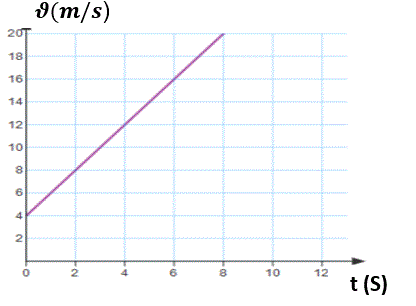
الخط البياني التالي يبيّن العلاقة بين السرعة والزمن. إن ميل الخط البياني يمثل:The graph shows the relationship between velocity and time. The slope of the graph represents:
التسارعAcceleration
السرعة المتوسطةAverage velocity
المسافة المقطوعةDistance traveled
السرعة اللحظيةInstantaneous velocity
الحلSolution
📌 ميل منحنى (السرعة–الزمن) يساوي \(\dfrac{\Delta v}{\Delta t}\)، وهو التسارع. مثلًا من الرسم: \(\dfrac{20-4}{8-0}=2\,m/s^2\).
✅ التسارع (A)
📌 The slope of a velocity–time graph equals \(\dfrac{\Delta v}{\Delta t}\), which is the acceleration. For example: \(\dfrac{20-4}{8-0}=2\,m/s^2\).
✅ Acceleration (A)
\[3\,\star\]
سيارة تتحرك بسرعة \(20\,m/s\) شاهد السائق طفلًا يعبر الطريق فطبّق نظام الفرملة فتوقفت السيارة بعد زمن قدره \(5\,s\)، فإن التسارع المتوسط يعادل:A car moving at \(20\,m/s\) sees a child crossing the road, applies the brakes, and stops after \(5\,s\). The average acceleration is:

\(a=-5\,m/s^2\)\(a=-5\,m/s^2\)
\(a=-6\,m/s^2\)\(a=-6\,m/s^2\)
\(a=-4\,m/s^2\)\(a=-4\,m/s^2\)
\(a=-10\,m/s^2\)\(a=-10\,m/s^2\)
الحلSolution
📌 \(a=\dfrac{v_f-v_i}{t}=\dfrac{0-20}{5}=-4\,m/s^2\). الإشارة السالبة تعني أن التسارع عكس اتجاه الحركة (تباطؤ).
✅ \(a=-4\,m/s^2\) (C)
📌 \(a=\dfrac{v_f-v_i}{t}=\dfrac{0-20}{5}=-4\,m/s^2\). The negative sign means the acceleration is opposite to the motion (deceleration).
✅ \(a=-4\,m/s^2\) (C)
\[4\,\star\star\]
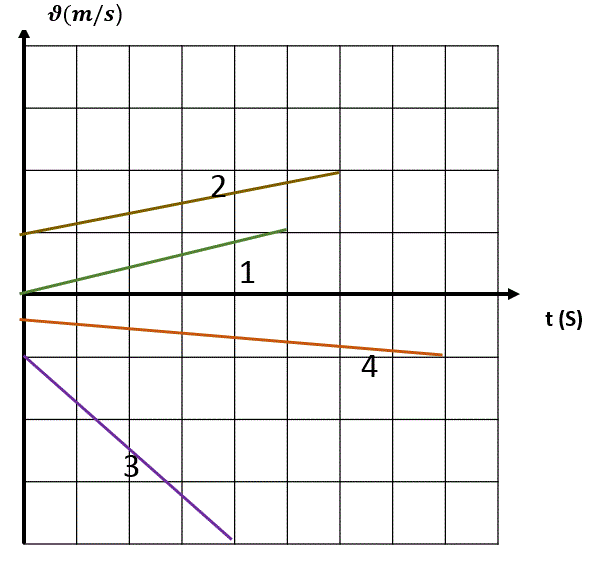
تم رسم العلاقة بين السرعة والزمن لأربعة طلاب. الترتيب الصحيح لمقدار التسارع من الأعلى إلى الأدنى هو (بغض النظر عن نوع التسارع):The velocity–time graphs of four students are shown. The correct order of the magnitude of acceleration from highest to lowest is (regardless of the type of acceleration):
\(a_2>a_1>a_3>a_4\)\(a_2>a_1>a_3>a_4\)
\(a_3>a_1>a_2>a_4\)\(a_3>a_1>a_2>a_4\)
\(a_4>a_2>a_1>a_3\)\(a_4>a_2>a_1>a_3\)
\(a_1=a_2=a_3=a_4\)\(a_1=a_2=a_3=a_4\)
الحلSolution
📌 مقدار التسارع هو مقدار ميل الخط في منحنى (السرعة–الزمن): كلما كان الخط أشد انحدارًا كان التسارع أكبر (بغض النظر عن اتجاه الميل).
📌 الخط 3 هو الأشد انحدارًا، ثم الخط 1 (مربع واحد ارتفاعًا لكل 5 مربعات)، ثم الخط 2 (مربع واحد لكل 6 مربعات)، وأخيرًا الخط 4 (الأقل ميلًا).
📌 الترتيب: \(a_3>a_1>a_2>a_4\).
✅ \(a_3>a_1>a_2>a_4\) (B)
📌 The magnitude of acceleration equals the magnitude of the slope in a velocity–time graph: the steeper the line, the greater the acceleration (whatever the direction of the slope).
📌 Line 3 is the steepest, then line 1 (one square of rise per 5 squares), then line 2 (one square per 6 squares), and finally line 4 (the gentlest).
📌 The order is \(a_3>a_1>a_2>a_4\).
✅ \(a_3>a_1>a_2>a_4\) (B)
\[5\,\star\]
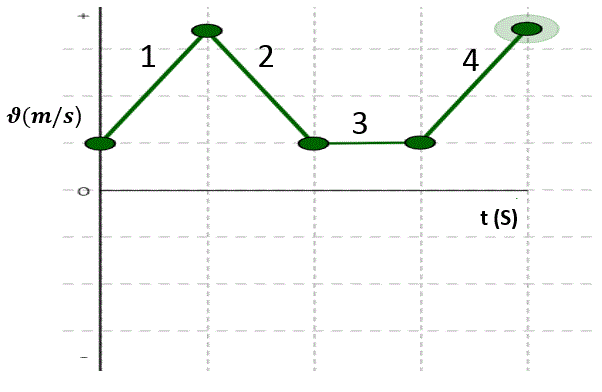
الخط البياني يبيّن العلاقة بين السرعة والزمن لدراجة. في أي مرحلة من الخط البياني تتحرك الدراجة بتسارع معدوم؟The graph shows the velocity–time relationship for a bicycle. In which stage does the bicycle move with zero acceleration?
المرحلة 1Stage 1
المرحلة 2Stage 2
المرحلة 3Stage 3
المرحلة 4Stage 4
الحلSolution
📌 يكون التسارع معدومًا عندما تكون السرعة ثابتة، أي عندما يكون الخط أفقيًا (ميله صفر). هذا ما يحدث في المرحلة 3.
✅ المرحلة 3 (C)
📌 Acceleration is zero when the velocity is constant, i.e. when the line is horizontal (zero slope). This happens in stage 3.
✅ Stage 3 (C)
\[6\,\star\star\]
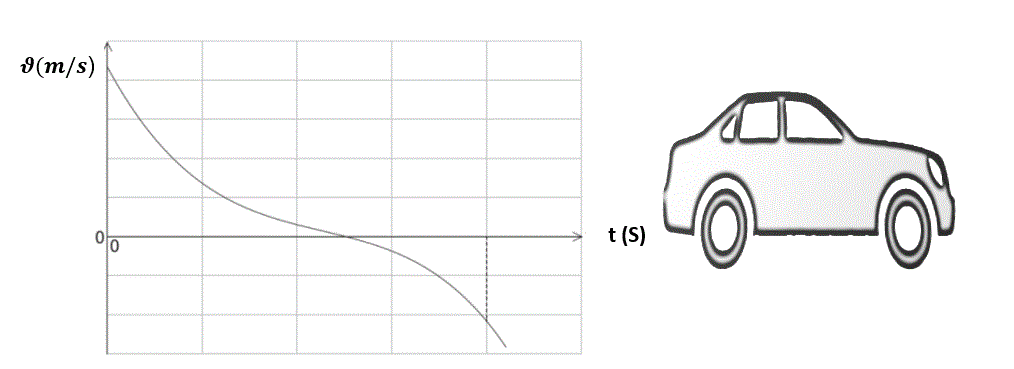
يوضّح الرسم البياني العلاقة بين السرعة والزمن لسيارة كتلتها ثابتة. من خلال الخط البياني نستطيع أن نقول إن:The graph shows the velocity–time relationship for a car of constant mass. From the graph we can say that:
السيارة تتحرك بتسارع منتظمThe car moves with uniform acceleration
السيارة تتحرك دائمًا بتسارع غير منتظمThe car always moves with non-uniform acceleration
السيارة تتحرك دائمًا بتسارع متباطئThe car always moves with deceleration
السيارة تتحرك باتجاه واحدThe car moves in one direction
الحلSolution
📌 الخط منحنٍ وليس مستقيمًا، أي أن ميله (التسارع) يتغير مع الزمن، فالتسارع غير منتظم.
📌 تتغير إشارة السرعة (من موجبة إلى سالبة)، فالسيارة تغيّر اتجاه حركتها، لذلك الخيار الأخير خطأ.
✅ السيارة تتحرك دائمًا بتسارع غير منتظم (B)
📌 The graph is curved, not straight, so its slope (the acceleration) changes with time: the acceleration is non-uniform.
📌 The velocity changes sign (from positive to negative), so the car reverses its direction; the last option is therefore wrong.
✅ The car always moves with non-uniform acceleration (B)
\[7\,\star\]
تتحرك دراجة على خط مستقيم. توضح الرسوم البيانية العلاقة بين الموقع والزمن. أي رسم بياني يُظهر حركة ذات تسارع سالب؟A bicycle moves along a straight line. The graphs show the position–time relationship. Which graph shows motion with negative acceleration?
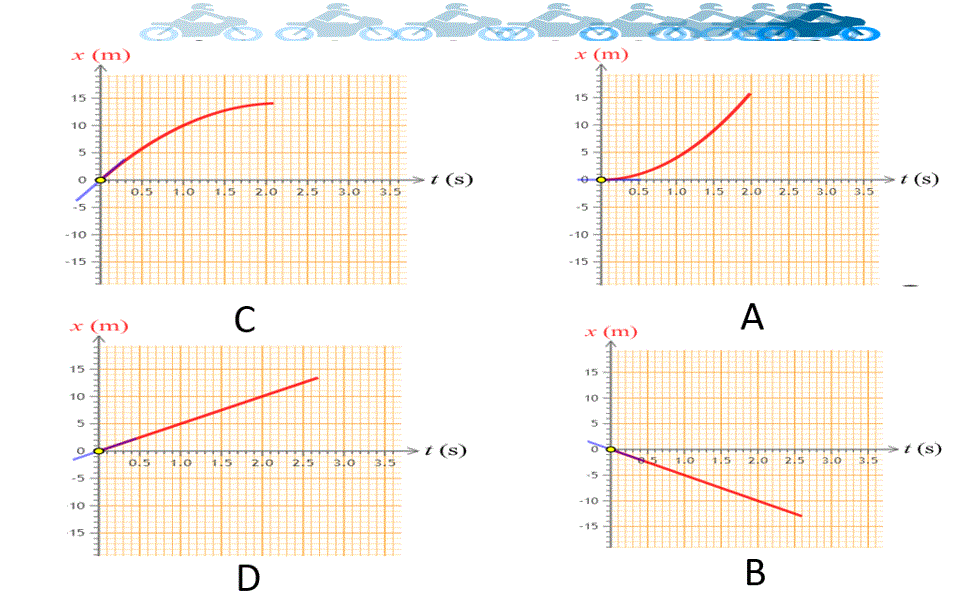
AA
BB
CC
DD
الحلSolution
📌 التسارع هو انحناء منحنى (الموقع–الزمن): ينحني لأعلى (مقعّر للأعلى) عندما يكون التسارع موجبًا، وينحني لأسفل عندما يكون التسارع سالبًا.
📌 الشكل C منحنٍ لأسفل (ميله يتناقص أي أن السرعة تتناقص)، والشكل A منحنٍ لأعلى، أما D وB فمستقيمان (تسارع معدوم).
✅ C
📌 Acceleration shows up as the curvature of a position–time graph: curving upward (concave up) means positive acceleration, curving downward means negative acceleration.
📌 Graph C curves downward (its slope, the velocity, decreases); A curves upward; D and B are straight lines (zero acceleration).
✅ C
\[8\,\star\star\]
الخط البياني التالي يبيّن العلاقة بين السرعة والزمن لسيارة تتحرك في اتجاه واحد بتسارع غير ثابت، فإن التسارع المتوسط للسيارة بين اللحظتين \(t=4\,s\) و \(t=8\,s\) يعادل:The graph shows the velocity–time relationship for a car moving in one direction with non-constant acceleration. The average acceleration between \(t=4\,s\) and \(t=8\,s\) is:
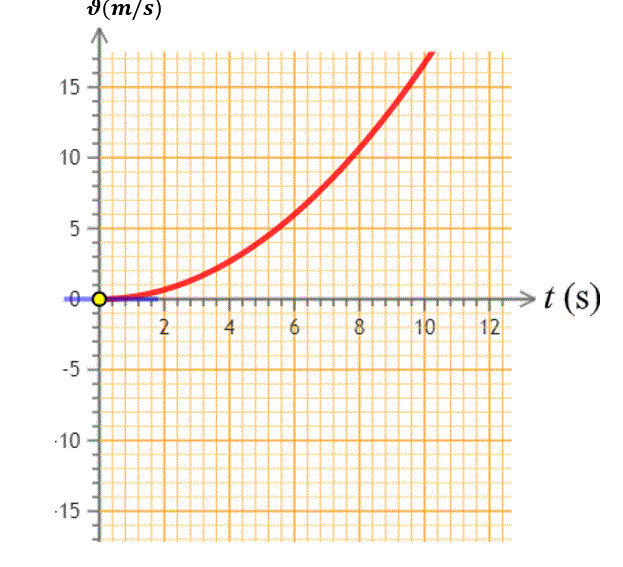
\(a_{avg}=4\,m/s^2\)\(a_{avg}=4\,m/s^2\)
\(a_{avg}=3\,m/s^2\)\(a_{avg}=3\,m/s^2\)
\(a_{avg}=5\,m/s^2\)\(a_{avg}=5\,m/s^2\)
\(a_{avg}=2\,m/s^2\)\(a_{avg}=2\,m/s^2\)
الحلSolution
📌 نقرأ من الرسم: \(v(4)\approx2.7\,m/s\) و \(v(8)\approx10.7\,m/s\).
📌 \(a_{avg}=\dfrac{\Delta v}{\Delta t}=\dfrac{10.7-2.7}{8-4}=2\,m/s^2\).
✅ \(a_{avg}=2\,m/s^2\) (D)
📌 Reading the graph: \(v(4)\approx2.7\,m/s\) and \(v(8)\approx10.7\,m/s\).
📌 \(a_{avg}=\dfrac{\Delta v}{\Delta t}=\dfrac{10.7-2.7}{8-4}=2\,m/s^2\).
✅ \(a_{avg}=2\,m/s^2\) (D)
\[9\,\star\star\]
الخط البياني التالي يبيّن العلاقة بين السرعة والزمن لسيارة تتحرك في اتجاه واحد بتسارع غير ثابت، فإن التسارع اللحظي عند اللحظة \(t=8\,s\) يعادل:The graph shows the velocity–time relationship for a car moving in one direction with non-constant acceleration. The instantaneous acceleration at \(t=8\,s\) is:
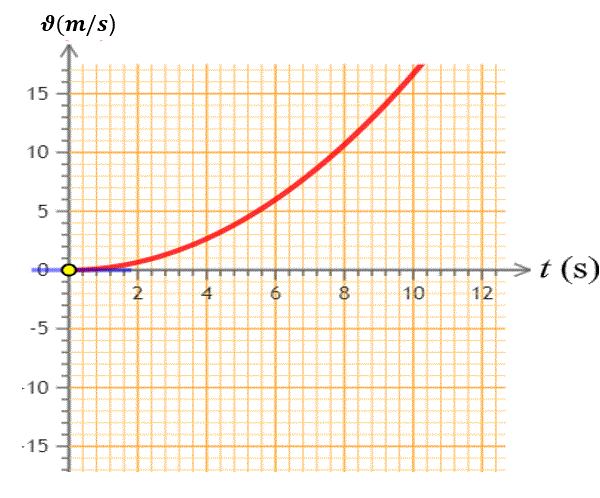
\(a_i=4.5\,m/s^2\)\(a_i=4.5\,m/s^2\)
\(a_i=3.5\,m/s^2\)\(a_i=3.5\,m/s^2\)
\(a_i=1.5\,m/s^2\)\(a_i=1.5\,m/s^2\)
\(a_i=2.7\,m/s^2\)\(a_i=2.7\,m/s^2\)
الحلSolution
📌 التسارع اللحظي هو ميل المماس لمنحنى السرعة عند تلك اللحظة.
📌 نرسم المماس عند \(t=8\,s\) (حيث \(v\approx10.7\,m/s\))؛ يقطع المماس محور الزمن عند \(t=4\,s\) تقريبًا.
📌 \(a_i=\dfrac{10.7-0}{8-4}\approx2.7\,m/s^2\).
✅ \(a_i=2.7\,m/s^2\) (D)
📌 The instantaneous acceleration is the slope of the tangent to the velocity curve at that instant.
📌 Draw the tangent at \(t=8\,s\) (where \(v\approx10.7\,m/s\)); it meets the time axis at about \(t=4\,s\).
📌 \(a_i=\dfrac{10.7-0}{8-4}\approx2.7\,m/s^2\).
✅ \(a_i=2.7\,m/s^2\) (D)
\[10\,\star\]
سيارة انطلقت من السكون بتسارع قدره \(4\,m/s^2\)، فإن السرعة التي وصلت إليها السيارة بعد زمن قدره \(6\,s\) تعادل:A car started from rest with an acceleration of \(4\,m/s^2\). The speed it reaches after \(6\,s\) is:
\(v_f=24\,m/s\)\(v_f=24\,m/s\)
\(v_f=18\,m/s\)\(v_f=18\,m/s\)
\(v_f=10\,m/s\)\(v_f=10\,m/s\)
\(v_f=12\,m/s\)\(v_f=12\,m/s\)
الحلSolution
📌 \(v_f=v_i+at=0+4\times6=24\,m/s\).
✅ \(v_f=24\,m/s\) (A)
📌 \(v_f=v_i+at=0+4\times6=24\,m/s\).
✅ \(v_f=24\,m/s\) (A)
\[11\,\star\]
لاعب كرة قدم أمريكية يتحرك بسرعة \(10\,m/s\) أُمسك به من الخلف حتى توقف خلال زمن قدره \(8\,s\)، فإن المسافة التي قطعها اللاعب حتى توقف تعادل (بافتراض تباطؤ منتظم):An American football player moves at \(10\,m/s\). He is tackled from behind and stops in \(8\,s\). The distance he travels before stopping is (assuming uniform deceleration):
\(\Delta x=10\,m\)\(\Delta x=10\,m\)
\(\Delta x=20\,m\)\(\Delta x=20\,m\)
\(\Delta x=30\,m\)\(\Delta x=30\,m\)
\(\Delta x=40\,m\)\(\Delta x=40\,m\)
الحلSolution
📌 التسارع: \(a=\dfrac{0-10}{8}=-1.25\,m/s^2\).
📌 \(\Delta x=v_it+\dfrac12at^2=10(8)+\dfrac12(-1.25)(8)^2=80-40=40\,m\).
✅ \(\Delta x=40\,m\) (D)
📌 Acceleration: \(a=\dfrac{0-10}{8}=-1.25\,m/s^2\).
📌 \(\Delta x=v_it+\dfrac12at^2=10(8)+\dfrac12(-1.25)(8)^2=80-40=40\,m\).
✅ \(\Delta x=40\,m\) (D)
\[12\,\star\]
دراجة تتحرك بسرعة متناقصة بشكل منتظم في الاتجاه السالب، فأحد الإجابات التالية تعبّر عن حركتها:A bicycle moves in the negative direction with uniformly decreasing speed. Which of the following describes its motion?

تسارع موجب والدراجة تتباطأPositive acceleration and the bicycle slows down
تسارع سالب والدراجة تتباطأNegative acceleration and the bicycle slows down
تسارع معدومZero acceleration
تسارع موجب والدراجة تتسارعPositive acceleration and the bicycle speeds up
الحلSolution
📌 السرعة سالبة (الحركة في الاتجاه السالب) ومقدارها يتناقص، أي أن السرعة تقترب من الصفر عبر القيم السالبة، فيكون التغير في السرعة \(\Delta v\) موجبًا.
📌 إذن التسارع موجب (عكس اتجاه السرعة) والجسم يتباطأ. فالتباطؤ لا يعني بالضرورة تسارعًا سالبًا: العبرة بالاتجاه بالنسبة للسرعة.
✅ تسارع موجب والدراجة تتباطأ (A)
📌 The velocity is negative (motion in the negative direction) and its magnitude is decreasing, so the velocity approaches zero through negative values and \(\Delta v\) is positive.
📌 So the acceleration is positive (opposite to the velocity) and the body slows down. Slowing down does not always mean negative acceleration; what matters is its direction relative to the velocity.
✅ Positive acceleration and the bicycle slows down (A)
\[13\,\star\star\]
طائرة تهبط على مدرج وتلامس أرضه بسرعة \(50\,m/s\) وتقطع مسافة قدرها \(329\,m\) حتى تتوقف، فإن متوسط التسارع الذي تحركت به الطائرة على المدرج يعادل:A plane lands on a runway at \(50\,m/s\) and travels \(329\,m\) before it stops. The average acceleration of the plane on the runway is:
\(a=-6.5\,m/s^2\)\(a=-6.5\,m/s^2\)
\(a=-2.1\,m/s^2\)\(a=-2.1\,m/s^2\)
\(a=-3.8\,m/s^2\)\(a=-3.8\,m/s^2\)
\(a=-8.3\,m/s^2\)\(a=-8.3\,m/s^2\)
الحلSolution
📌 لا يُعطى الزمن، لذا نستخدم: \(v_f^2=v_i^2+2a\Delta x\).
📌 \(0=50^2+2a(329)\Rightarrow a=-\dfrac{2500}{658}=-3.8\,m/s^2\).
✅ \(a=-3.8\,m/s^2\) (C)
📌 Time is not given, so we use \(v_f^2=v_i^2+2a\Delta x\).
📌 \(0=50^2+2a(329)\Rightarrow a=-\dfrac{2500}{658}=-3.8\,m/s^2\).
✅ \(a=-3.8\,m/s^2\) (C)
\[14\,\star\star\star\]
الخط البياني أدناه يبيّن العلاقة بين السرعة والزمن لسيارة. من معلومات الخط البياني فإن المسافة المقطوعة خلال \(30\,s\) تعادل:The graph below shows the velocity–time relationship for a car. From the graph, the distance traveled in \(30\,s\) is:
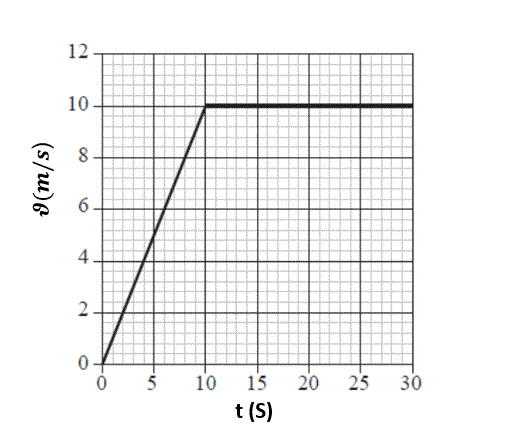
\(\Delta x=200\,m\)\(\Delta x=200\,m\)
\(\Delta x=350\,m\)\(\Delta x=350\,m\)
\(\Delta x=250\,m\)\(\Delta x=250\,m\)
\(\Delta x=300\,m\)\(\Delta x=300\,m\)
الحلSolution
📌 المسافة تساوي المساحة تحت منحنى (السرعة–الزمن).
📌 مثلث (من 0 إلى 10 s): \(\dfrac12(10)(10)=50\,m\)، ومستطيل (من 10 إلى 30 s): \((20)(10)=200\,m\).
📌 المجموع: \(50+200=250\,m\).
✅ \(\Delta x=250\,m\) (C)
📌 The distance equals the area under the velocity–time graph.
📌 Triangle (0 to 10 s): \(\dfrac12(10)(10)=50\,m\); rectangle (10 to 30 s): \((20)(10)=200\,m\).
📌 Total: \(50+200=250\,m\).
✅ \(\Delta x=250\,m\) (C)
\[15\,\star\star\]
سيارة تتحرك بسرعة \(2\,m/s\) زاد السائق سرعتها بمعدل \(0.5\,m/s^2\)، فإن المسافة التي قطعتها خلال زمن قدره \(1\,min\) تعادل:A car moving at \(2\,m/s\) has its speed increased by the driver at a rate of \(0.5\,m/s^2\). The distance it travels in \(1\,min\) is:
\(\Delta x=1430\,m\)\(\Delta x=1430\,m\)
\(\Delta x=1020\,m\)\(\Delta x=1020\,m\)
\(\Delta x=900\,m\)\(\Delta x=900\,m\)
\(\Delta x=1240\,m\)\(\Delta x=1240\,m\)
الحلSolution
📌 نحوّل الزمن: \(t=1\,min=60\,s\).
📌 \(\Delta x=v_it+\dfrac12at^2=2(60)+\dfrac12(0.5)(60)^2=120+900=1020\,m\).
✅ \(\Delta x=1020\,m\) (B)
📌 Convert the time: \(t=1\,min=60\,s\).
📌 \(\Delta x=v_it+\dfrac12at^2=2(60)+\dfrac12(0.5)(60)^2=120+900=1020\,m\).
✅ \(\Delta x=1020\,m\) (B)
\[16\,\star\star\star\]
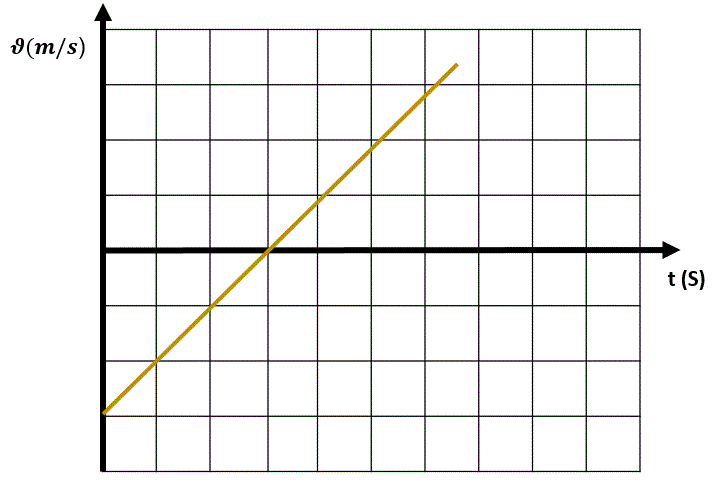
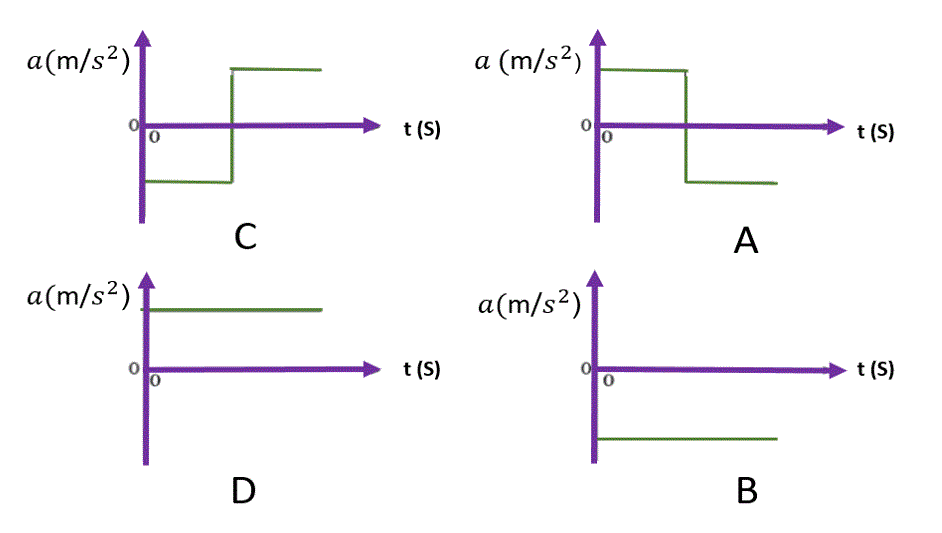
الخط البياني الأول يبيّن العلاقة بين السرعة والزمن لدراجة تتحرك في بعد واحد. أي الخطوط البيانية (A–D) هو الأفضل لتمثيل العلاقة بين التسارع والزمن لهذه الحركة؟The first graph shows the velocity–time relationship for a bicycle moving in one dimension. Which graph (A–D) best represents the acceleration–time relationship for this motion?
AA
BB
CC
DD
الحلSolution
📌 منحنى (السرعة–الزمن) خط مستقيم ميله موجب وثابت، أي أن التسارع موجب وثابت طوال الحركة (رغم أن السرعة تتغير من سالبة إلى موجبة).
📌 منحنى (التسارع–الزمن) إذن خط أفقي فوق محور الزمن: الشكل D.
✅ D
📌 The velocity–time graph is a straight line with a constant positive slope, so the acceleration is positive and constant throughout (even though the velocity changes from negative to positive).
📌 The acceleration–time graph is therefore a horizontal line above the time axis: graph D.
✅ D
\[17\,\star\]
عند سقوط جسم سقوطًا حرًا وبإهمال مقاومة الهواء فإن إحدى الكميات الفيزيائية التالية تتغير:When an object falls freely and air resistance is neglected, which of the following physical quantities changes?
سرعة الجسمThe velocity of the body
تسارع الجسمThe acceleration of the body
القوة المؤثرة على الجسمThe force on the body
كتلة الجسمThe mass of the body
الحلSolution
📌 في السقوط الحر التسارع ثابت (\(g\)) والقوة المؤثرة (الوزن) ثابتة والكتلة ثابتة، أما السرعة فتتزايد مع الزمن: \(v=gt\).
✅ سرعة الجسم (A)
📌 In free fall the acceleration (\(g\)), the force (weight) and the mass are constant, while the velocity increases with time: \(v=gt\).
✅ The velocity of the body (A)
\[18\,\star\star\]
تُركت كرة لتسقط سقوطًا حرًا من ارتفاع معيّن، فإن سرعة الكرة بعد \(3\,s\) تعادل (\(g=9.81\,m/s^2\)):A ball is dropped from a certain height. The velocity of the ball after \(3\,s\) is (\(g=9.81\,m/s^2\)):
\(v_f=-29.4\,m/s\)\(v_f=-29.4\,m/s\)
\(v_f=-3.3\,m/s\)\(v_f=-3.3\,m/s\)
\(v_f=-16.6\,m/s\)\(v_f=-16.6\,m/s\)
\(v_f=-22.8\,m/s\)\(v_f=-22.8\,m/s\)
الحلSolution
📌 الاتجاه الموجب لأعلى، والتسارع \(a=-g\): \(v_f=v_i-gt=0-9.81\times3=-29.4\,m/s\). الإشارة السالبة تعني أن الكرة تتحرك لأسفل.
✅ \(v_f=-29.4\,m/s\) (A)
📌 Taking up as positive, \(a=-g\): \(v_f=v_i-gt=0-9.81\times3=-29.4\,m/s\). The negative sign means the ball moves downward.
✅ \(v_f=-29.4\,m/s\) (A)
\[19\,\star\]
عند سقوط جسم سقوطًا حرًا في مجال الجاذبية الأرضية فإن الإزاحة المقطوعة تتناسب:When an object falls freely in Earth’s gravitational field, the displacement is proportional to:
طرديًا مع الزمنDirectly with time
عكسيًا مع الزمنInversely with time
طرديًا مع مربع الزمنDirectly with the square of time
عكسيًا مع مربع الزمنInversely with the square of time
الحلSolution
📌 من السكون: \(\Delta y=\dfrac12gt^2\)، فالإزاحة تتناسب طرديًا مع مربع الزمن.
✅ طرديًا مع مربع الزمن (C)
📌 Starting from rest: \(\Delta y=\dfrac12gt^2\), so the displacement is directly proportional to the square of time.
✅ Directly with the square of time (C)
\[20\,\star\]
تُركت كرة وريشة من الارتفاع نفسه لتسقطا سقوطًا حرًا بدون سرعة ابتدائية وبإهمال مقاومة الهواء، فإحدى الإجابات التالية صحيحة:A ball and a feather are dropped from the same height with no initial velocity, neglecting air resistance. Which of the following is correct?
الريشة والكرة تصلان معًاThe feather and the ball arrive together
الكرة تصل أولًاThe ball reaches the ground first
الريشة تصل أولًاThe feather reaches the ground first
لا نستطيع أن نحددWe cannot determine
الحلSolution
📌 في غياب مقاومة الهواء تسقط جميع الأجسام بالتسارع نفسه \(g\) بغض النظر عن كتلتها، فتصل الريشة والكرة في اللحظة نفسها.
✅ الريشة والكرة تصلان معًا (A)
📌 Without air resistance all objects fall with the same acceleration \(g\) regardless of mass, so the feather and the ball arrive at the same instant.
✅ The feather and the ball arrive together (A)
\[21\,\star\star\]
قُذف جسم رأسيًا إلى أعلى بسرعة مقدارها \(20\,m/s\)، فإن الزمن اللازم للوصول إلى أقصى ارتفاع يعادل (\(g=9.81\,m/s^2\)):A body is thrown vertically upward at \(20\,m/s\). The time needed to reach the maximum height is (\(g=9.81\,m/s^2\)):
\(t=2\,s\)\(t=2\,s\)
\(t=3\,s\)\(t=3\,s\)
\(t=2.5\,s\)\(t=2.5\,s\)
\(t=3.5\,s\)\(t=3.5\,s\)
الحلSolution
📌 عند أقصى ارتفاع تنعدم السرعة: \(0=v_i-gt\).
📌 \(t=\dfrac{v_i}{g}=\dfrac{20}{9.81}=2.04\,s\approx2\,s\).
✅ \(t=2\,s\) (A)
📌 At the maximum height the velocity is zero: \(0=v_i-gt\).
📌 \(t=\dfrac{v_i}{g}=\dfrac{20}{9.81}=2.04\,s\approx2\,s\).
✅ \(t=2\,s\) (A)
\[22\,\star\]
سيارة بدأت حركتها من السكون بتسارع منتظم مقداره \(2\,m/s^2\)، فإن سرعتها بعد أن تقطع مسافة قدرها \(20\,m\) تعادل:A car starts from rest with a uniform acceleration of \(2\,m/s^2\). Its speed after traveling \(20\,m\) is:
\(v_f=4.6\,m/s\)\(v_f=4.6\,m/s\)
\(v_f=12.2\,m/s\)\(v_f=12.2\,m/s\)
\(v_f=6.7\,m/s\)\(v_f=6.7\,m/s\)
\(v_f=8.9\,m/s\)\(v_f=8.9\,m/s\)
الحلSolution
📌 \(v_f^2=v_i^2+2a\Delta x=0+2(2)(20)=80\).
📌 \(v_f=\sqrt{80}=8.94\approx8.9\,m/s\).
✅ \(v_f=8.9\,m/s\) (D)
📌 \(v_f^2=v_i^2+2a\Delta x=0+2(2)(20)=80\).
📌 \(v_f=\sqrt{80}=8.94\approx8.9\,m/s\).
✅ \(v_f=8.9\,m/s\) (D)
\[23\,\star\]
قُذف حجر رأسيًا إلى أعلى بسرعة ابتدائية، فإن التسارع الذي يتحرك به الحجر لحظة وصوله إلى أقصى ارتفاع يعادل:A stone is thrown vertically upward with an initial velocity. The acceleration of the stone at the moment it reaches its maximum height is:
\(a=0\)\(a=0\)
\(a=-9.81\,m/s^2\)\(a=-9.81\,m/s^2\)
\(a=-2\,m/s^2\)\(a=-2\,m/s^2\)
\(a=-4\,m/s^2\)\(a=-4\,m/s^2\)
الحلSolution
📌 في أثناء الحركة الرأسية يؤثر وزن الجسم وحده، فيبقى التسارع ثابتًا \(a=-g=-9.81\,m/s^2\) طوال الرحلة، بما في ذلك عند أقصى ارتفاع (حيث تنعدم السرعة لحظيًا فقط).
✅ \(a=-9.81\,m/s^2\) (B)
📌 During vertical motion only the weight acts, so the acceleration stays constant at \(a=-g=-9.81\,m/s^2\) throughout the flight, including at the maximum height (where only the velocity is momentarily zero).
✅ \(a=-9.81\,m/s^2\) (B)
\[24\,\star\]
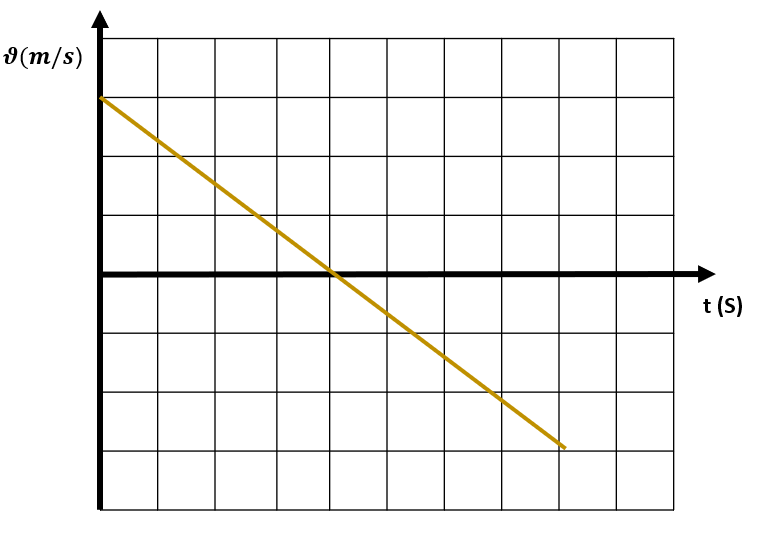
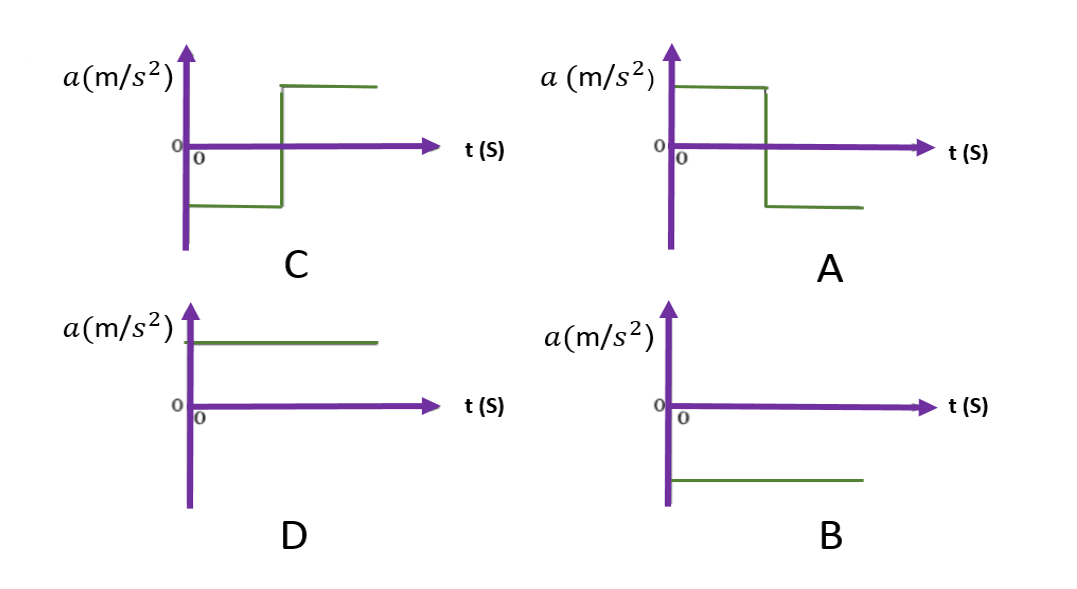
الخط البياني الأول يبيّن العلاقة بين (السرعة–الزمن) لجسم قُذف إلى أعلى بسرعة ابتدائية في بعد واحد. أي الخطوط البيانية (A–D) هو الأفضل لتمثيل العلاقة بين (التسارع–الزمن) لهذه الحركة؟The first graph shows the velocity–time relationship for a body thrown upward with an initial velocity in one dimension. Which graph (A–D) best represents the acceleration–time relationship for this motion?
AA
BB
CC
DD
الحلSolution
📌 منحنى (السرعة–الزمن) خط مستقيم ميله سالب وثابت، أي أن التسارع ثابت وسالب (\(-g\)) طوال الحركة.
📌 منحنى (التسارع–الزمن) خط أفقي تحت محور الزمن: الشكل B.
✅ B
📌 The velocity–time graph is a straight line with a constant negative slope, so the acceleration is constant and negative (\(-g\)) throughout.
📌 The acceleration–time graph is a horizontal line below the time axis: graph B.
✅ B
\[25\,\star\star\]
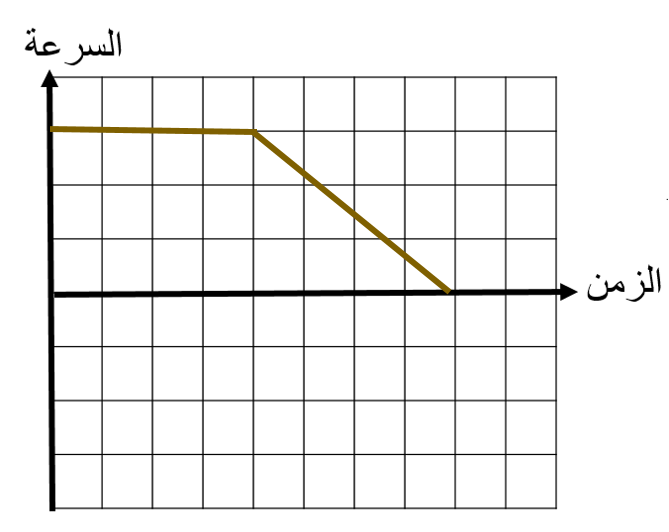
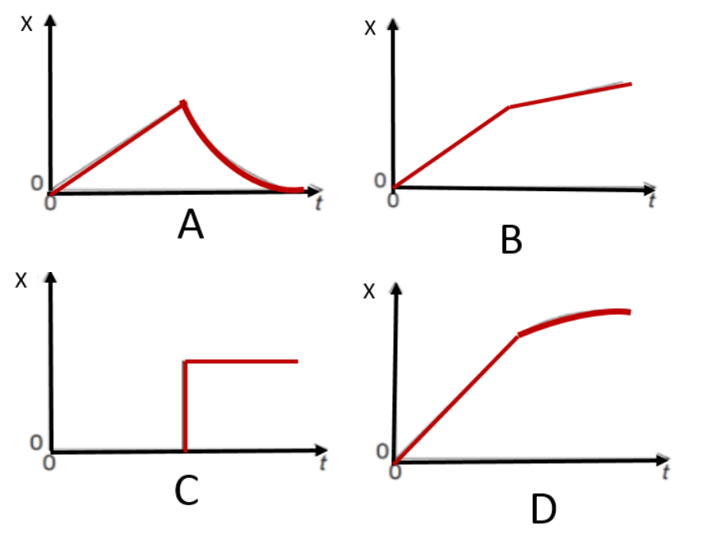
سيارة تسير في خط مستقيم، ويوضّح الرسم البياني الأول العلاقة بين السرعة والزمن. أي الخطوط البيانية (A–D) يوضّح العلاقة بين الموضع والزمن لحركة السيارة؟A car moves in a straight line. The first graph shows the velocity–time relationship. Which graph (A–D) shows the position–time relationship for the car’s motion?
AA
BB
CC
DD
الحلSolution
📌 في المرحلة الأولى السرعة ثابتة وموجبة، فيكون منحنى (الموضع–الزمن) خطًا مستقيمًا صاعدًا (ميله = السرعة).
📌 في المرحلة الثانية تتناقص السرعة بانتظام حتى الصفر، فيتناقص ميل المنحنى تدريجيًا حتى يصبح أفقيًا: منحنى مقعّر لأسفل ينتهي بميل صفر.
📌 هذا هو الشكل D. الشكل A يعني أن الموضع يتناقص (سرعة سالبة)، والشكل B يعني أن السرعة تهبط فجأة إلى قيمة أقل لا إلى الصفر، والشكل C قفزة مفاجئة في الموضع وهذا مستحيل.
✅ D
📌 In the first stage the velocity is constant and positive, so the position–time graph is a rising straight line (its slope is the velocity).
📌 In the second stage the velocity decreases uniformly to zero, so the slope of the curve decreases gradually until it becomes horizontal: a concave-down curve ending with zero slope.
📌 This is graph D. Graph A would mean the position decreases (negative velocity); B means the velocity suddenly drops to a smaller value instead of zero; C shows a sudden jump in position, which is impossible.
✅ D
\[26\,\star\star\]
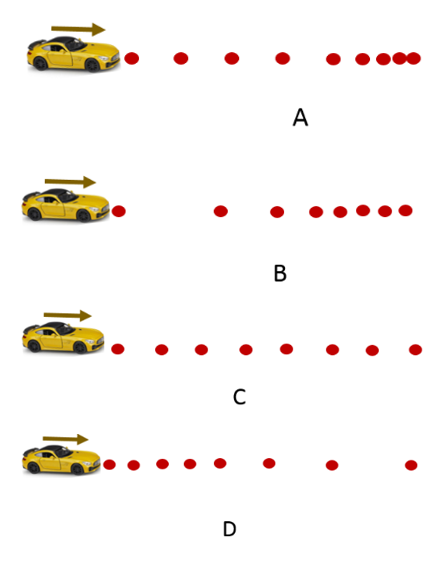
سيارة تتحرك بسرعة ثابتة ثم زادت سرعتها. أحد الأشكال التالية يمثل التمثيل الجسيمي (النقطي) لحركة السيارة (تُسجَّل مواضع السيارة في فترات زمنية متساوية):A car moves with constant speed and then increases its speed. Which of the following is the particle (dot) model of the car’s motion? (The positions are recorded at equal time intervals.)
AA
BB
CC
DD
الحلSolution
📌 تُسجَّل المواضع في فترات زمنية متساوية؛ فالسرعة الثابتة تعني مسافات متساوية بين النقاط، والسرعة المتزايدة تعني مسافات متزايدة.
📌 الشكل D فقط تبدأ نقاطه متساوية البعد ثم تتباعد تدريجيًا. أما A وB فنقاطهما تتقارب (تباطؤ)، وC متساوية البعد كلها.
✅ D
📌 Positions are recorded at equal time intervals: constant speed means equal distances between dots, and increasing speed means increasing distances.
📌 Only D starts with equally spaced dots and then spreads out gradually. A and B have dots that get closer (slowing down), and C is equally spaced throughout.
✅ D
\[27\,\star\]
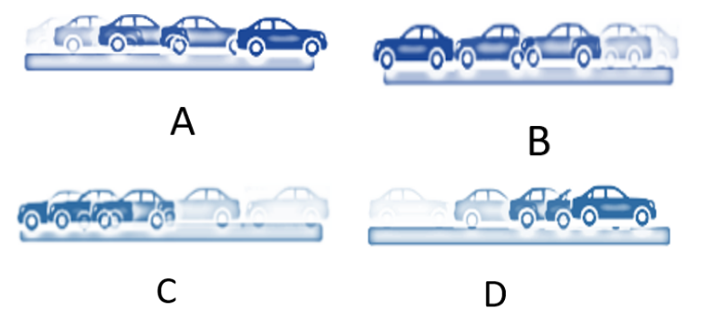
التُقطت صور لسيارة في فترات زمنية متساوية (الصورة الأوضح هي الأحدث). أحد الأشكال التالية يعبّر عن تسارع في الاتجاه السالب وسرعة في الاتجاه السالب:Pictures of a car were taken at equal time intervals (the clearest image is the latest). Which of the following shows acceleration in the negative direction and velocity in the negative direction?
AA
BB
CC
DD
الحلSolution
📌 السرعة سالبة: تتحرك السيارة نحو اليسار (الأحدث إلى اليسار). والتسارع سالب: تتزايد السرعة في هذا الاتجاه، فتزداد المسافة بين الصور المتتالية مع الزمن.
📌 هذا ينطبق على الشكل B. الشكلان A وD حركتهما نحو اليمين، والشكل C حركته نحو اليسار لكن بتباطؤ (تسارع موجب).
✅ B
📌 Negative velocity: the car moves to the left (the latest image is on the left). Negative acceleration: the speed increases in that direction, so the distance between successive images grows with time.
📌 This matches graph B. Figures A and D show motion to the right, and figure C shows motion to the left but slowing down (positive acceleration).
✅ B
\[28\,\star\star\]
رُصدت سيارة سباق عند الموقع \(40\,m\) من نقطة البداية بسرعة مقدارها \(20\,m/s\)، ولوحظ أنها تتحرك بتسارع قدره \(a=3\,m/s^2\)، فإن سرعة السيارة عند الموقع \(x_f=120\,m\) تعادل:A race car was observed at position \(40\,m\) from the starting point with a speed of \(20\,m/s\), and it accelerates at \(a=3\,m/s^2\). The speed of the car at position \(x_f=120\,m\) is:
\(v_f=18.4\,m/s\)\(v_f=18.4\,m/s\)
\(v_f=25.3\,m/s\)\(v_f=25.3\,m/s\)
\(v_f=29.7\,m/s\)\(v_f=29.7\,m/s\)
\(v_f=37.5\,m/s\)\(v_f=37.5\,m/s\)
الحلSolution
📌 الإزاحة: \(\Delta x=120-40=80\,m\).
📌 \(v_f^2=v_i^2+2a\Delta x=20^2+2(3)(80)=880\Rightarrow v_f=\sqrt{880}=29.7\,m/s\).
✅ \(v_f=29.7\,m/s\) (C)
📌 Displacement: \(\Delta x=120-40=80\,m\).
📌 \(v_f^2=v_i^2+2a\Delta x=20^2+2(3)(80)=880\Rightarrow v_f=\sqrt{880}=29.7\,m/s\).
✅ \(v_f=29.7\,m/s\) (C)
\[29\,\star\]
دراجة نارية تغيّرت سرعتها من \(10\,m/s\) إلى \(30\,m/s\) خلال \(5\,s\) بتسارع ثابت، فإن مقدار التسارع يعادل:A motorcycle’s speed changes from \(10\,m/s\) to \(30\,m/s\) in \(5\,s\) with constant acceleration. The magnitude of the acceleration is:
\(a=6\,m/s^2\)\(a=6\,m/s^2\)
\(a=4\,m/s^2\)\(a=4\,m/s^2\)
\(a=2\,m/s^2\)\(a=2\,m/s^2\)
\(a=8\,m/s^2\)\(a=8\,m/s^2\)
الحلSolution
📌 \(a=\dfrac{v_f-v_i}{t}=\dfrac{30-10}{5}=4\,m/s^2\).
✅ \(a=4\,m/s^2\) (B)
📌 \(a=\dfrac{v_f-v_i}{t}=\dfrac{30-10}{5}=4\,m/s^2\).
✅ \(a=4\,m/s^2\) (B)
\[30\,\star\]
جسم يتحرك على خط مستقيم بسرعة ثابتة مقدارها \(15\,m/s\)، فإن تسارعه يعادل:An object moves along a straight line with a constant speed of \(15\,m/s\). Its acceleration is:
\(a=15\,m/s^2\)\(a=15\,m/s^2\)
\(a=0\)\(a=0\)
\(a=9.81\,m/s^2\)\(a=9.81\,m/s^2\)
\(a=1.5\,m/s^2\)\(a=1.5\,m/s^2\)
الحلSolution
📌 التسارع هو معدل تغيّر السرعة. وعندما تكون السرعة ثابتة لا يوجد تغيّر فيها: \(a=\dfrac{\Delta v}{\Delta t}=0\).
✅ \(a=0\) (B)
📌 Acceleration is the rate of change of velocity. When the velocity is constant it does not change: \(a=\dfrac{\Delta v}{\Delta t}=0\).
✅ \(a=0\) (B)
\[31\,\star\]
قطار بدأ حركته من السكون بتسارع ثابت مقداره \(0.5\,m/s^2\)، فإن سرعته بعد \(20\,s\) تعادل:A train starts from rest with a constant acceleration of \(0.5\,m/s^2\). Its speed after \(20\,s\) is:
\(v=20\,m/s\)\(v=20\,m/s\)
\(v=40\,m/s\)\(v=40\,m/s\)
\(v=5\,m/s\)\(v=5\,m/s\)
\(v=10\,m/s\)\(v=10\,m/s\)
الحلSolution
📌 \(v_f=v_i+at=0+0.5\times20=10\,m/s\).
✅ \(v=10\,m/s\) (D)
📌 \(v_f=v_i+at=0+0.5\times20=10\,m/s\).
✅ \(v=10\,m/s\) (D)
\[32\,\star\]
المساحة المحصورة تحت منحنى (التسارع–الزمن) تمثّل:The area under an acceleration–time graph represents:
الإزاحةThe displacement
التغير في السرعةThe change in velocity
التسارع المتوسطThe average acceleration
السرعة المتوسطةThe average velocity
الحلSolution
📌 المساحة تحت منحنى (التسارع–الزمن) تساوي \(a\times t=\Delta v\)، أي التغير في السرعة. أما الإزاحة فتساوي المساحة تحت منحنى (السرعة–الزمن).
✅ التغير في السرعة (B)
📌 The area under an acceleration–time graph equals \(a\times t=\Delta v\), the change in velocity. The displacement is the area under the velocity–time graph.
✅ The change in velocity (B)
\[33\,\star\star\]
سيارة تسير بسرعة \(15\,m/s\) ضغط سائقها على الفرامل فتباطأت بتسارع \(-3\,m/s^2\)، فإن الزمن اللازم حتى تتوقف السيارة يعادل:A car moving at \(15\,m/s\) brakes and decelerates at \(-3\,m/s^2\). The time it takes to stop is:
\(t=45\,s\)\(t=45\,s\)
\(t=5\,s\)\(t=5\,s\)
\(t=0.2\,s\)\(t=0.2\,s\)
\(t=12\,s\)\(t=12\,s\)
الحلSolution
📌 عند التوقف \(v_f=0\): \(v_f=v_i+at\Rightarrow t=\dfrac{0-15}{-3}=5\,s\).
✅ \(t=5\,s\) (B)
📌 At rest \(v_f=0\): \(v_f=v_i+at\Rightarrow t=\dfrac{0-15}{-3}=5\,s\).
✅ \(t=5\,s\) (B)
\[34\,\star\star\]
سيارة تسير بسرعة \(20\,m/s\) فرمل سائقها بتسارع مقداره \(-5\,m/s^2\)، فإن المسافة التي تقطعها حتى تتوقف تعادل:A car moving at \(20\,m/s\) brakes with an acceleration of \(-5\,m/s^2\). The distance it travels before stopping is:
\(\Delta x=40\,m\)\(\Delta x=40\,m\)
\(\Delta x=80\,m\)\(\Delta x=80\,m\)
\(\Delta x=20\,m\)\(\Delta x=20\,m\)
\(\Delta x=4\,m\)\(\Delta x=4\,m\)
الحلSolution
📌 لا يُعطى الزمن، لذا نستخدم \(v_f^2=v_i^2+2a\Delta x\).
📌 \(0=20^2+2(-5)\Delta x\Rightarrow\Delta x=\dfrac{400}{10}=40\,m\).
✅ \(\Delta x=40\,m\) (A)
📌 Time is not given, so we use \(v_f^2=v_i^2+2a\Delta x\).
📌 \(0=20^2+2(-5)\Delta x\Rightarrow\Delta x=\dfrac{400}{10}=40\,m\).
✅ \(\Delta x=40\,m\) (A)
\[35\,\star\star\]
دراجة بدأت حركتها من السكون بتسارع ثابت مقداره \(1.2\,m/s^2\)، فإن المسافة التي تقطعها خلال \(10\,s\) تعادل:A bicycle starts from rest with a constant acceleration of \(1.2\,m/s^2\). The distance it travels in \(10\,s\) is:
\(\Delta x=60\,m\)\(\Delta x=60\,m\)
\(\Delta x=120\,m\)\(\Delta x=120\,m\)
\(\Delta x=12\,m\)\(\Delta x=12\,m\)
\(\Delta x=30\,m\)\(\Delta x=30\,m\)
الحلSolution
📌 \(\Delta x=v_it+\dfrac12at^2=0+\dfrac12(1.2)(10)^2=60\,m\).
✅ \(\Delta x=60\,m\) (A)
📌 \(\Delta x=v_it+\dfrac12at^2=0+\dfrac12(1.2)(10)^2=60\,m\).
✅ \(\Delta x=60\,m\) (A)
\[36\,\star\star\]
تُركت كرة لتسقط سقوطًا حرًا من قمة برج ارتفاعه \(20\,m\)، فإن سرعتها لحظة وصولها إلى الأرض تعادل (\(g=9.81\,m/s^2\)):A ball is dropped from the top of a \(20\,m\) tower. Its speed just before reaching the ground is (\(g=9.81\,m/s^2\)):
\(v=14.0\,m/s\)\(v=14.0\,m/s\)
\(v=39.2\,m/s\)\(v=39.2\,m/s\)
\(v=9.81\,m/s\)\(v=9.81\,m/s\)
\(v=19.8\,m/s\)\(v=19.8\,m/s\)
الحلSolution
📌 من السكون: \(v^2=2gh=2(9.81)(20)=392.4\).
📌 \(v=\sqrt{392.4}=19.8\,m/s\).
✅ \(v=19.8\,m/s\) (D)
📌 From rest: \(v^2=2gh=2(9.81)(20)=392.4\).
📌 \(v=\sqrt{392.4}=19.8\,m/s\).
✅ \(v=19.8\,m/s\) (D)
\[37\,\star\star\]
قُذف جسم رأسيًا إلى أعلى بسرعة \(15\,m/s\)، فإن أقصى ارتفاع يصل إليه الجسم يعادل (\(g=9.81\,m/s^2\)):A body is thrown vertically upward at \(15\,m/s\). The maximum height it reaches is (\(g=9.81\,m/s^2\)):
\(h=22.9\,m\)\(h=22.9\,m\)
\(h=1.5\,m\)\(h=1.5\,m\)
\(h=11.5\,m\)\(h=11.5\,m\)
\(h=15.0\,m\)\(h=15.0\,m\)
الحلSolution
📌 عند أقصى ارتفاع \(v_f=0\): \(0=v_i^2-2gh\).
📌 \(h=\dfrac{v_i^2}{2g}=\dfrac{15^2}{2(9.81)}=11.5\,m\).
✅ \(h=11.5\,m\) (C)
📌 At the maximum height \(v_f=0\): \(0=v_i^2-2gh\).
📌 \(h=\dfrac{v_i^2}{2g}=\dfrac{15^2}{2(9.81)}=11.5\,m\).
✅ \(h=11.5\,m\) (C)
\[38\,\star\star\]
قُذفت كرة رأسيًا إلى أعلى بسرعة \(24.5\,m/s\)، فإن الزمن الكلي حتى تعود إلى نقطة القذف نفسها يعادل (\(g=9.81\,m/s^2\)):A ball is thrown vertically upward at \(24.5\,m/s\). The total time until it returns to the launch point is (\(g=9.81\,m/s^2\)):
\(t=5.0\,s\)\(t=5.0\,s\)
\(t=2.5\,s\)\(t=2.5\,s\)
\(t=7.5\,s\)\(t=7.5\,s\)
\(t=10.0\,s\)\(t=10.0\,s\)
الحلSolution
📌 زمن الصعود يساوي زمن الهبوط: \(t_{up}=\dfrac{v_i}{g}=\dfrac{24.5}{9.81}=2.5\,s\).
📌 الزمن الكلي: \(t=2\times2.5=5.0\,s\).
✅ \(t=5.0\,s\) (A)
📌 The time up equals the time down: \(t_{up}=\dfrac{v_i}{g}=\dfrac{24.5}{9.81}=2.5\,s\).
📌 Total time: \(t=2\times2.5=5.0\,s\).
✅ \(t=5.0\,s\) (A)
\[39\,\star\star\star\]
يبيّن الشكل العلاقة بين سرعة جسم يتحرك على خط مستقيم والزمن. فإن المسافة الكلية التي قطعها الجسم خلال \(8\,s\) تعادل:The figure shows the velocity of an object moving along a straight line versus time. The total distance traveled by the object during \(8\,s\) is:
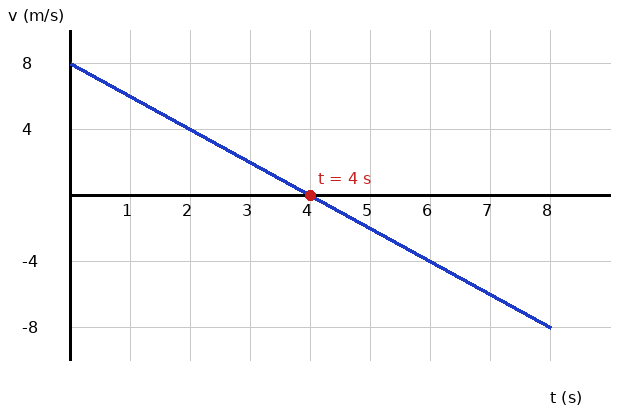
\(0\)\(0\)
\(16\,m\)\(16\,m\)
\(32\,m\)\(32\,m\)
\(64\,m\)\(64\,m\)
الحلSolution
📌 تتغير السرعة من \(+8\,m/s\) إلى \(-8\,m/s\) بانتظام، فتنعدم عند \(t=4\,s\) (يتغير اتجاه الحركة عندها).
📌 المساحة فوق المحور: \(\dfrac12(4)(8)=16\,m\) (حركة في الاتجاه الموجب)، والمساحة تحت المحور: \(\dfrac12(4)(8)=16\,m\) (حركة في الاتجاه السالب).
📌 المسافة الكلية تجمع المساحتين بقيمتيهما المطلقتين: \(16+16=32\,m\)، أما الإزاحة الصافية فتساوي \(16-16=0\) (يعود الجسم إلى نقطة البداية).
✅ \(32\,m\) (C)
📌 The velocity changes uniformly from \(+8\,m/s\) to \(-8\,m/s\), so it is zero at \(t=4\,s\) (the direction of motion reverses there).
📌 Area above the axis: \(\dfrac12(4)(8)=16\,m\) (motion in the positive direction); area below the axis: \(\dfrac12(4)(8)=16\,m\) (motion in the negative direction).
📌 The total distance adds the two areas as positive numbers: \(16+16=32\,m\), whereas the net displacement is \(16-16=0\) (the object returns to its starting point).
✅ \(32\,m\) (C)
\[40\,\star\star\star\]
سيارة بدأت حركتها من السكون بتسارع منتظم \(2\,m/s^2\) لمدة \(10\,s\)، ثم تابعت حركتها بالسرعة التي وصلت إليها ثابتةً لمدة \(5\,s\)، فإن المسافة الكلية التي قطعتها تعادل:A car starts from rest with a uniform acceleration of \(2\,m/s^2\) for \(10\,s\), then continues at the constant speed it has reached for \(5\,s\). The total distance it travels is:
\(\Delta x=150\,m\)\(\Delta x=150\,m\)
\(\Delta x=300\,m\)\(\Delta x=300\,m\)
\(\Delta x=100\,m\)\(\Delta x=100\,m\)
\(\Delta x=200\,m\)\(\Delta x=200\,m\)
الحلSolution
📌 مرحلة التسارع: \(\Delta x_1=\dfrac12at^2=\dfrac12(2)(10)^2=100\,m\)، والسرعة في نهايتها \(v=at=2\times10=20\,m/s\).
📌 مرحلة السرعة الثابتة: \(\Delta x_2=vt=20\times5=100\,m\).
📌 المجموع: \(100+100=200\,m\).
✅ \(\Delta x=200\,m\) (D)
📌 Acceleration stage: \(\Delta x_1=\dfrac12at^2=\dfrac12(2)(10)^2=100\,m\), and the speed at its end is \(v=at=2\times10=20\,m/s\).
📌 Constant-speed stage: \(\Delta x_2=vt=20\times5=100\,m\).
📌 Total: \(100+100=200\,m\).
✅ \(\Delta x=200\,m\) (D)
\[41\,\star\star\star\]
يُعطى موقع جسم يتحرك على خط مستقيم بالعلاقة \(x=5+4t+3t^2\) حيث \(x\) بالأمتار و \(t\) بالثواني. فإن السرعة الابتدائية والتسارع للجسم على الترتيب:The position of an object moving along a straight line is given by \(x=5+4t+3t^2\), where \(x\) is in meters and \(t\) in seconds. The initial velocity and the acceleration of the object are, respectively:
\(v_i=4\,m/s\)، \(a=6\,m/s^2\)\(v_i=4\,m/s\), \(a=6\,m/s^2\)
\(v_i=4\,m/s\)، \(a=3\,m/s^2\)\(v_i=4\,m/s\), \(a=3\,m/s^2\)
\(v_i=5\,m/s\)، \(a=6\,m/s^2\)\(v_i=5\,m/s\), \(a=6\,m/s^2\)
\(v_i=3\,m/s\)، \(a=4\,m/s^2\)\(v_i=3\,m/s\), \(a=4\,m/s^2\)
الحلSolution
📌 نقارن مع معادلة الحركة: \(x=x_i+v_it+\dfrac12at^2\).
📌 \(x_i=5\,m\)، و \(v_i=4\,m/s\)، و \(\dfrac12a=3\Rightarrow a=6\,m/s^2\).
✅ \(v_i=4\,m/s\)، \(a=6\,m/s^2\) (A)
📌 Compare with the equation of motion: \(x=x_i+v_it+\dfrac12at^2\).
📌 \(x_i=5\,m\), \(v_i=4\,m/s\), and \(\dfrac12a=3\Rightarrow a=6\,m/s^2\).
✅ \(v_i=4\,m/s\), \(a=6\,m/s^2\) (A)
\[42\,\star\star\star\]
تمرّ سيارة A بسرعة ثابتة \(20\,m/s\) بجانب سيارة ساكنة B، وفي اللحظة نفسها تبدأ B الحركة في الاتجاه نفسه بتسارع منتظم \(2\,m/s^2\). فإن الزمن الذي تحتاجه B لتلحق بالسيارة A يعادل:Car A passes a stationary car B at a constant speed of \(20\,m/s\). At the same instant B starts moving in the same direction with a uniform acceleration of \(2\,m/s^2\). The time B needs to catch up with A is:
\(t=10\,s\)\(t=10\,s\)
\(t=40\,s\)\(t=40\,s\)
\(t=20\,s\)\(t=20\,s\)
\(t=5\,s\)\(t=5\,s\)
الحلSolution
📌 تلحق B بالسيارة A عندما يكون موقعاهما متساويين: \(x_A=x_B\).
📌 \(x_A=20t\) و \(x_B=\dfrac12(2)t^2=t^2\)، إذن \(20t=t^2\Rightarrow t=20\,s\).
📌 لاحظ أن \(t=10\,s\) هي لحظة تساوي السرعتين فقط (\(v_B=2\times10=20\,m/s\)) وليست لحظة اللحاق.
✅ \(t=20\,s\) (C)
📌 B catches A when their positions are equal: \(x_A=x_B\).
📌 \(x_A=20t\) and \(x_B=\dfrac12(2)t^2=t^2\), so \(20t=t^2\Rightarrow t=20\,s\).
📌 Note that \(t=10\,s\) is only the instant when the speeds are equal (\(v_B=2\times10=20\,m/s\)), not the instant of catching up.
✅ \(t=20\,s\) (C)
\[43\,\star\star\star\]
قُذفت كرة رأسيًا إلى أسفل بسرعة \(5\,m/s\) من جسر فارتطمت بالماء بعد \(2\,s\)، فإن ارتفاع الجسر عن سطح الماء يعادل (\(g=9.81\,m/s^2\)):A ball is thrown vertically downward at \(5\,m/s\) from a bridge and hits the water after \(2\,s\). The height of the bridge above the water is (\(g=9.81\,m/s^2\)):
\(h=19.6\,m\)\(h=19.6\,m\)
\(h=29.6\,m\)\(h=29.6\,m\)
\(h=10.0\,m\)\(h=10.0\,m\)
\(h=39.2\,m\)\(h=39.2\,m\)
الحلSolution
📌 نأخذ الاتجاه إلى أسفل موجبًا، فالتسارع \(a=+g\) والسرعة الابتدائية \(v_i=5\,m/s\).
📌 \(h=v_it+\dfrac12gt^2=5(2)+\dfrac12(9.81)(2)^2=10+19.62=29.6\,m\).
✅ \(h=29.6\,m\) (B)
📌 Taking downward as positive, the acceleration is \(a=+g\) and the initial velocity is \(v_i=5\,m/s\).
📌 \(h=v_it+\dfrac12gt^2=5(2)+\dfrac12(9.81)(2)^2=10+19.62=29.6\,m\).
✅ \(h=29.6\,m\) (B)
📝 المسائل المقالية
📝 Essay Problems
\[1\,\star\star\]
غادرت سفينة فضاء مدار الأرض في طريقها إلى القمر، فتسارعت بمعدل \(15\,m/s^2\) لمدة \(1.5\,min\) وقطعت خلالها مسافة قدرها \(500\,km\). (أ) احسب سرعة سفينة الفضاء لحظة مغادرة المدار. (ب) احسب سرعتها بعد انقضاء الزمن المحدد.A spaceship left Earth’s orbit on its way to the Moon. It accelerated at \(15\,m/s^2\) for \(1.5\,min\) and traveled \(500\,km\) during that time. (a) Calculate the spaceship’s speed when it left the orbit. (b) Calculate its speed after the given time.
.....................................................................
الحلSolution
📌 نحوّل الوحدات: \(t=1.5\times60=90\,s\)، \(\Delta x=500\times1000=5\times10^5\,m\).
📌 (أ) \(\Delta x=v_it+\dfrac12at^2\Rightarrow5\times10^5=90v_i+\dfrac12(15)(90)^2\)، أي \(5\times10^5=90v_i+60750\).
📌 \(v_i=\dfrac{500000-60750}{90}=4880.6\,m/s\).
📌 (ب) \(v_f=v_i+at=4880.6+15(90)=6230.6\,m/s\).
✅ \(v_i=4880.6\,m/s\)، \(v_f=6230.6\,m/s\)
📌 Convert the units: \(t=1.5\times60=90\,s\), \(\Delta x=500\times1000=5\times10^5\,m\).
📌 (a) \(\Delta x=v_it+\dfrac12at^2\Rightarrow5\times10^5=90v_i+\dfrac12(15)(90)^2\), i.e. \(5\times10^5=90v_i+60750\).
📌 \(v_i=\dfrac{500000-60750}{90}=4880.6\,m/s\).
📌 (b) \(v_f=v_i+at=4880.6+15(90)=6230.6\,m/s\).
✅ \(v_i=4880.6\,m/s\), \(v_f=6230.6\,m/s\)
\[2\,\star\star\]
في سباق الفورمولا انطلقت سيارة من السكون، وبعد ثوانٍ قليلة حدث فيها عطل، وتم رصد العلاقة (السرعة–الزمن) فنتج الخط البياني أدناه. من معلومات الخط البياني: (أ) احسب التسارع المتوسط من الثانية 10 إلى الثانية 18. (ب) احسب المسافة المقطوعة عندما كانت السيارة تتحرك بسرعة ثابتة. (ج) احسب المسافة الكلية التي قطعتها السيارة.In a Formula race a car started from rest, and after a few seconds a fault occurred. The velocity–time relationship was recorded and gave the graph below. From the graph: (a) Calculate the average acceleration from \(t=10\,s\) to \(t=18\,s\). (b) Calculate the distance traveled while the car moved at constant speed. (c) Calculate the total distance traveled by the car.
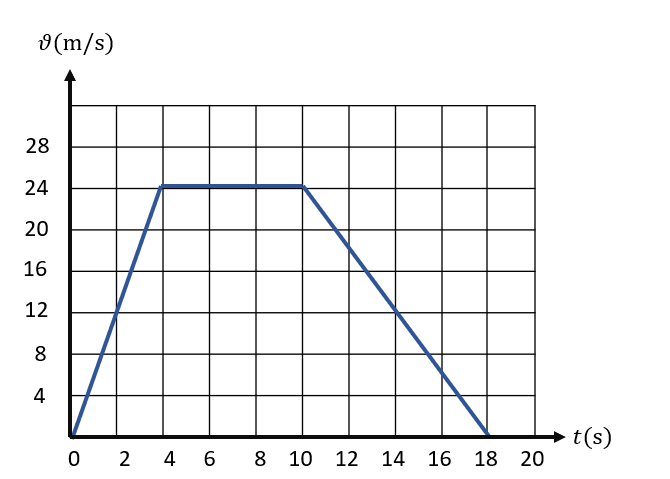
.....................................................................
الحلSolution
📌 (أ) من الرسم السرعة عند \(t=10\,s\) هي \(24\,m/s\) وعند \(t=18\,s\) تساوي صفرًا: \(a_{avg}=\dfrac{0-24}{18-10}=-3\,m/s^2\).
📌 (ب) السرعة ثابتة (\(24\,m/s\)) من \(t=4\,s\) إلى \(t=10\,s\): \(\Delta x=vt=24\times(10-4)=144\,m\).
📌 (ج) المسافة الكلية = المساحة تحت المنحنى: \(\dfrac12(4)(24)+144+\dfrac12(8)(24)=48+144+96=288\,m\).
✅ \(a_{avg}=-3\,m/s^2\)، \(\Delta x_{const}=144\,m\)، \(\Delta x_{total}=288\,m\)
📌 (a) From the graph the velocity at \(t=10\,s\) is \(24\,m/s\) and at \(t=18\,s\) it is zero: \(a_{avg}=\dfrac{0-24}{18-10}=-3\,m/s^2\).
📌 (b) The speed is constant (\(24\,m/s\)) from \(t=4\,s\) to \(t=10\,s\): \(\Delta x=vt=24\times(10-4)=144\,m\).
📌 (c) Total distance = area under the graph: \(\dfrac12(4)(24)+144+\dfrac12(8)(24)=48+144+96=288\,m\).
✅ \(a_{avg}=-3\,m/s^2\), \(\Delta x_{const}=144\,m\), \(\Delta x_{total}=288\,m\)
\[3\,\star\star\]
الخط البياني التالي يبيّن العلاقة بين (السرعة–الزمن) لحركة دراجة. (أ) في أي فترة زمنية كان مقدار السرعة متزايدًا والتسارع منتظمًا ولكن بإشارة سالبة؟ (ب) في أي فترة زمنية كان مقدار السرعة متناقصًا والتسارع منتظمًا ولكن بإشارة سالبة؟ (ج) احسب من الخط البياني التسارع المنتظم من الثانية 15 إلى الثانية 40.The graph shows the velocity–time relationship for a bicycle. (a) During which time interval was the speed increasing with a uniform acceleration of negative sign? (b) During which time interval was the speed decreasing with a uniform acceleration of negative sign? (c) Calculate from the graph the uniform acceleration from \(t=15\,s\) to \(t=40\,s\).
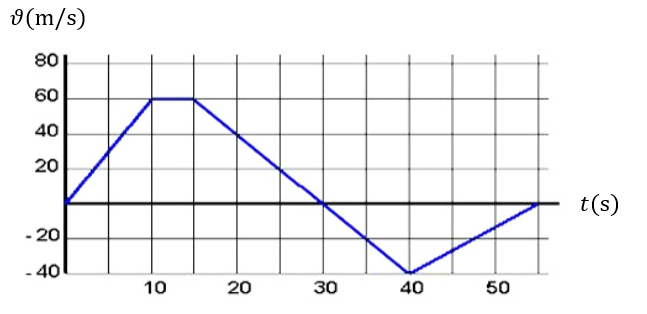
.....................................................................
الحلSolution
📌 (أ) المطلوب: مقدار السرعة يزداد والتسارع سالب، أي أن السرعة سالبة وتزداد في الاتجاه السالب: من \(t=30\,s\) إلى \(t=40\,s\) (تتغير السرعة من 0 إلى \(-40\,m/s\)).
📌 (ب) المطلوب: مقدار السرعة يتناقص والتسارع سالب، أي أن السرعة موجبة وتتناقص: من \(t=15\,s\) إلى \(t=30\,s\) (تتغير السرعة من \(60\,m/s\) إلى 0).
📌 (ج) من الرسم: \(v(15)=60\,m/s\) و \(v(40)=-40\,m/s\) والخط مستقيم بين اللحظتين: \(a=\dfrac{\Delta v}{\Delta t}=\dfrac{-40-60}{40-15}=-4\,m/s^2\).
✅ أ) \(30\to40\,s\)، ب) \(15\to30\,s\)، ج) \(a=-4\,m/s^2\)
📌 (a) The speed increases while the acceleration is negative, so the velocity is negative and grows in the negative direction: from \(t=30\,s\) to \(t=40\,s\) (the velocity changes from 0 to \(-40\,m/s\)).
📌 (b) The speed decreases while the acceleration is negative, so the velocity is positive and decreasing: from \(t=15\,s\) to \(t=30\,s\) (the velocity changes from \(60\,m/s\) to 0).
📌 (c) From the graph: \(v(15)=60\,m/s\) and \(v(40)=-40\,m/s\), with a straight line between them: \(a=\dfrac{\Delta v}{\Delta t}=\dfrac{-40-60}{40-15}=-4\,m/s^2\).
✅ (a) \(30\to40\,s\), (b) \(15\to30\,s\), (c) \(a=-4\,m/s^2\)
\[4\,\star\]
أراد يوسف أن يقيس عمق بئر، فترك حجرًا يسقط فيها سقوطًا حرًا وشاهد ارتطامه بالماء بعد ثانيتين من لحظة تركه، وبإهمال مقاومة الهواء: (أ) احسب عمق البئر. (ب) احسب سرعة ارتطام الحجر بماء البئر. (ج) ارسم العلاقة بين السرعة والزمن على الشبكة البيانية المقابلة (اعتبر الاتجاه إلى أعلى موجبًا).Yousef wanted to measure the depth of a well. He dropped a stone into it and saw it hit the water 2 seconds after he released it (neglect air resistance). (a) Calculate the depth of the well. (b) Calculate the speed with which the stone hits the water. (c) Draw the velocity–time graph on the grid shown (take upward as positive).
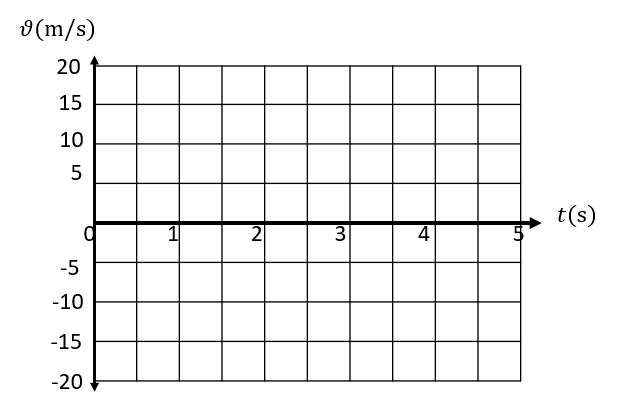
.....................................................................
الحلSolution
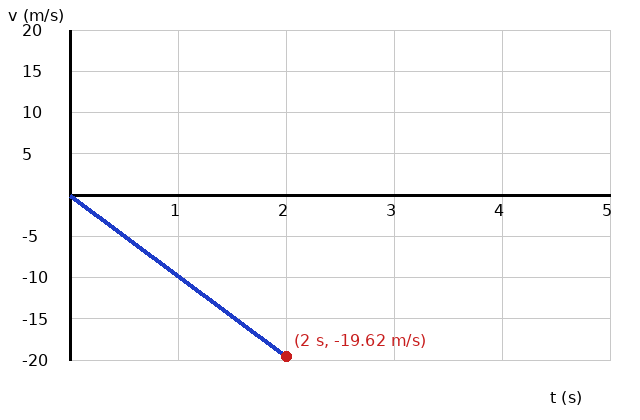
📌 (أ) \(h=\dfrac12gt^2=\dfrac12(9.81)(2)^2=19.62\,m\).
📌 (ب) \(v=gt=9.81\times2=19.62\,m/s\) (إلى أسفل).
📌 (ج) تبدأ السرعة من الصفر وتتناقص بانتظام (\(a=-9.81\,m/s^2\)) لتصل إلى \(-19.62\,m/s\) عند \(t=2\,s\): خط مستقيم ميله سالب كما في الشكل.
✅ \(h=19.62\,m\)، \(v=19.62\,m/s\)
📌 (a) \(h=\dfrac12gt^2=\dfrac12(9.81)(2)^2=19.62\,m\).
📌 (b) \(v=gt=9.81\times2=19.62\,m/s\) (downward).
📌 (c) The velocity starts at zero and decreases uniformly (\(a=-9.81\,m/s^2\)) to reach \(-19.62\,m/s\) at \(t=2\,s\): a straight line with a negative slope, as in the figure.
✅ \(h=19.62\,m\), \(v=19.62\,m/s\)
\[5\,\star\star\star\]
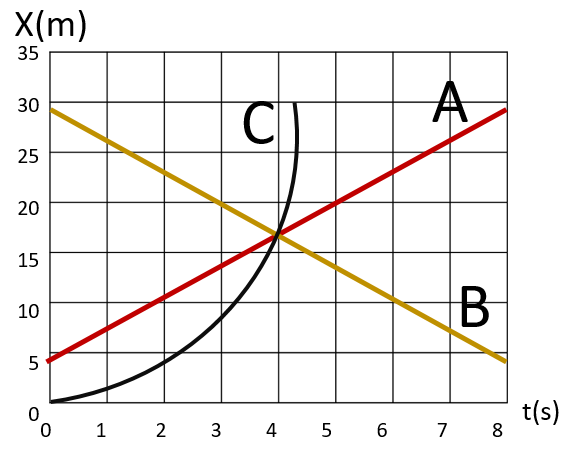
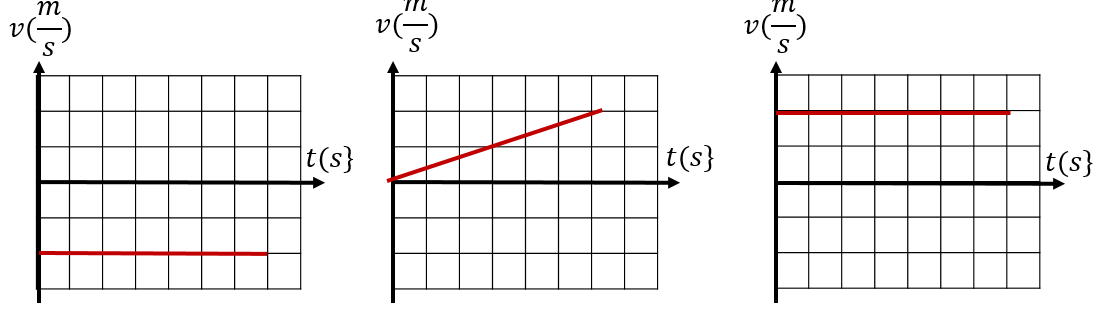
رُصدت العلاقة بين الموقع والزمن لحركة ثلاثة طلاب (A وB وC) كما في الشكل الأول. (أ) في أي ثانية يلتقي الطلاب الثلاثة؟ (ب) حدّد الرسم البياني (السرعة–الزمن) من الرسوم الثلاثة التالية الذي يتبع كل طالب، وبيّن نوع سرعته (ثابتة أم متغيرة) واتجاهها. (ج) أحد الطلاب تسارعه منتظم \(0.6\,m/s^2\) وبدأ حركته بسرعة \(2\,m/s\) من الموقع \(3\,m\)، حدّد موقعه بعد \(10\,s\) من بداية الحركة.The position–time relationship of three students (A, B and C) was recorded as shown in the first figure. (a) At what second do the three students meet? (b) Identify which of the three velocity–time graphs belongs to each student, and state whether the velocity is constant or changing and its direction. (c) One student has a uniform acceleration of \(0.6\,m/s^2\), started with a speed of \(2\,m/s\) from position \(3\,m\). Determine his position \(10\,s\) after the start.
.....................................................................
الحلSolution
📌 (أ) تتقاطع المنحنيات الثلاثة في نقطة واحدة عند \(t=4\,s\) (عند الموقع \(x\approx17\,m\)).
📌 (ب) الطالب A: الموقع يزداد على خط مستقيم، أي سرعة ثابتة موجبة، فهو الرسم الثالث (من اليسار).
📌 الطالب B: الموقع يتناقص على خط مستقيم، أي سرعة ثابتة سالبة، فهو الرسم الأول.
📌 الطالب C: ميل منحنى الموقع يزداد مع الزمن، أي سرعة متغيرة (متزايدة) في الاتجاه الموجب، فهو الرسم الثاني.
📌 (ج) \(x_f=x_i+v_it+\dfrac12at^2=3+2(10)+\dfrac12(0.6)(10)^2=3+20+30=53\,m\).
✅ \(t=4\,s\)، \(x_f=53\,m\)
📌 (a) The three graphs intersect at a single point at \(t=4\,s\) (at position \(x\approx17\,m\)).
📌 (b) Student A: the position increases along a straight line, i.e. a constant positive velocity: the third graph (from the left).
📌 Student B: the position decreases along a straight line, i.e. a constant negative velocity: the first graph.
📌 Student C: the slope of the position curve increases with time, i.e. a changing (increasing) velocity in the positive direction: the second graph.
📌 (c) \(x_f=x_i+v_it+\dfrac12at^2=3+2(10)+\dfrac12(0.6)(10)^2=3+20+30=53\,m\).
✅ \(t=4\,s\), \(x_f=53\,m\)
\[6\,\star\]
سيارة تتحرك بسرعة \(20\,m/s\) غيّر سائقها سرعتها بمعدل \(0.6\,m/s^2\) (زيادةً في السرعة). (أ) احسب الإزاحة المقطوعة خلال \(13\,s\). (ب) احسب سرعة السيارة بعد \(8\,s\). (ج) كم تحتاج السيارة من الزمن حتى تصبح سرعتها \(40\,m/s\)؟A car moves at \(20\,m/s\). Its driver increases the speed at a rate of \(0.6\,m/s^2\). (a) Calculate the displacement during \(13\,s\). (b) Calculate the car’s speed after \(8\,s\). (c) How long does the car need to reach a speed of \(40\,m/s\)?
.....................................................................
الحلSolution
📌 (أ) \(\Delta x=v_it+\dfrac12at^2=20(13)+\dfrac12(0.6)(13)^2=260+50.7=310.7\,m\).
📌 (ب) \(v_f=v_i+at=20+0.6(8)=24.8\,m/s\).
📌 (ج) \(t=\dfrac{v_f-v_i}{a}=\dfrac{40-20}{0.6}=33.3\,s\).
✅ \(\Delta x=310.7\,m\)، \(v_f=24.8\,m/s\)، \(t=33.3\,s\)
📌 (a) \(\Delta x=v_it+\dfrac12at^2=20(13)+\dfrac12(0.6)(13)^2=260+50.7=310.7\,m\).
📌 (b) \(v_f=v_i+at=20+0.6(8)=24.8\,m/s\).
📌 (c) \(t=\dfrac{v_f-v_i}{a}=\dfrac{40-20}{0.6}=33.3\,s\).
✅ \(\Delta x=310.7\,m\), \(v_f=24.8\,m/s\), \(t=33.3\,s\)
لاحظت خطأ؟ أو عندك سؤال عن أحد الأسئلة؟ اكتبه بالتعليقات وحدد رقم السؤال بالضبط.
Noticed an error? Or have a question about one of the questions? Write it in the comments and specify the exact question number.