🔄 بنك الأسئلة: الحركة الدورانية وعزم القوة
🔄 Question Bank: Rotational Motion and Torque
الإزاحة والسرعة والتسارع الزاوي، العلاقة بين الكميات الخطية والزاوية، عزم القوة، الاتزان الدوراني، مركز الكتلة والاستقرار، وعزم القصور الذاتي
Angular Displacement, Velocity and Acceleration, Linear–Angular Relations, Torque, Rotational Equilibrium, Center of Mass and Stability, and Moment of Inertia
⏱️ 25 سؤال اختيار من متعدد بتصحيح فوري، ومسألتان محلولتان بالكامل⏱️ 25 multiple-choice questions with instant feedback, plus 2 fully-solved problems
\[1\,\star\]
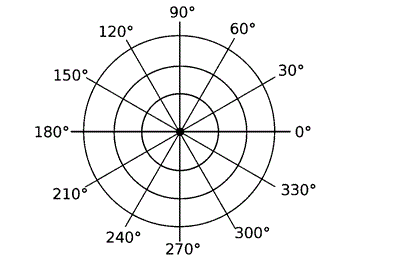
جسم يتحرك حركة دائرية فقطع إزاحة زاوية قدرها \(125^\circ\) مع عقارب الساعة، فإن الإزاحة الزاوية بوحدة الراديان تعادل:An object moves in a circle through an angular displacement of \(125^\circ\) clockwise. The angular displacement in radians is:
\(\theta=-2.18\,rad\)\(\theta=-2.18\,rad\)
\(\theta=-1.53\,rad\)\(\theta=-1.53\,rad\)
\(\theta=-3.53\,rad\)\(\theta=-3.53\,rad\)
\(\theta=-4.53\,rad\)\(\theta=-4.53\,rad\)
الحلSolution
📌 نحوّل الدرجات إلى راديان: \(\theta=125\times\dfrac{\pi}{180}\approx2.18\,rad\).
📌 الدوران مع عقارب الساعة يُعدّ سالبًا، فتكون الإزاحة الزاوية \(-2.18\,rad\).
✅ \(\theta=-2.18\,rad\) (A)
📌 Convert degrees to radians: \(\theta=125\times\dfrac{\pi}{180}\approx2.18\,rad\).
📌 Clockwise rotation is taken as negative, so the angular displacement is \(-2.18\,rad\).
✅ \(\theta=-2.18\,rad\) (A)
\[2\,\star\]
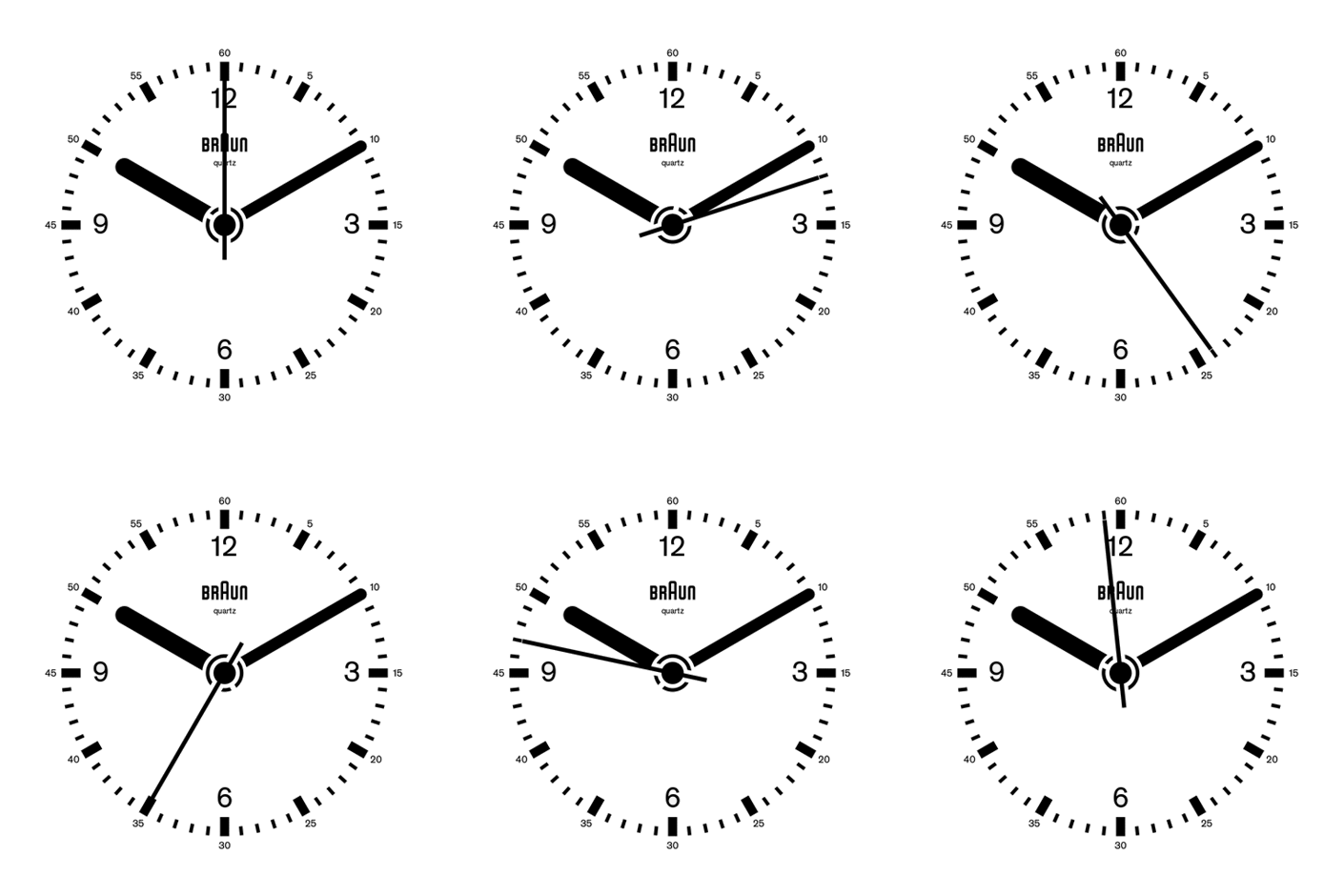
السرعة الزاوية لعقرب الثواني في الساعة تعادل:The angular velocity of the second hand of a clock is:
\(\omega=1.05\times10^{-1}\,rad/s\)\(\omega=1.05\times10^{-1}\,rad/s\)
\(\omega=1.74\times10^{-3}\,rad/s\)\(\omega=1.74\times10^{-3}\,rad/s\)
\(\omega=-1.74\times10^{-3}\,rad/s\)\(\omega=-1.74\times10^{-3}\,rad/s\)
\(\omega=-1.05\times10^{-1}\,rad/s\)\(\omega=-1.05\times10^{-1}\,rad/s\)
الحلSolution
📌 يدور عقرب الثواني دورة كاملة \(2\pi\,rad\) كل \(60\,s\) مع عقارب الساعة (اتجاه سالب).
📌 \(\omega=-\dfrac{2\pi}{60}\approx-0.105\,rad/s=-1.05\times10^{-1}\,rad/s\).
✅ \(\omega=-1.05\times10^{-1}\,rad/s\) (D)
📌 The second hand makes a full turn \(2\pi\,rad\) every \(60\,s\), clockwise (negative).
📌 \(\omega=-\dfrac{2\pi}{60}\approx-0.105\,rad/s=-1.05\times10^{-1}\,rad/s\).
✅ \(\omega=-1.05\times10^{-1}\,rad/s\) (D)
\[3\,\star\]
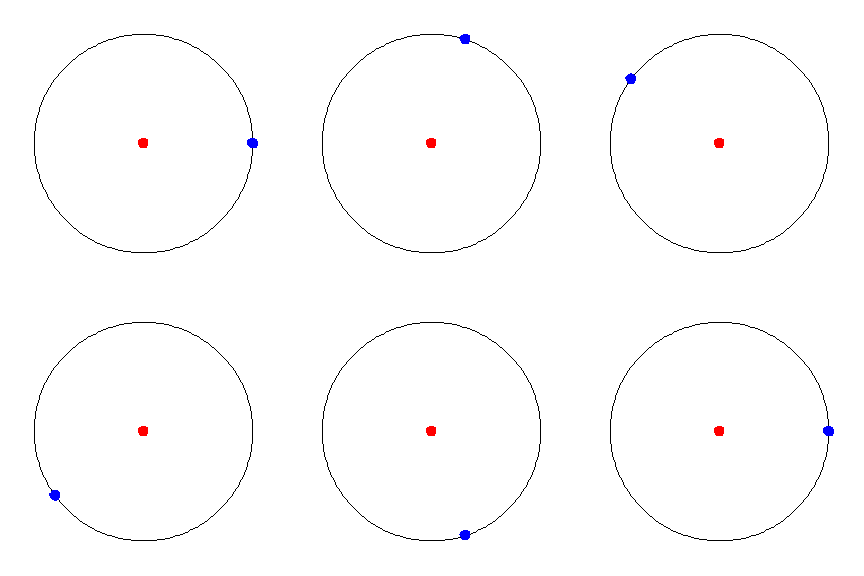
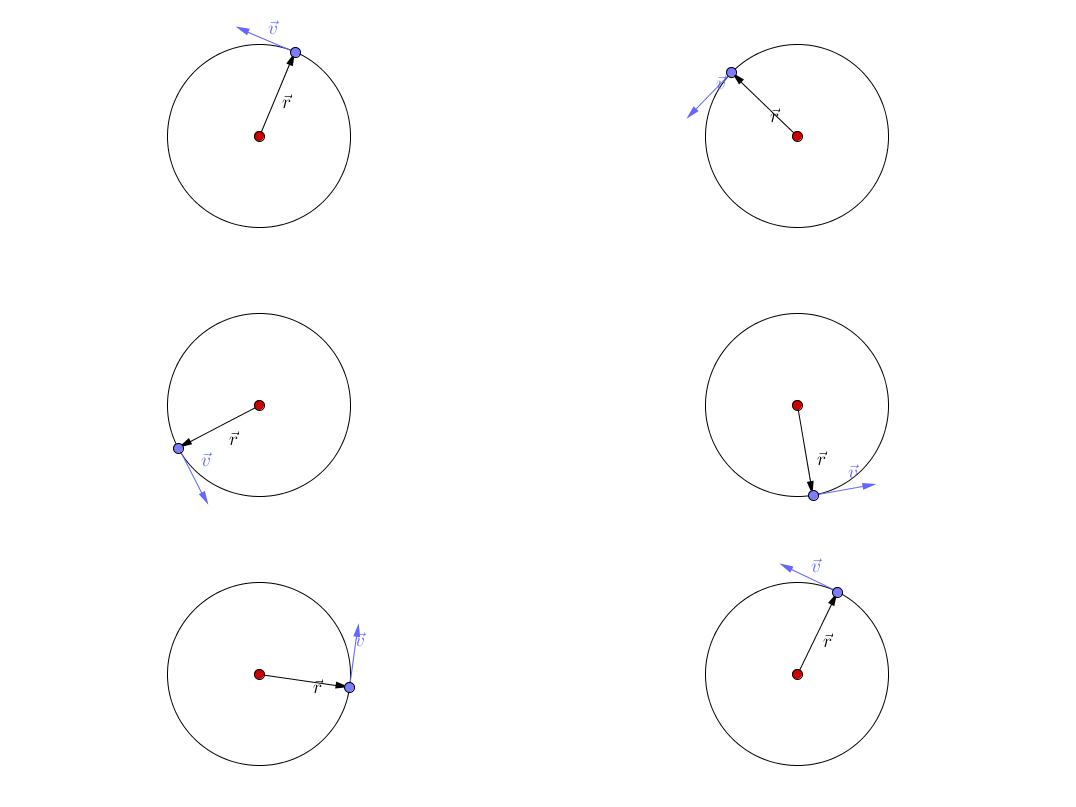
في الحركة الدائرية المنتظمة تكون السرعة الخطية:In uniform circular motion the linear velocity is:
ثابتة المقدار وثابتة الاتجاهConstant in magnitude and constant in direction
ثابتة المقدار ومتغيرة الاتجاهConstant in magnitude but changing in direction
متغيرة المقدار ومتغيرة الاتجاهChanging in magnitude and in direction
متغيرة المقدار وثابتة الاتجاهChanging in magnitude but constant in direction
الحلSolution
📌 مقدار السرعة \(v=\omega r\) ثابت في الحركة الدائرية المنتظمة، لكن اتجاهها مماس للمسار ويتغير باستمرار، لذلك تتغير السرعة المتجهة ويوجد تسارع مركزي.
✅ ثابتة المقدار ومتغيرة الاتجاه (B)
📌 The speed \(v=\omega r\) is constant in uniform circular motion, but the velocity is tangent to the path and its direction keeps changing, so the velocity changes and there is a centripetal acceleration.
✅ Constant in magnitude but changing in direction (B)
\[4\,\star\]
يتحرك جسم حركة دائرية منتظمة بحيث يُنجز ثلاث دورات ونصف عكس عقارب الساعة كل 6 ثوانٍ، فإن سرعته الزاوية بوحدة \(rad/s\) تعادل:An object moves in uniform circular motion, completing three and a half counterclockwise revolutions every 6 seconds. Its angular speed in \(rad/s\) is:
\(\omega=1.8\,rad/s\)\(\omega=1.8\,rad/s\)
\(\omega=2.3\,rad/s\)\(\omega=2.3\,rad/s\)
\(\omega=3.7\,rad/s\)\(\omega=3.7\,rad/s\)
\(\omega=5.4\,rad/s\)\(\omega=5.4\,rad/s\)
الحلSolution
📌 الزاوية الكلية: \(\Delta\theta=3.5\times2\pi=7\pi\approx22.0\,rad\).
📌 \(\omega=\dfrac{\Delta\theta}{\Delta t}=\dfrac{7\pi}{6}\approx3.7\,rad/s\) (موجبة لأن الدوران عكس عقارب الساعة).
✅ \(\omega=3.7\,rad/s\) (C)
📌 Total angle: \(\Delta\theta=3.5\times2\pi=7\pi\approx22.0\,rad\).
📌 \(\omega=\dfrac{\Delta\theta}{\Delta t}=\dfrac{7\pi}{6}\approx3.7\,rad/s\) (positive because the rotation is counterclockwise).
✅ \(\omega=3.7\,rad/s\) (C)
\[5\,\star\]
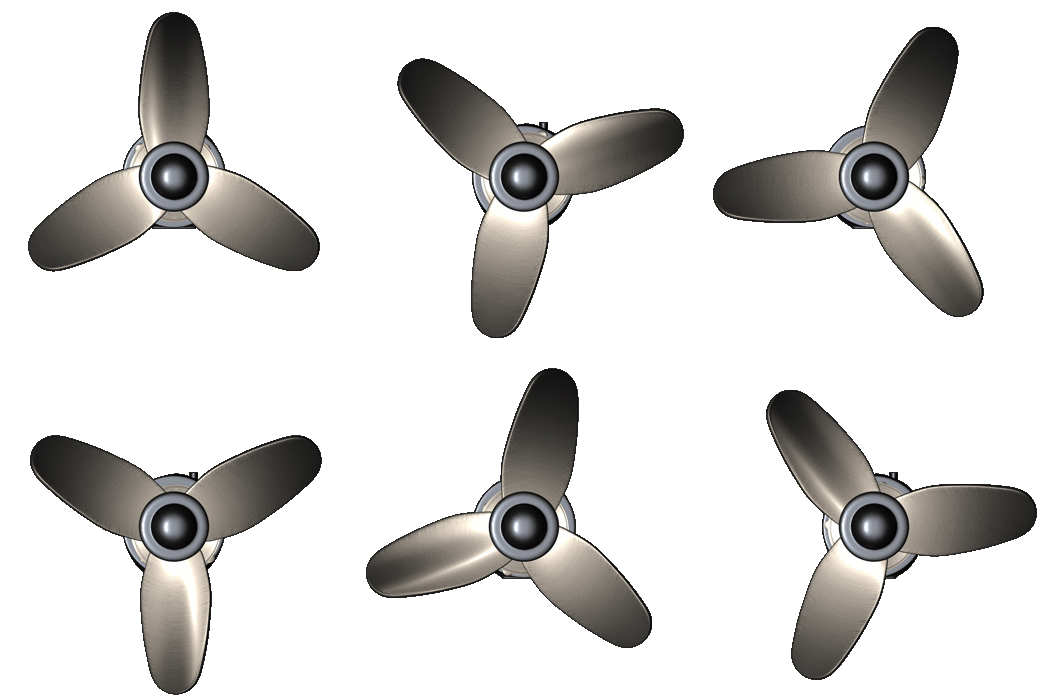
مروحة تدور بسرعة زاوية قدرها \(60\pi\,rad/s\)، فإن الزاوية التي تقطعها إحدى شفراتها خلال زمن قدره \(3\,s\) تعادل:A propeller rotates at an angular speed of \(60\pi\,rad/s\). The angle swept by one of its blades in \(3\,s\) is:
\(\Delta\theta=20\pi\,rad\)\(\Delta\theta=20\pi\,rad\)
\(\Delta\theta=60\pi\,rad\)\(\Delta\theta=60\pi\,rad\)
\(\Delta\theta=120\pi\,rad\)\(\Delta\theta=120\pi\,rad\)
\(\Delta\theta=180\pi\,rad\)\(\Delta\theta=180\pi\,rad\)
الحلSolution
📌 \(\Delta\theta=\omega\,\Delta t=60\pi\times3=180\pi\,rad\).
✅ \(\Delta\theta=180\pi\,rad\) (D)
📌 \(\Delta\theta=\omega\,\Delta t=60\pi\times3=180\pi\,rad\).
✅ \(\Delta\theta=180\pi\,rad\) (D)
\[6\,\star\]
كرة مربوطة بخيط وتدور بحركة دورانية منتظمة في مستوى أفقي، فإذا قُطع الخيط فإن الكرة:A ball tied to a string moves in uniform circular motion in a horizontal plane. If the string is cut, the ball:
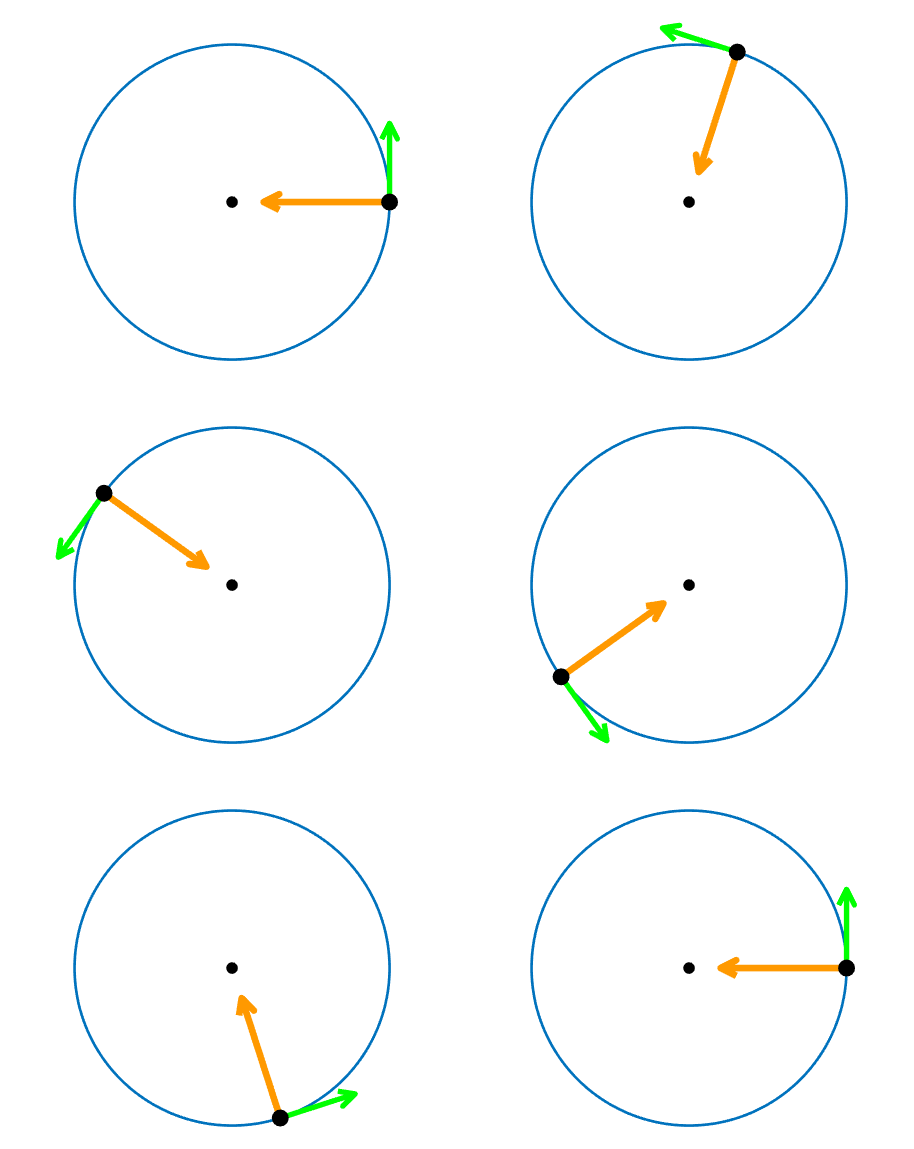
تستمر بخط مستقيم باتجاه السرعة الخطيةmoves off in a straight line in the direction of its linear velocity
تستمر بحركتها حول المركز بنفس السرعةkeeps moving around the center at the same speed
تسقط مباشرة إلى الأرضfalls straight down to the ground
تستمر بحركتها حول المركز بسرعة أقلkeeps moving around the center but more slowly
الحلSolution
📌 الخيط هو الذي يوفّر القوة المركزية التي تُبقي الكرة في مسارها الدائري. عند قطعه تختفي هذه القوة.
📌 وفق قانون نيوتن الأول تنطلق الكرة بخط مستقيم مماس للدائرة باتجاه السرعة الخطية لحظة القطع.
✅ تستمر بخط مستقيم باتجاه السرعة الخطية (A)
📌 The string supplies the centripetal force that keeps the ball on its circular path. Cutting it removes that force.
📌 By Newton’s first law the ball flies off in a straight line tangent to the circle, in the direction of the velocity at the moment of cutting.
✅ moves off in a straight line in the direction of its linear velocity (A)
\[7\,\star\star\]
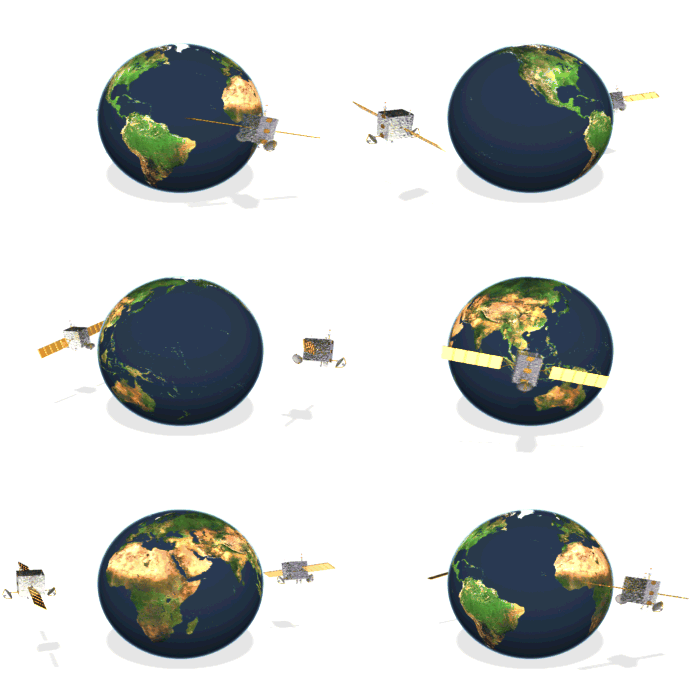
يتحرك قمر صناعي في مسار دائري منتظم حول الأرض نصف قطر المسار \(36000\,km\) وزمنه الدوري \(1\,day\)، فإن سرعته الخطية تساوي:A satellite moves in a uniform circular orbit around the Earth of radius \(36000\,km\) with period \(1\,day\). Its linear speed is:
\(v=3600\,m/s\)\(v=3600\,m/s\)
\(v=2134\,m/s\)\(v=2134\,m/s\)
\(v=1760\,m/s\)\(v=1760\,m/s\)
\(v=2618\,m/s\)\(v=2618\,m/s\)
الحلSolution
📌 \(r=36000\,km=3.6\times10^{7}\,m\) و \(T=1\,day=86400\,s\).
📌 \(v=\dfrac{2\pi r}{T}=\dfrac{2\pi\times3.6\times10^{7}}{86400}\approx2618\,m/s\).
✅ \(v=2618\,m/s\) (D)
📌 \(r=36000\,km=3.6\times10^{7}\,m\) and \(T=1\,day=86400\,s\).
📌 \(v=\dfrac{2\pi r}{T}=\dfrac{2\pi\times3.6\times10^{7}}{86400}\approx2618\,m/s\).
✅ \(v=2618\,m/s\) (D)
\[8\,\star\]
إطار دراجة نصف قطره \(32\,cm\) يدور بسرعة زاوية \(6\,rad/s\)، تمت زيادة سرعة الدراجة فأصبحت سرعته الزاوية \(12\,rad/s\) خلال زمن قدره \(8\,s\)، فإن التسارع الخطي لإطار الدراجة يعادل:A bicycle wheel of radius \(32\,cm\) rotates at \(6\,rad/s\). The bike speeds up so that the wheel reaches \(12\,rad/s\) in \(8\,s\). The linear (tangential) acceleration of the wheel rim is:
\(a=0.75\,m/s^2\)\(a=0.75\,m/s^2\)
\(a=0.46\,m/s^2\)\(a=0.46\,m/s^2\)
\(a=0.24\,m/s^2\)\(a=0.24\,m/s^2\)
\(a=0.14\,m/s^2\)\(a=0.14\,m/s^2\)
الحلSolution
📌 التسارع الزاوي: \(\alpha=\dfrac{12-6}{8}=0.75\,rad/s^2\).
📌 التسارع الخطي: \(a=\alpha r=0.75\times0.32=0.24\,m/s^2\).
✅ \(a=0.24\,m/s^2\) (C)
📌 Angular acceleration: \(\alpha=\dfrac{12-6}{8}=0.75\,rad/s^2\).
📌 Linear acceleration: \(a=\alpha r=0.75\times0.32=0.24\,m/s^2\).
✅ \(a=0.24\,m/s^2\) (C)
\[9\,\star\]
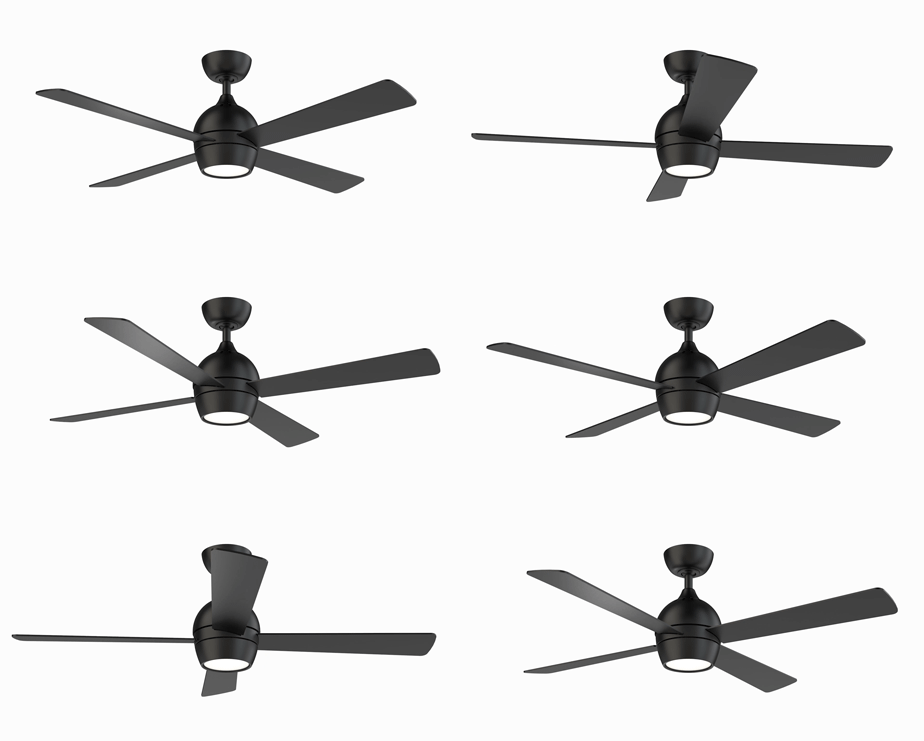
مروحة تدور في مسار دائري منتظم نصف قطره \(60\,cm\) حيث تقطع المروحة ثلاث دورات خلال زمن قدره \(2\,s\)، فإن سرعتها الخطية بوحدة \(m/s\) تعادل:A fan rotates uniformly on a circle of radius \(60\,cm\), making three revolutions in \(2\,s\). Its linear speed in \(m/s\) is:
\(v=2.41\,m/s\)\(v=2.41\,m/s\)
\(v=5.65\,m/s\)\(v=5.65\,m/s\)
\(v=3.77\,m/s\)\(v=3.77\,m/s\)
\(v=6.72\,m/s\)\(v=6.72\,m/s\)
الحلSolution
📌 \(\omega=\dfrac{3\times2\pi}{2}=3\pi\approx9.42\,rad/s\).
📌 \(v=\omega r=9.42\times0.6\approx5.65\,m/s\).
✅ \(v=5.65\,m/s\) (B)
📌 \(\omega=\dfrac{3\times2\pi}{2}=3\pi\approx9.42\,rad/s\).
📌 \(v=\omega r=9.42\times0.6\approx5.65\,m/s\).
✅ \(v=5.65\,m/s\) (B)
\[10\,\star\]
دولاب سيارة يتحرك بسرعة زاوية \(10\,rad/s\) غيّر سرعته فأصبحت \(15\,rad/s\) خلال زمن قدره \(10\,s\)، فإن التسارع الزاوي للدولاب يعادل:A car wheel spins at \(10\,rad/s\) and changes its speed to \(15\,rad/s\) in \(10\,s\). The angular acceleration of the wheel is:
\(\alpha=0.5\,rad/s^2\)\(\alpha=0.5\,rad/s^2\)
\(\alpha=1\,rad/s^2\)\(\alpha=1\,rad/s^2\)
\(\alpha=1.5\,rad/s^2\)\(\alpha=1.5\,rad/s^2\)
\(\alpha=2\,rad/s^2\)\(\alpha=2\,rad/s^2\)
الحلSolution
📌 \(\alpha=\dfrac{\Delta\omega}{\Delta t}=\dfrac{15-10}{10}=0.5\,rad/s^2\).
✅ \(\alpha=0.5\,rad/s^2\) (A)
📌 \(\alpha=\dfrac{\Delta\omega}{\Delta t}=\dfrac{15-10}{10}=0.5\,rad/s^2\).
✅ \(\alpha=0.5\,rad/s^2\) (A)
\[11\,\star\]
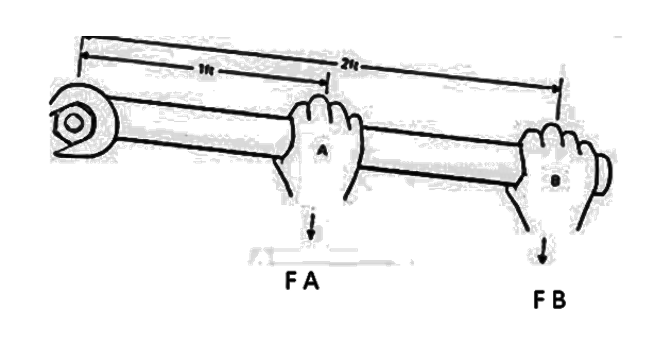
في الشكل أدناه قوتان متساويتان أثّرتا على جسم قابل للدوران فأصبح الجسم يدور، فإن أحد الإجابات التالية صحيحة:In the figure, two equal forces act on a rotatable body and make it rotate. Which of the following is correct?
\(\tau_A>\tau_B\)\(\tau_A>\tau_B\)
\(\tau_A=\tau_B\)\(\tau_A=\tau_B\)
لا توجد إجابة صحيحةNone of the answers is correct
\(\tau_B>\tau_A\)\(\tau_B>\tau_A\)
الحلSolution
📌 \(\tau=rF\sin\theta\): القوتان متساويتان وعموديتان على المفتاح، فالعزم يتناسب مع ذراع العزم.
📌 القوة \(F_B\) تؤثر على بعد أكبر من محور الدوران (2 ft مقابل 1 ft)، إذن \(\tau_B=2\,\tau_A\) أي \(\tau_B>\tau_A\).
✅ \(\tau_B>\tau_A\) (D)
📌 \(\tau=rF\sin\theta\): the forces are equal and perpendicular to the wrench, so the torque is proportional to the lever arm.
📌 Force \(F_B\) acts farther from the axis (2 ft versus 1 ft), so \(\tau_B=2\,\tau_A\), i.e. \(\tau_B>\tau_A\).
✅ \(\tau_B>\tau_A\) (D)
\[12\]
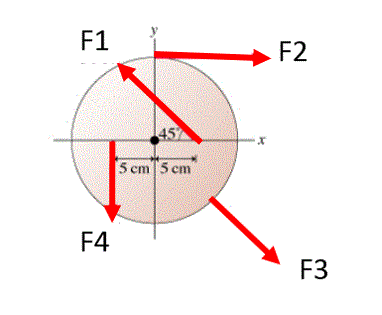
أربع قوى متساوية كما في الشكل أثّرت على قرص نصف قطره \(10\,cm\) قابل للدوران حول محور يمر بمركزه. أي القوى لها أكبر عزم دوران؟Four equal forces act on a disc of radius \(10\,cm\) that can rotate about an axis through its center, as shown. Which force produces the greatest torque?
\(\tau_1\)\(\tau_1\)
\(\tau_2\)\(\tau_2\)
\(\tau_3\)\(\tau_3\)
\(\tau_4\)\(\tau_4\)
الحلSolution
📌 عزم القوة يساوي القوة × ذراع العزم (البعد العمودي بين خط عمل القوة والمحور).
📌 القوة \(F_2\) أفقية تؤثر عند أعلى القرص فذراعها \(10\,cm\) (أكبر قيمة)، أما \(F_4\) فذراعها \(5\,cm\) و \(F_1\) ذراعها أقل من ذلك، وخط عمل \(F_3\) يمر بالمركز (قوة نصف قطرية) فعزمها صفر.
✅ \(\tau_2\) (B)
📌 Torque equals the force times the lever arm (the perpendicular distance from the line of action to the axis).
📌 Force \(F_2\) is horizontal and acts at the top of the disc, so its lever arm is \(10\,cm\) (the largest); \(F_4\) has a \(5\,cm\) arm, \(F_1\) has a smaller one, and the line of action of \(F_3\) passes through the center (a radial force), so its torque is zero.
✅ \(\tau_2\) (B)
\[13\]
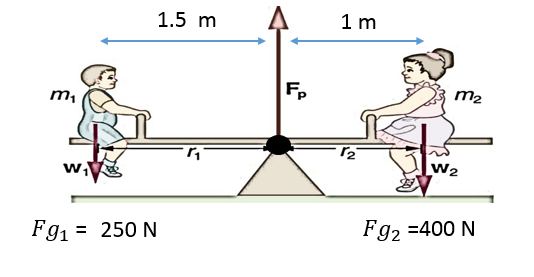
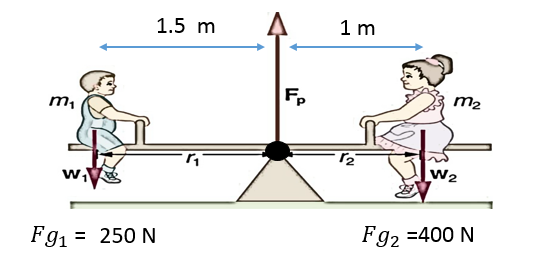
في الشكل أدناه لعبة توازن، ومن معلومات الشكل فإن محصلة عزم الدوران على لعبة التوازن تعادل (الدوران عكس عقارب الساعة موجب):The figure shows a balance toy (seesaw). From the information in the figure, the net torque on it is (counterclockwise is positive):
\(\tau_{net}=25\,N\cdot m\)\(\tau_{net}=25\,N\cdot m\)
\(\tau_{net}=-40\,N\cdot m\)\(\tau_{net}=-40\,N\cdot m\)
\(\tau_{net}=-25\,N\cdot m\)\(\tau_{net}=-25\,N\cdot m\)
\(\tau_{net}=40\,N\cdot m\)\(\tau_{net}=40\,N\cdot m\)
الحلSolution
📌 الطفل الأيسر يميل بالأرجوحة عكس عقارب الساعة: \(\tau_1=+F_{g1}r_1=+250\times1.5=+375\,N\cdot m\).
📌 الطفل الأيمن مع عقارب الساعة: \(\tau_2=-F_{g2}r_2=-400\times1=-400\,N\cdot m\).
📌 \(\tau_{net}=375-400=-25\,N\cdot m\) (الأرجوحة تميل مع عقارب الساعة).
✅ \(\tau_{net}=-25\,N\cdot m\) (C)
📌 The left child tends to turn the seesaw counterclockwise: \(\tau_1=+F_{g1}r_1=+250\times1.5=+375\,N\cdot m\).
📌 The right child tends to turn it clockwise: \(\tau_2=-F_{g2}r_2=-400\times1=-400\,N\cdot m\).
📌 \(\tau_{net}=375-400=-25\,N\cdot m\) (the seesaw tips clockwise).
✅ \(\tau_{net}=-25\,N\cdot m\) (C)
\[14\]
أحد الأجسام التالية أكثر استقرارًا:Which one of the following objects is the most stable?

AA
BB
CC
DD
الحلSolution
📌 يزداد استقرار الجسم كلما انخفض مركز كتلته واتسعت قاعدته؛ فيحتاج إلى إمالة أكبر قبل أن يقع مركز الكتلة خارج القاعدة.
📌 الجسم D قرص عريض قليل الارتفاع، فهو الأكثر استقرارًا.
✅ D
📌 An object is more stable the lower its center of mass and the wider its base; it must be tilted more before the center of mass moves outside the base.
📌 Object D is a wide, low disc, so it is the most stable.
✅ D
\[15\,\star\]
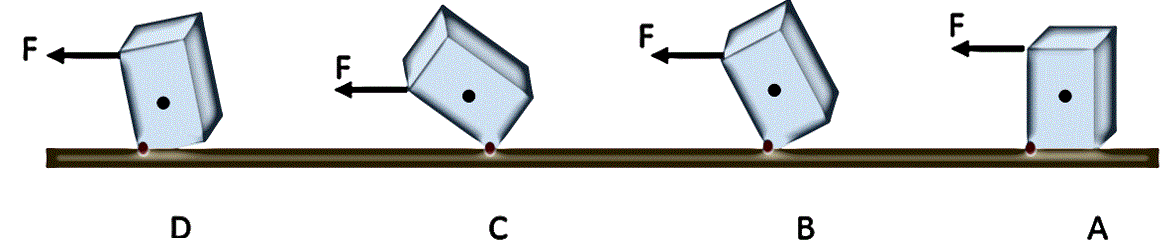
أحد المكعبات التالية يتعرض لأكبر عزم دوران كلي حول حافته السفلية اليسرى عند التأثير عليه بقوة أفقية \(F\) (ويكون وزنه مؤثرًا بعزم أيضًا):Which of the following blocks experiences the greatest total torque about its lower-left edge when a horizontal force \(F\) acts on it (its weight also produces a torque)?
AA
BB
CC
DD
الحلSolution
📌 العزم الكلي حول الحافة السفلية اليسرى = عزم القوة \(F\) + عزم وزن المكعب (يؤثر في مركز كتلته).
📌 في المكعبات A وB وD يقع مركز الكتلة يمين الحافة، فيدور وزنها مع عقارب الساعة ويعاكس عزم القوة \(F\) (عكس عقارب الساعة).
📌 أما في C فمركز الكتلة يقع يسار الحافة، فيدور وزنه عكس عقارب الساعة مثل القوة \(F\) فيجتمع العزمان ويكون العزم الكلي في C الأكبر (المكعب سيتقلّب).
✅ C
📌 The total torque about the lower-left edge = the torque of \(F\) + the torque of the block’s weight (acting at its center of mass).
📌 In blocks A, B and D the center of mass is to the right of the edge, so the weight turns them clockwise and opposes the torque of \(F\) (counterclockwise).
📌 In C the center of mass lies to the left of the edge, so its weight also turns it counterclockwise like \(F\); the two torques add and C has the greatest total torque (the block will tip over).
✅ C
\[16\,\star\star\star\]
أحد الأجسام التالية مركز كتلته خارج الجسم:Which of the following objects has its center of mass outside the body?
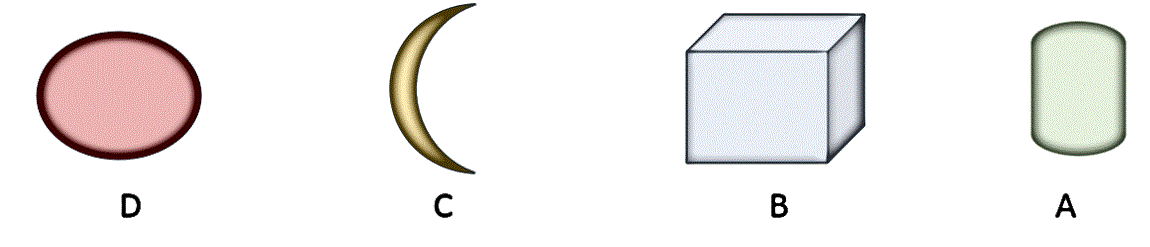
AA
BB
CC
DD
الحلSolution
📌 مركز كتلة الجسم المتماثل (القرص والمكعب والأسطوانة والشكل البيضاوي) يقع في مركزه الهندسي داخل الجسم.
📌 الجسم C على شكل هلال، ومركز كتلته يقع في الفراغ المقعّر خارج المادة.
✅ C
📌 The center of mass of a symmetric body (disc, cube, cylinder, oval) is at its geometric center, inside the body.
📌 Object C is crescent-shaped, and its center of mass lies in the hollow space outside the material.
✅ C
\[17\,\star\]
كرتان لهما نفس الكتلة والشكل وُضعتا على قمة مستوى مائل أملس كما في الشكل؛ الكرة السوداء مصمتة والكرة الذهبية مفرغة. أحد الإجابات التالية يعبّر بشكل صحيح عن النتائج المتوقعة:Two balls of equal mass and size are placed at the top of an incline as shown; the black ball is solid and the gold ball is hollow. Which statement correctly describes the expected result?
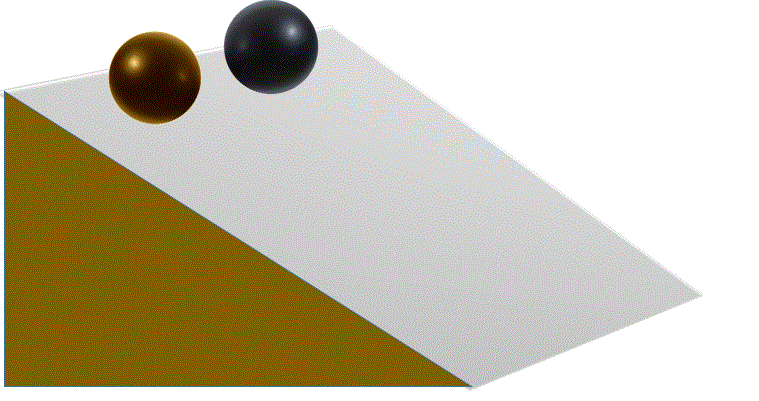
الكرة السوداء تصل أولًا إلى قاعدة المستوى المائلThe black ball reaches the bottom first
كلتا الكرتين تصلان معًا إلى قاعدة المستوى المائلBoth balls reach the bottom of the incline together
الكرة الذهبية تصل أولًا إلى قاعدة المستوى المائلThe gold ball reaches the bottom first
الكرة السوداء عزم قصورها الذاتي أكبر من الكرة الذهبيةThe black ball has a greater moment of inertia than the gold ball
الحلSolution
📌 الكرة المفرغة تتركز كتلتها بعيدًا عن المحور، فعزم قصورها الذاتي أكبر من عزم قصور الكرة المصمتة (\(I_{hollow}=\tfrac23mr^2\) مقابل \(I_{solid}=\tfrac25mr^2\)).
📌 تتحول الطاقة الكامنة إلى طاقة حركة انتقالية ودورانية، وتذهب حصة أكبر منها للدوران في الكرة المفرغة، فتتسارع أبطأ.
📌 إذن تصل الكرة السوداء المصمتة أولًا.
✅ الكرة السوداء تصل أولًا إلى قاعدة المستوى المائل (A)
📌 The hollow ball has its mass farther from the axis, so its moment of inertia is larger than the solid ball’s (\(I_{hollow}=\tfrac23mr^2\) versus \(I_{solid}=\tfrac25mr^2\)).
📌 Potential energy turns into translational and rotational kinetic energy; a larger share goes into rotation in the hollow ball, so it accelerates more slowly.
📌 So the solid black ball arrives first.
✅ The black ball reaches the bottom first (A)
\[18\,\star\]
حتى يكون الجسم في حالة اتزان دوراني وانتقالي يجب أن يكون:For a body to be in both rotational and translational equilibrium, it must satisfy:
\(\sum\tau=0\) فقط\(\sum\tau=0\) only
\(\sum F_x=0,\ \sum F_y=0\) فقط\(\sum F_x=0,\ \sum F_y=0\) only
\(\sum F_x=0,\ \sum\tau=0\) فقط\(\sum F_x=0,\ \sum\tau=0\) only
\(\sum F_x=0,\ \sum F_y=0,\ \sum\tau=0\)\(\sum F_x=0,\ \sum F_y=0,\ \sum\tau=0\)
الحلSolution
📌 الاتزان الانتقالي يتطلب أن تكون محصلة القوى صفرًا في كل اتجاه: \(\sum F_x=0\) و \(\sum F_y=0\).
📌 والاتزان الدوراني يتطلب أن تكون محصلة العزوم صفرًا: \(\sum\tau=0\). ويلزم الشرطان معًا.
✅ \(\sum F_x=0,\ \sum F_y=0,\ \sum\tau=0\) (D)
📌 Translational equilibrium requires zero net force in every direction: \(\sum F_x=0\) and \(\sum F_y=0\).
📌 Rotational equilibrium requires zero net torque: \(\sum\tau=0\). Both conditions are needed together.
✅ \(\sum F_x=0,\ \sum F_y=0,\ \sum\tau=0\) (D)
\[19\,\star\star\star\]
لوح خشبي كما في الشكل وُضعت عليه كتلة \(10\,kg\) على بعد \(5\,m\) من محور الدوران وكتلة \(5\,kg\) على بعد \(2\,m\) من محور الدوران. في أي موضع نضع كتلة مقدارها \(20\,kg\) في الطرف الآخر ليحدث اتزان؟A wooden plank is pivoted as shown. A \(10\,kg\) mass is placed \(5\,m\) from the pivot and a \(5\,kg\) mass \(2\,m\) from the pivot. Where should a \(20\,kg\) mass be placed on the other side to balance the plank?
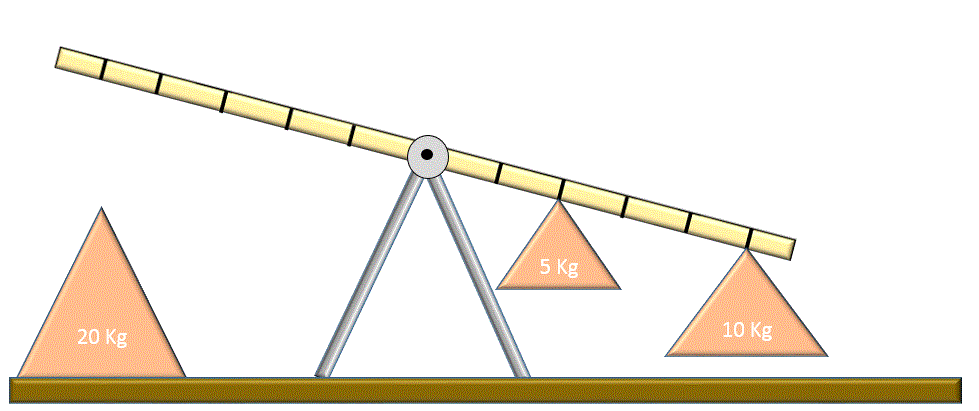
\(r=1\,m\)\(r=1\,m\)
\(r=3\,m\)\(r=3\,m\)
\(r=2\,m\)\(r=2\,m\)
\(r=4\,m\)\(r=4\,m\)
الحلSolution
📌 شرط الاتزان الدوراني: مجموع العزوم على أحد الجانبين = مجموع العزوم على الجانب الآخر.
📌 \((10)(g)(5)+(5)(g)(2)=(20)(g)\,r\Rightarrow50+10=20\,r\).
📌 \(r=\dfrac{60}{20}=3\,m\).
✅ \(r=3\,m\) (B)
📌 Rotational equilibrium: the sum of torques on one side equals the sum on the other.
📌 \((10)(g)(5)+(5)(g)(2)=(20)(g)\,r\Rightarrow50+10=20\,r\).
📌 \(r=\dfrac{60}{20}=3\,m\).
✅ \(r=3\,m\) (B)
\[20\,\star\]
إطار دراجة يدور بسرعة زاوية قدرها \(25\,rad/s\) باتجاه عقارب الساعة، تم إيقاف الإطار خلال زمن قدره \(5\,s\)، فإن متوسط التسارع الزاوي لإطار الدراجة يعادل:A bicycle wheel rotates clockwise at \(25\,rad/s\). It is brought to rest in \(5\,s\). The average angular acceleration of the wheel is:
\(\alpha=+5\,rad/s^2\)\(\alpha=+5\,rad/s^2\)
\(\alpha=-125\,rad/s^2\)\(\alpha=-125\,rad/s^2\)
\(\alpha=+125\,rad/s^2\)\(\alpha=+125\,rad/s^2\)
\(\alpha=-5\,rad/s^2\)\(\alpha=-5\,rad/s^2\)
الحلSolution
📌 الدوران مع عقارب الساعة سالب: \(\omega_i=-25\,rad/s\) و \(\omega_f=0\).
📌 \(\alpha=\dfrac{0-(-25)}{5}=+5\,rad/s^2\) (موجب لأنه يعاكس الدوران فيُبطئه).
✅ \(\alpha=+5\,rad/s^2\) (A)
📌 Clockwise rotation is negative: \(\omega_i=-25\,rad/s\) and \(\omega_f=0\).
📌 \(\alpha=\dfrac{0-(-25)}{5}=+5\,rad/s^2\) (positive because it opposes the rotation and slows it down).
✅ \(\alpha=+5\,rad/s^2\) (A)
\[21\,\star\star\]
جرار زراعي يملك إطارات أمامية ذات نصف قطر صغير \(r\) وإطارات خلفية ذات نصف قطر كبير \(R\). أحد الإجابات التالية يعبّر عن التسارع الزاوي والتسارع الخطي للإطارات:A tractor has small front wheels of radius \(r\) and large rear wheels of radius \(R\). Which answer correctly compares the angular and linear accelerations of the wheels?
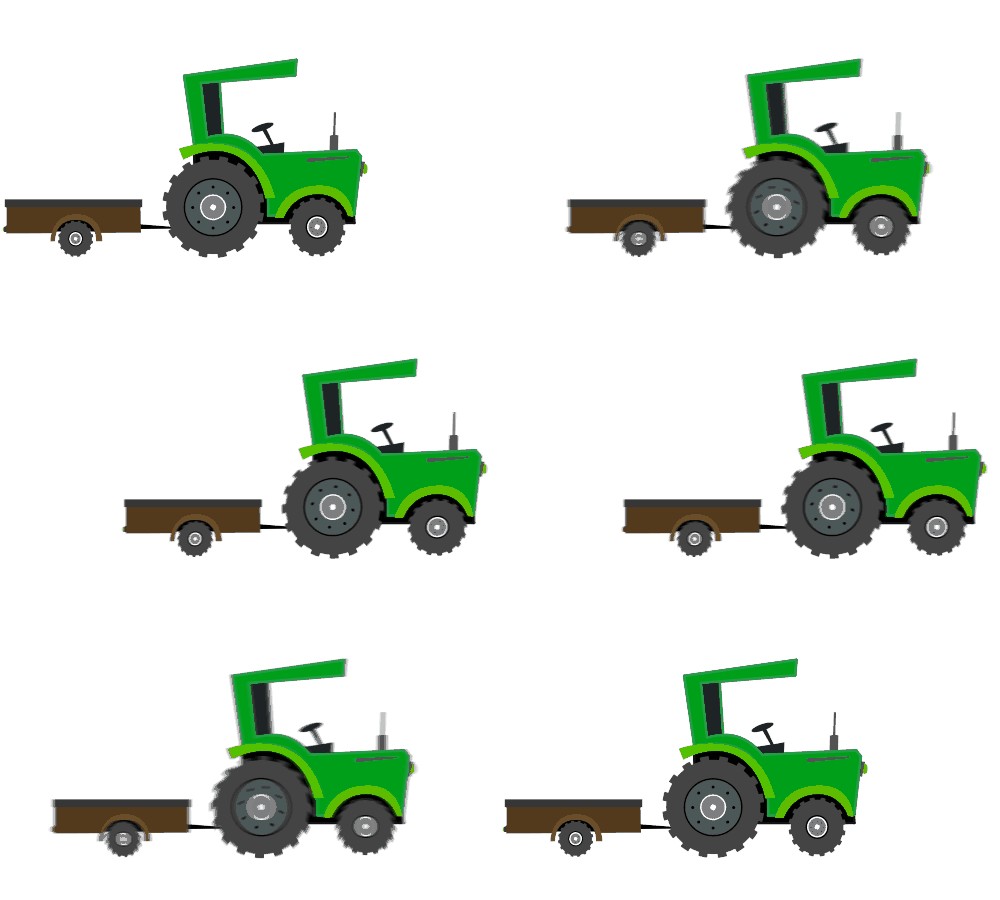
\(a_r>a_R,\quad\alpha_r>\alpha_R\)\(a_r>a_R,\quad\alpha_r>\alpha_R\)
\(a_R>a_r,\quad\alpha_R>\alpha_r\)\(a_R>a_r,\quad\alpha_R>\alpha_r\)
\(a_r=a_R,\quad\alpha_r=\alpha_R\)\(a_r=a_R,\quad\alpha_r=\alpha_R\)
\(a_r=a_R,\quad\alpha_r>\alpha_R\)\(a_r=a_R,\quad\alpha_r>\alpha_R\)
الحلSolution
📌 تدحرج الإطارات دون انزلاق، فالتسارع الخطي لمحيط كل إطار يساوي تسارع الجرار نفسه: \(a_r=a_R\).
📌 \(\alpha=\dfrac{a}{r}\): عند ثبوت \(a\) يزداد التسارع الزاوي كلما صغر نصف القطر، فيكون \(\alpha_r>\alpha_R\).
✅ \(a_r=a_R,\quad\alpha_r>\alpha_R\) (D)
📌 The wheels roll without slipping, so each rim’s linear acceleration equals the tractor’s own acceleration: \(a_r=a_R\).
📌 \(\alpha=\dfrac{a}{r}\): for the same \(a\) the angular acceleration is larger for the smaller radius, so \(\alpha_r>\alpha_R\).
✅ \(a_r=a_R,\quad\alpha_r>\alpha_R\) (D)
\[22\,\star\]
السرعة الزاوية لعقرب الساعات في الساعة تعادل:The angular velocity of the hour hand of a clock is:
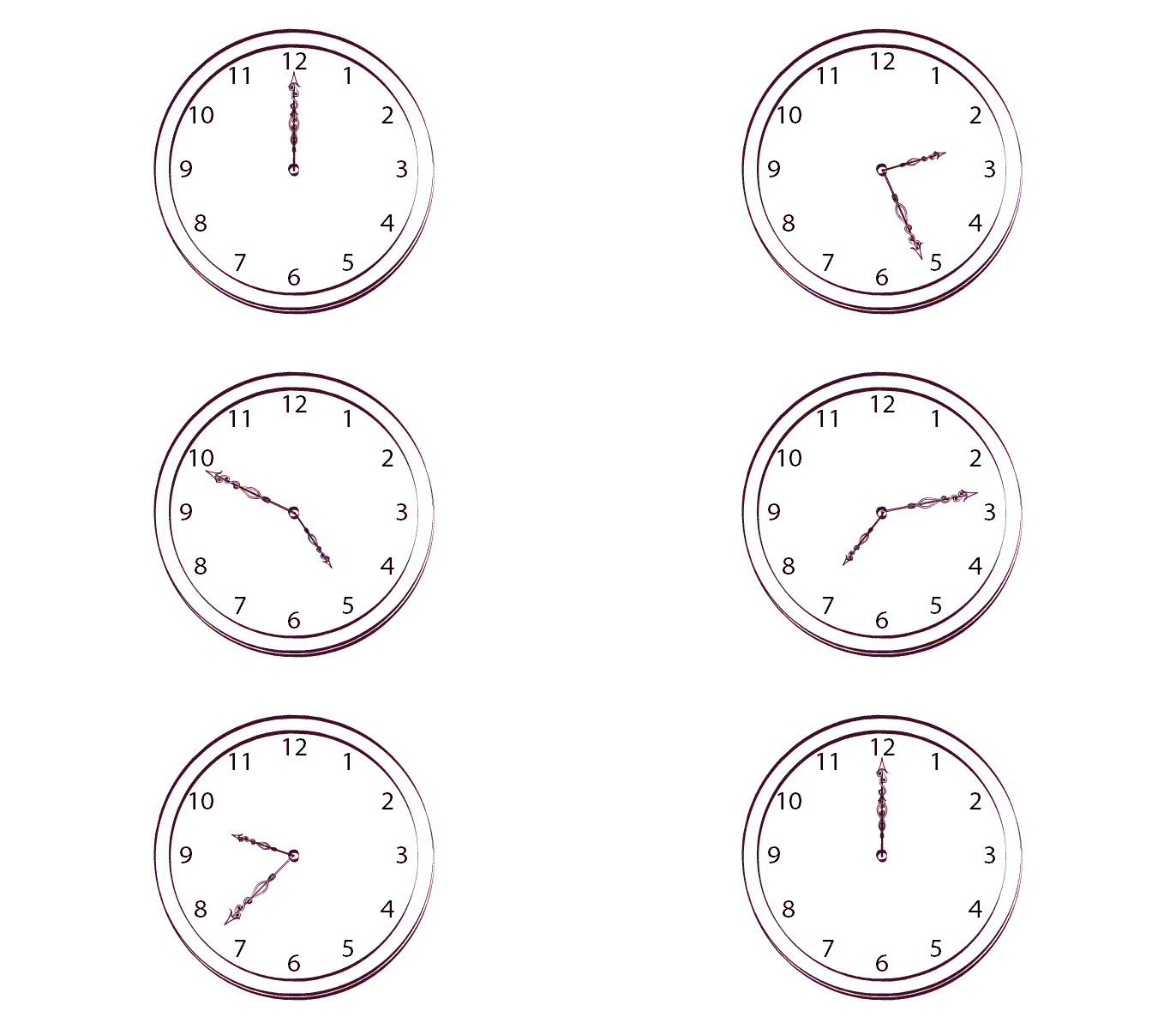
\(\omega=-1.74\times10^{-3}\,rad/s\)\(\omega=-1.74\times10^{-3}\,rad/s\)
\(\omega=+1.74\times10^{-3}\,rad/s\)\(\omega=+1.74\times10^{-3}\,rad/s\)
\(\omega=-1.45\times10^{-4}\,rad/s\)\(\omega=-1.45\times10^{-4}\,rad/s\)
\(\omega=+1.45\times10^{-4}\,rad/s\)\(\omega=+1.45\times10^{-4}\,rad/s\)
الحلSolution
📌 يُكمل عقرب الساعات دورة واحدة كل 12 ساعة: \(T=12\times3600=43200\,s\) مع عقارب الساعة (سالب).
📌 \(\omega=-\dfrac{2\pi}{43200}\approx-1.45\times10^{-4}\,rad/s\).
✅ \(\omega=-1.45\times10^{-4}\,rad/s\) (C)
📌 The hour hand makes one revolution every 12 hours: \(T=12\times3600=43200\,s\), clockwise (negative).
📌 \(\omega=-\dfrac{2\pi}{43200}\approx-1.45\times10^{-4}\,rad/s\).
✅ \(\omega=-1.45\times10^{-4}\,rad/s\) (C)
\[23\,\star\]
لوح خشبي مهمل الكتلة منتظم الشكل ثُبّت من منتصفه وأصبح قابلًا للدوران حول نقطة التثبيت، تأثر اللوح بعدد من القوى المتساوية. فإن محصلة العزم المؤثرة على اللوح تجعل اللوح:A uniform, massless wooden board is pivoted at its midpoint and is free to rotate about it. Several equal forces act on the board. The net torque makes the board:
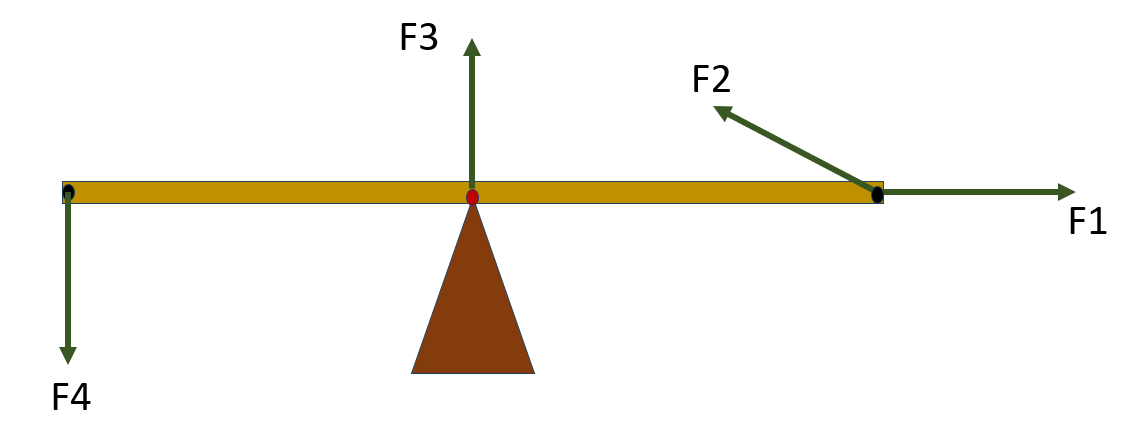
يدور مع عقارب الساعةrotate clockwise
يدور عكس عقارب الساعةrotate counterclockwise
في حالة اتزان دورانيstay in rotational equilibrium
في حالة اتزان دوراني وانتقاليstay in rotational and translational equilibrium
الحلSolution
📌 القوة \(F_3\) تؤثر عند نقطة التثبيت، وخط عمل القوة \(F_1\) (أفقية على امتداد اللوح) يمر بالمحور، فعزم كل منهما صفر.
📌 المركبة الرأسية للقوة \(F_2\) إلى الأعلى عند الطرف الأيمن تُدير اللوح عكس عقارب الساعة، والقوة \(F_4\) إلى الأسفل عند الطرف الأيسر تُديره عكس عقارب الساعة أيضًا.
📌 إذن العزم المحصّل عكس عقارب الساعة (واللوح ليس في حالة اتزان).
✅ يدور عكس عقارب الساعة (B)
📌 Force \(F_3\) acts at the pivot, and the line of action of \(F_1\) (horizontal along the board) passes through the pivot, so both have zero torque.
📌 The upward vertical component of \(F_2\) at the right end turns the board counterclockwise, and \(F_4\) pointing down at the left end also turns it counterclockwise.
📌 So the net torque is counterclockwise (the board is not in equilibrium).
✅ rotate counterclockwise (B)
\[24\,\star\]
أجسام لها نفس الكتلة ومتماثلة في نصف القطر، وجميعها قابلة للدوران حول محور يمر بمركزها، وعزم قصورها الذاتي موضح على كل شكل. أي منها يحتاج إلى عزم أكبر حتى يبدأ بالدوران؟The objects have the same mass and radius, and each can rotate about an axis through its center; its moment of inertia is given on each figure. Which one needs the largest torque to start rotating?
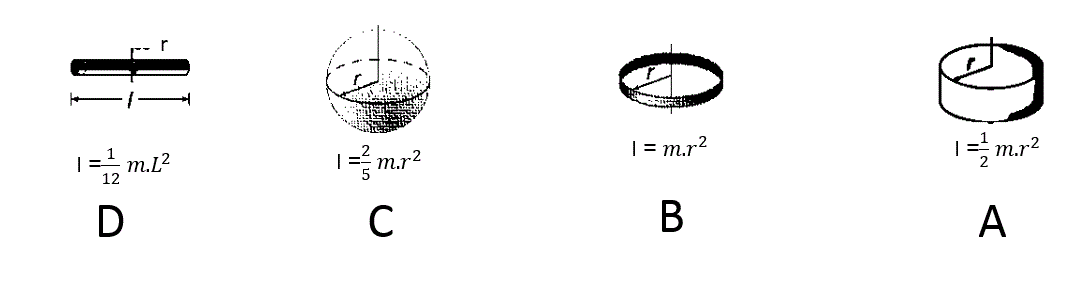
AA
BB
CC
DD
الحلSolution
📌 \(\tau=I\alpha\): لإكساب الجسم التسارع الزاوي نفسه يلزم عزم أكبر كلما زاد عزم القصور الذاتي.
📌 القيم: الأسطوانة \(\tfrac12mr^2\)، والحلقة \(mr^2\)، والكرة المصمتة \(\tfrac25mr^2\)، والقضيب \(\tfrac1{12}mL^2\) (وهو أصغرها لأن \(L=2r\) فيساوي \(\tfrac13mr^2\)).
📌 الأكبر هو الحلقة B (\(mr^2\)) لأن كتلتها كلها عند أبعد مسافة من المحور.
✅ B
📌 \(\tau=I\alpha\): to give the same angular acceleration, a larger moment of inertia needs a larger torque.
📌 Values: cylinder \(\tfrac12mr^2\), ring \(mr^2\), solid sphere \(\tfrac25mr^2\), rod \(\tfrac1{12}mL^2\) (with \(L=2r\) this is \(\tfrac13mr^2\)).
📌 The largest is the ring B (\(mr^2\)) since all its mass is at the greatest distance from the axis.
✅ B
\[25\,\star\]
قرص يدور حول محور يمر بمركزه بسرعة منتظمة، وخلال فترة زمنية معينة تتحرك النقاط معًا. فإن أحد الإجابات التالية صحيحة:A disc rotates uniformly about an axis through its center. During a given time interval all its points move together. Which of the following is correct?
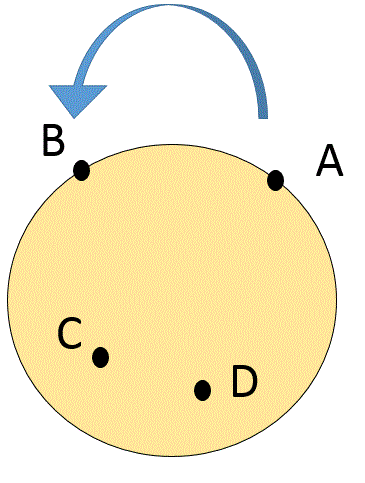
جميع النقاط تتحرك بنفس مقدار السرعة الزاويةAll points move with the same angular speed
\(A,B\) لهما نفس السرعة المتجهة\(A,B\) have the same velocity vector
\(A,C\) لهما نفس مقدار السرعة الخطية\(A,C\) have the same linear speed
جميع النقاط تتحرك بنفس مقدار السرعة الخطيةAll points move with the same linear speed
الحلSolution
📌 في الجسم الجاسئ تقطع جميع النقاط الزاوية نفسها في الزمن نفسه، فلها السرعة الزاوية نفسها \(\omega\).
📌 أما السرعة الخطية \(v=\omega r\) فتختلف بحسب البعد عن المحور، واتجاهها يختلف من نقطة لأخرى.
✅ جميع النقاط تتحرك بنفس مقدار السرعة الزاوية (A)
📌 In a rigid body all points sweep the same angle in the same time, so they all have the same angular speed \(\omega\).
📌 The linear speed \(v=\omega r\) depends on the distance from the axis, and its direction differs from point to point.
✅ All points move with the same angular speed (A)
📝 حل المسائل التالية
📝 Solve the Following Problems
\[1\]
في الشكل أدناه لعبة توازن (أرجوحة)، ومن معلومات الشكل: \(F_{g1}=250\,N\)، \(F_{g2}=400\,N\)، \(r_1=1.5\,m\)، \(r_2=1\,m\). احسب محصلة عزم الدوران على لعبة التوازن (الدوران عكس عقارب الساعة موجب).The figure shows a balance toy (seesaw) with \(F_{g1}=250\,N\), \(F_{g2}=400\,N\), \(r_1=1.5\,m\), \(r_2=1\,m\). Calculate the net torque on it (counterclockwise is positive).
.....................................................................
الحلSolution
📌 \(\tau_1=+F_{g1}r_1=250\times1.5=+375\,N\cdot m\) (عكس عقارب الساعة).
📌 \(\tau_2=-F_{g2}r_2=-400\times1=-400\,N\cdot m\) (مع عقارب الساعة).
📌 \(\tau_{net}=375-400=-25\,N\cdot m\).
✅ \(\tau_{net}=-25\,N\cdot m\)
📌 \(\tau_1=+F_{g1}r_1=250\times1.5=+375\,N\cdot m\) (counterclockwise).
📌 \(\tau_2=-F_{g2}r_2=-400\times1=-400\,N\cdot m\) (clockwise).
📌 \(\tau_{net}=375-400=-25\,N\cdot m\).
✅ \(\tau_{net}=-25\,N\cdot m\) (clockwise)
\[2\]
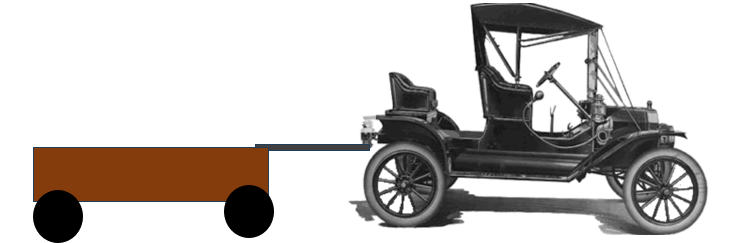
سيارة تملك إطارات نصف قطرها \(0.7\,m\) تتحرك بسرعة زاوية \(12\,rad/s\)، غيّرت السيارة سرعتها بشكل منتظم وأصبحت السرعة الزاوية للإطارات \(25\,rad/s\) خلال زمن قدره \(8\,s\). (أ) احسب التسارع الخطي لإطارات السيارة. (ب) عُلّقت بالسيارة عربة ذات إطارات نصف قطرها \(r=0.3\,m\)، احسب التسارع الخطي والزاوي لإطارات العربة الصغيرة.A car has wheels of radius \(0.7\,m\) rotating at \(12\,rad/s\). The car changes its speed uniformly until the wheels rotate at \(25\,rad/s\) in \(8\,s\). (a) Find the linear acceleration of the car’s wheels. (b) A small trailer with wheels of radius \(r=0.3\,m\) is hitched to the car. Find the linear and angular accelerations of the trailer’s wheels.
.....................................................................
الحلSolution
📌 (أ) التسارع الزاوي: \(\alpha=\dfrac{25-12}{8}=1.625\,rad/s^2\).
📌 التسارع الخطي: \(a=\alpha r=1.625\times0.7\approx1.14\,m/s^2\).
📌 (ب) العربة مرتبطة بالسيارة وتتحرك معها دون انزلاق، فتسارعها الخطي نفسه: \(a=1.14\,m/s^2\).
📌 التسارع الزاوي لإطارات العربة: \(\alpha=\dfrac{a}{r}=\dfrac{1.1375}{0.3}\approx3.79\,rad/s^2\).
✅ (أ) \(a\approx1.14\,m/s^2\) (ب) \(a\approx1.14\,m/s^2\) و \(\alpha\approx3.79\,rad/s^2\)
📌 (a) Angular acceleration: \(\alpha=\dfrac{25-12}{8}=1.625\,rad/s^2\).
📌 Linear acceleration: \(a=\alpha r=1.625\times0.7\approx1.14\,m/s^2\).
📌 (b) The trailer is hitched to the car and rolls without slipping, so it has the same linear acceleration: \(a=1.14\,m/s^2\).
📌 Angular acceleration of the trailer’s wheels: \(\alpha=\dfrac{a}{r}=\dfrac{1.1375}{0.3}\approx3.79\,rad/s^2\).
✅ (a) \(a\approx1.14\,m/s^2\) (b) \(a\approx1.14\,m/s^2\) and \(\alpha\approx3.79\,rad/s^2\)
لاحظت خطأ؟ أو عندك سؤال عن أحد الأسئلة؟ اكتبه بالتعليقات وحدد رقم السؤال بالضبط.
Noticed an error? Or have a question about one of the questions? Write it in the comments and specify the exact question number.