⚡ بنك الأسئلة: الحث الكهرومغناطيسي (12A)
⚡ Question Bank: Electromagnetic Induction (12A)
التدفق المغناطيسي، قانونا فاراداي ولنز، القوة الدافعة الحركية، الحث الذاتي والمتبادل، المولدات والمحركات
Magnetic Flux, Faraday's and Lenz's Laws, Motional EMF, Self and Mutual Induction, Generators and Motors
⏱️ 53 سؤال اختيار من متعدد بتصحيح فوري بمستويات متدرجة، و6 مسائل مقالية محلولة، مع حل مفصل لكل سؤال⏱️ 53 multiple-choice questions of graded difficulty with instant feedback, and 6 solved essay problems, with a detailed solution for each
\[1\,\star\]
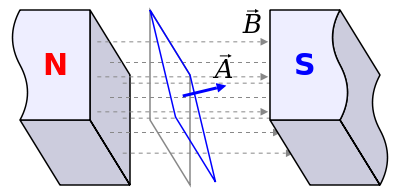
ملف مربع مساحة سطحه \(0.2\,m^{2}\) وُضع في مجال منتظم شدته \(0.3\,T\) والزاوية بين المجال وسطح الملف \(60^{\circ}\). التدفق المغناطيسي:A square coil of area \(0.2\,m^{2}\) is placed in a uniform field of \(0.3\,T\) and the angle between the field and the surface of the coil is \(60^{\circ}\). The magnetic flux is:
\(\phi=0.052\,T\cdot m^{2}\)\(\phi=0.052\,T\cdot m^{2}\)
\(\phi=0.015\,T\cdot m^{2}\)\(\phi=0.015\,T\cdot m^{2}\)
\(\phi=0.06\,T\cdot m^{2}\)\(\phi=0.06\,T\cdot m^{2}\)
\(\phi=0.03\,T\cdot m^{2}\)\(\phi=0.03\,T\cdot m^{2}\)
الحلSolution
📌 \(\phi=BA\cos\theta\) حيث \(\theta\) الزاوية بين المجال والعمود على السطح؛ والزاوية بين المجال والسطح \(60^{\circ}\) إذن \(\theta=30^{\circ}\).
\(\phi=0.3\times0.2\times\cos30^{\circ}=0.052\,T\cdot m^{2}\) (أو \(BA\sin60^{\circ}\)).
✅ \(\phi=0.052\,T\cdot m^{2}\) (A)
📌 \(\phi=BA\cos\theta\) where \(\theta\) is the angle between the field and the normal; the angle between the field and the surface is \(60^{\circ}\) so \(\theta=30^{\circ}\).
\(\phi=0.3\times0.2\times\cos30^{\circ}=0.052\,T\cdot m^{2}\) (or \(BA\sin60^{\circ}\)).
✅ \(\phi=0.052\,T\cdot m^{2}\) (A)
\[2\,\star\]
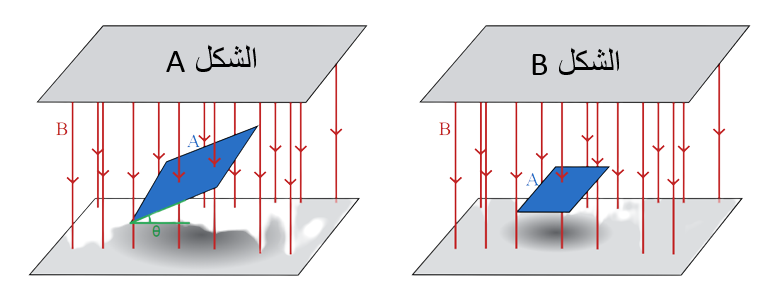
حلقة مربعة في مجال منتظم كما في الشكل A، والزاوية بين المجال والعمود على السطح \(20^{\circ}\) وكان التدفق \(0.5\,T\cdot m^{2}\). عُدّل وضع الحلقة فأصبح المجال عموديًا على السطح (الشكل B). التدفق الآن:A square loop in a uniform field as in figure A; the angle between the field and the normal to the surface is \(20^{\circ}\) and the flux is \(0.5\,T\cdot m^{2}\). The loop is reoriented so the field is perpendicular to the surface (figure B). The flux now is:
\(\phi=0.53\,T\cdot m^{2}\)\(\phi=0.53\,T\cdot m^{2}\)
\(\phi=0.63\,T\cdot m^{2}\)\(\phi=0.63\,T\cdot m^{2}\)
\(\phi=0.5\,T\cdot m^{2}\)\(\phi=0.5\,T\cdot m^{2}\)
\(\phi=0.6\,T\cdot m^{2}\)\(\phi=0.6\,T\cdot m^{2}\)
الحلSolution
\(\phi_A=BA\cos20^{\circ}=0.5\Rightarrow BA=\dfrac{0.5}{0.940}=0.532\).
📌 عندما يكون المجال عموديًا على السطح (موازيًا للعمود) \(\cos0=1\) فيكون \(\phi_B=BA=0.53\,T\cdot m^{2}\) وهي القيمة العظمى.
✅ \(\phi=0.53\,T\cdot m^{2}\) (A)
\(\phi_A=BA\cos20^{\circ}=0.5\Rightarrow BA=\dfrac{0.5}{0.940}=0.532\).
📌 When the field is perpendicular to the surface (parallel to the normal) \(\cos0=1\) so \(\phi_B=BA=0.53\,T\cdot m^{2}\), the maximum value.
✅ \(\phi=0.53\,T\cdot m^{2}\) (A)
\[3\,\star\star\]
أي الحالات التالية يتولد فيها تيار مستحث في الحلقة مع عقارب الساعة عند النظر إليها من الأعلى؟In which of the following cases is an induced current produced in the loop clockwise when viewed from above?
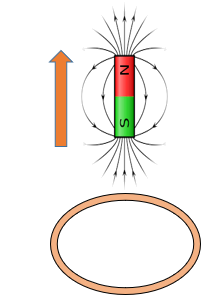
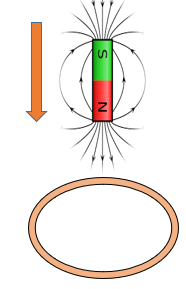
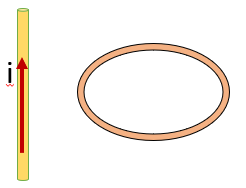
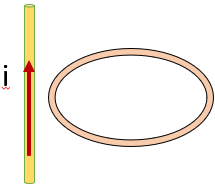
تحريك المغناطيس باتجاه الحلقةmoving the magnet toward the loop
تحريك المغناطيس بعيدًا عن الحلقةmoving the magnet away from the loop
إبعاد الحلقة عن سلك يمر به تيارmoving the loop away from a wire carrying a current
تقريب الحلقة من سلك يمر به تيارbringing the loop closer to a wire carrying a current
الحلSolution
📌 قاعدة لنز: الحقل المستحث يعاكس تغيّر التدفق. مغناطيس يقترب بقطبه الشمالي إلى أسفل: تدفق لأسفل يزداد فيتولد حقل لأعلى (عكس عقارب الساعة)؛ وعند ابتعاد المغناطيس بقطبه الشمالي إلى أعلى يتناقص تدفق لأعلى فيتولد حقل لأعلى أيضًا (عكس عقارب الساعة).
📌 السلك الذي يمر فيه تيار يعطي عند الحلقة مجالًا إلى داخل الصفحة؛ فإذا ابتعدت الحلقة تناقص التدفق إلى الداخل فيتولد حقل إلى الداخل أي تيار مع عقارب الساعة، وإذا اقتربت حدث العكس. فالإجابة: إبعاد الحلقة عن السلك.
✅ إبعاد الحلقة عن سلك يمر به تيار (C)
📌 Lenz's law: the induced field opposes the change of flux. A magnet approaching with its north pole downward gives an increasing downward flux so an upward field is induced (counterclockwise); a magnet moving away with its north pole up gives a decreasing upward flux so an upward field is induced as well (counterclockwise).
📌 The wire's field at the loop points into the page; if the loop moves away the inward flux decreases so an inward field is induced, i.e. a clockwise current, and if it comes closer the opposite happens. So the answer is moving the loop away from the wire.
✅ moving the loop away from a wire carrying a current (C)
\[4\,\star\]
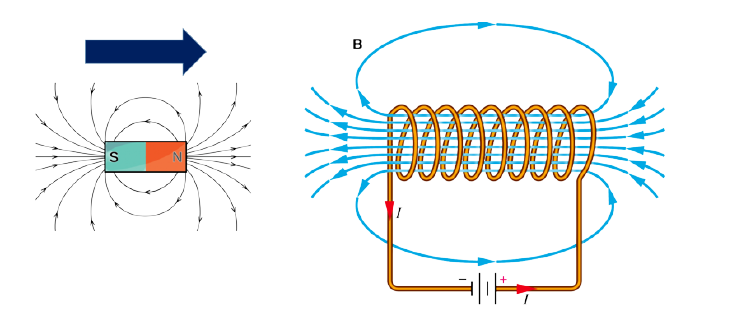
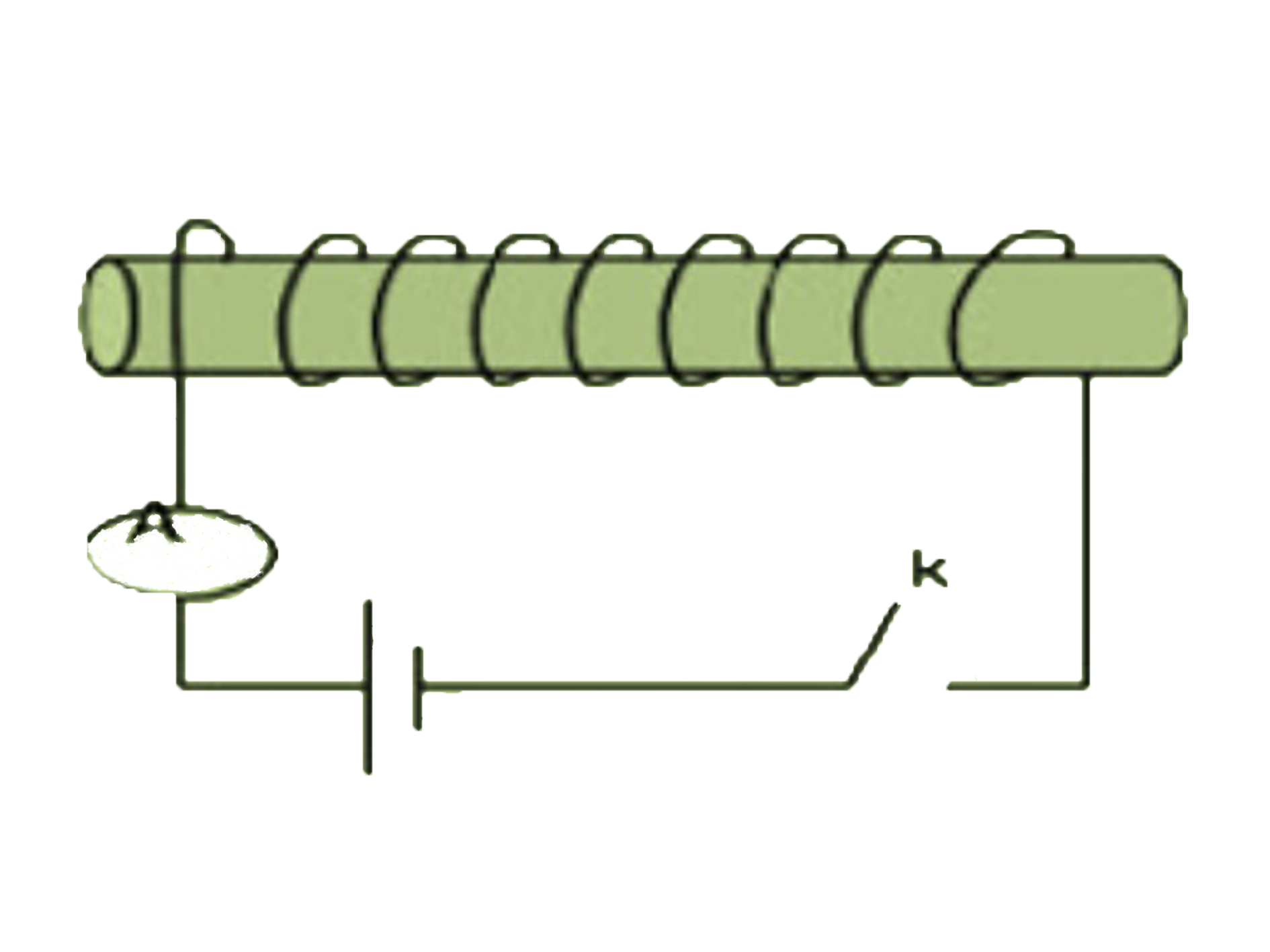
ملف متصل ببطارية يمر به تيار مستمر فينشأ مجال مغناطيسي كما في الشكل. لحظة تقريب مغناطيس من الملف:A coil connected to a battery carries a direct current and produces a magnetic field as in the figure. At the moment a magnet is brought close to the coil:
تزداد شدة التيارthe current increases
تقل شدة التيارthe current decreases
تبقى شدة التيار كما هيthe current stays the same
تنعدم شدة التيارthe current becomes zero
الحلSolution
📌 مجال الملف داخله إلى اليسار (طرفه الأيسر قطب شمالي)، والمغناطيس يقترب بقطبه الشمالي فيكون مجاله عند الملف إلى اليمين، أي معاكسًا لمجال الملف.
📌 التدفق الكلي إلى اليسار يتناقص، فتنشأ قوة دافعة مستحثة تعارض النقصان أي تدعم التيار الأصلي، فتزداد شدة التيار لحظة التقريب.
✅ تزداد شدة التيار (A)
📌 The field inside the coil points to the left (its left end is a north pole), and the magnet approaches with its north pole, so its field at the coil points to the right, opposite to the coil's field.
📌 The total flux to the left decreases, so an induced emf opposes the decrease, i.e. it supports the original current, and the current increases at that moment.
✅ the current increases (A)
\[5\,\star\star\]
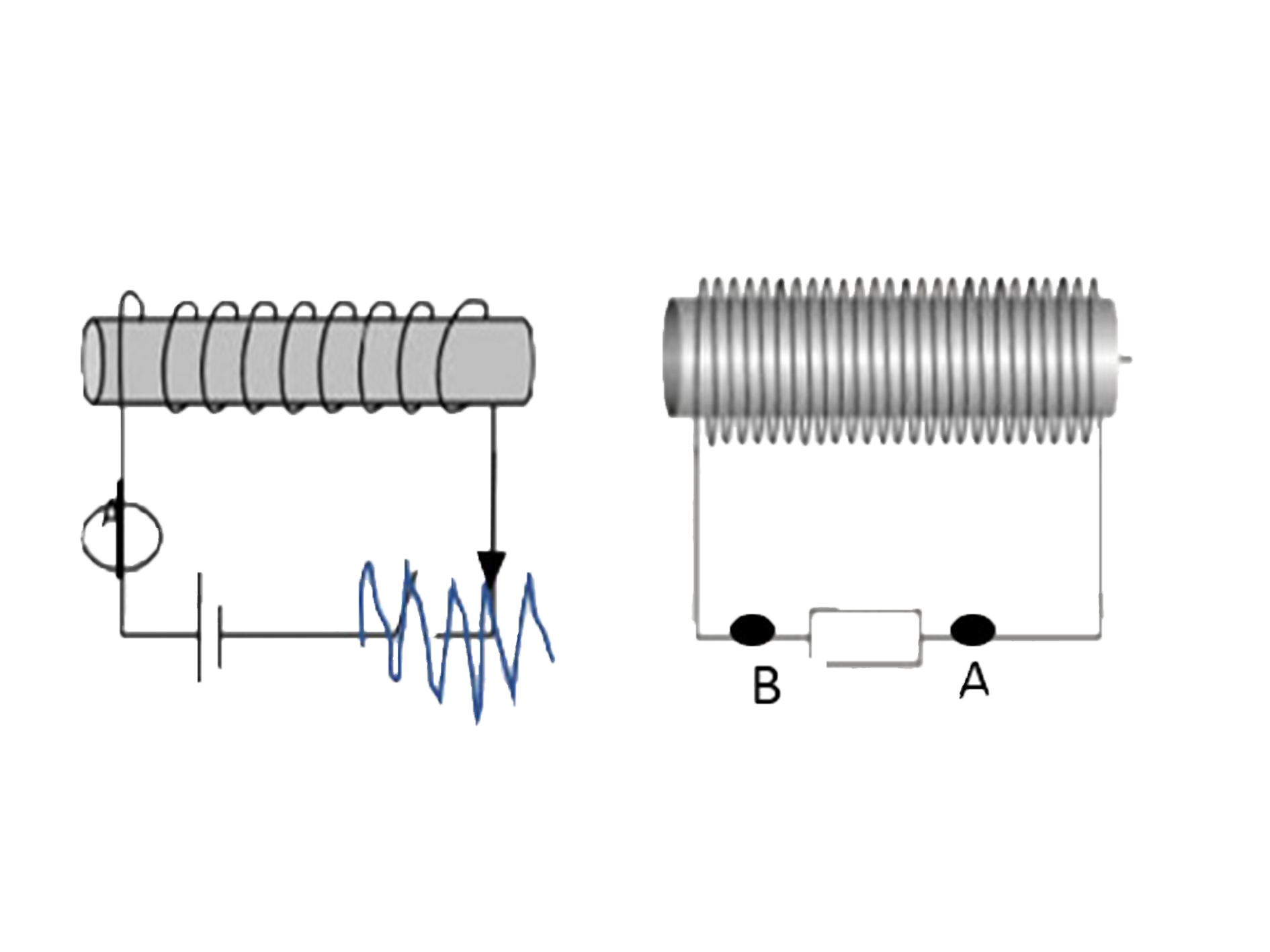
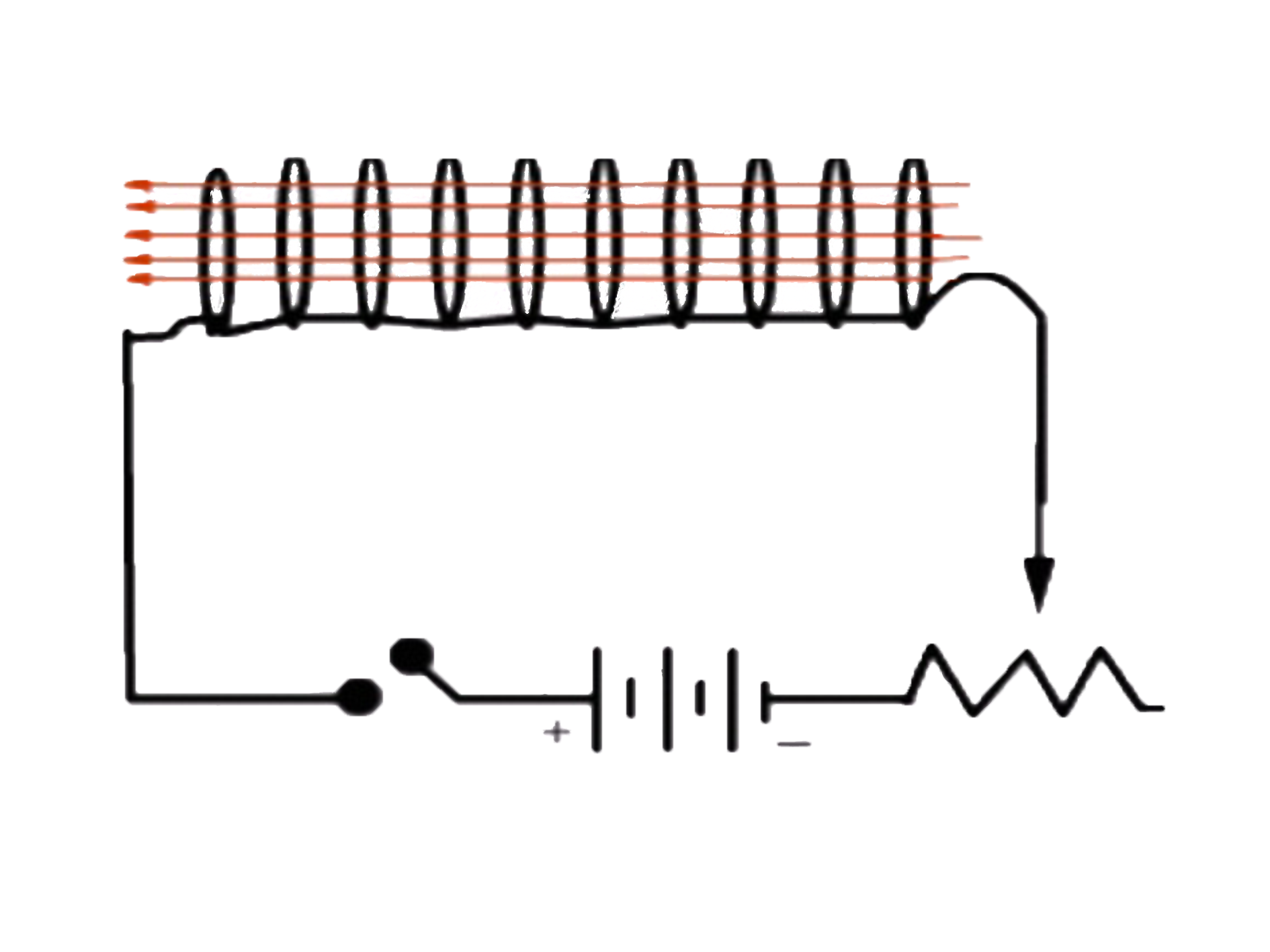
ملفان: الأول متصل ببطارية ومقاومة متغيرة وملفوف حول نواة حديد، والثاني متصل بمقاوم. يمر في المقاوم تيار مستحث من \(B\Rightarrow A\) في إحدى الحالات التالية:There are two coils: the first is connected to a battery and a rheostat and wound on an iron core, the second is connected to a resistor. An induced current passes through the resistor from \(B\Rightarrow A\) in one of the following cases:
فتح المفتاح في الملف الأولopening the switch in the first coil
إخراج نواة الحديد من الملف الأولremoving the iron core from the first coil
إنقاص المقاومة المتغيرة في الملف الأولdecreasing the rheostat in the first coil
زيادة المقاومة المتغيرة في الملف الأولincreasing the rheostat in the first coil
الحلSolution
📌 المطلوب اتجاه تيار مستحث محدد في الملف الثاني، ويحدث ذلك عند زيادة التدفق في الملف الأول (من جهة اتجاه الرسم). فنبحث عن الحالة التي يزداد فيها التدفق.
📌 فتح المفتاح أو إخراج النواة أو زيادة المقاومة تُنقص التدفق (تيار أصغر أو نفاذية أقل)، أما إنقاص المقاومة فيزيد التيار والتدفق ويعطي الاتجاه المطلوب.
✅ إنقاص المقاومة المتغيرة في الملف الأول (C)
📌 The required direction of the induced current in the second coil occurs when the flux in the first coil increases (for the winding in the figure), so we look for the case in which the flux increases.
📌 Opening the switch, removing the core or increasing the resistance reduces the flux (smaller current or lower permeability), whereas decreasing the resistance increases the current and the flux and gives the required direction.
✅ decreasing the rheostat in the first coil (C)
\[6\,\star\star\]
حلقة مرنة وُضعت في مجال مغناطيسي منتظم خارج من الصفحة كما في الشكل. يمكن توليد تيار مستحث فيها مع عقارب الساعة عند:A flexible loop is placed in a uniform magnetic field coming out of the page as in the figure. An induced current clockwise can be produced in it by:
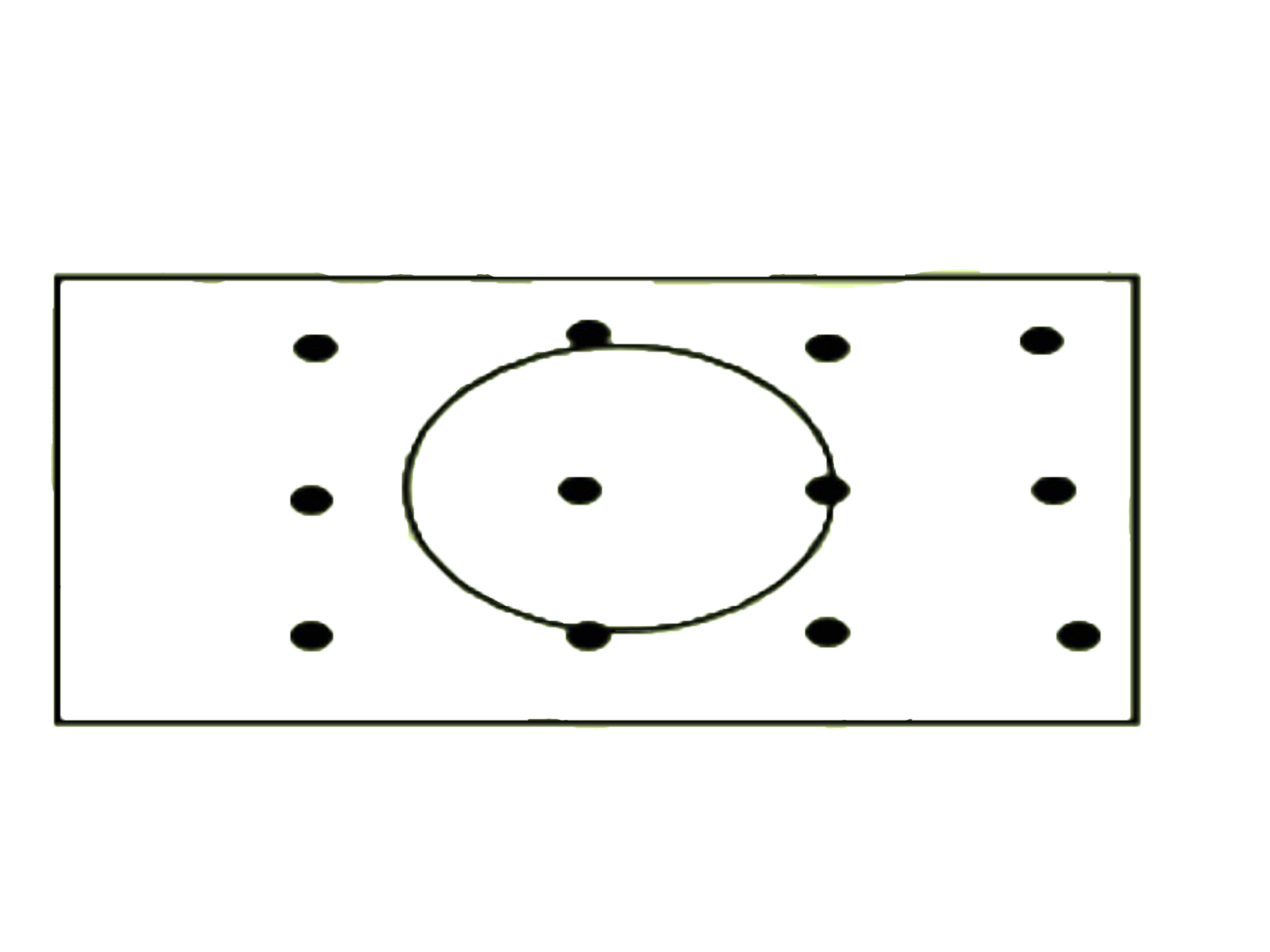
تحريك الحلقة داخل المجالmoving the loop inside the field
إخراج الحلقة من المجالremoving the loop from the field
تدويرها بحيث تبقى موازية للصفحةrotating it so that it stays parallel to the page
توسيع الحلقةexpanding the loop
الحلSolution
📌 تيار مع عقارب الساعة يولد حقلًا إلى داخل الصفحة داخل الحلقة، وهو يعارض زيادة التدفق الخارج.
📌 يزداد التدفق الخارج عندما تزداد المساحة (توسيع الحلقة)، أما التحريك داخل المجال المنتظم أو التدوير الموازي للصفحة فلا يغيّر التدفق، وإخراج الحلقة ينقصه فيعطي تيارًا عكس عقارب الساعة.
✅ توسيع الحلقة (D)
📌 A clockwise current produces a field into the page inside the loop, opposing an increase of the outward flux.
📌 The outward flux increases when the area increases (expanding the loop); moving inside a uniform field or rotating while parallel to the page does not change it, and removing the loop decreases it, giving a counterclockwise current.
✅ expanding the loop (D)
\[7\,\star\star\]
حلقة دائرية نصف قطرها \(0.2\,m\) عمودية على مجال متغير \(B=0.3t^{3}+2t\) (بالتسلا). مقدار فرق الجهد المستحث في الحلقة عند الثانية الثالثة:A circular loop of radius \(0.2\,m\) is perpendicular to a field \(B=0.3t^{3}+2t\) (in tesla). The magnitude of the induced emf in the loop at the third second is:
\(\Delta V_{ind}=-3.16\,V\)\(\Delta V_{ind}=-3.16\,V\)
\(\Delta V_{ind}=-2.08\,V\)\(\Delta V_{ind}=-2.08\,V\)
\(\Delta V_{ind}=-1.38\,V\)\(\Delta V_{ind}=-1.38\,V\)
\(\Delta V_{ind}=-1.27\,V\)\(\Delta V_{ind}=-1.27\,V\)
الحلSolution
\(A=\pi r^{2}=\pi(0.2)^{2}=0.1257\,m^{2}\) و\(\dfrac{dB}{dt}=0.9t^{2}+2=0.9(9)+2=10.1\,T/s\).
\(\Delta V_{ind}=-A\dfrac{dB}{dt}=-0.1257\times10.1=-1.27\,V\).
✅ \(\Delta V_{ind}=-1.27\,V\) (D)
\(A=\pi r^{2}=\pi(0.2)^{2}=0.1257\,m^{2}\) and \(\dfrac{dB}{dt}=0.9t^{2}+2=0.9(9)+2=10.1\,T/s\).
\(\Delta V_{ind}=-A\dfrac{dB}{dt}=-0.1257\times10.1=-1.27\,V\).
✅ \(\Delta V_{ind}=-1.27\,V\) (D)
\[8\,\star\]
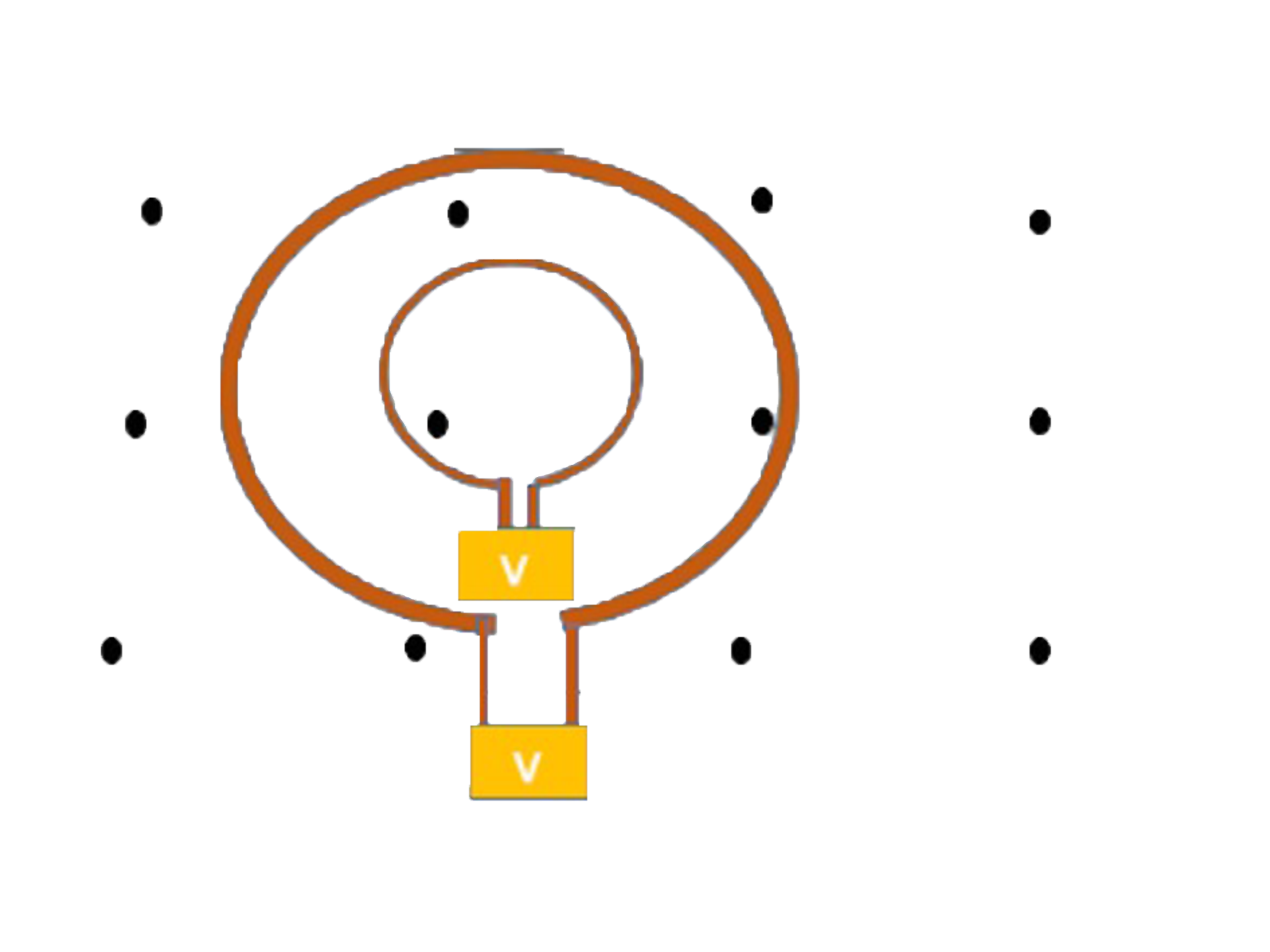
حلقة مرنة متغيرة المساحة في مجال شدته \(0.5\times10^{-4}\,T\) عمودي على سطحها. زادت مساحتها \(0.1\,m^{2}\) خلال \(0.4\,s\). معدل فرق الجهد المستحث:A flexible loop of variable area lies in a field of \(0.5\times10^{-4}\,T\) perpendicular to its surface. Its area increases by \(0.1\,m^{2}\) in \(0.4\,s\). The average induced emf is:
\(\Delta V_{ind}=1.11\times10^{-5}\,V\)\(\Delta V_{ind}=1.11\times10^{-5}\,V\)
\(\Delta V_{ind}=1.25\times10^{-5}\,V\)\(\Delta V_{ind}=1.25\times10^{-5}\,V\)
\(\Delta V_{ind}=4.35\times10^{-5}\,V\)\(\Delta V_{ind}=4.35\times10^{-5}\,V\)
\(\Delta V_{ind}=2.24\times10^{-5}\,V\)\(\Delta V_{ind}=2.24\times10^{-5}\,V\)
الحلSolution
\(|\Delta V_{ind}|=B\dfrac{\Delta A}{\Delta t}=0.5\times10^{-4}\times\dfrac{0.1}{0.4}=1.25\times10^{-5}\,V\).
✅ \(\Delta V_{ind}=1.25\times10^{-5}\,V\) (B)
\(|\Delta V_{ind}|=B\dfrac{\Delta A}{\Delta t}=0.5\times10^{-4}\times\dfrac{0.1}{0.4}=1.25\times10^{-5}\,V\).
✅ \(\Delta V_{ind}=1.25\times10^{-5}\,V\) (B)
\[9\,\star\star\]
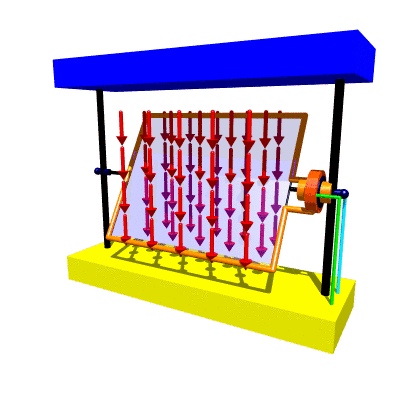
حلقة مساحتها \(0.1\,m^{2}\) تدور حول محورها في مجال منتظم شدته \(0.2\,T\) بسرعة زاوية \(5\,rad/s\)، وكان سطحها عموديًا على المجال لحظة بدء الدوران (التدفق أعظم ما يمكن). فرق الجهد المستحث عند الثانية الرابعة:A loop of area \(0.1\,m^{2}\) rotates about its axis in a uniform field of \(0.2\,T\) at an angular speed \(5\,rad/s\), its surface being perpendicular to the field when the rotation starts (the flux is maximum). The induced emf at the fourth second is:
\(\Delta V_{ind}=0.05\,V\)\(\Delta V_{ind}=0.05\,V\)
\(\Delta V_{ind}=0.06\,V\)\(\Delta V_{ind}=0.06\,V\)
\(\Delta V_{ind}=0.09\,V\)\(\Delta V_{ind}=0.09\,V\)
\(\Delta V_{ind}=0.02\,V\)\(\Delta V_{ind}=0.02\,V\)
الحلSolution
📌 \(\phi=BA\cos\omega t\) فيكون \(\Delta V_{ind}=-\dfrac{d\phi}{dt}=BA\omega\sin\omega t\).
\(=0.2\times0.1\times5\times\sin(5\times4)=0.1\times\sin(20\,rad)=0.1\times0.913\approx0.09\,V\) (الزاوية بالراديان).
✅ \(\Delta V_{ind}=0.09\,V\) (C)
📌 \(\phi=BA\cos\omega t\) so \(\Delta V_{ind}=-\dfrac{d\phi}{dt}=BA\omega\sin\omega t\).
\(=0.2\times0.1\times5\times\sin(5\times4)=0.1\times\sin(20\,rad)=0.1\times0.913\approx0.09\,V\) (the angle is in radians).
✅ \(\Delta V_{ind}=0.09\,V\) (C)
\[10\,\star\]
ملف لولبي هوائي مساحة مقطعه \(0.2\,m^{2}\) وعدد لفاته \(50\) وطوله \(10\,cm\) يمر به تيار \(3\,A\). التدفق الذي يجتاز سطح اللفة الواحدة:An air-core solenoid of cross-section \(0.2\,m^{2}\), \(50\) turns and length \(10\,cm\) carries \(3\,A\). The flux through the surface of one turn is:
\(\phi=3.77\times10^{-4}\,T\cdot m^{2}\)\(\phi=3.77\times10^{-4}\,T\cdot m^{2}\)
\(\phi=1.5\times10^{-3}\,T\cdot m^{2}\)\(\phi=1.5\times10^{-3}\,T\cdot m^{2}\)
\(\phi=3.0\times10^{-2}\,T\cdot m^{2}\)\(\phi=3.0\times10^{-2}\,T\cdot m^{2}\)
\(\phi=6.0\times10^{-4}\,T\cdot m^{2}\)\(\phi=6.0\times10^{-4}\,T\cdot m^{2}\)
الحلSolution
\(B=\dfrac{\mu_0NI}{\ell}=\dfrac{4\pi\times10^{-7}\times50\times3}{0.1}=1.885\times10^{-3}\,T\).
\(\phi=BA=1.885\times10^{-3}\times0.2=3.77\times10^{-4}\,T\cdot m^{2}\).
✅ \(\phi=3.77\times10^{-4}\,T\cdot m^{2}\) (A)
\(B=\dfrac{\mu_0NI}{\ell}=\dfrac{4\pi\times10^{-7}\times50\times3}{0.1}=1.885\times10^{-3}\,T\).
\(\phi=BA=1.885\times10^{-3}\times0.2=3.77\times10^{-4}\,T\cdot m^{2}\).
✅ \(\phi=3.77\times10^{-4}\,T\cdot m^{2}\) (A)
\[11\,\star\]
ملف لولبي معامل حثه الذاتي \(0.1\,H\) متصل ببطارية يمر به تيار \(2\,A\)، عُكس اتجاه التيار خلال \(0.15\,s\). القوة الدافعة المستحثة في الملف:A solenoid of self-inductance \(0.1\,H\) is connected to a battery and carries \(2\,A\); the current is reversed in \(0.15\,s\). The induced emf in the coil is:
\(\Delta V_{ind}=0.0\,V\)\(\Delta V_{ind}=0.0\,V\)
\(\Delta V_{ind}=1.3\,V\)\(\Delta V_{ind}=1.3\,V\)
\(\Delta V_{ind}=2.7\,V\)\(\Delta V_{ind}=2.7\,V\)
\(\Delta V_{ind}=-1.9\,V\)\(\Delta V_{ind}=-1.9\,V\)
الحلSolution
📌 عكس اتجاه التيار يعني تغير التيار من \(+2\,A\) إلى \(-2\,A\): \(\Delta I=-4\,A\).
\(\Delta V_{ind}=-L\dfrac{\Delta I}{\Delta t}=-0.1\times\dfrac{-4}{0.15}=+2.7\,V\).
✅ \(\Delta V_{ind}=2.7\,V\) (C)
📌 Reversing the current means it changes from \(+2\,A\) to \(-2\,A\): \(\Delta I=-4\,A\).
\(\Delta V_{ind}=-L\dfrac{\Delta I}{\Delta t}=-0.1\times\dfrac{-4}{0.15}=+2.7\,V\).
✅ \(\Delta V_{ind}=2.7\,V\) (C)
\[12\,\star\star\star\]
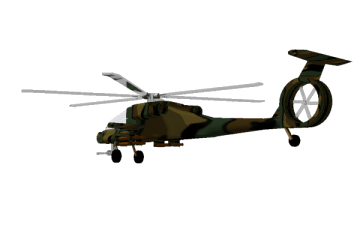
طائرة مروحية تحلّق أفقيًا فوق الإمارات في منطقة مجالها المغناطيسي \(0.4\times10^{-4}\,T\)، وقطر الدائرة التي تدور فيها مراوحها المصنوعة من الألمنيوم \(8\,m\) (أي طول كل مروحة \(4\,m\)) وتدور بسرعة زاوية \(200\,rad/s\). فرق الجهد المستحث من المحور إلى نهاية المروحة:A helicopter flies horizontally over the UAE where the magnetic field is \(0.4\times10^{-4}\,T\). The circle swept by its aluminium rotor blades has a diameter of \(8\,m\) (each blade is \(4\,m\) long) and they rotate at \(200\,rad/s\). The induced emf from the hub to the tip of a blade is:
\(\Delta V_{ind}=0.064\,V\)\(\Delta V_{ind}=0.064\,V\)
\(\Delta V_{ind}=0.254\,V\)\(\Delta V_{ind}=0.254\,V\)
\(\Delta V_{ind}=0.032\,V\)\(\Delta V_{ind}=0.032\,V\)
\(\Delta V_{ind}=0.128\,V\)\(\Delta V_{ind}=0.128\,V\)
الحلSolution
📌 المروحة قضيب يدور حول أحد طرفيه: سرعة نقطة تبعد \(x\) عن المحور \(v=\omega x\)، فتكون القوة الدافعة \(\int B\omega x\,dx=\dfrac{1}{2}B\omega L^{2}\).
\(\Delta V_{ind}=\dfrac{1}{2}\times0.4\times10^{-4}\times200\times4^{2}=0.064\,V\).
✅ \(\Delta V_{ind}=0.064\,V\) (A)
📌 A blade is a rod rotating about one end: a point at distance \(x\) from the hub has speed \(v=\omega x\), so the emf is \(\int B\omega x\,dx=\dfrac{1}{2}B\omega L^{2}\).
\(\Delta V_{ind}=\dfrac{1}{2}\times0.4\times10^{-4}\times200\times4^{2}=0.064\,V\).
✅ \(\Delta V_{ind}=0.064\,V\) (A)
\[13\,\star\star\]
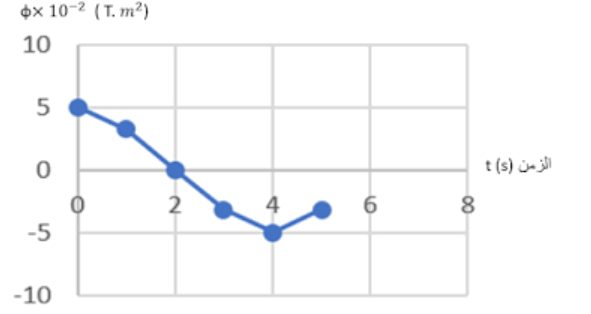
ملف من 20 لفة يدور بمعدل ثابت ومحوره عمودي على المجال، ورُسمت العلاقة بين التدفق والزمن (الشكل). أعظم فرق جهد مستحث في الملف:A coil of 20 turns rotates at a constant rate with its axis perpendicular to the field, and the graph of flux against time is drawn (figure). The maximum induced emf in the coil is:
\(\Delta V_{max}=0.79\,V\)\(\Delta V_{max}=0.79\,V\)
\(\Delta V_{max}=5.3\,V\)\(\Delta V_{max}=5.3\,V\)
\(\Delta V_{max}=4.2\,V\)\(\Delta V_{max}=4.2\,V\)
\(\Delta V_{max}=6.7\,V\)\(\Delta V_{max}=6.7\,V\)
الحلSolution
📌 من الرسم: \(\phi_{max}=5\times10^{-2}\,T\cdot m^{2}\) والتدفق يبدأ من القيمة العظمى ويصل إلى الصفر بعد \(2\,s\) (ربع دورة) فتكون الدورة \(T=8\,s\) و\(\omega=\dfrac{2\pi}{8}=0.785\,rad/s\).
\(\Delta V_{max}=N\phi_{max}\omega=20\times5\times10^{-2}\times0.785=0.79\,V\).
✅ \(\Delta V_{max}=0.79\,V\) (A)
📌 From the graph: \(\phi_{max}=5\times10^{-2}\,T\cdot m^{2}\) and the flux falls from its maximum to zero in \(2\,s\) (a quarter cycle), so \(T=8\,s\) and \(\omega=\dfrac{2\pi}{8}=0.785\,rad/s\).
\(\Delta V_{max}=N\phi_{max}\omega=20\times5\times10^{-2}\times0.785=0.79\,V\).
✅ \(\Delta V_{max}=0.79\,V\) (A)
\[14\,\star\star\]
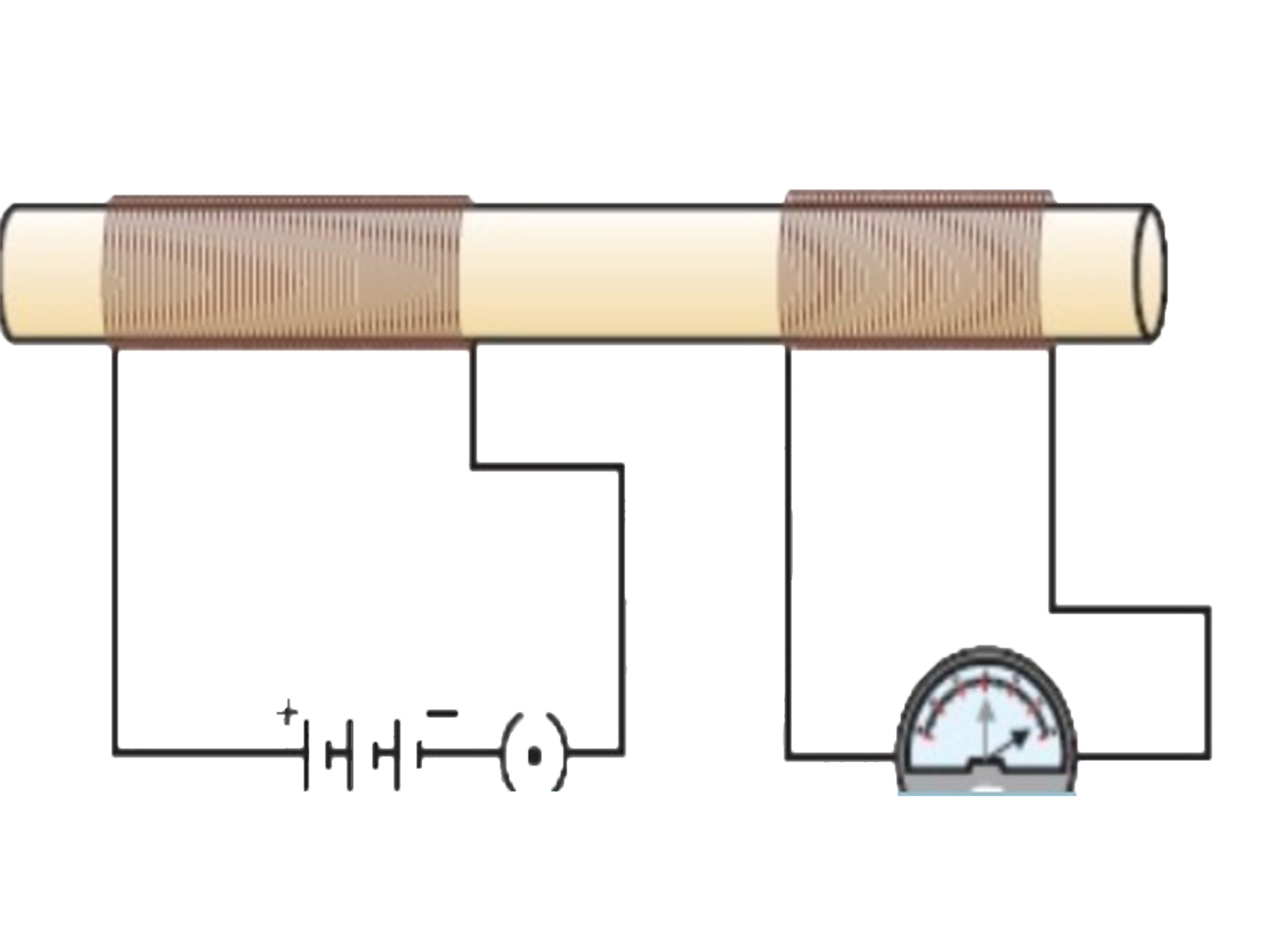
ملف ابتدائي من 30 لفة متصل ببطارية؛ وُصل المفتاح فأصبح التيار \(3\,A\) بعد \(0.1\,s\) والحث المتبادل \(0.2\,H\). إذا كان عدد لفات الثانوي نصف عدد لفات الابتدائي فإن المعدل الزمني لتغير التدفق في اللفة الواحدة من الثانوي:A primary coil of 30 turns is connected to a battery; the switch is closed and the current becomes \(3\,A\) after \(0.1\,s\), the mutual inductance being \(0.2\,H\). If the secondary has half as many turns as the primary, the rate of change of flux through one turn of the secondary is:
\(\dfrac{\Delta\phi}{\Delta t}=0.3\,V\)\(\dfrac{\Delta\phi}{\Delta t}=0.3\,V\)
\(\dfrac{\Delta\phi}{\Delta t}=0.4\,V\)\(\dfrac{\Delta\phi}{\Delta t}=0.4\,V\)
\(\dfrac{\Delta\phi}{\Delta t}=0.15\,V\)\(\dfrac{\Delta\phi}{\Delta t}=0.15\,V\)
\(\dfrac{\Delta\phi}{\Delta t}=0.6\,V\)\(\dfrac{\Delta\phi}{\Delta t}=0.6\,V\)
الحلSolution
\(N_s=\dfrac{30}{2}=15\) والقوة الدافعة في الثانوي كله \(V_s=M\dfrac{\Delta I}{\Delta t}=0.2\times\dfrac{3}{0.1}=6\,V\).
\(V_s=N_s\dfrac{\Delta\phi}{\Delta t}\Rightarrow\dfrac{\Delta\phi}{\Delta t}=\dfrac{6}{15}=0.4\,V\).
✅ \(\dfrac{\Delta\phi}{\Delta t}=0.4\,V\) (B)
\(N_s=\dfrac{30}{2}=15\) and the emf in the whole secondary is \(V_s=M\dfrac{\Delta I}{\Delta t}=0.2\times\dfrac{3}{0.1}=6\,V\).
\(V_s=N_s\dfrac{\Delta\phi}{\Delta t}\Rightarrow\dfrac{\Delta\phi}{\Delta t}=\dfrac{6}{15}=0.4\,V\).
✅ \(\dfrac{\Delta\phi}{\Delta t}=0.4\,V\) (B)
\[15\,\star\star\]
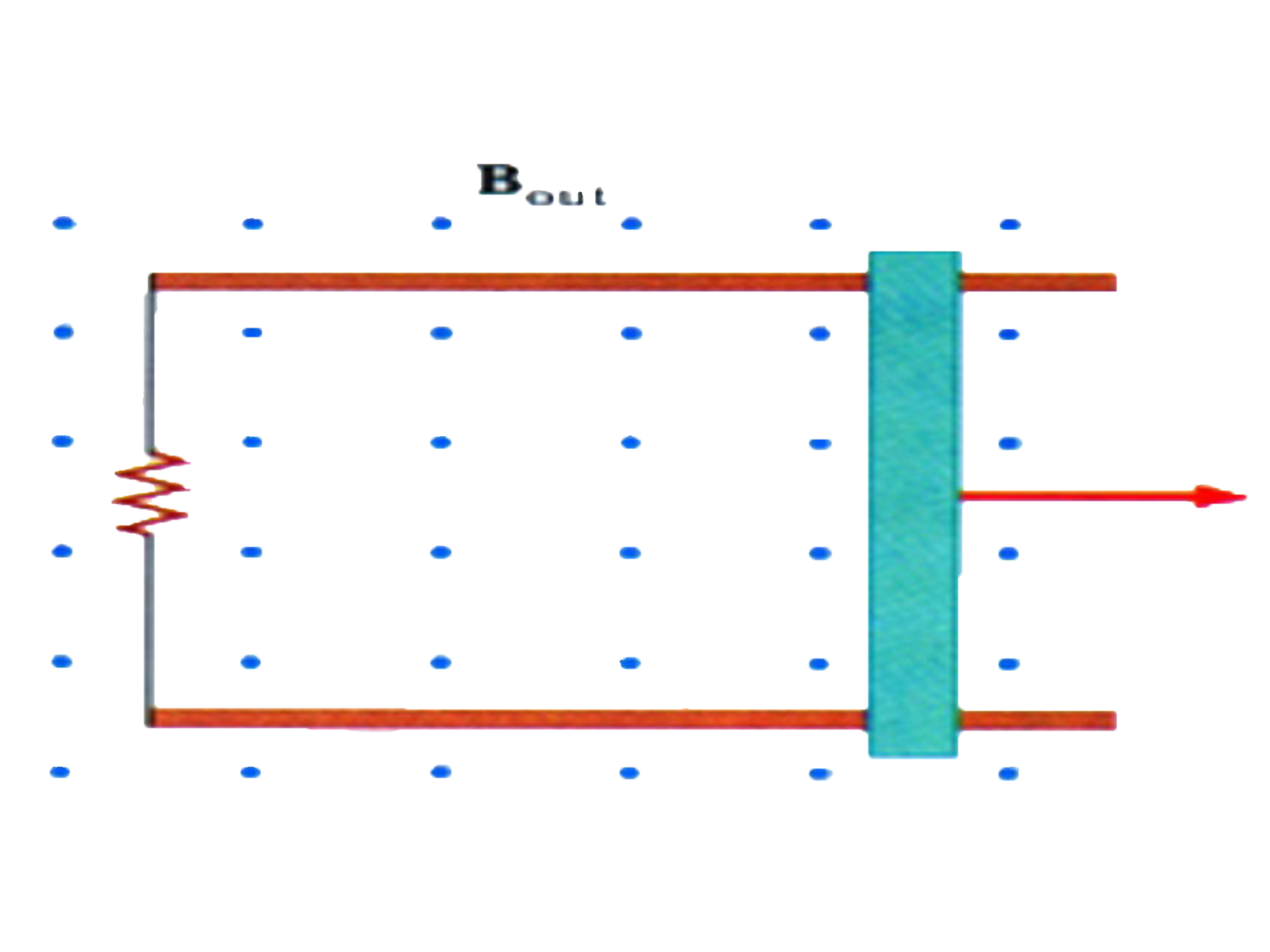
سلك طوله \(0.2\,m\) يتحرك بسرعة \(20\,m/s\) عموديًا على مجال \(B=0.2\,T\) على سكة بلا احتكاك متصلة بمقاومة \(5\,\Omega\). شدة التيار المستحث:A wire of length \(0.2\,m\) moves at \(20\,m/s\) perpendicular to a field \(B=0.2\,T\) on a frictionless rail connected to a \(5\,\Omega\) resistor. The induced current is:
\(I_{ind}=0.16\,A\)\(I_{ind}=0.16\,A\)
\(I_{ind}=0.48\,A\)\(I_{ind}=0.48\,A\)
\(I_{ind}=1\,A\)\(I_{ind}=1\,A\)
\(I_{ind}=0.3\,A\)\(I_{ind}=0.3\,A\)
الحلSolution
\(\Delta V_{ind}=BLv=0.2\times0.2\times20=0.8\,V\).
\(I=\dfrac{\Delta V_{ind}}{R}=\dfrac{0.8}{5}=0.16\,A\).
✅ \(I_{ind}=0.16\,A\) (A)
\(\Delta V_{ind}=BLv=0.2\times0.2\times20=0.8\,V\).
\(I=\dfrac{\Delta V_{ind}}{R}=\dfrac{0.8}{5}=0.16\,A\).
✅ \(I_{ind}=0.16\,A\) (A)
\[16\,\star\star\star\]
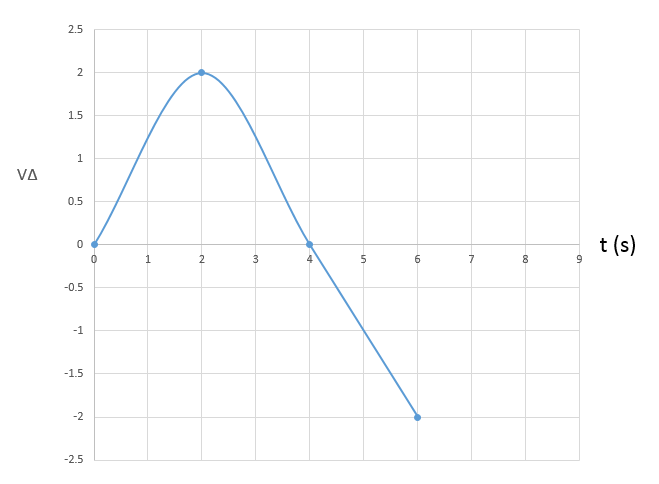
ملف من 30 لفة يدور في مجال مغناطيسي ومحور دورانه عمودي على المجال، ورُسمت العلاقة بين فرق الجهد المستحث والزمن (الشكل). التدفق المغناطيسي الذي يجتاز لفة واحدة عند الثانية الرابعة:A coil of 30 turns rotates in a magnetic field with its axis perpendicular to the field, and the graph of induced emf against time is drawn (figure). The flux through one turn at the fourth second is:
\(\phi=-0.054\,T\cdot m^{2}\)\(\phi=-0.054\,T\cdot m^{2}\)
\(\phi=0.0\)\(\phi=0.0\)
\(\phi=0.24\,T\cdot m^{2}\)\(\phi=0.24\,T\cdot m^{2}\)
\(\phi=-0.085\,T\cdot m^{2}\)\(\phi=-0.085\,T\cdot m^{2}\)
الحلSolution
📌 من الرسم: \(\Delta V_{max}=2\,V\) عند \(2\,s\) ويعود إلى الصفر عند \(4\,s\) فربع الدورة \(2\,s\) إذن \(T=8\,s\) و\(\omega=0.785\,rad/s\).
\(\phi_{max}=\dfrac{\Delta V_{max}}{N\omega}=\dfrac{2}{30\times0.785}=0.085\,T\cdot m^{2}\).
📌 القوة الدافعة تبدأ من الصفر وتنمو موجبة فالتدفق \(\phi=\phi_{max}\cos\omega t\)، وعند \(t=4\,s\) تكون \(\omega t=\pi\) فيكون \(\phi=-0.085\,T\cdot m^{2}\).
✅ \(\phi=-0.085\,T\cdot m^{2}\) (D)
📌 From the graph: \(\Delta V_{max}=2\,V\) at \(2\,s\) and it returns to zero at \(4\,s\) so a quarter cycle is \(2\,s\), hence \(T=8\,s\) and \(\omega=0.785\,rad/s\).
\(\phi_{max}=\dfrac{\Delta V_{max}}{N\omega}=\dfrac{2}{30\times0.785}=0.085\,T\cdot m^{2}\).
📌 The emf starts from zero and grows positive so \(\phi=\phi_{max}\cos\omega t\); at \(t=4\,s\), \(\omega t=\pi\) and \(\phi=-0.085\,T\cdot m^{2}\).
✅ \(\phi=-0.085\,T\cdot m^{2}\) (D)
\[17\,\star\star\]
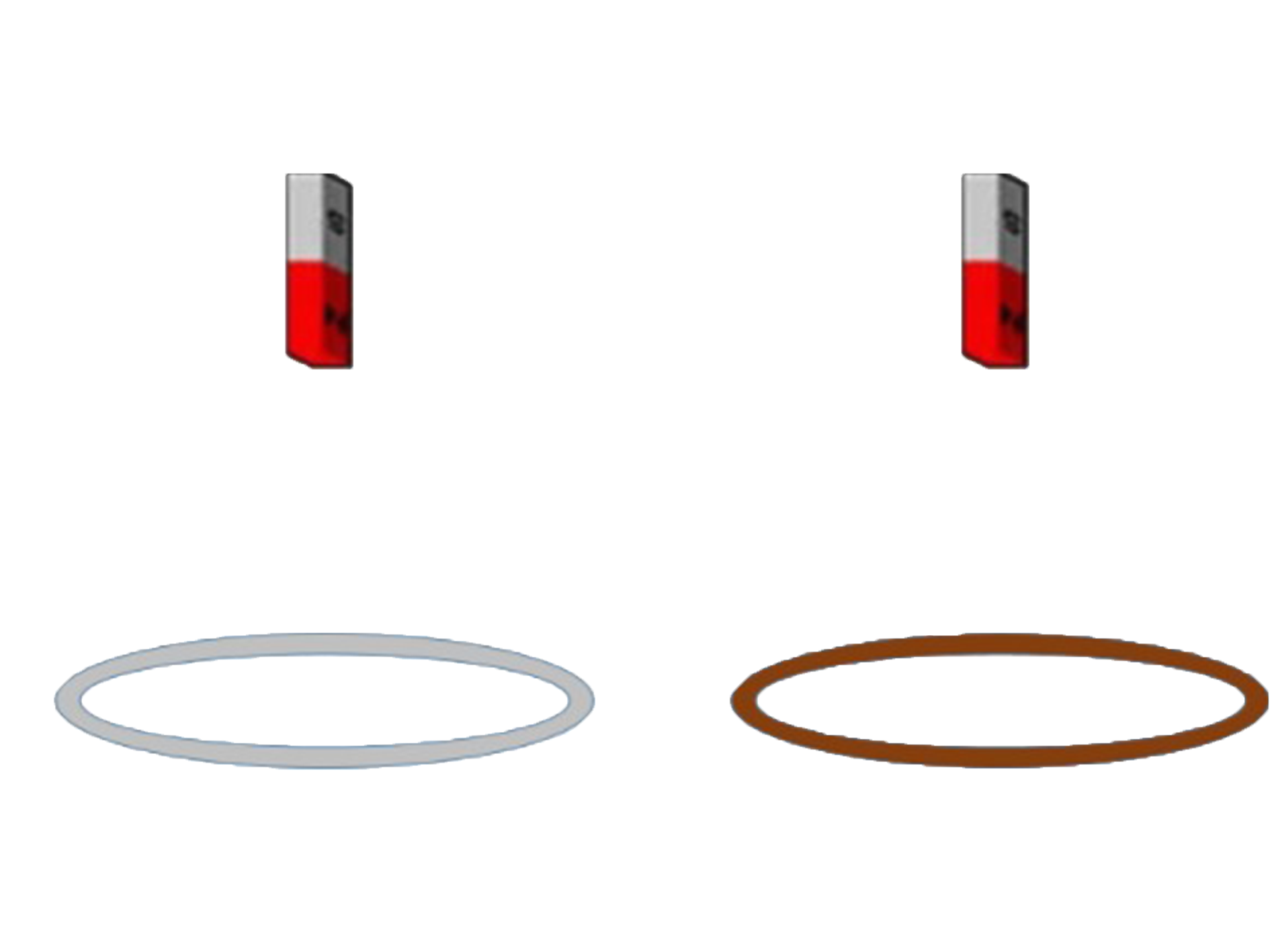
حلقتان إحداهما من الخشب والأخرى من الألمنيوم على الأرض، ومغناطيسان يُتركان للسقوط الحر من الارتفاع نفسه فوق الحلقتين (الشكل) بإهمال مقاومة الهواء:Two rings, one of wood and the other of aluminium, lie on the ground, and two magnets are released to fall freely from the same height above them (figure), neglecting air resistance:
المغناطيس فوق حلقة الخشب يصل أولًاthe magnet above the wood ring arrives first
يصل المغناطيسان إلى الأرض في اللحظة نفسهاboth magnets reach the ground at the same instant
المغناطيس فوق حلقة الألمنيوم يصل أولًاthe magnet above the aluminium ring arrives first
لا يمكن التحديد قبل معرفة كتلتي المغناطيسينit cannot be decided without the masses of the magnets
الحلSolution
📌 الخشب عازل فلا يتولد فيه تيار مستحث ويسقط المغناطيس سقوطًا حرًا.
📌 في حلقة الألمنيوم (موصل) يتولد تيار مستحث يولد مجالًا يعاكس حركة المغناطيس (قاعدة لنز) فيتباطأ سقوطه، فيصل المغناطيس فوق الخشب أولًا.
✅ المغناطيس فوق حلقة الخشب يصل أولًا (A)
📌 Wood is an insulator so no induced current flows in it and the magnet falls freely.
📌 In the aluminium ring (a conductor) an induced current produces a field that opposes the motion of the magnet (Lenz's law), slowing it down, so the magnet above the wood arrives first.
✅ the magnet above the wood ring arrives first (A)
\[18\,\star\]
حُرّك مغناطيس بسرعة نحو ملف لولبي ثابت متصل بجلفانوميتر فتولد فرق جهد وتيار مستحثان. إذا ضوعفت سرعة اقتراب المغناطيس فإحدى العبارات التالية غير صحيحة:A magnet is moved quickly toward a stationary solenoid connected to a galvanometer, producing an induced emf and current. If the speed of approach is doubled, which of the following statements is NOT correct?
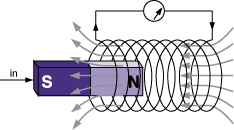
يزداد فرق الجهد المستحثthe induced emf increases
تزداد شدة التيار المستحثthe induced current increases
يزداد التدفق على الملفthe flux through the coil increases
يزداد انحراف الجلفانوميترthe deflection of the galvanometer increases
الحلSolution
📌 التدفق الكلي الذي يصل إليه الملف عند الاقتراب من المسافة نفسها لا يعتمد على السرعة، فالتدفق الذي يجتاز الملف لا يزداد بمضاعفة السرعة (إنما يتغير بسرعة أكبر).
📌 أما \(\Delta V_{ind}=-N\dfrac{\Delta\phi}{\Delta t}\) فتتضاعف لأن \(\Delta t\) يقل، فيزداد التيار وانحراف الجلفانوميتر.
✅ يزداد التدفق على الملف (C)
📌 The flux reached when the magnet gets to the same position does not depend on the speed, so the flux through the coil does not increase because the speed is doubled (it only changes faster).
📌 But \(\Delta V_{ind}=-N\dfrac{\Delta\phi}{\Delta t}\) doubles since \(\Delta t\) halves, so the current and the deflection increase.
✅ the flux through the coil increases (C)
\[19\,\star\]
مصباحان \(B_1\) (متصل بمقاوم) و\(B_2\) (متصل بملف) كما في الشكل. عند إغلاق المفتاح \(S\) مباشرة يضيء أولًا:Two bulbs \(B_1\) (with a resistor) and \(B_2\) (with a coil) as in the figure. When the switch \(S\) is closed, which bulb lights first?
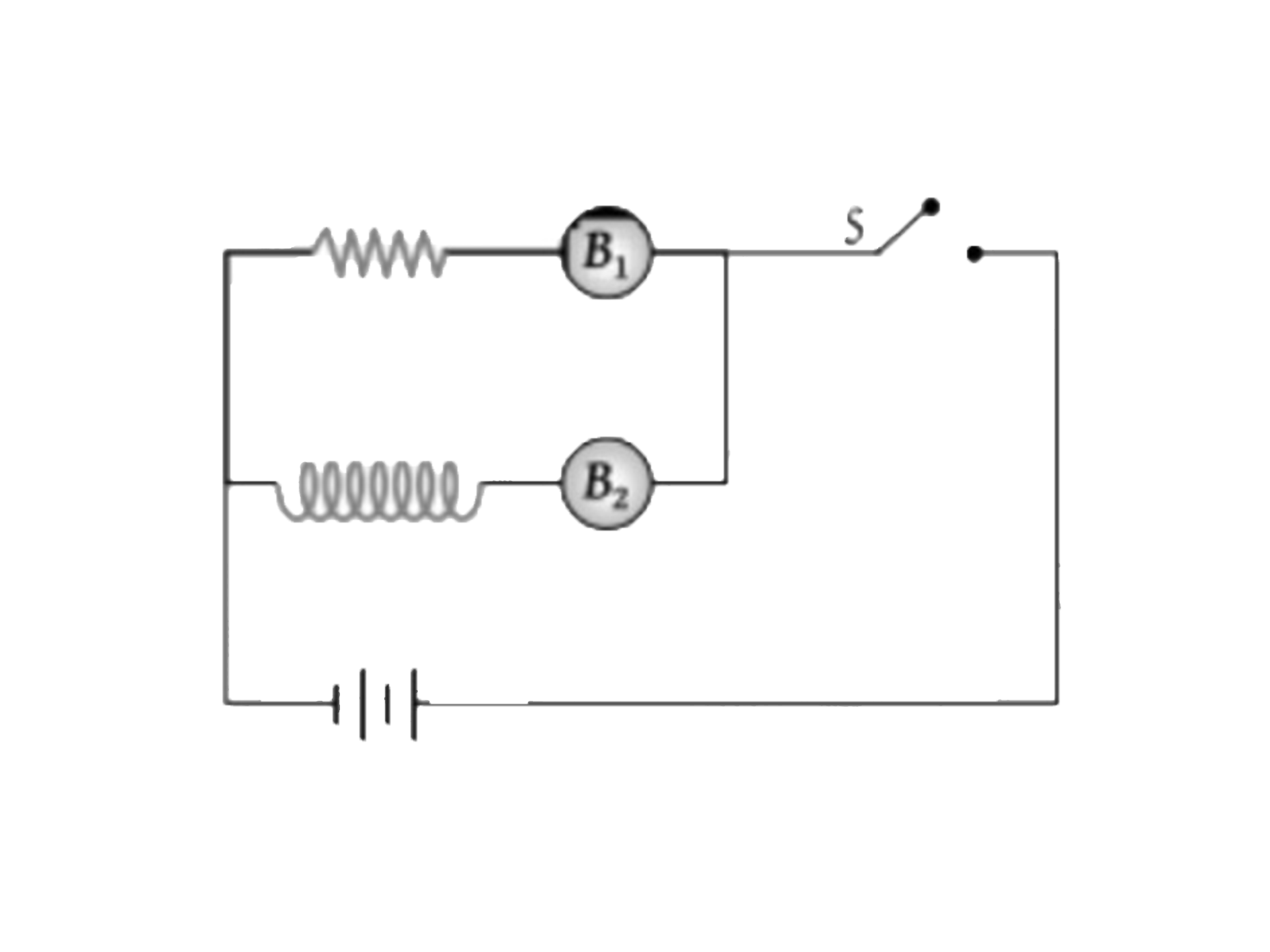
المصباح \(B_2\)bulb \(B_2\)
لا يضيء أي منهماneither lights
المصباح \(B_1\)bulb \(B_1\)
يضيء المصباحان مباشرة معًاboth light immediately together
الحلSolution
📌 عند إغلاق المفتاح يبدأ التيار بالنمو في فرع الملف فتتولد فيه قوة دافعة مستحثة تعارض نموه \(\Delta V_{ind}=-L\dfrac{\Delta I}{\Delta t}\).
📌 فيتأخر المصباح \(B_2\) قليلًا، بينما يصل التيار إلى \(B_1\) (المقاوم) مباشرة فيضيء أولًا.
✅ المصباح \(B_1\) (C)
📌 When the switch is closed the current begins to grow in the coil branch and an induced emf opposes its growth: \(\Delta V_{ind}=-L\dfrac{\Delta I}{\Delta t}\).
📌 So bulb \(B_2\) is delayed slightly, while the current reaches \(B_1\) (the resistor) immediately and it lights first.
✅ bulb \(B_1\) (C)
\[20\,\star\star\]
ملف من 20 لفة معامل حثه الذاتي \(0.4\,H\). قُصّت منه 8 لفات (قطعة بالمواصفات نفسها وطولها \(0.4\) من الطول الأصلي). معامل الحث الذاتي لهذه اللفات الثماني:A coil of 20 turns has a self-inductance of \(0.4\,H\). A piece of 8 turns (with the same winding, \(0.4\) of the original length) is cut from it. The self-inductance of these 8 turns is:
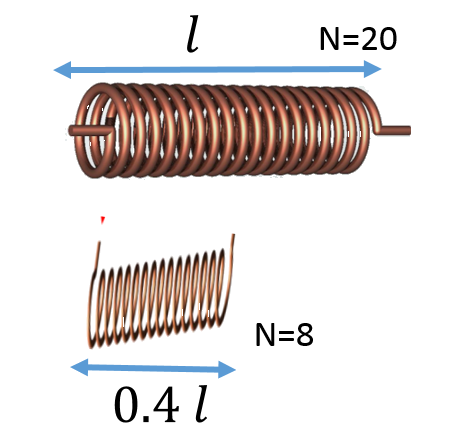
\(L=0.32\,H\)\(L=0.32\,H\)
\(L=0.16\,H\)\(L=0.16\,H\)
\(L=0.22\,H\)\(L=0.22\,H\)
\(L=0.24\,H\)\(L=0.24\,H\)
الحلSolution
\(L=\dfrac{\mu_0N^{2}A}{\ell}\): القطعة لها \(N^{\prime}=0.4N\) وطولها \(\ell^{\prime}=0.4\ell\) وللمساحة نفسها.
\(\dfrac{L^{\prime}}{L}=\dfrac{(0.4N)^{2}/(0.4\ell)}{N^{2}/\ell}=0.4\Rightarrow L^{\prime}=0.4\times0.4=0.16\,H\).
✅ \(L=0.16\,H\) (B)
\(L=\dfrac{\mu_0N^{2}A}{\ell}\): the piece has \(N^{\prime}=0.4N\), length \(\ell^{\prime}=0.4\ell\) and the same area.
\(\dfrac{L^{\prime}}{L}=\dfrac{(0.4N)^{2}/(0.4\ell)}{N^{2}/\ell}=0.4\Rightarrow L^{\prime}=0.4\times0.4=0.16\,H\).
✅ \(L=0.16\,H\) (B)
\[21\,\star\star\]
ملف لولبي طوله \(0.2\,m\) وعدد لفاته \(60\) ومساحة مقطعه \(0.1\,m^{2}\) يمر به تيار بمعدل ثابت. لُفّ حوله ملف صغير عدد لفاته \(6\) وطوله \(0.05\,m\) ومساحة مقطعه \(0.15\,m^{2}\). معامل الحث المتبادل بين الملفين:A solenoid of length \(0.2\,m\), \(60\) turns and cross-section \(0.1\,m^{2}\) carries a current at a constant rate. A small coil of \(6\) turns, length \(0.05\,m\) and cross-section \(0.15\,m^{2}\) is wound around it. The mutual inductance of the two coils is:
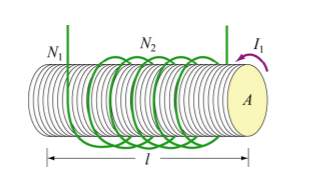
\(M=5.32\times10^{-4}\,H\)\(M=5.32\times10^{-4}\,H\)
\(M=1.45\times10^{-4}\,H\)\(M=1.45\times10^{-4}\,H\)
\(M=6.32\times10^{-4}\,H\)\(M=6.32\times10^{-4}\,H\)
\(M=2.26\times10^{-4}\,H\)\(M=2.26\times10^{-4}\,H\)
الحلSolution
📌 المجال لا يوجد إلا داخل الملف الطويل، فالمساحة التي يخترقها التدفق هي مساحة الملف الداخلي \(0.1\,m^{2}\) (وليست \(0.15\)).
\(M=\dfrac{\mu_0N_1N_2A}{\ell_1}=\dfrac{4\pi\times10^{-7}\times60\times6\times0.1}{0.2}=2.26\times10^{-4}\,H\).
✅ \(M=2.26\times10^{-4}\,H\) (D)
📌 The field exists only inside the long solenoid, so the area crossed by the flux is that of the inner solenoid \(0.1\,m^{2}\) (not \(0.15\)).
\(M=\dfrac{\mu_0N_1N_2A}{\ell_1}=\dfrac{4\pi\times10^{-7}\times60\times6\times0.1}{0.2}=2.26\times10^{-4}\,H\).
✅ \(M=2.26\times10^{-4}\,H\) (D)
\[22\,\star\star\star\]
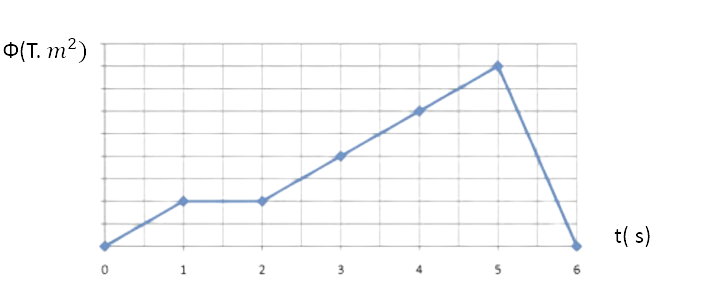
ملف في دائرة مغلقة يتغير التدفق الذي يجتازه كما في الرسم الأول. أي الرسوم (A وB وC وD) يمثل فرق الجهد المستحث مع الزمن؟A coil is in a closed circuit and the flux through it changes as in the first graph. Which graph (A, B, C, D) represents the induced emf against time?
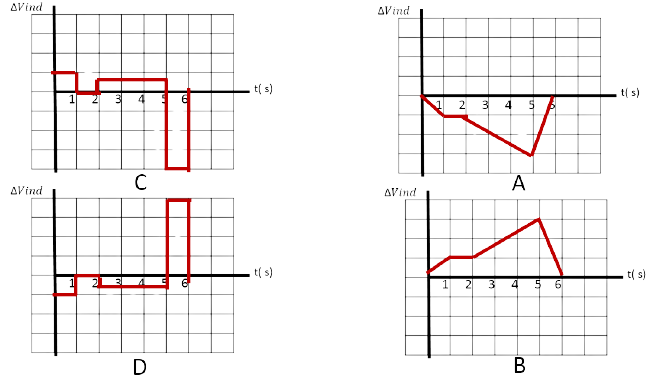
AA
BB
CC
DD
الحلSolution
📌 \(\Delta V_{ind}=-N\dfrac{\Delta\phi}{\Delta t}\): القوة الدافعة تساوي سالب ميل منحنى التدفق.
📌 المرحلة الأولى (0–1 s): التدفق يزداد فالقوة سالبة. الثانية (1–2 s): التدفق ثابت فالقوة صفر. الثالثة (2–5 s): يزداد التدفق بميل أقل فالقوة سالبة أصغر. الرابعة (5–6 s): يتناقص بسرعة كبيرة فالقوة موجبة كبيرة — وهذا هو الرسم D.
✅ D
📌 \(\Delta V_{ind}=-N\dfrac{\Delta\phi}{\Delta t}\): the emf equals minus the slope of the flux graph.
📌 Stage 1 (0–1 s): the flux increases so the emf is negative. Stage 2 (1–2 s): the flux is constant so the emf is zero. Stage 3 (2–5 s): the flux increases with a smaller slope so the emf is a smaller negative value. Stage 4 (5–6 s): the flux drops quickly so the emf is large and positive — this is graph D.
✅ D
\[23\,\star\]
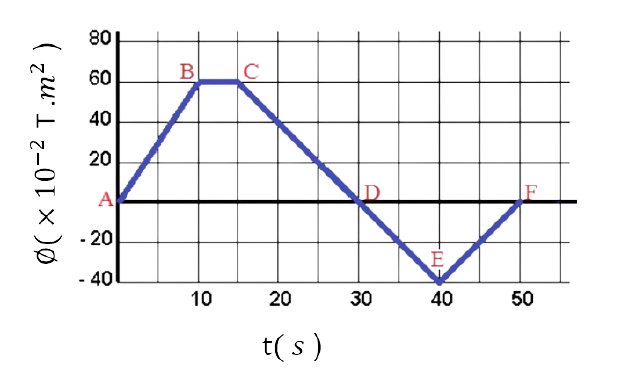
يبين الرسم العلاقة بين التدفق المغناطيسي على الملف والزمن. تنعدم القوة الدافعة المستحثة في المرحلة:The graph shows the magnetic flux through a coil against time. The induced emf is zero in the stage:
\(A\Rightarrow B\)\(A\Rightarrow B\)
\(C\Rightarrow D\)\(C\Rightarrow D\)
\(E\Rightarrow F\)\(E\Rightarrow F\)
\(B\Rightarrow C\)\(B\Rightarrow C\)
الحلSolution
📌 \(\Delta V_{ind}=0\) عندما يكون التدفق ثابتًا (ميل الرسم صفر).
📌 المرحلة \(B\Rightarrow C\) أفقية (التدفق ثابت \(60\times10^{-2}\)) أما بقية المراحل فميلها غير صفري.
✅ \(B\Rightarrow C\) (D)
📌 \(\Delta V_{ind}=0\) when the flux is constant (zero slope).
📌 The stage \(B\Rightarrow C\) is horizontal (the flux is constant at \(60\times10^{-2}\)) whereas the slopes of the other stages are not zero.
✅ \(B\Rightarrow C\) (D)
\[24\,\star\star\]
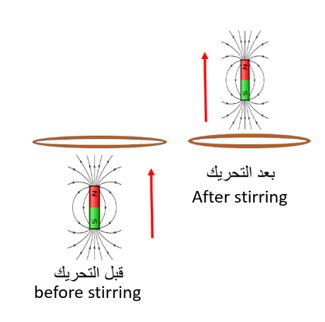
يُسحب قضيب مغناطيسي دائم لأعلى بسرعة ثابتة عبر حلقة (الشكل). اتجاه التيار المستحث في الحلقة (بالنظر إليها من الأعلى):A permanent bar magnet is pulled upward at constant speed through a loop (figure). The direction of the induced current in the loop (viewed from above) is:
دائمًا مع عقارب الساعةalways clockwise
أولًا مع عقارب الساعة ثم عكسهاfirst clockwise, then counterclockwise
دائمًا عكس عقارب الساعةalways counterclockwise
أولًا عكس عقارب الساعة ثم معهاfirst counterclockwise, then clockwise
الحلSolution
📌 قبل عبور المغناطيس للحلقة يقترب منها بقطبه الشمالي إلى أعلى فيزداد التدفق إلى أعلى، فيتولد حقل إلى أسفل أي تيار مع عقارب الساعة.
📌 بعد العبور يبتعد المغناطيس فيتناقص التدفق إلى أعلى فيتولد حقل إلى أعلى أي تيار عكس عقارب الساعة.
✅ أولًا مع عقارب الساعة ثم عكسها (B)
📌 Before the magnet crosses the loop it approaches with its north pole upward, so the upward flux increases and a downward field is induced, i.e. a clockwise current.
📌 After crossing, the magnet moves away so the upward flux decreases and an upward field is induced, i.e. a counterclockwise current.
✅ first clockwise, then counterclockwise (B)
\[25\,\star\star\]
ملف من 50 حلقة مربعة طول ضلع الحلقة \(10\,cm\) وُضع في مجال عمودي على سطحه يتناقص بمعدل \(6\,T/s\). فرق الجهد المستحث:A coil of 50 square loops of side \(10\,cm\) is placed in a field perpendicular to its surface that decreases at a rate of \(6\,T/s\). The induced emf is:
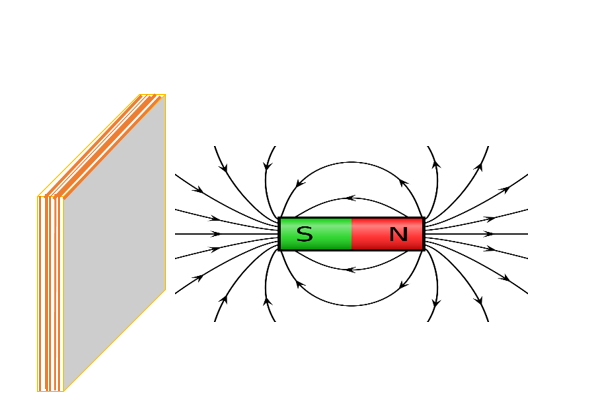
\(\Delta V_{ind}=3\,V\)\(\Delta V_{ind}=3\,V\)
\(\Delta V_{ind}=2\,V\)\(\Delta V_{ind}=2\,V\)
\(\Delta V_{ind}=4\,V\)\(\Delta V_{ind}=4\,V\)
\(\Delta V_{ind}=6\,V\)\(\Delta V_{ind}=6\,V\)
الحلSolution
\(A=(0.10)^{2}=0.01\,m^{2}\).
\(|\Delta V_{ind}|=NA\left|\dfrac{\Delta B}{\Delta t}\right|=50\times0.01\times6=3\,V\).
✅ \(\Delta V_{ind}=3\,V\) (A)
\(A=(0.10)^{2}=0.01\,m^{2}\).
\(|\Delta V_{ind}|=NA\left|\dfrac{\Delta B}{\Delta t}\right|=50\times0.01\times6=3\,V\).
✅ \(\Delta V_{ind}=3\,V\) (A)
\[26\,\star\star\]
حلقة معدنية على قضيب تتأرجح كالبندول بحرية. طُبّق مجال مغناطيسي كما في الشكل A فتوقف البندول بعد فترة. غُيّر اتجاه المجال فأصبح موازيًا لحركة الحلقة كما في الشكل B. البندول في الشكل B:A metal ring on a rod swings freely like a pendulum. A magnetic field is applied as in figure A and the pendulum stops after a while. The field direction is changed so that it is parallel to the motion of the ring as in figure B. The pendulum in figure B:
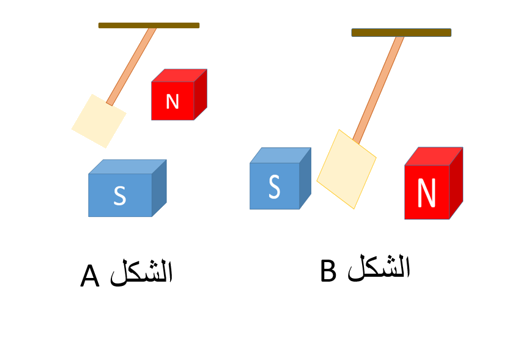
يستمر في التأرجح بالزمن الدوري نفسهcontinues to swing with the same period
يستمر في التأرجح لفترة أقصر بقليلswings for a slightly shorter time
يستمر في التأرجح لفترة أطول بقليلswings for a slightly longer time
يستمر في التأرجح دون توقفcontinues to swing without stopping
الحلSolution
📌 في الشكل A يتغير التدفق عبر الحلقة أثناء حركتها فتتولد تيارات دوامية تعيق الحركة (قاعدة لنز) فيتوقف البندول.
📌 في الشكل B تتحرك الحلقة موازية للمجال فلا يتغير التدفق عبرها ولا يتولد تيار مستحث، فيستمر البندول بلا إعاقة (بإهمال الهواء).
✅ يستمر في التأرجح دون توقف (D)
📌 In figure A the flux through the ring changes as it moves, so eddy currents flow and oppose the motion (Lenz's law), stopping the pendulum.
📌 In figure B the ring moves parallel to the field so the flux through it does not change and no induced current flows; the pendulum continues without being slowed (neglecting air).
✅ continues to swing without stopping (D)
\[27\,\star\]
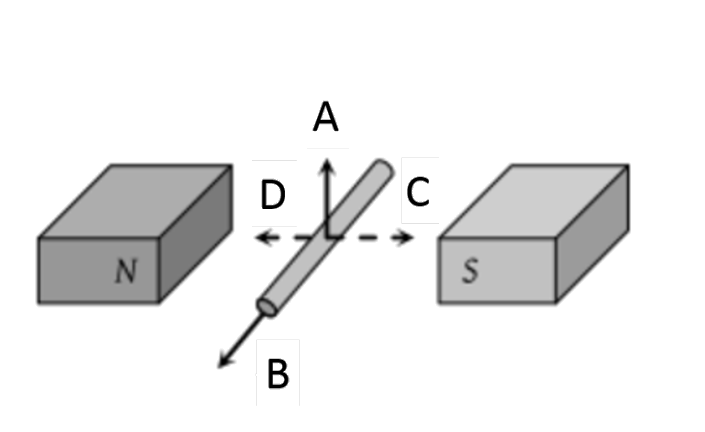
عند تحريك سلك موصل في أحد الاتجاهات المبينة بين قطبي المغناطيس (A إلى أعلى، B على امتداد السلك، C إلى اليمين، D إلى اليسار) يتولد فرق جهد مستحث بين طرفيه في الاتجاه:When a conducting wire is moved between the poles of the magnet in one of the directions shown (A upward, B along the wire, C to the right, D to the left), an induced emf is produced between its ends in the direction:
AA
BB
CC
DD
الحلSolution
📌 يتولد فرق جهد عندما يقطع السلك خطوط المجال: يجب أن تكون سرعته عمودية على المجال \(\vec{B}\) (من N إلى S أي يمينًا) وعلى السلك معًا.
📌 الحركة C وD موازية للمجال والحركة B على امتداد السلك فلا تقطع خطوطًا، أما الحركة A (إلى أعلى) فعمودية عليهما معًا فيتولد فرق جهد.
✅ A
📌 An emf is produced when the wire cuts field lines: its velocity must be perpendicular to the field \(\vec{B}\) (from N to S, i.e. to the right) and to the wire at the same time.
📌 Motions C and D are parallel to the field and B is along the wire so no lines are cut; motion A (upward) is perpendicular to both so an emf is produced.
✅ A
\[28\,\star\]
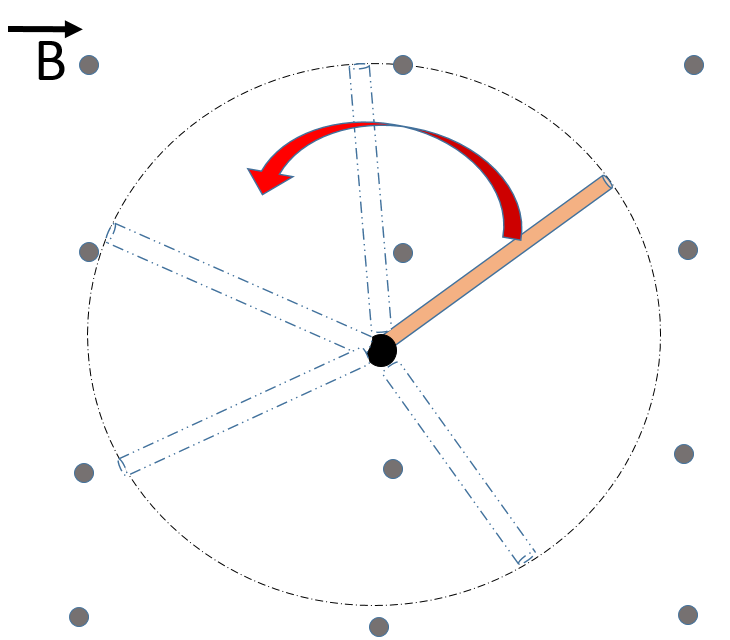
سلك طوله \(L\) ثُبّت أحد طرفيه وترك الطرف الآخر يدور بحركة دائرية منتظمة بسرعة زاوية \(\omega\) ليقطع خطوط مجال منتظم \(B\) عمودي على السلك. فرق الجهد المستحث:A wire of length \(L\) has one end fixed and the other end rotates uniformly with angular speed \(\omega\) cutting the lines of a uniform field \(B\) perpendicular to the wire. The induced emf is:
\(\Delta V_{ind}=B\omega\dfrac{L^{2}}{2}\)\(\Delta V_{ind}=B\omega\dfrac{L^{2}}{2}\)
\(\Delta V_{ind}=B\omega\dfrac{L}{2}\)\(\Delta V_{ind}=B\omega\dfrac{L}{2}\)
\(\Delta V_{ind}=B\omega L\)\(\Delta V_{ind}=B\omega L\)
\(\Delta V_{ind}=B\omega\dfrac{3L^{2}}{4}\)\(\Delta V_{ind}=B\omega\dfrac{3L^{2}}{4}\)
الحلSolution
📌 سرعة نقطة على بعد \(x\) من المحور \(v=\omega x\) فتكون \(d(\Delta V)=B\omega x\,dx\).
\(\Delta V_{ind}=\int_0^{L}B\omega x\,dx=B\omega\dfrac{L^{2}}{2}\) (أو \(B L\bar{v}\) بالسرعة المتوسطة \(\omega L/2\)).
✅ \(\Delta V_{ind}=B\omega\dfrac{L^{2}}{2}\) (A)
📌 A point at distance \(x\) from the axis has speed \(v=\omega x\) so \(d(\Delta V)=B\omega x\,dx\).
\(\Delta V_{ind}=\int_0^{L}B\omega x\,dx=B\omega\dfrac{L^{2}}{2}\) (or \(BL\bar{v}\) with the average speed \(\omega L/2\)).
✅ \(\Delta V_{ind}=B\omega\dfrac{L^{2}}{2}\) (A)
\[29\,\star\star\star\]
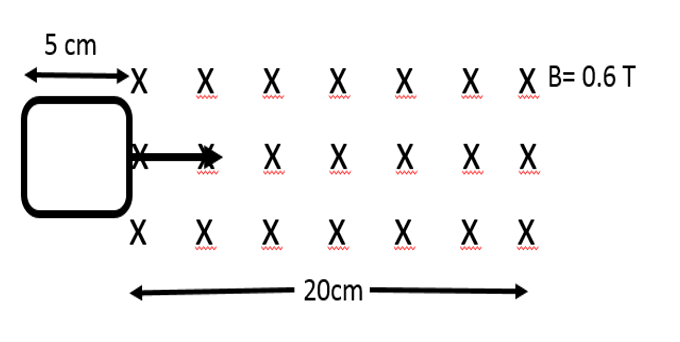
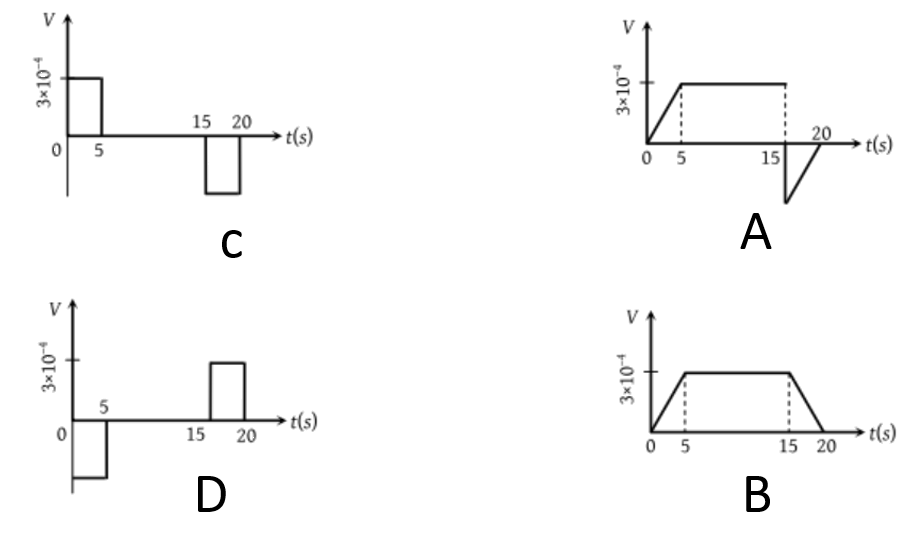
حلقة مربعة طول ضلعها \(5\,cm\) على حافة مجال منتظم \(B=0.6\,T\) تدخله بسرعة ثابتة \(1\,cm/s\) وتقطع \(20\,cm\) ثم تخرج منه كليًا. أي الرسوم يمثل فرق الجهد المستحث مع الزمن؟A square loop of side \(5\,cm\) at the edge of a uniform field \(B=0.6\,T\) enters it at a constant speed of \(1\,cm/s\), travels \(20\,cm\) and leaves it completely. Which graph represents the induced emf against time?
AA
BB
CC
DD
الحلSolution
📌 \(|\Delta V_{ind}|=BLv=0.6\times0.05\times0.01=3\times10^{-4}\,V\) أثناء دخول الحلقة (من 0 إلى 5 s) وأثناء خروجها (من 15 إلى 20 s).
📌 وهي صفر بينهما (5–15 s) لأن الحلقة كلها داخل المجال والتدفق ثابت.
📌 أثناء الدخول يزداد التدفق إلى الداخل فالقوة سالبة، وأثناء الخروج يتناقص فالقوة موجبة: النبضة الأولى سالبة والثانية موجبة — الرسم D.
✅ D
📌 \(|\Delta V_{ind}|=BLv=0.6\times0.05\times0.01=3\times10^{-4}\,V\) while the loop enters (0 to 5 s) and while it leaves (15 to 20 s).
📌 It is zero in between (5–15 s) because the whole loop is inside the field and the flux is constant.
📌 While entering the inward flux increases so the emf is negative, while leaving it decreases so the emf is positive: the first pulse is negative and the second positive — graph D.
✅ D
\[30\,\star\star\]
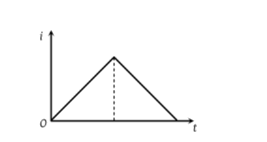
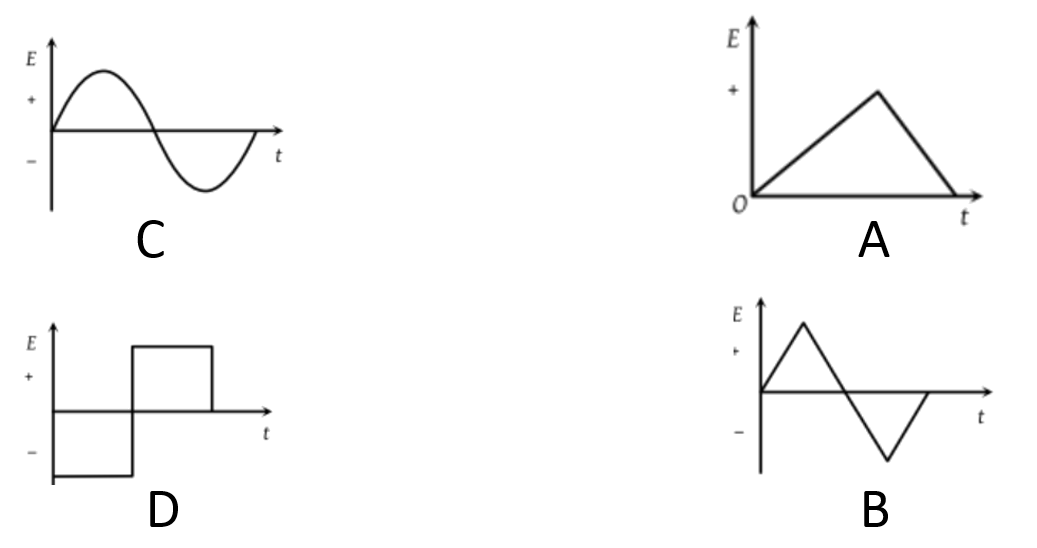
ملف معامل حثه الذاتي \(L\) يتغير فيه التيار مع الزمن وفق الرسم الأول (يزداد خطيًا ثم يتناقص خطيًا). أي الرسوم يمثل فرق الجهد المستحث مع الزمن؟A coil of self-inductance \(L\) carries a current that varies with time as in the first graph (it increases linearly then decreases linearly). Which graph represents the induced emf against time?
AA
BB
CC
DD
الحلSolution
📌 \(\Delta V_{ind}=-L\dfrac{\Delta I}{\Delta t}\): ميل منحنى التيار ثابت في كل مرحلة، فالقوة ثابتة في كل مرحلة.
📌 عند ازدياد التيار تكون القوة سالبة، وعند تناقصه تكون موجبة بالمقدار نفسه: موجة مربعة سالبة ثم موجبة — الرسم D.
✅ D
📌 \(\Delta V_{ind}=-L\dfrac{\Delta I}{\Delta t}\): the slope of the current graph is constant in each stage, so the emf is constant in each stage.
📌 While the current increases the emf is negative, and while it decreases it is positive with the same magnitude: a square wave, negative then positive — graph D.
✅ D
\[31\,\star\star\]
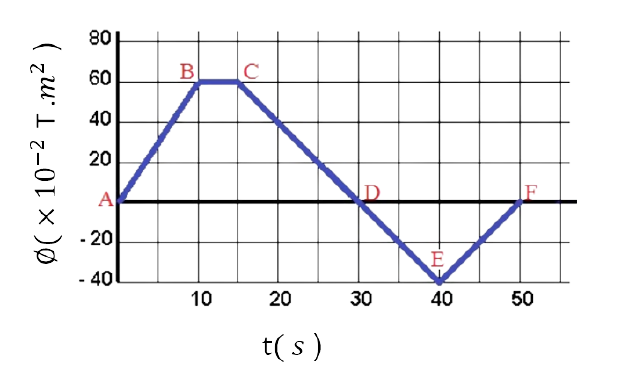
ملف من 30 لفة والرسم يبين التدفق المغناطيسي عليه مع الزمن. معدل فرق الجهد المستحث في المرحلة \(C\Rightarrow D\):A coil has 30 turns and the graph shows the flux through it against time. The average induced emf in the stage \(C\Rightarrow D\) is:
\(\Delta V_{ind}=-1.2\,V\)\(\Delta V_{ind}=-1.2\,V\)
\(\Delta V_{ind}=1.2\,V\)\(\Delta V_{ind}=1.2\,V\)
\(\Delta V_{ind}=-0.8\,V\)\(\Delta V_{ind}=-0.8\,V\)
\(\Delta V_{ind}=0.8\,V\)\(\Delta V_{ind}=0.8\,V\)
الحلSolution
📌 من الرسم: عند \(C\) (\(t=15\,s\)) التدفق \(60\times10^{-2}\) وعند \(D\) (\(t=30\,s\)) التدفق صفر.
\(\Delta V_{ind}=-N\dfrac{\Delta\phi}{\Delta t}=-30\times\dfrac{0-0.6}{15}=+1.2\,V\).
✅ \(\Delta V_{ind}=1.2\,V\) (B)
📌 From the graph: at \(C\) (\(t=15\,s\)) the flux is \(60\times10^{-2}\) and at \(D\) (\(t=30\,s\)) it is zero.
\(\Delta V_{ind}=-N\dfrac{\Delta\phi}{\Delta t}=-30\times\dfrac{0-0.6}{15}=+1.2\,V\).
✅ \(\Delta V_{ind}=1.2\,V\) (B)
\[32\,\star\star\]
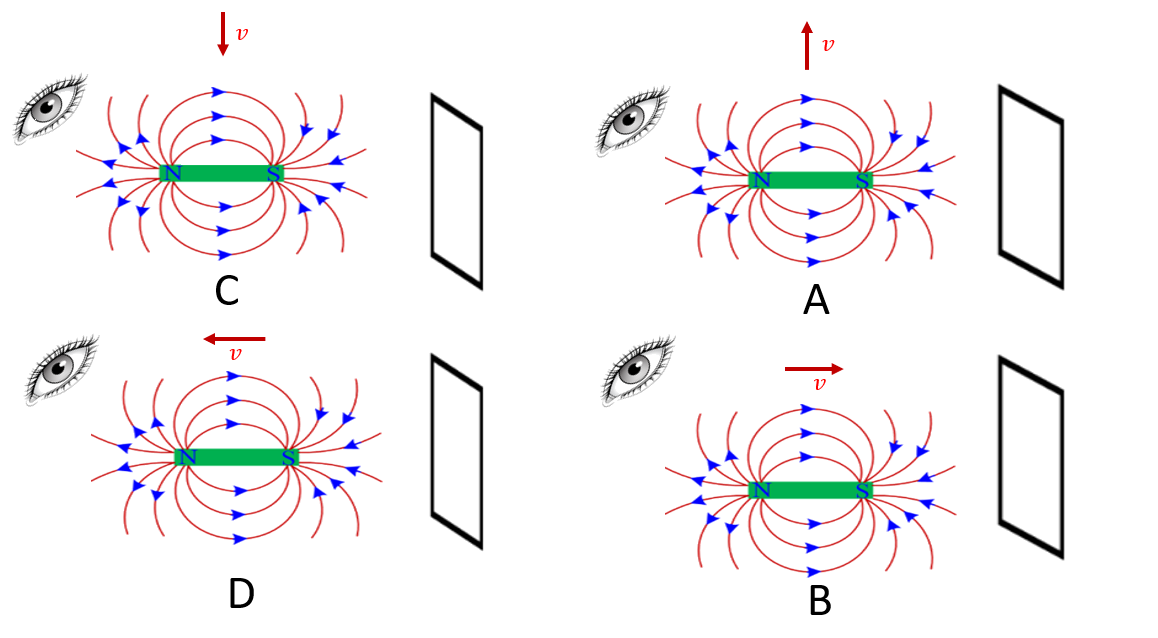
أراد متعلم توليد تيار مستحث في حلقة يدور مع عقارب الساعة وهو ينظر إلى الحلقة من جهة اليسار (الشكل). كان عليه تحريك المغناطيس:A student wants to induce a clockwise current in a loop while looking at it from the left (figure). The magnet must be moved:
إلى اليسارto the left
إلى اليمين (نحو الحلقة)to the right (toward the loop)
إلى أعلىupward
إلى أسفلdownward
الحلSolution
📌 تيار مع عقارب الساعة (لمن ينظر من اليسار) يولد حقلًا يتجه إلى اليمين (مبتعدًا عن الناظر).
📌 الحقل المستحث يعارض زيادة التدفق إلى اليسار، والقطب القريب من الحلقة هو الجنوبي (التدفق عنده نحو القطب أي إلى اليسار)، فيجب تقريب المغناطيس من الحلقة أي إلى اليمين.
✅ إلى اليمين (نحو الحلقة) (B)
📌 A clockwise current (seen from the left) produces a field pointing to the right (away from the observer).
📌 The induced field opposes an increase of the leftward flux; the pole nearest the loop is the south pole (the flux at it points toward the pole, i.e. to the left), so the magnet must be brought toward the loop, i.e. to the right.
✅ to the right (toward the loop) (B)
\[33\,\star\star\]
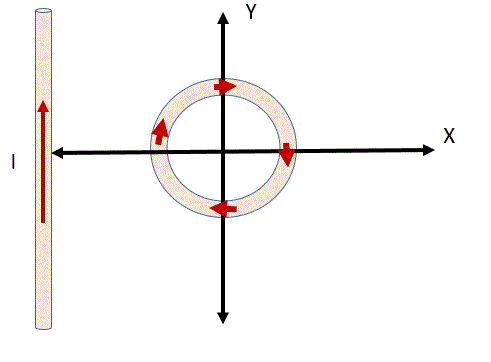
يتولد في الحلقة تيار حثي مع عقارب الساعة (الشكل) عند تحريك الحلقة باتجاه المحور:A clockwise induced current is produced in the loop (figure) when the loop is moved in the direction of the axis:
\(Y^{+}\uparrow\)\(Y^{+}\uparrow\)
\(Y^{-}\downarrow\)\(Y^{-}\downarrow\)
\(X^{+}\rightarrow\)\(X^{+}\rightarrow\)
\(X^{-}\leftarrow\)\(X^{-}\leftarrow\)
الحلSolution
📌 التيار في السلك إلى أعلى فمجاله عند الحلقة (على يمينه) إلى داخل الصفحة.
📌 التيار المستحث مع عقارب الساعة يولد حقلًا إلى الداخل، فهو يعارض تناقص التدفق إلى الداخل، أي أن الحلقة تبتعد عن السلك: في اتجاه \(X^{+}\).
✅ \(X^{+}\rightarrow\) (C)
📌 The current in the wire is upward so its field at the loop (to its right) points into the page.
📌 A clockwise induced current produces an inward field, so it opposes a decrease of the inward flux, i.e. the loop moves away from the wire: in the \(X^{+}\) direction.
✅ \(X^{+}\rightarrow\) (C)
\[34\,\star\star\]
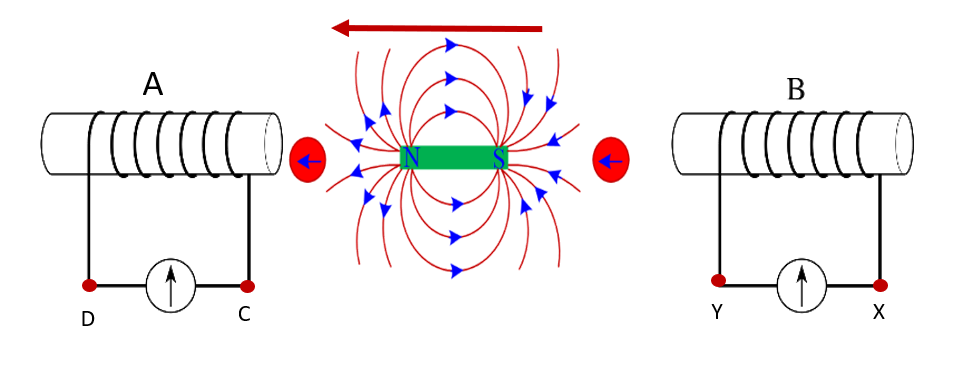
حُرّك المغناطيس المستقيم في الاتجاه المبين (إلى اليسار). اتجاه التيار الحثي المار عبر الجلفانوميتر في الملفين B وA على الترتيب:The bar magnet is moved in the direction shown (to the left). The direction of the induced current passing through the galvanometer in coils B and A, respectively, is:
في الملف B من Y إلى X، وفي الملف A من D إلى Cin coil B from Y to X, and in coil A from D to C
في الملف B من Y إلى X، وفي الملف A من C إلى Din coil B from Y to X, and in coil A from C to D
في الملف B من X إلى Y، وفي الملف A من D إلى Cin coil B from X to Y, and in coil A from D to C
في الملف B من X إلى Y، وفي الملف A من C إلى Din coil B from X to Y, and in coil A from C to D
الحلSolution
📌 الملف A: المغناطيس يقترب منه بقطبه الشمالي فيزداد التدفق، فينشأ حقل معاكس ويكون التيار من \(D\) إلى \(C\) (بقاعدة القبضة).
📌 الملف B: المغناطيس يبتعد عنه فيتناقص التدفق، فينشأ حقل مشابه للمسبب أي معاكس لحقل A، والملفان متماثلان فيكون التيار من \(X\) إلى \(Y\).
✅ في الملف B من X إلى Y، وفي الملف A من D إلى C (C)
📌 Coil A: the magnet approaches it with its north pole so the flux increases, an opposing field is created and the current flows from \(D\) to \(C\) (by the grip rule).
📌 Coil B: the magnet moves away so the flux decreases, a field similar to the cause is created, i.e. opposite to that in A; the coils are alike so the current flows from \(X\) to \(Y\).
✅ in coil B from X to Y, and in coil A from D to C (C)
\[35\,\star\]
ملف يدور في مجال مغناطيسي ومتصل بمقاوم من خلال نصفي حلقة. أي الرسوم يعبر عن التيار اللحظي المستحث المار في المقاوم؟A coil rotates in a magnetic field and is connected to a resistor through split rings. Which graph represents the instantaneous induced current through the resistor?
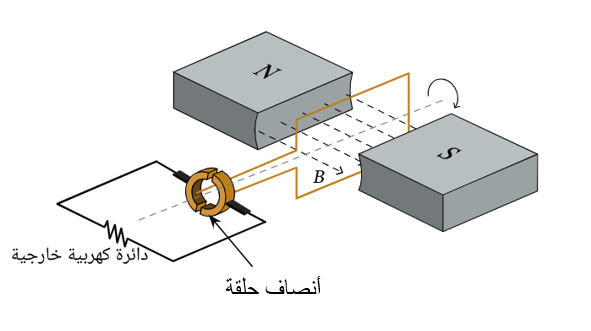
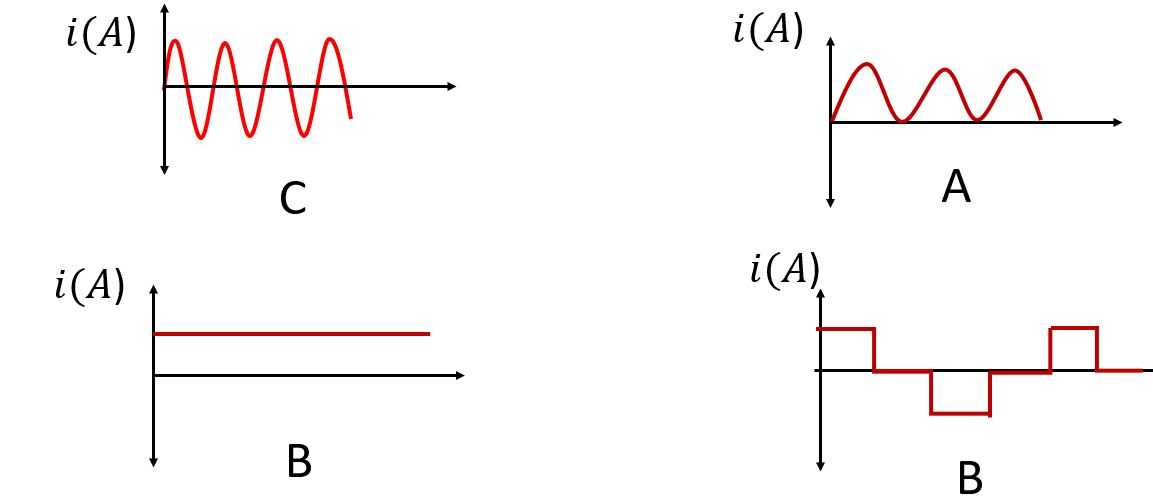
AA
BB
CC
DD
الحلSolution
📌 يتغير التدفق بدوران الملف فتتولد قوة دافعة جيبية في الملف.
📌 نصفا الحلقة (عاكس التيار) يبدّلان توصيل الملف بالمقاوم كل نصف دورة فيبقى التيار في المقاوم باتجاه واحد وتتغير قيمته: تيار نابض موجب دائمًا — الرسم A.
✅ A
📌 The flux changes as the coil rotates so a sinusoidal emf is produced in the coil.
📌 The split rings (commutator) swap the connection of the coil to the resistor every half turn, so the current in the resistor keeps one direction while its value varies: a pulsating, always-positive current — graph A.
✅ A
\[36\,\star\]
ملف يدور في مجال مغناطيسي ومتصل بمقاوم من خلال حلقتين كاملتين. أي الرسوم يعبر عن التيار اللحظي المستحث؟A coil rotates in a magnetic field and is connected to a resistor through two full rings. Which graph represents the instantaneous induced current?
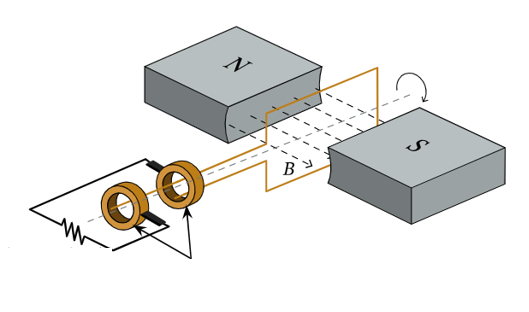
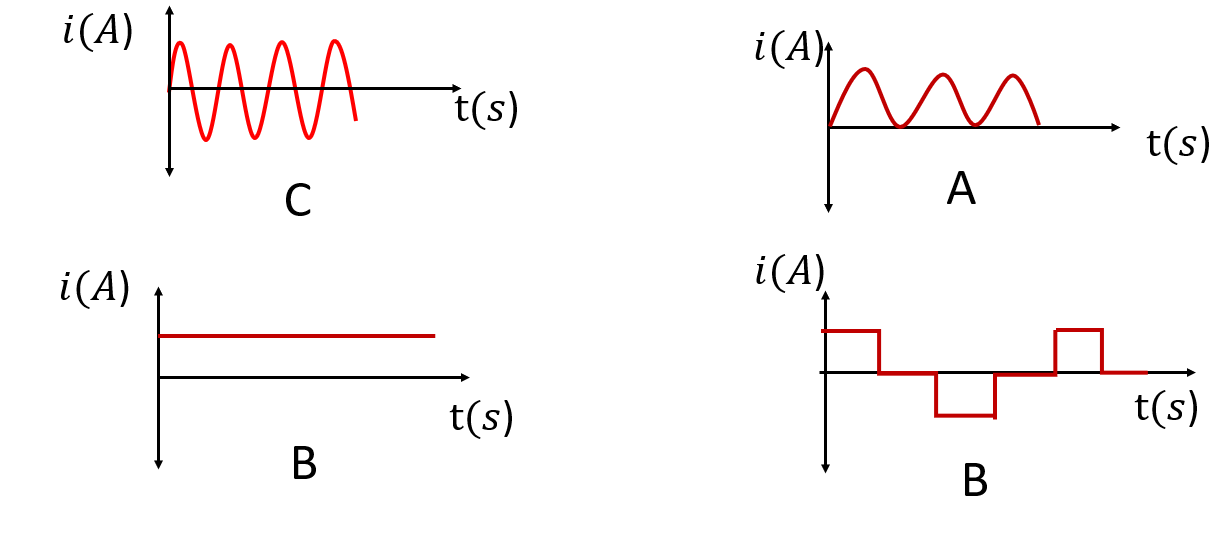
AA
BB
CC
DD
الحلSolution
📌 مع الحلقتين الكاملتين لا ينعكس التوصيل، فيعكس التيار اتجاهه كل نصف دورة ويتغير مقداره جيبيًا.
📌 هذا هو التيار المتردد — الرسم C.
✅ C
📌 With two full rings the connection is not reversed, so the current reverses its direction every half turn and its value varies sinusoidally.
📌 This is an alternating current — graph C.
✅ C
\[37\,\star\star\]
ملف يدور مع عقارب الساعة في مجال مغناطيسي ومتصل بمقاوم عبر حلقتين، السلك CD متصل بالحلقة الخارجية (البرتقالية) والسلك BA بالداخلية (الخضراء). أي الأوضاع (A وB وC وD) يعبر بشكل صحيح عن اتجاه التيار في الدائرة الخارجية كما هو مرسوم؟A coil rotates clockwise in a magnetic field and is connected through two rings to a resistor; wire CD is connected to the outer ring (orange) and wire BA to the inner ring (green). Which position (A, B, C, D) shows correctly the direction of the current in the external circuit as drawn?
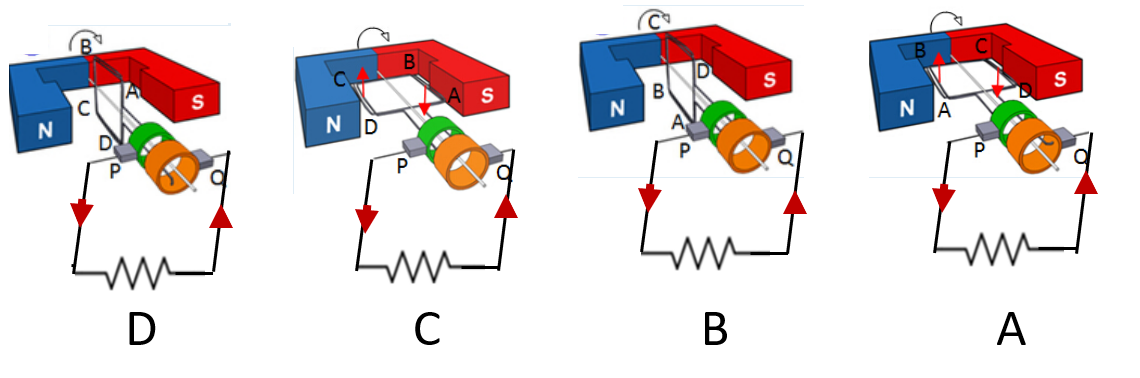
AA
BB
CC
DD
الحلSolution
📌 يتولد تيار في الدائرة الخارجية فقط عندما تقطع أضلاع الملف خطوط المجال، أي عندما لا تكون حركتها موازية للمجال.
📌 في الوضعين D وB تتحرك الأسلاك موازية للمجال فلا يمر تيار؛ وفي الوضع C يمر تيار بالاتجاه المرسوم نفسه (بقاعدة اليد اليمنى)، وفي الوضع A يمر بعكس الاتجاه المرسوم.
✅ C
📌 A current flows in the external circuit only when the sides of the coil cut the field lines, i.e. when their motion is not parallel to the field.
📌 In positions D and B the wires move parallel to the field so no current flows; in position C the current flows in the direction drawn (right-hand rule) and in position A it flows opposite to the direction drawn.
✅ C
\[38\,\star\]
ملف لولبي يمر به تيار؛ شدة المجال عند نقطة على محوره \(B=0.05\,T\). ضوعف التيار وقُرّبت الحلقات حتى صار طول الملف نصف ما كان. المجال عند أي نقطة على المحور:A solenoid carries a current; the field at a point on its axis is \(B=0.05\,T\). The current is doubled and the turns are brought together until the length of the solenoid is half what it was. The field at any point on the axis becomes:
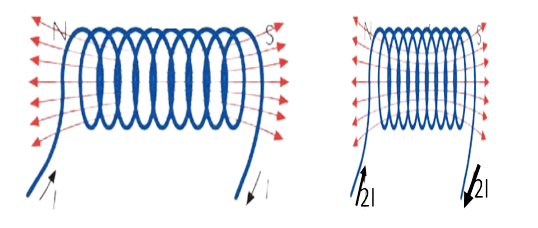
\(B=0.05\,T\)\(B=0.05\,T\)
\(B=0.025\,T\)\(B=0.025\,T\)
\(B=0.1\,T\)\(B=0.1\,T\)
\(B=0.2\,T\)\(B=0.2\,T\)
الحلSolution
\(B=\mu_0\dfrac{N}{\ell}I\): تتضاعف \(I\) وتتضاعف \(N/\ell\) (لأن \(\ell\) صار النصف).
\(B^{\prime}=2\times2\times0.05=0.2\,T\).
✅ \(B=0.2\,T\) (D)
\(B=\mu_0\dfrac{N}{\ell}I\): \(I\) doubles and \(N/\ell\) doubles (since \(\ell\) is halved).
\(B^{\prime}=2\times2\times0.05=0.2\,T\).
✅ \(B=0.2\,T\) (D)
\[39\,\star\]
ملف مساحة سطحه \(0.05\,m^{2}\) وُضع عموديًا على مجال منتظم شدته \(0.4\,T\). التدفق المغناطيسي:A coil of surface area \(0.05\,m^{2}\) is placed perpendicular to a uniform field of \(0.4\,T\). The magnetic flux is:
\(\phi=0.2\,T\cdot m^{2}\)\(\phi=0.2\,T\cdot m^{2}\)
\(\phi=0.02\,T\cdot m^{2}\)\(\phi=0.02\,T\cdot m^{2}\)
\(\phi=0.0\,T\cdot m^{2}\)\(\phi=0.0\,T\cdot m^{2}\)
\(\phi=0.125\,T\cdot m^{2}\)\(\phi=0.125\,T\cdot m^{2}\)
الحلSolution
📌 السطح عمودي على المجال فالمجال موازٍ للعمود على السطح: \(\phi=BA=0.4\times0.05=0.02\,T\cdot m^{2}\).
✅ \(\phi=0.02\,T\cdot m^{2}\) (B)
📌 The surface is perpendicular to the field, so the field is parallel to the normal: \(\phi=BA=0.4\times0.05=0.02\,T\cdot m^{2}\).
✅ \(\phi=0.02\,T\cdot m^{2}\) (B)
\[40\,\star\]
يكون التدفق المغناطيسي عبر حلقة مساوياً للصفر عندما:The magnetic flux through a loop is zero when:
يكون المجال عموديًا على سطح الحلقةthe field is perpendicular to the surface of the loop
تكون مساحة الحلقة كبيرةthe area of the loop is large
يكون المجال موازيًا لسطح الحلقةthe field is parallel to the surface of the loop
تكون شدة المجال كبيرةthe field is strong
الحلSolution
📌 \(\phi=BA\cos\theta\) حيث \(\theta\) بين المجال والعمود على السطح؛ ينعدم عندما \(\theta=90^{\circ}\) أي حين يكون المجال موازيًا للسطح (لا تخترقه خطوط المجال).
✅ يكون المجال موازيًا لسطح الحلقة (C)
📌 \(\phi=BA\cos\theta\) with \(\theta\) between the field and the normal; it vanishes when \(\theta=90^{\circ}\), i.e. when the field is parallel to the surface (no field lines pass through it).
✅ the field is parallel to the surface of the loop (C)
\[41\,\star\star\]
حلقة مساحتها \(0.2\,m^{2}\) عمودية على مجال يتغير من \(0.1\,T\) إلى \(0.5\,T\) خلال \(0.2\,s\). متوسط القوة الدافعة المستحثة:A loop of area \(0.2\,m^{2}\) is perpendicular to a field that changes from \(0.1\,T\) to \(0.5\,T\) in \(0.2\,s\). The average induced emf is:
\(0.4\,V\)\(0.4\,V\)
\(0.08\,V\)\(0.08\,V\)
\(0.8\,V\)\(0.8\,V\)
\(2\,V\)\(2\,V\)
الحلSolution
\(|\Delta V|=A\dfrac{\Delta B}{\Delta t}=0.2\times\dfrac{0.5-0.1}{0.2}=0.4\,V\).
✅ \(0.4\,V\) (A)
\(|\Delta V|=A\dfrac{\Delta B}{\Delta t}=0.2\times\dfrac{0.5-0.1}{0.2}=0.4\,V\).
✅ \(0.4\,V\) (A)
\[42\,\star\star\]
ملف من \(100\) لفة مساحة كل لفة \(0.01\,m^{2}\) وُضع عموديًا على مجال زاد من الصفر إلى \(0.2\,T\) خلال \(0.1\,s\). القوة الدافعة المستحثة:A coil of \(100\) turns, each of area \(0.01\,m^{2}\), is placed perpendicular to a field that rises from zero to \(0.2\,T\) in \(0.1\,s\). The induced emf is:
\(0.2\,V\)\(0.2\,V\)
\(2\,V\)\(2\,V\)
\(20\,V\)\(20\,V\)
\(0.02\,V\)\(0.02\,V\)
الحلSolution
\(|\Delta V|=NA\dfrac{\Delta B}{\Delta t}=100\times0.01\times\dfrac{0.2}{0.1}=2\,V\).
✅ \(2\,V\) (B)
\(|\Delta V|=NA\dfrac{\Delta B}{\Delta t}=100\times0.01\times\dfrac{0.2}{0.1}=2\,V\).
✅ \(2\,V\) (B)
\[43\,\star\]
تنص قاعدة لنز على أن التيار المستحث يكون باتجاه:Lenz's law states that the induced current flows in the direction that:
يدعم التغير في التدفق الذي سببهsupports the change in flux that caused it
يعاكس التغير في التدفق الذي سببهopposes the change in flux that caused it
يجعل التدفق ثابتًا دائمًا في اتجاه المجالalways makes the flux constant in the direction of the field
لا علاقة له بالتغير في التدفقis unrelated to the change in flux
الحلSolution
📌 الحقل المغناطيسي الناتج عن التيار المستحث يعارض التغير في التدفق (وليس التدفق نفسه)، وهذا تعبير عن حفظ الطاقة وتفسير الإشارة السالبة في قانون فاراداي.
✅ يعاكس التغير في التدفق الذي سببه (B)
📌 The magnetic field of the induced current opposes the change in flux (not the flux itself); this expresses energy conservation and explains the minus sign in Faraday's law.
✅ opposes the change in flux that caused it (B)
\[44\,\star\star\]
يُقرَّب القطب الشمالي لمغناطيس من حلقة. اتجاه التيار المستحث في الحلقة لمن ينظر إليها من جهة المغناطيس:The north pole of a magnet is brought toward a loop. The direction of the induced current in the loop for an observer looking at it from the magnet side is:
عكس عقارب الساعةcounterclockwise
مع عقارب الساعةclockwise
لا يتولد تيارno current is induced
يتغير اتجاهه باستمرارit keeps changing direction
الحلSolution
📌 التدفق نحو الحلقة (مبتعدًا عن القطب الشمالي) يزداد، فيتولد حقل يعاكسه أي أن الحلقة تتصرف كقطب شمالي مواجه للمغناطيس (تتنافر معه).
📌 الوجه الشمالي لحلقة هو الذي يُرى فيه التيار عكس عقارب الساعة.
✅ عكس عقارب الساعة (A)
📌 The flux toward the loop (away from the north pole) increases, so an opposing field is induced: the loop behaves as a north pole facing the magnet (repelling it).
📌 The north face of a loop is the one from which the current is seen counterclockwise.
✅ counterclockwise (A)
\[45\,\star\star\]
سلك طوله \(0.5\,m\) يتحرك بسرعة \(4\,m/s\) عموديًا على مجال شدته \(0.3\,T\). فرق الجهد المستحث بين طرفيه:A wire of length \(0.5\,m\) moves at \(4\,m/s\) perpendicular to a field of \(0.3\,T\). The induced emf between its ends is:
\(0.15\,V\)\(0.15\,V\)
\(1.5\,V\)\(1.5\,V\)
\(0.06\,V\)\(0.06\,V\)
\(0.6\,V\)\(0.6\,V\)
الحلSolution
\(\Delta V=BLv=0.3\times0.5\times4=0.6\,V\).
✅ \(0.6\,V\) (D)
\(\Delta V=BLv=0.3\times0.5\times4=0.6\,V\).
✅ \(0.6\,V\) (D)
\[46\,\star\star\]
وُصل السلك السابق (\(BLv=0.6\,V\)) بسكة ومقاومة كلية \(3\,\Omega\). التيار المستحث:The previous wire (\(BLv=0.6\,V\)) is connected to rails and a total resistance of \(3\,\Omega\). The induced current is:
\(1.8\,A\)\(1.8\,A\)
\(0.2\,A\)\(0.2\,A\)
\(0.5\,A\)\(0.5\,A\)
\(0.6\,A\)\(0.6\,A\)
الحلSolution
\(I=\dfrac{\Delta V}{R}=\dfrac{0.6}{3}=0.2\,A\).
✅ \(0.2\,A\) (B)
\(I=\dfrac{\Delta V}{R}=\dfrac{0.6}{3}=0.2\,A\).
✅ \(0.2\,A\) (B)
\[47\,\star\star\star\]
القوة اللازمة لتحريك السلك السابق بسرعة ثابتة (\(B=0.3\,T,\ L=0.5\,m,\ I=0.2\,A\)):The force needed to move the previous wire at constant speed (\(B=0.3\,T,\ L=0.5\,m,\ I=0.2\,A\)) is:
\(0.3\,N\)\(0.3\,N\)
\(0.03\,N\)\(0.03\,N\)
\(0.12\,N\)\(0.12\,N\)
\(0.003\,N\)\(0.003\,N\)
الحلSolution
📌 السرعة ثابتة فالقوة المؤثرة تساوي القوة المغناطيسية على السلك الذي يمر به تيار: \(F=BIL=0.3\times0.2\times0.5=0.03\,N\).
📌 تحقق: القدرة الميكانيكية \(Fv=0.12\,W\) تساوي القدرة الكهربائية \(I^{2}R=0.04\times3=0.12\,W\).
✅ \(0.03\,N\) (B)
📌 The speed is constant so the applied force equals the magnetic force on the current-carrying wire: \(F=BIL=0.3\times0.2\times0.5=0.03\,N\).
📌 Check: the mechanical power \(Fv=0.12\,W\) equals the electrical power \(I^{2}R=0.04\times3=0.12\,W\).
✅ \(0.03\,N\) (B)
\[48\,\star\star\]
ملف معامل حثه الذاتي \(0.5\,H\) ينخفض تيار فيه من \(4\,A\) إلى الصفر خلال \(0.2\,s\). مقدار القوة الدافعة المستحثة:A coil of self-inductance \(0.5\,H\) carries a current that falls from \(4\,A\) to zero in \(0.2\,s\). The magnitude of the induced emf is:
\(0.4\,V\)\(0.4\,V\)
\(2.5\,V\)\(2.5\,V\)
\(10\,V\)\(10\,V\)
\(0.1\,V\)\(0.1\,V\)
الحلSolution
\(|\Delta V|=L\dfrac{\Delta I}{\Delta t}=0.5\times\dfrac{4}{0.2}=10\,V\).
✅ \(10\,V\) (C)
\(|\Delta V|=L\dfrac{\Delta I}{\Delta t}=0.5\times\dfrac{4}{0.2}=10\,V\).
✅ \(10\,V\) (C)
\[49\,\star\star\star\]
ملف مولد من \(200\) لفة ومساحة اللفة \(0.02\,m^{2}\) يدور في مجال \(0.5\,T\) بسرعة زاوية \(100\,rad/s\). أعظم قوة دافعة مستحثة:A generator coil of \(200\) turns, each of area \(0.02\,m^{2}\), rotates in a field of \(0.5\,T\) at \(100\,rad/s\). The maximum induced emf is:
\(2\,V\)\(2\,V\)
\(20\,V\)\(20\,V\)
\(400\,V\)\(400\,V\)
\(200\,V\)\(200\,V\)
الحلSolution
\(\Delta V_{max}=NBA\omega=200\times0.5\times0.02\times100=200\,V\).
✅ \(200\,V\) (D)
\(\Delta V_{max}=NBA\omega=200\times0.5\times0.02\times100=200\,V\).
✅ \(200\,V\) (D)
\[50\,\star\star\star\]
إذا ضوعفت سرعة دوران ملف مولد كهربائي مع بقاء بقية العوامل ثابتة فإن أعظم قوة دافعة مستحثة وتردد التيار:If the rotation speed of a generator coil is doubled while everything else stays the same, the maximum induced emf and the frequency of the current:
تتضاعف القوة ولا يتغير الترددthe emf doubles and the frequency is unchanged
يتضاعفان معًاboth double
يتضاعف التردد ولا تتغير القوةthe frequency doubles and the emf is unchanged
لا يتغير أي منهماneither changes
الحلSolution
\(\Delta V_{max}=NBA\omega\) تتناسب طرديًا مع \(\omega\)، والتردد \(f=\dfrac{\omega}{2\pi}\) يتناسب طرديًا معها أيضًا.
✅ يتضاعفان معًا (B)
\(\Delta V_{max}=NBA\omega\) is directly proportional to \(\omega\), and the frequency \(f=\dfrac{\omega}{2\pi}\) is also directly proportional to it.
✅ both double (B)
\[51\,\star\star\star\]
قضيب طوله \(0.5\,m\) يدور حول أحد طرفيه بسرعة زاوية \(40\,rad/s\) في مجال \(0.2\,T\) عمودي على مستوى دورانه. فرق الجهد بين طرفيه:A rod of length \(0.5\,m\) rotates about one end at \(40\,rad/s\) in a field of \(0.2\,T\) perpendicular to its plane of rotation. The potential difference between its ends is:
\(2.0\,V\)\(2.0\,V\)
\(1.0\,V\)\(1.0\,V\)
\(0.5\,V\)\(0.5\,V\)
\(4.0\,V\)\(4.0\,V\)
الحلSolution
\(\Delta V=\dfrac{1}{2}B\omega L^{2}=\dfrac{1}{2}\times0.2\times40\times0.25=1.0\,V\).
✅ \(1.0\,V\) (B)
\(\Delta V=\dfrac{1}{2}B\omega L^{2}=\dfrac{1}{2}\times0.2\times40\times0.25=1.0\,V\).
✅ \(1.0\,V\) (B)
\[52\,\star\star\star\]
يتغير التدفق عبر ملف من \(50\) لفة وفق \(\phi=0.02t^{2}\) (بالـ Wb). مقدار القوة الدافعة المستحثة عند \(t=2\,s\):The flux through a coil of \(50\) turns varies as \(\phi=0.02t^{2}\) (in Wb). The magnitude of the induced emf at \(t=2\,s\) is:
\(0.08\,V\)\(0.08\,V\)
\(2\,V\)\(2\,V\)
\(8\,V\)\(8\,V\)
\(4\,V\)\(4\,V\)
الحلSolution
\(\dfrac{d\phi}{dt}=0.04t=0.08\,V\) عند \(t=2\,s\).
\(|\Delta V|=N\dfrac{d\phi}{dt}=50\times0.08=4\,V\).
✅ \(4\,V\) (D)
\(\dfrac{d\phi}{dt}=0.04t=0.08\,V\) at \(t=2\,s\).
\(|\Delta V|=N\dfrac{d\phi}{dt}=50\times0.08=4\,V\).
✅ \(4\,V\) (D)
\[53\,\star\star\star\star\]
ملف من \(100\) لفة متصل بمقاومة \(10\,\Omega\) (مقاومة الملف مهملة). تناقص التدفق عبر اللفة الواحدة بانتظام من \(0.06\,Wb\) إلى \(0.02\,Wb\) خلال \(0.4\,s\). شدة التيار المستحث:A coil of \(100\) turns is connected to a \(10\,\Omega\) resistor (the coil resistance is negligible). The flux through each turn decreases uniformly from \(0.06\,Wb\) to \(0.02\,Wb\) in \(0.4\,s\). The induced current is:
\(0.1\,A\)\(0.1\,A\)
\(10\,A\)\(10\,A\)
\(1\,A\)\(1\,A\)
\(4\,A\)\(4\,A\)
الحلSolution
\(|\Delta V|=N\dfrac{\Delta\phi}{\Delta t}=100\times\dfrac{0.04}{0.4}=10\,V\).
\(I=\dfrac{10}{10}=1\,A\).
✅ \(1\,A\) (C)
\(|\Delta V|=N\dfrac{\Delta\phi}{\Delta t}=100\times\dfrac{0.04}{0.4}=10\,V\).
\(I=\dfrac{10}{10}=1\,A\).
✅ \(1\,A\) (C)
📝 المسائل المقالية
📝 Essay Problems
\[1\,\star\star\]
بالاعتماد على ظاهرة الحث الكهرومغناطيسي، ماذا يطرأ على إضاءة المصباح عند تقريب المغناطيس من الملف؟ فسّر السبب.Based on electromagnetic induction, what happens to the brightness of the bulb when the magnet is brought close to the coil? Explain the reason.
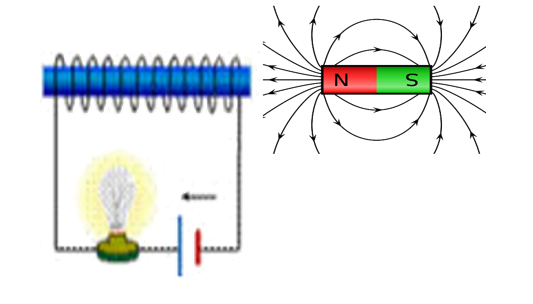
.....................................................................
الحلSolution
📌 يمر في الملف تيار من البطارية فيتولد حوله مجال مغناطيسي.
📌 عند تقريب المغناطيس يزداد التدفق المغناطيسي عبر الملف فيتولد فيه مجال معاكس للمجال المسبب (قاعدة لنز).
📌 هذا المجال المستحث معاكس لمجال تيار البطارية فتنشأ قوة دافعة مستحثة تعاكس قوة البطارية فيقل التيار.
✅ تقل إضاءة المصباح لأن القوة الدافعة المستحثة تعاكس قوة البطارية.
📌 A current from the battery flows in the coil and produces a magnetic field around it.
📌 When the magnet approaches, the magnetic flux through the coil increases and a field opposite to the cause is induced (Lenz's law).
📌 This induced field is opposite to the field of the battery current, so an induced emf opposes the battery's emf and the current decreases.
✅ The bulb gets dimmer because the induced emf opposes the battery's emf.
\[2\,\star\star\]
بالاعتماد على الحث المتبادل بين الدائرتين، ماذا يطرأ على إضاءة المصباح عند فتح المفتاح في الدائرة الأولى؟ فسّر السبب.Based on the mutual induction between the two circuits, what happens to the brightness of the bulb when the switch in the first circuit is opened? Explain the reason.
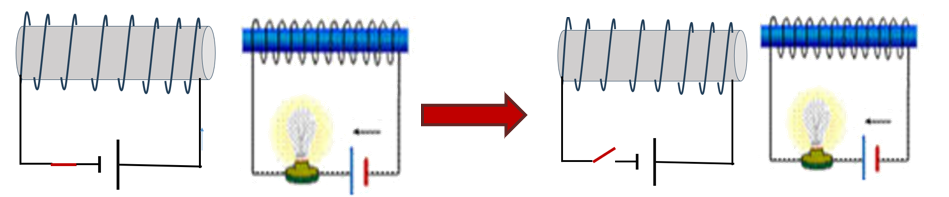
.....................................................................
الحلSolution
📌 عند فتح المفتاح في الدائرة الأولى يتناقص تيارها فيتناقص التدفق المغناطيسي الذي يجتاز الملف الثاني.
📌 يتولد في الملف الثاني مجال مستحث يعوّض النقص أي بالاتجاه نفسه لمجال الملف الأول (قاعدة لنز).
📌 هذا المجال معاكس للمجال الناتج عن مرور التيار في الملف الثاني نفسه، فيقل تيار الدائرة الثانية لحظيًا ثم يعود إلى قيمته.
✅ تتضاءل إضاءة المصباح لحظيًا عند فتح المفتاح ثم تعود.
📌 When the switch in the first circuit is opened its current decreases so the flux through the second coil decreases.
📌 In the second coil a field is induced that compensates the decrease, i.e. in the same direction as the field of the first coil (Lenz's law).
📌 This field is opposite to the field of the current flowing in the second coil itself, so the current of the second circuit decreases for a moment and then returns to its value.
✅ The bulb dims for a moment when the switch is opened, then comes back.
\[3\,\star\star\star\]
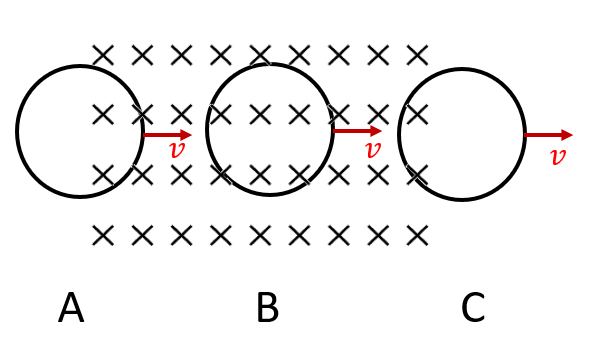
في الشكل مجال مغناطيسي منتظم (إلى داخل الصفحة)، وتتحرك حلقة من اليسار إلى اليمين بسرعة ثابتة بادئة من خارج المجال (المواضع A وB وC). (أ) حدّد الموضع الذي يتولد فيه تيار مستحث مع عقارب الساعة وفسّر السبب. (ب) حدّد الموضع الذي لا يتولد فيه تيار وفسّر السبب.In the figure there is a uniform magnetic field (into the page) and a loop moves from left to right at constant speed, starting outside the field (positions A, B and C). (a) Determine the position in which the induced current is clockwise and explain why. (b) Determine the position in which no current is induced and explain why.
.....................................................................
الحلSolution
📌 (أ) الموضع C (الخروج): تخرج الحلقة من المجال فيتناقص التدفق إلى الداخل، فيتولد حقل مشابه (إلى الداخل) أي تيار مع عقارب الساعة.
📌 (ب) الموضع B (داخل المجال كليًا): التدفق ثابت فلا تتولد قوة دافعة ولا تيار.
📌 وفي الموضع A (الدخول) يزداد التدفق إلى الداخل فيتولد حقل معاكس (إلى الخارج) أي تيار عكس عقارب الساعة.
✅ (أ) الموضع C (ب) الموضع B
📌 (a) Position C (leaving): the loop leaves the field so the inward flux decreases and a similar (inward) field is induced, i.e. a clockwise current.
📌 (b) Position B (completely inside the field): the flux is constant so no emf and no current are induced.
📌 In position A (entering) the inward flux increases so an opposing (outward) field is induced, i.e. a counterclockwise current.
✅ (a) position C (b) position B
\[4\,\star\star\star\]
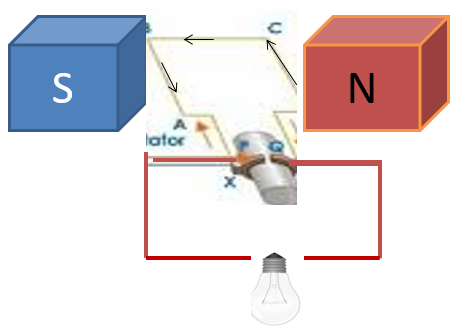
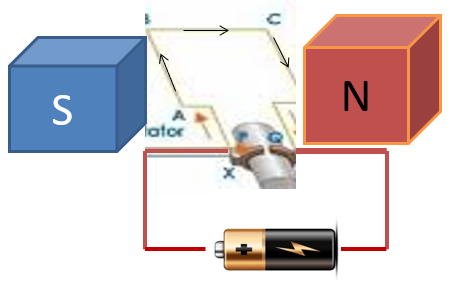
بالاعتماد على الشكلين، أكمل البيانات المطلوبة للجهاز في الشكل 1 (الدائرة فيها مصباح) وللجهاز في الشكل 2 (الدائرة فيها بطارية): (أ) اسم الجهاز. (ب) جهة الدوران بالنسبة لعقارب الساعة. (ج) الظاهرة التي يعتمد عليها في عمله. (د) عمل نصفي الحلقة.Using the two figures, complete the required data for the device in figure 1 (the circuit has a bulb) and for the device in figure 2 (the circuit has a battery): (a) the name of the device. (b) the direction of rotation relative to clockwise. (c) the phenomenon its operation is based on. (d) the function of the split rings.
.....................................................................
الحلSolution
📌 الشكل 1: مولّد كهربائي، يدور عكس عقارب الساعة، يعتمد على الحث الكهرومغناطيسي، ونصفا الحلقة يعكسان اتجاه التيار في الملف كل نصف دورة ليبقى التيار في الدائرة الخارجية في اتجاه واحد.
📌 الشكل 2: محرك كهربائي، يدور مع عقارب الساعة، يعتمد على القوة المغناطيسية على سلك يمر به تيار، ونصفا الحلقة يعكسان اتجاه التيار في الملف كل نصف دورة ليستمر الدوران في الاتجاه نفسه.
✅ الشكل 1: مولّد (عكس عقارب الساعة، حث كهرومغناطيسي)، الشكل 2: محرك (مع عقارب الساعة، قوة مغناطيسية).
📌 Figure 1: an electric generator, rotating counterclockwise, based on electromagnetic induction; the split rings reverse the connection every half turn so the current in the external circuit keeps one direction.
📌 Figure 2: an electric motor, rotating clockwise, based on the magnetic force on a current-carrying wire; the split rings reverse the current in the coil every half turn so the rotation continues in the same direction.
✅ Figure 1: generator (counterclockwise, electromagnetic induction); figure 2: motor (clockwise, magnetic force).
\[5\,\star\star\star\]
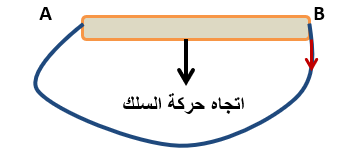
سلك موصل هو جزء من دائرة مغلقة تحرك داخل مجال مغناطيسي فتولد تيار مستحث كما في الشكل (حركة السلك إلى أسفل واتجاه التيار مبين على الشكل). (أ) حدّد قطبي السلك الموجب والسالب. (ب) حدّد اتجاه التيار داخل السلك. (ج) حدّد اتجاه المجال المغناطيسي بقاعدة الأصابع الثلاث. (د) إذا كانت القوة الدافعة المستحثة \(V_{ind}=0.15\,V\) وطول السلك \(L=0.2\,m\) وسرعته \(v=3\,m/s\) فاحسب أقل شدة للمجال أحدثت هذه القوة.A conducting wire that is part of a closed circuit moves in a magnetic field and an induced current appears as in the figure (the wire moves downward and the current direction is marked). (a) Determine the positive and negative ends of the wire. (b) Determine the direction of the current inside the wire. (c) Determine the direction of the magnetic field using the three-finger rule. (d) If the induced emf is \(V_{ind}=0.15\,V\), the length of the wire \(L=0.2\,m\) and its speed \(v=3\,m/s\), find the smallest field that produced this emf.
.....................................................................
الحلSolution
📌 (أ) السلك مصدر للقوة الدافعة، والتيار في الدائرة الخارجية يخرج من القطب الموجب: التيار المرسوم يدخل عند B فيكون A القطب السالب وB القطب الموجب.
📌 (ب) داخل المصدر يسير التيار من القطب السالب إلى الموجب: من A إلى B.
📌 (ج) بقاعدة الأصابع الثلاث لليد (الإبهام: حركة السلك إلى أسفل، السبابة: المجال، الوسطى: التيار من A إلى B): المجال عمودي إلى داخل الصفحة.
📌 (د) \(V_{ind}=BLv\sin\theta\) وأقل مجال عندما \(\sin\theta=1\): \(B=\dfrac{V_{ind}}{Lv}=\dfrac{0.15}{0.2\times3}=0.25\,T\).
✅ (أ) A سالب وB موجب (ب) من A إلى B (ج) إلى داخل الصفحة (د) \(B=0.25\,T\)
📌 (a) The wire is the source of the emf and the current leaves the positive pole in the external circuit; the drawn current leaves at B, so A is the negative pole and B the positive pole.
📌 (b) Inside the source the current flows from the negative to the positive pole: from A to B.
📌 (c) With the three-finger rule (thumb: motion of the wire downward, forefinger: the field, middle finger: current from A to B): the field is perpendicular into the page.
📌 (d) \(V_{ind}=BLv\sin\theta\) and the smallest field occurs when \(\sin\theta=1\): \(B=\dfrac{V_{ind}}{Lv}=\dfrac{0.15}{0.2\times3}=0.25\,T\).
✅ (a) A negative and B positive (b) from A to B (c) into the page (d) \(B=0.25\,T\)
\[6\,\star\star\star\]
ملف لولبي من \(N=8\) لفات متصل ببطارية. أُغلق المفتاح \(S\) فأصبحت شدة التيار \(I=10\,A\) بعد \(t=0.1\,s\) فتولدت في الملف قوة دافعة مستحثة \(\Delta V_{ind}=-2\,V\). (أ) احسب معامل الحث الذاتي للملف. (ب) احسب التدفق الذي يجتاز كل لفة. (ج) ناقش صحة العبارة: «معامل الحث الذاتي للملف لا يمكن أن يكون سالبًا».A solenoid of \(N=8\) turns is connected to a battery. The switch \(S\) is closed and the current becomes \(I=10\,A\) after \(t=0.1\,s\), producing an induced emf \(\Delta V_{ind}=-2\,V\) in the coil. (a) Calculate the self-inductance of the coil. (b) Calculate the flux through each turn. (c) Discuss the statement: “the self-inductance of a coil cannot be negative”.
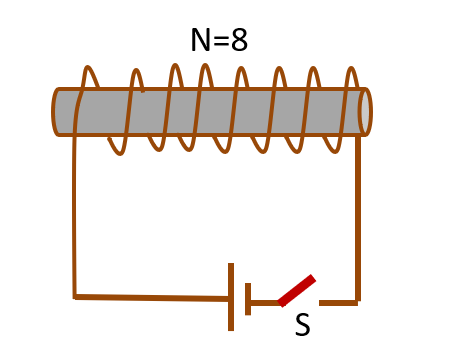
.....................................................................
الحلSolution
📌 (أ) التيار يزداد من الصفر إلى \(10\,A\): \(\Delta V_{ind}=-L\dfrac{\Delta I}{\Delta t}\Rightarrow-2=-L\dfrac{10-0}{0.1}\) ومنه \(L=0.02\,H\).
📌 (ب) \(\Delta V_{ind}=-N\dfrac{\Delta\phi}{\Delta t}\Rightarrow-2=-8\dfrac{\phi-0}{0.1}\) ومنه \(\phi=0.025\,T\cdot m^{2}\) (تحقق: \(L=\dfrac{N\phi}{I}=\dfrac{8\times0.025}{10}=0.02\,H\)).
📌 (ج) العبارة صحيحة: \(L=-\Delta V_{ind}\Big/\dfrac{\Delta I}{\Delta t}\). عند ازدياد التيار \(\Delta I\gt 0\) تكون \(\Delta V_{ind}\lt 0\) فيكون \(L=-\dfrac{(-)}{(+)}=+\)، وعند تناقصه \(\Delta I\lt 0\) تكون \(\Delta V_{ind}\gt 0\) فيكون \(L=-\dfrac{(+)}{(-)}=+\). فإشارة القوة الدافعة تتغير بتغير إشارة \(\Delta I\) ويبقى \(L\) موجبًا دائمًا.
✅ \(L=0.02\,H\)، \(\phi=0.025\,T\cdot m^{2}\)، ومعامل الحث الذاتي موجب دائمًا
📌 (a) The current rises from zero to \(10\,A\): \(\Delta V_{ind}=-L\dfrac{\Delta I}{\Delta t}\Rightarrow-2=-L\dfrac{10-0}{0.1}\) so \(L=0.02\,H\).
📌 (b) \(\Delta V_{ind}=-N\dfrac{\Delta\phi}{\Delta t}\Rightarrow-2=-8\dfrac{\phi-0}{0.1}\) so \(\phi=0.025\,T\cdot m^{2}\) (check: \(L=\dfrac{N\phi}{I}=\dfrac{8\times0.025}{10}=0.02\,H\)).
📌 (c) The statement is correct: \(L=-\Delta V_{ind}\Big/\dfrac{\Delta I}{\Delta t}\). When the current rises \(\Delta I\gt 0\) and \(\Delta V_{ind}\lt 0\) so \(L=-\dfrac{(-)}{(+)}=+\); when it falls \(\Delta I\lt 0\) and \(\Delta V_{ind}\gt 0\) so \(L=-\dfrac{(+)}{(-)}=+\). The sign of the emf follows the sign of \(\Delta I\) and \(L\) is always positive.
✅ \(L=0.02\,H\), \(\phi=0.025\,T\cdot m^{2}\), and the self-inductance is always positive
لاحظت خطأ؟ أو عندك سؤال عن أحد الأسئلة؟ اكتبه بالتعليقات وحدد رقم السؤال بالضبط.
Noticed an error? Or have a question about one of the questions? Write it in the comments and specify the exact question number.