🔌 بنك الأسئلة: التيار الكهربائي والدوائر الكهربائية
🔌 Question Bank: Electric Current and Electric Circuits
التيار والشحنة، المقاومة والمقاومية، قانون أوم، القدرة والطاقة الكهربائية، التوصيل على التوالي والتوازي، ومقارنة المقاومات، ونقل الطاقة الكهربائية
Current and Charge, Resistance and Resistivity, Ohm’s Law, Electric Power and Energy, Series and Parallel Connections, Comparing Resistances, and Power Transmission
⏱️ 37 سؤال اختيار من متعدد بتصحيح فوري بمستويات متدرجة، و7 مسائل مقالية محلولة⏱️ 37 multiple-choice questions of graded difficulty with instant feedback, plus 7 solved essay problems
\[1\,\star\]
أي من الأجهزة التالية تحول الطاقة الكهربائية إلى حرارية فقطWhich of the following devices converts electrical energy to heat only?

البطاريةBattery
المصباحLamp
المقاومةResistor
مجفف الشعرHair dryer
الحلSolution
💡 المفهوم: المقاومة هي مكون كهربائي يعيق مرور التيار ويحول الطاقة الكهربائية إلى طاقة حرارية (تسخين جول).
📌 التحليل: • البطارية: تحول الطاقة الكيميائية إلى كهربائية.
• المقاومة: تحول الطاقة الكهربائية إلى حرارية فقط.
• المصباح: يحول الطاقة الكهربائية إلى ضوء وحرارة.
• مجفف الشعر: يحول الطاقة الكهربائية إلى حرارة وطاقة حركية (مروحة).
• المقاومة: تحول الطاقة الكهربائية إلى حرارية فقط.
• المصباح: يحول الطاقة الكهربائية إلى ضوء وحرارة.
• مجفف الشعر: يحول الطاقة الكهربائية إلى حرارة وطاقة حركية (مروحة).
💡 تذكير: المقاومة هي أبسط جهاز يحول الطاقة الكهربائية بالكامل إلى حرارة.
✅ المقاومة (C)
💡 Concept: A resistor is an electrical component that opposes the flow of current and converts electrical energy into heat energy (Joule heating).
📌 Analysis: • Battery: converts chemical energy to electrical energy.
• Resistor: converts electrical energy to heat only.
• Lamp: converts electrical energy to light and heat.
• Hair dryer: converts electrical energy to heat and kinetic energy (fan).
• Resistor: converts electrical energy to heat only.
• Lamp: converts electrical energy to light and heat.
• Hair dryer: converts electrical energy to heat and kinetic energy (fan).
💡 Tip: A resistor is the simplest device that converts electrical energy completely into heat.
✅ Resistor (C)
\[2\,\star\]
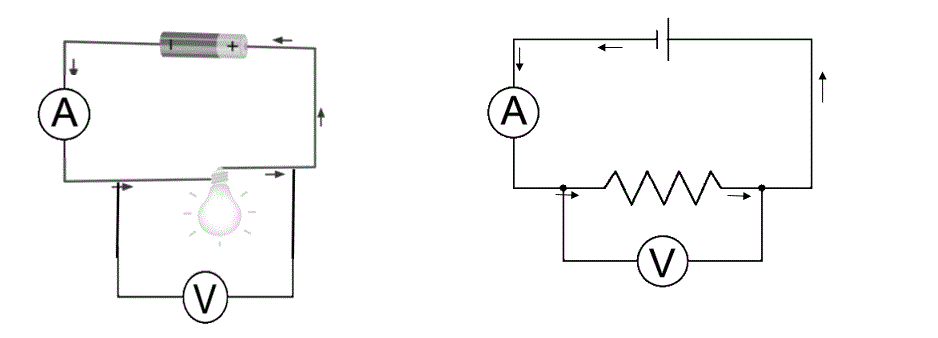
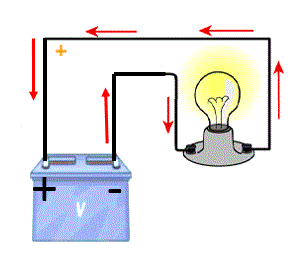
في الشكل أدناه دائرة كهربائية بسيطة، في أي جزء من الدائرة يتم فقد معظم الطاقة للشحنات الكهربائية؟In the circuit shown below, in which part of the circuit is most of the electrical energy lost?
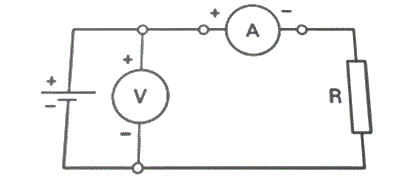
الأميترAmmeter
الفولتميترVoltmeter
الأسلاكWires
المقاومResistor
الحلSolution
💡 المفهوم: في الدائرة، تُفقد الطاقة على شكل حرارة في المكونات التي لها مقاومة. المقاوم يحول الطاقة الكهربائية إلى حرارة (تسخين جول).
📌 التحليل: • الأميتر: مقاومته منخفضة جداً، فقدان الطاقة مهمل.
• الفولتميتر: مقاومته عالية جداً، تيار مار به مهمل.
• المقاوم: له مقاومة كبيرة، يحول الطاقة الكهربائية إلى حرارة.
• الأسلاك: مقاومتها منخفضة جداً، فقدان الطاقة مهمل.
• الفولتميتر: مقاومته عالية جداً، تيار مار به مهمل.
• المقاوم: له مقاومة كبيرة، يحول الطاقة الكهربائية إلى حرارة.
• الأسلاك: مقاومتها منخفضة جداً، فقدان الطاقة مهمل.
💡 تذكير: في الدائرة، تُفقد الطاقة بشكل رئيسي في المقاوم لأن \(P = I^2R\).
✅ المقاوم (D)
💡 Concept: In a circuit, energy is lost as heat in components that have resistance. The resistor converts electrical energy into heat (Joule heating).
📌 Analysis: • Ammeter: has very low resistance, negligible energy loss.
• Voltmeter: has very high resistance, negligible current flow.
• Resistor: has significant resistance, converts electrical energy to heat.
• Wires: have very low resistance, negligible energy loss.
• Voltmeter: has very high resistance, negligible current flow.
• Resistor: has significant resistance, converts electrical energy to heat.
• Wires: have very low resistance, negligible energy loss.
💡 Tip: In a circuit, energy is lost mainly in the resistor because \(P = I^2R\).
✅ Resistor (D)
\[3\,\star\star\]
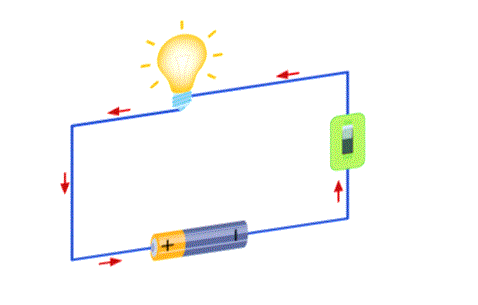
تيار كهربائي شدته \(3\;A\) يمر في مصباح، فرق الجهد بين طرفيه \(20\;V\). فإن الطاقة التي يصرفها المصباح خلال دقيقة تعادل:An electric current of \(3\;A\) passes through a lamp with a potential difference of \(20\;V\). The energy consumed by the lamp during one minute is:
\(E=1800 \;\;J\)\(E=1800 \;\;J\)
\(E=600 \;\;J\)\(E=600 \;\;J\)
\(E=1200 \;\;J\)\(E=1200 \;\;J\)
\(E=3600 \;\;J\)\(E=3600 \;\;J\)
الحلSolution
💡 المفهوم: القدرة الكهربائية هي \(P = VI\)، والطاقة هي \(E = P \times t = VIt\).
📌 حساب القدرة: \(P = VI = 20 \times 3 = 60 \;\;W\)
📌 تحويل الزمن: \(t = 1 \;\;min= 60 \;\;s\)
📌 حساب الطاقة: \(E = P \times t = 60 \times 60 = 3600 \;\;J\)
💡 تذكير: قم دائماً بتحويل الزمن إلى ثوانٍ عند استخدام وحدات النظام الدولي (جول).
✅ \(E=3600 \;\;J\) (D)
💡 Concept: Electrical power is \(P = VI\), and energy is \(E = P \times t = VIt\).
📌 Calculate power: \(P = VI = 20 \times 3 = 60 \;\;W\)
📌 Convert time: \(t = 1 \;\;min = 60 \;\;s\)
📌 Calculate energy: \(E = P \times t = 60 \times 60 = 3600 \;\;J\)
💡 Tip: Always convert time to seconds when using SI units (Joules).
✅ \(E=3600 \;\;J\) (D)
\[4\,\star\star\]
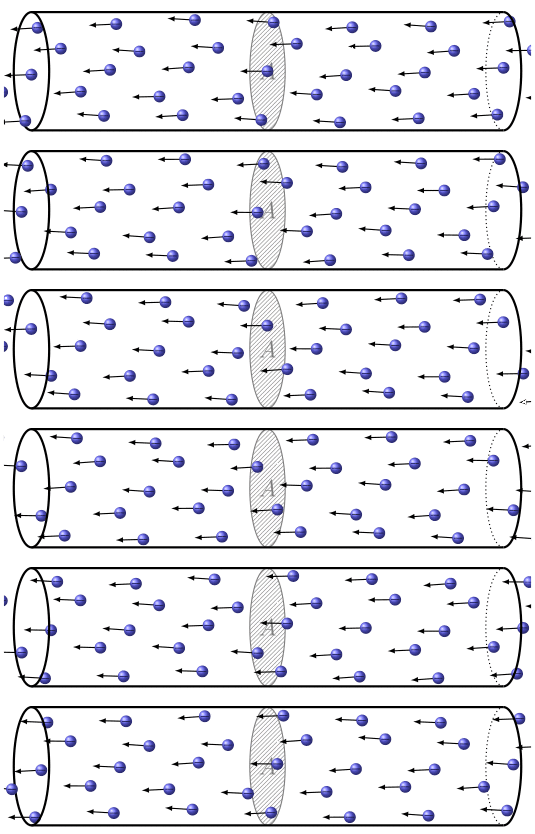
تم حصر عدد الإلكترونات التي تعبر مقطع سلك في دائرة كهربائية خلال \(120\,s\) فكان عددها \(20\times10^{20}\). فإن شدة التيار المار في السلك تعادل (\(e=1.6\times10^{-19}\,C\)):The number of electrons passing through a wire’s cross-section during \(120\,s\) is \(20\times10^{20}\). The current in the wire is (\(e=1.6\times10^{-19}\,C\)):
\(I=1.9 \;\;A\)\(I=1.9 \;\;A\)
\(I=2.7 \;\;A\)\(I=2.7 \;\;A\)
\(I=0.61 \;\;A\)\(I=0.61 \;\;A\)
\(I=1.3 \;\;A\)\(I=1.3 \;\;A\)
الحلSolution
📌 الشحنة الكلية: \(Q=ne=20\times10^{20}\times1.6\times10^{-19}=320\,C\).
📌 \(I=\dfrac{Q}{t}=\dfrac{320}{120}\approx2.7\,A\).
✅ \(I=2.7 \;\;A\) (B)
📌 Total charge: \(Q=ne=20\times10^{20}\times1.6\times10^{-19}=320\,C\).
📌 \(I=\dfrac{Q}{t}=\dfrac{320}{120}\approx2.7\,A\).
✅ \(I=2.7 \;\;A\) (B)
\[5\,\star\]
وحدة قياس القدرة هي الوات، وهي تعادل:The unit of power is the watt, which is equivalent to:
\(kg.m^2/S^2\)\(kg.m^2/S^2\)
\(J.S\)\(J.S\)
\(N.S/m\)\(N.S/m\)
\(kg.m^2/S^3\)\(kg.m^2/S^3\)
الحلSolution
💡 المفهوم: القدرة هي معدل بذل الشغل: \(P = \frac{W}{t} = \frac{F \times d}{t} = \frac{kg \cdot m/s^2 \times m}{s} = \frac{kg \cdot m^2}{s^3}\).
📌 اشتقاق الوحدة:
\(W = \frac{J}{S} = \frac{kg \cdot m^2/s^2}{s} = kg \cdot m^2 \cdot s^{-3}\).
💡 تذكير: 1 وات = 1 جول/ثانية = 1 كجم·م²/ث³.
✅ \(kg.m^2/S^3\) (D)
💡 Concept: Power is the rate of doing work: \(P = \frac{W}{t} = \frac{F \times d}{t} = \frac{kg \cdot m/s^2 \times m}{s} = \frac{kg \cdot m^2}{s^3}\).
📌 Derive unit: \(Watt = \frac{Joule}{second} = \frac{kg \cdot m^2/s^2}{s} = kg \cdot m^2 \cdot s^{-3}\).
💡 Tip: 1 Watt = 1 Joule/second = 1 kg·m²/s³.
✅ \(kg.m^2/S^3\) (D)
\[6\,\star\]
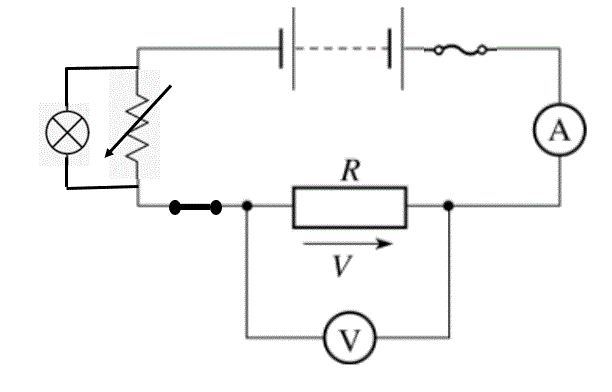
في الشكل أدناه مجموعة من الأجهزة مرتبطة مع بعضها البعض. الأجهزة التي تم توصيلها على التوازي:In the figure below, a group of devices are connected together. Which devices are connected in parallel?
أميتر - منصهرAmmeter – fuse
المقاومة المتغيرة - المقاومة RVariable resistor – resistor R
المصباح - المقاومة المتغيرةLamp – variable resistor
بطارية - مفتاحBattery – switch
الحلSolution
📌 العنصران على التوازي إذا اتصل طرفاهما بنقطتين مشتركتين نفسيهما فيكون لهما فرق الجهد نفسه.
📌 في الشكل يتصل طرفا المصباح بطرفي المقاومة المتغيرة، فهما على التوازي. أما الأميتر والمنصهر والبطارية والمفتاح والمقاومتان \(R\) والمتغيرة فعلى التوالي.
✅ المصباح - المقاومة المتغيرة (C)
📌 Two components are in parallel when both their ends connect to the same two nodes, so they share the same potential difference.
📌 In the figure the lamp’s two terminals connect to the two ends of the variable resistor, so they are in parallel. The ammeter, fuse, battery and switch are in series, and so are \(R\) and the variable resistor.
✅ Lamp – variable resistor (C)
\[7\,\star\]
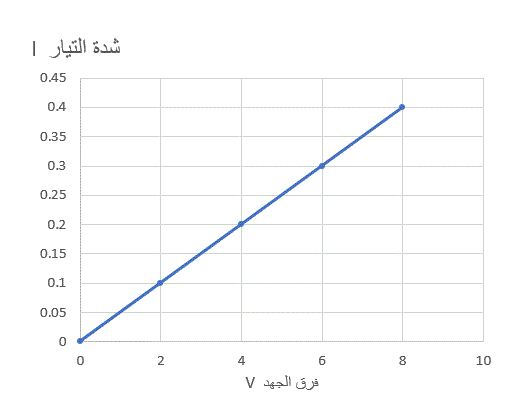
في الشكل أدناه تم رسم العلاقة بين شدة التيار وفرق الجهد لمقاوم أومي. فإن قيمة المقاومة تعادل:The graph below shows the relationship between current and voltage for an ohmic resistor. The value of the resistance is:
\(R= 10 \;\Omega\)\(R= 10 \;\Omega\)
\(R= 1.8 \;\Omega\)\(R= 1.8 \;\Omega\)
\(R= 0.05 \;\Omega\)\(R= 0.05 \;\Omega\)
\(R= 20 \;\Omega\)\(R= 20 \;\Omega\)
الحلSolution
📌 للمقاوم الأومي \(R=\dfrac{V}{I}\) (ميل العلاقة بين الجهد والتيار ثابت).
📌 من الرسم: عند \(V=8\,V\) يكون \(I=0.4\,A\) (وكذلك \(4\,V\to0.2\,A\)).
📌 \(R=\dfrac{8}{0.4}=20\,\Omega\).
✅ \(R= 20 \;\Omega\) (D)
📌 For an ohmic resistor \(R=\dfrac{V}{I}\) (the V–I relation has a constant slope).
📌 From the graph: at \(V=8\,V\) we read \(I=0.4\,A\) (likewise \(4\,V\to0.2\,A\)).
📌 \(R=\dfrac{8}{0.4}=20\,\Omega\).
✅ \(R= 20 \;\Omega\) (D)
\[8\,\star\]
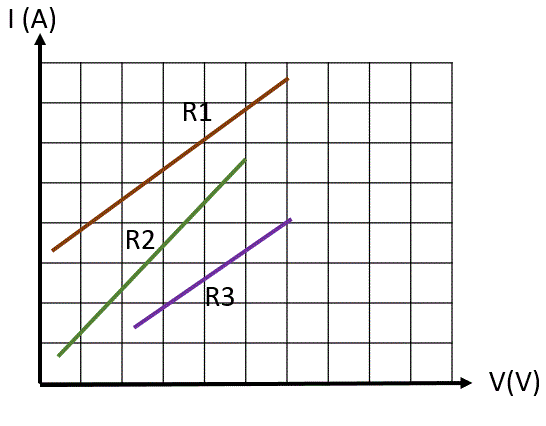
في الشكل أدناه تم رسم العلاقة بين شدة التيار وفرق الجهد لثلاث مقاومات (3,2,1). أحد الإجابات التالية تعبر عن هذه المقاومات:The graph below shows the relationship between current and voltage for three resistors (1, 2, 3). Which of the following correctly expresses these resistances?
\(R_3 > R_2 > R_1\)\(R_3 > R_2 > R_1\)
\(R_1 = R_3 > R_2\)\(R_1 = R_3 > R_2\)
\(R_1 > R_2 > R_3\)\(R_1 > R_2 > R_3\)
\(R_2 > R_1 > R_3\)\(R_2 > R_1 > R_3\)
الحلSolution
💡 المفهوم: لنفس الجهد، تيار أكبر يعني مقاومة أصغر. ميل منحنى التيار-الجهد هو \(1/R\)
📌 تحليل الميل: •\(R1\)و\(R3\) لهما نفس الميل نفس التيار لنفس الجهد
إذا مقاومة متساوية.
•\(R2\)له ميل أكبر (تيار أكبر لنفس الجهد) ← مقاومة أصغر.
إذن: \(R_1 = R_3 > R_2\).
•\(R2\)له ميل أكبر (تيار أكبر لنفس الجهد) ← مقاومة أصغر.
إذن: \(R_1 = R_3 > R_2\).
💡 تذكير: الميل الأكبر في منحنى التيار-الجهد يعني مقاومة أقل.
✅ \(R_1 = R_3 > R_2\) (B)
💡 Concept: For the same voltage, a larger current means smaller resistance. The slope of the I-V graph is \(1/R\).
📌 Analyze slopes: • R1 and R3 have the same slope (same current for same voltage) → equal resistance.
• R2 has a steeper slope (larger current for same voltage) → smaller resistance.
Therefore: \(R_1 = R_3 > R_2\).
• R2 has a steeper slope (larger current for same voltage) → smaller resistance.
Therefore: \(R_1 = R_3 > R_2\).
💡 Tip: Steeper slope in an I-V graph means lower resistance.
✅ \(R_1 = R_3 > R_2\) (B)
\[9\,\star\]
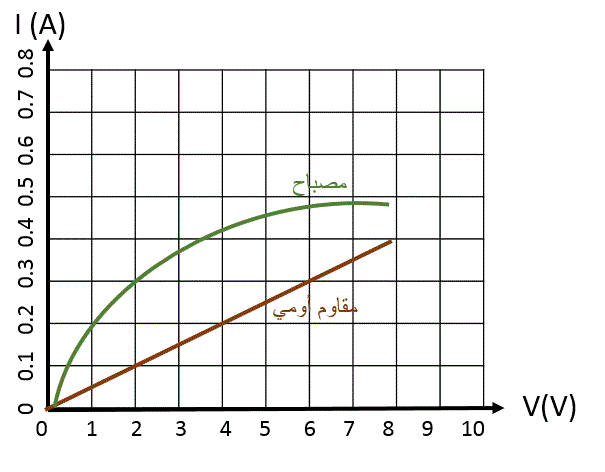
درس طالب العلاقة بين شدة التيار وفرق الجهد لمقاوم أومي ثم أجرى التجربة نفسها على مصباح (الشكل). عند أي جهد يتساوى ميل منحنى المصباح (المقاومة التفاضلية \(\Delta V/\Delta I\)) مع ميل خط المقاوم الأومي؟A student studied the relationship between current and voltage for an ohmic resistor, then repeated the experiment with a lamp (figure). At what voltage is the slope of the lamp’s curve (the differential resistance \(\Delta V/\Delta I\)) equal to the slope of the ohmic resistor’s line?
\(V=3.5 \;\;V\)\(V=3.5 \;\;V\)
\(V=1.5 \;\;V\)\(V=1.5 \;\;V\)
\(V=6.5 \;\;V\)\(V=6.5 \;\;V\)
\(V=8 \;\;V\)\(V=8 \;\;V\)
الحلSolution
📌 خط المقاوم الأومي مستقيم: \(R=\dfrac{8}{0.4}=20\,\Omega\)، أي أن ميل التيار–الجهد ثابت \(0.05\,A/V\).
📌 منحنى المصباح يتسطح تدريجيًا (تزداد مقاومته بارتفاع حرارة الفتيل)، وميله يتناقص مع الجهد.
📌 بين \(3\,V\) و \(4\,V\) يتغير التيار من نحو \(0.37\,A\) إلى \(0.42\,A\): ميله \(\approx0.05\,A/V\) يساوي ميل الخط الأومي، أي عند \(V\approx3.5\,V\).
✅ \(V=3.5 \;\;V\) (A)
📌 The ohmic line is straight: \(R=\dfrac{8}{0.4}=20\,\Omega\), i.e. a constant I–V slope of \(0.05\,A/V\).
📌 The lamp’s curve flattens gradually (its resistance rises as the filament heats up), so its slope decreases with voltage.
📌 Between \(3\,V\) and \(4\,V\) the current changes from about \(0.37\,A\) to \(0.42\,A\): a slope of \(\approx0.05\,A/V\), equal to the ohmic line’s, i.e. at \(V\approx3.5\,V\).
✅ \(V=3.5 \;\;V\) (A)
\[10\,\star\]
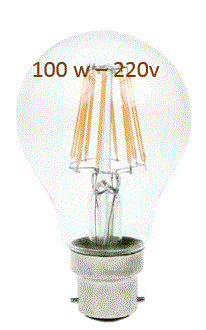
مصباح كُتب عليه \(100\;W\), \(220\;V\). تم توصيله ببطارية قوتها المحركة \(50\;V\). فإن قدرة المصباح تصبح:A lamp is rated \(100\;W\), \(220\;V\). It is connected to a battery with EMF \(50\;V\). The power of the lamp becomes:
\(P=10.5 \;\;W\)\(P=10.5 \;\;W\)
\(P=50 \;\;W\)\(P=50 \;\;W\)
\(P=15.8 \;\;W\)\(P=15.8 \;\;W\)
\(P=5.2 \;\;W\)\(P=5.2 \;\;W\)
الحلSolution
💡 المفهوم: مقاومة المصباح ثابتة: \(R = \frac{V^2}{P}\). ثم استخدم \(P = \frac{V^2}{R}\) للجهد الجديد.
📌 حساب المقاومة: \(R = \frac{V^2}{P} = \frac{220^2}{100} = 484 \;\Omega\)
📌 حساب القدرة الجديدة: \(P_{new} = \frac{V_{new}^2}{R} = \frac{50^2}{484} = \frac{2500}{484} = 5.17 \approx 5.2 \;\;W\)
💡 تذكير: مقاومة المصباح ثابتة (بافتراض أنها لا تتغير مع درجة الحرارة).
✅ \(P=5.2 \;\;W\) (D)
💡 Concept: The resistance of the lamp is constant: \(R = \frac{V^2}{P}\). Then use \(P = \frac{V^2}{R}\) for the new voltage.
📌 Calculate resistance: \(R = \frac{V^2}{P} = \frac{220^2}{100} = 484 \;\Omega\)
📌 Calculate new power: \(P_{new} = \frac{V_{new}^2}{R} = \frac{50^2}{484} = \frac{2500}{484} = 5.17 \approx 5.2 \;\;W\)
💡 Tip: The resistance of a lamp is constant (assuming it doesn't change with temperature).
✅ \(P=5.2 \;\;W\) (D)
\[11\,\star\]
مصباح قدرته \(120\;W\) ويعمل تحت فرق جهد \(220\;V\). فإن شدة التيار المار في المصباح تعادل:A lamp has power \(120\;W\) and operates at voltage \(220\;V\). The current through the lamp is:
\(I= 1.2 \;\;A\)\(I= 1.2 \;\;A\)
\(I= 0.54 \;\;A\)\(I= 0.54 \;\;A\)
\(I= 0.82 \;\;A\)\(I= 0.82 \;\;A\)
\(I= 1.8 \;\;A\)\(I= 1.8 \;\;A\)
الحلSolution
💡 المفهوم: القدرة هي \(P = VI\)، لذا \(I = \frac{P}{V}\).
📌 حساب شدة التيار: \(I = \frac{P}{V} = \frac{120}{220} = 0.545 \approx 0.54 \;\;A\)
💡 تذكير: تذكر مثلث القدرة: \(P = VI\)، \(I = P/V\)، \(V = P/I\).
✅ \(I= 0.54 \;\;A\) (B)
💡 Concept: Power is \(P = VI\), so \(I = \frac{P}{V}\).
📌 Calculate current: \(I = \frac{P}{V} = \frac{120}{220} = 0.545 \approx 0.54 \;\;A\)
💡 Tip: Remember the power triangle: \(P = VI\), \(I = P/V\), \(V = P/I\).
✅ \(I= 0.54 \;\;A\) (B)
\[12\,\star\]
مروحة تعمل تحت فرق جهد \(220\;V\) ويمر بها تيار شدته \(I=0.1\;A\). فإن الطاقة المصروفة خلال دقيقة تعادل:A fan operates at \(220\;V\) and carries a current of \(I=0.1\;A\). The energy consumed during one minute is:
\(E= 840 \;\;J\)\(E= 840 \;\;J\)
\(E= 1320 \;\;J\)\(E= 1320 \;\;J\)
\(E= 2318 \;\;J\)\(E= 2318 \;\;J\)
\(E= 615 \;\;J\)\(E= 615 \;\;J\)
الحلSolution
💡 المفهوم: الطاقة الكهربائية هي \(E = VIt\).
📌 تحويل الزمن: \(t = 1 \;\;min = 60 \;\;S\)
📌 حساب الطاقة: \(E = VIt = 220 \times 0.1 \times 60 = 1320 \;\;J\)
💡 تذكير: الطاقة = القدرة × الزمن = الجهد × التيار × الزمن.
✅ \(E= 1320 \;\;J\) (B)
💡 Concept: Electrical energy is \(E = VIt\).
📌 Convert time: \(t = 1 \;\;min = 60 \;\;s\)
📌 Calculate energy: \(E = VIt = 220 \times 0.1 \times 60 = 1320 \;\;J\)
💡 Tip: Energy = Power × Time = Voltage × Current × Time.
✅ \(E= 1320 \;\;J\) (B)
\[13\,\star\]
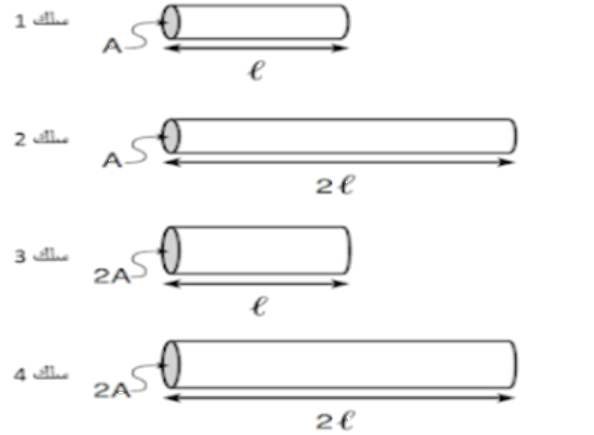
أربع أسلاك من نفس النوع وبنفس درجة الحرارة. أي الأسلاك التالية لها أقل مقاومة؟Four wires of the same material and same temperature are shown. Which wire has the least resistance?
سلك 1Wire 1
سلك 2Wire 2
سلك 3Wire 3
سلك 4Wire 4
الحلSolution
💡 المفهوم: المقاومة تُعطى بالعلاقة \(R = \rho \frac{L}{A}\). لنفس المادة (\(\rho\) ثابت)، المقاومة تتناسب طردياً مع الطول وعكسياً مع المساحة.
📌 تحليل كل سلك: السلك 3 لديه أكبر مساحة مقطع وأقصر طول ← أقل مقاومة.
💡 تذكير: لتقليل المقاومة: استخدم أسلاك قصيرة وسميكة ذات مقاومية نوعية منخفضة.
✅ سلك 3 (C)
💡 Concept: Resistance is given by \(R = \rho \frac{L}{A}\). For the same material (\(\rho\) constant), resistance is proportional to length and inversely proportional to area.
📌 Analyze each wire: Wire 3 has the largest cross-sectional area and the shortest length → least resistance.
💡 Tip: To minimize resistance: use short, thick wires with low resistivity.
✅ Wire 3 (C)
\[14\,\star\star\star\]
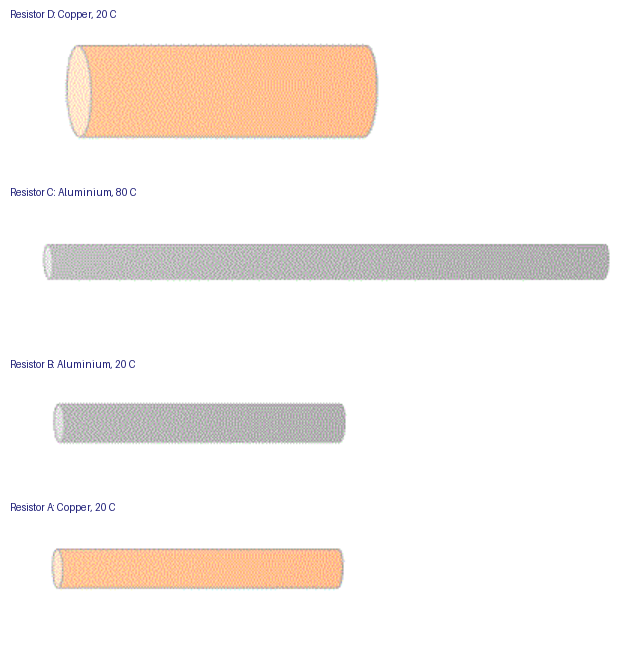
الترتيب الصحيح لمقاومات بياناتها في الجدول التالي من الأدنى مقاومة إلى الأعلى:The correct order of the resistances from the table below, from lowest to highest, is:
\(R_A > R_C > R_D > R_B\)\(R_A > R_C > R_D > R_B\)
\(R_D > R_A > R_B > R_C\)\(R_D > R_A > R_B > R_C\)
\(R_C > R_B > R_A > R_D\)\(R_C > R_B > R_A > R_D\)
\(R_C > R_B > R_D > R_A\)\(R_C > R_B > R_D > R_A\)
الحلSolution
📌 \(R=\rho\dfrac{L}{A}\): المقاومة تزداد بزيادة المقاومية النوعية (والألمنيوم أعلى من النحاس، وترتفع بارتفاع الحرارة) وبزيادة الطول وبنقصان مساحة المقطع.
📌 المقاوم C: ألمنيوم عند 80°C وهو طويل ورفيع جدًا ⇒ الأكبر مقاومة.
📌 المقاومان A وB لهما الأبعاد نفسها ودرجة الحرارة نفسها، والألمنيوم (B) أكبر مقاومية من النحاس (A) ⇒ \(R_B>R_A\).
📌 المقاوم D: نحاس قصير وسميك ⇒ الأصغر مقاومة. إذن \(R_C>R_B>R_A>R_D\).
✅ \(R_C > R_B > R_A > R_D\) (C)
📌 \(R=\rho\dfrac{L}{A}\): resistance increases with resistivity (aluminium is higher than copper, and it rises with temperature), with length, and as the cross-section decreases.
📌 Resistor C: aluminium at 80°C, long and very thin ⇒ the greatest resistance.
📌 Resistors A and B have the same dimensions and temperature, and aluminium (B) has higher resistivity than copper (A) ⇒ \(R_B>R_A\).
📌 Resistor D: copper, short and thick ⇒ the smallest resistance. So \(R_C>R_B>R_A>R_D\).
✅ \(R_C > R_B > R_A > R_D\) (C)
\[15\,\star\star\star\]
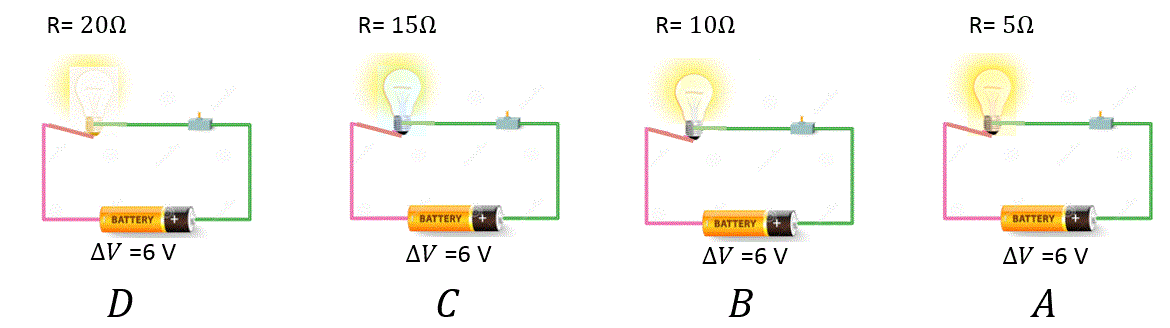
أحد المصابيح التالية يصرف أكثر طاقة عند عملها لمدة ساعة، حيث تم وصل جميع المصابيح بنفس البطارية:Which of the following lamps consumes the most energy when operated for one hour, given that all lamps are connected to the same battery?
AA
BB
CC
DD
الحلSolution
💡 المفهوم: عند التوصيل بنفس البطارية (نفس الجهد)، المصباح ذو المقاومة الأصغر سيسحب تياراً أكبر ويصرف قدرة أكبر: \(P = V^2/R\).
📌 التحليل: المصباح \(A\)لديه أقل مقاومة (فتيل رفيع) ← أعلى قدرة ← أكثر طاقة مصرفة في ساعة.
💡 تذكير: الطاقة المصروفة = القدرة × الزمن. لنفس الزمن، قدرة أعلى تعني طاقة أكبر.
✅ A
💡 Concept: When connected to the same battery (same voltage), the lamp with the smallest resistance will draw the most current and consume the most power: \(P = V^2/R\).
📌 Analyze: Lamp\(A\)has the lowest resistance (thin filament) → highest power → most energy consumed in one hour.
💡 Tip: Energy consumed = Power × Time. For the same time, higher power means more energy.
✅ A
\[16\,\star\]
من ميزات أسلاك نقل الطاقة يجب أن تكون:Power transmission wires should have which characteristics?
مقاومتها النوعية منخفضة ومساحة مقطعها صغيرةLow resistivity and small cross-sectional area
مقاومتها النوعية مرتفعة ومساحة مقطعها صغيرةHigh resistivity and small cross-sectional area
مقاومتها النوعية منخفضة ومساحة مقطعها كبيرةLow resistivity and large cross-sectional area
مقاومتها النوعية مرتفعة ومساحة مقطعها كبيرةHigh resistivity and large cross-sectional area
الحلSolution
💡 المفهوم: لتقليل فقدان الطاقة \(P = I^2R\) في خطوط النقل، يجب أن تكون المقاومة منخفضة قدر الإمكان: \(R = \rho L/A\).
📌 المتطلبات: • مقاومية نوعية منخفضة (\(\rho\) صغيرة)
• مساحة مقطع كبيرة (\(A\) كبيرة)
هذان العاملان يقللان المقاومة.
• مساحة مقطع كبيرة (\(A\) كبيرة)
هذان العاملان يقللان المقاومة.
💡 تذكير: تستخدم خطوط النقل مواد مثل النحاس أو الألمنيوم (مقاومية نوعية منخفضة) بأقطار كبيرة.
✅ مقاومتها النوعية منخفضة ومساحة مقطعها كبيرة (C)
💡 Concept: To minimize power loss \(P = I^2R\) in transmission lines, resistance should be as low as possible: \(R = \rho L/A\).
📌 Requirements: • Low resistivity (\(\rho\) small)
• Large cross-sectional area (\(A\) large)
These two factors minimize resistance.
• Large cross-sectional area (\(A\) large)
These two factors minimize resistance.
💡 Tip: Transmission lines use materials like copper or aluminium (low resistivity) with large diameters.
✅ Low resistivity and large cross-sectional area (C)
\[17\,\star\]
لنقل الطاقة من المحطة إلى المدن يتم وضع محولات للتقليل من الطاقة الضائعة. يكون نوع المحولات الموضوعة:To transmit power from the station to cities, transformers are used to reduce energy loss. What type of transformers are used?
عند المحطة: رافعة للجهد، خافضة للتيار؛ عند المدينة: رافعة للجهد، رافعة للتيارAt station: step-up voltage, step-down current; at city: step-up voltage, step-up current
عند المحطة: خافضة للجهد، رافعة للتيار؛ عند المدينة: رافعة للجهد، خافضة للتيارAt station: step-down voltage, step-up current; at city: step-up voltage, step-down current
عند المحطة: خافضة للجهد، خافضة للتيار؛ عند المدينة: رافعة للجهد، خافضة للتيارAt station: step-down voltage, step-down current; at city: step-up voltage, step-down current
عند المحطة: رافعة للجهد، خافضة للتيار؛ عند المدينة: خافضة للجهد، رافعة للتيارAt station: step-up voltage, step-down current; at city: step-down voltage, step-up current
الحلSolution
💡 المفهوم: لتقليل فقدان الطاقة أثناء النقل، يُستخدم جهد عالٍ وتيار منخفض \(P = VI\). عند المدينة، يُخفض الجهد للاستخدام الآمن.
📌 التحليل: • عند المحطة: محول رافع
يزيد V،
يقلل I
لتقليل فقد \(I^2R\).
• عند المدينة: محول خافض
يقلل V
يزيد I
للاستهلاك الآمن.
يزيد V،
يقلل I
لتقليل فقد \(I^2R\).
• عند المدينة: محول خافض
يقلل V
يزيد I
للاستهلاك الآمن.
💡 تذكير: فقدان الطاقة في خطوط النقل يتناسب مع \(I^2\). جهد أعلى يعني تيار أقل لنفس القدرة.
✅ عند المحطة: رافعة للجهد، خافضة للتيار؛ عند المدينة: خافضة للجهد، رافعة للتيار (D)
💡 Concept: To reduce power loss during transmission, high voltage and low current are used \(P = VI\). At the city, voltage is stepped down for safe use.
📌 Analysis: • At station: Step-up transformer (increase V, decrease I) to reduce \(I^2R\) losses.
• At city: Step-down transformer (decrease V, increase I) for safe consumption.
• At city: Step-down transformer (decrease V, increase I) for safe consumption.
💡 Tip: Power loss in transmission lines is proportional to \(I^2\). Higher voltage means lower current for the same power.
✅ At station: step-up voltage, step-down current; at city: step-down voltage, step-up current (D)
\[18\,\star\]
أحد الأجهزة التالية إذا تم توصيله على التوالي فإن التيار لا يمر في الدائرة:Which device, if connected in series, prevents current from flowing in the circuit?
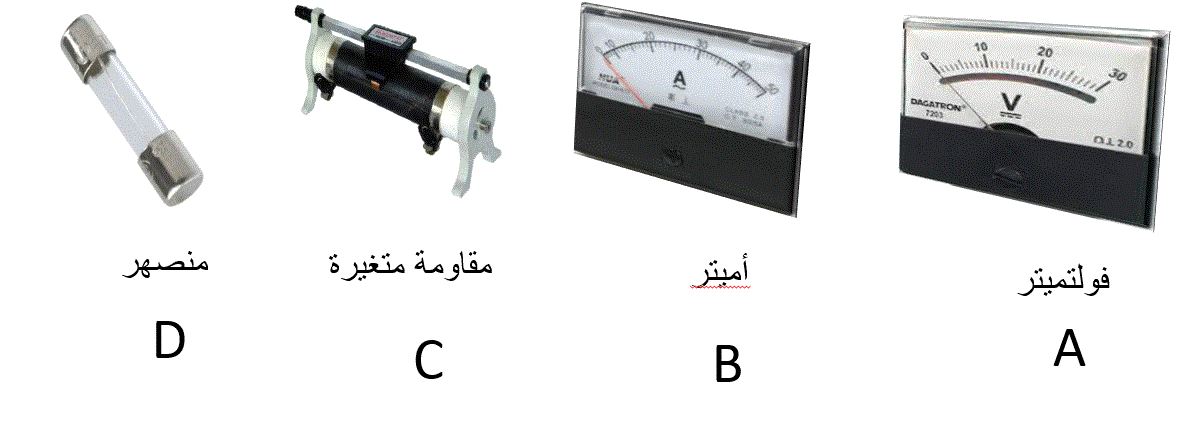
فولتميترVoltmeter
أميترAmmeter
المقاومة المتغيرةVariable resistor
منصهرFuse
الحلSolution
📌 الأميتر مقاومته صغيرة جدًا ويوصل على التوالي، والمقاومة المتغيرة والمنصهر يوصلان على التوالي أيضًا ويمر بهما التيار.
📌 أما الفولتميتر فمقاومته كبيرة جدًا (تقترب من اللانهاية) ويوصل على التوازي؛ فإذا وُصل على التوالي منع تقريبًا مرور التيار في الدائرة.
✅ فولتميتر (A)
📌 An ammeter has a very small resistance and is connected in series; the variable resistor and the fuse are also in series and carry the current.
📌 A voltmeter has a very large resistance (approaching infinity) and is connected in parallel; if connected in series it practically stops the current in the circuit.
✅ Voltmeter (A)
\[19\,\star\star\star\]
مقاومان لهما نفس الطول ومن نفس المادة وبنفس درجة الحرارة، ومساحة \(A_{R1}=2A_{R2}\). تم توصيلهما بنفس البطارية حتى انتهاء طاقتها. أحد الإجابات التالية تحقق هذه المعلومات:Two resistors have the same length, same material, same temperature, and cross-sectional areas \(A_{R1}=2A_{R2}\). They are connected to the same battery until its energy is depleted. Which of the following is correct?
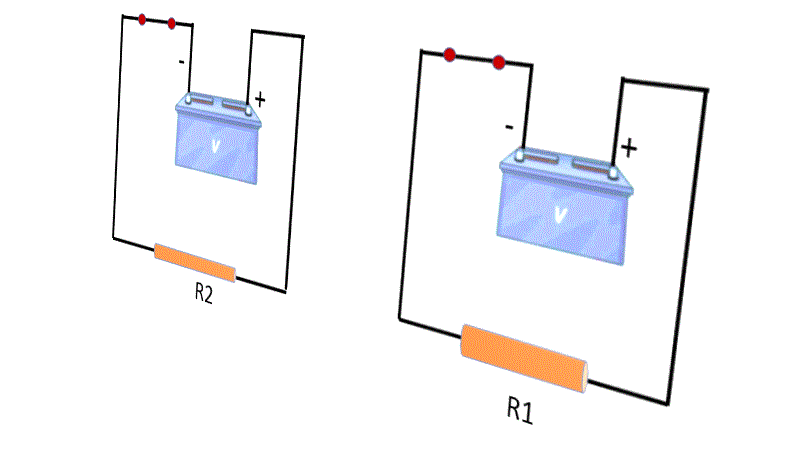
المقاوم 2 يعمل لفترة زمنية ضعف المقاوم 1Resistor 2 works for double the time of resistor 1
كلا المقاومين يعمل لنفس الفترة الزمنيةBoth resistors work for the same time
المقاوم 1 يعمل لفترة زمنية ضعف المقاوم 2Resistor 1 works for double the time of resistor 2
المقاوم الذي مقاومته أقل يعمل لفترة أطولThe resistor with lower resistance works for a longer time
الحلSolution
📌 \(R=\rho\dfrac{L}{A}\) لمقاومين من المادة نفسها وبالطول نفسه ودرجة الحرارة نفسها: \(R\propto\dfrac1A\)، وبما أن \(A_{R1}=2A_{R2}\) فإن \(R_1=\dfrac{R_2}{2}\).
📌 كل مقاوم وُصل بالبطارية نفسها ذات الطاقة المخزنة نفسها \(E\): \(P=\dfrac{V^2}{R}\) و \(t=\dfrac{E}{P}=\dfrac{ER}{V^2}\) أي \(t\propto R\).
📌 للمقاوم 2 ضعف مقاومة المقاوم 1، فيعمل ضعف المدة: \(t_2=2t_1\).
✅ المقاوم 2 يعمل لفترة زمنية ضعف المقاوم 1 (A)
📌 \(R=\rho\dfrac{L}{A}\) for the same material, length and temperature gives \(R\propto\dfrac1A\); since \(A_{R1}=2A_{R2}\), \(R_1=\dfrac{R_2}{2}\).
📌 Each resistor is connected to the same battery with the same stored energy \(E\): \(P=\dfrac{V^2}{R}\) and \(t=\dfrac{E}{P}=\dfrac{ER}{V^2}\), so \(t\propto R\).
📌 Resistor 2 has twice the resistance of resistor 1, so it runs twice as long: \(t_2=2t_1\).
✅ Resistor 2 works for double the time of resistor 1 (A)
\[20\,\star\star\]
مصباح قدرته \(100\;W\) يعمل بكفاءة 40% حيث يحول الطاقة الكهربائية إلى إشعاعية. فإن الطاقة المتحولة إلى حرارة خلال ساعة من الزمن تعادل:A lamp has power \(100\;W\) and operates at 40% efficiency, converting electrical energy to radiation. The energy converted to heat during one hour is:
\(E= 1.14 \times 10^5\;\;J\)\(E= 1.14 \times 10^5\;\;J\)
\(E= 6 \times 10^1\;\;J\)\(E= 6 \times 10^1\;\;J\)
\(E= 2.16 \times 10^5\;\;J\)\(E= 2.16 \times 10^5\;\;J\)
\(E= 4 \times 10^1\;\;J\)\(E= 4 \times 10^1\;\;J\)
الحلSolution
💡 المفهوم: الكفاءة = (الطاقة المفيدة) / (الطاقة الكلية). الطاقة الحرارية = الطاقة الكلية - الطاقة المفيدة.
📌 الطاقة الكلية في ساعة: \(E_{total} = P \times t = 100 \times 3600 = 3.6 \times 10^5 \;\;J\)
📌 الطاقة المفيدة (إشعاعية): \(E_{useful} = 0.40 \times E_{total} = 0.40 \times 3.6 \times 10^5 = 1.44 \times 10^5 \;\;J\)
📌 الطاقة الحرارية: \(E_{heat} = E_{total} - E_{useful} = 3.6 \times 10^5 - 1.44 \times 10^5 = 2.16 \times 10^5 \;\;J\)
💡 تذكير: الطاقة الحرارية = الطاقة الكلية × (1 - الكفاءة).
✅ \(E= 2.16 \times 10^5\;\;J\) (C)
💡 Concept: Efficiency = (useful energy) / (total energy). Heat energy = total energy - useful energy.
📌 Total energy in 1 hour: \(E_{total} = P \times t = 100 \times 3600 = 3.6 \times 10^5 \;\;J\)
📌 Useful energy (radiation): \(E_{useful} = 0.40 \times E_{total} = 0.40 \times 3.6 \times 10^5 = 1.44 \times 10^5 \;\;J\)
📌 Heat energy: \(E_{heat} = E_{total} - E_{useful} = 3.6 \times 10^5 - 1.44 \times 10^5 = 2.16 \times 10^5 \;\;J\)
💡 Tip: Heat energy = Total energy × (1 - Efficiency).
✅ \(E= 2.16 \times 10^5\;\;J\) (C)
\[21\,\star\]
فاتورة كهرباء كانت القراءة السابقة \(234532 \;KW.h\) والقراءة الحالية \(236458 \;KW.h\)، وحدد سعر \(1\;KW.h\) بما يعادل 0.3 درهم. فإن قيمة الفاتورة المدفوعة بالدرهم:An electricity bill shows a previous reading of \(234532 \;kW.h\) and a current reading of \(236458 \;kW.h\). The price of \(1\;kW.h\) is 0.3 dirhams. The amount of the bill in dirhams is:
\(577.8 \;\;DH\)\(577.8 \;\;DH\)
\(446.3 \;\;DH\)\(446.3 \;\;DH\)
\(685.2 \;\;DH\)\(685.2 \;\;DH\)
\(323.5 \;\;DH\)\(323.5 \;\;DH\)
الحلSolution
📌 الاستهلاك = القراءة الحالية − القراءة السابقة: \(236458-234532=1926\,kWh\).
📌 التكلفة = الاستهلاك × سعر الوحدة: \(1926\times0.3=577.8\,DH\).
✅ \(577.8 \;\;DH\) (A)
📌 Consumption = current reading − previous reading: \(236458-234532=1926\,kWh\).
📌 Cost = consumption × unit price: \(1926\times0.3=577.8\,DH\).
✅ \(577.8 \;\;DH\) (A)
\[22\,\star\star\star\]
مكيف هواء يمر به تيار شدته \(15\;A\) ويعمل تحت فرق جهد \(220\;V\). التكلفة المدفوعة لعمل المكيف لمدة أسبوع هي \(60\;DH\)، وسعر 1 كيلو وات ساعة يعادل \(0.3\;DH\). فإن متوسط عدد الساعات التي يعمل بها المكيف يومياً تعادل:An air conditioner carries a current of \(15\;A\) and operates at \(220\;V\). The cost of running it for one week is \(60\;DH\), and the price of 1 kWh is \(0.3\;DH\). The average number of hours the air conditioner runs per day is:
\(t=8.65 \;\;h\)\(t=8.65 \;\;h\)
\(t=6.54 \;\;h\)\(t=6.54 \;\;h\)
\(t=12.4 \;\;h\)\(t=12.4 \;\;h\)
\(t=7.12 \;\;h\)\(t=7.12 \;\;h\)
الحلSolution
💡 المفهوم: القدرة \(P = VI KW\) الطاقة \(E=P(kW) \times t(h)\). التكلفة = الطاقة × سعر الكيلو وات ساعة.
📌 حساب القدرة: \(P = VI = 220 \times 15 = 3300 \;\;W = 3.3 \;\;kW\)
📌 الطاقة الكلية للأسبوع: \(E = \frac{\)التكلفة\(}{\)السعر\(} = \frac{60}{0.3} = 200 \;\;kWh\)
📌 الزمن الكلي للأسبوع: \(t_{week} = \frac{E}{P} = \frac{200}{3.3} = 60.61 \;\;h\)
📌 الزمن اليومي: \(t_{daily} = \frac{60.61}{7} = 8.66 \approx 8.65 \;\;h\)
💡 تذكير: تذكر تحويل الوات إلى كيلووات عند استخدام وحدات kWh.
✅ \(t=8.65 \;\;h\) (A)
💡 Concept: Power \(P = VI KW\). Energy in \(E=P(kW) \times t(h)\) Cost = Energy × Price per kWh.
📌 Calculate power: \(P = VI = 220 \times 15 = 3300 \;\;W = 3.3 \;\;kW\)
📌 Total energy for the week: \(E = \frac{Cost}{Price} = \frac{60}{0.3} = 200 \;\;kWh\)
📌 Total time for the week: \(t_{week} = \frac{E}{P} = \frac{200}{3.3} = 60.61 \;\;h\)
📌 Time per day: \(t_{daily} = \frac{60.61}{7} = 8.66 \approx 8.65 \;\;h\)
💡 Tip: Remember to convert Watts to Kilowatts when using kWh units.
✅ \(t=8.65 \;\;h\) (A)
\[23\,\star\]
تيار كهربائي شدته \(5\,A\) يمر في سلك لمدة \(20\,s\)، فإن كمية الشحنة التي عبرت مقطع السلك تعادل:A current of \(5\,A\) flows in a wire for \(20\,s\). The amount of charge that passes through the wire’s cross-section is:
\(Q=4\,C\)\(Q=4\,C\)
\(Q=25\,C\)\(Q=25\,C\)
\(Q=0.25\,C\)\(Q=0.25\,C\)
\(Q=100\,C\)\(Q=100\,C\)
الحلSolution
📌 التيار هو معدل تدفق الشحنة \(I=\dfrac{Q}{t}\)، إذن \(Q=It=5\times20=100\,C\).
✅ \(Q=100\,C\) (D)
📌 Current is the rate of flow of charge \(I=\dfrac{Q}{t}\), so \(Q=It=5\times20=100\,C\).
✅ \(Q=100\,C\) (D)
\[24\,\star\]
يمر في مقاوم تيار \(3\,A\) عندما يكون فرق الجهد بين طرفيه \(12\,V\)، فإن مقاومته تعادل:A resistor carries \(3\,A\) when the potential difference across it is \(12\,V\). Its resistance is:
\(R=36\,\Omega\)\(R=36\,\Omega\)
\(R=4\,\Omega\)\(R=4\,\Omega\)
\(R=9\,\Omega\)\(R=9\,\Omega\)
\(R=0.25\,\Omega\)\(R=0.25\,\Omega\)
الحلSolution
📌 قانون أوم: \(R=\dfrac{V}{I}=\dfrac{12}{3}=4\,\Omega\).
✅ \(R=4\,\Omega\) (B)
📌 Ohm’s law: \(R=\dfrac{V}{I}=\dfrac{12}{3}=4\,\Omega\).
✅ \(R=4\,\Omega\) (B)
\[25\,\star\]
سلك مقاومته \(R\)، فإذا استُخدم سلك آخر من المادة نفسها وبمساحة المقطع نفسها لكن طوله ضعف طول السلك الأول، فإن مقاومته تساوي:A wire has resistance \(R\). A second wire of the same material and cross-sectional area but twice as long has resistance:
\(R/2\)\(R/2\)
\(2R\)\(2R\)
\(R\)\(R\)
\(4R\)\(4R\)
الحلSolution
📌 \(R=\rho\dfrac{L}{A}\): تتناسب المقاومة طرديًا مع الطول عند ثبات المادة والمساحة.
📌 مضاعفة الطول تضاعف المقاومة: \(2R\).
✅ \(2R\) (B)
📌 \(R=\rho\dfrac{L}{A}\): resistance is directly proportional to length when material and area are fixed.
📌 Doubling the length doubles the resistance: \(2R\).
✅ \(2R\) (B)
\[26\,\star\]
مصباح قدرته \(40\,W\) يعمل لمدة ساعتين، فإن الطاقة التي يستهلكها بوحدة \(kWh\) تعادل:A \(40\,W\) lamp runs for two hours. The energy it consumes in \(kWh\) is:
\(0.08\,kWh\)\(0.08\,kWh\)
\(0.8\,kWh\)\(0.8\,kWh\)
\(80\,kWh\)\(80\,kWh\)
\(0.02\,kWh\)\(0.02\,kWh\)
الحلSolution
📌 نحوّل القدرة إلى كيلووات: \(40\,W=0.04\,kW\).
📌 \(E=Pt=0.04\times2=0.08\,kWh\).
✅ \(0.08\,kWh\) (A)
📌 Convert the power to kilowatts: \(40\,W=0.04\,kW\).
📌 \(E=Pt=0.04\times2=0.08\,kWh\).
✅ \(0.08\,kWh\) (A)
\[27\,\star\star\]
سخّان كهربائي يعمل تحت فرق جهد \(220\,V\) ويمر فيه تيار \(5\,A\)، فإن قدرته تعادل:An electric heater operates at \(220\,V\) and carries a current of \(5\,A\). Its power is:
\(P=44\,W\)\(P=44\,W\)
\(P=1100\,W\)\(P=1100\,W\)
\(P=225\,W\)\(P=225\,W\)
\(P=1.1\,W\)\(P=1.1\,W\)
الحلSolution
📌 القدرة الكهربائية: \(P=VI\).
📌 \(P=220\times5=1100\,W\).
✅ \(P=1100\,W\) (B)
📌 Electric power: \(P=VI\).
📌 \(P=220\times5=1100\,W\).
✅ \(P=1100\,W\) (B)
\[28\,\star\star\]
سلك مقاومته \(R\)، فإذا صُنع سلك آخر من المادة نفسها وبالطول نفسه لكن نصف قطره ضعف نصف قطر الأول، فإن مقاومته تساوي:A wire has resistance \(R\). A second wire of the same material and length but with twice the radius has resistance:
\(2R\)\(2R\)
\(R/2\)\(R/2\)
\(4R\)\(4R\)
\(R/4\)\(R/4\)
الحلSolution
📌 \(A=\pi r^2\): مضاعفة نصف القطر تضرب المساحة في 4.
📌 \(R\propto\dfrac1A\) ⇒ \(R_2=\dfrac R4\).
✅ \(R/4\) (D)
📌 \(A=\pi r^2\): doubling the radius multiplies the area by 4.
📌 \(R\propto\dfrac1A\) ⇒ \(R_2=\dfrac R4\).
✅ \(R/4\) (D)
\[29\,\star\star\]
مصباح مكتوب عليه \(60\,W,\ 120\,V\)، فإن مقاومة فتيله عند التشغيل العادي تعادل:A lamp is marked \(60\,W,\ 120\,V\). The resistance of its filament at normal operation is:
\(R=0.5\,\Omega\)\(R=0.5\,\Omega\)
\(R=2\,\Omega\)\(R=2\,\Omega\)
\(R=240\,\Omega\)\(R=240\,\Omega\)
\(R=7200\,\Omega\)\(R=7200\,\Omega\)
الحلSolution
📌 \(P=\dfrac{V^2}{R}\Rightarrow R=\dfrac{V^2}{P}\).
📌 \(R=\dfrac{120^2}{60}=240\,\Omega\).
✅ \(R=240\,\Omega\) (C)
📌 \(P=\dfrac{V^2}{R}\Rightarrow R=\dfrac{V^2}{P}\).
📌 \(R=\dfrac{120^2}{60}=240\,\Omega\).
✅ \(R=240\,\Omega\) (C)
\[30\,\star\star\]
مصباح مكتوب عليه \(100\,W,\ 220\,V\) وُصل بمصدر جهده \(110\,V\)، فإن قدرته تصبح (بافتراض ثبات المقاومة):A lamp marked \(100\,W,\ 220\,V\) is connected to a \(110\,V\) source. Its power becomes (assuming constant resistance):
\(P=25\,W\)\(P=25\,W\)
\(P=50\,W\)\(P=50\,W\)
\(P=100\,W\)\(P=100\,W\)
\(P=12.5\,W\)\(P=12.5\,W\)
الحلSolution
📌 القدرة تتناسب مع مربع الجهد عند ثبات المقاومة: \(P\propto V^2\).
📌 الجهد نصف الجهد المقنن، فالقدرة ربعها: \(P=\dfrac{100}{4}=25\,W\).
✅ \(P=25\,W\) (A)
📌 Power is proportional to the square of the voltage when resistance is constant: \(P\propto V^2\).
📌 The voltage is half the rated voltage, so the power is a quarter: \(P=\dfrac{100}{4}=25\,W\).
✅ \(P=25\,W\) (A)
\[31\,\star\star\]
سخّان كهربائي قدرته \(2\,kW\) يعمل لمدة \(3\,h\)، فإذا كان سعر \(1\,kWh\) يساوي \(0.3\) درهم، فإن تكلفة التشغيل تعادل:A \(2\,kW\) electric heater runs for \(3\,h\). If \(1\,kWh\) costs \(0.3\) dirham, the running cost is:
\(0.6\,DH\)\(0.6\,DH\)
\(1.8\,DH\)\(1.8\,DH\)
\(6\,DH\)\(6\,DH\)
\(18\,DH\)\(18\,DH\)
الحلSolution
📌 الطاقة: \(E=Pt=2\times3=6\,kWh\).
📌 التكلفة: \(6\times0.3=1.8\,DH\).
✅ \(1.8\,DH\) (B)
📌 Energy: \(E=Pt=2\times3=6\,kWh\).
📌 Cost: \(6\times0.3=1.8\,DH\).
✅ \(1.8\,DH\) (B)
\[32\,\star\star\]
مكيف هواء قدرته \(3\,kW\) يعمل \(4\) ساعات يوميًا لمدة \(30\) يومًا، فإذا كان سعر \(1\,kWh\) يساوي \(0.3\) درهم، فإن قيمة الفاتورة تعادل:An air conditioner of \(3\,kW\) runs \(4\) hours a day for \(30\) days. If \(1\,kWh\) costs \(0.3\) dirham, the bill is:
\(36\,DH\)\(36\,DH\)
\(360\,DH\)\(360\,DH\)
\(108\,DH\)\(108\,DH\)
\(10.8\,DH\)\(10.8\,DH\)
الحلSolution
📌 الطاقة الكلية: \(E=3\times4\times30=360\,kWh\).
📌 الفاتورة: \(360\times0.3=108\,DH\).
✅ \(108\,DH\) (C)
📌 Total energy: \(E=3\times4\times30=360\,kWh\).
📌 The bill: \(360\times0.3=108\,DH\).
✅ \(108\,DH\) (C)
\[33\,\star\star\]
يمر في دائرة تيار شدته \(3.2\,A\) لمدة \(10\,s\)، فإن عدد الإلكترونات التي تعبر مقطع السلك خلال هذه المدة يعادل (\(e=1.6\times10^{-19}\,C\)):A current of \(3.2\,A\) flows in a circuit for \(10\,s\). The number of electrons crossing the wire’s cross-section in that time is (\(e=1.6\times10^{-19}\,C\)):
\(5\times10^{19}\)\(5\times10^{19}\)
\(2\times10^{19}\)\(2\times10^{19}\)
\(2\times10^{20}\)\(2\times10^{20}\)
\(5\times10^{20}\)\(5\times10^{20}\)
الحلSolution
📌 الشحنة: \(Q=It=3.2\times10=32\,C\).
📌 عدد الإلكترونات: \(n=\dfrac{Q}{e}=\dfrac{32}{1.6\times10^{-19}}=2\times10^{20}\).
✅ \(2\times10^{20}\) (C)
📌 Charge: \(Q=It=3.2\times10=32\,C\).
📌 Number of electrons: \(n=\dfrac{Q}{e}=\dfrac{32}{1.6\times10^{-19}}=2\times10^{20}\).
✅ \(2\times10^{20}\) (C)
\[34\,\star\star\star\]
سلكان من المادة نفسها وبدرجة الحرارة نفسها، طول الثاني \(3\) أضعاف طول الأول ومساحة مقطعه ضعف مساحة مقطع الأول، فإن النسبة \(R_2/R_1\) تعادل:Two wires of the same material and temperature: the second is \(3\) times as long as the first and has twice its cross-sectional area. The ratio \(R_2/R_1\) is:
\(6\)\(6\)
\(1.5\)\(1.5\)
\(3\)\(3\)
\(0.67\)\(0.67\)
الحلSolution
📌 \(\dfrac{R_2}{R_1}=\dfrac{L_2}{L_1}\times\dfrac{A_1}{A_2}\) لأن المادة والحرارة نفسها.
📌 \(\dfrac{R_2}{R_1}=3\times\dfrac12=1.5\).
✅ \(1.5\) (B)
📌 \(\dfrac{R_2}{R_1}=\dfrac{L_2}{L_1}\times\dfrac{A_1}{A_2}\) since the material and temperature are the same.
📌 \(\dfrac{R_2}{R_1}=3\times\dfrac12=1.5\).
✅ \(1.5\) (B)
\[35\,\star\star\star\]
يظهر منحنى التيار–الجهد لمصباح متوهج على شكل منحنى ينحني نحو محور الجهد وليس خطًا مستقيمًا، والسبب أن:The current–voltage graph of an incandescent lamp is a curve bending toward the voltage axis, not a straight line, because:
مقاومة الفتيل تزداد بارتفاع درجة حرارته عند زيادة الجهدthe filament’s resistance increases as its temperature rises with increasing voltage
مقاومة الفتيل تقل بارتفاع درجة حرارتهthe filament’s resistance decreases as its temperature rises
شحنة الإلكترونات تتغير مع الجهدthe electrons’ charge changes with voltage
البطارية تفقد جهدها مع الزمن فقطthe battery only loses voltage over time
الحلSolution
📌 كلما زاد الجهد زاد التيار فترتفع حرارة الفتيل، فتزداد مقاومته (\(R=\dfrac{V}{I}\) تتزايد).
📌 لذلك لا يتناسب التيار طرديًا مع الجهد فيتسطح المنحنى؛ فالمصباح موصل غير أومي.
✅ مقاومة الفتيل تزداد بارتفاع درجة حرارته عند زيادة الجهد (A)
📌 As the voltage rises the current rises and the filament heats up, so its resistance increases (\(R=\dfrac{V}{I}\) grows).
📌 So the current is not proportional to the voltage and the curve flattens; the lamp is a non-ohmic conductor.
✅ the filament’s resistance increases as its temperature rises with increasing voltage (A)
\[36\,\star\star\star\]
مصباح قدرته \(60\,W\) يحوّل \(20\%\) من الطاقة الكهربائية إلى ضوء والباقي إلى حرارة، فإذا عمل ساعة واحدة فإن الطاقة المتحولة إلى حرارة تعادل:A \(60\,W\) lamp converts \(20\%\) of its electrical energy into light and the rest into heat. If it runs for one hour, the energy turned into heat is:
\(4.32\times10^{4}\,J\)\(4.32\times10^{4}\,J\)
\(2.16\times10^{5}\,J\)\(2.16\times10^{5}\,J\)
\(3.6\times10^{3}\,J\)\(3.6\times10^{3}\,J\)
\(1.73\times10^{5}\,J\)\(1.73\times10^{5}\,J\)
الحلSolution
📌 الطاقة الكلية: \(E=Pt=60\times3600=2.16\times10^{5}\,J\).
📌 الحرارة \(=80\%\) من الكلية: \(0.8\times2.16\times10^{5}\approx1.73\times10^{5}\,J\).
✅ \(1.73\times10^{5}\,J\) (D)
📌 Total energy: \(E=Pt=60\times3600=2.16\times10^{5}\,J\).
📌 Heat is \(80\%\) of the total: \(0.8\times2.16\times10^{5}\approx1.73\times10^{5}\,J\).
✅ \(1.73\times10^{5}\,J\) (D)
\[37\,\star\star\star\]
في خط نقل للطاقة الكهربائية قُلّ التيار المار في السلك إلى النصف باستخدام محول رافع للجهد (مع بقاء مقاومة السلك ثابتة)، فإن الطاقة الضائعة على شكل حرارة في السلك \(P=I^2R\) تصبح:In a power transmission line, a step-up transformer halves the current in the wire (the wire’s resistance is unchanged). The heat power lost in the wire, \(P=I^2R\), becomes:
نصف قيمتها الأصليةhalf of its original value
ضعف قيمتها الأصليةtwice its original value
لا تتغيرunchanged
ربع قيمتها الأصليةa quarter of its original value
الحلSolution
📌 \(P=I^2R\): الطاقة الضائعة تتناسب مع مربع التيار عند ثبات المقاومة.
📌 \(I\to\tfrac I2\Rightarrow P\to\dfrac{P}{4}\)؛ ولذلك تُرفع الجهود في خطوط النقل لتقليل التيار.
✅ ربع قيمتها الأصلية (D)
📌 \(P=I^2R\): the lost power is proportional to the square of the current when the resistance is constant.
📌 \(I\to\tfrac I2\Rightarrow P\to\dfrac{P}{4}\); that is why voltage is stepped up on transmission lines to reduce the current.
✅ a quarter of its original value (D)
📝 المسائل المقالية
📝 Essay Problems
\[1\,\star\star\]
لدينا موصلان معدنيان \(A\)و\(B\) حيث جهد \(V_A > V_B\) أ- وضّح اتجاه حركة الإلكترونات والتيار الاصطلاحي عند توصيلهما بسلك.
ب- ماذا يحدث لحركة الشحنات عندما يتساوى الجهدان؟ ولماذا؟
ج- ما الدور الذي تلعبه البطارية في استمرار حركة الشحنات في الدائرة؟We have two metal conductors A and B, where the potential of A is greater than the potential of B (VA > VB).
a) Explain the direction of electron movement and conventional current when they are connected by a wire.
b) What happens to charge movement when the potentials are equal? Why?
c) What role does the battery play in maintaining charge movement in the circuit?
.....................................................................
الحلSolution
طريقة الحل: أ- الإلكترونات (شحنات سالبة) تتحرك من الجهد الأقل إلى الجهد الأعلى لأنها تنجذب للجهد الأعلى. بينما التيار الاصطلاحي (اتفاق العلماء) يتحرك من الجهد الأعلى إلى الجهد الأقل (عكس اتجاه الإلكترونات).
ب- عندما يتساوى الجهدان، يتوقف فرق الجهد، وبالتالي تتوقف حركة الشحنات لأن المجال الكهربائي داخل السلك يصبح صفراً.
ج- البطارية تعمل كمضخة للشحنات، حيث تحافظ على فرق جهد ثابت بين طرفيها عن طريق تحويل الطاقة الكيميائية إلى طاقة كهربائية، مما يضمن استمرار حركة الشحنات.
ب- عندما يتساوى الجهدان، يتوقف فرق الجهد، وبالتالي تتوقف حركة الشحنات لأن المجال الكهربائي داخل السلك يصبح صفراً.
ج- البطارية تعمل كمضخة للشحنات، حيث تحافظ على فرق جهد ثابت بين طرفيها عن طريق تحويل الطاقة الكيميائية إلى طاقة كهربائية، مما يضمن استمرار حركة الشحنات.
Solution: a) Electrons (negative charges) move from lower potential (B) to higher potential (A) because they are attracted to the higher potential. While conventional current (scientists' convention) moves from higher potential (A) to lower potential (B) (opposite to electron direction).
b) When the potentials are equal, the potential difference stops, and thus charge movement stops because the electric field inside the wire becomes zero.
c) The battery acts as a charge pump, maintaining a constant potential difference between its terminals by converting chemical energy into electrical energy, ensuring continuous charge movement.
\[2\,\star\star\]
اشرح بالتفصيل سلسلة تحولات الطاقة التي تحدث في محطة توليد كهرومائية (سد) حتى وصولها إلى منزل وتشغيل مصباح كهربائي.
وضح كل تحول مع ذكر الأجهزة المسؤولة عنه.Explain in detail the chain of energy transformations that occur in a hydroelectric power plant (dam) until it reaches a home and operates an electric lamp.
Identify each transformation and mention the devices responsible for it.
وضح كل تحول مع ذكر الأجهزة المسؤولة عنه.Explain in detail the chain of energy transformations that occur in a hydroelectric power plant (dam) until it reaches a home and operates an electric lamp.
Identify each transformation and mention the devices responsible for it.
.....................................................................
الحلSolution
طريقة الحل: 1. طاقة الوضع (الماء المخزون في السد) ←
2. طاقة حركية (سقوط الماء) ←
3. طاقة ميكانيكية (دوران التوربين) ←
4. طاقة كهربائية (المولد الكهربائي الذي يحول الحركة الدورانية إلى تيار كهربائي بفضل الحث الكهرومغناطيسي).
5. تنتقل الطاقة الكهربائية عبر أسلاك النقل إلى المنزل.
6. في المصباح، تتحول الطاقة الكهربائية إلى طاقة ضوئية (ومعظمها إلى طاقة حرارية).
Solution: 1. Potential energy (water stored in the dam) →
2. Kinetic energy (falling water) →
3. Mechanical energy (turbine rotation) →
4. Electrical energy (generator converts rotational motion to electric current via electromagnetic induction).
5. Electrical energy is transmitted through power lines to the home.
6. In the lamp, electrical energy is converted to light energy (and mostly to heat energy).
\[3\,\star\star\]
اذكر العوامل الأربعة التي تعتمد عليها مقاومة موصل معدني، مع شرح تأثير كل عامل باستخدام العلاقة الرياضية.
ثم فسر لماذا تزداد مقاومة المصباح المتوهج عند تشغيله مقارنة بوقت إطفائه.List the four factors that determine the resistance of a metal conductor, explaining the effect of each factor using the mathematical relationship.
Then explain why the resistance of an incandescent lamp increases when turned on compared to when it is off.
.....................................................................
الحلSolution
طريقة الحل: العوامل: 1. الطول (L): تزداد المقاومة طردياً مع الطول (R ∝ L).
2. مساحة المقطع العرضي (A): تتناقص المقاومة عكسياً مع المساحة (R ∝ 1/A).
3. نوع المادة (المقاومية ρ): تختلف المقاومية باختلاف المادة (R = ρ L / A).
4. درجة الحرارة: في المعادن، تزداد المقاومة بزيادة درجة الحرارة بسبب اهتزاز الذرات وزيادة تصادم الإلكترونات.
تفسير المصباح: عند تشغيل المصباح، ترتفع درجة حرارة فتيل التنجستن بشكل كبير، مما يزيد من مقاومته. لذلك تكون مقاومة المصباح في حالة التشغيل أعلى منها في حالة البرودة (الإطفاء).
Solution: Factors: 1. Length (L): Resistance increases proportionally with length (R ∝ L).
2. Cross-sectional area (A): Resistance decreases inversely with area (R ∝ 1/A).
3. Material type (resistivity ρ): Resistivity varies with different materials (R = ρ L / A).
4. Temperature: In metals, resistance increases with temperature due to atomic vibrations and increased electron collisions.
Lamp explanation: When the lamp is turned on, the tungsten filament temperature rises significantly, increasing its resistance. Therefore, the lamp's resistance when operating is higher than when it is cold (off).
\[4\,\star\star\star\]
أ- اشرح نص قانون أوم، واذكر شروط انطباقه (المواد الأومية).
ب- لديك مقاومة قيمتها \(100 \Omega\)، تم تمرير تيار متغير فيها وسجلت قيم الجهد والتيار. كيف يمكنك التحقق من أنها مقاومة أومية؟ وماذا سيكون شكل العلاقة البيانية بين \(V\)و\(I\)
ج- إذا كانت المقاومة غير أومية، أعط مثالاً عليها ووضح سبب عدم انطباق القانون.a) State Ohm's law, and mention the conditions for its applicability (ohmic materials).
b) You have a resistor of 100 Ω. A variable current is passed through it and voltage-current values are recorded. How can you verify that it is an ohmic resistor? What would the graph of V vs. I look like?
c) If the resistor is non-ohmic, give an example and explain why the law does not apply.
.....................................................................
الحلSolution
طريقة الحل: أ- ينص قانون أوم على أن: "فرق الجهد الكهربائي بين طرفي موصل معدني يتناسب طردياً مع شدة التيار المار فيه، بشرط ثبات درجة الحرارة وبشرط أن يكون الموصل أومياً". والعلاقة الرياضية:\(V = I \times R.\)
ب- للتأكد من أنها أومية: نغير الجهد ونقيس التيار، ثم نحسب النسبة \(V/I\) في كل مرة. إذا كانت النسبة ثابتة وتساوي \(100 \Omega\)، فهي أومية.
العلاقة البيانية ستكون خطاً مستقيماً يمر بنقطة الأصل، ميله يساوي قيمة المقاومة.
ج- مثال على مقاومة غير أومية: صمام ثنائي (دايود) أو مصباح الفلورسنت. السبب: أن العلاقة بين\(V\)و\(I\) ليست خطية بسبب تغير المقاومة مع تغير الجهد والتيار (تأثيرات حرارية أو خواص شبه الموصلات).
Solution: a) Ohm's law states: "The potential difference across a metal conductor is directly proportional to the current passing through it, provided temperature is constant and the conductor is ohmic." Mathematically: V = I × R.
b) To verify: Change the voltage and measure the current, then calculate the ratio V/I each time. If the ratio is constant and equals 100 Ω, it is ohmic.
The graph will be a straight line passing through the origin, with slope equal to the resistance value.
c) Example of non-ohmic resistor: Diode or fluorescent lamp. Reason: The relationship between V and I is not linear because resistance changes with voltage and current (thermal effects or semiconductor properties).
\[5\,\star\star\]
جهاز تسخين كهربائي قدرته
\(2000 W\)يعمل على جهد
\(220 V\)
أ- احسب شدة التيار الذي يسحبه الجهاز.
ب- احسب الطاقة المستهلكة خلال ساعة ونصف (بالجول والكيلوواط ساعة).
ج- إذا كانت تكلفة الكيلوواط ساعة هي 0.30 دينار، احسب تكلفة تشغيل الجهاز لمدة 5 ساعات يومياً لمدة 30 يوماً.A heating device has a power of 2000 W and operates at 220 V.
a) Calculate the current drawn by the device.
b) Calculate the energy consumed during 1.5 hours (in Joules and kWh).
c) If the cost of 1 kWh is 0.30 dinar, calculate the cost of operating the device for 5 hours daily for 30 days.
.....................................................................
الحلSolution
طريقة الحل: أ- التيار: I = P / V = 2000 / 220 = 9.09 A
ب- الطاقة: P = 2000 W = 2 kW. الزمن = 1.5 h.
الطاقة (kWh) = 2 × 1.5 = 3 kWh.
الطاقة (J) = 3 × 3.6×10⁶ = 10.8×10⁶ J (أو 10,800,000 J).
ج- الاستهلاك اليومي = 2 kW × 5 h = 10 kWh.
الاستهلاك الشهري = 10 × 30 = 300 kWh.
التكلفة = 300 × 0.30 = 90 دينار.
ب- الطاقة: P = 2000 W = 2 kW. الزمن = 1.5 h.
الطاقة (kWh) = 2 × 1.5 = 3 kWh.
الطاقة (J) = 3 × 3.6×10⁶ = 10.8×10⁶ J (أو 10,800,000 J).
ج- الاستهلاك اليومي = 2 kW × 5 h = 10 kWh.
الاستهلاك الشهري = 10 × 30 = 300 kWh.
التكلفة = 300 × 0.30 = 90 دينار.
Solution: a) Current: I = P / V = 2000 / 220 = 9.09 A
b) Energy: P = 2000 W = 2 kW. Time = 1.5 h.
Energy (kWh) = 2 × 1.5 = 3 kWh.
Energy (J) = 3 × 3.6×10⁶ = 10.8×10⁶ J (or 10,800,000 J).
c) Daily consumption = 2 kW × 5 h = 10 kWh.
Monthly consumption = 10 × 30 = 300 kWh.
Cost = 300 × 0.30 = 90 dinars.
b) Energy: P = 2000 W = 2 kW. Time = 1.5 h.
Energy (kWh) = 2 × 1.5 = 3 kWh.
Energy (J) = 3 × 3.6×10⁶ = 10.8×10⁶ J (or 10,800,000 J).
c) Daily consumption = 2 kW × 5 h = 10 kWh.
Monthly consumption = 10 × 30 = 300 kWh.
Cost = 300 × 0.30 = 90 dinars.
\[6\,\star\star\star\]
مهندس يحتاج إلى سلك مقاومته
\(0.5 \Omega\)لاستخدامه في دائرة. لديه مادة مقاومتها النوعية
\(1.6\times 10^{-8} \Omega \cdot m.\) أ- إذا كان طول السلك
\(5 m\) ما مساحة المقطع العرضي المطلوبة؟
ب- إذا كانت المساحة المتوفرة \(2 mm^2\) فما الطول اللازم لتحقيق المقاومة المطلوبة؟
ج- كيف يتغير الطول المطلوب إذا استخدم مادة مقاوميتها النوعية ضعف القيمة الأولى؟ (بدون حسابات، اشرح نوعياً).An engineer needs a wire with resistance 0.5 Ω for use in a circuit. He has a material with resistivity 1.6×10⁻⁸ Ω·m.
a) If the wire length is 5 m, what cross-sectional area is required?
b) If the available area is 2 mm², what length is needed to achieve the required resistance?
c) How does the required length change if a material with double the resistivity is used? (Without calculations, explain qualitatively).
.....................................................................
الحلSolution
طريقة الحل: أ- من قانون المقاومة: R = ρ L / A → A = ρ L / R
A = (1.6×10⁻⁸ × 5) / 0.5 = (8×10⁻⁸) / 0.5 = 1.6×10⁻⁷ m²
ب- A = 2 mm² = 2×10⁻⁶ m².
L = R × A / ρ = (0.5 × 2×10⁻⁶) / (1.6×10⁻⁸) = (1×10⁻⁶) / (1.6×10⁻⁸) = 62.5 m
ج- إذا تضاعفت المقاومية (ρ₂ = 2ρ₁) وتُريد نفس المقاومة ونفس المساحة، فيجب أن يتضاعف الطول أيضاً (حيث R ∝ ρL). أي أن الطول يصبح ضعف الطول المحسوب في الفرع (ب).
Solution: a) From resistance law: R = ρ L / A → A = ρ L / R
A = (1.6×10⁻⁸ × 5) / 0.5 = (8×10⁻⁸) / 0.5 = 1.6×10⁻⁷ m²
b) A = 2 mm² = 2×10⁻⁶ m².
L = R × A / ρ = (0.5 × 2×10⁻⁶) / (1.6×10⁻⁸) = (1×10⁻⁶) / (1.6×10⁻⁸) = 62.5 m
c) If resistivity doubles (ρ₂ = 2ρ₁) and we want the same resistance and same area, the length must also double (since R ∝ ρL). Therefore, the length becomes twice the length calculated in part (b).
\[7\,\star\star\star\]
في دائرة منزلية، تم تركيب قاطع كهربائي (فيوز) يتحمل تياراً أقصى
\(15 A\) أ- إذا تم تشغيل مكواة قدرتها
\(1500 W\)ومصباح قدرته
\(100 W\)ومجفف شعر قدرته
\(1200 W\)
جميعها على جهد
\(220 V\) فهل سيفصل القاطع؟ وضح بالحساب.
ب- إذا أردنا إضافة غسالة قدرتها \(2000 W\) ماذا سيحدث؟ وما الحل المقترح؟In a household circuit, a circuit breaker with a maximum current rating of 15 A is installed.
a) If an iron of 1500 W, a lamp of 100 W, and a hair dryer of 1200 W are all operated at 220 V, will the breaker trip? Show your calculations.
b) If we want to add a washing machine of 2000 W, what will happen? What is the suggested solution?
.....................................................................
الحلSolution
طريقة الحل: أ- التيار الكلي = مجموع قدرات الأجهزة / الجهد
Pₜ = 1500 + 100 + 1200 = 2800 W
Iₜ = 2800 / 220 = 12.73 A
بما أن \(15 A > 12.73A\) ، فإن القاطع لن يفصل.
ب- بإضافة الغسالة: Pₜ = 2800 + 2000 = 4800 W
Iₜ = 4800 / 220 = 21.82 A
هذا التيار أكبر من 15 A، لذلك سيفصل القاطع (أو يحترق الفيوز) لحماية الأسلاك من الحريق.
الحل: إما استخدام قاطع يتحمل تياراً أكبر (مثل 25 A) مع التأكد من قدرة الأسلاك، أو تشغيل الأجهزة بشكل متتابع وليس دفعة واحدة، أو توزيع الأحمال على دوائر منفصلة.
Solution: a) Total current = Total power of devices / Voltage
Pₜ = 1500 + 100 + 1200 = 2800 W
Iₜ = 2800 / 220 = 12.73 A
Since \(15 A > 12.73A\) the breaker will not trip.
b) With the washing machine added: Pₜ = 2800 + 2000 = 4800 W
Iₜ = 4800 / 220 = 21.82 A
This current is greater than 15 A, so the breaker will trip (or the fuse will blow) to protect the wires from fire.
Solution: Either use a breaker with higher rating (e.g., 25 A) while ensuring wire capacity, or operate devices sequentially rather than simultaneously, or distribute loads on separate circuits.
لاحظت خطأ؟ أو عندك سؤال عن أحد الأسئلة؟ اكتبه بالتعليقات وحدد رقم السؤال بالضبط.
Noticed an error? Or have a question about one of the questions? Write it in the comments and specify the exact question number.