🪞 بنك الأسئلة: الانعكاس والمرايا
🪞 Question Bank: Reflection and Mirrors
الانعكاس المنتظم وغير المنتظم، المرايا المستوية، المرايا المقعرة والمحدبة، قانون المرآة والتكبير، والرسم البياني
Regular and Irregular Reflection, Plane Mirrors, Concave and Convex Mirrors, the Mirror Equation and Magnification, Graphs
⏱️ 36 سؤال اختيار من متعدد بتصحيح فوري بمستويات متدرجة، وأربع مسائل محلولة، مع حل مفصل لكل سؤال⏱️ 36 multiple-choice questions of graded difficulty with instant feedback, and 4 solved problems, with a detailed solution for each
\[1\,\star\]
وُضع جسم أمام مرآة مستوية؛ النسبة بين طول الصورة إلى طول الجسم تعادل:An object is placed in front of a plane mirror; the ratio of the image length to the object length is:
تساوي 1equals 1
أكبر من 1greater than 1
أقل من 1less than 1
تتغير حسب موضع الجسمchanges with the object position
الحلSolution
\(M=\dfrac{h_i}{h_o}=1\)
📌 الصورة في المرآة المستوية تقديرية معتدلة مساوية للجسم دائمًا.
✅ تساوي 1 (A)
\(M=\dfrac{h_i}{h_o}=1\)
📌 The image in a plane mirror is virtual, upright and always equal to the object.
✅ equals 1 (A)
\[2\,\star\]
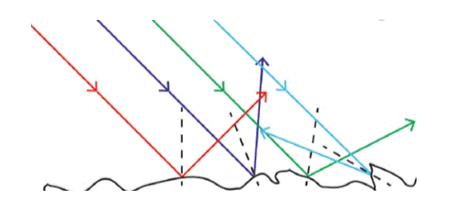
يحدث الانعكاس غير المنتظم كما في الشكل عندما يسقط الضوء على أحد الأسطح التالية:Irregular reflection as in the figure occurs when light falls on one of these surfaces:
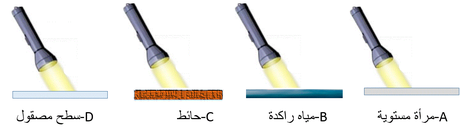
مرآة مستوية (A)a plane mirror (A)
مياه راكدة (B)still water (B)
حائط (C)a wall (C)
سطح مصقول (D)a polished surface (D)
الحلSolution
📌 السطح الخشن (الحائط) يعكس الأشعة المتوازية في اتجاهات مختلفة: انعكاس غير منتظم (منتشر)، أما الأسطح الملساء فتعطي انعكاسًا منتظمًا.
✅ حائط (C) (C)
📌 A rough surface (the wall) reflects parallel rays in different directions: irregular (diffuse) reflection, whereas smooth surfaces give regular reflection.
✅ a wall (C) (C)
\[3\,\star\]
سقط ضوء على سطح عاكس كما في الشكل (الزاوية بين الشعاع الساقط والسطح \(50^\circ\))؛ زاوية الانعكاس تعادل:Light falls on a reflecting surface as in the figure (the angle between the incident ray and the surface is \(50^\circ\)); the angle of reflection is:
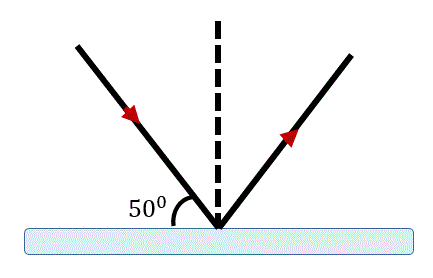
\(\theta_2=50^\circ\)\(\theta_2=50^\circ\)
\(\theta_2=40^\circ\)\(\theta_2=40^\circ\)
\(\theta_2=80^\circ\)\(\theta_2=80^\circ\)
\(\theta_2=100^\circ\)\(\theta_2=100^\circ\)
الحلSolution
\(\theta_i=90^\circ-50^\circ=40^\circ\)
📌 زاوية الانعكاس تساوي زاوية السقوط ومقيستان من العمود المقام: \(\theta_r=40^\circ\).
✅ \(\theta_2=40^\circ\) (B)
\(\theta_i=90^\circ-50^\circ=40^\circ\)
📌 The angle of reflection equals the angle of incidence, both measured from the normal: \(\theta_r=40^\circ\).
✅ \(\theta_2=40^\circ\) (B)
\[4\,\star\]
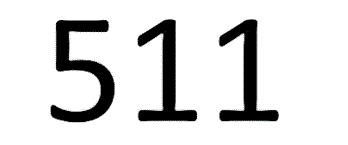
بطاقة كُتب عليها الرقم 511 وُضعت أمام مرآة مستوية؛ تظهر في المرآة بالشكل:A card with the number 511 is placed in front of a plane mirror; it appears in the mirror as:
\(115\)\(115\)
\(511\)\(511\)
\(211\)\(211\)
\(112\)\(112\)
الحلSolution
📌 المرآة المستوية تعكس الجسم جانبيًا (انقلاب جانبي): ينعكس ترتيب الأرقام فتُقرأ \(115\) (وكل رقم مقلوب جانبيًا أيضًا).
📌 (الخيار D في المصدر غير صحيح؛ الصحيح هو الخيار الذي يحمل 115).
✅ \(115\) (A)
📌 A plane mirror inverts left-to-right (lateral inversion): the order of the digits reverses so it reads \(115\) (each digit also flipped sideways).
📌 (Option 112 in the source is incorrect; the correct one is the option reading 115.)
✅ \(115\) (A)
\[5\,\star\star\]
سقط ضوء على سطح عاكس والزاوية بين الشعاع الساقط والسطح \(47^\circ\)؛ الزاوية بين الشعاع الساقط والشعاع المنعكس:Light falls on a reflecting surface with \(47^\circ\) between the incident ray and the surface; the angle between the incident and the reflected ray is:
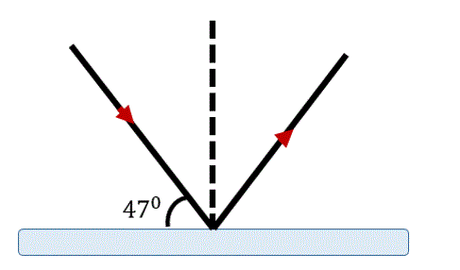
\(86^\circ\)\(86^\circ\)
\(94^\circ\)\(94^\circ\)
\(47^\circ\)\(47^\circ\)
\(43^\circ\)\(43^\circ\)
الحلSolution
\(\theta_i=90^\circ-47^\circ=43^\circ=\theta_r\)
\(\theta_i+\theta_r=43^\circ+43^\circ=86^\circ\)
✅ \(86^\circ\) (A)
\(\theta_i=90^\circ-47^\circ=43^\circ=\theta_r\)
\(\theta_i+\theta_r=43^\circ+43^\circ=86^\circ\)
✅ \(86^\circ\) (A)
\[6\,\star\star\]
مرآتان متعامدتان أُسقط ضوء على إحداهما بزاوية سقوط \(40^\circ\)؛ الزاوية التي ينعكس بها الضوء على المرآة الثانية:Two perpendicular mirrors; light falls on the first at an angle of incidence of \(40^\circ\); the angle at which it reflects from the second mirror is:
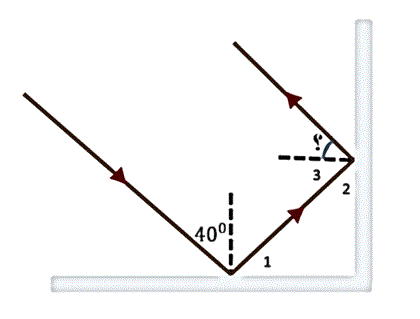
\(40^\circ\)\(40^\circ\)
\(35^\circ\)\(35^\circ\)
\(50^\circ\)\(50^\circ\)
\(30^\circ\)\(30^\circ\)
الحلSolution
📌 الشعاع المنعكس عن الأولى يصنع مع المرآة الثانية زاوية \(40^\circ\) لأن المرآتين متعامدتان، فتكون زاوية سقوطه على الثانية (من العمود) \(90^\circ-40^\circ=50^\circ\).
\(\theta_r=\theta_i=50^\circ\)
✅ \(50^\circ\) (C)
📌 The ray reflected from the first mirror makes \(40^\circ\) with the second mirror because they are perpendicular, so its angle of incidence on the second (from the normal) is \(90^\circ-40^\circ=50^\circ\).
\(\theta_r=\theta_i=50^\circ\)
✅ \(50^\circ\) (C)
\[7\,\star\]
إحدى العبارات التالية لا تُعد من صفات الصور الحقيقية:Which of the following is NOT a characteristic of real images?
تنتج من التقاء الأشعة المنعكسة أو المنكسرةformed by the convergence of reflected or refracted rays
قد تكون أكبر من الجسم أو أصغر أو مساوية لهmay be larger than, smaller than or equal to the object
دائمًا معتدلةalways upright
يمكن استقبالها على حاجزcan be received on a screen
الحلSolution
📌 الصور الحقيقية في المرايا الكروية مقلوبة، أما المعتدلة فهي الصور التقديرية.
✅ دائمًا معتدلة (C)
📌 Real images in spherical mirrors are inverted; upright images are the virtual ones.
✅ always upright (C)
\[8\,\star\star\]
مرآة مقعرة بعدها البؤري \(12\ cm\) وُضع جسم على بعد \(8\ cm\)؛ نسبة التكبير:A concave mirror of focal length \(12\ cm\) with an object at \(8\ cm\); the magnification ratio is:
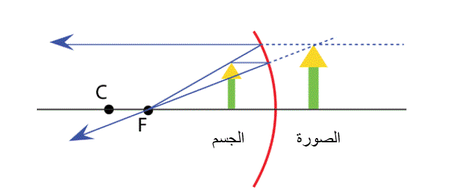
\(|M|=3\)\(|M|=3\)
\(|M|=2\)\(|M|=2\)
\(|M|=2.5\)\(|M|=2.5\)
\(|M|=3.5\)\(|M|=3.5\)
الحلSolution
\(\dfrac1{x_i}=\dfrac1f-\dfrac1{x_o}=\dfrac1{12}-\dfrac18=-\dfrac1{24}\Rightarrow x_i=-24\ \mathrm{cm}\)
\(|M|=\left|\dfrac{x_i}{x_o}\right|=\dfrac{24}{8}=3\)
📌 الجسم داخل البعد البؤري فالصورة تقديرية معتدلة مكبرة.
✅ \(|M|=3\) (A)
\(\dfrac1{x_i}=\dfrac1f-\dfrac1{x_o}=\dfrac1{12}-\dfrac18=-\dfrac1{24}\Rightarrow x_i=-24\ \mathrm{cm}\)
\(|M|=\left|\dfrac{x_i}{x_o}\right|=\dfrac{24}{8}=3\)
📌 The object is inside the focal length so the image is virtual, upright and magnified.
✅ \(|M|=3\) (A)
\[9\,\star\star\]
جسم أمام مرآة مقعرة على بعد \(30\ cm\) فظهرت له صورة مقلوبة مساوية له؛ البعد البؤري:An object is \(30\ cm\) in front of a concave mirror and its image is inverted and equal to it; the focal length is:
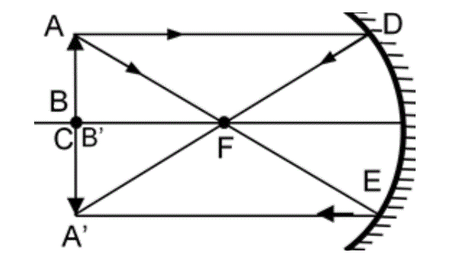
\(f=15\ cm\)\(f=15\ cm\)
\(f=10\ cm\)\(f=10\ cm\)
\(f=25\ cm\)\(f=25\ cm\)
\(f=20\ cm\)\(f=20\ cm\)
الحلSolution
📌 الصورة المقلوبة المساوية للجسم تتكون عندما يكون الجسم عند مركز التكور: \(x_o=R=2f\).
\(f=\dfrac{30}{2}=15\ \mathrm{cm}\)
✅ \(f=15\ cm\) (A)
📌 An inverted image equal to the object forms when the object is at the centre of curvature: \(x_o=R=2f\).
\(f=\dfrac{30}{2}=15\ \mathrm{cm}\)
✅ \(f=15\ cm\) (A)
\[10\,\star\star\star\]
في الشكل: مرآة مقعرة نصف قطر تكورها \(30\ cm\) (مركز التكور C) وجسم على بعد \(10\ cm\) منها؛ بعد الصورة عن المرآة:In the figure: a concave mirror of radius \(30\ cm\) (centre C) with an object \(10\ cm\) from it; the image distance is:
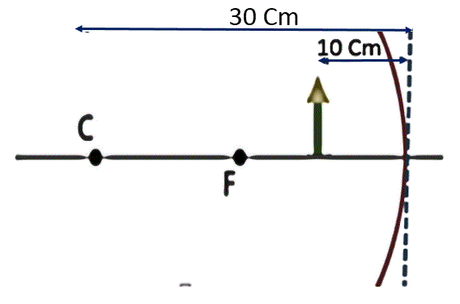
\(x_i=-40\ cm\)\(x_i=-40\ cm\)
\(x_i=-15\ cm\)\(x_i=-15\ cm\)
\(x_i=-30\ cm\)\(x_i=-30\ cm\)
\(x_i=-20\ cm\)\(x_i=-20\ cm\)
الحلSolution
\(f=\dfrac R2=15\ \mathrm{cm}\)
\(\dfrac1{x_i}=\dfrac1{15}-\dfrac1{10}=-\dfrac1{30}\Rightarrow x_i=-30\ \mathrm{cm}\)
📌 الإشارة السالبة: صورة تقديرية خلف المرآة (الجسم داخل البؤرة).
✅ \(x_i=-30\ cm\) (C)
\(f=\dfrac R2=15\ \mathrm{cm}\)
\(\dfrac1{x_i}=\dfrac1{15}-\dfrac1{10}=-\dfrac1{30}\Rightarrow x_i=-30\ \mathrm{cm}\)
📌 The minus sign: a virtual image behind the mirror (the object is inside the focus).
✅ \(x_i=-30\ cm\) (C)
\[11\,\star\star\star\]
مرآة كروية وُضع جسم أمامها على بعد \(10\ cm\) فظهرت صورة معتدلة طولها نصف طول الجسم؛ نوع المرآة وبعدها البؤري:A spherical mirror with an object \(10\ cm\) in front of it gives an upright image half the object’s height; the type of mirror and its focal length are:
\(f=-10\ cm\) محدبة\(f=-10\ cm\) convex
\(f=10\ cm\) مقعرة\(f=10\ cm\) concave
\(f=3.33\ cm\) مقعرة\(f=3.33\ cm\) concave
\(f=3.33\ cm\) محدبة\(f=3.33\ cm\) convex
الحلSolution
📌 الصورة المعتدلة المصغرة لا تتكون إلا في المرآة المحدبة: \(M=+\tfrac12\Rightarrow x_i=-5\ \mathrm{cm}\).
\(\dfrac1f=\dfrac1{10}+\dfrac1{-5}=-\dfrac1{10}\Rightarrow f=-10\ \mathrm{cm}\)
📌 (خيار المصدر B كان مكتوبًا إجابة خطأ؛ الصحيح D كما يدل حل المصدر نفسه.)
✅ \(f=-10\ cm\) محدبة (A)
📌 An upright diminished image forms only in a convex mirror: \(M=+\tfrac12\Rightarrow x_i=-5\ \mathrm{cm}\).
\(\dfrac1f=\dfrac1{10}+\dfrac1{-5}=-\dfrac1{10}\Rightarrow f=-10\ \mathrm{cm}\)
📌 (The source marked B, but its own working gives D.)
✅ \(f=-10\ cm\) convex (A)
\[12\,\star\star\]
طول أحمد \(1.6\ m\) وقف أمام مرآة مقعرة بعدها البؤري \(20\ cm\) فظهرت صورة مقلوبة طولها \(1.2\ m\)؛ بعده عن المرآة:Ahmed is \(1.6\ m\) tall and stands in front of a concave mirror of focal length \(20\ cm\); an inverted image of height \(1.2\ m\) appears. His distance from the mirror is:
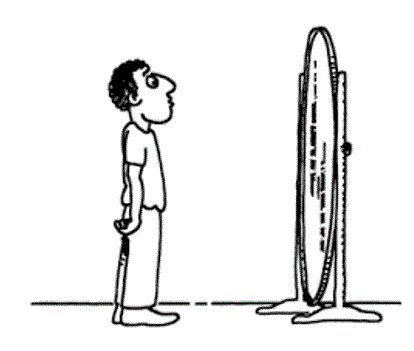
\(x_o=38.2\ cm\)\(x_o=38.2\ cm\)
\(x_o=46.6\ cm\)\(x_o=46.6\ cm\)
\(x_o=25.4\ cm\)\(x_o=25.4\ cm\)
\(x_o=30.7\ cm\)\(x_o=30.7\ cm\)
الحلSolution
\(|M|=\dfrac{1.2}{1.6}=0.75\Rightarrow x_i=0.75x_o\)
\(\dfrac1f=\dfrac1{x_o}+\dfrac1{0.75x_o}=\dfrac{2.33}{x_o}\Rightarrow x_o=2.33f=46.6\ \mathrm{cm}\)
✅ \(x_o=46.6\ cm\) (B)
\(|M|=\dfrac{1.2}{1.6}=0.75\Rightarrow x_i=0.75x_o\)
\(\dfrac1f=\dfrac1{x_o}+\dfrac1{0.75x_o}=\dfrac{2.33}{x_o}\Rightarrow x_o=2.33f=46.6\ \mathrm{cm}\)
✅ \(x_o=46.6\ cm\) (B)
\[13\,\star\star\star\]
يمثل الرسم العلاقة بين مقلوب بعد الجسم \(1/x_o\) ومقلوب بعد الصورة \(1/x_i\) لمرآة مقعرة؛ نصف قطر تكور المرآة:The graph shows the relation between the reciprocal of the object distance \(1/x_o\) and of the image distance \(1/x_i\) for a concave mirror; its radius of curvature is:
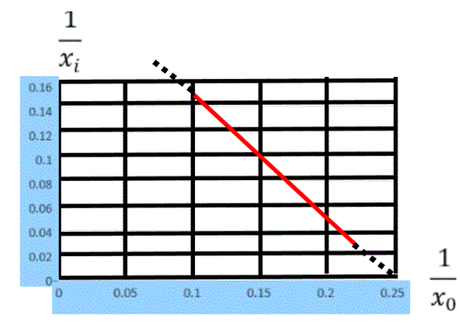
\(R=12\ cm\)\(R=12\ cm\)
\(R=4\ cm\)\(R=4\ cm\)
\(R=10\ cm\)\(R=10\ cm\)
\(R=8\ cm\)\(R=8\ cm\)
الحلSolution
📌 من \(\dfrac1{x_i}=\dfrac1f-\dfrac1{x_o}\) العلاقة خطية ميلها −1 ومقطعها \(1/f\)؛ يقطع الخط المحور الأفقي عند \(0.25\ \mathrm{cm^{-1}}\).
\(\dfrac1f=0.25\Rightarrow f=4\ \mathrm{cm},\quad R=2f=8\ \mathrm{cm}\)
✅ \(R=8\ cm\) (D)
📌 From \(\dfrac1{x_i}=\dfrac1f-\dfrac1{x_o}\) the relation is linear with slope −1 and intercept \(1/f\); the line meets the horizontal axis at \(0.25\ \mathrm{cm^{-1}}\).
\(\dfrac1f=0.25\Rightarrow f=4\ \mathrm{cm},\quad R=2f=8\ \mathrm{cm}\)
✅ \(R=8\ cm\) (D)
\[14\,\star\star\]
مسطرة أمام مرآة محدبة على بعد \(20\ cm\) فظهرت صورتها خلف المرآة على بعد \(5\ cm\)؛ البعد البؤري:A ruler is \(20\ cm\) in front of a convex mirror and its image appears \(5\ cm\) behind the mirror; the focal length is:
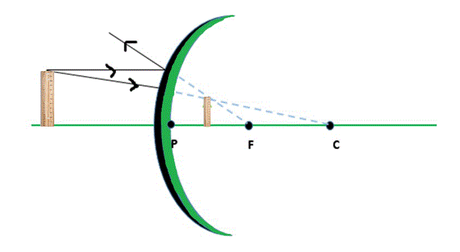
\(f=-12.4\ cm\)\(f=-12.4\ cm\)
\(f=-9.5\ cm\)\(f=-9.5\ cm\)
\(f=-15\ cm\)\(f=-15\ cm\)
\(f=-6.67\ cm\)\(f=-6.67\ cm\)
الحلSolution
\(\dfrac1f=\dfrac1{20}+\dfrac1{-5}=\dfrac{1-4}{20}=-\dfrac3{20}\)
\(f=-6.67\ \mathrm{cm}\)
✅ \(f=-6.67\ cm\) (D)
\(\dfrac1f=\dfrac1{20}+\dfrac1{-5}=\dfrac{1-4}{20}=-\dfrac3{20}\)
\(f=-6.67\ \mathrm{cm}\)
✅ \(f=-6.67\ cm\) (D)
\[15\,\star\]
مصابيح السيارة مرايا مقعرة حتى تصل الأشعة أبعد مسافة ممكنة؛ يوضع الفتيل عند:Car headlights are concave mirrors so the rays reach the greatest possible distance; the filament is placed at:
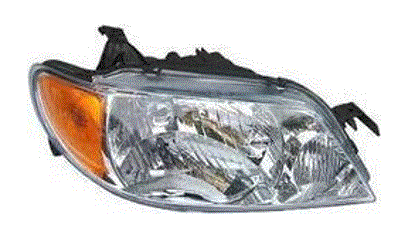
مركز التكورthe centre of curvature
البؤرةthe focus
بين مركز التكور والبؤرةbetween the centre of curvature and the focus
بين البؤرة وقطب المرآةbetween the focus and the pole
الحلSolution
📌 الجسم عند البؤرة تخرج أشعته بعد الانعكاس متوازية فتنتقل مسافة طويلة دون تفرق.
✅ البؤرة (B)
📌 A source at the focus emerges parallel after reflection and travels a long way without spreading.
✅ the focus (B)
\[16\,\star\star\star\]
مرآة محدبة بعدها البؤري \(12\ cm\) وُضع أمامها جسم طوله \(5\ cm\) على بعد \(12\ cm\)؛ طول الصورة:A convex mirror of focal length \(12\ cm\) has an object \(5\ cm\) tall at \(12\ cm\); the image height is:
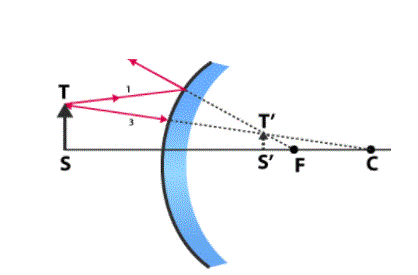
\(h_i=3\ cm\)\(h_i=3\ cm\)
\(h_i=2.5\ cm\)\(h_i=2.5\ cm\)
\(h_i=1.5\ cm\)\(h_i=1.5\ cm\)
\(h_i=2\ cm\)\(h_i=2\ cm\)
الحلSolution
\(\dfrac1{x_i}=\dfrac1{-12}-\dfrac1{12}=-\dfrac16\Rightarrow x_i=-6\ \mathrm{cm}\)
\(M=\dfrac{6}{12}=0.5,\quad h_i=0.5\times5=2.5\ \mathrm{cm}\)
✅ \(h_i=2.5\ cm\) (B)
\(\dfrac1{x_i}=\dfrac1{-12}-\dfrac1{12}=-\dfrac16\Rightarrow x_i=-6\ \mathrm{cm}\)
\(M=\dfrac{6}{12}=0.5,\quad h_i=0.5\times5=2.5\ \mathrm{cm}\)
✅ \(h_i=2.5\ cm\) (B)
\[17\,\star\star\star\]
مرآة مقعرة جسم على بعد \(30\ cm\) صورته على بعد \(18\ cm\)؛ إذا نُقل الجسم إلى موضع الصورة (\(18\ cm\)) فإن الصورة تظهر على بعد:A concave mirror: an object at \(30\ cm\) gives an image at \(18\ cm\); if the object is moved to the image position (\(18\ cm\)) the image appears at:
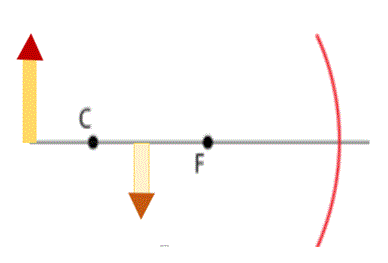
\(x_i=30\ cm\)\(x_i=30\ cm\)
\(x_i=25\ cm\)\(x_i=25\ cm\)
\(x_i=48\ cm\)\(x_i=48\ cm\)
\(x_i=40\ cm\)\(x_i=40\ cm\)
الحلSolution
\(\dfrac1f=\dfrac1{30}+\dfrac1{18}=\dfrac{8}{90}\Rightarrow f=11.25\ \mathrm{cm}\)
\(\dfrac1{x_i}=\dfrac1{11.25}-\dfrac1{18}=\dfrac{3}{90}\Rightarrow x_i=30\ \mathrm{cm}\)
📌 مبدأ الانعكاسية: يمكن تبديل موضعي الجسم والصورة.
✅ \(x_i=30\ cm\) (A)
\(\dfrac1f=\dfrac1{30}+\dfrac1{18}=\dfrac{8}{90}\Rightarrow f=11.25\ \mathrm{cm}\)
\(\dfrac1{x_i}=\dfrac1{11.25}-\dfrac1{18}=\dfrac{3}{90}\Rightarrow x_i=30\ \mathrm{cm}\)
📌 Reversibility: the object and image positions can be swapped.
✅ \(x_i=30\ cm\) (A)
\[18\,\star\star\]
جسم أمام مرآة مقعرة في مواضع مختلفة (الأشكال A–D)؛ أحد المواضع يعطي صورة حقيقية مقلوبة مكبرة:An object is placed in front of a concave mirror at different positions (figures A–D); one position gives a real, inverted, magnified image:
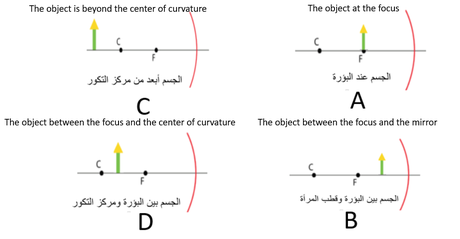
الموقع Aposition A
الموقع Bposition B
الموقع Cposition C
الموقع Dposition D
الحلSolution
📌 الصورة الحقيقية المقلوبة المكبرة تتكون عندما يكون الجسم بين مركز التكور والبؤرة \(R\gt x_o\gt f\)؛ وهو الشكل D.
✅ الموقع D (D)
📌 A real, inverted, magnified image forms when the object is between the centre of curvature and the focus \(R\gt x_o\gt f\); that is figure D.
✅ position D (D)
\[19\,\star\]
وُضعت شمعة أمام مرآة كما في الشكل؛ نوع المرآة وصفات الصورة:A candle is placed in front of a mirror as shown; the type of mirror and the characteristics of the image are:
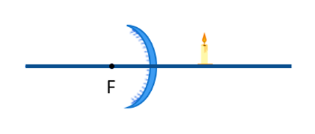
مقعرة: صورة حقيقية مقلوبة مكبرةconcave: real, inverted, magnified
محدبة: صورة تقديرية معتدلة مصغرةconvex: virtual, upright, diminished
مستوية: صورة تقديرية معتدلة مساوية للجسمplane: virtual, upright, equal to the object
محدبة: صورة تقديرية معتدلة مكبرةconvex: virtual, upright, magnified
الحلSolution
📌 البؤرة خلف المرآة في الشكل فهي محدبة، وتعطي دائمًا صورة تقديرية معتدلة مصغرة.
✅ محدبة: صورة تقديرية معتدلة مصغرة (B)
📌 The focus is behind the mirror in the figure so it is convex and always gives a virtual, upright, diminished image.
✅ convex: virtual, upright, diminished (B)
\[20\,\star\]
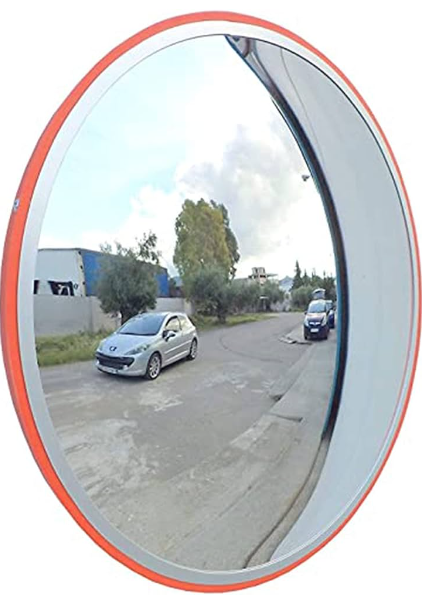
تضع شرطة المرور مرايا عند التقاطعات المخفية ليرى السائق السيارات القادمة؛ من ميزات هذا النوع من المرايا:Traffic police place mirrors at hidden intersections so drivers can see oncoming cars; a characteristic of this kind of mirror is:
تجمع الأشعة وتظهر صورًا حقيقيةconverges rays and forms real images
تشتت الأشعة وتظهر صورًا تقديريةdiverges rays and forms virtual images
تجمع الأشعة وتظهر صورًا تقديريةconverges rays and forms virtual images
تشتت الأشعة وتظهر صورًا حقيقيةdiverges rays and forms real images
الحلSolution
📌 هذه مرايا محدبة: تشتت الأشعة وتعطي صورًا تقديرية معتدلة مصغرة فيتسع مجال الرؤية.
✅ تشتت الأشعة وتظهر صورًا تقديرية (B)
📌 These are convex mirrors: they diverge rays and give virtual, upright, diminished images so the field of view widens.
✅ diverges rays and forms virtual images (B)
\[21\,\star\star\]
وقف أحمد أمام مرآة مقعرة فظهرت له صورة حقيقية مقلوبة مكبرة؛ موضع الجسم:Ahmed stands in front of a concave mirror and sees a real, inverted, magnified image; the object lies at:
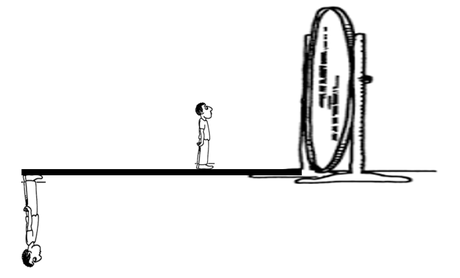
\(x_o\gt R\)\(x_o\gt R\)
\(f\gt x_o\)\(f\gt x_o\)
\(x_o=R\)\(x_o=R\)
\(R\gt x_o\gt f\)\(R\gt x_o\gt f\)
الحلSolution
📌 الصورة الحقيقية المكبرة تكون للجسم بين مركز التكور والبؤرة.
✅ \(R\gt x_o\gt f\) (D)
📌 A real magnified image is for an object between the centre of curvature and the focus.
✅ \(R\gt x_o\gt f\) (D)
\[22\,\star\star\]
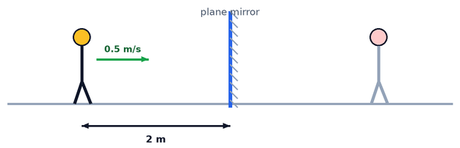
يقف شخص على بعد \(2\ m\) أمام مرآة مستوية ويتحرك نحوها بسرعة \(0.5\ m/s\). المسافة بين الشخص وصورته بعد \(2\ s\):A person stands \(2\ m\) in front of a plane mirror and walks towards it at \(0.5\ m/s\). The distance between the person and the image after \(2\ s\) is:
\(2\ m\)\(2\ m\)
\(1\ m\)\(1\ m\)
\(4\ m\)\(4\ m\)
\(3\ m\)\(3\ m\)
الحلSolution
\(d=2-0.5\times2=1\ \mathrm{m}\ \text{(from the mirror)}\)
📌 الصورة تبعد عن المرآة المسافة نفسها خلفها: المسافة بين الشخص وصورته \(2\times1=2\ \mathrm{m}\).
✅ \(2\ m\) (A)
\(d=2-0.5\times2=1\ \mathrm{m}\ \text{(from the mirror)}\)
📌 The image is the same distance behind the mirror: the person-to-image distance is \(2\times1=2\ \mathrm{m}\).
✅ \(2\ m\) (A)
\[23\,\star\star\]
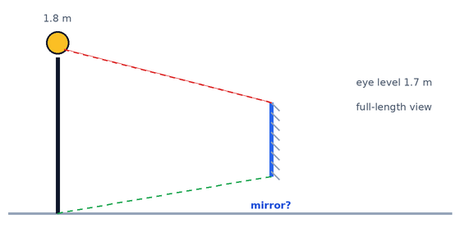
ما أقل ارتفاع لمرآة مستوية رأسية يمكّن شخصًا طوله \(1.8\ m\) من رؤية صورته كاملة؟What is the smallest height of a vertical plane mirror that lets a person \(1.8\ m\) tall see his whole image?
\(1.8\ m\)\(1.8\ m\)
\(0.45\ m\)\(0.45\ m\)
\(1.2\ m\)\(1.2\ m\)
\(0.9\ m\)\(0.9\ m\)
الحلSolution
📌 الأشعة من الرأس ومن القدم إلى العين تنعكس عن المرآة؛ تتشابه المثلثات فيكون ارتفاع المرآة نصف طول الشخص مهما كان بعده.
\(h=\dfrac{1.8}{2}=0.9\ \mathrm{m}\)
✅ \(0.9\ m\) (D)
📌 The rays from the head and the feet to the eye reflect from the mirror; by similar triangles the mirror height is half the person’s height whatever the distance.
\(h=\dfrac{1.8}{2}=0.9\ \mathrm{m}\)
✅ \(0.9\ m\) (D)
\[24\,\star\star\star\]
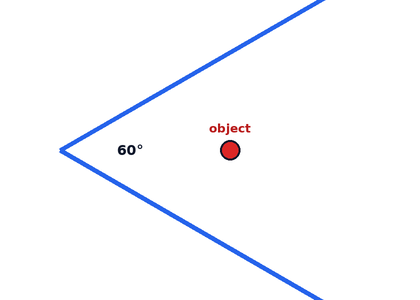
جسم صغير بين مرآتين مستويتين الزاوية بينهما \(60^\circ\). عدد الصور المتكونة:A small object lies between two plane mirrors inclined at \(60^\circ\). The number of images formed is:
\(6\)\(6\)
\(4\)\(4\)
\(3\)\(3\)
\(5\)\(5\)
الحلSolution
\(n=\dfrac{360^\circ}{\theta}-1=\dfrac{360}{60}-1=5\)
✅ D
\(n=\dfrac{360^\circ}{\theta}-1=\dfrac{360}{60}-1=5\)
✅ D
\[25\,\star\star\star\]
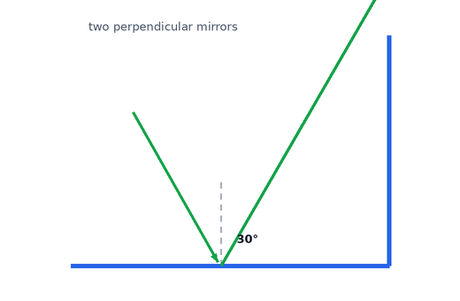
مرآتان مستويتان متعامدتان (عاكس زاوية). شعاع يسقط على الأولى بزاوية \(30^\circ\) مع العمود، فينعكس على الثانية؛ الزاوية بين الشعاع الساقط الأول والشعاع الخارج من الثانية:Two perpendicular plane mirrors (a corner reflector). A ray falls on the first at \(30^\circ\) to the normal and then reflects from the second; the angle between the first incident ray and the ray leaving the second mirror is:
\(90^\circ\)\(90^\circ\)
\(60^\circ\)\(60^\circ\)
\(180^\circ\)\(180^\circ\)
\(120^\circ\)\(120^\circ\)
الحلSolution
📌 مجموع انحراف الشعاع بعد الانعكاسين على مرآتين متعامدتين \(2\times90^\circ=180^\circ\) مهما كانت زاوية السقوط.
📌 فيخرج الشعاع موازيًا للشعاع الساقط ومعاكسًا له (كما في عاكسات الدراجات).
✅ \(180^\circ\) (C)
📌 The total deviation after two reflections from perpendicular mirrors is \(2\times90^\circ=180^\circ\) whatever the angle of incidence.
📌 The ray leaves parallel to the incident ray but opposite to it (as in bicycle reflectors).
✅ \(180^\circ\) (C)
\[26\,\star\star\]
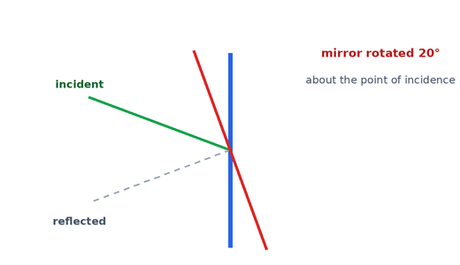
دُوّرت مرآة مستوية بزاوية \(20^\circ\) حول نقطة السقوط والشعاع الساقط ثابت؛ يدور الشعاع المنعكس بزاوية:A plane mirror is rotated by \(20^\circ\) about the point of incidence while the incident ray is fixed; the reflected ray rotates by:
\(20^\circ\)\(20^\circ\)
\(40^\circ\)\(40^\circ\)
\(10^\circ\)\(10^\circ\)
\(80^\circ\)\(80^\circ\)
الحلSolution
📌 دوران المرآة بزاوية \(\alpha\) يدير العمود بالزاوية نفسها فتتغير زاوية السقوط بـ \(\alpha\) وزاوية الانعكاس بـ \(\alpha\): ينحرف المنعكس بـ \(2\alpha\).
\(2\times20^\circ=40^\circ\)
✅ \(40^\circ\) (B)
📌 Rotating the mirror by \(\alpha\) rotates the normal by the same angle so the angle of incidence and of reflection each change by \(\alpha\): the reflected ray turns by \(2\alpha\).
\(2\times20^\circ=40^\circ\)
✅ \(40^\circ\) (B)
\[27\,\star\star\]
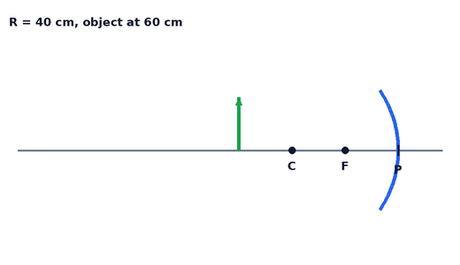
مرآة مقعرة نصف قطر تكورها \(40\ cm\) وُضع جسم أمامها على بعد \(60\ cm\)؛ موضع الصورة:A concave mirror has radius of curvature \(40\ cm\) and an object is \(60\ cm\) in front of it; the image position is:
\(x_i=20\ cm\)\(x_i=20\ cm\)
\(x_i=30\ cm\)\(x_i=30\ cm\)
\(x_i=-30\ cm\)\(x_i=-30\ cm\)
\(x_i=60\ cm\)\(x_i=60\ cm\)
الحلSolution
\(f=\dfrac R2=20\ \mathrm{cm}\)
\(\dfrac1{x_i}=\dfrac1{20}-\dfrac1{60}=\dfrac1{30}\Rightarrow x_i=30\ \mathrm{cm}\)
📌 الجسم أبعد من مركز التكور فالصورة حقيقية مقلوبة مصغرة بين F وC.
✅ \(x_i=30\ cm\) (B)
\(f=\dfrac R2=20\ \mathrm{cm}\)
\(\dfrac1{x_i}=\dfrac1{20}-\dfrac1{60}=\dfrac1{30}\Rightarrow x_i=30\ \mathrm{cm}\)
📌 The object is beyond the centre of curvature so the image is real, inverted and diminished, between F and C.
✅ \(x_i=30\ cm\) (B)
\[28\,\star\star\star\]
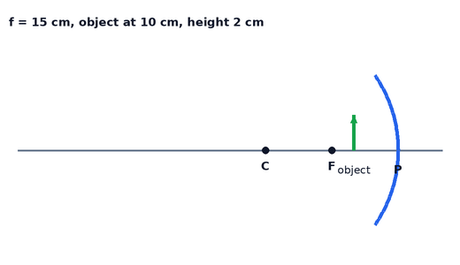
مرآة مقعرة بعدها البؤري \(15\ cm\) وُضع جسم طوله \(2\ cm\) على بعد \(10\ cm\)؛ طول الصورة وصفتها:A concave mirror of focal length \(15\ cm\) has a \(2\ cm\) tall object at \(10\ cm\); the height of the image and its nature are:
\(6\ cm\) حقيقية مقلوبة\(6\ cm\) real, inverted
\(3\ cm\) تقديرية معتدلة\(3\ cm\) virtual, upright
\(6\ cm\) تقديرية معتدلة\(6\ cm\) virtual, upright
\(1\ cm\) حقيقية مقلوبة\(1\ cm\) real, inverted
الحلSolution
\(\dfrac1{x_i}=\dfrac1{15}-\dfrac1{10}=-\dfrac1{30}\Rightarrow x_i=-30\ \mathrm{cm}\)
\(M=-\dfrac{x_i}{x_o}=+3,\quad h_i=3\times2=6\ \mathrm{cm}\)
📌 الجسم داخل البؤرة: صورة تقديرية معتدلة مكبرة.
✅ \(6\ cm\) تقديرية معتدلة (C)
\(\dfrac1{x_i}=\dfrac1{15}-\dfrac1{10}=-\dfrac1{30}\Rightarrow x_i=-30\ \mathrm{cm}\)
\(M=-\dfrac{x_i}{x_o}=+3,\quad h_i=3\times2=6\ \mathrm{cm}\)
📌 The object is inside the focus: a virtual, upright, magnified image.
✅ \(6\ cm\) virtual, upright (C)
\[29\,\star\star\]
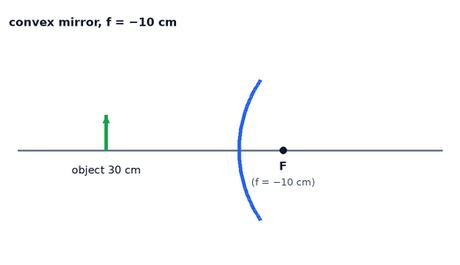
مرآة محدبة بعدها البؤري \(10\ cm\) وُضع جسم على بعد \(30\ cm\)؛ بعد الصورة عن المرآة (مقدارًا):A convex mirror of focal length \(10\ cm\) has an object at \(30\ cm\); the image distance from the mirror (magnitude) is:
\(15\ cm\)\(15\ cm\)
\(7.5\ cm\)\(7.5\ cm\)
\(10\ cm\)\(10\ cm\)
\(5\ cm\)\(5\ cm\)
الحلSolution
\(\dfrac1{x_i}=\dfrac1{-10}-\dfrac1{30}=-\dfrac4{30}\Rightarrow x_i=-7.5\ \mathrm{cm}\)
📌 الصورة تقديرية خلف المرآة على بعد \(7.5\ \mathrm{cm}\) (معتدلة مصغرة).
✅ \(7.5\ cm\) (B)
\(\dfrac1{x_i}=\dfrac1{-10}-\dfrac1{30}=-\dfrac4{30}\Rightarrow x_i=-7.5\ \mathrm{cm}\)
📌 The image is virtual, \(7.5\ \mathrm{cm}\) behind the mirror (upright, diminished).
✅ \(7.5\ cm\) (B)
\[30\,\star\star\star\]
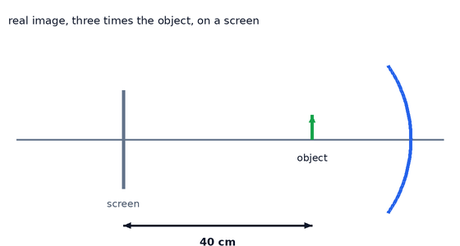
مرآة مقعرة تكوّن صورة حقيقية على حاجز مكبرة ثلاث مرات، والمسافة بين الجسم والحاجز \(40\ cm\)؛ البعد البؤري:A concave mirror forms a real image three times the size on a screen and the distance between the object and the screen is \(40\ cm\); the focal length is:
\(10\ cm\)\(10\ cm\)
\(20\ cm\)\(20\ cm\)
\(15\ cm\)\(15\ cm\)
\(30\ cm\)\(30\ cm\)
الحلSolution
\(x_i=3x_o,\quad x_i-x_o=40\Rightarrow x_o=20\ \mathrm{cm},\ x_i=60\ \mathrm{cm}\)
\(f=\dfrac{x_ox_i}{x_o+x_i}=\dfrac{20\times60}{80}=15\ \mathrm{cm}\)
✅ \(15\ cm\) (C)
\(x_i=3x_o,\quad x_i-x_o=40\Rightarrow x_o=20\ \mathrm{cm},\ x_i=60\ \mathrm{cm}\)
\(f=\dfrac{x_ox_i}{x_o+x_i}=\dfrac{20\times60}{80}=15\ \mathrm{cm}\)
✅ \(15\ cm\) (C)
\[31\,\star\star\star\]
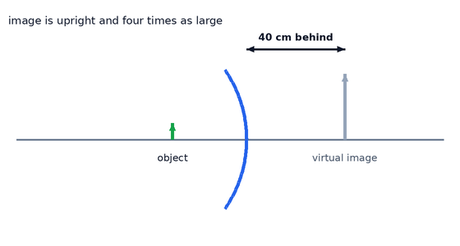
مرآة مقعرة تعطي صورة تقديرية معتدلة تكبيرها \(4\) على بعد \(40\ cm\) خلف المرآة؛ بعدها البؤري:A concave mirror gives a virtual upright image with magnification \(4\) at \(40\ cm\) behind the mirror; its focal length is:
\(10\ cm\)\(10\ cm\)
\(8\ cm\)\(8\ cm\)
\(20\ cm\)\(20\ cm\)
\(13.3\ cm\)\(13.3\ cm\)
الحلSolution
\(|x_i|=4x_o\Rightarrow x_o=\dfrac{40}{4}=10\ \mathrm{cm}\)
\(\dfrac1f=\dfrac1{10}-\dfrac1{40}=\dfrac3{40}\Rightarrow f=13.3\ \mathrm{cm}\)
✅ \(13.3\ cm\) (D)
\(|x_i|=4x_o\Rightarrow x_o=\dfrac{40}{4}=10\ \mathrm{cm}\)
\(\dfrac1f=\dfrac1{10}-\dfrac1{40}=\dfrac3{40}\Rightarrow f=13.3\ \mathrm{cm}\)
✅ \(13.3\ cm\) (D)
\[32\,\star\star\star\]
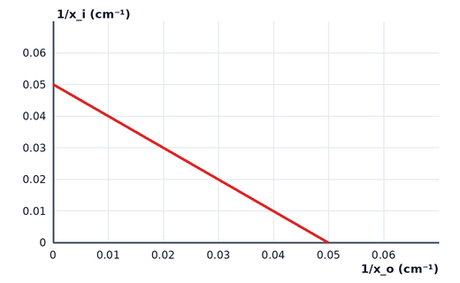
يمثل الرسم العلاقة بين \(1/x_i\) و\(1/x_o\) لمرآة مقعرة (خط مستقيم يقطع المحورين عند \(0.05\ \mathrm{cm^{-1}}\))؛ نصف قطر التكور:The graph shows \(1/x_i\) against \(1/x_o\) for a concave mirror (a straight line meeting both axes at \(0.05\ \mathrm{cm^{-1}}\)); the radius of curvature is:
\(R=20\ cm\)\(R=20\ cm\)
\(R=10\ cm\)\(R=10\ cm\)
\(R=5\ cm\)\(R=5\ cm\)
\(R=40\ cm\)\(R=40\ cm\)
الحلSolution
\(\dfrac1f=0.05\Rightarrow f=20\ \mathrm{cm}\)
\(R=2f=40\ \mathrm{cm}\)
✅ \(R=40\ cm\) (D)
\(\dfrac1f=0.05\Rightarrow f=20\ \mathrm{cm}\)
\(R=2f=40\ \mathrm{cm}\)
✅ \(R=40\ cm\) (D)
\[33\,\star\star\]
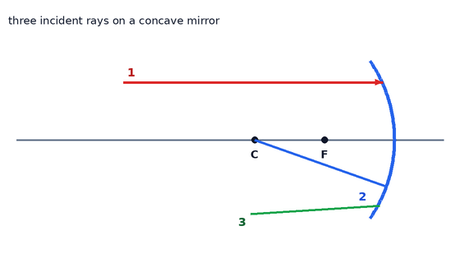
ثلاثة أشعة تسقط على مرآة مقعرة (الشكل): الشعاع 1 موازٍ للمحور، والشعاع 2 يمر بمركز التكور، والشعاع 3 يصنع زاوية مع المحور؛ الشعاع الذي ينعكس مارًّا بالبؤرة F هو:Three rays fall on a concave mirror (figure): ray 1 is parallel to the axis, ray 2 passes through the centre of curvature and ray 3 is oblique; the ray that reflects through the focus F is:
الشعاع 1ray 1
الشعاع 2ray 2
الشعاع 3ray 3
لا أحد منهاnone of them
الحلSolution
📌 الشعاع الموازي للمحور الرئيسي ينعكس مارًّا بالبؤرة؛ والشعاع المار بمركز التكور يعود على نفسه.
✅ الشعاع 1 (A)
📌 A ray parallel to the principal axis reflects through the focus; a ray through the centre of curvature returns along itself.
✅ ray 1 (A)
\[34\,\star\star\star\]
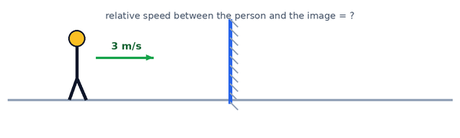
شخص يمشي نحو مرآة مستوية بسرعة \(3\ m/s\)؛ السرعة النسبية بين الشخص وصورته:A person walks towards a plane mirror at \(3\ m/s\); the speed of the person relative to his image is:
\(3\ m/s\)\(3\ m/s\)
\(0\)\(0\)
\(6\ m/s\)\(6\ m/s\)
\(1.5\ m/s\)\(1.5\ m/s\)
الحلSolution
📌 الصورة تقترب من المرآة بالسرعة نفسها من الجهة الأخرى فيقترب الشخص وصورته معًا: \(3+3=6\ \mathrm{m/s}\).
✅ \(6\ m/s\) (C)
📌 The image approaches the mirror at the same speed from the other side so person and image approach each other: \(3+3=6\ \mathrm{m/s}\).
✅ \(6\ m/s\) (C)
\[35\,\star\star\]
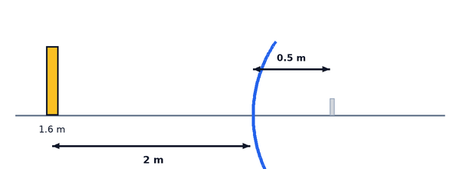
مرآة محدبة في متجر: رجل طوله \(1.6\ m\) على بعد \(2\ m\) منها وصورته على بعد \(0.5\ m\) خلفها؛ طول صورته:A convex shop mirror: a man \(1.6\ m\) tall stands \(2\ m\) from it and his image is \(0.5\ m\) behind it; the height of his image is:
\(0.8\ m\)\(0.8\ m\)
\(0.2\ m\)\(0.2\ m\)
\(0.4\ m\)\(0.4\ m\)
\(6.4\ m\)\(6.4\ m\)
الحلSolution
\(M=\dfrac{|x_i|}{x_o}=\dfrac{0.5}{2}=0.25\)
\(h_i=0.25\times1.6=0.4\ \mathrm{m}\)
✅ \(0.4\ m\) (C)
\(M=\dfrac{|x_i|}{x_o}=\dfrac{0.5}{2}=0.25\)
\(h_i=0.25\times1.6=0.4\ \mathrm{m}\)
✅ \(0.4\ m\) (C)
\[36\,\star\star\star\]
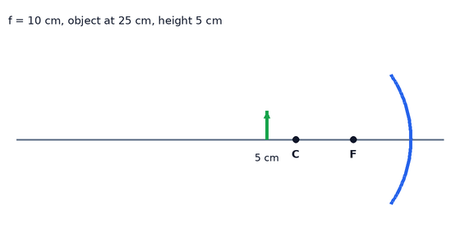
مرآة مقعرة بعدها البؤري \(10\ cm\) وُضع جسم طوله \(5\ cm\) على بعد \(25\ cm\)؛ مقدار طول الصورة:A concave mirror of focal length \(10\ cm\) has a \(5\ cm\) tall object at \(25\ cm\); the magnitude of the image height is:
\(6.25\ cm\)\(6.25\ cm\)
\(2\ cm\)\(2\ cm\)
\(5\ cm\)\(5\ cm\)
\(3.33\ cm\)\(3.33\ cm\)
الحلSolution
\(\dfrac1{x_i}=\dfrac1{10}-\dfrac1{25}=\dfrac{3}{50}\Rightarrow x_i=16.7\ \mathrm{cm}\)
\(|M|=\dfrac{16.7}{25}=0.667,\quad h_i=0.667\times5=3.33\ \mathrm{cm}\)
✅ \(3.33\ cm\) (D)
\(\dfrac1{x_i}=\dfrac1{10}-\dfrac1{25}=\dfrac{3}{50}\Rightarrow x_i=16.7\ \mathrm{cm}\)
\(|M|=\dfrac{16.7}{25}=0.667,\quad h_i=0.667\times5=3.33\ \mathrm{cm}\)
✅ \(3.33\ cm\) (D)
📝 المسائل المقالية
📝 Essay Problems
\[1\,\star\star\]
مرآة كروية محدبة نصف قطرها \(R=15\ cm\) وُضع جسم على بعد \(x_o=25\ cm\) منها. (أ) احسب بعد الصورة عن المرآة. (ب) احسب طول الصورة بالنسبة إلى طول الجسم.A convex spherical mirror has radius \(R=15\ cm\) and an object is placed \(x_o=25\ cm\) from it. (a) Calculate the image distance. (b) Calculate the image height relative to the object height.
.....................................................................
الحلSolution
📌 (أ) \(f=-\dfrac R2=-7.5\ \mathrm{cm}\) (محدبة).
\(\dfrac1{x_i}=\dfrac1f-\dfrac1{x_o}=-\dfrac1{7.5}-\dfrac1{25}=-\dfrac{13}{75}\Rightarrow x_i=-5.77\ \mathrm{cm}\) (تقديرية خلف المرآة).
📌 (ب) \(M=\left|\dfrac{x_i}{x_o}\right|=\dfrac{5.77}{25}=0.23\): طول الصورة 23% من طول الجسم (معتدلة مصغرة).
✅ \(x_i=-5.77\ cm,\ M=0.23\)
📌 (a) \(f=-\dfrac R2=-7.5\ \mathrm{cm}\) (convex).
\(\dfrac1{x_i}=\dfrac1f-\dfrac1{x_o}=-\dfrac1{7.5}-\dfrac1{25}=-\dfrac{13}{75}\Rightarrow x_i=-5.77\ \mathrm{cm}\) (virtual, behind the mirror).
📌 (b) \(M=\left|\dfrac{x_i}{x_o}\right|=\dfrac{5.77}{25}=0.23\): the image is 23% of the object’s height (upright, diminished).
✅ \(x_i=-5.77\ cm,\ M=0.23\)
\[2\,\star\star\]
جسم طوله \(h_o=2\ cm\) أمام مرآة كروية مقعرة على بعد \(x_o=20\ cm\) وبعدها البؤري \(f=10\ cm\). (أ) احسب موضع الصورة. (ب) احسب طولها. (ج) حدد صفاتها.An object of height \(h_o=2\ cm\) is \(x_o=20\ cm\) in front of a concave spherical mirror of focal length \(f=10\ cm\). (a) Find the image position. (b) Find its height. (c) State its characteristics.
.....................................................................
الحلSolution
\(\dfrac1{x_i}=\dfrac1{10}-\dfrac1{20}=\dfrac1{20}\Rightarrow x_i=20\ \mathrm{cm}\) (أمام المرآة).
📌 (ب) \(M=\dfrac{20}{20}=1\Rightarrow h_i=2\ \mathrm{cm}\).
📌 (ج) الجسم عند مركز التكور \(R=2f=20\ \mathrm{cm}\): الصورة حقيقية مقلوبة مساوية للجسم وعند مركز التكور.
✅ \(x_i=20\ cm,\ h_i=2\ cm\) حقيقية مقلوبة مساوية
\(\dfrac1{x_i}=\dfrac1{10}-\dfrac1{20}=\dfrac1{20}\Rightarrow x_i=20\ \mathrm{cm}\) (in front of the mirror).
📌 (b) \(M=\dfrac{20}{20}=1\Rightarrow h_i=2\ \mathrm{cm}\).
📌 (c) The object is at the centre of curvature \(R=2f=20\ \mathrm{cm}\): the image is real, inverted, equal to the object and also at the centre of curvature.
✅ \(x_i=20\ cm,\ h_i=2\ cm\) real, inverted, equal
\[3\,\star\star\star\]
تعمل القرنية كمرآة محدبة ويقيس مقياس القرنية تكبير الصورة. مصدر ضوء على بعد \(x_o=15\ cm\) من القرنية وتكبير الصورة \(M=0.025\). (أ) احسب موضع الصورة. (ب) احسب نصف قطر انحناء القرنية.The cornea acts as a convex mirror and a keratometer measures the magnification of the image. A light source is \(x_o=15\ cm\) from the cornea and the magnification is \(M=0.025\). (a) Find the image position. (b) Find the radius of curvature of the cornea.
.....................................................................
الحلSolution
\(|x_i|=Mx_o=0.025\times15=0.375\ \mathrm{cm}\) فالصورة تقديرية خلف القرنية: \(x_i=-0.375\ \mathrm{cm}\).
\(\dfrac1f=\dfrac1{15}+\dfrac1{-0.375}=0.0667-2.667=-2.6\ \mathrm{cm^{-1}}\Rightarrow f=-0.385\ \mathrm{cm}\).
\(R=2|f|=0.77\ \mathrm{cm}\) (قريب من القيمة الحقيقية لقرنية العين نحو \(0.78\ \mathrm{cm}\)).
✅ \(x_i=-0.375\ cm,\ R=0.77\ cm\)
\(|x_i|=Mx_o=0.025\times15=0.375\ \mathrm{cm}\) so the image is virtual behind the cornea: \(x_i=-0.375\ \mathrm{cm}\).
\(\dfrac1f=\dfrac1{15}+\dfrac1{-0.375}=0.0667-2.667=-2.6\ \mathrm{cm^{-1}}\Rightarrow f=-0.385\ \mathrm{cm}\).
\(R=2|f|=0.77\ \mathrm{cm}\) (close to the real value for an eye, about \(0.78\ \mathrm{cm}\)).
✅ \(x_i=-0.375\ cm,\ R=0.77\ cm\)
\[4\,\star\star\star\]
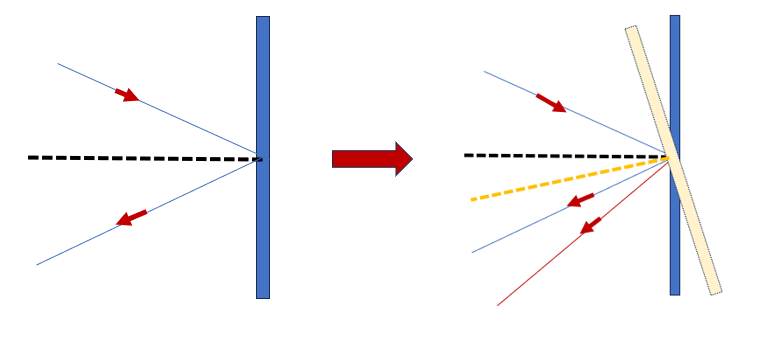
سقط شعاع على مرآة مستوية بزاوية \(30^\circ\) مع العمود، ثم دُوّرت المرآة \(15^\circ\) باتجاه الشعاع الساقط حول نقطة السقوط (فزادت زاوية السقوط). (أ) احسب زاوية السقوط الجديدة. (ب) احسب زاوية دوران الشعاع المنعكس.A ray strikes a plane mirror at \(30^\circ\) to the normal, then the mirror is rotated \(15^\circ\) towards the incident ray about the point of incidence (so the angle of incidence increases). (a) Find the new angle of incidence. (b) Find the rotation of the reflected ray.
.....................................................................
الحلSolution
📌 (أ) زاوية السقوط تزداد بزاوية الدوران نفسها: \(\theta_i'=30^\circ+15^\circ=45^\circ\).
📌 (ب) الشعاع المنعكس يدور بضعف دوران المرآة: \(\Delta=2\times15^\circ=30^\circ\) (من \(30^\circ\) إلى \(45^\circ\) لزاوية الانعكاس مع تغير العمود).
✅ \(\theta_i'=45^\circ,\ \Delta=30^\circ\)
📌 (a) The angle of incidence increases by the rotation angle: \(\theta_i'=30^\circ+15^\circ=45^\circ\).
📌 (b) The reflected ray turns through twice the rotation of the mirror: \(\Delta=2\times15^\circ=30^\circ\).
✅ \(\theta_i'=45^\circ,\ \Delta=30^\circ\)
لاحظت خطأ؟ أو عندك سؤال عن أحد الأسئلة؟ اكتبه بالتعليقات وحدد رقم السؤال بالضبط.
Noticed an error? Or have a question about one of the questions? Write it in the comments and specify the exact question number.