🛷 بنك الأسئلة: الاحتكاك
🛷 Question Bank: Friction
الاحتكاك السكوني والحركي، معامل الاحتكاك، القوة العمودية، وتطبيقات حسابية على الحركة
Static and Kinetic Friction, the Coefficient of Friction, the Normal Force and Numerical Applications
⏱️ 32 سؤال اختيار من متعدد بتصحيح فوري بمستويات متدرجة، و3 مسائل مقالية محلولة⏱️ 32 multiple-choice questions of graded difficulty with instant feedback, plus 3 solved essay problems
\[1\,\star\]
ما قوة الاحتكاك السكوني القصوى لجسم كتلته \(5\,kg\) على سطح أفقي معامل احتكاكه السكوني \(0.4\)؟ \(g=10\,m/s^{2}\)What is the maximum static friction force on a \(5\,kg\) object on a horizontal surface whose coefficient of static friction is \(0.4\)? \(g=10\,m/s^{2}\)
2 نيوتن\(2\,N\)
20 نيوتن\(20\,N\)
10 نيوتن\(10\,N\)
50 نيوتن\(50\,N\)
الحلSolution
📌 لا يوجد تسارع رأسي: \(F_N-F_g=0\Rightarrow F_N=mg=5\times10=50\,N\).
📌 \(F_{s,max}=\mu_s F_N=0.4\times50=20\,N\).
✅ 20 نيوتن (B)
📌 No vertical acceleration: \(F_N-F_g=0\Rightarrow F_N=mg=5\times10=50\,N\).
📌 \(F_{s,max}=\mu_s F_N=0.4\times50=20\,N\).
✅ \(20\,N\) (B)
\[2\,\star\]
إذا كانت قوة الاحتكاك الحركي المؤثرة على جسم \(30\,N\) والقوة العمودية \(100\,N\)، فما معامل الاحتكاك الحركي؟If the kinetic friction force on an object is \(30\,N\) and the normal force is \(100\,N\), what is the coefficient of kinetic friction?
0.30.3
0.030.03
33
3030
الحلSolution
📌 معامل الاحتكاك الحركي = قوة الاحتكاك الحركي ÷ القوة العمودية.
\(\mu_k=\dfrac{F_k}{F_N}=\dfrac{30}{100}=0.3\).
✅ 0.3 (A)
📌 The coefficient of kinetic friction = kinetic friction force ÷ normal force.
\(\mu_k=\dfrac{F_k}{F_N}=\dfrac{30}{100}=0.3\).
✅ 0.3 (A)
\[3\,\star\]
جسم كتلته \(2\,kg\) يتحرك على سطح أفقي معامل احتكاكه الحركي \(0.25\)، ما قوة الاحتكاك الحركي المؤثرة عليه؟ \(g=10\,m/s^{2}\)A \(2\,kg\) object moves on a horizontal surface with a coefficient of kinetic friction \(0.25\). What is the kinetic friction force on it? \(g=10\,m/s^{2}\)
0.5 نيوتن\(0.5\,N\)
8 نيوتن\(8\,N\)
5 نيوتن\(5\,N\)
20 نيوتن\(20\,N\)
الحلSolution
📌 \(F_N=mg=2\times10=20\,N\).
📌 \(F_k=\mu_kF_N=0.25\times20=5\,N\).
✅ 5 نيوتن (C)
📌 \(F_N=mg=2\times10=20\,N\).
📌 \(F_k=\mu_kF_N=0.25\times20=5\,N\).
✅ \(5\,N\) (C)
\[4\,\star\]
ما العلاقة بين معامل الاحتكاك السكوني والحركي لسطحين عادةً؟What is the usual relation between the coefficients of static and kinetic friction of two surfaces?
معامل الاحتكاك الحركي أكبر من السكونيThe kinetic coefficient is greater than the static one
معامل الاحتكاك السكوني أكبر من الحركيThe static coefficient is greater than the kinetic one
متساويان دائمًاThey are always equal
لا توجد علاقة ثابتة بينهماThere is no fixed relation between them
الحلSolution
📌 القوة اللازمة لبدء حركة الجسم (التغلب على الاحتكاك السكوني) أكبر عادةً من القوة اللازمة للحفاظ على حركته (التغلب على الاحتكاك الحركي).
📌 لذلك \(\mu_s\gt \mu_k\) عادةً.
✅ معامل الاحتكاك السكوني أكبر من الحركي (B)
📌 The force needed to start the motion (overcoming static friction) is usually larger than the force needed to keep it moving (overcoming kinetic friction).
📌 Hence \(\mu_s\gt \mu_k\) usually.
✅ The static coefficient is greater than the kinetic one (B)
\[5\,\star\]
قوة الاحتكاك السكوني القصوى بين سطحين:The maximum static friction force between two surfaces:
تتوقف على سرعة الجسمdepends on the speed of the object
تتناسب طرديًا مع القوة العمودية على السطحis directly proportional to the normal force on the surface
تساوي دائمًا القوة المؤثرة على الجسمalways equals the force acting on the object
لا تعتمد على طبيعة السطحينdoes not depend on the nature of the surfaces
الحلSolution
📌 \(F_{s,max}=\mu_s F_N\) أي أنها تتناسب طرديًا مع القوة العمودية، وتعتمد على طبيعة السطحين عبر \(\mu_s\).
✅ تتناسب طرديًا مع القوة العمودية على السطح (B)
📌 \(F_{s,max}=\mu_s F_N\): it is directly proportional to the normal force and depends on the nature of the surfaces through \(\mu_s\).
✅ is directly proportional to the normal force on the surface (B)
\[6\,\star\star\]
جسم كتلته \(10\,kg\) على سطح أفقي خشن، إذا كانت قوة الاحتكاك السكوني القصوى \(40\,N\) فما معامل الاحتكاك السكوني؟ \(g=10\,m/s^{2}\)A \(10\,kg\) object lies on a rough horizontal surface. If the maximum static friction force is \(40\,N\), what is the coefficient of static friction? \(g=10\,m/s^{2}\)
0.040.04
44
0.40.4
4040
الحلSolution
📌 \(F_N=mg=10\times10=100\,N\).
📌 \(\mu_s=\dfrac{F_{s,max}}{F_N}=\dfrac{40}{100}=0.4\).
✅ 0.4 (C)
📌 \(F_N=mg=10\times10=100\,N\).
📌 \(\mu_s=\dfrac{F_{s,max}}{F_N}=\dfrac{40}{100}=0.4\).
✅ 0.4 (C)
\[7\,\star\]
أي العوامل التالية لا يؤثر على قوة الاحتكاك بين سطحين؟Which of the following factors does not affect the friction force between two surfaces?
مساحة التلامسthe contact area
طبيعة السطحينthe nature of the surfaces
القوة العموديةthe normal force
معامل الاحتكاكthe coefficient of friction
الحلSolution
📌 قوة الاحتكاك لا تعتمد على مساحة التلامس بين الجسمين، بل على طبيعة السطحين (معامل الاحتكاك) والقوة العمودية بينهما.
✅ مساحة التلامس (A)
📌 Friction does not depend on the contact area between the bodies but on the nature of the surfaces (the coefficient of friction) and the normal force between them.
✅ the contact area (A)
\[8\,\star\star\]
جسم كتلته \(10\,kg\) على سطح أفقي خشن \((\mu_s=0.6,\ \mu_k=0.4)\). ما القوة اللازمة لبدء حركة الجسم؟ \(g=10\,m/s^{2}\)A \(10\,kg\) object lies on a rough horizontal surface \((\mu_s=0.6,\ \mu_k=0.4)\). What force is needed to start its motion? \(g=10\,m/s^{2}\)
\(40\,N\)\(40\,N\)
\(100\,N\)\(100\,N\)
\(60\,N\)\(60\,N\)
\(20\,N\)\(20\,N\)
الحلSolution
📌 \(F_N=mg=10\times10=100\,N\).
📌 لبدء الحركة نتغلّب على أقصى احتكاك سكوني: \(F_{s,max}=\mu_sF_N=0.6\times100=60\,N\) (يجب تطبيق قوة أكبر قليلًا من \(60\,N\)).
✅ \(60\,N\) (C)
📌 \(F_N=mg=10\times10=100\,N\).
📌 To start the motion we overcome the maximum static friction: \(F_{s,max}=\mu_sF_N=0.6\times100=60\,N\) (a force slightly larger than \(60\,N\) must be applied).
✅ \(60\,N\) (C)
\[9\,\star\star\]
جسم كتلته \(10\,kg\) على سطح أفقي خشن \((\mu_k=0.4)\). ما قوة الشد اللازمة حتى يتحرك الجسم بسرعة ثابتة؟ \(g=10\,m/s^{2}\)A \(10\,kg\) object lies on a rough horizontal surface \((\mu_k=0.4)\). What tension force is needed for the object to move at constant velocity? \(g=10\,m/s^{2}\)
\(20\,N\)\(20\,N\)
\(40\,N\)\(40\,N\)
\(60\,N\)\(60\,N\)
\(100\,N\)\(100\,N\)
الحلSolution
📌 السرعة ثابتة ⇒ المحصلة صفر ⇒ \(F_T=F_k\).
📌 \(F_N=mg=100\,N\) ثم \(F_k=\mu_kF_N=0.4\times100=40\,N\) فتكون \(F_T=40\,N\).
✅ \(40\,N\) (B)
📌 Constant velocity ⇒ zero net force ⇒ \(F_T=F_k\).
📌 \(F_N=mg=100\,N\) then \(F_k=\mu_kF_N=0.4\times100=40\,N\) so \(F_T=40\,N\).
✅ \(40\,N\) (B)
\[10\,\star\]
ما وحدة قياس معامل الاحتكاك؟What is the unit of the coefficient of friction?
NN
بدون وحدة (عدد فقط)Dimensionless (a number only)
N/m²N/m²
m/s²m/s²
الحلSolution
📌 معامل الاحتكاك = قوة الاحتكاك ÷ القوة العمودية، والبسط والمقام وحدتهما النيوتن فتُختصر الوحدة.
✅ بدون وحدة (عدد فقط) (B)
📌 The coefficient of friction = friction force ÷ normal force; both have the unit newton, so the unit cancels.
✅ Dimensionless (a number only) (B)
\[11\,\star\]
إذا كانت قوة الاحتكاك الحركي المؤثرة على جسم \(12\,N\) والقوة العمودية \(60\,N\)، فما معامل الاحتكاك الحركي؟If the kinetic friction force on an object is \(12\,N\) and the normal force is \(60\,N\), what is the coefficient of kinetic friction?
0.20.2
0.020.02
55
7272
الحلSolution
\(\mu_k=\dfrac{F_k}{F_N}=\dfrac{12}{60}=0.2\).
✅ 0.2 (A)
\(\mu_k=\dfrac{F_k}{F_N}=\dfrac{12}{60}=0.2\).
✅ 0.2 (A)
\[12\,\star\star\]
جسم كتلته \(8\,kg\) يتحرك على سطح معامل احتكاكه الحركي \(0.3\)، ما قوة الاحتكاك الحركي المؤثرة عليه؟ \(g=10\,m/s^{2}\)An \(8\,kg\) object moves on a surface with a coefficient of kinetic friction \(0.3\). What is the kinetic friction force on it? \(g=10\,m/s^{2}\)
2.4 نيوتن\(2.4\,N\)
26.7 نيوتن\(26.7\,N\)
24 نيوتن\(24\,N\)
80 نيوتن\(80\,N\)
الحلSolution
📌 \(F_N=mg=8\times10=80\,N\).
📌 \(F_k=\mu_kF_N=0.3\times80=24\,N\).
✅ 24 نيوتن (C)
📌 \(F_N=mg=8\times10=80\,N\).
📌 \(F_k=\mu_kF_N=0.3\times80=24\,N\).
✅ \(24\,N\) (C)
\[13\,\star\star\]
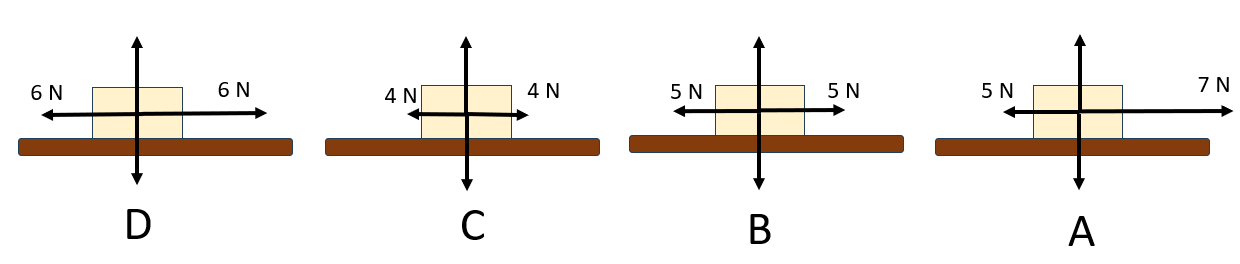
وُضع مكعب خشبي على سطح أفقي خشن وأثّرت عليه قوة شد نحو اليمين متزايدة حتى أصبح على وشك الحركة، ثم زيدت قوة الشد فتحرك. أي الأشكال التالية يعبّر عن أقصى قوة احتكاك سكوني (والجسم على وشك الحركة)؟A wooden cube lies on a rough horizontal surface. An increasing tension to the right is applied until the cube is about to move, then the tension is increased further and it moves. Which figure shows the maximum static friction force (the cube about to move)?
AA
BB
CC
DD
الحلSolution
📌 الاحتكاك يعاكس الحركة دائمًا وتزداد قوته كلما زادت قوة الشد (الشكلان C وB: الجسم ساكن).
📌 عندما يصبح الجسم على وشك الحركة تبلغ قوة الاحتكاك قيمتها العظمى (احتكاك سكوني أقصى) كما في D: \(6\,N\) مقابل \(6\,N\).
📌 وعندما يتحرك الجسم تقل قوة الاحتكاك ويصبح حركيًا كما في A (الاحتكاك \(5\,N\) أقل من الشد \(7\,N\)).
✅ D
📌 Friction always opposes motion and grows as the tension grows (figures C and B: the cube is at rest).
📌 When the cube is about to move the friction reaches its maximum value (maximum static friction), as in D: \(6\,N\) against \(6\,N\).
📌 When the cube moves, friction decreases and becomes kinetic, as in A (friction \(5\,N\) is less than the pull \(7\,N\)).
✅ D
\[14\,\star\star\star\]
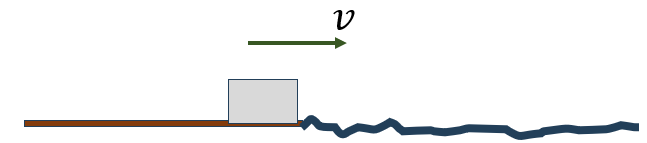
قالب كتلته \(3\,kg\) يتحرك بسرعة ثابتة على أرض عديمة الاحتكاك، ثم دخل منطقة خشنة فتباطأ بتسارع مقداره \(2\,m/s^{2}\). معامل الاحتكاك الحركي يعادل (اعتبر \(g=9.81\,m/s^{2}\)):A \(3\,kg\) block moves at constant speed on a frictionless floor, then enters a rough region and slows down with an acceleration of magnitude \(2\,m/s^{2}\). The coefficient of kinetic friction is (take \(g=9.81\,m/s^{2}\)):
0.20.2
0.250.25
0.30.3
0.350.35
الحلSolution
📌 في المنطقة الخشنة تكون قوة الاحتكاك هي المحصلة: \(-F_k=ma=3\times(-2)=-6\Rightarrow F_k=6\,N\).
📌 \(F_N=F_g=3\times9.81=29.4\,N\).
📌 \(\mu_k=\dfrac{F_k}{F_N}=\dfrac{6}{29.4}\approx0.2\).
✅ 0.2 (A)
📌 In the rough region friction is the net force: \(-F_k=ma=3\times(-2)=-6\Rightarrow F_k=6\,N\).
📌 \(F_N=F_g=3\times9.81=29.4\,N\).
📌 \(\mu_k=\dfrac{F_k}{F_N}=\dfrac{6}{29.4}\approx0.2\).
✅ 0.2 (A)
\[15\,\star\star\star\]
جسم كتلته \(4\,kg\) على مستوى أفقي خشن أثّرت فيه قوة شد أفقية \(20\,N\) نحو اليمين فتحرك بتسارع \(1.5\,m/s^{2}\). معامل الاحتكاك الحركي يعادل (\(g=9.81\,m/s^{2}\)):A \(4\,kg\) object on a rough horizontal surface is pulled by a horizontal \(20\,N\) force to the right and accelerates at \(1.5\,m/s^{2}\). The coefficient of kinetic friction is (\(g=9.81\,m/s^{2}\)):

0.480.48
0.320.32
0.570.57
0.360.36
الحلSolution
📌 على المحور الأفقي: \(F_T-F_k=ma\Rightarrow20-F_k=4\times1.5=6\Rightarrow F_k=14\,N\).
📌 رأسيًا: \(F_N=F_g=4\times9.81=39.24\,N\).
📌 \(\mu_k=\dfrac{14}{39.24}\approx0.36\).
✅ 0.36 (D)
📌 Horizontally: \(F_T-F_k=ma\Rightarrow20-F_k=4\times1.5=6\Rightarrow F_k=14\,N\).
📌 Vertically: \(F_N=F_g=4\times9.81=39.24\,N\).
📌 \(\mu_k=\dfrac{14}{39.24}\approx0.36\).
✅ 0.36 (D)
\[16\,\star\star\star\]
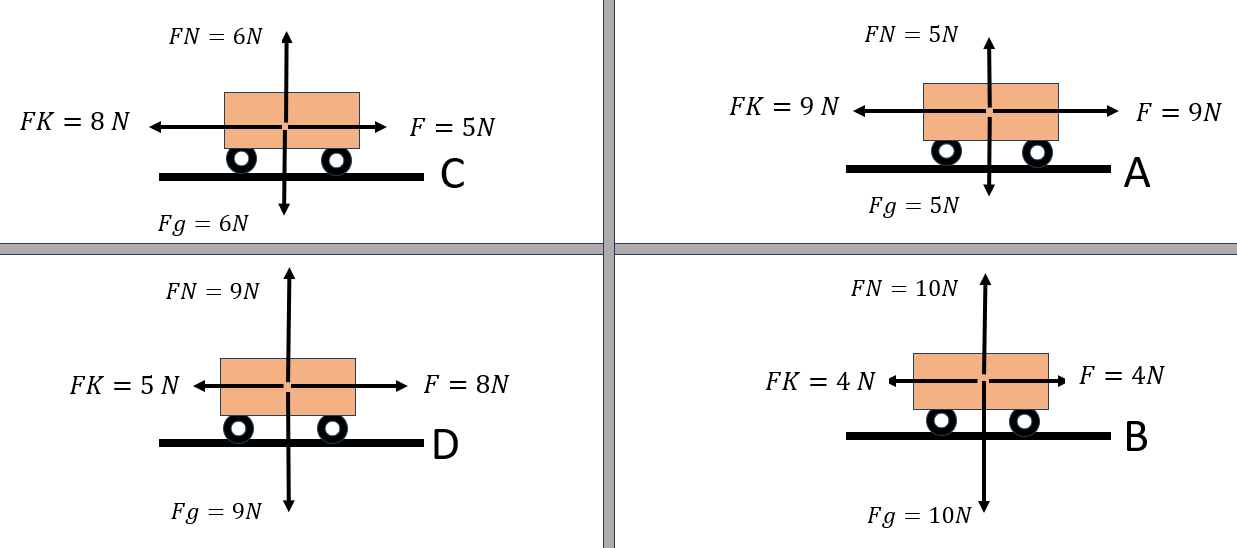
كتلة كل سيارة \(m=2\,kg\) وتتحرك نحو اليمين. إحدى السيارات التالية تتحرك بتسارع \(a=1.5\,m/s^{2}\) نحو اليسار:Each car has mass \(m=2\,kg\) and moves to the right. One of the following cars accelerates at \(a=1.5\,m/s^{2}\) to the left:
AA
BB
CC
DD
الحلSolution
📌 التسارع نحو اليسار ⇒ المحصلة نحو اليسار: \(F-F_k=ma\) سالبة، أي \(F\lt F_k\).
📌 السيارة C: \(5-8=-3=2a\Rightarrow a=-1.5\,m/s^{2}\) (نحو اليسار). أما A وB فالمحصلة فيهما صفر، وفي D المحصلة \(8-5=+3\) نحو اليمين.
✅ C
📌 Acceleration to the left ⇒ the net force points left: \(F-F_k=ma\) is negative, i.e. \(F\lt F_k\).
📌 Car C: \(5-8=-3=2a\Rightarrow a=-1.5\,m/s^{2}\) (to the left). In A and B the net force is zero, and in D the net force is \(8-5=+3\) to the right.
✅ C
\[17\,\star\star\star\]
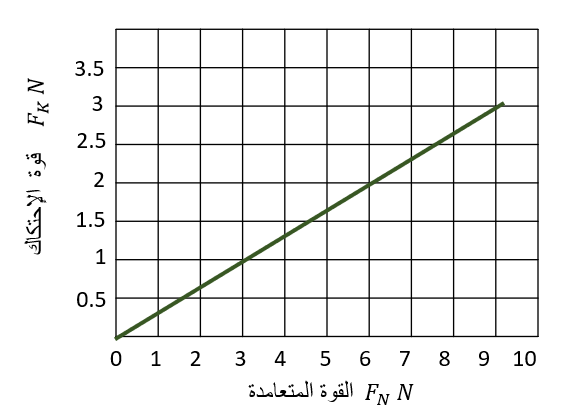
رُسمت العلاقة بين القوة العمودية وقوة الاحتكاك الحركي لمكعب حديد يتحرك على طاولة خشبية فنتج الخط البياني الموضح. معامل الاحتكاك الحركي يعادل:The relation between the normal force and the kinetic friction force of an iron cube sliding on a wooden table is plotted. The coefficient of kinetic friction is:
0.120.12
0.450.45
0.330.33
0.210.21
الحلSolution
📌 \(F_k=\mu_kF_N\) فالخط مستقيم من نقطة الأصل وميله هو معامل الاحتكاك الحركي.
📌 من الرسم: النقطة \((3,1)\) والنقطة \((9,3)\): \(\mu_k=\text{slope}=\dfrac{3-1}{9-3}=\dfrac{2}{6}\approx0.33\).
✅ 0.33 (C)
📌 \(F_k=\mu_kF_N\) so the line is straight through the origin and its slope is the coefficient of kinetic friction.
📌 From the graph: the points \((3,1)\) and \((9,3)\): \(\mu_k=\text{slope}=\dfrac{3-1}{9-3}=\dfrac{2}{6}\approx0.33\).
✅ 0.33 (C)
\[18\,\star\]
اتجاه قوة الاحتكاك الحركي المؤثرة على جسم ينزلق نحو اليمين على سطح خشن هو:The direction of the kinetic friction force on an object sliding to the right on a rough surface is:
نحو اليمين (باتجاه الحركة)to the right (along the motion)
نحو اليسار (عكس حركة الجسم)to the left (opposite to the motion)
نحو الأعلىupward
نحو الأسفلdownward
الحلSolution
📌 قوة الاحتكاك تعاكس الحركة النسبية بين السطحين دائمًا، فهي نحو اليسار.
✅ نحو اليسار (عكس حركة الجسم) (B)
📌 Friction always opposes the relative motion of the surfaces, so it points left.
✅ to the left (opposite to the motion) (B)
\[19\,\star\]
أي إجراء مما يلي يزيد قوة الاحتكاك الحركي على جسم ينزلق على سطح؟Which of the following actions increases the kinetic friction on an object sliding on a surface?
تزييت السطحينlubricating the surfaces
صقل السطحين وتنعيمهماpolishing the surfaces
تقليل وزن الجسمreducing the weight of the object
وضع كتلة إضافية فوق الجسمputting an extra mass on top of the object
الحلSolution
📌 \(F_k=\mu_kF_N\) والكتلة الإضافية تزيد القوة العمودية \(F_N\) فتزداد قوة الاحتكاك. أما التزييت والصقل فيقللان \(\mu_k\)، وتقليل الوزن يقلل \(F_N\).
✅ وضع كتلة إضافية فوق الجسم (D)
📌 \(F_k=\mu_kF_N\) and the extra mass increases the normal force \(F_N\), so friction grows. Lubricating and polishing reduce \(\mu_k\), and reducing the weight reduces \(F_N\).
✅ putting an extra mass on top of the object (D)
\[20\,\star\]
ما قوة الاحتكاك السكوني القصوى لصندوق كتلته \(20\,kg\) على أرض معامل احتكاكها السكوني \(0.5\)؟ \(g=10\,m/s^{2}\)What is the maximum static friction on a \(20\,kg\) crate on a floor with a coefficient of static friction \(0.5\)? \(g=10\,m/s^{2}\)
\(10\,N\)\(10\,N\)
\(100\,N\)\(100\,N\)
\(40\,N\)\(40\,N\)
\(200\,N\)\(200\,N\)
الحلSolution
\(F_N=mg=20\times10=200\,N\).
\(F_{s,max}=\mu_sF_N=0.5\times200=100\,N\).
✅ \(100\,N\) (B)
\(F_N=mg=20\times10=200\,N\).
\(F_{s,max}=\mu_sF_N=0.5\times200=100\,N\).
✅ \(100\,N\) (B)
\[21\,\star\star\]
صندوق كتلته \(10\,kg\) ساكن على أرض خشنة \((\mu_s=0.5,\ \mu_k=0.4)\)، دفعناه أفقيًا بقوة \(30\,N\) فلم يتحرك. قوة الاحتكاك المؤثرة عليه تساوي: \(g=10\,m/s^{2}\)A \(10\,kg\) crate rests on a rough floor \((\mu_s=0.5,\ \mu_k=0.4)\). We push it horizontally with \(30\,N\) and it does not move. The friction force on it equals: \(g=10\,m/s^{2}\)
\(50\,N\)\(50\,N\)
\(30\,N\)\(30\,N\)
\(40\,N\)\(40\,N\)
صفرzero
الحلSolution
📌 أقصى احتكاك سكوني \(\mu_sF_N=0.5\times100=50\,N\) وهو أكبر من \(30\,N\) فالجسم ساكن.
📌 الجسم ساكن ⇒ المحصلة صفر ⇒ قوة الاحتكاك السكوني تساوي قوة الدفع \(=30\,N\) (وليست القيمة القصوى).
✅ \(30\,N\) (B)
📌 The maximum static friction is \(\mu_sF_N=0.5\times100=50\,N\), larger than \(30\,N\), so the crate stays at rest.
📌 At rest ⇒ zero net force ⇒ the static friction equals the push \(=30\,N\) (not the maximum value).
✅ \(30\,N\) (B)
\[22\,\star\star\]
سُحب جسم كتلته \(5\,kg\) على سطح أفقي بقوة أفقية \(40\,N\) فتحرك بسرعة ثابتة. معامل الاحتكاك الحركي بين الجسم والسطح: \(g=10\,m/s^{2}\)A \(5\,kg\) object is pulled over a horizontal surface by a horizontal force of \(40\,N\) and moves at constant velocity. The coefficient of kinetic friction between the object and the surface is: \(g=10\,m/s^{2}\)
0.080.08
88
1.251.25
0.80.8
الحلSolution
📌 السرعة ثابتة ⇒ \(F_k=F_T=40\,N\).
📌 \(F_N=mg=50\,N\) ثم \(\mu_k=\dfrac{40}{50}=0.8\).
✅ 0.8 (D)
📌 Constant velocity ⇒ \(F_k=F_T=40\,N\).
📌 \(F_N=mg=50\,N\) then \(\mu_k=\dfrac{40}{50}=0.8\).
✅ 0.8 (D)
\[23\,\star\star\]
إذا تضاعفت القوة العمودية بين سطحين (دون تغيّر طبيعتهما) فإن قوة الاحتكاك الحركي بينهما:If the normal force between two surfaces doubles (their nature unchanged), the kinetic friction force between them:
تتضاعفdoubles
تبقى ثابتةstays constant
تتناقص إلى النصفis halved
تتضاعف أربع مراتbecomes four times larger
الحلSolution
📌 \(F_k=\mu_kF_N\) و\(\mu_k\) ثابت لأن السطحين لم يتغيرا، فالعلاقة طردية: مضاعفة \(F_N\) تضاعف \(F_k\).
✅ تتضاعف (A)
📌 \(F_k=\mu_kF_N\) and \(\mu_k\) is constant because the surfaces are unchanged: the relation is direct, so doubling \(F_N\) doubles \(F_k\).
✅ doubles (A)
\[24\,\star\star\]
سُحب جسم كتلته \(4\,kg\) بقوة أفقية \(24\,N\) على سطح معامل احتكاكه الحركي \(0.3\). تسارع الجسم: \(g=10\,m/s^{2}\)A \(4\,kg\) object is pulled by a horizontal force of \(24\,N\) on a surface with a coefficient of kinetic friction \(0.3\). The acceleration of the object is: \(g=10\,m/s^{2}\)
\(3\,m/s^{2}\)\(3\,m/s^{2}\)
\(6\,m/s^{2}\)\(6\,m/s^{2}\)
\(9\,m/s^{2}\)\(9\,m/s^{2}\)
\(1.5\,m/s^{2}\)\(1.5\,m/s^{2}\)
الحلSolution
📌 \(F_N=mg=40\,N\) ومنه \(F_k=0.3\times40=12\,N\).
📌 \(a=\dfrac{F_T-F_k}{m}=\dfrac{24-12}{4}=3\,m/s^{2}\).
✅ \(3\,m/s^{2}\) (A)
📌 \(F_N=mg=40\,N\) so \(F_k=0.3\times40=12\,N\).
📌 \(a=\dfrac{F_T-F_k}{m}=\dfrac{24-12}{4}=3\,m/s^{2}\).
✅ \(3\,m/s^{2}\) (A)
\[25\,\star\star\star\]
تنزلق سيارة كتلتها \(1000\,kg\) بعجلات مقفلة على طريق معامل احتكاكه الحركي \(0.8\) وسرعتها \(20\,m/s\). المسافة التي تقطعها حتى تتوقف: \(g=10\,m/s^{2}\)A \(1000\,kg\) car skids with locked wheels on a road with a coefficient of kinetic friction \(0.8\) at \(20\,m/s\). The distance it travels before stopping is: \(g=10\,m/s^{2}\)
\(50\,m\)\(50\,m\)
\(12.5\,m\)\(12.5\,m\)
\(2.5\,m\)\(2.5\,m\)
\(25\,m\)\(25\,m\)
الحلSolution
📌 التباطؤ بفعل الاحتكاك: \(a=\dfrac{\mu_kmg}{m}=\mu_kg=0.8\times10=8\,m/s^{2}\).
📌 \(v^{2}=v_0^{2}-2ad\Rightarrow d=\dfrac{v_0^{2}}{2a}=\dfrac{400}{16}=25\,m\).
✅ \(25\,m\) (D)
📌 The deceleration due to friction: \(a=\dfrac{\mu_kmg}{m}=\mu_kg=0.8\times10=8\,m/s^{2}\).
📌 \(v^{2}=v_0^{2}-2ad\Rightarrow d=\dfrac{v_0^{2}}{2a}=\dfrac{400}{16}=25\,m\).
✅ \(25\,m\) (D)
\[26\,\star\star\star\]
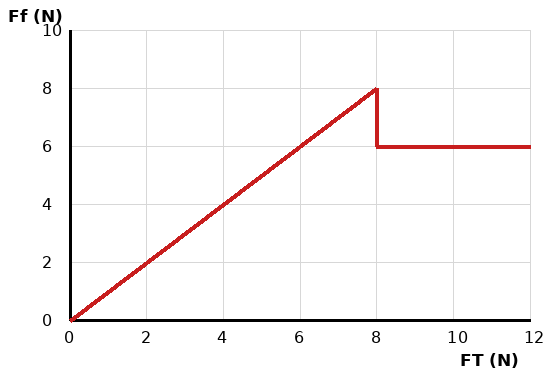
يبين الرسم قوة الاحتكاك المؤثرة على جسم كتلته \(4\,kg\) عند سحبه بقوة أفقية متزايدة \(F_T\): ترتفع حتى \(8\,N\) ثم تهبط إلى \(6\,N\) بعد أن يبدأ الجسم بالحركة. معامل الاحتكاك الحركي: \(g=10\,m/s^{2}\)The graph shows the friction force on a \(4\,kg\) object pulled by an increasing horizontal force \(F_T\): it rises to \(8\,N\) then drops to \(6\,N\) once the object starts moving. The coefficient of kinetic friction is: \(g=10\,m/s^{2}\)
0.20.2
0.30.3
0.150.15
0.10.1
الحلSolution
📌 القيمة العظمى \(8\,N\) هي الاحتكاك السكوني الأقصى، والقيمة الثابتة بعد الحركة \(6\,N\) هي الاحتكاك الحركي.
📌 \(F_N=mg=40\,N\) فـ \(\mu_k=\dfrac{6}{40}=0.15\) (بينما \(\mu_s=\dfrac{8}{40}=0.2\)).
✅ 0.15 (C)
📌 The peak \(8\,N\) is the maximum static friction and the steady value \(6\,N\) after the motion starts is the kinetic friction.
📌 \(F_N=mg=40\,N\) so \(\mu_k=\dfrac{6}{40}=0.15\) (while \(\mu_s=\dfrac{8}{40}=0.2\)).
✅ 0.15 (C)
\[27\,\star\star\star\]
قُذف جسم على أرض خشنة معامل احتكاكها الحركي \(0.2\) بسرعة ابتدائية \(6\,m/s\). المسافة التي ينزلقها حتى يتوقف: \(g=10\,m/s^{2}\)An object is launched over a rough floor with a coefficient of kinetic friction \(0.2\) at an initial speed of \(6\,m/s\). The distance it slides before stopping is: \(g=10\,m/s^{2}\)
\(18\,m\)\(18\,m\)
\(3\,m\)\(3\,m\)
\(4.5\,m\)\(4.5\,m\)
\(9\,m\)\(9\,m\)
الحلSolution
📌 \(a=\mu_kg=0.2\times10=2\,m/s^{2}\) (تباطؤ).
📌 \(d=\dfrac{v_0^{2}}{2a}=\dfrac{36}{4}=9\,m\).
✅ \(9\,m\) (D)
📌 \(a=\mu_kg=0.2\times10=2\,m/s^{2}\) (deceleration).
📌 \(d=\dfrac{v_0^{2}}{2a}=\dfrac{36}{4}=9\,m\).
✅ \(9\,m\) (D)
\[28\,\star\star\star\star\]
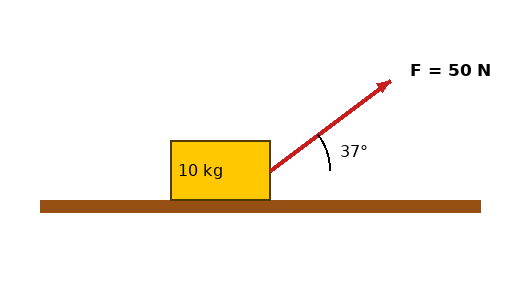
يُسحب صندوق كتلته \(10\,kg\) على أرض أفقية بقوة \(50\,N\) تصنع زاوية \(37^{\circ}\) فوق الأفق، ومعامل الاحتكاك الحركي \(0.5\). تسارع الصندوق (\(\sin37^{\circ}=0.6,\ \cos37^{\circ}=0.8\)): \(g=10\,m/s^{2}\)A \(10\,kg\) crate is pulled on a horizontal floor by a \(50\,N\) force at \(37^{\circ}\) above the horizontal; the coefficient of kinetic friction is \(0.5\). The acceleration of the crate is (\(\sin37^{\circ}=0.6,\ \cos37^{\circ}=0.8\)): \(g=10\,m/s^{2}\)
\(0.5\,m/s^{2}\)\(0.5\,m/s^{2}\)
\(4\,m/s^{2}\)\(4\,m/s^{2}\)
صفرzero
\(1.5\,m/s^{2}\)\(1.5\,m/s^{2}\)
الحلSolution
📌 رأسيًا: \(F_N+F\sin37^{\circ}=mg\Rightarrow F_N=100-30=70\,N\) (الشد يخفف الضغط على الأرض).
📌 \(F_k=0.5\times70=35\,N\)، والمركبة الأفقية للشد \(F\cos37^{\circ}=40\,N\).
📌 \(a=\dfrac{40-35}{10}=0.5\,m/s^{2}\).
✅ \(0.5\,m/s^{2}\) (A)
📌 Vertically: \(F_N+F\sin37^{\circ}=mg\Rightarrow F_N=100-30=70\,N\) (the pull reduces the push on the floor).
📌 \(F_k=0.5\times70=35\,N\) and the horizontal component of the pull is \(F\cos37^{\circ}=40\,N\).
📌 \(a=\dfrac{40-35}{10}=0.5\,m/s^{2}\).
✅ \(0.5\,m/s^{2}\) (A)
\[29\,\star\star\star\star\]
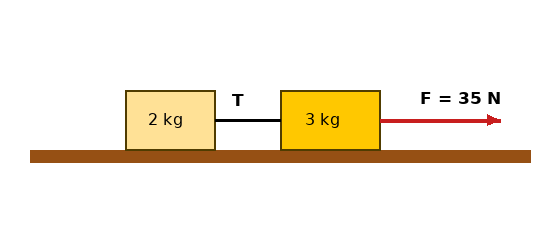
كتلتان \(2\,kg\) و\(3\,kg\) موصولتان بخيط خفيف على أرض خشنة معامل احتكاكها الحركي \(0.3\) لكلتيهما، وتُسحبان بقوة أفقية \(35\,N\) مؤثرة في الكتلة \(3\,kg\). قوة الشد في الخيط: \(g=10\,m/s^{2}\)Masses \(2\,kg\) and \(3\,kg\) are joined by a light string on a rough floor with a coefficient of kinetic friction \(0.3\) for both, and pulled by a horizontal \(35\,N\) force acting on the \(3\,kg\) mass. The tension in the string is: \(g=10\,m/s^{2}\)
\(14\,N\)\(14\,N\)
\(21\,N\)\(21\,N\)
\(35\,N\)\(35\,N\)
\(8\,N\)\(8\,N\)
الحلSolution
📌 للمجموعة كلها: \(a=\dfrac{F-\mu_k(m_1+m_2)g}{m_1+m_2}=\dfrac{35-0.3\times50}{5}=4\,m/s^{2}\).
📌 للكتلة \(2\,kg\) (الخلفية): \(T-\mu_km_2g=m_2a\Rightarrow T=6+2\times4=14\,N\).
✅ \(14\,N\) (A)
📌 For the whole system: \(a=\dfrac{F-\mu_k(m_1+m_2)g}{m_1+m_2}=\dfrac{35-0.3\times50}{5}=4\,m/s^{2}\).
📌 For the \(2\,kg\) mass (behind): \(T-\mu_km_2g=m_2a\Rightarrow T=6+2\times4=14\,N\).
✅ \(14\,N\) (A)
\[30\,\star\star\star\star\]
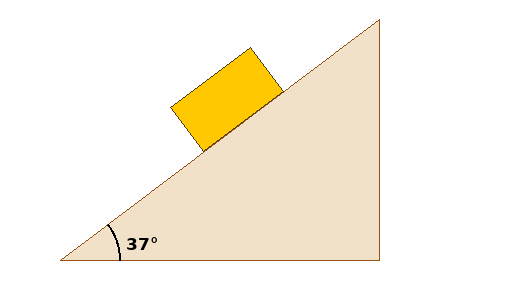
ينزلق جسم بسرعة ثابتة على مستوى مائل خشن يميل بزاوية \(37^{\circ}\) عن الأفق. معامل الاحتكاك الحركي (\(\sin37^{\circ}=0.6,\ \cos37^{\circ}=0.8\)):A body slides at constant speed down a rough incline making \(37^{\circ}\) with the horizontal. The coefficient of kinetic friction is (\(\sin37^{\circ}=0.6,\ \cos37^{\circ}=0.8\)):
0.60.6
0.80.8
0.750.75
1.331.33
الحلSolution
📌 السرعة ثابتة ⇒ المحصلة صفر: \(mg\sin\theta=F_k=\mu_kmg\cos\theta\).
📌 ومنه \(\mu_k=\tan\theta=\dfrac{0.6}{0.8}=0.75\).
✅ 0.75 (C)
📌 Constant speed ⇒ zero net force: \(mg\sin\theta=F_k=\mu_kmg\cos\theta\).
📌 Hence \(\mu_k=\tan\theta=\dfrac{0.6}{0.8}=0.75\).
✅ 0.75 (C)
\[31\,\star\star\star\star\]
جسم كتلته \(5\,kg\) ساكن على مستوى مائل بزاوية \(37^{\circ}\) ومعامل الاحتكاك السكوني \(0.9\). قوة الاحتكاك المؤثرة عليه (\(\sin37^{\circ}=0.6,\ \cos37^{\circ}=0.8\)): \(g=10\,m/s^{2}\)A \(5\,kg\) body rests on an incline of \(37^{\circ}\) with a coefficient of static friction \(0.9\). The friction force on it is (\(\sin37^{\circ}=0.6,\ \cos37^{\circ}=0.8\)): \(g=10\,m/s^{2}\)
\(36\,N\)\(36\,N\)
\(40\,N\)\(40\,N\)
\(50\,N\)\(50\,N\)
\(30\,N\)\(30\,N\)
الحلSolution
📌 مركبة الوزن الموازية للمستوى: \(mg\sin\theta=50\times0.6=30\,N\).
📌 أقصى احتكاك سكوني \(0.9\times50\times0.8=36\,N\) أكبر من \(30\,N\) فالجسم ساكن.
📌 الجسم ساكن فالاحتكاك الفعلي يساوي \(30\,N\) موازيًا للمستوى نحو الأعلى.
✅ \(30\,N\) (D)
📌 The weight component parallel to the incline: \(mg\sin\theta=50\times0.6=30\,N\).
📌 The maximum static friction is \(0.9\times50\times0.8=36\,N\), larger than \(30\,N\), so the body is at rest.
📌 At rest, the actual friction equals \(30\,N\) up along the incline.
✅ \(30\,N\) (D)
\[32\,\star\star\star\star\]
ماذا يحدث لمعامل الاحتكاك الحركي بين سطحين عند زيادة سرعة الانزلاق عدة أضعاف (ضمن المدى المعتاد)؟What happens to the coefficient of kinetic friction between two surfaces when the sliding speed increases several times (within the usual range)?
يزداد بزيادة السرعةit increases with the speed
يتناقص إلى أن ينعدمit decreases until it vanishes
يتضاعف بمضاعفة السرعةit doubles when the speed doubles
يبقى ثابتًا تقريبًاit stays approximately constant
الحلSolution
📌 في النموذج المدروس تعتمد قوة الاحتكاك الحركي على طبيعة السطحين والقوة العمودية فقط، ولا تعتمد على السرعة.
✅ يبقى ثابتًا تقريبًا (D)
📌 In the studied model the kinetic friction depends only on the nature of the surfaces and the normal force, not on the speed.
✅ it stays approximately constant (D)
📝 المسائل المقالية
📝 Essay Problems
\[1\,\star\star\star\]
في الشكل جسم كتلته \(4\,kg\) وُضع على مستوى أفقي خشن، وأثّرت فيه قوة شد أفقية \(20\,N\) نحو اليمين فتحرك بتسارع \(1.5\,m/s^{2}\). (أ) حدّد القوى المؤثرة على الجسم. (ب) احسب معامل الاحتكاك الحركي (\(g=9.81\,m/s^{2}\)).In the figure a \(4\,kg\) object is placed on a rough horizontal surface and a horizontal tension of \(20\,N\) to the right makes it accelerate at \(1.5\,m/s^{2}\). (a) Identify the forces acting on the object. (b) Calculate the coefficient of kinetic friction (\(g=9.81\,m/s^{2}\)).

.....................................................................
الحلSolution
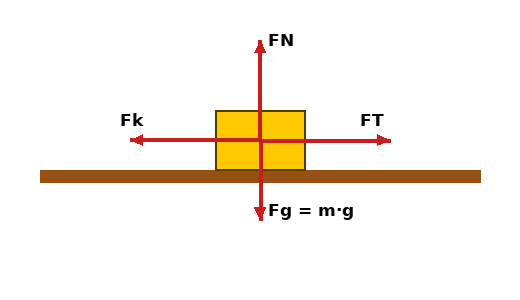
📌 (أ) القوى: الوزن \(F_g\) للأسفل، والقوة العمودية \(F_N\) للأعلى، وقوة الشد \(F_T\) نحو اليمين، وقوة الاحتكاك الحركي \(F_k\) نحو اليسار (عكس الحركة).
📌 (ب) أفقيًا: \(F_T-F_k=ma\Rightarrow20-F_k=4\times1.5=6\Rightarrow F_k=14\,N\).
📌 رأسيًا: \(F_N-F_g=0\Rightarrow F_N=4\times9.81=39.24\,N\).
📌 \(\mu_k=\dfrac{F_k}{F_N}=\dfrac{14}{39.24}\approx0.36\).
✅ \(F_k=14\,N\)، \(\mu_k\approx0.36\)
📌 (a) The forces: the weight \(F_g\) downward, the normal force \(F_N\) upward, the tension \(F_T\) to the right and the kinetic friction \(F_k\) to the left (opposite to the motion).
📌 (b) Horizontally: \(F_T-F_k=ma\Rightarrow20-F_k=4\times1.5=6\Rightarrow F_k=14\,N\).
📌 Vertically: \(F_N-F_g=0\Rightarrow F_N=4\times9.81=39.24\,N\).
📌 \(\mu_k=\dfrac{F_k}{F_N}=\dfrac{14}{39.24}\approx0.36\).
✅ \(F_k=14\,N\), \(\mu_k\approx0.36\)
\[2\,\star\star\]
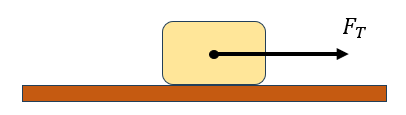
في الشكل جسم كتلته \(3\,kg\) على مستوى أفقي خشن أثّرت فيه قوة شد أفقية نحو اليمين فتحرك، ومعامل الاحتكاك الحركي \(0.4\) (\(g=9.81\,m/s^{2}\)). احسب قوة الاحتكاك الحركي.In the figure a \(3\,kg\) object on a rough horizontal surface is pulled by a horizontal force to the right and moves; the coefficient of kinetic friction is \(0.4\) (\(g=9.81\,m/s^{2}\)). Calculate the kinetic friction force.
.....................................................................
الحلSolution
📌 رأسيًا: \(F_N=F_g=mg=3\times9.81=29.43\,N\).
📌 \(F_k=\mu_kF_N=0.4\times29.43\approx11.8\,N\).
✅ \(F_k\approx11.8\,N\)
📌 Vertically: \(F_N=F_g=mg=3\times9.81=29.43\,N\).
📌 \(F_k=\mu_kF_N=0.4\times29.43\approx11.8\,N\).
✅ \(F_k\approx11.8\,N\)
\[3\,\star\star\star\]
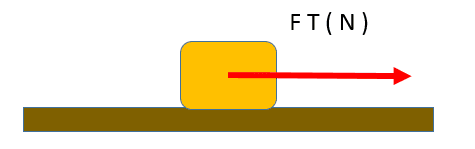
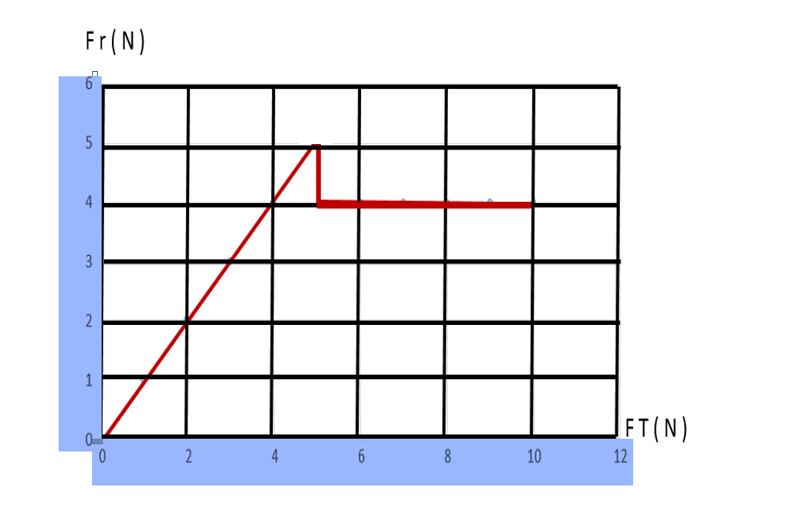
رُسمت العلاقة بين قوة الشد الأفقية \(F_T\) وقوة الاحتكاك \(F_r\) لجسم كتلته \(2\,kg\) وُضع على مستوى أفقي خشن فظهر الخط البياني. احسب معامل الاحتكاك السكوني (\(g=10\,m/s^{2}\)).The relation between the horizontal tension \(F_T\) and the friction force \(F_r\) for a \(2\,kg\) object on a rough horizontal surface is plotted. Calculate the coefficient of static friction (\(g=10\,m/s^{2}\)).
.....................................................................
الحلSolution
📌 من الخط البياني: تزداد قوة الاحتكاك السكوني مع قوة الشد حتى أقصى قيمة \(F_{s,max}=5\,N\) ثم تنخفض إلى \(4\,N\) (احتكاك حركي) عندما يتحرك الجسم.
📌 \(F_N=F_g=mg=2\times10=20\,N\).
📌 \(\mu_s=\dfrac{F_{s,max}}{F_N}=\dfrac{5}{20}=0.25\) (بلا وحدة لأنه نسبة بين قوتين).
✅ \(\mu_s=0.25\)
📌 From the graph: the static friction grows with the tension up to a maximum \(F_{s,max}=5\,N\) then drops to \(4\,N\) (kinetic friction) once the object moves.
📌 \(F_N=F_g=mg=2\times10=20\,N\).
📌 \(\mu_s=\dfrac{F_{s,max}}{F_N}=\dfrac{5}{20}=0.25\) (unitless, a ratio of two forces).
✅ \(\mu_s=0.25\)
🔗 محاكيات GeoGebra للاستعانة بها عند اللزوم
🔗 GeoGebra Simulations to Use When Needed
اضغط «تشغيل» لتعمل المحاكاة هنا داخل الدرس؛ ويمكن للطالب الرجوع إليها لتجربة الفكرة بطريقة أخرى.
Press “Run” to run the simulation right here inside the lesson; the student can use it to try the idea in another way.
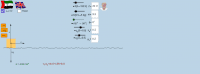
جسم يتحرك على مستوى أفقي خشنA body moving on a rough horizontal surface
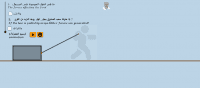
القوى المؤثرة على صندوق مسحوبForces on a pulled box
لاحظت خطأ؟ أو عندك سؤال عن أحد الأسئلة؟ اكتبه بالتعليقات وحدد رقم السؤال بالضبط.
Noticed an error? Or have a question about one of the questions? Write it in the comments and specify the exact question number.