⚡ بنك الأسئلة: الأجسام الجاسئة
⚡ Question Bank: Rigid Bodies
مركز الكتلة، سرعة مركز الكتلة، حفظ الزخم، الأنظمة المركبة، الصاروخ
Center of Mass, Velocity of the Center of Mass, Momentum Conservation, Composite Systems, Rockets
⏱️ 25 سؤال اختيار من متعدد بتصحيح فوري بمستويات متدرجة مع حل مفصل لكل سؤال⏱️ 25 multiple-choice questions of graded difficulty with instant feedback and a detailed solution for each
\[1\,\star\]
يتم تحديد مركز الكتلة لجسم من خلال تحديد:The center of mass of a body is determined by identifying:
المركز الهندسي لجسم له كثافة منتظمةthe geometric center of a body of uniform density
النقطة التي يمكن اعتبار كتلة الجسم كلها متركزة عندهاthe point at which the whole mass of the body can be considered concentrated
نقطة اتزان الجسمthe balance point of the body
جميع ما سبقall of the above
الحلSolution
📌 مركز الكتلة نقطة تتصرف عندها كتلة الجسم كلها كأنها متركزة، وهو نقطة اتزان الجسم في مجال جاذبية منتظم.
📌 ولجسم منتظم الكثافة ومتماثل يقع في مركزه الهندسي. فالعبارات الثلاث صحيحة معًا.
✅ جميع ما سبق (D)
📌 The center of mass is the point where the whole mass of the body behaves as if it were concentrated, and it is the balance point of the body in a uniform gravitational field.
📌 For a symmetric body of uniform density it lies at its geometric center. So all three statements are true together.
✅ all of the above (D)
\[2\,\star\]
جسمان غير متساويين في الكتلة، فيكون مركز الكتلة المشترك لهما دومًا:Two bodies have unequal masses. Their common center of mass is always:
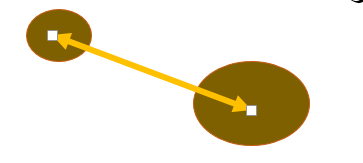
أقرب إلى الجسم الأكبرcloser to the larger body
أقرب إلى الجسم الأصغرcloser to the smaller body
في منتصف المسافة بين الجسمينat the midpoint between the two bodies
على امتداد الخط الواصل بين الجسمين فقط خارج المسافة بينهماon the line joining them but outside the distance between them
الحلSolution
📌 \(x_{cm}=\dfrac{m_1x_1+m_2x_2}{m_1+m_2}\) متوسط مرجَّح بالكتل فيميل نحو الكتلة الأكبر.
📌 ويقع دائمًا على الخط الواصل بين الجسمين وبينهما.
✅ أقرب إلى الجسم الأكبر (A)
📌 \(x_{cm}=\dfrac{m_1x_1+m_2x_2}{m_1+m_2}\) is a mass-weighted average so it leans toward the larger mass.
📌 It always lies on the line joining the two bodies, between them.
✅ closer to the larger body (A)
\[3\,\star\star\]
كرة كتلتها \(m_1=0.5\,kg\) عند \((0.8\,m,\ 0.4\,m)\) وكرة ثانية كتلتها \(m_2=0.3\,kg\) عند \((-0.4\,m,\ -0.4\,m)\). موقع مركز الكتلة المشترك:A ball of mass \(m_1=0.5\,kg\) is at \((0.8\,m,\ 0.4\,m)\) and a second ball of mass \(m_2=0.3\,kg\) is at \((-0.4\,m,\ -0.4\,m)\). The common center of mass is at:
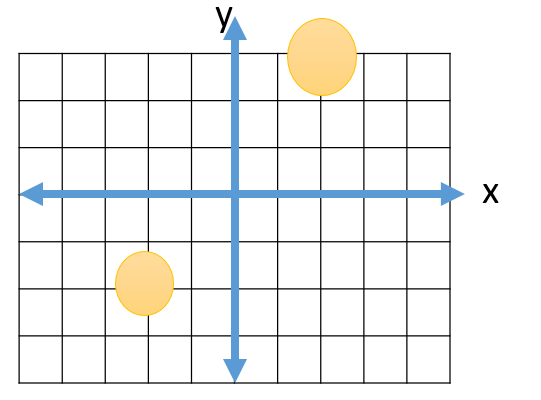
\((0.35\,m,\ -0.2\,m)\)\((0.35\,m,\ -0.2\,m)\)
\((0.35\,m,\ 0.1\,m)\)\((0.35\,m,\ 0.1\,m)\)
\((0.15\,m,\ -0.1\,m)\)\((0.15\,m,\ -0.1\,m)\)
\((0.25\,m,\ 0.2\,m)\)\((0.25\,m,\ 0.2\,m)\)
الحلSolution
\(x_{cm}=\dfrac{0.5(0.8)+0.3(-0.4)}{0.8}=\dfrac{0.28}{0.8}=0.35\,m\).
\(y_{cm}=\dfrac{0.5(0.4)+0.3(-0.4)}{0.8}=\dfrac{0.08}{0.8}=0.1\,m\).
✅ \((0.35\,m,\ 0.1\,m)\) (B)
\(x_{cm}=\dfrac{0.5(0.8)+0.3(-0.4)}{0.8}=\dfrac{0.28}{0.8}=0.35\,m\).
\(y_{cm}=\dfrac{0.5(0.4)+0.3(-0.4)}{0.8}=\dfrac{0.08}{0.8}=0.1\,m\).
✅ \((0.35\,m,\ 0.1\,m)\) (B)
\[4\,\star\star\]
كرة كتلتها \(m_1=0.5\,kg\) عند \((0.8\,m,\ 0.4\,m)\) وكرة ثانية كتلتها \(m_2=0.3\,kg\) موقعها مجهول. تبين أن مركز الكتلة المشترك عند \((0.1\,m,\ -0.3\,m)\). موقع الكرة الثانية:A ball of mass \(m_1=0.5\,kg\) is at \((0.8\,m,\ 0.4\,m)\) and a second ball of mass \(m_2=0.3\,kg\) has an unknown position. The common center of mass is found to be at \((0.1\,m,\ -0.3\,m)\). The position of the second ball is:
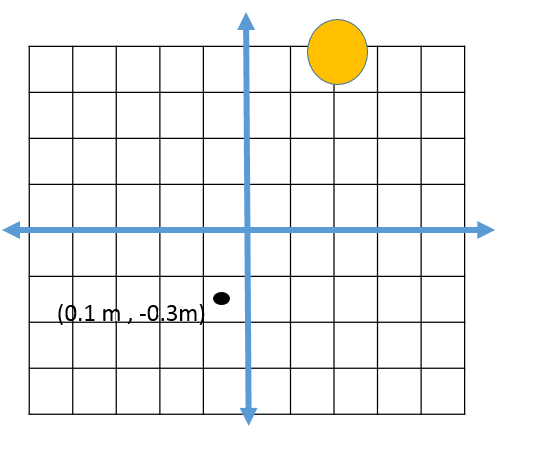
\((1.27\,m,\ 1.37\,m)\)\((1.27\,m,\ 1.37\,m)\)
\((-1.267\,m,\ 1.87\,m)\)\((-1.267\,m,\ 1.87\,m)\)
\((-1.067\,m,\ -1.47\,m)\)\((-1.067\,m,\ -1.47\,m)\)
\((-2.29\,m,\ 0.2\,m)\)\((-2.29\,m,\ 0.2\,m)\)
الحلSolution
\(x_{cm}=\dfrac{m_1x_1+m_2x_2}{m_1+m_2}\Rightarrow0.1\times0.8=0.5(0.8)+0.3x_2\) فيكون \(x_2=\dfrac{0.08-0.4}{0.3}=-1.067\,m\).
\(-0.3\times0.8=0.5(0.4)+0.3y_2\Rightarrow y_2=\dfrac{-0.24-0.2}{0.3}=-1.47\,m\).
✅ \((-1.067\,m,\ -1.47\,m)\) (C)
\(x_{cm}=\dfrac{m_1x_1+m_2x_2}{m_1+m_2}\Rightarrow0.1\times0.8=0.5(0.8)+0.3x_2\) so \(x_2=\dfrac{0.08-0.4}{0.3}=-1.067\,m\).
\(-0.3\times0.8=0.5(0.4)+0.3y_2\Rightarrow y_2=\dfrac{-0.24-0.2}{0.3}=-1.47\,m\).
✅ \((-1.067\,m,\ -1.47\,m)\) (C)
\[5\,\star\star\]
ثلاث كتل نقطية مرتبة كما في الشكل: \(10\,kg\) عند \((1,0)\) و\(5\,kg\) عند \((0,1)\) و\(2\,kg\) عند \((2,1)\) (بالمتر). مركز كتلة النظام:Three point masses are arranged as in the figure: \(10\,kg\) at \((1,0)\), \(5\,kg\) at \((0,1)\) and \(2\,kg\) at \((2,1)\) (in metres). The center of mass of the system is at:
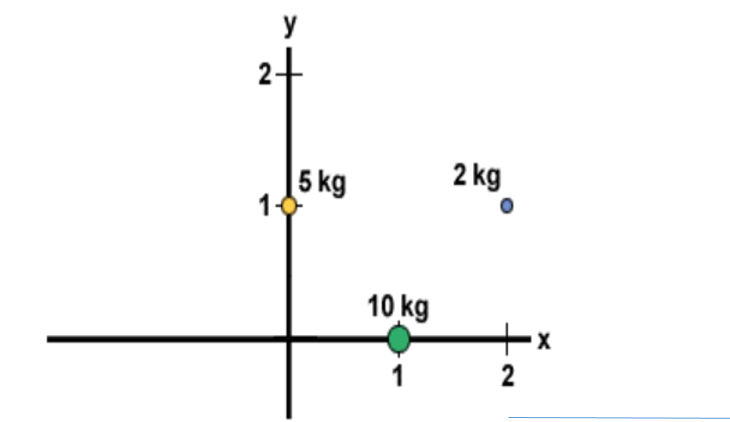
\((0.747\,m,\ 0.652\,m)\)\((0.747\,m,\ 0.652\,m)\)
\((0.823\,m,\ 0.412\,m)\)\((0.823\,m,\ 0.412\,m)\)
\((0.913\,m,\ 0.517\,m)\)\((0.913\,m,\ 0.517\,m)\)
\((0.713\,m,\ 0.715\,m)\)\((0.713\,m,\ 0.715\,m)\)
الحلSolution
\(x_{cm}=\dfrac{10(1)+5(0)+2(2)}{17}=\dfrac{14}{17}=0.823\,m\).
\(y_{cm}=\dfrac{10(0)+5(1)+2(1)}{17}=\dfrac{7}{17}=0.412\,m\).
✅ \((0.823\,m,\ 0.412\,m)\) (B)
\(x_{cm}=\dfrac{10(1)+5(0)+2(2)}{17}=\dfrac{14}{17}=0.823\,m\).
\(y_{cm}=\dfrac{10(0)+5(1)+2(1)}{17}=\dfrac{7}{17}=0.412\,m\).
✅ \((0.823\,m,\ 0.412\,m)\) (B)
\[6\,\star\star\star\star\]
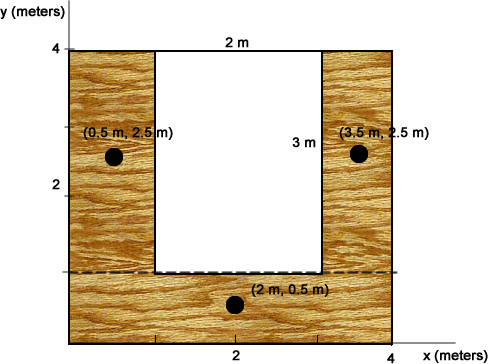
قطعة مربعة من الخشب الرقائقي طول ضلعها \(4\,m\) قُطع منها مستطيل عرضه \(2\,m\) وارتفاعه \(3\,m\) كما في الشكل. موقع مركز كتلة القطعة المتبقية:A square piece of plywood of side \(4\,m\) has a rectangle of width \(2\,m\) and height \(3\,m\) cut from it as in the figure. The center of mass of the remaining piece is at:
\((1.8\,m,\ 1.4\,m)\)\((1.8\,m,\ 1.4\,m)\)
\((2.5\,m,\ 1\,m)\)\((2.5\,m,\ 1\,m)\)
\((2\,m,\ 1.7\,m)\)\((2\,m,\ 1.7\,m)\)
\((3\,m,\ 1.5\,m)\)\((3\,m,\ 1.5\,m)\)
الحلSolution
📌 نقسم القطعة إلى ثلاثة مستطيلات متجانسة: اليسار \(1\times3\) (كتلتها \(3m\)) مركزها \((0.5,2.5)\)، واليمين \(1\times3\) (\(3m\)) مركزها \((3.5,2.5)\)، والسفلي \(4\times1\) (\(4m\)) مركزها \((2,0.5)\).
\(x_{cm}=\dfrac{3(0.5)+4(2)+3(3.5)}{10}=2\,m\) و\(y_{cm}=\dfrac{3(2.5)+4(0.5)+3(2.5)}{10}=1.7\,m\).
📌 تحقق بطريقة الطرح: \(x_{cm}=\dfrac{16(2)-6(2)}{10}=2\) و\(y_{cm}=\dfrac{16(2)-6(2.5)}{10}=1.7\).
✅ \((2\,m,\ 1.7\,m)\) (C)
📌 Divide the piece into three uniform rectangles: left \(1\times3\) (mass \(3m\)) with center \((0.5,2.5)\), right \(1\times3\) (\(3m\)) with center \((3.5,2.5)\), and bottom \(4\times1\) (\(4m\)) with center \((2,0.5)\).
\(x_{cm}=\dfrac{3(0.5)+4(2)+3(3.5)}{10}=2\,m\) and \(y_{cm}=\dfrac{3(2.5)+4(0.5)+3(2.5)}{10}=1.7\,m\).
📌 Check by subtraction: \(x_{cm}=\dfrac{16(2)-6(2)}{10}=2\) and \(y_{cm}=\dfrac{16(2)-6(2.5)}{10}=1.7\).
✅ \((2\,m,\ 1.7\,m)\) (C)
\[7\,\star\star\]
حجر كتلته \(m=4\,kg\) قُذف بمنجنيق فسقط على بعد \(180\,m\) منه. في المرة الثانية تفتت الحجر في الجو إلى قطعتين وصلتا إلى الأرض في اللحظة نفسها (بإهمال مقاومة الهواء). سقطت القطعة الأولى (\(m_1=1\,kg\)) على بعد \(240\,m\). بعد القطعة الثانية:A stone of mass \(m=4\,kg\) launched by a catapult lands \(180\,m\) away. The second time the stone breaks in the air into two pieces that reach the ground at the same instant (neglecting air resistance). The first piece (\(m_1=1\,kg\)) lands \(240\,m\) away. The distance of the second piece is:
\(d_2=120\,m\)\(d_2=120\,m\)
\(d_2=160\,m\)\(d_2=160\,m\)
\(d_2=150\,m\)\(d_2=150\,m\)
\(d_2=180\,m\)\(d_2=180\,m\)
الحلSolution
📌 لا قوة خارجية أفقية (بإهمال الهواء) فيبقى مركز الكتلة على المسار نفسه ويسقط على بعد \(180\,m\) كما في المرة الأولى.
\(180=\dfrac{1(240)+3d_2}{4}\Rightarrow d_2=\dfrac{720-240}{3}=160\,m\).
✅ \(d_2=160\,m\) (B)
📌 There is no horizontal external force (neglecting air) so the center of mass follows the same path and lands \(180\,m\) away as the first time.
\(180=\dfrac{1(240)+3d_2}{4}\Rightarrow d_2=\dfrac{720-240}{3}=160\,m\).
✅ \(d_2=160\,m\) (B)
\[8\,\star\star\]
نظام من جسمين: كتلة الأول \(4\,kg\) وسرعته \((v_x,v_y)=(2,\,5)\,m/s\) وكتلة الثاني \(2\,kg\) وسرعته \((2,\,2)\,m/s\). سرعة مركز كتلة النظام:A system of two bodies: the first has mass \(4\,kg\) and velocity \((v_x,v_y)=(2,\,5)\,m/s\), the second has mass \(2\,kg\) and velocity \((2,\,2)\,m/s\). The velocity of the center of mass is:
\((2.0,\ 4.0)\,m/s\)\((2.0,\ 4.0)\,m/s\)
\((2.0,\ 3.0)\,m/s\)\((2.0,\ 3.0)\,m/s\)
\((2.5,\ 3.0)\,m/s\)\((2.5,\ 3.0)\,m/s\)
\((3.0,\ 2.0)\,m/s\)\((3.0,\ 2.0)\,m/s\)
الحلSolution
\(v_{cm,x}=\dfrac{4(2)+2(2)}{6}=2.0\,m/s\).
\(v_{cm,y}=\dfrac{4(5)+2(2)}{6}=4.0\,m/s\).
✅ \((2.0,\ 4.0)\,m/s\) (A)
\(v_{cm,x}=\dfrac{4(2)+2(2)}{6}=2.0\,m/s\).
\(v_{cm,y}=\dfrac{4(5)+2(2)}{6}=4.0\,m/s\).
✅ \((2.0,\ 4.0)\,m/s\) (A)
\[9\,\star\star\star\]
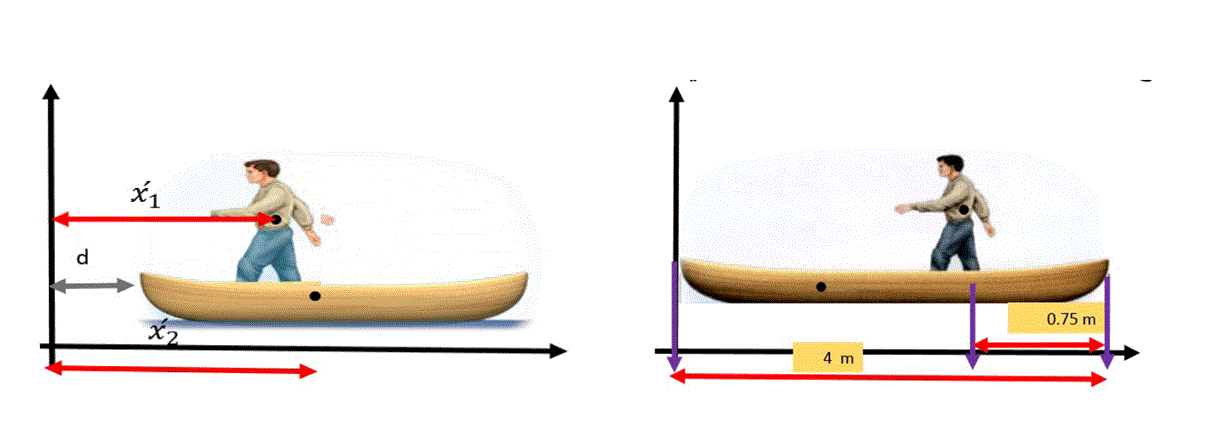
يقف رجل كتلته \(60\,kg\) في زورق كتلته \(80\,kg\) طوله \(4\,m\) يطفو على الماء، فمشى من نقطة تبعد \(0.75\,m\) عن مؤخرته إلى نقطة تبعد \(0.75\,m\) عن مقدمته (احتكاك الماء مهمل). المسافة التي يتحركها الزورق:A man of mass \(60\,kg\) stands in a boat of mass \(80\,kg\) and length \(4\,m\) floating on water and walks from a point \(0.75\,m\) from the stern to a point \(0.75\,m\) from the bow (water friction is negligible). The distance the boat moves is:
\(d=2.3\,m\)\(d=2.3\,m\)
\(d=0.48\,m\)\(d=0.48\,m\)
\(d=1.07\,m\)\(d=1.07\,m\)
\(d=1.65\,m\)\(d=1.65\,m\)
الحلSolution
📌 لا قوة أفقية خارجية فيبقى مركز كتلة (الرجل + الزورق) ثابتًا. إزاحة الرجل بالنسبة للزورق \(4-0.75-0.75=2.5\,m\).
📌 إذا تحرك الزورق \(d\) في الاتجاه المعاكس: \(60(2.5-d)=80\,d\) ومنه \(d=\dfrac{60\times2.5}{140}=1.07\,m\) (وهو الجواب نفسه الذي يعطيه حساب مركز الكتلة قبل الحركة وبعدها).
✅ \(d=1.07\,m\) (C)
📌 There is no horizontal external force so the center of mass of (man + boat) stays fixed. The man's displacement relative to the boat is \(4-0.75-0.75=2.5\,m\).
📌 If the boat moves a distance \(d\) in the opposite direction: \(60(2.5-d)=80\,d\) so \(d=\dfrac{60\times2.5}{140}=1.07\,m\) (the same result as the center-of-mass calculation before and after the walk).
✅ \(d=1.07\,m\) (C)
\[10\,\star\star\star\]
مركبة فضائية كتلتها الصافية \(60\,000\,kg\) تحمل وقودًا كتلته \(2\,400\,000\,kg\) يخرج من الصاروخ بسرعة \(3500\,m/s\) بالنسبة للصاروخ. السرعة النهائية للصاروخ بعد نفاذ الوقود (ابتدأ من السكون وبإهمال الجاذبية):A spacecraft of dry mass \(60\,000\,kg\) carries \(2\,400\,000\,kg\) of fuel that leaves the rocket at \(3500\,m/s\) relative to the rocket. The final speed of the rocket after the fuel is used up (starting from rest and neglecting gravity) is:
\(v_f=15\,000\,m/s\)\(v_f=15\,000\,m/s\)
\(v_f=24\,000\,m/s\)\(v_f=24\,000\,m/s\)
\(v_f=45\,000\,m/s\)\(v_f=45\,000\,m/s\)
\(v_f=13\,000\,m/s\)\(v_f=13\,000\,m/s\)
الحلSolution
\(m_i=60\,000+2\,400\,000=2\,460\,000\,kg\) و\(m_f=60\,000\,kg\).
\(v_f=v_{ex}\ln\dfrac{m_i}{m_f}=3500\times\ln41=3500\times3.71\approx13\,000\,m/s\).
✅ \(v_f=13\,000\,m/s\) (D)
\(m_i=60\,000+2\,400\,000=2\,460\,000\,kg\) and \(m_f=60\,000\,kg\).
\(v_f=v_{ex}\ln\dfrac{m_i}{m_f}=3500\times\ln41=3500\times3.71\approx13\,000\,m/s\).
✅ \(v_f=13\,000\,m/s\) (D)
\[11\,\star\]
مركز كتلة كرة منتظمة الكثافة يقع:The center of mass of a sphere of uniform density is located:
على سطحهاon its surface
عند أحد قطبيهاat one of its poles
في نقطة تتغير مع دورانهاat a point that changes as it rotates
في مركزها الهندسيat its geometric center
الحلSolution
📌 للجسم المتماثل منتظم الكثافة يقع مركز الكتلة في مركز التماثل وهو المركز الهندسي.
✅ في مركزها الهندسي (D)
📌 For a symmetric body of uniform density the center of mass is at the center of symmetry, i.e. the geometric center.
✅ at its geometric center (D)
\[12\,\star\star\]
كتلة \(2\,kg\) عند \(x=0\) وكتلة \(6\,kg\) عند \(x=4\,m\) على محور واحد. موقع مركز الكتلة:A mass of \(2\,kg\) is at \(x=0\) and a mass of \(6\,kg\) is at \(x=4\,m\) on the same axis. The center of mass is at:
\(x_{cm}=3\,m\)\(x_{cm}=3\,m\)
\(x_{cm}=2\,m\)\(x_{cm}=2\,m\)
\(x_{cm}=1\,m\)\(x_{cm}=1\,m\)
\(x_{cm}=2.5\,m\)\(x_{cm}=2.5\,m\)
الحلSolution
\(x_{cm}=\dfrac{2(0)+6(4)}{8}=3\,m\) (أقرب إلى الكتلة الأكبر).
✅ \(x_{cm}=3\,m\) (A)
\(x_{cm}=\dfrac{2(0)+6(4)}{8}=3\,m\) (closer to the larger mass).
✅ \(x_{cm}=3\,m\) (A)
\[13\,\star\star\]
ثلاث كتل: \(1\,kg\) عند \((0,0)\)، و\(2\,kg\) عند \((3,0)\)، و\(3\,kg\) عند \((0,4)\) (بالمتر). مركز الكتلة:Three masses: \(1\,kg\) at \((0,0)\), \(2\,kg\) at \((3,0)\) and \(3\,kg\) at \((0,4)\) (in metres). The center of mass is at:
\((2,\ 1)\,m\)\((2,\ 1)\,m\)
\((1,\ 2)\,m\)\((1,\ 2)\,m\)
\((1.5,\ 2)\,m\)\((1.5,\ 2)\,m\)
\((1,\ 4)\,m\)\((1,\ 4)\,m\)
الحلSolution
\(x_{cm}=\dfrac{1(0)+2(3)+3(0)}{6}=1\,m\).
\(y_{cm}=\dfrac{1(0)+2(0)+3(4)}{6}=2\,m\).
✅ \((1,\ 2)\,m\) (B)
\(x_{cm}=\dfrac{1(0)+2(3)+3(0)}{6}=1\,m\).
\(y_{cm}=\dfrac{1(0)+2(0)+3(4)}{6}=2\,m\).
✅ \((1,\ 2)\,m\) (B)
\[14\,\star\star\]
جسم كتلته \(3\,kg\) يتحرك بسرعة \(4\,m/s\) نحو اليمين وجسم كتلته \(1\,kg\) بسرعة \(4\,m/s\) نحو اليسار على المستقيم نفسه. سرعة مركز الكتلة:A body of mass \(3\,kg\) moves at \(4\,m/s\) to the right and a body of mass \(1\,kg\) moves at \(4\,m/s\) to the left on the same line. The velocity of the center of mass is:
\(4\,m/s\)\(4\,m/s\)
\(0\,m/s\)\(0\,m/s\)
\(2\,m/s\)\(2\,m/s\)
\(8\,m/s\)\(8\,m/s\)
الحلSolution
📌 نأخذ اليمين موجبًا: \(v_{cm}=\dfrac{3(4)+1(-4)}{4}=+2\,m/s\) أي بمقدار \(2\,m/s\) نحو اليمين.
✅ \(2\,m/s\) (C)
📌 Taking right as positive: \(v_{cm}=\dfrac{3(4)+1(-4)}{4}=+2\,m/s\), i.e. \(2\,m/s\) to the right.
✅ \(2\,m/s\) (C)
\[15\,\star\star\]
إذا كانت محصلة القوى الخارجية المؤثرة في نظام تساوي صفرًا فإن مركز كتلة النظام:If the resultant external force on a system is zero, the center of mass of the system:
يتحرك بسرعة ثابتة أو يبقى ساكنًاmoves with constant velocity or stays at rest
يتسارع بتسارع ثابتaccelerates uniformly
يتحرك دائمًا في مسار دائريalways moves in a circle
يتوقف بالضرورةnecessarily stops
الحلSolution
\(F_{net,ext}=M\,a_{cm}=0\Rightarrow a_{cm}=0\) فتبقى سرعة مركز الكتلة ثابتة (قد تكون صفرًا).
✅ يتحرك بسرعة ثابتة أو يبقى ساكنًا (A)
\(F_{net,ext}=M\,a_{cm}=0\Rightarrow a_{cm}=0\) so the velocity of the center of mass stays constant (it may be zero).
✅ moves with constant velocity or stays at rest (A)
\[16\,\star\star\]
جسمان كتلتاهما \(2\,kg\) و\(3\,kg\) أثرت قوة خارجية محصلتها \(20\,N\) في النظام. تسارع مركز الكتلة:Two bodies of masses \(2\,kg\) and \(3\,kg\) are acted on by a resultant external force of \(20\,N\). The acceleration of the center of mass is:
\(a_{cm}=10\,m/s^{2}\)\(a_{cm}=10\,m/s^{2}\)
\(a_{cm}=6.7\,m/s^{2}\)\(a_{cm}=6.7\,m/s^{2}\)
\(a_{cm}=4\,m/s^{2}\)\(a_{cm}=4\,m/s^{2}\)
\(a_{cm}=100\,m/s^{2}\)\(a_{cm}=100\,m/s^{2}\)
الحلSolution
\(a_{cm}=\dfrac{F_{net,ext}}{M}=\dfrac{20}{2+3}=4\,m/s^{2}\).
✅ \(a_{cm}=4\,m/s^{2}\) (C)
\(a_{cm}=\dfrac{F_{net,ext}}{M}=\dfrac{20}{2+3}=4\,m/s^{2}\).
✅ \(a_{cm}=4\,m/s^{2}\) (C)
\[17\,\star\star\]
قذيفة تنفجر في الجو إلى عدة شظايا (بإهمال مقاومة الهواء). مركز كتلة الشظايا بعد الانفجار:A projectile explodes in the air into several fragments (neglecting air resistance). The center of mass of the fragments after the explosion:
يتوقف عن الحركةstops moving
يتحرك في خط مستقيم دائمًاalways moves along a straight line
يصبح في موضع أحد الشظاياcoincides with the position of one of the fragments
يواصل السير في مسار القذيفة الأصلي نفسهkeeps following the original path of the projectile
الحلSolution
📌 قوى الانفجار داخلية فلا تغيّر حركة مركز الكتلة؛ والقوة الخارجية الوحيدة هي الوزن فيتابع مركز الكتلة المسار المنحني الأصلي.
✅ يواصل السير في مسار القذيفة الأصلي نفسه (D)
📌 The forces of the explosion are internal so they do not change the motion of the center of mass; the only external force is the weight, so the center of mass follows the original parabolic path.
✅ keeps following the original path of the projectile (D)
\[18\,\star\star\star\]
رجل كتلته \(50\,kg\) يمشي مسافة \(3\,m\) بالنسبة إلى زورق ساكن كتلته \(100\,kg\) يطفو على الماء (احتكاك مهمل). يتحرك الزورق بالنسبة إلى الماء:A man of mass \(50\,kg\) walks \(3\,m\) relative to a boat of mass \(100\,kg\) initially at rest on the water (negligible friction). The boat moves relative to the water by:
\(1\,m\) في عكس اتجاه مشي الرجل\(1\,m\) opposite to the man's walk
\(1\,m\) في اتجاه مشي الرجل\(1\,m\) in the direction of the man's walk
\(3\,m\) في عكس اتجاه مشي الرجل\(3\,m\) opposite to the man's walk
لا يتحركdoes not move
الحلSolution
📌 يبقى مركز الكتلة ثابتًا: \(50(3-d)=100\,d\) ومنه \(d=\dfrac{150}{150}=1\,m\).
📌 يتحرك الزورق في الاتجاه المعاكس لحركة الرجل.
✅ \(1\,m\) في عكس اتجاه مشي الرجل (A)
📌 The center of mass stays fixed: \(50(3-d)=100\,d\) so \(d=\dfrac{150}{150}=1\,m\).
📌 The boat moves opposite to the man.
✅ \(1\,m\) opposite to the man's walk (A)
\[19\,\star\star\star\]
قضيب منتظم كتلته \(2\,kg\) وطوله \(1\,m\) وُضعت كتلة نقطية \(2\,kg\) عند أحد طرفيه. بُعد مركز الكتلة عن الطرف الآخر (الخالي):A uniform rod of mass \(2\,kg\) and length \(1\,m\) has a point mass of \(2\,kg\) attached at one end. The distance of the center of mass from the other (free) end is:
\(0.5\,m\)\(0.5\,m\)
\(0.25\,m\)\(0.25\,m\)
\(0.75\,m\)\(0.75\,m\)
\(1.0\,m\)\(1.0\,m\)
الحلSolution
📌 نأخذ الطرف الخالي نقطة الأصل: القضيب عند \(0.5\,m\) والكتلة النقطية عند \(1\,m\).
\(x_{cm}=\dfrac{2(0.5)+2(1)}{4}=0.75\,m\).
✅ \(0.75\,m\) (C)
📌 Take the free end as the origin: the rod's center is at \(0.5\,m\) and the point mass is at \(1\,m\).
\(x_{cm}=\dfrac{2(0.5)+2(1)}{4}=0.75\,m\).
✅ \(0.75\,m\) (C)
\[20\,\star\star\star\]
لوح مربع منتظم طول ضلعه \(2\,m\) قُطع من أحد أركانه مربع طول ضلعه \(1\,m\). مركز كتلة الجزء المتبقي مقيسًا من نقطة الأصل عند الركن المقابل للمقطوع (الإحداثيان متساويان):A uniform square plate of side \(2\,m\) has a square of side \(1\,m\) removed from one corner. The center of mass of the remaining part, measured from the corner opposite to the removed one (the two coordinates are equal), is at:
\(x_{cm}=y_{cm}=0.83\,m\)\(x_{cm}=y_{cm}=0.83\,m\)
\(x_{cm}=y_{cm}=1.0\,m\)\(x_{cm}=y_{cm}=1.0\,m\)
\(x_{cm}=y_{cm}=0.75\,m\)\(x_{cm}=y_{cm}=0.75\,m\)
\(x_{cm}=y_{cm}=1.17\,m\)\(x_{cm}=y_{cm}=1.17\,m\)
الحلSolution
📌 نأخذ نقطة الأصل عند الركن المقابل للمقطوع، فمركز اللوح الكامل عند \((1,1)\) ومركز المربع المقطوع عند \((1.5,1.5)\) (الأمتار).
\(x_{cm}=\dfrac{4(1)-1(1.5)}{3}=0.83\,m\) وكذلك \(y_{cm}=0.83\,m\).
✅ \(x_{cm}=y_{cm}=0.83\,m\) (A)
📌 Take the origin at the corner opposite the removed one: the center of the full plate is at \((1,1)\) and the center of the removed square at \((1.5,1.5)\) (metres).
\(x_{cm}=\dfrac{4(1)-1(1.5)}{3}=0.83\,m\) and likewise \(y_{cm}=0.83\,m\).
✅ \(x_{cm}=y_{cm}=0.83\,m\) (A)
\[21\,\star\star\]
متزلجان على الجليد ساكنان دفع كل منهما الآخر بعيدًا. كتلة الأول \(60\,kg\) وانطلق بسرعة \(2\,m/s\)، فسرعة الثاني (كتلته \(40\,kg\)):Two skaters at rest on ice push each other apart. The first (mass \(60\,kg\)) moves off at \(2\,m/s\); the speed of the second (mass \(40\,kg\)) is:
\(2\,m/s\)\(2\,m/s\)
\(3\,m/s\)\(3\,m/s\)
\(1.33\,m/s\)\(1.33\,m/s\)
\(5\,m/s\)\(5\,m/s\)
الحلSolution
📌 لا قوة خارجية أفقية فالزخم الكلي يبقى صفرًا: \(60(2)=40\,v\) فيكون \(v=3\,m/s\) في الاتجاه المعاكس.
✅ \(3\,m/s\) (B)
📌 There is no horizontal external force so the total momentum stays zero: \(60(2)=40\,v\) so \(v=3\,m/s\) in the opposite direction.
✅ \(3\,m/s\) (B)
\[22\,\star\star\star\]
يطلق صاروخ غازات عادمه بسرعة \(2000\,m/s\) بالنسبة له بمعدل \(50\,kg/s\). قوة الدفع:A rocket expels exhaust gas at \(2000\,m/s\) relative to itself at a rate of \(50\,kg/s\). The thrust is:
\(4\times10^{1}\,N\)\(4\times10^{1}\,N\)
\(4\times10^{4}\,N\)\(4\times10^{4}\,N\)
\(1\times10^{3}\,N\)\(1\times10^{3}\,N\)
\(1\times10^{5}\,N\)\(1\times10^{5}\,N\)
الحلSolution
\(F=v_{ex}\left|\dfrac{dm}{dt}\right|=2000\times50=1\times10^{5}\,N\).
✅ \(1\times10^{5}\,N\) (D)
\(F=v_{ex}\left|\dfrac{dm}{dt}\right|=2000\times50=1\times10^{5}\,N\).
✅ \(1\times10^{5}\,N\) (D)
\[23\,\star\star\star\]
نسبة كتلة الصاروخ الابتدائية إلى النهائية \(20\) وسرعة العادم \(3000\,m/s\). السرعة النهائية للصاروخ المنطلق من السكون (بإهمال الجاذبية):The ratio of the initial to the final mass of a rocket is \(20\) and the exhaust speed is \(3000\,m/s\). The final speed of the rocket launched from rest (neglecting gravity) is:
\(8.99\times10^{3}\,m/s\)\(8.99\times10^{3}\,m/s\)
\(6.0\times10^{4}\,m/s\)\(6.0\times10^{4}\,m/s\)
\(1.5\times10^{2}\,m/s\)\(1.5\times10^{2}\,m/s\)
\(2.0\times10^{3}\,m/s\)\(2.0\times10^{3}\,m/s\)
الحلSolution
\(v_f=v_{ex}\ln\dfrac{m_i}{m_f}=3000\times\ln20=3000\times2.996=8.99\times10^{3}\,m/s\).
✅ \(8.99\times10^{3}\,m/s\) (A)
\(v_f=v_{ex}\ln\dfrac{m_i}{m_f}=3000\times\ln20=3000\times2.996=8.99\times10^{3}\,m/s\).
✅ \(8.99\times10^{3}\,m/s\) (A)
\[24\,\star\star\star\]
جسم كتلته \(6\,kg\) ساكن انفجر إلى قطعتين: كتلة الأولى \(2\,kg\) وسرعتها \(9\,m/s\) شرقًا. سرعة القطعة الثانية:A body of mass \(6\,kg\) at rest explodes into two pieces: the first has mass \(2\,kg\) and speed \(9\,m/s\) toward the east. The velocity of the second piece is:
\(4.5\,m/s\) شرقًا\(4.5\,m/s\) toward the east
\(4.5\,m/s\) غربًا\(4.5\,m/s\) toward the west
\(9\,m/s\) غربًا\(9\,m/s\) toward the west
\(13.5\,m/s\) غربًا\(13.5\,m/s\) toward the west
الحلSolution
📌 الزخم الكلي يبقى صفرًا: \(2(9)+4\,v=0\) ومنه \(v=-4.5\,m/s\) أي بمقدار \(4.5\,m/s\) غربًا.
✅ \(4.5\,m/s\) غربًا (B)
📌 The total momentum stays zero: \(2(9)+4\,v=0\) so \(v=-4.5\,m/s\), i.e. \(4.5\,m/s\) toward the west.
✅ \(4.5\,m/s\) toward the west (B)
\[25\,\star\star\star\star\]
ثلاث كتل: \(2\,kg\) عند \((0,0)\)، و\(3\,kg\) عند \((5,0)\)، و\(5\,kg\) عند \((0,6)\) (بالمتر). مركز كتلة النظام:Three masses: \(2\,kg\) at \((0,0)\), \(3\,kg\) at \((5,0)\) and \(5\,kg\) at \((0,6)\) (in metres). The center of mass of the system is at:
\((3,\ 1.5)\,m\)\((3,\ 1.5)\,m\)
\((2.5,\ 3)\,m\)\((2.5,\ 3)\,m\)
\((1.5,\ 6)\,m\)\((1.5,\ 6)\,m\)
\((1.5,\ 3)\,m\)\((1.5,\ 3)\,m\)
الحلSolution
\(x_{cm}=\dfrac{2(0)+3(5)+5(0)}{10}=1.5\,m\).
\(y_{cm}=\dfrac{2(0)+3(0)+5(6)}{10}=3\,m\).
✅ \((1.5,\ 3)\,m\) (D)
\(x_{cm}=\dfrac{2(0)+3(5)+5(0)}{10}=1.5\,m\).
\(y_{cm}=\dfrac{2(0)+3(0)+5(6)}{10}=3\,m\).
✅ \((1.5,\ 3)\,m\) (D)
لاحظت خطأ؟ أو عندك سؤال عن أحد الأسئلة؟ اكتبه بالتعليقات وحدد رقم السؤال بالضبط.
Noticed an error? Or have a question about one of the questions? Write it in the comments and specify the exact question number.