⚡ امتحان تجريبي: مراجعة شاملة (فيزياء 12 متقدم — الفصل الثاني)
⚡ Practice Exam: Comprehensive Review (Physics 12 Advanced — Chapter 2)
التيار الكهربائي وكثافة التيار، المقاومة والمقاومة النوعية، دوائر التوالي والتوازي، قوانين كيرشوف، المكثفات، والمغناطيسية
Electric Current & Current Density, Resistance & Resistivity, Series & Parallel Circuits, Kirchhoff's Laws, Capacitors, and Magnetism
⏱️ 42 سؤال اختيار من متعدد بتصحيح فوري، و8 مسائل محلولة بالكامل⏱️ 42 multiple-choice questions with instant feedback, plus 8 fully-solved problems
\[1\,\star\]
سلك يمر به تيار شدته \(4\,A\)، فإن عدد الإلكترونات التي تعبر مقطع السلك خلال زمن قدره \(3\,s\) تعادلA wire carries a current of \(4\,A\). The number of electrons crossing the wire's cross-section during \(3\,s\) is
\(8.3\times10^{20}\)
\(7.5\times10^{19}\)
\(2.8\times10^{20}\)
\(9.6\times10^{19}\)
الحلSolution
📌 الشحنة الكلية: \(q=It=4\times3=12\,C\)
📌 عدد الإلكترونات: \(n=\dfrac{q}{e}=\dfrac{12}{1.6\times10^{-19}}=7.5\times10^{19}\)
✅ \(7.5\times10^{19}\) إلكترون
📌 Total charge: \(q=It=4\times3=12\,C\)
📌 Number of electrons: \(n=\dfrac{q}{e}=\dfrac{12}{1.6\times10^{-19}}=7.5\times10^{19}\)
✅ \(7.5\times10^{19}\) electrons
\[2\,\star\]
كمية من الشحنة تمر عبر مقطع سلك تتغيّر بتغيّر الزمن وفق المعادلة \(q(t)=2t^2+3\)، فإن شدة التيار المار في السلك بعد نصف ثانية تعادلThe charge through a wire's cross-section varies with time as \(q(t)=2t^2+3\). The current after half a second is
\(i=3\,A\)
\(i=1\,A\)
\(i=2\,A\)
\(i=4\,A\)
الحلSolution
📌 التيار = مشتقة الشحنة: \(i=\dfrac{dq}{dt}=4t\)
📌 عند \(t=0.5\,s\): \(i=4\times0.5=2\,A\)
✅ \(i=2\,A\)
📌 Current = derivative of charge: \(i=\dfrac{dq}{dt}=4t\)
📌 At \(t=0.5\,s\): \(i=4\times0.5=2\,A\)
✅ \(i=2\,A\)
\[3\,\star\]
سلك موصل نصف قطره \(r=0.1\,mm\) يمر به تيار، ومقدار الشحنة التي تعبر مقطع السلك \(q=1.5\,C\) خلال زمن قدره \(t=3\,s\). فإن كثافة التيار تعادلA conducting wire of radius \(r=0.1\,mm\) carries a charge of \(q=1.5\,C\) across its cross-section in \(t=3\,s\). The current density is
\(J=8.3\times10^{6}\,A/m^2\)
\(J=18.8\times10^{6}\,A/m^2\)
\(J=15.9\times10^{6}\,A/m^2\)
\(J=5.72\times10^{6}\,A/m^2\)
الحلSolution
📌 التيار: \(I=\dfrac{q}{t}=\dfrac{1.5}{3}=0.5\,A\)
📌 مساحة المقطع: \(A=\pi r^2=\pi(10^{-4})^2=3.14\times10^{-8}\,m^2\)
📌 كثافة التيار: \(J=\dfrac{I}{A}=\dfrac{0.5}{3.14\times10^{-8}}\approx15.9\times10^{6}\,A/m^2\)
✅ \(J\approx15.9\times10^{6}\,A/m^2\)
📌 Current: \(I=\dfrac{q}{t}=\dfrac{1.5}{3}=0.5\,A\)
📌 Cross-section area: \(A=\pi r^2=\pi(10^{-4})^2=3.14\times10^{-8}\,m^2\)
📌 Current density: \(J=\dfrac{I}{A}=\dfrac{0.5}{3.14\times10^{-8}}\approx15.9\times10^{6}\,A/m^2\)
✅ \(J\approx15.9\times10^{6}\,A/m^2\)
\[4\,\star\]
سلكان من النحاس لهما نفس الطول ومن نفس المادة وبنفس درجة الحرارة، تم وصلهما على التوالي. نصف قطر الأول يعادل ضعف نصف قطر الثاني، فإن النسبة بين كثافة التيار للسلك الأول إلى السلك الثاني تعادلTwo copper wires of equal length, same material and temperature, are connected in series. The first wire's radius is twice the second's. The ratio of current density in wire 1 to wire 2 is
\(\dfrac{j_1}{j_2}=4\)
\(\dfrac{j_1}{j_2}=0.5\)
\(\dfrac{j_1}{j_2}=2\)
\(\dfrac{j_1}{j_2}=0.25\)
الحلSolution
📌 التوالي ⟹ نفس التيار I في كلا السلكين. \(J=\dfrac{I}{A}=\dfrac{I}{\pi r^2}\)، ومع \(r_1=2r_2\) فإن \(A_1=4A_2\)
📌 النسبة: \(\dfrac{j_1}{j_2}=\dfrac{A_2}{A_1}=\dfrac{1}{4}=0.25\)
✅ \(0.25\)
📌 Series ⟹ same current I in both wires. \(J=\dfrac{I}{A}=\dfrac{I}{\pi r^2}\), and with \(r_1=2r_2\), \(A_1=4A_2\)
📌 Ratio: \(\dfrac{j_1}{j_2}=\dfrac{A_2}{A_1}=\dfrac{1}{4}=0.25\)
✅ \(0.25\)
\[5\,\star\]
سلكان من نفس المادة وبنفس درجة الحرارة. طول السلك الأول نصف طول السلك الثاني، ونصف قطر السلك الأول ضعف نصف قطر السلك الثاني. فإن النسبة بين مقاومة السلك الأول إلى الثاني تعادلTwo wires of the same material and temperature. Wire 1's length is half of wire 2's, and its radius is twice wire 2's. The ratio of resistance of wire 1 to wire 2 is
\(8\)
\(0.125\)
\(4\)
\(0.25\)
الحلSolution
📌 القانون: \(R=\dfrac{\rho L}{\pi r^2}\)، مع \(L_1=\tfrac12L_2\) و\(r_1=2r_2\) (فـ\(A_1=4A_2\))
📌 النسبة: \(\dfrac{R_1}{R_2}=\dfrac{L_1}{L_2}\times\dfrac{A_2}{A_1}=\dfrac12\times\dfrac14=\dfrac18=0.125\)
✅ \(0.125\)
📌 Formula: \(R=\dfrac{\rho L}{\pi r^2}\), with \(L_1=\tfrac12L_2\) and \(r_1=2r_2\) (so \(A_1=4A_2\))
📌 Ratio: \(\dfrac{R_1}{R_2}=\dfrac{L_1}{L_2}\times\dfrac{A_2}{A_1}=\dfrac12\times\dfrac14=\dfrac18=0.125\)
✅ \(0.125\)
\[6\,\star\]
سلك مجهول النوع طوله \(L=100\,m\) ونصف قطر مقطعه \(r=1\,mm\)، وحُسبت مقاومته من قانون أوم فكانت \(R=0.547\,\Omega\). باستخدام جدول المقاومات النوعية أدناه (مقيسة في درجة حرارة التجربة)، فإن السلك مصنوع منA wire of unknown material has \(L=100\,m\) and radius \(r=1\,mm\); its resistance was measured as \(R=0.547\,\Omega\). Using the resistivity table below (measured at the experiment's temperature), the wire is made of
| \(\rho=1.718\times10^{-8}\,\Omega\cdot m\) نحاسCopper | \(\rho=1.62\times10^{-8}\,\Omega\cdot m\) فضةSilver |
| \(\rho=2.82\times10^{-8}\,\Omega\cdot m\) ألمنيومAluminum | \(\rho=2.44\times10^{-8}\,\Omega\cdot m\) ذهبGold |
فضةSilver
ذهبGold
نحاسCopper
ألمنيومAluminum
الحلSolution
📌 من \(R=\dfrac{\rho L}{A}\): \(\rho=\dfrac{R\,A}{L}=\dfrac{0.547\times\pi(10^{-3})^2}{100}=\dfrac{0.547\times3.1416\times10^{-6}}{100}\approx1.718\times10^{-8}\,\Omega\cdot m\)
📌 المطابقة: تطابق هذه القيمة تمامًا مقاومة النحاس النوعية في الجدول.
✅ نحاس
📌 From \(R=\dfrac{\rho L}{A}\): \(\rho=\dfrac{R\,A}{L}=\dfrac{0.547\times\pi(10^{-3})^2}{100}\approx1.718\times10^{-8}\,\Omega\cdot m\)
📌 Match: this exactly matches copper's resistivity in the table.
✅ Copper
\[7\,\star\]
مقاومتان متساويتان في الدائرة أدناه. عند توصيل المفتاح \(S\)، فإن قراءة الأميتر في الدائرةTwo equal resistors are shown in the circuit below. When switch \(S\) is closed, the ammeter reading

تقل للنصفDecreases to half
تزداد للضعفDoubles
تزداد أربع أضعافIncreases fourfold
تبقى كما هيStays the same
الحلSolution
📌 قبل الإغلاق: المسار الوحيد هو الفرع العلوي (مقاومة \(R\) فقط)، لأن \(S\) مفتوح في الفرع الآخر.
📌 بعد الإغلاق: يتوازى الفرعان (كلاهما \(R\))، فتصبح المقاومة المكافئة \(R_{eq}=R/2\).
📌 بما أن \(I=V/R_{eq}\) وقد انخفضت المقاومة للنصف، فإن التيار يتضاعف.
✅ تزداد للضعف
📌 Before closing: the only path is the top branch (just \(R\)), since \(S\) is open on the other branch.
📌 After closing: the two branches (each \(R\)) become parallel, giving \(R_{eq}=R/2\).
📌 Since \(I=V/R_{eq}\) and resistance halved, the current doubles.
✅ Doubles
\[8\,\star\]
في الدائرة أدناه، قِيست شدة التيار فكانت \(I=4\,A\). طُلب من متعلم تقليل شدة التيار إلى النصف. فإن الإجراء المتبع لذلك هوIn the circuit below, the measured current is \(I=4\,A\). A student is asked to reduce the current to half. The correct procedure is
زيادة المقاومة إلى الضعف أو زيادة جهد المصدر إلى الضعفDouble the resistance OR double the source voltage
تقليل المقاومة إلى النصف أو تقليل جهد المصدر إلى النصفHalve the resistance OR halve the source voltage
تقليل المقاومة إلى النصف أو زيادة جهد المصدر إلى الضعفHalve the resistance OR double the source voltage
زيادة المقاومة إلى الضعف أو تقليل جهد المصدر إلى النصفDouble the resistance OR halve the source voltage
الحلSolution
📌 من قانون أوم: \(I=\dfrac{V}{R}\). لتنصيف \(I\) مع تثبيت المتغيّر الآخر: إمّا مضاعفة \(R\) (المقام) أو تنصيف \(V\) (البسط).
✅ زيادة المقاومة إلى الضعف أو تقليل جهد المصدر إلى النصف
📌 From Ohm's law: \(I=\dfrac{V}{R}\). To halve \(I\) while holding the other variable fixed: either double \(R\) (denominator) or halve \(V\) (numerator).
✅ Double the resistance OR halve the source voltage
\[9\,\star\]
ثلاث مقاومات متصلة على التوالي \(R_1=5\,\Omega\)، \(R_2=10\,\Omega\)، \(R_3=?\)، وكانت قراءة الأميتر والفولتميتر \(I=0.6\,A\)، \(V=18\,V\). فإن قيمة المقاوم الثالث تعادلThree resistors in series: \(R_1=5\,\Omega\), \(R_2=10\,\Omega\), \(R_3=?\). The ammeter and voltmeter read \(I=0.6\,A\), \(V=18\,V\). The value of \(R_3\) is

\(R_3=10\,\Omega\)
\(R_3=5\,\Omega\)
\(R_3=20\,\Omega\)
\(R_3=15\,\Omega\)
الحلSolution
📌 المقاومة الكلية: \(R_{tot}=\dfrac{V}{I}=\dfrac{18}{0.6}=30\,\Omega\)
📌 التوالي: \(R_3=R_{tot}-R_1-R_2=30-5-10=15\,\Omega\)
✅ \(R_3=15\,\Omega\)
📌 Total resistance: \(R_{tot}=\dfrac{V}{I}=\dfrac{18}{0.6}=30\,\Omega\)
📌 Series: \(R_3=R_{tot}-R_1-R_2=30-5-10=15\,\Omega\)
✅ \(R_3=15\,\Omega\)
\[10\,\star\]
ثلاث مقاومات متصلة على التوالي كما في الشكل أدناه، وحُسبت المقاومة المكافئة فكانت \(25\,\Omega\). فإن قيمة المقاوم الثاني تعادلThree resistors in series as shown; the equivalent resistance was found to be \(25\,\Omega\). The value of \(R_2\) is

\(R_2=7\,\Omega\)
\(R_2=11\,\Omega\)
\(R_2=9\,\Omega\)
\(R_2=13\,\Omega\)
الحلSolution
📌 التوالي: \(R_2=R_{eq}-R_1-R_3=25-8-6=11\,\Omega\)
✅ \(R_2=11\,\Omega\)
📌 Series: \(R_2=R_{eq}-R_1-R_3=25-8-6=11\,\Omega\)
✅ \(R_2=11\,\Omega\)
\[11\,\star\]
ثلاث مقاومات متصلة على التوازي كما في الشكل أدناه، وحُسبت المقاومة المكافئة فكانت \(6\,\Omega\). فإن قيمة المقاوم الثاني تعادلThree resistors in parallel as shown; the equivalent resistance was found to be \(6\,\Omega\). The value of \(R_2\) is

\(R_2=10\,\Omega\)
\(R_2=20\,\Omega\)
\(R_2=30\,\Omega\)
\(R_2=40\,\Omega\)
الحلSolution
📌 التوازي: \(\dfrac{1}{R_{eq}}=\dfrac{1}{60}+\dfrac{1}{R_2}+\dfrac{1}{10}\Rightarrow\dfrac{1}{6}=\dfrac{1}{60}+\dfrac{1}{R_2}+\dfrac{6}{60}\)
📌 الحل: \(\dfrac{1}{R_2}=\dfrac{10}{60}-\dfrac{1}{60}-\dfrac{6}{60}=\dfrac{3}{60}=\dfrac{1}{20}\Rightarrow R_2=20\,\Omega\)
✅ \(R_2=20\,\Omega\)
📌 Parallel: \(\dfrac{1}{R_{eq}}=\dfrac{1}{60}+\dfrac{1}{R_2}+\dfrac{1}{10}\Rightarrow\dfrac{1}{6}=\dfrac{1}{60}+\dfrac{1}{R_2}+\dfrac{6}{60}\)
📌 Solve: \(\dfrac{1}{R_2}=\dfrac{10}{60}-\dfrac{1}{60}-\dfrac{6}{60}=\dfrac{3}{60}=\dfrac{1}{20}\Rightarrow R_2=20\,\Omega\)
✅ \(R_2=20\,\Omega\)
\[12\,\star\star\]
مكيف هواء يعمل بتيار شدته \(I=10\,A\) ومقاومة داخلية \(R=15\,\Omega\). فإن القدرة الكهربائية للمكيف تعادلAn air conditioner draws \(I=10\,A\) with internal resistance \(R=15\,\Omega\). Its electrical power is
\(P=150\,W\)
\(P=2250\,W\)
\(P=1500\,W\)
\(P=1200\,W\)
الحلSolution
📌 القدرة: \(P=I^2R=(10)^2\times15=100\times15=1500\,W\)
✅ \(P=1500\,W\)
📌 Power: \(P=I^2R=(10)^2\times15=100\times15=1500\,W\)
✅ \(P=1500\,W\)
\[13\,\star\star\]
مصباح مكتوب عليه \(100\,W\,,\,220\,V\)، وُصِل ببطارية قوتها المحركة \(50\,V\). فإن قدرة المصباح الفعلية تصبحA lamp rated \(100\,W,220\,V\) is connected to a \(50\,V\) source. Its actual power becomes
\(P=12.7\,W\)
\(P=50\,W\)
\(P=25\,W\)
\(P=5.2\,W\)
الحلSolution
📌 مقاومة المصباح الثابتة (من التسمية الأصلية): \(R=\dfrac{V_{rated}^2}{P_{rated}}=\dfrac{220^2}{100}=484\,\Omega\)
📌 القدرة الفعلية عند 50V: \(P=\dfrac{V^2}{R}=\dfrac{50^2}{484}=\dfrac{2500}{484}\approx5.2\,W\)
✅ \(P\approx5.2\,W\)
📌 Lamp's fixed resistance (from rating): \(R=\dfrac{V_{rated}^2}{P_{rated}}=\dfrac{220^2}{100}=484\,\Omega\)
📌 Actual power at 50V: \(P=\dfrac{V^2}{R}=\dfrac{50^2}{484}=\dfrac{2500}{484}\approx5.2\,W\)
✅ \(P\approx5.2\,W\)
\[14\,\star\star\star\]
في الشكل أدناه، فرق الجهد بين طرفي المقاوم الأول والثالث على الترتيب يعادلIn the figure below, the potential differences across resistors 1 and 3 respectively are

\(V_1=7\,V\,,\,V_3=2\,V\)
\(V_1=5\,V\,,\,V_3=7\,V\)
\(V_1=7\,V\,,\,V_3=5\,V\)
\(V_1=2\,V\,,\,V_3=7\,V\)
الحلSolution
📌 عند العقدة B: يتفرّع التيار إلى فرعين بين النقطتين B وF (عبر الأسلاك السفلية المشتركة): الفرع عبر \(R_2\) (فرق جهده \(5\,V\)) والفرع عبر \(R_3\) ثم \(R_4\) (فرق جهده \(3\,V\) عبر \(R_4\)).
📌 فرق الجهد بين B وF واحد لكلا الفرعين المتوازيين: \(V_2=V_3+V_4\Rightarrow5=V_3+3\Rightarrow V_3=2\,V\)
📌 حلقة البطارية الكاملة: \(12=V_1+V_2\Rightarrow V_1=12-5=7\,V\)
✅ \(V_1=7\,V\,,\,V_3=2\,V\)
📌 At node B: the current splits into two branches between B and F: one through \(R_2\) (drop \(5\,V\)), the other through \(R_3\) then \(R_4\) (drop \(3\,V\) across \(R_4\)).
📌 The voltage between B and F is the same for both parallel branches: \(V_2=V_3+V_4\Rightarrow5=V_3+3\Rightarrow V_3=2\,V\)
📌 Full battery loop: \(12=V_1+V_2\Rightarrow V_1=12-5=7\,V\)
✅ \(V_1=7\,V\,,\,V_3=2\,V\)
\[15\,\star\]
حسب قانون كيرشوف الأول (للتيار)، فإن شدة التيار \(i_2=?\) واتجاهه يعادلBy Kirchhoff's first (current) law, the current \(i_2=?\) and its direction are

\(i_2=7\,A\) للداخل inward
\(i_2=15\,A\) للداخل inward
\(i_2=3\,A\) للخارج outward
\(i_2=5\,A\) للخارج outward
الحلSolution
📌 قانون كيرشوف الأول: مجموع التيارات الداخلة = مجموع التيارات الخارجة.
📌 الداخل معلوم: \(i_1=4\,A\) فقط، بينما الخارج \(i_3+i_4=6+5=11\,A\). لا توازن (4≠11)، فلا بد أن \(i_2\) داخل لتعويض الفرق.
📌 الحل: \(i_1+i_2=i_3+i_4\Rightarrow4+i_2=11\Rightarrow i_2=7\,A\) (للداخل)
✅ \(i_2=7\,A\) للداخل
📌 Kirchhoff's first law: sum of currents in = sum of currents out.
📌 Known inflow: only \(i_1=4\,A\), while outflow is \(i_3+i_4=6+5=11\,A\). These don't balance (4≠11), so \(i_2\) must be inward to compensate.
📌 Solve: \(i_1+i_2=i_3+i_4\Rightarrow4+i_2=11\Rightarrow i_2=7\,A\) (inward)
✅ \(i_2=7\,A\) inward
\[16\,\star\]
في الشكل أدناه، شدتا التيار المارّتين في \(R_1,R_2\) تعادلانIn the figure below, the currents through \(R_1,R_2\) are
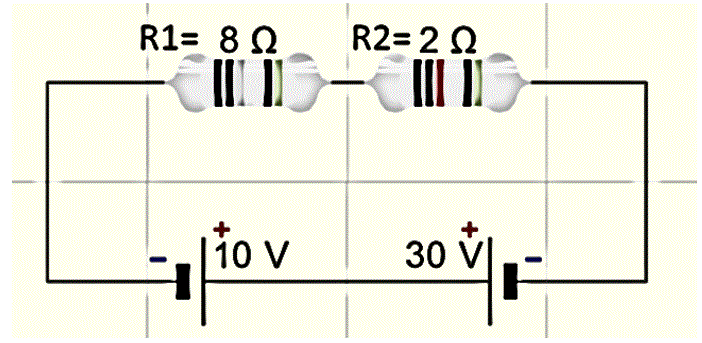
\(I_1=2\,A\,,\,I_2=2\,A\)
\(I_1=1\,A\,,\,I_2=4\,A\)
\(I_1=1\,A\,,\,I_2=4\,A\)
\(I_1=1\,A\,,\,I_2=1\,A\)
الحلSolution
📌 حلقة واحدة ⟹ نفس التيار في كل عناصرها: بما أن \(R_1,R_2\) على التوالي في نفس الحلقة، \(I_1=I_2\) حتمًا — وهذا يستبعد فورًا كل الخيارات التي تُعطي قيمتين مختلفتين.
📌 قطبا البطاريتين متقابلان (+ يواجه +): فتتعارضان، والقوة المحركة الصافية \(=30-10=20\,V\)
📌 التيار: \(I=\dfrac{20}{R_1+R_2}=\dfrac{20}{8+2}=2\,A\)
✅ \(I_1=I_2=2\,A\)
📌 Single loop ⟹ same current everywhere: since \(R_1,R_2\) are in series in the same loop, \(I_1=I_2\) necessarily — this immediately rules out any option giving different values.
📌 The batteries' + terminals face each other: so they oppose, net EMF \(=30-10=20\,V\)
📌 Current: \(I=\dfrac{20}{R_1+R_2}=\dfrac{20}{8+2}=2\,A\)
✅ \(I_1=I_2=2\,A\)
\[17\,\star\star\star\]
جهاز الفولتميتر يقيس فرق الجهد ويُوصَل على التوازي في الدائرة. لزيادة مدى الفولتميتر في القياس، يُوصَلA voltmeter measures potential difference and is connected in parallel. To increase its measuring range, one connects
مقاومة صغيرة على التوازيa small resistance in parallel
مقاومة صغيرة على التواليa small resistance in series
مقاومة عالية القيمة على التواليa high-value resistance in series
مقاومة عالية القيمة على التوازيa high-value resistance in parallel
الحلSolution
📌 الفكرة: لتوسيع مدى الفولتميتر، تُضاف مقاومة مضاعِفة (عالية القيمة) على التوالي معه، فتتحمل جزءًا أكبر من الجهد الكلي وتبقى قراءة الجلفانومتر الداخلي ضمن مداها.
✅ مقاومة عالية القيمة على التوالي
📌 Idea: to extend a voltmeter's range, a high-value multiplier resistor is added in series, so it takes on a larger share of the total voltage while the internal galvanometer stays within its range.
✅ A high-value resistance in series
\[18\,\star\]
جهاز الأميتر يقيس شدة التيار ويُوصَل على التوالي في الدائرة. لزيادة مدى الأميتر في القياس، يُوصَلAn ammeter measures current and is connected in series. To increase its measuring range, one connects
مقاومة صغيرة على التواليa small resistance in series
مقاومة صغيرة على التوازيa small resistance in parallel
مقاومة عالية القيمة على التوازيa high-value resistance in parallel
مقاومة عالية القيمة على التواليa high-value resistance in series
الحلSolution
📌 الفكرة: لتوسيع مدى الأميتر، تُضاف مقاومة تحويلية (شنت، صغيرة القيمة) على التوازي معه، فتحوّل معظم التيار الزائد بعيدًا عن الجلفانومتر الداخلي.
✅ مقاومة صغيرة على التوازي
📌 Idea: to extend an ammeter's range, a small-value shunt resistor is added in parallel, diverting most of the excess current away from the internal galvanometer.
✅ A small resistance in parallel
\[19\,\star\star\]
مكثف سعته \(C=6\,\mu F\) شُحن بالكامل ببطارية فرق جهدها \(V=18\,V\)، ثم يُفرَّغ عبر مقاوم \(R=1\,k\Omega\) متصل معه على التوالي. بعد زمن \(t=6\,ms\)، فإن النسبة المتبقية من شحنة المكثف (بالنسبة للشحنة الابتدائية) تعادل تقريبًاA capacitor \(C=6\,\mu F\) is fully charged by an \(V=18\,V\) battery, then discharges through \(R=1\,k\Omega\) in series. After \(t=6\,ms\), the fraction of the initial charge remaining is approximately

\(14\%\)
\(37\%\)
\(63\%\)
\(83\%\)
الحلSolution
📌 الزمن الثابت: \(\tau=RC=1000\times6\times10^{-6}=6\,ms\)، وبما أن \(t=6\,ms=\tau\) بالضبط:
📌 التفريغ: \(\dfrac{q(t)}{q_0}=e^{-t/\tau}=e^{-1}\approx0.37\) أي \(37\%\)
✅ \(\approx37\%\)
📌 Time constant: \(\tau=RC=1000\times6\times10^{-6}=6\,ms\), and since \(t=6\,ms=\tau\) exactly:
📌 Discharge: \(\dfrac{q(t)}{q_0}=e^{-t/\tau}=e^{-1}\approx0.37\), i.e. \(37\%\)
✅ \(\approx37\%\)
\[20\,\star\star\star\]
مكثف سعته \(20\,\mu F\) غير مشحون، وُصِل بمقاوم \(150\,\Omega\) على التوالي مع بطارية (نفس دائرة الشكل أعلاه، لكن بالشحن لا التفريغ). فإن النسبة المئوية لشحن المكثف بعد زمن \(t=3\,ms\) تعادلAn uncharged \(20\,\mu F\) capacitor is connected with a \(150\,\Omega\) resistor and battery in series (same circuit as above, but charging not discharging). The percentage of charge after \(t=3\,ms\) is
\(75\%\)
\(63\%\)
\(47\%\)
\(82\%\)
الحلSolution
📌 الزمن الثابت: \(\tau=RC=150\times20\times10^{-6}=3\,ms=t\)
📌 الشحن: \(\dfrac{q(t)}{q_0}=1-e^{-t/\tau}=1-e^{-1}\approx0.63\) أي \(63\%\)
✅ \(\approx63\%\)
📌 Time constant: \(\tau=RC=150\times20\times10^{-6}=3\,ms=t\)
📌 Charging: \(\dfrac{q(t)}{q_0}=1-e^{-t/\tau}=1-e^{-1}\approx0.63\), i.e. \(63\%\)
✅ \(\approx63\%\)
\[21\,\star\]
مغناطيسان وُضعا كما في الشكل. فإن اتجاه المجال المغناطيسي المحصّل عند النقطة \(O\) يكون نحوTwo magnets are placed as shown. The direction of the resultant magnetic field at point \(O\) is toward

\(\nearrow\) الشمال الشرقي Northeast
\(\rightarrow\) الشرق East
\(\nwarrow\) الشمال الغربي Northwest
\(\uparrow\) الشمال North
الحلSolution
📌 المغناطيس الرأسي (S أعلى، N أسفل): النقطة O تقع على خط استواء هذا المغناطيس تقريبًا، والمجال هناك يعاكس اتجاه العزم المغناطيسي (من S إلى N، أي للأسفل)، فيكون مساهمة هذا المغناطيس عند O نحو الأعلى.
📌 المغناطيس الأفقي (S يسار، N يمين): النقطة O تقع على امتداد محوره من جهة S، والمجال المحوري يوازي عزمه (من S إلى N، أي نحو اليمين)، فمساهمته عند O نحو الشرق.
📌 المحصّلة: مركّبة للأعلى + مركّبة نحو اليمين ⟹ الاتجاه المحصّل نحو الشمال الشرقي.
✅ الشمال الشرقي (↗)
📌 Vertical magnet (S top, N bottom): point O lies roughly on this magnet's equatorial line, where the field is antiparallel to the dipole moment (S→N, i.e. downward), so this magnet's contribution at O points upward.
📌 Horizontal magnet (S left, N right): point O lies along its axial extension on the S side, where the axial field is parallel to the moment (S→N, i.e. rightward), so its contribution at O points east.
📌 Resultant: an upward component + an eastward component ⟹ the resultant points northeast.
✅ Northeast (↗)
\[22\,\star\]
حلقة تيار دائرية نصف قطرها \(r=2\,cm\) تحمل تيارًا \(i=0.1\,A\)، وخاضعة لمجال مغناطيسي شدته \(B=0.5\,T\) يصنع زاوية \(30°\) مع العمود على مستوى الحلقة. فإن مقدار العزم المغناطيسي لثنائي القطب وعزم الدوران المؤثر يعادلانA circular current loop of radius \(r=2\,cm\) carries \(i=0.1\,A\) in a field \(B=0.5\,T\) making \(30°\) with the loop's normal. The magnetic dipole moment and torque are

\(\mu=5.23\times10^{-4}\,A\cdot m^2\,,\,\tau=4.6\times10^{-5}\,N\cdot m\)
\(\mu=2.15\times10^{-4}\,A\cdot m^2\,,\,\tau=2.3\times10^{-5}\,N\cdot m\)
\(\mu=3.86\times10^{-4}\,A\cdot m^2\,,\,\tau=1.8\times10^{-5}\,N\cdot m\)
\(\mu=1.25\times10^{-4}\,A\cdot m^2\,,\,\tau=3.1\times10^{-5}\,N\cdot m\)
الحلSolution
📌 العزم المغناطيسي: \(\mu=iA=i\pi r^2=0.1\times\pi(0.02)^2=0.1\times1.257\times10^{-3}\approx1.26\times10^{-4}\,A\cdot m^2\)
📌 عزم الدوران: \(\tau=\mu B\sin\theta=1.26\times10^{-4}\times0.5\times\sin30°=1.26\times10^{-4}\times0.5\times0.5\approx3.1\times10^{-5}\,N\cdot m\)
✅ \(\mu\approx1.25\times10^{-4}\,A\cdot m^2\,,\,\tau\approx3.1\times10^{-5}\,N\cdot m\)
📌 Magnetic moment: \(\mu=iA=i\pi r^2=0.1\times\pi(0.02)^2\approx1.26\times10^{-4}\,A\cdot m^2\)
📌 Torque: \(\tau=\mu B\sin\theta=1.26\times10^{-4}\times0.5\times\sin30°\approx3.1\times10^{-5}\,N\cdot m\)
✅ \(\mu\approx1.25\times10^{-4}\,A\cdot m^2\,,\,\tau\approx3.1\times10^{-5}\,N\cdot m\)
\[23\,\star\]
ملف يتكوّن من 100 حلقة مربعة الشكل طول ضلعها \(0.2\,m\)، يمر به تيار \(3\,A\)، وموضوع في مجال مغناطيسي شدته \(0.5\,T\). فإن الحد الأقصى لعزم الدوران يعادلA coil of 100 square turns, side \(0.2\,m\), carries \(3\,A\) in a field \(0.5\,T\). The maximum torque is
\(\tau_{max}=10\,N\cdot m\)
\(\tau_{max}=6\,N\cdot m\)
\(\tau_{max}=4\,N\cdot m\)
\(\tau_{max}=8\,N\cdot m\)
الحلSolution
📌 العزم الأقصى (عندما \(\theta=90°\)): \(\tau_{max}=NIAB=100\times3\times(0.2)^2\times0.5=100\times3\times0.04\times0.5=6\,N\cdot m\)
✅ \(\tau_{max}=6\,N\cdot m\)
📌 Maximum torque (at \(\theta=90°\)): \(\tau_{max}=NIAB=100\times3\times(0.2)^2\times0.5=6\,N\cdot m\)
✅ \(\tau_{max}=6\,N\cdot m\)
\[24\,\star\star\]
حلقة سلكية مربعة طول ضلعها \(20\,cm\) يمر بها تيار \(I\). حُسب المجال المغناطيسي الناتج في مركز الحلقة فكانت شدته \(B=0.4\,mT\) نحو خارج الصفحة. فإن مقدار واتجاه التيار المار في الحلقة يعادلانA square wire loop of side \(20\,cm\) carries current \(I\). The field at its center was found to be \(B=0.4\,mT\) out of the page. The magnitude and direction of the current are

\(i=50\sqrt2\approx70.7\,A\) عكس عقارب الساعة counterclockwise
\(i=50\,A\) عكس عقارب الساعة counterclockwise
\(i=100\,A\) مع عقارب الساعة clockwise
\(i=35.4\,A\) مع عقارب الساعة clockwise
الحلSolution
📌 مجال حلقة مربعة عند مركزها: كل ضلع طوله \(a=0.2\,m\) يبعد عن المركز مسافة عمودية \(d=a/2=0.1\,m\)، وبتطبيق قانون بيوسافار على قطعة منتهية الطول لكل ضلع (بزاويتَي \(45°\) من طرفَيه)، فإن مساهمة كل ضلع \(B_{side}=\dfrac{\mu_0 I}{4\pi d}\times2\sin45°=\dfrac{\mu_0 I\sqrt2}{2\pi a}\)
📌 مجموع الأضلاع الأربعة: \(B=4\times B_{side}=\dfrac{2\sqrt2\,\mu_0 I}{\pi a}\)
📌 حل من أجل \(I\): \(I=\dfrac{B\pi a}{2\sqrt2\,\mu_0}=\dfrac{4\times10^{-4}\times\pi\times0.2}{2\sqrt2\times4\pi\times10^{-7}}=\dfrac{100}{\sqrt2}=50\sqrt2\approx70.7\,A\)
📌 ملاحظة على خيارات المصدر الأصلي: القيمة \(50\,A\) الواردة في بعض المصادر تُحسَب لو عومل كل ضلع كسلك لا نهائي الطول (بإسقاط عامل الزاوية \(\sin45°\))، وهو تبسيط غير دقيق لضلع محدود الطول؛ القيمة الدقيقة عبر بيوسافار الكامل هي \(50\sqrt2\,A\).
📌 الاتجاه: بتطبيق قاعدة اليد اليمنى، تيار عكس عقارب الساعة (كما يراه القارئ) ينتج مجالًا خارج الصفحة في المركز — يطابق المعطى.
✅ \(i=50\sqrt2\approx70.7\,A\) عكس عقارب الساعة
📌 Field of a square loop at its center: each side of length \(a=0.2\,m\) is at perpendicular distance \(d=a/2=0.1\,m\) from the center; applying the finite-wire Biot–Savart law (with \(45°\) angles at each end), each side contributes \(B_{side}=\dfrac{\mu_0 I}{4\pi d}\times2\sin45°=\dfrac{\mu_0 I\sqrt2}{2\pi a}\)
📌 Summing all four sides: \(B=4\times B_{side}=\dfrac{2\sqrt2\,\mu_0 I}{\pi a}\)
📌 Solving for \(I\): \(I=\dfrac{B\pi a}{2\sqrt2\,\mu_0}=\dfrac{100}{\sqrt2}=50\sqrt2\approx70.7\,A\)
📌 Note on some sources' answer: the value \(50\,A\) sometimes quoted comes from treating each side as an infinite wire (dropping the \(\sin45°\) factor) — an inaccurate simplification for a finite side; the exact Biot–Savart result is \(50\sqrt2\,A\).
📌 Direction: by the right-hand rule, a counterclockwise current (as seen by the reader) produces a field out of the page at the center — matching the given data.
✅ \(i=50\sqrt2\approx70.7\,A\) counterclockwise
\[25\,\star\]
سلك طويل يمر به تيار كما في الشكل. فإن النسبة بين المجال عند النقطة \(a\) إلى المجال عند النقطة \(B\) تعادلA long current-carrying wire is shown. The ratio of the field at point \(a\) to that at point \(B\) is

\(\dfrac{B_a}{B_b}=9\)
\(\dfrac{B_a}{B_b}=4\)
\(\dfrac{B_a}{B_b}=3\)
\(\dfrac{B_a}{B_b}=2\)
الحلSolution
📌 مجال السلك الطويل: \(B\propto\dfrac{1}{d}\)، والنقطة \(a\) تبعد \(r\) بينما \(B\) تبعد \(r+2r=3r\)
📌 النسبة: \(\dfrac{B_a}{B_b}=\dfrac{d_B}{d_a}=\dfrac{3r}{r}=3\)
✅ \(3\)
📌 Long-wire field: \(B\propto\dfrac{1}{d}\), and point \(a\) is at \(r\) while \(B\) is at \(r+2r=3r\)
📌 Ratio: \(\dfrac{B_a}{B_b}=\dfrac{d_B}{d_a}=\dfrac{3r}{r}=3\)
✅ \(3\)
\[26\,\star\]
سلك عمودي على الورقة. حُسب المجال المغناطيسي عند نقطة تبعد عنه \(0.2\,m\) فكانت شدته \(4.0\times10^{-6}\,T\)، واتجاهه يوازي الورقة نحو الأعلى. فإن مقدار واتجاه التيار في السلك يساويانA wire is perpendicular to the page. The field at a point \(0.2\,m\) away was found to be \(4.0\times10^{-6}\,T\), directed upward in the plane of the page. The magnitude and direction of the current are

\(i=4\,A\) عمودي للداخل perpendicular, into the page
\(i=4\,A\) عمودي للخارج perpendicular, out of the page
\(i=2\,A\) عمودي للداخل perpendicular, into the page
\(i=2\,A\) عمودي للخارج perpendicular, out of the page
الحلSolution
📌 المقدار: \(I=\dfrac{2\pi d B}{\mu_0}=\dfrac{2\pi\times0.2\times4\times10^{-6}}{4\pi\times10^{-7}}=4\,A\)
📌 الاتجاه: بقاعدة اليد اليمنى، نقطة على يسار السلك يكون فيها المجال متجهًا للأعلى فقط إذا كان التيار داخلًا في الصفحة (بعيدًا عن القارئ).
✅ \(i=4\,A\) عمودي للداخل
📌 Magnitude: \(I=\dfrac{2\pi d B}{\mu_0}=\dfrac{2\pi\times0.2\times4\times10^{-6}}{4\pi\times10^{-7}}=4\,A\)
📌 Direction: by the right-hand rule, a point to the left of the wire has an upward field only if the current goes into the page (away from the reader).
✅ \(i=4\,A\) into the page
\[27\,\star\]
أي من الوحدات التالية يعادل وحدة قياس المجال المغناطيسي تسلا \((T)\) من حيث الوحدات الأساسية؟Which of the following is equivalent to the tesla \((T)\), the unit of magnetic field, in base SI units?
\(T=\dfrac{Kg\cdot m}{A\cdot s^2}\)
\(T=\dfrac{Kg\cdot m^2}{A\cdot s^2}\)
\(T=\dfrac{Kg\cdot m^2}{A\cdot s}\)
\(T=\dfrac{Kg}{A\cdot s^2}\)
الحلSolution
📌 من \(F=qvB\): \(B=\dfrac{F}{qv}\)، ووحدة \(F=Kg\cdot m/s^2\)، ووحدة \(qv=A\cdot s\times m/s=A\cdot m\)
📌 القسمة: \(T=\dfrac{Kg\cdot m/s^2}{A\cdot m}=\dfrac{Kg}{A\cdot s^2}\)
✅ \(T=\dfrac{Kg}{A\cdot s^2}\)
📌 From \(F=qvB\): \(B=\dfrac{F}{qv}\), with \(F\) in \(Kg\cdot m/s^2\) and \(qv\) in \(A\cdot s\times m/s=A\cdot m\)
📌 Dividing: \(T=\dfrac{Kg\cdot m/s^2}{A\cdot m}=\dfrac{Kg}{A\cdot s^2}\)
✅ \(T=\dfrac{Kg}{A\cdot s^2}\)
\[28\,\star\]
تعبر شحنة مقدارها \(q=15\,C\) مقطع سلك خلال زمن \(t=5\,s\). فإن شدة التيار المار في السلك تعادلA charge of \(q=15\,C\) crosses a wire's cross-section in \(t=5\,s\). The current is
\(I=3\,A\)
\(I=5\,A\)
\(I=0.33\,A\)
\(I=75\,A\)
الحلSolution
📌 القانون: \(I=\dfrac{q}{t}=\dfrac{15}{5}=3\,A\)
✅ \(I=3\,A\)
📌 Formula: \(I=\dfrac{q}{t}=\dfrac{15}{5}=3\,A\)
✅ \(I=3\,A\)
\[29\,\star\star\]
سلك دائري المقطع نصف قطره \(r=0.5\,mm\) يمر به تيار \(I=2\,A\). فإن كثافة التيار تعادلA wire of circular cross-section, radius \(r=0.5\,mm\), carries \(I=2\,A\). The current density is
\(J\approx2.55\times10^{6}\,A/m^2\)
\(J\approx1.27\times10^{6}\,A/m^2\)
\(J\approx5.09\times10^{6}\,A/m^2\)
\(J\approx6.37\times10^{5}\,A/m^2\)
الحلSolution
📌 المساحة: \(A=\pi r^2=\pi(5\times10^{-4})^2\approx7.854\times10^{-7}\,m^2\)
📌 الكثافة: \(J=\dfrac{I}{A}=\dfrac{2}{7.854\times10^{-7}}\approx2.55\times10^{6}\,A/m^2\)
✅ \(J\approx2.55\times10^{6}\,A/m^2\)
📌 Area: \(A=\pi r^2=\pi(5\times10^{-4})^2\approx7.854\times10^{-7}\,m^2\)
📌 Density: \(J=\dfrac{I}{A}=\dfrac{2}{7.854\times10^{-7}}\approx2.55\times10^{6}\,A/m^2\)
✅ \(J\approx2.55\times10^{6}\,A/m^2\)
\[30\,\star\]
سلك مقاومته النوعية \(\rho=1.7\times10^{-8}\,\Omega\cdot m\)، طوله \(L=50\,m\)، ومساحة مقطعه \(A=2\times10^{-6}\,m^2\). فإن مقاومة السلك تعادلA wire has resistivity \(\rho=1.7\times10^{-8}\,\Omega\cdot m\), length \(L=50\,m\), cross-section \(A=2\times10^{-6}\,m^2\). Its resistance is
\(R=0.425\,\Omega\)
\(R=1.7\,\Omega\)
\(R=0.085\,\Omega\)
\(R=4.25\,\Omega\)
الحلSolution
📌 القانون: \(R=\dfrac{\rho L}{A}=\dfrac{1.7\times10^{-8}\times50}{2\times10^{-6}}=\dfrac{8.5\times10^{-7}}{2\times10^{-6}}=0.425\,\Omega\)
✅ \(R=0.425\,\Omega\)
📌 Formula: \(R=\dfrac{\rho L}{A}=\dfrac{1.7\times10^{-8}\times50}{2\times10^{-6}}=0.425\,\Omega\)
✅ \(R=0.425\,\Omega\)
\[31\,\star\]
المقاومة النوعية \((\rho)\) لمادة موصل تعتمد بشكل أساسي علىA conductor's resistivity \((\rho)\) depends mainly on
طول السلك ومساحة مقطعهthe wire's length and cross-section area
نوع المادة ودرجة الحرارة فقطthe material type and temperature only
شدة التيار المار فيهthe current flowing through it
فرق الجهد المطبَّق عليهthe applied voltage
الحلSolution
📌 الفكرة: المقاومة النوعية \(\rho\) خاصية جوهرية للمادة نفسها (تعتمد على تركيبها الذرّي ودرجة الحرارة)، بخلاف المقاومة \(R=\rho L/A\) التي تعتمد أيضًا على الأبعاد الهندسية.
✅ نوع المادة ودرجة الحرارة فقط
📌 Idea: resistivity \(\rho\) is an intrinsic material property (depending on atomic structure and temperature), unlike resistance \(R=\rho L/A\), which also depends on geometric dimensions.
✅ Material type and temperature only
\[32\,\star\]
دائرة كهربائية تحوي مقاومة \(R=25\,\Omega\) موصولة ببطارية جهدها \(V=100\,V\). فإن شدة التيار المار تعادلA circuit has \(R=25\,\Omega\) connected to a \(V=100\,V\) battery. The current is
\(I=4\,A\)
\(I=25\,A\)
\(I=0.25\,A\)
\(I=2500\,A\)
الحلSolution
📌 قانون أوم: \(I=\dfrac{V}{R}=\dfrac{100}{25}=4\,A\)
✅ \(I=4\,A\)
📌 Ohm's law: \(I=\dfrac{V}{R}=\dfrac{100}{25}=4\,A\)
✅ \(I=4\,A\)
\[33\,\star\]
ثلاث مقاومات على التوالي \(R_1=4\,\Omega\)، \(R_2=6\,\Omega\)، \(R_3=10\,\Omega\)، متصلة ببطارية جهدها \(40\,V\). فإن شدة التيار المار في الدائرة تعادلThree series resistors \(R_1=4\,\Omega\), \(R_2=6\,\Omega\), \(R_3=10\,\Omega\) connect to a \(40\,V\) battery. The circuit current is
\(I=2\,A\)
\(I=4\,A\)
\(I=0.5\,A\)
\(I=20\,A\)
الحلSolution
📌 المقاومة الكلية: \(R_{tot}=4+6+10=20\,\Omega\)
📌 التيار: \(I=\dfrac{40}{20}=2\,A\)
✅ \(I=2\,A\)
📌 Total resistance: \(R_{tot}=4+6+10=20\,\Omega\)
📌 Current: \(I=\dfrac{40}{20}=2\,A\)
✅ \(I=2\,A\)
\[34\,\star\]
مقاومتان على التوازي \(R_1=12\,\Omega\)، \(R_2=4\,\Omega\). فإن المقاومة المكافئة تعادلTwo parallel resistors \(R_1=12\,\Omega\), \(R_2=4\,\Omega\). The equivalent resistance is
\(R_{eq}=3\,\Omega\)
\(R_{eq}=8\,\Omega\)
\(R_{eq}=16\,\Omega\)
\(R_{eq}=48\,\Omega\)
الحلSolution
📌 التوازي: \(\dfrac{1}{R_{eq}}=\dfrac{1}{12}+\dfrac{1}{4}=\dfrac{1}{12}+\dfrac{3}{12}=\dfrac{4}{12}=\dfrac{1}{3}\Rightarrow R_{eq}=3\,\Omega\)
✅ \(R_{eq}=3\,\Omega\)
📌 Parallel: \(\dfrac{1}{R_{eq}}=\dfrac{1}{12}+\dfrac{1}{4}=\dfrac{1}{3}\Rightarrow R_{eq}=3\,\Omega\)
✅ \(R_{eq}=3\,\Omega\)
\[35\,\star\]
عند نقطة تفرّع في دائرة كهربائية، يدخل تياران أحدهما \(I_1=7\,A\) والآخر \(I_2=5\,A\)، بينما يخرج منها تياران فقط أحدهما \(I_3=8\,A\). فإن التيار الثاني الخارج \(I_4\) يعادلAt a circuit junction, two currents enter, \(I_1=7\,A\) and \(I_2=5\,A\), while two leave, one being \(I_3=8\,A\). The other outgoing current \(I_4\) is
\(I_4=4\,A\)
\(I_4=12\,A\)
\(I_4=20\,A\)
\(I_4=8\,A\)
الحلSolution
📌 كيرشوف الأول: \(I_1+I_2=I_3+I_4\Rightarrow7+5=8+I_4\Rightarrow12=8+I_4\Rightarrow I_4=4\,A\)
✅ \(I_4=4\,A\)
📌 Kirchhoff's first law: \(I_1+I_2=I_3+I_4\Rightarrow7+5=8+I_4\Rightarrow I_4=4\,A\)
✅ \(I_4=4\,A\)
\[36\,\star\star\]
دائرة على شكل حلقة واحدة تحتوي على بطاريتين متعاكستَي القطبية، قوّتاهما المحرّكتان \(E_1=15\,V\) و\(E_2=5\,V\) (بلا مقاومة داخلية)، ومقاومتين على التوالي \(R_1=3\,\Omega\)، \(R_2=2\,\Omega\). فإن شدة التيار المار في الدائرة تعادلA single-loop circuit has two opposing batteries \(E_1=15\,V\), \(E_2=5\,V\) (no internal resistance) and two series resistors \(R_1=3\,\Omega\), \(R_2=2\,\Omega\). The circuit current is
\(I=2\,A\)
\(I=4\,A\)
\(I=10\,A\)
\(I=0.5\,A\)
الحلSolution
📌 القوة المحركة الصافية: بما أن البطاريتين متعاكستان، \(E_{net}=E_1-E_2=15-5=10\,V\)
📌 التيار: \(I=\dfrac{E_{net}}{R_1+R_2}=\dfrac{10}{3+2}=2\,A\)
✅ \(I=2\,A\)
📌 Net EMF: since the batteries oppose, \(E_{net}=E_1-E_2=15-5=10\,V\)
📌 Current: \(I=\dfrac{E_{net}}{R_1+R_2}=\dfrac{10}{3+2}=2\,A\)
✅ \(I=2\,A\)
\[37\,\star\]
مصباح كهربائي مقاومته \(R=50\,\Omega\) يمر به تيار \(I=0.4\,A\). فإن القدرة المستهلكة في المصباح تعادلA lamp of resistance \(R=50\,\Omega\) carries \(I=0.4\,A\). The power consumed is
\(P=8\,W\)
\(P=20\,W\)
\(P=200\,W\)
\(P=0.008\,W\)
الحلSolution
📌 القانون: \(P=I^2R=(0.4)^2\times50=0.16\times50=8\,W\)
✅ \(P=8\,W\)
📌 Formula: \(P=I^2R=(0.4)^2\times50=8\,W\)
✅ \(P=8\,W\)
\[38\,\star\]
مكثف سعته \(C=4\,\mu F\) يُشحن ببطارية جهدها \(12\,V\) عبر مقاوم \(R=2\,k\Omega\). بعد زمن يساوي الزمن الثابت للدائرة \((\tau=RC)\) بالضبط، فإن النسبة المئوية من الشحنة الكلية التي اكتسبها المكثف تعادل تقريبًاA capacitor \(C=4\,\mu F\) charges through \(R=2\,k\Omega\). After exactly one time constant \((\tau=RC)\), the percentage of full charge acquired is approximately
\(63\%\)
\(37\%\)
\(50\%\)
\(100\%\)
الحلSolution
📌 عند \(t=\tau\): \(\dfrac{q(t)}{q_0}=1-e^{-t/\tau}=1-e^{-1}\approx0.63\), أي \(63\%\) — هذه نتيجة عامة لا تعتمد على قيمتَي \(R,C\) تحديدًا، بل على شرط \(t=\tau\) فقط.
✅ \(\approx63\%\)
📌 At \(t=\tau\): \(\dfrac{q(t)}{q_0}=1-e^{-1}\approx0.63\), i.e. \(63\%\) — a general result independent of the specific \(R,C\) values, depending only on \(t=\tau\).
✅ \(\approx63\%\)
\[39\,\star\star\]
شحنة موجبة تتحرك بسرعة \(v\) نحو الشرق، ضمن مجال مغناطيسي منتظم \(B\) متجه نحو الشمال. فإن اتجاه القوة المغناطيسية المؤثرة على الشحنة يكونA positive charge moves east with speed \(v\) in a uniform magnetic field \(B\) pointing north. The direction of the magnetic force on the charge is
نحو الأعلى (خارجًا من مستوى الأرض)upward (out of the ground plane)
نحو الأسفلdownward
نحو الشرقeast
نحو الشمالnorth
الحلSolution
📌 قاعدة اليد اليمنى: \(\vec F=q\vec v\times\vec B\). بالنظر من الأعلى (شرق=\(\hat x\)، شمال=\(\hat y\))، فإن \(\hat x\times\hat y=\hat z\) (خارج مستوى الأرض، أي للأعلى).
📌 الشحنة موجبة: فتكون القوة في نفس اتجاه \(\vec v\times\vec B\)، أي للأعلى.
✅ نحو الأعلى
📌 Right-hand rule: \(\vec F=q\vec v\times\vec B\). Viewed from above (east=\(\hat x\), north=\(\hat y\)), \(\hat x\times\hat y=\hat z\) (out of the ground plane, i.e. upward).
📌 Positive charge: so the force is along \(\vec v\times\vec B\), i.e. upward.
✅ Upward
\[40\,\star\]
سلك مستقيم طوله \(L=0.4\,m\) يحمل تيارًا \(I=5\,A\)، موضوع بشكل عمودي تمامًا على مجال مغناطيسي منتظم \(B=0.3\,T\). فإن مقدار القوة المغناطيسية المؤثرة على السلك تعادلA straight wire of length \(L=0.4\,m\) carries \(I=5\,A\), perpendicular to a uniform field \(B=0.3\,T\). The magnetic force on the wire is
\(F=0.6\,N\)
\(F=6\,N\)
\(F=0.06\,N\)
\(F=1.5\,N\)
الحلSolution
📌 القانون (عمودي، \(\sin90°=1\)): \(F=BIL=0.3\times5\times0.4=0.6\,N\)
✅ \(F=0.6\,N\)
📌 Formula (perpendicular, \(\sin90°=1\)): \(F=BIL=0.3\times5\times0.4=0.6\,N\)
✅ \(F=0.6\,N\)
\[41\,\star\]
سلك طويل مستقيم يمر به تيار \(I=15\,A\). فإن شدة المجال المغناطيسي الناتج عند نقطة تبعد \(d=0.06\,m\) عن السلك تعادلA long straight wire carries \(I=15\,A\). The magnetic field at a point \(d=0.06\,m\) away is
\(B=5\times10^{-5}\,T\)
\(B=2.5\times10^{-5}\,T\)
\(B=1\times10^{-4}\,T\)
\(B=5\times10^{-4}\,T\)
الحلSolution
📌 قانون السلك الطويل: \(B=\dfrac{\mu_0 I}{2\pi d}=\dfrac{4\pi\times10^{-7}\times15}{2\pi\times0.06}=\dfrac{2\times10^{-7}\times15}{0.06}=5\times10^{-5}\,T\)
✅ \(B=5\times10^{-5}\,T\)
📌 Long-wire formula: \(B=\dfrac{\mu_0 I}{2\pi d}=\dfrac{4\pi\times10^{-7}\times15}{2\pi\times0.06}=5\times10^{-5}\,T\)
✅ \(B=5\times10^{-5}\,T\)
\[42\,\star\star\]
ملف دائري عدد لفاته \(N=50\)، مساحة كل لفة \(A=0.02\,m^2\)، يمر به تيار \(I=1.5\,A\)، وموضوع في مجال مغناطيسي \(B=0.8\,T\) بحيث يكون العمود على مستوى الملف موازيًا تمامًا للمجال (الزاوية بينهما تساوي صفرًا). فإن عزم الدوران المؤثر في الملف يعادلA coil of \(N=50\) turns, each of area \(A=0.02\,m^2\), carries \(I=1.5\,A\) in a field \(B=0.8\,T\), with the coil's normal exactly parallel to \(B\) (angle between them is zero). The torque on the coil is
\(\tau=0\)
\(\tau=1.2\,N\cdot m\)
\(\tau=0.024\,N\cdot m\)
\(\tau=2.4\,N\cdot m\)
الحلSolution
📌 القانون: \(\tau=NIAB\sin\theta\)، والزاوية بين الناظم والمجال هنا \(\theta=0°\)، لذا \(\sin0°=0\)
📌 النتيجة: \(\tau=NIAB\times0=0\) — هذا وضع الاتزان المستقر للملف (مستواه عمودي تمامًا على المجال).
📌 ملاحظة على الخيار الشائع: القيمة \(1.2\,N\cdot m\) هي حاصل \(NIAB\) نفسه، وتُستخدَم خطأً لو نُسي عامل \(\sin\theta\).
✅ \(\tau=0\)
📌 Formula: \(\tau=NIAB\sin\theta\), and here the angle between the normal and \(B\) is \(\theta=0°\), so \(\sin0°=0\)
📌 Result: \(\tau=NIAB\times0=0\) — this is the coil's stable equilibrium orientation (its plane perpendicular to \(B\)).
📌 Note on a common distractor: \(1.2\,N\cdot m\) is simply \(NIAB\) itself, mistakenly used if the \(\sin\theta\) factor is forgotten.
✅ \(\tau=0\)
المسألة 1Problem 1
المقاومة أداة تعمل على ممانعة مرور التيار الكهربائي، ولها أنواع مختلفة. (أ) حدّد نوع المقاومة الذي يمثله كل من الخطوط البيانية الثلاثة أدناه (R مقابل T). (ب) قام طالب بدراسة العلاقة بين شدة التيار وفرق الجهد لمقاوم أومي وصمام ثنائي (دايود)، وسجّل بيانات كل منهما في جدول. ارسم الخط البياني I-V لكل منهما، واحسب مقاومة المقاوم الأومي من ميل الخط البياني. (ج) هل يمكن تطبيق قانون أوم على الصمام الثنائي؟ فسّر إجابتك.A resistor opposes current flow, and comes in different types. (a) Identify the resistor type represented by each of the three R–T graphs below. (b) A student studied current vs. voltage for an ohmic resistor and a diode, tabulating the data for each. Sketch the I–V graph for each, and compute the ohmic resistor's resistance from the graph's slope. (c) Can Ohm's law be applied to the diode? Explain.


الحلSolution
📌 (أ) تحديد الأنواع: الخط الهابط (R تقل مع T) ⟵ الثيرمستور (NTC). الخط الصاعد بشدة (منحنٍ حاد) ⟵ المصباح (فتيلة معدنية، مقاومتها تزداد كثيرًا مع الحرارة). الخط المستقيم الصاعد بلطف ⟵ المقاوم الأومي (مقاومته شبه ثابتة، تزداد قليلًا فقط مع الحرارة).
📌 (ب) المقاوم الأومي: من الجدول، الميل \(=\dfrac{\Delta I}{\Delta V}=\dfrac{0.6-0.3}{12-6}=\dfrac{0.3}{6}=0.05\,A/V\). المقاومة \(R=\dfrac{1}{\text{الميل}}=\dfrac{1}{0.05}=20\,\Omega\). الخط البياني I-V للمقاوم الأومي خط مستقيم يمر بالأصل (علاقة خطية).
📌 الصمام الثنائي: الخط البياني I-V منحنٍ غير خطي (يبدأ بميل صغير جدًا قرب الصفر ثم يزداد الميل بشدة بعد حوالي \(0.7\,V\)).
📌 (ج) قانون أوم: لا يمكن تطبيقه على كامل الخط البياني للصمام الثنائي، لأن العلاقة بين الجهد والتيار ليست خطية عمومًا؛ لكن بعد حوالي \(0.7\,V\) يمكن اعتبار العلاقة تقريبًا خطية على مدى محدود.
✅ ثيرمستور، مصباح، مقاوم أومي (بالترتيب) | \(R_{ohmic}=20\,\Omega\) | قانون أوم لا ينطبق على كامل منحنى الصمام الثنائي
📌 (a) Identification: the decreasing curve (R drops with T) ⟶ thermistor (NTC). The sharply rising curve ⟶ lamp (metal filament, resistance rises strongly with heat). The gently rising straight line ⟶ ohmic resistor (nearly constant resistance, rising only slightly with temperature).
📌 (b) Ohmic resistor: from the table, slope \(=\dfrac{\Delta I}{\Delta V}=\dfrac{0.6-0.3}{12-6}=0.05\,A/V\). Resistance \(R=\dfrac{1}{\text{slope}}=20\,\Omega\). Its I-V graph is a straight line through the origin (linear relationship).
📌 Diode: its I-V graph is non-linear (very small slope near zero, then rising sharply past about \(0.7\,V\)).
📌 (c) Ohm's law: cannot be applied over the diode's entire curve, since the V-I relationship is not linear overall; but past about \(0.7\,V\) the relationship can be approximated as linear over a limited range.
✅ Thermistor, lamp, ohmic resistor (in order) | \(R_{ohmic}=20\,\Omega\) | Ohm's law does not apply over the diode's full curve
المسألة 2Problem 2
في الدائرة المركّبة أدناه، \(I_1=2.5\,A\) عبر \(R_A=8\,\Omega\)، ثم يتفرّع التيار إلى ثلاثة فروع متوازية: \(R_B=5\,\Omega\) (بتيار \(I_2=1.2\,A\))، \(R_C=6\,\Omega\) (بتيار \(I_3=1.0\,A\))، و\(R_D=7\,\Omega\) على التوالي مع \(R_E=?\)، ثم \(R_F=9\,\Omega\). أوجد قيمة \(R_E\) وقيمة جهد البطارية.In the compound circuit below, \(I_1=2.5\,A\) flows through \(R_A=8\,\Omega\), then splits into three parallel branches: \(R_B=5\,\Omega\) (current \(I_2=1.2\,A\)), \(R_C=6\,\Omega\) (current \(I_3=1.0\,A\)), and \(R_D=7\,\Omega\) in series with \(R_E=?\), then \(R_F=9\,\Omega\). Find \(R_E\) and the battery voltage.

الحلSolution
📌 جهد الفروع المتوازية: \(V_{parallel}=I_2R_B=1.2\times5=6\,V\) (يتحقق أيضًا بـ \(I_3R_C=1.0\times6=6\,V\))
📌 تيار الفرع الثالث: \(I_4=I_1-I_2-I_3=2.5-1.2-1.0=0.3\,A\)
📌 قيمة \(R_E\): \(R_D+R_E=\dfrac{V_{parallel}}{I_4}=\dfrac{6}{0.3}=20\,\Omega\Rightarrow R_E=20-7=13\,\Omega\)
📌 جهد البطارية: \(V=I_1R_A+V_{parallel}+I_1R_F=2.5\times8+6+2.5\times9=20+6+22.5=48.5\,V\)
✅ \(R_E=13\,\Omega\)، \(V=48.5\,V\)
📌 Voltage across the parallel section: \(V_{parallel}=I_2R_B=1.2\times5=6\,V\) (also confirmed by \(I_3R_C=6\,V\))
📌 Third branch's current: \(I_4=I_1-I_2-I_3=2.5-1.2-1.0=0.3\,A\)
📌 Value of \(R_E\): \(R_D+R_E=\dfrac{6}{0.3}=20\,\Omega\Rightarrow R_E=20-7=13\,\Omega\)
📌 Battery voltage: \(V=I_1R_A+V_{parallel}+I_1R_F=20+6+22.5=48.5\,V\)
✅ \(R_E=13\,\Omega\), \(V=48.5\,V\)
المسألة 3Problem 3
في الدائرة أدناه، قِيست شدة التيار المار في \(R_1=3\,\Omega\) فكانت \(I_1=0.8\,A\)، بينما \(R_2=6\,\Omega\) على التوازي معه، و\(R_3=4\,\Omega\) على التوالي مع المجموعة. احسب جهد المصدر.In the circuit below, the current through \(R_1=3\,\Omega\) was measured as \(I_1=0.8\,A\), with \(R_2=6\,\Omega\) in parallel, and \(R_3=4\,\Omega\) in series with the combination. Calculate the source voltage.

الحلSolution
📌 جهد الفرع المتوازي: \(V_{parallel}=I_1R_1=0.8\times3=2.4\,V\)
📌 تيار \(R_2\): \(I_2=\dfrac{V_{parallel}}{R_2}=\dfrac{2.4}{6}=0.4\,A\)
📌 التيار الكلي (عبر \(R_3\)): \(I=I_1+I_2=0.8+0.4=1.2\,A\)
📌 جهد المصدر: \(V=V_{parallel}+IR_3=2.4+1.2\times4=2.4+4.8=7.2\,V\)
✅ \(V=7.2\,V\)
📌 Parallel-section voltage: \(V_{parallel}=I_1R_1=0.8\times3=2.4\,V\)
📌 Current through \(R_2\): \(I_2=\dfrac{2.4}{6}=0.4\,A\)
📌 Total current (through \(R_3\)): \(I=I_1+I_2=1.2\,A\)
📌 Source voltage: \(V=V_{parallel}+IR_3=2.4+4.8=7.2\,V\)
✅ \(V=7.2\,V\)
المسألة 4Problem 4
في الدائرة أدناه ثلاثة فروع متوازية بين نفس النقطتين: فرع فيه \(R=2.5\,\Omega\) على التوالي مع بطارية \(18.0\,V\)، فرع فيه \(R=6.0\,\Omega\) فقط، وفرع فيه بطارية \(45.0\,V\) على التوالي مع \(R=3.0\,\Omega\) (وتيار هذا الفرع معلوم \(i=6.77\,A\)). احسب شدة التيار المار في المقاوم \(R=2.5\,\Omega\)، ثم احسب القدرة المصروفة في المقاوم \(R=6.0\,\Omega\).Three parallel branches connect the same two nodes: one with \(R=2.5\,\Omega\) in series with an \(18.0\,V\) battery, one with just \(R=6.0\,\Omega\), and one with a \(45.0\,V\) battery in series with \(R=3.0\,\Omega\) (this branch's current is given, \(i=6.77\,A\)). Find the current through \(R=2.5\,\Omega\), then the power dissipated in \(R=6.0\,\Omega\).

الحلSolution
📌 طريقة جهد العقدة: لتكن \(V\) فرق الجهد بين العقدتين المشتركتين. من فرع 2.5Ω: \(V=2.5I_A+18\). من فرع 6Ω: \(V=6I_B\).
📌 حفظ التيار عند العقدة: التيار الداخل من فرع 45V (المعطى \(6.77\,A\)) يساوي مجموع الخارجَين: \(I_A+I_B=6.77\)
📌 الحل: بالتعويض: \(\dfrac{V-18}{2.5}+\dfrac{V}{6}=6.77\Rightarrow17V=419.1\Rightarrow V\approx24.65\,V\)
📌 النتائج: \(I_A=\dfrac{24.65-18}{2.5}\approx2.66\,A\)، \(I_B=\dfrac{24.65}{6}\approx4.11\,A\)
📌 القدرة في 6Ω: \(P=I_B^2\times6\approx(4.11)^2\times6\approx101.3\,W\)
✅ \(I(2.5\Omega)\approx2.66\,A\)، \(P(6\Omega)\approx101.3\,W\)
📌 Node-voltage method: let \(V\) be the voltage between the shared nodes. From the 2.5Ω branch: \(V=2.5I_A+18\). From the 6Ω branch: \(V=6I_B\).
📌 Current conservation at the node: the current entering from the 45V branch (given \(6.77\,A\)) equals the sum leaving: \(I_A+I_B=6.77\)
📌 Solve: substituting: \(17V=419.1\Rightarrow V\approx24.65\,V\)
📌 Results: \(I_A\approx2.66\,A\), \(I_B\approx4.11\,A\)
📌 Power in 6Ω: \(P=I_B^2\times6\approx101.3\,W\)
✅ \(I(2.5\Omega)\approx2.66\,A\), \(P(6\Omega)\approx101.3\,W\)
المسألة 5Problem 5
تتكون الدائرة الكهربائية من أربعة مقاومات كما في الشكل أدناه: \(R_1=8\,\Omega\) و\(R_2=8\,\Omega\) على التوازي، على التوالي مع \(R_3=3\,\Omega\) و\(R_4=5\,\Omega\)، وبطاريتان \(6\,V\) و\(12\,V\) بحيث يواجه قطباهما الموجبان جهة مجموعة \(R_1\|R_2\). احسب شدة التيار المار في كل مقاومة.The circuit has four resistors as shown: \(R_1=8\,\Omega\) and \(R_2=8\,\Omega\) in parallel, in series with \(R_3=3\,\Omega\) and \(R_4=5\,\Omega\), and two batteries \(6\,V\) and \(12\,V\) whose positive terminals both face the \(R_1\|R_2\) side. Find the current through each resistor.

الحلSolution
📌 قطبا البطاريتين الموجبان متقابلان (كلاهما يواجه جهة R1∥R2): فتتعارضان؛ القوة المحركة الصافية \(=12-6=6\,V\) (تقود التيار باتجاه البطارية الأكبر، 12V).
📌 المقاومة الكلية: \(R_{1\|2}+R_3+R_4=4+3+5=12\,\Omega\)
📌 التيار الكلي (عبر R3، R4): \(I=\dfrac{6}{12}=0.5\,A\)
📌 توزيع التيار على R1، R2 (متساويان): \(I_1=I_2=\dfrac{0.5}{2}=0.25\,A\)
✅ \(I_1=I_2=0.25\,A\)، \(I_3=I_4=0.5\,A\)
📌 Both batteries' + terminals face the R1∥R2 side: so they oppose; net EMF \(=12-6=6\,V\) (driving current toward the larger, 12V, battery).
📌 Total resistance: \(R_{1\|2}+R_3+R_4=4+3+5=12\,\Omega\)
📌 Total current (through R3, R4): \(I=\dfrac{6}{12}=0.5\,A\)
📌 Splitting between equal R1, R2: \(I_1=I_2=0.25\,A\)
✅ \(I_1=I_2=0.25\,A\), \(I_3=I_4=0.5\,A\)
المسألة 6Problem 6
في الدائرة المركّبة أدناه: \(R_2=10\,\Omega\) على التوالي مع بطارية \(10\,V\) (فرع علوي)، \(R_3=15\,\Omega\) على التوالي مع \(R_4=40\,\Omega\) (فرع أوسط)، وكلاهما على التوازي بين نفس العقدتين؛ وفرع ثالث (جذعي) فيه بطارية \(30\,V\) على التوالي مع \(R_1=?\)، بتيار معلوم \(I_1=0.56\,A\). احسب فرق الجهد بين طرفي \(R_2\)، ثم قيمة \(R_1\).In the compound circuit below: \(R_2=10\,\Omega\) in series with a \(10\,V\) battery (top branch), \(R_3=15\,\Omega\) in series with \(R_4=40\,\Omega\) (middle branch), both in parallel between the same two nodes; and a third (trunk) branch with a \(30\,V\) battery in series with \(R_1=?\), carrying a known current \(I_1=0.56\,A\). Find the voltage across \(R_2\), then \(R_1\).

الحلSolution
📌 طريقة جهد العقدة: بأخذ عقدة اليمين مرجعًا (0V)، وعقدة اليسار بجهد \(x\): فرع \(R_2\): \(I_{top}=\dfrac{x-10}{10}\). فرع \(R_3+R_4\): \(I_{mid}=\dfrac{x}{55}\)
📌 حفظ التيار: \(I_1=I_{top}+I_{mid}\Rightarrow0.56=\dfrac{x-10}{10}+\dfrac{x}{55}\Rightarrow13x=171.6\Rightarrow x=13.2\,V\)
📌 تيار فرع \(R_2\): \(I_{top}=\dfrac{13.2-10}{10}=0.32\,A\)
📌 فرق الجهد بين طرفي \(R_2\) (المقاومة وحدها): \(V_2=I_{top}\times R_2=0.32\times10=3.2\,V\)
📌 قيمة \(R_1\): من حلقة الفرع الجذعي: \(0-0.56R_1+30=13.2\Rightarrow R_1=\dfrac{30-13.2}{0.56}=30\,\Omega\)
✅ \(V_2=3.2\,V\)، \(R_1=30\,\Omega\)
📌 Node-voltage method: taking the right node as reference (0V), left node at \(x\): \(R_2\) branch: \(I_{top}=\dfrac{x-10}{10}\). \(R_3+R_4\) branch: \(I_{mid}=\dfrac{x}{55}\)
📌 Current conservation: \(0.56=\dfrac{x-10}{10}+\dfrac{x}{55}\Rightarrow x=13.2\,V\)
📌 Current through \(R_2\) branch: \(I_{top}=0.32\,A\)
📌 Voltage across \(R_2\) alone: \(V_2=0.32\times10=3.2\,V\)
📌 Value of \(R_1\): from the trunk branch's loop: \(R_1=\dfrac{30-13.2}{0.56}=30\,\Omega\)
✅ \(V_2=3.2\,V\), \(R_1=30\,\Omega\)
المسألة 7Problem 7
جسيم مشحون بشحنة موجبة، كتلته \(m=6\times10^{-8}\,kg\)، سرعته \(v=6\times10^4\,m/s\)، شحنته \(q=0.005\,C\)، يدخل بشكل عمودي على مجال مغناطيسي منتظم \(B=0.2\,T\) خارج الصفحة. احسب العجلة المركزية للجسيم، ونصف قطر مساره الدائري، وارسم (صف) اتجاه المسار.A positive charge with \(m=6\times10^{-8}\,kg\), \(v=6\times10^4\,m/s\), \(q=0.005\,C\), enters perpendicular to a uniform field \(B=0.2\,T\) out of the page. Find the particle's centripetal acceleration, the radius of its circular path, and describe the path's direction.

الحلSolution
📌 القوة المغناطيسية = القوة المركزية: \(qvB=ma_c\Rightarrow a_c=\dfrac{qvB}{m}=\dfrac{0.005\times6\times10^4\times0.2}{6\times10^{-8}}=\dfrac{60}{6\times10^{-8}}=1\times10^{9}\,m/s^2\)
📌 نصف القطر: \(r=\dfrac{mv}{qB}=\dfrac{6\times10^{-8}\times6\times10^4}{0.005\times0.2}=\dfrac{3.6\times10^{-3}}{10^{-3}}=3.6\,m\)
📌 اتجاه المسار: بتطبيق \(\vec F=q\vec v\times\vec B\) (شحنة موجبة تتحرك للأعلى، مجال خارج الصفحة)، القوة الابتدائية تدفع الجسيم نحو اليمين، فيبدأ بالانحناء في مسار دائري باتجاه عقارب الساعة.
✅ \(a_c=1\times10^9\,m/s^2\)، \(r=3.6\,m\)، مسار دائري مع عقارب الساعة
📌 Magnetic force = centripetal force: \(a_c=\dfrac{qvB}{m}=1\times10^{9}\,m/s^2\)
📌 Radius: \(r=\dfrac{mv}{qB}=3.6\,m\)
📌 Path direction: applying \(\vec F=q\vec v\times\vec B\) (positive charge moving upward, field out of the page), the initial force pushes the particle to the right, so it curves into a clockwise circular path.
✅ \(a_c=1\times10^9\,m/s^2\), \(r=3.6\,m\), clockwise circular path
المسألة 8Problem 8
جسيم مشحون داخل مجال مغناطيسي منتظم يتحرك في مسار دائري نصف قطره \(r=0.2\,m\)، عكس عقارب الساعة، بشحنة \(q=-5\times10^{-6}\,C\)، كتلة \(m=4.5\times10^{-12}\,kg\)، وسرعة \(v=8\times10^4\,m/s\). احسب القوة المغناطيسية المؤثرة على الجسيم وحدد اتجاهها، ثم احسب المجال المغناطيسي وحدد اتجاهه.A charged particle moves in a circular path of radius \(r=0.2\,m\), counterclockwise, in a uniform magnetic field, with \(q=-5\times10^{-6}\,C\), \(m=4.5\times10^{-12}\,kg\), \(v=8\times10^4\,m/s\). Find the magnetic force on the particle and its direction, then the magnetic field and its direction.

الحلSolution
📌 القوة المركزية (=القوة المغناطيسية): \(F=\dfrac{mv^2}{r}=\dfrac{4.5\times10^{-12}\times(8\times10^4)^2}{0.2}=\dfrac{4.5\times10^{-12}\times6.4\times10^9}{0.2}=\dfrac{0.0288}{0.2}=0.144\,N\)
📌 اتجاه القوة: القوة المركزية تتجه دائمًا من موقع الجسيم نحو مركز الدائرة.
📌 المجال المغناطيسي: \(B=\dfrac{mv}{|q|r}=\dfrac{4.5\times10^{-12}\times8\times10^4}{5\times10^{-6}\times0.2}=\dfrac{3.6\times10^{-7}}{10^{-6}}=0.36\,T\)
📌 اتجاه المجال: بما أن الشحنة سالبة والحركة عكس عقارب الساعة، فتطبيق \(\vec F=q\vec v\times\vec B\) يعطي أن المجال يجب أن يتجه خارج الصفحة (نحو القارئ) ليُنتج قوة مركزية صحيحة الاتجاه.
✅ \(F=0.144\,N\) (نحو المركز)، \(B=0.36\,T\) خارج الصفحة
📌 Centripetal force (=magnetic force): \(F=\dfrac{mv^2}{r}=0.144\,N\)
📌 Force direction: centripetal force always points from the particle toward the circle's center.
📌 Magnetic field: \(B=\dfrac{mv}{|q|r}=0.36\,T\)
📌 Field direction: since the charge is negative and the motion is counterclockwise, applying \(\vec F=q\vec v\times\vec B\) shows the field must point out of the page (toward the reader) to produce a correctly-directed centripetal force.
✅ \(F=0.144\,N\) (toward center), \(B=0.36\,T\) out of the page
لاحظت خطأ؟ أو عندك سؤال عن التجربة؟ اكتبه بالتعليقات وحدد مكانه بالضبط.
Noticed an error? Or have a question? Write it in the comments and specify exactly where.