🎯 نواتج التعلم
🎯 Learning Outcomes
بعد دراسة هذا الدرس ستكون قادرًا على أن:
After this lesson you will be able to:
- تكتب الأعداد الكبيرة والصغيرة بالترميز العلمي.Write very large and very small numbers in scientific notation.
- تحدد الأرقام المعنوية وتطبّق قواعدها في الضرب والقسمة والجمع والطرح.Identify significant figures and apply their rules in multiplication, division, addition and subtraction.
- تستخدم البادئات ومعامل التحويل لتحويل الوحدات (طول وكتلة وزمن).Use prefixes and the conversion factor to convert units (length, mass, time).
- تمثّل المتجهات في بعدين وثلاثة أبعاد وتحللها وتجمعها وتطرحها.Represent vectors in two and three dimensions and resolve, add and subtract them.
- تحسب الضرب القياسي والضرب الاتجاهي لمتجهين.Calculate the dot and cross products of two vectors.
🔢 الترميز العلمي
🔢 Scientific Notation
طُوّر الترميز العلمي لتمثيل الأعداد الكبيرة جدًا أو الصغيرة جدًا بسهولة. فكتلة الأرض تقريبًا \(5972000000000000000000000\ \mathrm{kg}\) أي \(5.972\times1\,000\,000\,000\,000\,000\,000\,000\,000\)؛ والعدد المزعج هو \(1\) متبوعًا بأربعة وعشرين صفرًا، وهو حاصل ضرب \(10\) في نفسه \(24\) مرة أي \(10^{24}\).
Scientific notation was developed to represent very large or very small numbers easily. The Earth’s mass is roughly \(5972000000000000000000000\ \mathrm{kg}\), i.e. \(5.972\times1\,000\,000\,000\,000\,000\,000\,000\,000\); the awkward number is \(1\) followed by twenty-four zeros, which is \(10\) multiplied by itself \(24\) times, i.e. \(10^{24}\).
📌 الترميز العلمي
📌 Scientific notation
\[m_{earth}=5.972\times10^{24}\ \mathrm{kg}\]
\[q_e=\frac{1.6}{10^{19}}=1.6\times10^{-19}\ \mathrm C\]
\(10^{1}=10,\ 10^{2}=100,\ 10^{-1}=\tfrac1{10},\ 10^{-5}=\tfrac1{100000}\). الأس الموجب للأعداد الكبيرة والسالب للأعداد الصغيرة، ويُكتب العدد على الصورة \(a\times10^n\) حيث \(1\le a\lt 10\).
\(10^{1}=10,\ 10^{2}=100,\ 10^{-1}=\tfrac1{10},\ 10^{-5}=\tfrac1{100000}\). A positive exponent is for large numbers and a negative one for small numbers, and a number is written \(a\times10^n\) with \(1\le a\lt 10\).
🧪 جرّب بنفسك: الترميز العلمي
🧪 Try It Yourself: Scientific Notation
🧪 تجربة 1: الترميز العلمي
🧪 Experiment 1: Scientific Notation
اختر العدد \(a\) والأس \(n\) لترى العدد بالكتابة العادية وبالترميز العلمي \(a\times10^{n}\) وكم خانة تتحرك الفاصلة. الأزرار تضبط أمثلة من الفيزياء.
Choose the number \(a\) and the exponent \(n\) to see the number in ordinary and in scientific form \(a\times10^{n}\) and how many places the point moves. The buttons set examples from physics.
اكتب بالترميز العلمي: الضغط عند عمق البحر \(98700000\ \mathrm{Pa}\)، شحنة كرة \(0.0000007\ \mathrm C\)، سرعة الضوء \(300000000\ \mathrm{m/s}\)، نصف قطر الذرة \(0.0000000025\ \mathrm m\).
Write in scientific notation: the pressure at sea depth \(98700000\ \mathrm{Pa}\), the charge of a ball \(0.0000007\ \mathrm C\), the speed of light \(300000000\ \mathrm{m/s}\), the atomic radius \(0.0000000025\ \mathrm m\).
📐 الأرقام المعنوية
📐 Significant Figures
الأرقام المعنوية هي الأرقام القابلة للقياس بأجهزة القياس، وتشمل أرقامًا حقيقية (يتفق عليها جميع القارئين) ورقمًا واحدًا تقديريًا يختلف من قارئ لآخر. فطول القلم يُقاس بالمسطرة فهو رقم معنوي، أما عدد طلاب الصف فهو عدٌّ لا قياس فليس معنويًا.
Significant figures are the digits that can be measured with measuring instruments; they include certain digits (that all readers agree on) and one estimated digit that varies between readers. A pen’s length measured with a ruler is significant, whereas the number of students in a class is a count, not a measurement, so it is not significant.

طول القلم \(13.85\ \mathrm{cm}\): الرقمان \(13.8\) حقيقيان والرقم \(5\) تقديري.
The pen’s length is \(13.85\ \mathrm{cm}\): \(13.8\) are certain digits and \(5\) is estimated.
يُستخدم الجلفانوميتر لقياس شدة التيار. اقرأ التيار من الشكل واذكر عدد الأرقام المعنوية.
A galvanometer is used to measure current. Read the current from the figure and state the number of significant figures.
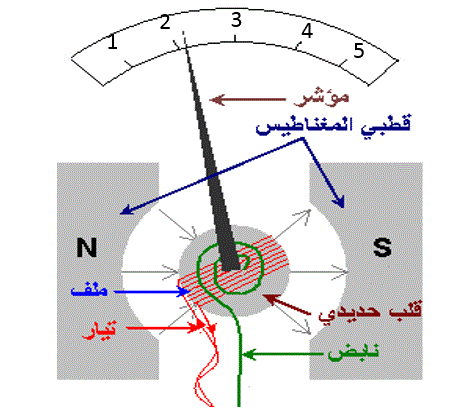
قراءة التيار \(2.3\) (رقمان معنويان).
The current reading \(2.3\) (two significant figures).
📋 قواعد الأرقام المعنوية
📋 Rules of Significant Figures
| القاعدةRule | المثالExample |
|---|---|
| 1) كل رقم غير صفري معنوي1) Every non-zero digit is significant | \(3.46\): ثلاثة أرقام\(3.46\): three figures |
| 2) الأصفار على اليسار ليست معنوية2) Leading zeros are not significant | \(0.00034\): رقمان (3 و4)\(0.00034\): two figures (3 and 4) |
| 3) الأصفار على اليمين (بلا فاصلة) ليست معنوية3) Trailing zeros (without a decimal point) are not significant | \(5800\): رقمان (5 و8)\(5800\): two figures (5 and 8) |
| 4) الأصفار بين الأرقام معنوية4) Zeros between digits are significant | \(5003\): أربعة أرقام\(5003\): four figures |
| 5) الأصفار بعد الفاصلة معنوية5) Zeros after the decimal point are significant | \(6.00\): ثلاثة أرقام\(6.00\): three figures |
تنبيه
Note
العدد \(5800\) ملتبس: قد يكون رقماه الصفران معنويين أو لا. ولإزالة اللبس نكتبه بالترميز العلمي: \(5.8\times10^3\) (رقمان) أو \(5.800\times10^3\) (أربعة أرقام).
The number \(5800\) is ambiguous: its two zeros may or may not be significant. To remove the ambiguity we write it in scientific notation: \(5.8\times10^3\) (two figures) or \(5.800\times10^3\) (four figures).
🧪 جرّب بنفسك: عدّاد الأرقام المعنوية
🧪 Try It Yourself: the Significant Figures Counter
🧪 تجربة 2: عدّاد الأرقام المعنوية
🧪 Experiment 2: The Significant Figures Counter
اكتب أي عدد (أو اختر مثالًا) وانظر أي أرقامه معنوية (أخضر) وأيها غير معنوي (رمادي) بحسب القواعد الخمس.
Type any number (or choose an example) and see which of its digits are significant (green) and which are not (grey) by the five rules.
عيّن عدد الأرقام المعنوية: \(0.00520\)، \(2010\)، \(2000\)، \(98790\).
Find the number of significant figures: \(0.00520\), \(2010\), \(2000\), \(98790\).
✖️ العمليات الحسابية على الأرقام المعنوية
✖️ Calculations with Significant Figures
الضرب والقسمة: يحتوي الناتج على عدد من الأرقام المعنوية يساوي أقل عدد منها في المعطيات.
Multiplication and division: the result has as many significant figures as the data value with the fewest.
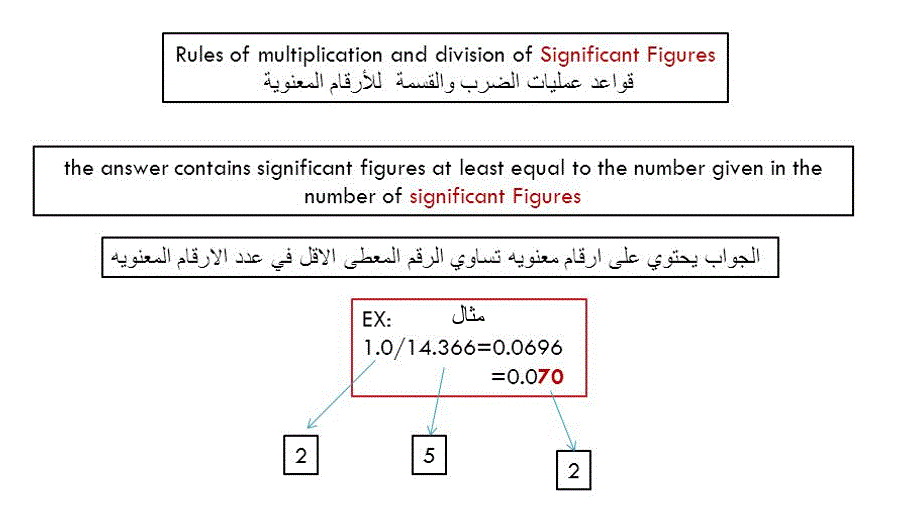
مثال: \(1.0\div14.366=0.0696\) يُكتب \(0.070\) (رقمان).
Example: \(1.0\div14.366=0.0696\) is written \(0.070\) (two figures).
الجمع والطرح: يُقرَّب الناتج إلى أقل عدد من المنازل العشرية بين المعطيات.
Addition and subtraction: the result is rounded to the fewest decimal places among the data.
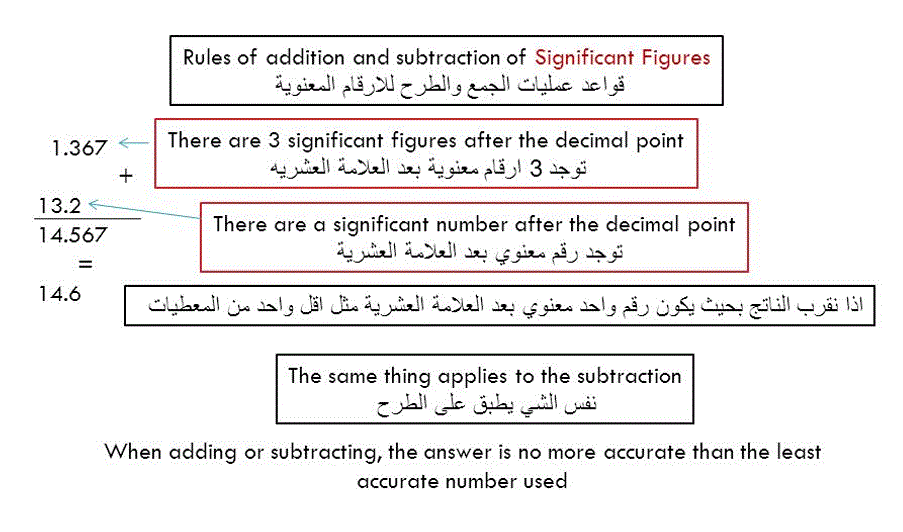
مثال: \(1.367+13.2=14.567\) يُقرَّب إلى \(14.6\) (منزلة عشرية واحدة).
Example: \(1.367+13.2=14.567\) is rounded to \(14.6\) (one decimal place).
باستخدام قواعد الأرقام المعنوية والترميز العلمي أوجد: \(50.4\times310\).
Using the rules of significant figures and scientific notation find \(50.4\times310\).
أوجد: \(5.63+15.1+14\).
Find \(5.63+15.1+14\).
أي النتائج التالية تمثل \(2.50\times3.1\) بعدد الأرقام المعنوية الصحيح؟
Which result represents \(2.50\times3.1\) with the correct number of significant figures?
🧮 البادئات ومعامل التحويل
🧮 Prefixes and the Conversion Factor
البادئات مضاعفات وأجزاء لوحدات القياس. وبما أن \(k=10^{3}\) فإن \(\dfrac{10^{3}}{k}=\dfrac{k}{10^{3}}=1\)؛ وهذه الكسور التي تساوي واحدًا تسمى معامل التحويل، نضرب فيها القيمة دون أن يتغير مقدار الكمية.
Prefixes are multiples and submultiples of units. Since \(k=10^{3}\), \(\dfrac{10^{3}}{k}=\dfrac{k}{10^{3}}=1\); such fractions equal to one are called the conversion factor, and multiplying by them does not change the quantity.
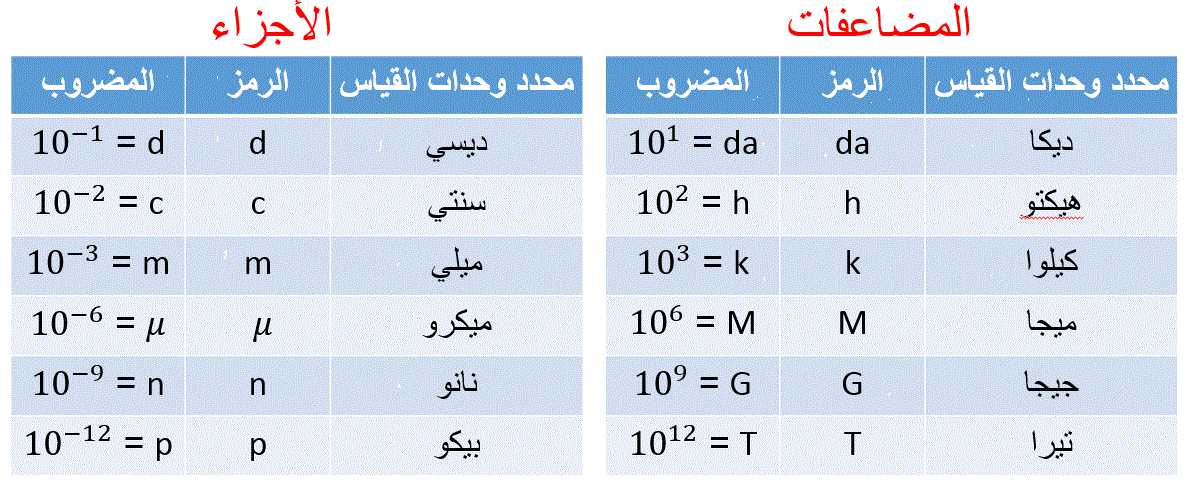
البادئات من تيرا \(10^{12}\) إلى بيكو \(10^{-12}\).
The prefixes from tera \(10^{12}\) to pico \(10^{-12}\).
🧪 جرّب بنفسك: التحويل بالبادئات
🧪 Try It Yourself: Conversion with Prefixes
🧪 تجربة 3: البادئات ومعامل التحويل
🧪 Experiment 3: Prefixes and the Conversion Factor
اختر القيمة والبادئة المعطاة والبادئة المطلوبة، وراقب معامل التحويل \(10^{a-b}\) والنتيجة بالترميز العلمي.
Choose the value, the given prefix and the required prefix, and watch the conversion factor \(10^{a-b}\) and the result in scientific notation.
المسافة من دبي إلى الرياض \(6.3\) ميجا متر. كم المسافة بالمتر؟
The distance from Dubai to Riyadh is \(6.3\) megametres. What is it in metres?
حوّل \(16.4\ \mathrm{mg}\) إلى \(\mathrm{kg}\).
Convert \(16.4\ \mathrm{mg}\) to \(\mathrm{kg}\).
أي مما يلي يساوي \(5\ \mathrm{km}\)؟
Which of the following equals \(5\ \mathrm{km}\)?
أي مما يلي يساوي \(5\ \mu\mathrm s\)؟
Which of the following equals \(5\ \mu\mathrm s\)?
📏 المقاييس في عالمنا
📏 Measurements in Our World
مقاييس الطول
Length
الطول هو المسافة بين نقطتين في الفضاء، ووحدته الدولية المتر، ونستخدم البادئات لقياسه بالمضاعفات والأجزاء. وهناك وحدات شائعة كالبوصة والقدم والميل، والوحدة الفلكية للمسافات الكبيرة، والسنة الضوئية للمسافات خارج النظام الشمسي.
Length is the distance between two points in space; its SI unit is the metre and prefixes give multiples and submultiples. Common units include the inch, foot and mile, the astronomical unit for large distances, and the light-year for distances outside the solar system.
📌 معاملات تحويل الطول
📌 Length conversions
\[1\ \text{in}=2.54\ \text{cm},\qquad 1\ \text{foot}=0.3048\ \text{m},\qquad 1\ \text{mile}=1609\ \text{m}\]
\[1\ \text{AU}=1.496\times10^{11}\ \text{m},\qquad 1\ \text{light-year}\approx9.46\times10^{15}\ \text{m}\]
مقاييس الكتلة
Mass
الكتلة مقدار المادة في الجسم، ووحدتها الأساسية الكيلوجرام، وتتراوح من كتلة الإلكترون \(m_e=9.11\times10^{-31}\ \mathrm{kg}\) إلى كتلة الأرض \(6\times10^{24}\ \mathrm{kg}\).
Mass is the amount of matter in a body; its base unit is the kilogram, ranging from the electron mass \(m_e=9.11\times10^{-31}\ \mathrm{kg}\) to the Earth’s mass \(6\times10^{24}\ \mathrm{kg}\).
مقاييس الزمن
Time
الزمن هو المدة بين حدثين، ووحدته الدولية الثانية، ونستخدم الدقيقة والساعة واليوم والسنة والقرن للفترات الطويلة:
Time is the interval between two events; its SI unit is the second, and for long periods we use the minute, hour, day, year and century:
📌 معاملات تحويل الزمن
📌 Time conversions
\[1\ \text{min}=60\ \text{s},\quad 1\ \text{h}=3600\ \text{s},\quad 1\ \text{day}=86.4\times10^{3}\ \text{s}\]
\[1\ \text{year}=31.557\times10^{6}\ \text{s},\quad 1\ \text{century}=31.557\times10^{8}\ \text{s}\]
طول أحمد \(4\) أقدام و\(20\) بوصة. كم طوله بالمتر؟
Ahmed’s height is \(4\) feet \(20\) inches. What is it in metres?
سرعة سيارة \(65\ \mathrm{mile/h}\). كم سرعتها بوحدة \(\mathrm{m/s}\)؟
A car’s speed is \(65\ \mathrm{mile/h}\). What is it in \(\mathrm{m/s}\)?
يُخزَّن وقود طائرات في أسطوانة ارتفاعها \(82.6\ \mathrm{in}\) ومحيطها \(249\ \mathrm{in}\). ما حجم الوقود بالمتر المكعب؟
Aircraft fuel is stored in a cylinder of height \(82.6\ \mathrm{in}\) and circumference \(249\ \mathrm{in}\). What is the fuel volume in cubic metres?
كم ثانية في يوم واحد؟
How many seconds are there in one day?
🧭 المتجهات في بعدين وثلاثة أبعاد
🧭 Vectors in Two and Three Dimensions
تُقسم الكميات الفيزيائية إلى قياسية (تتحدد بالمقدار فقط، كالمسافة والكتلة والحجم والزمن) ومتجهة (تتحدد بالمقدار والاتجاه معًا، كالإزاحة والسرعة والتسارع والقوة).
Physical quantities are divided into scalars (determined by magnitude only, such as distance, mass, volume and time) and vectors (determined by both magnitude and direction, such as displacement, velocity, acceleration and force).
الإحداثيات الديكارتية
Cartesian Coordinates
لتحديد موضع نقطة في مستوى نستخدم رقمين (إحداثيين): الأول بعدها على المحور الأفقي والثاني على المحور الرأسي، مثل \((12.5,\ 5)\). وفي الفضاء نستخدم ثلاثة \((P_x,P_y,P_z)\) والثالث بعد النقطة على المحور \(z\) العمودي على المحورين.
To locate a point in a plane we use two numbers (coordinates): the first along the horizontal axis and the second along the vertical axis, such as \((12.5,\ 5)\). In space we use three \((P_x,P_y,P_z)\), the third along the \(z\) axis perpendicular to the other two.
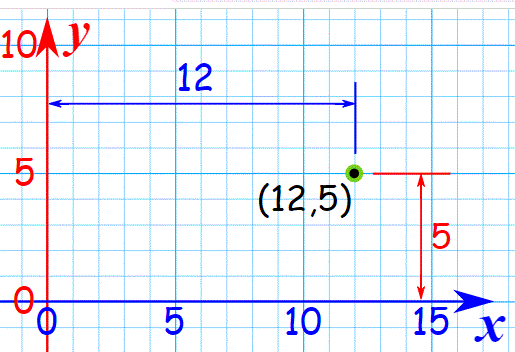
نقطة في مستوى ثنائي الأبعاد بإحداثيين.
A point in a two-dimensional plane with two coordinates.
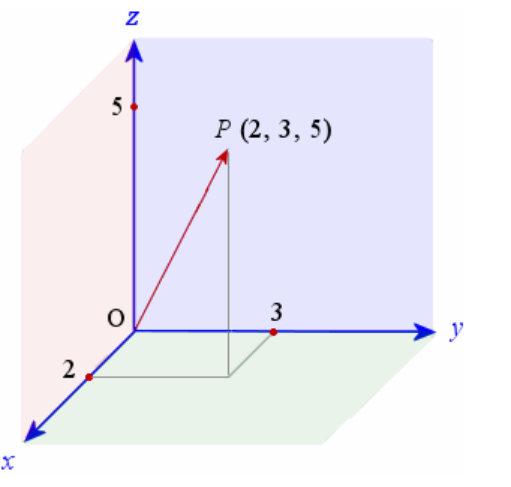
نقطة في فضاء ثلاثي الأبعاد بثلاثة إحداثيات.
A point in three-dimensional space with three coordinates.
تحليل المتجه إلى مركبات
Resolving a Vector into Components
التحليل إسقاط المتجه على المحورين الأفقي والرأسي وتحويل المتجه الواحد إلى مركبتين تكافئانه، مع تحديد إشارة كل مركبة بحسب الجهة التي تسقط عليها. وهو عكس عملية إيجاد المحصلة:
Resolution is projecting a vector onto the horizontal and vertical axes, converting one vector into two equivalent components, with the sign of each according to the side it falls on. It is the opposite of finding the resultant:
\[A_x=A\cos\theta,\qquad A_y=A\sin\theta\]
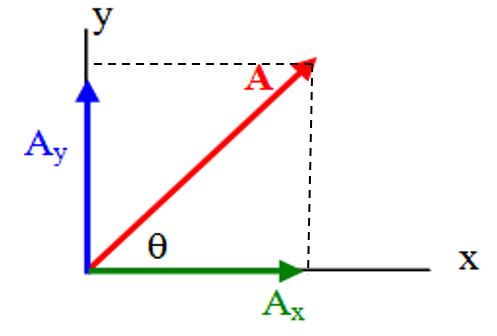
المتجه ومركبتاه الأفقية والرأسية والزاوية \(\theta\).
The vector, its horizontal and vertical components and the angle \(\theta\).
المتجه \(\vec A\) نقطة بدايته \((-5,-3)\) ونقطة نهايته \((5,1)\). حدد مركباته.
Vector \(\vec A\) starts at \((-5,-3)\) and ends at \((5,1)\). Find its components.
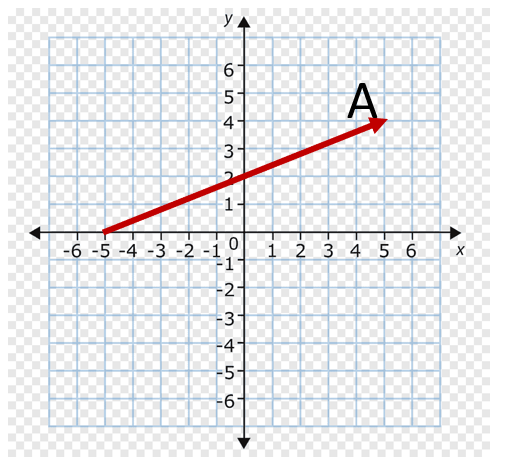
المتجه من نقطة البداية \((-5,-3)\) إلى النهاية \((5,1)\).
The vector from the start \((-5,-3)\) to the end \((5,1)\).
➕ جمع المتجهات وطرحها
➕ Adding and Subtracting Vectors
الجمع بالرسم (الذيل إلى الرأس): ننقل أحد المتجهين حتى ينطبق ذيله على رأس الأول مع المحافظة على المقدار والاتجاه، ثم نصل من ذيل الأول إلى رأس الثاني فتكون المحصلة. وتصلح الطريقة لأكثر من متجهين، ولا يهم أيهما ننقل أولًا.
Graphical addition (head to tail): move one vector until its tail coincides with the head of the first, keeping magnitude and direction, then join the tail of the first to the head of the second to get the resultant. The method works for more than two vectors and the order does not matter.
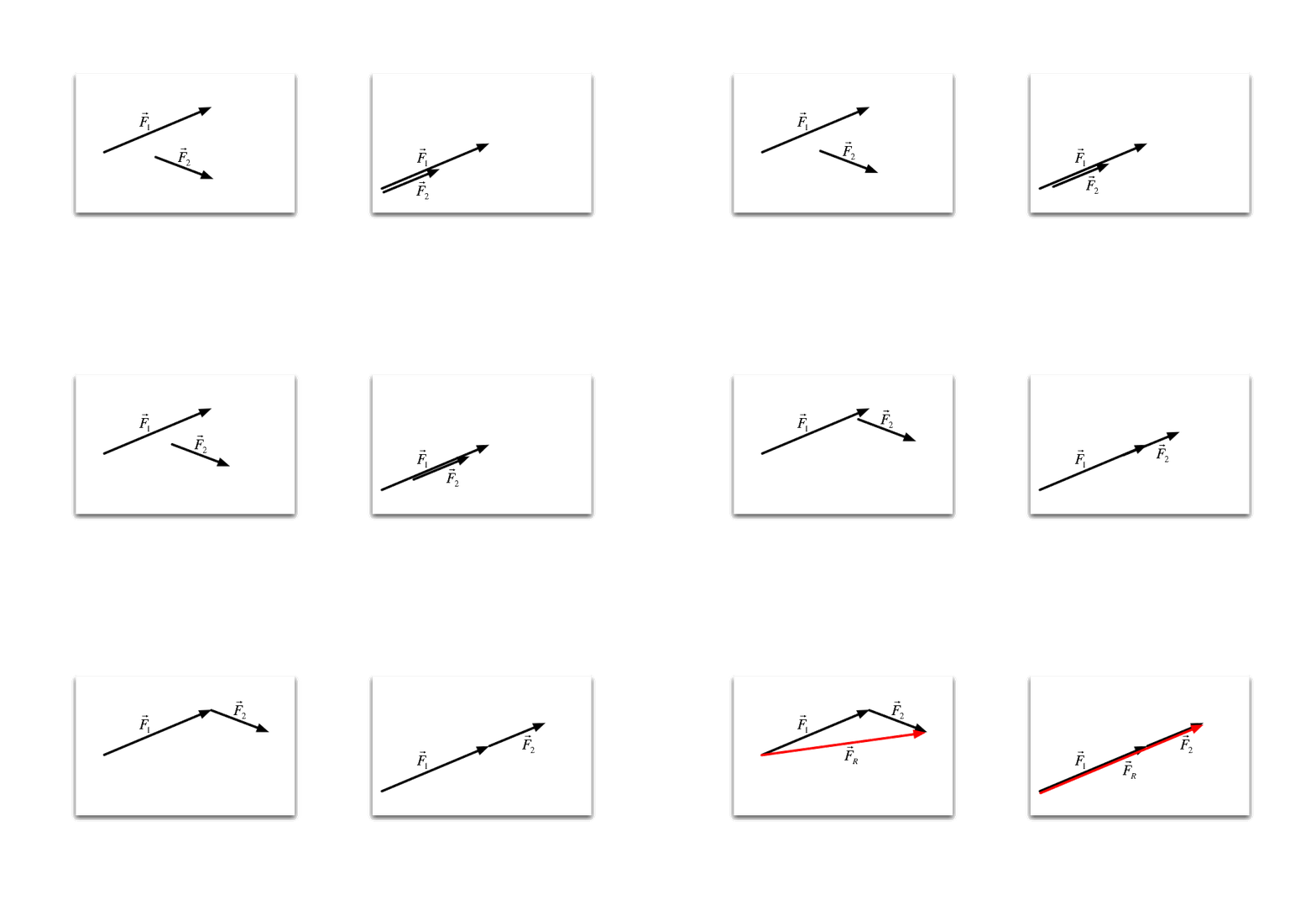
جمع متجهين من الذيل إلى الرأس.
Adding two vectors head to tail.
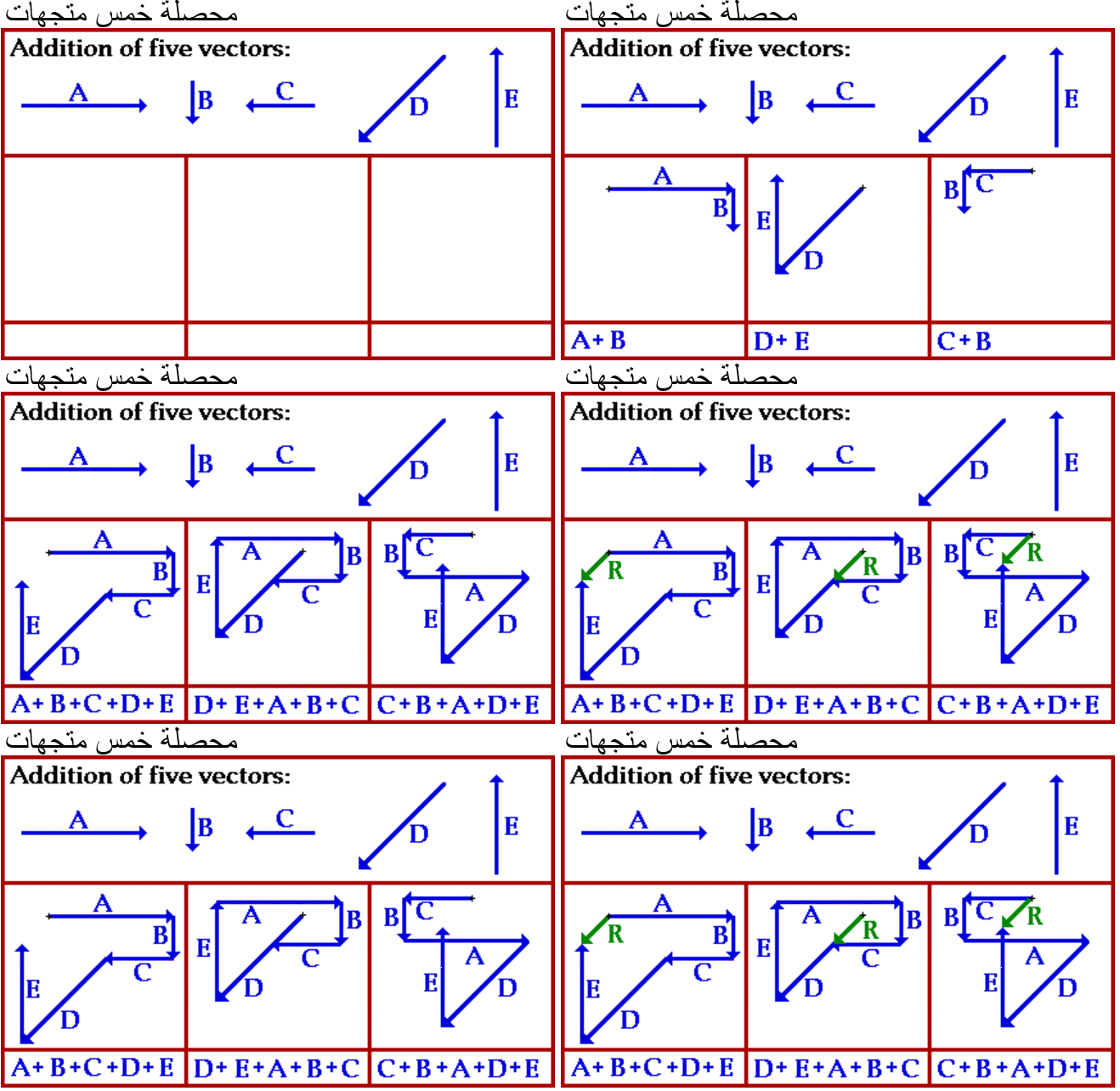
جمع خمسة متجهات بوضعها رأسًا لذيل.
Adding five vectors by placing them head to tail.
الطرح: \(\vec A-\vec B=\vec A+(-\vec B)\): نعكس اتجاه المتجه المطروح ثم نجمع كما سبق.
Subtraction: \(\vec A-\vec B=\vec A+(-\vec B)\): reverse the subtracted vector then add as before.
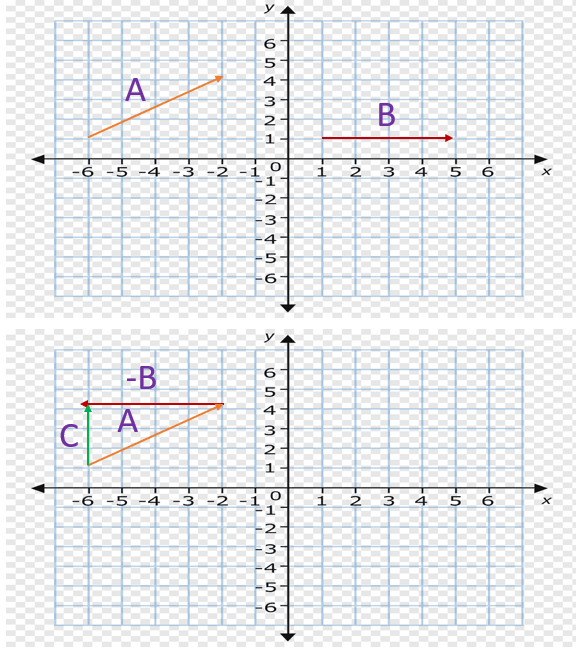
طرح المتجهين بجمع المتجه المعاكس.
Subtracting vectors by adding the opposite vector.
📌 الجمع والطرح بالمركبات
📌 Addition and subtraction by components
\[C_x=A_x\pm B_x,\qquad C_y=A_y\pm B_y,\qquad C_z=A_z\pm B_z\]
🧪 جرّب بنفسك: الجمع والطرح بالمركبات
🧪 Try It Yourself: Adding and Subtracting by Components
🧪 تجربة 4: جمع المتجهات وطرحها بيانيًا وبالمركبات
🧪 Experiment 4: Adding and Subtracting Vectors Graphically and by Components
اضبط مقداري المتجهين وزاويتيهما، وبدّل بين الجمع والطرح، وراقب المحصلة بطريقة الذيل إلى الرأس ومركباتها.
Set the magnitudes and angles of the two vectors, switch between addition and subtraction, and watch the resultant by the head-to-tail method and its components.
✳️ ضرب متجه في كمية قياسية
✳️ Multiplying a Vector by a Scalar
ناتج ضرب كمية قياسية في متجه كمية متجهة: إذا كان العدد القياسي موجبًا كان الناتج في اتجاه المتجه الأصلي، وإذا كان سالبًا كان في عكس اتجاهه.
The product of a scalar and a vector is a vector: if the scalar is positive the result is in the direction of the original vector, and if it is negative it is in the opposite direction.
إذا كان \(\vec A=2\hat x+4\hat y-2\hat z\) فأوجد \(2\vec A\) و\(-2\vec A\).
If \(\vec A=2\hat x+4\hat y-2\hat z\) find \(2\vec A\) and \(-2\vec A\).
1️⃣ متجهات الوحدة
1️⃣ Unit Vectors
متجهات الوحدة طول كلٍّ منها \(1\) وتقع على المحاور: \(\hat i\) على \(x\) و\(\hat j\) على \(y\) و\(\hat k\) على \(z\)، فيُكتب المتجه \(\vec A=A_x\hat i+A_y\hat j+A_z\hat k\).
Unit vectors have length \(1\) and lie on the axes: \(\hat i\) on \(x\), \(\hat j\) on \(y\) and \(\hat k\) on \(z\), so a vector is written \(\vec A=A_x\hat i+A_y\hat j+A_z\hat k\).
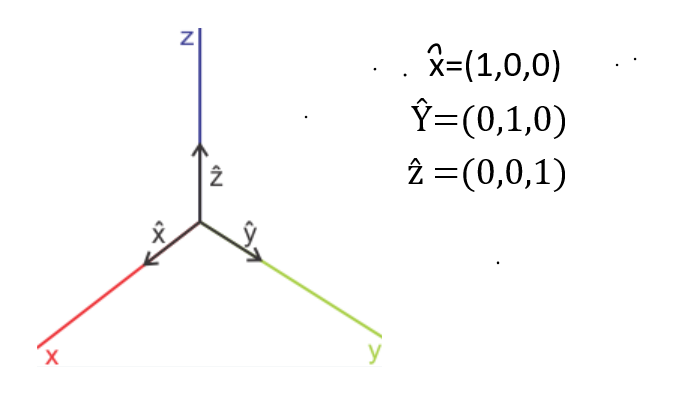
متجهات الوحدة \(\hat i,\hat j,\hat k\) على المحاور الثلاثة.
The unit vectors \(\hat i,\hat j,\hat k\) on the three axes.
🧊 جرّب بنفسك: المتجهات في ثلاثة أبعاد
🧊 Try It Yourself: Vectors in Three Dimensions
🧪 تجربة 5: جمع المتجهات وطرحها بالمركبات (ثلاثة أبعاد)
🧪 Experiment 5: Adding and Subtracting Vectors by Components (3D)
اختر مركبات \(A\) و\(B\) بالمنزلقات وبدّل بين الجمع والطرح، وراقب المحصلة مركّبةً مركّبة. اجعل \(z=0\) لتعود إلى بعدين.
Choose the components of \(A\) and \(B\) with the sliders and switch between addition and subtraction; watch the result component by component. Set \(z=0\) to return to two dimensions.
📐 طول المتجه واتجاهه
📐 Magnitude and Direction of a Vector
إذا عُرفت مركبات المتجه حُسب طوله واتجاهه:
If the components of a vector are known its magnitude and direction can be found:
\[A=\sqrt{A_x^2+A_y^2},\qquad \theta=\tan^{-1}\frac{A_y}{A_x}\]
متجه مقداره \(60\) يصنع \(20^\circ\) شمال الشرق. أوجد مركبتيه ثم تحقق من مقداره واتجاهه.
A vector of magnitude \(60\) makes \(20^\circ\) north of east. Find its components then check its magnitude and direction.
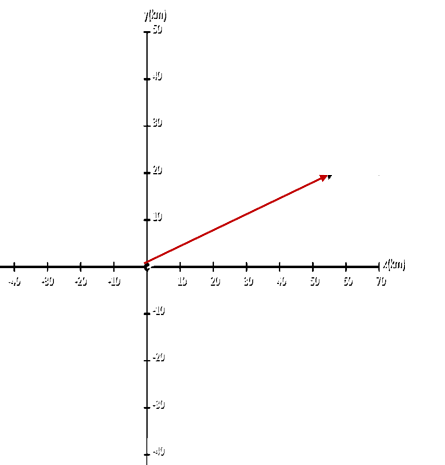
المتجه \(60\) بزاوية \(20^\circ\) ومركبتاه.
The vector \(60\) at \(20^\circ\) and its components.
✖️ الضرب القياسي للمتجهات
✖️ The Dot Product
الشغل كمية قياسية ناتجة عن ضرب متجه القوة في متجه الإزاحة، ويسمى هذا الضرب القياسي: مقدار الأول في مقدار الثاني في جيب تمام الزاوية بينهما.
Work is a scalar quantity obtained by multiplying the force vector by the displacement vector; this product is called the scalar (dot) product: the magnitude of the first times the magnitude of the second times the cosine of the angle between them.
📌 الضرب القياسي
📌 The dot product
\[\vec A\cdot\vec B=|\vec A||\vec B|\cos\theta=A_xB_x+A_yB_y+A_zB_z\]
خصائصه: إبدالي \(\vec A\cdot\vec B=\vec B\cdot\vec A\)، وتوزيعي، ويساوي صفرًا إذا تعامد المتجهان.
Its properties: commutative \(\vec A\cdot\vec B=\vec B\cdot\vec A\), distributive, and zero when the vectors are perpendicular.
🧪 جرّب بنفسك: الضرب القياسي
🧪 Try It Yourself: the Dot Product
🧪 تجربة 6: الضرب القياسي: \(AB\cos\theta\)
🧪 Experiment 6: The Dot Product: \(AB\cos\theta\)
غيّر المقدارين والزاوية بينهما وراقب ناتج الضرب القياسي ومسقط \(B\) على \(A\) وإشارة الناتج.
Change the two magnitudes and the angle between them and watch the dot product, the projection of \(B\) on \(A\), and the sign of the result.
ليكن \(\vec A=3\hat i+4\hat j+5\hat k\) و\(\vec B=\hat i-2\hat j+2\hat k\). أوجد \(\vec A\cdot\vec B\).
Let \(\vec A=3\hat i+4\hat j+5\hat k\) and \(\vec B=\hat i-2\hat j+2\hat k\). Find \(\vec A\cdot\vec B\).
\(\vec A=2\hat x+3\hat y+4\hat z\) و\(\vec B=\hat x-2\hat y+3\hat z\). أوجد الزاوية بينهما.
\(\vec A=2\hat x+3\hat y+4\hat z\) and \(\vec B=\hat x-2\hat y+3\hat z\). Find the angle between them.
❌ الضرب الاتجاهي للمتجهات
❌ The Cross Product
القوة المغناطيسية كمية متجهة ناتجة عن ضرب الشحنة في متجه السرعة في متجه المجال المغناطيسي. ويسمى هذا الضرب الاتجاهي: ناتجه متجه مقداره حاصل ضرب المقدارين في جيب الزاوية بينهما، واتجاهه عمودي على مستويهما بقاعدة اليد اليمنى.
The magnetic force is a vector quantity obtained from the charge, the velocity vector and the magnetic field vector. This product is called the vector (cross) product: its result is a vector whose magnitude is the product of the two magnitudes and the sine of the angle between them, and whose direction is perpendicular to their plane by the right-hand rule.
📌 الضرب الاتجاهي
📌 The cross product
\[|\vec A\times\vec B|=|\vec A||\vec B|\sin\theta\]
\[\vec A\times\vec B=\begin{vmatrix}\hat i&\hat j&\hat k\\A_x&A_y&A_z\\B_x&B_y&B_z\end{vmatrix}=\hat i(A_yB_z-A_zB_y)-\hat j(A_xB_z-A_zB_x)+\hat k(A_xB_y-A_yB_x)\]
خصائصه: ناتجه متجه عمودي على المستوي، وغير إبدالي \(\vec A\times\vec B=-(\vec B\times\vec A)\).
Its properties: the result is a vector perpendicular to the plane, and it is anti-commutative \(\vec A\times\vec B=-(\vec B\times\vec A)\).
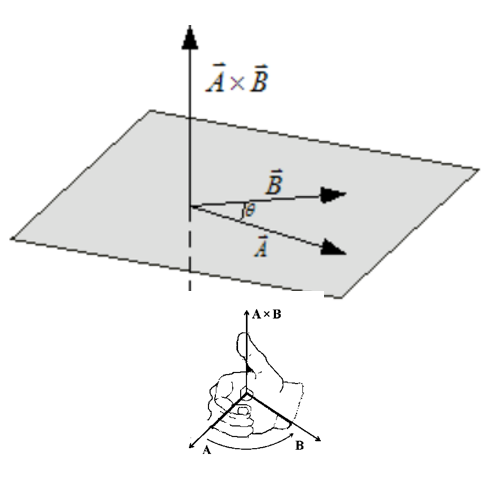
تحديد اتجاه \(\vec A\times\vec B\) بقاعدة اليد اليمنى.
Finding the direction of \(\vec A\times\vec B\) by the right-hand rule.
🧪 جرّب بنفسك: الضرب الاتجاهي
🧪 Try It Yourself: the Cross Product
🧪 تجربة 7: الضرب الاتجاهي: \(AB\sin\theta\)
🧪 Experiment 7: The Cross Product: \(AB\sin\theta\)
غيّر المقدارين والزاوية وراقب مساحة متوازي الأضلاع (مقدار الناتج) واتجاهه عموديًا على الصفحة، وبدّل الترتيب لترى انعكاس الاتجاه.
Change the magnitudes and the angle and watch the parallelogram area (the magnitude of the result) and its direction perpendicular to the page; swap the order to see the direction flip.
\(\vec A=3\hat i+2\hat j+\hat k\) و\(\vec B=4\hat i+5\hat j+6\hat k\). أوجد \(\vec A\times\vec B\).
\(\vec A=3\hat i+2\hat j+\hat k\) and \(\vec B=4\hat i+5\hat j+6\hat k\). Find \(\vec A\times\vec B\).
إذا كان \(\vec A\times\vec B=\vec C\) فإن \(\vec B\times\vec A\) يساوي:
If \(\vec A\times\vec B=\vec C\) then \(\vec B\times\vec A\) equals:
🎲 تدرّب
🎲 Practice
🧪 تجربة 8: تدرّب: مسائل القياس والمتجهات
🧪 Experiment 8: Practice: Measurement and Vector Problems
مسائل عشوائية بأرقام مختلفة. احسب واكتب الجواب ثم اضغط «تحقّق».
Random problems with different numbers. Work it out, enter the answer and press “Check”.
📊 جدول ملخص
📊 Summary
| الموضوعTopic | القاعدةRule |
|---|---|
| الترميز العلميScientific notation | \(a\times10^{n},\ 1\le a\lt 10\)\(a\times10^{n},\ 1\le a\lt 10\) |
| الضرب والقسمةMultiplication and division | أقل عدد أرقام معنويةthe fewest significant figures |
| الجمع والطرحAddition and subtraction | أقل عدد منازل عشريةthe fewest decimal places |
| التحويل بالبادئاتPrefix conversion | \(\times\,10^{a-b}\)\(\times\,10^{a-b}\) |
| تحليل المتجهResolution | \(A_x=A\cos\theta,\ A_y=A\sin\theta\)\(A_x=A\cos\theta,\ A_y=A\sin\theta\) |
| الضرب القياسيDot product | \(AB\cos\theta=A_xB_x+A_yB_y+A_zB_z\)\(AB\cos\theta=A_xB_x+A_yB_y+A_zB_z\) |
| الضرب الاتجاهيCross product | \(|A\times B|=AB\sin\theta\)\(|A\times B|=AB\sin\theta\) |
🧪 اختبر نفسك: امتحان من 20 سؤالاً
🧪 Test Yourself: a 20-Question Exam
أنهِ الدرس بالاختبار التفاعلي التالي؛ أسئلته تجمع بين الفهم والحساب وتغطي جميع أقسام الدرس.
Finish with the interactive exam below; its questions mix understanding with calculation and cover every section of the lesson.
اختبار ميكانيكا الجسيمات النقطية Mechanics of Point Particles Quiz
20 سؤالاً - الكميات المتجهة والقياسية، فيثاغورس، قانون جيب التمام، تحليل المتجهات والمحصلة بالمركبات 20 Questions - vector and scalar quantities, Pythagoras, the law of cosines, resolving vectors and the resultant by components
• عدد الأسئلة: 20 سؤالاً
• مدة الاختبار: 30 دقيقة
• لا يمكنك تغيير إجاباتك أو إعادة الاختبار إلا بعد 24 ساعة من التسليم.
• تأكد من إجاباتك قبل التسليم! 📌 Important Instructions:
• Number of questions: 20 questions
• Quiz duration: 30 minutes
• You cannot change your answers or retake the quiz for 24 hours after submission.
• Make sure of your answers before submitting!
🔗 محاكيات GeoGebra للاستعانة بها عند اللزوم
🔗 GeoGebra Simulations to Use When Needed
اضغط «تشغيل» لتعمل المحاكاة هنا داخل الدرس؛ ويمكن للطالب الرجوع إليها لتجربة الفكرة بطريقة أخرى.
Press “Run” to run the simulation right here inside the lesson; the student can use it to try the idea in another way.