🎯 نواتج التعلم
🎯 Learning Outcomes
بعد دراسة هذا الدرس ستكون قادرًا على أن:
After this lesson you will be able to:
- تعرّف قوة لورنتس على شحنة متحركة \(\vec F=q\vec v\times\vec B\) وعلى سلك يحمل تيارًا \(F=ILB\sin\theta\).Define the Lorentz force on a moving charge \(\vec F=q\vec v\times\vec B\) and on a current-carrying wire \(F=ILB\sin\theta\).
- تستنتج قانون السلك من قانون الشحنة المفردة.Derive the wire law from the law for a single charge.
- تحدد اتجاه القوة بقاعدة اليد اليمنى (الكف المفتوحة) وتعرف متى تنعدم أو تبلغ أقصاها.Find the direction of the force with the right-hand (open palm) rule and know when it vanishes or is maximum.
- تحلّ مسائل السلك المعلّق والمحرك الكهربائي وتفسّر دور المبدّل.Solve problems on the hanging wire and the electric motor and explain the role of the commutator.
- تشرح تطبيقات: المحرك والجلفانومتر ومكبر الصوت والقطار المغناطيسي.Explain applications: the motor, the galvanometer, the loudspeaker and the maglev train.
⚡ ما هي قوة لورنتس؟
⚡ What Is the Lorentz Force?
قوة لورنتس هي القوة المؤثرة على جسيم مشحون متحرك في مجال كهربائي ومجال مغناطيسي معًا. وتُستعمل لفهم سلوك الأسلاك الحاملة للتيار في المجالات المغناطيسية، لأن التيار ما هو إلا شحنات متحركة.
The Lorentz force is the force on a moving charged particle in an electric field and a magnetic field together. It is used to understand the behaviour of current-carrying wires in magnetic fields, because a current is simply moving charges.
📌 القانون العام
📌 The general law
\[\vec F=q\left(\vec E+\vec v\times\vec B\right)\]
الجزء الأول \(q\vec E\) قوة كهربائية (تؤثر في الشحنة ساكنة أو متحركة)، والجزء الثاني \(q\vec v\times\vec B\) هو القوة المغناطيسية التي لا تؤثر إلا في الشحنة المتحركة وتكون عمودية على السرعة والمجال، ولذلك لا تبذل شغلًا. وفي هذا الدرس نركّز على الجزء المغناطيسي وعلى تأثيره في الأسلاك.
The first part \(q\vec E\) is an electric force (acting on a charge at rest or moving); the second \(q\vec v\times\vec B\) is the magnetic force which acts only on a moving charge and is perpendicular to the velocity and the field, so it does no work. In this lesson we concentrate on the magnetic part and its effect on wires.
🧲 القوة على سلك يمر به تيار
🧲 The Force on a Current-Carrying Wire
📌 قانون القوة على السلك
📌 The law for a wire
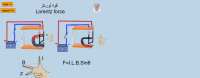
\[F=I\,L\,B\,\sin\theta\]
\(F\) القوة (نيوتن)، \(I\) شدة التيار (أمبير)، \(L\) طول السلك داخل المجال (متر)، \(B\) المجال (تسلا)، \(\theta\) الزاوية بين اتجاه التيار (السلك) والمجال.
\(F\) the force (newton), \(I\) the current (ampere), \(L\) the length of wire inside the field (metre), \(B\) the field (tesla), \(\theta\) the angle between the current (the wire) and the field.
🔄 اشتقاق القوة من تأثير الشحنة
🔄 Deriving the Force from the Charge
القوة على شحنة واحدة \(F=qvB\sin\theta\). في سلك طوله \(L\) تمرّ شحنة كلية \(q=It\) خلال زمن \(t=L/v\)، أي \(q=I\,L/v\). فمجموع القوى على كل الشحنات المتحركة داخل السلك:
The force on one charge is \(F=qvB\sin\theta\). In a wire of length \(L\) a total charge \(q=It\) passes in a time \(t=L/v\), that is \(q=IL/v\). So the sum of the forces on all the moving charges in the wire is:
📌 الاشتقاق
📌 The derivation
\[F=q\,v\,B\sin\theta=\frac{I\,L}{v}\;v\,B\sin\theta=I\,L\,B\sin\theta\]
وقوة السلك إذن هي محصلة قوى لورنتس على جميع الشحنات المتحركة فيه.
The force on the wire is therefore the resultant of the Lorentz forces on all the moving charges in it.
| الحالةCase | الزاوية \(\theta\)Angle \(\theta\) | القوةThe force |
|---|---|---|
| السلك موازٍ للمجالWire parallel to the field | \(0^\circ\) أو \(180^\circ\)\(0^\circ\) or \(180^\circ\) | صفرzero |
| السلك يصنع زاوية مع المجالWire at an angle to the field | بين \(0\) و\(90^\circ\)between \(0\) and \(90^\circ\) | \(ILB\sin\theta\)\(ILB\sin\theta\) |
| السلك عمودي على المجالWire perpendicular to the field | \(90^\circ\)\(90^\circ\) | أعظم قيمة \(ILB\)maximum \(ILB\) |
العوامل التي تؤثر في قوة لورنتس على سلك يمر به تيار:
The factors that affect the Lorentz force on a current-carrying wire are:
تكون قوة لورنتس على سلك أعظمية عندما:
The Lorentz force on a wire is maximum when the wire is:
📐 اتجاه القوة: قاعدة اليد اليمنى
📐 The Direction of the Force: the Right-Hand Rule
نبسط الكف اليمنى: الإبهام باتجاه التيار التقليدي، والأصابع باتجاه المجال المغناطيسي، فتدفع راحة اليد في اتجاه القوة. القوة دائمًا عمودية على كل من السلك والمجال، وتنعكس إذا انعكس التيار أو المجال (وليس كليهما معًا).
Open the right palm: the thumb along the conventional current, the fingers along the magnetic field, and the palm pushes in the direction of the force. The force is always perpendicular to both the wire and the field, and it reverses if the current or the field is reversed (but not both together).
📌 بالرموز
📌 In symbols
\[\vec F=I\,\vec L\times\vec B\]
هذا ضرب اتجاهي يتبع قاعدة اليد اليمنى؛ ومقداره \(ILB\sin\theta\).
This is a vector (cross) product that follows the right-hand rule; its magnitude is \(ILB\sin\theta\).
🧪 جرّب بنفسك: مدرّب اتجاه القوة
🧪 Try It Yourself: the Force-Direction Trainer
🧪 تجربة 1: مدرّب الاتجاه: طبّق قاعدة الكف
🧪 Experiment 1: Direction Trainer: Apply the Palm Rule
يظهر لك مجال مغناطيسي واتجاه تيار (أو سرعة شحنة). اختر اتجاه القوة الصحيح من الأزرار ثم اضغط «سؤال جديد». بدّل بين سلك وشحنة موجبة وإلكترون لترى كيف تنعكس القوة للشحنة السالبة. الاصطلاح: ⊙ خارج الصفحة، ⊗ داخل الصفحة.
A magnetic field and a current direction (or a charge velocity) appear. Choose the correct force direction with the buttons, then press “New question”. Switch between a wire, a positive charge and an electron to see how the force reverses for a negative charge. Convention: ⊙ out of the page, ⊗ into the page.
كيف نحدد اتجاه قوة لورنتس على سلك؟
How do we find the direction of the Lorentz force on a wire?
🧮 أمثلة محلولة
🧮 Worked Examples
سلك طوله \(0.5\ \mathrm m\) يمرّ به تيار \(3\ \mathrm A\) وهو عمودي على مجال \(0.4\ \mathrm T\). أوجد القوة.
A wire \(0.5\ \mathrm m\) long carries \(3\ \mathrm A\) and is perpendicular to a field of \(0.4\ \mathrm T\). Find the force.
أعد المسألة السابقة عندما يصنع السلك زاوية \(30^\circ\) مع المجال.
Repeat the previous problem when the wire makes \(30^\circ\) with the field.
سلك معلّق كتلته \(40\ \mathrm g\) وطوله داخل المجال \(0.5\ \mathrm m\) يمر به \(5\ \mathrm A\) في مجال أفقي \(0.12\ \mathrm T\). أوجد زاوية انحراف الخيط عن الرأسي (\(g=10\)).
A hanging wire of mass \(40\ \mathrm g\) with \(0.5\ \mathrm m\) inside the field carries \(5\ \mathrm A\) in a horizontal field of \(0.12\ \mathrm T\). Find the angle of the string from the vertical (\(g=10\)).
🧪 جرّب بنفسك: السلك المعلّق
🧪 Try It Yourself: the Hanging Wire
🧪 تجربة 2: سلك معلّق في مجال مغناطيسي: يتأرجح بتأثير القوة
🧪 Experiment 2: A Hanging Wire in a Magnetic Field: It Swings under the Force
سلك معلّق بخيط بين قطبي مغناطيس (المجال رأسي)، ويمر به تيار عمودي على الصفحة. اضغط «أغلق المفتاح» فتتأرجح الكتلة وتستقر عند زاوية تحقق \(\tan\alpha=F/mg\) حيث \(F=ILB\). جرّب عكس التيار أو عكس قطبي المغناطيس، ثم سجّل قياسات بتيارات مختلفة لترى أن \(F\) تتناسب طرديًا مع \(I\). أنجز المهام في الصندوق الأصفر.
A wire hangs on a string between the poles of a magnet (the field is vertical) and carries a current perpendicular to the page. Press “Close the switch” and the mass swings and settles at an angle satisfying \(\tan\alpha=F/mg\) where \(F=ILB\). Try reversing the current or swapping the poles and watch the direction reverse, then record measurements at different currents to see that \(F\) is proportional to \(I\). Complete the missions in the yellow box.
سلك يمر به \(3\ \mathrm A\) وطوله \(0.5\ \mathrm m\) في مجال \(0.4\ \mathrm T\) عموديًا عليه. القوة:
A wire carrying \(3\ \mathrm A\), \(0.5\ \mathrm m\) long, in a field of \(0.4\ \mathrm T\) perpendicular to it. The force is:
🔧 تطبيقات قوة لورنتس
🔧 Applications of the Lorentz Force
⚙️ المحرك الكهربائي
⚙️ The Electric Motor
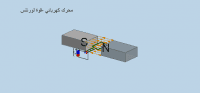
ملف مستطيل في مجال مغناطيسي يمر به تيار: الضلعان المتقابلان يتأثران بقوتين متعاكستين فيتكوّن عزم ازدواج يدير الملف. بعد نصف دورة تنعكس القوتان فيتوقف الدوران ما لم ينعكس التيار؛ وهنا يعمل المبدّل (الكوموتاتور) على عكس التيار كل نصف دورة ليبقى العزم في اتجاه واحد. عزم الملف \(\tau=NIAB\sin\varphi\).
A rectangular coil carrying a current in a magnetic field: the two opposite sides feel opposite forces, forming a couple that turns the coil. After half a turn the forces would reverse and stop the rotation unless the current reverses; the commutator reverses the current every half-turn so the torque keeps the same sense. The torque of the coil is \(\tau=NIAB\sin\varphi\).
🧪 تجربة 5: المحرك الكهربائي: دوّر الملف وتحكّم بالمبدّل
🧪 Experiment 5: The Electric Motor: Spin the Coil and Control the Commutator
يظهر منظر محوري لملف داخل مجال أفقي. اضغط «وصّل البطارية» فيؤثر على ضلعي الملف ازدواج يديره. جرّب إلغاء المبدّل لترى الملف يتذبذب ثم يتوقف بدل أن يدور، ثم أعده لتراه يدور باستمرار. المنحنى يبيّن العزم مع الزاوية.
An end view of a coil in a horizontal field is shown. Press “Connect the battery” and a couple acts on the two sides of the coil and turns it. Try removing the commutator to see the coil oscillate and stop instead of rotating, then restore it to see it spin continuously. The graph shows the torque against the angle.
دور المبدّل (الكوموتاتور) في المحرك:
The role of the commutator in the motor is to:
📏 الجلفانومتر
📏 The Galvanometer
ملف في مجال مغناطيسي شعاعي يتصل بنابض حلزوني: يمر التيار فيتأثر بعزم مغناطيسي يوازنه عزم النابض، فينحرف المؤشر بزاوية تتناسب مع التيار. يُحوَّل إلى أميتر بمجزّئ على التوازي وإلى فولتمتر بمقاومة على التوالي.
A coil in a radial magnetic field attached to a spiral spring: the current gives a magnetic torque balanced by the spring torque, so the pointer deflects through an angle proportional to the current. It becomes an ammeter with a shunt in parallel and a voltmeter with a series resistance.
🧪 تجربة 4: الجلفانومتر: حوّله إلى أميتر أو فولتوميتر
🧪 Experiment 4: The Galvanometer: Turn It into an Ammeter or a Voltmeter
اختر الجهاز ثم حدّد مقاومة الجلفانومتر وتيار انحرافه الأعظم والمدى المطلوب؛ تحسب التجربة مقاومة المجزّئ \(S\) (أميتر، على التوازي) أو مقاومة المضاعف \(R\) (فولتوميتر، على التوالي). اضغط «طبّق القياس» لترى المؤشر يتحرك وكم يمرّ في الجلفانومتر.
Choose the instrument then set the galvanometer resistance, its full-scale current and the required range; the experiment calculates the shunt \(S\) (ammeter, in parallel) or the multiplier \(R\) (voltmeter, in series). Press “Apply the measurement” to watch the pointer move and see how much flows through the galvanometer.
🔊 مكبر الصوت
🔊 The Loudspeaker
ملف صوتي ملتصق بمخروط في مجال مغناطيسي دائم؛ يمر فيه تيار متردد يمثل الإشارة الصوتية فتتغير القوة \(F=ILB\) اتجاهًا ومقدارًا فيهتز المخروط ويولّد الصوت.
A voice coil attached to a cone sits in a permanent magnetic field; an alternating current carrying the audio signal passes through it so the force \(F=ILB\) changes in direction and size and the cone vibrates and makes sound.
🧪 تجربة 3: مكبّر الصوت: تيار متردد يحرّك المخروط
🧪 Experiment 3: The Loudspeaker: an Alternating Current Moves the Cone
يُعرض مقطع في مكبّر الصوت بحركة مُبطّأة (÷100) كي ترى الاهتزاز. اضغط «أرسل الإشارة» فيمرّ تيار متردد في الملف فتتغيّر القوة \(F=BIL\) ويهتزّ المخروط بتردد الإشارة، وتنتشر الموجات. ويمكنك الضغط على «صوت حقيقي» لتسمع النغمة بالتردد المختار.
A cross-section of a loudspeaker is shown in slow motion (÷100) so you can see the vibration. Press “Send the signal”: an alternating current flows in the coil, the force \(F=BIL\) changes and the cone vibrates at the signal’s frequency while waves spread out. You can also press “Real sound” to hear the tone at the chosen frequency.
🚆 القطار المغناطيسي (ماجليف)
🚆 The Maglev Train
تُستعمل مغانط كهربائية قوية في القطار والمسار؛ تجعل قوى التنافر والتجاذب المغناطيسية القطار يطفو فوق المسار دون احتكاك، وبتغيير اتجاه التيار في ملفات المسار تدفعه قوى لورنتس إلى الأمام.
Strong electromagnets in the train and the track make magnetic repulsion and attraction levitate the train above the track without friction, and by changing the direction of the current in the track coils Lorentz forces push it forward.
تطبيق قوة لورنتس في المحرك الكهربائي هو:
The application of the Lorentz force in the electric motor is:
🧪 اختبر نفسك: امتحان من 20 سؤالاً
🧪 Test Yourself: a 20-Question Exam
أنهِ الدرس بالاختبار التفاعلي التالي؛ أسئلته تجمع بين الفهم والحساب وتغطي جميع أقسام الدرس.
Finish with the interactive exam below; its questions mix understanding with calculation and cover every section of the lesson.
اختبار قوة لورنتس Lorentz Force Quiz
20 سؤالاً - القوة على شحنة وسلك، اتجاه القوة، المحرك والجلفانومتر ومكبر الصوت 20 Questions - the force on a charge and a wire, its direction, the motor, the galvanometer and the loudspeaker
• عدد الأسئلة: 20 سؤالاً
• مدة الاختبار: 30 دقيقة
• لا يمكنك تغيير إجاباتك أو إعادة الاختبار إلا بعد 24 ساعة من التسليم.
• تأكد من إجاباتك قبل التسليم! 📌 Important Instructions:
• Number of questions: 20 questions
• Quiz duration: 30 minutes
• You cannot change your answers or retake the quiz for 24 hours after submission.
• Make sure of your answers before submitting!
🔗 محاكيات GeoGebra للاستعانة بها عند اللزوم
🔗 GeoGebra Simulations to Use When Needed
اضغط «تشغيل» لتعمل المحاكاة هنا داخل الدرس؛ ويمكن للطالب الرجوع إليها لتجربة الفكرة بطريقة أخرى.
Press “Run” to run the simulation right here inside the lesson; the student can use it to try the idea in another way.