🎯 نواتج التعلم
🎯 Learning Outcomes
بعد دراسة هذا الدرس ستكون قادرًا على أن:
After this lesson you will be able to:
- تنص على قانون الجذب العام لنيوتن وتفسّر العوامل المؤثرة في قوة التجاذب.State Newton’s law of universal gravitation and explain the factors affecting the gravitational force.
- تحسب قوة التجاذب بين جسمين وتتنبأ بأثر تغيير الكتلة أو المسافة.Calculate the gravitational force between two bodies and predict the effect of changing the mass or the distance.
- تشتق شدة مجال الجاذبية \(g=GM/r^2\) وتفسّر تغيّرها مع الارتفاع.Derive the gravitational field strength \(g=GM/r^2\) and explain its variation with altitude.
- تحسب السرعة المدارية والزمن الدوري لقمر صناعي.Calculate the orbital speed and the period of a satellite.
- تفرّق بين الكتلة والوزن والتجاذب الكتلي في الحياة والفضاء.Distinguish between mass, weight and gravitational attraction in life and in space.
📜 من الملاحظة إلى القانون
📜 From Observation to the Law
درس نيوتن أبحاث من سبقه من العلماء فوجد أن بين الكتل المختلفة قوة تجاذب، وأن من أسباب حركة الكواكب في مداراتها واستقرارها فيها وجود قوة تجاذب بينها وبين الشمس وبين الكواكب بعضها وبعض. ووضع قانون الجذب العام أو ما يُعرف بقانون تربيع المسافة (قانون التربيع العكسي): بين أي جسمين ماديين قوة تجاذب تتناسب طرديًا مع حاصل ضرب كتلتيهما وعكسيًا مع مربع المسافة بين مركزيهما.
Newton studied the research of the scientists before him and found that there is a force of attraction between different masses, and that one of the reasons planets move in their orbits and remain stable in them is the attraction between them and the Sun and among the planets themselves. He formulated the law of universal gravitation, also called the inverse-square law: between any two material bodies there is an attractive force directly proportional to the product of their masses and inversely proportional to the square of the distance between their centres.
⚖️ قانون الجذب العام
⚖️ The law of universal gravitation
\[F=G\,\frac{m_1m_2}{r^{2}},\qquad G=6.674\times10^{-11}\ \mathrm{N\cdot m^2/kg^2}\]
معنى الرموز
Meaning of the symbols
- \(F\): قوة التجاذب بين الجسمين (نيوتن).\(F\): the gravitational force between the bodies (newtons).
- \(m_1\) و\(m_2\): كتلتا الجسمين (كيلوجرام).\(m_1\) and \(m_2\): the masses of the bodies (kilograms).
- \(r\): المسافة بين مركزَي الجسمين (متر).\(r\): the distance between the centres of the bodies (metres).
- \(G\): ثابت الجذب العام، قيمته صغيرة جدًا ولذلك لا نلاحظ التجاذب بين الأجسام العادية.\(G\): the universal gravitational constant; its value is very small so we do not notice the attraction between ordinary bodies.
🔍 العوامل المؤثرة بالتفصيل
🔍 The Influencing Factors in Detail
| التغييرChange | أثره في القوةEffect on the force | السببReason |
|---|---|---|
| تضاعف إحدى الكتلتينOne mass doubled | تتضاعفDoubles | \(F\propto m_1m_2\) |
| تضاعف الكتلتين معًاBoth masses doubled | تصبح 4 أمثالهاBecomes 4 times | \(2\times2=4\) |
| تضاعف المسافةDistance doubled | تصبح الربعBecomes a quarter | \(1/2^2\) |
| زيادة المسافة إلى ثلاثة أمثالهاDistance tripled | تصبح التسعBecomes one ninth | \(1/3^2\) |
| نصف المسافةDistance halved | تصبح 4 أمثالهاBecomes 4 times | \(1/(1/2)^2\) |
وتُعدّ القوة متبادلة: يجذب الجسم الأول الثاني بالقوة نفسها التي يجذب بها الثاني الأول (مقدارًا) وفي الاتجاه المعاكس، وهذا تطبيق للقانون الثالث لنيوتن حتى لو اختلفت الكتلتان كثيرًا. وتظهر القوة واضحة عندما تكون الكتل كبيرة كالأرض والشمس، أما بين الأجسام الصغيرة فهي ضئيلة جدًا (حتى بين الإلكترون والبروتون في الذرة تتغلّب القوة الكهربائية بما لا يُقارن).
The force is mutual: the first body attracts the second with the same force (in magnitude) as the second attracts the first and in the opposite direction, an application of Newton’s third law even if the masses are very different. The force is obvious when the masses are huge such as the Earth and the Sun, but between small bodies it is extremely small (even between the electron and the proton in an atom the electric force dominates incomparably).
🧪 جرّب بنفسك: التجاذب بين كتلتين
🧪 Try It Yourself: Attraction between Two Masses
🧪 تجربة 1: قوة التجاذب بين كتلتين
🧪 Experiment 1: The Gravitational Force between Two Masses
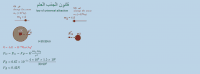
غيّر الكتلتين (بمليارات الكيلوجرامات) والمسافة بين مركزيهما (بالكيلومتر) وراقب القوة المتبادلة على الجسمين ومنحنى \(F\)–\(r\). (بيانات الصورة: \(2\) و\(4\) مليار kg و\(4\ \mathrm{km}\) فتكون \(F=33.4\ \mathrm N\).)
Change the two masses (in billions of kilograms) and the distance between their centres (in kilometres) and watch the mutual force on the two bodies and the \(F\)–\(r\) curve. (The picture’s data: \(2\) and \(4\) billion kg and \(4\ \mathrm{km}\) giving \(F=33.4\ \mathrm N\).)
جسم كتلته \(10\ \mathrm{kg}\) وآخر \(20\ \mathrm{kg}\) والمسافة بين مركزيهما \(2\ \mathrm m\). أوجد قوة التجاذب (\(G=6.674\times10^{-11}\)).
A \(10\ \mathrm{kg}\) body and a \(20\ \mathrm{kg}\) body with \(2\ \mathrm m\) between their centres. Find the gravitational force (\(G=6.674\times10^{-11}\)).
إذا تضاعفت المسافة بين جسمين فماذا يحدث لقوة التجاذب؟ وإذا تضاعفت كتلة كلٍّ منهما معًا؟
If the distance between two bodies is doubled what happens to the gravitational force? And if the mass of each is doubled?
🌍 مجال الجاذبية وتسارع الجاذبية
🌍 The Gravitational Field and the Gravitational Acceleration
مجال الجاذبية هو المنطقة حول جسم كبير (كالأرض) التي يؤثر فيها بقوة جاذبيته على الأجسام الأخرى. وشدّة المجال عند نقطة هي قوة الجاذبية على وحدة الكتل (\(\mathrm{N/kg}\))، وتساوي تسارع الجاذبية \(g\). فإذا كان جسم كتلته \(m\) على بعد \(r\) من مركز الأرض (كتلتها \(M\)):
The gravitational field is the region around a large body (such as the Earth) in which it exerts its gravitational force on other bodies. The field strength at a point is the gravitational force per unit mass (\(\mathrm{N/kg}\)) and equals the gravitational acceleration \(g\). If a body of mass \(m\) is at a distance \(r\) from the centre of the Earth (of mass \(M\)):
📌 شدة المجال
📌 Field strength
\[F=G\frac{Mm}{r^2}=mg\ \Rightarrow\ g=\frac{GM}{r^2}\]
\[g_{surface}=\frac{GM}{R^2}\approx9.8\ \mathrm{m/s^2},\qquad g(h)=\frac{GM}{(R+h)^2}\]
تعتمد \(g\) على كتلة الكوكب \(M\) والبعد عن مركزه \(r\) فقط، ولا تعتمد على كتلة الجسم الموجود فيها؛ ولهذا تسقط الأجسام المختلفة الكتلة بالتسارع نفسه. وتتناقص مع الارتفاع ولا تنعدم أبدًا.
\(g\) depends only on the mass of the planet \(M\) and the distance from its centre \(r\), and not on the mass of the body within it; that is why bodies of different masses fall with the same acceleration. It decreases with altitude and never vanishes.
كتلة الأرض \(M\approx6\times10^{24}\ \mathrm{kg}\) ونصف قطرها \(R\approx6.4\times10^{6}\ \mathrm m\). أوجد قوة الجاذبية على جسم كتلته \(1\ \mathrm{kg}\) على سطح الأرض (\(G=6.67\times10^{-11}\)).
The Earth’s mass is \(M\approx6\times10^{24}\ \mathrm{kg}\) and its radius \(R\approx6.4\times10^{6}\ \mathrm m\). Find the gravitational force on a \(1\ \mathrm{kg}\) body on the Earth’s surface (\(G=6.67\times10^{-11}\)).
ما قيمة \(g\) على ارتفاع يساوي نصف قطر الأرض فوق سطحها (أي \(r=2R\))؟ (\(g_0=9.8\))
What is the value of \(g\) at an altitude equal to the Earth’s radius above its surface (i.e. \(r=2R\))? (\(g_0=9.8\))
🧪 جرّب بنفسك: g مع الارتفاع
🧪 Try It Yourself: g with Altitude
🧪 تجربة 2: شدة مجال الجاذبية والارتفاع
🧪 Experiment 2: Field Strength and Altitude
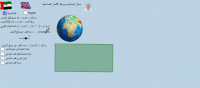
اضبط الارتفاع فوق سطح الجسم السماوي ثم قارن بين الأرض والقمر والمريخ والمشتري؛ وراقب \(g=GM/r^2\) ونقاط المدارات المعروفة (محطة الفضاء وGPS والمدار الثابت).
Set the altitude above the surface of the celestial body then compare the Earth, the Moon, Mars and Jupiter; and watch \(g=GM/r^2\) and the points of the well-known orbits (the space station, GPS and the geostationary orbit).
🛰️ حركة الأقمار الصناعية
🛰️ Motion of Artificial Satellites
يدور القمر الصناعي حول الأرض لأن قوة الجاذبية هي التي توفّر القوة المركزية اللازمة للحركة الدائرية؛ فهو في حالة سقوط حر مستمر نحو الأرض لكنه بسرعته المدارية يخطئها دائمًا. (وليست هناك قوة «طاردة مركزية» حقيقية تؤثر فيه؛ هي قصور الجسم في إطار دوّار.) من تساوي قوة الجاذبية مع \(mv^2/r\):
A satellite orbits the Earth because gravity provides the centripetal force needed for circular motion; it is in continuous free fall toward the Earth but with its orbital speed it always misses it. (There is no real “centrifugal force” acting on it; that is the inertia of the body in a rotating frame.) Equating the gravitational force with \(mv^2/r\):
📌 السرعة المدارية والزمن الدوري
📌 Orbital speed and period
\[\frac{GMm}{r^2}=\frac{mv^2}{r}\ \Rightarrow\ v=\sqrt{\frac{GM}{r}}\]
\[T=\frac{2\pi r}{v}=2\pi\sqrt{\frac{r^3}{GM}}\]
العوامل المؤثرة
Influencing factors
- كتلة الجسم المركزي \(M\) (الأرض مثلًا): كلما زادت زادت السرعة المدارية.The mass of the central body \(M\) (the Earth for example): the greater it is the greater the orbital speed.
- ارتفاع المدار: كلما زاد الارتفاع قلّت السرعة وزاد الزمن الدوري.The orbit’s altitude: the higher it is the lower the speed and the longer the period.
- السرعة المدارية تحدد شكل المدار (دائري أو إهليجي)؛ وكتلة القمر الصناعي لا تؤثر.The orbital speed determines the shape of the orbit (circular or elliptical); the satellite’s mass has no effect.
| التطبيقApplication | المدارOrbit | الارتفاع التقريبيApproximate altitude |
|---|---|---|
| محطة الفضاء الدوليةInternational Space Station | مدار أرضي منخفضLow Earth orbit | 400 km |
| أنظمة GPSGPS systems | مدار متوسط (MEO)Medium Earth orbit (MEO) | 20 200 km |
| أقمار الاتصالاتCommunication satellites | مدار ثابت (GEO)Geostationary orbit (GEO) | 35 786 km |
قمر صناعي يدور على بعد \(r=7\times10^{6}\ \mathrm m\) من مركز الأرض (\(M=6\times10^{24}\ \mathrm{kg}\)، \(G=6.67\times10^{-11}\)). أوجد سرعته المدارية وزمنه الدوري.
A satellite orbits at \(r=7\times10^{6}\ \mathrm m\) from the centre of the Earth (\(M=6\times10^{24}\ \mathrm{kg}\), \(G=6.67\times10^{-11}\)). Find its orbital speed and its period.
احسب السرعة والزمن الدوري لقمر في المدار الثابت \(r=4.2164\times10^{7}\ \mathrm m\) (\(M=5.972\times10^{24}\ \mathrm{kg}\)).
Calculate the speed and the period of a satellite in the geostationary orbit \(r=4.2164\times10^{7}\ \mathrm m\) (\(M=5.972\times10^{24}\ \mathrm{kg}\)).
🧪 جرّب بنفسك: القمر الصناعي
🧪 Try It Yourself: the Satellite
🧪 تجربة 3: حركة قمر صناعي حول الأرض
🧪 Experiment 3: A Satellite Orbiting the Earth
اختر ارتفاع المدار (أو اضغط محطة الفضاء / GPS / المدار الثابت) وراقب السرعة المدارية والزمن الدوري وتسارع الجاذبية؛ واضغط «حرّك القمر» لتراه يدور (المقياس غير خطي).
Choose the orbit altitude (or press space station / GPS / geostationary) and watch the orbital speed, the period and the gravitational acceleration; press “Move the satellite” to see it orbit (the scale is non-linear).
🌌 أهمية دراسة التجاذب الكتلي
🌌 Why Study Gravitation
تطبيقات
Applications
- فهم حركة الكواكب والأجرام السماوية وقوانين كبلر.Understanding the motion of planets and celestial bodies and Kepler’s laws.
- تصميم الأقمار الصناعية والمركبات الفضائية وحساب المدارات بدقة.Designing satellites and spacecraft and calculating orbits accurately.
- دراسة المدّ والجزر في المحيطات.Studying the tides in the oceans.
- الجيوفيزياء واكتشاف الموارد الطبيعية ودراسة التركيب الداخلي للأرض.Geophysics, discovering natural resources and studying the internal structure of the Earth.
وللتجاذب علاقة بقوانين أخرى: قانونا نيوتن للحركة، وقوانين كبلر لحركة الكواكب، ونظرية النسبية العامة لأينشتاين التي فسّرت الجاذبية بانحناء الزمكان؛ كما يبحث العلماء عن جسيمات الجاذبية (الغرافيتونات).
Gravitation is related to other laws too: Newton’s laws of motion, Kepler’s laws of planetary motion and Einstein’s general theory of relativity which explained gravity as a curvature of space-time; scientists also search for gravitational particles (gravitons).
⚠️ أخطاء شائعة
⚠️ Common Mistakes
تجنّب هذه الأخطاء
Avoid these mistakes
- استعمال المسافة بين سطحي الجسمين بدل المسافة بين مركزيهما.Using the distance between the surfaces instead of the distance between the centres.
- نسيان تربيع المسافة، أو إدخال الكتل بوحدات غير الكيلوجرام.Forgetting to square the distance, or entering masses in units other than kilograms.
- الظن أن الجسم الأثقل يسقط أسرع: \(g\) لا تعتمد على كتلة الجسم الساقط.Thinking that a heavier body falls faster: \(g\) does not depend on the mass of the falling body.
- الظن أن \(g\) تنعدم في الفضاء؛ إنما تقلّ مع البعد ولا تنعدم، وانعدام الوزن سببه السقوط الحر.Thinking that \(g\) vanishes in space; it only decreases with distance, and weightlessness is caused by free fall.
📝 ملخص الدرس
📝 Lesson Summary
أهم ما تعلمناه
Key points
- \(F=Gm_1m_2/r^2\): طردية مع الكتلتين وعكسية مع مربع المسافة بين المركزين.\(F=Gm_1m_2/r^2\): directly proportional to the masses and inversely proportional to the square of the distance between the centres.
- القوتان على الجسمين متساويتان ومتعاكستان (القانون الثالث).The forces on the two bodies are equal and opposite (the third law).
- \(g=GM/r^2\) وتتناقص مع الارتفاع، و\(W=mg\).\(g=GM/r^2\) and it decreases with altitude, and \(W=mg\).
- الأقمار: \(v=\sqrt{GM/r}\) و\(T=2\pi\sqrt{r^3/GM}\).Satellites: \(v=\sqrt{GM/r}\) and \(T=2\pi\sqrt{r^3/GM}\).
🎲 تدرّب على المسائل
🎲 Practice Problems
🧪 تجربة 4: تدرّب: مسائل قوة التجاذب
🧪 Experiment 4: Practice: Gravitational Force Problems
مسائل عشوائية بأرقام مختلفة. احسب واكتب الجواب (مثل 3.34e-9) ثم اضغط «تحقّق».
Random problems with different numbers. Work it out, enter the answer (like 3.34e-9) and press “Check”.
✅ قيّم نفسك
✅ Self-Check
إذا تضاعفت المسافة بين جسمين فإن قوة التجاذب بينهما تصبح:
If the distance between two bodies is doubled the gravitational force between them becomes:
إذا تضاعفت كتلة كلٍّ من الجسمين مع ثبات المسافة فإن القوة تصبح:
If the mass of each body is doubled with the distance fixed the force becomes:
تعتمد شدة مجال الجاذبية \(g=GM/r^2\) على:
The gravitational field strength \(g=GM/r^2\) depends on:
السرعة المدارية لقمر صناعي \(v=\sqrt{GM/r}\): عند زيادة نصف قطر المدار:
The orbital speed of a satellite \(v=\sqrt{GM/r}\): when the orbital radius increases:
🧪 اختبر نفسك: امتحان من 20 سؤالاً
🧪 Test Yourself: a 20-Question Exam
أنهِ الدرس بالاختبار التفاعلي التالي؛ أسئلته تجمع بين الفهم والحساب وتغطي جميع أقسام الدرس.
Finish with the interactive exam below; its questions mix understanding with calculation and cover every section of the lesson.
اختبار قوة التجاذب الكتلي Gravitational Force Quiz
20 سؤالاً - قانون الجذب العام، العوامل المؤثرة، شدة المجال g، الأقمار الصناعية 20 Questions - the law of universal gravitation, influencing factors, field strength g, satellites
• عدد الأسئلة: 20 سؤالاً
• مدة الاختبار: 30 دقيقة
• لا يمكنك تغيير إجاباتك أو إعادة الاختبار إلا بعد 24 ساعة من التسليم.
• تأكد من إجاباتك قبل التسليم! 📌 Important Instructions:
• Number of questions: 20 questions
• Quiz duration: 30 minutes
• You cannot change your answers or retake the quiz for 24 hours after submission.
• Make sure of your answers before submitting!
🔗 محاكيات GeoGebra للاستعانة بها عند اللزوم
🔗 GeoGebra Simulations to Use When Needed
اضغط «تشغيل» لتعمل المحاكاة هنا داخل الدرس؛ ويمكن للطالب الرجوع إليها لتجربة الفكرة بطريقة أخرى.
Press “Run” to run the simulation right here inside the lesson; the student can use it to try the idea in another way.