🎯 نواتج التعلم
🎯 Learning Outcomes
بعد دراسة هذا الدرس ستكون قادرًا على أن:
After this lesson you will be able to:
- تنص قوانين نيوتن الثلاثة وتفسّر بها ظواهر من الحياة اليومية.State Newton’s three laws and use them to explain everyday phenomena.
- تعرّف القصور الذاتي وتربطه بالكتلة.Define inertia and relate it to mass.
- تحسب القوة والتسارع والكتلة بالعلاقة \(F=ma\) وتفسّر الرسمين \(a\)–\(F\) و\(a\)–\(1/m\).Calculate force, acceleration and mass with \(F=ma\) and interpret the \(a\)–\(F\) and \(a\)–\(1/m\) graphs.
- تميّز زوج الفعل ورد الفعل وتعرف لماذا لا يلغي أحدهما الآخر.Identify an action–reaction pair and know why they do not cancel.
- تطبّق القوانين على المستوى الأفقي والمائل وآلة أتود.Apply the laws to horizontal and inclined surfaces and the Atwood machine.
📖 مقدمة
📖 Introduction
قوانين نيوتن للحركة ثلاثة قوانين أسّست عليها الميكانيكا الكلاسيكية، صاغها إسحاق نيوتن في كتابه «الأصول الرياضية للفلسفة الطبيعية» عام 1687. وهي الأساس الذي نفسّر به حركة الأجسام وتفاعلها مع القوى، وتُستخدم في الهندسة الميكانيكية والطيران والفيزياء الفلكية وتصميم الآلات والمركبات.
Newton’s laws of motion are three laws on which classical mechanics is founded, formulated by Isaac Newton in his Principia in 1687. They are the basis on which we explain how bodies move and interact with forces, and they are used in mechanical and aerospace engineering, astrophysics and the design of machines and vehicles.
🔹 القانون الأول: القصور الذاتي
🔹 The First Law: Inertia
📌 القانون الأول
📌 The first law
\[\sum\vec F=0\ \Rightarrow\ \vec v=\text{constant}\]
يبقى الجسم على حالته الحركية (ساكنًا أو متحركًا بسرعة ثابتة في خط مستقيم) ما لم تؤثر فيه قوة محصلة تغيّر هذه الحالة.
A body stays in its state of motion (at rest or moving with constant velocity along a straight line) unless a net force acts on it and changes that state.
شرح
Explanation
- الجسم الساكن يبقى ساكنًا حتى تحرّكه قوة.A body at rest stays at rest until a force moves it.
- الجسم المتحرك يستمر بالسرعة نفسها والاتجاه نفسه حتى تغيّره قوة.A moving body keeps the same speed and direction until a force changes it.
- القصور الذاتي ميل الأجسام إلى مقاومة تغيّر حالتها الحركية، ويزداد بزيادة الكتلة ولا يعتمد على السرعة.Inertia is the tendency of bodies to resist a change in their state of motion; it grows with mass and does not depend on speed.
أمثلة: يندفع الراكب للأمام عند الفرملة المفاجئة (حزام الأمان)، وتستمر الكرة على سطح أملس في حركتها، ويبقى الغبار ساكنًا عند هز الثياب. وفي الفضاء الخارجي تستمر المركبات بسرعتها دون محركات، وتبقى الأقمار الصناعية في مداراتها.
Examples: a passenger lurches forward when the car brakes suddenly (seat belts), a ball on a smooth surface keeps moving, and dust stays put when clothes are shaken. In outer space spacecraft keep their speed without engines and satellites stay in their orbits.
🧪 جرّب بنفسك: الصندوق والشاحنة
🧪 Try It Yourself: the Box and the Truck
🧪 القصور الذاتي: صندوق على شاحنة
🧪 Inertia: a Box on a Truck
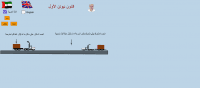
تتسارع الشاحنة بتسارع \(a\) وبين الصندوق والشاحنة احتكاك \(\mu\). إن كان \(a\) أكبر من \(\mu g\) انزلقت الشاحنة وبقي الصندوق في حالته؛ وإلا تحرك معها.
The truck accelerates with \(a\) and there is friction \(\mu\) between the box and the truck. If \(a\) exceeds \(\mu g\) the truck slides away and the box stays in its state; otherwise it moves with it.
صندوق على شاحنة معامل الاحتكاك بينهما \(\mu=0.5\). ما أكبر تسارع للشاحنة يبقى معه الصندوق دون انزلاق؟ (\(g=9.81\))
A box on a truck with friction coefficient \(\mu=0.5\) between them. What is the largest truck acceleration at which the box does not slip? (\(g=9.81\))
عند فرملة الحافلة فجأة يندفع الركاب للأمام بسبب:
When a bus brakes suddenly the passengers lurch forward because of:
🔹 القانون الثاني: القوة والتسارع
🔹 The Second Law: Force and Acceleration
📌 القانون الثاني
📌 The second law
\[\vec F=m\vec a\]
محصلة القوى المؤثرة في جسم تساوي كتلته مضروبة في تسارعه، ويكون التسارع في اتجاه المحصلة. وحدة القوة النيوتن: \(1\ \mathrm N=1\ \mathrm{kg\,m/s^2}\).
The net force on a body equals its mass times its acceleration, and the acceleration is in the direction of the net force. The unit of force is the newton: \(1\ \mathrm N=1\ \mathrm{kg\,m/s^2}\).
شرح
Explanation
- علاقة طردية: \(a\propto F\) عند ثبات الكتلة.Direct: \(a\propto F\) at constant mass.
- علاقة عكسية: \(a\propto\dfrac1m\) عند ثبات القوة.Inverse: \(a\propto\dfrac1m\) at constant force.
- القوة سبب تغيّر الحركة (التسارع) وليست سبب الحركة نفسها.Force is the cause of a change of motion (acceleration), not of the motion itself.
أمثلة: كلما دفعت عربة التسوق بقوة أكبر زاد تسارعها، وسيارات السباق خفيفة وقوية المحركات فتتسارع كثيرًا، وفي المصعد المتسارع للأعلى تشعر بزيادة وزنك.
Examples: the harder you push a shopping cart the greater its acceleration, race cars are light with powerful engines so they accelerate strongly, and in an elevator accelerating upward you feel heavier.
🧪 تجربة 1: التسارع والقوة
🧪 Experiment 1: Acceleration and Force
في محاكاة GeoGebra (في آخر الصفحة) تُنقل 100 جرام من العربة إلى الكتلة المعلّقة فتتغير القوة وتبقى كتلة المجموعة ثابتة؛ ثم تُسجَّل قيم التسارع. جرّب ذلك هنا:
In the GeoGebra simulation (at the end of the page) 100 g is moved from the cart to the hanging mass, changing the force while the total mass stays constant; then the accelerations are recorded. Try it here:
🧪 التسارع والقوة (كتلة الجملة ثابتة)
🧪 Acceleration and Force (constant system mass)
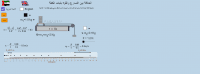
كتلة العربة مع أقراصها (100 g لكل قرص) + الأقراص المعلّقة = \(1.0\ \mathrm{kg}\) دائمًا. انقل قرصًا تلو الآخر إلى الكتلة المعلّقة فتزداد القوة \(F=m_2g\) (\(g=10\)) وتبقى كتلة الجملة ثابتة. أطلق العربة وسجّل القراءة.
The cart with its discs (100 g each) + the hanging discs = \(1.0\ \mathrm{kg}\) always. Move one disc at a time to the hanging mass so the force \(F=m_2g\) (\(g=10\)) grows while the system mass stays constant. Release the cart and record the reading.
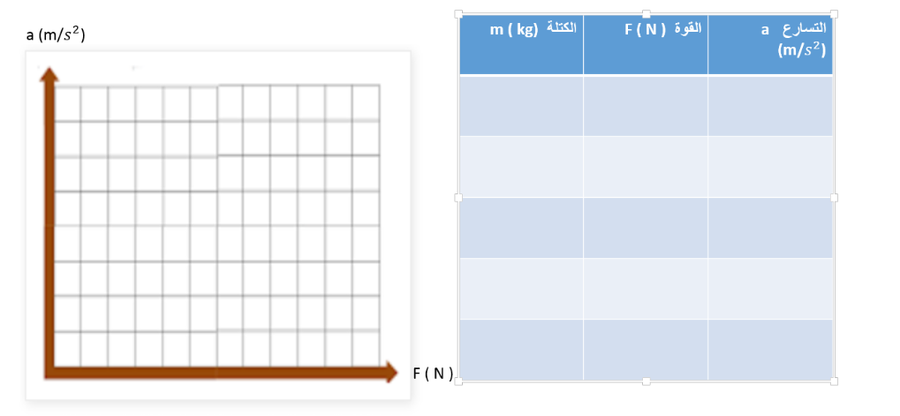
نموذج جدول البيانات والخط البياني للتسارع مقابل القوة.
Template of the data table and the acceleration–force graph.
🧪 تجربة 2: التسارع ومقلوب الكتلة
🧪 Experiment 2: Acceleration and Inverse Mass
هنا نثبّت قوة الشد ونغيّر كتلة العربة ونسجّل التسارع مقابل \(1/m\):
Here we keep the tension constant, change the cart’s mass and record the acceleration against \(1/m\):
🧪 التسارع ومقلوب الكتلة (القوة ثابتة)
🧪 Acceleration and Inverse Mass (constant force)
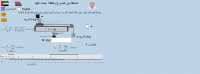
يُعلَّق قرصان (\(m_2=0.2\ \mathrm{kg}\)) فتكون القوة ثابتة \(F=2\ \mathrm N\). أضف أقراصًا إلى العربة لتزيد كتلة الجملة \(M\)، أطلق العربة وسجّل التسارع، وراقب العلاقة بين \(a\) و\(1/M\).
Two discs are hung (\(m_2=0.2\ \mathrm{kg}\)) so the force is constant \(F=2\ \mathrm N\). Add discs to the cart to increase the system mass \(M\), release the cart and record the acceleration; watch the relation between \(a\) and \(1/M\).
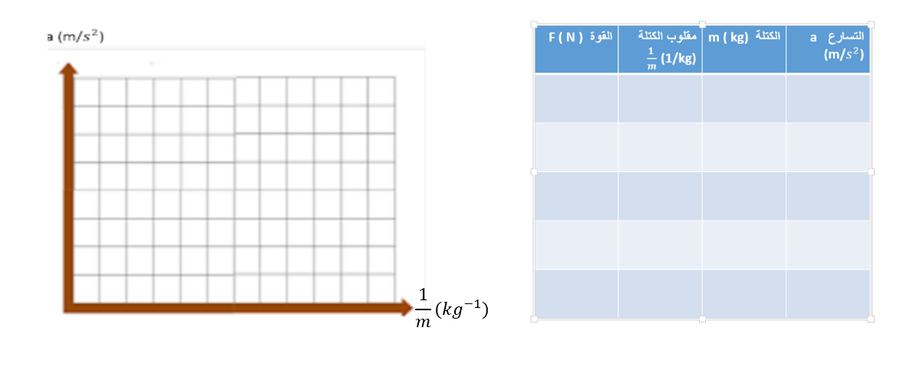
نموذج الخط البياني للتسارع مقابل مقلوب الكتلة.
Template of the acceleration versus inverse-mass graph.
تؤثر قوة محصلة \(50\ \mathrm N\) في جسم كتلته \(10\ \mathrm{kg}\). أوجد تسارعه.
A net force of \(50\ \mathrm N\) acts on a \(10\ \mathrm{kg}\) body. Find its acceleration.
جسم كتلته \(4\ \mathrm{kg}\) يتسارع بمقدار \(6\ \mathrm{m/s^2}\). ما القوة المحصلة المؤثرة فيه؟
A \(4\ \mathrm{kg}\) body accelerates at \(6\ \mathrm{m/s^2}\). What is the net force on it?
إذا تضاعفت كتلة الجسم مع ثبات القوة المحصلة فإن تسارعه:
If the mass of a body doubles while the net force stays constant, its acceleration:
🔹 القانون الثالث: الفعل ورد الفعل
🔹 The Third Law: Action and Reaction
📌 القانون الثالث
📌 The third law
\[\vec F_{12}=-\vec F_{21}\]
لكل فعل رد فعل مساوٍ له في المقدار ومعاكس له في الاتجاه.
For every action there is a reaction equal in magnitude and opposite in direction.
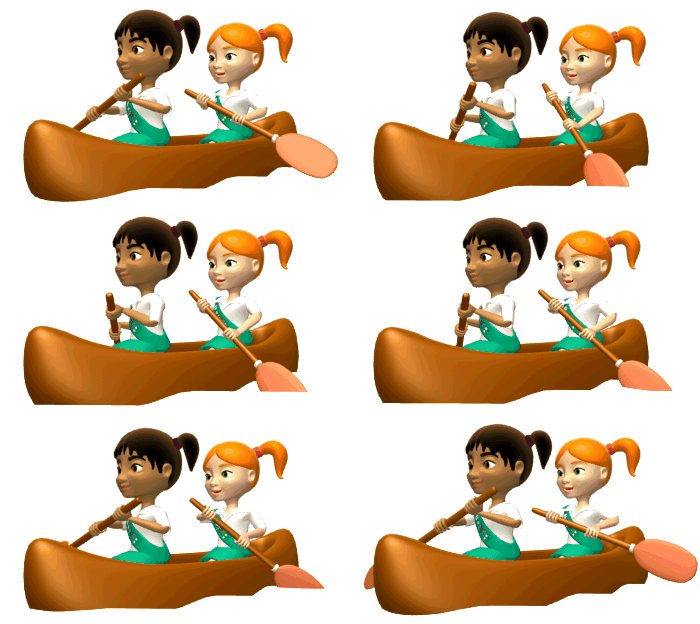
القفز من القارب: تدفع القارب للخلف فيدفعك للأمام.
Jumping from a boat: you push the boat backward and it pushes you forward.
شرح
Explanation
- القوى تظهر دائمًا في أزواج متساوية ومتعاكسة.Forces always appear in equal and opposite pairs.
- الفعل يؤثر في جسم ورد الفعل في جسم آخر، ولذلك لا يلغي أحدهما الآخر.The action acts on one body and the reaction on another, so they do not cancel.
- يحدثان في اللحظة نفسها ومن النوع نفسه من القوى.They occur at the same instant and are forces of the same kind.
أمثلة: القفز من القارب، المشي (تدفع الأرض للخلف فتدفعك للأمام)، وإطلاق النار (الرصاصة للأمام والبندقية ترتدّ للخلف). وتنبيه: ردّ فعل جذب الأرض لك هو جذبك أنت للأرض؛ أما رد فعل القوة العمودية فهو ضغط قدميك على الأرض.
Examples: jumping from a boat, walking (you push the ground backward and it pushes you forward) and firing a gun (the bullet goes forward and the gun recoils). Note: the reaction to the Earth’s pull on you is your pull on the Earth; the reaction to the normal force from the ground is your feet pressing on the ground.
🧪 جرّب بنفسك: متزلجان على الجليد
🧪 Try It Yourself: Two Skaters on Ice
🧪 الفعل ورد الفعل: متزلجان على الجليد
🧪 Action and Reaction: Two Skaters on Ice
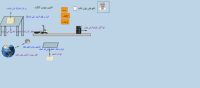
يتلامس المتزلجان ويدفع كلٌّ منهما الآخر بقوة \(F\) مدة \(0.5\ \mathrm s\) (قوتان متساويتان ومتعاكستان)، ثم ينفصلان. غيّر الكتلتين وحرّك الزمن لترى التسارعين والسرعتين وحفظ الزخم.
The first skater pushes the second with a force \(F\) and the second pushes back with an equal and opposite force. Change the two masses and look at the accelerations.
يدفع شخص كتلته \(60\ \mathrm{kg}\) قاربًا كتلته \(120\ \mathrm{kg}\) بقوة \(90\ \mathrm N\). أوجد تسارع كل منهما.
A \(60\ \mathrm{kg}\) person pushes a \(120\ \mathrm{kg}\) boat with a force of \(90\ \mathrm N\). Find the acceleration of each.
لماذا لا يلغي الفعل ورد الفعل بعضهما؟
Why do action and reaction not cancel each other?
🛠️ تطبيقات على قوانين نيوتن
🛠️ Applications of Newton’s Laws
أولًا: جسم على مستوى أفقي
First: a Body on a Horizontal Surface
القوى المؤثرة: الوزن \(W=mg\) إلى الأسفل، والقوة العمودية \(N\) إلى الأعلى (وتساوي \(mg\) إذا لم توجد قوى رأسية أخرى)، وقوة الشد أو الدفع \(F\) في اتجاه الحركة، والاحتكاك \(f=\mu N\) عكس الحركة.
The forces: the weight \(W=mg\) downward, the normal force \(N\) upward (equal to \(mg\) if there are no other vertical forces), the pull or push \(F\) along the motion and friction \(f=\mu N\) opposing it.
\[F_{net}=F-f=ma\]
🧪 جرّب بنفسك: المستوى الأفقي
🧪 Try It Yourself: the Horizontal Surface
🧪 حركة جسم على مستوى أفقي
🧪 Motion on a Horizontal Surface
اضبط القوة المؤثرة والكتلة ومعامل الاحتكاك وراقب مخطط القوى: \(N=mg\)، والاحتكاك، والتسارع.
Set the applied force, the mass and the friction coefficient and watch the free-body diagram: \(N=mg\), friction and acceleration.
يُسحب جسم كتلته \(10\ \mathrm{kg}\) على سطح أفقي بقوة \(50\ \mathrm N\) ومعامل الاحتكاك الحركي \(0.2\). أوجد تسارعه (\(g=9.81\)).
A \(10\ \mathrm{kg}\) body is pulled on a horizontal surface with a force of \(50\ \mathrm N\) and a kinetic friction coefficient \(0.2\). Find its acceleration (\(g=9.81\)).
ثانيًا: جسم على مستوى مائل
Second: a Body on an Inclined Plane
نحلّل الوزن إلى مركبتين: موازية للمستوى \(mg\sin\theta\) وعمودية عليه \(mg\cos\theta\). وبلا احتكاك يكون \(a=g\sin\theta\)، ومع الاحتكاك \(a=g(\sin\theta-\mu\cos\theta)\).
We resolve the weight into a component parallel to the plane \(mg\sin\theta\) and one perpendicular to it \(mg\cos\theta\). Without friction \(a=g\sin\theta\), and with friction \(a=g(\sin\theta-\mu\cos\theta)\).
📌 المستوى المائل
📌 The inclined plane
\[mg\sin\theta-f=ma,\qquad N=mg\cos\theta\]
🧪 جرّب بنفسك: المستوى المائل
🧪 Try It Yourself: the Inclined Plane
🧪 حركة جسم على مستوى مائل
🧪 Motion on an Inclined Plane
غيّر زاوية الميل والكتلة ومعامل الاحتكاك وراقب المركبتين \(mg\sin\theta\) و\(mg\cos\theta\) والتسارع.
Change the angle of the incline, the mass and the friction coefficient and watch the components \(mg\sin\theta\) and \(mg\cos\theta\) and the acceleration.
ينزلق جسم دون احتكاك على مستوى مائل زاويته \(30^\circ\). أوجد تسارعه (\(g=9.81\)).
A body slides without friction on a plane inclined at \(30^\circ\). Find its acceleration (\(g=9.81\)).
ثالثًا: آلة أتود
Third: the Atwood Machine
كتلتان \(m_1\gt m_2\) معلّقتان بخيط يمرّ على بكرة. نطبّق القانون الثاني على كل كتلة: \(m_1g-T=m_1a\) و\(T-m_2g=m_2a\) فنجد:
Two masses \(m_1\gt m_2\) hang from a string passing over a pulley. Applying the second law to each: \(m_1g-T=m_1a\) and \(T-m_2g=m_2a\), giving:
📌 آلة أتود
📌 The Atwood machine
\[a=g\,\frac{m_1-m_2}{m_1+m_2}\]
\[T=\frac{2m_1m_2}{m_1+m_2}\,g\]
🧪 جرّب بنفسك: آلة أتود
🧪 Try It Yourself: the Atwood Machine
🧪 آلة أتود
🧪 The Atwood Machine
كتلتان معلّقتان بخيط على بكرة. غيّر الكتلتين وراقب التسارع وقوة الشد، وحرّك الزمن أو اضغط تشغيل.
Two masses hanging from a string over a pulley. Change the two masses and watch the acceleration and the tension, and move the time or press play.
في آلة أتود \(m_1=5\ \mathrm{kg}\) و\(m_2=3\ \mathrm{kg}\). أوجد التسارع وقوة الشد (\(g=9.81\)).
In an Atwood machine \(m_1=5\ \mathrm{kg}\) and \(m_2=3\ \mathrm{kg}\). Find the acceleration and the tension (\(g=9.81\)).
في آلة أتود إذا تساوت الكتلتان فإن التسارع:
In an Atwood machine, if the two masses are equal the acceleration is:
🎲 تدرّب
🎲 Practice
🧪 تدرّب: مسائل قوانين نيوتن
🧪 Practice: Newton’s Laws Problems
مسائل عشوائية بأرقام مختلفة. احسب واكتب الجواب ثم اضغط «تحقّق».
Random problems with different numbers. Work it out, enter the answer and press “Check”.
📊 ملخص قوانين نيوتن
📊 Summary of Newton’s Laws
| القانونLaw | الصيغةFormula | المفهومConcept |
|---|---|---|
| الأولFirst | \(\sum\vec F=0\Rightarrow\vec v=\text{const}\)\(\sum\vec F=0\Rightarrow\vec v=\text{const}\) | القصور الذاتيInertia |
| الثانيSecond | \(\vec F=m\vec a\)\(\vec F=m\vec a\) | القوة والتسارعForce and acceleration |
| الثالثThird | \(\vec F_{12}=-\vec F_{21}\)\(\vec F_{12}=-\vec F_{21}\) | الفعل ورد الفعلAction and reaction |
| المستوى الأفقيHorizontal | \(F-\mu mg=ma\)\(F-\mu mg=ma\) | الاحتكاكFriction |
| المستوى المائلInclined | \(a=g(\sin\theta-\mu\cos\theta)\)\(a=g(\sin\theta-\mu\cos\theta)\) | مركبتا الوزنWeight components |
| آلة أتودAtwood | \(a=g\frac{m_1-m_2}{m_1+m_2}\)\(a=g\frac{m_1-m_2}{m_1+m_2}\) | كتلتان وبكرةTwo masses and a pulley |
🧪 اختبر نفسك: امتحان من 20 سؤالاً
🧪 Test Yourself: a 20-Question Exam
أنهِ الدرس بالاختبار التفاعلي التالي؛ أسئلته تجمع بين الفهم والحساب وتغطي جميع أقسام الدرس.
Finish with the interactive exam below; its questions mix understanding with calculation and cover every section of the lesson.
اختبار قوانين نيوتن Newton’s Laws Quiz
20 سؤالاً - الكميات المتجهة والقياسية، فيثاغورس، قانون جيب التمام، تحليل المتجهات والمحصلة بالمركبات 20 Questions - vector and scalar quantities, Pythagoras, the law of cosines, resolving vectors and the resultant by components
• عدد الأسئلة: 20 سؤالاً
• مدة الاختبار: 30 دقيقة
• لا يمكنك تغيير إجاباتك أو إعادة الاختبار إلا بعد 24 ساعة من التسليم.
• تأكد من إجاباتك قبل التسليم! 📌 Important Instructions:
• Number of questions: 20 questions
• Quiz duration: 30 minutes
• You cannot change your answers or retake the quiz for 24 hours after submission.
• Make sure of your answers before submitting!
🔗 محاكيات GeoGebra للاستعانة بها عند اللزوم
🔗 GeoGebra Simulations to Use When Needed
اضغط «تشغيل» لتعمل المحاكاة هنا داخل الدرس؛ ويمكن للطالب الرجوع إليها لتجربة الفكرة بطريقة أخرى.
Press “Run” to run the simulation right here inside the lesson; the student can use it to try the idea in another way.