🎯 نواتج التعلم
🎯 Learning Outcomes
بعد دراسة هذا الدرس ستكون قادرًا على أن:
After this lesson you will be able to:
- تنصّ على قانون الوصلة (كيرشوف الأول) وتطبّقه لإيجاد تيار مجهول عند وصلة.State the junction rule (Kirchhoff’s first law) and apply it to find an unknown current at a junction.
- تنصّ على قانون الحلقة (كيرشوف الثاني) وتتبّع خطوات حل دائرة ذات حلقتين وبطاريتين.State the loop rule (Kirchhoff’s second law) and follow the steps of solving a circuit with two loops and two batteries.
- تستعمل قنطرة وتستون لإيجاد مقاومة مجهولة: \(R_x=R_3R_b/R_a\).Use the Wheatstone bridge to find an unknown resistance: \(R_x=R_3R_b/R_a\).
- تحسب مقاومة المجزّئ لتوسيع مدى الأميتر ومقاومة المضاعِف لتوسيع مدى الفولتميتر.Calculate the shunt resistance to extend the range of an ammeter and the multiplier resistance to extend the range of a voltmeter.
- تصف شحن المكثف وتفريغه في دائرة \(RC\) وتحسب الثابت الزمني \(\tau=RC\).Describe the charging and discharging of a capacitor in an \(RC\) circuit and calculate the time constant \(\tau=RC\).
🔌 لماذا قوانين كيرشوف؟
🔌 Why Kirchhoff’s Laws?
قانون أوم يكفي لحل دوائر بسيطة، لكن الدوائر المركّبة التي فيها أكثر من بطارية وأكثر من مسار للتيار لا يمكن اختزالها بالتوالي والتوازي وحدهما. هنا نستعمل قانوني كيرشوف، وهما تعبيران عن حفظ الشحنة وحفظ الطاقة. وقبل البدء نتعرّف المصطلحات:
Ohm’s law is enough for simple circuits, but complex circuits with more than one battery and more than one path for the current cannot be reduced with series and parallel alone. Here we use Kirchhoff’s laws, which express the conservation of charge and the conservation of energy. First, let us know the terms:
| المصطلحTerm | المعنىMeaning |
|---|---|
| الوصلة (العقدة)Junction (node) | نقطة تلتقي عندها ثلاثة أسلاك أو أكثرA point where three or more wires meet |
| الفرعBranch | مسار بين وصلتين يمرّ فيه تيار واحدA path between two junctions carrying one current |
| الحلقةLoop | أي مسار مغلق في الدائرةAny closed path in the circuit |
🔀 قانون كيرشوف الأول: قانون الوصلة
🔀 Kirchhoff’s First Law: The Junction Rule
قانون الوصلة: مجموع التيارات الداخلة إلى أي وصلة يساوي مجموع التيارات الخارجة منها، لأن الشحنة لا تتراكم ولا تفنى عند الوصلة (حفظ الشحنة). وبصيغة أخرى مجموع التيارات الجبري عند الوصلة صفر (الداخل موجب والخارج سالب).
The junction rule: the sum of the currents entering any junction equals the sum of the currents leaving it, because the charge neither accumulates nor disappears at the junction (conservation of charge). In another form the algebraic sum of the currents at the junction is zero (entering positive and leaving negative).
📌 قانون الوصلة
📌 The junction rule
\[\sum I_{in}=\sum I_{out}\qquad\Longleftrightarrow\qquad\sum I=0\]
عند وصلة يدخل تياران \(12\ \mathrm A\) و\(6\ \mathrm A\) ويخرج تيار \(5\ \mathrm A\) وتيار آخر مجهول \(I\). أوجد \(I\).
At a junction two currents \(12\ \mathrm A\) and \(6\ \mathrm A\) enter and a current \(5\ \mathrm A\) and another unknown current \(I\) leave. Find \(I\).
🧪 تجربة 1: قانون الوصلة
🧪 Experiment 1: The Junction Rule
وصلة تلتقي فيها أربعة أسلاك: غيّر ثلاثة تيارات واكتشف الرابع.
A junction where four wires meet: change three currents and discover the fourth.
🛠️ خطوات العمل
🛠️ Procedure
- اضبط \(I_1=8\), \(I_2=5\), \(I_3=6\ \mathrm A\) واقرأ \(I_4\).Set \(I_1=8\), \(I_2=5\), \(I_3=6\ \mathrm A\) and read \(I_4\).
- اجعل \(I_3\) أكبر من \(I_1+I_2\) وراقب إشارة \(I_4\).Make \(I_3\) larger than \(I_1+I_2\) and watch the sign of \(I_4\).
🧪 تجربة 1: قانون الوصلة (قانون كيرشوف الأول)
🧪 Experiment 1: Kirchhoff’s First Law: The Junction Rule
عند وصلة تلتقي فيها أربعة أسلاك: تياران داخلان \(I_1,I_2\) وتيار خارج \(I_3\). غيّر القيم واحسب التيار الرابع \(I_4\) من قانون الوصلة.
At a junction where four wires meet: two entering currents \(I_1,I_2\) and a leaving current \(I_3\). Change the values and find the fourth current \(I_4\) from the junction rule.
🔎 ماذا نلاحظ؟ وما الاستنتاج؟
🔎 What do we observe? What is the conclusion?
- مجموع الداخل دائمًا يساوي مجموع الخارج.The sum entering always equals the sum leaving.
- إذا خرجت قيمة سالبة فالاتجاه الفعلي للتيار معكوس عمّا فرضناه، ولا يعني ذلك خطأ في الحل.If a negative value comes out, the actual direction of the current is opposite to what we assumed, and this does not mean an error in the solution.
قانون الوصلة \(\sum I_{in}=\sum I_{out}\) يحدد التيار المجهول وإشارته.
The junction rule \(\sum I_{in}=\sum I_{out}\) determines the unknown current and its sign.
🔄 قانون كيرشوف الثاني: قانون الحلقة
🔄 Kirchhoff’s Second Law: The Loop Rule
قانون الحلقة: المجموع الجبري لفروق الجهد حول أي حلقة مغلقة يساوي صفرًا، لأن الطاقة محفوظة: ما تكتسبه الشحنة من البطاريات تفقده كله في المقاومات عند عودتها إلى نقطة البداية.
The loop rule: the algebraic sum of the potential differences around any closed loop equals zero, because energy is conserved: what the charge gains from the batteries it loses entirely in the resistors when it returns to the starting point.
📌 قانون الحلقة
📌 The loop rule
\[\sum \Delta V=0\qquad\Longleftrightarrow\qquad\sum \varepsilon=\sum IR\]
قواعد الإشارات عند الدوران في الحلقة
Sign rules when going around the loop
- بطارية: إذا مررنا من القطب السالب إلى الموجب فجهدها \(+V\)، وإن مررنا من الموجب إلى السالب فجهدها \(-V\).A battery: if we go from the negative to the positive terminal its voltage is \(+V\), and if we go from positive to negative it is \(-V\).
- مقاومة: إذا مررنا مع اتجاه التيار فالهبوط \(-IR\)، وإن مررنا عكس اتجاه التيار فهو \(+IR\).A resistor: if we go along the current the drop is \(-IR\), and if we go against the current it is \(+IR\).
- نختار اتجاه الدوران (مع عقارب الساعة أو عكسها) ونثبّته في المعادلة كلها.We choose the direction of going around (clockwise or counterclockwise) and keep it for the whole equation.
بطارية \(12\ \mathrm V\) ومقاومتان \(4\ \Omega\) و\(8\ \Omega\) على التوالي في حلقة واحدة. أوجد التيار.
A \(12\ \mathrm V\) battery and two resistors \(4\ \Omega\) and \(8\ \Omega\) in series in one loop. Find the current.
🧭 خطوات حل مسائل كيرشوف
🧭 Steps of Solving Kirchhoff Problems
الخطوات
The steps
- نفرض اتجاهًا للتيار في كل فرع (لو أخطأنا خرجت القيمة سالبة، ونصحح الاتجاه في الرسم فقط).We assume a direction for the current in each branch (if we are wrong the value comes out negative, and we correct the direction in the figure only).
- نكتب معادلة الوصلة (التيار الداخل = التيار الخارج) عند وصلة واحدة.We write the junction equation (entering current = leaving current) at a junction.
- نحدّد الحلقات ونفرض اتجاهًا موجبًا لكل حلقة (مع عقارب الساعة أو عكسها).We determine the loops and assume a positive direction for each loop (clockwise or counterclockwise).
- نكتب معادلة الحلقة لكل حلقة مع مراعاة إشارة جهد البطارية وإشارة جهد المقاومة. إذا كان لدينا ثلاثة تيارات مجهولة نكتفي بحلقتين لأن لدينا معادلة الوصلة.We write the loop equation for each loop taking into account the sign of the battery voltage and of the resistor voltage. If we have three unknown currents two loops are enough because we have the junction equation.
- نحلّ المعادلات الثلاث معًا (بالتعويض أو بحاسبة المعادلات).We solve the three equations together (by substitution or with the equation calculator).
- نفسّر النتيجة: الإشارة السالبة تعني أن الاتجاه الفعلي معكوس للمفروض.We interpret the result: a negative sign means that the actual direction is opposite to the assumed one.
📝 مثال محلول كامل: دائرة بحلقتين وبطاريتين
📝 A Full Worked Example: A Circuit With Two Loops and Two Batteries
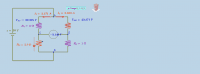
الدائرة ثلاثة فروع بين النقطتين \(A\) و\(B\): البطارية \(V_1=20\ \mathrm V\) مع \(R_1=40\ \Omega\)، والبطارية \(V_2=30\ \mathrm V\) مع \(R_2=30\ \Omega\)، والمقاومة \(R_3=40\ \Omega\) (مقاومتان \(20\ \Omega\) على التوالي). نفرض \(I_1\) و\(I_3\) نحو \(A\) و\(I_2\) مغادرًا \(A\).
The circuit has three branches between the points \(A\) and \(B\): the battery \(V_1=20\ \mathrm V\) with \(R_1=40\ \Omega\), the battery \(V_2=30\ \mathrm V\) with \(R_2=30\ \Omega\), and the resistance \(R_3=40\ \Omega\) (two \(20\ \Omega\) resistors in series). We assume \(I_1\) and \(I_3\) toward \(A\) and \(I_2\) leaving \(A\).
📌 المعادلات الثلاث
📌 The three equations
\[I_1-I_2+I_3=0\qquad,\qquad 40I_1+30I_2=10\qquad,\qquad -40I_1+40I_3=20\]
حلّ المعادلات الثلاث السابقة وأوجد \(I_1\) و\(I_2\) و\(I_3\) واشرح معنى الإشارة السالبة.
Solve the three previous equations and find \(I_1\), \(I_2\) and \(I_3\) and explain the meaning of the negative sign.
الإشارة السالبة للتيار \(I_1\) تعني أننا أخطأنا في تحديد اتجاهه، فالاتجاه الصحيح عكس المفروض (\(0.05\ \mathrm A\) في الاتجاه المعاكس). ولا يعني ذلك خطأ في الحل.
The negative sign of the current \(I_1\) means that we were wrong in determining its direction, so the correct direction is opposite to the assumed one (\(0.05\ \mathrm A\) in the opposite direction). This does not mean an error in the solution.
🧪 تجربة 2: حل دائرة بحلقتين
🧪 Experiment 2: Solving a Circuit With Two Loops
غيّر البطاريتين والمقاومات الثلاث وراقب التيارات الثلاثة ومعادلات كيرشوف.
Change the two batteries and the three resistors and watch the three currents and Kirchhoff’s equations.
🛠️ خطوات العمل
🛠️ Procedure
- اترك القيم الأصلية وتأكد من \(I_1=-0.05\), \(I_2=0.4\), \(I_3=0.45\ \mathrm A\).Keep the original values and make sure of \(I_1=-0.05\), \(I_2=0.4\), \(I_3=0.45\ \mathrm A\).
- غيّر \(V_1\) أو \(V_2\) وراقب انعكاس اتجاه التيارات.Change \(V_1\) or \(V_2\) and watch the reversal of the direction of the currents.
- تحقق أن \(I_1-I_2+I_3=0\) دائمًا.Check that \(I_1-I_2+I_3=0\) always.
🧪 تجربة 2: قانون الحلقة (قانون كيرشوف الثاني): دائرة بحلقتين
🧪 Experiment 2: Kirchhoff’s Second Law: A Circuit With Two Loops
دائرة من ثلاثة فروع بين النقطتين \(A\) و\(B\): بطارية \(V_1\) مع \(R_1\)، وبطارية \(V_2\) مع \(R_2\)، ومقاومة \(R_3\). تُحسب التيارات بقانون الوصلة وقانون الحلقة، والسهم الأخضر يبيّن الاتجاه الفعلي.
A circuit of three branches between the points \(A\) and \(B\): a battery \(V_1\) with \(R_1\), a battery \(V_2\) with \(R_2\), and a resistor \(R_3\). The currents are found with the junction rule and the loop rule, and the green arrow shows the actual direction.
🔎 ماذا نلاحظ؟ وما الاستنتاج؟
🔎 What do we observe? What is the conclusion?
- معادلة الوصلة تتحقق دائمًا لأن الحل يحققها.The junction equation always holds because the solution satisfies it.
- عند اتجاه فعلي معاكس يتحول السهم الأخضر إلى الجهة الأخرى.When the actual direction is opposite the green arrow turns to the other side.
قانونا كيرشوف يعطيان ثلاث معادلات خطية تحدّد التيارات الثلاثة.
Kirchhoff’s two laws give three linear equations that determine the three currents.
⚖️ قنطرة وتستون
⚖️ The Wheatstone Bridge
قنطرة وتستون دائرة تُستعمل لقياس قيمة مقاومة مجهولة. تحتوي أربع مقاومات (إحداها متغيرة) وجلفانومترًا في الفرع القطري. نغيّر المقاومة المتغيرة حتى تصبح قراءة الجلفانومتر صفرًا (تتساوى جهود طرفيه)، وعندها تكون القنطرة متزنة ويمكن حساب المقاومة المجهولة:
The Wheatstone bridge is a circuit used to measure the value of an unknown resistance. It has four resistors (one of them variable) and a galvanometer in the diagonal branch. We change the variable resistor until the galvanometer reading becomes zero (the potentials of its two ends are equal), then the bridge is balanced and the unknown resistance can be calculated:
📌 شرط الاتزان
📌 The balance condition
\[\frac{R_a}{R_b}=\frac{R_3}{R_x}\ \Rightarrow\ R_x=R_3\,\frac{R_b}{R_a}\]
قنطرة وتستون اتزنت عندما \(R_a=100\ \Omega\) و\(R_b=200\ \Omega\) و\(R_3=125\ \Omega\). أوجد \(R_x\).
A Wheatstone bridge balanced when \(R_a=100\ \Omega\), \(R_b=200\ \Omega\) and \(R_3=125\ \Omega\). Find \(R_x\).
🧪 تجربة 3: قنطرة وتستون
🧪 Experiment 3: The Wheatstone Bridge
مقاومة مجهولة عشوائية نقيسها بالقنطرة: نغيّر \(R_3\) حتى يتزن الجلفانومتر.
A random unknown resistance measured with the bridge: we change \(R_3\) until the galvanometer balances.
🛠️ خطوات العمل
🛠️ Procedure
- حرّك \(R_3\) ببطء وراقب إبرة الجلفانومتر (mA).Move \(R_3\) slowly and watch the galvanometer needle (mA).
- عند الصفر اقرأ \(R_3\) وطبّق \(R_x=R_3R_b/R_a\).At zero read \(R_3\) and apply \(R_x=R_3R_b/R_a\).
- أدخل \(R_x\) ثم اضغط «مقاومة جديدة» وكرّر.Enter \(R_x\) then press “New resistor” and repeat.
🧪 تجربة 3: قنطرة وتستون: قياس مقاومة مجهولة
🧪 Experiment 3: The Wheatstone Bridge: Measuring an Unknown Resistance
غيّر المقاومة المتغيرة \(R_3\) حتى يقرأ الجلفانومتر صفرًا، فتكون القنطرة متزنة ثم احسب المقاومة المجهولة \(R_x=R_3R_b/R_a\).
Change the variable resistor \(R_3\) until the galvanometer reads zero so the bridge is balanced, then calculate the unknown resistance \(R_x=R_3R_b/R_a\).
🔎 ماذا نلاحظ؟ وما الاستنتاج؟
🔎 What do we observe? What is the conclusion?
- عند الاتزان لا يمرّ تيار في الجلفانومتر وتتساوى جهود طرفيه.At balance no current passes through the galvanometer and the potentials of its two ends are equal.
- يتغير اتجاه انحراف الإبرة عند تجاوز قيمة الاتزان.The direction of the deflection of the needle changes when the balance value is passed.
عند الاتزان \(R_x=R_3R_b/R_a\).
At balance \(R_x=R_3R_b/R_a\).
📏 الأميتر والمجزّئ
📏 The Ammeter and the Shunt
يقيس الأميتر شدة التيار ويُوصَل على التوالي. بعض الأجهزة لا تتحمل إلا تيارات صغيرة، فنوسّع مداها بمقاومة صغيرة جدًا تُسمى المجزّئ توصل على التوازي مع الأميتر، فيمر معظم التيار فيها.
The ammeter measures the intensity of the current and is connected in series. Some devices withstand only small currents, so we extend their range with a very small resistance called the shunt connected in parallel with the ammeter so that most of the current passes through it.
📌 المجزّئ
📌 The shunt
\[I_{max}=I_{g}+I_S=N\,I_g\qquad,\qquad I_S R_S=I_g\,r\ \Rightarrow\ R_S=\frac{I_g\,r}{I_{max}-I_g}\]
أميتر مقاومته الداخلية \(10\ \Omega\) يقيس حتى \(8\ \mathrm{mA}\). نريد أن يقيس حتى \(2\ \mathrm A\). أوجد مقاومة المجزّئ.
An ammeter of internal resistance \(10\ \Omega\) measures up to \(8\ \mathrm{mA}\). We want it to measure up to \(2\ \mathrm A\). Find the shunt resistance.
🧪 تجربة 4: توسيع مدى الأميتر
🧪 Experiment 4: Extending the Range of an Ammeter
غيّر مقاومة الأميتر وتياره الأقصى والمدى المطلوب وراقب مقاومة المجزّئ.
Change the resistance of the ammeter, its maximum current and the required range and watch the shunt resistance.
🛠️ خطوات العمل
🛠️ Procedure
- اضبط \(r=10\ \Omega\), \(I_g=8\ \mathrm{mA}\), \(I=2\ \mathrm A\).Set \(r=10\ \Omega\), \(I_g=8\ \mathrm{mA}\), \(I=2\ \mathrm A\).
- زِد المدى وراقب \(R_S\).Increase the range and watch \(R_S\).
🧪 تجربة 4: توسيع مدى الأميتر: مقاومة المجزّئ
🧪 Experiment 4: Extending the Range of an Ammeter: The Shunt Resistor
أميتر مقاومته \(r\) يتحمل تيارًا أقصى \(I_g\). نوصل على التوازي معه مقاومة صغيرة \(R_S\) ليقيس تيارًا أكبر \(I\). اضبط القيم واحسب \(R_S\).
An ammeter of resistance \(r\) can withstand a maximum current \(I_g\). We connect a small resistance \(R_S\) in parallel with it so that it measures a larger current \(I\). Set the values and calculate \(R_S\).
🔎 ماذا نلاحظ؟ وما الاستنتاج؟
🔎 What do we observe? What is the conclusion?
- كلما كبر المدى صغرت \(R_S\) فيمر معظم التيار فيها.The larger the range the smaller \(R_S\) so most of the current passes through it.
- فرق الجهد على الأميتر والمجزّئ متساوٍ لأنهما على التوازي.The potential difference across the ammeter and the shunt is equal because they are in parallel.
\(R_S=\dfrac{I_g\,r}{I-I_g}\) صغيرة جدًا.
\(R_S=\dfrac{I_g\,r}{I-I_g}\) is very small.
📐 الفولتميتر والمضاعِف
📐 The Voltmeter and the Multiplier
يقيس الفولتميتر فرق الجهد ويُوصَل على التوازي. ولتوسيع مداه نوصل معه مقاومة كبيرة جدًا تُسمى المضاعِف على التوالي، فيهبط معظم الجهد عليها.
The voltmeter measures the potential difference and is connected in parallel. To extend its range we connect with it a very large resistance called the multiplier in series so that most of the voltage drops across it.
📌 المضاعِف
📌 The multiplier
\[V_{max}=V_g+V_{es}=N\,V_g\qquad,\qquad R_{es}=\frac{V_{es}}{I}=R_V\left(\frac{V_{max}}{V_g}-1\right)\]
فولتميتر مقاومته الداخلية \(1000\ \Omega\) يقيس حتى \(0.05\ \mathrm V\). نريد أن يقيس حتى \(10\ \mathrm V\). أوجد مقاومة المضاعِف.
A voltmeter of internal resistance \(1000\ \Omega\) measures up to \(0.05\ \mathrm V\). We want it to measure up to \(10\ \mathrm V\). Find the multiplier resistance.
🧪 تجربة 5: توسيع مدى الفولتميتر
🧪 Experiment 5: Extending the Range of a Voltmeter
غيّر مقاومة الفولتميتر وجهده الأقصى والمدى المطلوب وراقب مقاومة المضاعِف.
Change the resistance of the voltmeter, its maximum voltage and the required range and watch the multiplier resistance.
🛠️ خطوات العمل
🛠️ Procedure
- اضبط \(R_V=1000\ \Omega\), \(V_g=0.05\ \mathrm V\), \(V_{max}=10\ \mathrm V\).Set \(R_V=1000\ \Omega\), \(V_g=0.05\ \mathrm V\), \(V_{max}=10\ \mathrm V\).
- زِد المدى وراقب \(R_{es}\).Increase the range and watch \(R_{es}\).
🧪 تجربة 5: توسيع مدى الفولتميتر: مقاومة المضاعِف
🧪 Experiment 5: Extending the Range of a Voltmeter: The Multiplier Resistor
فولتميتر مقاومته \(R_V\) يقيس جهدًا أقصى \(V_g\). نوصل معه على التوالي مقاومة كبيرة \(R_{es}\) ليقيس جهدًا أكبر \(V_{max}\). اضبط القيم واحسب \(R_{es}\).
A voltmeter of resistance \(R_V\) measures a maximum voltage \(V_g\). We connect a large resistance \(R_{es}\) in series with it so that it measures a larger voltage \(V_{max}\). Set the values and calculate \(R_{es}\).
🔎 ماذا نلاحظ؟ وما الاستنتاج؟
🔎 What do we observe? What is the conclusion?
- كلما كبر المدى كبرت \(R_{es}\).The larger the range the larger \(R_{es}\).
- التيار واحد في الفولتميتر والمضاعِف لأنهما على التوالي.The current is the same in the voltmeter and the multiplier because they are in series.
\(R_{es}=R_V\,(V_{max}/V_g-1)\) كبيرة جدًا.
\(R_{es}=R_V\,(V_{max}/V_g-1)\) is very large.
🔋 دائرة RC: شحن المكثف وتفريغه
🔋 The RC Circuit: Charging and Discharging a Capacitor
عند توصيل مكثف مع مقاومة وبطارية يمرّ تيار يشحن المكثف تدريجيًا بشكل أسّي حتى يصبح جهده مساويًا لجهد البطارية فيتوقف التيار. والتيار أكبر ما يمكن لحظة البدء ثم يتناقص أسّيًا. أما التفريغ فيمرّ التيار بالاتجاه المعاكس ويفقد المكثف شحنته أسّيًا. الثابت الزمني \(\tau=RC\).
When a capacitor is connected with a resistor and a battery, a current passes that charges the capacitor gradually exponentially until its voltage equals the battery voltage and the current stops. The current is greatest at the start then decreases exponentially. In discharging the current passes in the opposite direction and the capacitor loses its charge exponentially. The time constant is \(\tau=RC\).
📌 الشحن
📌 Charging
\[q(t)=CV\left(1-e^{-t/RC}\right)\qquad,\qquad I=\frac{V}{R}\,e^{-t/RC}\]
📌 التفريغ
📌 Discharging
\[q(t)=q_{max}\,e^{-t/RC}\qquad,\qquad I=-\frac{q_{max}}{RC}\,e^{-t/RC}\]
| الزمنTime | الشحن: \(V_C/V\)Charging: \(V_C/V\) | التفريغ: \(V_C/V_0\)Discharging: \(V_C/V_0\) |
|---|---|---|
| \(t=\tau\) | \(63\%\) | \(37\%\) |
| \(t=2\tau\) | \(86\%\) | \(14\%\) |
| \(t=5\tau\) | \(99.3\%\) | \(0.7\%\) |
دائرة \(RC\): \(R=10\ \mathrm{k\Omega}\) و\(C=100\ \mu\mathrm F\) وبطارية \(12\ \mathrm V\). أوجد الثابت الزمني وجهد المكثف بعد \(2\ \mathrm s\) من بدء الشحن.
An \(RC\) circuit: \(R=10\ \mathrm{k\Omega}\), \(C=100\ \mu\mathrm F\) and a \(12\ \mathrm V\) battery. Find the time constant and the capacitor voltage \(2\ \mathrm s\) after the start of charging.
🧪 تجربة 6: شحن المكثف وتفريغه
🧪 Experiment 6: Charging and Discharging a Capacitor
مكثف ومقاومة وبطارية: حرّك الزمن بدلالة الثابت الزمني وراقب الجهد والتيار.
A capacitor, a resistor and a battery: move the time in terms of the time constant and watch the voltage and the current.
🛠️ خطوات العمل
🛠️ Procedure
- اختر «شحن» واضبط \(t/\tau=1\): الجهد \(63\%\).Choose “Charging” and set \(t/\tau=1\): the voltage is \(63\%\).
- حرّك الزمن إلى \(5\tau\) وراقب التيار.Move the time to \(5\tau\) and watch the current.
- بدّل إلى «تفريغ» وقارن عند \(t=\tau\).Switch to “Discharging” and compare at \(t=\tau\).
- غيّر \(R\) أو \(C\) وراقب \(\tau\).Change \(R\) or \(C\) and watch \(\tau\).
🧪 تجربة 6: دائرة RC: شحن المكثف وتفريغه
🧪 Experiment 6: The RC Circuit: Charging and Discharging a Capacitor
مقاومة ومكثف على التوالي مع بطارية. اختر الشحن أو التفريغ، وغيّر \(R\) و\(C\) والجهد، وحرّك شريط الزمن \(t/\tau\) (أو اضغط «ابدأ») وراقب جهد المكثف والتيار.
A resistor and a capacitor in series with a battery. Choose charging or discharging, change \(R\), \(C\) and the voltage, and move the time slider \(t/\tau\) (or press “Start”) and watch the capacitor voltage and the current.
🔎 ماذا نلاحظ؟ وما الاستنتاج؟
🔎 What do we observe? What is the conclusion?
- الشحن أسّي: سريع في البداية ثم يبطؤ حتى \(V_C\to V\).Charging is exponential: fast at the beginning then slows until \(V_C\to V\).
- كلما كبر \(\tau=RC\) استغرق الشحن زمنًا أطول.The larger \(\tau=RC\) the longer the charging takes.
جهد المكثف وتياره دالتان أسّيتان في الزمن بثابت زمني \(\tau=RC\).
The voltage and the current of the capacitor are exponential functions of time with a time constant \(\tau=RC\).
عند وصلة يدخل تيار \(10\ \mathrm A\) ويتفرع إلى فرعين، أحدهما \(4\ \mathrm A\). تيار الفرع الآخر:
A current of \(10\ \mathrm A\) enters a junction and branches into two branches, one of them \(4\ \mathrm A\). The current of the other branch:
يُوصَل المجزّئ مع الأميتر:
The shunt is connected with the ammeter:
🚀 تطبيقات
🚀 Applications
أين نستعمل هذه القوانين؟
Where do we use these laws?
- تحليل الدوائر الإلكترونية في الحواسيب والهواتف وشبكات الكهرباء.Analyzing the electronic circuits in computers, phones and power networks.
- قنطرة وتستون في مقاييس الإجهاد (مقاومات الانفعال) ومستشعرات الحرارة.The Wheatstone bridge in strain gauges and temperature sensors.
- أجهزة القياس متعددة المدى (أميتر وفولتميتر بمجزّئات ومضاعِفات).Multi-range measuring devices (ammeters and voltmeters with shunts and multipliers).
- دوائر التوقيت وفلاتر الإشارة وأضواء الوميض اعتمادًا على \(\tau=RC\).Timing circuits, signal filters and flashing lights depending on \(\tau=RC\).
⚠️ أخطاء شائعة
⚠️ Common Mistakes
تجنّب هذه الأخطاء
Avoid these mistakes
- اعتبار الإشارة السالبة للتيار خطأً في الحل؛ هي فقط تعني أن اتجاهه الفعلي معكوس.Considering the negative sign of a current an error in the solution; it only means that its actual direction is reversed.
- خلط إشارة جهد البطارية مع إشارة جهد المقاومة عند الدوران في الحلقة.Mixing the sign of the battery voltage with the sign of the voltage of the resistor when going around the loop.
- توصيل الأميتر على التوازي والفولتميتر على التوالي بدل العكس.Connecting the ammeter in parallel and the voltmeter in series instead of the opposite.
- ظن أن المكثف يشحن خطيًا؛ الشحن أسّي ويحتاج نحو \(5\tau\) ليكتمل تقريبًا.Thinking that the capacitor charges linearly; the charging is exponential and needs about \(5\tau\) to be almost complete.
📚 ملخص
📚 Summary
أهم ما تعلمناه
Key points
- قانون الوصلة: \(\sum I_{in}=\sum I_{out}\) (حفظ الشحنة). قانون الحلقة: \(\sum\Delta V=0\) (حفظ الطاقة).The junction rule: \(\sum I_{in}=\sum I_{out}\) (conservation of charge). The loop rule: \(\sum\Delta V=0\) (conservation of energy).
- لدائرة بثلاثة تيارات مجهولة: معادلة وصلة ومعادلتا حلقة، والإشارة السالبة تعني اتجاهًا معكوسًا.For a circuit with three unknown currents: one junction equation and two loop equations, and a negative sign means a reversed direction.
- قنطرة وتستون: \(R_x=R_3R_b/R_a\). المجزّئ \(R_S=I_gr/(I-I_g)\) والمضاعِف \(R_{es}=R_V(V_{max}/V_g-1)\).The Wheatstone bridge: \(R_x=R_3R_b/R_a\). The shunt \(R_S=I_gr/(I-I_g)\) and the multiplier \(R_{es}=R_V(V_{max}/V_g-1)\).
- دائرة \(RC\): \(\tau=RC\) والشحن \(V_C=V(1-e^{-t/\tau})\) والتفريغ \(V_C=V_0e^{-t/\tau}\).The \(RC\) circuit: \(\tau=RC\), charging \(V_C=V(1-e^{-t/\tau})\) and discharging \(V_C=V_0e^{-t/\tau}\).
🧪 اختبر نفسك: امتحان من 20 سؤالاً
🧪 Test Yourself: a 20-Question Exam
أنهِ الدرس بالاختبار التفاعلي التالي؛ أسئلته تجمع بين الفهم والحساب وتغطي جميع أقسام الدرس.
Finish with the interactive exam below; its questions mix understanding with calculation and cover every section of the lesson.
اختبار قوانين كيرشوف (12A) Kirchhoff’s Laws Quiz (12A)
20 سؤالاً - قانونا كيرشوف وقنطرة وتستون والأميتر والفولتميتر ودائرة RC 20 Questions - Kirchhoff’s laws, the Wheatstone bridge, the ammeter and voltmeter and the RC circuit
• عدد الأسئلة: 20 سؤالاً
• مدة الاختبار: 30 دقيقة
• لا يمكنك تغيير إجاباتك أو إعادة الاختبار إلا بعد 24 ساعة من التسليم.
• تأكد من إجاباتك قبل التسليم! 📌 Important Instructions:
• Number of questions: 20 questions
• Quiz duration: 30 minutes
• You cannot change your answers or retake the quiz for 24 hours after submission.
• Make sure of your answers before submitting!
🔗 محاكيات GeoGebra للاستعانة بها عند اللزوم
🔗 GeoGebra Simulations to Use When Needed
اضغط «تشغيل» لتعمل المحاكاة هنا داخل الدرس؛ ويمكن للطالب الرجوع إليها لتجربة الفكرة بطريقة أخرى.
Press “Run” to run the simulation right here inside the lesson; the student can use it to try the idea in another way.