🎯 نواتج التعلم
🎯 Learning Outcomes
بعد دراسة هذا الدرس ستكون قادرًا على أن:
After this lesson you will be able to:
- تنص على قانون لنز وتفسّره بحفظ الطاقة.State Lenz’s law and explain it with conservation of energy.
- تحدد اتجاه التيار المستحث وقطبي الملف عند اقتراب مغناطيس منه وابتعاده.Find the direction of the induced current and the poles of the coil when a magnet approaches or leaves it.
- تربط قانون لنز بقانون فاراداي \(\varepsilon=-N\dfrac{d\Phi}{dt}\) وتفسّر الإشارة السالبة.Link Lenz’s law to Faraday’s law \(\varepsilon=-N\dfrac{d\Phi}{dt}\) and explain the minus sign.
- تفسّر سقوط مغناطيس ببطء في أنبوب معدني وتذكر تطبيقات (الفرامل التحريضية، مواقد الحث، كاشف المعادن).Explain the slow fall of a magnet in a metal tube and list applications (induction brakes, induction cookers, metal detectors).
- تشرح المولد الكهربائي وتحسب \(\varepsilon_{max}=NBA\omega\) وتفسّر العزم المعاكس.Explain the electric generator, calculate \(\varepsilon_{max}=NBA\omega\) and explain the opposing torque.
📜 نص القانون
📜 The Law
📌 قانون لنز
📌 Lenz’s law
يكون اتجاه التيار المستحث الناتج عن تغير التدفق المغناطيسي بحيث يولّد مجالًا مغناطيسيًا يعاكس التغير الذي سبّبه.
The direction of the induced current produced by a change in magnetic flux is such that it creates a magnetic field opposing the change that caused it.
وهو تطبيق لقانون حفظ الطاقة: لو ساعد التيار المستحث التغير لازداد التغير وتولد التيار أكثر… وتتضاعف الطاقة دون مصدر!
It is an application of conservation of energy: if the induced current helped the change, the change would grow and produce still more current… and energy would multiply with no source!
⚠️ يعاكس «التغير» لا «المجال»
⚠️ It opposes the “change”, not the “field”
قاعدة لنز لا تقول إن المجال المستحث يعاكس المجال الأصلي دائمًا؛ بل يعاكس تغيّر التدفق: إن ازداد التدفق كان المجال المستحث عكس الأصلي، وإن تناقص كان بالاتجاه نفسه ليحاول إبقاء التدفق.
Lenz’s rule does not say the induced field always opposes the original field; it opposes the change of flux: if the flux increases the induced field is opposite to the original, and if it decreases it is in the same direction, trying to keep the flux.
🧲 مغناطيس وملف: الاقتراب والابتعاد
🧲 A Magnet and a Coil: Approach and Departure
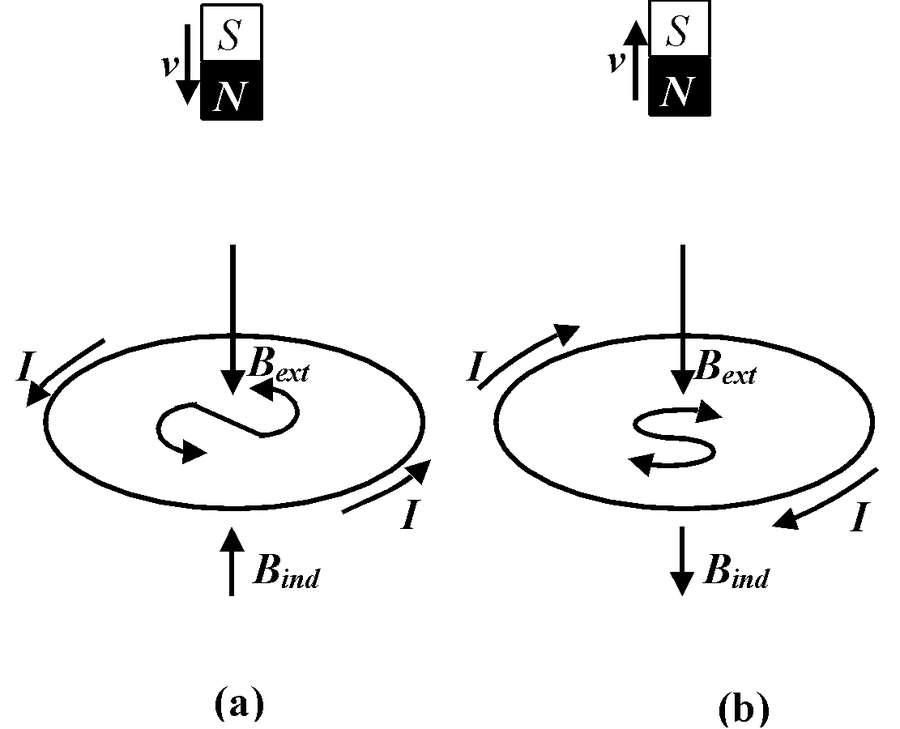
(a) اقتراب القطب الشمالي: \(B_{ind}\) معاكس لـ \(B_{ext}\) والتيار عكس عقارب الساعة. (b) ابتعاده: \(B_{ind}\) بالاتجاه نفسه والتيار مع عقارب الساعة. (من جهة المغناطيس)
(a) The north pole approaches: \(B_{ind}\) opposes \(B_{ext}\) and the current is counter-clockwise. (b) It leaves: \(B_{ind}\) is in the same direction and the current is clockwise. (Seen from the magnet’s side.)
| الحالةCase | التدفقFlux | المجال المستحثInduced field | قطب وجه الملف المقابلPole of the facing coil face | القوةForce |
|---|---|---|---|---|
| يقترب القطب الشماليN pole approaches | يزدادincreases | عكس مجال المغناطيسopposite to the magnet’s | شمالي Nnorth N | تنافرrepulsion |
| يبتعد القطب الشماليN pole leaves | يتناقصdecreases | بالاتجاه نفسهsame direction | جنوبي Ssouth S | تجاذبattraction |
| يقترب القطب الجنوبيS pole approaches | يزدادincreases | عكس مجال المغناطيسopposite to the magnet’s | جنوبي Ssouth S | تنافرrepulsion |
| يبتعد القطب الجنوبيS pole leaves | يتناقصdecreases | بالاتجاه نفسهsame direction | شمالي Nnorth N | تجاذبattraction |
📘 خطوات تحديد اتجاه التيار
📘 Steps to find the direction of the current
- حدّد اتجاه المجال الأصلي عبر الملف (من القطب المقابل للملف).Find the direction of the original field through the coil (from the pole facing the coil).
- هل التدفق يزداد (اقتراب) أم يتناقص (ابتعاد)؟Is the flux increasing (approach) or decreasing (departure)?
- اختر اتجاه المجال المستحث: عكس الأصلي إن ازداد التدفق، ومثله إن تناقص.Choose the induced field: opposite to the original if the flux increases, the same if it decreases.
- بقاعدة قبضة اليد اليمنى للملف: الإبهام نحو المجال المستحث والأصابع تدل على اتجاه التيار.With the right-hand grip rule for a coil: the thumb along the induced field and the fingers show the current.
🧪 تجربة 1: قاعدة لنز: مغناطيس يقترب من ملف ويبتعد عنه
🧪 Experiment 1: Lenz’s law: a magnet approaching and leaving a coil
اضغط «اقترب» أو «ابتعد» ليتحرك المغناطيس بسرعة ثابتة (أو اسحبه بالفأرة). يتغير التدفق فتتولد قوة دافعة مستحثة تظهر في المخطط وفي الجلفانومتر، ويرتسم اتجاه التيار والمجال المستحث الذي يعاكس التغير. بدّل القطب لتعكس الاتجاهات.
Press “Approach” or “Leave” to move the magnet at a constant speed (or drag it). The flux changes so an induced EMF appears in the graph and in the galvanometer, and the current direction and the induced field that opposes the change are drawn. Switch the pole to reverse the directions.
🧪 تجربة 2: تدرّب: حدّد اتجاه التيار المستحث
🧪 Experiment 2: Practice: find the induced current direction
يظهر مغناطيس يقترب من ملف أو يبتعد عنه بقطب معيّن. اختر اتجاه التيار (كما يُرى من جهة المغناطيس) وقطب وجه الملف المقابل للمغناطيس، ثم اضغط «تحقق». تذكّر: الاقتراب ⇒ المجال المستحث معاكس (تنافر)، والابتعاد ⇒ بالاتجاه نفسه (تجاذب).
A magnet with a given pole approaches a coil or leaves it. Choose the current direction (seen from the magnet’s side) and the pole of the coil face towards the magnet, then press “Check”. Remember: approaching ⇒ an opposing induced field (repulsion), leaving ⇒ the same direction (attraction).
يبتعد القطب الجنوبي لمغناطيس عن ملف. وجه الملف المقابل للمغناطيس يصير:
The south pole of a magnet moves away from a coil. The facing side of the coil becomes:
➖ قانون لنز وقانون فاراداي
➖ Lenz’s Law and Faraday’s Law
📌 قانون فاراداي ــ لنز
📌 The Faraday–Lenz law
\[\varepsilon=-N\,\dfrac{d\Phi_B}{dt},\qquad \Phi_B=B\,A\cos\theta\]
حيث \(\varepsilon\) القوة الدافعة المستحثة (فولت)، و\(\Phi_B\) التدفق المغناطيسي (ويبر). الإشارة السالبة هي قاعدة لنز: القوة الدافعة تعاكس تغير التدفق. ويُحسب التيار \(I=\dfrac{\varepsilon}{R}\).
where \(\varepsilon\) is the induced EMF (volts) and \(\Phi_B\) the magnetic flux (webers). The minus sign is Lenz’s rule: the EMF opposes the change of flux. The current is \(I=\dfrac{\varepsilon}{R}\).
ملف عدد لفاته \(N=100\) ومقاومته \(R=5\ \Omega\) تغيّر التدفق خلاله من \(0.02\ \mathrm{Wb}\) إلى \(0.06\ \mathrm{Wb}\) خلال \(0.2\ \mathrm{s}\). احسب القوة الدافعة والتيار، وصف اتجاه المجال المستحث.
A coil of \(N=100\) turns and resistance \(R=5\ \Omega\) has the flux through it change from \(0.02\ \mathrm{Wb}\) to \(0.06\ \mathrm{Wb}\) in \(0.2\ \mathrm{s}\). Find the EMF and the current, and describe the direction of the induced field.
➡️ سلك يقطع خطوط المجال (تجربة لنز)
➡️ A Wire Cutting the Field Lines (Lenz’s Experiment)
عند سحب سلك على سكتين في مجال \(B\) بقوة خارجية ثابتة \(F\) تتولد \(\varepsilon=BLv\) وتيار \(I=\dfrac{BLv}{R}\)، فيتأثر السلك بقوة \(F_m=BIL=\dfrac{B^2L^2v}{R}\) تعاكس حركته (قاعدة لنز). تزداد \(F_m\) مع \(v\) حتى تتساوى مع \(F\) فتثبت السرعة عند \(v_T=\dfrac{FR}{B^2L^2}\). وإذا زالت \(F\) بقيت \(F_m\) وأوقفت السلك.
When a rod on rails is pulled in a field \(B\) by a constant external force \(F\), an EMF \(\varepsilon=BLv\) and a current \(I=\dfrac{BLv}{R}\) appear, and the rod feels a force \(F_m=BIL=\dfrac{B^2L^2v}{R}\) that opposes its motion (Lenz’s law). \(F_m\) grows with \(v\) until it equals \(F\), so the speed becomes constant at \(v_T=\dfrac{FR}{B^2L^2}\). If \(F\) vanishes, \(F_m\) remains and stops the rod.
🧪 تجربة 3: تجربة لنز: سلك يُسحب بقوة ثابتة في مجال مغناطيسي
🧪 Experiment 3: Lenz’s experiment: a rod pulled by a constant force in a magnetic field
يُسحب السلك المعدني على سكتين بقوة ثابتة \(F\) داخل مجال \(B\) (إلى داخل الصفحة). حرّك شريط الزمن لترى كيف تتولد \(\varepsilon=BLv\) والتيار \(I\) وقوة مغناطيسية \(F_m=BIL\) تعاكس الحركة فتزداد حتى تساوي \(F\) فتثبت السرعة. فعّل «أزل القوة الخارجية» لترى توقف السلك.
A metal rod is pulled along rails by a constant force \(F\) in a field \(B\) (into the page). Move the time slider to see \(\varepsilon=BLv\), the current \(I\) and a magnetic force \(F_m=BIL\) that opposes the motion and grows until it equals \(F\), so the speed becomes constant. Tick “Remove the external force” to see the rod stop.
سلك طوله \(0.5\ \mathrm{m}\) يُسحب بقوة \(0.25\ \mathrm{N}\) في مجال \(1\ \mathrm{T}\) ومقاومة الدائرة \(2\ \Omega\). احسب السرعة الحدية.
A rod of length \(0.5\ \mathrm{m}\) is pulled by \(0.25\ \mathrm{N}\) in a \(1\ \mathrm{T}\) field with a circuit resistance of \(2\ \Omega\). Find the terminal speed.
سلك يتحرك في مجال ويمر فيه تيار مستحث؛ القوة المغناطيسية عليه:
A rod moving in a field carries an induced current; the magnetic force on it:
🛢️ مغناطيس يسقط في أنبوب معدني
🛢️ A Magnet Falling in a Metal Tube
عند إسقاط مغناطيس في أنبوب من النحاس أو الألومنيوم يتغير التدفق عبر جدار الأنبوب، فتتولد فيه تيارات دوامية مغلقة تولّد مجالًا يعاكس الحركة (قاعدة لنز). النتيجة قوة كبح تزداد مع السرعة فيسقط المغناطيس ببطء بسرعة حدية، رغم أنه لا يلمس الجدران! أما أنبوب البلاستيك فلا توصل فلا تيارات فيه ويسقط المغناطيس سقوطًا حرًّا.
When a magnet is dropped in a copper or aluminium tube the flux through the tube’s wall changes, so closed eddy currents form in it and create a field that opposes the motion (Lenz’s law). The result is a braking force that grows with speed so the magnet falls slowly at a terminal speed, even though it touches nothing! A plastic tube does not conduct so no currents flow and the magnet falls freely.
🧪 تجربة 4: مغناطيس يسقط في أنابيب مختلفة
🧪 Experiment 4: A magnet falling through different tubes
اضغط «أسقط المغناطيسات» فيسقط مغناطيس في كل أنبوب. في الأنبوب المعدني يتغير التدفق عبر جداره فتتولد تيارات دوامية تولّد قوة تعاكس السقوط (قاعدة لنز) فتبلغ السرعة حدًّا ثابتًا، والنحاس أقوى توصيلًا فأبطأ. أما البلاستيك فلا تيارات فيه فيسقط سقوطًا حرًّا.
Press “Drop the magnets” and a magnet falls in each tube. In a metal tube the flux through its wall changes so eddy currents form and give a force that opposes the fall (Lenz’s law), so the speed reaches a limit; copper conducts better so it is slower. In plastic there are no currents so it falls freely.
🛠️ تطبيقات
🛠️ Applications
- الفرامل التحريضية: في القطارات والملاهي؛ تبطئ الحركة دون احتكاك فلا تتآكل.Induction (eddy-current) brakes: on trains and amusement rides; they slow the motion without friction so nothing wears out.
- مواقد الحث: مجال متردد يولّد تيارات دوامية في قاع الوعاء المعدني فيسخن.Induction cookers: an alternating field makes eddy currents in the metal pot’s base which heats it.
- كاشف المعادن: يتغير مجاله بوجود المعدن بسبب التيارات الدوامية المتولدة فيه.Metal detectors: their field changes when a metal is near because of the eddy currents formed in it.
- المولدات: تحويل الطاقة الميكانيكية إلى كهربائية، ويقاوم دورانها عزم لنز.Generators: turning mechanical energy into electrical energy, with Lenz’s torque resisting the rotation.
يسقط مغناطيس في أنبوب نحاسي أبطأ منه في أنبوب بلاستيكي لأن:
A magnet falls more slowly in a copper tube than in a plastic tube because:
⚙️ المولد الكهربائي
⚙️ The Electric Generator
يعمل المولد بالحث الكهرومغناطيسي: تُحوَّل الطاقة الميكانيكية إلى كهربائية بتدوير ملف في مجال مغناطيسي. يتكون من جزء دوار (ملف) وجزء ثابت (مغانط)، وحلقتين انزلاقيتين وفرشاتين كربونيتين لنقل التيار.
The generator works by electromagnetic induction: mechanical energy is turned into electrical energy by rotating a coil in a magnetic field. It has a rotor (the coil), a stator (magnets), and slip rings with carbon brushes to carry the current.
📌 قوة المولد الدافعة
📌 The generator’s EMF
\[\Phi_B=BA\cos\theta,\quad\theta=\omega t\;\Longrightarrow\;\varepsilon=NBA\omega\sin\omega t\]
أكبر قيمة \(\varepsilon_{max}=NBA\omega\) حين تقطع السلكان الجانبيان الخطوط عموديًا (\(\theta=90^\circ\))، وتنعدم حين تكون سرعتهما موازية للمجال. تنعكس إشارة \(\varepsilon\) كل نصف دورة فالتيار متردد، وقيمته الفعالة \(\varepsilon_{rms}=\dfrac{\varepsilon_{max}}{\sqrt2}\).
The maximum \(\varepsilon_{max}=NBA\omega\) occurs when the two side wires cut the lines perpendicularly (\(\theta=90^\circ\)); it vanishes when their velocity is along the field. The sign of \(\varepsilon\) reverses every half turn so the current is alternating, with rms value \(\varepsilon_{rms}=\dfrac{\varepsilon_{max}}{\sqrt2}\).
🧪 تجربة 5: المولد الكهربائي: ملف يدور في مجال
🧪 Experiment 5: The electric generator: a coil rotating in a field
اضغط «أدِر الملف» (أو حرّك شريط الزاوية) ليدور ملف مستطيل في مجال مغناطيسي. \(\varepsilon=NBA\omega\sin\theta\): أعظم قيمة حين تقطع الأسلاك الخطوط (90° و270°) وصفر حين تكون موازية لها (0° و180°)، وتتغير الإشارة كل نصف دورة فالتيار متردد. عند وصل حمل يتولد عزم يعاكس الدوران (قاعدة لنز).
Press “Rotate the coil” (or move the angle slider) to turn a rectangular coil in a magnetic field. \(\varepsilon=NBA\omega\sin\theta\): it is maximum when the wires cut the lines (90° and 270°) and zero when they move along them (0° and 180°), and it changes sign every half turn so the current is alternating. With a load connected a torque opposing the rotation appears (Lenz’s law).
📘 أين قاعدة لنز في المولد؟
📘 Where is Lenz’s law in the generator?
عند وصل حمل يمر تيار في الملف الدوار فيتأثر بعزم مغناطيسي يعاكس الدوران \(\tau=NBIA\sin\theta\). لذلك لا يدور المولد المحمَّل «مجانًا»: نبذل قدرة ميكانيكية تساوي القدرة الكهربائية التي يولّدها (مع الفاقد). وكلما زاد التيار المسحوب زاد العزم المقاوم.
When a load is connected a current flows in the rotating coil and it feels a magnetic torque opposing the rotation, \(\tau=NBIA\sin\theta\). So a loaded generator does not turn “for free”: we supply mechanical power equal to the electrical power it produces (plus losses). The more current drawn, the larger the opposing torque.
ملف مولد عدد لفاته \(N=100\) ومساحته \(A=100\ \mathrm{cm}^2\) يدور في مجال \(B=0.5\ \mathrm{T}\) بتردد \(f=50\ \mathrm{Hz}\). احسب \(\varepsilon_{max}\) و\(\varepsilon_{rms}\).
A generator coil has \(N=100\) turns and area \(A=100\ \mathrm{cm}^2\) and rotates in \(B=0.5\ \mathrm{T}\) at \(f=50\ \mathrm{Hz}\). Find \(\varepsilon_{max}\) and \(\varepsilon_{rms}\).
القوة الدافعة المستحثة في مولد تساوي صفرًا عندما يكون مستوى الملف:
The induced EMF in a generator is zero when the coil’s plane is:
🌍 تطبيقات المولدات
🌍 Applications of generators
- محطات القدرة: تدير التوربينات (بخار أو ماء) مولدات ضخمة، وقدرة الماء \(P=\eta\rho gQH\).Power stations: turbines (steam or water) turn huge generators, and hydro power is \(P=\eta\rho gQH\).
- توربينات الرياح: \(P=\tfrac12\rho Av^3C_p\) حيث \(C_p\le0.59\).Wind turbines: \(P=\tfrac12\rho Av^3C_p\) with \(C_p\le0.59\).
- مولد السيارة (الدينامو المتناوب) يشحن البطارية ويغذي الدوائر.The car alternator charges the battery and supplies the circuits.
📚 ملخص الدرس
📚 Lesson Summary
| الفكرةIdea | القاعدةRule |
|---|---|
| قانون لنزLenz’s law | المجال المستحث يعاكس تغير التدفقthe induced field opposes the change of flux |
| الاقتراب / الابتعادApproach / departure | تنافر عند الاقتراب، تجاذب عند الابتعادrepulsion on approach, attraction on departure |
| فاراداي–لنزFaraday–Lenz | \(\varepsilon=-N\dfrac{d\Phi}{dt}\)\(\varepsilon=-N\dfrac{d\Phi}{dt}\) |
| سلك على سكتينRod on rails | \(\varepsilon=BLv,\ F_m=\dfrac{B^2L^2v}{R},\ v_T=\dfrac{FR}{B^2L^2}\)\(\varepsilon=BLv,\ F_m=\dfrac{B^2L^2v}{R},\ v_T=\dfrac{FR}{B^2L^2}\) |
| المولدGenerator | \(\varepsilon_{max}=NBA\omega,\ \varepsilon_{rms}=\dfrac{\varepsilon_{max}}{\sqrt2}\)\(\varepsilon_{max}=NBA\omega,\ \varepsilon_{rms}=\dfrac{\varepsilon_{max}}{\sqrt2}\) |
⚠️ أخطاء شائعة
⚠️ Common mistakes
- الظن أن التيار المستحث يعاكس المجال دائمًا؛ هو يعاكس تغيّر التدفق.Thinking the induced current always opposes the field; it opposes the change of flux.
- تحديد اتجاه التيار دون ذكر من أي جهة نراه (من جهة المغناطيس).Giving the current direction without saying from which side we look (from the magnet’s side).
- نسيان أن قاعدة لنز تنتج من حفظ الطاقة.Forgetting that Lenz’s rule comes from conservation of energy.
- الظن أن المغناطيس يبقى ساكنًا في الأنبوب المعدني؛ يسقط لكن ببطء بسرعة حدية.Thinking the magnet stays still in the metal tube; it does fall, but slowly at a terminal speed.
- الخلط بين \(\varepsilon_{max}\) و\(\varepsilon_{rms}\) في المولد.Mixing up \(\varepsilon_{max}\) and \(\varepsilon_{rms}\) for the generator.
🧪 اختبر نفسك: امتحان من 20 سؤالاً
🧪 Test Yourself: a 20-Question Exam
أنهِ الدرس بالاختبار التفاعلي التالي؛ أسئلته تجمع بين الفهم والحساب وتغطي جميع أقسام الدرس.
Finish with the interactive exam below; its questions mix understanding with calculation and cover every section of the lesson.
اختبار قانون لنز Lenz’s Law Quiz
20 سؤالاً - اتجاه التيار المستحث وقانون لنز وتطبيقاته 20 Questions - direction of the induced current, Lenz’s law and its applications
• عدد الأسئلة: 20 سؤالاً
• مدة الاختبار: 30 دقيقة
• لا يمكنك تغيير إجاباتك أو إعادة الاختبار إلا بعد 24 ساعة من التسليم.
• تأكد من إجاباتك قبل التسليم! 📌 Important Instructions:
• Number of questions: 20 questions
• Quiz duration: 30 minutes
• You cannot change your answers or retake the quiz for 24 hours after submission.
• Make sure of your answers before submitting!
🔗 محاكيات GeoGebra للاستعانة بها عند اللزوم
🔗 GeoGebra Simulations to Use When Needed
اضغط «تشغيل» لتعمل المحاكاة هنا داخل الدرس؛ ويمكن للطالب الرجوع إليها لتجربة الفكرة بطريقة أخرى.
Press “Run” to run the simulation right here inside the lesson; the student can use it to try the idea in another way.