🎯 نواتج التعلم
🎯 Learning Outcomes
بعد دراسة هذا الدرس ستكون قادرًا على أن:
After this lesson you will be able to:
- تعرّف التدفق الكهربائي وتحسبه \(\Phi=EA\cos\theta\) عبر سطح مستوٍ وعبر الأسطح المغلقة.Define the electric flux and calculate it \(\Phi=EA\cos\theta\) through a plane surface and through closed surfaces.
- تنصّ على قانون جاوس \(\Phi=q_{enc}/\varepsilon_0\) وتستنتجه من قانون كولوم.State Gauss’s law \(\Phi=q_{enc}/\varepsilon_0\) and deduce it from Coulomb’s law.
- تفسّر أن المجال داخل الموصل صفر وأن التجاويف الموصلة محمية من المجالات.Explain that the field inside a conductor is zero and that conducting cavities are shielded from fields.
- تطبّق قانون جاوس بالتماثل لإيجاد مجال السلك اللانهائي والصفيحة والقشرة الكروية والكرة المصمتة.Apply Gauss’s law with symmetry to find the field of the infinite wire, the sheet, the spherical shell and the solid sphere.
🌊 التدفق الكهربائي
🌊 The Electric Flux
التدفق الكهربائي هو عدد خطوط المجال الكهربائي التي تجتاز سطحًا ما بصورة عمودية. ويعتمد على مساحة السطح وشدة المجال والزاوية \(\theta\) بين المجال والعمود الخارج من السطح. وهو كمية قياسية وحدته \(\mathrm{N\cdot m^2/C}\).
The electric flux is the number of electric field lines that pass through a surface perpendicularly. It depends on the area of the surface, the strength of the field and the angle \(\theta\) between the field and the normal leaving the surface. It is a scalar quantity whose unit is \(\mathrm{N\cdot m^2/C}\).
📌 التدفق الكهربائي
📌 The electric flux
\[\Phi=E\,A\cos\theta\qquad\left[\frac{\mathrm{N\cdot m^2}}{\mathrm C}\right]\]
حالات خاصة
Special cases
- المجال عمودي على السطح (\(\theta=0\)): \(\Phi=EA\) أكبر قيمة.The field is perpendicular to the surface (\(\theta=0\)): \(\Phi=EA\) the greatest value.
- المجال يوازي السطح (\(\theta=90^\circ\)): \(\Phi=0\).The field is parallel to the surface (\(\theta=90^\circ\)): \(\Phi=0\).
- الخطوط تدخل السطح (\(\theta\gt 90^\circ\)): التدفق سالب؛ وفي السطح المغلق نعتبر العمود إلى الخارج.The lines enter the surface (\(\theta\gt 90^\circ\)): the flux is negative; for a closed surface we take the normal outward.
سطح مربع ضلعه \(0.2\ \mathrm m\) في مجال منتظم \(E=500\ \mathrm{N/C}\). أوجد التدفق إذا صنع المجال \(30^\circ\) مع السطح.
A square surface of side \(0.2\ \mathrm m\) in a uniform field \(E=500\ \mathrm{N/C}\). Find the flux if the field makes \(30^\circ\) with the surface.
وإذا صنع المجال \(30^\circ\) مع العمود فإن \(\Phi=20\cos30^\circ=17.3\); وإذا كان عموديًا على السطح \(\Phi=20\); وإذا كان موازيًا فـ\(\Phi=0\).
If the field makes \(30^\circ\) with the normal then \(\Phi=20\cos30^\circ=17.3\); if it is perpendicular to the surface \(\Phi=20\); and if it is parallel then \(\Phi=0\).
🧪 تجربة 1: التدفق عبر سطح مستوٍ
🧪 Experiment 1: The Flux Through a Plane Surface
نغيّر الزاوية وشدة المجال والمساحة ونقرأ التدفق.
We change the angle, the strength of the field and the area and read the flux.
🛠️ خطوات العمل
🛠️ Procedure
- اضبط \(E=500\), \(s=20\ \mathrm{cm}\), \(\theta=60^\circ\) وتحقق من \(10\).Set \(E=500\), \(s=20\ \mathrm{cm}\), \(\theta=60^\circ\) and check \(10\).
- حرّك \(\theta\) من \(0\) إلى \(180^\circ\) وراقب الإشارة.Move \(\theta\) from \(0\) to \(180^\circ\) and watch the sign.
🧪 تجربة 1: التدفق الكهربائي عبر سطح مستوٍ (كمحاكاة GeoGebra)
🧪 Experiment 1: Electric Flux Through a Plane Surface (like the GeoGebra applet)
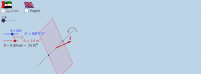
سطح مربع في مجال منتظم. غيّر شدة المجال وطول الضلع والزاوية \(\theta\) بين المجال والعمود على السطح وراقب التدفق \(\Phi=EA\cos\theta\).
A square surface in a uniform field. Change the strength of the field, the length of the side and the angle \(\theta\) between the field and the normal to the surface and watch the flux \(\Phi=EA\cos\theta\).
🔎 ماذا نلاحظ؟ وما الاستنتاج؟
🔎 What do we observe? What is the conclusion?
- التدفق أكبر ما يمكن عند \(\theta=0\) وصفر عند \(90^\circ\) وسالب بعدها.The flux is maximum at \(\theta=0\), zero at \(90^\circ\) and negative afterwards.
- يتناسب التدفق طرديًا مع \(E\) و\(A\).The flux is directly proportional to \(E\) and \(A\).
\(\Phi=EA\cos\theta\).
\(\Phi=EA\cos\theta\).
وحدة التدفق الكهربائي:
The unit of the electric flux:
🧊 التدفق عبر سطح مغلق: المكعب
🧊 The Flux Through a Closed Surface: The Cube
مكعب ضلعه \(0.3\ \mathrm m\) في مجال منتظم \(200\ \mathrm{N/C}\) موازٍ لمحور \(x\). أوجد التدفق عبر كل وجه والتدفق الكلي.
A cube of side \(0.3\ \mathrm m\) in a uniform field \(200\ \mathrm{N/C}\) parallel to the \(x\) axis. Find the flux through each face and the total flux.
نتيجة هامة: إذا وُضع جسم في مجال كهربائي (منتظم أو غير منتظم) ولم تكن بداخله شحنة فإن التدفق الكلي عبر سطحه المغلق يساوي صفرًا؛ لأن عدد الخطوط الداخلة يساوي عدد الخطوط الخارجة.
An important result: if a body is placed in an electric field (uniform or not) and there is no charge inside it, the total flux through its closed surface is zero; because the number of lines entering equals the number of lines leaving.
🧪 تجربة 2: المكعب في مجال منتظم
🧪 Experiment 2: The Cube in a Uniform Field
نغيّر اتجاه المجال بالنسبة للمكعب ونحسب التدفق عبر كل وجه.
We change the direction of the field relative to the cube and calculate the flux through each face.
🛠️ خطوات العمل
🛠️ Procedure
- اجعل \(\alpha=0\) ولاحظ الوجهين الجانبيين.Make \(\alpha=0\) and notice the two side faces.
- اجعل \(\alpha=45^\circ\) ولاحظ الأوجه الأربعة.Make \(\alpha=45^\circ\) and notice the four faces.
🧪 تجربة 2: مكعب في مجال منتظم
🧪 Experiment 2: A Cube in a Uniform Field
مكعب ضلعه \(s\) في مجال منتظم بزاوية \(\alpha\) مع المحور \(x\). احسب التدفق عبر كل وجه ثم التدفق الكلي.
A cube of side \(s\) in a uniform field at an angle \(\alpha\) with the \(x\) axis. Calculate the flux through each face then the total flux.
🔎 ماذا نلاحظ؟ وما الاستنتاج؟
🔎 What do we observe? What is the conclusion?
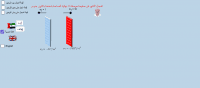
- التدفق الداخل سالب والخارج موجب ومجموعهما صفر.The entering flux is negative and the leaving flux is positive and their sum is zero.
- الوجهان الموازيان للمجال لا يمر عبرهما تدفق.The two faces parallel to the field have no flux passing through them.
التدفق الكلي عبر سطح مغلق لا يحوي شحنة صفر.
The total flux through a closed surface that contains no charge is zero.
🎯 قانون جاوس
🎯 Gauss’s Law
لشحنة نقطية \(q\) نختار سطح جاوس كرويًّا مركزه الشحنة ونصف قطره \(r\). المجال على السطح ثابت المقدار وعمودي عليه، فالتدفق:
For a point charge \(q\) we choose a spherical Gaussian surface centred on the charge with a radius \(r\). The field on the surface is constant in magnitude and perpendicular to it, so the flux is:
📌 استنتاج قانون جاوس
📌 Deducing Gauss’s law
\[\Phi=\oint E\,dA=E\,(4\pi r^2)=\frac{q}{4\pi\varepsilon_0r^2}\,(4\pi r^2)=\frac{q}{\varepsilon_0}\]
📌 قانون جاوس
📌 Gauss’s law
\[\Phi=\oint\vec E\cdot d\vec A=\frac{q_{enc}}{\varepsilon_0}\qquad,\qquad\varepsilon_0=8.85\times10^{-12}\ \mathrm{C^2/(N\cdot m^2)}\]
يعتمد التدفق الكلي فقط على الشحنة المحصورة داخل السطح، لا على شكل السطح ولا على نصف قطره ولا على الشحنات خارجه. ويسهّل القانون إيجاد المجال عندما تكون للتوزيع تماثل يجعل المجال ثابت المقدار على سطح جاوس.
The total flux depends only on the charge enclosed inside the surface, not on the shape of the surface nor on its radius nor on the charges outside it. The law makes finding the field easy when the distribution has a symmetry that makes the field constant in magnitude on the Gaussian surface.
شحنة نقطية \(5\ \mathrm{nC}\) داخل سطح كروي. أوجد التدفق الكلي عبره.
A point charge \(5\ \mathrm{nC}\) inside a spherical surface. Find the total flux through it.
🧪 تجربة 3: قانون جاوس لشحنة نقطية
🧪 Experiment 3: Gauss’s Law for a Point Charge
نغيّر الشحنة ونصف قطر السطح الجاوسي ونضع الشحنة خارجه.
We change the charge and the radius of the Gaussian surface and put the charge outside it.
🛠️ خطوات العمل
🛠️ Procedure
- غيّر \(r\) وراقب \(E\) و\(A\) والتدفق.Change \(r\) and watch \(E\), \(A\) and the flux.
- غيّر \(q\) وراقب التدفق.Change \(q\) and watch the flux.
- اضغط «انقل الشحنة خارج السطح».Press “Move the charge outside the surface”.
🧪 تجربة 3: قانون جاوس: شحنة نقطية داخل سطح كروي
🧪 Experiment 3: Gauss’s Law: A Point Charge Inside a Spherical Surface
شحنة نقطية في مركز سطح جاوس كروي. غيّر \(q\) ونصف القطر \(r\) وراقب \(E\) و\(A\) والتدفق \(\Phi=q/\varepsilon_0\)، ثم انقل الشحنة خارج السطح.
A point charge at the centre of a spherical Gaussian surface. Change \(q\) and the radius \(r\) and watch \(E\), \(A\) and the flux \(\Phi=q/\varepsilon_0\), then move the charge outside the surface.
🔎 ماذا نلاحظ؟ وما الاستنتاج؟
🔎 What do we observe? What is the conclusion?
- \(E\) تتناقص مع \(r^2\) و\(A\) تزداد معه فيبقى التدفق ثابتًا.\(E\) decreases with \(r^2\) and \(A\) increases with it so the flux remains constant.
- شحنة خارج السطح تعطي تدفقًا كليًا صفرًا.A charge outside the surface gives a total flux of zero.
\(\Phi=q_{enc}/\varepsilon_0\).
\(\Phi=q_{enc}/\varepsilon_0\).
🛡️ الموصلات وقانون جاوس
🛡️ Conductors and Gauss’s Law
نتائج قانون جاوس على الموصلات
Results of Gauss’s law on conductors
- المجال الكهربائي داخل موصل معزول في حالة الاتزان الكهروستاتيكي يساوي صفرًا.The electric field inside an isolated conductor in electrostatic equilibrium equals zero.
- عند وضع موصل في مجال تتحرك الشحنات الحرة (السالبة عكس المجال والموجبة معه) فتولّد مجالًا معاكسًا يلغي المجال الداخلي.When a conductor is placed in a field the free charges move (the negative against the field and the positive along it) and generate an opposite field that cancels the internal field.
- الشحنة الزائدة تتوزع على السطح الخارجي فقط، ولا توجد شحنة داخل الموصل.The excess charge is distributed on the outer surface only and there is no charge inside the conductor.
- التجاويف داخل الموصل محمية من المجالات الخارجية (قفص فاراداي).The cavities inside a conductor are shielded from external fields (a Faraday cage).
🧪 تجربة 4: موصل في مجال خارجي
🧪 Experiment 4: A Conductor in an External Field
نضع موصلًا في مجال منتظم ونقرأ المجال داخله والشحنة المستحثة على سطحه.
We put a conductor in a uniform field and read the field inside it and the charge induced on its surface.
🛠️ خطوات العمل
🛠️ Procedure
- اضغط «ضع الموصل» وراقب هجرة الشحنات.Press “Put the conductor” and watch the migration of the charges.
- ضاعف المجال وراقب كثافة الشحنة المستحثة.Double the field and watch the induced charge density.
🧪 تجربة 6: موصل في مجال خارجي (كمحاكاة GeoGebra)
🧪 Experiment 6: A Conductor in an External Field (like the GeoGebra applet)
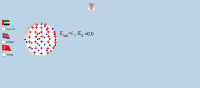
ضع كتلة موصلة في مجال منتظم وراقب هجرة الشحنات الحرة وتكوّن مجال معاكس يجعل المجال داخل الموصل صفرًا.
Put a conducting block in a uniform field and watch the migration of the free charges and the formation of an opposite field that makes the field inside the conductor zero.
🔎 ماذا نلاحظ؟ وما الاستنتاج؟
🔎 What do we observe? What is the conclusion?
- المجال داخل الموصل صفر مهما كان المجال الخارجي.The field inside the conductor is zero whatever the external field.
- \(\sigma=\varepsilon_0E\) على سطح الموصل.\(\sigma=\varepsilon_0E\) on the surface of the conductor.
\(E_{in}=0\) و\(\sigma=\varepsilon_0E\).
\(E_{in}=0\) and \(\sigma=\varepsilon_0E\).
📏 المجال بالتماثل: السلك والصفيحة
📏 Fields by Symmetry: The Wire and the Sheet
سلك لانهائي كثافته الخطية \(\lambda\): نختار أسطوانة جاوسية طولها \(L\) ونصف قطرها \(r\) فيمرّ التدفق عبر السطح الجانبي فقط (القاعدتان معدومتا التدفق).
An infinite wire with a linear density \(\lambda\): we choose a Gaussian cylinder of length \(L\) and radius \(r\) so the flux passes through the lateral surface only (the two bases have no flux).
📌 السلك اللانهائي
📌 The infinite wire
\[E\,(2\pi rL)=\frac{\lambda L}{\varepsilon_0}\ \Rightarrow\ E=\frac{\lambda}{2\pi\varepsilon_0r}=\frac{2k\lambda}{r}\]
صفيحة غير موصلة لانهائية بكثافة سطحية \(\sigma\): أسطوانة جاوسية تخترق الصفيحة فيمرّ التدفق عبر القاعدتين (\(2EA\)). أما الصفيحة الموصلة فالشحنة على سطحها وداخلها مجال صفر، فيمرّ التدفق عبر القاعدة الخارجية فقط (\(EA\)).
An infinite non-conducting sheet with a surface density \(\sigma\): a Gaussian cylinder piercing the sheet so the flux passes through the two bases (\(2EA\)). For the conducting sheet the charge is on its surface and the field inside is zero, so the flux passes through the outer base only (\(EA\)).
📌 الصفيحتان
📌 The two sheets
\[E_{n}=\frac{\sigma}{2\varepsilon_0}\qquad,\qquad E_{c}=\frac{\sigma}{\varepsilon_0}\]
سلك طويل جدًا مشحون قيمة المجال عند نقطة تبعد \(0.3\ \mathrm m\) عنه \(2.5\times10^3\ \mathrm{N/C}\) والاتجاه نحو السلك. أوجد عدد الإلكترونات المكتسبة في كل متر.
A very long charged wire; the field at a point \(0.3\ \mathrm m\) from it is \(2.5\times10^3\ \mathrm{N/C}\) directed toward the wire. Find the number of electrons gained per metre.
صفيحة لانهائية كثافة شحنتها \(2\ \mu\mathrm C/\mathrm{m^2}\). أوجد المجال لحالة غير موصلة ولحالة موصلة.
An infinite sheet of charge density \(2\ \mu\mathrm C/\mathrm{m^2}\). Find the field for a non-conducting and for a conducting case.
🧪 تجربة 5: السلك والصفيحة
🧪 Experiment 5: The Wire and the Sheet
نقارن مجال السلك والصفيحتين وكيف يتغير مع البعد.
We compare the field of the wire and the two sheets and how it changes with the distance.
🛠️ خطوات العمل
🛠️ Procedure
- اختر سلكًا وضاعف البعد.Choose a wire and double the distance.
- اختر صفيحة غير موصلة وغيّر البعد.Choose a non-conducting sheet and change the distance.
- اختر صفيحة موصلة وقارن القيمة.Choose a conducting sheet and compare the value.
🧪 تجربة 4: السلك والصفيحة بقانون جاوس (كمحاكاة GeoGebra)
🧪 Experiment 4: The Wire and the Sheet With Gauss’s Law (like the GeoGebra applet)
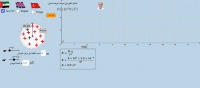
اختر سلكًا لانهائيًا أو صفيحة غير موصلة أو موصلة، وغيّر كثافة الشحنة والبعد وقارن اعتماد المجال على البعد.
Choose an infinite wire or a non-conducting or conducting sheet and change the charge density and the distance and compare how the field depends on the distance.
🔎 ماذا نلاحظ؟ وما الاستنتاج؟
🔎 What do we observe? What is the conclusion?
- السلك: \(E\propto1/r\). الصفيحة: \(E\) ثابت لا يعتمد على البعد.The wire: \(E\propto1/r\). The sheet: \(E\) is constant and does not depend on the distance.
- الصفيحة الموصلة ضعف غير الموصلة بالكثافة نفسها.The conducting sheet is double the non-conducting one with the same density.
تختلف أشكال \(E(r)\) باختلاف التماثل.
The forms of \(E(r)\) differ according to the symmetry.
🌐 التماثل الكروي
🌐 Spherical Symmetry
القشرة الكروية الموصلة (نصف قطرها \(R\) وشحنتها \(Q\)): خارجها \(E=kQ/r^2\) كأن الشحنة في المركز، وداخلها \(E=0\) لأن الشحنة المحصورة صفر. الكرة المصمتة غير الموصلة بكثافة حجمية \(\rho\): خارجها \(E=kQ/r^2\)، وداخلها الشحنة المحصورة \(q_s=Q\,r^3/R^3\) فيكون \(E=kQr/R^3\) (يزداد خطيًا مع \(r\)).
The conducting spherical shell (radius \(R\) and charge \(Q\)): outside it \(E=kQ/r^2\) as if the charge is at the centre, and inside it \(E=0\) because the enclosed charge is zero. The solid non-conducting sphere with a volume density \(\rho\): outside it \(E=kQ/r^2\), and inside it the enclosed charge is \(q_s=Q\,r^3/R^3\) so \(E=kQr/R^3\) (it increases linearly with \(r\)).
📌 الكرة المصمتة
📌 The solid sphere
\[E_{in}=\frac{kQ\,r}{R^3}\ \ (r\lt R)\qquad,\qquad E_{out}=\frac{kQ}{r^2}\ \ (r\gt R)\]
كرة مصمتة غير موصلة شحنتها \(10\ \mathrm{nC}\) ونصف قطرها \(10\ \mathrm{cm}\). أوجد المجال عند \(5\ \mathrm{cm}\) وعند \(20\ \mathrm{cm}\) من المركز.
A solid non-conducting sphere of charge \(10\ \mathrm{nC}\) and radius \(10\ \mathrm{cm}\). Find the field at \(5\ \mathrm{cm}\) and at \(20\ \mathrm{cm}\) from the centre.
🧪 تجربة 6: القشرة الكروية والكرة المصمتة
🧪 Experiment 6: The Spherical Shell and the Solid Sphere
نحسب المجال داخل الجسم وخارجه ونرسم المنحنى \(E(r)\).
We calculate the field inside the body and outside it and draw the curve \(E(r)\).
🛠️ خطوات العمل
🛠️ Procedure
- اختر قشرة موصلة وحرّك \(r\) من الداخل إلى الخارج.Choose a conducting shell and move \(r\) from inside to outside.
- اختر كرة مصمتة وراقب الخط المستقيم داخلها.Choose a solid sphere and watch the straight line inside it.
🧪 تجربة 5: القشرة الكروية والكرة المصمتة (كمحاكاة GeoGebra)
🧪 Experiment 5: The Spherical Shell and the Solid Sphere (like the GeoGebra applet)
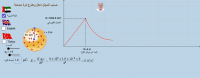
اختر قشرة كروية موصلة أو كرة مصمتة غير موصلة، وحرّك نقطة الحساب \(r\) داخل الجسم وخارجه وراقب المنحنى \(E(r)\).
Choose a conducting spherical shell or a solid non-conducting sphere and move the point of calculation \(r\) inside and outside the body and watch the curve \(E(r)\).
🔎 ماذا نلاحظ؟ وما الاستنتاج؟
🔎 What do we observe? What is the conclusion?
- في القشرة المجال صفر داخلها ويقفز عند السطح إلى \(kQ/R^2\).For the shell the field is zero inside it and jumps at the surface to \(kQ/R^2\).
- في الكرة المصمتة يزداد المجال خطيًا حتى السطح ثم يتناقص كـ\(1/r^2\).For the solid sphere the field increases linearly up to the surface then decreases as \(1/r^2\).
قانون جاوس يعطي \(E(r)\) لكل تماثل.
Gauss’s law gives \(E(r)\) for each symmetry.
المجال داخل قشرة كروية موصلة مشحونة:
The field inside a charged conducting spherical shell:
🚀 تطبيقات
🚀 Applications
أين نستعمل قانون جاوس؟
Where do we use Gauss’s law?
- قفص فاراداي: حماية الأجهزة والسيارات والطائرات من الصواعق والمجالات.A Faraday cage: protecting devices, cars and aircraft from lightning and fields.
- المكثفات ذات الألواح المتوازية: \(E=\sigma/\varepsilon_0\) بين لوحين موصلين.Parallel-plate capacitors: \(E=\sigma/\varepsilon_0\) between two conducting plates.
- حساب مجال الكابلات المحورية والأسلاك الطويلة.Calculating the field of coaxial cables and long wires.
⚠️ أخطاء شائعة
⚠️ Common Mistakes
تجنّب هذه الأخطاء
Avoid these mistakes
- أخذ الزاوية مع السطح بدل الزاوية مع العمود على السطح في \(\cos\theta\).Taking the angle with the surface instead of the angle with the normal to the surface in \(\cos\theta\).
- الظن أن الشحنات خارج سطح جاوس لا تؤثر في المجال؛ هي لا تؤثر في التدفق الكلي فقط.Thinking that the charges outside the Gaussian surface do not affect the field; they only do not affect the total flux.
- استعمال \(kQ/r^2\) داخل الكرة المصمتة؛ داخلها \(E=kQr/R^3\).Using \(kQ/r^2\) inside the solid sphere; inside it \(E=kQr/R^3\).
- الخلط بين الصفيحة الموصلة (\(\sigma/\varepsilon_0\)) وغير الموصلة (\(\sigma/2\varepsilon_0\)).Confusing the conducting sheet (\(\sigma/\varepsilon_0\)) with the non-conducting one (\(\sigma/2\varepsilon_0\)).
📚 ملخص
📚 Summary
أهم ما تعلمناه
Key points
- \(\Phi=EA\cos\theta\) وهو قياسي، والتدفق الكلي عبر سطح مغلق بلا شحنة صفر.\(\Phi=EA\cos\theta\) and it is a scalar, and the total flux through a closed surface without charge is zero.
- قانون جاوس: \(\oint\vec E\cdot d\vec A=q_{enc}/\varepsilon_0\).Gauss’s law: \(\oint\vec E\cdot d\vec A=q_{enc}/\varepsilon_0\).
- المجال داخل الموصل صفر، والتجاويف محمية، والشحنة الزائدة على السطح الخارجي.The field inside a conductor is zero, the cavities are shielded and the excess charge is on the outer surface.
- السلك \(2k\lambda/r\)، الصفيحة \(\sigma/2\varepsilon_0\) أو \(\sigma/\varepsilon_0\)، القشرة \(kQ/r^2\) وداخلها صفر، الكرة المصمتة \(kQr/R^3\).The wire \(2k\lambda/r\), the sheet \(\sigma/2\varepsilon_0\) or \(\sigma/\varepsilon_0\), the shell \(kQ/r^2\) and zero inside, the solid sphere \(kQr/R^3\).
🧪 اختبر نفسك: امتحان من 20 سؤالاً
🧪 Test Yourself: a 20-Question Exam
أنهِ الدرس بالاختبار التفاعلي التالي؛ أسئلته تجمع بين الفهم والحساب وتغطي جميع أقسام الدرس.
Finish with the interactive exam below; its questions mix understanding with calculation and cover every section of the lesson.
اختبار قانون جاوس والمجال الكهربائي (12A) Gauss’s Law and the Electric Field Quiz (12A)
20 سؤالاً - التدفق وقانون جاوس والموصلات والتماثل 20 Questions - the flux, Gauss’s law, conductors and symmetry
• عدد الأسئلة: 20 سؤالاً
• مدة الاختبار: 30 دقيقة
• لا يمكنك تغيير إجاباتك أو إعادة الاختبار إلا بعد 24 ساعة من التسليم.
• تأكد من إجاباتك قبل التسليم! 📌 Important Instructions:
• Number of questions: 20 questions
• Quiz duration: 30 minutes
• You cannot change your answers or retake the quiz for 24 hours after submission.
• Make sure of your answers before submitting!
🔗 محاكيات GeoGebra للاستعانة بها عند اللزوم
🔗 GeoGebra Simulations to Use When Needed
اضغط «تشغيل» لتعمل المحاكاة هنا داخل الدرس؛ ويمكن للطالب الرجوع إليها لتجربة الفكرة بطريقة أخرى.
Press “Run” to run the simulation right here inside the lesson; the student can use it to try the idea in another way.