📖 مقدمة
📖 Introduction
طاقة الوضع (Potential Energy) هي الطاقة التي يختزنها الجسم نتيجة موضعه أو تركيبه. هناك أنواع مختلفة منها، سندرس نوعين: طاقة الوضع الجذبية وطاقة الوضع المرونية.
Potential energy is the energy stored by an object due to its position or configuration. There are different types; we will study two: gravitational potential energy and elastic potential energy.
- طاقة الوضع الجذبية: الطاقة المخزونة في جسم بسبب ارتفاعه عن سطح الأرض.Gravitational potential energy: energy stored in an object due to its height above the ground.
- طاقة الوضع المرونية: الطاقة المخزونة في الأجسام المرنة مثل الزنبركات عند ضغطها أو شدها.Elastic potential energy: energy stored in elastic objects like springs when compressed or stretched.
🔹 طاقة الوضع الجذبية (Gravitational Potential Energy)
🔹 Gravitational Potential Energy
طاقة الوضع الجذبية هي الطاقة التي يختزنها جسم نتيجة موضعه من مستوى إسناد صفري، ويرمز لها بـ GPE أو \(U_G\)، وتُقدَّر بوحدة الجول (J).
Gravitational potential energy is the energy stored by an object due to its position relative to a zero reference level, denoted GPE or \(U_G\), measured in joules (J).
📊 تجربة 1: أثر الارتفاع على طاقة الوضع الجذبية
📊 Experiment 1: Effect of Height on Gravitational Potential Energy
غيّر ارتفاع الجسم مع بقاء الكتلة (2kg) ومجال الجاذبية (10 m/s²) ثابتين، وحدّد طاقة الوضع الناتجة:
Vary the object's height while mass (2kg) and gravitational field (10 m/s²) stay constant, and observe the resulting potential energy:
طاقة الوضع الناتجة:Resulting potential energy: 200 J
طاقة الوضع الجذبية تتناسب طرديًا مع الارتفاع: \(U_G \propto h\)Gravitational potential energy is directly proportional to height: \(U_G \propto h\)
📊 تجربة 2: أثر الكتلة على طاقة الوضع الجذبية
📊 Experiment 2: Effect of Mass on Gravitational Potential Energy
غيّر كتلة الجسم مع بقاء الارتفاع (10m) ومجال الجاذبية (10 m/s²) ثابتين:
Vary the object's mass while height (10m) and gravitational field (10 m/s²) stay constant:
طاقة الوضع الناتجة:Resulting potential energy: 200 J
طاقة الوضع الجذبية تتناسب طرديًا مع الكتلة: \(U_G \propto m\)Gravitational potential energy is directly proportional to mass: \(U_G \propto m\)
📊 تجربة 3: أثر مجال الجاذبية على طاقة الوضع الجذبية
📊 Experiment 3: Effect of Gravity on Gravitational Potential Energy
غيّر مجال الجاذبية مع بقاء الكتلة (2kg) والارتفاع (10m) ثابتين:
Vary the gravitational field while mass (2kg) and height (10m) stay constant:
طاقة الوضع الناتجة:Resulting potential energy: 200 J
طاقة الوضع الجذبية تتناسب طرديًا مع مجال الجاذبية: \(U_G \propto g\)Gravitational potential energy is directly proportional to the gravitational field: \(U_G \propto g\)
📝 أمثلة محلولة📝 Worked Examples
١. برميل نفط كتلته 100kg يمتلك طاقة وضع مقدارها 2900J. ما ارتفاعه عن سطح الأرض؟ (g=9.81 m/s²)1. An oil barrel with mass 100kg has potential energy of 2900J. What is its height above the ground? (g=9.81 m/s²)

\[h=\dfrac{U_G}{mg}=\dfrac{2900}{100\times9.81}=2.95\,m\] ✅ الإجابة: B\[h=\dfrac{U_G}{mg}=\dfrac{2900}{100\times9.81}=2.95\,m\] ✅ Answer: B
٢. لوح خشبي كتلته 30kg مرفوع فوق رأس رجل بارتفاع 2.2m ويتحرك به مسافة 12m نحو اليمين. ما التغيّر في طاقة وضعه؟ (g=9.81 m/s²)2. A 30kg wooden plank is held 2.2m above a man's head and moves 12m to the right. What is the change in its potential energy? (g=9.81 m/s²)

طاقة الوضع الجذبية تعتمد على الارتفاع فقط؛ الحركة الأفقية لا تغيّره: \(\Delta h=0 \Rightarrow \Delta U_G=0\,J\) ✅ الإجابة: DGravitational potential energy depends only on height; horizontal motion doesn't change it: \(\Delta h=0 \Rightarrow \Delta U_G=0\,J\) ✅ Answer: D
🔹 طاقة الوضع المرونية (Elastic Potential Energy)
🔹 Elastic Potential Energy
هي الطاقة المخزنة داخل الأجسام المرنة مثل الزنبركات عند ضغطها أو شدها، ويُرمز لها بـ \(PE_s\) أو \(U_s\). إذا أثّرنا بقوة شدّ على زنبرك فسيستطيل، ويتحوّل هذا الشغل إلى طاقة وضع مرونية — كلما زادت قوة الشد زادت الاستطالة وطاقة الوضع.
This is the energy stored inside elastic objects like springs when compressed or stretched, denoted \(PE_s\) or \(U_s\). If we apply a stretching force to a spring, it will elongate, and this work converts into elastic potential energy — the greater the stretching force, the greater the elongation and potential energy.
📊 محاكاة قانون هوك — معمل الفيزياء التفاعلي
📊 Hooke's Law Simulation — Interactive Physics Lab
علّق كتلًا مختلفة بالنابض وسجّل الاستطالة لكل كتلة، ثم أدخل قيمك بالجدول لحساب القوة وطاقة الوضع:
Hang different masses on the spring and record the elongation for each mass, then enter your values in the table to calculate the force and potential energy:
الكتل المستخدمة:Masses used: \(m_1=10g,\ m_2=20g,\ m_3=60g,\ m_4=30g\) (g=10 m/s²)(g=10 m/s²)
| المحاولة | Trial | الكتلة (kg) | Mass (kg) | القوة F=mg (N) | Force F=mg (N) | الاستطالة ΔL (m) | Elongation ΔL (m) | PEs=½k(ΔL)² (J) |
|---|---|---|---|---|---|---|---|---|
| 1 | 0.01 | |||||||
| 2 | 0.02 | |||||||
| 3 | 0.06 | |||||||
| 4 | 0.03 |
📐 ثابت هوك (k) يساوي ميل الخط البياني (القوة ÷ الاستطالة). أدخل قيمة ثابت هوك المستنتَج من المنحنى:
📐 Hooke's constant (k) equals the graph's slope (force ÷ elongation). Enter the value of k you found from the graph:
N/m📐 طاقة الوضع المرونية = المساحة تحت المنحنى: \(PE_s=\tfrac12 F\Delta L\). احسب طاقة الوضع للكتلة الرابعة (المحاولة 4):
📐 Elastic potential energy = the area under the curve: \(PE_s=\tfrac12 F\Delta L\). Calculate the potential energy for the fourth mass (trial 4):
J📝 مثال محلول: مقارنة صلابة زنبركين📝 Worked Example: Comparing Two Springs' Stiffness
عند رسم العلاقة بين قوة الشد والاستطالة لزنبركين A وB، فإن الميل يمثّل ثابت هوك: \(k=\dfrac{F_2-F_1}{L_2-L_1}\). كلما زاد الميل زاد ثابت هوك، أي كان الزنبرك أكثر صلابة. إذن الزنبرك A أكثر صلابة من الزنبرك B.
When plotting the relationship between stretching force and elongation for two springs A and B, the slope represents Hooke's constant: \(k=\dfrac{F_2-F_1}{L_2-L_1}\). The greater the slope, the greater Hooke's constant, meaning the spring is stiffer. So spring A is stiffer than spring B.

٣. نابض ثابته k=20 N/m، ما مقدار طاقة وضعه المرونية عندما يستطيل بمقدار 0.4m؟3. A spring with constant k=20 N/m — what is its elastic potential energy when stretched by 0.4m?
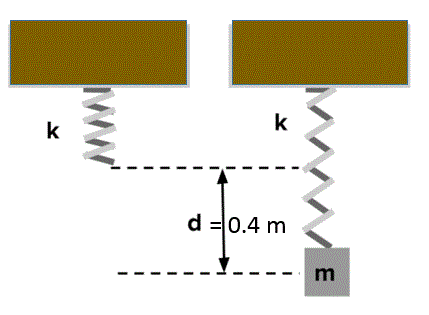
\[PE_s=\tfrac12k(\Delta L)^2=\tfrac12\times20\times0.16=1.6\,J\] ✅ الإجابة: B\[PE_s=\tfrac12k(\Delta L)^2=\tfrac12\times20\times0.16=1.6\,J\] ✅ Answer: B
🎯 اختبار طاقة الوضع🎯 Potential Energy Quiz
10 أسئلة — طاقة الوضع الجذبية والمرونية10 questions — gravitational and elastic potential energy