🎯 نواتج التعلم
🎯 Learning Outcomes
بعد هذه التجربة ستكون قادرًا على أن:
After this experiment you will be able to:
- تفسّر لماذا يرتفع جهد المكثف تدريجيًا ولا يصل إلى جهد البطارية فورًا.Explain why the capacitor voltage rises gradually instead of reaching the battery voltage at once.
- تحسب ثابت الزمن \(\tau=RC\) وتستخدمه لتقدير زمن الشحن والتفريغ.Calculate the time constant \(\tau=RC\) and use it to estimate the charging and discharging times.
- تحسب التيار وجهد المكثف وشحنته في أي لحظة أثناء الشحن والتفريغ.Calculate the current, the capacitor voltage and its charge at any instant during charging and discharging.
- تفسّر لماذا تُفقد نصف الطاقة المقدمة من البطارية في المقاومة أثناء الشحن.Explain why half of the energy supplied by the battery is lost in the resistor during charging.
🔍 الفكرة في صورة
🔍 The Idea in a Picture
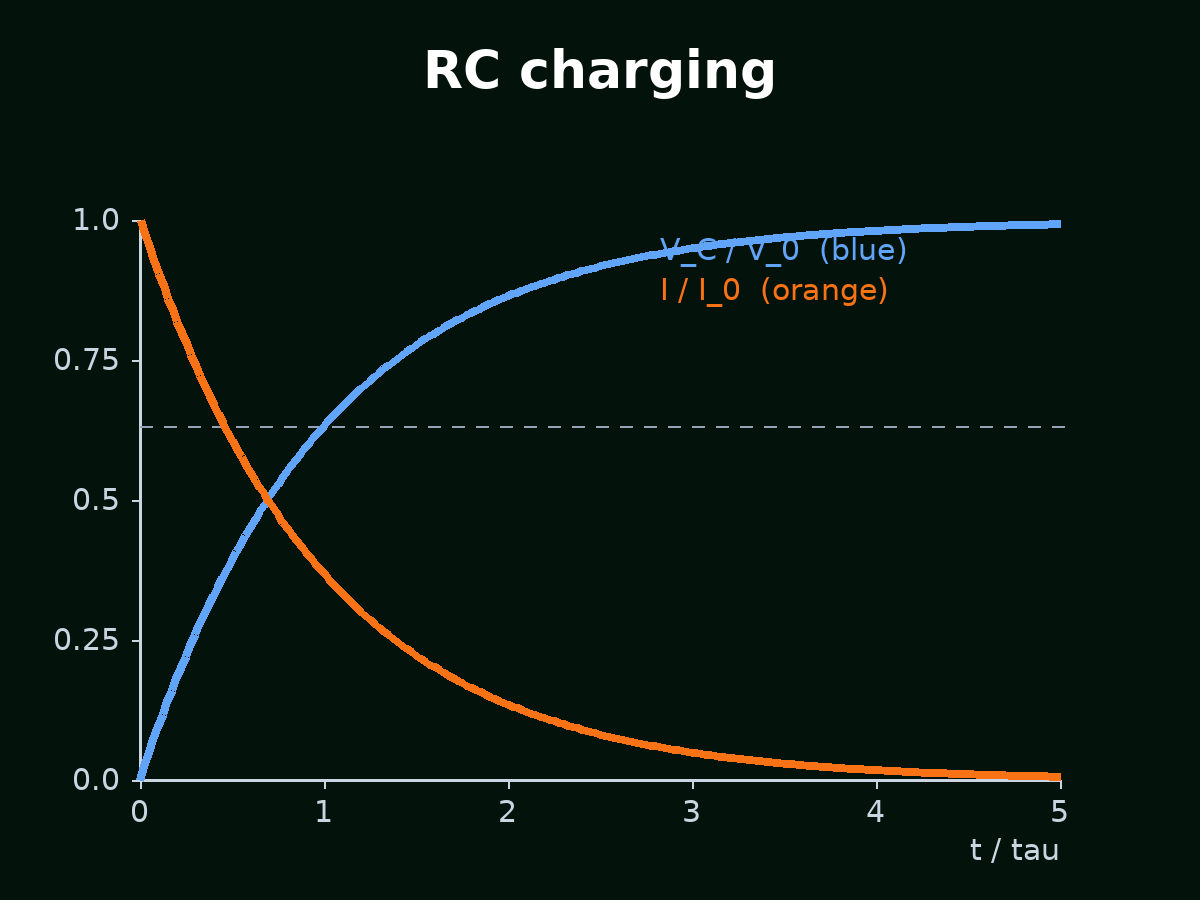
⚡ معادلات الشحن
⚡ Charging Equations
عند إغلاق الدائرة تبدأ البطارية بدفع الشحنات إلى لوحي المكثف عبر المقاومة. كلما ازدادت شحنة المكثف قلّ فرق الجهد بين طرفي المقاومة، فيقل التيار، ويصبح الشحن أبطأ كلما اقترب المكثف من الامتلاء.
When the circuit closes, the battery pushes charge onto the capacitor plates through the resistor. As the capacitor charges, the voltage across the resistor falls, so the current decreases and charging slows down as the capacitor nears full charge.
📘 قوانين الشحن والتفريغ
📘 Charging and discharging laws
\[\tau=RC\]
\[V_C=V_0\left(1-e^{-t/\tau}\right)\qquad I=\dfrac{V_0}{R}\,e^{-t/\tau}\qquad(\text{charging})\]
\[V_C=V_0\,e^{-t/\tau}\qquad I=-\dfrac{V_0}{R}\,e^{-t/\tau}\qquad(\text{discharging})\]
حيث \(V_C\) جهد المكثف، و\(V_0\) جهد البطارية، و\(R\) المقاومة، و\(C\) السعة، و\(\tau\) ثابت الزمن. وفي الشحن تكون الشحنة \(q=CV_C\).
where \(V_C\) is the capacitor voltage, \(V_0\) the battery voltage, \(R\) the resistance, \(C\) the capacitance and \(\tau\) the time constant. During charging the charge is \(q=CV_C\).
💡 شرح إضافي: لماذا يكون المنحنى أسيًا؟
💡 Extra explanation: why is the curve exponential?
معدل شحن المكثف هو التيار \(I=\dfrac{dq}{dt}\)، والتيار يساوي \(\dfrac{V_0-V_C}{R}\). فكلما زاد \(V_C\) قلّ معدل الشحن، وهذا يعطي منحنى يقترب من \(V_0\) بسرعة تقل تدريجيًا. هذه الصفة هي ما يجعل \(\tau\) كافيًا لوصف الدائرة.
The charging rate is the current \(I=\dfrac{dq}{dt}\), and the current equals \(\dfrac{V_0-V_C}{R}\). The larger \(V_C\) gets, the slower it charges. This gives a curve that approaches \(V_0\) with a steadily decreasing rate. This is why \(\tau\) is enough to describe the circuit.
💡 شرح إضافي: أين تذهب طاقة البطارية؟
💡 Extra explanation: where does the battery's energy go?
تقدم البطارية شغلًا مقداره \(Q V_0\)، وتخزن المكثف منه \(\tfrac12 QV_0\) فقط، والباقي \(\tfrac12 QV_0\) يتحول إلى حرارة في المقاومة مهما كانت قيمتها. وهذا لا يعتمد على \(R\)، بل يعتمد على شحنة المكثف النهائية.
The battery delivers work \(QV_0\), the capacitor stores only \(\tfrac12 QV_0\), and the remaining \(\tfrac12 QV_0\) becomes heat in the resistor, whatever its value. This does not depend on \(R\), only on the final charge.
⚡ دائرة RC: الشحن والتفريغ
⚡ RC circuit: charging and discharging
✍️ أمثلة محلولة
✍️ Worked Examples
مكثف سعته \(100\ \mu\mathrm{F}\) يُشحن ببطارية \(12\ \mathrm{V}\) عبر مقاومة \(1\ \mathrm{k\Omega}\). احسب ثابت الزمن، وجهد المكثف عند \(t=\tau\)، والتيار الابتدائي.
A \(100\ \mu\mathrm{F}\) capacitor is charged by a \(12\ \mathrm{V}\) battery through a \(1\ \mathrm{k\Omega}\) resistor. Find the time constant, the capacitor voltage at \(t=\tau\), and the initial current.
في المثال السابق، احسب الطاقة المخزنة في المكثف بعد شحنه بالكامل، والطاقة التي قدمتها البطارية، والطاقة المتحولة إلى حرارة في المقاومة.
In the previous example, find the energy stored in the capacitor after full charging, the energy supplied by the battery, and the energy converted to heat in the resistor.
مكثف مشحون إلى \(12\ \mathrm{V}\) يُفرّغ عبر المقاومة نفسها (\(\tau=0.1\ \mathrm{s}\)). بعد كم ثانية يصبح جهده \(4\ \mathrm{V}\)؟
A capacitor charged to \(12\ \mathrm{V}\) discharges through the same resistor (\(\tau=0.1\ \mathrm{s}\)). After how many seconds does its voltage become \(4\ \mathrm{V}\)?
📚 ملخص
📚 Summary
| المفهومConcept | القانون أو النتيجةLaw or result |
|---|---|
| ثابت الزمنTime constant | \(\tau=RC\)\(\tau=RC\) |
| جهد المكثف أثناء الشحنCapacitor voltage while charging | \(V_C=V_0(1-e^{-t/\tau})\)\(V_C=V_0(1-e^{-t/\tau})\) |
| التيار أثناء الشحنCurrent while charging | \(I=\dfrac{V_0}{R}e^{-t/\tau}\)\(I=\dfrac{V_0}{R}e^{-t/\tau}\) |
| بعد زمن \(\tau\)After one \(\tau\) | 63% من الشحن الكامل63% of full charge |
| الشحن الكامل تقريبًاAlmost fully charged | بعد \(5\tau\)After \(5\tau\) |
⚠️ أخطاء شائعة
⚠️ Common mistakes
- الظن أن المكثف يشحن فورًا عند غلق الدائرة؛ الشحن يستغرق زمنًا يحدده \(\tau\).Thinking the capacitor charges instantly when the circuit closes; charging takes a time set by \(\tau\).
- الخلط بين \(V_0\) و\(V_C\): الأولى ثابتة لأنها جهد البطارية، والثانية تتغير مع الزمن.Confusing \(V_0\) and \(V_C\): the first is the constant battery voltage, the second changes with time.
- استخدام \(\tau=R+C\) بدل \(\tau=RC\)؛ وحدات الزمن تأتي من حاصل الضرب.Using \(\tau=R+C\) instead of \(\tau=RC\); the product gives the units of time.
- الظن أن زيادة \(R\) تقلل الحرارة؛ الحرارة الكلية هي نصف طاقة البطارية مهما كانت \(R\)، لكن زيادتها تبطئ الشحن.Thinking a larger \(R\) reduces the heat; the total heat is half the battery energy whatever \(R\) is, but a larger \(R\) makes charging slower.
🧠 اختبر نفسك
🧠 Test Yourself
عند شحن مكثف عبر مقاومة، ماذا يحدث للتيار مع الزمن؟
When a capacitor charges through a resistor, what happens to the current over time?
مكثف مشحون بالكامل ثم فُرّغ عبر مقاومة. بعد زمن \(\tau\)، ما نسبة جهده إلى جهده الابتدائي؟
A fully charged capacitor is discharged through a resistor. After a time \(\tau\), what fraction of its initial voltage remains?
🔗 محاكاة GeoGebra للاستعانة بها عند اللزوم
🔗 GeoGebra Simulation to Use When Needed
اضغط «تشغيل» لتعمل المحاكاة هنا داخل الدرس؛ ويمكن للطالب الرجوع إليها لتجربة الفكرة بطريقة أخرى.
Press “Run” to run the simulation right here inside the lesson; the student can use it to try the idea in another way.