🎯 نواتج التعلم
🎯 Learning Outcomes
بعد دراسة هذا الدرس ستكون قادرًا على أن:
After this lesson you will be able to:
- تعرّف كمية الحركة الخطية \(\vec p=m\vec v\) وتنص على قانون حفظها لنظام معزول.Define linear momentum \(\vec p=m\vec v\) and state its conservation law for an isolated system.
- تميّز بين التصادم المرن واللامرن واللامرن تمامًا بحفظ الطاقة الحركية.Distinguish elastic, inelastic and perfectly inelastic collisions by the conservation of kinetic energy.
- تحسب السرعتين بعد التصادم المرن في بعد واحد، وتستعمل الحالات الخاصة.Calculate the two velocities after a one-dimensional elastic collision and use the special cases.
- تحسب السرعة المشتركة في التصادم اللامرن تمامًا والطاقة الحركية الضائعة.Calculate the common velocity in a perfectly inelastic collision and the kinetic energy lost.
- تطبّق حفظ كمية الحركة على كل محور في التصادم في بعدين.Apply conservation of momentum along each axis in a two-dimensional collision.
💥 كمية الحركة والتصادم
💥 Momentum and Collisions
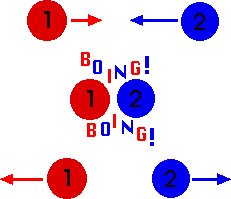
جسمان يقتربان فيتصادمان ثم يتحركان في اتجاهين مختلفين.
Two bodies approach, collide and then move in different directions.
كمية الحركة الخطية لجسم كتلته \(m\) وسرعته \(\vec v\) هي \(\vec p=m\vec v\) (متجه باتجاه السرعة، وحدتها \(\mathrm{kg\cdot m/s}\)). وبقانون نيوتن الثاني: \(\vec F_{net}=\dfrac{\Delta\vec p}{\Delta t}\)، فإذا كانت محصلة القوى الخارجية على النظام صفرًا لم تتغير كمية حركته.
The linear momentum of a body of mass \(m\) and velocity \(\vec v\) is \(\vec p=m\vec v\) (a vector along the velocity, unit \(\mathrm{kg\cdot m/s}\)). By Newton’s second law \(\vec F_{net}=\dfrac{\Delta\vec p}{\Delta t}\), so if the net external force on a system is zero its momentum does not change.
📌 قانون حفظ كمية الحركة
📌 The law of conservation of momentum
في نظام معزول (محصلة القوى الخارجية صفر) تبقى كمية الحركة الكلية ثابتة قبل التصادم وبعده:
In an isolated system (zero net external force) the total momentum stays constant before and after a collision:
\[\vec p_{i1}+\vec p_{i2}=\vec p_{f1}+\vec p_{f2}\;\Longleftrightarrow\;m_1\vec v_{i1}+m_2\vec v_{i2}=m_1\vec v_{f1}+m_2\vec v_{f2}\]
يصحّ هذا في كل أنواع التصادم لأن قوتي التفاعل بين الجسمين متساويتان ومتعاكستان (نيوتن الثالث) فيتغير زخماهما بمقدارين متساويين متعاكسين، فيبقى المجموع ثابتًا.
This holds for every kind of collision because the two interaction forces are equal and opposite (Newton’s third law) so the two momenta change by equal and opposite amounts, leaving the sum constant.
⚠️ الإشارات في بعد واحد
⚠️ Signs in one dimension
اختر اتجاهًا موجبًا (مثلًا نحو اليمين) وضع إشارة سالبة لأي سرعة في الاتجاه المعاكس. نسيان الإشارة هو أكثر خطأ شيوعًا في المسائل.
Choose a positive direction (say to the right) and give a negative sign to any velocity in the opposite direction. Forgetting the sign is the most common mistake in these problems.
| النوعKind | كمية الحركة \(P\)Momentum \(P\) | الطاقة الحركية \(K\)Kinetic energy \(K\) | ما يحدث للجسمينWhat happens to the bodies | \(e\)\(e\) |
|---|---|---|---|---|
| مرنElastic | محفوظةconserved | محفوظةconserved | يرتدّان ولا يتشوهانthey bounce without deformation | 11 |
| لا مرنInelastic | محفوظةconserved | تقل (تتحول إلى حرارة وتشوّه)decreases (turns into heat and deformation) | يرتدّان مع تشوّهthey bounce with deformation | \(0\lt e\lt 1\)\(0\lt e\lt 1\) |
| لا مرن تمامًاPerfectly inelastic | محفوظةconserved | تقل إلى أكبر حد ممكنdecreases the most possible | يلتحمان ويتحركان معًاthey stick and move together | 00 |
في أي تصادم بين جسمين في نظام معزول تبقى محفوظة:
In any collision between two bodies in an isolated system the quantity that is conserved is:
🏓 التصادم المرن في بعد واحد
🏓 The Elastic Collision in One Dimension
في التصادم المرن تُحفظ كمية الحركة والطاقة الحركية معًا:
In an elastic collision both the momentum and the kinetic energy are conserved:
\[m_1v_{i1}+m_2v_{i2}=m_1v_{f1}+m_2v_{f2},\qquad \tfrac12m_1v_{i1}^2+\tfrac12m_2v_{i2}^2=\tfrac12m_1v_{f1}^2+\tfrac12m_2v_{f2}^2\]
بحل المعادلتين معًا نحصل على السرعتين بعد التصادم (والنتيجة المفيدة: سرعة الاقتراب = سرعة الابتعاد أي \(v_{i1}-v_{i2}=-(v_{f1}-v_{f2})\)):
Solving the two equations together gives the velocities after the collision (and a useful result: the speed of approach equals the speed of separation, i.e. \(v_{i1}-v_{i2}=-(v_{f1}-v_{f2})\)):
📌 السرعتان بعد التصادم المرن
📌 The velocities after an elastic collision
\[v_{f1}=\dfrac{m_1-m_2}{m_1+m_2}\,v_{i1}+\dfrac{2m_2}{m_1+m_2}\,v_{i2}\]
\[v_{f2}=\dfrac{2m_1}{m_1+m_2}\,v_{i1}+\dfrac{m_2-m_1}{m_1+m_2}\,v_{i2}\]
| الحالة الخاصةSpecial case | النتيجةResult |
|---|---|
| كتلتان متساويتان \(m_1=m_2\)Equal masses \(m_1=m_2\) | يتبادلان السرعتين: \(v_{f1}=v_{i2}\) و\(v_{f2}=v_{i1}\)they exchange velocities: \(v_{f1}=v_{i2}\) and \(v_{f2}=v_{i1}\) |
| هدف ساكن \(v_{i2}=0\)Target at rest \(v_{i2}=0\) | \(v_{f1}=\dfrac{m_1-m_2}{m_1+m_2}v_{i1}\) و\(v_{f2}=\dfrac{2m_1}{m_1+m_2}v_{i1}\)\(v_{f1}=\dfrac{m_1-m_2}{m_1+m_2}v_{i1}\) and \(v_{f2}=\dfrac{2m_1}{m_1+m_2}v_{i1}\) |
| مقذوف خفيف يصطدم بهدف ثقيل ساكن \(m_1\ll m_2\)A light projectile hits a heavy target at rest \(m_1\ll m_2\) | يرتد المقذوف بسرعته تقريبًا (\(v_{f1}\approx-v_{i1}\)) والهدف يكاد لا يتحركthe projectile bounces back at nearly its speed (\(v_{f1}\approx-v_{i1}\)) and the target hardly moves |
| مقذوف ثقيل يصطدم بهدف خفيف ساكن \(m_1\gg m_2\)A heavy projectile hits a light target at rest \(m_1\gg m_2\) | يستمر المقذوف تقريبًا بسرعته، ويندفع الهدف بنحو ضعفها (\(v_{f2}\approx2v_{i1}\))the projectile continues at about its speed and the target shoots off at about twice that (\(v_{f2}\approx2v_{i1}\)) |
جسمان: \(m_1=1\ \mathrm{kg}\) بسرعة \(+10\ \mathrm{m/s}\) و\(m_2=2\ \mathrm{kg}\) بسرعة \(-10\ \mathrm{m/s}\) يتصادمان تصادمًا مرنًا. احسب سرعتيهما بعد التصادم وتحقق من حفظ \(P\) و\(K\).
Two bodies: \(m_1=1\ \mathrm{kg}\) at \(+10\ \mathrm{m/s}\) and \(m_2=2\ \mathrm{kg}\) at \(-10\ \mathrm{m/s}\) collide elastically. Find their velocities after the collision and check conservation of \(P\) and \(K\).
على منضدة هوائية يتحرك راكب كتلته \(0.6\ \mathrm{kg}\) نحو اليسار بسرعة \(10\ \mathrm{m/s}\) وآخر كتلته \(0.4\ \mathrm{kg}\) نحو اليمين بسرعة \(20\ \mathrm{m/s}\) ويتصادمان بمرونة. احسب سرعتيهما بعد التصادم.
On an air table a glider of mass \(0.6\ \mathrm{kg}\) moves left at \(10\ \mathrm{m/s}\) and another of mass \(0.4\ \mathrm{kg}\) moves right at \(20\ \mathrm{m/s}\); they collide elastically. Find their velocities after the collision.
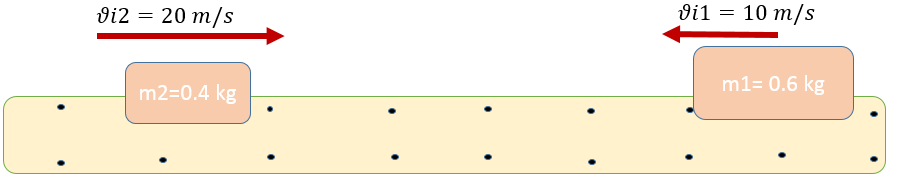
مثال 2: الراكبان على المنضدة الهوائية.
Example 2: the two gliders on the air table.
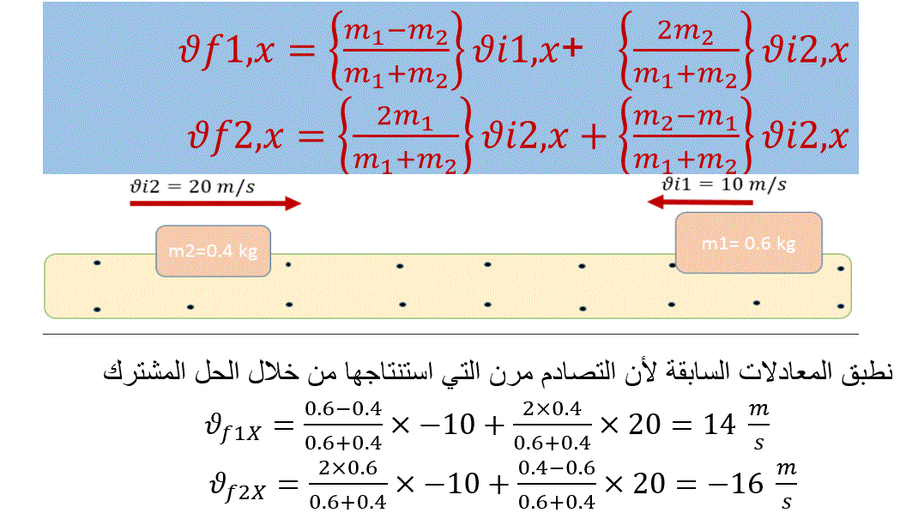
طريقة الحل المصوّرة للمثال 2.
The illustrated solution of example 2.
🧪 تجربة 1: تصادم في بعد واحد: جرّب المرن واللامرن
🧪 Experiment 1: A one-dimensional collision: try elastic and inelastic
اختر كتلتي الجسمين وسرعتيهما (الإشارة تعني الاتجاه) ومعامل الارتداد \(e\): \(e=1\) تصادم مرن و\(e=0\) لا مرن تمامًا (يلتحمان). اضغط «شغّل التصادم» وراقب: كمية الحركة تبقى كما هي دائمًا، أما الطاقة الحركية فتقل إذا كان \(e\lt 1\).
Choose the two masses and velocities (the sign is the direction) and the coefficient of restitution \(e\): \(e=1\) is an elastic collision and \(e=0\) is perfectly inelastic (they stick). Press “Run the collision” and watch: momentum always stays the same, while kinetic energy falls if \(e\lt 1\).
كرة كتلتها \(2\ \mathrm{kg}\) تتحرك بـ \(6\ \mathrm{m/s}\) تصطدم مرنًا بكرة أخرى مماثلة ساكنة. سرعة الكرة الأولى بعد التصادم:
A \(2\ \mathrm{kg}\) ball moving at \(6\ \mathrm{m/s}\) collides elastically with an identical ball at rest. The first ball’s velocity after the collision:
🔗 التصادم اللامرن تمامًا
🔗 The Perfectly Inelastic Collision
يلتحم الجسمان بعد التصادم ويتحركان كجسم واحد بسرعة مشتركة \(v_f\). كمية الحركة محفوظة، لكن الطاقة الحركية تقل (لا تُحفظ) إذ يضيع جزء منها حرارةً وتشوّهًا وصوتًا.
The two bodies stick together and move as one body with a common velocity \(v_f\). Momentum is conserved, but kinetic energy decreases (is not conserved): part of it is lost as heat, deformation and sound.
📌 التصادم اللامرن تمامًا
📌 The perfectly inelastic collision
\[m_1v_{i1}+m_2v_{i2}=(m_1+m_2)\,v_f\;\Longrightarrow\;v_f=\dfrac{m_1v_{i1}+m_2v_{i2}}{m_1+m_2}\]
\[\Delta K=K_i-K_f=\dfrac12\,\dfrac{m_1m_2}{m_1+m_2}\,(v_{i1}-v_{i2})^2\]
والفاقد \(\Delta K\) موجب دائمًا وأكبر ما يمكن بين كل أنواع التصادم، وينعدم فقط إذا كانت \(v_{i1}=v_{i2}\) (لا تصادم).
The loss \(\Delta K\) is always positive and the largest of all collision types; it is zero only if \(v_{i1}=v_{i2}\) (no collision).
🔎 بين المرن واللامرن تمامًا: معامل الارتداد
🔎 Between elastic and perfectly inelastic: the coefficient of restitution
يقيس مدى «ارتداد» الجسمين: \(e=\dfrac{v_{f2}-v_{f1}}{v_{i1}-v_{i2}}\) (سرعة الابتعاد ÷ سرعة الاقتراب). \(e=1\) للمرن، و\(e=0\) للامرن تمامًا، وبينهما للامرن العادي. وتتحرك التجربة التالية بتغيير \(e\) من 0 إلى 1.
It measures how much the bodies “bounce”: \(e=\dfrac{v_{f2}-v_{f1}}{v_{i1}-v_{i2}}\) (speed of separation ÷ speed of approach). \(e=1\) for an elastic collision, \(e=0\) for a perfectly inelastic one, and in between for an ordinary inelastic collision. The experiment above lets you change \(e\) from 0 to 1.
جسمان: \(m_1=1\ \mathrm{kg}\) بسرعة \(+10\ \mathrm{m/s}\) و\(m_2=1\ \mathrm{kg}\) بسرعة \(-30\ \mathrm{m/s}\) يلتحمان بعد التصادم. احسب السرعة المشتركة والطاقة الحركية الضائعة.
Two bodies: \(m_1=1\ \mathrm{kg}\) at \(+10\ \mathrm{m/s}\) and \(m_2=1\ \mathrm{kg}\) at \(-30\ \mathrm{m/s}\) stick together after the collision. Find the common velocity and the kinetic energy lost.
عربتان كتلتاهما متساويتان تتحركان نحو بعضهما بسرعتين متساويتين في المقدار وتلتحمان. العربتان بعد التصادم:
Two carts of equal mass move towards each other at equal speeds and stick together. After the collision the carts:
🎱 التصادم في بعدين
🎱 Collisions in Two Dimensions
كمية الحركة متجه، فنحفظها على كل محور على حدة:
Momentum is a vector, so we conserve it along each axis separately:
\[\text{المحور }x:\; m_1v_{i1x}+m_2v_{i2x}=m_1v_{f1x}+m_2v_{f2x}\qquad \text{المحور }y:\; m_1v_{i1y}+m_2v_{i2y}=m_1v_{f1y}+m_2v_{f2y}\]
💡 خطوات الحل
💡 Steps of the solution
- ارسم المحورين وحلّل كل سرعة إلى \(v_x=v\cos\theta\) و\(v_y=v\sin\theta\).Draw the axes and resolve each velocity into \(v_x=v\cos\theta\) and \(v_y=v\sin\theta\).
- اكتب معادلة حفظ \(P\) على \(x\) ثم على \(y\).Write the conservation of \(P\) along \(x\) and then along \(y\).
- إن كان التصادم مرنًا أضف معادلة حفظ \(K\) (مجموع مربعات السرعات، بلا اتجاه).If the collision is elastic add the conservation of \(K\) (a sum of squared speeds, with no direction).
كرة كتلتها \(1.5\ \mathrm{kg}\) تتحرك بسرعة \(15\ \mathrm{m/s}\) تصطدم بكرة كتلتها \(1\ \mathrm{kg}\) ساكنة، فتتحرك الأولى بعد التصادم بسرعة \(8.66\ \mathrm{m/s}\) بزاوية \(30^\circ\) فوق المحور، وتتحرك الثانية بسرعة \(13\ \mathrm{m/s}\) بزاوية \(30^\circ\) تحت المحور. تحقق من حفظ كمية الحركة، وهل التصادم مرن؟
A \(1.5\ \mathrm{kg}\) ball moving at \(15\ \mathrm{m/s}\) hits a \(1\ \mathrm{kg}\) ball at rest. Afterwards the first moves at \(8.66\ \mathrm{m/s}\) at \(30^\circ\) above the axis and the second at \(13\ \mathrm{m/s}\) at \(30^\circ\) below the axis. Verify conservation of momentum and decide whether the collision is elastic.
🎯 قاعدة الزاوية القائمة
🎯 The right-angle rule
عند تصادم مرن بين كرتين متساويتي الكتلة إحداهما ساكنة (وليس تصادمًا مباشرًا) تتباعد الكرتان بزاوية قائمة \(90^\circ\) بين اتجاهي سرعتيهما بعد التصادم. جرّب ذلك في التجربة.
In an elastic collision between two balls of equal mass, one initially at rest (and not head-on), the two balls leave with a right angle \(90^\circ\) between their velocities. Try it in the experiment.
🧪 تجربة 2: تصادم في بعدين: كرتان وزاوية الاصطدام
🧪 Experiment 2: A two-dimensional collision: two balls and an impact angle
كرة حمراء تتحرك نحو كرة زرقاء ساكنة (أو متحركة). غيّر الكتل والسرعات والإزاحة \(b\) (مدى انحراف التصادم عن المنتصف) و\(e\). اضغط «شغّل التصادم»: تتوزع كمية الحركة على المحورين \(x\) و\(y\) لكنها تبقى محفوظة في كل منهما. للكتل المتساوية والتصادم المرن والكرة الساكنة تتفرق الكرتان بزاوية \(90^\circ\).
A red ball moves towards a blue ball at rest (or moving). Change the masses, the speeds, the offset \(b\) (how far the impact is from head-on) and \(e\). Press “Run the collision”: the momentum is shared between the \(x\) and \(y\) axes but is conserved along each. For equal masses, an elastic collision and a target at rest the balls leave at \(90^\circ\).
في التصادم في بعدين تُحفظ كمية الحركة:
In a collision in two dimensions momentum is conserved:
🚗 التصادم اللامرن في بعدين: سيارتان عند تقاطع
🚗 A Perfectly Inelastic Collision in Two Dimensions: Two Cars at an Intersection
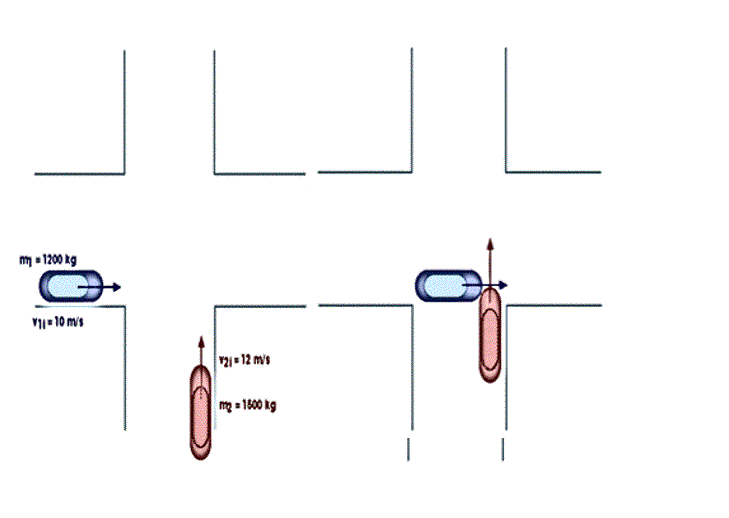
سيارة \(1200\ \mathrm{kg}\) شرقًا بـ \(10\ \mathrm{m/s}\) وسيارة \(1500\ \mathrm{kg}\) شمالًا بـ \(12\ \mathrm{m/s}\).
A \(1200\ \mathrm{kg}\) car going east at \(10\ \mathrm{m/s}\) and a \(1500\ \mathrm{kg}\) car going north at \(12\ \mathrm{m/s}\).
تصادمت السيارتان في الشكل والتحمتا. احسب سرعتهما المشتركة واتجاهها.
The two cars in the figure collide and stick together. Find their common velocity and its direction.
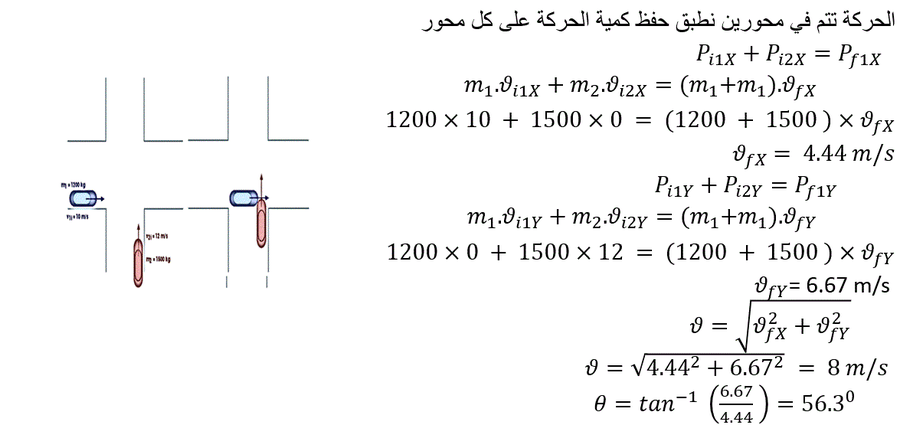
طريقة الحل المصوّرة للمثال 5.
The illustrated solution of example 5.
🧪 تجربة 3: تصادم سيارتين ملتحمتين عند تقاطع
🧪 Experiment 3: Two cars sticking together at an intersection
سيارة كتلتها \(m_1\) تسير شرقًا وأخرى \(m_2\) تسير شمالًا، وتلتحمان بعد التصادم. اضغط «شغّل التصادم». تُحفظ كمية الحركة على كل محور فتنتج سرعة مشتركة اتجاهها بين الشرق والشمال، وتُرسم متجهات كمية الحركة لترى أن \(\vec p=\vec p_1+\vec p_2\). وهذه هي مسألة الدرس (1200 kg بسرعة 10 m/s و1500 kg بسرعة 12 m/s).
A car of mass \(m_1\) drives east and another of mass \(m_2\) drives north, and they stick together after the collision. Press “Run the collision”. Momentum is conserved along each axis so a common velocity results, directed between east and north, and the momentum vectors are drawn to show \(\vec p=\vec p_1+\vec p_2\). This is the lesson’s problem (1200 kg at 10 m/s and 1500 kg at 12 m/s).
سيارتان تلتحمان بعد تصادم عند تقاطع: الأولى شرقًا والثانية شمالًا. اتجاه السرعة المشتركة:
Two cars stick together after colliding at an intersection: the first going east, the second north. The common velocity points:
📚 ملخص الدرس
📚 Lesson Summary
| الفكرةIdea | القاعدةRule |
|---|---|
| كمية الحركةMomentum | \(\vec p=m\vec v,\ \vec F=\dfrac{\Delta\vec p}{\Delta t}\)\(\vec p=m\vec v,\ \vec F=\dfrac{\Delta\vec p}{\Delta t}\) |
| الحفظ في أي تصادمConservation in any collision | \(\sum m\vec v_i=\sum m\vec v_f\)\(\sum m\vec v_i=\sum m\vec v_f\) |
| مرنElastic | \(K_i=K_f,\ v_{i1}-v_{i2}=-(v_{f1}-v_{f2})\)\(K_i=K_f,\ v_{i1}-v_{i2}=-(v_{f1}-v_{f2})\) |
| لا مرن تمامًاPerfectly inelastic | \(v_f=\dfrac{m_1v_{i1}+m_2v_{i2}}{m_1+m_2},\ \Delta K=\tfrac12\mu(\Delta v)^2\)\(v_f=\dfrac{m_1v_{i1}+m_2v_{i2}}{m_1+m_2},\ \Delta K=\tfrac12\mu(\Delta v)^2\) |
| في بعدينIn two dimensions | نحفظ \(P\) على \(x\) وعلى \(y\) كلٍّ على حدةconserve \(P\) along \(x\) and along \(y\) separately |
⚠️ أخطاء شائعة
⚠️ Common mistakes
- نسيان إشارة السرعة في الاتجاه المعاكس عند حفظ كمية الحركة.Forgetting the sign of a velocity in the opposite direction when conserving momentum.
- استعمال حفظ الطاقة الحركية في تصادم لا مرن؛ تُحفظ فقط كمية الحركة.Using conservation of kinetic energy in an inelastic collision; only momentum is conserved.
- جمع كميتي الحركة على محورين بالجمع العددي بدل الجمع المتجهي (فيثاغورس).Adding the momenta of two axes arithmetically instead of vectorially (Pythagoras).
- الظن أن الطاقة «تختفي» في التصادم اللامرن؛ هي تتحول إلى حرارة وتشوّه وصوت.Thinking the energy “disappears” in an inelastic collision; it turns into heat, deformation and sound.
- تطبيق معادلتي المرن عندما يلتحم الجسمان.Applying the elastic formulas when the bodies stick together.
🧪 اختبر نفسك: امتحان من 20 سؤالاً
🧪 Test Yourself: a 20-Question Exam
أنهِ الدرس بالاختبار التفاعلي التالي؛ أسئلته تجمع بين الفهم والحساب وتغطي جميع أقسام الدرس.
Finish with the interactive exam below; its questions mix understanding with calculation and cover every section of the lesson.
اختبار حفظ كمية الحركة والتصادمات Momentum and Collisions Quiz
20 سؤالاً - كمية الحركة والتصادم المرن واللامرن في بعد وبعدين 20 Questions - momentum and elastic and inelastic collisions in one and two dimensions
• عدد الأسئلة: 20 سؤالاً
• مدة الاختبار: 30 دقيقة
• لا يمكنك تغيير إجاباتك أو إعادة الاختبار إلا بعد 24 ساعة من التسليم.
• تأكد من إجاباتك قبل التسليم! 📌 Important Instructions:
• Number of questions: 20 questions
• Quiz duration: 30 minutes
• You cannot change your answers or retake the quiz for 24 hours after submission.
• Make sure of your answers before submitting!
🔗 محاكيات GeoGebra للاستعانة بها عند اللزوم
🔗 GeoGebra Simulations to Use When Needed
اضغط «تشغيل» لتعمل المحاكاة هنا داخل الدرس؛ ويمكن للطالب الرجوع إليها لتجربة الفكرة بطريقة أخرى.
Press “Run” to run the simulation right here inside the lesson; the student can use it to try the idea in another way.