🎯 نواتج التعلم
🎯 Learning Outcomes
بعد دراسة هذا الدرس ستكون قادرًا على أن:
After this lesson you will be able to:
- ترسم مخطط القوى لجسم على مستوى أفقي وتحدد القوة العمودية في كل حالة.Draw the free-body diagram of a body on a horizontal plane and find the normal force in each case.
- تحسب تسارع الجسم على سطح أملس بقوة شد أفقية ومائلة.Calculate the acceleration of a body on a smooth surface under a horizontal and an angled pull.
- تفرّق بين الاحتكاك السكوني والحركي وتطبّق شرط الحركة \(T_x\gt \mu_sN\).Distinguish between static and kinetic friction and apply the condition for motion \(T_x\gt \mu_sN\).
- تحسب التسارع على سطح خشن في حالتي الشد لأعلى والشد لأسفل.Calculate the acceleration on a rough surface for both an upward and a downward pull.
- تحلّ مسائل جسمين متصلين بخيط على سطح أفقي.Solve problems of two bodies connected by a string on a horizontal surface.
🧭 الخطوات العامة لحلّ المسائل
🧭 General Steps for Solving Problems
تؤثر في الجسم على المستوى الأفقي القوى الآتية: وزنه \(mg\) رأسيًا إلى أسفل، والقوة العمودية \(N\) التي يؤثر بها السطح رأسيًا إلى أعلى، وقوة الشد \(T\)، وقوة الاحتكاك \(f\) عكس اتجاه الحركة (أو الحركة المحتملة). ونتّبع دائمًا: (1) رسم المخطط، (2) اختيار المحورين \(x\) و\(y\)، (3) تطبيق قانون نيوتن الثاني على كل محور. وبما أن الجسم لا يتحرك رأسيًا فإن \(\sum F_y=0\) وبه نجد \(N\).
The forces acting on a body on a horizontal plane are: its weight \(mg\) vertically downward, the normal force \(N\) exerted by the surface vertically upward, the pulling force \(T\), and the friction force \(f\) opposite to the (possible) motion. We always follow: (1) draw the diagram, (2) choose the \(x\) and \(y\) axes, (3) apply Newton’s second law on each axis. Since the body does not move vertically \(\sum F_y=0\) and from it we find \(N\).
🟦 أولًا: مستوى أفقي أملس
🟦 1. A Smooth Horizontal Plane
الحالة 1: قوة شد أفقية
Case 1: a horizontal pulling force
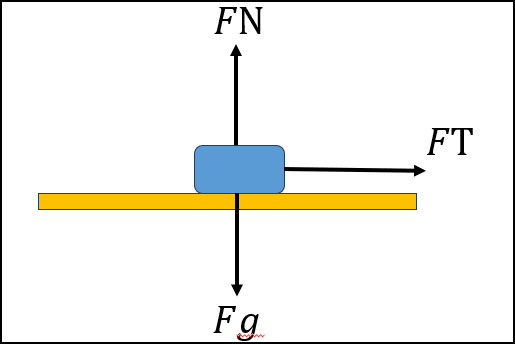
مخطط القوى: \(F_N\) و\(F_g\) و\(F_T\).
Free-body diagram: \(F_N\), \(F_g\) and \(F_T\).
📌 الشد الأفقي على سطح أملس
📌 Horizontal pull on a smooth surface
\[\sum F_x=T=ma\ \Rightarrow\ a=\frac{T}{m}\]
\[\sum F_y=N-mg=0\ \Rightarrow\ N=mg\]
\[v_f=v_0+at,\qquad \Delta x=v_0t+\tfrac12at^2\]
الحالة 2: قوة شد مائلة بزاوية \(\theta\)
Case 2: an angled pulling force \(\theta\)
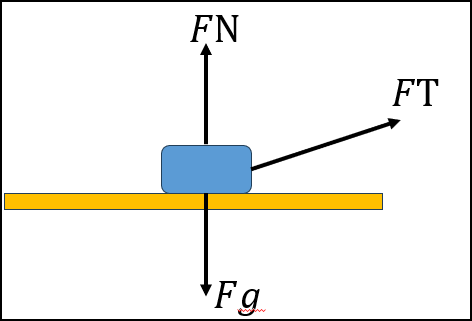
القوة \(T\) تميل بزاوية \(\theta\) فوق الأفقي.
The force \(T\) is at an angle \(\theta\) above the horizontal.
📌 الشد المائل على سطح أملس
📌 Angled pull on a smooth surface
\[\sum F_x=T\cos\theta=ma\ \Rightarrow\ a=\frac{T\cos\theta}{m}\]
\[\sum F_y=N+T\sin\theta-mg=0\ \Rightarrow\ N=mg-T\sin\theta\]
لاحظ أن المركّبة الرأسية \(T\sin\theta\) تخفّف ضغط الجسم على السطح فتصغر \(N\) عن \(mg\)، وتكون فعّالة في التسارع المركّبة الأفقية \(T\cos\theta\) فقط.
Note that the vertical component \(T\sin\theta\) relieves the body’s pressure on the surface so \(N\) becomes less than \(mg\), and only the horizontal component \(T\cos\theta\) is effective in producing acceleration.
رموز المتغيرات
Notation
- \(T\): قوة الشد (N) — \(m\): الكتلة (kg) — \(a\): التسارع (m/s²).\(T\): the pulling force (N) — \(m\): mass (kg) — \(a\): acceleration (m/s²).
- \(v_0\): السرعة الابتدائية (m/s) — \(t\): الزمن (s) — \(\theta\): زاوية ميل القوة.\(v_0\): initial velocity (m/s) — \(t\): time (s) — \(\theta\): the angle of the force.
- \(g\): تسارع الجاذبية \(9.8\ \mathrm{m/s^2}\).\(g\): gravitational acceleration \(9.8\ \mathrm{m/s^2}\).
جسم كتلته \(10\ \mathrm{kg}\) على سطح أفقي أملس يُشدّ بقوة أفقية \(30\ \mathrm N\) من السكون. أوجد تسارعه وسرعته وإزاحته بعد \(4\ \mathrm s\).
A \(10\ \mathrm{kg}\) body on a smooth horizontal surface is pulled from rest by a horizontal force of \(30\ \mathrm N\). Find its acceleration, velocity and displacement after \(4\ \mathrm s\).
جسم كتلته \(5\ \mathrm{kg}\) على سطح أملس يُشدّ بقوة \(20\ \mathrm N\) بزاوية \(30^\circ\) فوق الأفقي (\(g=9.8\)). أوجد تسارعه والقوة العمودية.
A \(5\ \mathrm{kg}\) body on a smooth surface is pulled by \(20\ \mathrm N\) at \(30^\circ\) above the horizontal (\(g=9.8\)). Find its acceleration and the normal force.
🟫 ثانيًا: مستوى أفقي خشن
🟫 2. A Rough Horizontal Plane
📌 ملاحظات عن الاحتكاك
📌 Notes on friction
- \(\mu_s\): معامل الاحتكاك السكوني، وأقصى احتكاك سكوني \(f_{s,max}=\mu_sN\). والاحتكاك السكوني قبل الحركة يساوي القوة المؤثرة فقط (\(f_s\le\mu_sN\)).\(\mu_s\): the coefficient of static friction, and the maximum static friction is \(f_{s,max}=\mu_sN\). Static friction before motion equals the applied force only (\(f_s\le\mu_sN\)).
- \(\mu_k\): معامل الاحتكاك الحركي، و\(f_k=\mu_kN\) ثابتة أثناء الحركة، وعادةً \(\mu_k\lt \mu_s\).\(\mu_k\): the coefficient of kinetic friction, \(f_k=\mu_kN\) is constant during motion, and usually \(\mu_k\lt \mu_s\).
- الاحتكاك يعتمد على القوة العمودية \(N\) لا على الوزن مباشرة، فإذا تغيّرت \(N\) (بشد مائل) تغيّر الاحتكاك.Friction depends on the normal force \(N\), not directly on the weight, so if \(N\) changes (by an angled pull) the friction changes.
الشد أفقي
Horizontal pull
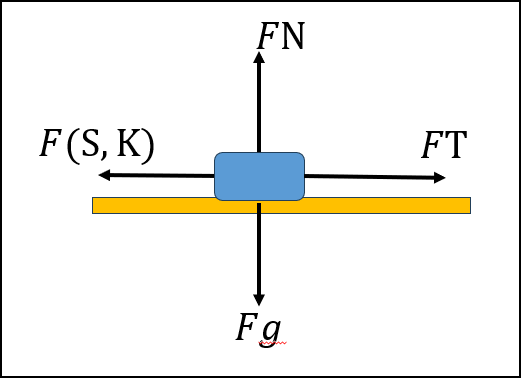
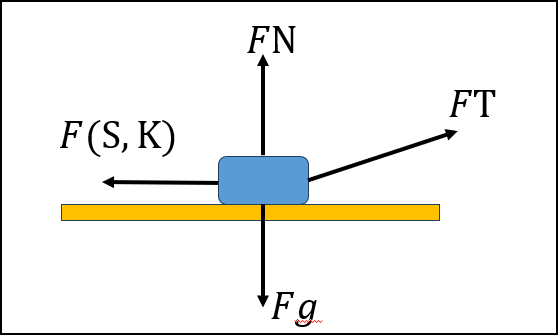
المخطط: القوة \(F(s,k)\) تعاكس الشد.
The diagram: the force \(F(s,k)\) opposes the pull.
📌 شرط الحركة (شد أفقي)
📌 Condition for motion (horizontal pull)
\[N=mg;\qquad T\gt \mu_sN\ \Rightarrow\ \text{moves},\qquad T\le\mu_sN\ \Rightarrow\ \text{at rest}\]
\[\text{moving: }\sum F_x=T-\mu_kN=ma\ \Rightarrow\ a=\frac{T-\mu_kN}{m}\]
الشد مائل بزاوية \(\theta\)
Angled pull at \(\theta\)
المخطط: الشد المائل مع الاحتكاك.
The diagram: the angled pull with friction.
📌 الشد المائل على سطح خشن
📌 Angled pull on a rough surface
\[T_x=T\cos\theta,\qquad T_y=T\sin\theta\]
\[\text{upward pull: }N=mg-T_y\qquad\text{downward pull: }N=mg+T_y\]
\[T_x\gt \mu_sN\ \Rightarrow\ \text{moves};\qquad a=\frac{T_x-\mu_kN}{m}\]
تلخيص الحالتين أثناء الحركة
The two cases while moving
- الشد لأعلى: \(a=\dfrac{T_x-\mu_k(mg-T_y)}{m}\).Upward pull: \(a=\dfrac{T_x-\mu_k(mg-T_y)}{m}\).
- الشد لأسفل: \(a=\dfrac{T_x-\mu_k(mg+T_y)}{m}\) (يزداد الاحتكاك).Downward pull: \(a=\dfrac{T_x-\mu_k(mg+T_y)}{m}\) (friction increases).
🧪 جرّب بنفسك: السحب على سطح أملس وخشن
🧪 Try It Yourself: Pulling on a Smooth and a Rough Surface
🧪 تجربة 1: سحب جسم على مستوى أفقي أملس وخشن
🧪 Experiment 1: Pulling a Body on a Smooth and a Rough Horizontal Plane
اضبط الكتلة وقوة الشد وزاويتها ومعاملي الاحتكاك (اجعلهما صفرًا للسطح الأملس) واختر الشد لأعلى أو لأسفل، ثم اضغط «ابدأ الحركة». راقب القوة العمودية والاحتكاك ومنحنى \(f\)–\(T_x\).
Set the mass, the pulling force and its angle and the two friction coefficients (zero for a smooth surface), choose an upward or downward pull, then press “Start”. Watch the normal force, the friction and the \(f\)–\(T_x\) curve.
جسم كتلته \(10\ \mathrm{kg}\) على سطح خشن \(\mu_s=0.4,\ \mu_k=0.3\) (\(g=9.8\)). صف حركته وأوجد التسارع إذا شُدّ بقوة أفقية (أ) \(30\ \mathrm N\)، (ب) \(50\ \mathrm N\).
A \(10\ \mathrm{kg}\) body on a rough surface \(\mu_s=0.4,\ \mu_k=0.3\) (\(g=9.8\)). Describe its motion and find the acceleration if it is pulled by a horizontal force of (a) \(30\ \mathrm N\), (b) \(50\ \mathrm N\).
جسم كتلته \(20\ \mathrm{kg}\) على سطح خشن \(\mu_s=0.5,\ \mu_k=0.4\) يُشدّ بقوة \(100\ \mathrm N\) بزاوية \(37^\circ\) (\(\cos37^\circ=0.8\)). قارن الحالتين: الشد لأعلى والشد لأسفل (\(g=9.8\)).
A \(20\ \mathrm{kg}\) body on a rough surface \(\mu_s=0.5,\ \mu_k=0.4\) is pulled by \(100\ \mathrm N\) at \(37^\circ\) (\(\cos37^\circ=0.8\)). Compare the two cases: upward pull and downward pull (\(g=9.8\)).
🧪 جرّب بنفسك: أفضل زاوية للسحب
🧪 Try It Yourself: the Best Pulling Angle
🧪 تجربة 2: أفضل زاوية للسحب
🧪 Experiment 2: The Best Angle for Pulling
مع بقاء قوة الشد ثابتة غيّر زاويتها وراقب التسارع: يزداد قليلًا ثم يقل. اضبط الزاوية على \(\theta^*=\tan^{-1}\mu_k\) لتحصل على أكبر تسارع.
With the pulling force fixed change its angle and watch the acceleration: it increases a little then decreases. Set the angle to \(\theta^*=\tan^{-1}\mu_k\) to get the greatest acceleration.
🔗 جسمان متصلان بخيط
🔗 Two Bodies Connected by a String
الجملة المادية تتحرك بالتسارع نفسه لأن الخيط لا يمتط، وقوة الشد متساوية على طرفي الخيط. وعند دراسة الجسم نحدد القوى المؤثرة عليه ونطبّق قانون نيوتن الثاني حتى نحصل على تسارع الجملة. فإذا شُدّ الجسم الثاني بقوة \(F\) على سطح أملس:
The system moves with the same acceleration because the string does not stretch, and the tension is the same at both ends of the string. When studying a body we determine the forces acting on it and apply Newton’s second law until we obtain the acceleration of the system. If the second body is pulled by a force \(F\) on a smooth surface:
📌 جسمان متصلان على سطح أفقي
📌 Two connected bodies on a horizontal surface
\[a=\frac{F-\mu(m_1+m_2)g}{m_1+m_2}\]
\[T=m_1(a+\mu g)\qquad(\mu=0:\ T=\frac{m_1}{m_1+m_2}F)\]
🧪 جرّب بنفسك: الجسمان المتصلان
🧪 Try It Yourself: the Connected Bodies
🧪 تجربة 3: جسمان متصلان بخيط على مستوى أفقي
🧪 Experiment 3: Two Bodies Connected by a String on a Horizontal Plane
يُسحب الجسم الثاني بقوة أفقية \(F\) فيجرّ الأول بالخيط. غيّر الكتلتين والقوة والاحتكاك وراقب التسارع المشترك وقوة الشد في الخيط.
The second body is pulled by a horizontal force \(F\) and drags the first through the string. Change the masses, the force and the friction and watch the common acceleration and the string tension.
جسمان \(m_1=2\ \mathrm{kg}\) و\(m_2=3\ \mathrm{kg}\) موصولان بخيط على سطح أملس، سُحب الثاني بقوة \(20\ \mathrm N\). أوجد تسارع الجملة وقوة الشد في الخيط.
Two bodies \(m_1=2\ \mathrm{kg}\) and \(m_2=3\ \mathrm{kg}\) are connected by a string on a smooth surface and the second is pulled by \(20\ \mathrm N\). Find the acceleration of the system and the tension in the string.
📋 جداول المقارنة والقيم النموذجية
📋 Comparison Tables and Typical Values
| الحالةCase | المعادلاتEquations | شرط الحركةCondition for motion | تطبيق عمليPractical application |
|---|---|---|---|
| قوة شد أفقية (جسم ساكن)Horizontal pull (at rest) | \(f_s=T,\ \sum F_x=T-f_s=0\) | \(T\le\mu_smg\) | سحب خزانة ثقيلةPulling a heavy cabinet |
| قوة شد أفقية (جسم متحرك)Horizontal pull (moving) | \(f_k=\mu_kN,\ \sum F_x=T-f_k=ma\) | \(T\gt \mu_smg\) | جر عربة على أرضيةPulling a cart on the floor |
| قوة شد مائلة (\(\theta\) مع الأفقي)Angled pull (\(\theta\) with the horizontal) | \(T_x=T\cos\theta,\ T_y=T\sin\theta,\ N=mg-T_y\) | \(T_x\gt \mu_s(mg-T_y)\) | سحب صندوق بحبل مائلPulling a box with an angled rope |
| المقدارQuantity | الرمزSymbol | قيم نموذجيةTypical values | الوحدةUnit |
|---|---|---|---|
| الكتلةMass | \(m\) | 10 – 100 | كجمkg |
| معامل الاحتكاك السكونيStatic friction coefficient | \(\mu_s\) | 0.3 (خشب–خشب)، 0.6 (مطاط–أسفلت)0.3 (wood–wood), 0.6 (rubber–asphalt) | بدون وحدةdimensionless |
| معامل الاحتكاك الحركيKinetic friction coefficient | \(\mu_k\) | 0.2 (خشب–خشب)، 0.4 (مطاط–أسفلت)0.2 (wood–wood), 0.4 (rubber–asphalt) | بدون وحدةdimensionless |
| قوة الشدPulling force | \(T\) | 50 – 500 | نيوتنN |
تفسيرات فيزيائية
Physical interpretations
- الاحتكاك السكوني يمنع الحركة الأولية حتى بلوغ القوة الحرجة \(\mu_sN\).Static friction prevents the initial motion until the critical force \(\mu_sN\) is reached.
- الاحتكاك الحركي يقاوم الحركة بعد بدئها بقيمة ثابتة تقريبًا.Kinetic friction opposes the motion once it has started with an approximately constant value.
- القوة العمودية تتأثر بالمركّبة الرأسية للشد في الحالات المائلة.The normal force is affected by the vertical component of the pull in the angled cases.
🌍 تطبيقات عملية
🌍 Practical Applications
أين نستفيد من هذه المفاهيم؟
Where do we use these concepts?
- تصميم أنظمة الفرامل في السيارات.Designing vehicle brake systems.
- حساب القوة اللازمة لسحب الأثاث.Calculating the force needed to move furniture.
- تحسين أداء الإطارات على الطرق.Optimising tyre performance on roads.
- تصميم أنظمة النقل بالسيور.Designing conveyor-belt systems.
⚠️ أخطاء شائعة
⚠️ Common Mistakes
تجنّب هذه الأخطاء
Avoid these mistakes
- كتابة \(N=mg\) دائمًا، والصحيح أن \(N\) تتغير عند الشد المائل.Always writing \(N=mg\); \(N\) changes with an angled pull.
- استعمال \(T\) بدل \(T_x\) في شرط الحركة وفي القانون الثاني عند الشد المائل.Using \(T\) instead of \(T_x\) in the condition for motion and in the second law for an angled pull.
- حساب الاحتكاك الحركي \(\mu_kN\) قبل التأكد من أن الجسم تحرّك فعلًا.Calculating the kinetic friction \(\mu_kN\) before checking that the body actually moved.
- نسيان أن الاحتكاك السكوني لا يزيد عن \(T\) قبل الحركة (يساويها بالمقدار).Forgetting that the static friction before motion equals the applied force (it does not exceed it).
📝 ملخص الدرس
📝 Lesson Summary
أهم ما تعلمناه
Key points
- أملس: \(a=T_x/m\) و\(N=mg-T_y\).Smooth: \(a=T_x/m\) and \(N=mg-T_y\).
- خشن: يتحرك الجسم إذا \(T_x\gt \mu_sN\) وعندها \(a=(T_x-\mu_kN)/m\).Rough: the body moves if \(T_x\gt \mu_sN\) and then \(a=(T_x-\mu_kN)/m\).
- الشد لأعلى يخفّض \(N\) والشد لأسفل يرفعها.An upward pull lowers \(N\) and a downward pull raises it.
- جسمان متصلان: \(a=F/(m_1+m_2)\) على سطح أملس و\(T=m_1a\).Two connected bodies: \(a=F/(m_1+m_2)\) on a smooth surface and \(T=m_1a\).
🎲 تدرّب على المسائل
🎲 Practice Problems
🧪 تجربة 4: تدرّب: مسائل الحركة على مستوى أفقي
🧪 Experiment 4: Practice: Motion on a Horizontal Plane Problems
مسائل عشوائية بأرقام مختلفة. احسب واكتب الجواب ثم اضغط «تحقّق».
Random problems with different numbers. Work it out, enter the answer and press “Check”.
✅ قيّم نفسك
✅ Self-Check
جسم كتلته \(10\ \mathrm{kg}\) على سطح أملس يُشدّ بقوة أفقية \(30\ \mathrm N\). تسارعه:
A \(10\ \mathrm{kg}\) body on a smooth surface is pulled by a horizontal force of \(30\ \mathrm N\). Its acceleration:
عند سحب جسم بقوة مائلة نحو الأعلى فإن القوة العمودية:
When a body is pulled by a force inclined upward the normal force:
يتحرك الجسم على سطح خشن إذا كان:
A body on a rough surface moves if:
جسمان \(2\ \mathrm{kg}\) و\(3\ \mathrm{kg}\) موصولان بخيط على سطح أملس وتُسحب الجملة بقوة \(20\ \mathrm N\). تسارعها:
Two bodies \(2\ \mathrm{kg}\) and \(3\ \mathrm{kg}\) connected by a string on a smooth surface and pulled by \(20\ \mathrm N\). Their acceleration:
🧪 اختبر نفسك: امتحان من 20 سؤالاً
🧪 Test Yourself: a 20-Question Exam
أنهِ الدرس بالاختبار التفاعلي التالي؛ أسئلته تجمع بين الفهم والحساب وتغطي جميع أقسام الدرس.
Finish with the interactive exam below; its questions mix understanding with calculation and cover every section of the lesson.
اختبار حركة جسم على مستوى أفقي Motion on a Horizontal Plane Quiz
20 سؤالاً - القوة العمودية، الاحتكاك السكوني والحركي، السحب الأفقي والمائل، الجسمان المتصلان 20 Questions - the normal force, static and kinetic friction, horizontal and angled pulls, connected bodies
• عدد الأسئلة: 20 سؤالاً
• مدة الاختبار: 30 دقيقة
• لا يمكنك تغيير إجاباتك أو إعادة الاختبار إلا بعد 24 ساعة من التسليم.
• تأكد من إجاباتك قبل التسليم! 📌 Important Instructions:
• Number of questions: 20 questions
• Quiz duration: 30 minutes
• You cannot change your answers or retake the quiz for 24 hours after submission.
• Make sure of your answers before submitting!
🔗 محاكيات GeoGebra للاستعانة بها عند اللزوم
🔗 GeoGebra Simulations to Use When Needed
اضغط «تشغيل» لتعمل المحاكاة هنا داخل الدرس؛ ويمكن للطالب الرجوع إليها لتجربة الفكرة بطريقة أخرى.
Press “Run” to run the simulation right here inside the lesson; the student can use it to try the idea in another way.