🎯 نواتج التعلم
🎯 Learning Outcomes
بعد دراسة هذا الدرس ستكون قادرًا على أن:
After this lesson you will be able to:
- تفسّر لماذا يتخذ الجسيم المشحون مسارًا دائريًا عند دخوله عموديًا على مجال منتظم وتشتقّ \(r=\dfrac{mv}{qB}\).Explain why a charged particle follows a circular path when it enters a uniform field perpendicularly and derive \(r=\dfrac{mv}{qB}\).
- تحسب الزمن الدوري والتردد والسرعة الزاوية وتدرك أنها لا تعتمد على السرعة.Calculate the period, frequency and angular speed and recognise that they do not depend on the speed.
- تحدّد جهة الدوران من إشارة الشحنة واتجاه المجال.Find the sense of rotation from the sign of the charge and the direction of the field.
- تشرح عمل السيكلوترون ومنقي السرعات ومطياف الكتلة وتحلّ مسائلها.Explain how the cyclotron, the velocity selector and the mass spectrometer work and solve problems on them.
- تصف المسار اللولبي وتحسب نصف القطر والخطوة.Describe the helical path and calculate its radius and pitch.
🌀 لماذا يتخذ الجسيم مسارًا دائريًا؟
🌀 Why Does the Particle Move in a Circle?
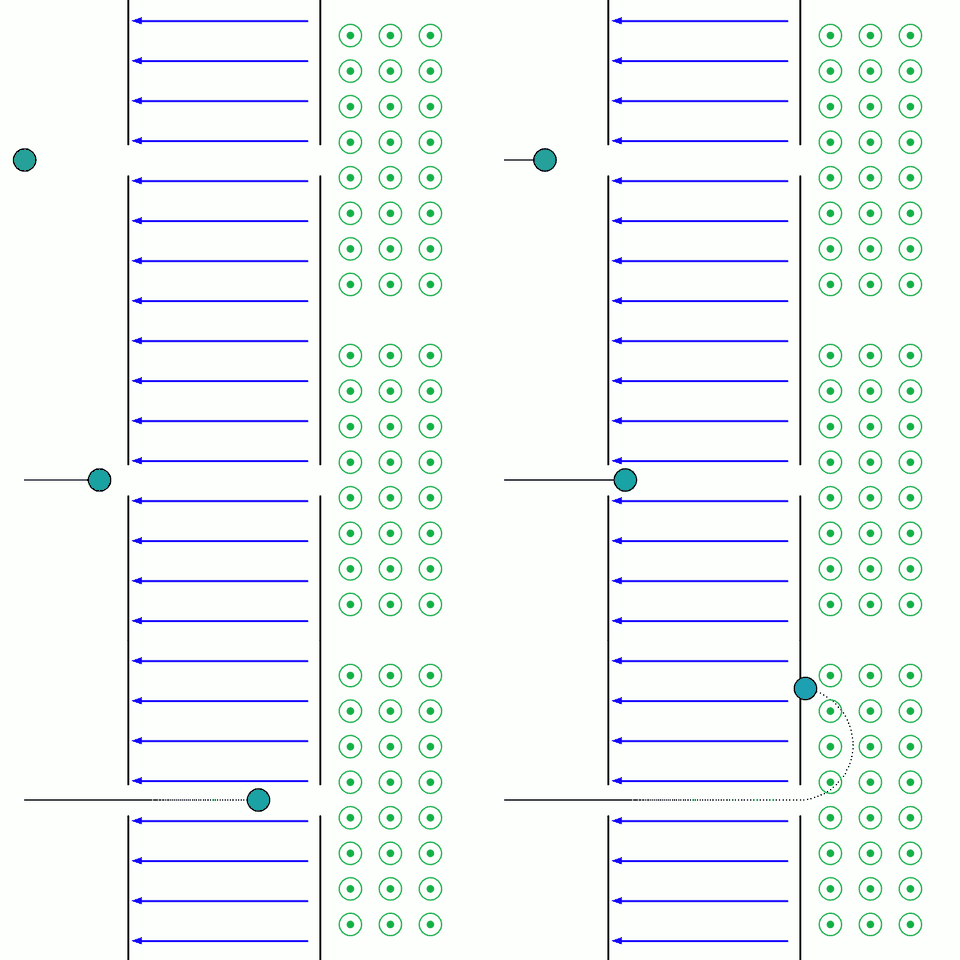
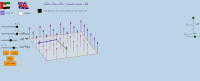
جسيمات مشحونة تدخل منطقة مجال مغناطيسي بسرعة ثابتة وبشكل عمودي على المجال.
Charged particles entering a region of magnetic field at constant speed, perpendicular to the field.
قُذف جسيم مشحون بسرعة ثابتة وبشكل عمودي على مجال مغناطيسي منتظم؛ فيتأثر بقوة مغناطيسية تغيّر اتجاه حركته. لكن لماذا يتخذ مسارًا دائريًا تحديدًا؟
A charged particle is projected at a constant speed perpendicular to a uniform magnetic field; it feels a magnetic force that changes its direction of motion. But why exactly a circular path?
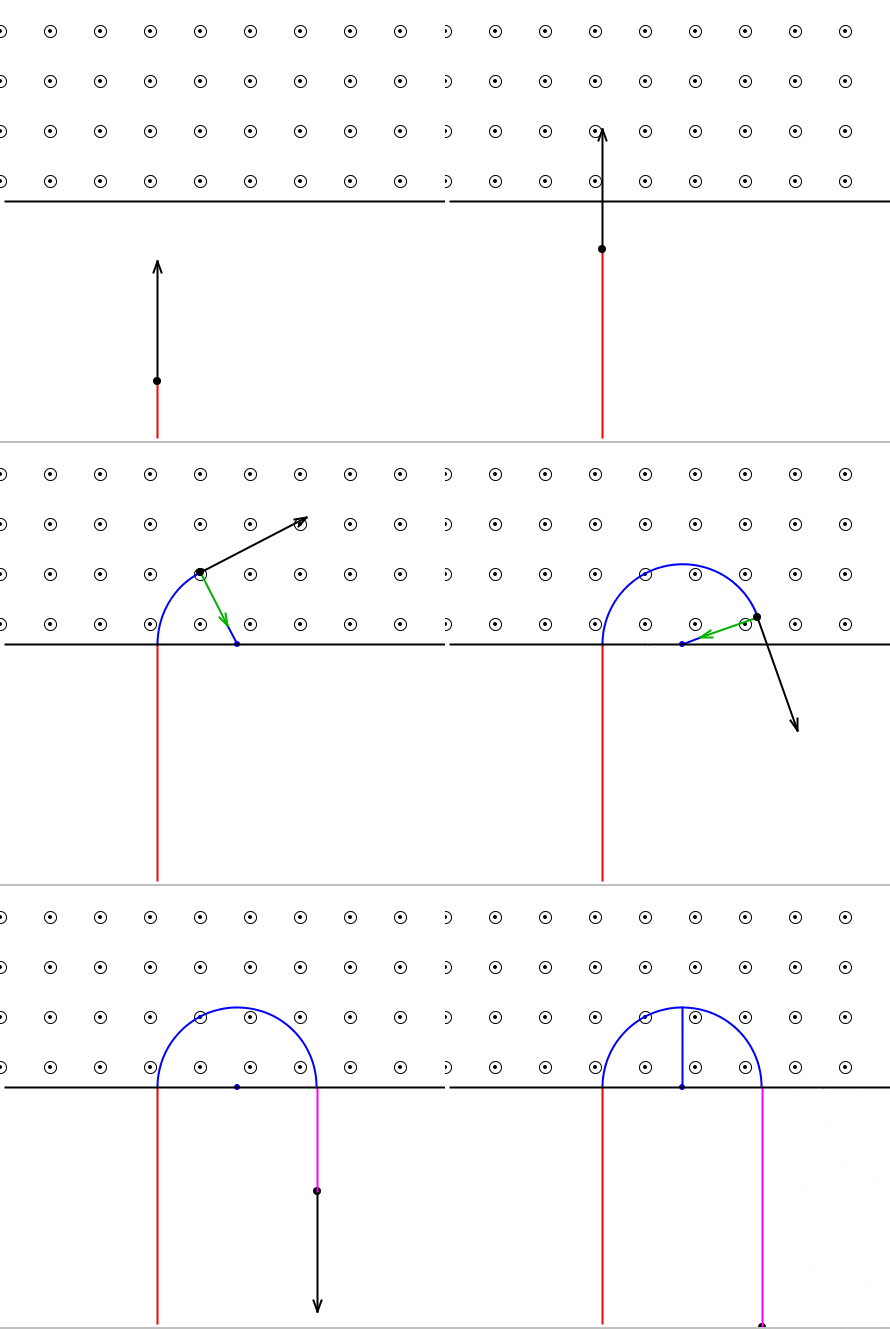
الشحنة تدخل المجال: القوة عمودية على السرعة فتنحني الحركة.
The charge enters the field: the force is perpendicular to the velocity so the motion bends.
🔍 شروط الحركة الدائرية
🔍 The conditions for circular motion
• القوة ثابتة المقدار \(F=qvB\) لأن الشحنة ثابتة والمجال منتظم والسرعة ثابتة المقدار.
• القوة والسرعة والمجال متعامدة: القوة عمودية على السرعة دائمًا فتغيّر اتجاهها دون مقدارها.
• هذه هي بالضبط شروط القوة المركزية المسببة للحركة الدائرية المنتظمة، فالمسار دائرة.
• The force has a constant magnitude \(F=qvB\) because the charge is constant, the field is uniform and the speed is constant.
• The force, velocity and field are mutually perpendicular: the force is always perpendicular to the velocity so it changes its direction but not its magnitude.
• These are exactly the conditions of a centripetal force causing uniform circular motion, so the path is a circle.
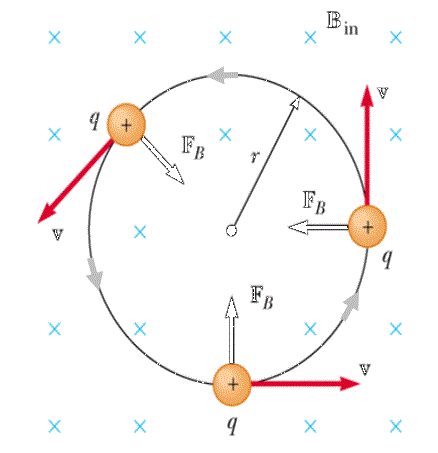
الشحنة الموجبة في مجال داخل الصفحة: القوة \(F_B\) دائمًا نحو المركز والسرعة \(v\) مماسية.
A positive charge in a field into the page: the force \(F_B\) always points to the centre and the velocity \(v\) is tangent.
📌 نصف قطر المسار
📌 The radius of the path
القوة المغناطيسية تعمل قوة مركزية: \(F_B=F_C\)
The magnetic force acts as the centripetal force: \(F_B=F_C\)
\[q\,v\,B=\frac{m\,v^2}{r}\ \Rightarrow\ r=\frac{m\,v}{q\,B}\]
يزداد نصف القطر بزيادة الكتلة والسرعة، ويقل بزيادة الشحنة والمجال: \(r\propto m\,v\) و\(r\propto\dfrac{1}{qB}\).
The radius increases with mass and speed and decreases with charge and field: \(r\propto m\,v\) and \(r\propto\dfrac{1}{qB}\).
⚡ والطاقة؟ (شرح إضافي)
⚡ And the energy? (extra)
القوة المغناطيسية عمودية على الإزاحة فلا تبذل شغلًا: الطاقة الحركية والسرعة ثابتتان ولا يمكن للمجال المغناطيسي وحده أن يسرّع جسيمًا؛ لذلك يلزم مجال كهربائي في المسرعات.
The magnetic force is perpendicular to the displacement so it does no work: the kinetic energy and the speed stay constant and a magnetic field alone cannot speed a particle up; this is why accelerators need an electric field.
🧪 جرّب بنفسك: المسار الدائري
🧪 Try It Yourself: The Circular Path
🧪 تجربة 1: جسيم مشحون في مجال مغناطيسي: مسار دائري
🧪 Experiment 1: A Charged Particle in a Magnetic Field: a Circular Path
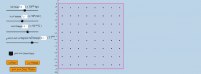
اختر الجسيم (بروتون، إلكترون، جسيم ألفا) والسرعة والمجال ثم اضغط «أطلق الجسيم». القوة \(qvB\) عمودية على السرعة فيدور الجسيم في دائرة نصف قطرها \(r=mv/qB\). جرّب تغيير الشحنة وعكس اتجاه المجال لترى اتجاه الدوران. الحركة مُبطّأة للتوضيح.
Choose the particle (proton, electron, alpha particle), the speed and the field then press “Launch the particle”. The force \(qvB\) is perpendicular to the velocity so the particle moves in a circle of radius \(r=mv/qB\). Change the charge and reverse the field to see the sense of rotation. The motion is slowed for clarity.
دخل بروتون ونيوترون وإلكترون منطقة مجال منتظم بالسرعة نفسها وبشكل عمودي على المجال. صف حركة كل منها.
A proton, a neutron and an electron enter a uniform field with the same speed, perpendicular to the field. Describe the motion of each.
جسيم ألفا (\(q=2e\)، \(m\approx4m_p\)) وبروتون يدخلان مجالًا منتظمًا بالسرعة نفسها عموديًا عليه. النسبة \(r_\alpha/r_p\):
An alpha particle (\(q=2e\), \(m\approx4m_p\)) and a proton enter a uniform field at the same speed perpendicular to it. The ratio \(r_\alpha/r_p\) is:
إذا تضاعفت سرعة جسيم مشحون يتحرك عموديًا على مجال منتظم فإن نصف قطر مساره:
If the speed of a charged particle moving perpendicular to a uniform field doubles, the radius of its path:
⏱️ الزمن الدوري والتردد والسرعة الزاوية
⏱️ Period, Frequency and Angular Speed
إذا قطع الجسيم دورة كاملة (محيط الدائرة \(2\pi r\)) بالسرعة \(v\):
If the particle completes one full revolution (circumference \(2\pi r\)) at speed \(v\):
📌 الزمن الدوري والتردد والسرعة الزاوية
📌 Period, frequency and angular speed
\[T=\frac{2\pi r}{v}=\frac{2\pi m}{qB}\qquad f=\frac1T=\frac{qB}{2\pi m}\qquad \omega=2\pi f=\frac{qB}{m}\]
💡 ملاحظة مهمة (شرح إضافي)
💡 An important remark (extra)
لا تظهر السرعة \(v\) ولا نصف القطر \(r\) في \(T\) و\(f\) و\(\omega\): الجسيم السريع يقطع دائرة أكبر في الزمن نفسه الذي يقطع فيه البطيء دائرة أصغر. وهذه الخاصية هي أساس عمل السيكلوترون.
Neither the speed \(v\) nor the radius \(r\) appears in \(T\), \(f\) and \(\omega\): a fast particle covers a larger circle in the same time that a slow one covers a smaller circle. This property is the basis of the cyclotron.
قُذف بروتون عموديًا على مجال منتظم شدته \(0.5\ \mathrm{T}\) فاتخذ مسارًا دائريًا. أوجد تردد حركته الدائرية (\(q_p=1.6\times10^{-19}\ \mathrm{C}\)، \(m_p=1.67\times10^{-27}\ \mathrm{kg}\)).
A proton is projected perpendicular to a uniform field of \(0.5\ \mathrm{T}\) and follows a circular path. Find its frequency of circular motion (\(q_p=1.6\times10^{-19}\ \mathrm{C}\), \(m_p=1.67\times10^{-27}\ \mathrm{kg}\)).
إذا تضاعفت سرعة بروتون في مجال منتظم مع بقاء المجال، فإن الزمن الدوري لحركته:
If the speed of a proton in a uniform field doubles with the field unchanged, the period of its motion:
🔄 اتجاه الدوران
🔄 Direction of Rotation
تحدّد إشارة الشحنة واتجاه المجال جهة الدوران: إذا كان المجال داخل الصفحة دارت الشحنة الموجبة عكس عقارب الساعة والسالبة مع عقاربها، وينعكس كل ذلك إذا كان المجال خارجًا من الصفحة. طبّق قاعدة الكف (الأصابع مع \(B\)، الإبهام مع \(v\) للموجب) وحدّد اتجاه القوة نحو المركز.
The sign of the charge and the direction of the field decide the sense of rotation: if the field is into the page a positive charge rotates counterclockwise and a negative one clockwise, and everything reverses if the field is out of the page. Apply the palm rule (fingers with \(B\), thumb with \(v\) for a positive charge) and find the direction of the force toward the centre.
تحرك شعاع من الإلكترونات بين قطبي مغناطيس كما في الشكل. نحو أي اتجاه ينحرف بتأثير القوة المغناطيسية؟
A beam of electrons moves between the poles of a magnet as shown. In which direction is it deflected by the magnetic force?
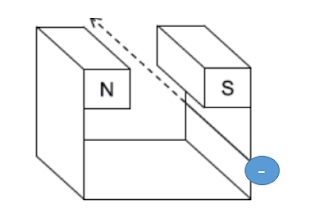
شكل المثال 3: شعاع إلكتروني بين قطبي مغناطيس.
Example 3: an electron beam between the poles of a magnet.
جسيمان لهما الكتلة نفسها ومقدار الشحنة نفسه، قُذفا عموديًا على مجال منتظم (داخل الصفحة) كما في الشكل: الأول (1) يدور مع عقارب الساعة بنصف قطر صغير والثاني (2) يدور عكس عقارب الساعة بنصف قطر أكبر. ما إشارة كل شحنة والمقارنة بين السرعتين؟
Two particles of the same mass and the same charge magnitude are projected perpendicular to a uniform field (into the page) as shown: the first (1) rotates clockwise with a small radius and the second (2) counterclockwise with a larger radius. What is the sign of each charge and how do the speeds compare?
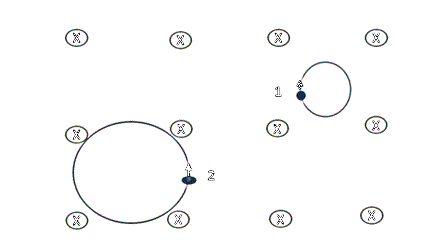
شكل المثال 4: جسيمان في مجال داخل الصفحة.
Example 4: two particles in a field into the page.
⚙️ السيكلوترون
⚙️ The Cyclotron
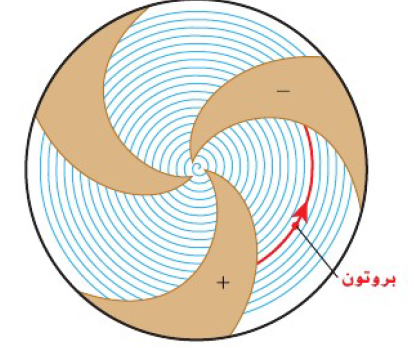
السيكلوترون: قطبان على شكل \(D\) بينهما مجال كهربائي متردد ومجال مغناطيسي عمودي عليهما.
The cyclotron: two D-shaped dees with an alternating electric field between them and a magnetic field perpendicular to them.
يحتوي السيكلوترون على شفرتين (D) متصلتين بمصدر جهد متردد، ومجال مغناطيسي منتظم عمودي عليهما إلى الداخل. المجال الكهربائي في الفجوة يزيد سرعة البروتون كلما عبرها (وتتغير شحنة الشفرة عند وصوله إليها)، والمجال المغناطيسي يحني مساره فيدور في نصف دائرة داخل الشفرة، ويزداد نصف قطر المسار بزيادة السرعة.
The cyclotron has two dees (D) connected to an alternating voltage source and a uniform magnetic field perpendicular to them, into the page. The electric field in the gap speeds the proton up each time it crosses (and the dees’ charges swap as it arrives), while the magnetic field bends the path so it travels a semicircle inside a dee, and the radius grows as the speed increases.
🔑 لماذا يعمل بجهد متردد ثابت التردد؟ (شرح إضافي)
🔑 Why does a fixed-frequency alternating voltage work? (extra)
نصف الدورة داخل الشفرة يستغرق \(\dfrac T2=\dfrac{\pi m}{qB}\) ولا يعتمد على السرعة ولا نصف القطر. لذلك يكفي أن يكون تردد الجهد المتردد مساويًا لتردد الدوران \(f=\dfrac{qB}{2\pi m}\) (شرط الرنين) فيصل الجسيم إلى الفجوة في كل مرة والجهد في الاتجاه المناسب.
The half-turn inside a dee takes \(\dfrac T2=\dfrac{\pi m}{qB}\), independent of the speed and the radius. So it is enough for the alternating voltage to have the same frequency as the cyclotron motion \(f=\dfrac{qB}{2\pi m}\) (the resonance condition) and the particle always arrives at the gap when the voltage has the right direction.
أكبر طاقة حركية عند الخروج بنصف القطر \(R\): \(K_{max}=\dfrac12mv^2=\dfrac{q^2B^2R^2}{2m}\).
The greatest kinetic energy on leaving at radius \(R\): \(K_{max}=\dfrac12mv^2=\dfrac{q^2B^2R^2}{2m}\).
ترك بروتون بين شفرتي سيكلوترون مجاله المغناطيسي \(0.6\ \mathrm{T}\) فخرج بنصف قطر \(0.3\ \mathrm{m}\). أوجد سرعته عند الخروج وطاقته الحركية.
A proton is released between the dees of a cyclotron whose field is \(0.6\ \mathrm{T}\) and leaves at a radius of \(0.3\ \mathrm{m}\). Find its speed on leaving and its kinetic energy.
ما الذي يجعل السيكلوترون يعمل بجهد متردد ذي تردد ثابت؟
What lets the cyclotron work with an alternating voltage of fixed frequency?
🧪 جرّب بنفسك: السيكلوترون
🧪 Try It Yourself: The Cyclotron
🧪 تجربة 2: السيكلوترون: شرط الرنين وطاقة الخروج
🧪 Experiment 2: The Cyclotron: the Resonance Condition and the Exit Energy
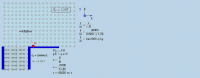
بروتون يبدأ من المركز بين الشفرتين؛ في كل مرة يعبر الفجوة يكتسب طاقة \(qV\) إذا كان الجهد في الاتجاه الصحيح، فيزداد نصف قطر مساره حتى يخرج عند \(R\). غيّر نسبة تردد الجهد إلى تردد الدوران \(f_{ac}/f_c\) وراقب ضياع الرنين (عند \(1\) يكون التسارع أعظم).
A proton starts at the centre between the dees; each time it crosses the gap it gains \(qV\) if the voltage has the right direction, so the radius of its path grows until it leaves at \(R\). Change the ratio of the voltage frequency to the rotation frequency \(f_{ac}/f_c\) and watch resonance be lost (at \(1\) the acceleration is greatest).
🔬 منقي السرعات ومطياف الكتلة
🔬 The Velocity Selector and the Mass Spectrometer
يتكوّن جهاز مطياف الكتلة من: (1) مصدر الأيونات، (2) منقي السرعات، (3) جهاز الكشف عن الجسيمات.
The mass spectrometer consists of: (1) the ion source, (2) the velocity selector and (3) the particle detector.
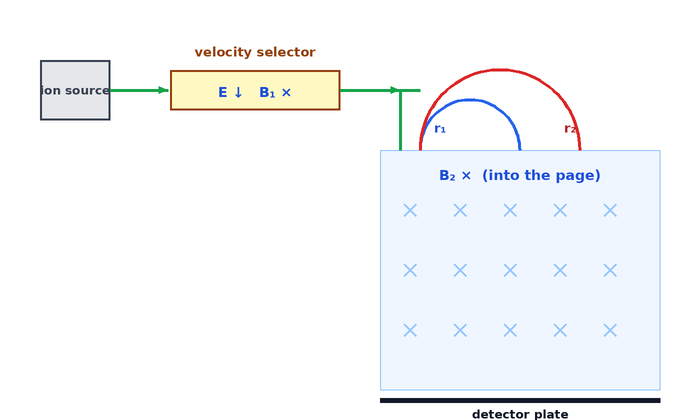
مطياف الكتلة: مصدر أيونات ← منقي سرعات (\(E\) و\(B_1\)) ← مجال \(B_2\) ← لوح الكشف.
The mass spectrometer: ion source → velocity selector (\(E\) and \(B_1\)) → field \(B_2\) → detector plate.
📌 منقي السرعات ونصف قطر المسار
📌 The velocity selector and the radius
في منقي السرعات يتعامد المجالان الكهربائي والمغناطيسي ولا ينحرف إلا الجسيم الذي تتساوى عليه القوتان:
In the velocity selector the electric and magnetic fields are perpendicular and only the particle for which the two forces are equal goes straight:
\[qE=qvB_1\ \Rightarrow\ v=\frac{E}{B_1}\]
ثم يدخل الأيون مجالًا مغناطيسيًا \(B_2\) فيدور في نصف دائرة نصف قطرها \(r=\dfrac{mv}{qB_2}\) ويمكن إيجاد الكتلة:
Then the ion enters a magnetic field \(B_2\) and moves in a semicircle of radius \(r=\dfrac{mv}{qB_2}\), so the mass can be found:
\[m=\frac{q\,B_2\,r}{v}=\frac{q\,B_1B_2\,r}{E}\]
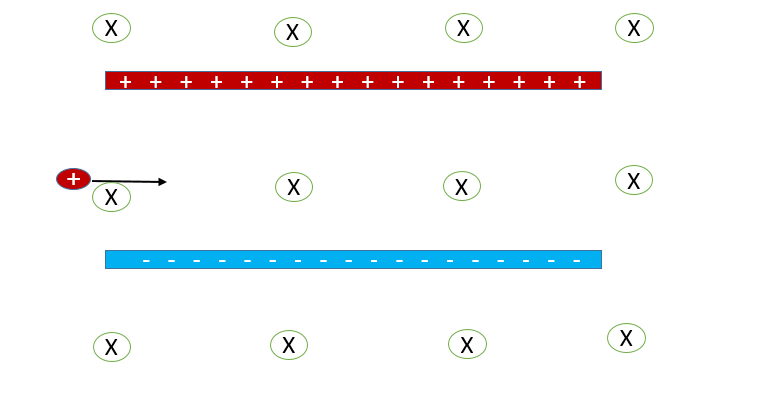
منقي السرعات: مجال كهربائي بين لوحين ومجال مغناطيسي داخل الصفحة.
The velocity selector: an electric field between two plates and a magnetic field into the page.
❓ اسأل نفسك وأجب
❓ Ask yourself and answer
1) عمل مصدر الأيونات؟ يحوّل العينة إلى أيونات (جسيمات مشحونة) بالتأيين ويقذفها بسرعات مختلفة.
2) عمل منقي السرعات؟ يسمح فقط بمرور الأيونات ذات السرعة المحددة (القوة الكهربائية = القوة المغناطيسية).
3) غاية المجال الكهربائي؟ يؤثر بقوة على الأيونات في المنقي (ويُستعمل لتسريعها وتوجيهها) ويوازن القوة المغناطيسية للسرعة المختارة.
4) غاية المجال المغناطيسي؟ يحني مسار الأيونات حسب نسبة الكتلة إلى الشحنة.
5) لو لم يتعامد المجالان؟ لن تتوازن القوتان على خط مستقيم وتنحرف الأيونات فلا تصل إلى الكاشف.
6) سرعة الأيونات الواصلة؟ \(v=E/B\).
7) تصادم في منطقتين على اللوح؟ يوجد نظيران للعنصر بكتلتين مختلفتين.
1) What does the ion source do? It turns the sample into ions (charged particles) by ionisation and projects them at different speeds.
2) The velocity selector? It lets only ions of one specific speed through (electric force = magnetic force).
3) The purpose of the electric field? It exerts a force on the ions in the selector (and is used to accelerate and direct them) and balances the magnetic force for the chosen speed.
4) The purpose of the magnetic field? It bends the ions’ paths according to their mass-to-charge ratio.
5) If the fields were not perpendicular? The forces would not balance along a straight line and the ions would deflect and not reach the detector.
6) The speed of the ions reaching the detector? \(v=E/B\).
7) Hits in two regions on the plate? There are two isotopes of the element with different masses.
جسيم ألفا (شحنته مثل شحنة بروتونين) دخل منقي السرعات ولم ينحرف. إذا كانت النسبة \(B/E=0.0025\ \mathrm{T\cdot C/N}\) فما سرعته؟
An alpha particle (charge equal to two protons) enters the velocity selector and is not deflected. If \(B/E=0.0025\ \mathrm{T\cdot C/N}\), what is its speed?
في مطياف كتلة: \(E=5000\ \mathrm{V/m}\)، \(B_1=0.1\ \mathrm{T}\)، \(B_2=0.5\ \mathrm{T}\). يمر نظيرا النيون \(\mathrm{^{20}Ne^+}\) (\(m=3.32\times10^{-26}\ \mathrm{kg}\)) و\(\mathrm{^{22}Ne^+}\) (\(m=3.65\times10^{-26}\ \mathrm{kg}\)). أوجد السرعة ونصفي القطرين والمسافة بين موضعي الارتطام.
In a mass spectrometer: \(E=5000\ \mathrm{V/m}\), \(B_1=0.1\ \mathrm{T}\), \(B_2=0.5\ \mathrm{T}\). The neon isotopes \(\mathrm{^{20}Ne^+}\) (\(m=3.32\times10^{-26}\ \mathrm{kg}\)) and \(\mathrm{^{22}Ne^+}\) (\(m=3.65\times10^{-26}\ \mathrm{kg}\)) pass. Find the speed, the two radii and the distance between the impact points.
منقي سرعات فيه \(E=3000\ \mathrm{V/m}\) و\(B=0.01\ \mathrm{T}\). سرعة الأيونات التي تمر دون انحراف:
A velocity selector has \(E=3000\ \mathrm{V/m}\) and \(B=0.01\ \mathrm{T}\). The speed of the ions that pass undeflected is:
🧪 جرّب بنفسك: منقي السرعات ومطياف الكتلة
🧪 Try It Yourself: The Velocity Selector and the Mass Spectrometer
🧪 تجربة 3: منقي السرعات ومطياف الكتلة
🧪 Experiment 3: The Velocity Selector and the Mass Spectrometer
تنطلق أيونات النيون بسرعات مختلفة (\(0.6v\) … \(1.4v\)). يمرّر المنقي السرعة \(v=E/B_1\) فقط، ثم يدور الأيونان \(\mathrm{^{20}Ne}\) و\(\mathrm{^{22}Ne}\) في المجال \(B_2\) بنصفي قطر مختلفين فيرتطمان بموضعين مختلفين. اضغط «أطلق الأيونات».
Neon ions are emitted with different speeds (\(0.6v\) … \(1.4v\)). The selector passes only \(v=E/B_1\), then \(\mathrm{^{20}Ne}\) and \(\mathrm{^{22}Ne}\) move in \(B_2\) with different radii and hit two different places. Press “Launch the ions”.
🧬 المسار اللولبي
🧬 The Helical Path
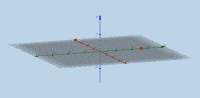
إذا قُذف الجسيم في المجال المنتظم بشكل غير عمودي فإن سرعته \(\vec v\) تتحلل إلى مركبتين: \(v_\perp=v\sin\theta\) عمودية على المجال (تسبّب حركة دائرية) و\(v_\parallel=v\cos\theta\) موازية للمجال (لا تتأثر بقوة فتستمر مستقيمة). تركيب الحركتين يعطي مسارًا لولبيًا (حلزونيًا) محوره موازٍ للمجال.
If the particle is projected into the uniform field non-perpendicularly its velocity \(\vec v\) splits into two components: \(v_\perp=v\sin\theta\) perpendicular to the field (causing circular motion) and \(v_\parallel=v\cos\theta\) parallel to the field (no force on it, so it continues straight). The combination gives a helical path whose axis is parallel to the field.
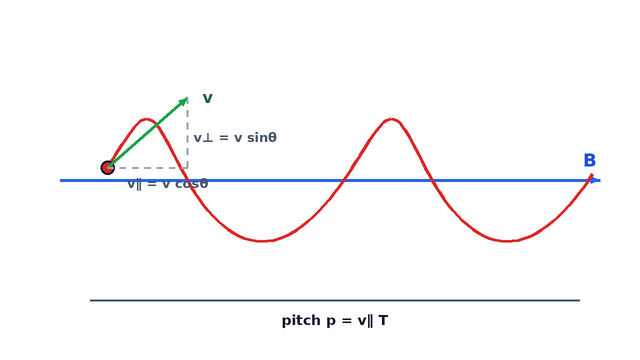
المسار اللولبي: دائرة في المستوى العمودي على المجال وحركة منتظمة على امتداده.
The helical path: a circle in the plane perpendicular to the field and uniform motion along it.
📌 نصف القطر والخطوة
📌 Radius and pitch
\[r=\frac{m\,v\sin\theta}{q\,B}\qquad T=\frac{2\pi m}{qB}\qquad p=v_\parallel T=\frac{2\pi m\,v\cos\theta}{qB}\]
الخطوة \(p\) المسافة التي يقطعها الجسيم على امتداد المجال في دورة واحدة. عندما \(\theta=90^\circ\) يصبح المسار دائرة، وعندما \(\theta=0\) خطًا مستقيمًا.
The pitch \(p\) is the distance the particle advances along the field in one turn. For \(\theta=90^\circ\) the path is a circle and for \(\theta=0\) a straight line.
🌌 تطبيقات (شرح إضافي)
🌌 Applications (extra)
تدور الجسيمات المشحونة القادمة من الشمس لولبيًا حول خطوط المجال المغناطيسي الأرضي نحو القطبين فتتوهج الأيونات في الغلاف الجوي مشكّلة الشفق القطبي. وتُحبس البلازما في الزجاجة المغناطيسية بفضل هذه الحركة اللولبية.
Charged particles from the Sun spiral around the Earth’s magnetic field lines toward the poles and make the atmosphere glow as the aurora. Plasma is confined in a magnetic bottle thanks to this helical motion.
مجال منتظم شدته \(5\times10^{-2}\ \mathrm{T}\) نحو الشرق. قُذف إلكترون بسرعة \(4\times10^{6}\ \mathrm{m/s}\) بزاوية \(60^\circ\) فوق محور الشرق. أوجد نصف قطر المسار والخطوة (\(q_e=1.6\times10^{-19}\ \mathrm{C}\)، \(m_e=9.11\times10^{-31}\ \mathrm{kg}\)).
A uniform field of \(5\times10^{-2}\ \mathrm{T}\) points east. An electron is projected at \(4\times10^{6}\ \mathrm{m/s}\) at \(60^\circ\) above the east axis. Find the radius of the path and the pitch (\(q_e=1.6\times10^{-19}\ \mathrm{C}\), \(m_e=9.11\times10^{-31}\ \mathrm{kg}\)).
جسيم مشحون يُقذف بزاوية \(\theta\) مع المجال. يكون مساره خطًا مستقيمًا عندما:
A charged particle is projected at an angle \(\theta\) to the field. Its path is a straight line when:
🧪 جرّب بنفسك: المسار اللولبي
🧪 Try It Yourself: The Helical Path
🧪 تجربة 4: المسار اللولبي: زاوية القذف والخطوة
🧪 Experiment 4: The Helical Path: Projection Angle and Pitch
محور المجال أفقي. غيّر الزاوية \(\theta\) بين السرعة والمجال ثم اضغط «أطلق»: ترى المسار اللولبي ومسقطه الدائري. عند \(90^\circ\) دائرة، وعند \(0\) خط مستقيم، وما بينهما لولب تزداد خطوته مع \(\cos\theta\).
The field axis is horizontal. Change the angle \(\theta\) between the velocity and the field then press “Launch”: you see the helix and its circular projection. At \(90^\circ\) it is a circle, at \(0\) a straight line, and in between a helix whose pitch grows with \(\cos\theta\).
🧪 تجربة 5: تدريب: نصف القطر والتردد ومنقي السرعات والسيكلوترون
🧪 Experiment 5: Practice: Radius, Frequency, the Velocity Selector and the Cyclotron
مسائل عشوائية بأرقام مختلفة (بروتون: \(q=1.602\times10^{-19}\ \mathrm{C}\)، \(m=1.673\times10^{-27}\ \mathrm{kg}\)). احسب واكتب الجواب بالوحدة المطلوبة ثم اضغط «تحقّق».
Random problems with different numbers (proton: \(q=1.602\times10^{-19}\ \mathrm{C}\), \(m=1.673\times10^{-27}\ \mathrm{kg}\)). Work it out, enter the answer in the requested unit and press “Check”.
🛰️ حجرة الإسقاط الزمني (معلومة)
🛰️ The time projection chamber (info)
في هذه الحجرات تتصادم أنوية ثقيلة فتنتج آلاف الجسيمات التي تؤيّن الغاز داخل الحجرة، ويحني المجال المغناطيسي مساراتها دائريًا؛ ومن انحناء كل مسار (\(r=\dfrac{mv}{qB}\)) يستنتج العلماء زخم الجسيم وإشارة شحنته.
In these chambers heavy nuclei collide and produce thousands of particles that ionise the gas in the chamber, and the magnetic field bends their paths into circles; from the curvature of each track (\(r=\dfrac{mv}{qB}\)) scientists work out the particle’s momentum and the sign of its charge.
✅ ملخص الدرس
✅ Lesson Summary
| الموضوعTopic | العلاقةRelation | ملاحظةNote |
|---|---|---|
| نصف القطرRadius | \(r=\dfrac{mv}{qB}\) | عمودي على المجالperpendicular to the field |
| الزمن الدوري/الترددPeriod/frequency | \(T=\dfrac{2\pi m}{qB},\ f=\dfrac{qB}{2\pi m}\) | لا تعتمد على \(v\)independent of \(v\) |
| طاقة السيكلوترونCyclotron energy | \(K=\dfrac{q^2B^2R^2}{2m}\) | رنين: \(f_{ac}=f\)resonance: \(f_{ac}=f\) |
| منقي السرعاتVelocity selector | \(v=\dfrac EB\) | \(F_E=F_B\)\(F_E=F_B\) |
| مطياف الكتلةMass spectrometer | \(m=\dfrac{qB_2r}{v}\) | النظائر تهبط في مواضع مختلفةisotopes land at different places |
| المسار اللولبيHelical path | \(r=\dfrac{mv\sin\theta}{qB},\ p=\dfrac{2\pi mv\cos\theta}{qB}\) | \(\theta\) مع المجال\(\theta\) with the field |
🧪 اختبر نفسك: امتحان من 20 سؤالاً
🧪 Test Yourself: a 20-Question Exam
أنهِ الدرس بالاختبار التفاعلي التالي؛ أسئلته تجمع بين الفهم والحساب وتغطي جميع أقسام الدرس.
Finish with the interactive exam below; its questions mix understanding with calculation and cover every section of the lesson.
اختبار حركة الجسيمات المشحونة Charged Particle Motion Quiz
20 سؤالاً - المسار الدائري، الزمن الدوري، السيكلوترون، مطياف الكتلة، والمسار اللولبي 20 Questions - the circular path, the period, the cyclotron, the mass spectrometer and the helical path
• عدد الأسئلة: 20 سؤالاً
• مدة الاختبار: 30 دقيقة
• لا يمكنك تغيير إجاباتك أو إعادة الاختبار إلا بعد 24 ساعة من التسليم.
• تأكد من إجاباتك قبل التسليم! 📌 Important Instructions:
• Number of questions: 20 questions
• Quiz duration: 30 minutes
• You cannot change your answers or retake the quiz for 24 hours after submission.
• Make sure of your answers before submitting!
🔗 محاكيات GeoGebra للاستعانة بها عند اللزوم
🔗 GeoGebra Simulations to Use When Needed
اضغط «تشغيل» لتعمل المحاكاة هنا داخل الدرس؛ ويمكن للطالب الرجوع إليها لتجربة الفكرة بطريقة أخرى.
Press “Run” to run the simulation right here inside the lesson; the student can use it to try the idea in another way.