🎯 نواتج التعلم
🎯 Learning Outcomes
بعد دراسة هذا الدرس ستكون قادرًا على أن:
After this lesson you will be able to:
- تحسب القوة المغناطيسية على شحنة \(F=qvB\sin\theta\) وتحدد اتجاهها بقاعدة اليد اليمنى (وتعكسها للشحنة السالبة).Calculate the magnetic force on a charge \(F=qvB\sin\theta\) and find its direction with the right-hand rule (reversed for a negative charge).
- تفسّر لماذا يتخذ الجسيم المقذوف عموديًا على المجال مسارًا دائريًا بسرعة ثابتة المقدار.Explain why a particle projected perpendicular to the field follows a circle at constant speed.
- تستنتج وتطبّق \(r=\dfrac{mv}{qB}\) و\(\omega=\dfrac{qB}{m}\) و\(T=\dfrac{2\pi m}{qB}\).Derive and apply \(r=\dfrac{mv}{qB}\), \(\omega=\dfrac{qB}{m}\) and \(T=\dfrac{2\pi m}{qB}\).
- تحدد كيف يتغير نصف القطر والزمن الدوري عند تغيير الكتلة أو الشحنة أو السرعة أو المجال.Determine how the radius and the period change when the mass, charge, speed or field changes.
🧲 الفكرة: قوة عمودية على السرعة
🧲 The Idea: a Force Perpendicular to the Velocity
إذا قُذف جسيم مشحون في منطقة مجال مغناطيسي منتظم وبشكل عمودي على المجال فإنه يتأثر بقوة ثابتة المقدار \(\vec F=q\,\vec v\times\vec B\)، وهذه القوة دائمًا عمودية على السرعة وعلى المجال معًا. لأنها عمودية على السرعة فهي لا تبذل شغلًا فلا تغيّر مقدار السرعة، بل تغيّر اتجاهها فقط.
If a charged particle is projected into a region of uniform magnetic field perpendicular to the field it feels a force of constant magnitude \(\vec F=q\,\vec v\times\vec B\), and this force is always perpendicular to both the velocity and the field. Because it is perpendicular to the velocity it does no work and so it does not change the magnitude of the speed, only its direction.
📌 قانون القوة المغناطيسية
📌 The magnetic force law
\[\vec F_B=q\,\vec v\times\vec B,\qquad F_B=|q|\,v\,B\sin\theta\]
عندما \(\theta=90^\circ\) (القذف العمودي) تكون القوة عظمى \(F=|q|vB\). وتقاس \(B\) بالتسلا، و\(q\) بالكولوم، و\(v\) بالمتر على الثانية.
When \(\theta=90^\circ\) (perpendicular projection) the force is maximum \(F=|q|vB\). \(B\) is in tesla, \(q\) in coulomb and \(v\) in metres per second.
🖐️ اتجاه القوة: قاعدة اليد اليمنى
🖐️ The Direction of the Force: the Right-Hand Rule
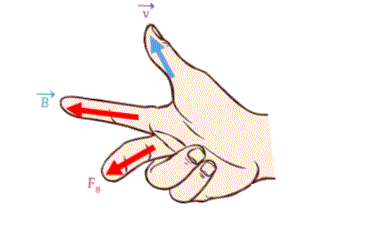
قاعدة اليد اليمنى: السرعة والمجال والقوة.
The right-hand rule: velocity, field and force.
لشحنة موجبة: السبابة باتجاه المجال \(\vec B\)، والإبهام باتجاه السرعة \(\vec v\)، فتشير الوسطى إلى اتجاه القوة \(\vec F\). وللشحنة السالبة يُعكس اتجاه القوة (أو نستخدم اليد اليسرى). والقوة لا تتغير إشارتها بتغيّر مقدار السرعة، بل بتغيّر اتجاه السرعة أو المجال أو إشارة الشحنة.
For a positive charge: index finger along the field \(\vec B\), thumb along the velocity \(\vec v\); the middle finger then gives the direction of the force \(\vec F\). For a negative charge the force is reversed (or use the left hand). The direction of the force changes with the direction of the velocity or the field or the sign of the charge, not with the magnitude of the speed.
🧪 جرّب بنفسك: مدرّب اتجاه القوة
🧪 Try It Yourself: the Force-Direction Trainer
🧪 تجربة 1: مدرّب الاتجاه: طبّق قاعدة الكف
🧪 Experiment 1: Direction Trainer: Apply the Palm Rule
يظهر لك مجال مغناطيسي واتجاه تيار (أو سرعة شحنة). اختر اتجاه القوة الصحيح من الأزرار ثم اضغط «سؤال جديد». بدّل بين سلك وشحنة موجبة وإلكترون لترى كيف تنعكس القوة للشحنة السالبة. الاصطلاح: ⊙ خارج الصفحة، ⊗ داخل الصفحة.
A magnetic field and a current direction (or a charge velocity) appear. Choose the correct force direction with the buttons, then press “New question”. Switch between a wire, a positive charge and an electron to see how the force reverses for a negative charge. Convention: ⊙ out of the page, ⊗ into the page.
إذا كانت شحنة الجسيم سالبة فإن اتجاه القوة المغناطيسية:
If the particle’s charge is negative, the direction of the magnetic force:
🔄 لماذا المسار دائري؟ استنتاج نصف القطر
🔄 Why a Circle? Deriving the Radius
القوة ثابتة المقدار (الشحنة والمجال والسرعة ثوابت) وتبقى عمودية على السرعة في كل لحظة، وهذه هي شروط القوة المركزية للحركة الدائرية المنتظمة. إذن القوة المغناطيسية هي القوة المركزية:
The force is constant in magnitude (charge, field and speed are constant) and remains perpendicular to the velocity at every instant; these are the conditions of the centripetal force of uniform circular motion. So the magnetic force is the centripetal force:
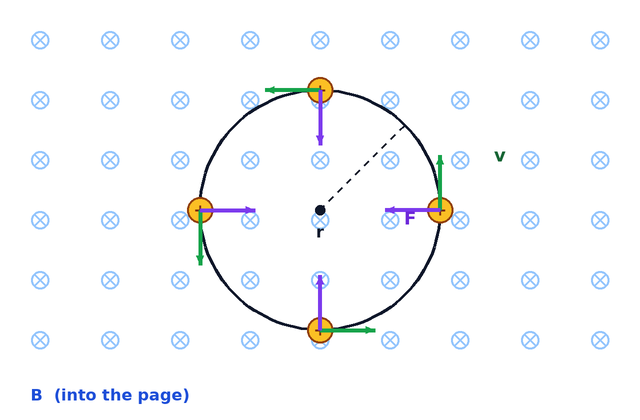
مسار دائري لشحنة موجبة في مجال نحو داخل الصفحة: \(F\) نحو المركز و\(v\) مماس للدائرة.
A circular path of a positive charge in a field into the page: \(F\) toward the centre and \(v\) tangent to the circle.
📌 الاستنتاج
📌 The derivation
\[F_B=F_c\ \Rightarrow\ qvB=\frac{mv^2}{r}\]
\[r=\frac{m\,v}{q\,B}\]
\[\omega=\frac{v}{r}=\frac{qB}{m},\qquad T=\frac{2\pi}{\omega}=\frac{2\pi m}{qB},\qquad f=\frac1T=\frac{qB}{2\pi m}\]
نصف القطر يتناسب طرديًا مع الكتلة والسرعة وعكسيًا مع الشحنة والمجال. أما السرعة الزاوية والزمن الدوري فلا يعتمدان على السرعة الابتدائية: الجسيم الأسرع يدور في دائرة أكبر لكنه يكمل الدورة في الزمن نفسه.
The radius is directly proportional to the mass and the speed and inversely proportional to the charge and the field. The angular speed and the period do not depend on the initial speed: a faster particle circles in a bigger circle but completes the turn in the same time.
🧪 جرّب بنفسك: المسار الدائري
🧪 Try It Yourself: the Circular Path
🧪 تجربة 3: جسيم مشحون في مجال مغناطيسي: مسار دائري
🧪 Experiment 3: A Charged Particle in a Magnetic Field: a Circular Path
اختر الجسيم (بروتون، إلكترون، جسيم ألفا) والسرعة والمجال ثم اضغط «أطلق الجسيم». القوة \(qvB\) عمودية على السرعة فيدور الجسيم في دائرة نصف قطرها \(r=mv/qB\). جرّب تغيير الشحنة وعكس اتجاه المجال لترى اتجاه الدوران. الحركة مُبطّأة للتوضيح.
Choose the particle (proton, electron, alpha particle), the speed and the field then press “Launch the particle”. The force \(qvB\) is perpendicular to the velocity so the particle moves in a circle of radius \(r=mv/qB\). Change the charge and reverse the field to see the sense of rotation. The motion is slowed for clarity.
جسيم كتلته \(9.11\times10^{-31}\ \mathrm{kg}\) وشحنته \(1.6\times10^{-19}\ \mathrm C\) يتحرك بسرعة \(2\times10^{6}\ \mathrm{m/s}\) عموديًا على مجال شدته \(0.5\ \mathrm T\). أوجد نصف قطر مساره.
A particle of mass \(9.11\times10^{-31}\ \mathrm{kg}\) and charge \(1.6\times10^{-19}\ \mathrm C\) moves at \(2\times10^{6}\ \mathrm{m/s}\) perpendicular to a field of \(0.5\ \mathrm T\). Find the radius of its path.
جسيم شحنته \(3.2\times10^{-19}\ \mathrm C\) وكتلته \(6.64\times10^{-27}\ \mathrm{kg}\) يتحرك في مجال \(1.5\ \mathrm T\). أوجد سرعته الزاوية وزمنه الدوري.
A particle of charge \(3.2\times10^{-19}\ \mathrm C\) and mass \(6.64\times10^{-27}\ \mathrm{kg}\) moves in a field of \(1.5\ \mathrm T\). Find its angular speed and period.
⚖️ ماذا يحدث لو غيّرنا المتغيرات؟
⚖️ What Happens if We Change the Variables?
| المتغيّر المضاعَفVariable doubled | نصف القطر \(r\)Radius \(r\) | الزمن الدوري \(T\)Period \(T\) | السرعة الزاوية \(\omega\)Angular speed \(\omega\) |
|---|---|---|---|
| الكتلة \(m\)Mass \(m\) | يتضاعفdoubles | يتضاعفdoubles | ينصفhalves |
| السرعة \(v\)Speed \(v\) | يتضاعفdoubles | لا يتغيرunchanged | لا تتغيرunchanged |
| الشحنة \(q\)Charge \(q\) | ينصفhalves | ينصفhalves | تتضاعفdoubles |
| المجال \(B\)Field \(B\) | ينصفhalves | ينصفhalves | تتضاعفdoubles |
🧪 جرّب بنفسك: النسب
🧪 Try It Yourself: the Ratios
🧪 تجربة 2: من يتحكم في نصف القطر والزمن الدوري؟
🧪 Experiment 2: What Controls the Radius and the Period?
غيّر مضاعفات الكتلة والشحنة والسرعة والمجال بالنسبة لبروتون مرجعي (الدائرة المتقطعة)، وراقب نسب \(r\) و\(T\) و\(\omega\) و\(F\). اضغط «أطلق» لترى الجسيمين يدوران: لاحظ أن زيادة السرعة وحدها لا تغيّر الزمن الدوري.
Change the multiples of the mass, charge, speed and field relative to a reference proton (the dashed circle) and watch the ratios of \(r\), \(T\), \(\omega\) and \(F\). Press “Launch” to see both particles circle: notice that increasing the speed alone does not change the period.
إذا تضاعفت سرعة جسيم مشحون يتحرك عموديًا على مجال مغناطيسي فإن نصف قطر مساره:
If the speed of a charged particle moving perpendicular to a magnetic field doubles, the radius of its path:
إذا تضاعفت كتلة جسيم مشحون يتحرك في مجال مغناطيسي فإن نصف قطر المسار:
If the mass of a charged particle moving in a magnetic field doubles, the radius of the path:
السرعة الزاوية لجسيم مشحون في مجال مغناطيسي منتظم:
The angular speed of a charged particle in a uniform magnetic field:
أي العلاقات التالية صحيحة لنصف قطر المسار الدائري؟
Which of the following is correct for the radius of the circular path?
⚡ جسيم مسرَّع بفرق جهد
⚡ A Particle Accelerated by a Potential Difference
كثيرًا ما يُعطى الجهد الذي سُرّع به الجسيم بدل السرعة؛ عندها نحسب السرعة من الطاقة: \(qV=\tfrac12mv^2\) ثم نعوّض في \(r=mv/qB\):
The accelerating potential is often given instead of the speed; then we find the speed from energy: \(qV=\tfrac12mv^2\) and substitute in \(r=mv/qB\):
📌 النصف قطر بدلالة الجهد
📌 The radius in terms of the potential
\[v=\sqrt{\frac{2qV}{m}}\ \Rightarrow\ r=\frac1B\sqrt{\frac{2mV}{q}}\]
بروتون سُرّع من السكون بفرق جهد \(1000\ \mathrm V\) ثم دخل مجالًا \(0.1\ \mathrm T\) عموديًا عليه. أوجد سرعته ونصف قطر مساره (\(q=1.6\times10^{-19}\ \mathrm C\)، \(m=1.67\times10^{-27}\ \mathrm{kg}\)).
A proton is accelerated from rest through \(1000\ \mathrm V\) and then enters a field of \(0.1\ \mathrm T\) perpendicular to it. Find its speed and the radius of its path (\(q=1.6\times10^{-19}\ \mathrm C\), \(m=1.67\times10^{-27}\ \mathrm{kg}\)).
🧮 حاسبة الجسيم المشحون
🧮 The Charged-Particle Calculator
🧪 تجربة 4: حاسبة الجسيم المشحون: أدخل قيمك
🧪 Experiment 4: The Charged-Particle Calculator: Enter Your Own Values
اختر جسيمًا جاهزًا أو أدخل الكتلة والشحنة (سالبة للإلكترون) والسرعة والمجال والزاوية، ثم اضغط «احسب» لترى القوة ونصف القطر والسرعة الزاوية والزمن الدوري والتردد مع رسم المسار.
Choose a ready particle or enter the mass, the charge (negative for an electron), the speed, the field and the angle, then press “Calculate” to see the force, the radius, the angular speed, the period and the frequency with a sketch of the path.
🌪️ ماذا لو لم يكن القذف عموديًا؟
🌪️ What if the Projection Is Not Perpendicular?
إذا صنعت السرعة زاوية \(\theta\) مع المجال حلّلناها: المركّبة العمودية \(v\sin\theta\) تُدير الجسيم في دائرة نصف قطرها \(r=\dfrac{mv\sin\theta}{qB}\)، والمركّبة الموازية \(v\cos\theta\) لا تتأثر بقوة فتتقدم بالجسيم على امتداد المجال، فيصبح المسار لولبيًا. وعند \(\theta=0\) يتحرك الجسيم في خط مستقيم لا تؤثر فيه قوة.
If the velocity makes an angle \(\theta\) with the field we resolve it: the perpendicular component \(v\sin\theta\) makes the particle circle with radius \(r=\dfrac{mv\sin\theta}{qB}\), while the parallel component \(v\cos\theta\) feels no force and carries the particle along the field, so the path is a helix. At \(\theta=0\) the particle moves in a straight line with no force on it.
🧪 تجربة 5: المسار اللولبي: زاوية القذف والخطوة
🧪 Experiment 5: The Helical Path: Projection Angle and Pitch
محور المجال أفقي. غيّر الزاوية \(\theta\) بين السرعة والمجال ثم اضغط «أطلق»: ترى المسار اللولبي ومسقطه الدائري. عند \(90^\circ\) دائرة، وعند \(0\) خط مستقيم، وما بينهما لولب تزداد خطوته مع \(\cos\theta\).
The field axis is horizontal. Change the angle \(\theta\) between the velocity and the field then press “Launch”: you see the helix and its circular projection. At \(90^\circ\) it is a circle, at \(0\) a straight line, and in between a helix whose pitch grows with \(\cos\theta\).
يتحرك جسيم مشحون موازيًا لمجال مغناطيسي. القوة المغناطيسية عليه:
A charged particle moves parallel to a magnetic field. The magnetic force on it is:
🧪 اختبر نفسك: امتحان من 20 سؤالاً
🧪 Test Yourself: a 20-Question Exam
أنهِ الدرس بالاختبار التفاعلي التالي؛ أسئلته تجمع بين الفهم والحساب وتغطي جميع أقسام الدرس.
Finish with the interactive exam below; its questions mix understanding with calculation and cover every section of the lesson.
اختبار حركة الجسيم المشحون في مجال مغناطيسي Charged Particle in a Magnetic Field Quiz
20 سؤالاً - قوة لورنتز، اتجاه القوة، المسار الدائري، نصف القطر، السرعة الزاوية والزمن الدوري 20 Questions - the Lorentz force, its direction, the circular path, the radius, the angular speed and the period
• عدد الأسئلة: 20 سؤالاً
• مدة الاختبار: 30 دقيقة
• لا يمكنك تغيير إجاباتك أو إعادة الاختبار إلا بعد 24 ساعة من التسليم.
• تأكد من إجاباتك قبل التسليم! 📌 Important Instructions:
• Number of questions: 20 questions
• Quiz duration: 30 minutes
• You cannot change your answers or retake the quiz for 24 hours after submission.
• Make sure of your answers before submitting!
🔗 محاكيات GeoGebra للاستعانة بها عند اللزوم
🔗 GeoGebra Simulations to Use When Needed
اضغط «تشغيل» لتعمل المحاكاة هنا داخل الدرس؛ ويمكن للطالب الرجوع إليها لتجربة الفكرة بطريقة أخرى.
Press “Run” to run the simulation right here inside the lesson; the student can use it to try the idea in another way.