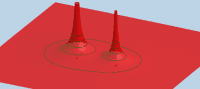
🎯 نواتج التعلم
🎯 Learning Outcomes
بعد دراسة هذا الدرس ستكون قادرًا على أن:
After this lesson you will be able to:
- تحسب المجال \(E=kq/r^2\) والجهد \(V=kq/r\) لشحنة نقطية ولعدة شحنات (الجهد جمع عددي والمجال جمع اتجاهي).Calculate the field \(E=kq/r^2\) and the potential \(V=kq/r\) of a point charge and of several charges (the potential is a scalar sum and the field a vector sum).
- تعرّف خطوط تساوي الجهد وتذكر خصائصها وأشكالها لشحنة منفردة ولثنائي القطب وللمجال المنتظم.Define the equipotential lines and state their properties and their shapes for a single charge, a dipole and a uniform field.
- تبيّن أن خطوط تساوي الجهد عمودية على خطوط المجال وأن المجال يتجه نحو الجهد الأقل \(E=-dV/dr\).Show that the equipotential lines are perpendicular to the field lines and that the field points toward the lower potential \(E=-dV/dr\).
- تحسب الشغل \(W=q\,\Delta V\) وطاقة حركة الجسيم وسرعته، وتستنتج أن الشغل صفر على خط تساوي الجهد.Calculate the work \(W=q\,\Delta V\) and the kinetic energy and the speed of the particle, and deduce that the work is zero along an equipotential line.
⚡ المجال الكهربائي والجهد الكهربائي
⚡ The Electric Field and the Electric Potential
المجال الكهربائي \(\vec E\) كمية متجهة تعبّر عن القوة على وحدة الشحنة الموجبة، أما الجهد الكهربائي \(V\) فكمية قياسية تعبّر عن طاقة الوضع لكل وحدة شحنة. لشحنة نقطية \(q\) على بعد \(r\) منها:
The electric field \(\vec E\) is a vector quantity that expresses the force per unit positive charge, while the electric potential \(V\) is a scalar quantity that expresses the potential energy per unit charge. For a point charge \(q\) at a distance \(r\) from it:
📌 مجال وجهد شحنة نقطية
📌 The field and the potential of a point charge
\[E=\frac{k|q|}{r^2}\qquad,\qquad V=\frac{kq}{r}\qquad,\qquad k=8.99\times10^{9}\ \mathrm{N\cdot m^2/C^2}\]
| وجه المقارنةAspect | المجال \(E\)The field \(E\) | الجهد \(V\)The potential \(V\) |
|---|---|---|
| نوع الكميةType of quantity | متجهة (مقدار واتجاه)Vector (magnitude and direction) | قياسية (قيمة وإشارة)Scalar (value and sign) |
| اعتماده على البعدDependence on the distance | \(1/r^2\) | \(1/r\) |
| الوحدةUnit | \(\mathrm{N/C}=\mathrm{V/m}\) | \(\mathrm V=\mathrm{J/C}\) |
| جمع عدة شحناتSeveral charges | جمع اتجاهيVector sum | جمع عددي مع الإشارةAlgebraic sum with the sign |
شحنة نقطية \(2\ \mathrm{nC}\). أوجد المجال والجهد على بعد \(3\ \mathrm{cm}\) منها.
A point charge \(2\ \mathrm{nC}\). Find the field and the potential at a distance of \(3\ \mathrm{cm}\) from it.
🧪 تجربة 1: الجهد والمجال لشحنة نقطية
🧪 Experiment 1: The Potential and the Field of a Point Charge
نقارن تغيّر الجهد مع البعد (\(1/r\)) بتغيّر المجال (\(1/r^2\)) ونرى دوائر تساوي الجهد.
We compare the change of the potential with the distance (\(1/r\)) with the change of the field (\(1/r^2\)) and see the equipotential circles.
🛠️ خطوات العمل
🛠️ Procedure
- اضبط \(q=2\ \mathrm{nC}\) و\(r=3\ \mathrm{cm}\) وسجّل \(V\) و\(E\).Set \(q=2\ \mathrm{nC}\) and \(r=3\ \mathrm{cm}\) and record \(V\) and \(E\).
- ضاعف \(r\) وقارن نسبة نقصان كلٍّ منهما.Double \(r\) and compare the ratio of the decrease of each.
- اجعل \(q\) سالبة وراقب الإشارة والاتجاه.Make \(q\) negative and watch the sign and the direction.
🧪 تجربة 1: الجهد والمجال لشحنة نقطية
🧪 Experiment 1: The Potential and the Field of a Point Charge
شحنة نقطية \(q\) وخطوط تساوي الجهد دوائر حولها. غيّر \(q\) والبعد \(r\) وقارن تغيّر الجهد (\(1/r\)) بتغيّر المجال (\(1/r^2\)).
A point charge \(q\) and the equipotential lines are circles around it. Change \(q\) and the distance \(r\) and compare the change of the potential (\(1/r\)) with the change of the field (\(1/r^2\)).
🔎 ماذا نلاحظ؟ وما الاستنتاج؟
🔎 What do we observe? What is the conclusion?
- الجهد يتناقص إلى النصف والمجال إلى الربع عند مضاعفة البعد.The potential decreases to half and the field to a quarter when the distance is doubled.
- خطوط تساوي الجهد دوائر مركزها الشحنة وتتباعد كلما ابتعدنا.The equipotential lines are circles centred on the charge and they get farther apart as we go away.
\(V\propto1/r\) و\(E\propto1/r^2\).
\(V\propto1/r\) and \(E\propto1/r^2\).
🗺️ خطوط تساوي الجهد
🗺️ Equipotential Lines
خطوط (أسطح) تساوي الجهد هي خطوط وهمية يكون الجهد الكهربائي متساويًا عند جميع نقاطها. وتُرسم عادةً بفروق جهد ثابتة بين كل خط وآخر، فتدل كثافتها على شدة المجال: كلما تقاربت الخطوط كان المجال أقوى.
Equipotential lines (surfaces) are imaginary lines at all points of which the electric potential is the same. They are usually drawn with a constant potential difference between each line and the next, so their density indicates the strength of the field: the closer the lines the stronger the field.
خصائص خطوط تساوي الجهد
Properties of the equipotential lines
- عمودية دائمًا على خطوط المجال الكهربائي عند كل نقطة.They are always perpendicular to the electric field lines at every point.
- لا تتقاطع أبدًا (للنقطة الواحدة جهد واحد).They never cross (a point has one potential).
- الشغل المبذول لنقل شحنة عليها صفر لأن \(\Delta V=0\).The work done to move a charge along them is zero because \(\Delta V=0\).
- لشحنة منفردة هي أسطح كروية، وللمجال المنتظم مستويات متوازية متساوية البعد.For a single charge they are spherical surfaces, and for the uniform field they are parallel planes that are equally spaced.
- يتجه المجال من الجهد الأعلى إلى الجهد الأقل.The field is directed from the higher potential to the lower potential.
📌 العلاقة بين المجال والجهد
📌 The relation between the field and the potential
\[E=-\frac{dV}{dr}\qquad,\qquad E=\frac{\Delta V}{d}\]
في المجال المنتظم \(E=\Delta V/d\) فتكون خطوط تساوي الجهد متساوية البعد؛ وفي المجال غير المنتظم يتغير الجهد بسرعة قرب الشحنات فتتقارب الخطوط هناك.
In the uniform field \(E=\Delta V/d\) so the equipotential lines are equally spaced; and in the non-uniform field the potential changes quickly near the charges so the lines come close there.
لوحان متوازيان فرق الجهد بينهما \(200\ \mathrm V\) والمسافة \(4\ \mathrm{cm}\). أوجد المجال وكم يبعد خط الجهد \(150\ \mathrm V\) عن اللوح الموجب؟
Two parallel plates with a potential difference of \(200\ \mathrm V\) and a distance of \(4\ \mathrm{cm}\). Find the field and how far the \(150\ \mathrm V\) line is from the positive plate.
🧪 تجربة 3: المجال المنتظم بين لوحين
🧪 Experiment 3: The Uniform Field Between Two Plates
خطوط تساوي الجهد بين لوحين مستويات متوازية متساوية البعد، والجهد يتناقص خطيًا.
The equipotential lines between two plates are parallel planes that are equally spaced, and the potential decreases linearly.
🛠️ خطوات العمل
🛠️ Procedure
- اضبط \(\Delta V=200\ \mathrm V\) و\(d=4\ \mathrm{cm}\) واقرأ \(E\).Set \(\Delta V=200\ \mathrm V\) and \(d=4\ \mathrm{cm}\) and read \(E\).
- حرّك المسبار واقرأ \(V(x)\).Move the probe and read \(V(x)\).
- انقل الشحنة إلى اللوح السالب واقرأ الشغل.Move the charge to the negative plate and read the work.
🧪 تجربة 3: المجال المنتظم بين لوحين
🧪 Experiment 3: The Uniform Field Between Two Plates
لوحان متوازيان بينهما فرق جهد \(\Delta V\) والمسافة \(d\): المجال \(E=\Delta V/d\) وخطوط تساوي الجهد مستويات متوازية متساوية البعد. حرّك المسبار وانقل شحنة.
Two parallel plates with a potential difference \(\Delta V\) and a distance \(d\): the field \(E=\Delta V/d\) and the equipotential lines are parallel planes that are equally spaced. Move the probe and move a charge.
🔎 ماذا نلاحظ؟ وما الاستنتاج؟
🔎 What do we observe? What is the conclusion?
- الجهد يهبط بمقدار ثابت لكل سنتيمتر.The potential drops by a constant amount per centimetre.
- الشغل لا يعتمد على المسار بل على فرق الجهد.The work does not depend on the path but on the potential difference.
\(E=\Delta V/d\) و\(V(x)=V-Ex\).
\(E=\Delta V/d\) and \(V(x)=V-Ex\).
🧭 خطوط المجال وخطوط تساوي الجهد معًا
🧭 Field Lines and Equipotential Lines Together
خطوط المجال تبدأ من الشحنة الموجبة وتنتهي عند السالبة وتشير إلى اتجاه القوة، أما خطوط تساوي الجهد فلا اتجاه لها ولا بداية ولا نهاية. والجمع بينهما يعطي «خريطة» كاملة للمجال: الخطوط الأولى تعبّر عن الاتجاه والثانية عن مستوى الجهد.
The field lines start at the positive charge and end at the negative one and show the direction of the force, while the equipotential lines have no direction and no start or end. Combining them gives a complete “map” of the field: the first lines express the direction and the second ones the level of the potential.
| الخاصيةProperty | خطوط المجالField lines | خطوط تساوي الجهدEquipotential lines |
|---|---|---|
| الاتجاهDirection | تشير إلى اتجاه القوةThey show the direction of the force | بلا اتجاهNo direction |
| البداية والنهايةStart and end | من + إلى −From + to − | مغلقة أو ممتدة بلا شحنة عليهاClosed or extended with no charge on them |
| الشغلThe work | يعتمد على المسافة على الخطDepends on the distance along the line | صفر عند الحركة عليهاZero when moving along them |
| العلاقةThe relation | متعامدةPerpendicular | متعامدةPerpendicular |
خطوط تساوي الجهد بالنسبة لخطوط المجال الكهربائي:
The equipotential lines relative to the electric field lines:
🧪 تجربة 2: خريطة تساوي الجهد لشحنتين
🧪 Experiment 2: The Equipotential Map of Two Charges
نرسم خريطة الجهد لشحنتين ونسحب مسبارًا ليبيّن الجهد والمجال والخط المارّ به.
We draw the map of the potential of two charges and drag a probe that shows the potential, the field and the line passing through it.
🛠️ خطوات العمل
🛠️ Procedure
- اترك شحنتين متساويتين متعاكستين وحرّك المسبار على الخط الذهبي.Keep two equal opposite charges and move the probe along the golden line.
- اجعل الشحنتين متماثلتين وضع المسبار في المنتصف.Make the two charges alike and put the probe in the middle.
- فعّل «متجهات المجال» وراقبها عند خطوط الجهد.Turn on “field vectors” and watch them at the potential lines.
🧪 تجربة 2: خريطة تساوي الجهد لشحنتين (كمحاكاة GeoGebra)
🧪 Experiment 2: The Equipotential Map of Two Charges (like the GeoGebra applet)
غيّر شحنتين وبعدهما، واسحب المسبار لتقرأ الجهد والمجال عند أي نقطة؛ يظهر خط تساوي الجهد المارّ به بالذهبي، ويمكنك إظهار متجهات المجال.
Change two charges and their separation and drag the probe to read the potential and the field at any point; the equipotential line passing through it appears in gold, and you can show the field vectors.
🔎 ماذا نلاحظ؟ وما الاستنتاج؟
🔎 What do we observe? What is the conclusion?
- عند منتصف شحنتين متعاكستين الجهد صفر والمجال لا يساوي صفرًا.At the midpoint of two opposite charges the potential is zero and the field is not zero.
- عند منتصف شحنتين متماثلتين المجال صفر والجهد لا يساوي صفرًا.At the midpoint of two like charges the field is zero and the potential is not zero.
الجهد صفر لا يعني المجال صفرًا والعكس.
A zero potential does not mean a zero field and vice versa.
🏃 الشغل والجهد
🏃 Work and the Potential
إذا انتقلت شحنة \(q\) من نقطة جهدها \(V_A\) إلى نقطة جهدها \(V_B\) فإن الشغل الذي يبذله المجال \(W=q(V_A-V_B)\). ويتحول إلى طاقة حركة \(\Delta K=W\). والإلكترون فولت (\(\mathrm{eV}\)) هو الطاقة التي يكتسبها إلكترون يتسارع خلال فرق جهد \(1\ \mathrm V\)، و\(1\ \mathrm{eV}=1.6\times10^{-19}\ \mathrm J\).
If a charge \(q\) moves from a point of potential \(V_A\) to a point of potential \(V_B\) the work done by the field is \(W=q(V_A-V_B)\). It turns into kinetic energy \(\Delta K=W\). The electron-volt (\(\mathrm{eV}\)) is the energy gained by an electron accelerating through a potential difference of \(1\ \mathrm V\), and \(1\ \mathrm{eV}=1.6\times10^{-19}\ \mathrm J\).
📌 الشغل والسرعة
📌 The work and the speed
\[W=q\,(V_A-V_B)=\Delta K\qquad,\qquad v=\sqrt{\frac{2W}{m}}\]
انتقلت شحنة \(2\ \mu\mathrm C\) من نقطة جهدها \(100\ \mathrm V\) إلى نقطة جهدها \(40\ \mathrm V\). أوجد الشغل الذي يبذله المجال.
A charge \(2\ \mu\mathrm C\) moved from a point of potential \(100\ \mathrm V\) to a point of potential \(40\ \mathrm V\). Find the work done by the field.
إلكترون يتسارع من السكون خلال فرق جهد \(500\ \mathrm V\). أوجد طاقته وسرعته.
An electron accelerates from rest through a potential difference of \(500\ \mathrm V\). Find its energy and speed.
🧪 تجربة 4: الشغل والسرعة
🧪 Experiment 4: Work and Speed
نحرّك جسيمًا بين نقطتين مختلفتي الجهد ونقرأ الشغل والطاقة والسرعة.
We move a particle between two points of different potentials and read the work, the energy and the speed.
🛠️ خطوات العمل
🛠️ Procedure
- اضبط إلكترونًا من \(0\) إلى \(500\ \mathrm V\) واضغط «حرّك».Set an electron from \(0\) to \(500\ \mathrm V\) and press “Move”.
- اجعل \(V_A=V_B\) وراقب الشغل.Make \(V_A=V_B\) and watch the work.
- بدّل الجسيم إلى بروتون ثم ألفا.Switch the particle to a proton then an alpha.
🧪 تجربة 4: الشغل والطاقة والسرعة
🧪 Experiment 4: Work, Energy and Speed
جسيم مشحون يتحرك بين نقطتين جهداهما \(V_A\) و\(V_B\): الشغل \(W=q(V_A-V_B)\) يتحول إلى طاقة حركة، ومنه السرعة من السكون.
A charged particle moves between two points of potentials \(V_A\) and \(V_B\): the work \(W=q(V_A-V_B)\) turns into kinetic energy, and from it the speed from rest.
🔎 ماذا نلاحظ؟ وما الاستنتاج؟
🔎 What do we observe? What is the conclusion?
- الإلكترون السالب يتسارع نحو الجهد الأعلى والبروتون نحو الجهد الأقل.The negative electron accelerates toward the higher potential and the proton toward the lower potential.
- الشغل صفر على خط تساوي الجهد.The work is zero along an equipotential line.
\(W=q\,\Delta V=\Delta K\).
\(W=q\,\Delta V=\Delta K\).
تحرّك شحنة بين نقطتين على خط تساوي جهد واحد فإن الشغل:
A charge moves between two points on one equipotential line so the work is:
🚀 تطبيقات
🚀 Applications
أين نستعمل خطوط تساوي الجهد؟
Where do we use the equipotential lines?
- خرائط الطقس والمناسيب (الخطوط المتساوية الضغط والارتفاع) بنفس الفكرة.Weather and contour maps (the lines of equal pressure and height) with the same idea.
- تصميم تجهيزات التأريض والحماية من الصواعق.Designing earthing and lightning-protection equipment.
- تخطيط القلب والدماغ: قياس فروق الجهد على الجلد.The ECG and EEG: measuring potential differences on the skin.
- تسريع الإلكترونات في أنابيب الأشعة والمسرّعات بفروق جهد معروفة.Accelerating electrons in ray tubes and accelerators with known potential differences.
⚠️ أخطاء شائعة
⚠️ Common Mistakes
تجنّب هذه الأخطاء
Avoid these mistakes
- جمع الجهود كمتجهات؛ الجهد قياسي يُجمع عدديًّا بإشاراته.Adding the potentials as vectors; the potential is a scalar added algebraically with its signs.
- الظن أن الجهد صفر يعني مجالًا صفرًا (في ثنائي القطب الجهد صفر عند المنتصف والمجال لا).Thinking that a zero potential means a zero field (in a dipole the potential is zero at the middle but the field is not).
- رسم خطوط تساوي الجهد موازية لخطوط المجال؛ هي عمودية عليها.Drawing the equipotential lines parallel to the field lines; they are perpendicular to them.
- استعمال \(1/r^2\) للجهد بدل \(1/r\).Using \(1/r^2\) for the potential instead of \(1/r\).
📚 ملخص
📚 Summary
أهم ما تعلمناه
Key points
- \(E=kq/r^2\) (متجه) و\(V=kq/r\) (قياسي)؛ والجهد جمع عددي والمجال جمع اتجاهي.\(E=kq/r^2\) (a vector) and \(V=kq/r\) (a scalar); the potential is an algebraic sum and the field a vector sum.
- خطوط تساوي الجهد: عمودية على المجال، لا تتقاطع، الشغل عليها صفر، والمجال نحو الجهد الأقل.Equipotential lines: perpendicular to the field, never cross, the work along them is zero, and the field is toward the lower potential.
- المجال المنتظم \(E=\Delta V/d\) وخطوطه متساوية البعد.The uniform field \(E=\Delta V/d\) and its lines are equally spaced.
- \(W=q\,\Delta V=\Delta K\) و\(1\ \mathrm{eV}=1.6\times10^{-19}\ \mathrm J\).\(W=q\,\Delta V=\Delta K\) and \(1\ \mathrm{eV}=1.6\times10^{-19}\ \mathrm J\).
🧪 اختبر نفسك: امتحان من 20 سؤالاً
🧪 Test Yourself: a 20-Question Exam
أنهِ الدرس بالاختبار التفاعلي التالي؛ أسئلته تجمع بين الفهم والحساب وتغطي جميع أقسام الدرس.
Finish with the interactive exam below; its questions mix understanding with calculation and cover every section of the lesson.
اختبار خطوط تساوي الجهد والمجال الكهربائي Equipotential and Electric Field Lines Quiz
20 سؤالاً - الجهد وخطوط تساوي الجهد والمجال والشغل 20 Questions - potential, equipotential lines, the field and work
• عدد الأسئلة: 20 سؤالاً
• مدة الاختبار: 30 دقيقة
• لا يمكنك تغيير إجاباتك أو إعادة الاختبار إلا بعد 24 ساعة من التسليم.
• تأكد من إجاباتك قبل التسليم! 📌 Important Instructions:
• Number of questions: 20 questions
• Quiz duration: 30 minutes
• You cannot change your answers or retake the quiz for 24 hours after submission.
• Make sure of your answers before submitting!
🔗 محاكيات GeoGebra للاستعانة بها عند اللزوم
🔗 GeoGebra Simulations to Use When Needed
اضغط «تشغيل» لتعمل المحاكاة هنا داخل الدرس؛ ويمكن للطالب الرجوع إليها لتجربة الفكرة بطريقة أخرى.
Press “Run” to run the simulation right here inside the lesson; the student can use it to try the idea in another way.