🎯 نواتج التعلم
🎯 Learning Outcomes
بعد دراسة هذا الدرس ستكون قادرًا على أن:
After this lesson you will be able to:
- تفسّر انعكاس الضوء وتسمّي أجزاء المخطط: الشعاع الساقط والمنعكس والعمود وزاويتي السقوط والانعكاس.Explain the reflection of light and name the parts of the diagram: the incident ray, the reflected ray, the normal and the angles of incidence and reflection.
- تنص على قانون الانعكاس \(\theta_i=\theta_r\) وتطبّقه في المسائل، ومنها مرآتان متعامدتان.State the law of reflection \(\theta_i=\theta_r\) and apply it in problems, including two perpendicular mirrors.
- تميّز بين الانعكاس المنتظم وغير المنتظم وتعطي أمثلة على كلٍّ منهما.Distinguish regular from irregular reflection and give examples of each.
- تذكر صفات الصورة في المرآة المستوية وتحدد موضعها وحجمها.List the properties of the image in a plane mirror and find its position and size.
- تفرّق بين المرآة المقعرة والمحدبة وترسم الأشعة الثلاثة المميزة وتعيّن الصورة.Distinguish a concave from a convex mirror, draw the three principal rays and locate the image.
- تطبّق معادلة المرآة \(\dfrac{1}{x_o}+\dfrac{1}{x_i}=\dfrac{1}{f}\) والتكبير بقاعدة الإشارات الصحيحة.Apply the mirror equation \(\dfrac{1}{x_o}+\dfrac{1}{x_i}=\dfrac{1}{f}\) and the magnification with the correct sign convention.
💡 ما انعكاس الضوء؟
💡 What Is the Reflection of Light?
انعكاس الضوء هو ارتداد الضوء عن سطح عندما يصطدم به دون أن ينفذ فيه. نرى معظم الأجسام حولنا لأنها تعكس إلينا جزءًا من الضوء الساقط عليها، ونرى وجوهنا في المرايا لأن المرآة تعكس الضوء بانتظام.
Reflection of light is the bouncing back of light from a surface it hits, without entering the surface. We see most objects around us because they reflect part of the light falling on them, and we see our faces in mirrors because a mirror reflects light in an orderly way.
💡 لماذا لا يتغير شيء في الموجة؟
💡 Why does nothing change in the wave?
الضوء الساقط والمنعكس في الوسط نفسه، فسرعة الموجة \(v\) ثابتة. والمصدر واحد للموجتين الساقطة والمرتدة، فالتردد \(f\) ثابت أيضًا. وبما أن \(v=\lambda f\) فإن الطول الموجي \(\lambda\) ثابت؛ المتغير الوحيد هو اتجاه الانتشار.
The incident and reflected light travel in the same medium, so the wave speed \(v\) is constant. Both waves come from one source, so the frequency \(f\) is constant too. Since \(v=\lambda f\), the wavelength \(\lambda\) is constant; the only thing that changes is the direction of travel.
📐 مخطط الانعكاس وقانونه
📐 The Reflection Diagram and Its Law
ارسم العمود على السطح عند نقطة سقوط الشعاع (خط متقطع). تُقاس الزاويتان من هذا العمود وليس من السطح:
Draw the normal to the surface at the point where the ray strikes (a dashed line). Both angles are measured from this normal, not from the surface:
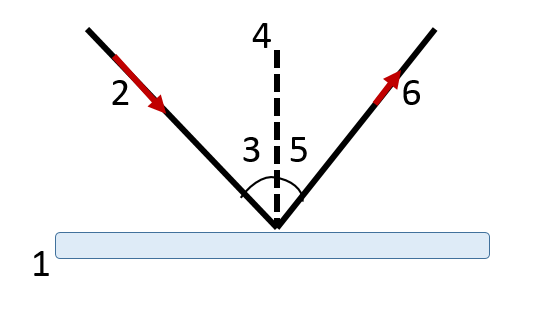
مخطط الانعكاس: ① السطح العاكس ② الشعاع الساقط ③ زاوية السقوط ④ العمود ⑤ زاوية الانعكاس ⑥ الشعاع المنعكس.
The reflection diagram: ① the reflecting surface ② the incident ray ③ the angle of incidence ④ the normal ⑤ the angle of reflection ⑥ the reflected ray.
| الرقمNo. | الجزءPart | التعريفDefinition |
|---|---|---|
| ① | السطح العاكسReflecting surface | السطح الذي يرتد عنه الضوءThe surface the light bounces off |
| ② | الشعاع الساقطIncident ray | الشعاع القادم من المصدر نحو السطحThe ray travelling from the source to the surface |
| ③ | زاوية السقوط \(\theta_i\)Angle of incidence \(\theta_i\) | الزاوية بين الشعاع الساقط والعمودThe angle between the incident ray and the normal |
| ④ | العمودThe normal | خط عمودي على السطح عند نقطة السقوطA line perpendicular to the surface at the point of incidence |
| ⑤ | زاوية الانعكاس \(\theta_r\)Angle of reflection \(\theta_r\) | الزاوية بين الشعاع المنعكس والعمودThe angle between the reflected ray and the normal |
| ⑥ | الشعاع المنعكسReflected ray | الشعاع الذي يرتد عن السطحThe ray leaving the surface |
📌 قانون الانعكاس
📌 The Law of Reflection
1) زاوية السقوط تساوي زاوية الانعكاس.
1) The angle of incidence equals the angle of reflection.
\[\theta_i=\theta_r\]
2) الشعاع الساقط والشعاع المنعكس والعمود على السطح تقع في مستوى واحد.
2) The incident ray, the reflected ray and the normal all lie in one plane.
⚠️ انتبه
⚠️ Be careful
إذا أعطاك السؤال الزاوية بين الشعاع والسطح فهي ليست زاوية السقوط؛ زاوية السقوط تكمّلها إلى \(90^\circ\): \(\theta_i=90^\circ-\alpha\).
If a question gives the angle between the ray and the surface that is not the angle of incidence; the angle of incidence is its complement: \(\theta_i=90^\circ-\alpha\).
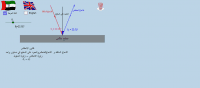
🧪 تجربة 1: قانون الانعكاس: وجّه الشعاع بنفسك
🧪 Experiment 1: The law of reflection: aim the ray yourself
اسحب المصدر الأصفر (أو حرّك شريط الزاوية) لتغيير زاوية السقوط \(\theta_i\) المقيسة من العمود وليس من السطح، ولاحظ زاوية الانعكاس \(\theta_r\). سجّل عدة قراءات ثم أصِب الهدف، وجرّب تفعيل المرآتين المتعامدتين.
Drag the yellow source (or move the angle slider) to change the angle of incidence \(\theta_i\), measured from the normal and not from the surface, and watch the angle of reflection \(\theta_r\). Record several readings, then hit the target and try the two perpendicular mirrors.
سقط شعاع ضوء على مرآة مستوية فصنع مع سطحها زاوية \(50^\circ\) (انظر الشكل). أوجد زاوية الانعكاس \(\theta_r\).
A ray of light strikes a plane mirror and makes an angle of \(50^\circ\) with its surface (see the figure). Find the angle of reflection \(\theta_r\).
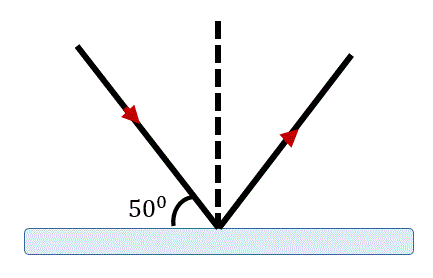
مثال 1: الزاوية \(50^\circ\) مع السطح لا مع العمود.
Example 1: the \(50^\circ\) is measured to the surface, not to the normal.
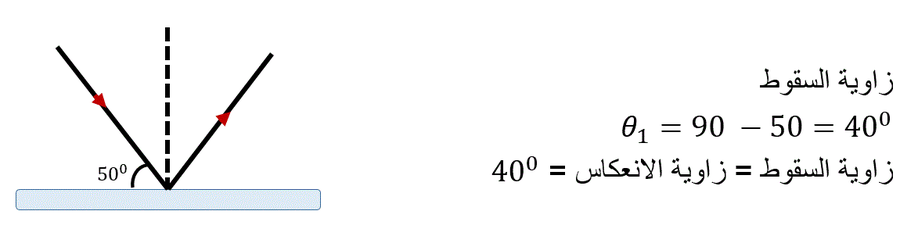
طريقة الحل المصوّرة للمثال 1.
The illustrated solution of example 1.
🪞 مرآتان متعامدتان
🪞 Two Perpendicular Mirrors
عندما ينعكس الشعاع عن مرآة ثم عن مرآة ثانية عمودية عليها، تربط الزاويتين علاقة بسيطة: في المثلث الذي رأسه نقطتا السقوط وزاوية الركن \(90^\circ\) يكون مجموع زاويتَي الشعاع مع السطحين \(90^\circ\). لذلك:
When a ray reflects from one mirror and then from a second mirror perpendicular to the first, the two angles are linked by a simple relation: in the triangle formed by the two points of incidence and the \(90^\circ\) corner, the ray’s two angles with the mirrors add up to \(90^\circ\). Therefore:
\[\theta_{2}=90^\circ-\theta_{1}\]
ويخرج الشعاع في النهاية موازيًا للشعاع الساقط ومعاكسًا له في الاتجاه (جرّب ذلك بتفعيل «مرآة ثانية» في التجربة 1).
and the ray finally leaves parallel to the incident ray and travelling in the opposite direction (try it by switching on the “second mirror” in Experiment 1).
مرآتان مستويتان متعامدتان. سقط شعاع على إحداهما بزاوية سقوط \(40^\circ\) فانعكس نحو المرآة الثانية (انظر الشكل). ما زاوية سقوطه \(\theta\) على المرآة الثانية؟
Two plane mirrors are perpendicular. A ray strikes one of them with an angle of incidence of \(40^\circ\) and reflects towards the second mirror (see the figure). What is its angle of incidence \(\theta\) on the second mirror?
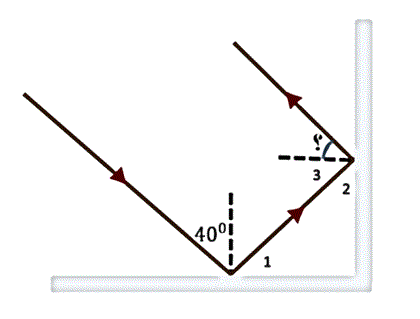
مثال 2: مرآتان متعامدتان وزاوية السقوط الأولى \(40^\circ\).
Example 2: two perpendicular mirrors; the first angle of incidence is \(40^\circ\).
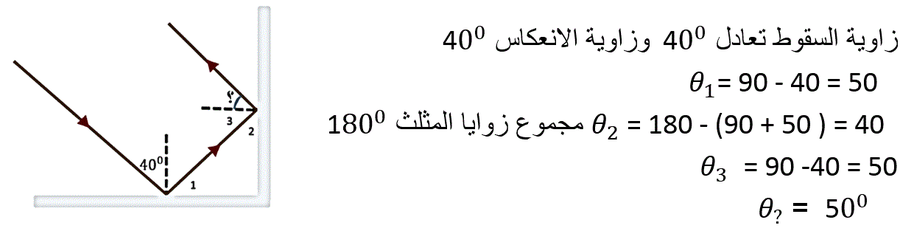
طريقة الحل المصوّرة للمثال 2.
The illustrated solution of example 2.
سقط شعاع على مرآة مستوية بزاوية سقوط \(35^\circ\). الزاوية بين الشعاع الساقط والشعاع المنعكس تساوي:
A ray strikes a plane mirror with an angle of incidence of \(35^\circ\). The angle between the incident and the reflected rays is:
🌫️ الانعكاس المنتظم وغير المنتظم
🌫️ Regular and Irregular Reflection
الأشعة الموازية تتصرف بحسب نعومة السطح:
Parallel rays behave differently depending on how smooth the surface is:
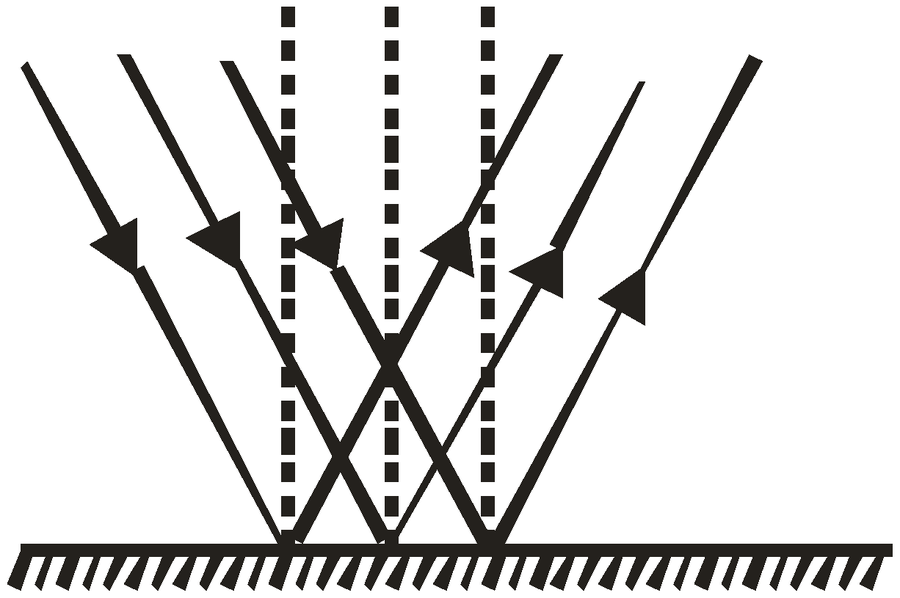
انعكاس منتظم: سطح أملس، فتبقى الأشعة المنعكسة متوازية.
Regular reflection: a smooth surface, so the reflected rays stay parallel.
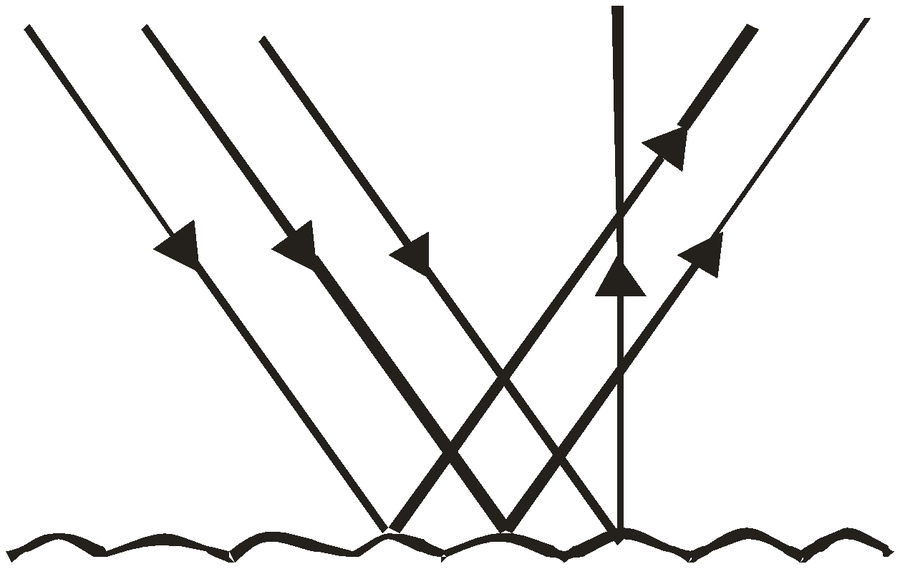
انعكاس غير منتظم: سطح خشن، فتتفرق الأشعة المنعكسة في اتجاهات شتى.
Irregular reflection: a rough surface, so the reflected rays scatter in many directions.
| وجه المقارنةComparison | الانعكاس المنتظمRegular reflection | الانعكاس غير المنتظمIrregular reflection |
|---|---|---|
| السطحSurface | أملس (مرآة، ماء ساكن)smooth (mirror, still water) | خشن (ورق، جدار، ثوب)rough (paper, wall, cloth) |
| زوايا السقوطAngles of incidence | متساويةequal | مختلفة من نقطة إلى أخرىdifferent from point to point |
| اتجاه الانعكاسDirection of the reflected light | جهة واحدة (أشعة متوازية)one direction (parallel rays) | في جميع الاتجاهاتall directions |
| قانون الانعكاسLaw of reflection | محقَّقobeyed | محقَّق أيضًا عند كل نقطةalso obeyed at every point |
| النتيجةResult | نرى صورة واضحةwe see a clear image | لا نرى صورة، لكنّا نرى الجسم نفسه من كل جهةno image, but we see the object itself from every side |
🚦 لماذا اللافتات المرورية خشنة؟
🚦 Why are road signs rough?
سطح اللافتة خشن عمدًا ليعكس الضوء في جميع الاتجاهات، فيراها كل سائق مهما كان موقعه. أما لو كانت ملساء كالمرآة لانعكس الضوء في جهة واحدة، ولم يرها إلا من وقع في تلك الجهة.
The sign’s surface is deliberately rough so it reflects light in all directions, and every driver can see it wherever they are. If it were smooth like a mirror the light would go in one direction only and just the people on that side would see it.
الورقة البيضاء تُرى من كل الجهات لأن سطحها يعكس الضوء:
A white sheet of paper is seen from every side because its surface reflects light:
🧍 الصورة في المرآة المستوية
🧍 The Image in a Plane Mirror
المرآة المستوية سطح عاكس مستوٍ أملس. حين تنظر إلى جسم عبرها ترى صورة له خلف المرآة. تتكوّن الصورة عند تقاطع امتدادات الأشعة المنعكسة (لا الأشعة نفسها)، ولذلك لا يمكن استقبالها على شاشة.
A plane mirror is a flat, smooth reflecting surface. When you look at an object through it you see an image of it behind the mirror. The image forms where the extensions of the reflected rays meet (not the rays themselves), so it cannot be caught on a screen.

صورة الطفل في المرآة المستوية تبدو خلف المرآة وبالحجم نفسه.
The child’s image seems to be behind the mirror, and the same size.
🔬 الصورة الحقيقية والصورة الوهمية
🔬 Real and virtual images
صورة حقيقية: تنتج من التقاء الأشعة المنعكسة نفسها، وتُستقبل على شاشة، وهي مقلوبة غالبًا.
A real image: formed where the reflected rays themselves meet; it can be caught on a screen and is usually inverted.
صورة وهمية (تخيلية): تنتج من التقاء امتدادات الأشعة المنعكسة، لا تُستقبل على شاشة، وتكون معتدلة.
A virtual image: formed where the extensions of the reflected rays meet; it cannot be caught on a screen and is upright.
📌 صفات الصورة في المرآة المستوية
📌 Properties of the image in a plane mirror
- وهمية (خلف المرآة).Virtual (behind the mirror).
- معتدلة (غير مقلوبة رأسيًا).Upright (not turned upside down).
- معكوسة جانبيًا: اليمين يصير يسارًا.Laterally inverted: right becomes left.
- طولها يساوي طول الجسم: \(h_i=h_o\).Its height equals the object’s height: \(h_i=h_o\).
- بعدها عن المرآة يساوي بعد الجسم لكنها في الجهة المقابلة: \(x_i=-x_o\).Its distance from the mirror equals the object’s but on the other side: \(x_i=-x_o\).
🧪 تجربة 2: الصورة في المرآة المستوية
🧪 Experiment 2: The image in a plane mirror
اسحب النقطة الزرقاء فوق الجسم لتغيير بُعده وطوله، واسحب العين لترى كيف يصل الضوء إليها. الأشعة المنعكسة تبدو قادمة من الصورة الوهمية خلف المرآة (الامتداد المتقطع). لاحظ العلَم الأخضر: يتجه يمينًا في الجسم ويسارًا في الصورة (انعكاس جانبي).
Drag the blue point on top of the object to change its distance and height, and drag the eye to see how light reaches it. The reflected rays seem to come from the virtual image behind the mirror (the dashed extension). Notice the green flag: it points right in the object and left in the image (lateral inversion).
يقف شخص على بعد \(1.5\ \text{m}\) أمام مرآة مستوية. على أي بعد منه تقع صورته؟ وإذا اقترب من المرآة \(0.5\ \text{m}\) فما المسافة الجديدة بينه وبين صورته؟
A person stands \(1.5\ \text{m}\) in front of a plane mirror. How far from them is their image? If they move \(0.5\ \text{m}\) closer to the mirror, what is the new distance between them and the image?
وُضع جسم أمام مرآة ومهما تغيّر بعده عن المرآة بقيت الصورة معتدلة وبحجم الجسم. إذن المرآة:
An object is placed in front of a mirror and, however its distance changes, the image stays upright and the same size. The mirror is:
صورة الجسم في المرآة المستوية عند مضاعفة بعد الجسم عن المرآة:
When the object’s distance from a plane mirror is doubled, the image:
🥄 من المستوية إلى الكروية
🥄 From Plane to Curved Mirrors
المرآة المستوية تعطي دائمًا صورة وهمية معتدلة بحجم الجسم. فماذا لو انحنى السطح العاكس؟ تتغير اتجاهات الأشعة المنعكسة فتتغير صفات الصورة وحجمها وموضعها بحسب بعد الجسم. هذا ما ندرسه في المرايا الكروية، وهي تُستعمل في مصابيح السيارات ومرايا الرؤية الجانبية ومرايا الحلاقة.
A plane mirror always gives a virtual, upright, same-size image. What if the reflecting surface is curved? The directions of the reflected rays change, so the properties, size and position of the image depend on the object’s distance. That is what we study in spherical mirrors, used in car headlights, side-view mirrors and shaving mirrors.
🔍 ما المرايا الكروية؟
🔍 What Are Spherical Mirrors?
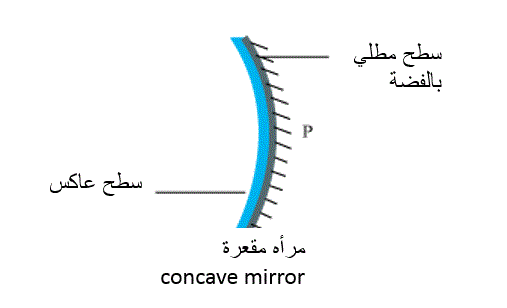
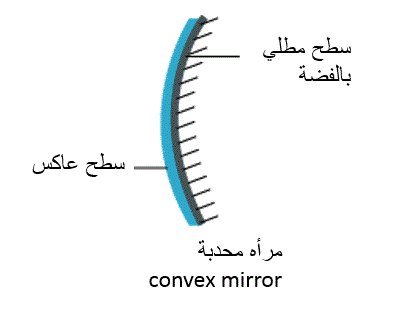
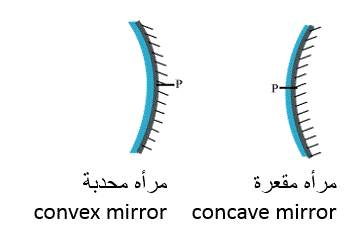
المرآة الكروية هي جزء من سطح كرة أحد وجهيها عاكس. تختلف عن المرآة المستوية في أن سطحها منحنٍ، فتغيّر اتجاه الأشعة المنعكسة بحسب موضع سقوطها فتجمعها أو تفرّقها. وتنقسم إلى نوعين بحسب أي وجه هو العاكس:
A spherical mirror is a part of the surface of a sphere with one face reflecting. It differs from a plane mirror in that its surface is curved so it changes the direction of the reflected rays according to where they hit it, either gathering them or spreading them. There are two types according to which face reflects:
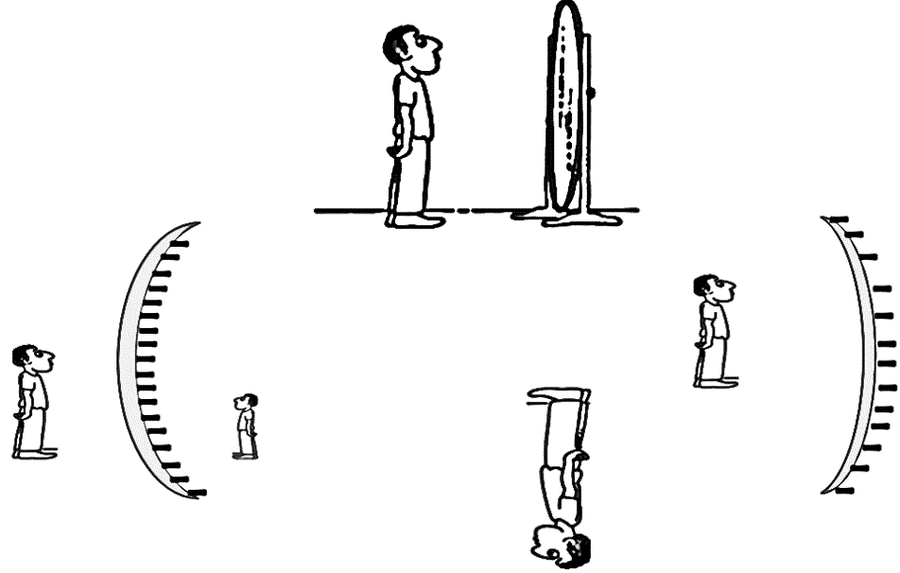
مرآة مستوية ومرآة مقعرة ومرآة محدبة: الصورة في كل منها مختلفة.
A plane, a concave and a convex mirror: the image differs in each.
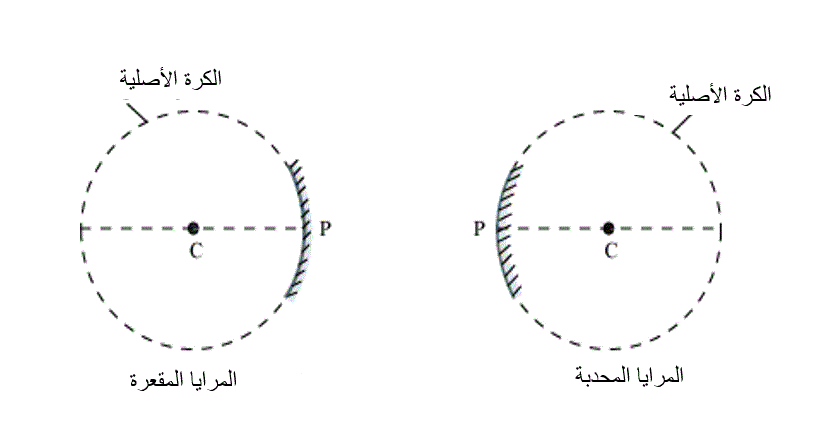
المرآة جزء من كرة: المرايا المقعرة (يسار) والمحدبة (يمين) من الكرة الأصلية ذات المركز C.
The mirror is a part of a sphere: the concave mirror (left) and the convex mirror (right) from the original sphere with centre C.
| النوعType | السطح العاكسReflecting surface | تأثيره في الأشعة المتوازيةEffect on parallel rays | اسم آخرOther name |
|---|---|---|---|
| المرآة المقعرةConcave mirror | السطح الداخلي (المنحني إلى الداخل)the inner surface (curved inwards) | تجمعها (بؤرة حقيقية)gathers them (a real focus) | مرآة لامّة (مجمّعة)a converging mirror |
| المرآة المحدبةConvex mirror | السطح الخارجي (المنتفخ نحو الجسم)the outer surface (bulging towards the object) | تفرّقها (بؤرة وهمية)spreads them (a virtual focus) | مرآة مفرّقةa diverging mirror |
📍 مصطلحات المرآة الكروية
📍 Terms of a Spherical Mirror
📘 المصطلحات الأربعة
📘 The four terms
- مركز التكور \(C\): مركز الكرة التي اقتُطعت منها المرآة، وبُعده عن المرآة هو نصف قطر التكور \(R\).The centre of curvature \(C\): the centre of the sphere from which the mirror was cut; its distance from the mirror is the radius of curvature \(R\).
- القطب \(P\): النقطة المركزية للسطح العاكس، وتقع على المرآة نفسها.The pole \(P\): the central point of the reflecting surface, lying on the mirror itself.
- المحور الأساسي: الخط المستقيم المار بالقطب \(P\) ومركز التكور \(C\).The principal axis: the straight line through the pole \(P\) and the centre of curvature \(C\).
- البؤرة \(F\): النقطة التي تتلاقى عندها الأشعة المنعكسة (أو امتداداتها) إذا سقطت الأشعة موازية للمحور، وبُعدها عن المرآة هو البعد البؤري \(f\).The focus \(F\): the point at which the reflected rays (or their extensions) meet if the rays fall parallel to the axis; its distance from the mirror is the focal length \(f\).
القطب P نقطة منتصف السطح العاكس.
The pole P, the midpoint of the reflecting surface.
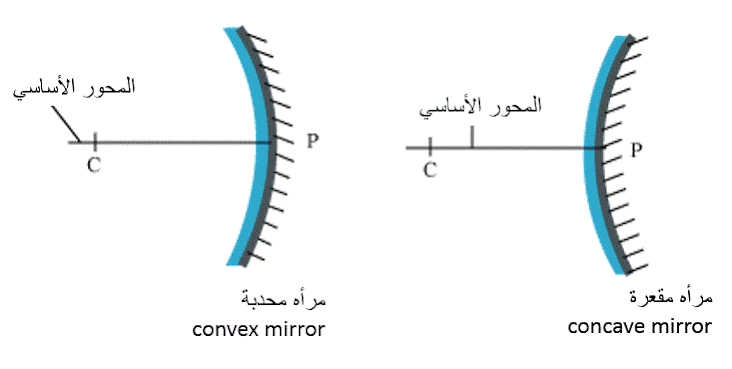
المحور الأساسي يمر بالقطب P ومركز التكور C.
The principal axis through the pole P and the centre of curvature C.
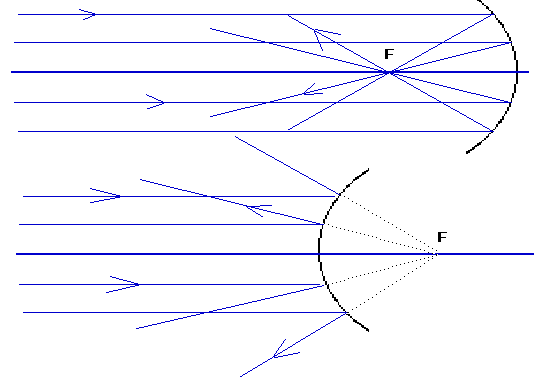
الأشعة الموازية للمحور: في المقعرة تتلاقى الأشعة المنعكسة في F (حقيقية)، وفي المحدبة تتباعد وتلتقي امتداداتها خلف المرآة في F (وهمية).
Rays parallel to the axis: in the concave mirror the reflected rays meet at F (real); in the convex mirror they diverge and their extensions meet behind the mirror at F (virtual).
📘 العلاقة بين \(f\) و\(R\)
📘 The relation between \(f\) and \(R\)
\[f=\dfrac{R}{2}\]
لماذا تقع البؤرة في منتصف المسافة بين \(P\) و\(C\)؟
Why is the focus midway between \(P\) and \(C\)?
يسقط شعاع موازٍ للمحور قريب منه على المرآة عند نقطة \(M\). الخط \(CM\) هو العمودي على المرآة عند \(M\)، فزاوية السقوط تساوي الزاوية بين الشعاع والعمودي، وزاوية الانعكاس تساويها، فيتكوّن مثلث \(CFM\) متساوي الساقين (\(FC=FM\)). وللأشعة القريبة من المحور \(FM\approx FP\)، فيكون \(FC\approx FP\) أي أن \(F\) في منتصف \(CP\): \(f=\dfrac{R}{2}\). وتصح العلاقة للأشعة القريبة من المحور فقط.
A ray parallel to the axis and close to it hits the mirror at a point \(M\). The line \(CM\) is the normal to the mirror at \(M\), so the angle of incidence equals the angle between the ray and the normal and the angle of reflection equals it, making the triangle \(CFM\) isosceles (\(FC=FM\)). For rays close to the axis \(FM\approx FP\), so \(FC\approx FP\), that is \(F\) is midway along \(CP\): \(f=\dfrac{R}{2}\). The relation holds for rays close to the axis only.
مرآة كروية نصف قطر تكورها \(36\ \mathrm{cm}\). بعدها البؤري:
A spherical mirror has a radius of curvature of \(36\ \mathrm{cm}\). Its focal length is:
➡️ مسار الأشعة في المرايا الكروية
➡️ The Path of Rays in Spherical Mirrors
لتحديد موضع الصورة نرسم شعاعين على الأقل من الأشعة الثلاثة المميزة الصادرة من رأس الجسم؛ فحيث تتقاطع الأشعة المنعكسة (أو امتداداتها) تقع صورة رأس الجسم. وجميع الأشعة، المميزة وغيرها، تحقق قانون الانعكاس:
To locate the image we draw at least two of the three principal rays from the head of the object; where the reflected rays (or their extensions) cross lies the image of the head of the object. All rays, principal or not, obey the law of reflection:
📘 الأشعة الثلاثة المميزة
📘 The three principal rays
- شعاع موازٍ للمحور الأساسي ⇐ ينعكس مارًّا بالبؤرة (أو يبدو أن امتداده يمر بها).A ray parallel to the principal axis ⇒ is reflected through the focus (or its extension seems to pass through it).
- شعاع مارٌّ بالبؤرة (أو متجه نحوها) ⇐ ينعكس موازيًا للمحور الأساسي.A ray through the focus (or heading towards it) ⇒ is reflected parallel to the principal axis.
- شعاع مارٌّ بمركز التكور (أو متجه نحوه) ⇐ يسقط عموديًّا على المرآة فيرتدّ على نفسه.A ray through the centre of curvature (or heading towards it) ⇒ hits the mirror along the normal so it is reflected back on itself.
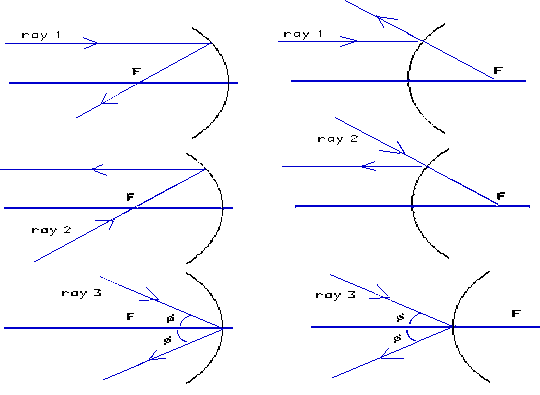
الأشعة المميزة في المرآة المقعرة (أعلى) والمحدبة (أسفل).
The principal rays in the concave mirror (top) and the convex mirror (bottom).
لماذا يكفي شعاعان؟ وما فائدة الثالث؟
Why are two rays enough? And what is the use of the third?
كل نقطة من الجسم ترسل عددًا لا نهائيًّا من الأشعة، وكلها تتلاقى بعد الانعكاس في نقطة واحدة هي صورة تلك النقطة. لذلك يكفي أي شعاعين لتحديدها، ويُستعمل الثالث للتحقق من صحة الرسم: إن مرّ بالنقطة نفسها فالرسم صحيح. وإذا لم تتلاقَ الأشعة المنعكسة نفسها فإننا نمدّها إلى الخلف بخطوط متقطعة لتتقاطع خلف المرآة: صورة وهمية.
Every point of the object sends an infinite number of rays and after reflection they all meet at one point, the image of that point. Any two rays are therefore enough to find it and the third is used to check the drawing: if it passes through the same point the drawing is right. If the reflected rays themselves do not meet we extend them backwards with dashed lines so they cross behind the mirror: a virtual image.
🧪 تجربة 3: ارسم الصورة بالأشعة الثلاثة بنفسك
🧪 Experiment 3: Draw the image with the three principal rays yourself
اختر نوع المرآة، ثم اسحب رأس الجسم (النقطة الدائرية) يمينًا ويسارًا لتغيير بعده \(x_o\) وإلى الأعلى والأسفل لتغيير طوله. تُرسم الأشعة الثلاثة المميزة: ① موازٍ للمحور ينعكس مارًّا بالبؤرة، ② مارٌّ بالبؤرة ينعكس موازيًا للمحور، ③ مارٌّ بمركز التكور يرتد على نفسه. الخط المتصل شعاع حقيقي، والمتقطع امتداده خلف المرآة (صورة وهمية). ثم جرّب التحدي. (لا شيء يتحرك إلا بتحريكك.)
Choose the type of mirror, then drag the head of the object (the round point) left and right to change its distance \(x_o\) and up and down to change its height. The three principal rays are drawn: ① parallel to the axis, reflected through the focus, ② through the focus, reflected parallel to the axis, ③ through the centre of curvature, reflected back on itself. A solid line is a real ray and a dashed one is its extension behind the mirror (a virtual image). Then try the challenge. (Nothing moves unless you move it.)
🖼️ صفات الصورة في كل موضع للجسم
🖼️ Properties of the Image for Every Position of the Object
الصورة الحقيقية تتكوّن من تلاقي الأشعة المنعكسة فعلًا فتقع أمام المرآة ويمكن استقبالها على شاشة، وتكون مقلوبة. الصورة الوهمية تتكوّن من تلاقي امتدادات الأشعة فتقع خلف المرآة ولا تُستقبل على شاشة، وتكون معتدلة. نضع الجسم في مواضع مختلفة أمام المرآة المقعرة:
A real image is formed by the actual meeting of the reflected rays, so it lies in front of the mirror, can be received on a screen and is inverted. A virtual image is formed by the meeting of the extensions of the rays, so it lies behind the mirror, cannot be received on a screen and is upright. We place the object in different positions in front of the concave mirror:
| موضع الجسمObject position | موضع الصورةImage position | الصفاتProperties |
|---|---|---|
| أبعد من \(C\) (\(x_o\gt 2f\))beyond \(C\) (\(x_o\gt 2f\)) | بين \(F\) و\(C\)between \(F\) and \(C\) | حقيقية، مقلوبة، مصغرةreal, inverted, diminished |
| عند \(C\) (\(x_o=2f\))at \(C\) (\(x_o=2f\)) | عند \(C\)at \(C\) | حقيقية، مقلوبة، مساوية للجسمreal, inverted, same size |
| بين \(C\) و\(F\) (\(f\lt x_o\lt 2f\))between \(C\) and \(F\) (\(f\lt x_o\lt 2f\)) | أبعد من \(C\)beyond \(C\) | حقيقية، مقلوبة، مكبرةreal, inverted, enlarged |
| عند \(F\) (\(x_o=f\))at \(F\) (\(x_o=f\)) | في اللانهايةat infinity | لا تتكون صورة (أشعة منعكسة متوازية)no image (parallel reflected rays) |
| بين \(F\) والقطب \(P\) (\(x_o\lt f\))between \(F\) and the pole \(P\) (\(x_o\lt f\)) | خلف المرآةbehind the mirror | وهمية، معتدلة، مكبرةvirtual, upright, enlarged |
| المرآة المحدبة: أي موضعa convex mirror: any position | خلف المرآة بين \(P\) و\(F\)behind the mirror between \(P\) and \(F\) | وهمية، معتدلة، مصغرة دائمًاalways virtual, upright, diminished |
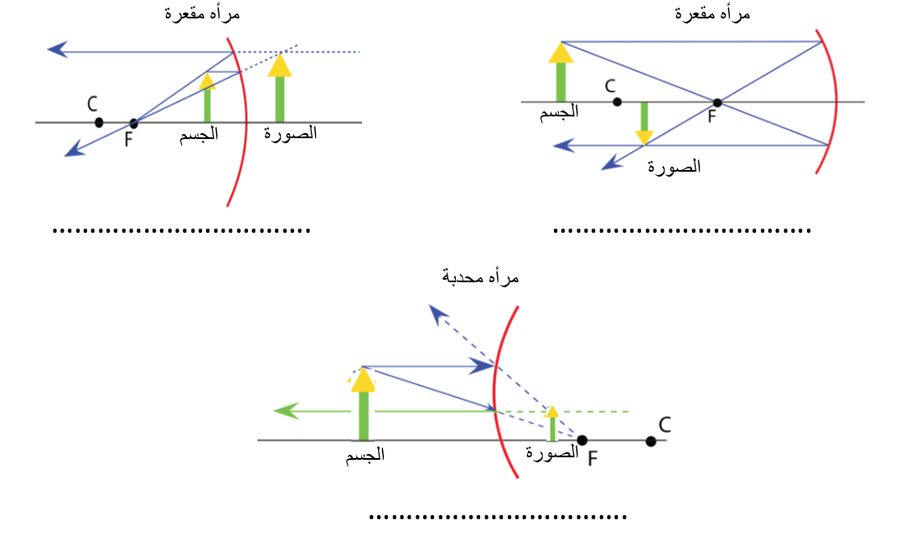
ثلاث حالات: جسم بين F والقطب في مقعرة، جسم أبعد من C في مقعرة، وجسم أمام مرآة محدبة.
Three cases: an object between F and the pole in a concave mirror, an object beyond C in a concave mirror and an object in front of a convex mirror.
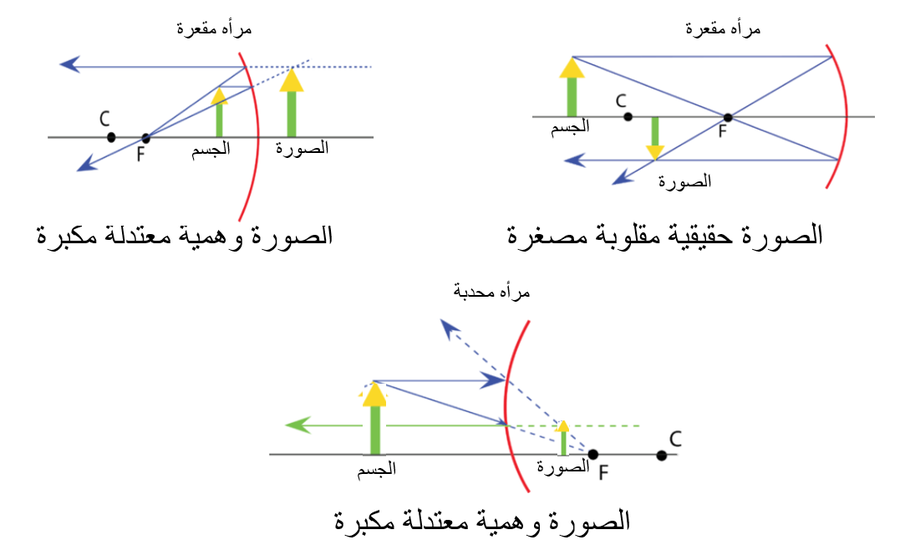
الحل: وهمية معتدلة مكبرة، حقيقية مقلوبة مصغرة، وهمية معتدلة مصغرة.
The answer: virtual upright enlarged, real inverted diminished, virtual upright diminished.
كيف أتذكّر الجدول؟
How to remember the table?
- كلما اقترب الجسم من المرآة المقعرة ابتعدت الصورة الحقيقية وكبرت، حتى إذا بلغ الجسم البؤرة ذهبت الصورة إلى اللانهاية.The nearer the object comes to the concave mirror the farther the real image goes and the larger it grows, until the object reaches the focus and the image goes to infinity.
- وإذا دخل الجسم داخل البؤرة تحوّلت الصورة فجأة إلى وهمية معتدلة مكبرة خلف المرآة (مرآة الحلاقة).If the object goes inside the focus the image suddenly becomes virtual, upright and enlarged behind the mirror (the shaving mirror).
- الحالة الوحيدة المساوية للجسم (من المقعرة) عندما يكون الجسم عند \(C\) تمامًا.The only same-size case (from the concave mirror) is when the object is exactly at \(C\).
وُضع جسم أمام مرآة فبقيت الصورة معتدلة مهما تغير بعد الجسم. المرآة:
An object is placed in front of a mirror and the image stays upright whatever the object distance. The mirror is:
جسم عند مركز تكور مرآة مقعرة. صورته:
An object is at the centre of curvature of a concave mirror. Its image is:
جسم عند البؤرة أمام مرآة مقعرة. الصورة:
An object is at the focus in front of a concave mirror. The image:
وُضع جسم أمام مرآة فظهرت له صورة أكبر من الجسم. المرآة:
An object is placed in front of a mirror and an image larger than the object appears. The mirror is:
✏️ مهارة الرسم: أكمل رسم الصورة
✏️ Drawing Skill: Complete the Image
ارسم الصورة التي تتكوّن لجسم (شمعة) أمام مرآة مقعرة في المواضع الخمسة الآتية باستعمال شعاعين مميزين، ثم قارن بالحل. تذكّر: شعاع موازٍ للمحور ينعكس مارًّا بالبؤرة، وشعاع مارٌّ بالبؤرة ينعكس موازيًا للمحور.
Draw the image formed of an object (a candle) in front of a concave mirror in the five positions below using two principal rays, then compare with the answer. Remember: a ray parallel to the axis is reflected through the focus and a ray through the focus is reflected parallel to the axis.
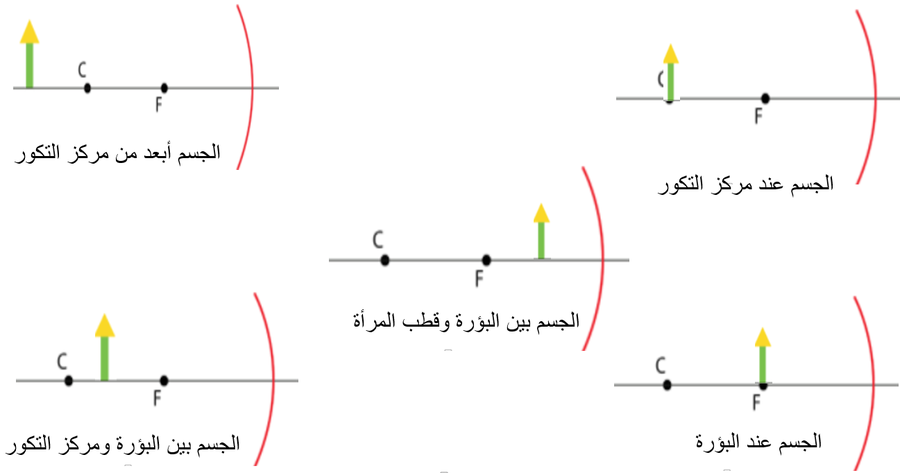
التمرين: الجسم في مواضع مختلفة أمام مرآة مقعرة.
The exercise: the object in different positions in front of a concave mirror.
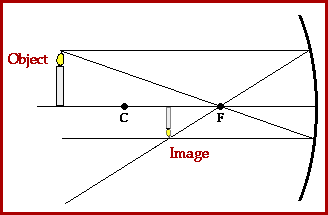
الجسم أبعد من مركز التكور: صورة حقيقية مقلوبة مصغرة بين F وC.
The object beyond the centre of curvature: a real, inverted, diminished image between F and C.
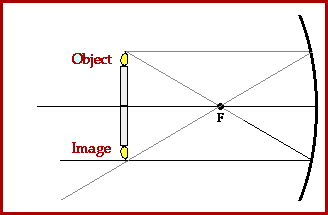
الجسم عند مركز التكور: صورة حقيقية مقلوبة مساوية للجسم عند C.
The object at the centre of curvature: a real, inverted, same-size image at C.
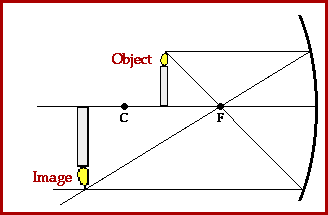
الجسم بين C وF: صورة حقيقية مقلوبة مكبرة أبعد من C.
The object between C and F: a real, inverted, enlarged image beyond C.
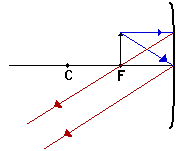
الجسم عند البؤرة: تنعكس الأشعة متوازية ولا تتكون صورة.
The object at the focus: the rays are reflected parallel and no image forms.
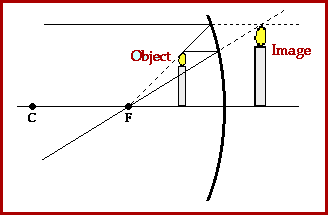
الجسم بين F والقطب: صورة وهمية معتدلة مكبرة خلف المرآة.
The object between F and the pole: a virtual, upright, enlarged image behind the mirror.
📐 معادلة المرآة والتكبير
📐 The Mirror Equation and the Magnification
بتشابه المثلثات في الرسم السابق نستنتج معادلة المرآة التي تربط بُعد الجسم \(x_o\) وبُعد الصورة \(x_i\) والبعد البؤري \(f\) (كلها تُقاس من القطب \(P\)):
From similar triangles in the previous diagrams we get the mirror equation relating the object distance \(x_o\), the image distance \(x_i\) and the focal length \(f\) (all measured from the pole \(P\)):
📘 معادلة المرآة والتكبير
📘 The mirror equation and the magnification
\[\dfrac{1}{x_o}+\dfrac{1}{x_i}=\dfrac{1}{f}\qquad\Longrightarrow\qquad x_i=\dfrac{x_o\,f}{x_o-f}\]
\[M=\dfrac{h_i}{h_o}=-\dfrac{x_i}{x_o}\]
والمشكلة في تطبيق المعادلة هي الإشارات. نضع الإشارة للقيم المعلومة فقط وفق الجدول، ثم نحكم على الصورة من إشارة الناتج:
The difficulty in applying the equation is the signs. We put the sign on the known values only according to the table, then judge the image from the sign of the result:
| الكميةQuantity | إشارة موجبة (+)Positive (+) | إشارة سالبة (−)Negative (−) |
|---|---|---|
| البعد البؤري \(f\)The focal length \(f\) | مرآة مقعرة (لامّة)a concave (converging) mirror | مرآة محدبة (مفرّقة)a convex (diverging) mirror |
| بعد الجسم \(x_o\)The object distance \(x_o\) | جسم حقيقي أمام المرآة (الحالة المعتادة)a real object in front of the mirror (the usual case) | جسم وهمي (نادر)a virtual object (rare) |
| بعد الصورة \(x_i\)The image distance \(x_i\) | صورة حقيقية، مقلوبة، أمام المرآةa real, inverted image in front of the mirror | صورة وهمية، معتدلة، خلف المرآةa virtual, upright image behind the mirror |
| التكبير \(M\)The magnification \(M\) | معتدلةupright | مقلوبةinverted |
نتائج مهمة لا تُنسى
Key results to remember
- إشارة \(M\) دائمًا معاكسة لإشارة \(x_i\): الصورة الحقيقية مقلوبة والوهمية معتدلة.The sign of \(M\) is always opposite to the sign of \(x_i\): a real image is inverted and a virtual one is upright.
- \(|M|\gt 1\) صورة مكبرة، \(|M|\lt 1\) مصغرة، \(|M|=1\) مساوية للجسم.\(|M|\gt 1\) an enlarged image, \(|M|\lt 1\) a diminished one, \(|M|=1\) the same size.
- في المرآة المحدبة \(f\lt 0\) فنحصل دائمًا على \(x_i\lt 0\) و\(0\lt M\lt 1\).In the convex mirror \(f\lt 0\) so we always get \(x_i\lt 0\) and \(0\lt M\lt 1\).
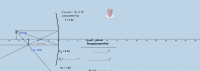
🧪 تجربة 4: معادلة المرآة وقاعدة الإشارات
🧪 Experiment 4: The mirror equation and the sign convention
يبيّن المنحنى كيف يتغير بعد الصورة \(x_i\) مع بعد الجسم \(x_o\) في المرآة المختارة (النقطة البرتقالية هي حالتك الحالية). لاحظ خط التقارب عند \(x_o=f\) في المقعرة حيث لا تتكون صورة، وتغير إشارة \(x_i\) من موجبة (حقيقية) إلى سالبة (وهمية) عندما يعبر الجسم البؤرة. الحل مكتوب أدناه بالإشارات خطوة بخطوة، ثم اختبر نفسك.
The curve shows how the image distance \(x_i\) changes with the object distance \(x_o\) in the chosen mirror (the orange point is your current case). Notice the asymptote at \(x_o=f\) in the concave mirror where no image forms, and the sign of \(x_i\) changing from positive (real) to negative (virtual) when the object crosses the focus. The solution is written below with signs step by step, then test yourself.
مرآة مقعرة بعدها البؤري \(10\ \mathrm{cm}\). وُضع أمامها جسم طوله \(6\ \mathrm{cm}\) على بعد \(30\ \mathrm{cm}\). أوجد بعد الصورة وطولها وصفاتها.
A concave mirror has a focal length of \(10\ \mathrm{cm}\). An object \(6\ \mathrm{cm}\) tall is placed \(30\ \mathrm{cm}\) in front of it. Find the image distance, its height and its properties.
في المرآة السابقة نقرّب الجسم إلى \(15\ \mathrm{cm}\). أوجد \(x_i\) و\(M\).
In the same mirror the object is brought to \(15\ \mathrm{cm}\). Find \(x_i\) and \(M\).
في المرآة نفسها وُضع الجسم على بعد \(5\ \mathrm{cm}\) فقط. أوجد \(x_i\) و\(M\).
In the same mirror the object is only \(5\ \mathrm{cm}\) away. Find \(x_i\) and \(M\).
مرآة محدبة بعدها البؤري \(12\ \mathrm{cm}\) وُضع أمامها جسم على بعد \(24\ \mathrm{cm}\). أوجد \(x_i\) و\(M\).
A convex mirror has a focal length of \(12\ \mathrm{cm}\); an object is placed \(24\ \mathrm{cm}\) in front of it. Find \(x_i\) and \(M\).
مرآة مقعرة نصف قطر تكورها \(40\ \mathrm{cm}\). أين يوضع الجسم لتتكوّن صورة حقيقية مساوية له؟ وما بعد الصورة إذا وُضع الجسم على بعد \(60\ \mathrm{cm}\)؟
A concave mirror has a radius of curvature of \(40\ \mathrm{cm}\). Where must the object be placed to form a real image equal to it? And what is the image distance if the object is \(60\ \mathrm{cm}\) away?
مرآة مقعرة بعدها البؤري \(12\ \mathrm{cm}\). أين يوضع جسم لتتكوّن له صورة حقيقية مكبرة ثلاث مرات؟ وأين تقع الصورة؟
A concave mirror has a focal length of \(12\ \mathrm{cm}\). Where must an object be placed to form a real image three times its size? Where is the image?
مرآة محدبة \(|f|=20\ \mathrm{cm}\) وجسم على بعد \(20\ \mathrm{cm}\). بعد الصورة:
A convex mirror has \(|f|=20\ \mathrm{cm}\) and an object \(20\ \mathrm{cm}\) away. The image distance is:
صورة حقيقية في مرآة طولها نصف طول الجسم. بُعد الجسم \(40\ \mathrm{cm}\). بعد الصورة:
A real image in a mirror is half the height of the object. The object is \(40\ \mathrm{cm}\) away. The image distance is:
إذا كانت قيمة \(M\) سالبة فإن الصورة:
If the value of \(M\) is negative the image is:
🌍 تطبيقات المرايا الكروية
🌍 Applications of Spherical Mirrors
| المرآةMirror | التطبيقApplication | السببReason |
|---|---|---|
| مقعرةconcave | مرآة الحلاقة والماكياج وطبيب الأسنانshaving and make-up mirrors and the dentist’s mirror | الوجه قريب (\(x_o\lt f\)) فتتكون صورة وهمية معتدلة مكبرةthe face is near (\(x_o\lt f\)) so a virtual, upright, enlarged image forms |
| مقعرةconcave | مصابيح السيارات والكشافات والأفران الشمسيةcar headlights, spotlights and solar cookers | المصدر عند البؤرة فينعكس ضوءه شعاعًا متوازيًا؛ أو تُجمع أشعة الشمس عند البؤرةa source at the focus reflects its light as a parallel beam; or the sun’s rays are gathered at the focus |
| محدبةconvex | مرآة الرؤية الجانبية في السيارات ومرايا المراقبة في المتاجرcar side mirrors and shop security mirrors | تعطي صورة معتدلة مصغرة لمجال رؤية واسعit gives an upright, diminished image of a wide field of view |
📚 ملخص الدرس
📚 Lesson Summary
| الفكرةIdea | القانون / القاعدةLaw / rule |
|---|---|
| قانون الانعكاسLaw of reflection | \(\theta_i=\theta_r\)\(\theta_i=\theta_r\) |
| المرآة المستويةPlane mirror | وهمية، معتدلة، \(h_i=h_o\)، \(x_i=-x_o\)، معكوسة جانبيًاvirtual, upright, \(h_i=h_o\), \(x_i=-x_o\), laterally inverted |
| البعد البؤريFocal length | \(f=\dfrac{R}{2}\)\(f=\dfrac{R}{2}\) |
| معادلة المرآةThe mirror equation | \(\dfrac{1}{x_o}+\dfrac{1}{x_i}=\dfrac{1}{f}\)\(\dfrac{1}{x_o}+\dfrac{1}{x_i}=\dfrac{1}{f}\) |
| التكبيرMagnification | \(M=\dfrac{h_i}{h_o}=-\dfrac{x_i}{x_o}\)\(M=\dfrac{h_i}{h_o}=-\dfrac{x_i}{x_o}\) |
| إشارة \(f\)The sign of \(f\) | مقعرة (+) ومحدبة (−)concave (+) and convex (−) |
| الصورة الحقيقيةA real image | \(x_i\gt 0\)، مقلوبة (\(M\lt 0\))، أمام المرآة\(x_i\gt 0\), inverted (\(M\lt 0\)), in front of the mirror |
| الصورة الوهميةA virtual image | \(x_i\lt 0\)، معتدلة (\(M\gt 0\))، خلف المرآة\(x_i\lt 0\), upright (\(M\gt 0\)), behind the mirror |
⚠️ أخطاء شائعة
⚠️ Common mistakes
- نسيان إشارة \(f\): البعد البؤري للمرآة المحدبة سالب في المعادلة.Forgetting the sign of \(f\): the focal length of the convex mirror is negative in the equation.
- الخلط بين \(f\) و\(R\): \(f=\dfrac{R}{2}\) وليس \(2R\)، ومركز التكور \(C\) على بعد \(2f\).Confusing \(f\) with \(R\): \(f=\dfrac{R}{2}\) not \(2R\), and the centre of curvature \(C\) is at \(2f\).
- جمع \(\dfrac{1}{x_o}+\dfrac{1}{x_i}\) ثم نسيان قلب الناتج للحصول على \(f\) أو \(x_i\).Adding \(\dfrac{1}{x_o}+\dfrac{1}{x_i}\) then forgetting to invert the result to get \(f\) or \(x_i\).
- اعتبار كل صورة في المرآة المقعرة مقلوبة؛ فإذا كان الجسم بين \(F\) والقطب فهي معتدلة وهمية.Taking every image in a concave mirror as inverted; if the object is between \(F\) and the pole it is upright and virtual.
- رسم الشعاع الثالث بلا مرور بمركز التكور، أو رسم الأشعة الوهمية متصلة بدل متقطعة.Drawing the third ray without passing through the centre of curvature, or drawing virtual rays solid instead of dashed.
- الظن أن المحدبة تعطي صورة حقيقية؛ صورتها وهمية معتدلة مصغرة دائمًا.Thinking a convex mirror can give a real image; its image is always virtual, upright and diminished.
🧪 اختبر نفسك: امتحان من 20 سؤالاً
🧪 Test Yourself: a 20-Question Exam
أنهِ الدرس بالاختبار التفاعلي التالي؛ أسئلته تجمع بين الفهم والحساب وتغطي جميع أقسام الدرس.
Finish with the interactive exam below; its questions mix understanding with calculation and cover every section of the lesson.
اختبار انعكاس الضوء والمرايا Light Reflection and Mirrors Quiz
20 سؤالاً - قانون الانعكاس والمرايا المستوية والكروية ومعادلة المرآة 20 Questions - law of reflection, plane and spherical mirrors, the mirror equation
• عدد الأسئلة: 20 سؤالاً
• مدة الاختبار: 30 دقيقة
• لا يمكنك تغيير إجاباتك أو إعادة الاختبار إلا بعد 24 ساعة من التسليم.
• تأكد من إجاباتك قبل التسليم! 📌 Important Instructions:
• Number of questions: 20 questions
• Quiz duration: 30 minutes
• You cannot change your answers or retake the quiz for 24 hours after submission.
• Make sure of your answers before submitting!
🔗 محاكيات GeoGebra للاستعانة بها عند اللزوم
🔗 GeoGebra Simulations to Use When Needed
اضغط «تشغيل» لتعمل المحاكاة هنا داخل الدرس؛ ويمكن للطالب الرجوع إليها لتجربة الفكرة بطريقة أخرى.
Press “Run” to run the simulation right here inside the lesson; the student can use it to try the idea in another way.