🎯 نواتج التعلم
🎯 Learning Outcomes
بعد دراسة هذا الدرس ستكون قادرًا على أن:
After this lesson you will be able to:
- تصف المكثف وكيف يخزّن الشحنة والطاقة في المجال الكهربائي بين لوحيه.Describe the capacitor and how it stores charge and energy in the electric field between its plates.
- تحسب سعة المكثف المستوي \(C=\varepsilon_0\kappa A/d\) وتفسّر أثر المساحة والمسافة والعازل، وتستعمل \(Q=CV\).Calculate the capacitance of the parallel-plate capacitor \(C=\varepsilon_0\kappa A/d\), explain the effect of the area, the separation and the dielectric, and use \(Q=CV\).
- تحسب السعة المكافئة والشحنة والجهد لمكثفات على التوالي وعلى التوازي.Calculate the equivalent capacitance, the charge and the voltage for capacitors in series and in parallel.
- تصف شحن المكثف وتفريغه وتستعمل الزمن المميز \(\tau=RC\) والعلاقات الأسية.Describe the charging and the discharging of a capacitor and use the time constant \(\tau=RC\) and the exponential relations.
- تذكر استخدامات المكثفات وأنواعها وأهم مصطلحاتها.State the uses of capacitors, their kinds and their main terms.
🔋 ما هي المكثفات؟
🔋 What Are Capacitors?
المكثف مكوّن إلكتروني يخزّن الطاقة الكهربائية في مجال كهربائي مؤقت. يتكون أساسًا من صفيحتين موصلتين (عادة من المعدن) تفصل بينهما مادة عازلة تسمى العازل الكهربائي (Dielectric).
A capacitor is an electronic component that stores electric energy in a temporary electric field. It basically consists of two conducting plates (usually of metal) separated by an insulating material called the dielectric.
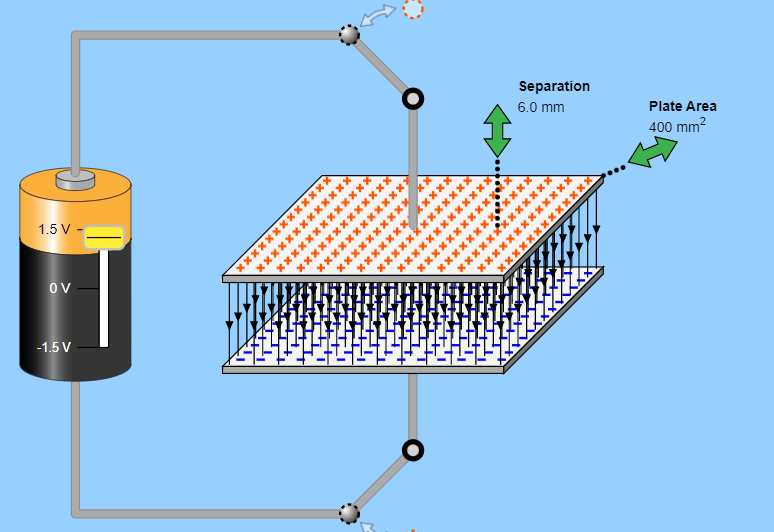
مكثف ذو لوحين متوازيين موصول ببطارية: المساحة والمسافة بين اللوحين
A parallel-plate capacitor connected to a battery: the area and the separation between the plates
كيف يعمل المكثف؟
How does the capacitor work?
- عند توصيله بمصدر تتراكم شحنات موجبة على لوح وسالبة بالمقدار نفسه على اللوح الآخر.When connected to a source, positive charges accumulate on one plate and equal negative charges on the other.
- ينشأ مجال كهربائي منتظم تقريبًا بين اللوحين \(E=V/d\) وتُخزَّن الطاقة فيه.An approximately uniform electric field \(E=V/d\) is created between the plates and energy is stored in it.
- يمكن تفريغ هذه الشحنة والطاقة في دائرة عند الحاجة.This charge and energy can be discharged into a circuit when needed.
| الاستخدامات الشائعةCommon uses | مثالExample |
|---|---|
| تنعيم الإشارات الكهربائيةSmoothing electric signals | مزودات الطاقةPower supplies |
| ترشيح التردداتFiltering frequencies | دوائر الراديو والصوتRadio and audio circuits |
| تخزين طاقة مؤقتTemporary energy storage | فلاش الكاميراتCamera flashes |
| ضبط التوقيت مع المقاوماتTiming with resistors | دوائر التوقيت الإلكترونيةElectronic timing circuits |
| نوع المكثفKind of capacitor | الخاصيةProperty |
|---|---|
| سيراميكيCeramic | صغير الحجمSmall in size |
| إلكتروليتيElectrolytic | قطبي وسعة عاليةPolarized with a high capacitance |
| تنتالومTantalum | أداء أفضل من الإلكتروليتيBetter performance than the electrolytic |
| متغيرVariable | سعته قابلة للتعديلIts capacitance is adjustable |
مصطلحات مهمة
Important terms
- السعة (Capacitance): قدرة التخزين وتقاس بالفاراد (F).Capacitance: the storage ability, measured in farads (F).
- الجهد التشغيلي (Voltage rating): أقصى جهد يُسمح بتطبيقه على المكثف.Voltage rating: the maximum voltage allowed to be applied to the capacitor.
- التسامح (Tolerance): نسبة الانحراف المئوية عن السعة الاسمية.Tolerance: the percentage deviation from the nominal capacitance.
📐 معادلة السعة
📐 The Capacitance Equation
📌 السعة والشحنة
📌 The capacitance and the charge
\[C=\frac{Q}{V}\qquad,\qquad C=\varepsilon_0\kappa\,\frac{A}{d}\qquad,\qquad \varepsilon_0=8.854\times10^{-12}\ \mathrm{F/m}\]
حيث \(\kappa\) (أو \(\varepsilon_r\)) ثابت العزل النسبي للعازل (بلا وحدة)، و\(A\) مساحة اللوح بـ \(\mathrm{m^2}\)، و\(d\) المسافة بين اللوحين بالمتر. السعة تتناسب طرديًا مع المساحة والعازل وعكسيًا مع المسافة، وهي خاصية هندسية للمكثف لا تتغير بتغير \(Q\) أو \(V\).
where \(\kappa\) (or \(\varepsilon_r\)) is the relative dielectric constant of the insulator (unitless), \(A\) is the area of the plate in \(\mathrm{m^2}\) and \(d\) is the separation between the plates in metres. The capacitance is directly proportional to the area and the dielectric and inversely to the separation, and it is a geometric property of the capacitor that does not change with \(Q\) or \(V\).
مكثف مستوٍ هوائي مساحة لوحه \(0.01\ \mathrm m^2\) والمسافة بين اللوحين \(1\ \mathrm{mm}\). أوجد سعته، ثم شحنته عند توصيله بجهد \(12\ \mathrm V\).
An air parallel-plate capacitor has a plate area of \(0.01\ \mathrm m^2\) and a separation of \(1\ \mathrm{mm}\). Find its capacitance, then its charge when connected to \(12\ \mathrm V\).
🧪 تجربة 1: سعة المكثف ذي الألواح المتوازية
🧪 Experiment 1: The Capacitance of a Parallel-Plate Capacitor
نغيّر مساحة اللوح والمسافة والعازل لنتحقق من العلاقة \(C=\varepsilon_0\kappa A/d\) وأن \(Q=CV\).
We change the area of the plate, the separation and the dielectric to verify the relation \(C=\varepsilon_0\kappa A/d\) and that \(Q=CV\).
🛠️ خطوات العمل
🛠️ Procedure
- سجّل السعة الابتدائية \(C_0\) (هواء، \(100\\ \mathrm{cm^2}\)، \(1\\ \mathrm{mm}\)).Record the initial capacitance \(C_0\) (air, \(100\\ \mathrm{cm^2}\), \(1\\ \mathrm{mm}\)).
- ضاعف المساحة ثم أعدها، وضاعف المسافة ثم أعدها وسجّل النسبة \(C/C_0\).Double the area then restore it, and double the separation then restore it and record the ratio \(C/C_0\).
- اختر عازلًا مختلفًا وراقب السعة والمجال والطاقة.Choose a different dielectric and watch the capacitance, the field and the energy.
🧪 تجربة 1: سعة المكثف ذي الألواح المتوازية
🧪 Experiment 1: The Capacitance of a Parallel-Plate Capacitor
غيّر مساحة اللوحين والمسافة بينهما ونوع العازل والجهد وراقب السعة \(C\) والشحنة \(Q\) والمجال \(E\) والطاقة \(U\).
Change the area of the plates, the separation, the kind of the dielectric and the voltage and watch the capacitance \(C\), the charge \(Q\), the field \(E\) and the energy \(U\).
🔎 ماذا نلاحظ؟ وما الاستنتاج؟
🔎 What do we observe? What is the conclusion?
- مضاعفة المساحة تضاعف السعة، ومضاعفة المسافة تنصفها.Doubling the area doubles the capacitance and doubling the separation halves it.
- العازل ذو \(\kappa=5\) يجعل السعة 5 أمثالها عند جهد ثابت، وتزداد الشحنة والطاقة بالنسبة نفسها.A dielectric of \(\kappa=5\) makes the capacitance 5 times at a constant voltage, and the charge and the energy increase by the same ratio.
السعة خاصية هندسية: \(C=\varepsilon_0\kappa A/d\)، والشحنة \(Q=CV\) والطاقة \(U=\tfrac12CV^2\).
The capacitance is a geometric property: \(C=\varepsilon_0\kappa A/d\), the charge \(Q=CV\) and the energy \(U=\tfrac12CV^2\).
ماذا يحدث لسعة مكثف عند زيادة مساحة اللوحين؟
What happens to the capacitance of a capacitor when the area of the plates increases?
🔗 التوصيل على التوالي
🔗 Series Connection
في التوصيل على التوالي تُوصَل الصفيحة الثانية لمكثف بالأولى للمكثف التالي. فتكون الشحنة واحدة على كل المكثفات، ويتوزع الجهد الكلي عليها.
In the series connection the second plate of a capacitor is connected to the first plate of the next. So the charge is the same on all the capacitors and the total voltage is distributed among them.
📌 التوالي
📌 Series
\[Q_{total}=Q_1=Q_2=\dots\ ,\quad V_{total}=V_1+V_2+\dots\ ,\quad \frac{1}{C_{eq}}=\frac{1}{C_1}+\frac{1}{C_2}+\dots\]
مكثفان \(C_1=4\ \mu\mathrm F\) و\(C_2=6\ \mu\mathrm F\) على التوالي موصولان بمصدر \(12\ \mathrm V\). أوجد السعة المكافئة والشحنة وجهد كل مكثف.
Two capacitors \(C_1=4\ \mu\mathrm F\) and \(C_2=6\ \mu\mathrm F\) are connected in series to a \(12\ \mathrm V\) source. Find the equivalent capacitance, the charge and the voltage of each capacitor.
ملاحظات هامة
Important notes
- السعة المكافئة على التوالي أقل دائمًا من أصغر سعة في الدائرة.The equivalent capacitance in series is always less than the smallest capacitance in the circuit.
- الجهد الأكبر يقع على المكثف الأصغر سعة (\(V=Q/C\)).The greater voltage is across the capacitor of the smaller capacitance (\(V=Q/C\)).
- يُستخدم التوالي لتحمّل جهد كهربائي عالٍ يتوزع على المكثفات.The series connection is used to withstand a high voltage distributed among the capacitors.
🧪 تجربة 2: توصيل المكثفات على التوالي
🧪 Experiment 2: Capacitors in Series
نوصل ثلاثة مكثفات على التوالي ونراقب الشحنة وتوزيع الجهد والسعة المكافئة.
We connect three capacitors in series and watch the charge, the distribution of the voltage and the equivalent capacitance.
🛠️ خطوات العمل
🛠️ Procedure
- اضبط \(C_1=4\) و\(C_2=6\\ \mu\mathrm F\) وسجّل \(C_{eq}\).Set \(C_1=4\) and \(C_2=6\\ \mu\mathrm F\) and record \(C_{eq}\).
- قارن \(C_{eq}\) بأصغر مكثف.Compare \(C_{eq}\) with the smallest capacitor.
- اجمع الجهود الثلاثة وقارنها بجهد المصدر.Add the three voltages and compare them with the source voltage.
🧪 تجربة 2: توصيل المكثفات على التوالي
🧪 Experiment 2: Capacitors in Series
غيّر سعات المكثفات الثلاثة والجهد وراقب السعة المكافئة وتوزيع الجهد (الشحنة واحدة).
Change the capacitances of the three capacitors and the voltage and watch the equivalent capacitance and the distribution of the voltage (the charge is the same).
🔎 ماذا نلاحظ؟ وما الاستنتاج؟
🔎 What do we observe? What is the conclusion?
- السعة المكافئة أقل من أصغر مكثف دائمًا.The equivalent capacitance is always less than the smallest capacitor.
- الشحنة واحدة على الكل، ومجموع الجهود يساوي جهد المصدر.The charge is the same on all and the sum of the voltages equals the source voltage.
على التوالي: \(Q\) ثابتة و\(V=\sum V_i\) و\(1/C_{eq}=\sum1/C_i\).
In series: \(Q\) is constant, \(V=\sum V_i\) and \(1/C_{eq}=\sum1/C_i\).
⚡ التوصيل على التوازي
⚡ Parallel Connection
في التوصيل على التوازي تُوصَل الصفائح الأولى معًا بأحد قطبي المصدر والثانية معًا بالقطب الآخر، فيكون الجهد واحدًا على كل المكثفات وتتوزع الشحنة.
In the parallel connection all the first plates are connected together to one terminal of the source and all the second plates to the other, so the voltage is the same across all the capacitors and the charge is distributed.
📌 التوازي
📌 Parallel
\[V_{total}=V_1=V_2=\dots\ ,\quad Q_{total}=Q_1+Q_2+\dots\ ,\quad C_{eq}=C_1+C_2+\dots\]
ثلاثة مكثفات \(4\ \mu\mathrm F\) و\(6\ \mu\mathrm F\) و\(2\ \mu\mathrm F\) على التوازي مع مصدر \(12\ \mathrm V\). أوجد السعة المكافئة وشحنة كل مكثف.
Three capacitors \(4\ \mu\mathrm F\), \(6\ \mu\mathrm F\) and \(2\ \mu\mathrm F\) in parallel with a \(12\ \mathrm V\) source. Find the equivalent capacitance and the charge of each capacitor.
ملاحظات هامة
Important notes
- السعة المكافئة على التوازي أكبر دائمًا من أي سعة فردية.The equivalent capacitance in parallel is always greater than any individual capacitance.
- الشحنة الأكبر على المكثف الأكبر سعة (\(Q=CV\)).The greater charge is on the capacitor of the greater capacitance (\(Q=CV\)).
- يُستخدم التوازي في تخزين الطاقة ودوائر التوقيت والترشيح.The parallel connection is used in energy storage, timing and filtering circuits.
🧪 تجربة 3: توصيل المكثفات على التوازي
🧪 Experiment 3: Capacitors in Parallel
نوصل ثلاثة مكثفات على التوازي ونراقب السعة المكافئة وتوزيع الشحنة.
We connect three capacitors in parallel and watch the equivalent capacitance and the distribution of the charge.
🛠️ خطوات العمل
🛠️ Procedure
- اضبط \(4\) و\(6\) و\(2\\ \mu\mathrm F\) وسجّل \(C_{eq}\).Set \(4\), \(6\) and \(2\\ \mu\mathrm F\) and record \(C_{eq}\).
- قارن \(C_{eq}\) بأكبر مكثف.Compare \(C_{eq}\) with the largest capacitor.
- راقب شحنة كل مكثف وجهده.Watch the charge and the voltage of each capacitor.
🧪 تجربة 3: توصيل المكثفات على التوازي
🧪 Experiment 3: Capacitors in Parallel
غيّر سعات المكثفات الثلاثة والجهد وراقب السعة المكافئة وتوزيع الشحنة (الجهد واحد).
Change the capacitances of the three capacitors and the voltage and watch the equivalent capacitance and the distribution of the charge (the voltage is the same).
🔎 ماذا نلاحظ؟ وما الاستنتاج؟
🔎 What do we observe? What is the conclusion?
- السعة المكافئة مجموع السعات وهي أكبر من أكبرها.The equivalent capacitance is the sum of the capacitances and it is greater than the largest.
- الجهد واحد على الكل، والشحنة تتناسب مع السعة.The voltage is the same on all and the charge is proportional to the capacitance.
على التوازي: \(V\) ثابت و\(Q=\sum Q_i\) و\(C_{eq}=\sum C_i\).
In parallel: \(V\) is constant, \(Q=\sum Q_i\) and \(C_{eq}=\sum C_i\).
مكثفان \(4\ \mu\mathrm F\) و\(6\ \mu\mathrm F\) على التوالي: السعة المكافئة:
Two capacitors \(4\ \mu\mathrm F\) and \(6\ \mu\mathrm F\) in series: the equivalent capacitance is:
🔄 شحن المكثف وتفريغه
🔄 Charging and Discharging a Capacitor
الشحن: عند إغلاق الدائرة تتحرك الإلكترونات من المصدر وتتراكم الشحنات على اللوحين، فينشأ مجال بينهما ويقل التيار تدريجيًا حتى ينقطع. التفريغ: عند توصيل المكثف المشحون بمقاومة تعمل شحناته كمصدر فيمر تيار معاكس وتتناقص الشحنة أسّيًا حتى تنعدم.
Charging: when the circuit is closed the electrons move from the source and the charges accumulate on the two plates, so a field arises between them and the current gradually decreases until it stops. Discharging: when the charged capacitor is connected to a resistor its charges act as a source so an opposite current passes and the charge decreases exponentially until it vanishes.
📌 العلاقات الأسية
📌 The exponential relations
\[V_C(t)=V_0\left(1-e^{-t/RC}\right)\ \ \uparrow\ ,\qquad V_C(t)=V_0\,e^{-t/RC}\ \ \downarrow\ ,\qquad \tau=RC\]
الزمن المميز \(\tau=RC\) يقيس سرعة العملية: بعد \(\tau\) واحد يبلغ الجهد 63% من \(V_0\) عند الشحن ويبقى 37% عند التفريغ، وبعد \(5\tau\) تكتمل العملية تقريبًا. وبزيادة \(R\) أو \(C\) تبطؤ العملية.
The time constant \(\tau=RC\) measures the speed of the process: after one \(\tau\) the voltage reaches 63% of \(V_0\) when charging and 37% remains when discharging, and after \(5\tau\) the process is almost complete. Increasing \(R\) or \(C\) slows the process.
مقاومة \(10\ \mathrm{k\Omega}\) ومكثف \(100\ \mu\mathrm F\) موصولان بمصدر \(12\ \mathrm V\). أوجد الزمن المميز وجهد المكثف بعد \(1\ \mathrm s\) من بدء الشحن.
A \(10\ \mathrm{k\Omega}\) resistor and a \(100\ \mu\mathrm F\) capacitor are connected to a \(12\ \mathrm V\) source. Find the time constant and the voltage of the capacitor \(1\ \mathrm s\) after charging starts.
🧪 تجربة 4: شحن المكثف وتفريغه
🧪 Experiment 4: Charging and Discharging a Capacitor
نشحن المكثف ونفرّغه ونراقب جهده مع الزمن بوحدة الزمن المميز.
We charge and discharge the capacitor and watch its voltage against time in units of the time constant.
🛠️ خطوات العمل
🛠️ Procedure
- اضبط \(R=10\\ \mathrm{k\Omega}\) و\(C=100\\ \mu\mathrm F\) واضغط «شحن» وتابع \(t=\tau\) و\(5\tau\).Set \(R=10\\ \mathrm{k\Omega}\) and \(C=100\\ \mu\mathrm F\) and press “Charge” and follow \(t=\tau\) and \(5\tau\).
- اضغط «تفريغ» وتابع \(t=\tau\).Press “Discharge” and follow \(t=\tau\).
- غيّر \(R\) أو \(C\) وراقب تغيّر \(\tau\) وسرعة العملية.Change \(R\) or \(C\) and watch the change of \(\tau\) and of the speed of the process.
🧪 تجربة 4: شحن المكثف وتفريغه
🧪 Experiment 4: Charging and Discharging a Capacitor
اضبط جهد المصدر والمقاومة والسعة ثم اضغط «شحن» أو «تفريغ» وتابع منحنى الجهد مع الزمن بوحدة الزمن المميز \(\tau=RC\).
Set the source voltage, the resistance and the capacitance then press “Charge” or “Discharge” and follow the curve of the voltage against time in units of the time constant \(\tau=RC\).
🔎 ماذا نلاحظ؟ وما الاستنتاج؟
🔎 What do we observe? What is the conclusion?
- بعد \(\tau\) واحد: 63% عند الشحن و37% عند التفريغ.After one \(\tau\): 63% when charging and 37% when discharging.
- بعد \(5\tau\) يكاد المكثف يمتلئ أو يفرغ تمامًا.After \(5\tau\) the capacitor is almost completely full or empty.
الزمن المميز \(\tau=RC\) يحدد سرعة الشحن والتفريغ، والتغير أسّي.
The time constant \(\tau=RC\) determines the speed of charging and discharging, and the change is exponential.
🔋 الطاقة المخزنة في المكثف
🔋 The Energy Stored in the Capacitor
الطاقة المخزنة في المجال بين اللوحين هي الشغل اللازم لشحن المكثف: \(U=\tfrac12QV=\tfrac12CV^2=\dfrac{Q^2}{2C}\). وتتناسب مع مربع الجهد. وهي ما يعطيه المكثف عند التفريغ (مثل ومضة الكاميرا).
The energy stored in the field between the plates is the work needed to charge the capacitor: \(U=\tfrac12QV=\tfrac12CV^2=\dfrac{Q^2}{2C}\). It is proportional to the square of the voltage. It is what the capacitor gives when discharging (such as a camera flash).
مكثف \(100\ \mu\mathrm F\) مشحون بجهد \(12\ \mathrm V\). ما الطاقة المخزنة فيه؟
A \(100\ \mu\mathrm F\) capacitor is charged with a voltage of \(12\ \mathrm V\). What is the energy stored in it?
بعد \(t=\tau\) من بدء شحن مكثف يكون جهده تقريبًا:
At \(t=\tau\) after the charging of a capacitor starts its voltage is approximately:
🚀 تطبيقات
🚀 Applications
أين نستعمل المكثفات؟
Where do we use capacitors?
- دوائر التوقيت الإلكترونية وأنظمة إضاءة الطوارئ.Electronic timing circuits and emergency lighting systems.
- مرشحات التيار في مصادر الطاقة وتنعيم الإشارات.Current filters in power supplies and smoothing the signals.
- ومضة الكاميرا ولوحات المفاتيح والشاشات اللمسية.The camera flash, keyboards and touch screens.
⚠️ أخطاء شائعة
⚠️ Common Mistakes
تجنّب هذه الأخطاء
Avoid these mistakes
- جمع السعات على التوالي مباشرة؛ الجمع المباشر للتوازي فقط.Adding the capacitances directly in series; the direct sum is for parallel only.
- الظن أن السعة تتغير بتغير الجهد أو الشحنة.Thinking that the capacitance changes with the voltage or the charge.
- نسيان تحويل cm² و mm و µF إلى وحدات SI قبل الحساب.Forgetting to convert cm², mm and µF to SI units before calculating.
- الظن أن الشحن يكتمل عند \(t=\tau\)؛ تكتمل تقريبًا عند \(5\tau\).Thinking that the charging completes at \(t=\tau\); it is almost complete at \(5\tau\).
📚 ملخص
📚 Summary
أهم ما تعلمناه
Key points
- \(C=Q/V=\varepsilon_0\kappa A/d\) و\(U=\tfrac12CV^2\).\(C=Q/V=\varepsilon_0\kappa A/d\) and \(U=\tfrac12CV^2\).
- التوالي: \(Q\) ثابتة و\(1/C_{eq}=\sum1/C_i\)؛ التوازي: \(V\) ثابت و\(C_{eq}=\sum C_i\).Series: \(Q\) is constant and \(1/C_{eq}=\sum1/C_i\); parallel: \(V\) is constant and \(C_{eq}=\sum C_i\).
- الشحن والتفريغ أسّيان بزمن مميز \(\tau=RC\).Charging and discharging are exponential with a time constant \(\tau=RC\).
🧪 اختبر نفسك: امتحان من 20 سؤالاً
🧪 Test Yourself: a 20-Question Exam
أنهِ الدرس بالاختبار التفاعلي التالي؛ أسئلته تجمع بين الفهم والحساب وتغطي جميع أقسام الدرس.
Finish with the interactive exam below; its questions mix understanding with calculation and cover every section of the lesson.
اختبار المكثف ذي الألواح المتوازية Parallel-Plate Capacitor Quiz
20 سؤالاً - السعة والتوصيل والشحن والتفريغ 20 Questions - capacitance, connections, charging and discharging
• عدد الأسئلة: 20 سؤالاً
• مدة الاختبار: 30 دقيقة
• لا يمكنك تغيير إجاباتك أو إعادة الاختبار إلا بعد 24 ساعة من التسليم.
• تأكد من إجاباتك قبل التسليم! 📌 Important Instructions:
• Number of questions: 20 questions
• Quiz duration: 30 minutes
• You cannot change your answers or retake the quiz for 24 hours after submission.
• Make sure of your answers before submitting!
🔗 محاكيات GeoGebra للاستعانة بها عند اللزوم
🔗 GeoGebra Simulations to Use When Needed
اضغط «تشغيل» لتعمل المحاكاة هنا داخل الدرس؛ ويمكن للطالب الرجوع إليها لتجربة الفكرة بطريقة أخرى.
Press “Run” to run the simulation right here inside the lesson; the student can use it to try the idea in another way.