🎯 نواتج التعلم
🎯 Learning Outcomes
بعد دراسة هذا الدرس ستكون قادرًا على أن:
After this lesson you will be able to:
- تعرّف المقذوف بزاوية وتصف شكل مساره.Define a projectile launched at an angle and describe the shape of its path.
- تحلّل السرعة الابتدائية إلى مركبتين أفقية ورأسية \(v_x=v_0\cos\theta\) و\(v_y=v_0\sin\theta\).Resolve the initial velocity into horizontal and vertical components \(v_x=v_0\cos\theta\) and \(v_y=v_0\sin\theta\).
- تطبّق معادلات الحركة على كل محور على حدة (سرعة ثابتة أفقيًا وتسارع \(-g\) رأسيًا).Apply the equations of motion to each axis separately (constant velocity horizontally and acceleration \(-g\) vertically).
- تحسب زمن التحليق وأقصى ارتفاع والمدى الأفقي.Calculate the time of flight, the maximum height and the horizontal range.
- تحسب السرعة (مقدارًا واتجاهًا) عند أي نقطة من المسار وتحدد أين تكون أصغر ما يمكن.Calculate the velocity (magnitude and direction) at any point of the path and tell where it is smallest.
- تفسّر لماذا تعطي زاويتان مجموعهما \(90^{\circ}\) المدى نفسه، ومتى يكون المدى أكبر ما يمكن.Explain why two angles adding up to \(90^{\circ}\) give the same range, and when the range is largest.
🏀 الحركة في بعدين والمقذوف بزاوية
🏀 Motion in Two Dimensions and the Projectile at an Angle
الحركة في بعدين هي حركة جسم على المحور الأفقي \(X\) وفي اللحظة نفسها على المحور الرأسي \(Y\). وعند دراستها يكون الأسهل أن ندرس الحركة على كل محور على حدة ثم نجمع النتيجتين. والمقذوف بزاوية هو أحد أهم تطبيقاتها.
Motion in two dimensions is the motion of an object along the horizontal axis \(X\) and, at the same moment, along the vertical axis \(Y\). To study it, it is easier to treat each axis separately and then combine the two results. The projectile launched at an angle is one of its most important applications.
📘 المقذوف بزاوية
📘 A projectile at an angle
المقذوفات هي أجسام قُذفت بسرعة ابتدائية ثم تحركت تحت تأثير وزنها فقط (مع إهمال مقاومة الهواء). وفي المقذوف بزاوية تصنع السرعة الابتدائية زاوية \(\theta\) مع الأفق:
Projectiles are objects thrown with an initial velocity that then move under the effect of their weight only (neglecting air resistance). For a projectile at an angle the initial velocity makes an angle \(\theta\) with the horizontal:
\[0^{\circ}\lt \theta\lt 90^{\circ}\]
مثل كرة القدم أو كرة السلة أو قذيفة المدفع. وسنفترض في الدرس أن الجسم يُقذف من الأرض ويعود إليها (إلا إذا ذُكر غير ذلك) وأن \(g=9.8\ m/s^{2}\).
Such as a football, a basketball or a cannon shell. We assume in the lesson that the body is launched from the ground and returns to it (unless stated otherwise) and that \(g=9.8\ m/s^{2}\).
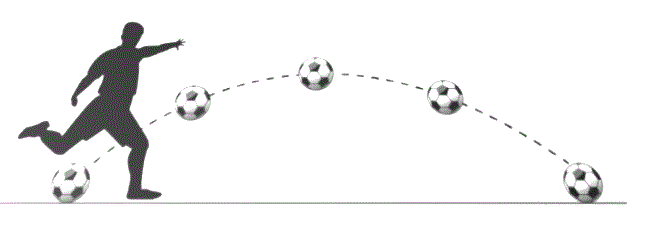
مسار كرة قدم مقذوفة بزاوية: منحنى (قطع مكافئ).
The path of a football kicked at an angle: a curve (a parabola).
🧠 فكرة أساسية: الحركتان مستقلتان
🧠 Key idea: the two motions are independent
الجاذبية تؤثر رأسيًا فقط، فلا توجد أي قوة أفقية. لذلك: على المحور الأفقي تكون الحركة بسرعة ثابتة (التسارع صفر)، وعلى المحور الرأسي تكون الحركة بتسارع ثابت \(-g\) نحو الأسفل. وكل محور لا يتأثر بالآخر؛ والزمن \(t\) هو الكمية المشتركة بين المحورين.
Gravity acts vertically only, so there is no horizontal force. Therefore: along the horizontal axis the motion is at constant velocity (zero acceleration), and along the vertical axis the motion has constant acceleration \(-g\) downward. Each axis is unaffected by the other, and the time \(t\) is the quantity shared by both.
📐 مركبتا السرعة الابتدائية
📐 The Components of the Initial Velocity
السرعة الابتدائية \(v_0\) تصنع زاوية \(\theta\) مع الأفق، فنحلّلها إلى مركبتين متعامدتين: أفقية \(v_{0x}\) على المحور \(X\) ورأسية \(v_{0y}\) على المحور \(Y\). المركبتان تشكّلان مع السرعة مثلثًا قائمًا وترُه \(v_0\):
The initial velocity \(v_0\) makes an angle \(\theta\) with the horizontal, so we resolve it into two perpendicular components: a horizontal one \(v_{0x}\) along \(X\) and a vertical one \(v_{0y}\) along \(Y\). The two components form with the velocity a right triangle whose hypotenuse is \(v_0\):
📌 المركبتان
📌 The components
\[v_{0x}=v_0\cos\theta\qquad\qquad v_{0y}=v_0\sin\theta\]
\[v_0=\sqrt{v_{0x}^{2}+v_{0y}^{2}},\qquad \tan\theta=\dfrac{v_{0y}}{v_{0x}}\]
🧠 توضيح إضافي: متى نستخدم \(\cos\) ومتى \(\sin\)؟
🧠 Extra explanation: when to use \(\cos\) and when \(\sin\)?
الزاوية \(\theta\) تُقاس من الأفق. المركبة المجاورة للزاوية (الأفقية) تأخذ \(\cos\)، والمركبة المقابلة للزاوية (الرأسية) تأخذ \(\sin\). تحقّق بالحالتين المتطرفتين: عند \(\theta\to0^{\circ}\) تصبح كل السرعة أفقية (\(\cos0=1\)، \(\sin0=0\))، وعند \(\theta\to90^{\circ}\) تصبح كل السرعة رأسية (قذف رأسي). وعند \(\theta=45^{\circ}\) تتساوى المركبتان.
The angle \(\theta\) is measured from the horizontal. The component adjacent to the angle (the horizontal one) takes \(\cos\), and the opposite component (the vertical one) takes \(\sin\). Check the two extreme cases: at \(\theta\to0^{\circ}\) all the velocity is horizontal (\(\cos0=1\), \(\sin0=0\)), at \(\theta\to90^{\circ}\) all of it is vertical (a vertical throw). At \(\theta=45^{\circ}\) the two components are equal.
قُذف جسم بسرعة \(20\ m/s\) بزاوية \(30^{\circ}\) فوق الأفق. احسب مركبتي السرعة الابتدائية.
An object is thrown at \(20\ m/s\) at \(30^{\circ}\) above the horizontal. Find the components of the initial velocity.
غيّر السرعة والزاوية في التجربة التالية وانظر كيف تتغير المركبتان.
Change the speed and the angle in the next experiment and watch how the two components change.
🧪 تجربة 1: تحليل السرعة الابتدائية إلى مركبتين
🧪 Experiment 1: Resolving the initial velocity into two components
غيّر مقدار السرعة الابتدائية \(v_0\) والزاوية \(\theta\). يرسم البرنامج السهم \(v_0\) ومركبتيه الأفقية والرأسية ويحسب قيمتيهما. لاحظ ماذا يحدث للمركبتين عند زاوية صغيرة وعند زاوية كبيرة وعند \(45^{\circ}\).
Change the magnitude of the initial velocity \(v_0\) and the angle \(\theta\). The program draws the arrow \(v_0\) and its horizontal and vertical components and computes their values. Notice what happens to the components at a small angle, at a large angle and at \(45^{\circ}\).
📈 الحركة على كل محور
📈 Motion Along Each Axis
➡️ المحور الأفقي \(X\): سرعة ثابتة
➡️ The horizontal axis \(X\): constant velocity
لا توجد قوة أفقية، فالسرعة الأفقية ثابتة دومًا وتساوي مسقط السرعة الابتدائية على الأفق. الخط البياني للسرعة الأفقية مع الزمن خط أفقي وميله صفر:
There is no horizontal force, so the horizontal velocity is always constant and equal to the projection of the initial velocity onto the horizontal. The graph of horizontal velocity against time is a horizontal line with zero slope:
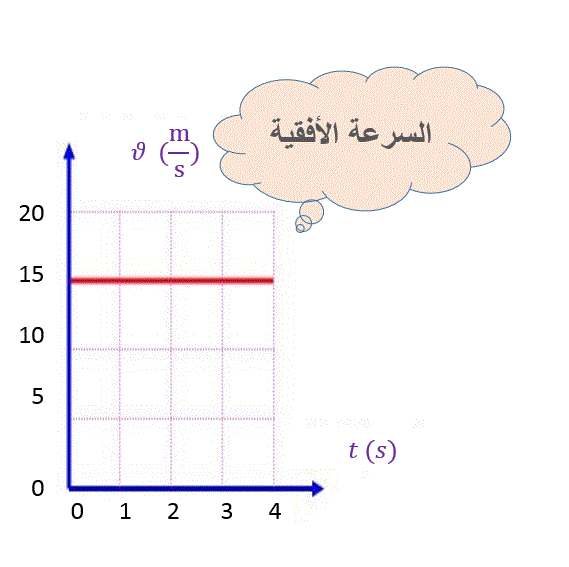
السرعة الأفقية مقابل الزمن: خط أفقي.
Horizontal velocity versus time: a horizontal line.
من الخط البياني للسرعة الأفقية: ما مقدار التسارع (ميل الخط) على المحور \(X\)؟
From the graph of the horizontal velocity: what is the acceleration (the slope) along the \(X\) axis?
📌 معادلة الحركة على المحور الأفقي
📌 The equation of motion along the horizontal axis
\[v_x=v_0\cos\theta\ (\text{constant}),\qquad x=v_0\cos\theta\;t\]
⬆️ المحور الرأسي \(Y\): تسارع \(-g\)
⬆️ The vertical axis \(Y\): acceleration \(-g\)
رأسيًا يؤثر الوزن فقط، فتكون الحركة بتسارع ثابت \(-g\) (نحو الأسفل): تتناقص السرعة الرأسية بمقدار \(9.8\ m/s\) كل ثانية، فتنعدم عند أقصى ارتفاع ثم تصير سالبة (الجسم يهبط). الخط البياني مستقيم ميله \(-g\):
Vertically only the weight acts, so the motion has constant acceleration \(-g\) (downward): the vertical velocity decreases by \(9.8\ m/s\) every second, vanishes at the maximum height and then becomes negative (the object falls). The graph is a straight line with slope \(-g\):
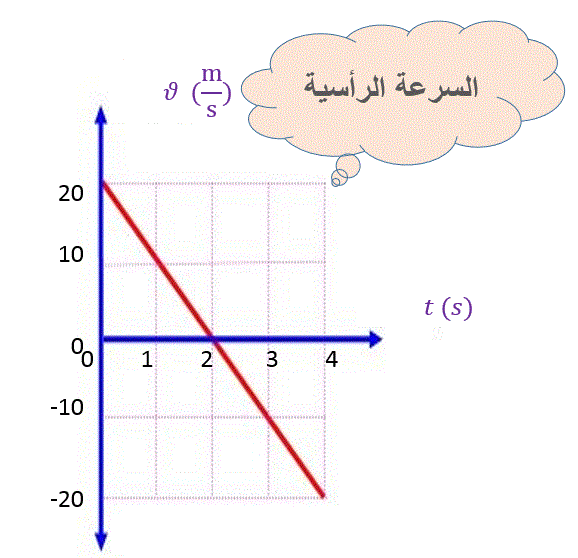
السرعة الرأسية مقابل الزمن: خط مستقيم متناقص.
Vertical velocity versus time: a decreasing straight line.
من الخط البياني للسرعة الرأسية (من \(+20\) إلى \(-20\ m/s\) خلال \(4\ s\)): ما مقدار التسارع على المحور \(Y\)؟
From the graph of the vertical velocity (from \(+20\) to \(-20\ m/s\) in \(4\ s\)): what is the acceleration along the \(Y\) axis?
📌 معادلات الحركة على المحور الرأسي
📌 The equations of motion along the vertical axis
\[v_{fy}=v_0\sin\theta-g\,t\]
\[v_{fy}^{2}=(v_0\sin\theta)^{2}-2g\,\Delta y\]
\[\Delta y=v_0\sin\theta\;t-\tfrac12\,g\,t^{2}\]
🧠 توضيح إضافي: الإشارات
🧠 Extra explanation: the signs
نختار الاتجاه نحو الأعلى موجبًا: فالمركبة الرأسية الابتدائية \(+v_0\sin\theta\) والتسارع \(-g\). عندما تكون \(v_{y}\gt 0\) يصعد الجسم، وعندما \(v_{y}=0\) يكون في قمة المسار، وعندما \(v_{y}\lt 0\) يهبط. أما \(\Delta y\) فهي الإزاحة الرأسية عن نقطة القذف (وليست الارتفاع عن الأرض إلا إذا بدأ القذف من الأرض).
We choose upward as positive: the initial vertical component is \(+v_0\sin\theta\) and the acceleration is \(-g\). When \(v_{y}\gt 0\) the object is rising, when \(v_{y}=0\) it is at the top of the path, and when \(v_{y}\lt 0\) it is falling. \(\Delta y\) is the vertical displacement from the launch point (the height above the ground only if the launch is from the ground).
جرّب المقذوف بزاوية بنفسك في التجربة الرئيسية التالية: اضبط الزاوية والسرعة والارتفاع الابتدائي، وشغّل الحركة، أو تقدّم بها كل \(0.5\ s\) وسجّل القراءات في الجدول (وهي تغني عن تجربة showmethephysics ومحاكاة GeoGebra «مقذوف بزاوية 1»). تحقّق من أن المدى الأفقي يزداد بانتظام (\(x=v_{0x}t\)) وأن \(v_y\) تتناقص بانتظام.
Try the projectile at an angle yourself in the main experiment below: set the angle, speed and initial height, run the motion or advance it every \(0.5\ s\) and record the readings in the table (it replaces the showmethephysics experiment and the GeoGebra “projectile at an angle 1” simulation). Check that the horizontal range grows uniformly (\(x=v_{0x}t\)) and that \(v_y\) decreases uniformly.
🧪 تجربة 2: المقذوف بزاوية: المحاكاة الرئيسية وجدول القراءات
🧪 Experiment 2: The projectile at an angle: the main simulation and the readings table
اضبط زاوية القذف والسرعة الابتدائية والارتفاع الابتدائي (صفر لقذف من الأرض). اضغط «شغّل» لتشاهد الحركة، أو «خطوة 0.5 ث» لتتقدم بها كل نصف ثانية فتُسجَّل القراءة في الجدول (الزمن والمدى الأفقي والارتفاع والسرعة الرأسية). أظهر المركبات لترى أن السرعة الأفقية ثابتة وأن الرأسية تتناقص. النقاط على المسار تُرسم كل \(0.5\ s\) (تصوير متقطع). (تستخدم التجارب \(g=9.8\ m/s^{2}\).)
Set the launch angle, the initial speed and the initial height (zero for a launch from the ground). Press “Run” to watch the motion, or “Step 0.5 s” to advance it every half second and have the reading recorded in the table (time, horizontal range, height and vertical velocity). Show the components to see that the horizontal velocity is constant while the vertical one decreases. The dots on the path are drawn every \(0.5\ s\) (stroboscopic). (The experiments use \(g=9.8\ m/s^{2}\).)
🚀 السرعة عند أي نقطة من المسار
🚀 The Velocity at Any Point of the Path
كل نقطة من المسار لها سرعتان: سرعة على المحور \(X\) وسرعة على المحور \(Y\). ثم نجمعهما اتجاهيًا (مثلث قائم) لنحصل على السرعة الكلية:
Every point of the path has two velocities: one along \(X\) and one along \(Y\). We then combine them as vectors (a right triangle) to get the total velocity:
📌 السرعة عند أي لحظة
📌 The velocity at any instant
\[v_x=v_0\cos\theta,\qquad v_y=v_0\sin\theta-g\,t\]
\[v=\sqrt{v_x^{2}+v_y^{2}},\qquad \tan\alpha=\dfrac{v_y}{v_x}\]
\(\alpha\) زاوية السرعة مع الأفق: فوق الأفق إن كانت \(v_y\gt 0\) (صاعد) وتحته إن كانت \(v_y\lt 0\) (هابط). والسرعة مماسّة للمسار دائمًا.
\(\alpha\) is the angle of the velocity with the horizontal: above it if \(v_y\gt 0\) (rising) and below it if \(v_y\lt 0\) (falling). The velocity is always tangent to the path.
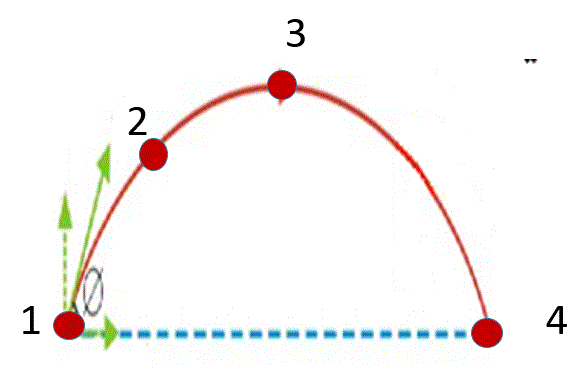
أربعة مواقع على المسار: 1 القذف، 2 صاعد، 3 القمة، 4 العودة إلى مستوى القذف.
Four positions on the path: 1 launch, 2 rising, 3 the top, 4 back at the launch level.
📌 عند قمة المسار (أقصى ارتفاع)
📌 At the top of the path (maximum height)
عند أقصى ارتفاع تنعدم السرعة الرأسية (\(v_y=0\)) ويبقى للمقذوف مركبة أفقية فقط، فتكون سرعته عندئذ أقل ما يمكن:
At the maximum height the vertical velocity vanishes (\(v_y=0\)) and the projectile keeps a horizontal component only, so its speed there is the smallest possible:
\[v_{\text{top}}=v_x=v_0\cos\theta\]
أما في الموقعين 1 و4 (على المستوى نفسه) فتكون السرعة أكبر ما يمكن ومتساوية في المقدار (\(v=v_0\)). وتنبّه: التسارع عند القمة ليس صفرًا بل \(g\) نحو الأسفل!
At positions 1 and 4 (at the same level) the speed is the largest possible and equal in magnitude (\(v=v_0\)). Note: the acceleration at the top is not zero but \(g\) downward!
في القذف بزاوية، أقل سرعة يصل إليها المقذوف تكون عند الموقع (انظر الشكل أعلاه):
For a projectile at an angle, the smallest speed the projectile reaches is at the position (see the figure above):
قُذفت كرة من سطح الأرض بسرعة \(20\ m/s\) بزاوية \(40^{\circ}\) مع الأفق. سرعتها عند أقصى ارتفاع:
A ball is thrown from the ground at \(20\ m/s\) at \(40^{\circ}\) to the horizontal. Its speed at the maximum height is:
استعمل التجربة التالية لقياس السرعة عند أي لحظة: حرّك منزلق الزمن وراقب السهمين \(v_x\) و\(v_y\) والسرعة الكلية، وانتقل بزر «القمة» لترى أن \(v_y=0\) (وهي تغني عن محاكاة GeoGebra «مقذوف بزاوية: السرعة عند أي موقع»).
Use the next experiment to measure the velocity at any instant: move the time slider and watch the arrows \(v_x\), \(v_y\) and the total velocity; press “Top” to see that \(v_y=0\) (it replaces the GeoGebra simulation “projectile at an angle: the velocity at any position”).
🧪 تجربة 3: السرعة عند أي لحظة (أي موقع)
🧪 Experiment 3: The velocity at any instant (any position)
حرّك منزلق الزمن من لحظة القذف إلى لحظة الوصول للأرض. يرسم البرنامج السهم الأفقي \(v_x\) والرأسي \(v_y\) والسرعة الكلية \(v\) (مماسّة للمسار) ويحسب مقدارها واتجاهها. اضغط «القمة» لترى أن \(v_y=0\) وأن السرعة عندئذ أصغر ما يمكن \(v_0\cos\theta\).
Move the time slider from the launch instant to the landing instant. The program draws the horizontal arrow \(v_x\), the vertical one \(v_y\) and the total velocity \(v\) (tangent to the path) and computes its magnitude and direction. Press “Top” to see that \(v_y=0\) and the speed is then the smallest possible \(v_0\cos\theta\).
قُذف جسم من الأرض بسرعة \(25\ m/s\) بزاوية \(37^{\circ}\) (\(\sin37^{\circ}=0.6,\ \cos37^{\circ}=0.8\)، \(g=10\ m/s^{2}\)). احسب سرعته بعد \(2\ s\) من القذف.
An object is thrown from the ground at \(25\ m/s\) at \(37^{\circ}\) (\(\sin37^{\circ}=0.6,\ \cos37^{\circ}=0.8\), \(g=10\ m/s^{2}\)). Find its velocity \(2\ s\) after the launch.
📏 زمن التحليق وأقصى ارتفاع والمدى
📏 Time of Flight, Maximum Height and Range
نشتق القوانين الثلاثة المهمة للقذف من الأرض (والعودة إلى مستوى القذف) من المعادلات السابقة:
We derive the three important formulae for a launch from the ground (returning to the launch level) from the equations above:
🧮 الاشتقاق خطوة بخطوة
🧮 The derivation step by step
- زمن الوصول لأقصى ارتفاع: عند القمة \(v_{fy}=0\Rightarrow v_0\sin\theta-g\,t_{up}=0\Rightarrow t_{up}=\dfrac{v_0\sin\theta}{g}\).Time to the top: at the top \(v_{fy}=0\Rightarrow v_0\sin\theta-g\,t_{up}=0\Rightarrow t_{up}=\dfrac{v_0\sin\theta}{g}\).
- زمن التحليق: المسار متماثل فالهبوط يستغرق الزمن نفسه: \(T=2\,t_{up}\). (وبالطريقة الأخرى: \(\Delta y=0\Rightarrow v_0\sin\theta\,T-\tfrac12gT^{2}=0\Rightarrow T=\dfrac{2v_0\sin\theta}{g}\).)Time of flight: the path is symmetric so the descent takes the same time: \(T=2\,t_{up}\). (The other way: \(\Delta y=0\Rightarrow v_0\sin\theta\,T-\tfrac12gT^{2}=0\Rightarrow T=\dfrac{2v_0\sin\theta}{g}\).)
- أقصى ارتفاع: \(0=(v_0\sin\theta)^{2}-2gH\Rightarrow H=\dfrac{(v_0\sin\theta)^{2}}{2g}\).Maximum height: \(0=(v_0\sin\theta)^{2}-2gH\Rightarrow H=\dfrac{(v_0\sin\theta)^{2}}{2g}\).
- المدى الأفقي: \(R=v_x\,T=v_0\cos\theta\cdot\dfrac{2v_0\sin\theta}{g}=\dfrac{v_0^{2}\,(2\sin\theta\cos\theta)}{g}=\dfrac{v_0^{2}\sin2\theta}{g}\).Horizontal range: \(R=v_x\,T=v_0\cos\theta\cdot\dfrac{2v_0\sin\theta}{g}=\dfrac{v_0^{2}\,(2\sin\theta\cos\theta)}{g}=\dfrac{v_0^{2}\sin2\theta}{g}\).
📌 القوانين (قذف من الأرض)
📌 The formulae (launch from the ground)
\[T=\dfrac{2v_0\sin\theta}{g},\qquad H=\dfrac{(v_0\sin\theta)^{2}}{2g},\qquad R=\dfrac{v_0^{2}\sin2\theta}{g}\]
⚠️ هذه القوانين تصح فقط إذا عاد الجسم إلى مستوى القذف نفسه. وإذا بدأ القذف من ارتفاع \(h_0\) فنحلّ المعادلة \(\Delta y=-h_0\) (انظر المثال 4).
⚠️ These formulae hold only if the body returns to the same level it was launched from. If the launch starts from a height \(h_0\) we solve the equation \(\Delta y=-h_0\) (see example 4).
📌 ملاحظات مهمة (تأكّد منها بالتجربة)
📌 Important notes (check them with the experiment)
- زمن التحليق يساوي ضعف زمن الوصول إلى أقصى ارتفاع.The time of flight is twice the time to reach the maximum height.
- عند الوصول إلى أقصى ارتفاع تكون السرعة الرأسية معدومة.At the maximum height the vertical velocity is zero.
- تصل القذيفة إلى أكبر مدى أفقي إذا كانت زاوية الإطلاق \(45^{\circ}\) (لأن \(\sin2\theta=1\) عندئذ).The projectile reaches its largest horizontal range when the launch angle is \(45^{\circ}\) (because \(\sin2\theta=1\) then).
- يمكن لقذيفتين مختلفتين أن تصلا إلى المدى نفسه إذا أُطلقتا بزاويتين مجموعهما \(90^{\circ}\) (مثل \(30^{\circ}\) و\(60^{\circ}\)).Two different projectiles can reach the same range if they are launched at two angles whose sum is \(90^{\circ}\) (such as \(30^{\circ}\) and \(60^{\circ}\)).
- مضاعفة سرعة القذف (بالزاوية نفسها) تضاعف \(T\) و\(\times4\) لكل من \(H\) و\(R\).Doubling the launch speed (same angle) doubles \(T\) and multiplies both \(H\) and \(R\) by \(4\).
لماذا الزاويتان المتتامتان؟ لأن \(\sin2\theta=\sin(180^{\circ}-2\theta)=\sin\big(2(90^{\circ}-\theta)\big)\). أما الزاوية الأكبر فتصل إلى ارتفاع أكبر وتبقى في الهواء زمنًا أطول، لكنها تتحرك أفقيًا بسرعة أقل.
Why complementary angles? Because \(\sin2\theta=\sin(180^{\circ}-2\theta)=\sin\big(2(90^{\circ}-\theta)\big)\). The larger angle reaches a greater height and stays in the air longer, but moves horizontally more slowly.
جرّب في التجربة التالية: غيّر السرعة والزاوية وانظر مساري الزاويتين \(\theta\) و\(90^{\circ}-\theta\) (لهما المدى نفسه)، ومنحنى المدى مقابل الزاوية الذي يبلغ أقصاه عند \(45^{\circ}\).
Try the following experiment: change the speed and the angle and look at the paths of the two angles \(\theta\) and \(90^{\circ}-\theta\) (they have the same range), and the curve of the range against the angle which peaks at \(45^{\circ}\).
🧪 تجربة 4: المدى والزاوية: الزاويتان المتتامتان
🧪 Experiment 4: Range and angle: complementary angles
غيّر السرعة والزاوية: يرسم البرنامج مسار الزاوية \(\theta\) (برتقالي) ومسار الزاوية المتتامة \(90^{\circ}-\theta\) (أزرق) ويحسب مداهما وأقصى ارتفاع لكل منهما وزمن تحليقه. لاحظ تساوي المدى، وأن الزاوية الأكبر ترتفع أكثر وتبقى أطول، وأن منحنى المدى مقابل الزاوية يبلغ ذروته عند \(45^{\circ}\).
Change the speed and the angle: the program draws the path of the angle \(\theta\) (orange) and that of the complementary angle \(90^{\circ}-\theta\) (blue) and computes their range, maximum height and time of flight. Notice that the ranges are equal, that the larger angle rises higher and stays longer, and that the curve of range against angle peaks at \(45^{\circ}\).
قُذف جسم من الأرض بسرعة \(25\ m/s\) بزاوية \(37^{\circ}\) (\(\sin37^{\circ}=0.6,\ \cos37^{\circ}=0.8\)، \(g=10\ m/s^{2}\)). احسب زمن التحليق وأقصى ارتفاع والمدى.
An object is thrown from the ground at \(25\ m/s\) at \(37^{\circ}\) (\(\sin37^{\circ}=0.6,\ \cos37^{\circ}=0.8\), \(g=10\ m/s^{2}\)). Find the time of flight, the maximum height and the range.
قُذف جسم من حافة سطح ارتفاعه \(20\ m\) بسرعة \(20\ m/s\) بزاوية \(30^{\circ}\) فوق الأفق (\(g=10\ m/s^{2}\)). احسب زمن وصوله إلى الأرض ومداه الأفقي وسرعته لحظة الاصطدام.
An object is thrown from the edge of a roof \(20\ m\) high at \(20\ m/s\) at \(30^{\circ}\) above the horizontal (\(g=10\ m/s^{2}\)). Find the time to reach the ground, its horizontal range and its speed at impact.
ركل أحمد الكرة بسرعة \(20\ m/s\) بزاوية \(60^{\circ}\) مع الأفق. أقصى ارتفاع تصل إليه الكرة (\(g=9.8\ m/s^{2}\)):
Ahmed kicked the ball at \(20\ m/s\) at \(60^{\circ}\) to the horizontal. The maximum height the ball reaches (\(g=9.8\ m/s^{2}\)):
كرة غولف قُذفت من الأرض بسرعة \(30\ m/s\) بزاوية \(40^{\circ}\) مع الأفق. زمن بقائها محلّقة في الجو (\(g=9.8\ m/s^{2}\)):
A golf ball is hit from the ground at \(30\ m/s\) at \(40^{\circ}\) to the horizontal. Its time in the air (\(g=9.8\ m/s^{2}\)):
قُذفت كرة من الأرض بسرعة \(20\ m/s\) بزاوية \(30^{\circ}\). المدى الأفقي (\(g=9.8\ m/s^{2}\)):
A ball is thrown from the ground at \(20\ m/s\) at \(30^{\circ}\). The horizontal range (\(g=9.8\ m/s^{2}\)):
أُطلقت قذيفة بزاوية \(30^{\circ}\) فبلغت مدى معينًا. أي زاوية أخرى (بالسرعة نفسها) تعطي المدى نفسه؟
A projectile launched at \(30^{\circ}\) reaches a certain range. Which other angle (same speed) gives the same range?
📝 ملخص الدرس
📝 Lesson Summary
أهم ما تعلّمناه
Key points
- المقذوف بزاوية يتحرك تحت تأثير وزنه فقط؛ مساره قطع مكافئ، والمحوران مستقلان.A projectile at an angle moves under its weight alone; its path is a parabola and the two axes are independent.
- \(v_{0x}=v_0\cos\theta\) و\(v_{0y}=v_0\sin\theta\).\(v_{0x}=v_0\cos\theta\) and \(v_{0y}=v_0\sin\theta\).
- أفقيًا: \(a_x=0\)، \(v_x\) ثابتة، \(x=v_0\cos\theta\,t\). رأسيًا: \(a_y=-g\)، \(v_y=v_0\sin\theta-gt\)، \(\Delta y=v_0\sin\theta\,t-\tfrac12gt^{2}\).Horizontally: \(a_x=0\), \(v_x\) constant, \(x=v_0\cos\theta\,t\). Vertically: \(a_y=-g\), \(v_y=v_0\sin\theta-gt\), \(\Delta y=v_0\sin\theta\,t-\tfrac12gt^{2}\).
- \(T=\dfrac{2v_0\sin\theta}{g}\)، \(H=\dfrac{(v_0\sin\theta)^{2}}{2g}\)، \(R=\dfrac{v_0^{2}\sin2\theta}{g}\) (قذف من الأرض).\(T=\dfrac{2v_0\sin\theta}{g}\), \(H=\dfrac{(v_0\sin\theta)^{2}}{2g}\), \(R=\dfrac{v_0^{2}\sin2\theta}{g}\) (launch from the ground).
- السرعة عند أي نقطة: \(v=\sqrt{v_x^{2}+v_y^{2}}\)؛ أصغر ما يمكن عند القمة (\(v_0\cos\theta\)) ومتساوية عند المستوى نفسه.The velocity at any point: \(v=\sqrt{v_x^{2}+v_y^{2}}\); smallest at the top (\(v_0\cos\theta\)) and equal at the same level.
- أكبر مدى عند \(45^{\circ}\)، والزاويتان المتتامتان تعطيان المدى نفسه.The largest range is at \(45^{\circ}\), and complementary angles give the same range.
🧪 اختبر نفسك: امتحان من 20 سؤالاً
🧪 Test Yourself: a 20-Question Exam
أنهِ الدرس بالاختبار التفاعلي التالي؛ أسئلته تجمع بين الفهم والحساب وتغطي جميع أقسام الدرس.
Finish with the interactive exam below; its questions mix understanding with calculation and cover every section of the lesson.
اختبار المقذوف بزاوية Projectile at an Angle Quiz
20 سؤالاً - المركبات، زمن التحليق، أقصى ارتفاع، المدى، والسرعة عند أي نقطة 20 Questions - Components, Time of Flight, Maximum Height, Range and the Velocity at Any Point
• عدد الأسئلة: 20 سؤالاً
• مدة الاختبار: 30 دقيقة
• لا يمكنك تغيير إجاباتك أو إعادة الاختبار إلا بعد 24 ساعة من التسليم.
• تأكد من إجاباتك قبل التسليم! 📌 Important Instructions:
• Number of questions: 20 questions
• Quiz duration: 30 minutes
• You cannot change your answers or retake the quiz for 24 hours after submission.
• Make sure of your answers before submitting!
🔗 محاكيات GeoGebra للاستعانة بها عند اللزوم
🔗 GeoGebra Simulations to Use When Needed
اضغط «تشغيل» لتعمل المحاكاة هنا داخل الدرس؛ ويمكن للطالب الرجوع إليها لتجربة الفكرة بطريقة أخرى.
Press “Run” to run the simulation right here inside the lesson; the student can use it to try the idea in another way.