🎯 نواتج التعلم
🎯 Learning Outcomes
بعد دراسة هذا الدرس ستكون قادرًا على أن:
After this lesson you will be able to:
- تصف حركة المقذوف الرأسي بأنها حركة بتسارع ثابت \(-g\) تحت تأثير الجاذبية وحدها.Describe vertical projectile motion as motion with a constant acceleration \(-g\) under gravity alone.
- تستخدم المعادلات \(v=v_0-gt\) و\(h=v_0t-\tfrac12gt^2\) و\(v^2=v_0^2-2gh\).Use the equations \(v=v_0-gt\), \(h=v_0t-\tfrac12gt^2\) and \(v^2=v_0^2-2gh\).
- تحسب أقصى ارتفاع وزمن الصعود وزمن الرحلة وسرعة الارتطام.Calculate the maximum height, the time of rise, the flight time and the impact speed.
- تفسّر الرسوم البيانية للموضع والسرعة والتسارع مع الزمن، وتدرك أن التسارع لا ينعدم عند القمة.Interpret the graphs of position, velocity and acceleration against time and recognise that the acceleration does not vanish at the top.
- تحلّ مسائل القذف من الأرض ومن ارتفاع.Solve problems of throwing from the ground and from a height.
🧭 ما هو المقذوف الرأسي؟
🧭 What Is a Vertical Projectile?
المقذوف الرأسي جسم يُقذف رأسيًا إلى الأعلى (أو إلى الأسفل) ثم يتحرك تحت تأثير الجاذبية الأرضية وحدها (نهمل مقاومة الهواء). لذلك يتحرك بتسارع ثابت مقداره \(g\approx9.81\ \mathrm{m/s^2}\) نحو الأسفل طوال رحلته: صعودًا وعند القمة وهبوطًا. وهو حالة خاصة من الحركة في بعد واحد.
A vertical projectile is a body thrown vertically upward (or downward) which then moves under the influence of Earth’s gravity alone (air resistance is neglected). It therefore moves with a constant acceleration of magnitude \(g\approx9.81\ \mathrm{m/s^2}\) downward throughout its journey: rising, at the top and falling. It is a special case of motion in one dimension.
الاصطلاح: نعتبر الاتجاه إلى الأعلى موجبًا، فيكون التسارع \(a=-g\) دائمًا. وتبقى السرعة \(v\) موجبة أثناء الصعود، وتنعدم عند القمة، وتصبح سالبة أثناء الهبوط. ويُرمز إلى الارتفاع عن نقطة القذف (أو عن الأرض) بالرمز \(h\).
Convention: we take up as positive, so the acceleration is always \(a=-g\). The velocity \(v\) is positive while rising, zero at the top and negative while falling. The height above the launch point (or above the ground) is written \(h\).
📐 معادلات المقذوف الرأسي
📐 Equations of Vertical Projectile Motion
📌 المعادلات الأساسية
📌 The basic equations
\[v=v_0-gt\]
\[h=v_0t-\tfrac{1}{2}gt^2\ \ (\text{from the launch point})\]
\[v^2=v_0^2-2gh\]
حيث \(v_0\) سرعة القذف الابتدائية، و\(t\) الزمن منذ لحظة القذف، و\(h\) الارتفاع عن نقطة القذف. وإذا قُذف الجسم من ارتفاع \(h_0\) عن الأرض فالارتفاع عن الأرض \(h=h_0+v_0t-\tfrac12gt^2\).
where \(v_0\) is the initial launch speed, \(t\) the time since launch and \(h\) the height above the launch point. If the body is launched from a height \(h_0\) above the ground its height above the ground is \(h=h_0+v_0t-\tfrac12gt^2\).
🔝 اللحظات المهمة في الرحلة
🔝 The Key Moments of the Flight
| المرحلةStage | السرعة \(v\)Velocity \(v\) | التسارع \(a\)Acceleration \(a\) | الوصفDescription |
|---|---|---|---|
| الصعودRising | موجبة وتتناقصPositive, decreasing | \(-g\) | يتباطأ الجسمThe body slows down |
| القمة (أقصى ارتفاع)The top (maximum height) | \(0\) | \(-g\) | يتوقف لحظيًا ويغيّر اتجاههStops momentarily and reverses |
| الهبوطFalling | سالبة ويتزايد مقدارهاNegative, growing in magnitude | \(-g\) | يتسارع نحو الأسفلSpeeds up downward |
💡 خطأ شائع: التسارع عند القمة
💡 A common mistake: acceleration at the top
- عند القمة تنعدم السرعة فقط؛ أما التسارع فيبقى \(-g\) وإلا لما بدأ الجسم بالهبوط.At the top only the velocity is zero; the acceleration remains \(-g\), otherwise the body would never start falling.
- الجاذبية تؤثر في الجسم في كل لحظة من رحلته، وهي سبب تباطؤه صعودًا وتسارعه هبوطًا.Gravity acts on the body at every instant of its flight; it is the reason for slowing down while rising and speeding up while falling.
🧮 القيم المشتقة
🧮 Derived Quantities
عند القذف من الأرض (\(h_0=0\)) نحصل من المعادلات الأساسية على الكميات الآتية: عند القمة \(v=0\) فيكون زمن الصعود \(t_{up}=v_0/g\)، ثم نعوّض في \(v^2=v_0^2-2gh\) فنجد أقصى ارتفاع، وبالتناظر يكون زمن الهبوط مساويًا لزمن الصعود فتكون الرحلة كلها \(2v_0/g\):
When thrown from the ground (\(h_0=0\)) the basic equations give the following quantities: at the top \(v=0\) so the time of rise is \(t_{up}=v_0/g\), then substituting in \(v^2=v_0^2-2gh\) gives the maximum height, and by symmetry the time of fall equals the time of rise so the whole flight takes \(2v_0/g\):
📌 القذف من الأرض
📌 Launch from the ground
\[t_{up}=\frac{v_0}{g}\]
\[h_{max}=\frac{v_0^{2}}{2g}\]
\[t_{total}=\frac{2v_0}{g}\]
\[v_{impact}=-v_0\ \ (\text{same speed, opposite direction})\]
🔁 التناظر
🔁 Symmetry
- زمن الصعود = زمن الهبوط عند العودة إلى مستوى القذف.Time of rise = time of fall when returning to the launch level.
- عند أي ارتفاع تكون سرعة الجسم صعودًا مساوية لسرعته هبوطًا مقدارًا (والاتجاه معاكس).At any height the speed going up equals the speed coming down (in the opposite direction).
- سرعة الارتطام بالأرض تساوي سرعة القذف مقدارًا إذا قُذف الجسم من الأرض.The impact speed equals the launch speed if the body was thrown from the ground.
🧪 جرّب بنفسك: المقذوف والرسوم البيانية
🧪 Try It Yourself: the Projectile and Its Graphs
🧪 تجربة 1: حركة المقذوف الرأسي والرسوم البيانية
🧪 Experiment 1: Vertical Projectile Motion and Its Graphs
اضبط سرعة القذف \(v_0\) وارتفاع نقطة القذف \(h_0\) ثم اضغط «تشغيل» (أو حرّك شريط التقدّم)، وراقب الكرة والمتجهين \(v\) و\(a\) ورسوم \(h\) و\(v\) و\(a\) مع الزمن.
Set the launch speed \(v_0\) and the launch height \(h_0\) then press “Play” (or move the progress bar) and watch the ball, the vectors \(v\) and \(a\) and the graphs of \(h\), \(v\) and \(a\) against time.
اقرأ الرسوم: رسم \(h\)–\(t\) قطع مكافئ قمته عند أقصى ارتفاع، ورسم \(v\)–\(t\) خط مستقيم ميله \(-g\) يقطع المحور الأفقي عند القمة، ورسم \(a\)–\(t\) خط أفقي ثابت عند \(-g\).
Reading the graphs: the \(h\)–\(t\) graph is a parabola whose vertex is at the maximum height, the \(v\)–\(t\) graph is a straight line of slope \(-g\) crossing the time axis at the top, and the \(a\)–\(t\) graph is a horizontal line at \(-g\).
✏️ أمثلة محلولة
✏️ Worked Examples
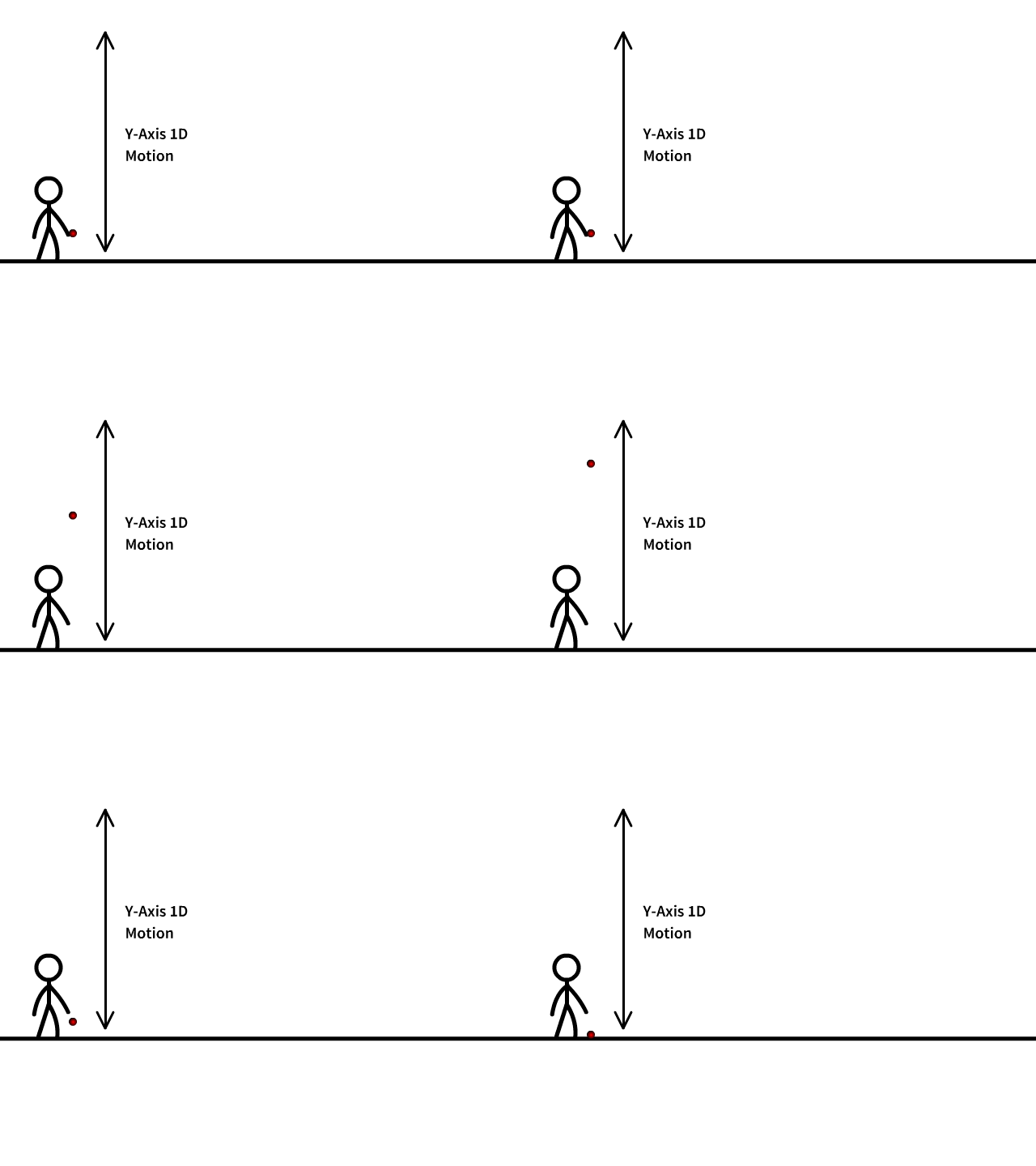
المثال 1: قذف كرة رأسيًا إلى أعلى.
Example 1: throwing a ball vertically upward.
قُذف جسم رأسيًا إلى أعلى بسرعة \(20\ \mathrm{m/s}\). أوجد الزمن اللازم للوصول إلى أقصى ارتفاع وأقصى ارتفاع يبلغه (\(g=9.81\ \mathrm{m/s^2}\)).
A body is thrown vertically upward at \(20\ \mathrm{m/s}\). Find the time needed to reach the maximum height and the maximum height reached (\(g=9.81\ \mathrm{m/s^2}\)).
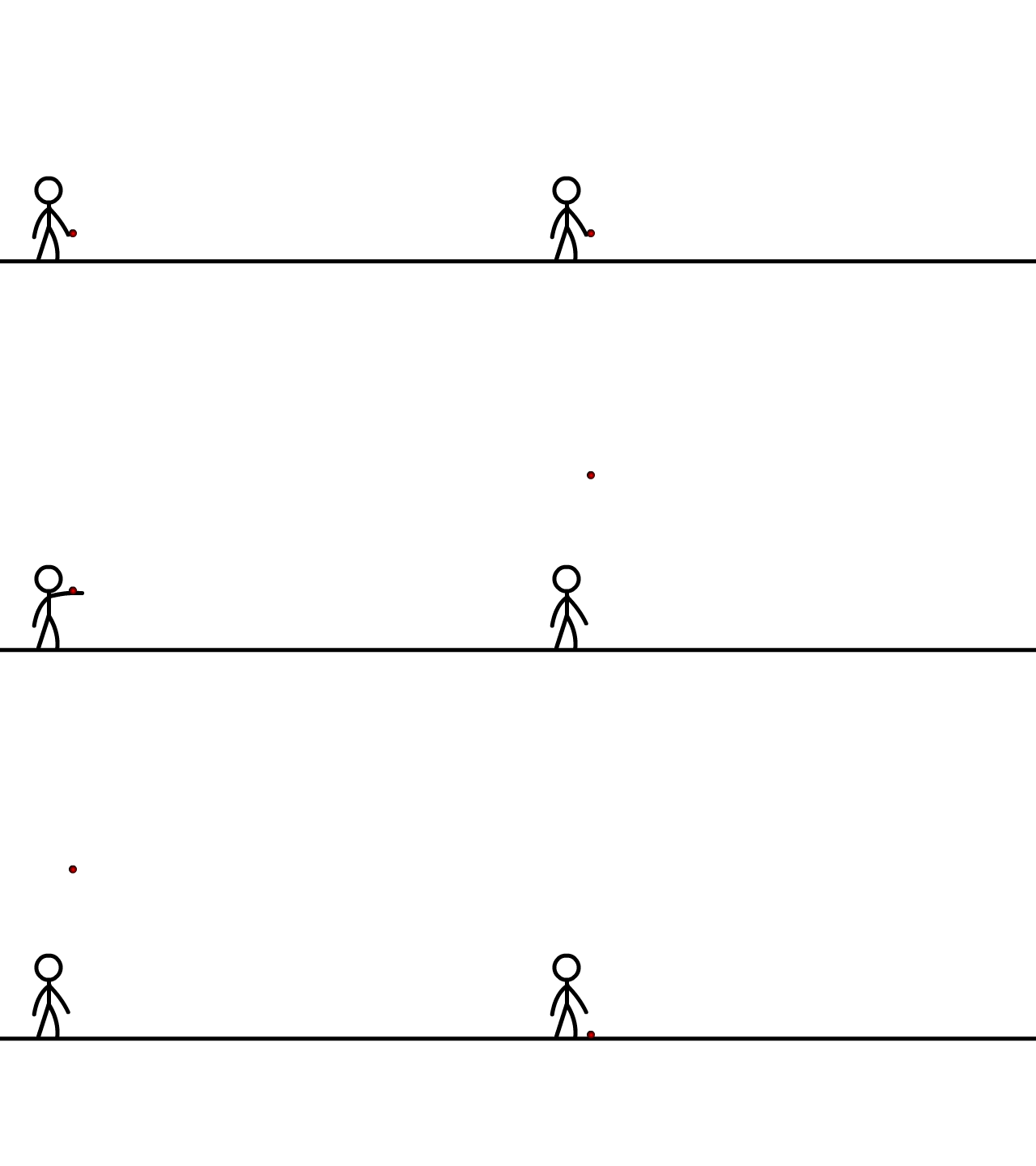
المثال 2: حجر مقذوف رأسيًا إلى أعلى.
Example 2: a stone thrown vertically upward.
قُذف حجر رأسيًا إلى أعلى بسرعة ابتدائية. ما تسارعه لحظة وصوله إلى أقصى ارتفاع؟
A stone is thrown vertically upward with an initial velocity. What is its acceleration at the moment it reaches the maximum height?
قُذف جسم رأسيًا إلى أعلى بسرعة \(15\ \mathrm{m/s}\) (\(g=10\ \mathrm{m/s^2}\)). أوجد زمن الصعود وأقصى ارتفاع وسرعته وارتفاعه بعد \(3\ \mathrm s\).
A body is thrown vertically upward at \(15\ \mathrm{m/s}\) (\(g=10\ \mathrm{m/s^2}\)). Find the time of rise, the maximum height, and its velocity and height after \(3\ \mathrm s\).
قُذف جسم رأسيًا إلى أعلى بسرعة \(10\ \mathrm{m/s}\) من حافة مبنى ارتفاعه \(15\ \mathrm m\) (\(g=10\ \mathrm{m/s^2}\)). أوجد زمن وصوله إلى الأرض وسرعة ارتطامه.
A body is thrown vertically upward at \(10\ \mathrm{m/s}\) from the edge of a \(15\ \mathrm m\) high building (\(g=10\ \mathrm{m/s^2}\)). Find the time to reach the ground and its impact velocity.
🧪 جرّب بنفسك: حاسبة المقذوف الرأسي
🧪 Try It Yourself: the Vertical Projectile Calculator
🧪 تجربة 2: حاسبة المقذوف الرأسي
🧪 Experiment 2: Vertical Projectile Calculator
لكل مقذوف سرعة قذف \(v_0\) وزمن \(t\). احسب أقصى ارتفاع والسرعة عند الزمن \(t\) وزمن العودة للأرض وسرعة الارتطام ثم اضغط «تحقّق» (اضغط «بيانات جديدة» لمسألة أخرى).
Each projectile has a launch speed \(v_0\) and a time \(t\). Find the maximum height, the velocity at time \(t\), the time to return to the ground and the impact velocity, then press “Check” (press “New data” for another problem).
⚠️ أخطاء شائعة
⚠️ Common Mistakes
تجنّب هذه الأخطاء
Avoid these mistakes
- اعتبار التسارع صفرًا عند القمة، والصحيح \(a=-g\) دائمًا.Taking the acceleration as zero at the top; it is always \(a=-g\).
- إهمال الإشارات: التسارع سالب والسرعة سالبة أثناء الهبوط.Neglecting signs: the acceleration is negative and the velocity is negative while falling.
- الظن أن زمن الرحلة \(v_0/g\)؛ هذا زمن الصعود فقط، والرحلة كلها \(2v_0/g\).Thinking that the flight time is \(v_0/g\); that is only the time of rise, the whole flight is \(2v_0/g\).
- الظن أن الجسم الأثقل يصعد أو يهبط أسرع: التسارع \(g\) لا يعتمد على الكتلة (مع إهمال الهواء).Thinking that a heavier body rises or falls faster: the acceleration \(g\) does not depend on the mass (neglecting air).
📝 ملخص الدرس
📝 Lesson Summary
أهم ما تعلمناه
Key points
- المقذوف الرأسي يتحرك بتسارع ثابت \(a=-g\) (الأعلى موجب).A vertical projectile moves with a constant acceleration \(a=-g\) (up is positive).
- \(v=v_0-gt\) و\(h=v_0t-\tfrac12gt^2\) و\(v^2=v_0^2-2gh\).\(v=v_0-gt\), \(h=v_0t-\tfrac12gt^2\) and \(v^2=v_0^2-2gh\).
- عند القمة \(v=0\): \(t_{up}=v_0/g\) و\(h_{max}=v_0^2/2g\).At the top \(v=0\): \(t_{up}=v_0/g\) and \(h_{max}=v_0^2/2g\).
- الرحلة من الأرض وإليها تستغرق \(2v_0/g\) وتنتهي بسرعة \(-v_0\).A flight from and back to the ground takes \(2v_0/g\) and ends with velocity \(-v_0\).
🎲 تدرّب على المسائل
🎲 Practice Problems
🧪 تجربة 3: تدرّب: مسائل المقذوف الرأسي
🧪 Experiment 3: Practice: Vertical Projectile Problems
مسائل عشوائية بأرقام مختلفة. احسب واكتب الجواب ثم اضغط «تحقّق».
Random problems with different numbers. Work it out, enter the answer and press “Check”.
✅ قيّم نفسك
✅ Self-Check
قُذف جسم رأسيًا إلى أعلى بسرعة \(30\ \mathrm{m/s}\) (\(g=10\ \mathrm{m/s^2}\)). زمن الصعود إلى القمة:
A body is thrown vertically upward at \(30\ \mathrm{m/s}\) (\(g=10\ \mathrm{m/s^2}\)). The time to reach the top:
في السؤال السابق، أقصى ارتفاع يبلغه الجسم:
In the previous question, the maximum height reached by the body:
سرعة جسم مقذوف رأسيًا لحظة وصوله إلى أقصى ارتفاع:
The velocity of a vertically thrown body at the moment it reaches the maximum height:
تسارع جسم مقذوف رأسيًا أثناء هبوطه (الأعلى موجب):
The acceleration of a vertically thrown body while it is falling (up is positive):
🧪 اختبر نفسك: امتحان من 20 سؤالاً
🧪 Test Yourself: a 20-Question Exam
أنهِ الدرس بالاختبار التفاعلي التالي؛ أسئلته تجمع بين الفهم والحساب وتغطي جميع أقسام الدرس.
Finish with the interactive exam below; its questions mix understanding with calculation and cover every section of the lesson.
اختبار المقذوف الرأسي Vertical Projectile Quiz
20 سؤالاً - معادلات الحركة الرأسية، أقصى ارتفاع، زمن الصعود والهبوط، سرعة الارتطام والتسارع 20 Questions - equations of vertical motion, maximum height, time of rise and fall, impact speed and acceleration
• عدد الأسئلة: 20 سؤالاً
• مدة الاختبار: 30 دقيقة
• لا يمكنك تغيير إجاباتك أو إعادة الاختبار إلا بعد 24 ساعة من التسليم.
• تأكد من إجاباتك قبل التسليم! 📌 Important Instructions:
• Number of questions: 20 questions
• Quiz duration: 30 minutes
• You cannot change your answers or retake the quiz for 24 hours after submission.
• Make sure of your answers before submitting!
🔗 محاكيات GeoGebra للاستعانة بها عند اللزوم
🔗 GeoGebra Simulations to Use When Needed
اضغط «تشغيل» لتعمل المحاكاة هنا داخل الدرس؛ ويمكن للطالب الرجوع إليها لتجربة الفكرة بطريقة أخرى.
Press “Run” to run the simulation right here inside the lesson; the student can use it to try the idea in another way.