🎯 نواتج التعلم
🎯 Learning Outcomes
بعد دراسة هذا الدرس ستكون قادرًا على أن:
After this lesson you will be able to:
- تعرّف المسافة بأنها كمية عددية موجبة، والإزاحة بأنها كمية متجهة.Define distance as a positive scalar quantity and displacement as a vector quantity.
- تحدد الموضع على خط الأعداد وتحسب الإزاحة من العلاقة \(\Delta x=x_f-x_i\) وتفسّر إشارتها.Locate positions on a number line, calculate displacement from \(\Delta x=x_f-x_i\) and interpret its sign.
- تحسب المسافة والإزاحة لجسم يتحرك في اتجاه واحد أو يغيّر اتجاهه.Calculate the distance and displacement of a body that moves in one direction or reverses.
- تقارن بين المسافة والإزاحة وتدرك أن المسافة تعتمد على المسار وأن الإزاحة لا تعتمد عليه.Compare distance and displacement and recognise that distance depends on the path while displacement does not.
- تطبّق ذلك على الحركة الدائرية وعلى الحركة التي تعود إلى نقطة البداية.Apply this to circular motion and to motion that returns to the starting point.
📍 الموضع على خط الأعداد
📍 Position on a Number Line
لوصف حركة جسم نحتاج أولًا إلى نقطة إسناد (الصفر) واتجاه موجب. في الحركة على خط مستقيم نرسم محور \(x\) فتكون المواضع يمين الصفر موجبة والمواضع يساره سالبة. ويُسمّى موضع الجسم عند بدء الحركة الموضع الابتدائي \(x_i\)، وعند انتهائها الموضع النهائي \(x_f\).
To describe the motion of a body we first need a reference point (zero) and a positive direction. For motion along a straight line we draw an \(x\) axis: positions to the right of zero are positive and to its left negative. The position at the start of the motion is the initial position \(x_i\) and at its end the final position \(x_f\).
📏 المسافة
📏 Distance
المسافة هي الطول الكلي للمسار الذي قطعه الجسم أثناء حركته. وهي كمية عددية (قياسية) لها مقدار فقط ولا اتجاه لها، وقيمتها موجبة دائمًا (أو صفر إذا لم يتحرك الجسم)، ووحدتها المتر \(\mathrm{m}\). وفي الحركة على خط مستقيم دون رجوع تساوي المسافة القيمة المطلقة للفرق بين الموضعين، أما إذا تغيّر الاتجاه فنجمع أطوال كل حركة على حدة.
Distance is the total length of the path travelled by a body during its motion. It is a scalar quantity: it has magnitude only and no direction, it is always positive (or zero if the body does not move), and its unit is the metre \(\mathrm{m}\). For motion along a straight line with no reversal the distance is the absolute value of the difference of the two positions; if the direction changes we add up the lengths of each movement separately.
📌 المسافة
📌 Distance
حركة في اتجاه واحد (بلا رجوع):
Motion in one direction (no reversal):
\[S=|x_f-x_i|\]
حركة تتغير فيها الاتجاه مرة واحدة عند \(x_m\):
Motion that reverses once at \(x_m\):
\[S=|x_m-x_i|+|x_f-x_m|\]
➡️ الإزاحة
➡️ Displacement
الإزاحة هي التغيّر في موضع الجسم، أي الفرق بين موضعه في نهاية الحركة وموضعه عند بدايتها؛ وهي بذلك أقصر مسافة مستقيمة بين البداية والنهاية مع الاتجاه من البداية إلى النهاية. وهي كمية متجهة لها مقدار واتجاه، فتكون موجبة أو سالبة أو صفرًا. وعندما يتحرك جسم من الموضع \(x_i\) إلى الموضع \(x_f\) تُعطى إزاحته بالعلاقة:
Displacement is the change in the position of the body, i.e. the difference between its position at the end of the motion and at its start; it is therefore the shortest straight-line separation from the start to the end together with the direction from the start to the end. It is a vector quantity with magnitude and direction, so it can be positive, negative or zero. When a body moves from the position \(x_i\) to the position \(x_f\) its displacement is given by:
📌 الإزاحة
📌 Displacement
\[\Delta x=x_f-x_i\]
💡 كيف نقرأ إشارة الإزاحة؟
💡 How do we read the sign of the displacement?
- \(\Delta x\gt 0\): النهاية على يمين البداية، أي أن الإزاحة في الاتجاه الموجب (نحو اليمين/الشرق).\(\Delta x\gt 0\): the end is to the right of the start, i.e. the displacement is in the positive direction (right/east).
- \(\Delta x\lt 0\): النهاية على يسار البداية، أي أن الإزاحة في الاتجاه السالب (نحو اليسار/الغرب).\(\Delta x\lt 0\): the end is to the left of the start, i.e. the displacement is in the negative direction (left/west).
- \(\Delta x=0\): عاد الجسم إلى نقطة البداية، مهما كانت المسافة التي قطعها.\(\Delta x=0\): the body returned to the starting point, however large the distance it travelled.
ولاحظ أن الإزاحة تُحسب دائمًا النهاية − البداية (وليس العكس)، وأن قيمتها لا تتأثر بما حدث بين النقطتين؛ فلو غيّر الجسم اتجاهه عدة مرات تبقى إزاحته محددة بالموضعين الأول والأخير فقط.
Note that displacement is always calculated as end − start (not the reverse) and it is not affected by what happened between the two points; even if the body reverses several times its displacement is fixed by the first and last positions only.
🧪 جرّب بنفسك: المسافة والإزاحة على خط مستقيم
🧪 Try It Yourself: Distance and Displacement on a Line
🧪 تجربة 1: المسافة والإزاحة على خط مستقيم
🧪 Experiment 1: Distance and Displacement on a Straight Line
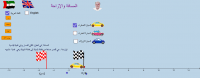
حدّد موضع البداية \(x_i\) ونقطة الالتفاف \(x_m\) والنهاية \(x_f\) ثم اضغط «تشغيل» لتتحرك السيارة، وراقب المسافة \(S\) تتراكم دائمًا بينما تتغير الإزاحة \(\Delta x\) بإشارتها.
Choose the start \(x_i\), the turning point \(x_m\) and the end \(x_f\), then press “Play” to move the car and watch the distance \(S\) always accumulate while the displacement \(\Delta x\) changes with its sign.
✏️ أمثلة محلولة
✏️ Worked Examples

المثال 1: \(80\ \mathrm m\) ثم \(50\ \mathrm m\) شرقًا ثم \(160\ \mathrm m\) غربًا.
Example 1: \(80\ \mathrm m\) then \(50\ \mathrm m\) east then \(160\ \mathrm m\) west.
تحرك أحمد نحو الشرق مسافة \(80\ \mathrm m\) ثم تابع سيره بنفس الاتجاه مسافة \(50\ \mathrm m\) ثم غيّر اتجاهه وقطع مسافة \(160\ \mathrm m\) غربًا. أوجد المسافة والإزاحة المقطوعتين (اعتبر الشرق موجبًا).
Ahmed moved east a distance of \(80\ \mathrm m\) then continued in the same direction \(50\ \mathrm m\) then changed direction and travelled \(160\ \mathrm m\) west. Find the distance and displacement travelled (east is positive).

المثال 2: من \(-4\) إلى \(+8\) ثم إلى \(-2\).
Example 2: from \(-4\) to \(+8\) then to \(-2\).
تحرك أحمد من الموقع \(-4\ \mathrm m\) إلى الموقع \(+8\ \mathrm m\) ثم غيّر اتجاهه وتحرك إلى الموقع \(-2\ \mathrm m\). أوجد المسافة والإزاحة المقطوعتين.
Ahmed moved from position \(-4\ \mathrm m\) to position \(+8\ \mathrm m\) then reversed and moved to position \(-2\ \mathrm m\). Find the distance and displacement travelled.
سارت سيارة من الموضع \(0\) إلى الموضع \(+30\ \mathrm m\) ثم عادت إلى الموضع \(0\). أوجد المسافة والإزاحة.
A car moved from position \(0\) to position \(+30\ \mathrm m\) then returned to position \(0\). Find the distance and displacement.
🧮 خطوات الحساب
🧮 Calculation Steps
| الحالةCase | المسافة المقطوعةDistance | الإزاحةDisplacement |
|---|---|---|
| حركة واحدة بلا رجوعOne movement, no reversal | \(S=|x_f-x_i|\) | \(\Delta x=x_f-x_i\) |
| حركتان وتغيّر اتجاه (الالتفاف عند \(x_m\))Two movements with a reversal (at \(x_m\)) | \(S=|x_m-x_i|+|x_f-x_m|\) | \(\Delta x=x_f-x_i\) |
| العودة إلى نقطة البدايةReturning to the start | ضعف المسافة في اتجاه واحدTwice the one-way distance | \(\Delta x=0\) |
الفرق في الحساب: المسافة تحتاج إلى كل نقاط الحركة (البداية والالتفاف والنهاية)، أما الإزاحة فتحتاج إلى البداية والنهاية فقط، وتُهمل نقطة الالتفاف.
The difference in calculation: the distance needs all the points of the motion (start, turning and end) while the displacement needs only the start and the end, and the turning point is ignored.
🧪 جرّب بنفسك: حاسبة السيارات
🧪 Try It Yourself: the Cars Calculator
🧪 تجربة 3: حاسبة المسافة والإزاحة للسيارات الثلاث
🧪 Experiment 3: Distance and Displacement Calculator for Three Cars
لكل سيارة موضع بداية (علم أخضر) ونهاية (علم أحمر)، والصفراء والزرقاء تغيّران اتجاههما عند علم برتقالي. احسب المسافة والإزاحة لكل سيارة ثم اضغط «تحقّق» (اضغط «بيانات جديدة» لمسألة أخرى).
Each car has a start (green flag) and an end (red flag); the yellow and blue cars reverse at an orange flag. Calculate the distance and displacement of each car then press “Check” (press “New data” for another problem).
⚖️ مقارنة بين المسافة والإزاحة
⚖️ Comparison between Distance and Displacement
| الخاصيةProperty | المسافةDistance | الإزاحةDisplacement |
|---|---|---|
| الطبيعةNature | كمية عددية (مقدار فقط)Scalar (magnitude only) | كمية متجهة (مقدار واتجاه)Vector (magnitude and direction) |
| الرمزSymbol | \(S\) (or \(d\)) | \(\Delta x\) |
| القيمةValue | موجبة دائمًاAlways positive | موجبة أو سالبة أو صفرPositive, negative or zero |
| الاتجاهDirection | لا يوجدNone | يوجدHas direction |
| الاعتماد على المسارPath dependence | تعتمد على المسارDepends on the path | لا تعتمد على المسار (البداية والنهاية فقط)Does not depend on the path (start and end only) |
| العلاقة بينهماRelation between them | \(S\ge|\Delta x|\) | يساوي المسافة فقط عند الحركة في اتجاه واحدEquals the distance only for motion in one direction |
| العلاقة الرياضيةMathematical relation | مجموع أطوال المسارSum of the path lengths | \(\Delta x=x_f-x_i\) |
| الوحدةUnit | المتر \(\mathrm m\)Metre \(\mathrm m\) | المتر \(\mathrm m\)Metre \(\mathrm m\) |
| الحركة الدائرية (دورة كاملة)Circular motion (a full lap) | محيط الدائرة \(2\pi r\)The circumference \(2\pi r\) | صفر (العودة لنقطة البداية)Zero (back at the start) |
🧪 جرّب بنفسك: الإزاحة واحدة والمسار مختلف
🧪 Try It Yourself: One Displacement, Different Paths
🧪 تجربة 2: الإزاحة واحدة والمسار مختلف
🧪 Experiment 2: One Displacement, Different Paths
من النقطة \(A\) إلى النقطة \(B\) (على بعد \(100\ \mathrm m\)) اختر مسارًا: مستقيمًا أو منكسرًا أو منحنيًا أو ذهابًا وإيابًا أو دورة كاملة، وشاهد كيف تتغير المسافة بينما تبقى الإزاحة محددة بالبداية والنهاية فقط.
From point \(A\) to point \(B\) (\(100\ \mathrm m\) apart) choose a path: straight, broken, curved, there-and-back or a full circle, and see how the distance changes while the displacement depends only on the start and the end.
🔄 الحركة الدائرية
🔄 Circular Motion
عندما يدور جسم على مسار دائري نصف قطره \(r\): بعد نصف دورة تكون المسافة \(\pi r\) ومقدار الإزاحة \(2r\) (قطر الدائرة)، وبعد دورة كاملة تكون المسافة \(2\pi r\) والإزاحة صفرًا لأن الجسم عاد إلى نقطة البداية.
When a body moves on a circular path of radius \(r\): after half a lap the distance is \(\pi r\) and the magnitude of the displacement is \(2r\) (the diameter); after a full lap the distance is \(2\pi r\) and the displacement is zero because the body returned to its starting point.
ركض عدّاء دورة ونصفًا على مضمار دائري نصف قطره \(50\ \mathrm m\) بدءًا من نقطة على المضمار. أوجد المسافة المقطوعة ومقدار الإزاحة.
A runner ran one and a half laps on a circular track of radius \(50\ \mathrm m\) starting from a point on the track. Find the distance travelled and the magnitude of the displacement.
⚠️ أخطاء شائعة
⚠️ Common Mistakes
تجنّب هذه الأخطاء
Avoid these mistakes
- جمع الإزاحات بدل المسافات: المسافة تُجمع بالقيم المطلقة لكل حركة، أما الإزاحة فتُحسب من الطرفين فقط.Adding displacements instead of distances: the distance is added with the absolute values of each movement while the displacement comes from the two ends only.
- الظن أن المسافة قد تكون سالبة: المسافة موجبة دائمًا، والسالب يخص الإزاحة وحدها.Thinking that distance can be negative: distance is always positive, the negative sign belongs to displacement only.
- عكس الطرح (البداية − النهاية): الإزاحة دائمًا النهاية − البداية.Reversing the subtraction (start − end): displacement is always end − start.
- الظن أن الإزاحة الصفرية تعني أن الجسم لم يتحرك: قد يكون قطع مسافة كبيرة وعاد إلى مكانه.Thinking that zero displacement means the body did not move: it may have travelled a large distance and come back.
📝 ملخص الدرس
📝 Lesson Summary
أهم ما تعلمناه
Key points
- المسافة: الطول الكلي للمسار، كمية عددية موجبة وتعتمد على المسار.Distance: the total path length, a positive scalar that depends on the path.
- الإزاحة: \(\Delta x=x_f-x_i\)، كمية متجهة تعتمد على البداية والنهاية فقط.Displacement: \(\Delta x=x_f-x_i\), a vector that depends on the start and the end only.
- دائمًا \(S\ge|\Delta x|\)، وتتساويان عند الحركة في اتجاه واحد دون رجوع.Always \(S\ge|\Delta x|\); they are equal for motion in one direction with no reversal.
- عند العودة إلى نقطة البداية (مثل دورة كاملة) تكون الإزاحة صفرًا.When the body returns to the start (e.g. a full lap) the displacement is zero.
🎲 تدرّب على المسائل
🎲 Practice Problems
🧪 تجربة 4: تدرّب: مسائل المسافة والإزاحة
🧪 Experiment 4: Practice: Distance and Displacement Problems
مسائل عشوائية بأرقام مختلفة. احسب واكتب الجواب ثم اضغط «تحقّق».
Random problems with different numbers. Work it out, enter the answer and press “Check”.
✅ قيّم نفسك
✅ Self-Check
تحرك جسم \(40\ \mathrm m\) شرقًا ثم \(15\ \mathrm m\) غربًا (الشرق موجب). الإزاحة تساوي:
A body moved \(40\ \mathrm m\) east then \(15\ \mathrm m\) west (east is positive). The displacement equals:
في السؤال السابق، المسافة المقطوعة تساوي:
In the previous question, the distance travelled equals:
تحرك جسم من الموضع \(+6\ \mathrm m\) إلى الموضع \(-3\ \mathrm m\). الإزاحة:
A body moved from position \(+6\ \mathrm m\) to position \(-3\ \mathrm m\). The displacement:
أي العبارات صحيحة دائمًا؟
Which statement is always true?
🧪 اختبر نفسك: امتحان من 20 سؤالاً
🧪 Test Yourself: a 20-Question Exam
أنهِ الدرس بالاختبار التفاعلي التالي؛ أسئلته تجمع بين الفهم والحساب وتغطي جميع أقسام الدرس.
Finish with the interactive exam below; its questions mix understanding with calculation and cover every section of the lesson.
اختبار المسافة والإزاحة Distance and Displacement Quiz
20 سؤالاً - المسافة والإزاحة، الكمية العددية والمتجهة، الموضع، الحركة في اتجاهين، المسار والحركة الدائرية 20 Questions - distance and displacement, scalars and vectors, position, motion with a reversal, path and circular motion
• عدد الأسئلة: 20 سؤالاً
• مدة الاختبار: 30 دقيقة
• لا يمكنك تغيير إجاباتك أو إعادة الاختبار إلا بعد 24 ساعة من التسليم.
• تأكد من إجاباتك قبل التسليم! 📌 Important Instructions:
• Number of questions: 20 questions
• Quiz duration: 30 minutes
• You cannot change your answers or retake the quiz for 24 hours after submission.
• Make sure of your answers before submitting!
🔗 محاكيات GeoGebra للاستعانة بها عند اللزوم
🔗 GeoGebra Simulations to Use When Needed
اضغط «تشغيل» لتعمل المحاكاة هنا داخل الدرس؛ ويمكن للطالب الرجوع إليها لتجربة الفكرة بطريقة أخرى.
Press “Run” to run the simulation right here inside the lesson; the student can use it to try the idea in another way.