🎯 نواتج التعلم
🎯 Learning Outcomes
بعد هذا الدرس ستكون قادرًا على أن:
After this lesson you will be able to:
- تحسب شدة المجال الكهربائي لشحنة نقطية بالعلاقة \(E=\dfrac{kq}{r^2}\)، وتحدد اتجاهه.Calculate the electric field of a point charge using \(E=\dfrac{kq}{r^2}\), and determine its direction.
- تطبق مبدأ التراكب لجمع مجالات عدة شحنات اتجاهيًا، وتحدد الموضع الذي ينعدم فيه المجال.Apply the superposition principle to add the fields of several charges as vectors, and locate where the field vanishes.
- تحسب القوة على شحنة في مجال بالعلاقة \(F=qE\)، والمجال المنتظم بين لوحين بالعلاقة \(E=\dfrac{V}{d}\).Calculate the force on a charge in a field using \(F=qE\), and the uniform field between two plates using \(E=\dfrac{V}{d}\).
- تعرّف التدفق الكهربائي \(\Phi=EA\cos\theta\)، وتطبق قانون غاوس \(\Phi=\dfrac{q_{\text{enc}}}{\varepsilon_0}\).Define electric flux \(\Phi=EA\cos\theta\), and apply Gauss's law \(\Phi=\dfrac{q_{\text{enc}}}{\varepsilon_0}\).
- تستنتج المجال لتوزيعات متماثلة (سلك لا نهائي، وصفيحة لا نهائية، وكرة مشحونة، وموصل مجوف)، وتفسر حماية الموصل المجوف من المجالات.Deduce the field for symmetric distributions (an infinite wire, an infinite sheet, a charged sphere and a hollow conductor), and explain how a hollow conductor shields from fields.
⚡ القسم الأول: المجال الكهربائي
⚡ Part One: The Electric Field
المجال الكهربائي هو منطقة تحيط بالشحنة وتظهر فيها آثار القوة الكهربائية، وهو عبارة عن محصلة القوة الكهربائية المؤثرة على شحنة اختبار مقسومة على تلك الشحنة. المجال الكهربائي كمية متجهة لها مقدار واتجاه.
The electric field is the region surrounding a charge where the effects of the electric force appear. It equals the electric force on a test charge divided by that charge. The electric field is a vector quantity with magnitude and direction.
🧭 تحديد اتجاه المجال الكهربائي
🧭 Determining the Direction of the Electric Field
📌 الطريقة الأولى: نضع شحنة اختبار عند النقطة المطلوب تحديد اتجاه المجال عندها. إذا كانت شحنة الاختبار موجبة فإن اتجاه المجال بنفس اتجاه القوة، وإذا كانت سالبة فإن اتجاه المجال عكس اتجاه القوة الكهربائية.
📌 Method 1: Place a test charge at the point where the direction is needed. If the test charge is positive, the field direction matches the force direction; if negative, the field direction is opposite to the force.

🧪 تجربة تفاعلية لتحديد اتجاه المجال الكهربائي
🧪 Interactive Experiment: Field Direction
شرح التجربة:
1. حدّد شحنة المصدر (موجبة أو سالبة) باستخدام الأزرار أدناه
2. انقر على لوحة الرسم لوضع شحنة الاختبار (سيُسألك عن نوعها)
3. سيظهر اتجاه القوة المؤثرة على شحنة الاختبار واتجاه المجال الكهربائي
4. إذا كانت شحنة الاختبار موجبة، فإن اتجاه المجال بنفس اتجاه القوة
5. إذا كانت شحنة الاختبار سالبة، فإن اتجاه المجال عكس اتجاه القوة
Experiment steps:
1. Choose the source charge sign using the buttons below
2. Click the canvas to place a test charge (you'll be asked its sign)
3. The force and field directions on the test charge will be drawn
4. Positive test charge → field direction matches the force
5. Negative test charge → field direction is opposite to the force
\[1 \star\]\[1 \star\]
أحد وحدات القياس التالية تكافئ وحدة قياس المجال الكهربائيWhich of the following units is equivalent to the unit of electric field?
📌 الطريقة الثانية: من خلال رسم خطوط المجال. خطوط المجال لشحنة موجبة خارجة من الشحنة، وخطوط المجال لشحنة سالبة داخلة على الشحنة.
📌 Method 2: By drawing field lines. Field lines for a positive charge emerge outward; for a negative charge they converge inward.
🧪 تجربة 1: خطوط المجال لشحنة نقطية
🧪 Experiment 1: Field Lines of a Point Charge
اختر إشارة الشحنة وكميتها، ثم اسحب النقطة الصفراء لتقيس شدة المجال عند بعد r. تخرج الخطوط من الشحنة الموجبة وتدخل إلى الشحنة السالبة.
Choose the sign and magnitude of the charge, then drag the yellow point to measure the field at distance r. Lines leave a positive charge and enter a negative one.
🧪 تجربة 2: تخطيط المجال لشحنتين
🧪 Experiment 2: Field of Two Charges
اختر شحنتين متشابهتين أو مختلفتين وغيّر المسافة بينهما، ثم اسحب النقطة الصفراء لتقيس شدة المجال. لاحظ شكل الخطوط ومجالها عند المنتصف.
Choose two like or unlike charges and change the distance between them, then drag the yellow point to measure the field. Observe the line pattern and the field at the midpoint.
🧪 تجربة 3: المجال المنتظم بين لوحين متوازيين
🧪 Experiment 3: Uniform Field Between Parallel Plates
لوحان متوازيان مشحونان بشحنتين متساويتين ومتعاكستين. غيّر الجهد والبعد، وراقب أن الخطوط متوازية ومتساوية، وأن المجال E = V / d.
Two parallel plates carry equal and opposite charges. Change the voltage and separation, and observe that the lines are parallel and equally spaced, and that E = V / d.
🧭 صفات خطوط المجال الكهربائي
🧭 Properties of Electric Field Lines
- خطوط المجال لا تتقاطع أبداً، لأن للمجال اتجاهاً واحداً فقط عند كل نقطة.
- تخرج الخطوط من الشحنة الموجبة وتدخل إلى الشحنة السالبة، أو تمتد إلى اللانهاية إذا لم تجد شحنة سالبة.
- كثافة الخطوط تتناسب مع شدة المجال؛ فحيث تتقارب الخطوط يكون المجال أقوى، وحيث تتباعد يكون أضعف.
- المماس لخط المجال عند أي نقطة يحدد اتجاه المجال عندها.
- خطوط المجال الكهربائي الساكن لا تكون مغلقة، وتكون عمودية على سطح الموصل عند نقاطه.
- Field lines never cross, because the field has only one direction at each point.
- Lines leave a positive charge and enter a negative charge, or extend to infinity if there is no negative charge.
- The line density is proportional to the field strength: where the lines are close the field is stronger, and where they are far apart it is weaker.
- The tangent to a field line at any point gives the direction of the field at that point.
- Electrostatic field lines are never closed, and they are perpendicular to the surface of a conductor at its surface.
📏 المجال المنتظم وغير المنتظم
📏 Uniform and Non-Uniform Fields
المجال المنتظم: مجال تكون شدته واتجاهه ثابتين عند جميع النقاط في منطقته، وتكون خطوطه متوازية ومتساوية البعد.
مثال: المجال بين لوحين متوازيين مشحونين بشحنتين متساويتين ومتعاكستين، بعيداً عن حافتيهما.
Uniform field: a field whose magnitude and direction are constant at every point in its region, and whose lines are parallel and equally spaced.
Example: the field between two parallel plates with equal and opposite charges, away from their edges.
المجال غير المنتظم: مجال تتغير شدته أو اتجاهه (أو كلاهما) من نقطة إلى أخرى، وتكون خطوطه متباعدة أو متقاربة أو غير متوازية.
مثال: المجال حول شحنة نقطية، إذ تقل شدته كلما ابتعدنا عن الشحنة.
Non-uniform field: a field whose magnitude or direction (or both) changes from point to point, and whose lines are spaced unevenly or are not parallel.
Example: the field around a point charge, which weakens as we move away from the charge.
📝 أسئلة اختيار من متعدد
📝 Multiple Choice Questions
\[2 \star\]\[2 \star\]
بالنظر إلى الصورة، ما اتجاه خطوط المجال الكهربائي حول الشحنة الموجبة وحول الشحنة السالبة؟Looking at the figure, what is the direction of the field lines around the positive charge and around the negative charge?
\[3 \star\]\[3 \star\]
شحنة نقطية مقدارها \(q\) يؤثر عند نقطة تبعد عنها مسافة \(r\) بمجال كهربائي شدته \(E\). إذا ضوعفت الشحنة وقُلّلت المسافة إلى النصف، فما الشدة الجديدة للمجال عند النقطة نفسها؟A point charge \(q\) produces an electric field of magnitude \(E\) at a point at distance \(r\) from it. If the charge is doubled and the distance is halved, what is the new field magnitude at the same point?
\[3 \star\]\[3 \star\]
وُضعت شحنة نقطية \(q_1=+4\,\mu C\) عند نقطة الأصل، وشحنة نقطية \(q_2=-1\,\mu C\) عند الموضع \(x=3\,m\) على المحور \(x\). عند أي موضع على المحور \(x\) تكون شدة المجال الكهربائي الكلي مساوية للصفر؟A point charge \(q_1=+4\,\mu C\) is placed at the origin and a point charge \(q_2=-1\,\mu C\) at \(x=3\,m\) on the \(x\)-axis. At which position on the \(x\)-axis is the net electric field zero?
📐 المجال الكهربائي الناتج عن الشحنات النقطية
📐 The Field of Point Charges
📝 مثال محلول 1
📝 Worked Example 1
شحنتان نقطيتان \(q_1=-6\,\mu C\)، \(q_2=4\,\mu C\). وُضعت الأولى عند نقطة الأصل، والثانية عند الموضع \(X=5\,cm\). احسب المجال الكهربائي عند الموضع \(X=8\,cm\)
Two point charges \(q_1=-6\,\mu C\), \(q_2=4\,\mu C\). The first at the origin, the second at \(X=5\,cm\). Calculate the field at \(X=8\,cm\)

الحل:
\(E_1=K.\dfrac{q_1}{r_1^2}=8.99\times10^9\times\dfrac{6\times10^{-6}}{0.08^2}=8.43\times10^6\,N/C\) نحو اليسار (بما أن \(q_1\) سالبة، مجالها يتجه نحوها)
\(E_2=K.\dfrac{q_2}{r_2^2}=8.99\times10^9\times\dfrac{4\times10^{-6}}{0.03^2}=39.95\times10^6\,N/C\) نحو اليمين (بعيدًا عن \(q_2\) الموجبة)
\(E_{net}=E_2-E_1=39.95\times10^6-8.43\times10^6=31.52\times10^6\,N/C\) نحو اليمين
Solution:
\(E_1=8.43\times10^6\,N/C\) to the left (toward negative \(q_1\))
\(E_2=39.95\times10^6\,N/C\) to the right (away from positive \(q_2\))
\(E_{net}=E_2-E_1=31.52\times10^6\,N/C\) to the right
📝 مثال محلول 2
📝 Worked Example 2
شحنتان نقطيتان \(q_1=-3\,nC\)، \(q_2=5\,nC\) وُضعتا على رؤوس مثلث كما في الشكل. احسب المجال الكهربائي عند الموضع \(A\)
Two point charges \(q_1=-3\,nC\), \(q_2=5\,nC\) at a triangle's vertices as shown. Calculate the field at point \(A\)

الحل:
\(E_1=K.\dfrac{q_1}{r_1^2}=8.99\times10^9\times\dfrac{3\times10^{-9}}{0.03^2}=29.9\times10^3\,N/C\) نحو اليسار
\(E_2=K.\dfrac{q_2}{r_2^2}=8.99\times10^9\times\dfrac{5\times10^{-9}}{0.04^2}=28.1\times10^3\,N/C\) نحو الأسفل
المركبتان متعامدتان: \(E_{net}=\sqrt{E_1^2+E_2^2}=\sqrt{(29.9\times10^3)^2+(28.1\times10^3)^2}=41.1\times10^3\,N/C\)
الاتجاه: \(\theta=\tan^{-1}\left(\dfrac{E_2}{E_1}\right)=\tan^{-1}\left(\dfrac{28.1}{29.9}\right)\approx43.2°\) عن اتجاه \(E_1\)
Solution:
\(E_1\approx29.9\times10^3\,N/C\) left; \(E_2\approx28.1\times10^3\,N/C\) down (perpendicular components)
\(E_{net}=\sqrt{E_1^2+E_2^2}\approx41.1\times10^3\,N/C\), at \(\theta\approx43.2°\) from \(E_1\)
🧪 تجربة 4: تراكب المجالات الكهربائية عند نقطة
🧪 Experiment 4: Superposition of Electric Fields at a Point
ثلاث شحنات نقطية حول النقطة P (0, 0). اعرض مجال كل شحنة واتجاهه، ثم مركباته، ثم المحصلة. غيّر قيمة كل شحنة بالمنزلق (موجبة أو سالبة أو صفر) ولاحظ تغيّر المحصلة.
Three point charges around point P (0, 0). Show each charge's field and direction, then its components, then the resultant. Change each charge with its slider (positive, negative or zero) and observe how the resultant changes.

(قراءة ذاتية) المجال الكهربائي لثنائي القطب
(Self-Study) The Electric Field of a Dipole


📝 مثال محلول: على امتداد المحور
📝 Worked Example: On the Axial Line
حساب المجال الناتج عن ثنائي القطب على امتداد محور الثنائي، عند نقطة تبعد عن مركزه مسافة \(X\)
Field of a dipole along its axis, at a point a distance \(X\) from its center
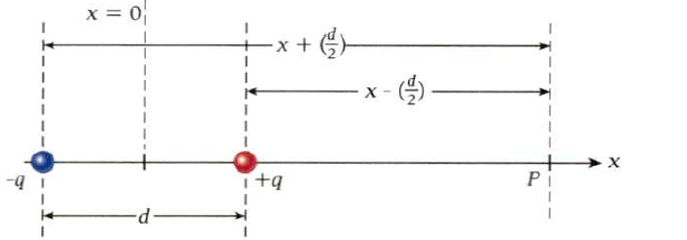
النقطة خاضعة لمجالين: من الشحنة الموجبة \(E_1=\dfrac{1}{4\pi\varepsilon_0}\dfrac{q}{(X-\frac12d)^2}\) نحو اليمين، ومن الشحنة السالبة \(E_2=\dfrac{1}{4\pi\varepsilon_0}\dfrac{q}{(X+\frac12d)^2}\) نحو اليسار.
بما أن \(E_1>E_2\)، فالمحصلة \(E_{net}=E_1-E_2\) نحو اليمين. بإخراج العامل المشترك وتوحيد المقامات ثم التبسيط بشرط \(X\gg d\):
\[E_{net}=\dfrac{2dq}{4\pi\varepsilon_0X^3}=\dfrac{dq}{2\pi\varepsilon_0X^3}=\dfrac{2kdq}{X^3}\]
الكمية \(P=q.d\) تسمى عزم ثنائي القطب، وهي كمية متجهة اتجاهها من الشحنة السالبة إلى الموجبة (عكس اتجاه المجال الداخلي بين الشحنتين).
The point is influenced by two fields: from the positive charge \(E_1\) (right), from the negative \(E_2\) (left), with \(E_1>E_2\), so \(E_{net}=E_1-E_2\) points right.
Combining and simplifying for \(X\gg d\): \[E_{net}=\dfrac{2kdq}{X^3}=\dfrac{2kp}{X^3}\]
The dipole moment \(P=q.d\) is a vector pointing from the negative to the positive charge.

📝 مثال محلول: على العمود المنصف
📝 Worked Example: On the Perpendicular Bisector
حساب المجال الناتج عن ثنائي القطب عند نقطة تقع على العمود المنصف للثنائي، وتبعد عن مركزه مسافة \(y\)
Field of a dipole at a point on its perpendicular bisector, a distance \(y\) from its center

بالتناظر، المركبتان الرأسيتان لمجالي الشحنتين متساويتان وتُلغيان تمامًا، وتبقى المركبتان الأفقيتان تُضافان. من الشكل \(r=\sqrt{(d/2)^2+y^2}\)، \(\cos\theta=\dfrac{d/2}{r}\)، فينتج:
\[E_{net}=-\dfrac{kqd}{[(d/2)^2+y^2]^{3/2}}\]
(الإشارة السالبة تعني أن الاتجاه عكس المحور الأفقي الموجب). إذا كان \(y\gg d\) فإن \(d/2\approx0\) وتصبح العلاقة \[E_{net}=-\dfrac{kqd}{y^3}\]
By symmetry, the vertical components cancel exactly, leaving only horizontal components, giving:
\[E_{net}=-\dfrac{kqd}{[(d/2)^2+y^2]^{3/2}}\]
For \(y\gg d\): \[E_{net}=-\dfrac{kqd}{y^3}\]
🧮 التوزيعات العامة للشحنات
🧮 General Charge Distributions
| على طول خطAlong a line | على مساحة سطحOver a surface | على حجم جسمOver a volume |
|---|---|---|
| \(dq=\lambda\,dx\) | \(dq=\delta\,dA\) | \(dq=\rho\,dV\) |
📝 (إثرائي) مثال محلول: مجال سلك محدود الطول
📝 (Enrichment) Field of a Finite-Length Wire
سلك طوله محدود ومشحون بشكل منتظم كما في الشكل. احسب مقدار واتجاه المجال عند نقطة تقع على امتداد الخط المقام عموديًا من منتصف السلك.
A uniformly charged wire of finite length as shown. Find the field at a point on the perpendicular bisector of the wire.

نأخذ شحنة صغيرة \(dq\) ونحسب مجالها ثم نُجري التكامل على كامل السلك. بالتناظر بين نصفَي السلك، المركبتان الأفقيتان لكل نصف متساويتان ومتعاكستان فتُلغيان، بينما المركبتان الرأسيتان متساويتان ومتفقتان في الاتجاه. من الشكل \(r=\sqrt{X^2+Y^2}\)، \(\cos\theta=Y/r\):
\[E=2\int_0^a dE_Y=2k\lambda Y\int_0^a\dfrac{dx}{(X^2+Y^2)^{3/2}}\]
وبإجراء التكامل (بوساطة الجداول):
\[E=2k\lambda\dfrac1Y\dfrac{a}{\sqrt{a^2+Y^2}}\]
حيث \(a\) هي طول نصف السلك.
Take a small charge element \(dq\), integrate over the wire; by symmetry the horizontal components cancel while vertical components add:
\[E=2k\lambda\dfrac1Y\dfrac{a}{\sqrt{a^2+Y^2}}\]
where \(a\) is half the wire's length.
حالة خاصة: سلك لا نهائي الطول
Special Case: Infinite Wire
💪 القوة الناتجة عن المجال الكهربائي
💪 The Force Resulting from an Electric Field
| المجال غير منتظمNon-uniform field | المجال منتظمUniform field |
|---|---|
 |  |
\[2 \star\]\[2 \star\]
وُضع جسيم موجب الشحنة داخل المجال الموضح بالشكل أدناه فإن أحد الإجابات التالية تعبّر عن حركة الجسمA positive charge is placed in the field shown below. Which describes its motion?

\[3 \star\]\[3 \star\]
تُركت كرة كتلتها \(m=5\,kg\) تسقط على الأرض وهي مشحونة بشحنة مقدارها \(q=5\,mC\)، فإن متجه المجال الكهربائي المنتظم الذي يجعلها متزنةA ball of mass \(m=5\,kg\) and charge \(q=5\,mC\) is falling. What uniform electric field vector keeps it in equilibrium?

📡 القسم الثاني: قانون جاوس
📡 Part Two: Gauss's Law

🌊 التدفق الكهربائي
🌊 Electric Flux

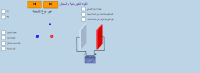
🧪 تجربة: التدفق عبر سطح في مجال منتظم
🧪 Experiment: Flux Through a Surface in a Uniform Field
مجال كهربائي منتظم E يتجه نحو اليمين. السطح المربع (المستطيل الوردي) متجه المساحة A العمودي عليه يصنع زاوية θ مع المجال. غيّر شدة المجال والمساحة والزاوية، ولاحظ أن التدفق Φ = E·A·cos θ يكون أكبر ما يمكن عند θ = 0 وصفراً عند θ = 90°.
A uniform field E points to the right. The pink rectangle is the surface, and its area vector A (normal to the surface) makes an angle θ with the field. Change the field, area and angle, and notice that Φ = E·A·cos θ is largest at θ = 0 and zero at θ = 90°.
📏 تمرين: سطح مربع
📏 Exercise: A Square Surface

| المجال يصنع زاوية 30° مع السطحField at 30° to the surface | المجال يصنع زاوية 30° مع العمود على السطحField at 30° to the normal |
|---|---|
| \(\varnothing=A.E.\cos(60°)=0.04\times500\times0.5=10\,\dfrac{N.m^2}{C}\) | \(\varnothing=A.E.\cos(30°)=0.04\times500\times0.866\approx17.3\,\dfrac{N.m^2}{C}\) |
| المجال عمودي على السطحField perpendicular to the surface | المجال يوازي السطحField parallel to the surface |
| \(\varnothing=A.E.\cos(0°)=0.04\times500\times1=20\,\dfrac{N.m^2}{C}\) | \(\varnothing=A.E.\cos(90°)=0.04\times500\times0=0\) |
📌 ملاحظة: الزاوية المستخدمة في \(\varnothing=A.E.\cos\theta\) هي دائمًا الزاوية بين المجال والعمود الخارج من السطح (وليست الزاوية مع السطح نفسه)، لذلك في الحالة الأولى استُخدم \(\cos(90°-30°)=\cos(60°)\).
📌 Note: the angle in \(\varnothing=A.E.\cos\theta\) is always measured from the surface normal, not the surface itself — hence \(\cos(60°)\) in the first case.
🧪 تجربة: التدفق عبر سطح بين لوحين مشحونين (ثلاثي الأبعاد)
🧪 Experiment: Flux Through a Surface Between Charged Plates (3D)
لوحان متوازيان: الموجب على اليمين والسالب على اليسار، والمجال منتظم يتجه من الموجب إلى السالب. المستطيل الشفاف هو السطح، وسهمه الأسود هو المتجه العمودي n عليه، وθ الزاوية بين n والمجال. أدر المشهد بالفأرة أو باللمس.
Two parallel plates: positive on the right and negative on the left, with a uniform field pointing from positive to negative. The translucent rectangle is the surface, its black arrow is the normal n, and θ is the angle between n and the field. Rotate the scene with the mouse or touch.
📝 مثال محلول: التدفق عبر مكعب
📝 Worked Example: Flux Through a Cube
مكعب طول ضلعه \(0.3\,m\) وُضع داخل مجال كهربائي منتظم يتجه نحو محور \(X\)، شدته \(E=200\,\dfrac{N}{C}\). احسب التدفق الذي يجتاز كل سطح والتدفق الكلي.
A cube of side \(0.3\,m\) in a uniform field along \(X\), \(E=200\,\dfrac{N}{C}\). Find the flux through each face and the net flux.

للمكعب ست أوجه: 1-أمامي، 2-خلفي، 3-علوي، 4-سفلي، 5-جانبي أيمن، 6-جانبي أيسر.
\(\varnothing_1=\varnothing_2=\varnothing_3=\varnothing_4=0\) لأن المجال يوازي هذه الأسطح.
\(\varnothing_5=A.E.\cos(0°)=(0.3\times0.3)\times200\times1=18\,\dfrac{N.m^2}{C}\)
\(\varnothing_6=A.E.\cos(180°)=(0.3\times0.3)\times200\times(-1)=-18\,\dfrac{N.m^2}{C}\)
التدفق الكلي: \(\varnothing_{net}=0+0+0+0+18-18=0\)
نتيجة هامة: إذا وضع جسم داخل مجال كهربائي منتظم أو غير منتظم (دون شحنة محصورة بداخله)، فإن التدفق الكلي عبره معدوم، لأن عدد الخطوط الداخلة إلى الجسم يساوي عدد الخطوط الخارجة منه.
Four faces are parallel to the field (zero flux each); the two remaining faces give \(\varnothing_5=+18\), \(\varnothing_6=-18\,\dfrac{N.m^2}{C}\).
Net flux \(=0\).
Key result: a closed surface with no enclosed charge always has zero net flux — the same number of lines enter as leave.
⚖️ قانون جاوس (استنتاج القانون من قانون كولوم)
⚖️ Gauss's Law (Derived from Coulomb's Law)

التدفق: \(d\varnothing=dA.E.\cos(\theta)\)
\[\varnothing=\oint dA.E.\cos(0)=E\oint dA=E.A=4\pi r^2.\dfrac{q}{4\pi\varepsilon_0r^2}\]
Flux: \(d\varnothing=dA.E.\cos(\theta)\)
\[\varnothing=E.A=4\pi r^2.\dfrac{q}{4\pi\varepsilon_0r^2}\]
نتائج من خلال قانون جاوس
Results from Gauss's Law
المجال الكهربائي داخل موصل معزول يساوي الصفر دائمًا. عند وضع موصل داخل مجال كهربائي، تتأثر شحناته بقوة المجال فتندفع الشحنات السالبة عكس المجال والموجبة باتجاهه، فيتكوّن مجال معاكس للمجال المؤثر، وتصبح محصلة المجال داخل الموصل معدومة.
The field inside an isolated conductor is always zero. When placed in an external field, the conductor's charges rearrange to create an opposing internal field, cancelling the net field inside.

🧪 تجربة: الموصل في مجال خارجي (حركة الإلكترونات)
🧪 Experiment: A Conductor in an External Field (Electron Motion)
عند تشغيل المجال الخارجي E₀ تتحرك الإلكترونات (الشحنات السالبة) عكس المجال، فتتكدس على الجانب الأيسر، ويظهر على الجانب الأيمن شحنات موجبة ثابتة بلا إلكترونات. هذه الشحنات المستحثة تولّد مجالاً داخلياً E′ يعاكس E₀ حتى تصبح المحصلة داخل الكرة صفراً.
When the external field E₀ is turned on, the electrons move opposite to it and pile up on the left side, leaving fixed positive charges on the right side. These induced charges create an internal field E′ opposing E₀, until the net field inside the sphere is zero.
تتكدس الإلكترونات على الجانب الأيسر، فيظهر وجه أيمن موجب (الشحنات الثابتة بلا إلكترونات). هذه الشحنات المستحثة تولد مجالاً معاكساً للمجال الخارجي.
Electrons pile up on the left side, leaving a positive right face (the fixed charges without electrons). These induced charges produce a field opposite to the external field.
التجاويف داخل الموصلات محمية من المجالات
Cavities Inside Conductors Are Shielded

🧪 التجربة التفاعلية: مولدا فاندوغراف والطائرة
🧪 Interactive Experiment: Two Van de Graaff Generators and an Airplane
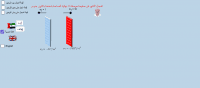
شغّل المولدين. في الكوب المعدني تبقى كرات نخاع البيلسان ساكنة، لأن المعدن يحجب المجال. وفي الكوب البلاستيكي تتطاير الكرات، لأن البلاستيك عازل يسمح بمرور المجال. وفي الوسط يظهر الركاب داخل الطائرة آمنين رغم الصاعقة.
Start both generators. Inside the metal cup the pith balls stay still, because the metal blocks the field. Inside the plastic cup the balls fly out, because plastic is an insulator that lets the field through. In the middle, the passengers in the airplane are safe despite the lightning.
🛡️ الموصل المجوف يحمي من المجال
🛡️ A hollow conductor shields from fields
📏 حساب المجال الناتج عن سلك طويل لا نهائي باستخدام قانون جاوس
📏 Field of an Infinite Wire, via Gauss's Law

لاحظ أن التدفق على قاعدتي الأسطوانة معدوم، لأن المجال عمودي على العمود الخارج من قاعدتيها. يبقى التدفق على السطح الجانبي، الذي مساحته \(A=2\pi r.L\):
\[\varnothing=\oint\vec E.\vec{dA}=\dfrac{q}{\varepsilon_0}\Rightarrow E.2\pi r.L=\dfrac{\lambda.L}{\varepsilon_0}\]
Flux through the cylinder's two end caps is zero (field is perpendicular to their normal); only the side surface (\(A=2\pi r.L\)) contributes:
\[E.2\pi r.L=\dfrac{\lambda.L}{\varepsilon_0}\]
\[4 \star\star\]\[4 \star\star\]
سلك طوله لا نهائي، حُسب المجال عند نقطة تبعد عن السلك \(0.3\,m\) فكانت قيمة المجال \(2.5\times10^3\,N/C\) والاتجاه موضح على الشكل، فإن عدد الإلكترونات المكتسبة أو المفقودة في وحدة الطول تعادلFor an infinite wire, the field at \(0.3\,m\) is \(2.5\times10^3\,N/C\) with the shown direction. The number of electrons gained or lost per unit length is:

📄 حساب المجال الناتج عن صفيحة غير موصلة لا نهائية المساحة
📄 Field of an Infinite Non-Conducting Sheet

التدفق على السطح الجانبي للأسطوانة معدوم (المجال عمودي على عمودها الخارج)؛ يبقى التدفق على قاعدتيها:
\[\varnothing=\oint dA_1.E_1.\cos(0)+\oint dA_2.E_2.\cos(0)=\dfrac{q}{\varepsilon_0}\Rightarrow E(A+A)=\dfrac{\delta.A}{\varepsilon_0}\]
Only the two end caps contribute flux:
\[E(A+A)=\dfrac{\delta.A}{\varepsilon_0}\]
📄 حساب المجال الناتج عن صفيحة موصلة لا نهائية المساحة
📄 Field of an Infinite Conducting Sheet

التدفق على السطح الجانبي معدوم، والمجال داخل الموصل معدوم أيضًا (وجه القاعدة الداخلية)، فيبقى التدفق على القاعدة الخارجية فقط:
\[\varnothing=\oint dA_1.E_1.\cos(0)=\dfrac{q}{\varepsilon_0}\Rightarrow E.A=\dfrac{\delta.A}{\varepsilon_0}\]
Only the outer face contributes (field inside the conductor is zero):
\[E.A=\dfrac{\delta.A}{\varepsilon_0}\]
🧪 التجربة التفاعلية: صفيحتان لا نهائيتان
🧪 Interactive Experiment: Two Infinite Sheets
غيّر كثافتي الشحنة والمسافة بين الصفيحتين، وحرّك النقطة P بالفأرة أو باللمس، وراقب الأسهم. اختر بين الصفيحة الموصلة والعازلة لترى الفرق في القيمة. اللون الأحمر للشحنة الموجبة والأزرق للسالبة.
Change the two charge densities and the separation, drag the point P with the mouse or touch, and watch the arrows. Choose between conducting and insulating sheets to see the difference. Red is positive and blue is negative.
➖ المجال الناتج عن صفيحتين لا نهائيتين
➖ The field of two infinite sheets
\[5 \star\]\[5 \star\]
لوحان لا نهائيان في الطول موصلان شُحنا بكثافة متساوية (متعاكستان في النوع، كما في الشكل)، فأي الإجابات التالية صحيحة؟Two infinite conducting plates charged with equal density (opposite signs, as shown). Which is correct?

🌐 التماثل الكروي
🌐 Spherical Symmetry
هيكل كروي (قشرة موصلة)
Spherical Shell (Conducting)

\[\varnothing=\oint\vec E.\vec{dA}=\dfrac{q}{\varepsilon_0}\Rightarrow E(4\pi r_2^2)=\dfrac{q}{\varepsilon_0}\]
\[E(4\pi r_2^2)=\dfrac{q}{\varepsilon_0}\]
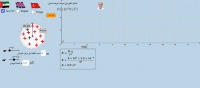
🧪 التجربة التفاعلية: المجال داخل الهيكل وخارجه
🧪 Interactive Experiment: The Field Inside and Outside the Shell
غيّر الشحنة وبعد النقطة r، وراقب سطح جاوس. داخل الهيكل المجال صفر، وخارجه يتناقص مع مربع البعد. الرسم البياني يبيّن القفزة عند السطح r = R.
Change the charge and the distance r, and watch the Gaussian surface. Inside the shell the field is zero, and outside it falls with the square of the distance. The graph shows the jump at the surface r = R.
⚪ المجال داخل هيكل كروي مشحون وخارجه
⚪ The field inside and outside a charged spherical shell
كرة مصمتة غير موصلة
Solid Non-Conducting Sphere

\[\varnothing=\oint\vec E.\vec{dA}=\dfrac{q_t}{\varepsilon_0}\Rightarrow E(4\pi r^2)=\dfrac{q_t}{\varepsilon_0}\]
\[E(4\pi r^2)=\dfrac{q_t}{\varepsilon_0}\]
الطريقة الأولى (عبر كثافة الحجم \(\rho\)): \(\varnothing=\oint\vec E.\vec{dA}=\dfrac{q_s}{\varepsilon_0}\Rightarrow E(4\pi r_s^2)=\dfrac{\rho.\frac43\pi r_s^3}{\varepsilon_0}\)
\[E=\dfrac{\rho.r_s}{3\varepsilon_0}\]
الطريقة الثانية (عبر نسبة الحجوم مباشرة): \(\dfrac{q_s}{q_t}=\dfrac{\rho.V_s}{\rho.V_t}=\dfrac{r_s^3}{R^3}\Rightarrow q_s=\dfrac{q_t.r_s^3}{R^3}\)
\[E(4\pi r_s^2)=\dfrac{q_t.r_s^3}{\varepsilon_0.R^3}\Rightarrow E=\dfrac{q_t.r_s}{4\pi\varepsilon_0.R^3}=\dfrac{K.q_t.r_s}{R^3}\]
Method 1 (via volume density \(\rho\)): \(E=\dfrac{\rho.r_s}{3\varepsilon_0}\)
Method 2 (via volume ratio): \(q_s=q_t(r_s/R)^3\Rightarrow E=\dfrac{K.q_t.r_s}{R^3}\)
داخل الكرة: \(E=\dfrac{K.q_t.r}{R^3}\;\;\;\) خارج الكرة: \(E=\dfrac{k.q_t}{r^2}\)
Inside the sphere: \(E=K.q_t.r/R^3\) Outside: \(E=k.q_t/r^2\)
📌 خطوات الحل العامة: نختار سطحًا كرويًا يمر بالنقطة المطلوبة، ثم حسب قانون جاوس:
(المجال × مساحة السطح الجاوسي = الشحنة المحصورة داخل السطح ÷ ثابت العزل الكهربائي)
إذا كانت النقطة داخل الكرة، الشحنة المحصورة جزء فقط، نستخدم: (شحنة الكرة الكلية ÷ شحنة الكرة الجاوسية = حجم الكرة الكلي ÷ حجم الكرة الجاوسية). إذا كانت النقطة خارج الكرة، الشحنة المحصورة هي كامل شحنة الكرة.
📌 General method: choose a spherical Gaussian surface through the point, then apply (field × Gaussian surface area = enclosed charge ÷ ε₀). Inside the sphere, use the volume ratio to find the enclosed charge; outside, the full charge is enclosed.

\[6 \star\star\star\]\[6 \star\star\star\]
رُسمت العلاقة بين المجال والبعد عن مركز كرة مشحونة مصمتة غير موصلة فكان الخط البياني الموضح، فإن مقدار المجال عند نقطة تبعد عن مركز الكرة \(0.15\,m\) يعادلThe E-vs-r graph for a solid non-conducting charged sphere is shown. What is the field at \(r=0.15\,m\) from the center?

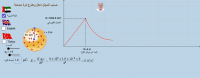
🧪 التجربة التفاعلية: المجال داخل الكرة وخارجها
🧪 Interactive Experiment: The Field Inside and Outside the Sphere
غيّر نصف قطر الكرة والشحنة والبعد r، وراقب سطح جاوس والمجال. الرسم البياني يبيّن أن المجال يزداد خطيًا داخل الكرة، ثم يتناقص مع مربع البعد خارجها، وأعلى قيمة عند السطح.
Change the sphere's radius, the charge and the distance r, and watch the Gaussian surface and the field. The graph shows that the field grows linearly inside the sphere, then falls with the square of the distance outside it, with the highest value at the surface.
⚪ المجال داخل كرة مصمتة وخارجها
⚪ The field inside and outside a solid sphere
🧪 امتحان شامل: 30 سؤالاً (متوسط وعالٍ)
🧪 Comprehensive Exam: 30 Questions (Medium and Advanced)
أنهِ الدرس بالاختبار التفاعلي التالي، وأسئلته تجمع بين الفهم وقراءة البيانات والحساب.
Finish with the interactive exam below: its questions mix understanding, data reading, and calculation.
اختبار المجال الكهربائي وقانون جاوس Electric Field and Gauss's Law Quiz
30 سؤالاً - المجال الكهربائي وقانون جاوس 30 Questions - Electric field and Gauss's law
• عدد الأسئلة: 30 سؤالاً
• مدة الاختبار: 45 دقيقة
• لا يمكنك تغيير إجاباتك أو إعادة الاختبار إلا بعد 24 ساعة من التسليم.
• تأكد من إجاباتك قبل التسليم! 📌 Important Instructions:
• Number of questions: 30 questions
• Quiz duration: 45 minutes
• You cannot change your answers or retake the quiz for 24 hours after submission.
• Make sure of your answers before submitting!