🎯 نواتج التعلم
🎯 Learning Outcomes
بعد دراسة هذا الدرس ستكون قادرًا على أن:
After this lesson you will be able to:
- تميّز بين الكمية القياسية والكمية المتجهة وتمثّل المتجه بسهم.Distinguish scalar from vector quantities and represent a vector by an arrow.
- تجمع المتجهات بيانيًا بطريقة الذيل إلى الرأس.Add vectors graphically by the head-to-tail method.
- تحسب محصلة متجهين بفيثاغورس وبقانوني جيب التمام والجيب.Calculate the resultant of two vectors using Pythagoras and the laws of cosines and sines.
- تحلّل المتجه إلى مركبتين \(F_x\) و\(F_y\) وتحدد إشارتيهما.Resolve a vector into components \(F_x\) and \(F_y\) and determine their signs.
- تجد محصلة عدة متجهات بجمع المركبات.Find the resultant of several vectors by adding components.
📖 الكميات القياسية والمتجهة
📖 Scalar and Vector Quantities
الكمية القياسية يكفي لوصفها مقدارٌ ووحدة فقط، مثل الكتلة والزمن والمسافة والطاقة. أما الكمية المتجهة فلا يكتمل وصفها إلا بذكر المقدار والاتجاه معًا، مثل الإزاحة والسرعة المتجهة والتسارع والقوة. فقولك «سرت 5 كم» وصف قياسي، وقولك «سرت 5 كم شمالًا» وصف متجه.
A scalar quantity is fully described by a magnitude and a unit alone, such as mass, time, distance and energy. A vector quantity needs both magnitude and direction, such as displacement, velocity, acceleration and force. “I walked 5 km” is scalar; “I walked 5 km north” is a vector.
| الكمية القياسيةScalar | الكمية المتجهةVector |
|---|---|
| المسافةDistance | الإزاحةDisplacement |
| السرعة القياسيةSpeed | السرعة المتجهةVelocity |
| الكتلة، الزمن، الطاقة، درجة الحرارةMass, time, energy, temperature | التسارع، القوة، الزخم، المجالAcceleration, force, momentum, field |
➡️ تمثيل المتجه
➡️ Representing a Vector
يُمثَّل المتجه بسهم: طول السهم يتناسب مع المقدار، واتجاه السهم هو اتجاه الكمية، ويُرمز له بحرف فوقه سهم \(\vec A\) أو بحرف غامق، ويُكتب مقداره \(A\) أو \(|\vec A|\). ويمكن نقل المتجه موازيًا لنفسه دون أن يتغير ما دام مقداره واتجاهه ثابتين، وهذا ما يسمح بجمع المتجهات بيانيًا.
A vector is drawn as an arrow: the length is proportional to the magnitude and the arrowhead shows the direction. It is written \(\vec A\) (or in bold) and its magnitude as \(A\) or \(|\vec A|\). A vector may be moved parallel to itself without change, which is what allows graphical addition.
📐 الجمع البياني: الذيل إلى الرأس
📐 Graphical Addition: Head to Tail
لجمع متجهين \(\vec A+\vec B\): ارسم \(\vec A\) أولًا، ثم ارسم \(\vec B\) بحيث يبدأ ذيله من رأس \(\vec A\). المحصلة \(\vec R\) هي السهم الواصل من ذيل \(\vec A\) إلى رأس \(\vec B\). والترتيب لا يهم: \(\vec A+\vec B=\vec B+\vec A\). وهذه الطريقة تُعمَّم على أي عدد من المتجهات بوضعها رأسًا لذيل ثم الوصل من أول ذيل إلى آخر رأس.
To add \(\vec A+\vec B\): draw \(\vec A\) first, then draw \(\vec B\) so its tail starts at the head of \(\vec A\). The resultant \(\vec R\) is the arrow from the tail of \(\vec A\) to the head of \(\vec B\). Order does not matter: \(\vec A+\vec B=\vec B+\vec A\). The method extends to any number of vectors: place them head to tail and join the first tail to the last head.
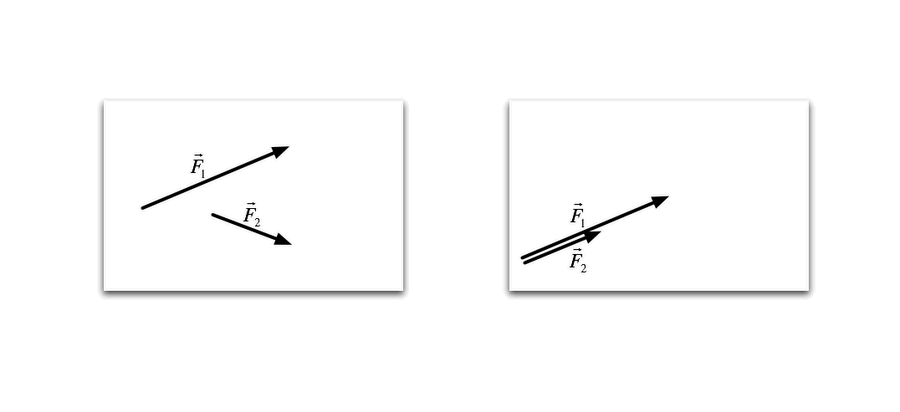
جمع متجهين بيانيًا: المحصلة تصل من ذيل المتجه الأول إلى رأس الأخير.
Graphical addition: the resultant runs from the tail of the first vector to the head of the last.
📏 محصلة متجهين متعامدين
📏 The Resultant of Two Perpendicular Vectors
عندما يتعامد المتجهان \(\vec A\) و\(\vec B\) تكوّن المتجهات الثلاثة مثلثًا قائمًا وترُه المحصلة، فنستخدم نظرية فيثاغورس لمقدارها والظل لاتجاهها:
When \(\vec A\) and \(\vec B\) are perpendicular the three vectors form a right triangle whose hypotenuse is the resultant, so Pythagoras gives its magnitude and the tangent its direction:
📌 المحصلة للمتجهين المتعامدين
📌 Resultant of perpendicular vectors
\[R=\sqrt{A^{2}+B^{2}}\]
\[\theta=\tan^{-1}\!\left(\frac{B}{A}\right)\]
\(\theta\) هي الزاوية بين المحصلة والمتجه \(A\). تذكّر المثلثات الشهيرة: \(3\text{–}4\text{–}5\) و\(5\text{–}12\text{–}13\) وزاويتها \(53.13^\circ\) و\(36.87^\circ\).
\(\theta\) is the angle between the resultant and \(A\). Remember the famous triangles \(3\text{–}4\text{–}5\) and \(5\text{–}12\text{–}13\), with angles \(53.13^\circ\) and \(36.87^\circ\).
🧪 جرّب بنفسك: المتجهان المتعامدان
🧪 Try It Yourself: Perpendicular Vectors
🧪 تجربة 1: محصلة متجهين متعامدين: فيثاغورس
🧪 Experiment 1: The Resultant of Two Perpendicular Vectors: Pythagoras
المتجه \(A\) شرقًا و\(B\) شمالًا. غيّر المقدارين ولاحظ المحصلة \(R\) ووتر المثلث القائم والزاوية \(\theta\).
The vector \(A\) points east and \(B\) north. Change the two magnitudes and watch the resultant \(R\), the hypotenuse of the right triangle, and the angle \(\theta\).
تؤثر في جسم قوتان متعامدتان مقدارهما \(10\ \mathrm N\) شرقًا و\(5\ \mathrm N\) شمالًا. أوجد مقدار محصلتهما واتجاهها.
Two perpendicular forces of \(10\ \mathrm N\) east and \(5\ \mathrm N\) north act on a body. Find the magnitude and direction of their resultant.
تحرّك متسابق \(40\ \mathrm m\) شرقًا ثم \(30\ \mathrm m\) جنوبًا. أوجد مقدار إزاحته الكلية واتجاهها.
A runner moves \(40\ \mathrm m\) east then \(30\ \mathrm m\) south. Find the magnitude and direction of the total displacement.
🔺 محصلة متجهين بينهما زاوية
🔺 The Resultant of Two Vectors at an Angle
إذا لم يكن المتجهان متعامدين نستخدم قانون جيب التمام للمقدار وقانون الجيب للاتجاه. ولتجنب الخلط في الإشارة: نعرّف \(\varphi\) بأنها الزاوية بين المتجهين عندما يخرجان من نقطة واحدة (ذيل مع ذيل). وإذا وُضع المتجهان رأسًا لذيل فالزاوية الداخلية للمثلث هي \(\theta=180^\circ-\varphi\) ويصبح الحد الأخير سالبًا.
If the vectors are not perpendicular use the law of cosines for the magnitude and the law of sines for the direction. To avoid sign confusion define \(\varphi\) as the angle between the vectors when they start from one point (tail to tail). If they are placed head to tail the interior triangle angle is \(\theta=180^\circ-\varphi\) and the last term becomes negative.
📌 قانونا جيب التمام والجيب
📌 The laws of cosines and sines
\[R^{2}=A^{2}+B^{2}+2AB\cos\varphi\;=\;A^{2}+B^{2}-2AB\cos\theta\]
\[\frac{R}{\sin\theta}=\frac{A}{\sin\alpha}=\frac{B}{\sin\beta}\]
حالات خاصة: \(\varphi=0^\circ\Rightarrow R=A+B\)، و\(\varphi=90^\circ\Rightarrow R=\sqrt{A^2+B^2}\)، و\(\varphi=180^\circ\Rightarrow R=|A-B|\).
Special cases: \(\varphi=0^\circ\Rightarrow R=A+B\), \(\varphi=90^\circ\Rightarrow R=\sqrt{A^2+B^2}\), and \(\varphi=180^\circ\Rightarrow R=|A-B|\).
🧪 جرّب بنفسك: قانون جيب التمام
🧪 Try It Yourself: the Law of Cosines
🧪 تجربة 2: محصلة متجهين بينهما زاوية: قانون جيب التمام
🧪 Experiment 2: The Resultant of Two Vectors at an Angle: the Law of Cosines
غيّر المقدارين والزاوية \(\varphi\) بين المتجهين (ذيل مع ذيل) وراقب المحصلة (قطر متوازي الأضلاع) واتجاهها.
Change the two magnitudes and the angle \(\varphi\) between the vectors (tail to tail) and watch the resultant (the diagonal of the parallelogram) and its direction.
يتحرك جسم \(3\ \mathrm m\) على طول المحور \(x\)، ثم \(5\ \mathrm m\) في اتجاه يصنع \(53.1^\circ\) مع الاتجاه الأول (قياسًا من رأس المتجه الأول). أوجد مقدار الإزاحة الكلية واتجاهها.
A body moves \(3\ \mathrm m\) along the \(x\)-axis then \(5\ \mathrm m\) in a direction making \(53.1^\circ\) with the first direction (measured at the head of the first vector). Find the magnitude and direction of the total displacement.
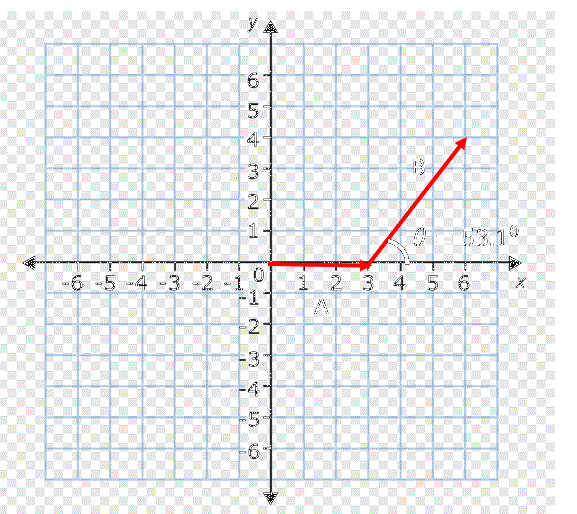
الشكل لمسألة المتجه \(A=3\) والمتجه \(B=5\) المقيس من رأس \(A\).
The figure for the problem with \(A=3\) and \(B=5\) measured at the head of \(A\).
متجهان مقداراهما \(5\) و\(5\) والزاوية بينهما \(60^\circ\) (ذيل مع ذيل). مقدار المحصلة:
Two vectors of magnitudes \(5\) and \(5\) with \(60^\circ\) between them (tail to tail). The resultant magnitude is:
✂️ تحليل المتجه إلى مركبتين
✂️ Resolving a Vector into Components
كل متجه \(\vec F\) يصنع زاوية \(\theta\) مع المحور \(+x\) يمكن استبداله بمركبتين متعامدتين تحققان معًا الأثر نفسه: مركبة أفقية \(F_x\) ومركبة رأسية \(F_y\). وهذا التحليل هو أقوى أداة لحل مسائل المتجهات لأن جمع المركبات على كل محور جمعٌ جبري عادي.
Any vector \(\vec F\) making an angle \(\theta\) with the \(+x\) axis can be replaced by two perpendicular components having the same effect: a horizontal \(F_x\) and a vertical \(F_y\). Resolution is the most powerful tool for vector problems because adding components on each axis is ordinary algebra.
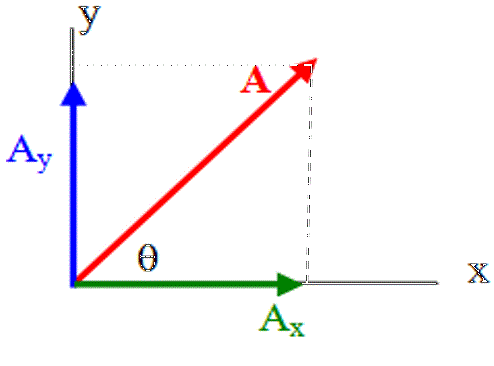
المتجه \(F\) ومركبتاه \(F_x\) و\(F_y\) والزاوية \(\theta\).
The vector \(F\), its components \(F_x\) and \(F_y\), and the angle \(\theta\).
📌 المركبتان
📌 The components
\[F_x=F\cos\theta,\qquad F_y=F\sin\theta\]
\[F=\sqrt{F_x^2+F_y^2},\qquad \theta=\tan^{-1}\!\frac{|F_y|}{|F_x|}\]
عندما تُقاس \(\theta\) من المحور \(+x\) عكس عقارب الساعة تظهر الإشارة تلقائيًا. أما إذا أُعطيت زاوية حادة مع أحد المحورين فحدّد الربع أولًا ثم ضع الإشارة بنفسك.
When \(\theta\) is measured from the \(+x\) axis anticlockwise the signs appear automatically. If an acute angle with one axis is given, find the quadrant first and then assign the signs yourself.
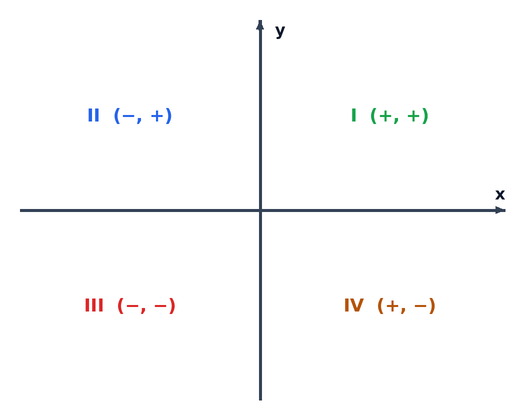
إشارتا المركبتين في كل ربع.
Signs of the two components in each quadrant.
🧪 جرّب بنفسك: المركبات والأرباع
🧪 Try It Yourself: Components and Quadrants
🧪 تجربة 3: تحليل المتجه إلى مركبتين وإشارتيهما
🧪 Experiment 3: Resolving a Vector into Two Components and Their Signs
غيّر مقدار القوة وزاويتها \(\theta\) (من المحور \(+x\) عكس عقارب الساعة) وراقب المركبتين \(F_x\) و\(F_y\) وإشارتيهما في كل ربع.
Change the magnitude of the force and its angle \(\theta\) (from the \(+x\) axis anticlockwise) and watch the components \(F_x\) and \(F_y\) and their signs in each quadrant.
قوة مقدارها \(60\ \mathrm N\) تصنع زاوية \(30^\circ\) مع الاتجاه \(-x\) نحو الأسفل (جنوب الغرب). أوجد مركبتيها.
A force of \(60\ \mathrm N\) makes \(30^\circ\) with the \(-x\) direction, downward (south of west). Find its components.
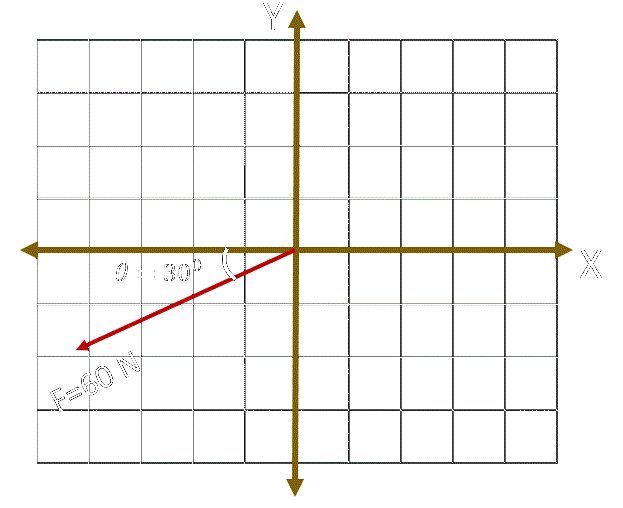
الشكل لمسألة القوة \(60\ \mathrm N\) جنوب الغرب.
The figure for the \(60\ \mathrm N\) force toward south-west.
أي من التالية صحيحة لمتجه في الربع الثالث؟
Which is true for a vector in the third quadrant?
🧮 محصلة عدة متجهات بالتحليل
🧮 The Resultant of Several Vectors by Resolution
خطوات الحل
Steps of the method
- ارسم المحورين وحلّل كل متجه إلى \(A_x\) و\(A_y\) مع الإشارة الصحيحة.Draw the axes and resolve every vector into \(A_x\) and \(A_y\) with the right signs.
- اجمع المركبات: \(R_x=\sum A_x\) و\(R_y=\sum A_y\).Add the components: \(R_x=\sum A_x\) and \(R_y=\sum A_y\).
- احسب \(R=\sqrt{R_x^2+R_y^2}\) واتجاهها \(\theta=\tan^{-1}|R_y/R_x|\) مع تحديد الربع.Compute \(R=\sqrt{R_x^2+R_y^2}\) and \(\theta=\tan^{-1}|R_y/R_x|\), identifying the quadrant.
🧪 جرّب بنفسك: ثلاثة متجهات
🧪 Try It Yourself: Three Vectors
🧪 تجربة 4: محصلة عدة متجهات بالتحليل
🧪 Experiment 4: The Resultant of Several Vectors by Resolution
ثلاثة متجهات بمقادير وزوايا تتحكم بها. تُحلَّل كل منها ثم تُجمع المركبات على كل محور: \(R_x=\sum A_x\) و\(R_y=\sum A_y\).
Three vectors whose magnitudes and angles you control. Each is resolved then the components are added on each axis: \(R_x=\sum A_x\) and \(R_y=\sum A_y\).
متجهان: \(\vec A=40\) شرقًا و\(\vec B=30\) شمالًا. مقدار محصلتهما:
Two vectors: \(\vec A=40\) east and \(\vec B=30\) north. The magnitude of their resultant is:
متجهان \(6\) و\(8\) متعامدان: الزاوية بين المحصلة والمتجه \(6\):
Perpendicular vectors \(6\) and \(8\): the angle between the resultant and the vector \(6\) is:
🎲 تدرّب
🎲 Practice
🧪 تجربة 5: تدرّب: مسائل المتجهات
🧪 Experiment 5: Practice: Vector Problems
مسائل عشوائية بأرقام مختلفة. احسب واكتب الجواب ثم اضغط «تحقّق».
Random problems with different numbers. Work it out, enter the answer and press “Check”.
📊 جدول ملخص العلاقات
📊 Summary of the Relations
| الحالةCase | العلاقةRelation |
|---|---|
| متجهان متعامدانPerpendicular vectors | \(R=\sqrt{A^2+B^2},\ \theta=\tan^{-1}(B/A)\)\(R=\sqrt{A^2+B^2},\ \theta=\tan^{-1}(B/A)\) |
| متجهان بينهما زاوية \(\varphi\)Vectors at angle \(\varphi\) | \(R^2=A^2+B^2+2AB\cos\varphi\)\(R^2=A^2+B^2+2AB\cos\varphi\) |
| قانون الجيبLaw of sines | \(R/\sin\theta=A/\sin\alpha=B/\sin\beta\)\(R/\sin\theta=A/\sin\alpha=B/\sin\beta\) |
| المركبتانComponents | \(F_x=F\cos\theta,\ F_y=F\sin\theta\)\(F_x=F\cos\theta,\ F_y=F\sin\theta\) |
| عدة متجهاتSeveral vectors | \(R_x=\sum A_x,\ R_y=\sum A_y\)\(R_x=\sum A_x,\ R_y=\sum A_y\) |
🧪 اختبر نفسك: امتحان من 20 سؤالاً
🧪 Test Yourself: a 20-Question Exam
أنهِ الدرس بالاختبار التفاعلي التالي؛ أسئلته تجمع بين الفهم والحساب وتغطي جميع أقسام الدرس.
Finish with the interactive exam below; its questions mix understanding with calculation and cover every section of the lesson.
اختبار المتجهات في بعدين Vectors in Two Dimensions Quiz
20 سؤالاً - الكميات المتجهة والقياسية، فيثاغورس، قانون جيب التمام، تحليل المتجهات والمحصلة بالمركبات 20 Questions - vector and scalar quantities, Pythagoras, the law of cosines, resolving vectors and the resultant by components
• عدد الأسئلة: 20 سؤالاً
• مدة الاختبار: 30 دقيقة
• لا يمكنك تغيير إجاباتك أو إعادة الاختبار إلا بعد 24 ساعة من التسليم.
• تأكد من إجاباتك قبل التسليم! 📌 Important Instructions:
• Number of questions: 20 questions
• Quiz duration: 30 minutes
• You cannot change your answers or retake the quiz for 24 hours after submission.
• Make sure of your answers before submitting!
🔗 محاكيات GeoGebra للاستعانة بها عند اللزوم
🔗 GeoGebra Simulations to Use When Needed
اضغط «تشغيل» لتعمل المحاكاة هنا داخل الدرس؛ ويمكن للطالب الرجوع إليها لتجربة الفكرة بطريقة أخرى.
Press “Run” to run the simulation right here inside the lesson; the student can use it to try the idea in another way.