🎯 نواتج التعلم
🎯 Learning Outcomes
بعد دراسة هذا الدرس ستكون قادرًا على أن:
After this lesson you will be able to:
- تفرّق بين الكتلة (كمية قياسية ثابتة) والوزن (قوة متجهة تتغير مع الجاذبية).Distinguish between mass (a constant scalar) and weight (a vector force that changes with gravity).
- تحسب الوزن \(W=mg\) والكتلة على الأرض وعلى الكواكب الأخرى.Calculate the weight \(W=mg\) and the mass on Earth and on other worlds.
- تعرّف الوزن الظاهري بأنه قراءة الميزان (القوة العمودية) وتحسبه في المصعد \(N=m(g\pm a)\).Define apparent weight as the scale reading (the normal force) and calculate it in an elevator \(N=m(g\pm a)\).
- تفسّر انعدام الوزن في السقوط الحر ولماذا يطفو رواد الفضاء.Explain weightlessness in free fall and why astronauts float.
- تحسب الوزن الظاهري عند قمة تلّ وفي قاع وادٍ.Calculate the apparent weight on top of a hill and at the bottom of a valley.
📖 مقدمة: كثيرًا ما يُخلَط بينهما
📖 Introduction: They Are Often Confused
نقول في حياتنا اليومية «وزني 60 كيلوجرامًا» فنخلط بين مفهومين مختلفين. في الفيزياء الكتلة تصف «كم مادة» في الجسم، والوزن قوة تجذب بها الأرض (أو أي كوكب) هذا الجسم. وسنتعرّف في الدرس أيضًا على الوزن الظاهري وهو ما يقيسه الميزان حين يكون الجسم متسارعًا.
In everyday life we say “my weight is 60 kilograms”, mixing two different concepts. In physics mass describes “how much matter” is in the body, and weight is the force with which the Earth (or any planet) attracts it. In this lesson we also meet apparent weight, which is what a scale measures when the body is accelerating.
📐 الكتلة
📐 Mass
الكتلة مقياس لكمية المادة في الجسم، وهي أيضًا مقياس للقصور الذاتي أي مقاومة الجسم لتغيير حالته الحركية. وحدتها الكيلوجرام (kg). وهي كمية قياسية (لها مقدار فقط) لا تتغير بتغير الموقع: تبقى ثابتة على الأرض والقمر وفي الفضاء. وتُقاس بالميزان ذي الكفتين الذي يقارن الجسم بكتل معيارية فيتوازن في كل مكان.
Mass is a measure of the amount of matter in a body, and also a measure of its inertia, i.e. its resistance to a change of its state of motion. Its unit is the kilogram (kg). It is a scalar quantity (magnitude only) that does not change with location: it stays the same on Earth, on the Moon and in space. It is measured by the beam balance, which compares the body with standard masses and therefore balances everywhere.
📌 الكتلة والكثافة والحجم
📌 Mass, density and volume
\[m=\rho\,V\]
⬇️ الوزن
⬇️ Weight
الوزن هو قوة الجذب التي يؤثر بها الكوكب في الجسم، وهو كمية متجهة اتجاهها نحو مركز الكوكب (رأسيًا إلى أسفل)، ووحدته النيوتن (N). ويُقاس بالميزان الزنبركي (الدينامومتر). وبما أن تسارع الجاذبية \(g\) يختلف من مكان لآخر فإن الوزن يختلف أيضًا:
Weight is the force of attraction exerted by the planet on the body. It is a vector directed toward the centre of the planet (vertically downward) and its unit is the newton (N). It is measured with the spring scale (dynamometer). Since the gravitational acceleration \(g\) differs from place to place, the weight differs too:
📌 الوزن
📌 Weight
\[W=mg\]
على سطح الأرض \(g\approx9.81\ \mathrm{m/s^2}\) (يؤخذ أحيانًا \(9.8\) أو \(10\))، وعلى القمر \(g=1.625\ \mathrm{m/s^2}\)، وعلى المريخ \(g=3.721\ \mathrm{m/s^2}\). ولهذا يكون وزن الجسم على القمر نحو سُدس وزنه على الأرض بينما كتلته نفسها.
On the Earth’s surface \(g\approx9.81\ \mathrm{m/s^2}\) (sometimes taken as \(9.8\) or \(10\)), on the Moon \(g=1.625\ \mathrm{m/s^2}\) and on Mars \(g=3.721\ \mathrm{m/s^2}\). So the weight of a body on the Moon is about one sixth of its weight on Earth while its mass is the same.
📊 الفروق الأساسية
📊 Key Differences
| الخاصيةProperty | الكتلةMass | الوزنWeight |
|---|---|---|
| النوعType | كمية قياسيةScalar | كمية متجهة (قوة)Vector (a force) |
| الرمزSymbol | \(m\) | \(W\) (\(F_g\)) |
| الاعتماد على الموقعDependence on location | لا تتغيرDoes not change | تتغير مع الجاذبيةChanges with gravity |
| الوحدةUnit | كيلوجرام (kg)kilogram (kg) | نيوتن (N)newton (N) |
| أداة القياسMeasuring instrument | ميزان ذو كفتينBeam balance | ميزان زنبركيSpring scale |
| العلاقةRelation | \(m=\rho V\) | \(W=mg\) |
🧪 جرّب بنفسك: الكتلة نفسها على عوالم مختلفة
🧪 Try It Yourself: the Same Mass on Different Worlds
🧪 تجربة 1: الكتلة نفسها على عوالم مختلفة
🧪 Experiment 1: The Same Mass on Different Worlds
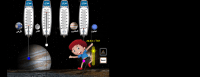
غيّر الكتلة وراقب الميزان الزنبركي على القمر وبلوتو والمريخ والأرض ونبتون والمشتري: الكتلة واحدة والوزن يتغير بتغير الجاذبية. والميزان ذو الكفتين في الأسفل يتوازن في كل مكان.
Change the mass and watch the spring scale on the Moon, Pluto, Mars, Earth, Neptune and Jupiter: the mass is the same and the weight changes with gravity. The beam balance at the bottom balances everywhere.
جسم كتلته \(60\ \mathrm{kg}\). أوجد وزنه على الأرض (\(g=9.81\)) وعلى القمر (\(g=1.625\)) وكتلته على القمر.
A body has a mass of \(60\ \mathrm{kg}\). Find its weight on Earth (\(g=9.81\)) and on the Moon (\(g=1.625\)) and its mass on the Moon.
جسم وزنه \(490\ \mathrm N\) على الأرض (\(g=9.8\)). أوجد كتلته ووزنه على الكوكب الذي \(g=15\ \mathrm{m/s^2}\).
A body weighs \(490\ \mathrm N\) on Earth (\(g=9.8\)). Find its mass and its weight on a planet with \(g=15\ \mathrm{m/s^2}\).
وزنك في هذا العالم
Your weight in this world
يمكنك حساب وزنك على كوكب آخر بضرب وزنك على الأرض في نسبة تسارعي الجاذبية \(g_{planet}/g_{earth}\):
You can find your weight on another planet by multiplying your weight on Earth by the ratio of the two gravitational accelerations \(g_{planet}/g_{earth}\):
| الكوكبWorld | النسبة \(g/g_{earth}\)Ratio \(g/g_{earth}\) | \(g\) تقريبًا (m/s²)\(g\) approx. (m/s²) |
|---|---|---|
| القمرMoon | 0.166 | 1.63 |
| عطاردMercury | 0.378 | 3.7 |
| المريخMars | 0.377 | 3.7 |
| الزهرةVenus | 0.907 | 8.9 |
| أورانوسUranus | 0.889 | 8.7 |
| الأرضEarth | 1.000 | 9.81 |
| زحلSaturn | 1.064 | 10.4 |
| نبتونNeptune | 1.125 | 11.0 |
| المشتريJupiter | 2.528 | 24.8 |
| بلوتوPluto | 0.067 | 0.66 |
📈 الوزن الظاهري
📈 Apparent Weight
الوزن الظاهري هو القوة التي يؤثر بها الجسم في السطح الذي يحمله (أو في الميزان)، وهو بحسب القانون الثالث لنيوتن يساوي في المقدار القوة العمودية \(N\) التي يؤثر بها السطح في الجسم. إذا كان الجسم والسطح ساكنين أو متحركين بسرعة ثابتة فالوزن الظاهري يساوي الوزن الحقيقي، أما إذا تسارعا فيختلف عنه.
Apparent weight is the force the body exerts on the surface supporting it (or on the scale); by Newton’s third law it equals in magnitude the normal force \(N\) exerted by the surface on the body. If the body and the surface are at rest or moving at constant velocity the apparent weight equals the real weight; if they accelerate it differs from it.
الاشتقاق: لشخص كتلته \(m\) في مصعد يتسارع بتسارع \(a\) (موجب لأعلى) يطبّق القانون الثاني لنيوتن على المحور الرأسي (الأعلى موجب):
Derivation: for a person of mass \(m\) in an elevator with acceleration \(a\) (positive upward) we apply Newton’s second law on the vertical axis (up positive):
📌 الوزن الظاهري في المصعد
📌 Apparent weight in an elevator
\[N-mg=ma\ \Rightarrow\ N=m(g+a)\]
\[a\gt 0\ (\text{up}):\ N\gt mg\qquad a\lt 0\ (\text{down}):\ N\lt mg\]
| الحالةCase | المعادلةEquation | مثالExample |
|---|---|---|
| يتسارع لأعلىAccelerating upward | \(N=m(g+a)\) | \(m=70\ \mathrm{kg},\ a=2\): \(N=70(9.8+2)=826\ \mathrm N\)\(m=70\ \mathrm{kg},\ a=2\): \(N=70(9.8+2)=826\ \mathrm N\) |
| يتسارع لأسفلAccelerating downward | \(N=m(g-a)\) | \(a=5\): \(N=70(9.8-5)=336\ \mathrm N\)\(a=5\): \(N=70(9.8-5)=336\ \mathrm N\) |
| سرعة ثابتة (أو سكون)Constant velocity (or at rest) | \(N=mg\) | يساوي الوزن الحقيقيEqual to the real weight |
| سقوط حر \(a=g\)Free fall \(a=g\) | \(N=0\) | انعدام الوزن الظاهريApparent weightlessness |
💡 تنبيهات مهمة
💡 Important notes
- الوزن الظاهري يعتمد على التسارع لا على السرعة: مصعد يصعد بسرعة ثابتة يعطي الوزن الحقيقي.Apparent weight depends on the acceleration, not on the velocity: an elevator rising at constant velocity gives the real weight.
- في السقوط الحر تبقى الجاذبية تؤثر (الوزن الحقيقي \(mg\) لم يتغير) لكن لا يوجد دفع من الميزان فنشعر بانعدام الوزن. ورواد الفضاء في المحطة الدولية يسقطون سقوطًا حرًا حول الأرض فيطفون.In free fall gravity still acts (the real weight \(mg\) has not changed) but there is no push from the scale so we feel weightless. Astronauts in the space station are in free fall around the Earth so they float.
- إذا كان تسارع المصعد لأسفل أكبر من \(g\) فلا يستطيع الشخص مجاراته: يرتفع عن الأرضية و\(N=0\).If the elevator accelerates downward at more than \(g\) the person cannot keep up: he leaves the floor and \(N=0\).
🧪 جرّب بنفسك: المصعد والميزان
🧪 Try It Yourself: the Elevator and the Scale
🧪 تجربة 2: الوزن الظاهري في المصعد
🧪 Experiment 2: Apparent Weight in an Elevator
اضبط كتلة الشخص وتسارع المصعد (موجب لأعلى وسالب لأسفل) أو اختر حالة جاهزة، وراقب قراءة الميزان \(N\) ومخطط القوى. اضغط «حرّك المصعد» لترى الحركة.
Set the person’s mass and the elevator’s acceleration (positive upward, negative downward) or choose a ready state, and watch the scale reading \(N\) and the free-body diagram. Press “Move the elevator” to see the motion.
رجل كتلته \(70\ \mathrm{kg}\) داخل مصعد (\(g=10\ \mathrm{m/s^2}\)). أوجد وزنه الظاهري إذا تسارع المصعد: (أ) \(2\ \mathrm{m/s^2}\) لأعلى، (ب) \(3\ \mathrm{m/s^2}\) لأسفل.
A man of mass \(70\ \mathrm{kg}\) is inside an elevator (\(g=10\ \mathrm{m/s^2}\)). Find his apparent weight if the elevator accelerates: (a) \(2\ \mathrm{m/s^2}\) upward, (b) \(3\ \mathrm{m/s^2}\) downward.
وُضع جسم كتلته \(5\ \mathrm{kg}\) على ميزان في مصعد فقرأ \(40\ \mathrm N\) (\(g=10\)). ما تسارع المصعد واتجاهه؟
A body of mass \(5\ \mathrm{kg}\) placed on a scale in an elevator reads \(40\ \mathrm N\) (\(g=10\)). What are the acceleration of the elevator and its direction?
🔄 الوزن الظاهري في الحركة الدائرية
🔄 Apparent Weight in Circular Motion
عندما يتحرك جسم على مسار منحنٍ رأسيًا يلزم محصلة قوى نحو المركز تعطي التسارع المركزي \(v^2/r\). فلسيارة على قمة تلّ (المركز أسفل السيارة): \(mg-N=mv^2/r\)، ولسيارة في قاع وادٍ (المركز أعلى السيارة): \(N-mg=mv^2/r\):
When a body moves along a vertically curved path a net force toward the centre is needed to provide the centripetal acceleration \(v^2/r\). For a car on top of a hill (the centre below the car): \(mg-N=mv^2/r\), and for a car at the bottom of a valley (the centre above the car): \(N-mg=mv^2/r\):
📌 قمة تلّ وقاع وادٍ
📌 Hill top and valley bottom
\[N_{top}=m\left(g-\frac{v^2}{r}\right)\]
\[N_{bottom}=m\left(g+\frac{v^2}{r}\right)\]
وعندما \(v^2/r=g\) أي \(v=\sqrt{gr}\) تنعدم \(N\) على القمة وتفقد السيارة التلامس بالطريق. (أما داخل حلقة رأسية فعند أعلى نقطة يكون \(N=m(v^2/r-g)\) لأن مركز الدائرة أسفل الجسم.)
When \(v^2/r=g\), i.e. \(v=\sqrt{gr}\), \(N\) vanishes at the top and the car loses contact with the road. (Inside a vertical loop, at the highest point \(N=m(v^2/r-g)\) because the centre of the circle is below the body.)
🧪 جرّب بنفسك: التلّ والوادي
🧪 Try It Yourself: Hill and Valley
🧪 تجربة 3: الوزن الظاهري على قمة تلّ وفي قاع وادٍ
🧪 Experiment 3: Apparent Weight on a Hill Top and in a Valley Bottom
تسير سيارة بسرعة \(v\) على قمة تلّ نصف قطر انحنائه \(r\) وعلى قاع وادٍ بالانحناء نفسه؛ غيّر \(v\) و\(r\) و\(m\) وراقب قوة التلامس \(N\) في الموضعين.
A car moves at speed \(v\) on top of a hill of radius of curvature \(r\) and at the bottom of a valley with the same curvature; change \(v\), \(r\) and \(m\) and watch the contact force \(N\) in both places.
سيارة كتلتها \(1000\ \mathrm{kg}\) تسير بسرعة \(10\ \mathrm{m/s}\) على جسر محدّب نصف قطر انحنائه \(40\ \mathrm m\) (\(g=9.8\)). أوجد القوة العمودية على قمة الجسر وفي قاع منحنى بالانحناء نفسه.
A \(1000\ \mathrm{kg}\) car moves at \(10\ \mathrm{m/s}\) over a convex bridge of radius of curvature \(40\ \mathrm m\) (\(g=9.8\)). Find the normal force at the top of the bridge and at the bottom of a curve of the same curvature.
🌍 تطبيقات عملية
🌍 Practical Applications
أين نستفيد من هذه المفاهيم؟
Where do we use these concepts?
- أنظمة المصاعد: حساب الحمل الأقصى حتى مع تسارع المصعد.Elevator systems: calculating the maximum load even when the elevator accelerates.
- تدريب رواد الفضاء بأجهزة الطرد المركزي لمحاكاة تسارع كبير.Training astronauts with centrifuges to simulate large accelerations.
- تصميم الطائرات الحربية وحساب قوى \(G\) التي يتعرض لها الطيار.Designing fighter aircraft and calculating the \(G\)-forces the pilot experiences.
- تصميم المركبات والمستعمرات على القمر والمريخ بحسب جاذبيتهما.Designing vehicles and colonies on the Moon and Mars according to their gravity.
⚠️ أخطاء شائعة
⚠️ Common Mistakes
تجنّب هذه الأخطاء
Avoid these mistakes
- قول «وزني 60 كيلوجرامًا»: الكيلوجرام وحدة كتلة؛ الوزن بالنيوتن.Saying “my weight is 60 kilograms”: the kilogram is a unit of mass; weight is in newtons.
- الظن أن الكتلة تتغير على القمر، والصحيح أن وزنها وحده يتغير.Thinking that mass changes on the Moon; only the weight does.
- الظن أن رواد الفضاء يطفون لأن لا جاذبية؛ الجاذبية موجودة وهم في سقوط حر.Thinking that astronauts float because there is no gravity; gravity is present and they are in free fall.
- ربط الوزن الظاهري بالسرعة، والصحيح أنه يرتبط بالتسارع.Relating apparent weight to the velocity; it is related to the acceleration.
📝 ملخص الدرس
📝 Lesson Summary
أهم ما تعلمناه
Key points
- الكتلة ثابتة في كل مكان (kg)، والوزن \(W=mg\) قوة تتغير بتغير الجاذبية (N).Mass is constant everywhere (kg); weight \(W=mg\) is a force that changes with gravity (N).
- الوزن الظاهري \(N=m(g\pm a)\): يزيد عند التسارع لأعلى ويقل عند التسارع لأسفل وينعدم في السقوط الحر.Apparent weight \(N=m(g\pm a)\): it increases for upward acceleration, decreases for downward acceleration and vanishes in free fall.
- على قمة تلّ \(N=m(g-v^2/r)\) وفي قاع وادٍ \(N=m(g+v^2/r)\).On top of a hill \(N=m(g-v^2/r)\) and at the bottom of a valley \(N=m(g+v^2/r)\).
🎲 تدرّب على المسائل
🎲 Practice Problems
🧪 تجربة 4: تدرّب: مسائل الكتلة والوزن
🧪 Experiment 4: Practice: Mass and Weight Problems
مسائل عشوائية بأرقام مختلفة. احسب واكتب الجواب ثم اضغط «تحقّق».
Random problems with different numbers. Work it out, enter the answer and press “Check”.
✅ قيّم نفسك
✅ Self-Check
جسم كتلته \(10\ \mathrm{kg}\) على الأرض (\(g=9.8\)). وزنه:
A body of mass \(10\ \mathrm{kg}\) on Earth (\(g=9.8\)). Its weight:
نقل رائد فضاء من الأرض إلى القمر. أي الكميتين تتغير؟
An astronaut is moved from Earth to the Moon. Which quantity changes?
رجل كتلته \(70\ \mathrm{kg}\) في مصعد يتسارع \(2\ \mathrm{m/s^2}\) لأعلى (\(g=10\)). وزنه الظاهري:
A \(70\ \mathrm{kg}\) man in an elevator accelerating at \(2\ \mathrm{m/s^2}\) upward (\(g=10\)). His apparent weight:
الوزن الظاهري لجسم في سقوط حر:
The apparent weight of a body in free fall:
🧪 اختبر نفسك: امتحان من 20 سؤالاً
🧪 Test Yourself: a 20-Question Exam
أنهِ الدرس بالاختبار التفاعلي التالي؛ أسئلته تجمع بين الفهم والحساب وتغطي جميع أقسام الدرس.
Finish with the interactive exam below; its questions mix understanding with calculation and cover every section of the lesson.
اختبار الكتلة والوزن والوزن الظاهري Mass, Weight and Apparent Weight Quiz
20 سؤالاً - الكتلة والوزن، الجاذبية على الكواكب، الوزن الظاهري في المصعد وفي الحركة الدائرية 20 Questions - mass and weight, gravity on the planets, apparent weight in an elevator and in circular motion
• عدد الأسئلة: 20 سؤالاً
• مدة الاختبار: 30 دقيقة
• لا يمكنك تغيير إجاباتك أو إعادة الاختبار إلا بعد 24 ساعة من التسليم.
• تأكد من إجاباتك قبل التسليم! 📌 Important Instructions:
• Number of questions: 20 questions
• Quiz duration: 30 minutes
• You cannot change your answers or retake the quiz for 24 hours after submission.
• Make sure of your answers before submitting!
🔗 محاكيات GeoGebra للاستعانة بها عند اللزوم
🔗 GeoGebra Simulations to Use When Needed
اضغط «تشغيل» لتعمل المحاكاة هنا داخل الدرس؛ ويمكن للطالب الرجوع إليها لتجربة الفكرة بطريقة أخرى.
Press “Run” to run the simulation right here inside the lesson; the student can use it to try the idea in another way.