🎯 نواتج التعلم
🎯 Learning Outcomes
بعد دراسة هذا الدرس ستكون قادرًا على أن:
After this lesson you will be able to:
- تفسّر قوى التماسك والتوتر السطحي، وتبيّن سبب تكوّن القطرات الكروية.Explain cohesive forces and surface tension, and why drops are spherical.
- تفسّر قوى التلاصق والخاصية الشعرية، وتفرّق بين سلوك الماء والزئبق في الأنبوب الشعري.Explain adhesive forces and capillarity, and distinguish the behaviour of water and mercury in a capillary tube.
- تصف التبخر والتكثف على المستوى الجزيئي، وتفسّر لماذا يبرّد التبخر السائل.Describe evaporation and condensation at the molecular level, and explain why evaporation cools a liquid.
- تنص على مبدأ باسكال وتطبّقه في المكبس الهيدروليكي \(F_1/A_1=F_2/A_2\).State Pascal's principle and apply it to the hydraulic press \(F_1/A_1=F_2/A_2\).
- تحسب ضغط المائع \(P=\rho gh\) والضغط الكلي \(P=p_0+\rho gh\)، وتحدد العوامل المؤثرة فيه.Calculate the fluid pressure \(P=\rho gh\) and the total pressure \(P=p_0+\rho gh\), and identify the factors that affect it.
- تفسّر دافعة أرخميدس وتحسبها بالطريقتين \(F_B=F_g-F_g^{\prime}\) و\(F_B=\rho Vg\)، وتحدد متى يطفو الجسم أو يغوص.Explain the buoyant force of Archimedes, calculate it in both ways \(F_B=F_g-F_g^{\prime}\) and \(F_B=\rho Vg\), and decide when an object floats or sinks.
🫧 القوى داخل السوائل: التماسك والتوتر السطحي
🫧 Forces Inside Liquids: Cohesion and Surface Tension
جزيئات السائل قريبة بعضها من بعض فتتجاذب بقوى كهربائية ضعيفة نسبيًا مقارنة بالجوامد، ولهذا يتخذ السائل شكل الإناء الذي يوضع فيه ويحتفظ بحجمه. وتسمى هذه القوى بين الجزيئات المتماثلة قوى التماسك.
The molecules of a liquid are close to each other and attract one another with electric forces that are weaker than in solids. For this reason a liquid takes the shape of its container yet keeps its volume. These forces between like molecules are called cohesive forces.
📘 قوى التماسك
📘 Cohesive forces
قوى التماسك هي قوى التجاذب المتبادلة بين جزيئات المادة الواحدة، وهي التي تجبر جزيئات السائل على الاحتفاظ بشكل معين وعلى البقاء متقاربة.
Cohesive forces are the mutual attractive forces between the molecules of the same substance; they keep the molecules of a liquid close together and give the liquid a definite form.
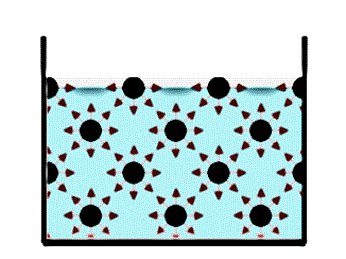
جزيء داخل السائل تجذبه الجزيئات المجاورة من كل الاتجاهات بقوى متساوية، أما جزيء السطح فيُجذب نحو الداخل فقط.
A molecule inside the liquid is pulled equally in all directions by its neighbours, while a molecule at the surface is pulled inward only.
🔍 لماذا يختلف الجزيء الداخلي عن جزيء السطح؟
🔍 Why does a molecule inside differ from one at the surface?
داخل السائل: يحيط بالجزيء جزيئات من كل الجهات فيتأثر بقوى تجاذب متساوية في جميع الاتجاهات، فتكون محصلة القوى عليه صفرًا.
Inside the liquid: the molecule is surrounded by neighbours on all sides, so the attractive forces on it are equal in every direction and their resultant is zero.
على السطح: لا توجد جزيئات سائلة فوق جزيء السطح (فوقه هواء قليل الكثافة)، فيُجذب إلى الأسفل وإلى الجانبين فقط، وتكون محصلة القوى عليه نحو داخل السائل.
At the surface: there are no liquid molecules above a surface molecule (only low-density air), so it is pulled downward and sideways only, and the resultant force on it points into the liquid.
📘 التوتر السطحي
📘 Surface tension
تجذب القوى المحصلة جزيئات السطح نحو الداخل، فيميل السطح إلى التقلص ليأخذ أصغر مساحة ممكنة، ويتصرف كأنه غشاء مشدود. تسمى هذه الظاهرة التوتر السطحي، ويقاس بالقوة المؤثرة على وحدة الطول من السطح (\(\mathrm{N/m}\)). للماء عند \(20^{\circ}\mathrm{C}\) نحو \(0.073\ \mathrm{N/m}\).
The net inward forces pull the surface molecules inward, so the surface tends to contract to the smallest possible area and behaves like a stretched film. This is called surface tension; it is measured as the force acting on a unit length of the surface (\(\mathrm{N/m}\)). For water at \(20^{\circ}\mathrm{C}\) it is about \(0.073\ \mathrm{N/m}\).
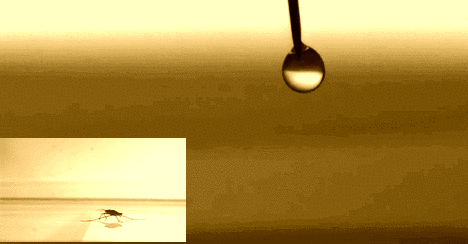
التوتر السطحي: قطرة الماء تتخذ شكلًا قريبًا من الكرة، والحشرة تمشي على الماء دون أن تغوص.
Surface tension: a drop of water takes a nearly spherical shape and an insect walks on water without sinking.
💡 شرح إضافي: كيف نرى التوتر السطحي في حياتنا؟
💡 Extra explanation: where do we see surface tension?
- القطرات الكروية: الكرة هي الشكل الذي يملك أصغر مساحة سطح لحجم معين، لذلك تتكور قطرة الماء لتقلل مساحة سطحها.Spherical drops: a sphere has the smallest surface area for a given volume, so a drop contracts into a ball to reduce its surface area.
- مشي الحشرات على الماء: يعمل السطح كغشاء مرن يتحمل وزن الحشرة الصغير، فتنخفض أقدامها قليلًا دون أن تخترقه.Insects walking on water: the surface acts like an elastic film that supports the small weight of the insect, so its feet dent the surface without piercing it.
- إبرة طافية: إبرة فولاذية نظيفة توضع برفق على الماء قد تبقى على سطحه رغم أن كثافتها أكبر من كثافة الماء، لكن إضافة قليل من الصابون يخفّض التوتر السطحي فتغوص.A floating needle: a clean steel needle laid gently on water may stay on the surface although it is denser than water; adding a little soap lowers the surface tension and it sinks.
جزيء يقع في منتصف كمية من السائل، فما محصلة قوى التماسك المؤثرة فيه؟
A molecule lies in the middle of a body of liquid. What is the resultant of the cohesive forces on it?
لماذا تتخذ قطرة الماء شكلًا قريبًا من الكرة عندما لا تؤثر فيها قوى أخرى كبيرة؟
Why does a drop of water take a nearly spherical shape when no other large forces act on it?
🧪 قوى التلاصق والخاصية الشعرية
🧪 Adhesive Forces and Capillarity
📘 قوى التلاصق
📘 Adhesive forces
قوى التلاصق هي قوى التجاذب بين جزيئات مادتين مختلفتين، كجزيئات الماء وجزيئات الزجاج. والمقارنة بين قوى التلاصق وقوى التماسك هي التي تحدد سلوك السائل عند جدار الإناء.
Adhesive forces are the attractive forces between the molecules of two different substances, such as water molecules and glass molecules. Comparing adhesive with cohesive forces decides how a liquid behaves at the wall of its container.
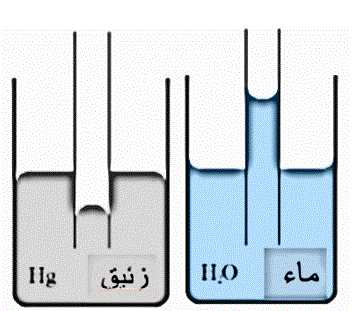
أنبوبة شعرية في الماء (يرتفع الماء ويكون سطحه مقعرًا) وأخرى في الزئبق (ينخفض الزئبق ويكون سطحه محدبًا).
A capillary tube in water (the water rises and its surface is concave) and another in mercury (the mercury is depressed and its surface is convex).
| وجه المقارنةComparison | الماء في أنبوب زجاجي شعريWater in a glass capillary tube | الزئبق في أنبوب زجاجي شعريMercury in a glass capillary tube |
|---|---|---|
| المقارنة بين القوتينWhich force is larger | التلاصق (ماء–زجاج) أكبر من التماسك (ماء–ماء)adhesion (water–glass) is greater than cohesion (water–water) | التماسك (زئبق–زئبق) أكبر من التلاصق (زئبق–زجاج)cohesion (mercury–mercury) is greater than adhesion (mercury–glass) |
| مستوى السائل في الأنبوبةLevel in the tube | يرتفع فوق مستواه في الإناءrises above its level in the vessel | ينخفض تحت مستواه في الإناءis depressed below its level in the vessel |
| شكل سطح السائلShape of the surface | مقعّرconcave | محدّبconvex |
| نوع السائلType of liquid | يبلّل الزجاجwets the glass | لا يبلّل الزجاجdoes not wet the glass |
💡 شرح إضافي: لماذا يرتفع الماء فعلًا؟
💡 Extra explanation: why does the water really rise?
عند جدار الأنبوب تجذب جزيئات الزجاج جزيئات الماء إلى الأعلى بقوة أكبر من تجاذب الماء لنفسه، فيلتصق الماء بالجدار ويصعد عليه، ثم يسحب التوتر السطحي بقية الماء خلفه حتى يتوازن وزن عمود الماء المرتفع مع القوة الرافعة. وكلما كان الأنبوب أضيق كانت نسبة محيط الجدار إلى مساحة المقطع أكبر فيرتفع الماء أكثر.
At the wall of the tube the glass molecules pull the water molecules upward more strongly than water attracts itself, so the water clings to the wall and climbs; surface tension then drags the rest of the water after it until the weight of the raised column balances the lifting force. The narrower the tube, the larger the ratio of wall perimeter to cross-sectional area, so the higher the water rises.
هذه هي الخاصية الشعرية، وبها يصعد الماء في جذوع النباتات وفي المناديل الورقية والإسفنج.
This is capillarity; it is how water climbs up plant stems, paper towels and sponges.
للتوسع: ارتفاع السائل في أنبوب نصف قطره \(r\) يعطى بالعلاقة \(h=\dfrac{2\gamma\cos\theta}{\rho g r}\)، حيث \(\gamma\) التوتر السطحي و\(\theta\) زاوية التلامس (للماء والزجاج \(\theta\approx0^{\circ}\) وللزئبق والزجاج \(\theta\approx140^{\circ}\) فتكون \(h\) سالبة أي انخفاض).
Going further: the height of the liquid in a tube of radius \(r\) is \(h=\dfrac{2\gamma\cos\theta}{\rho g r}\), where \(\gamma\) is the surface tension and \(\theta\) the contact angle (for water on glass \(\theta\approx0^{\circ}\); for mercury on glass \(\theta\approx140^{\circ}\), so \(h\) is negative, i.e. a depression).
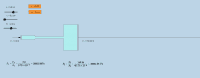
🧪 تجربة 1: الأنبوب الشعري: ارتفاع السائل أو انخفاضه
🧪 Experiment 1: The capillary tube: rise or depression of the liquid
اختر السائل (ماء أو زئبق أو إيثانول) وغيّر نصف قطر الأنبوب. لاحظ شكل سطح السائل (مقعّر أو محدّب) واتجاه حركته، وكيف يزداد الارتفاع عند تضييق الأنبوب وفق العلاقة \(h=2\gamma\cos\theta/(\rho g r)\).
Choose the liquid (water, mercury or ethanol) and change the radius of the tube. Notice the shape of the surface (concave or convex), the direction of the movement, and how the height grows as the tube narrows according to \(h=2\gamma\cos\theta/(\rho g r)\).
أنبوب زجاجي شعري نصف قطره \(0.50\ \mathrm{mm}\) مغموس في الماء (\(\gamma=0.0728\ \mathrm{N/m}\)، \(\theta=0^{\circ}\)). احسب ارتفاع الماء فيه. خذ \(g=9.8\ \mathrm{m/s^2}\).
A glass capillary tube of radius \(0.50\ \mathrm{mm}\) is dipped into water (\(\gamma=0.0728\ \mathrm{N/m}\), \(\theta=0^{\circ}\)). Find the height of the water in it. Take \(g=9.8\ \mathrm{m/s^2}\).
وُضع أنبوب شعري زجاجي في إناء به زئبق. ماذا نلاحظ؟
A glass capillary tube is placed in a vessel of mercury. What do we observe?
إذا قُلّل نصف قطر الأنبوب الشعري إلى النصف (في الماء نفسه) فإن ارتفاع الماء فيه:
If the radius of the capillary tube is halved (in the same water), the height of the water in it:
♨️ التبخر والتكثف
♨️ Evaporation and Condensation
📘 التبخر
📘 Evaporation
التبخر هو تحول المادة من الحالة السائلة إلى الحالة الغازية. يحدث من سطح السائل عند أي درجة حرارة (ويزداد بارتفاعها)، لأن جزيئات السطح الأسرع حركة، وهي التي تملك أكبر طاقة حركية، تستطيع التغلب على قوى التجاذب والإفلات من السائل.
Evaporation is the change of a substance from the liquid state to the gaseous state. It takes place from the surface of the liquid at any temperature (and increases as the temperature rises), because the faster surface molecules, which have the greatest kinetic energy, can overcome the attractive forces and escape from the liquid.
💡 شرح إضافي: لماذا يبرّد التبخر السائل؟
💡 Extra explanation: why does evaporation cool a liquid?
جزيئات السائل ليست متساوية في سرعتها؛ فمنها السريع ومنها البطيء، ودرجة الحرارة تقيس متوسط الطاقة الحركية. الجزيئات التي تغادر السطح هي الأسرع، فيبقى في السائل جزيئات متوسط طاقتها أقل، أي تنخفض درجة حرارة السائل وما يلامسه. ولهذا نشعر بالبرودة عندما يتبخر العرق عن الجلد أو الكحول عن اليد.
The molecules of a liquid do not all move at the same speed; some are fast and some are slow, and temperature measures the average kinetic energy. The molecules that leave the surface are the fastest, so the molecules left behind have a lower average energy: the liquid and whatever touches it cools. That is why we feel cold when sweat evaporates from the skin or alcohol from the hand.
عوامل زيادة معدل التبخر: ارتفاع درجة الحرارة، وزيادة مساحة السطح المعرّض، وحركة الهواء فوق السطح، وانخفاض رطوبة الهواء، ونوع السائل (الكحول يتبخر أسرع من الماء لأن قوى التماسك فيه أضعف).
Factors that increase the rate of evaporation: a higher temperature, a larger exposed surface area, air moving over the surface, drier air, and the type of liquid (alcohol evaporates faster than water because its cohesive forces are weaker).
📘 التكثف
📘 Condensation
التكثف هو تحول المادة من الحالة الغازية إلى الحالة السائلة (عكس التبخر) عند انخفاض درجة حرارتها. يحدث عندما تصطدم جزيئات البخار السريعة بجزيئات بطيئة فتفقد جزءًا من طاقتها الحركية، فتعجز عن الإفلات من قوى التجاذب المؤثرة فيها من جزيئات السائل وتتحول إلى سائل.
Condensation is the change of a substance from the gaseous state to the liquid state (the reverse of evaporation) when its temperature falls. It happens when fast vapour molecules collide with slow ones and lose part of their kinetic energy, so they can no longer escape the attractive forces exerted by the liquid molecules and turn into liquid.
💡 شرح إضافي: الإناء المفتوح والإناء المغلق
💡 Extra explanation: open and closed vessels
في الإناء المفتوح تغادر جزيئات البخار ولا تعود، فيستمر التبخر حتى ينفد السائل. أما في الإناء المغلق فتعود بعض الجزيئات إلى السائل (تتكثف)، وبعد زمن يتساوى عدد الجزيئات المتبخرة مع عدد الجزيئات المتكثفة في الثانية، فتستقر كمية البخار ويقال إن النظام في اتزان ديناميكي.
In an open vessel the vapour molecules leave and do not return, so evaporation continues until the liquid is used up. In a closed vessel some molecules return to the liquid (condense), and after a while the number evaporating per second equals the number condensing, so the amount of vapour stays constant and the system is said to be in dynamic equilibrium.
🧪 تجربة 2: التبخر والتكثف على المستوى الجزيئي
🧪 Experiment 2: Evaporation and condensation at the molecular level
الجزيئات الزرقاء بطيئة والبرتقالية أسرع، وعند إفلات جزيء سريع من السطح يصبح بخارًا (أحمر). جرّب فتح الإناء وإغلاقه، ورفع درجة الحرارة، وإيقاف التسخين، وراقب معدلي التبخر والتكثف وعدد جزيئات البخار.
The blue molecules are slow and the orange ones faster; when a fast molecule escapes from the surface it becomes vapour (red). Try opening and closing the vessel, raising the temperature and switching off the heater, and watch the rates of evaporation and condensation and the number of vapour molecules.
لماذا يؤدي التبخر إلى تبريد السائل المتبقي؟
Why does evaporation cool the remaining liquid?
في إناء مغلق فيه سائل وبخاره، متى يصل النظام إلى الاتزان؟
In a closed vessel containing a liquid and its vapour, when does the system reach equilibrium?
🏗️ الموائع الساكنة ومبدأ باسكال
🏗️ Fluids at Rest and Pascal's Principle
المائع هو أي مادة تنساب وتتخذ شكل الإناء الذي تملؤه، وهو يشمل السوائل والغازات. وعندما يكون المائع ساكنًا فإنه يؤثر بقوة عمودية على أي سطح يلامسه، ونعرّف الضغط بأنه القوة العمودية المؤثرة على وحدة المساحة:
A fluid is any substance that flows and takes the shape of its container; it includes liquids and gases. A fluid at rest exerts a force perpendicular to any surface it touches, and the pressure is defined as the perpendicular force acting on a unit area:
\[P=\dfrac{F}{A}\qquad\left(1\ \mathrm{Pa}=1\ \mathrm{N/m^2}\right)\]
📘 مبدأ باسكال
📘 Pascal's principle
عند تسليط ضغط إضافي على سائل محصور في إناء فإن هذا الضغط ينتقل إلى جميع أجزاء السائل وإلى جدران الإناء بالتساوي ودون نقصان.
When an additional pressure is applied to a confined liquid in a vessel, this pressure is transmitted equally and undiminished to every part of the liquid and to the walls of the vessel.
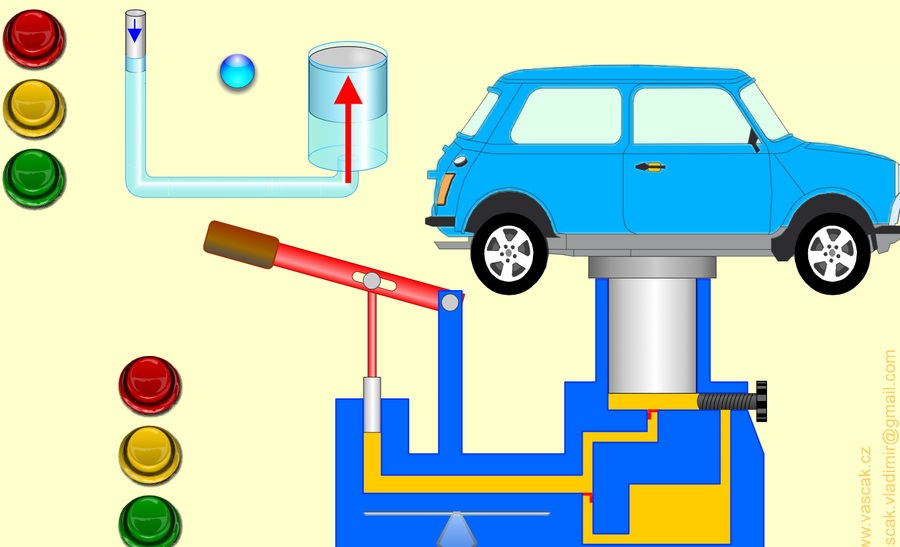
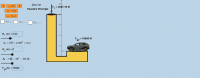
المكبس الهيدروليكي: قوة صغيرة على المكبس الصغير تنتج قوة كبيرة على المكبس الكبير، فيرفع السيارة.
The hydraulic press: a small force on the small piston produces a large force on the large piston, which lifts the car.
📌 المكبس الهيدروليكي
📌 The hydraulic press
الضغط الناتج عن القوة \(F_1\) على المكبس الصغير (مساحته \(A_1\)) هو نفسه الضغط على المكبس الكبير (مساحته \(A_2\))، أي \(P_1=P_2\):
The pressure produced by the force \(F_1\) on the small piston (area \(A_1\)) is the same pressure acting on the large piston (area \(A_2\)), that is \(P_1=P_2\):
\[\dfrac{F_1}{A_1}=\dfrac{F_2}{A_2}\quad\Rightarrow\quad F_2=F_1\,\dfrac{A_2}{A_1}\]
💡 شرح إضافي: هل حصلنا على طاقة مجانية؟
💡 Extra explanation: is it free energy?
تتضاعف القوة بنسبة \(A_2/A_1\) لكن الشغل لا يتضاعف. السائل غير قابل للانضغاط تقريبًا، فحجم السائل الذي ينزاحه المكبس الصغير يساوي حجم السائل الذي يرفع به المكبس الكبير: \(A_1d_1=A_2d_2\). لذلك يتحرك المكبس الكبير مسافة أقل بنفس النسبة، ويكون الشغل المبذول \(F_1d_1\) مساويًا للشغل المنجز \(F_2d_2\) (مع إهمال الاحتكاك).
The force is multiplied by the ratio \(A_2/A_1\) but the work is not. The liquid is almost incompressible, so the volume displaced by the small piston equals the volume that raises the large piston: \(A_1d_1=A_2d_2\). Hence the large piston moves a shorter distance in the same ratio, and the work put in \(F_1d_1\) equals the work done \(F_2d_2\) (neglecting friction).
من تطبيقاته: رافعة السيارات، ومكابح السيارات الهيدروليكية، وكرسي طبيب الأسنان، والمكابس الصناعية.
Applications: car lifts, hydraulic car brakes, the dentist's chair and industrial presses.
🧪 تجربة 3: مبدأ باسكال: المكبس الهيدروليكي
🧪 Experiment 3: Pascal's principle: the hydraulic press
غيّر القوة على المكبس الصغير ومساحتي المكبسين وكتلة الحِمل، ثم اضغط «شغّل» لترى حركة المكبسين. يُنقل الضغط نفسه إلى المكبس الكبير فتتضاعف القوة بنسبة المساحتين، لكن المكبس الكبير يتحرك مسافة أقل. ثم احسب أقل قوة تكفي لرفع الحِمل.
Change the force on the small piston, the areas of the two pistons and the mass of the load, then press “Run” to see the pistons move. The same pressure is transmitted to the large piston, so the force is multiplied by the ratio of the areas, but the large piston moves a shorter distance. Then calculate the smallest force that can lift the load.
في رافعة هيدروليكية مساحة المكبس الصغير \(0.020\ \mathrm{m^2}\) ومساحة المكبس الكبير \(0.80\ \mathrm{m^2}\). ما أقل قوة يجب التأثير بها على المكبس الصغير لرفع سيارة كتلتها \(1200\ \mathrm{kg}\)؟ (\(g=9.8\ \mathrm{m/s^2}\))
In a hydraulic lift the small piston has area \(0.020\ \mathrm{m^2}\) and the large piston \(0.80\ \mathrm{m^2}\). What is the smallest force needed on the small piston to lift a car of mass \(1200\ \mathrm{kg}\)? (\(g=9.8\ \mathrm{m/s^2}\))
رافعة هيدروليكية مساحة مكبسها الصغير \(10\ \mathrm{cm^2}\) والكبير \(200\ \mathrm{cm^2}\). إذا أثرنا بقوة \(50\ \mathrm{N}\) على الصغير فإن القوة على الكبير:
A hydraulic lift has a small piston of area \(10\ \mathrm{cm^2}\) and a large one of \(200\ \mathrm{cm^2}\). If a force of \(50\ \mathrm{N}\) acts on the small piston, the force on the large one is:
🌊 ضغط المائع والضغط الكلي
🌊 Fluid Pressure and Total Pressure
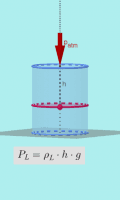
كلما غُصنا في الماء شعرنا بضغط أكبر على آذاننا. يمكن استنتاج السبب بتخيل عمود من السائل ارتفاعه \(h\) ومساحة قاعدته \(A\) فوق نقطة ما؛ وزن هذا العمود هو ما يضغط على القاعدة:
The deeper we dive, the more pressure we feel on our ears. We can find the reason by imagining a column of liquid of height \(h\) and base area \(A\) above a point; the weight of this column is what presses on the base:
\[P=\dfrac{F}{A}=\dfrac{mg}{A}=\dfrac{\rho Vg}{A}=\dfrac{\rho Ah\,g}{A}\;\Rightarrow\;P=\rho gh\]
📘 ضغط المائع والضغط الكلي
📘 Fluid pressure and total pressure
ضغط المائع على عمق \(h\): \(P=\rho gh\) حيث \(\rho\) كثافة المائع و\(g\) عجلة الجاذبية. يزداد الضغط خطيًا مع العمق وبزيادة كثافة المائع، ولا يعتمد على شكل الإناء ولا على مساحة قاعدته.
Fluid pressure at depth \(h\): \(P=\rho gh\), where \(\rho\) is the density of the fluid and \(g\) the acceleration of gravity. The pressure increases linearly with depth and with the density of the fluid, and does not depend on the shape of the vessel or the area of its base.
الضغط الكلي (المطلق) هو ضغط المائع مضافًا إليه الضغط الجوي الذي يضغط على سطح السائل:
The total (absolute) pressure is the fluid pressure plus the atmospheric pressure acting on the surface of the liquid:
\[P_{tot}=p_0+\rho gh,\qquad p_0=101\,325\ \mathrm{N/m^2}\approx1\ \mathrm{atm}\]
| المائعFluid | الكثافة \(\rho\) (\(\mathrm{kg/m^3}\))Density \(\rho\) (\(\mathrm{kg/m^3}\)) |
|---|---|
| الهواءAir | 1.221.22 |
| الزيتOil | ≈ 800≈ 800 |
| الماءWater | 10001000 |
| ماء البحرSea water | ≈ 1025≈ 1025 |
| الزئبقMercury | 13 60013 600 |
💡 شرح إضافي: ماذا يعني الضغط المقيس والضغط المطلق؟
💡 Extra explanation: gauge pressure and absolute pressure
الحد \(\rho gh\) وحده يسمى الضغط المقيس (الزيادة على الضغط الجوي)، وهو ما تقيسه مقاييس الضغط في إطارات السيارات. أما \(p_0+\rho gh\) فهو الضغط المطلق. على عمق \(10\ \mathrm{m}\) من الماء يكون \(\rho gh\approx98\,000\ \mathrm{Pa}\) أي قريبًا من ضغط جوي إضافي، فيصبح الضغط المطلق نحو \(2\ \mathrm{atm}\).
The term \(\rho gh\) alone is the gauge pressure (the excess over atmospheric pressure), which is what a tyre gauge reads. \(p_0+\rho gh\) is the absolute pressure. At a depth of \(10\ \mathrm{m}\) of water \(\rho gh\approx98\,000\ \mathrm{Pa}\), about one extra atmosphere, so the absolute pressure is about \(2\ \mathrm{atm}\).
ولهذا تُبنى السدود أسمك عند القاع، ويحتاج الغواص إلى بدلة تتحمل الضغط المتزايد.
This is why dams are built thicker at the bottom, and why a diver needs a suit that withstands the increasing pressure.
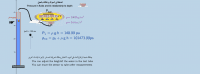
🧪 تجربة 4: الضغط والعمق والكثافة
🧪 Experiment 4: Pressure, depth and density
حرّك الحساس إلى الأسفل وبدّل السائل، وراقب كيف يزداد ضغط المائع \(\rho gh\) خطيًا مع العمق وكيف يزداد الميل بزيادة الكثافة. فعّل أو ألغِ الضغط الجوي لترى الفرق بين ضغط المائع والضغط الكلي. ثم احسب الضغط عند العمق المعروض.
Move the sensor down and change the liquid, and watch how the fluid pressure \(\rho gh\) grows linearly with depth and how the slope grows with density. Switch the atmospheric pressure on or off to see the difference between the fluid pressure and the total pressure. Then calculate the pressure at the depth shown.
غواص على عمق \(30\ \mathrm{m}\) في ماء البحر (\(\rho=1030\ \mathrm{kg/m^3}\)). احسب (أ) ضغط الماء عليه، (ب) الضغط الكلي. (\(g=9.8\ \mathrm{m/s^2}\))
A diver is at a depth of \(30\ \mathrm{m}\) in sea water (\(\rho=1030\ \mathrm{kg/m^3}\)). Find (a) the water pressure on the diver and (b) the total pressure. (\(g=9.8\ \mathrm{m/s^2}\))
ما ضغط الماء (بإهمال الضغط الجوي) على عمق \(5\ \mathrm{m}\) في ماء عذب؟ (\(\rho=1000\ \mathrm{kg/m^3}\)، \(g=9.8\ \mathrm{m/s^2}\))
What is the water pressure (neglecting atmospheric pressure) at a depth of \(5\ \mathrm{m}\) in fresh water? (\(\rho=1000\ \mathrm{kg/m^3}\), \(g=9.8\ \mathrm{m/s^2}\))
ما الضغط الكلي عند قاع بركة عمقها \(10\ \mathrm{m}\) (\(\rho=1000\ \mathrm{kg/m^3}\)، \(g=9.8\ \mathrm{m/s^2}\)، \(p_0=101\,325\ \mathrm{Pa}\))؟
What is the total pressure at the bottom of a pool \(10\ \mathrm{m}\) deep (\(\rho=1000\ \mathrm{kg/m^3}\), \(g=9.8\ \mathrm{m/s^2}\), \(p_0=101\,325\ \mathrm{Pa}\))?
⚓ دافعة أرخميدس
⚓ Archimedes' Buoyant Force
بعض الأجسام إذا وُضعت في مائع تغوص، وبعضها يبقى معلقًا في أي موضع، وبعضها يرتفع نحو السطح ويطفو.
Some objects placed in a fluid sink, some stay suspended at any position, and some rise to the surface and float.
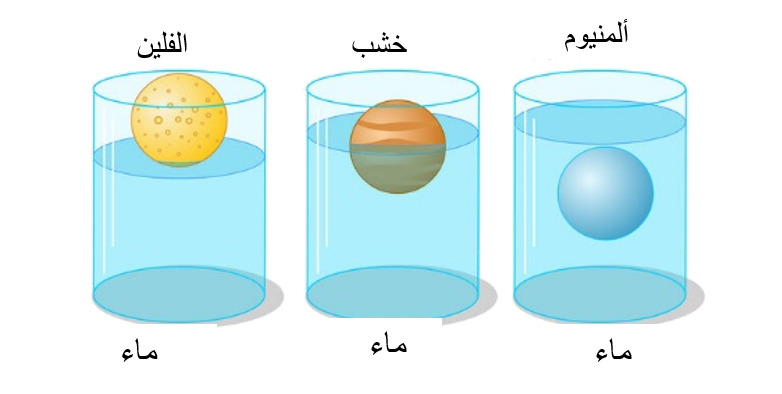
ثلاث كرات في الماء: الفلين يطفو، والخشب يطفو مغمورًا جزئيًا أو معلقًا، والألمنيوم يغوص.
Three spheres in water: the cork floats, the wood is partly submerged or suspended, and the aluminium sinks.
وإذا وزنّا جسمًا بميزان نابضي في الهواء ثم أنزلناه في الماء لاحظنا أن قراءة الميزان تقل. السبب وجود قوة تدفع الجسم إلى الأعلى.
If we weigh an object with a spring balance in air and then lower it into water, the reading of the balance decreases. The reason is a force pushing the object upward.
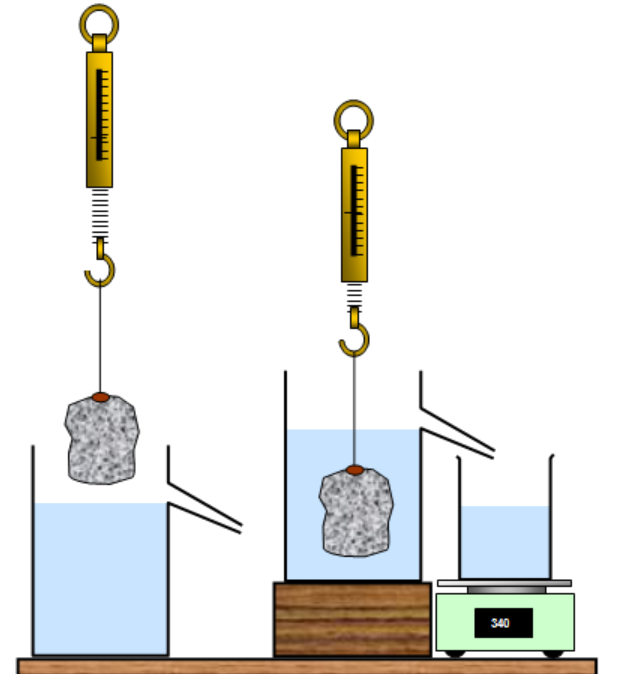
وزن الحجر في الهواء أكبر منه في الماء، والماء المنزاح (الذي يتجمع من الإناء) وزنه يساوي دافعة أرخميدس.
The weight of the stone in air is larger than in water, and the weight of the displaced water (collected from the overflow can) equals the buoyant force.
📘 دافعة أرخميدس
📘 The buoyant force
دافعة أرخميدس (\(F_B\)) هي القوة التي يؤثر بها المائع على الجسم المغمور فيه كليًا أو جزئيًا، وتتجه رأسيًا إلى الأعلى. ويسمى وزن الجسم داخل المائع (\(F_g^{\prime}\)) الوزن الظاهري.
The buoyant force (\(F_B\)) is the force exerted by a fluid on an object immersed in it fully or partly, directed vertically upward. The weight of the object inside the fluid (\(F_g^{\prime}\)) is called its apparent weight.
\[F_B=F_g-F_g^{\prime}\]
وتساوي الدافعة أيضًا وزن المائع المزاح (مبدأ أرخميدس):
The buoyant force also equals the weight of the displaced fluid (Archimedes' principle):
\[F_B=\rho_{f}\,V_{sub}\,g\]
\(\rho_f\): كثافة المائع المزاح، \(V_{sub}\): حجم المائع المزاح = حجم الجزء المغمور من الجسم، \(g\): عجلة الجاذبية.
\(\rho_f\): density of the displaced fluid, \(V_{sub}\): volume of the displaced fluid = volume of the submerged part of the object, \(g\): acceleration of gravity.
💡 شرح إضافي: لماذا توجد دافعة؟ ومتى يطفو الجسم؟
💡 Extra explanation: why is there a buoyant force, and when does an object float?
ضغط المائع على الوجه السفلي للجسم أكبر من ضغطه على الوجه العلوي لأن \(P=\rho gh\) يزداد مع العمق، فتكون القوة المحصلة للضغط إلى الأعلى، وهذه هي دافعة أرخميدس. والدافعة لا تعتمد على وزن الجسم ولا على مادته، وإنما على كثافة المائع وحجم الجزء المغمور فقط.
The pressure of the fluid on the lower face of the object is greater than on the upper face because \(P=\rho gh\) grows with depth, so the net force from the pressure is upward: this is the buoyant force. It does not depend on the weight of the object or its material, only on the density of the fluid and the volume of the submerged part.
قارن الدافعة بالوزن \(F_g=\rho_o V g\) (حيث \(\rho_o\) كثافة الجسم):
Compare the buoyant force with the weight \(F_g=\rho_o V g\) (where \(\rho_o\) is the density of the object):
- \(\rho_o\gt \rho_f\): الجسم يغوص لأن الدافعة (حتى عند الغمر الكامل) أقل من الوزن.\(\rho_o\gt \rho_f\): the object sinks because the buoyant force (even when fully submerged) is less than the weight.
- \(\rho_o=\rho_f\): الجسم معلّق عند أي عمق لأن الدافعة تساوي الوزن.\(\rho_o=\rho_f\): the object is suspended at any depth because the buoyant force equals the weight.
- \(\rho_o\lt \rho_f\): الجسم يطفو، ويغمر منه جزء فقط تتساوى عنده الدافعة مع الوزن: \(\dfrac{V_{sub}}{V}=\dfrac{\rho_o}{\rho_f}\).\(\rho_o\lt \rho_f\): the object floats, with only the part submerged at which the buoyant force equals the weight: \(\dfrac{V_{sub}}{V}=\dfrac{\rho_o}{\rho_f}\).
وبهذا تطفو السفن الحديدية لأن شكلها المجوّف يجعل متوسط كثافتها (مع الهواء داخلها) أقل من كثافة الماء، وتغوص الغواصة أو تطفو بتغيير كمية الماء في خزاناتها.
This is why iron ships float: their hollow shape makes their average density (including the air inside) less than that of water; a submarine sinks or floats by changing the amount of water in its tanks.
🧪 تجربة 5: دافعة أرخميدس: يغوص أم يطفو؟
🧪 Experiment 5: Archimedes' buoyant force: does it sink or float?
غيّر كتلة الجسم وحجمه ونوع السائل. يقارن البرنامج كثافة الجسم بكثافة السائل: فيغوص أو يطفو أو يبقى معلقًا، ويحسب دافعة أرخميدس والوزن الظاهري كما يقرؤه الميزان النابضي. ثم احسب الدافعة بنفسك وتحقق من إجابتك.
Change the mass and volume of the object and the type of liquid. The program compares the density of the object with that of the liquid: it sinks, floats or stays suspended, and it calculates the buoyant force and the apparent weight as the spring balance would read it. Then calculate the buoyant force yourself and check your answer.
وُزن حجر في الهواء فكان \(3.0\ \mathrm{N}\)، ثم وُزن مغمورًا كليًا في الماء فكان \(2.0\ \mathrm{N}\). احسب دافعة أرخميدس، وحجم الحجر، وكثافته. (\(\rho_w=1000\ \mathrm{kg/m^3}\)، \(g=9.8\ \mathrm{m/s^2}\))
A stone weighs \(3.0\ \mathrm{N}\) in air and \(2.0\ \mathrm{N}\) when fully submerged in water. Find the buoyant force, the volume of the stone and its density. (\(\rho_w=1000\ \mathrm{kg/m^3}\), \(g=9.8\ \mathrm{m/s^2}\))
وزن جسم في الهواء \(8\ \mathrm{N}\) ووزنه الظاهري في الماء \(6\ \mathrm{N}\). ما دافعة أرخميدس عليه؟
The weight of an object in air is \(8\ \mathrm{N}\) and its apparent weight in water is \(6\ \mathrm{N}\). What is the buoyant force on it?
قطعة خشب كثافتها \(600\ \mathrm{kg/m^3}\) تطفو على الماء (\(1000\ \mathrm{kg/m^3}\)). ما نسبة حجمها المغمور؟
A piece of wood of density \(600\ \mathrm{kg/m^3}\) floats on water (\(1000\ \mathrm{kg/m^3}\)). What fraction of its volume is submerged?
على أي العاملين تعتمد دافعة أرخميدس على جسم مغمور كليًا؟
On which of the following does the buoyant force on a fully submerged object depend?
📚 ملخص الدرس
📚 Lesson Summary
| المفهومConcept | الفكرة / القانونIdea / Law |
|---|---|
| التماسك والتوتر السطحيCohesion and surface tension | تجاذب بين جزيئات المادة نفسها؛ جزيء السطح يُجذب نحو الداخل فيتقلص السطحattraction between like molecules; a surface molecule is pulled inward so the surface contracts |
| التلاصق والخاصية الشعريةAdhesion and capillarity | تلاصق أكبر من تماسك: يرتفع السائل (الماء)؛ تماسك أكبر: ينخفض (الزئبق)adhesion > cohesion: the liquid rises (water); cohesion > adhesion: it is depressed (mercury) |
| التبخرEvaporation | هروب الجزيئات الأسرع من السطح فيبرد السائلthe fastest molecules escape from the surface, so the liquid cools |
| التكثفCondensation | الجزيئات البطيئة تفقد طاقتها فتعود سائلة؛ عند الاتزان يتساوى المعدلانmolecules lose energy and return to liquid; at equilibrium the two rates are equal |
| مبدأ باسكالPascal's principle | \(\dfrac{F_1}{A_1}=\dfrac{F_2}{A_2}\)\(\dfrac{F_1}{A_1}=\dfrac{F_2}{A_2}\) |
| ضغط المائعFluid pressure | \(P=\rho gh\ ;\ P_{tot}=p_0+\rho gh\)\(P=\rho gh\ ;\ P_{tot}=p_0+\rho gh\) |
| دافعة أرخميدسBuoyant force | \(F_B=F_g-F_g^{\prime}=\rho_f V_{sub}g\)\(F_B=F_g-F_g^{\prime}=\rho_f V_{sub}g\) |
⚠️ أخطاء شائعة
⚠️ Common mistakes
- نسيان إضافة الضغط الجوي \(p_0\) عند حساب الضغط الكلي.Forgetting to add the atmospheric pressure \(p_0\) when calculating the total pressure.
- الاعتقاد أن الضغط يعتمد على شكل الإناء؛ هو يعتمد على العمق والكثافة فقط.Thinking that the pressure depends on the shape of the vessel; it depends on the depth and the density only.
- استعمال حجم الجسم كله في \(F_B=\rho Vg\) والجسم طافٍ؛ الصحيح هو حجم الجزء المغمور فقط.Using the whole volume of the object in \(F_B=\rho Vg\) for a floating object; the correct volume is that of the submerged part only.
- الخلط بين مساحة المكبس الصغير والكبير في \(F_1/A_1=F_2/A_2\)؛ القوة الأكبر دائمًا عند المكبس الأكبر مساحة.Mixing up the small and large pistons in \(F_1/A_1=F_2/A_2\); the larger force is always at the piston of larger area.
🧪 اختبر نفسك: امتحان من 20 سؤالاً
🧪 Test Yourself: a 20-Question Exam
أنهِ الدرس بالاختبار التفاعلي التالي؛ أسئلته تجمع بين الفهم والحساب وتغطي جميع أقسام الدرس.
Finish with the interactive exam below; its questions mix understanding with calculation and cover every section of the lesson.
اختبار القوى داخل السوائل والموائع الساكنة Forces in Liquids and Fluids at Rest Quiz
20 سؤالاً - التماسك والتلاصق، التبخر والتكثف، مبدأ باسكال، ضغط المائع، ودافعة أرخميدس 20 Questions - Cohesion and Adhesion, Evaporation and Condensation, Pascal's Principle, Fluid Pressure and Buoyancy
• عدد الأسئلة: 20 سؤالاً
• مدة الاختبار: 30 دقيقة
• لا يمكنك تغيير إجاباتك أو إعادة الاختبار إلا بعد 24 ساعة من التسليم.
• تأكد من إجاباتك قبل التسليم! 📌 Important Instructions:
• Number of questions: 20 questions
• Quiz duration: 30 minutes
• You cannot change your answers or retake the quiz for 24 hours after submission.
• Make sure of your answers before submitting!
🔗 محاكيات GeoGebra للاستعانة بها عند اللزوم
🔗 GeoGebra Simulations to Use When Needed
اضغط «تشغيل» لتعمل المحاكاة هنا داخل الدرس؛ ويمكن للطالب الرجوع إليها لتجربة الفكرة بطريقة أخرى.
Press “Run” to run the simulation right here inside the lesson; the student can use it to try the idea in another way.