🎯 نواتج التعلم
🎯 Learning Outcomes
بعد دراسة هذا الدرس ستكون قادرًا على أن:
After this lesson you will be able to:
- تصف تجربتي كولوم وتستنتج أن \(F\propto q_1q_2\) وأن \(F\propto1/r^2\).Describe Coulomb’s two experiments and conclude that \(F\propto q_1q_2\) and \(F\propto1/r^2\).
- تطبّق قانون كولوم \(F=k\dfrac{|q_1q_2|}{r^2}\) وتحدد اتجاه القوة (تجاذب أو تنافر).Apply Coulomb’s law \(F=k\dfrac{|q_1q_2|}{r^2}\) and determine the direction of the force (attraction or repulsion).
- تحسب محصلة القوى الكهربائية على شحنة بجمع المتجهات (مبدأ التراكب).Calculate the resultant of the electric forces on a charge by adding vectors (the principle of superposition).
- تجد موضع اتزان شحنة اختبارية وتحل مسائل الكرات المعلقة.Find the equilibrium position of a test charge and solve problems of hanging balls.
- تقارن بين القوة الكهربائية وقوة الجاذبية الكتلية.Compare the electric force with the gravitational force.
🔬 تجربتا كولوم
🔬 Coulomb’s Two Experiments
درس العالم كولوم القوة المتبادلة بين شحنتين نقطيتين بميزان الليّ. غيّر مقدار الشحنتين وهو يثبّت المسافة بينهما (التجربة الأولى)، ثم غيّر المسافة وهو يثبّت الشحنتين (التجربة الثانية)، فوجد علاقتين بسيطتين جمعهما في قانون واحد.
The scientist Coulomb studied the mutual force between two point charges with a torsion balance. He changed the magnitudes of the charges while keeping the distance constant (the first experiment), then changed the distance while keeping the charges constant (the second experiment), and found two simple relations which he combined in one law.
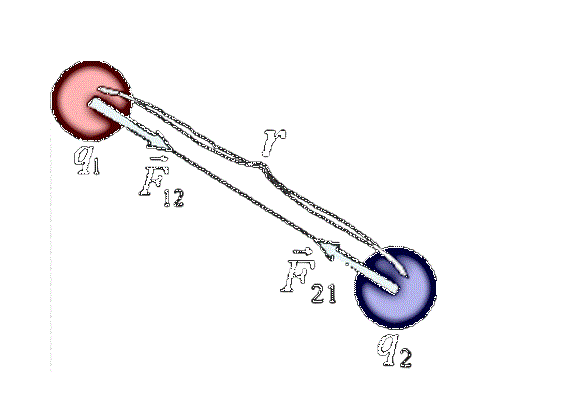
القوتان المتبادلتان بين شحنتين نقطيتين على الخط الواصل بينهما
The mutual forces between two point charges along the line joining them
🧪 تجربة 1: القوة ومقدار الشحنتين
🧪 Experiment 1: Force and the Magnitude of the Charges
نكرّر تجربة كولوم الأولى: نثبّت المسافة \(r=10\ \mathrm{cm}\) ونغيّر الشحنتين لنرى كيف تتغير القوة المتبادلة.
We repeat Coulomb’s first experiment: we keep the distance \(r=10\ \mathrm{cm}\) constant and change the charges to see how the mutual force changes.
🛠️ خطوات العمل
🛠️ Procedure
- ابدأ من \(q_1=q_2=5\ \mu\mathrm C\) وسجّل القوة \(F_0\).Start with \(q_1=q_2=5\ \mu\mathrm C\) and record the force \(F_0\).
- ضاعف \(q_1\) فقط ثم ضاعف الشحنتين معًا وسجّل النسبة \(F/F_0\) في كل مرة.Double \(q_1\) only then double both charges and record the ratio \(F/F_0\) each time.
- جرّب أن تنقص إحدى الشحنتين إلى النصف.Try halving one of the charges.
🧪 تجربة 1: القوة والشحنتان (تجربة كولوم الأولى)
🧪 Experiment 1: Force and the Two Charges (Coulomb’s First Experiment)
تبقى المسافة بين الشحنتين ثابتة \(r=10\ \mathrm{cm}\) وتغيّر مقدار الشحنتين. راقب كيف تتغير القوة وقارنها بالقوة الابتدائية \(F_0\).
The distance between the two charges stays constant \(r=10\ \mathrm{cm}\) while you change the magnitudes of the charges. Watch how the force changes and compare it with the initial force \(F_0\).
🔎 ماذا نلاحظ؟ وما الاستنتاج؟
🔎 What do we observe? What is the conclusion?
- تضاعف إحدى الشحنتين يضاعف القوة، وتضاعف الشحنتين معًا يجعلها 4 أمثالها.Doubling one charge doubles the force and doubling both makes it 4 times as great.
- منحنى \(F\) مع \(q_1\) خط مستقيم يمر بالأصل.The curve of \(F\) against \(q_1\) is a straight line through the origin.
القوة الكهربائية تتناسب طرديًا مع حاصل ضرب الشحنتين: \(F\propto q_1q_2\).
The electric force is directly proportional to the product of the two charges: \(F\propto q_1q_2\).
🧪 تجربة 2: القوة والمسافة
🧪 Experiment 2: Force and Distance
نكرّر تجربة كولوم الثانية: نثبّت الشحنتين \(5\ \mu\mathrm C\) ونغيّر المسافة بينهما.
We repeat Coulomb’s second experiment: we keep the two charges \(5\ \mu\mathrm C\) constant and change the distance between them.
🛠️ خطوات العمل
🛠️ Procedure
- ابدأ من \(r=10\ \mathrm{cm}\) وسجّل القوة.Start with \(r=10\ \mathrm{cm}\) and record the force.
- ضاعف المسافة إلى 20 ثم 30 cm وسجّل النسبة \(F/F_0\).Double the distance to 20 then 30 cm and record the ratio \(F/F_0\).
- احسب الجداء \(F\cdot r^2\) في كل حالة وقارن.Calculate the product \(F\cdot r^2\) in each case and compare.
🧪 تجربة 2: القوة والمسافة (تجربة كولوم الثانية)
🧪 Experiment 2: Force and Distance (Coulomb’s Second Experiment)
تبقى الشحنتان ثابتتين \(q_1=q_2=5\ \mu\mathrm C\) وتغيّر المسافة بينهما. راقب منحنى \(F\) مع \(r\) وكيف يبقى الجداء \(F\cdot r^2\) ثابتًا.
The charges stay constant \(q_1=q_2=5\ \mu\mathrm C\) while you change the distance between them. Watch the curve of \(F\) against \(r\) and how the product \(F\cdot r^2\) stays constant.
🔎 ماذا نلاحظ؟ وما الاستنتاج؟
🔎 What do we observe? What is the conclusion?
- عند \(r=20\ \mathrm{cm}\) تصير القوة ربع الأصل، وعند \(30\ \mathrm{cm}\) تصير تُسعها.At \(r=20\ \mathrm{cm}\) the force is a quarter of the original and at \(30\ \mathrm{cm}\) it is a ninth.
- الجداء \(F\cdot r^2\) يبقى ثابتًا (\(=kq_1q_2\)).The product \(F\cdot r^2\) stays constant (\(=kq_1q_2\)).
القوة الكهربائية تتناسب عكسيًا مع مربع المسافة: \(F\propto 1/r^2\).
The electric force is inversely proportional to the square of the distance: \(F\propto 1/r^2\).
| التغييرThe change | أثره في القوةIts effect on the force | العلاقةThe relation |
|---|---|---|
| تضاعف إحدى الشحنتينOne charge doubled | تتضاعف القوةThe force doubles | \(F\propto q_1q_2\) |
| تضاعف الشحنتين معًاBoth charges doubled | تصير 4 أمثالهاBecomes 4 times | \(F\propto q_1q_2\) |
| تضاعف المسافةThe distance doubled | تنقص إلى الربعFalls to a quarter | \(F\propto 1/r^2\) |
| نصف المسافةHalf the distance | تصير 4 أمثالهاBecomes 4 times | \(F\propto 1/r^2\) |
⚡ قانون كولوم
⚡ Coulomb’s Law
📌 قانون كولوم
📌 Coulomb’s law
\[F=k\,\frac{|q_1q_2|}{r^2}\qquad,\qquad k=\frac{1}{4\pi\varepsilon_0}=8.99\times10^{9}\ \mathrm{N\,m^2/C^2}\]
حيث \(\varepsilon_0=8.85\times10^{-12}\ \mathrm{C^2/N\,m^2}\) سماحية الفراغ. وفي وسط مادي تُستبدل \(\varepsilon_0\) بـ \(\varepsilon_0\varepsilon_r\) فتقل القوة بالعامل \(\varepsilon_r\) (السماحية النسبية).
where \(\varepsilon_0=8.85\times10^{-12}\ \mathrm{C^2/N\,m^2}\) is the permittivity of vacuum. In a material medium \(\varepsilon_0\) is replaced by \(\varepsilon_0\varepsilon_r\) so the force decreases by the factor \(\varepsilon_r\) (the relative permittivity).
شحنتان متماثلتان في المقدار تفصل بينهما \(0.2\ \mathrm m\) والقوة المتبادلة بينهما \(0.4\ \mathrm N\). أوجد مقدار كل شحنة.
Two charges of equal magnitude are \(0.2\ \mathrm m\) apart and the mutual force between them is \(0.4\ \mathrm N\). Find the magnitude of each charge.
بأي عامل تتغير القوة الكهربائية بين شحنتين إذا زاد مقدار إحداهما إلى الضعف وقل البعد بينهما إلى النصف؟
By what factor does the electric force between two charges change if the magnitude of one of them doubles and the distance between them halves?
إذا أثّرت الشحنة الأولى في الثانية بقوة \(10\ \mathrm N\) نحو اليمين فإن قوة الثانية في الأولى:
If the first charge exerts a force of \(10\ \mathrm N\) to the right on the second charge, the force of the second on the first is:
➡️ القوة كمتجه
➡️ The Force as a Vector
القوة الكهربائية قوة اتجاهية تعمل على امتداد الخط الواصل بين الشحنتين، لذلك نكتبها بصيغة متجهة. تكون تنافرًا إذا كانت الشحنتان من النوع نفسه (\(q_1q_2\gt 0\)) وتجاذبًا إذا اختلف نوعاهما (\(q_1q_2\lt 0\))، وتكون القوتان المتبادلتان متساويتين في المقدار ومتعاكستين في الاتجاه (قانون نيوتن الثالث).
The electric force is a directional force that acts along the line joining the charges, so we write it in vector form. It is a repulsion if the charges are of the same kind (\(q_1q_2\gt 0\)) and an attraction if they are of different kinds (\(q_1q_2\lt 0\)), and the two mutual forces are equal in magnitude and opposite in direction (Newton’s third law).
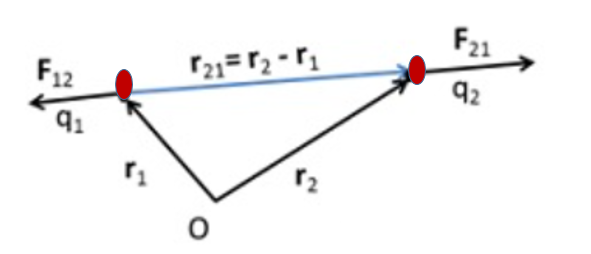
المتجهان \(\vec r_1\) و\(\vec r_2\) والقوتان \(\vec F_{12}\) و\(\vec F_{21}\)
The vectors \(\vec r_1\) and \(\vec r_2\) and the forces \(\vec F_{12}\) and \(\vec F_{21}\)
📌 الصيغة المتجهة
📌 The vector form
\[\vec F_{12}=k\,\frac{q_1q_2}{r^2}\,\hat r_{21}\qquad,\qquad \vec F_{21}=-\vec F_{12}\]
\(\hat r_{21}\) متجه وحدة من الشحنة 2 إلى الشحنة 1. فإذا كان \(q_1q_2\gt 0\) كانت \(\vec F_{12}\) في اتجاه \(\hat r_{21}\) أي ابتعادًا عن الشحنة 2 (تنافر)، وإذا كان \(q_1q_2\lt 0\) انعكس الاتجاه (تجاذب).
\(\hat r_{21}\) is a unit vector from charge 2 to charge 1. If \(q_1q_2\gt 0\), \(\vec F_{12}\) is in the direction of \(\hat r_{21}\), i.e., away from charge 2 (repulsion), and if \(q_1q_2\lt 0\) the direction is reversed (attraction).
🧮 تراكب القوى الكهربائية
🧮 Superposition of Electric Forces
عند وجود أكثر من شحنتين تكون القوة الكلية على شحنة هي المجموع الاتجاهي لقوى الشحنات الأخرى، كل قوة تُحسب كأن الأخرى غير موجودة: \(\vec F=\vec F_{12}+\vec F_{13}+\cdots\). نحسب كل مقدار بقانون كولوم ثم نحدد اتجاهه ونجمع المتجهات.
When there are more than two charges the total force on a charge is the vector sum of the forces of the other charges, each calculated as if the others were absent: \(\vec F=\vec F_{12}+\vec F_{13}+\cdots\). We calculate each magnitude by Coulomb’s law then find its direction and add the vectors.

ثلاث شحنات \(q_1\) و\(q_2\) و\(q_3\) على استقامة واحدة والمسافة \(r\) بين كل اثنتين متجاورتين
Three charges \(q_1\), \(q_2\) and \(q_3\) on one line and the distance \(r\) between adjacent ones
مثال تفكيري: أين تتجه القوة على \(q_1\) من \(q_2\) و\(q_3\) إذا كانت الشحنات الثلاث متساوية؟ القوتان في الاتجاه نفسه لأن كلاً منهما تنافر (تدفع \(q_1\) بعيدًا)، وقوة \(q_2\) أكبر لأنها أقرب.
A thinking example: in which direction is the force on \(q_1\) due to \(q_2\) and \(q_3\) if the three charges are equal? The two forces are in the same direction because each is a repulsion (it pushes \(q_1\) away), and the force of \(q_2\) is larger because it is nearer.
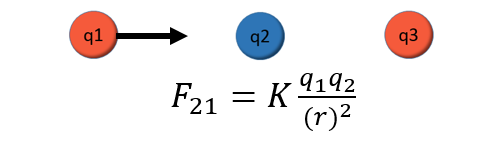
\(F_{21}=k\dfrac{q_1q_2}{r^2}\)
\(F_{21}=k\dfrac{q_1q_2}{r^2}\)
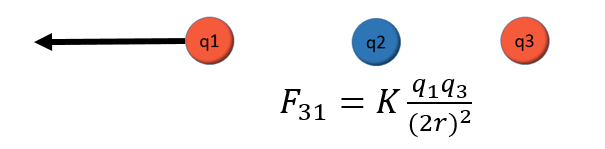
\(F_{31}=k\dfrac{q_1q_3}{(2r)^2}\)
\(F_{31}=k\dfrac{q_1q_3}{(2r)^2}\)
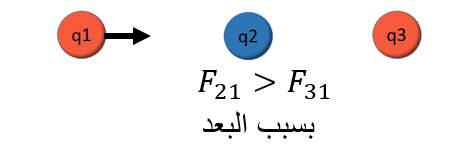
\(F_{21}\gt F_{31}\) بسبب البعد
\(F_{21}\gt F_{31}\) because of the distance
ثلاث شحنات على خط مستقيم: \(q_1=+2\ \mu\mathrm C\) عند \(x=0\) و\(q_2=+4\ \mu\mathrm C\) عند \(x=0.3\ \mathrm m\) و\(q_3=+6\ \mu\mathrm C\) عند \(x=0.5\ \mathrm m\). أوجد القوة المحصلة على \(q_2\).
Three charges on a straight line: \(q_1=+2\ \mu\mathrm C\) at \(x=0\), \(q_2=+4\ \mu\mathrm C\) at \(x=0.3\ \mathrm m\) and \(q_3=+6\ \mu\mathrm C\) at \(x=0.5\ \mathrm m\). Find the resultant force on \(q_2\).
ثلاث شحنات من النوع نفسه: \(q_1=q\) و\(q_2=q\) و\(q_3=2q\) على خط واحد، البعد بين \(q_1\) و\(q_2\) هو \(r\) وبين \(q_2\) و\(q_3\) هو \(2r\). ما اتجاه القوة على \(q_2\)؟
Three charges of the same kind: \(q_1=q\), \(q_2=q\) and \(q_3=2q\) on one line, the distance between \(q_1\) and \(q_2\) is \(r\) and between \(q_2\) and \(q_3\) is \(2r\). In which direction is the force on \(q_2\)?
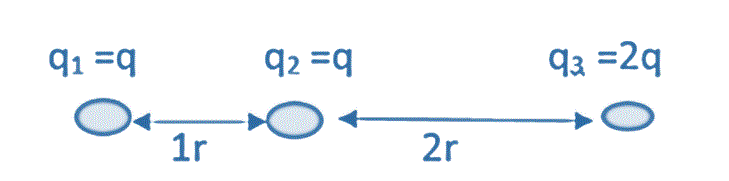
ثلاث شحنات من النوع نفسه \(q\) و\(q\) و\(2q\)
Three charges of the same kind \(q\), \(q\) and \(2q\)
🧪 تجربة 3: تراكب القوى على شحنة
🧪 Experiment 3: Superposition of Forces on a Charge
نضع شحنتين \(q_2\) و\(q_3\) بجوار الشحنة \(q_1\) ونرى كيف تُجمع القوتان جمعًا اتجاهيًا لتعطي المحصلة.
We place two charges \(q_2\) and \(q_3\) near the charge \(q_1\) and see how the two forces are added vectorially to give the resultant.
🛠️ خطوات العمل
🛠️ Procedure
- اجعل \(q_2\) و\(q_3\) موجبتين وراقب اتجاه كل قوة (تنافر).Make \(q_2\) and \(q_3\) positive and watch the direction of each force (repulsion).
- اجعل إحداهما سالبة وراقب تغيّر اتجاه القوة المقابلة (تجاذب).Make one of them negative and watch the direction of the corresponding force change (attraction).
- اضبط القيم بحيث يتساوى مقدار \(F_{12}\) و\(F_{13}\) ولاحظ اتجاه المحصلة.Adjust the values so that the magnitudes of \(F_{12}\) and \(F_{13}\) are equal and notice the direction of the resultant.
🧪 تجربة 3: تراكب القوى الكهربائية على شحنة
🧪 Experiment 3: Superposition of Electric Forces on a Charge
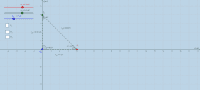
الشحنة \(q_1=+4\ \mu\mathrm C\) في الأصل، و\(q_2\) على بعد \(0.3\ \mathrm m\) على محور \(x\)، و\(q_3\) على بعد \(0.4\ \mathrm m\) على محور \(y\). غيّر \(q_2\) و\(q_3\) (قيمًا وإشارةً) وراقب القوتين ومحصلتهما.
The charge \(q_1=+4\ \mu\mathrm C\) is at the origin, \(q_2\) is \(0.3\ \mathrm m\) away on the \(x\) axis and \(q_3\) is \(0.4\ \mathrm m\) away on the \(y\) axis. Change \(q_2\) and \(q_3\) (values and sign) and watch the two forces and their resultant.
🔎 ماذا نلاحظ؟ وما الاستنتاج؟
🔎 What do we observe? What is the conclusion?
- لكل شحنة قوة مستقلة على \(q_1\) بحسب نوعها ومقدارها وبعدها.Each charge has its own force on \(q_1\) according to its kind, magnitude and distance.
- المحصلة هي قطر متوازي الأضلاع المنشأ على القوتين.The resultant is the diagonal of the parallelogram built on the two forces.
القوة الكلية على شحنة هي المجموع الاتجاهي لقوى الشحنات الأخرى (مبدأ التراكب).
The total force on a charge is the vector sum of the forces of the other charges (the principle of superposition).
ثلاث شحنات متماثلة \(+2\ \mu\mathrm C\): \(q_1\) في الأصل و\(q_2\) على بعد \(0.3\ \mathrm m\) على محور \(x\) و\(q_3\) على بعد \(0.4\ \mathrm m\) على محور \(y\). أوجد مقدار القوة على \(q_1\).
Three identical charges \(+2\ \mu\mathrm C\): \(q_1\) at the origin, \(q_2\) \(0.3\ \mathrm m\) away on the \(x\) axis and \(q_3\) \(0.4\ \mathrm m\) away on the \(y\) axis. Find the magnitude of the force on \(q_1\).
ثلاث شحنات من النوع نفسه على خط واحد: \(q\) و\(q\) و\(2q\) على أبعاد \(r\) و\(2r\). اتجاه القوة على الشحنة الوسطى:
Three charges of the same kind on a line: \(q\), \(q\) and \(2q\) at distances \(r\) and \(2r\). The direction of the force on the middle charge is:
⚖️ اتزان شحنة
⚖️ Equilibrium of a Charge
نقول إن شحنة متزنة إذا كانت محصلة القوى الكهربائية المؤثرة عليها معدومة. وللعثور على موضع الاتزان نساوي مقداري القوتين: \(k\dfrac{|q_1q|}{x_1^2}=k\dfrac{|q_2q|}{x_2^2}\) ثم نتحقق أن اتجاهيهما متعاكسان.
A charge is said to be in equilibrium if the resultant of the electric forces acting on it is zero. To find the equilibrium position we equate the magnitudes of the two forces: \(k\dfrac{|q_1q|}{x_1^2}=k\dfrac{|q_2q|}{x_2^2}\) then check that their directions are opposite.
| الشحنتانThe two charges | موضع الاتزانEquilibrium position |
|---|---|
| من النوع نفسهOf the same kind | بين الشحنتين وأقرب إلى الأصغر مقدارًاBetween the charges, nearer the smaller one |
| مختلفتان في النوعOf different kinds | على امتداد الخط خارج الشحنتين وأقرب إلى الأصغر مقدارًاOn the line outside the charges, nearer the smaller one |
| مختلفتان ومتساويتان في المقدارDifferent kinds and equal in magnitude | لا يوجد موضع على الخطThere is no position on the line |
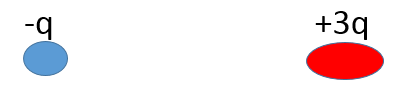
شحنتان مختلفتان في النوع: \(-q\) و\(+3q\)
Two charges of different kinds: \(-q\) and \(+3q\)

موضع الاتزان خارج الشحنتين وأقرب إلى \(-q\) الأصغر
The equilibrium position is outside the charges and nearer the smaller \(-q\)
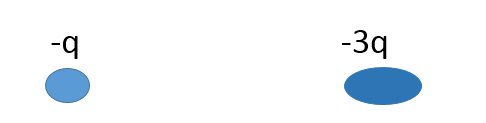
شحنتان من النوع نفسه \(-q\) و\(-3q\)
Two charges of the same kind \(-q\) and \(-3q\)
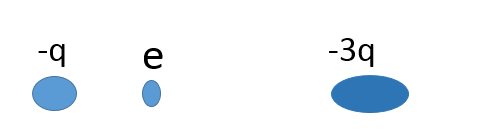
موضع الاتزان بينهما وأقرب إلى \(-q\) الأصغر
The equilibrium position is between them and nearer the smaller \(-q\)
شحنتان \(+4\ \mu\mathrm C\) و\(+1\ \mu\mathrm C\) تفصل بينهما \(0.3\ \mathrm m\). أين تُوضع شحنة ثالثة لتتزن؟
Two charges \(+4\ \mu\mathrm C\) and \(+1\ \mu\mathrm C\) are \(0.3\ \mathrm m\) apart. Where must a third charge be placed to be in equilibrium?
شحنتان \(+4\ \mu\mathrm C\) و\(-1\ \mu\mathrm C\) تفصل بينهما \(0.3\ \mathrm m\). أين تتزن شحنة ثالثة؟
Two charges \(+4\ \mu\mathrm C\) and \(-1\ \mu\mathrm C\) are \(0.3\ \mathrm m\) apart. Where is a third charge in equilibrium?
🧪 تجربة 4: موضع اتزان شحنة
🧪 Experiment 4: The Equilibrium Position of a Charge
نحرّك شحنة اختبارية على الخط الواصل بين شحنتين ونبحث عن الموضع الذي تنعدم فيه القوة المحصلة.
We move a test charge along the line joining two charges and look for the position where the resultant force vanishes.
🛠️ خطوات العمل
🛠️ Procedure
- اختر «من النوع نفسه» وحرّك الشحنة الاختبارية وراقب إشارة القوة المحصلة.Choose “the same kind” and move the test charge and watch the sign of the resultant force.
- حدّد النقطة التي يقطع عندها المنحنى المحور (القوة صفر) أو اضغط «اعرض موضع الاتزان».Locate the point where the curve crosses the axis (zero force) or press “Show the equilibrium position”.
- كرّر مع «مختلفتان في النوع» وقارن موضع الاتزان.Repeat with “different kinds” and compare the equilibrium position.
🧪 تجربة 4: اتزان شحنة على خط مستقيم
🧪 Experiment 4: Equilibrium of a Charge on a Straight Line
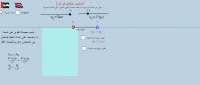
شحنتان \(q_1\) عند \(x=0\) و\(q_2\) عند \(x=0.3\ \mathrm m\). حرّك شحنة اختبارية \(+1\ \mu\mathrm C\) على الخط وابحث عن الموضع الذي تنعدم فيه المحصلة (منحنى القوة يقطع المحور).
Two charges \(q_1\) at \(x=0\) and \(q_2\) at \(x=0.3\ \mathrm m\). Move a \(+1\ \mu\mathrm C\) test charge along the line and look for the position where the resultant vanishes (the force curve crosses the axis).
🔎 ماذا نلاحظ؟ وما الاستنتاج؟
🔎 What do we observe? What is the conclusion?
- للشحنتين المتشابهتين يقع الاتزان بينهما وأقرب إلى الأصغر.For like charges the equilibrium lies between them and nearer the smaller one.
- للمختلفتين يقع خارجهما وأقرب إلى الأصغر، وإذا تساوتا في المقدار فلا يوجد اتزان على الخط.For unlike charges it lies outside them nearer the smaller one, and if they are equal in magnitude there is no equilibrium on the line.
موضع الاتزان يحقق \(F_1=F_2\) أي \(\dfrac{|q_1|}{x_1^2}=\dfrac{|q_2|}{x_2^2}\) مع تعاكس الاتجاهين.
The equilibrium position satisfies \(F_1=F_2\), i.e., \(\dfrac{|q_1|}{x_1^2}=\dfrac{|q_2|}{x_2^2}\) with the two directions opposite.
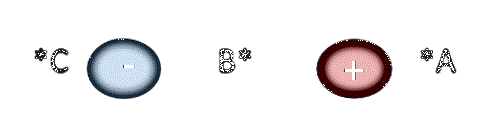
شحنتان مختلفتان في النوع ومتماثلتان في المقدار (سؤال: أين لا تتأثر شحنة اختبارية بقوة؟)
Two charges of different kinds and equal magnitude (question: where is a test charge not affected by a force?)
شحنتان مختلفتان في النوع ومتساويتان في المقدار. عند أي موضع على الخط الواصل بينهما لا يتأثر إلكترون بقوة كهربائية؟
Two charges of different kinds and equal magnitude. At which position on the line joining them is an electron not affected by an electric force?
🪢 كرتان مشحونتان معلقتان
🪢 Two Charged Hanging Balls
كرتان متماثلتان مشحونتان بالشحنة نفسها معلقتان بخيطين عديمي الكتلة وغير مرنين، تبتعدان بقوة كهربائية \(F_e\) حتى يميل كل خيط بزاوية \(\theta\) عن الرأسي. بتحليل القوى على كرة: \(T\cos\theta=mg\) و\(T\sin\theta=F_e\) ومنهما \(\tan\theta=\dfrac{F_e}{mg}\).
Two identical balls charged with the same charge are hanging by two massless inextensible threads and move apart by an electric force \(F_e\) until each thread makes an angle \(\theta\) with the vertical. Resolving the forces on one ball: \(T\cos\theta=mg\) and \(T\sin\theta=F_e\) so \(\tan\theta=\dfrac{F_e}{mg}\).
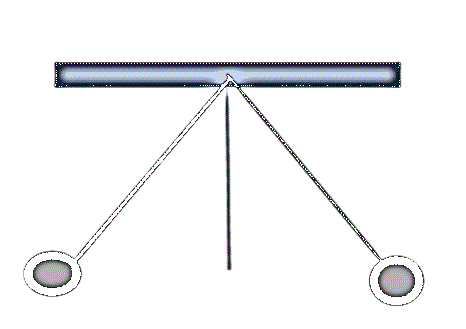
كرتان مشحونتان معلقتان بخيطين تميل كل منهما بزاوية \(\theta\)
Two charged balls hanging by threads, each inclined by an angle \(\theta\)
كرتان متماثلتان مشحونتان معلقتان بخيطين فتبتعدان بقوة كهربائية \(F_e=4\ \mathrm N\) ويميل كل خيط بزاوية \(30^\circ\) عن الرأسي. أوجد كتلة كل كرة.
Two identical charged balls hanging by threads move apart by an electric force \(F_e=4\ \mathrm N\) and each thread is inclined \(30^\circ\) from the vertical. Find the mass of each ball.
🧪 تجربة 5: الكرتان المعلقتان
🧪 Experiment 5: The Hanging Balls
نغيّر شحنة الكرتين وكتلتهما وطول الخيط ونرى كيف يتغير ميل الخيط \(\theta\) عند الاتزان.
We change the charge of the balls, their mass and the length of the thread and see how the inclination of the thread \(\theta\) changes at equilibrium.
🛠️ خطوات العمل
🛠️ Procedure
- زِد الشحنة \(q\) وراقب الزاوية والمسافة بين الكرتين.Increase the charge \(q\) and watch the angle and the distance between the balls.
- زِد الكتلة \(m\) وراقب الزاوية.Increase the mass \(m\) and watch the angle.
- تأكد أن \(F_e=mg\tan\theta\) في كل حالة.Make sure that \(F_e=mg\tan\theta\) in each case.
🧪 تجربة 5: كرتان مشحونتان معلّقتان بخيطين
🧪 Experiment 5: Two Charged Balls Hanging by Threads
تتنافر كرتان متماثلتان مشحونتان فتبتعدان حتى تتزن القوى. غيّر الشحنة والكتلة وطول الخيط وراقب الزاوية \(\theta\) والمسافة والقوة الكهربائية.
Two identical charged balls repel each other and move apart until the forces balance. Change the charge, the mass and the length of the thread and watch the angle \(\theta\), the distance and the electric force.
🔎 ماذا نلاحظ؟ وما الاستنتاج؟
🔎 What do we observe? What is the conclusion?
- زيادة الشحنة تُبعد الكرتين وتكبّر \(\theta\)، وزيادة الكتلة تُقرّبهما.Increasing the charge moves the balls apart and increases \(\theta\), and increasing the mass brings them closer.
- توازن الكرة تحت ثلاث قوى: الوزن والشد والقوة الكهربائية.The ball is balanced under three forces: the weight, the tension and the electric force.
عند الاتزان \(\tan\theta=\dfrac{F_e}{mg}\) و\(F_e=\dfrac{kq^2}{r^2}\) و\(r=2L\sin\theta\).
At equilibrium \(\tan\theta=\dfrac{F_e}{mg}\), \(F_e=\dfrac{kq^2}{r^2}\) and \(r=2L\sin\theta\).
🌍 القوة الكهربائية وقوة التجاذب الكتلي
🌍 The Electric Force and the Gravitational Force
| وجه المقارنةAspect | القوة الكهربائيةThe electric force | قوة التجاذب الكتليThe gravitational force |
|---|---|---|
| القانونLaw | \(F=k\dfrac{q_1q_2}{r^2}\) | \(F=G\dfrac{m_1m_2}{r^2}\) |
| وجه التشابهSimilarity | قوة مجالية تتناسب عكسيًا مع \(r^2\)A field force inversely proportional to \(r^2\) | قوة مجالية تتناسب عكسيًا مع \(r^2\)A field force inversely proportional to \(r^2\) |
| النوعKind | تجاذب أو تنافرAttraction or repulsion | تجاذب فقطAttraction only |
| المقدارMagnitude | أكبر بكثيرMuch greater | ضعيفة جدًاVery weak |
قارن بين القوة الكهربائية وقوة الجاذبية بين بروتون وإلكترون في الذرة (\(G=6.67\times10^{-11}\)، \(m_p=1.67\times10^{-27}\ \mathrm{kg}\)، \(m_e=9.11\times10^{-31}\ \mathrm{kg}\)).
Compare the electric force with the gravitational force between a proton and an electron in an atom (\(G=6.67\times10^{-11}\), \(m_p=1.67\times10^{-27}\ \mathrm{kg}\), \(m_e=9.11\times10^{-31}\ \mathrm{kg}\)).
لذلك نهمل قوة الجاذبية بين الجسيمات المشحونة في الذرة، بينما تتحكم الجاذبية في حركة الكواكب لأن الأجرام السماوية متعادلة كهربائيًا تقريبًا.
So we neglect the gravitational force between the charged particles in the atom, while gravity controls the motion of the planets because the celestial bodies are almost electrically neutral.
🚀 تطبيقات
🚀 Applications
أين نستفيد من قانون كولوم؟
Where do we benefit from Coulomb’s law?
- تفسير تماسك الذرات والجزيئات والروابط الكيميائية.Explaining the cohesion of atoms and molecules and the chemical bonds.
- تصميم الطابعات الليزرية وآلات التصوير والترسيب الكهروستاتيكي للغبار.Designing laser printers and photocopiers and the electrostatic precipitation of dust.
- تقدير القوة بين الشحنات في المكثفات والدارات وفي تجارب فيزياء الجسيمات.Estimating the force between charges in capacitors, circuits and particle physics experiments.
⚠️ أخطاء شائعة
⚠️ Common Mistakes
تجنّب هذه الأخطاء
Avoid these mistakes
- جمع مقادير القوى جمعًا عاديًا بدل الجمع الاتجاهي.Adding the magnitudes of the forces arithmetically instead of vectorially.
- نسيان تربيع المسافة، أو استعمال المسافة بالسنتيمتر دون تحويلها إلى متر.Forgetting to square the distance or using the distance in centimetres without converting it to metres.
- وضع إشارة الشحنة في القانون ثم الخلط في الاتجاه؛ الأفضل حساب المقدار بالقيم المطلقة وتحديد الاتجاه من نوع الشحنتين.Putting the sign of the charge in the law then mixing up the direction; it is better to calculate the magnitude with absolute values and find the direction from the kinds of the charges.
- الظن أن الشحنة الأكبر تؤثر بقوة أكبر في الأصغر؛ القوتان متساويتان دائمًا (نيوتن الثالث).Thinking that the larger charge exerts a greater force on the smaller one; the two forces are always equal (Newton’s third law).
📚 ملخص
📚 Summary
أهم ما تعلمناه
Key points
- \(F=k|q_1q_2|/r^2\) مع \(k=8.99\times10^{9}\ \mathrm{N\,m^2/C^2}\): طردية مع الجداء وعكسية مع مربع المسافة.\(F=k|q_1q_2|/r^2\) with \(k=8.99\times10^{9}\ \mathrm{N\,m^2/C^2}\): directly proportional to the product and inversely to the square of the distance.
- الشحنتان المتشابهتان تتنافران والمختلفتان تتجاذبان، والقوتان المتبادلتان متساويتان ومتعاكستان.Like charges repel and unlike ones attract, and the two mutual forces are equal and opposite.
- القوة الكلية على شحنة هي المجموع الاتجاهي لقوى الشحنات الأخرى (التراكب).The total force on a charge is the vector sum of the forces of the other charges (superposition).
- الاتزان: بين الشحنتين المتشابهتين وخارجهما قرب الأصغر للمختلفتين.Equilibrium: between like charges and outside unlike ones near the smaller.
🧪 اختبر نفسك: امتحان من 20 سؤالاً
🧪 Test Yourself: a 20-Question Exam
أنهِ الدرس بالاختبار التفاعلي التالي؛ أسئلته تجمع بين الفهم والحساب وتغطي جميع أقسام الدرس.
Finish with the interactive exam below; its questions mix understanding with calculation and cover every section of the lesson.
اختبار القوى الكهروستاتيكية - الجزء الثاني (12A) Electrostatic Forces, Part 2 (12A) Quiz
20 سؤالاً - قانون كولوم وتراكب القوى واتزان الشحنة 20 Questions - Coulomb’s law, superposition of forces and equilibrium of a charge
• عدد الأسئلة: 20 سؤالاً
• مدة الاختبار: 30 دقيقة
• لا يمكنك تغيير إجاباتك أو إعادة الاختبار إلا بعد 24 ساعة من التسليم.
• تأكد من إجاباتك قبل التسليم! 📌 Important Instructions:
• Number of questions: 20 questions
• Quiz duration: 30 minutes
• You cannot change your answers or retake the quiz for 24 hours after submission.
• Make sure of your answers before submitting!
🔗 محاكيات GeoGebra للاستعانة بها عند اللزوم
🔗 GeoGebra Simulations to Use When Needed
اضغط «تشغيل» لتعمل المحاكاة هنا داخل الدرس؛ ويمكن للطالب الرجوع إليها لتجربة الفكرة بطريقة أخرى.
Press “Run” to run the simulation right here inside the lesson; the student can use it to try the idea in another way.