🎯 نواتج التعلم
🎯 Learning Outcomes
بعد دراسة هذا الدرس ستكون قادرًا على أن:
After this lesson you will be able to:
- تذكر القوى الأساسية الأربع في الطبيعة وتفرّق بين القوة الكهرومغناطيسية وغيرها.State the four fundamental forces in nature and distinguish the electromagnetic force from the others.
- تحسب شحنة جسم من عدد الإلكترونات المكتسبة أو المفقودة \(Q=\pm ne\) وتطبّق حفظ الشحنة وتكميمها.Calculate the charge of a body from the number of gained or lost electrons \(Q=\pm ne\) and apply the conservation and the quantization of charge.
- تفسّر تجربة ميليكان وتحسب شحنة قطرة الزيت وعدد الشحنات الأولية عليها.Explain Millikan’s experiment and calculate the charge of an oil drop and the number of elementary charges on it.
- تميّز بين الموصلات والعوازل وأشباه الموصلات (N وP) وفائقة التوصيل.Distinguish between conductors, insulators, semiconductors (N and P) and superconductors.
- تشرح طرق الشحن الثلاث: بالدلك والتلامس والحث وتحدد نوع الشحنة الناتجة.Explain the three methods of charging: friction, contact and induction and determine the kind of the resulting charge.
🌌 القوى الأساسية في الطبيعة
🌌 The Fundamental Forces in Nature
كل ما يحدث في الكون من حركة وتفاعل يمكن إرجاعه إلى أربع قوى أساسية: قوة الجاذبية، والقوة الكهرومغناطيسية، والقوة النووية القوية (الشديدة)، والقوة النووية الضعيفة. وقد وُحِّدت القوتان الكهربائية والمغناطيسية في قوة واحدة هي القوة الكهرومغناطيسية، كما وُحِّدت الكهرومغناطيسية مع الضعيفة في القوة الكهروضعيفة، ويبحث العلماء عن نظرية تجمع القوى جميعًا.
Everything that happens in the universe of motion and interaction can be traced back to four fundamental forces: gravity, the electromagnetic force, the strong nuclear force and the weak nuclear force. The electric and the magnetic forces were unified into one force called the electromagnetic force, and the electromagnetic and the weak forces were unified in the electroweak force, while scientists are looking for a theory that combines all the forces.
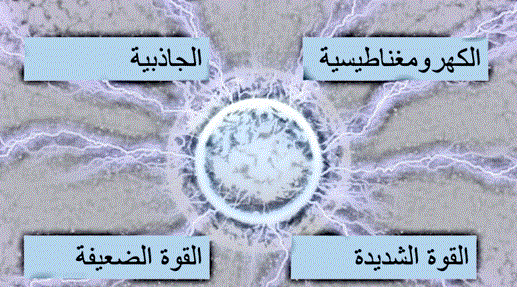
القوى الأساسية الأربع
The four fundamental forces
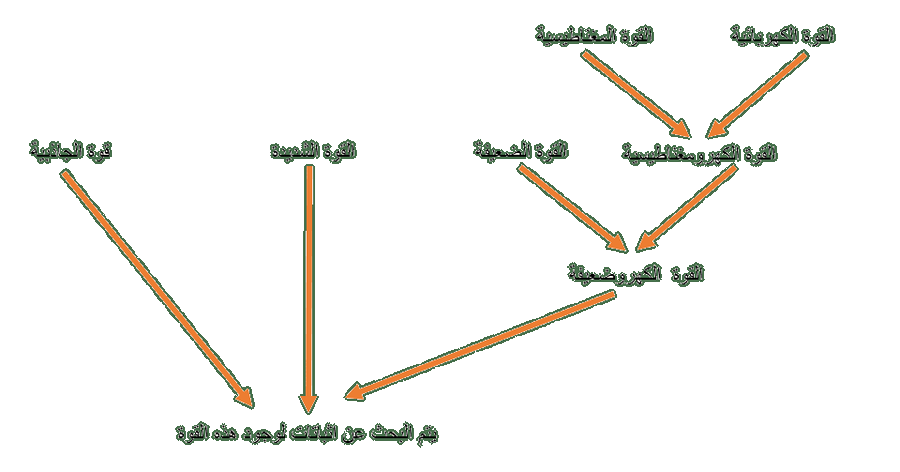
مخطط توحيد القوى
The unification of the forces
| القوةForce | تؤثر بينActs between | مثالExample |
|---|---|---|
| الجاذبيةGravity | كل الأجسام ذات الكتلةAll bodies with mass | سقوط التفاحة ودوران القمرA falling apple, the Moon’s orbit |
| الكهرومغناطيسيةElectromagnetic | الأجسام المشحونةCharged bodies | التصاق البالون بالحائط، الاحتكاك، الروابط الكيميائيةA balloon sticking to the wall, friction, chemical bonds |
| النووية القويةStrong nuclear | مكونات النواة والكواركاتNucleons and quarks | تماسك النواةHolding the nucleus together |
| النووية الضعيفةWeak nuclear | الجسيمات الأوليةElementary particles | التحلل الإشعاعي بيتاBeta radioactive decay |
⚛️ الذرة والشحنة الكهربائية
⚛️ The Atom and the Electric Charge
تتكون الذرة من نواة تحوي بروتونات موجبة الشحنة ونيوترونات متعادلة، تدور حولها إلكترونات سالبة الشحنة. شحنة البروتون تساوي شحنة الإلكترون في المقدار وتسمى الشحنة الأولية \(e=1.602\times10^{-19}\ \mathrm C\). وتكون الذرة متعادلة لأن عدد بروتوناتها يساوي عدد إلكتروناتها.
An atom consists of a nucleus that contains positively charged protons and neutral neutrons, with negatively charged electrons moving around it. The charge of the proton equals the charge of the electron in magnitude and is called the elementary charge \(e=1.602\times10^{-19}\ \mathrm C\). The atom is neutral because its number of protons equals its number of electrons.
معلومات مهمة
Important information
- الإلكترونات هي التي تنتقل بين الأجسام فتكتسب أو تفقد؛ أما البروتونات فمحبوسة في النواة.The electrons are what move between bodies by being gained or lost; the protons are confined in the nucleus.
- جسم سالب: اكتسب إلكترونات (عدد الإلكترونات > عدد البروتونات).A negative body: gained electrons (number of electrons > number of protons).
- جسم موجب: فقد إلكترونات (عدد البروتونات > عدد الإلكترونات).A positive body: lost electrons (number of protons > number of electrons).
📌 شحنة الجسم
📌 The charge of a body
\[q=e\,(N_p-N_e)\qquad,\qquad Q=\pm n\,e\]
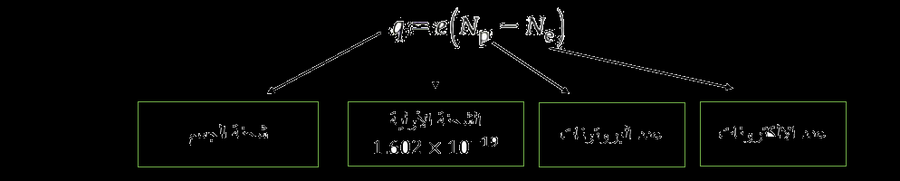
شحنة الجسم = الشحنة الأولية × (عدد البروتونات − عدد الإلكترونات)
Charge of the body = the elementary charge × (number of protons − number of electrons)
جسم مشحون يزيد عدد بروتوناته عن عدد إلكتروناته بمقدار \(32\) بروتونًا. أوجد شحنته.
A charged body has \(32\) more protons than electrons. Find its charge.
جسم متعادل اكتسب \(8\) إلكترونات. ما شحنته؟
A neutral body gained \(8\) electrons. What is its charge?
🧪 تجربة 1: شحنة الجسم وحفظ الشحنة
🧪 Experiment 1: Charge of a Body and Conservation of Charge
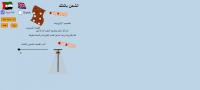
عند دلك قضيب إيبونيت بقطعة صوف تنتقل بعض الإلكترونات من الصوف إلى القضيب. في هذه التجربة تتحكم في عدد الإلكترونات المنقولة \(n\) وتراقب كيف تتغير شحنة كل جسم وكيف يبقى مجموع الشحنتين ثابتًا.
When an ebonite rod is rubbed with a piece of wool some electrons move from the wool to the rod. In this experiment you control the number of transferred electrons \(n\) and watch how the charge of each body changes and how the sum of the two charges stays constant.
🛠️ خطوات العمل
🛠️ Procedure
- اضغط «ادلك» (أو حرّك الشريط) لنقل إلكترون واحد من الصوف إلى القضيب.Press “Rub” (or move the slider) to transfer one electron from the wool to the rod.
- عدّ علامات «+» و«−» في كل جسم واحسب الفرق بينهما.Count the “+” and “−” signs in each body and calculate their difference.
- قارن شحنة الصوف بشحنة القضيب ثم اجمعهما.Compare the charge of the wool with that of the rod then add them.
🧪 تجربة 1: شحنة الجسم وحفظ الشحنة
🧪 Experiment 1: The Charge of a Body and Conservation of Charge
ندلك قضيب إيبونيت بقطعة صوف فتنتقل إلكترونات من الصوف إلى القضيب. حرّك عدد الإلكترونات المنقولة \(n\) وراقب شحنة كل منهما \(Q=\pm ne\) ومجموعهما.
We rub an ebonite rod with a piece of wool so electrons move from the wool to the rod. Change the number of transferred electrons \(n\) and watch the charge of each \(Q=\pm ne\) and their sum.
🔎 ماذا نلاحظ؟ وما الاستنتاج؟
🔎 What do we observe? What is the conclusion?
- الجسم الذي يفقد إلكترونات يصير موجبًا، والذي يكتسبها يصير سالبًا.The body that loses electrons becomes positive and the one that gains them becomes negative.
- شحنة كل جسم تساوي \(n\cdot e\) بإشارة موجبة أو سالبة؛ فهي دائمًا مضاعف صحيح للشحنة الأولية.The charge of each body equals \(n\cdot e\) with a positive or negative sign; it is always an integer multiple of the elementary charge.
الشحنة لا تفنى ولا تُستحدث: ما يفقده الصوف يكتسبه القضيب، فيبقى مجموع الشحنتين صفرًا قبل الدلك وبعده.
Charge is neither created nor destroyed: what the wool loses the rod gains, so the sum of the two charges is zero before and after rubbing.
♾️ حفظ الشحنة
♾️ Conservation of Charge
الشحنة الكهربائية لا تفنى ولا تُستحدث، وإنما تنتقل من جسم إلى آخر. فعند دلك قطعة صوف بقضيب إيبونيت تفقد الصوف إلكترونات فتصير موجبة، ويكتسب القضيب الإلكترونات نفسها فيصير سالبًا، ويكون مجموع الشحنتين قبل الدلك وبعده صفرًا في النظام المغلق: \(\Sigma Q_{i}=\Sigma Q_{f}\).
Electric charge is neither created nor destroyed but transferred from one body to another. When a piece of wool is rubbed with an ebonite rod the wool loses electrons and becomes positive, and the rod gains the same electrons and becomes negative, so the total charge before and after rubbing is zero in a closed system: \(\Sigma Q_i=\Sigma Q_f\).
تم دلك بالون بقطعة صوف فأصبح مشحونًا بشحنة سالبة قدرها \(8\times10^{-19}\ \mathrm C\). عدد الإلكترونات التي فقدتها قطعة الصوف:
A balloon is rubbed with a piece of wool and becomes charged with a negative charge of \(8\times10^{-19}\ \mathrm C\). The number of electrons lost by the wool is:
🔢 الشحنة مكمّاة وتجربة ميليكان
🔢 Charge Is Quantized: Millikan’s Experiment
أثبت العالم ميليكان أن شحنة أي جسم تساوي دائمًا عددًا صحيحًا من الشحنة الأولية: \(Q=n\,e\) حيث \(n=1,2,3,\dots\) ولا توجد شحنة بمقدار \(1.5e\) مثلًا. وقد قاس شحنة قطرات زيت صغيرة معلّقة بين لوحين مشحونين.
The scientist Millikan proved that the charge of any body always equals an integer number of the elementary charge: \(Q=n\,e\) with \(n=1,2,3,\dots\) and there is no charge of \(1.5e\) for example. He measured the charge of tiny oil drops suspended between two charged plates.
فكرة التجربة
The idea of the experiment
- بين لوحين فرق الجهد \(V\) والمسافة \(d\) يتولد مجال منتظم \(E=V/d\).Between two plates with potential difference \(V\) and separation \(d\) a uniform field \(E=V/d\) is produced.
- تتعلق القطرة عندما تتزن القوة الكهربائية مع الوزن: \(qE=mg\).The drop is suspended when the electric force balances the weight: \(qE=mg\).
- الشحنة \(q=\dfrac{mgd}{V}\)، والكتلة \(m=\rho\cdot\tfrac43\pi r^3\)، وعدد الشحنات \(n=\dfrac{q}{e}\).The charge is \(q=\dfrac{mgd}{V}\), the mass is \(m=\rho\cdot\tfrac43\pi r^3\) and the number of charges is \(n=\dfrac{q}{e}\).
قطرة زيت كتلتها \(1.87\times10^{-15}\ \mathrm{kg}\) تعلّقت بين لوحين يفصل بينهما \(1.0\ \mathrm{cm}\) عند فرق جهد \(581\ \mathrm V\). أوجد شحنتها وعدد الشحنات الأولية عليها (\(g=9.8\ \mathrm{m/s^2}\)).
An oil drop of mass \(1.87\times10^{-15}\ \mathrm{kg}\) is suspended between two plates \(1.0\ \mathrm{cm}\) apart at a potential difference of \(581\ \mathrm V\). Find its charge and the number of elementary charges on it (\(g=9.8\ \mathrm{m/s^2}\)).
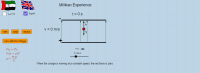
🧪 تجربة 2: ميزان ميليكان: تعليق قطرة زيت
🧪 Experiment 2: Millikan’s Balance: Suspending an Oil Drop
تُرش قطرات زيت مشحونة بين لوحين متوازيين. القطرة تسقط بفعل وزنها، فإذا وصلنا اللوحين بفرق جهد مناسب نشأ مجال كهربائي يرفعها بقوة \(qE\). نضبط الجهد حتى تتوقف القطرة ثم نحسب شحنتها.
Charged oil drops are sprayed between two parallel plates. The drop falls under its weight, and if we connect the plates to a suitable potential difference an electric field arises that lifts it with a force \(qE\). We adjust the voltage until the drop stops then we calculate its charge.
🛠️ خطوات العمل
🛠️ Procedure
- حرّك شريط الجهد \(V\) ببطء وراقب القطرة: تصعد إذا كانت \(qE\gt mg\) وتهبط إذا كانت \(qE\lt mg\).Move the voltage slider \(V\) slowly and watch the drop: it rises if \(qE\gt mg\) and falls if \(qE\lt mg\).
- عندما تتوقف القطرة (تصير خضراء) سجّل الجهد \(V\) وكتلتها \(m\) المعطاة.When the drop stops (turns green) record the voltage \(V\) and its given mass \(m\).
- احسب \(q=\dfrac{mgd}{V}\) ثم \(n=\dfrac{q}{e}\) وأدخل \(n\) في «اختبر نفسك».Calculate \(q=\dfrac{mgd}{V}\) then \(n=\dfrac{q}{e}\) and enter \(n\) in “Test yourself”.
- كرّر مع قطرة جديدة وقارن جهد التعليق (استعن بزر التلميح عند اللزوم).Repeat with a new drop and compare the balance voltage (use the hint button when necessary).
🧪 تجربة 2: ميزان ميليكان: تعليق قطرة زيت
🧪 Experiment 2: Millikan’s Balance: Suspending an Oil Drop
قطرة زيت مشحونة بين لوحين متوازيين يفصل بينهما \(d=1.0\ \mathrm{cm}\). اضبط فرق الجهد \(V\) حتى تتعلق القطرة، ثم احسب شحنتها \(q=mgd/V\) وعدد الشحنات الأولية \(n=q/e\).
A charged oil drop between two parallel plates separated by \(d=1.0\ \mathrm{cm}\). Adjust the potential difference \(V\) until the drop is suspended, then calculate its charge \(q=mgd/V\) and the number of elementary charges \(n=q/e\).
🔎 ماذا نلاحظ؟ وما الاستنتاج؟
🔎 What do we observe? What is the conclusion?
- جهد التعليق يختلف من قطرة إلى أخرى لأن شحنتها \(n\,e\) مختلفة.The balance voltage differs from one drop to another because their charges \(n\,e\) are different.
- الناتج \(n=q/e\) يخرج دائمًا عددًا صحيحًا (1 أو 2 أو 3 ...) لا كسرًا.The result \(n=q/e\) always comes out as an integer (1, 2, 3 ...) never a fraction.
هذا يثبت أن الشحنة مكمّاة: لا توجد شحنة أقل من \(e=1.6\times10^{-19}\ \mathrm C\) وكل شحنة مضاعف صحيح لها.
This proves that charge is quantized: there is no charge smaller than \(e=1.6\times10^{-19}\ \mathrm C\) and every charge is an integer multiple of it.
أي الشحنات التالية لا يمكن أن توجد على جسم؟
Which of the following charges cannot exist on a body?
🧩 قراءة ذاتية: الكواركات
🧩 Self-Study: The Quarks
عند فحص البروتونات والنيوترونات وُجد أنها تتكون من جسيمات أصغر تسمى الكواركات ترتبط معًا بوساطة الغلوونات. الكوارك العلوي \(u\) شحنته \(+\tfrac23e\) والسفلي \(d\) شحنته \(-\tfrac13e\).
When protons and neutrons were examined they were found to consist of smaller particles called quarks bound together by gluons. The up quark \(u\) has a charge of \(+\tfrac23e\) and the down quark \(d\) has a charge of \(-\tfrac13e\).
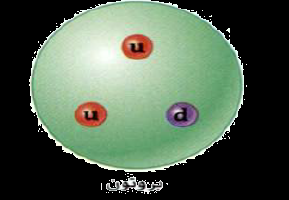
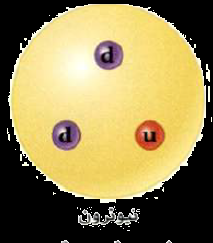
البروتون يتكون من كواركين علويين وكوارك سفلي، والنيوترون من كوارك علوي وكواركين سفليين. أوجد شحنة كل منهما.
The proton consists of two up quarks and one down quark, and the neutron of one up quark and two down quarks. Find the charge of each.
🔩 مثال: قالب من الحديد
🔩 Example: An Iron Block
قالب من الحديد كتلته \(1.4\ \mathrm{kg}\) وشحنته السالبة \(0.4\ \mathrm C\). ما نسبة الإلكترونات التي اكتسبها إلى عدد إلكتروناته الكلي؟ علمًا أن الكتلة المولية للحديد \(56\ \mathrm g/mol\) وعدده الذري \(26\).
An iron block of mass \(1.4\ \mathrm{kg}\) has a negative charge of \(0.4\ \mathrm C\). What is the ratio of the electrons it gained to its total number of electrons? Given that the molar mass of iron is \(56\ \mathrm g/mol\) and its atomic number is \(26\).
هذه النسبة صغيرة جدًا: فحتى الشحنة الكبيرة (\(0.4\ \mathrm C\)) تعني اكتساب جزء بسيط جدًا من إلكترونات الجسم.
This ratio is very small: even a large charge (\(0.4\ \mathrm C\)) means gaining a very small fraction of the body’s electrons.
🔌 الموصلات والعوازل وأشباه الموصلات وفائقة التوصيل
🔌 Conductors, Insulators, Semiconductors and Superconductors
| نوع المادةKind of material | الخاصيةProperty | أمثلةExamples |
|---|---|---|
| موصلConductor | تحوي إلكترونات حرة تتحرك في المادة فتوصل التيارIt contains free electrons that move in the material so it conducts current | النحاس، الحديد، الألومنيومCopper, iron, aluminium |
| عازلInsulator | إلكتروناته مرتبطة بالنواة ولا تتحرك فلا يوصل التيارIts electrons are bound to the nucleus and do not move so it does not conduct | الخشب، البلاستيك، الإيبونيتWood, plastic, ebonite |
| شبه موصلSemiconductor | يوصل التيار في ظروف خاصة (حرارة أو تطعيم)Conducts current under special conditions (heat or doping) | السليكون والجرمانيوم (المجموعة 14)Silicon and germanium (group 14) |
| فائق التوصيلSuperconductor | ممانعته تكاد تنعدم عند درجات حرارة منخفضة جدًاIts resistance almost vanishes at very low temperatures | الزئبق عند \(4.2\ \mathrm K\)، النيوبيومMercury at \(4.2\ \mathrm K\), niobium |
أشباه الموصلات
Semiconductors
لذرة السليكون والجرمانيوم أربعة إلكترونات تكافؤ ترتبط بها الذرات بروابط تساهمية. عند الصفر المطلق (\(-273^\circ\mathrm C\)) تكون كل الإلكترونات مرتبطة فلا يوصل، وعند درجة حرارة الغرفة تتكسر بعض الروابط فتتحرر إلكترونات وتترك وراءها فجوات تتصرف كشحنات موجبة.
The silicon and germanium atoms have four valence electrons with which the atoms are linked by covalent bonds. At absolute zero (\(-273^\circ\mathrm C\)) all electrons are bound so it does not conduct, and at room temperature some bonds break, freeing electrons and leaving behind holes that behave as positive charges.
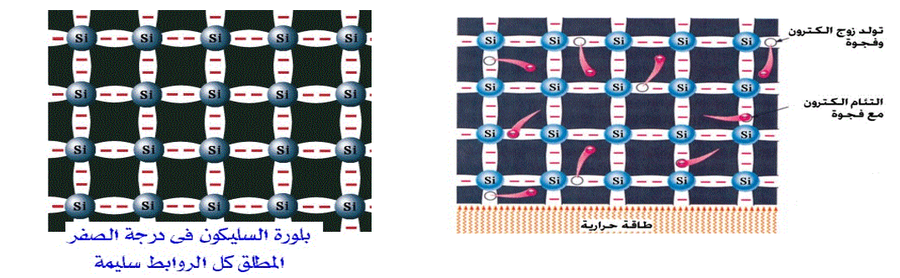
بلورة السليكون: عند الصفر المطلق (يسار) وعند درجة الحرارة (يمين)
A silicon crystal: at absolute zero (left) and at room temperature (right)
التطعيم: النوع N والنوع P
Doping: N-type and P-type
يُطعَّم شبه الموصل بذرة شائبة واحدة لكل مليون ذرة أصلية: عناصر المجموعة 15 (مانحات، خمسة إلكترونات تكافؤ) تعطي النوع N وحاملاته الأكثرية الإلكترونات، وعناصر المجموعة 13 (مستقبِلات، ثلاثة إلكترونات تكافؤ) تعطي النوع P وحاملاته الأكثرية الفجوات.
The semiconductor is doped with one impurity atom for every million original atoms: elements of group 15 (donors, five valence electrons) give the N type whose majority carriers are electrons, and elements of group 13 (acceptors, three valence electrons) give the P type whose majority carriers are holes.
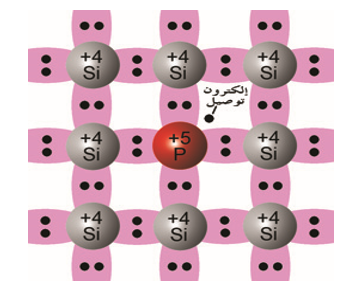
النوع N: ذرة فوسفور تعطي إلكترونًا حرًّا
N-type: a phosphorus atom gives a free electron
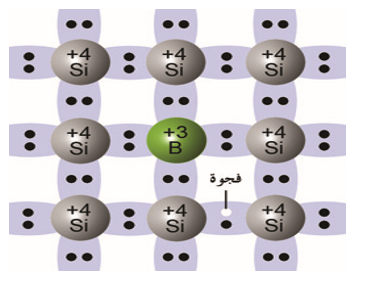
النوع P: ذرة بورون تترك فجوة
P-type: a boron atom leaves a hole
🧪 تجربة 3: أشباه الموصلات: النقي والنوعان N وP
🧪 Experiment 3: Semiconductors: Pure, N-type and P-type
نتحكم في درجة الحرارة وفي التطعيم بذرات شائبة لنرى كيف تظهر الإلكترونات الحرة والفجوات وكيف يتحول السليكون من شبه موصل نقي إلى نوع N أو نوع P.
We control the temperature and the doping with impurity atoms to see how free electrons and holes appear and how silicon turns from a pure semiconductor into an N-type or a P-type.
🛠️ خطوات العمل
🛠️ Procedure
- اختر «نقي» واترك \(T=0\): هل توجد حاملات حرة؟Choose “Pure” and leave \(T=0\): are there free carriers?
- ارفع \(T\) تدريجيًا إلى درجة الغرفة وعدّ الإلكترونات الحرة والفجوات.Raise \(T\) gradually to room temperature and count the free electrons and holes.
- اختر النوع N ثم P وغيّر عدد الذرات الشائبة وقارن الأعداد.Choose the N then the P type and change the number of impurity atoms and compare the numbers.
🧪 تجربة 3: أشباه الموصلات: النقي والتطعيم N وP
🧪 Experiment 3: Semiconductors: Pure and N- and P-type Doping
غيّر درجة الحرارة ونوع المادة وعدد الذرات الشائبة وراقب أعداد الإلكترونات الحرة والفجوات.
Change the temperature, the type of the material and the number of impurity atoms and watch the numbers of free electrons and holes.
🔎 ماذا نلاحظ؟ وما الاستنتاج؟
🔎 What do we observe? What is the conclusion?
- عند \(T=0\) لا يوصل السليكون النقي، وعند الحرارة يتولد إلكترون حر وفجوة معًا بعدد متساوٍ.At \(T=0\) pure silicon does not conduct, and with heat a free electron and a hole are produced together in equal numbers.
- النوع N فيه إلكترونات أكثر من الفجوات، والنوع P فيه فجوات أكثر من الإلكترونات.The N type has more electrons than holes and the P type has more holes than electrons.
التطعيم بعناصر المجموعة 15 يعطي النوع N (حاملاته الإلكترونات)، وبعناصر المجموعة 13 يعطي النوع P (حاملاته الفجوات).
Doping with group 15 elements gives the N type (its carriers are electrons) and with group 13 elements gives the P type (its carriers are holes).
عند تطعيم السليكون بذرات من المجموعة 15 فإن شبه الموصل الناتج:
When silicon is doped with atoms of group 15 the resulting semiconductor is:
⚡ طرق الشحن الكهربائي
⚡ Methods of Charging
1) الشحن بالدلك
1) Charging by friction
عند دلك جسمين مختلفين تنتقل الإلكترونات من المادة الأقل تمسكًا بها إلى الأكثر تمسكًا، فيكتسب أحدهما شحنة سالبة ويفقدها الآخر فيصير موجبًا بالمقدار نفسه. ترتيب المواد في السلسلة الكهربائية بالدلك يحدد أيها يفقد وأيها يكتسب.
When two different bodies are rubbed, electrons move from the material that holds them less strongly to the one that holds them more strongly, so one of them gets a negative charge and the other loses it and becomes positive by the same amount. The order of materials in the triboelectric series determines which loses and which gains.
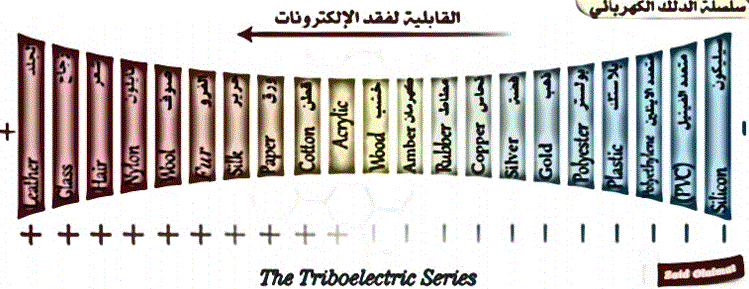
السلسلة الكهربائية بالدلك: المواد في اليسار أقرب لفقد الإلكترونات
The triboelectric series: the materials on the left are likelier to lose electrons
🧪 تجربة 4: الشحن بالدلك
🧪 Experiment 4: Charging by Friction
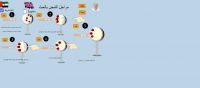
نتتبع الإلكترونات عند دلك القضيب بالصوف: من يفقدها ومن يكتسبها وكم تكون الشحنة الناتجة.
We follow the electrons when the rod is rubbed with the wool: who loses them, who gains them and how large the resulting charge is.
🛠️ خطوات العمل
🛠️ Procedure
- اضغط «الخطوة التالية» وراقب الجسمين المتعادلين (عدد + يساوي عدد −).Press “Next step” and watch the two neutral bodies (number of + equals number of −).
- في خطوة الدلك تحرّك الإلكترونات الثلاثة نحو القضيب.In the rubbing step the three electrons move toward the rod.
- بعد الفصل اقرأ شحنة كل جسم.After separating read the charge of each body.
🧪 تجربة 4: الشحن بالدلك
🧪 Experiment 4: Charging by Friction
اضغط «الخطوة التالية» لترى كيف تنتقل الإلكترونات من الصوف إلى القضيب عند الدلك ثم عند الفصل.
Press “Next step” to see how the electrons move from the wool to the rod when rubbing and then when separating.
🔎 ماذا نلاحظ؟ وما الاستنتاج؟
🔎 What do we observe? What is the conclusion?
- الجسم الذي فقد إلكترونات صار موجبًا، والذي اكتسبها صار سالبًا.The body that lost electrons became positive and the one that gained them became negative.
- عدد الإلكترونات المفقودة = عدد المكتسبة فالشحنتان متساويتان في المقدار.The number of lost electrons = the number of gained ones so the two charges are equal in magnitude.
الدلك يولّد شحنتين متساويتين متعاكستين دون أن تتغير الشحنة الكلية.
Friction produces two equal opposite charges without changing the total charge.
2) الشحن بالتلامس
2) Charging by contact
عند لمس جسم متعادل بجسم مشحون تنتقل شحنات بينهما حتى يتوازنا، فيكتسب الجسم المتعادل شحنة من نوع شحنة الجسم المشحون نفسه. فإن كان القضيب سالبًا انتقلت إليه إلكترونات، وإن كان موجبًا انتزع إلكترونات من الجسم فصار موجبًا.
When a neutral body touches a charged body charges move between them until they are balanced, so the neutral body gets a charge of the same kind as the charged body’s. If the rod is negative electrons move to the body, and if it is positive it pulls electrons from the body which becomes positive.
🧪 تجربة 5: الشحن بالتلامس
🧪 Experiment 5: Charging by Contact
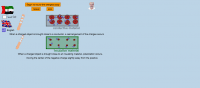
نلمس كرة موصلة متعادلة بقضيب سالب لنرى كيف تنتقل الإلكترونات إليها وما نوع شحنتها بعد إبعاد القضيب.
We touch a neutral conducting sphere with a negative rod to see how the electrons move to it and what kind of charge it has after the rod is removed.
🛠️ خطوات العمل
🛠️ Procedure
- اضغط «الخطوة التالية» لتقريب القضيب من الكرة حتى يلمسها.Press “Next step” to bring the rod to the sphere until it touches it.
- راقب انتقال 3 إلكترونات زائدة من القضيب إلى الكرة.Watch 3 excess electrons move from the rod to the sphere.
- أبعد القضيب واقرأ شحنة الكرة وشحنة القضيب.Remove the rod and read the charge of the sphere and of the rod.
🧪 تجربة 5: الشحن بالتلامس
🧪 Experiment 5: Charging by Contact
اضغط «الخطوة التالية» لترى كيف تنتقل الإلكترونات من القضيب السالب إلى الكرة عند اللمس.
Press “Next step” to see how the electrons move from the negative rod to the sphere on touching.
🔎 ماذا نلاحظ؟ وما الاستنتاج؟
🔎 What do we observe? What is the conclusion?
- الكرة اكتسبت شحنة سالبة من نوع شحنة القضيب نفسه.The sphere gained a negative charge of the same kind as the rod’s.
- شحنة القضيب قلّت من −6e إلى −3e وشحنة الكرة صارت −3e: المجموع −6e محفوظ.The rod’s charge decreased from −6e to −3e and the sphere’s became −3e: the total −6e is conserved.
الشحن بالتلامس يعطي الجسم المتعادل شحنة من نوع شحنة الجسم المشحون، ويتقاسمان الشحنة الكلية.
Charging by contact gives the neutral body a charge of the same kind as the charged body’s and they share the total charge.
3) الشحن بالحث
3) Charging by induction
هو شحن جسم موصل دون ملامسته بالجسم المشحون، فتكون الشحنة الناتجة معاكسة لشحنة الجسم المحِثّ. خطوات شحن كشاف (أو كرة موصلة) بشحنة سالبة بقضيب موجب:
It is charging a conducting body without touching it with the charged body, so the resulting charge is opposite to the charge of the inducing body. The steps to charge an electroscope (or a conducting sphere) negatively with a positive rod:
خطوات الحث
Steps of induction
- نقرّب القضيب الموجب من الكشاف دون لمس فتتجمع الإلكترونات قرب القضيب وتبتعد الشحنات الموجبة (استقطاب).We bring the positive rod near the electroscope without touching so electrons gather near the rod and the positive charges go away (polarization).
- نلمس قاعدته بالإصبع (تأريض) فتنتقل إلكترونات من الأرض إلى الكشاف وتتخلص الشحنات الحرة.We touch its base with a finger (grounding) so electrons move from the Earth to the electroscope and neutralize the free charges.
- نبعد الإصبع أولًا ثم نبعد القضيب.We remove the finger first then we remove the rod.
- يبقى الكشاف مشحونًا بشحنة سالبة معاكسة لشحنة القضيب.The electroscope stays charged with a negative charge opposite to the rod’s charge.
🧪 تجربة 6: الشحن بالحث
🧪 Experiment 6: Charging by Induction
نشحن كرة موصلة بقضيب سالب دون أن يلمسها. الترتيب الصحيح للخطوات هو سر نجاح الحث.
We charge a conducting sphere with a negative rod without it touching the sphere. The correct order of the steps is the secret of the success of induction.
🛠️ خطوات العمل
🛠️ Procedure
- اضغط «الخطوة التالية» لتقريب القضيب دون لمس ولاحظ الاستقطاب في الكرة.Press “Next step” to bring the rod near without touching and notice the polarization in the sphere.
- في خطوة التأريض راقب هروب إلكترونين إلى الأرض.In the grounding step watch two electrons escape to the Earth.
- أزل التأريض أولًا ثم أبعد القضيب، واقرأ الشحنة النهائية.Remove the grounding first then remove the rod and read the final charge.
- جرّب الرجوع بزر «السابقة» لإعادة أي خطوة.Try going back with the “Previous” button to repeat any step.
🧪 تجربة 6: الشحن بالحث
🧪 Experiment 6: Charging by Induction
اضغط «الخطوة التالية» لتتتبع الخطوات الخمس: تقريب، تأريض، إزالة التأريض، إبعاد القضيب. جرّب الرجوع بزر «السابقة».
Press “Next step” to follow the five steps: bringing near, grounding, removing the grounding, removing the rod. Try going back with the “Previous” button.
🔎 ماذا نلاحظ؟ وما الاستنتاج؟
🔎 What do we observe? What is the conclusion?
- الكرة صارت موجبة (+2e) وهي عكس شحنة القضيب السالب.The sphere became positive (+2e) which is opposite to the negative rod’s charge.
- لو أُبعد القضيب قبل إزالة التأريض لعادت الإلكترونات من الأرض وبقيت الكرة متعادلة.If the rod were removed before the grounding the electrons would come back from the Earth and the sphere would remain neutral.
الحث يعطي شحنة معاكسة لشحنة الجسم المؤثر دون أي تلامس، بشرط التأريض ثم إزالته قبل إبعاد القضيب.
Induction gives a charge opposite to that of the inducing body without any contact, provided that the grounding is applied and then removed before the rod is moved away.
موصلات وعوازل أمام جسم مشحون
Conductors and Insulators Near a Charged Body
عند تقريب جسم مشحون من موصل تتحرك الإلكترونات الحرة وتُعاد ترتيب الشحنات، أما في العازل فلا تتحرك الشحنات بحرية، وإنما يبتعد مركز الشحنة الموجبة قليلًا عن مركز السالبة داخل كل ذرة (استقطاب) دون انتقال شحنة.
When a charged body is brought near a conductor the free electrons move and the charges rearrange, whereas in an insulator the charges do not move freely but the centre of the positive charge shifts slightly from the centre of the negative charge inside each atom (polarization) with no transfer of charge.
| الخاصيةProperty | الموصلاتConductors | العوازلInsulators |
|---|---|---|
| حركة الإلكتروناتMotion of electrons | حرةFree | مرتبطة بذراتهاBound to their atoms |
| التوصيل الكهربائيElectrical conduction | جيدGood | معدوم تقريبًاAlmost none |
| توزيع الشحنةDistribution of charge | تنتشر على السطحSpreads over the surface | تبقى في مكانهاStays in place |
| الاستعمالUse | أسلاك التوصيلConnecting wires | عزل الأسلاكInsulating wires |
شُحن كشاف كهربائي بالحث بتقريب قضيب موجب منه. تكون شحنة الكشاف النهائية:
An electroscope is charged by induction by bringing a positive rod near it. The final charge of the electroscope is:
🚀 تطبيقات
🚀 Applications
أين نستفيد من الكهرباء الساكنة؟
Where do we benefit from static electricity?
- الطلاء الكهروستاتيكي لسيارات ومعدات وآلات التصوير والطابعات الليزرية.Electrostatic painting of cars and equipment, photocopiers and laser printers.
- مرسّبات الغبار في المداخن وأجهزة تنقية الهواء.Dust precipitators in chimneys and air purifiers.
- الكشاف الكهربائي للكشف عن الشحنة ونوعها، وأنظمة التأريض لحماية الأجهزة.The electroscope for detecting charge and its kind, and grounding systems to protect devices.
- أشباه الموصلات في الترانزستورات والدارات المتكاملة والخلايا الشمسية.Semiconductors in transistors, integrated circuits and solar cells.
⚠️ أخطاء شائعة
⚠️ Common Mistakes
تجنّب هذه الأخطاء
Avoid these mistakes
- الظن أن البروتونات هي التي تنتقل عند الشحن؛ الإلكترونات وحدها تنتقل.Thinking that protons move during charging; only the electrons move.
- نسيان أن الشحن بالحث يعطي شحنة معاكسة، وبالتلامس شحنة من النوع نفسه.Forgetting that induction gives an opposite charge and contact gives the same kind of charge.
- إهمال إزالة التأريض قبل إبعاد الجسم المحِثّ في الشحن بالحث.Neglecting to remove the grounding before removing the inducing body in induction.
- اعتبار أن شحنة جسم يمكن أن تكون أي قيمة؛ هي دائمًا عدد صحيح من \(e\).Considering that the charge of a body can be any value; it is always an integer multiple of \(e\).
📚 ملخص
📚 Summary
أهم ما تعلمناه
Key points
- أربع قوى أساسية: الجاذبية والكهرومغناطيسية والنووية القوية والنووية الضعيفة.Four fundamental forces: gravity, electromagnetic, strong nuclear and weak nuclear.
- \(Q=\pm ne\) مع \(e=1.6\times10^{-19}\ \mathrm C\)؛ والشحنة محفوظة ومكمّاة.\(Q=\pm ne\) with \(e=1.6\times10^{-19}\ \mathrm C\); charge is conserved and quantized.
- ميليكان: \(qE=mg\) و\(q=mgd/V\) و\(n=q/e\).Millikan: \(qE=mg\), \(q=mgd/V\) and \(n=q/e\).
- الموصلات حرة الإلكترونات، والعوازل لا توصل، وشبه الموصل ينتج N بالمجموعة 15 وP بالمجموعة 13.Conductors have free electrons, insulators do not conduct, and a semiconductor gives N with group 15 and P with group 13.
- الشحن بالدلك ينتج شحنتين متعاكستين، وبالتلامس شحنة مماثلة، وبالحث شحنة معاكسة.Charging by friction gives two opposite charges, by contact a similar charge and by induction an opposite charge.
🧪 اختبر نفسك: امتحان من 20 سؤالاً
🧪 Test Yourself: a 20-Question Exam
أنهِ الدرس بالاختبار التفاعلي التالي؛ أسئلته تجمع بين الفهم والحساب وتغطي جميع أقسام الدرس.
Finish with the interactive exam below; its questions mix understanding with calculation and cover every section of the lesson.
اختبار القوى الكهروستاتيكية - الجزء الأول (12A) Electrostatic Forces, Part 1 (12A) Quiz
20 سؤالاً - الشحنة والموصلات وأشباه الموصلات وطرق الشحن 20 Questions - charge, conductors, semiconductors and charging methods
• عدد الأسئلة: 20 سؤالاً
• مدة الاختبار: 30 دقيقة
• لا يمكنك تغيير إجاباتك أو إعادة الاختبار إلا بعد 24 ساعة من التسليم.
• تأكد من إجاباتك قبل التسليم! 📌 Important Instructions:
• Number of questions: 20 questions
• Quiz duration: 30 minutes
• You cannot change your answers or retake the quiz for 24 hours after submission.
• Make sure of your answers before submitting!
🔗 محاكيات GeoGebra للاستعانة بها عند اللزوم
🔗 GeoGebra Simulations to Use When Needed
اضغط «تشغيل» لتعمل المحاكاة هنا داخل الدرس؛ ويمكن للطالب الرجوع إليها لتجربة الفكرة بطريقة أخرى.
Press “Run” to run the simulation right here inside the lesson; the student can use it to try the idea in another way.