🎯 نواتج التعلم
🎯 Learning Outcomes
بعد دراسة هذا الدرس ستكون قادرًا على أن:
After this lesson you will be able to:
- تشتقّ \(F=ILB\sin\theta\) من القوة على الشحنات المتحركة وتحدّد اتجاهها بقاعدة الكف.Derive \(F=ILB\sin\theta\) from the force on moving charges and find its direction with the palm rule.
- تحسب القوة على أسلاك بزوايا مختلفة وتقارن بينها.Calculate the force on wires at different angles and compare them.
- تطبّق القوة على سلك في مكبر الصوت.Apply the force on a wire to the loudspeaker.
- تحسب العزم على ملف \(\tau=NIAB\sin\theta\) وعزم ثنائي القطب \(\mu=NIA\).Calculate the torque on a coil \(\tau=NIAB\sin\theta\) and the dipole moment \(\mu=NIA\).
- تفسّر تأثير هول وتحسب جهد هول وكثافة الحاملات وشدة المجال.Explain the Hall effect and calculate the Hall voltage, the carrier density and the field strength.
🧲 لماذا يتأثر السلك بقوة؟
🧲 Why Does a Wire Feel a Force?
🤔 تأمّل
🤔 Think
سلك يمر به تيار ويقع في مجال مغناطيسي لا يوازي طوله، فيتأثر بقوة. ما السبب؟ الجواب: التيار شحنات متحركة، والمجال المغناطيسي يؤثر على كل شحنة متحركة بقوة.
A wire carrying a current in a magnetic field that is not parallel to its length feels a force. Why? Because the current is moving charges and a magnetic field acts on every moving charge.
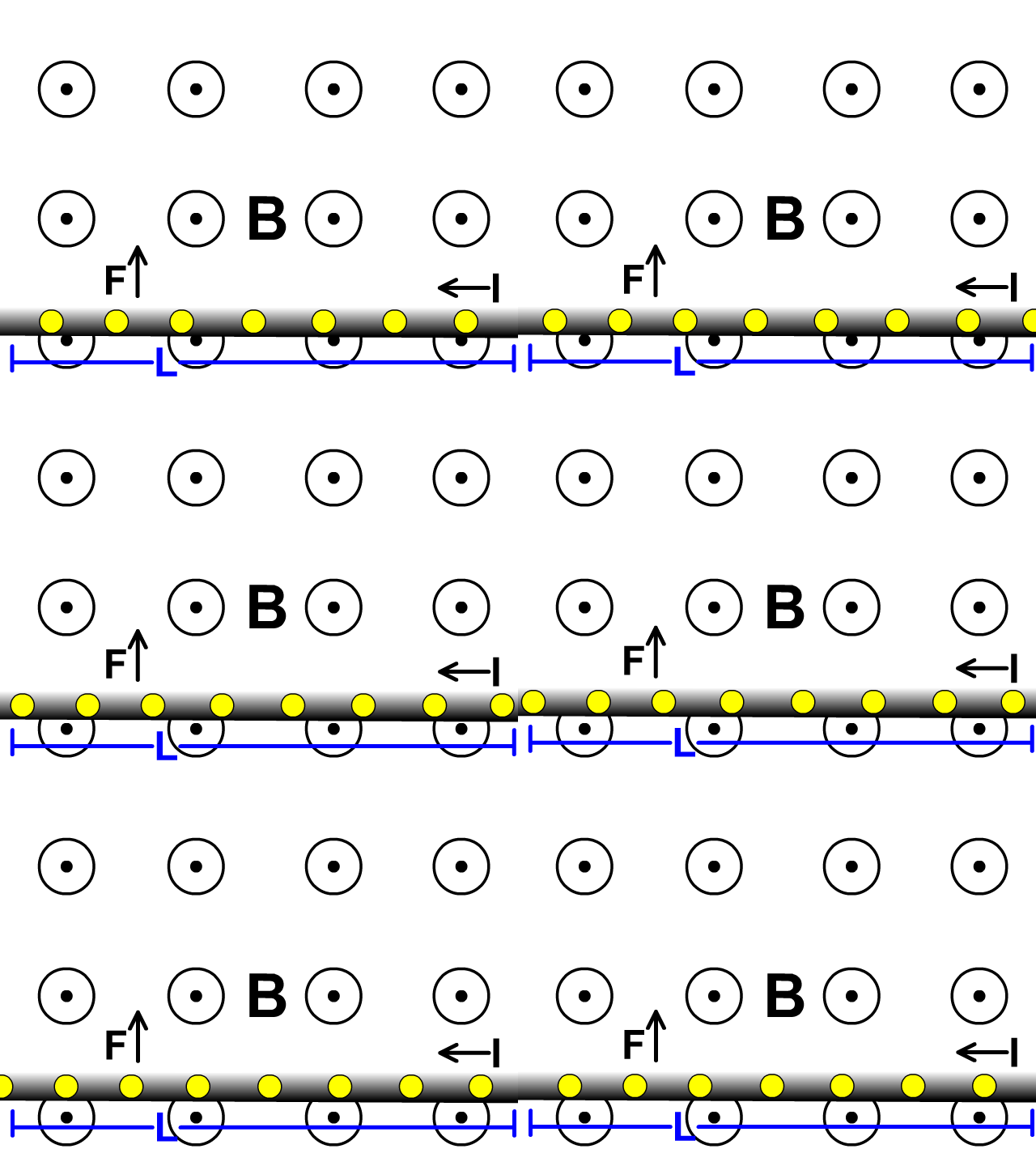
سلك طوله \(L\) يمر به تيار \(I\) في مجال \(B\) (النقاط = خارج الصفحة): تظهر قوة \(F\) عمودية على السلك والمجال.
A wire of length \(L\) carrying a current \(I\) in a field \(B\) (dots = out of the page): a force \(F\) appears perpendicular to the wire and the field.
📌 الاشتقاق
📌 The derivation
التيار هو الشحنة المارة في الثانية: \(I=\dfrac{q}{t}\) والشحنة التي تمر في طول \(L\) من السلك خلال الزمن \(t=\dfrac{L}{v}\) هي:
The current is the charge passing per second: \(I=\dfrac{q}{t}\) and the charge crossing a length \(L\) of wire in the time \(t=\dfrac{L}{v}\) is:
\[q=I\,t=I\,\frac{L}{v}\]
هذه الشحنات تتحرك في مجال مغناطيسي فتتأثر بقوة \(F=qvB\sin\theta\):
These charges move in a magnetic field so they feel a force \(F=qvB\sin\theta\):
\[F=I\,\frac{L}{v}\,v\,B\sin\theta\ \Rightarrow\ F=I\,L\,B\,\sin\theta\]
📝 معنى الرموز
📝 The symbols
\(I\): شدة التيار (A) — \(L\): طول السلك داخل المجال (m) — \(B\): شدة المجال (T) — \(\theta\): الزاوية بين السلك (اتجاه التيار) والمجال. القوة عمودية دائمًا على السلك وعلى المجال معًا.
\(I\): current (A) — \(L\): length of wire inside the field (m) — \(B\): field strength (T) — \(\theta\): the angle between the wire (current direction) and the field. The force is always perpendicular to both the wire and the field.
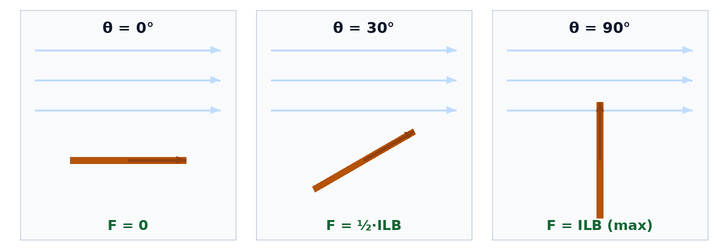
القوة تتناسب مع \(\sin\theta\): صفر عندما يوازي السلك المجال وأكبر ما يمكن عندما يكون عموديًا عليه.
The force is proportional to \(\sin\theta\): zero when the wire is parallel to the field and largest when perpendicular.
🖐️ اتجاه القوة
🖐️ The direction of the force
قاعدة الأصابع الثلاث لليد اليمنى: اجعل الأصابع الثلاثة متعامدة؛ السبابة مع المجال \(B\)، والإبهام مع التيار الاصطلاحي \(I\) (من القطب الموجب للبطارية إلى السالب)، فتكون القوة \(F\) باتجاه الوسطى.
The three-finger rule of the right hand: hold the three fingers perpendicular; index along the field \(B\), thumb along the conventional current \(I\) (from the positive terminal of the battery to the negative), and the force \(F\) is along the middle finger.
تنبيه للتيار الإلكتروني: إذا استعملت اتجاه حركة الإلكترونات فاعكس الاتجاه الناتج، أو استعمل اليد اليسرى فيكون الاتجاه صحيحًا.
Electron current: if you use the direction in which the electrons move, reverse the resulting direction, or use the left hand to get the right direction.
ملاحظة: تتعدد القواعد في الكتب (كف اليد مع خروج القوة من الراحة، أو تبديل أدوار الأصابع)، والمهم أن يكون \(\vec F=I\vec L\times\vec B\).
Note: books use different rules (open palm with the force out of the palm, or other finger assignments); what matters is that \(\vec F=I\vec L\times\vec B\).
🧪 جرّب بنفسك: القوة على سلك
🧪 Try It Yourself: The Force on a Wire
🧪 تجربة 1: سلك يدور في المجال: القوة تتبع \(\sin\theta\)
🧪 Experiment 1: A Wire Rotating in the Field: the Force Follows \(\sin\theta\)
المنظر من الأعلى: مجال أفقي (أزرق) وسلك يمر به تيار تستطيع تدويره بالمنزلق. تظهر القوة عمودية على الصفحة (⊙ خارجة أو ⊗ داخلة) ويتناسب حجمها مع \(\sin\theta\). اضغط «امسح الزاوية» ليدور السلك من \(0^\circ\) إلى \(180^\circ\) وتتبّع المنحنى.
Top view: a horizontal field (blue) and a current-carrying wire that you can rotate with the slider. The force is perpendicular to the page (⊙ out or ⊗ in) and its size follows \(\sin\theta\). Press “Sweep the angle” to turn the wire from \(0^\circ\) to \(180^\circ\) and follow the curve.
✏️ مثال 1: ثلاثة أسلاك
✏️ Example 1: Three Wires
ثلاثة أسلاك \(A\) و\(C\) و\(D\) لها الطول نفسه ويمر بها التيار نفسه، وُضعت في مجال منتظم كما في الشكل (\(A\) يوازي المجال، \(C\) عمودي عليه، \(D\) يميل \(60^\circ\)). أي الأسلاك لم يتأثر بقوة؟ وأيها تأثر بأكبر قوة؟ وما النسبة \(F_C/F_D\)؟
Three wires \(A\), \(C\) and \(D\) of the same length carry the same current in a uniform field as shown (\(A\) is parallel to the field, \(C\) is perpendicular to it, \(D\) is inclined at \(60^\circ\)). Which wire feels no force? Which feels the greatest force? What is the ratio \(F_C/F_D\)?
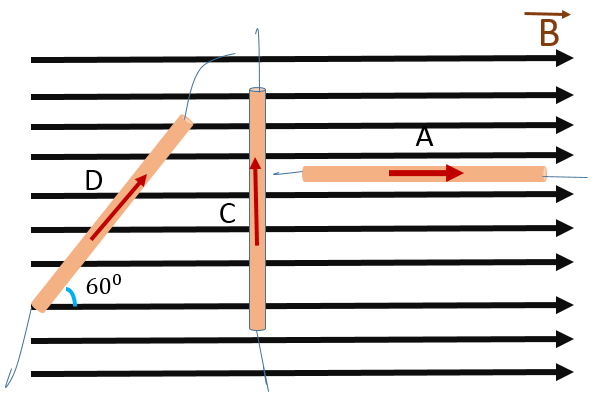
شكل المثال 1: الأسلاك \(A\) و\(C\) و\(D\) في مجال منتظم.
Example 1: wires \(A\), \(C\) and \(D\) in a uniform field.
سلك طوله \(0.5\ \mathrm{m}\) يمر به \(4\ \mathrm{A}\) ويصنع زاوية \(30^\circ\) مع مجال \(0.3\ \mathrm{T}\). القوة عليه:
A \(0.5\ \mathrm{m}\) wire carries \(4\ \mathrm{A}\) at \(30^\circ\) to a field of \(0.3\ \mathrm{T}\). The force on it is:
سلك يحمل تيارًا نحو اليمين في مجال خارج من الصفحة. اتجاه القوة (قاعدة الكف):
A wire carries a current to the right in a field pointing out of the page. The force (palm rule) points:
🔊 التطبيق: مكبّر الصوت
🔊 Application: The Loudspeaker
في مكبر الصوت ملف سلكي ملفوف على مخروط من الورق المقوّى يقع في مجال مغناطيسي شعاعي. التيار المتردد في الملف يولّد قوة \(F=NIL_1B\)... وعمليًا نحسب طول سلك الملف كله من عدد اللفات: \(L=N\cdot2\pi r\).
A loudspeaker has a coil of wire wound on a cardboard cone in a radial magnetic field. The alternating current in the coil produces a force; in practice we find the total wire length from the number of turns: \(L=N\cdot2\pi r\).
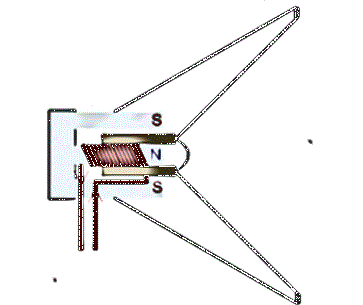
مكبّر صوت: ملف على مخروط بين قطبي مغناطيس.
A loudspeaker: a coil on a cone between the poles of a magnet.
مكبر صوت مخروطي ملفوف عليه سلك نحاس من \(50\) لفة نصف قطر اللفة \(2\ \mathrm{cm}\)، موضوع في مجال مغناطيسي ويمر به تيار \(3\ \mathrm{mA}\) فتأثر بقوة \(0.02\ \mathrm{N}\). أوجد أقل شدة للمجال تحقق ذلك.
A cone loudspeaker has \(50\) turns of copper wire of radius \(2\ \mathrm{cm}\) in a magnetic field, carrying \(3\ \mathrm{mA}\), and feels a force of \(0.02\ \mathrm{N}\). Find the smallest field that gives this.
ملف مكبر صوت من \(40\) لفة نصف قطر اللفة \(3\ \mathrm{cm}\). طول سلكه تقريبًا:
A loudspeaker coil has \(40\) turns of radius \(3\ \mathrm{cm}\). Its wire length is about:
⚙️ العزم المؤثر في ملف يمر به تيار (المحرك الكهربائي)
⚙️ Torque on a Current-Carrying Loop (The Electric Motor)
قوة لورنتز أكبر ما يمكن عندما يكون السلك عموديًا على المجال، وتنعدم إذا كان موازيًا له، وتكون دائمًا عمودية على اتجاه التيار وعلى خطوط المجال. في ملف مستطيل (ضلعه \(a\)) يتأثر الضلعان المتقابلان بقوتين متساويتين ومتعاكستين \(F=IaB\)، فيتشكّل ازدواج يولّد عزمًا يدير الملف.
Lorentz force is largest when the wire is perpendicular to the field and vanishes when parallel, and it is always perpendicular to the current and to the field lines. In a square loop (side \(a\)) the two opposite sides feel equal and opposite forces \(F=IaB\), forming a couple that produces a torque turning the loop.
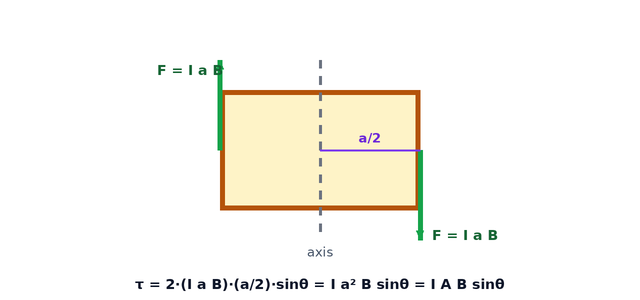
الضلعان المتقابلان يتأثران بقوتين متساويتين ومتعاكستين فينشأ ازدواج حول محور الملف.
The two opposite sides feel equal and opposite forces, producing a couple about the coil’s axis.
📌 العزم وعزم ثنائي القطب
📌 Torque and dipole moment
\[\tau=2\,(IaB)\,\frac a2\sin\theta=I\,a^2B\sin\theta=I\,A\,B\sin\theta\]
\[\tau=N\,I\,A\,B\sin\theta\qquad \mu=N\,I\,A\qquad \tau=\mu\,B\sin\theta\]
\(\theta\): الزاوية بين المجال والعمود على مستوى الملف. العزم الأعظم \(\tau_{max}=NIAB\) عندما يوازي مستوى الملف المجال (\(\theta=90^\circ\))، وينعدم عندما يتعامد مستواه مع المجال (\(\theta=0\)).
\(\theta\): the angle between the field and the normal to the plane of the coil. The maximum torque \(\tau_{max}=NIAB\) occurs when the plane of the coil is parallel to the field (\(\theta=90^\circ\)) and it is zero when the plane is perpendicular to the field (\(\theta=0\)).
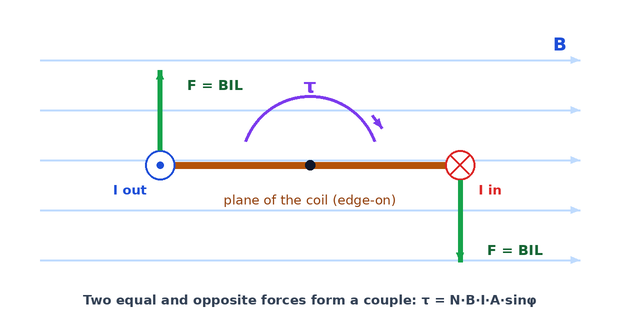
منظر محوري: القوتان تُشكّلان ازدواجًا يدير الملف.
End view: the two forces form a couple that turns the coil.
🔍 كيف يستمر الدوران؟ (شرح إضافي)
🔍 How does rotation continue? (extra)
عندما يتعامد مستوى الملف مع المجال ينعدم العزم، ويتجاوز الملف هذا الوضع بقصوره الذاتي؛ عندئذ يعكس المبدّل (أنصاف الحلقات) اتجاه التيار فيستمر العزم في الاتجاه نفسه. وبذلك يعمل المحرك الكهربائي على تحويل الطاقة الكهربائية إلى حركية.
When the plane of the coil becomes perpendicular to the field the torque vanishes and the coil’s inertia carries it past this position; then the commutator (split rings) reverses the current so the torque keeps the same sense. This is how the electric motor turns electrical energy into kinetic energy.
ملف من \(100\) لفة مساحته \(0.01\ \mathrm{m^2}\) يمر به تيار \(2\ \mathrm{A}\) في مجال \(0.5\ \mathrm{T}\). أوجد عزم ثنائي القطب والعزم الأعظم، والعزم عندما يصنع العمودي على الملف زاوية \(30^\circ\) مع المجال.
A coil of \(100\) turns and area \(0.01\ \mathrm{m^2}\) carries \(2\ \mathrm{A}\) in a field of \(0.5\ \mathrm{T}\). Find the dipole moment, the maximum torque and the torque when the normal to the coil makes \(30^\circ\) with the field.
ملف من \(50\) لفة مساحته \(0.02\ \mathrm{m^2}\) يمر به \(0.5\ \mathrm{A}\). عزم ثنائي القطب المغناطيسي:
A coil of \(50\) turns and area \(0.02\ \mathrm{m^2}\) carries \(0.5\ \mathrm{A}\). Its magnetic dipole moment is:
🧪 جرّب بنفسك: عزم الملف
🧪 Try It Yourself: Torque on a Coil
🧪 تجربة 2: ملف في مجال: العزم وعزم ثنائي القطب
🧪 Experiment 2: A Coil in a Field: Torque and the Dipole Moment
يظهر منظر محوري لملف داخل مجال أفقي. السهم البنفسجي هو عزم ثنائي القطب \(\vec\mu\) (العمودي على الملف). غيّر الزاوية \(\theta\) بين \(\vec\mu\) و\(\vec B\)، ثم اضغط «حرّر الملف» لترى العزم يدوّره ليصطف مع المجال ويتذبذب حتى يستقر.
An end view of a coil in a horizontal field. The purple arrow is the magnetic dipole moment \(\vec\mu\) (normal to the coil). Change the angle \(\theta\) between \(\vec\mu\) and \(\vec B\), then press “Release the coil” to see the torque turn it to align with the field and oscillate until it settles.
🔋 تأثير هول
🔋 The Hall Effect
سلك (شريحة) موصل ارتفاعه \(h\) وعرضه \(d\) وطوله \(L\) يمر به تيار، وضع في مجال مغناطيسي عمودي على اتجاه التيار. ماذا تتوقع أن يحدث بعد مدة؟
A conducting strip of height \(h\), width \(d\) and length \(L\) carries a current and is placed in a magnetic field perpendicular to the current. What do you expect to happen after some time?
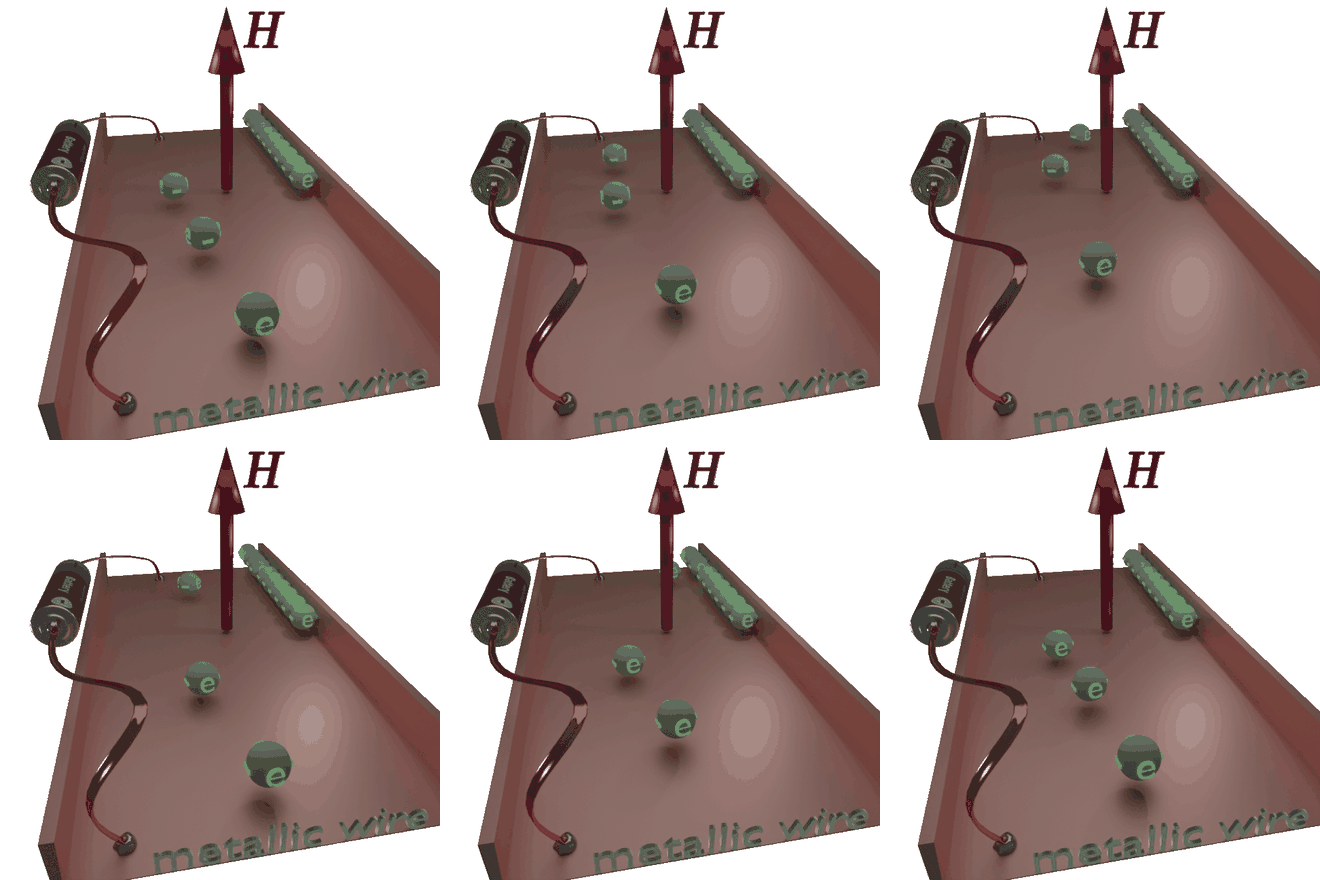
تأثير هول في شريحة معدنية: الإلكترونات تنحرف نحو أحد الحافتين بتأثير المجال \(H\) (\(B\)).
The Hall effect in a metallic strip: the electrons are deflected toward one edge by the field \(H\) (\(B\)).
🔍 ماذا يحدث؟ خطوة بخطوة
🔍 What happens, step by step
1) الإلكترونات تتحرك عكس التيار الاصطلاحي بسرعة انسياق \(v_d\) فتتأثر بقوة مغناطيسية \(F_B=ev_dB\) تدفعها نحو إحدى الحافتين.
2) تتجمع الشحنات السالبة على حافة والموجبة على الحافة المقابلة فينشأ مجال كهربائي عرضي \(E_H\).
3) يؤثر المجال الكهربائي على الإلكترونات بقوة \(F_E=eE_H\) تعاكس \(F_B\).
4) بعد زمن قصير تتساوى القوتان فيتوقف الانحراف وتمر الإلكترونات بخط مستقيم، ويبقى بين الحافتين فرق جهد ثابت هو جهد هول \(\Delta V_H\).
1) The electrons move opposite to the conventional current at the drift speed \(v_d\) and feel a magnetic force \(F_B=ev_dB\) pushing them toward one edge.
2) Negative charge collects on one edge and positive charge on the opposite edge, creating a transverse electric field \(E_H\).
3) The electric field acts on the electrons with \(F_E=eE_H\), opposing \(F_B\).
4) After a very short time the two forces are equal, the deflection stops and the electrons move straight, leaving a steady potential difference between the edges: the Hall voltage \(\Delta V_H\).
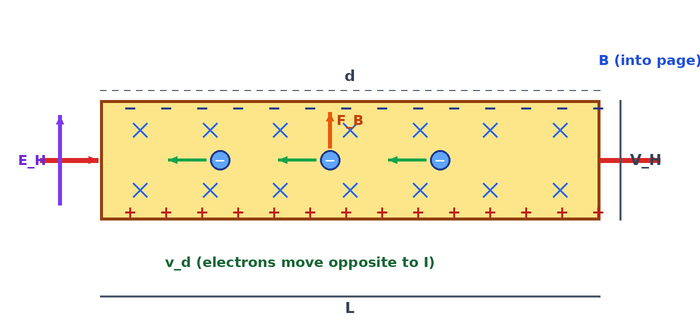
مقطع علوي: التيار \(I\) نحو اليمين والمجال \(B\) داخل الصفحة؛ تتجمّع الإلكترونات على الحافة العليا.
Top view: the current \(I\) is to the right and the field \(B\) into the page; the electrons collect on the upper edge.
📌 معادلات تأثير هول
📌 The Hall-effect equations
\[F_B=F_E\ \Rightarrow\ q\,v_dB=q\,E_H\ \Rightarrow\ E_H=v_dB\]
\[\Delta V_H=E_H\,d=v_d\,B\,d\]
\[I=n\,e\,A\,v_d,\quad A=h\,d\ \Rightarrow\ v_d=\frac{I}{n\,e\,h\,d}\]
\[\Delta V_H=\frac{I\,B}{n\,e\,h}\qquad\Longleftrightarrow\qquad B=\frac{\Delta V_H\,n\,e\,h}{I}\]
\(n\): عدد حاملات الشحنة في وحدة الحجم (\(\mathrm{m^{-3}}\))، \(e\): شحنة الإلكترون، \(h\): سمك الشريحة في اتجاه المجال، \(d\): عرضها بين الحافتين.
\(n\): number of charge carriers per unit volume (\(\mathrm{m^{-3}}\)), \(e\): electron charge, \(h\): the thickness of the strip along the field, \(d\): its width between the two edges.
💡 فوائد تأثير هول (شرح إضافي)
💡 Uses of the Hall effect (extra)
• قياس المجال المغناطيسي: مجس هول يعطي \(\Delta V_H\) متناسبًا مع \(B\).
• تحديد نوع الحاملات: إشارة جهد هول تبيّن إن كانت الحاملات إلكترونات (سالبة) أم فجوات (موجبة) في أشباه الموصلات.
• حساب كثافة الحاملات \(n\) للمادة.
• حساسات السرعة والموضع في السيارات والهواتف.
• Measuring magnetic fields: a Hall probe gives \(\Delta V_H\) proportional to \(B\).
• Finding the type of carriers: the sign of the Hall voltage shows whether the carriers are electrons (negative) or holes (positive) in semiconductors.
• Finding the carrier density \(n\) of a material.
• Speed and position sensors in cars and phones.
في المعادن \(n\) كبيرة جدًا (\(\sim10^{28}\ \mathrm{m^{-3}}\)) فجهد هول صغير جدًا، أما في أشباه الموصلات فـ\(n\) أصغر بكثير فجهد هول أكبر ولهذا تُصنع منها المجسات.
In metals \(n\) is very large (\(\sim10^{28}\ \mathrm{m^{-3}}\)) so the Hall voltage is very small, while in semiconductors \(n\) is much smaller so the Hall voltage is larger, which is why probes are made from them.
شريحة نحاس سمكها \(h=1\ \mathrm{mm}\) يمر بها تيار \(2\ \mathrm{A}\) في مجال \(0.5\ \mathrm{T}\) عمودي عليها، وكثافة الإلكترونات \(n=8.5\times10^{28}\ \mathrm{m^{-3}}\). أوجد جهد هول.
A copper strip of thickness \(h=1\ \mathrm{mm}\) carries \(2\ \mathrm{A}\) in a perpendicular field of \(0.5\ \mathrm{T}\), with electron density \(n=8.5\times10^{28}\ \mathrm{m^{-3}}\). Find the Hall voltage.
مجس هول من شبه موصل: \(n=1.0\times10^{24}\ \mathrm{m^{-3}}\)، سمك \(h=0.2\ \mathrm{mm}\)، تيار \(0.5\ \mathrm{A}\). قرأ الفولتميتر \(62.5\ \mu\mathrm{V}\). ما شدة المجال؟
A semiconductor Hall probe has \(n=1.0\times10^{24}\ \mathrm{m^{-3}}\), thickness \(h=0.2\ \mathrm{mm}\) and current \(0.5\ \mathrm{A}\). The voltmeter reads \(62.5\ \mu\mathrm{V}\). What is the field strength?
سرعة الانسياق لإلكترونات في شريحة عرضها \(1\ \mathrm{cm}\) عندما يكون جهد هول \(2\ \mu\mathrm{V}\) والمجال \(0.5\ \mathrm{T}\):
The drift speed of electrons in a strip \(1\ \mathrm{cm}\) wide when the Hall voltage is \(2\ \mu\mathrm{V}\) and the field \(0.5\ \mathrm{T}\):
إذا تضاعف التيار في شريحة هول مع بقاء المجال والأبعاد، فإن جهد هول:
If the current in a Hall strip doubles with the field and dimensions unchanged, the Hall voltage:
🧪 جرّب بنفسك: تأثير هول
🧪 Try It Yourself: The Hall Effect
🧪 تجربة 3: تأثير هول: راقب تجمّع الشحنات وجهد هول
🧪 Experiment 3: The Hall Effect: Watch the Charges Collect and the Hall Voltage Build Up
شريحة موصلة يمر بها تيار \(I\) نحو اليمين. اضغط «طبّق المجال» فتنحرف الحاملات إلى إحدى الحافتين ويرتفع جهد هول تدريجيًا حتى يبلغ قيمته المستقرة \(\Delta V_H=IB/(neh)\) عندما تتساوى القوتان. جرّب عكس المجال، أو تبديل نوع الحاملات، أو تغيير المادة.
A conducting strip carries a current \(I\) to the right. Press “Apply the field”: the carriers are deflected toward one edge and the Hall voltage rises gradually to its steady value \(\Delta V_H=IB/(neh)\) when the forces balance. Try reversing the field, switching the carrier type, or changing the material.
🧪 تجربة 4: تدريب: قوة وعزم وجهد هول
🧪 Experiment 4: Practice: Force, Torque and Hall Voltage
مسائل عشوائية بأرقام مختلفة: القوة على سلك، أو نسبة قوتين، أو العزم على ملف، أو جهد هول. احسب واكتب الجواب بالوحدة المطلوبة ثم اضغط «تحقّق».
Random problems with different numbers: the force on a wire, the ratio of two forces, the torque on a coil or the Hall voltage. Work it out, enter the answer in the requested unit and press “Check”.
✅ ملخص الدرس
✅ Lesson Summary
| الموضوعTopic | العلاقةRelation | ملاحظةNote |
|---|---|---|
| قوة على سلكForce on a wire | \(F=ILB\sin\theta\) | \(F=0\) عندما يوازي السلك المجال\(F=0\) when the wire is parallel to the field |
| عزم على ملفTorque on a coil | \(\tau=NIAB\sin\theta=\mu B\sin\theta\) | \(\mu=NIA\)\(\mu=NIA\) |
| جهد هولHall voltage | \(\Delta V_H=\dfrac{IB}{neh}\) | \(E_H=v_dB\)\(E_H=v_dB\) |
| المجال من جهد هولField from the Hall voltage | \(B=\dfrac{\Delta V_H\,n\,e\,h}{I}\) | مجس هولHall probe |
🧪 اختبر نفسك: امتحان من 20 سؤالاً
🧪 Test Yourself: a 20-Question Exam
أنهِ الدرس بالاختبار التفاعلي التالي؛ أسئلته تجمع بين الفهم والحساب وتغطي جميع أقسام الدرس.
Finish with the interactive exam below; its questions mix understanding with calculation and cover every section of the lesson.
اختبار قوة لورنتز وتأثير هول Lorentz Force and Hall Effect Quiz
20 سؤالاً - القوة على سلك، مكبّر الصوت، العزم على ملف، وتأثير هول 20 Questions - the force on a wire, the loudspeaker, torque on a loop and the Hall effect
• عدد الأسئلة: 20 سؤالاً
• مدة الاختبار: 30 دقيقة
• لا يمكنك تغيير إجاباتك أو إعادة الاختبار إلا بعد 24 ساعة من التسليم.
• تأكد من إجاباتك قبل التسليم! 📌 Important Instructions:
• Number of questions: 20 questions
• Quiz duration: 30 minutes
• You cannot change your answers or retake the quiz for 24 hours after submission.
• Make sure of your answers before submitting!
🔗 محاكيات GeoGebra للاستعانة بها عند اللزوم
🔗 GeoGebra Simulations to Use When Needed
اضغط «تشغيل» لتعمل المحاكاة هنا داخل الدرس؛ ويمكن للطالب الرجوع إليها لتجربة الفكرة بطريقة أخرى.
Press “Run” to run the simulation right here inside the lesson; the student can use it to try the idea in another way.