🎯 نواتج التعلم
🎯 Learning Outcomes
بعد دراسة هذا الدرس ستكون قادرًا على أن:
After this lesson you will be able to:
- تحدد اتجاه القوة الكهربائية \(F=qE\) والقوة المغناطيسية \(F=qvB\sin\theta\) على جسيم مشحون.Find the direction of the electric force \(F=qE\) and the magnetic force \(F=qvB\sin\theta\) on a charged particle.
- تشرح تجربة طومسون وكيف استنتج سرعة الإلكترونات ونسبة \(e/m\).Explain Thomson's experiment and how he found the speed of the electrons and the ratio \(e/m\).
- تطبّق شرط محدد السرعات \(v=E/B\).Apply the condition of the velocity selector \(v=E/B\).
- تحسب نصف قطر المسار الدائري \(r=mv/qB\) والسرعة بعد التسارع \(v=\sqrt{2qV/m}\).Calculate the radius of the circular path \(r=mv/qB\) and the speed after acceleration \(v=\sqrt{2qV/m}\).
- تشرح عمل مطياف الكتلة وتحسب \(q/m=2V/(r^2B^2)\).Explain how the mass spectrometer works and calculate \(q/m=2V/(r^2B^2)\).
🔬 تجربة طومسون: اكتشاف الإلكترون
🔬 Thomson's Experiment: Discovery of the Electron
| العالمScientist | إنجازهAchievement |
|---|---|
| جوزيف طومسون (J. J. Thomson)Joseph John Thomson | اكتشف الإلكترون عام 1897 فقاد العلم إلى آفاق جديدة، وحدّد النسبة بين شحنة الإلكترون وكتلته \(e/m\).He discovered the electron in 1897, leading science to new horizons, and determined the ratio of the electron's charge to its mass \(e/m\). |
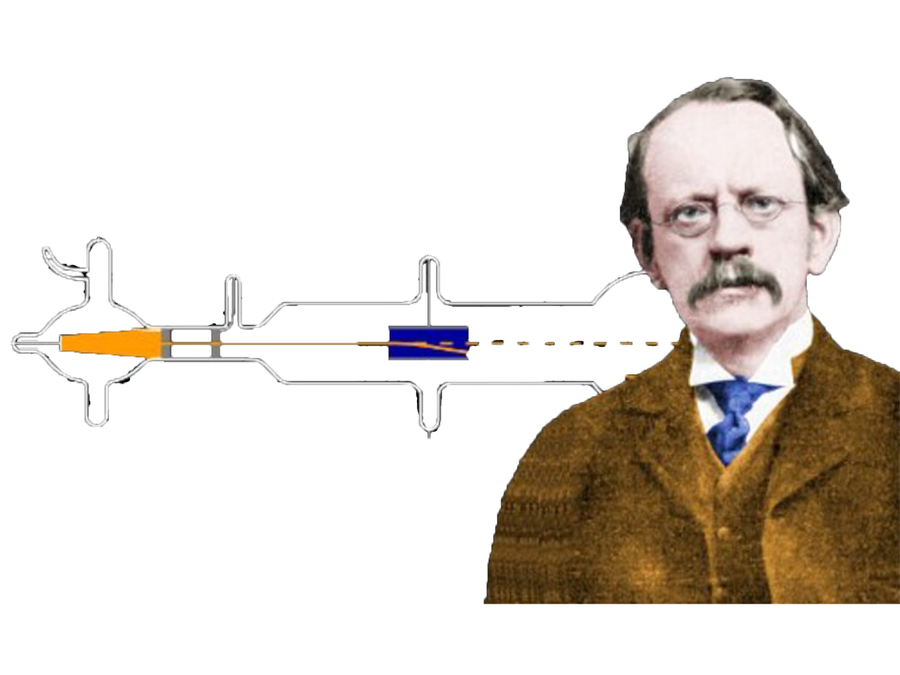
جوزيف طومسون وأنبوب أشعة الكاثود.
Joseph John Thomson and his cathode-ray tube.
استعمل طومسون أنبوب أشعة الكاثود: أنبوب مفرغ فيه قطبان، أحدهما سالب (الكاثود) والآخر موجب (الأنود) يُوصلان بدائرة. تخرج الأشعة من الكاثود وتمر عبر ثقب في الأنود ثم عبر منطقة يمكن فيها تفعيل مجال كهربائي ومجال مغناطيسي، وتنتهي على الجهة الأخرى من الأنبوب على شاشة مضيئة.
Thomson used the cathode-ray tube: an evacuated tube with two electrodes, one negative (the cathode) and one positive (the anode) connected to a circuit. The rays leave the cathode, pass through a hole in the anode and then through a region in which an electric and a magnetic field can be switched on, and end on the other side of the tube on a fluorescent screen.
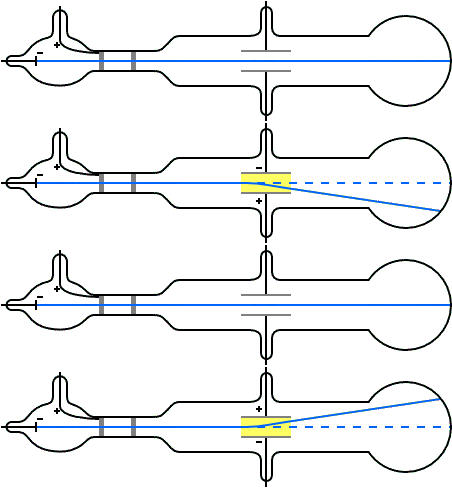
مخطط أنبوب طومسون (متحرك).
The diagram of Thomson's tube (animated).
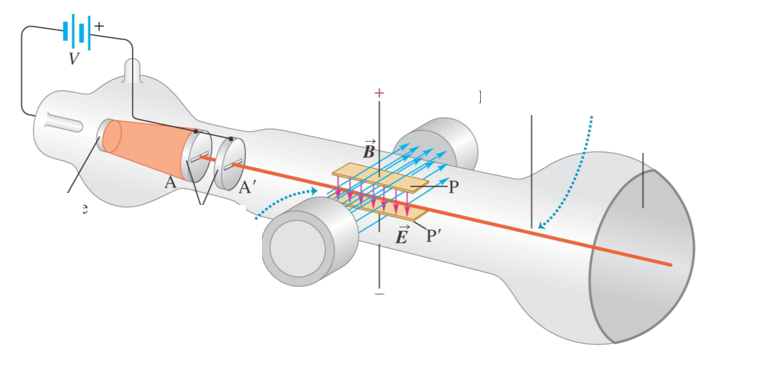
الأنبوب مع صفيحتي المجال الكهربائي ومغناطيس المجال المغناطيسي.
The tube with the plates of the electric field and the magnet of the magnetic field.
القوتان الكهربائية والمغناطيسية على الإلكترون
The electric and magnetic forces on the electron
📘 القوتان على جسيم مشحون
📘 The two forces on a charged particle
\[\vec F_E=q\vec E\qquad F_B=q\,v\,B\sin\theta\]
- القوة الكهربائية \(qE\): في اتجاه \(\vec E\) للشحنة الموجبة وعكسه للسالبة (الإلكترون)، وتغيّر سرعة الجسيم مقدارًا واتجاهًا.The electric force \(qE\): along \(\vec E\) for a positive charge and opposite to it for a negative one (the electron); it changes the speed of the particle in magnitude and direction.
- القوة المغناطيسية \(qvB\sin\theta\): عمودية على \(\vec v\) وعلى \(\vec B\) معًا (قاعدة الكف/اليد اليمنى)، وتنعدم عندما يكون الجسيم ساكنًا أو يتحرك موازيًا للمجال، ولا تبذل شغلًا فلا تغيّر مقدار السرعة بل اتجاهها فقط.The magnetic force \(qvB\sin\theta\): perpendicular to both \(\vec v\) and \(\vec B\) (palm/right-hand rule); it vanishes when the particle is at rest or moves parallel to the field, and it does no work so it changes only the direction of the velocity, not its magnitude.
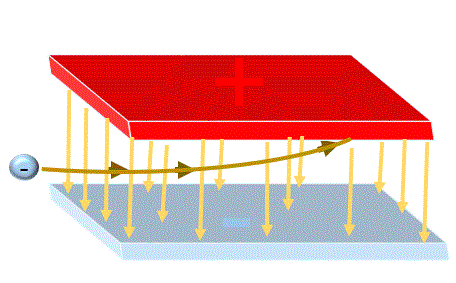
عند تنشيط المجال الكهربائي (إلى الأسفل) ينحرف الإلكترون إلى الأعلى عكس اتجاه المجال.
When the electric field (downward) is switched on the electron is deflected upward, opposite to the field.
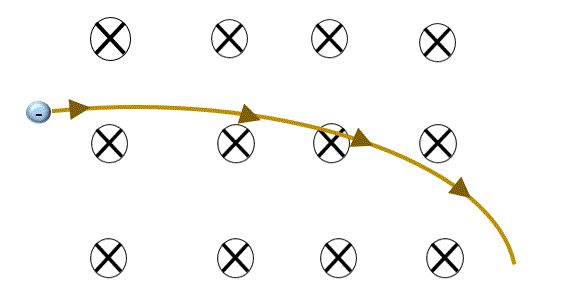
عند تنشيط المجال المغناطيسي (إلى داخل الصفحة) ينحرف الإلكترون إلى الأسفل حسب قاعدة الكف.
When the magnetic field (into the page) is switched on the electron is deflected downward according to the palm rule.
💡 شرح إضافي: كيف نحدد اتجاه القوة المغناطيسية؟
💡 Extra explanation: how do we find the direction of the magnetic force?
نضع كف اليد اليمنى بحيث تشير الأصابع (المفرودة) إلى اتجاه \(\vec B\) ويشير الإبهام إلى اتجاه سرعة الشحنة الموجبة فيخرج اتجاه القوة من باطن الكف. وللإلكترون (سالب) ينعكس الاتجاه. في الشكل \(\vec B\) إلى داخل الصفحة والإلكترون يتجه يمينًا: القوة على الشحنة الموجبة كانت ستكون إلى الأعلى، فهي على الإلكترون إلى الأسفل. أما القوة الكهربائية فسهلة: عكس \(\vec E\) للإلكترون. ولذلك يمكن أن يلغي أحد المجالين أثر الآخر على الإلكترون.
Place the right palm so that the (extended) fingers point along \(\vec B\) and the thumb along the velocity of the positive charge; the direction of the force comes out of the palm. For the electron (negative) the direction is reversed. In the figure \(\vec B\) is into the page and the electron moves to the right: the force on a positive charge would have been upward, so it is downward on the electron. The electric force is easy: opposite to \(\vec E\) for the electron. So one field can cancel the effect of the other on the electron.
الشعاع المستقيم: سرعة الإلكترونات
The straight beam: the speed of the electrons
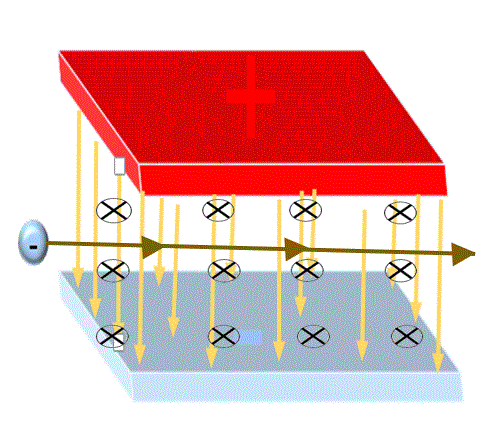
عند تساوي القوتين الكهربائية والمغناطيسية يبقى الإلكترون على خط مستقيم.
When the electric and magnetic forces are equal the electron stays on a straight line.
📘 محدد السرعات
📘 The velocity selector
عند ضبط شدتي المجالين بحيث يبقى الشعاع مستقيمًا تتساوى القوتان:
When the strengths of the two fields are adjusted so that the beam stays straight, the two forces are equal:
\[q\,v\,B=q\,E\quad\Longrightarrow\quad v=\dfrac{E}{B}\]
وتمرّ بهذه الطريقة فقط الجسيمات التي سرعتها \(E/B\) أيًّا كانت شحنتها وكتلتها.
Only the particles whose speed is \(E/B\) pass in this way, whatever their charge and mass.
تتحرك إلكترونات أفقيًا في مجال مغناطيسي شدته \(B=0.5\ \mathrm{T}\) ومجال كهربائي شدته \(E=4\times10^4\ \mathrm{N/C}\) (القوتان متساويتان). احسب سرعتها.
Electrons move horizontally in a magnetic field of \(B=0.5\ \mathrm{T}\) and an electric field of \(E=4\times10^4\ \mathrm{N/C}\) (the two forces are equal). Find their speed.
🧪 تجربة 3: محدد السرعات
🧪 Experiment 3: The velocity selector
يمر في محدد السرعات مجالان متعامدان: كهربائي \(E\) (إلى الأسفل) ومغناطيسي \(B\) (إلى داخل الصفحة). على أيون موجب القوة الكهربائية \(F_E=qE\) إلى الأسفل والمغناطيسية \(F_B=qvB\) إلى الأعلى، فيمر دون انحراف الأيون الذي سرعته \(v=E/B\) فقط. غيّر سرعة الأيون و\(E\) و\(B\) وراقب مسار الأيون، ثم احسب سرعة الانتقاء وتحقق.
Two perpendicular fields act in the velocity selector: an electric field \(E\) (downward) and a magnetic field \(B\) (into the page). On a positive ion the electric force \(F_E=qE\) is downward and the magnetic force \(F_B=qvB\) is upward, so only the ion whose speed is \(v=E/B\) passes without deflection. Change the speed of the ion, \(E\) and \(B\) and watch the path of the ion, then calculate the selected speed and check.
المسار الدائري ونسبة الشحنة إلى الكتلة
The circular path and the charge-to-mass ratio
عند إلغاء المجال الكهربائي يبقى المجال المغناطيسي وحده، فتصبح القوة المغناطيسية عمودية دائمًا على السرعة، فتعمل قوة مركزية وتجعل الإلكترون يتحرك في مسار دائري ثم يصطدم باللوح الحساس. من قياس نصف قطر المسار نحسب \(e/m\):
When the electric field is cancelled the magnetic field remains alone, so the magnetic force is always perpendicular to the velocity and acts as a centripetal force, making the electron move in a circle before hitting the sensitive plate. By measuring the radius of the path we calculate \(e/m\):
📘 المسار الدائري
📘 The circular path
\[q\,v\,B=\dfrac{m v^2}{r}\ \Longrightarrow\ r=\dfrac{m v}{q B}\qquad\dfrac{q}{m}=\dfrac{v}{rB}\]
وإذا تسارع الجسيم من السكون بفرق جهد \(V\) فإن \(\tfrac12mv^2=qV\) أي:
And if the particle is accelerated from rest through a potential difference \(V\) then \(\tfrac12mv^2=qV\), i.e.:
\[v=\sqrt{\dfrac{2qV}{m}}\qquad\dfrac{q}{m}=\dfrac{2V}{r^2B^2}\]
💡 شرح إضافي: ماذا يتغير مع \(v\) و\(B\) و\(m\)؟
💡 Extra explanation: what changes with \(v\), \(B\) and \(m\)?
من \(r=mv/qB\): السرعة الأكبر تعطي دائرة أكبر (\(r\propto v\))، والمجال الأقوى يعطي دائرة أصغر (\(r\propto1/B\))، والجسيم الأثقل دائرة أكبر (\(r\propto m\))، والشحنة الأكبر دائرة أصغر. أما زمن الدورة \(T=\dfrac{2\pi r}{v}=\dfrac{2\pi m}{qB}\) فلا يعتمد على السرعة ولا على نصف القطر، وهو أساس عمل المسرّع الدوراني (السيكلوترون). ولهذا يدور الإلكترون الأسرع في دائرة أكبر لكن في الزمن نفسه.
From \(r=mv/qB\): a larger speed gives a larger circle (\(r\propto v\)), a stronger field gives a smaller circle (\(r\propto1/B\)), a heavier particle a larger circle (\(r\propto m\)) and a larger charge a smaller circle. The period \(T=\dfrac{2\pi r}{v}=\dfrac{2\pi m}{qB}\) does not depend on the speed or the radius, and it is the basis of the cyclotron. So a faster electron moves in a larger circle but in the same time.
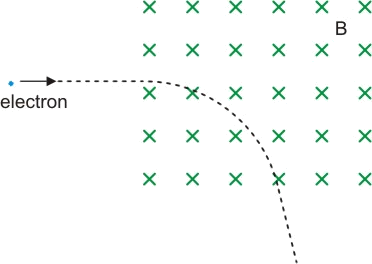
إلكترون يدخل مجالًا مغناطيسيًا (إلى داخل الصفحة) فينحني مساره.
An electron enters a magnetic field (into the page) and its path bends.
قُذف إلكترون (شحنته \(1.6\times10^{-19}\ \mathrm{C}\) وكتلته \(9.1\times10^{-31}\ \mathrm{kg}\)) عموديًا على مجال مغناطيسي شدته \(0.4\ \mathrm{T}\) بسرعة \(5\times10^6\ \mathrm{m/s}\). احسب نصف قطر مساره الدائري.
An electron (charge \(1.6\times10^{-19}\ \mathrm{C}\), mass \(9.1\times10^{-31}\ \mathrm{kg}\)) is shot perpendicular to a magnetic field of \(0.4\ \mathrm{T}\) with a speed of \(5\times10^6\ \mathrm{m/s}\). Find the radius of its circular path.
تسارع إلكترون من السكون بفرق جهد \(500\ \mathrm{V}\) ثم دخل مجالًا مغناطيسيًا \(5\ \mathrm{mT}\) عموديًا. احسب سرعته ونصف قطر مساره، ثم تحقق من \(e/m\).
An electron is accelerated from rest through \(500\ \mathrm{V}\) and then enters a magnetic field of \(5\ \mathrm{mT}\) perpendicularly. Find its speed and the radius of its path, then verify \(e/m\).
🧪 تجربة 1: أنبوب أشعة الكاثود لطومسون
🧪 Experiment 1: Thomson's cathode-ray tube
تتسارع الإلكترونات بفرق جهد \(V\) فتكتسب السرعة \(v=\sqrt{2eV/m}\) ثم تدخل منطقة فيها مجال كهربائي \(E\) (الأسهم إلى الأسفل) ومجال مغناطيسي \(B\) (إلى داخل الصفحة). المجال الكهربائي يرفع الإلكترون (عكس اتجاه المجال) والمغناطيسي يخفضه. الجزء الأول: اجعل \(E\) و\(B\) معًا يُبقيان الشعاع مستقيمًا ثم احسب \(v=E/B\). الجزء الثاني: ألغِ \(E\) (اجعله صفرًا) فيدور الشعاع في مسار دائري نصف قطره \(r\)؛ احسب \(e/m=2V/(B^2r^2)\).
The electrons are accelerated through a potential difference \(V\) and gain the speed \(v=\sqrt{2eV/m}\), then enter a region with an electric field \(E\) (arrows pointing down) and a magnetic field \(B\) (into the page). The electric field pushes the electron up (opposite to the field) and the magnetic field pushes it down. Part 1: make \(E\) and \(B\) together keep the beam straight and calculate \(v=E/B\). Part 2: cancel \(E\) (set it to zero) and the beam moves in a circle of radius \(r\); calculate \(e/m=2V/(B^2r^2)\).
الإلكترون في مجال كهربائي إلى الأسفل ينحرف:
An electron in a downward electric field is deflected:
القوة المغناطيسية على جسيم مشحون يتحرك موازيًا لخطوط المجال:
The magnetic force on a charged particle moving parallel to the field lines is:
يمر إلكترون مستقيمًا بسرعة \(2\times10^5\ \mathrm{m/s}\) في مجال مغناطيسي \(B=0.02\ \mathrm{T}\). شدة المجال الكهربائي اللازمة:
An electron passes straight at a speed of \(2\times10^5\ \mathrm{m/s}\) in a magnetic field \(B=0.02\ \mathrm{T}\). The electric field needed is:
إذا تضاعفت سرعة جسيم يتحرك في مسار دائري في مجال مغناطيسي ثابت فإن نصف قطر المسار:
If the speed of a particle moving in a circle in a constant magnetic field is doubled, the radius of the path:
إذا تضاعف المجال المغناطيسي \(B\) فإن نصف قطر المسار الدائري:
If the magnetic field \(B\) is doubled the radius of the circular path:
القوة المغناطيسية على جسيم مشحون متحرك:
The magnetic force on a moving charged particle:
➕ قياس نسبة شحنة البروتون إلى كتلته
➕ The Charge-to-Mass Ratio of the Proton
أضاف طومسون غاز الهيدروجين إلى الأنبوب وعكس المجال الكهربائي بين الأنود والكاثود، وزاد قيمته حتى انتزع إلكترونًا من ذرة الهيدروجين فبقي الأيون الموجب (البروتون) الذي تحرك بالطريقة نفسها، وحُدّدت نسبة شحنته إلى كتلته. والبروتون موجب فينحرف باتجاه المجال الكهربائي، وعكس انحراف الإلكترون في المجال المغناطيسي.
Thomson added hydrogen gas to the tube and reversed the electric field between the anode and the cathode, increasing its value until an electron was removed from the hydrogen atom, leaving the positive ion (the proton), which moved in the same way, and the ratio of its charge to its mass was determined. The proton is positive so it is deflected along the electric field, and opposite to the electron in the magnetic field.
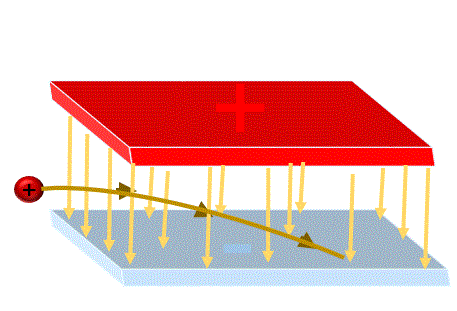
البروتون ينحرف في اتجاه المجال الكهربائي (إلى الأسفل).
The proton is deflected along the electric field (downward).
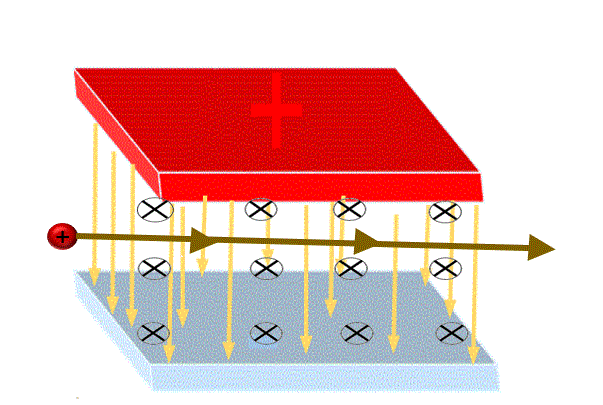
عند تساوي القوتين يمر البروتون مستقيمًا وسرعته \(v=E/B\).
When the forces are equal the proton passes straight with the speed \(v=E/B\).
💡 شرح إضافي: لماذا يدور البروتون في دائرة أكبر؟
💡 Extra explanation: why does the proton move in a larger circle?
العلاقات نفسها: \(v=E/B\) و\(r=mv/qB\) و\(q_p/m_p=v/(rB)\). لكن كتلة البروتون أكبر من كتلة الإلكترون بنحو \(1836\) مرة وشحنتاهما متساويتان بالمقدار، فنسبة \(q/m\) للبروتون \(\approx9.6\times10^7\ \mathrm{C/kg}\) أصغر بكثير من \(1.76\times10^{11}\ \mathrm{C/kg}\) للإلكترون. وعند السرعة نفسها والمجال نفسه يكون نصف قطر مسار البروتون أكبر بنحو \(1836\) مرة، ويدور في الاتجاه المعاكس لأن شحنته موجبة.
The same relations: \(v=E/B\), \(r=mv/qB\) and \(q_p/m_p=v/(rB)\). But the mass of the proton is about \(1836\) times that of the electron and their charges are equal in magnitude, so the \(q/m\) of the proton \(\approx9.6\times10^7\ \mathrm{C/kg}\) is much smaller than \(1.76\times10^{11}\ \mathrm{C/kg}\) of the electron. At the same speed and in the same field the radius of the proton's path is about \(1836\) times larger, and it circulates in the opposite direction because its charge is positive.
سُرّع بروتون من السكون بفرق جهد \(1000\ \mathrm{V}\) ثم دخل مجالًا مغناطيسيًا \(0.10\ \mathrm{T}\) عموديًا. احسب نصف قطر مساره. (\(m_p=1.67\times10^{-27}\ \mathrm{kg}\))
A proton is accelerated from rest through \(1000\ \mathrm{V}\) and then enters a magnetic field of \(0.10\ \mathrm{T}\) perpendicularly. Find the radius of its path. (\(m_p=1.67\times10^{-27}\ \mathrm{kg}\))
نسبة \(q/m\) للبروتون مقارنة بالإلكترون:
The ratio \(q/m\) of the proton compared with that of the electron is:
بروتون وإلكترون يدخلان مجالًا مغناطيسيًا بالسرعة نفسها. أيهما نصف قطر مساره أكبر؟
A proton and an electron enter a magnetic field with the same speed. Which has the larger radius?
تسارع أيون من السكون بفرق جهد \(V\). طاقته الحركية:
An ion is accelerated from rest through a potential difference \(V\). Its kinetic energy is:
⚗️ جهاز مطياف الكتلة
⚗️ The Mass Spectrometer
يستعمل المطياف لتحليل مادة أو جزيء لمعرفة العناصر المكوّنة له وبنيته الكيميائية والبيولوجية والفيزيائية. ويتكون من:
The spectrometer is used to analyse a substance or a molecule to know the elements it is made of and its chemical, biological and physical structure. It consists of:
📘 أجزاء المطياف
📘 Parts of the spectrometer
- مصدر الأيونات: يؤيّن الذرات ويقذفها بسرعات متفاوتة بعد تسارعها بفرق جهد \(V\).The ion source: ionizes the atoms and shoots them with different speeds after being accelerated through a potential difference \(V\).
- حجرة محدد (منقّي) السرعات: مجالان متعامدان \(E\) و\(B_1\) تتساوى فيهما القوتان فلا تعبر إلا الأيونات التي سرعتها \(v=E/B_1\).The velocity-selector chamber: two perpendicular fields \(E\) and \(B_1\) in which the forces are equal, so only ions with speed \(v=E/B_1\) get through.
- جهاز الكشف عن الجسيمات: مجال مغناطيسي \(B_2\) يحرف الأيونات في مسار نصف دائري نصف قطره \(r\) إلى لوح حساس.The particle detector: a magnetic field \(B_2\) bends the ions in a semicircle of radius \(r\) onto a sensitive plate.
\[r=\dfrac{m v}{qB}\qquad v=\sqrt{\dfrac{2qV}{m}}\ \Rightarrow\ r=\dfrac1B\sqrt{\dfrac{2mV}{q}}\qquad\dfrac qm=\dfrac{2V}{r^2B^2}\]
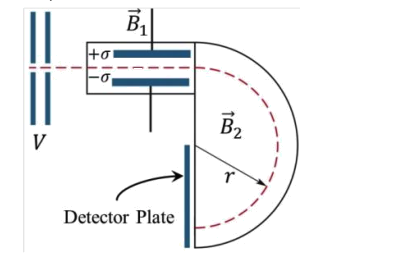
مخطط المطياف: التسارع بالجهد \(V\) ثم محدد السرعات (\(E\) و\(B_1\)) ثم المجال \(B_2\) ولوح الكشف.
The spectrometer: acceleration through \(V\), then the velocity selector (\(E\) and \(B_1\)), then the field \(B_2\) and the detector plate.
💡 شرح إضافي: ماذا تعني النتائج على اللوح؟
💡 Extra explanation: what do the results on the plate mean?
- اصطدام في منطقتين على اللوح الحساس يعني وجود نظيرين للعنصر (كتلتان مختلفتان وشحنة واحدة)، والأثقل أبعد.Impacts in two regions on the sensitive plate mean the element has two isotopes (two masses with one charge), the heavier one being farther.
- غاية المجال المغناطيسي \(B_1\) في المحدد: قوة تعاكس الكهربائية لانتقاء سرعة واحدة؛ وغاية المجال الكهربائي: القوة المعاكسة. ولو لم يكن \(E\) عموديًا على \(B\) لما تعادلت القوتان فلن يمر الأيون مستقيمًا ولن يصل إلى حجرة الكشف.The purpose of the magnetic field \(B_1\) in the selector: a force opposing the electric one to select a single speed; and of the electric field: the opposite force. If \(E\) were not perpendicular to \(B\) the forces could not balance, so the ion would not go straight nor reach the detector.
- سرعة الأيونات الواصلة إلى جهاز الكشف جميعها \(v=E/B_1\) (وهي التي نجحت في المحدد).The speed of the ions reaching the detector is \(v=E/B_1\) for all of them (the ones that passed the selector).
🧪 تجربة 2: مطياف الكتلة وفصل النظائر
🧪 Experiment 2: The mass spectrometer and the separation of isotopes
تتسارع الأيونات الموجبة بفرق جهد \(V\) ثم تدخل مجالًا مغناطيسيًا (خارج الصفحة) فتدور نصف دائرة نصف قطرها \(r=\dfrac{mv}{qB}=\dfrac1B\sqrt{\dfrac{2mV}{q}}\) وتصطدم باللوح عند بُعد \(2r\) عن الشق. النظيران بكتلتين مختلفتين يسقطان في موضعين مختلفين. اختر العنصر وشحنة الأيون وغيّر \(V\) و\(B\)، ثم احسب نصف قطر مسار النظير الأخف وتحقق.
The positive ions are accelerated through a potential difference \(V\) and enter a magnetic field (out of the page), moving in a semicircle of radius \(r=\dfrac{mv}{qB}=\dfrac1B\sqrt{\dfrac{2mV}{q}}\) and hitting the plate at a distance \(2r\) from the slit. The two isotopes of different masses land at two different places. Choose the element and the charge of the ion and change \(V\) and \(B\), then calculate the radius of the path of the lighter isotope and check.
أُرسلت حزمة من أيونات ثنائية التأين كتلة الأيون \(4\times10^{-26}\ \mathrm{kg}\) تحت فرق جهد \(2\times10^4\ \mathrm{V}\). احسب سرعة الأيون.
A beam of doubly ionized ions of mass \(4\times10^{-26}\ \mathrm{kg}\) is accelerated through \(2\times10^4\ \mathrm{V}\). Find the speed of the ion.
تتسارع حزمة ثلاثية التأين كتلة أيونها \(3.25\times10^{-26}\ \mathrm{kg}\) بفرق جهد \(220\ \mathrm{V}\) وتمر في مجال مغناطيسي \(0.05\ \mathrm{T}\). احسب نصف قطر مسارها.
A triply ionized beam whose ion has a mass of \(3.25\times10^{-26}\ \mathrm{kg}\) is accelerated through \(220\ \mathrm{V}\) and moves in a magnetic field of \(0.05\ \mathrm{T}\). Find the radius of its path.
في مطياف كتلة تتسارع أيونات النيون \(^{20}\mathrm{Ne}^+\) و\(^{22}\mathrm{Ne}^+\) بفرق جهد \(1000\ \mathrm{V}\) في مجال \(0.20\ \mathrm{T}\). احسب نصفي قطريهما والمسافة بين موضعي سقوطهما. (\(1\ \mathrm{u}=1.66\times10^{-27}\ \mathrm{kg}\))
In a mass spectrometer \(^{20}\mathrm{Ne}^+\) and \(^{22}\mathrm{Ne}^+\) ions are accelerated through \(1000\ \mathrm{V}\) in a field of \(0.20\ \mathrm{T}\). Find their two radii and the distance between their landing points. (\(1\ \mathrm{u}=1.66\times10^{-27}\ \mathrm{kg}\))
أيون يتسارع من السكون بفرق جهد \(V\) وشحنته \(q\) وكتلته \(m\). سرعته:
An ion accelerated from rest through a potential difference \(V\) has charge \(q\) and mass \(m\). Its speed is:
وقعت الأيونات في منطقتين على لوح المطياف. هذا يعني:
The ions fell in two regions on the plate of the spectrometer. This means:
وظيفة محدد السرعات:
The function of the velocity selector is:
نصف قطر مسار أيون في مطياف الكتلة يتناسب طرديًا مع:
The radius of the path of an ion in a mass spectrometer is directly proportional to:
📚 ملخص الدرس
📚 Lesson Summary
| المفهومConcept | العلاقةRelation |
|---|---|
| القوة الكهربائيةElectric force | \(F_E=qE\)\(F_E=qE\) |
| القوة المغناطيسيةMagnetic force | \(F_B=qvB\sin\theta\ (\perp\vec v,\perp\vec B)\)\(F_B=qvB\sin\theta\ (\perp\vec v,\perp\vec B)\) |
| محدد السرعاتVelocity selector | \(qvB=qE\ \Rightarrow\ v=E/B\)\(qvB=qE\ \Rightarrow\ v=E/B\) |
| المسار الدائريCircular path | \(r=\dfrac{mv}{qB}\ ;\ \dfrac qm=\dfrac{v}{rB}\)\(r=\dfrac{mv}{qB}\ ;\ \dfrac qm=\dfrac{v}{rB}\) |
| التسارع بفرق جهدAcceleration through a voltage | \(v=\sqrt{2qV/m}\ ;\ \dfrac qm=\dfrac{2V}{r^2B^2}\)\(v=\sqrt{2qV/m}\ ;\ \dfrac qm=\dfrac{2V}{r^2B^2}\) |
| الدورPeriod | \(T=\dfrac{2\pi m}{qB}\)\(T=\dfrac{2\pi m}{qB}\) |
⚠️ أخطاء شائعة
⚠️ Common mistakes
- نسيان عكس اتجاه القوة للشحنة السالبة (الإلكترون) في المجالين.Forgetting to reverse the direction of the force for a negative charge (the electron) in both fields.
- الظن أن المجال المغناطيسي يزيد سرعة الجسيم؛ هو يغيّر اتجاهها فقط.Thinking that the magnetic field increases the speed of the particle; it changes only its direction.
- استعمال شحنة الأيون \(e\) بدل \(2e\) أو \(3e\) للأيونات متعددة التأين.Using the charge \(e\) instead of \(2e\) or \(3e\) for multiply ionized ions.
- نسيان تحويل الكتلة إلى الكيلوجرام (u أو g) والمجال إلى تسلا (mT أو G).Forgetting to convert the mass to kilograms (u or g) and the field to tesla (mT or G).
- الظن أن زمن الدورة يعتمد على السرعة؛ \(T=2\pi m/qB\) لا يعتمد عليها.Thinking that the period depends on the speed; \(T=2\pi m/qB\) does not.
🧪 اختبر نفسك: امتحان من 20 سؤالاً
🧪 Test Yourself: a 20-Question Exam
أنهِ الدرس بالاختبار التفاعلي التالي؛ أسئلته تجمع بين الفهم والحساب وتغطي جميع أقسام الدرس.
Finish with the interactive exam below; its questions mix understanding with calculation and cover every section of the lesson.
اختبار الكهرومغناطيسية: القوة الكهربائية والمغناطيسية على الجسيمات Electric and Magnetic Forces on Particles Quiz
20 سؤالاً - الكهرومغناطيسية: القوة الكهربائية والمغناطيسية على الجسيمات وطرق انتقال الحرارة 20 Questions - Thomson's Experiment, the Velocity Selector and the Mass Spectrometer
• عدد الأسئلة: 20 سؤالاً
• مدة الاختبار: 30 دقيقة
• لا يمكنك تغيير إجاباتك أو إعادة الاختبار إلا بعد 24 ساعة من التسليم.
• تأكد من إجاباتك قبل التسليم! 📌 Important Instructions:
• Number of questions: 20 questions
• Quiz duration: 30 minutes
• You cannot change your answers or retake the quiz for 24 hours after submission.
• Make sure of your answers before submitting!