🔍 أنواع العدسات
🔍 Types of Lenses
العدسة قطعة شفافة (من الزجاج أو البلاستيك) سطحاها أو أحدهما منحنٍ، تكسر الضوء عند مروره فيها فتُكوّن صورًا للأجسام. وهناك نوعان رئيسيان بحسب شكلها:
A lens is a transparent piece (of glass or plastic) with one or both surfaces curved; it bends light passing through it and so forms images of objects. There are two main types, according to shape:
1️⃣ العدسة المحدبة (المجمّعة)
1️⃣ The Convex (Converging) Lens
سميكة في الوسط ورقيقة عند الأطراف. تجمع الأشعة الساقطة عليها موازية للمحور في نقطة واحدة تدعى البؤرة، وهي بؤرة حقيقية لأنها ناتجة من التقاء الأشعة المنكسرة نفسها (يمكن استقبالها على حاجز).
Thick in the middle and thin at the edges. It gathers incident rays parallel to the axis at a single point called the focus, which is real because it is formed where the refracted rays themselves meet (it can be caught on a screen).
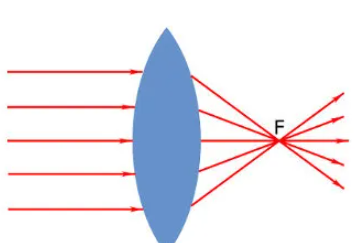
العدسة المحدبة تجمع الأشعة المتوازية في البؤرة الحقيقية \(F\).
A convex lens gathers parallel rays at the real focus \(F\).
2️⃣ العدسة المقعرة (المفرِّقة)
2️⃣ The Concave (Diverging) Lens
سميكة عند الأطراف ورقيقة في الوسط. تفرّق الأشعة الساقطة عليها موازية للمحور، لكن امتدادات الأشعة المنكسرة (الخطوط المتقطعة) تلتقي في نقطة واحدة هي البؤرة، وهي بؤرة تخيلية لأنها ناتجة من التقاء الامتدادات لا الأشعة نفسها.
Thick at the edges and thin in the middle. It spreads incident rays parallel to the axis, but the extensions of the refracted rays (the dashed lines) meet at a single point, the focus, which is virtual because it is formed where the extensions, not the rays themselves, meet.
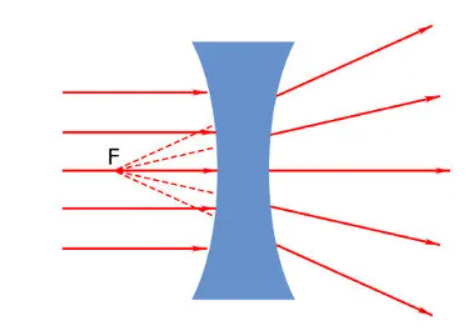
العدسة المقعرة تفرّق الأشعة، وامتداداتها تلتقي في البؤرة التخيلية \(F\).
A concave lens spreads rays; their extensions meet at the virtual focus \(F\).
💡 لماذا تجمع المحدبة وتفرّق المقعرة؟
💡 Why Does the Convex Lens Converge and the Concave Lens Diverge?
تنكسر الأشعة عند السطحين المنحنيين (انكسار ضوء من الهواء إلى الزجاج ثم من الزجاج إلى الهواء). يمكن تشبيه العدسة المحدبة بمنشورين زجاجيين قاعدتاهما ملتصقتان: كل منشور يحرف الأشعة نحو قاعدته، فتنحرف الأشعة نحو الوسط وتتجمع. وفي المقعرة يكون الوضع معكوسًا (قاعدتا المنشورين عند الأطراف) فتنحرف الأشعة بعيدًا عن الوسط وتتفرق. وكلما ازداد انحناء السطحين قصرت البؤرة (العدسة أقوى).
The rays are refracted at the two curved surfaces (air to glass, then glass to air). A convex lens can be pictured as two glass prisms joined base to base: each prism bends rays toward its base, so the rays are bent toward the middle and converge. In a concave lens it is the other way round (the prism bases at the edges), so the rays are bent away from the middle and spread out. The more curved the surfaces, the shorter the focal length (the stronger the lens).
وللعدسات أشكال مختلفة بحسب انحناء كل وجه (محدبة الوجهين، مستوية محدبة، هلالية محدبة... ومقعرة الوجهين، مستوية مقعرة، هلالية مقعرة)، لكن القاعدة العامة: إذا كانت العدسة أسمك من الوسط فهي مجمّعة، وإذا كانت أرق من الوسط فهي مفرِّقة.
Lenses come in different shapes according to the curvature of each face (double convex, plano-convex, convex meniscus... and double concave, plano-concave, concave meniscus), but the general rule is: if the lens is thicker in the middle it is converging; if thinner in the middle it is diverging.
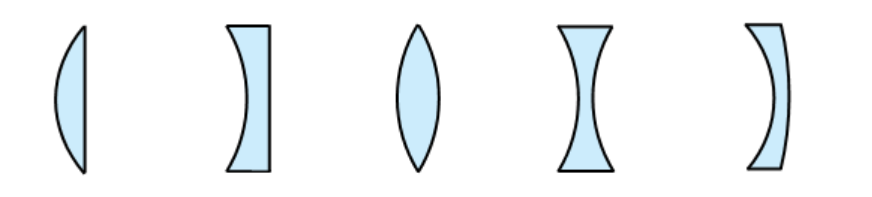
بعض أشكال العدسات المحدبة (الأسمك في الوسط) والمقعرة (الأرق في الوسط).
Some convex (thicker in the middle) and concave (thinner in the middle) lens shapes.
عدسة سميكة في الوسط ورقيقة عند الأطراف. هي عدسة:
A lens is thick in the middle and thin at the edges. It is a:
📍 المصطلحات الأساسية
📍 Key Terms
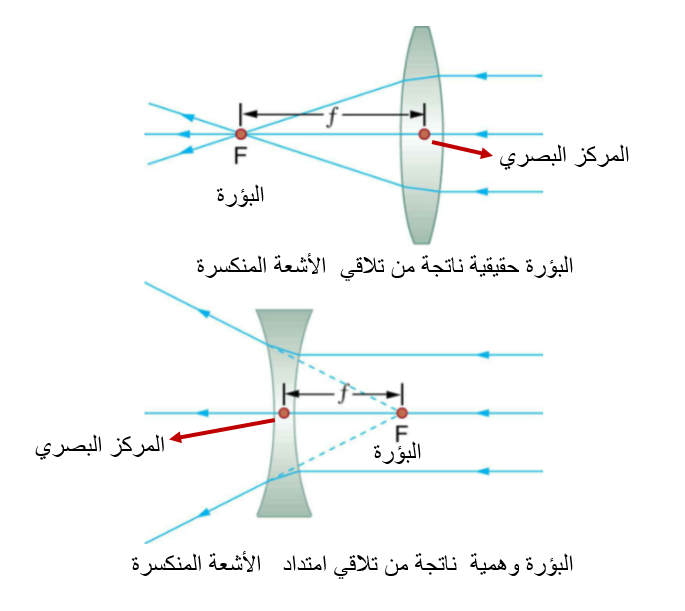
المحور الأساسي، والبؤرة \(F\)، والبعد البؤري \(f\)، والمركز البصري في العدسة المحدبة (أعلى) والمقعرة (أسفل).
The principal axis, the focus \(F\), the focal length \(f\) and the optical center in the convex (top) and concave (bottom) lenses.
📜 تعريفات
📜 Definitions
- المحور الأساسي: الخط المستقيم المار بمركز العدسة عموديًا على سطحها.Principal axis: the straight line through the center of the lens, perpendicular to its surface.
- المركز البصري: نقطة في مركز العدسة؛ الشعاع المار بها لا ينحرف (العدسة رقيقة).Optical center: the point at the middle of the lens; a ray through it is not deviated (for a thin lens).
- البؤرة \(F\): النقطة التي تلتقي عندها الأشعة المنكسرة (الحقيقية في المحدبة) أو امتداداتها (التخيلية في المقعرة) لحزمة موازية للمحور. وللعدسة بؤرتان متماثلتان على جانبيها.Focus \(F\): the point where the refracted rays (real, in a convex lens) or their extensions (virtual, in a concave lens) of a beam parallel to the axis meet. A lens has two symmetric foci, one on each side.
- البعد البؤري \(f\): المسافة بين المركز البصري والبؤرة؛ موجب للمحدبة وسالب للمقعرة.Focal length \(f\): the distance from the optical center to the focus; positive for a convex lens and negative for a concave lens.
أي العبارات التالية صحيحة بالنسبة للعدسة المقعرة؟
Which of the following statements is true for a concave lens?
✏️ الصور في العدسات: مسار الأشعة
✏️ Images in Lenses: the Path of Rays
لتحديد موضع الصورة وصفاتها بالرسم نتتبع مسار أشعة قليلة صادرة من رأس الجسم، وكلها تحقق قانون الانكسار. تلتقي الأشعة المنكسرة (أو امتداداتها) عند رأس الصورة. وتكفي شعاعان للتحديد، والثالث للتحقق. ولدينا ثلاثة أشعة «معروفة المسار»:
To find the position and characteristics of an image by drawing, we follow a few rays leaving the top of the object, all obeying the law of refraction. The refracted rays (or their extensions) meet at the top of the image. Two rays are enough, the third is a check. Three rays have a known path:
① شعاع موازٍ للمحور الأساسي
① A Ray Parallel to the Principal Axis
ينكسر مارًّا بالبؤرة في العدسة المحدبة، أو يمر امتداده بالبؤرة في العدسة المقعرة.
It is refracted through the focus in a convex lens, or its extension passes through the focus in a concave lens.

الشعاع 1: موازٍ للمحور ← يمر بالبؤرة (محدبة) / امتداده يمر بالبؤرة (مقعرة).
Ray 1: parallel to the axis → through the focus (convex) / its extension through the focus (concave).
② شعاع مارٌّ بالمركز البصري
② A Ray Through the Optical Center
يتابع طريقه دون أن ينكسر (لأن العدسة الرقيقة تُشبه في مركزها شريحة زجاجية متوازية الوجهين فلا يتغير اتجاه الشعاع إلا بإزاحة مهملة).
It continues without being refracted (at its center a thin lens acts like a parallel-sided glass slab, which shifts the ray only by a negligible amount).

الشعاع 2: المار بالمركز البصري يتابع دون انكسار.
Ray 2: the ray through the optical center continues undeviated.
③ شعاع مارٌّ بالبؤرة (أو متجه نحوها)
③ A Ray Through (or Aimed at) the Focus
شعاع يمر بالبؤرة في العدسة المحدبة، أو يتجه امتداده نحو البؤرة في العدسة المقعرة، ينكسر موازيًا للمحور الأساسي (عكس الشعاع الأول تمامًا).
A ray passing through the focus in a convex lens, or whose extension is aimed at the focus in a concave lens, is refracted parallel to the principal axis (exactly the reverse of ray 1).

الشعاع 3: المار بالبؤرة ينكسر موازيًا للمحور.
Ray 3: the ray through the focus is refracted parallel to the axis.
أي العبارات التالية تصف الأشعة المتوازية الساقطة على عدسة مقعرة بشكل صحيح؟
Which statement correctly describes parallel rays incident on a concave lens?
🎯 أين تتكون الصورة؟ جدول العدسة المحدبة
🎯 Where Is the Image? Table for the Convex Lens
يعتمد موضع الصورة وصفاتها في العدسة المحدبة على موضع الجسم بالنسبة إلى البؤرة \(F\) وإلى \(2F\) (ضعف البعد البؤري):
In a convex lens the position and characteristics of the image depend on where the object is relative to the focus \(F\) and to \(2F\) (twice the focal length):
| موضع الجسمObject position | موضع الصورةImage position | نوع الصورةType | الصفاتCharacteristics |
|---|---|---|---|
| أبعد من \(2F\)beyond \(2F\) | بين \(F\) و\(2F\)between \(F\) and \(2F\) | حقيقيةreal | مقلوبة، مصغّرةinverted, diminished |
| عند \(2F\)at \(2F\) | عند \(2F\)at \(2F\) | حقيقيةreal | مقلوبة، بحجم الجسم (\(M=-1\))inverted, same size (\(M=-1\)) |
| بين \(F\) و\(2F\)between \(F\) and \(2F\) | أبعد من \(2F\)beyond \(2F\) | حقيقيةreal | مقلوبة، مكبّرةinverted, magnified |
| عند \(F\)at \(F\) | في اللانهايةat infinity | —— | لا تتكون صورة محددة (أشعة متوازية)no definite image (parallel rays) |
| أقرب من \(F\)inside \(F\) | على جانب الجسم نفسهon the same side as the object | تخيلية (افتراضية)virtual | معتدلة، مكبّرة (مكبّر)upright, magnified (a magnifier) |
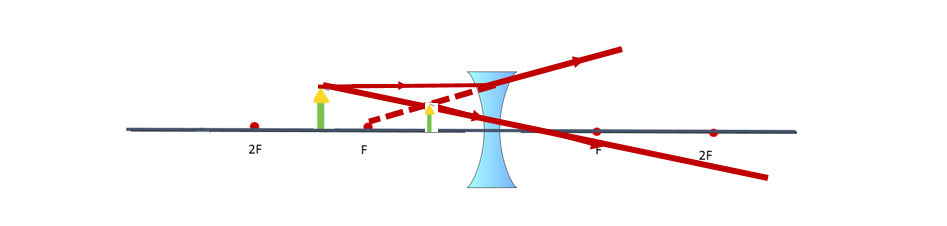
أما العدسة المقعرة فمهما كان موضع الجسم تتكون صورة تخيلية معتدلة مصغّرة بين الجسم والعدسة (أقرب إلى العدسة من الجسم).
For the concave lens, wherever the object is, the image is virtual, upright and diminished, lying between the object and the lens (closer to the lens than the object).
🧪 تجربة: ارسم الصور بنفسك
🧪 Experiment: Draw the Images Yourself
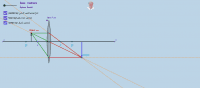
حرّك الجسم أمام العدسة وغيّر نوعها وبعدها البؤري، وراقب الأشعة الثلاثة والصورة. اجعل الجسم أبعد من \(2F\) ثم عند \(2F\) ثم بين \(F\) و\(2F\) ثم داخل \(F\)، وحاول التنبؤ بالصورة قبل النظر إلى النتيجة. ثم بدّل إلى عدسة مقعرة وانظر ما يتغير.
Move the object in front of the lens and change its type and focal length, and watch the three rays and the image. Put the object beyond \(2F\), then at \(2F\), then between \(F\) and \(2F\), then inside \(F\), and try to predict the image before looking at the result. Then switch to a concave lens and see what changes.
🧪 تجربة 1: رسم الصور بالأشعة الثلاثة
🧪 Experiment 1: Ray Diagrams with the Three Rays
الأحمر: الشعاع الموازي للمحور، الأزرق: المار بالمركز البصري، الأخضر: المار بالبؤرة. الصورة الحقيقية خط متصل والتخيلية خط متقطع. النقاط \(F\) و\(2F\) على المحور.
Red: the ray parallel to the axis; blue: through the optical center; green: through the focus. A real image is drawn solid and a virtual one dashed. The points \(F\) and \(2F\) are marked on the axis.
✍️ مهارة الرسم
✍️ Drawing Skill
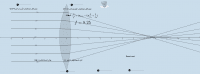
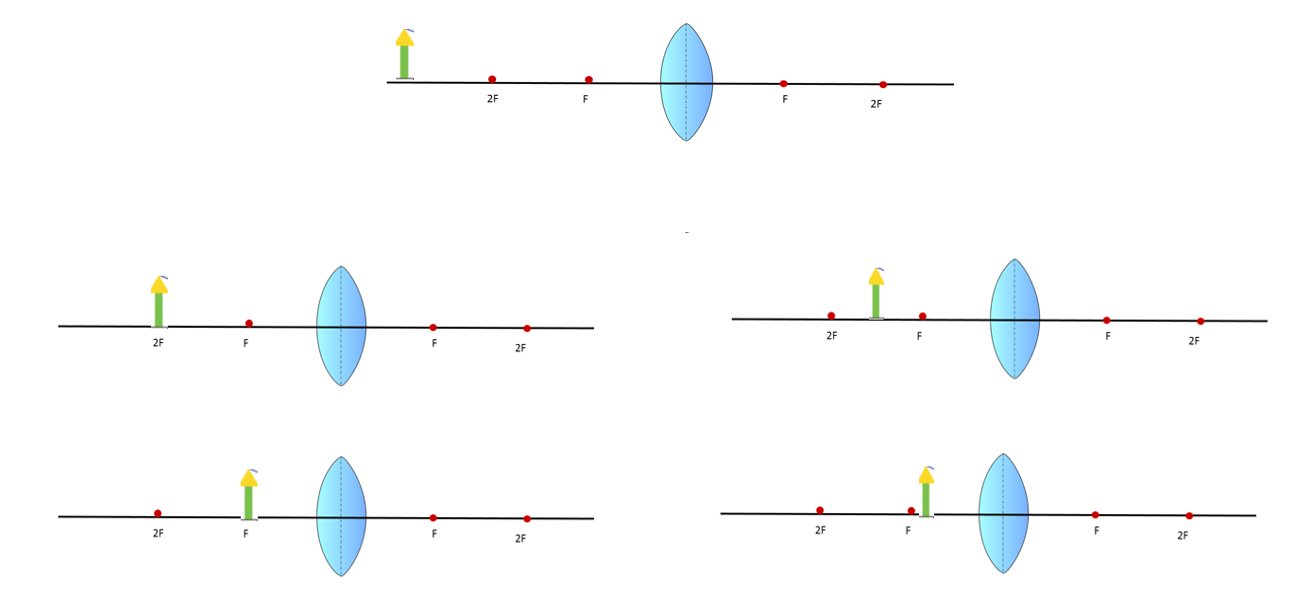
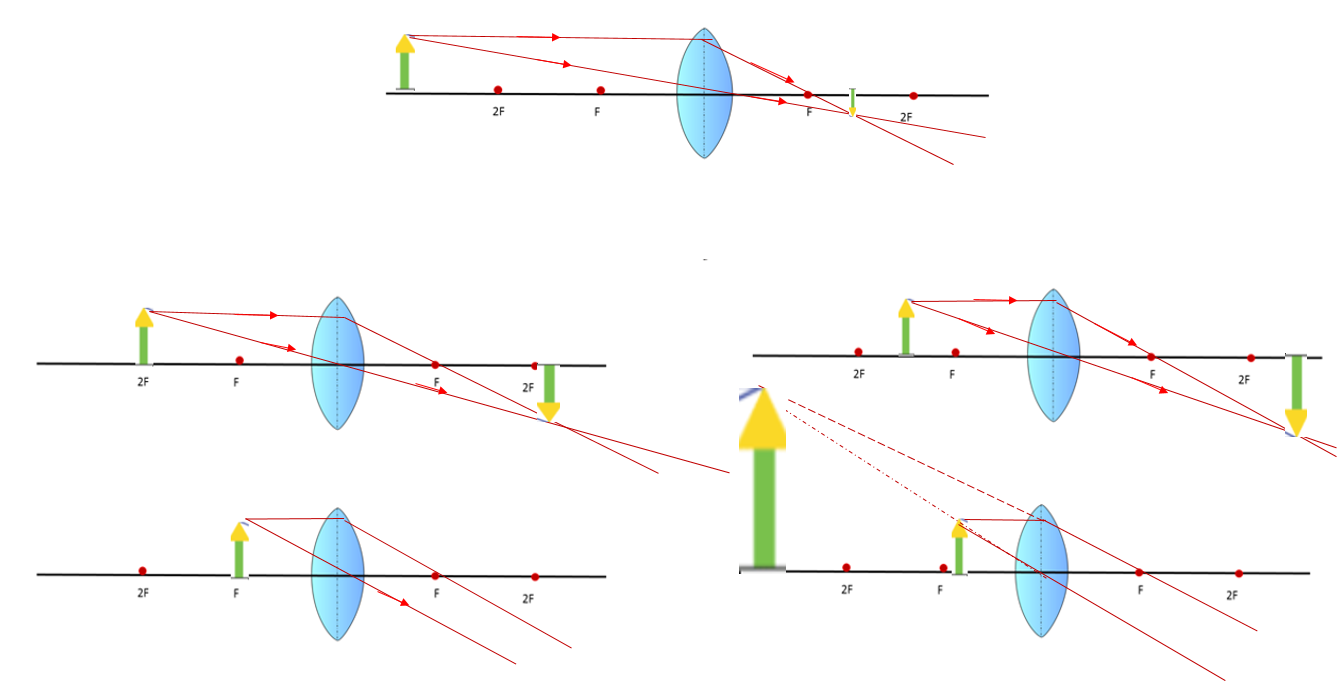
أكمل رسم الصور المتكونة (بالأشعة الثلاثة) عند وضع جسم أمام عدسة محدبة في أربعة مواضع مختلفة كما في الشكل، ثم تأكد من الحل.
Complete the drawing of the images formed (using the three rays) when an object is placed in front of a convex lens at four different positions, as in the figure, then check the solution.
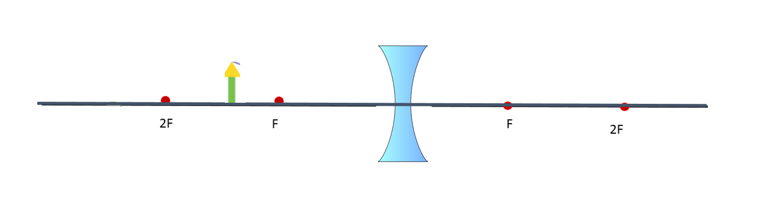
أكمل رسم الصورة المتكونة عند وضع جسم أمام عدسة مقعرة (في أي موضع تظهر الصورة نفسها: تخيلية معتدلة مصغّرة)، ثم تأكد من الحل.
Complete the drawing of the image formed when an object is placed in front of a concave lens (at any position the same kind of image appears: virtual, upright, diminished), then check the solution.
📐 قانون العدسات والتكبير
📐 The Lens Law and Magnification
بتشابه المثلثات في مخطط الأشعة يمكن اشتقاق قانون العدسات (معادلة العدسة الرقيقة) الذي يربط بعد الجسم \(X_o\) وبعد الصورة \(X_i\) بالبعد البؤري \(f\):
From similar triangles in the ray diagram we can derive the lens law (the thin-lens equation), which relates the object distance \(X_o\) and the image distance \(X_i\) to the focal length \(f\):
📜 قانون العدسات
📜 The Lens Law
\[\frac{1}{f}=\frac{1}{X_o}+\frac{1}{X_i}\]
ولا يكفي القانون وحده؛ لا بد من اصطلاح الإشارات للقيم المعطاة:
The law alone is not enough; we need a sign convention for the given values:
| نوع العدسةLens type | البعد البؤري \(f\)Focal length \(f\) | بعد الجسم \(X_o\)Object distance \(X_o\) | بعد الصورة \(X_i\)Image distance \(X_i\) |
|---|---|---|---|
| محدبة (مجمّعة)Convex (converging) | موجب (+)positive (+) | موجب (+) إذا كان الجسم حقيقيًّا أمام العدسة؛ سالب إذا كان «الجسم» صورة من عدسة أخرىpositive (+) for a real object in front of the lens; negative if the “object” is an image from another lens | موجب (+) للصورة الحقيقية (على الجانب المقابل للجسم)؛ سالب (−) للتخيليةpositive (+) for a real image (on the opposite side from the object); negative (−) for a virtual image |
| مقعرة (مفرِّقة)Concave (diverging) | سالب (−)negative (−) | موجب (+) للجسم الحقيقي أمام العدسةpositive (+) for a real object in front of the lens | سالب (−) دائمًا (صورة تخيلية)always negative (−) (a virtual image) |
💡 قاعدة عملية
💡 A Practical Rule
نضع الإشارة للقيم المعلومة فقط ونترك المجهول ليخرج بإشارته من الحل: إشارة \(X_i\) الناتجة تخبرنا نوع الصورة (موجبة: حقيقية، سالبة: تخيلية). وفي الحساب نتعامل مع مقلوبات الأعداد: \(\dfrac{1}{X_i}=\dfrac{1}{f}-\dfrac{1}{X_o}\) ثم نقلب الناتج.
We put signs only on the known values and let the unknown come out with its own sign from the solution: the sign of the resulting \(X_i\) tells the type of image (positive: real, negative: virtual). In the calculation we work with reciprocals: \(\dfrac{1}{X_i}=\dfrac{1}{f}-\dfrac{1}{X_o}\), then invert the result.
📜 التكبير
📜 Magnification
التكبير هو النسبة بين طول الصورة \(h_i\) وطول الجسم \(h_o\)، وتُعطي بتشابه المثلثات:
The magnification is the ratio of the image height \(h_i\) to the object height \(h_o\), and by similar triangles it is:
\[M=\frac{h_i}{h_o}=-\frac{X_i}{X_o}\]
- إشارة \(M\) دائمًا عكس إشارة \(X_i\): صورة حقيقية (\(X_i\gt 0\)) ⇒ \(M\lt 0\) أي مقلوبة؛ صورة تخيلية (\(X_i\lt 0\)) ⇒ \(M\gt 0\) أي معتدلة.The sign of \(M\) is always opposite to that of \(X_i\): a real image (\(X_i\gt 0\)) ⇒ \(M\lt 0\), inverted; a virtual image (\(X_i\lt 0\)) ⇒ \(M\gt 0\), upright.
- \(|M|\gt 1\) مكبّرة، \(|M|\lt 1\) مصغّرة، \(|M|=1\) بحجم الجسم.\(|M|\gt 1\) magnified, \(|M|\lt 1\) diminished, \(|M|=1\) same size.
عدسة محدبة بعدها البؤري \(20\ cm\) وُضع جسم على بعد \(30\ cm\) منها. أين تتكون الصورة؟
A convex lens has a focal length of \(20\ cm\) and an object is placed \(30\ cm\) from it. Where is the image formed?
جسم طوله \(4\ cm\) وُضع على بعد \(30\ cm\) من عدسة محدبة بعدها البؤري \(20\ cm\). احسب طول الصورة وصفاتها.
An object \(4\ cm\) tall is placed \(30\ cm\) from a convex lens of focal length \(20\ cm\). Find the height of the image and its characteristics.
إذا كان بعد الجسم عن عدسة محدبة \(30\ cm\) وبعد الصورة \(15\ cm\)، فما البعد البؤري للعدسة؟
The object distance from a convex lens is \(30\ cm\) and the image distance is \(15\ cm\). What is the focal length of the lens?
عدسة مقعرة بعدها البؤري \(15\ cm\) (أي \(f=-15\ cm\)) وُضع جسم على بعد \(30\ cm\) منها. أين تتكون الصورة؟
A concave lens has focal length \(15\ cm\) (i.e. \(f=-15\ cm\)) and an object is placed \(30\ cm\) from it. Where is the image formed?
عدسة مقعرة بعدها البؤري \(15\ cm\) وُضع جسم على بعد \(30\ cm\) منها. فإن بعد الصورة يعادل:
A concave lens has a focal length of \(15\ cm\) and an object is placed \(30\ cm\) from it. The image distance is:
وُضع جسم على بعد \(10\ cm\) من عدسة محدبة بعدها البؤري \(15\ cm\). ما صفات الصورة؟
An object is placed \(10\ cm\) from a convex lens of focal length \(15\ cm\). What are the characteristics of the image?
وُضع جسم على بعد \(10\ cm\) من عدسة محدبة بعدها البؤري \(15\ cm\). فإن صفات الصورة المتكونة:
An object is placed \(10\ cm\) from a convex lens of focal length \(15\ cm\). The image formed is:
ما البعد البؤري لعدسة محدبة تُكوّن صورة حقيقية على بعد \(40\ cm\) عندما يوضع الجسم على بعد \(20\ cm\) منها؟
What is the focal length of a convex lens that forms a real image \(40\ cm\) away when the object is \(20\ cm\) from it?
💡 حالة خاصة مهمة: الجسم عند \(2f\)
💡 An Important Special Case: Object at \(2f\)
عندما \(X_o=2f\) في عدسة محدبة: \(\dfrac{1}{X_i}=\dfrac{1}{f}-\dfrac{1}{2f}=\dfrac{1}{2f}\) إذن \(X_i=2f\)، و\(M=-\dfrac{2f}{2f}=-1\): صورة حقيقية مقلوبة بحجم الجسم. وهي نقطة الفصل بين الصور المصغّرة (الجسم أبعد من \(2f\)) والمكبّرة (الجسم بين \(f\) و\(2f\)).
When \(X_o=2f\) in a convex lens: \(\dfrac{1}{X_i}=\dfrac{1}{f}-\dfrac{1}{2f}=\dfrac{1}{2f}\), so \(X_i=2f\) and \(M=-\dfrac{2f}{2f}=-1\): a real, inverted image the same size as the object. It is the dividing point between diminished images (object beyond \(2f\)) and magnified images (object between \(f\) and \(2f\)).
ما خاصية الصورة في العدسة المحدبة عندما يوضع الجسم على بعد يساوي ضعف البعد البؤري (\(X_o=2f\))؟
What are the characteristics of the image in a convex lens when the object is at a distance equal to twice the focal length (\(X_o=2f\))?
إذا كان تكبير الصورة المتكونة من عدسة يساوي \(-0.5\)، فأي العبارات التالية صحيحة؟
If the magnification of an image formed by a lens is \(-0.5\), which statement is true?
🧪 تجربة 2: حاسبة قانون العدسات
🧪 Experiment 2: Lens-Law Calculator
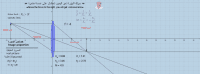
اختر نوع العدسة والمجهول المطلوب وأدخل المعطيات (بالسنتيمتر). أدخل \(f\) كقيمة موجبة (المقعرة تأخذ السالب تلقائيًّا)، وأدخل \(X_i\) بإشارته (موجبة للحقيقية وسالبة للتخيلية) عندما يكون معطًى. يعرض البرنامج خطوات الحل وصفات الصورة.
Choose the lens type and the unknown and enter the givens (in cm). Enter \(f\) as a positive value (the concave lens takes the negative sign automatically) and enter \(X_i\) with its sign (positive for real, negative for virtual) when it is given. The program shows the solution steps and the image characteristics.
🧮 من أين يأتي البعد البؤري؟ معادلة صانع العدسات وقوة العدسة
🧮 Where Does the Focal Length Come From? The Lensmaker’s Equation and Lens Power
يعتمد البعد البؤري للعدسة على معامل انكسار مادتها \(n\) (بالنسبة للهواء) وعلى نصفي قطر انحناء وجهيها \(R_1\) و\(R_2\) بحسب معادلة صانع العدسات:
The focal length of a lens depends on the refractive index of its material \(n\) (relative to air) and on the radii of curvature of its two faces \(R_1\) and \(R_2\), according to the lensmaker’s equation:
📜 معادلة صانع العدسات وقوة العدسة
📜 The Lensmaker’s Equation and Lens Power
\[\frac{1}{f}=(n-1)\left(\frac{1}{R_1}-\frac{1}{R_2}\right)\]
- نأخذ \(R\) موجبًا إذا كان مركز انحناء الوجه على جانب خروج الضوء، وسالبًا في الحالة المعاكسة. فالعدسة المحدبة الوجهين المتماثلة: \(R_1=+R\) و\(R_2=-R\) ⇒ \(\dfrac{1}{f}=(n-1)\dfrac{2}{R}\) أي \(f\gt 0\).We take \(R\) positive if the center of curvature of the face is on the side the light leaves, and negative otherwise. For a symmetric double-convex lens \(R_1=+R\) and \(R_2=-R\) ⇒ \(\dfrac{1}{f}=(n-1)\dfrac{2}{R}\), i.e. \(f\gt 0\).
- كلما زاد \(n\) أو قلّ نصفا القطرين (انحناء أشد) قصر البعد البؤري. والعدسة المقعرة الوجهين: \(f\lt 0\).The larger \(n\) or the smaller the radii (stronger curvature), the shorter the focal length. For a double-concave lens \(f\lt 0\).
- قوة العدسة \(P=\dfrac{1}{f}\) (\(f\) بالمتر) وحدتها الديوبتر \(D\)؛ تكون موجبة للمحدبة وسالبة للمقعرة، وقوة عدستين ملتصقتين تساوي مجموع قوتيهما.The power of a lens is \(P=\dfrac{1}{f}\) (\(f\) in meters), in dioptres \(D\); it is positive for convex and negative for concave lenses, and the power of two lenses in contact is the sum of their powers.
عدسة محدبة الوجهين متماثلة، معامل انكسار زجاجها \(n=1.5\) ونصف قطر انحناء كل وجه \(20\ cm\). احسب بعدها البؤري وقوتها.
A symmetric double-convex lens has a glass of refractive index \(n=1.5\) and each face has a radius of curvature of \(20\ cm\). Find its focal length and its power.
🌈 عيوب العدسات: الانحراف اللوني والزيغ الكروي
🌈 Lens Defects: Chromatic and Spherical Aberration
العدسة الحقيقية ليست مثالية: لا تلتقي كل الأشعة عند نقطة واحدة تمامًا، فتتشوّه الصورة قليلًا. وأهم عيبين:
A real lens is not perfect: not all rays meet at exactly one point, so the image is slightly distorted. The two most important defects are:
🌈 الانحراف اللوني (Chromatic Aberration)
🌈 Chromatic Aberration
تشوّه في الصورة سببه عدم قدرة العدسة على جمع الألوان في نقطة واحدة. فمعامل انكسار الزجاج يتناقص مع زيادة الطول الموجي: قيمته للضوء الأزرق أكبر منه للأحمر. وبحسب معادلة صانع العدسات \(\dfrac{1}{f}=(n-1)(\dots)\) فإن \(n\) الأكبر يعني \(f\) أقصر: تتجمع الأشعة الزرقاء أقرب إلى العدسة من الحمراء فتظهر هالات ملونة حول حواف الصورة.
A distortion of the image caused by the lens’s inability to focus all colors at one point. The refractive index of glass decreases as the wavelength increases: it is larger for blue light than for red. By the lensmaker’s equation \(\dfrac{1}{f}=(n-1)(\dots)\), a larger \(n\) means a shorter \(f\): blue rays focus nearer the lens than red rays, so colored fringes appear around the edges of the image.
يُعالج بعدستين متلاصقتين من زجاجين مختلفين (عدسة لا لونية).
It is corrected with two lenses in contact made of different glasses (an achromatic doublet).
⚪ الزيغ الكروي (Spherical Aberration)
⚪ Spherical Aberration
تأثير بصري في العدسات والمرايا: الأشعة الساقطة قرب حافة العدسة تنكسر انكسارًا أكبر من الأشعة القريبة من المركز، فتلتقي أقرب إلى العدسة ولا تجتمع كل الأشعة في بؤرة واحدة. وقد عرف العلماء هذه الخاصية لسطح الكرة في القرن السابع عشر حين حاولوا صنع تلسكوب بمرآة مقعرة كروية، ووجدوا أن سطح القطع المكافئ يجمع الأشعة المتوازية في بؤرة واحدة.
An optical effect in lenses and mirrors: rays falling near the edge of the lens are refracted more strongly than those near the center, so they meet nearer the lens and not all the rays gather at a single focus. Scientists recognized this property of a spherical surface in the 17th century when trying to build a telescope with a spherical concave mirror, and found that a parabolic surface gathers parallel rays at a single focus.
يُقلَّل بتصغير فتحة العدسة (حاجز يمنع أشعة الحافة) أو باستعمال أسطح غير كروية.
It is reduced by shrinking the aperture (a stop that blocks the edge rays) or by using non-spherical surfaces.
في التجربة التالية تتبّع البرنامج مسار الأشعة عبر عدسة زجاجية بتطبيق قانون سنل فعليًّا عند كل من السطحين الكرويين (وليس بالتقريب)، فتستطيع رؤية العيبين بنفسك.
In the next experiment the program traces rays through a glass lens by actually applying Snell’s law at each of the two spherical surfaces (not by approximation), so you can see both defects for yourself.
🧪 تجربة 3: الانحراف اللوني والزيغ الكروي (تتبع أشعة بقانون سنل)
🧪 Experiment 3: Chromatic and Spherical Aberration (Snell’s-law Ray Tracing)
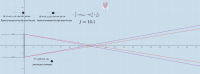
عدسة محدبة الوجهين متماثلة نصف قطر انحناء كل وجه \(15\ cm\). في وضع الانحراف اللوني تُرسل أشعة حمراء وخضراء وزرقاء قرب المحور، ويزداد معامل الانكسار من الأحمر إلى الأزرق بمقدار تتحكم فيه بالمنزلق (مبالغ فيه ليظهر). في وضع الزيغ الكروي تُرسل أشعة بلون واحد على ارتفاعات مختلفة؛ قلّل «نصف فتحة العدسة» لترى كيف يتناقص الزيغ. (تُقاس مواضع البؤر من الوجه الأول للعدسة.)
A symmetric double-convex lens with each face of radius of curvature \(15\ cm\). In chromatic mode red, green and blue rays are sent near the axis, and the refractive index rises from red to blue by an amount you control with the slider (exaggerated so it is visible). In spherical mode single-color rays are sent at different heights; reduce the “half aperture” to see the aberration shrink. (Focus positions are measured from the lens’s first face.)
🛠️ مقارنة وتطبيقات
🛠️ Comparison and Applications
| العدسة المحدبةConvex lens | العدسة المقعرةConcave lens | |
|---|---|---|
| الشكلShape | أسمك في الوسط وأرق عند الحوافthicker in the middle, thinner at the edges | أرق في الوسط وأسمك عند الحوافthinner in the middle, thicker at the edges |
| أثرها في الأشعةEffect on rays | تجمّعها نحو المركزgathers them toward the center | تفرّقها بعيدًا عن المركزspreads them away from the center |
| البؤرةFocus | حقيقية، \(f\gt 0\)real, \(f\gt 0\) | تخيلية، \(f\lt 0\)virtual, \(f\lt 0\) |
| الصورةImage | حقيقية أو تخيلية؛ مقلوبة أو معتدلة؛ مكبّرة أو مصغّرةreal or virtual; inverted or upright; magnified or diminished | تخيلية معتدلة مصغّرة دائمًاalways virtual, upright, diminished |
| التكبيرMagnification | \(M=-\dfrac{X_i}{X_o}\) | \(M=-\dfrac{X_i}{X_o}\) |
| تصحيح النظرVision correction | طول النظرfarsightedness | قصر النظرnearsightedness |
يتكوّن في العين السليمة صورة حقيقية على الشبكية. في طول النظر تتكون الصورة خلف الشبكية فنضيف عدسة محدبة تزيد تجميع الأشعة، وفي قصر النظر تتكون أمامها فنضيف عدسة مقعرة تفرّق الأشعة قليلًا قبل وصولها إلى العين.
In a healthy eye a real image forms on the retina. In farsightedness the image forms behind the retina so we add a convex lens to converge the rays more; in nearsightedness it forms in front of the retina so we add a concave lens that spreads the rays slightly before they reach the eye.
🛠️ تطبيقات
🛠️ Applications
- المحدبة: الكاميرات والمناظير، المجاهر والمكبّرات، نظارات طول النظر، والتلسكوبات الفلكية (الشيئية).Convex: cameras and binoculars, microscopes and magnifiers, farsightedness glasses, and astronomical telescopes (the objective).
- المقعرة: نظارات قصر النظر، والعين السحرية في الأبواب لتوسيع مجال الرؤية، وتوسيع حزم الليزر، والعدسة العينية في تلسكوب جاليليو.Concave: nearsightedness glasses, door peepholes (to widen the field of view), laser beam expanders, and the eyepiece of Galileo’s telescope.
📝 ملخص الدرس
📝 Lesson Summary
- المحدبة مجمّعة (\(f\gt 0\)، بؤرة حقيقية) والمقعرة مفرِّقة (\(f\lt 0\)، بؤرة تخيلية).Convex lenses converge (\(f\gt 0\), real focus), concave lenses diverge (\(f\lt 0\), virtual focus).
- أشعة معروفة: الموازي للمحور (يمر بالبؤرة)، المار بالمركز (لا ينكسر)، المار بالبؤرة (ينكسر موازيًا).Known rays: parallel to the axis (through the focus), through the center (undeviated), through the focus (refracted parallel).
- \(\dfrac{1}{f}=\dfrac{1}{X_o}+\dfrac{1}{X_i}\) و\(M=\dfrac{h_i}{h_o}=-\dfrac{X_i}{X_o}\)؛ \(X_i\gt 0\) حقيقية و\(X_i\lt 0\) تخيلية، و\(M\) عكس إشارة \(X_i\).\(\dfrac{1}{f}=\dfrac{1}{X_o}+\dfrac{1}{X_i}\) and \(M=\dfrac{h_i}{h_o}=-\dfrac{X_i}{X_o}\); \(X_i\gt 0\) real, \(X_i\lt 0\) virtual, and \(M\) has the opposite sign to \(X_i\).
- \(\dfrac{1}{f}=(n-1)\left(\dfrac{1}{R_1}-\dfrac{1}{R_2}\right)\) و\(P=\dfrac{1}{f}\) بالديوبتر.\(\dfrac{1}{f}=(n-1)\left(\dfrac{1}{R_1}-\dfrac{1}{R_2}\right)\) and \(P=\dfrac{1}{f}\) in dioptres.
- الانحراف اللوني بسبب تغيّر \(n\) مع اللون، والزيغ الكروي بسبب انكسار أشعة الحافة أشد من أشعة المركز.Chromatic aberration comes from \(n\) changing with color; spherical aberration from edge rays being refracted more than central rays.
🧪 اختبر نفسك: امتحان من 20 سؤالاً
🧪 Test Yourself: a 20-Question Exam
أنهِ الدرس بالاختبار التفاعلي التالي؛ أسئلته بمستوى متوسط وعالٍ وتجمع بين الفهم والحساب.
Finish with the interactive exam below; its questions are of medium and high difficulty and mix understanding with calculation.
اختبار العدسات Lenses Quiz
20 سؤالاً - أنواع العدسات، قانون العدسات والتكبير، صفات الصور، وعيوب العدسات 20 Questions - Lens Types, the Lens Law and Magnification, Image Characteristics, and Lens Defects
• عدد الأسئلة: 20 سؤالاً
• مدة الاختبار: 30 دقيقة
• لا يمكنك تغيير إجاباتك أو إعادة الاختبار إلا بعد 24 ساعة من التسليم.
• تأكد من إجاباتك قبل التسليم! 📌 Important Instructions:
• Number of questions: 20 questions
• Quiz duration: 30 minutes
• You cannot change your answers or retake the quiz for 24 hours after submission.
• Make sure of your answers before submitting!
🔗 محاكيات GeoGebra للاستعانة بها عند اللزوم
🔗 GeoGebra Simulations to Use When Needed
اضغط «تشغيل» لتعمل المحاكاة هنا داخل الدرس؛ ويمكن للطالب الرجوع إليها لتجربة الفكرة بطريقة أخرى.
Press “Run” to run the simulation right here inside the lesson; the student can use it to try the idea in another way.