🎯 نواتج التعلم
🎯 Learning Outcomes
بعد دراسة هذا الدرس ستكون قادرًا على أن:
After this lesson you will be able to:
- تفرّق بين الطاقة الحرارية ودرجة الحرارة وتربط درجة الحرارة بمتوسط الطاقة الحركية للجزيئات.Distinguish between thermal energy and temperature and relate the temperature to the average kinetic energy of the molecules.
- تحدد العوامل المؤثرة في الطاقة الحرارية وتطبّق \(Q=mc\Delta T\).State the factors affecting the thermal energy and apply \(Q=mc\Delta T\).
- تعدّد أنواع الترمومترات وتشرح مبدأ عمل كل منها.List the types of thermometers and explain the working principle of each.
- تحوّل بين مقاييس سليزي وفهرنهايت وكلفن.Convert between the Celsius, Fahrenheit and Kelvin scales.
- تميّز بين التوصيل والحمل والإشعاع وتذكر مثالًا لكل منها.Distinguish conduction, convection and radiation and give an example of each.
🔥 الطاقة الحرارية ودرجة الحرارة
🔥 Thermal Energy and Temperature
| وجه المقارنةComparison | الطاقة الحراريةThermal energy | درجة الحرارةTemperature |
|---|---|---|
| المعنىMeaning | شكل من أشكال الطاقة تنتقل من جسم إلى آخرa form of energy that transfers from one body to another | عدد يدل على سخونة الجسم أو برودتهa number indicating how hot or cold the body is |
| مثالExample | عندما نلمس كوب شاي ساخنًا تنتقل طاقة إلى اليد فتشعر بأنها اكتسبت طاقة حراريةwhen we touch a hot cup of tea energy moves to the hand and it gains thermal energy | تدل على متوسط الطاقة الحركية للجزيئات: كلما زادت درجة الحرارة زادت الطاقة الحركيةit indicates the average kinetic energy of the molecules: the higher the temperature the greater the kinetic energy |
| الرمز والوحدةSymbol and unit | \(Q\ ,\ \mathrm{J}\)\(Q\ ,\ \mathrm{J}\) | \(T\ ,\ ^\circ\mathrm{C}\ ,\ \mathrm{K}\)\(T\ ,\ ^\circ\mathrm{C}\ ,\ \mathrm{K}\) |
| تعتمد علىDepends on | الكتلة ونوع المادة ودرجة الحرارةthe mass, the type of material and the temperature | متوسط حركة الجزيئات لا عددهاthe average motion of the molecules, not their number |
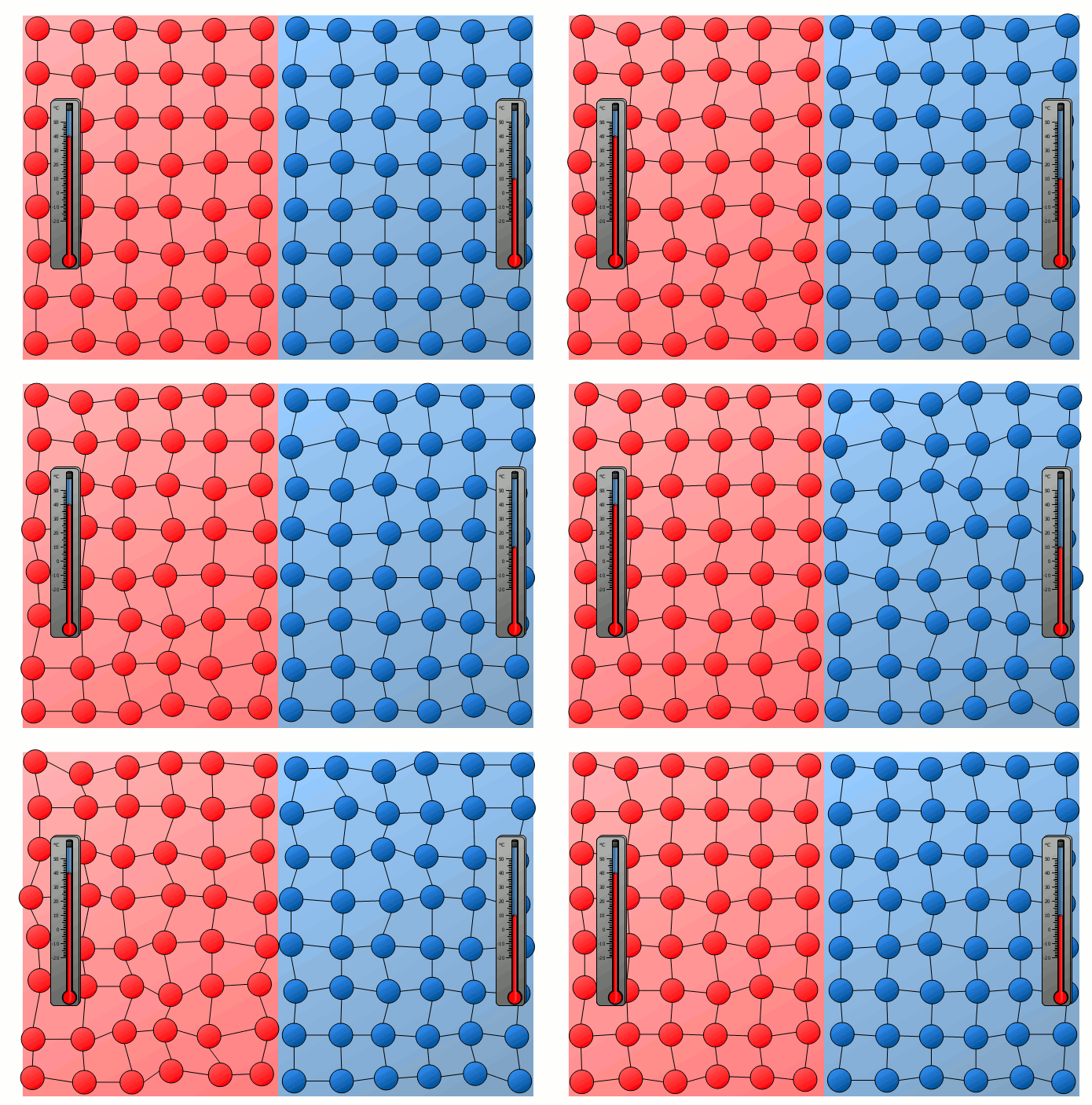
جزيئات منطقة ساخنة (حمراء) وباردة (زرقاء): الطاقة الحرارية تنتقل بتصادم الجزيئات.
Particles of a hot (red) and a cold (blue) region: thermal energy transfers through collisions of the particles.
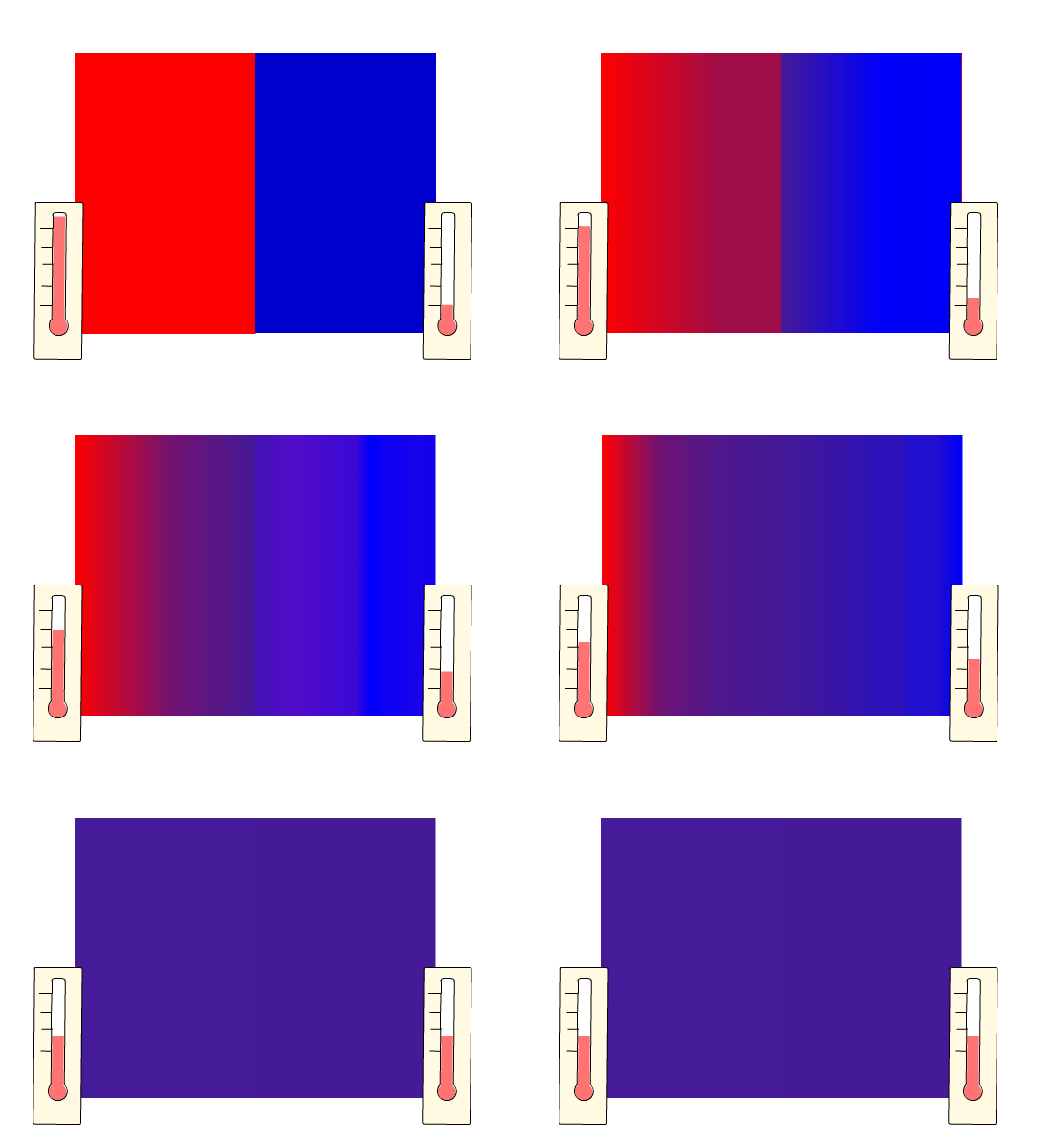
تنتقل الطاقة من الجسم الساخن إلى البارد حتى تتساوى درجتا الحرارة.
Energy flows from the hot body to the cold one until the temperatures become equal.
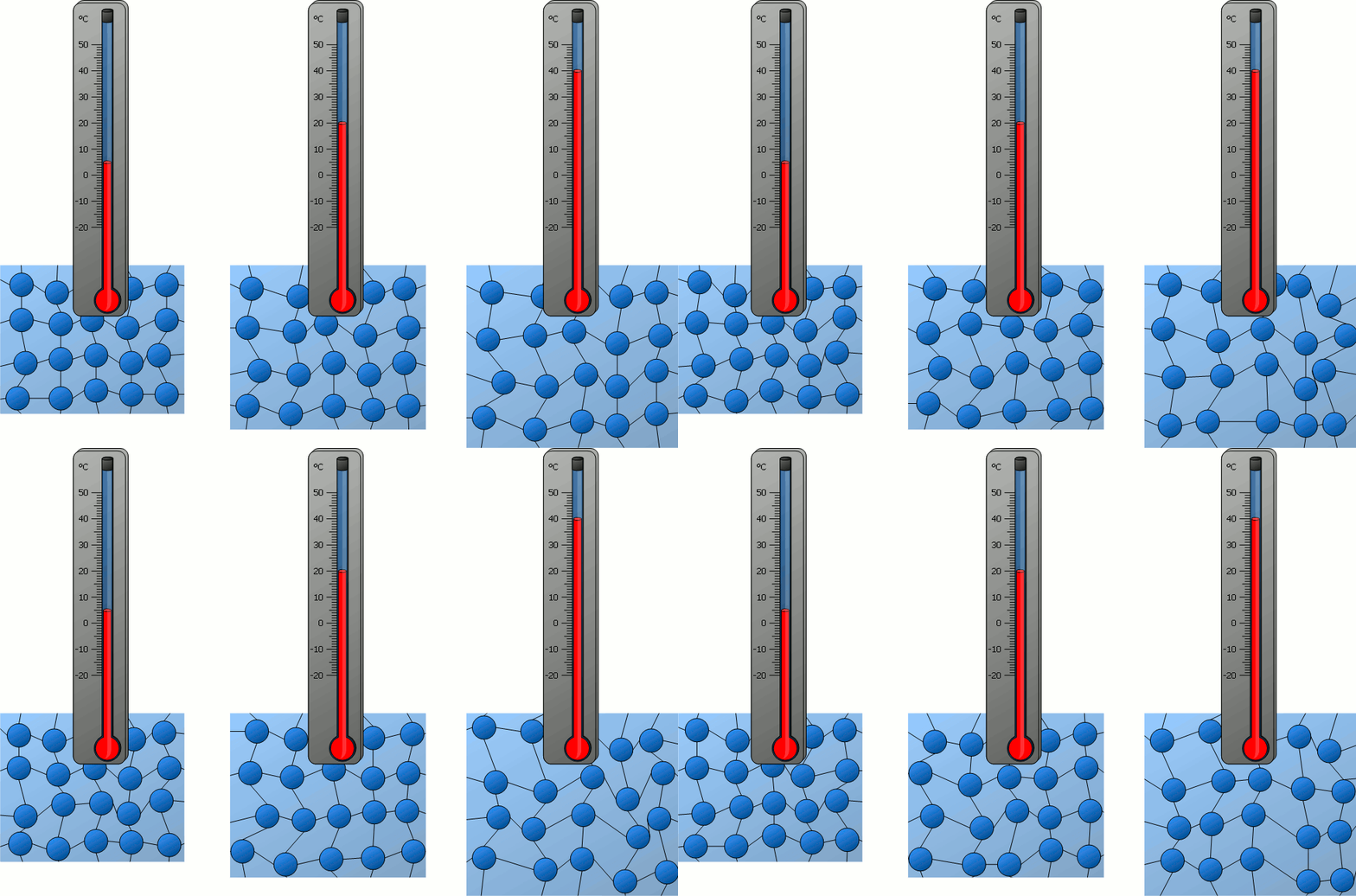
كلما ارتفعت درجة الحرارة ازدادت سرعة اهتزاز الجزيئات وطاقتها الحركية.
The higher the temperature the faster the particles vibrate and the greater their kinetic energy.
💡 شرح إضافي: الفرق بين «كمية الحرارة» و«درجة الحرارة»
💡 Extra explanation: the difference between “amount of heat” and “temperature”
حوض ماء فاتر وكوب شاي ساخن: كوب الشاي أعلى درجة حرارة، لكن الحوض يحتوي طاقة حرارية أكبر بكثير لأن كتلته أكبر. فدرجة الحرارة تقيس متوسط الطاقة الحركية للجزيئات (تدل على اتجاه انتقال الحرارة: من الأعلى إلى الأقل)، أما الطاقة الحرارية فتعتمد على عدد الجزيئات وطاقتها معًا. وتربط الفيزياء الجزيئية بينهما بالعلاقة \(\overline{KE}=\dfrac32k_BT\) (للغاز المثالي، \(T\) بالكلفن)، أي إن درجة الحرارة المطلقة تتناسب مع متوسط الطاقة الحركية.
A tub of lukewarm water and a cup of hot tea: the cup has the higher temperature, but the tub holds much more thermal energy because its mass is larger. The temperature measures the average kinetic energy of the molecules (and tells the direction of heat flow: from the higher to the lower), while the thermal energy depends on the number of molecules and their energy together. Molecular physics relates them by \(\overline{KE}=\dfrac32k_BT\) (for an ideal gas, \(T\) in kelvin), i.e. the absolute temperature is proportional to the average kinetic energy.
🧪 تجربة 1: حركة جزيئات غازين ودرجة الحرارة
🧪 Experiment 1: The motion of the molecules of two gases and the temperature
غازان في وعاء واحد: الجزيئات الزرقاء خفيفة (كتلة \(m\)) والحمراء ثقيلة (كتلة \(3m\)). ارفع درجة الحرارة وراقب: تزداد سرعة الجزيئات وطاقتها الحركية، وبالتصادمات تنتقل الطاقة بين الجزيئات حتى يتساوى متوسط الطاقة الحركية للغازين عند درجة الحرارة نفسها، فتكون الخفيفة أسرع. احسب النسبة \(v_{blue}/v_{red}\) وتحقق.
Two gases in one container: the blue molecules are light (mass \(m\)) and the red ones heavy (mass \(3m\)). Raise the temperature and watch: the speed of the molecules and their kinetic energy increase, and through collisions energy is transferred between molecules until the average kinetic energy of the two gases is equal at the same temperature, so the light ones are faster. Calculate the ratio \(v_{blue}/v_{red}\) and check.
الطاقة الحرارية هي:
Thermal energy is:
درجة الحرارة تدل على:
The temperature indicates:
كوب شاي ساخن وحوض ماء فاتر. أيهما أعلى درجة حرارة وأيهما أكبر طاقة حرارية؟
A cup of hot tea and a tub of lukewarm water. Which has the higher temperature and which has the larger thermal energy?
⚖️ العوامل المؤثرة في الطاقة الحرارية
⚖️ Factors Affecting the Thermal Energy
نقيس الطاقة الحرارية \(Q\) اللازمة لتسخين مادة بتجارب بسيطة على الماء، ونستنتج ثلاثة عوامل:
We measure the thermal energy \(Q\) needed to heat a material in simple experiments on water, and conclude three factors:
📘 العوامل الثلاثة
📘 The three factors
- الكتلة: \(Q\propto m\) (علاقة طردية). كأسان من الماء بتغير الحرارة نفسه: الأكبر كتلة يحتاج طاقة أكبر.Mass: \(Q\propto m\) (directly proportional). Two cups of water with the same temperature change: the larger mass needs more energy.
- التغير في درجة الحرارة: \(Q\propto\Delta T\) (علاقة طردية) حيث \(\Delta T=T_f-T_i\).The temperature change: \(Q\propto\Delta T\) (directly proportional) where \(\Delta T=T_f-T_i\).
- نوع المادة: لكل مادة سعة حرارية نوعية \(c\) مختلفة (الماء \(4180\) والزيت \(1670\ \mathrm{J/kg\cdot{}^\circ C}\) تقريبًا).The type of material: each material has a different specific heat capacity \(c\) (water \(4180\) and oil about \(1670\ \mathrm{J/kg\cdot{}^\circ C}\)).
\[Q=m\,c\,\Delta T\]
💡 شرح إضافي: ماذا تعني السعة الحرارية النوعية \(c\)؟
💡 Extra explanation: what does the specific heat capacity \(c\) mean?
\(c\) هي الطاقة اللازمة لرفع درجة حرارة \(1\ \mathrm{kg}\) من المادة درجة واحدة. فإذا أُعطي كوب ماء وكوب زيت (الكتلة نفسها) الطاقة نفسها فإن الزيت ترتفع حرارته أسرع لأن \(c\) له أصغر (\(\Delta T=Q/mc\)). وكذلك يسخن الحديد أسرع من الحجر لأن \(c_{iron}=450\lt c_{stone}\approx840\). (سنتوسع في ذلك في درس «السعة الحرارية النوعية وتحولات المادة».)
\(c\) is the energy needed to raise the temperature of \(1\ \mathrm{kg}\) of the material by one degree. So if a cup of water and a cup of oil (the same mass) are given the same energy, the oil warms faster because its \(c\) is smaller (\(\Delta T=Q/mc\)). Likewise iron warms faster than stone because \(c_{iron}=450\lt c_{stone}\approx840\). (We expand on this in the lesson “Specific Heat Capacity and Phase Changes”.)
كأسان من الماء كتلتاهما \(100\ \mathrm{g}\) و\(200\ \mathrm{g}\) سُخّنا من \(20\) إلى \(70^\circ\mathrm{C}\). قارن بين الطاقتين الحراريتين اللازمتين.
Two cups of water of masses \(100\ \mathrm{g}\) and \(200\ \mathrm{g}\) are heated from \(20\) to \(70^\circ\mathrm{C}\). Compare the thermal energies needed.
احسب الطاقة اللازمة لرفع درجة حرارة \(0.50\ \mathrm{kg}\) من الماء من \(20^\circ\mathrm{C}\) إلى \(60^\circ\mathrm{C}\).
Calculate the energy needed to raise the temperature of \(0.50\ \mathrm{kg}\) of water from \(20^\circ\mathrm{C}\) to \(60^\circ\mathrm{C}\).
يتلقى كوب ماء وكوب زيت (كتلة كل منهما \(0.20\ \mathrm{kg}\)) \(8000\ \mathrm{J}\) من طاقة الموقد. أيهما تزداد حرارته أكثر؟ احسب \(\Delta T\) لكل منهما.
A cup of water and a cup of oil (each of mass \(0.20\ \mathrm{kg}\)) receive \(8000\ \mathrm{J}\) from the stove. Which warms more? Calculate \(\Delta T\) for each.
🧪 تجربة 2: العوامل المؤثرة في الطاقة الحرارية
🧪 Experiment 2: The factors affecting the thermal energy
كأسان A وB. اختر السائل في كل كأس وغيّر الكتلة والتغير في درجة الحرارة \(\Delta T\) وراقب ارتفاع الأعمدة التي تمثل الطاقة الحرارية اللازمة \(Q=mc\Delta T\). جرّب: كتلتان مختلفتان بالمادة و\(\Delta T\) نفسهما؛ ثم \(\Delta T\) مختلفان؛ ثم مادتان مختلفتان (ماء وزيت). احسب النسبة \(Q_B/Q_A\) وتحقق.
Two beakers A and B. Choose the liquid in each one and change the mass and the temperature change \(\Delta T\), and watch the height of the bars that represent the thermal energy needed \(Q=mc\Delta T\). Try: two different masses of the same material and the same \(\Delta T\); then different \(\Delta T\); then two different materials (water and oil). Calculate the ratio \(Q_B/Q_A\) and check.
زادت كتلة جسم إلى الضعف مع بقاء \(\Delta T\) والمادة ثابتين. الطاقة الحرارية اللازمة:
The mass of a body is doubled while \(\Delta T\) and the material stay constant. The thermal energy needed:
الطاقة اللازمة لرفع حرارة \(2\ \mathrm{kg}\) ماء بمقدار \(10^\circ\mathrm{C}\) (\(c=4180\)):
The energy needed to raise the temperature of \(2\ \mathrm{kg}\) of water by \(10^\circ\mathrm{C}\) (\(c=4180\)):
أعطينا كتلتين متساويتين من الماء والزيت الطاقة نفسها. ترتفع الحرارة أسرع في:
Equal masses of water and oil are given the same energy. The temperature rises faster in:
🌡️ الترمومترات ومقاييس درجة الحرارة
🌡️ Thermometers and Temperature Scales
الترمومتر جهاز يقيس درجة الحرارة بالاعتماد على خاصية فيزيائية تتغير بتغيرها. ومن أنواعه:
A thermometer is a device that measures the temperature using a physical property that changes with it. Some of its types:
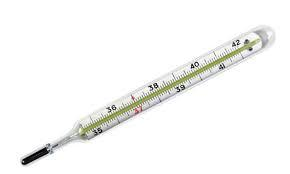
ترمومتر زئبقي
Mercury thermometer
بارتفاع درجة الحرارة يتمدد الزئبق في الأنبوب الشعري.
As the temperature rises the mercury expands in the capillary tube.
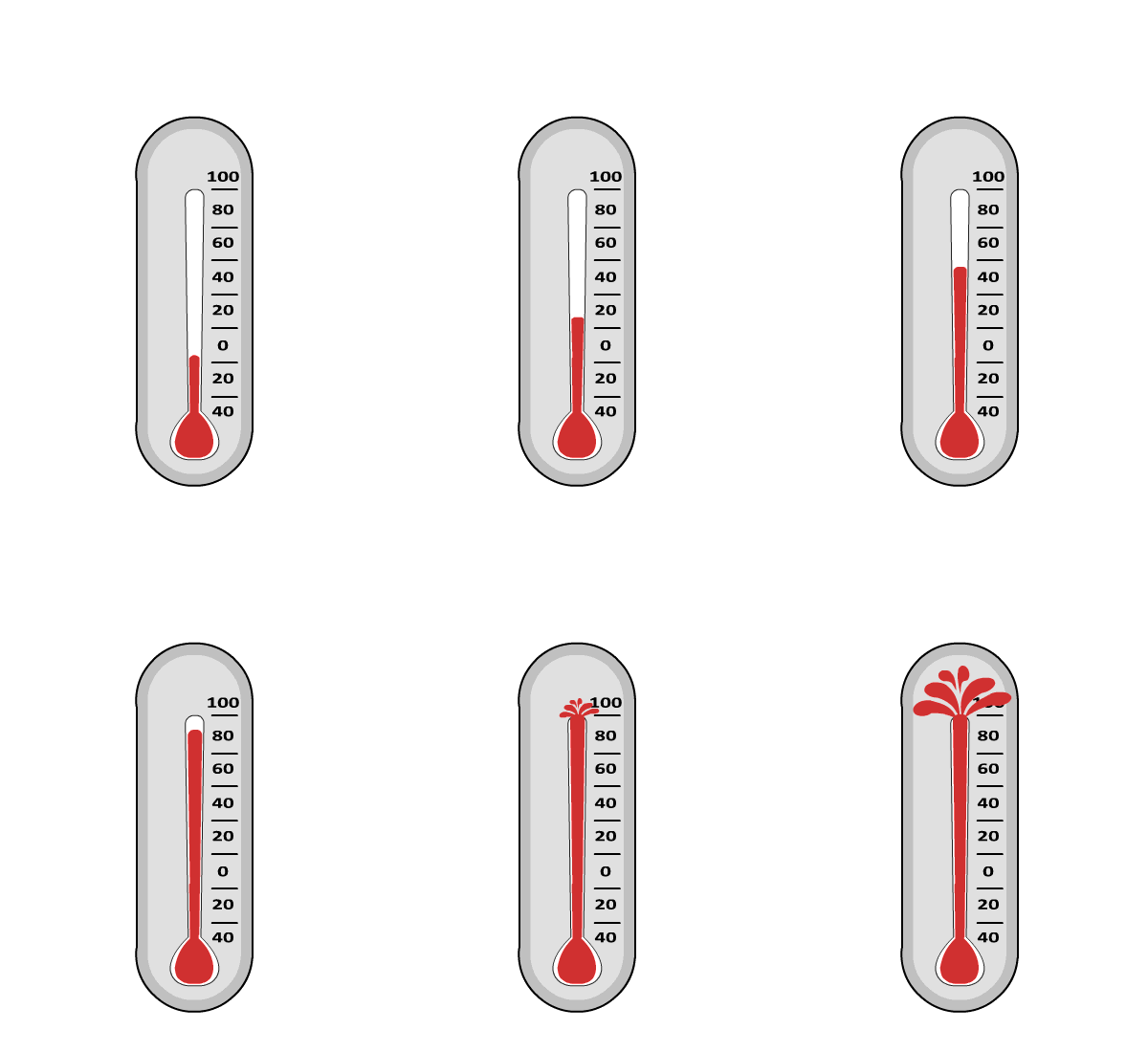
ترمومتر الكحول
Alcohol thermometer
بارتفاع درجة الحرارة يتمدد الكحول الملوّن (ويصلح لدرجات منخفضة جدًا لأن تجمده عند حرارة أقل).
As the temperature rises the coloured alcohol expands (and it suits very low temperatures because it freezes at a lower temperature).

ترمومتر البلورات الملونة
Colour-crystal thermometer
بارتفاع درجة الحرارة يتغير لون البلورات فيدل اللون الظاهر على الدرجة.
As the temperature rises the colour of the crystals changes and the visible colour shows the temperature.
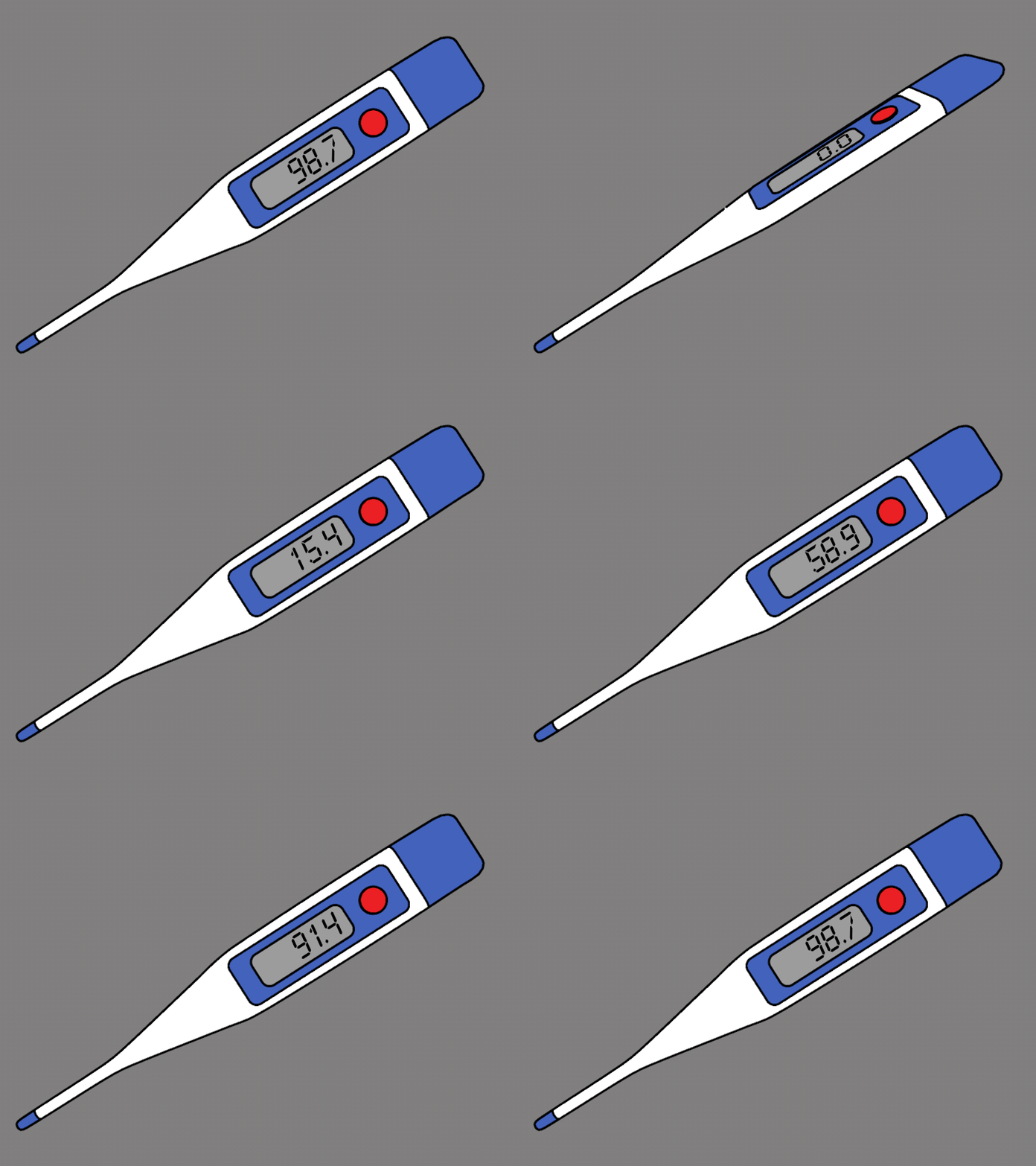
ترمومتر رقمي
Digital thermometer
حسّاس إلكتروني يحوّل أثر الحرارة إلى إشارة ويظهر الرقم المعادل لدرجة الحرارة.
An electronic sensor converts the effect of heat into a signal and shows the number equal to the temperature.
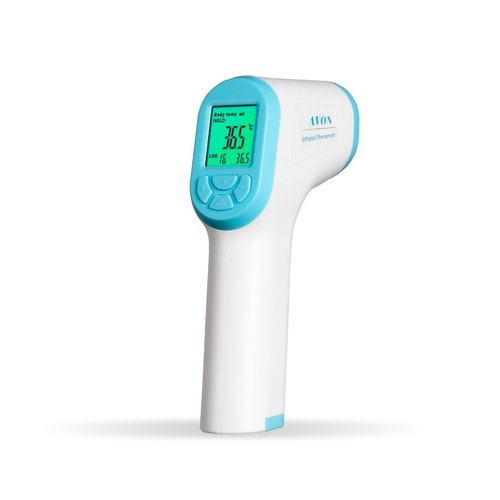
ترمومتر إشعاعي
Infrared thermometer
يستقبل الأشعة تحت الحمراء المنبعثة من الجسم ويقيس درجة حرارته دون تلامس.
It receives the infrared radiation emitted by the body and measures its temperature without contact.
مقاييس درجة الحرارة
Temperature scales
هناك ثلاثة مقاييس: السليزي (°C) والفهرنهايتي (°F) والمطلق (الكلفن) (K). تُعرَّف بنقطتين ثابتتين: انصهار الجليد وغليان الماء (عند الضغط الجوي).
There are three scales: Celsius (°C), Fahrenheit (°F) and the absolute (Kelvin) scale (K). They are defined by two fixed points: the melting of ice and the boiling of water (at atmospheric pressure).
| القياسQuantity | سليزيCelsius | فهرنهايتFahrenheit | كلفنKelvin |
|---|---|---|---|
| انصهار الجليدIce melting point | 00 | 3232 | 273273 |
| غليان الماءWater boiling point | 100100 | 212212 | 373373 |
| عدد الأقسام بين النقطتينDivisions between the two points | 100100 | 180180 | 100100 |
📘 قوانين التحويل
📘 Conversion formulas
\[T_F=\dfrac95\,T_C+32\qquad T_C=\dfrac59\,(T_F-32)\]
\[T_K=T_C+273\qquad T_C=T_K-273\]
💡 شرح إضافي: حجم الدرجة والصفر المطلق
💡 Extra explanation: the size of the degree and absolute zero
لأن بين النقطتين \(100\) قسم سليزي و\(180\) قسم فهرنهايتي، فإن تغير \(1^\circ\mathrm{C}\) يساوي تغير \(1\ \mathrm{K}\) ويساوي \(1.8^\circ\mathrm{F}\) (لذلك نستعمل \(\Delta T\) بالسليزي أو الكلفن بالقيمة نفسها في \(Q=mc\Delta T\)). أما صفر كلفن (\(-273.15^\circ\mathrm{C}\)) فهو الصفر المطلق: أقل درجة ممكنة تتوقف عندها حركة الجزيئات الحرارية، ولا توجد درجات سالبة على مقياس كلفن. ومن الطريف أن \(-40^\circ\mathrm{C}=-40^\circ\mathrm{F}\).
Because there are \(100\) Celsius divisions and \(180\) Fahrenheit divisions between the two points, a change of \(1^\circ\mathrm{C}\) equals a change of \(1\ \mathrm{K}\) and \(1.8^\circ\mathrm{F}\) (so we may use \(\Delta T\) in Celsius or kelvin with the same value in \(Q=mc\Delta T\)). Zero kelvin (\(-273.15^\circ\mathrm{C}\)) is absolute zero: the lowest possible temperature at which the thermal motion of the molecules stops, and there are no negative temperatures on the Kelvin scale. Interestingly \(-40^\circ\mathrm{C}=-40^\circ\mathrm{F}\).
🧪 تجربة 3: مقاييس درجة الحرارة والتحويل بينها
🧪 Experiment 3: Temperature scales and converting between them
حرّك الشريط لترى الدرجة نفسها على المقاييس الثلاثة: سليزي وفهرنهايت وكلفن، ولاحظ أن ارتفاع درجة واحدة سليزية يساوي ارتفاع درجة كلفن واحدة و\(1.8\) درجة فهرنهايت. ثم اضغط «سؤال جديد» وحوّل القيمة المعطاة وتحقق.
Move the slider to see the same temperature on the three scales: Celsius, Fahrenheit and Kelvin, and notice that a rise of one degree Celsius equals a rise of one kelvin and \(1.8\) degrees Fahrenheit. Then press “New question” and convert the given value and check.
درجة حرارة مريض \(40^\circ\mathrm{C}\). كم تعادل بالفهرنهايت؟
The temperature of a patient is \(40^\circ\mathrm{C}\). What is it in Fahrenheit?
حوّل \(68^\circ\mathrm{F}\) إلى سليزي ثم إلى كلفن.
Convert \(68^\circ\mathrm{F}\) to Celsius and then to kelvin.
درجة حرارة جسم الإنسان الطبيعية \(37^\circ\mathrm{C}\). احسبها بالفهرنهايت وبالكلفن.
The normal temperature of the human body is \(37^\circ\mathrm{C}\). Find it in Fahrenheit and in kelvin.
درجة حرارة مريض \(40^\circ\mathrm{C}\) تعادل:
A patient's temperature of \(40^\circ\mathrm{C}\) equals:
\(25^\circ\mathrm{C}\) تعادل بالكلفن (تقريبًا):
\(25^\circ\mathrm{C}\) equals in kelvin (approximately):
درجة انصهار الجليد على مقياس فهرنهايت:
The melting point of ice on the Fahrenheit scale is:
♨️ طرق انتقال الحرارة
♨️ Methods of Heat Transfer
تنتقل الطاقة الحرارية \(Q\) (وحدتها الجول \(\mathrm{J}\)) دائمًا من الجسم الأعلى حرارة إلى الجسم الأقل حرارة حتى تتساوى درجتا حرارتيهما. وتنتقل بثلاث طرق:
The thermal energy \(Q\) (unit: joule \(\mathrm{J}\)) always flows from the body of higher temperature to the body of lower temperature until their temperatures become equal. It transfers in three ways:
📘 الطرق الثلاث
📘 The three ways
- التوصيل: انتقال الحرارة في الأجسام الصلبة بتصادم الجزيئات المتجاورة دون أن تنتقل المادة نفسها (مثل قضيب معدني يسخَّن من طرفه).Conduction: heat transfer in solids through collisions of neighbouring molecules without the material itself moving (like a metal rod heated at one end).
- الحمل: انتقال الحرارة في السوائل والغازات بحركة المائع نفسه: ترتفع الجزيئات الساخنة (الأقل كثافة) وتهبط الباردة (الأكثر كثافة) فتتكوّن تيارات حمل.Convection: heat transfer in liquids and gases by the motion of the fluid itself: the hot molecules (less dense) rise and the cold ones (more dense) sink forming convection currents.
- الإشعاع: انتقال الطاقة بالموجات الكهرومغناطيسية دون حاجة إلى وسط مادي (مثل وصول حرارة الشمس إلى الأرض عبر الفراغ).Radiation: transfer of energy by electromagnetic waves without a material medium (like the Sun's heat reaching the Earth through vacuum).
🧪 تجربة 4: انتقال الحرارة بالتوصيل: مقارنة بين ثلاث مواد
🧪 Experiment 4: Heat transfer by conduction: comparing three materials
ثلاثة قضبان متماثلة (من النحاس والحديد والحجر) يُسخَّن طرف كل منها الأيسر بلهب درجته \(300^\circ\mathrm{C}\)، وعلى كل قضيب خمس قطع شمع تنصهر عند \(60^\circ\mathrm{C}\). اضغط «ابدأ» وراقب: يتدرج لون القضيب من الأزرق (بارد) إلى الأحمر (ساخن)، وتنصهر قطع الشمع وتسقط بالترتيب من الأقرب إلى الأبعد. الجدول أسفل الرسم يعطي زمن انصهار أول قطعة وآخر قطعة لكل مادة: قارن بينها.
Three identical rods (copper, iron and stone) are each heated at the left end by a flame at \(300^\circ\mathrm{C}\), and each rod carries five wax pieces that melt at \(60^\circ\mathrm{C}\). Press “Start” and watch: the colour of the rod graduates from blue (cold) to red (hot), and the wax pieces melt and fall in order from the nearest to the farthest. The table below the drawing gives the melting time of the first and the last piece for each material: compare them.
💡 شرح إضافي: أمثلة وتطبيقات
💡 Extra explanation: examples and applications
- التوصيل: تُصنع أواني الطبخ من المعادن الجيدة التوصيل (نحاس، ألمنيوم)، وتُغطى مقابضها بمواد رديئة التوصيل (خشب، بلاستيك) فلا نحترق. والهواء المحبوس في الصوف والفراء عازل جيد.Conduction: cooking pots are made of good conductors (copper, aluminium) and their handles are covered with poor conductors (wood, plastic) so we are not burnt. Air trapped in wool and fur is a good insulator.
- الحمل: يوضع المدفأة قرب الأرض والمكيّف قرب السقف، ويسبب الحمل نسيم البحر وتكوّن الغيوم وغليان الماء في القدر.Convection: a heater is placed near the floor and an air conditioner near the ceiling; convection causes the sea breeze, the formation of clouds and the boiling of water in a pot.
- الإشعاع: الأسطح الداكنة أفضل امتصاصًا وإصدارًا للإشعاع من الفاتحة اللامعة، ولذلك نلبس الألوان الفاتحة في الصيف. وبالإشعاع تسخّن المدفأة الكهربائية جسمك دون أن تسخّن الهواء بينكما أولًا.Radiation: dark surfaces absorb and emit radiation better than light shiny ones, so we wear light colours in summer. An electric radiant heater warms your body by radiation without first warming the air between you.
انتقال الحرارة في الأجسام الصلبة يسمى:
Heat transfer in solids is called:
انتقال الحرارة في السوائل والغازات يتم أساسًا بـ:
Heat transfer in liquids and gases occurs mainly by:
تصل حرارة الشمس إلى الأرض عبر الفراغ بـ:
The Sun's heat reaches the Earth through vacuum by:
لماذا يُصنع مقبض وعاء الطبخ من البلاستيك أو الخشب؟
Why is the handle of a cooking pot made of plastic or wood?
📚 ملخص الدرس
📚 Lesson Summary
| المفهومConcept | العلاقةRelation |
|---|---|
| الطاقة الحراريةThermal energy | \(Q=mc\Delta T\ ;\ Q\propto m\ ,\ Q\propto\Delta T\ ;\ \mathrm{J}\)\(Q=mc\Delta T\ ;\ Q\propto m\ ,\ Q\propto\Delta T\ ;\ \mathrm{J}\) |
| درجة الحرارةTemperature | مقياس لمتوسط الطاقة الحركية للجزيئاتa measure of the average kinetic energy of the molecules |
| سليزي ← فهرنهايتCelsius → Fahrenheit | \(T_F=\dfrac95T_C+32\)\(T_F=\dfrac95T_C+32\) |
| فهرنهايت ← سليزيFahrenheit → Celsius | \(T_C=\dfrac59(T_F-32)\)\(T_C=\dfrac59(T_F-32)\) |
| سليزي ↔ كلفنCelsius ↔ Kelvin | \(T_K=T_C+273\)\(T_K=T_C+273\) |
| طرق انتقال الحرارةHeat transfer | توصيل (الصلب)، حمل (السوائل والغازات)، إشعاع (الموجات الكهرومغناطيسية)conduction (solids), convection (liquids and gases), radiation (electromagnetic waves) |
⚠️ أخطاء شائعة
⚠️ Common mistakes
- الخلط بين الطاقة الحرارية ودرجة الحرارة؛ الجسم الأسخن ليس بالضرورة الأكبر طاقة.Confusing thermal energy with temperature; the hotter body does not necessarily have more energy.
- استعمال درجة الحرارة النهائية بدل التغير \(\Delta T\) في \(Q=mc\Delta T\).Using the final temperature instead of the change \(\Delta T\) in \(Q=mc\Delta T\).
- نسيان إضافة \(32\) أو ضرب \(9/5\) بالترتيب الصحيح عند التحويل إلى فهرنهايت.Forgetting to add \(32\) or to multiply by \(9/5\) in the right order when converting to Fahrenheit.
- الظن أن الإشعاع يحتاج إلى وسط مادي؛ ينتقل في الفراغ.Thinking that radiation needs a material medium; it travels through vacuum.
- الظن أن الحمل يحدث في الأجسام الصلبة؛ هو للسوائل والغازات فقط.Thinking that convection happens in solids; it is only for liquids and gases.
🧪 اختبر نفسك: امتحان من 20 سؤالاً
🧪 Test Yourself: a 20-Question Exam
أنهِ الدرس بالاختبار التفاعلي التالي؛ أسئلته تجمع بين الفهم والحساب وتغطي جميع أقسام الدرس.
Finish with the interactive exam below; its questions mix understanding with calculation and cover every section of the lesson.
اختبار الطاقة الحرارية ودرجة الحرارة Thermal Energy and Temperature Quiz
20 سؤالاً - الطاقة الحرارية ودرجة الحرارة وطرق انتقال الحرارة 20 Questions - Thermal Energy, Temperature and Heat Transfer
• عدد الأسئلة: 20 سؤالاً
• مدة الاختبار: 30 دقيقة
• لا يمكنك تغيير إجاباتك أو إعادة الاختبار إلا بعد 24 ساعة من التسليم.
• تأكد من إجاباتك قبل التسليم! 📌 Important Instructions:
• Number of questions: 20 questions
• Quiz duration: 30 minutes
• You cannot change your answers or retake the quiz for 24 hours after submission.
• Make sure of your answers before submitting!