ما هو الشغل؟
What Is Work?
المعنى الشائع للشغل هو بذل جهد جسدي أو فكري، وهذا يختلف عن المعنى الفيزيائي للشغل.
المعنى الفيزيائي للشغل: مقدار الطاقة اللازمة لتحريك جسم ذي كتلة معينة لمسافة معينة، فهو يتطلب قوة مؤثرة وإزاحة. ولا يقتصر مفهوم الشغل على تحريك الأجسام فقط، بل يُعبّر عن انتقال الطاقة إلى الجسم.
وحدة الشغل تُشابه وحدة الطاقة وهي الجول (نيوتن·متر)، وقد جاءت مسميات الوحدات نسبة إلى العالم الذي اكتشفها.
تُصنّف القوة المؤثرة على الجسم إلى:
Common meaning of work: making a physical or mental effort — different from the physics meaning.
Physics meaning of work: the amount of energy required to move an object of a certain mass through a certain distance; it requires a force and a displacement. The concept is general — it represents energy transfer to an object, not only "moving objects."
The SI unit of work is the joule (N·m); unit names are often taken from the scientist who introduced them.
Forces acting on an object are classified as:
| قوة متغيرةVariable force | قوة منتظمةConstant force |
|---|---|
| القوة متغيرة المقدار أو الاتجاه أو كلاهما أثناء إزاحة الجسمMagnitude and/or direction change during the displacement | القوة ثابتة المقدار والاتجاه طوال فترة التأثيرMagnitude and direction remain constant throughout |
| شغل ناتج عن قوة متغيرةWork due to a variable force | شغل ناتج عن قوة منتظمةWork due to a constant force |
| \(W=\int F\,ds\) | \(W=F\cdot d\cdot\cos\theta\) |
الشغل الناتج عن قوة منتظمة
Work Done by a Constant Force
الحالة الأولى: القوة موازية لاتجاه الحركة
Case 1: Force Parallel to the Direction of Motion

الشغل الناتج من القوة الثابتة على الجسم يساوي حاصل الضرب العددي لمتجه القوة المؤثرة ومتجه الإزاحة:
The work done by a constant force equals the dot product of the force vector and the displacement vector:
الحالة الثانية: القوة تصنع زاوية مع اتجاه الحركة
Case 2: Force at an Angle to the Motion

يتطلب حساب الشغل هنا تحليل القوة إلى مركبتين: أفقية مع اتجاه الحركة، وعمودية عليها. الشغل الناتج عن المركبة العمودية يساوي صفرًا لأنها لا تسبب أي إزاحة، والشغل الناتج عن القوة المعطاة هو شغل المركبة الأفقية فقط:
Here, the force must be resolved into two components: one parallel to the motion and one perpendicular to it. The perpendicular component does zero work because it causes no displacement; the total work equals the work done by the parallel component only:
حيث \(\theta\) هي الزاوية بين اتجاه القوة المؤثرة والإزاحة الناتجة.
where \(\theta\) is the angle between the force direction and the resulting displacement.
في المحاكاة التالية، القوة المؤثرة على الجسم تبذل شغلًا يحرّك الجسم، وهذا الشغل يعادل المساحة المحصورة تحت المنحنى. يمكنك أيضًا إمالة القوة بزاوية:
In the simulation below, the applied force does work and moves the object; this work equals the area under the curve. You can also tilt the force by an angle:
حاسبة التجارب: احسب الشغل والمساحة تحت المنحنى
Experiments Calculator: Compute Work and Area Under the Curve
📌 تعليمات الاستخدام:
- أدخل القوة (نيوتن)، الإزاحة (متر)، والزاوية (بالدرجات) لكل تجربة.
- احسب الشغل والمساحة تحت المنحنى بنفسك وأدخل النتائج في الجدول.
- اضغط على زر "تصحيح الإجابات" للتحقق من صحة حساباتك.
- معادلة الشغل: الشغل = القوة × الإزاحة × جيب تمام الزاوية.
- المساحة تحت المنحنى (قوة–إزاحة) = القوة × الإزاحة.
📌 Instructions:
- Enter the force (N), displacement (m), and angle (degrees) for each experiment.
- Calculate the work and the area under the curve yourself, then type the results in the table.
- Click "Check Answers" to verify your calculations.
- Work formula: Work = Force × Displacement × cos(θ).
- Area under the curve (force–displacement) = Force × Displacement.
| رقم التجربةExperiment # | القوة (N)Force (N) | الإزاحة (m)Displacement (m) | الزاوية (°)Angle (°) | الشغل (J)Work (J) | المساحة تحت المنحنىArea Under Curve | نوع الشغلWork Type |
|---|
أنواع الشغل
Types of Work
الشغل الموجب
Positive Work
يحدث عندما تكون الزاوية بين القوة والإزاحة أقل من 90°، أي أن جيب تمام الزاوية موجب.
مثال: دفع صندوق يتحرك في اتجاه الدفع نفسه.
Occurs when the angle between force and displacement is less than 90°, so cos(θ) is positive.
Example: pushing a box that moves in the direction of the push.
الشغل السالب
Negative Work
يحدث عندما تكون الزاوية أكبر من 90° وأقل من أو تساوي 180°، أي أن جيب تمام الزاوية سالب.
مثال: قوة الاحتكاك المعاكسة للحركة.
Occurs when the angle is greater than 90° and up to 180°, so cos(θ) is negative.
Example: friction opposing motion.
الشغل المعدوم
Zero Work
يحدث عندما تكون الزاوية 90°، أي أن جيب تمام الزاوية يساوي صفرًا.
مثال: حمل حقيبة والسير بها أفقيًا.
Occurs when the angle is 90°, so cos(θ) = 0.
Example: carrying a bag while walking horizontally.

💡 القوة باتجاه الإزاحة نفسه، أي أن الزاوية بينهما تساوي صفرًا: \(\cos(0^\circ)=1\)
\(W=F\cdot d\cdot\cos\theta=10\times4\times1=40\;J\)
✅ \(W=40\;J\)
💡 The force is in the same direction as the displacement, so the angle between them is zero: \(\cos(0^\circ)=1\)
\(W=F\cdot d\cdot\cos\theta=10\times4\times1=40\;J\)
✅ \(W=40\;J\)

💡 نستخدم معادلة الشغل للقوة المائلة:
\(W=F\cdot d\cdot\cos\theta=60\times10\times\cos(35^\circ)\)
\(W=600\times0.819\approx491.5\;J\)
✅ \(W\approx491.5\;J\)
💡 We use the work equation for an inclined force:
\(W=F\cdot d\cdot\cos\theta=60\times10\times\cos(35^\circ)\)
\(W=600\times0.819\approx491.5\;J\)
✅ \(W\approx491.5\;J\)
محصلة الشغل لمجموعة من القوى المنتظمة
Net Work for a System of Constant Forces
القوى المتلاقية والحركة
Concurrent Forces and Motion
القوى المتلاقية هي القوى التي تؤثر على جسم من نقاط مختلفة لكنها تتلاقى في نقطة واحدة. في المحاكاة أدناه يمكنك رؤية تأثير هذه القوى على حركة الجسم في الوقت الحقيقي.
Concurrent forces act on an object such that their lines of action meet at a point. In the app below, you can observe how these forces affect motion in real time.
كيفية حساب الشغل للقوى المتلاقية
How to Calculate Work for Concurrent Forces
عندما تؤثر عدة قوى على جسم يتحرك في مستوى أفقي، يمكن حساب الشغل الكلي بطريقتين:
When multiple forces act on an object moving on a horizontal surface, the net work can be found in two ways:
الطريقة الأولى: نحسب شغل كل قوة على حدة ونجري الجمع الجبري لشغل هذه القوى.
Method 1: compute the work done by each force separately, then add them algebraically.
الطريقة الثانية: نجد محصلة تلك القوى حسب قانون نيوتن الثاني، ونحدد الزاوية بين محصلة القوى والإزاحة، فيكون الشغل الكلي:
Method 2: find the resultant force (Newton's 2nd law), then use the angle between the resultant and the displacement:
في التطبيق أدناه نحسب الشغل لكل قوة ثم نجمع النتائج، مع إمكانية رؤية تأثير كل قوة على حركة الجسم.
The app below computes the work done by each force and sums the results, while visualizing each force’s effect on motion.
📌 ملاحظات هامة:
- القوة التي تكون زاويتها 0° تساهم بأكبر قدر في الشغل.
- القوة التي تكون زاويتها 90° لا تساهم في الشغل.
- القوة التي تكون زاويتها أكبر من 90° تساهم بشغل سالب.
- حركة الجسم تعتمد على القوة المحصلة في اتجاه الحركة.
📌 Important notes:
- A force at 0° contributes the maximum work.
- A force at 90° contributes zero work.
- Angles greater than 90° produce negative work.
- Motion depends on the resultant force in the direction of motion.
المحاكاة التفاعلية: محصلة القوى
Interactive Simulation: Resultant Forces
إعدادات الجسمObject Settings
القوى المؤثرةApplied Forces
نتائج الحسابResults
الشغل الكلي:Total Work: 0 J
محصلة القوى:Resultant Force: 0 N
التسارع:Acceleration: 0 m/s²
إشارة الشغل حسب الزاوية
The Sign of Work by Angle
الشغل إما أن يكون سالبًا أو موجبًا أو معدومًا. في الشكل أدناه، توجد ثلاث قوى تؤثر على جسم يتحرك على مستوٍ مائل خشن: قوة الوزن، وقوة الاحتكاك، والقوة المتعامدة.
Work can be positive, negative, or zero. In the figure below, three forces act on an object moving on a rough inclined plane: weight, friction, and the normal (perpendicular) force.
يكون الشغل موجبًا إذا كانت الزاوية بين متجه القوة والإزاحة أكبر من أو تساوي صفرًا وأقل من 90°؛ وفي هذه الحالة يكون الشغل مسببًا للحركة. شغل قوة الوزن هنا موجب لأن الزاوية بين قوة الوزن والإزاحة حادة:
Work is positive when the angle between the force and displacement is between 0° and 90°; in this case, the work supports the motion. The work done by weight is positive here because the angle between it and the displacement is acute:
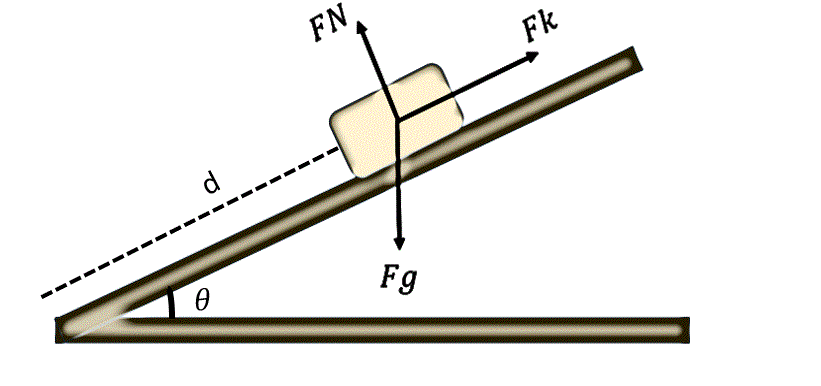
يكون الشغل سالبًا إذا كانت الزاوية بين متجه القوة والإزاحة أكبر من 90° وأقل من أو تساوي 180°؛ وفي هذه الحالة يكون الشغل مقاومًا للحركة. شغل قوة الاحتكاك سالب لأن الزاوية بين قوة الاحتكاك والإزاحة 180°:
Work is negative when the angle between the force and displacement is greater than 90° and up to 180°; in this case, the work resists the motion. The work done by friction is negative because the angle between it and the displacement is 180°:

أما إذا كانت الزاوية تساوي 90°، فإن الشغل الناتج عن القوة يساوي صفرًا. شغل القوة المتعامدة معدوم لأن الزاوية بين القوة المتعامدة والإزاحة 90°:
If the angle equals 90°, the work done by that force is zero. The work done by the normal force is zero because it is 90° to the displacement:

نتائج
Summary
- شغل موجب: عندما تكون الزاوية بين القوة والإزاحة أقل من 90°Positive work: when the angle is less than 90°
- شغل سالب: عندما تكون الزاوية بين القوة والإزاحة أكبر من 90°Negative work: when the angle is greater than 90°
- شغل معدوم: عندما تكون الزاوية بين القوة والإزاحة تساوي 90°Zero work: when the angle equals 90°
القدرة
Power
عندما نؤثر بقوة على جسم قابل للحركة ويتحرك الجسم، نقول إننا بذلنا شغلًا على هذا الجسم. وإذا تم إنجاز هذا الشغل خلال فترة زمنية معينة، فإن الشغل المنجَز خلال وحدة الزمن يُدعى القدرة.
تُقدَّر القدرة بوحدة الواط:
When a force acts on a movable object and the object moves, we say that work is done. If this work is completed in a certain time interval, the work done per unit time is called power.
Power is measured in watts:

💡 الشغل المبذول لتسلّق الدرج يساوي الشغل اللازم لرفع وزن الطالب ارتفاعًا h: \(W=mgh\)
\(W=50\times9.81\times18\approx8829\;J\)
\(P=\dfrac{W}{t}=\dfrac{8829}{40}\approx220.7\;Watt\)
✅ \(P\approx220.7\;Watt\)
💡 The work done climbing the stairs equals the work needed to raise the student's weight a height h: \(W=mgh\)
\(W=50\times9.81\times18\approx8829\;J\)
\(P=\dfrac{W}{t}=\dfrac{8829}{40}\approx220.7\;Watt\)
✅ \(P\approx220.7\;Watt\)
