🎯 نواتج التعلم
🎯 Learning Outcomes
بعد دراسة هذا الدرس ستكون قادرًا على أن:
After this lesson you will be able to:
- تعرّف السعة الحرارية النوعية \(c\) ووحدتها وتقارن بين المواد المختلفة.Define the specific heat capacity \(c\) and its unit and compare different materials.
- تحسب الطاقة الحرارية \(Q=mc\Delta T\) وتحسب \(c\) أو \(m\) أو \(\Delta T\) من المعطيات.Calculate the heat \(Q=mc\Delta T\) and find \(c\), \(m\) or \(\Delta T\) from the data.
- تطبّق مبدأ الاتزان الحراري (المفقودة = المكتسبة) وتحسب درجة حرارة المزيج وسعة مادة مجهولة.Apply thermal equilibrium (energy lost = energy gained) and calculate the final temperature of a mixture and the specific heat of an unknown material.
- تفسّر أثر المسعر وتستعمل ثابته \(C\) في المعادلة.Explain the effect of the calorimeter and use its constant \(C\) in the equation.
- تفسّر منحنى تسخين الجليد وتحسب الحرارة الكامنة \(Q=mL_f\) و\(Q=mL_v\).Interpret the heating curve of ice and calculate the latent heat \(Q=mL_f\) and \(Q=mL_v\).
🌡️ السعة الحرارية النوعية
🌡️ Specific Heat Capacity
لو أخذنا \(1\ \mathrm{kg}\) من كل مادة (حديد، ماء، نحاس، فضة، جليد، ميثانول، رصاص، ألمنيوم) وسخّناها فسنجد أن الطاقة اللازمة لرفع درجة حرارة كل منها درجة واحدة تختلف من مادة إلى أخرى. وتسمى هذه الطاقة السعة الحرارية النوعية.
If we take \(1\ \mathrm{kg}\) of each material (iron, water, copper, silver, ice, methanol, lead, aluminium) and heat it, we find that the energy needed to raise the temperature of each by one degree is different from one material to another. This energy is called the specific heat capacity.
📘 السعة الحرارية النوعية
📘 Specific heat capacity
هي الطاقة الحرارية اللازمة لرفع درجة حرارة \(1\ \mathrm{kg}\) من المادة بمقدار \(1^\circ\mathrm{C}\) (أو \(1\ \mathrm{K}\)). نرمز لها بالرمز \(c\) (أو \(C_p\)) ووحدتها:
It is the thermal energy needed to raise the temperature of \(1\ \mathrm{kg}\) of the material by \(1^\circ\mathrm{C}\) (or \(1\ \mathrm{K}\)). It is denoted by \(c\) (or \(C_p\)) and its unit is:
\[c\ :\ \dfrac{\mathrm{J}}{\mathrm{kg\cdot{}^\circ C}}=\dfrac{\mathrm{J}}{\mathrm{kg\cdot K}}\]
| المادةMaterial | الرمزSymbol | \(c\ (\mathrm{J/kg\cdot{}^\circ C})\)\(c\ (\mathrm{J/kg\cdot{}^\circ C})\) | ملاحظةNote |
|---|---|---|---|
| الماءWater | \(c_w\)\(c_w\) | 41864186 | عند 20°Cat 20°C |
| الجليدIce | \(c_{ice}\)\(c_{ice}\) | 20902090 | صلبsolid |
| الألمنيومAluminium | \(c_{Al}\)\(c_{Al}\) | 897897 | نقيpure |
| الحديدIron | \(c_{Fe}\)\(c_{Fe}\) | 450450 | صلبsolid |
| النحاسCopper | \(c_{Cu}\)\(c_{Cu}\) | 385385 | صلبsolid |
| الفضةSilver | \(c_{Ag}\)\(c_{Ag}\) | 235235 | —— |
| الزئبقMercury | \(c_{Hg}\)\(c_{Hg}\) | 139139 | سائلliquid |
| الذهبGold | \(c_{Au}\)\(c_{Au}\) | 129129 | —— |
💡 شرح إضافي: ماذا تعني القيم في الجدول؟
💡 Extra explanation: what do the values in the table mean?
الماء (4186) يحتاج إلى طاقة أكبر بنحو 10 مرات من الحديد (450) ليرتفع كل كيلوجرام منه درجة واحدة، لذلك يسخن ببطء ويبرد ببطء ويصلح لتخزين الطاقة الحرارية. أما المعادن (النحاس والفضة والذهب والرصاص) فسعتها منخفضة فتسخن وتبرد بسرعة. وبعبارة أخرى: كلما كبرت \(c\) احتجنا طاقة أكبر لتغيير الحرارة نفسها.
Water (4186) needs about 10 times more energy than iron (450) for each kilogram to rise by one degree, so it heats and cools slowly and is good for storing thermal energy. Metals (copper, silver, gold, lead) have low values so they heat and cool quickly. In other words: the larger \(c\) is, the more energy is needed for the same temperature change.
ولا تخلط بين السعة الحرارية النوعية \(c\) (لكل كيلوجرام) والسعة الحرارية \(C=mc\) للجسم كله (وحدتها \(\mathrm{J/{}^\circ C}\)). وبما أن فرق درجتين سيلزيوس يساوي فرق درجتين كلفن، فإن \(\mathrm{J/kg\cdot{}^\circ C}\) و\(\mathrm{J/kg\cdot K}\) وحدتان متكافئتان.
Do not mix up the specific heat capacity \(c\) (per kilogram) with the heat capacity \(C=mc\) of the whole body (unit \(\mathrm{J/{}^\circ C}\)). Since a difference of one degree Celsius equals a difference of one kelvin, \(\mathrm{J/kg\cdot{}^\circ C}\) and \(\mathrm{J/kg\cdot K}\) are equivalent units.
على ماذا تعتمد الطاقة الحرارية؟
What does the heat depend on?
📘 الطاقة الحرارية \(Q\)
📘 The heat \(Q\)
- تعتمد على كتلة المادة بعلاقة طردية: \(Q\propto m\).It depends on the mass directly: \(Q\propto m\).
- تعتمد على تغير درجة الحرارة بعلاقة طردية: \(Q\propto\Delta T\).It depends on the temperature change directly: \(Q\propto\Delta T\).
- تعتمد على نوع المادة فلكل مادة \(c\) مختلفة.It depends on the type of material; each material has a different \(c\).
\[Q=m\,c\,\Delta T=m\,c\,(T_f-T_i)\]
إذا كانت \(Q\gt 0\) اكتسبت المادة طاقة (سخنت)، وإذا كانت \(Q\lt 0\) فقدت طاقة (بردت).
If \(Q\gt 0\) the material gained energy (heated); if \(Q\lt 0\) it lost energy (cooled).
أنبوب مياه مصنوع من النحاس كتلته \(5\ \mathrm{kg}\) ترتفع درجة حرارته من \(20^\circ\mathrm{C}\) إلى \(85^\circ\mathrm{C}\). احسب الطاقة الحرارية التي يكتسبها الأنبوب. (\(c_{Cu}=385\ \mathrm{J/kg\cdot{}^\circ C}\))
A copper water pipe of mass \(5\ \mathrm{kg}\) is heated from \(20^\circ\mathrm{C}\) to \(85^\circ\mathrm{C}\). Find the heat gained by the pipe. (\(c_{Cu}=385\ \mathrm{J/kg\cdot{}^\circ C}\))
جسم كتلته \(0.20\ \mathrm{kg}\) امتص \(840\ \mathrm{J}\) فارتفعت حرارته من \(20^\circ\mathrm{C}\) إلى \(60^\circ\mathrm{C}\). احسب السعة الحرارية النوعية لمادته.
A body of mass \(0.20\ \mathrm{kg}\) absorbed \(840\ \mathrm{J}\) and its temperature rose from \(20^\circ\mathrm{C}\) to \(60^\circ\mathrm{C}\). Find the specific heat capacity of its material.
امتصت كتلة \(0.50\ \mathrm{kg}\) من مادة مجهولة \(10\,465\ \mathrm{J}\) فارتفعت حرارتها من \(20^\circ\mathrm{C}\) إلى \(25^\circ\mathrm{C}\). ما هذه المادة؟
A mass of \(0.50\ \mathrm{kg}\) of an unknown material absorbed \(10\,465\ \mathrm{J}\) and its temperature rose from \(20^\circ\mathrm{C}\) to \(25^\circ\mathrm{C}\). What is this material?
🧪 تجربة 1: الطاقة الحرارية \(Q=mc\Delta T\) والمادة المجهولة
🧪 Experiment 1: The heat \(Q=mc\Delta T\) and the unknown material
اختر المادة وغيّر الكتلة ودرجتي الحرارة الابتدائية والنهائية. يقارن الرسم بالأعمدة الطاقة اللازمة لنفس الكتلة ونفس \(\Delta T\) في المواد المختلفة: لاحظ أن الماء يحتاج أكبر طاقة. احسب \(Q\) بنفسك وتحقق. ثم اضغط «مادة مجهولة» لتحدد المادة من \(Q\) والكتلة وتغير الحرارة.
Choose the material and change the mass and the initial and final temperatures. The bar chart compares the energy needed for the same mass and the same \(\Delta T\) in different materials: notice that water needs the most energy. Calculate \(Q\) yourself and check. Then press “Unknown material” to identify the material from \(Q\), the mass and the temperature change.
السعة الحرارية النوعية لمادة هي:
The specific heat capacity of a material is:
وحدة السعة الحرارية النوعية في النظام الدولي:
The SI unit of the specific heat capacity is:
أي المواد التالية لها أعلى سعة حرارية نوعية؟
Which of the following materials has the highest specific heat capacity?
كم تحتاج كتلة \(0.5\ \mathrm{kg}\) من الماء من طاقة لترتفع حرارتها من \(25^\circ\mathrm{C}\) إلى \(75^\circ\mathrm{C}\)؟
How much energy does \(0.5\ \mathrm{kg}\) of water need to rise from \(25^\circ\mathrm{C}\) to \(75^\circ\mathrm{C}\)?
أنبوب نحاسي كتلته \(2\ \mathrm{kg}\) ارتفعت حرارته من \(20^\circ\mathrm{C}\) إلى \(60^\circ\mathrm{C}\). الطاقة المكتسبة (\(c=385\)):
A copper pipe of mass \(2\ \mathrm{kg}\) is heated from \(20^\circ\mathrm{C}\) to \(60^\circ\mathrm{C}\). The energy gained (\(c=385\)) is:
إذا تضاعفت كتلة المادة مع ثبات العوامل الأخرى فإن الطاقة الحرارية \(Q\):
If the mass doubles while the other factors stay constant, the heat \(Q\):
⚖️ الاتزان الحراري وقياس السعة الحرارية
⚖️ Thermal Equilibrium and Measuring the Specific Heat
عند خلط مادتين تختلفان في درجة الحرارة تنتقل الطاقة من الساخنة إلى الباردة حتى تتساوى درجتا حرارتيهما، فنقول إنهما بلغتا الاتزان الحراري. هناك مادة فقدت طاقة حرارية وأخرى اكتسبتها، وبما أن الطاقة محفوظة (في وعاء معزول):
When two materials at different temperatures are mixed, energy flows from the hot one to the cold one until their temperatures become equal; we say they reached thermal equilibrium. One material lost thermal energy and the other gained it, and since energy is conserved (in an insulated container):
📘 قانون الاتزان الحراري
📘 The law of thermal equilibrium
\[Q_{gained}=|Q_{lost}|\quad\Longleftrightarrow\quad \Delta E_A=-\Delta E_B\]
\[c_A m_A\,(T_f-T_{iA})=-\,c_B m_B\,(T_f-T_{iB})\]
ومنها درجة حرارة المزيج:
from which the final temperature of the mixture is:
\[T_f=\dfrac{c_A m_A T_{iA}+c_B m_B T_{iB}}{c_A m_A+c_B m_B}\]
💡 شرح إضافي: كيف أتحقق من نتيجتي؟
💡 Extra explanation: how do I check my result?
درجة حرارة المزيج \(T_f\) تقع دائمًا بين درجتي الحرارة الابتدائيتين، وتقترب أكثر من درجة حرارة المادة التي لها سعة حرارية \(mc\) أكبر. فإذا خلطت كتلة صغيرة من معدن ساخن بكمية كبيرة من الماء فستبقى درجة حرارة المزيج قريبة من درجة حرارة الماء. وإذا حسبت \(T_f\) خارج هذا المجال فراجع الإشارات.
The final temperature \(T_f\) always lies between the two initial temperatures, and it is closer to the temperature of the material with the larger heat capacity \(mc\). If you mix a small mass of hot metal with a large amount of water, the final temperature stays close to that of the water. If you get \(T_f\) outside this range, check your signs.
خُلط \(0.20\ \mathrm{kg}\) من الماء عند \(80^\circ\mathrm{C}\) مع \(0.30\ \mathrm{kg}\) من الماء عند \(20^\circ\mathrm{C}\) في وعاء معزول. احسب درجة حرارة المزيج.
\(0.20\ \mathrm{kg}\) of water at \(80^\circ\mathrm{C}\) is mixed with \(0.30\ \mathrm{kg}\) of water at \(20^\circ\mathrm{C}\) in an insulated container. Find the final temperature.
سُخّنت قطعة ألمنيوم كتلتها \(0.50\ \mathrm{kg}\) إلى \(90^\circ\mathrm{C}\) ثم غُمرت في \(1.0\ \mathrm{kg}\) من الماء عند \(20^\circ\mathrm{C}\). احسب درجة حرارة الاتزان (أهمل الفقد).
A piece of aluminium of mass \(0.50\ \mathrm{kg}\) is heated to \(90^\circ\mathrm{C}\) and immersed in \(1.0\ \mathrm{kg}\) of water at \(20^\circ\mathrm{C}\). Find the equilibrium temperature (neglect losses).
المسعر وفقد الطاقة
The calorimeter and the lost energy
نجري هذه التجارب داخل مسعر، لكن المسعر نفسه يمتص جزءًا من الطاقة فتحدث «طاقة مفقودة» تتغير قيمتها حسب نوع المسعر. نعبّر عنها بسعة حرارية للمسعر \(C\) (وحدتها \(\mathrm{J/K}\)) تُضاف إلى سعة الماء الذي بداخله لأنه يبدأ بدرجة حرارة الماء نفسها:
We do these experiments inside a calorimeter, but the calorimeter itself absorbs part of the energy, so some energy is “lost” and its value depends on the type of calorimeter. We express it by a heat capacity of the calorimeter \(C\) (unit \(\mathrm{J/K}\)) added to the heat capacity of the water inside it because it starts at the same temperature as the water:
📘 معادلة المسعر
📘 The calorimeter equation
\[(c_w m_w+C)\,(T_f-T_w)=-\,c_x m_x\,(T_f-T_x)\]
نحدد \(C\) بخلط كميتين من الماء بدرجتي حرارة مختلفتين، ثم نستعمل هذه القيمة لحساب السعة الحرارية لمادة صلبة مجهولة \(c_x\) أو درجة حرارة المزيج.
We find \(C\) by mixing two amounts of water at different temperatures, and then use this value to find the specific heat \(c_x\) of an unknown solid or the final temperature of a mixture.
في مسعر وُضع \(0.20\ \mathrm{kg}\) ماء عند \(20^\circ\mathrm{C}\) ثم أُضيف \(0.20\ \mathrm{kg}\) ماء عند \(60^\circ\mathrm{C}\) فاستقرت الحرارة عند \(38.9^\circ\mathrm{C}\). احسب ثابت المسعر \(C\). (\(c_w=4186\))
In a calorimeter \(0.20\ \mathrm{kg}\) of water at \(20^\circ\mathrm{C}\) is placed and \(0.20\ \mathrm{kg}\) of water at \(60^\circ\mathrm{C}\) is added; the temperature settles at \(38.9^\circ\mathrm{C}\). Find the calorimeter constant \(C\). (\(c_w=4186\))
سُخّنت قطعة معدن كتلتها \(0.15\ \mathrm{kg}\) إلى \(100^\circ\mathrm{C}\) وغُمرت في مسعر ثابته \(100\ \mathrm{J/K}\) يحوي \(0.20\ \mathrm{kg}\) ماء عند \(20^\circ\mathrm{C}\)، فبلغت الحرارة النهائية \(25.4^\circ\mathrm{C}\). احسب السعة الحرارية النوعية للمعدن وحدّد نوعه.
A piece of metal of mass \(0.15\ \mathrm{kg}\) is heated to \(100^\circ\mathrm{C}\) and immersed in a calorimeter of constant \(100\ \mathrm{J/K}\) containing \(0.20\ \mathrm{kg}\) of water at \(20^\circ\mathrm{C}\); the final temperature is \(25.4^\circ\mathrm{C}\). Find the specific heat of the metal and identify it.
🧪 تجربة 2: الاتزان الحراري: خلط مادة ساخنة بالماء في مسعر
🧪 Experiment 2: Thermal equilibrium: mixing a hot material with water in a calorimeter
نضع الماء في مسعر درجة حرارته الابتدائية مثل الماء ثم نغمر فيه جسمًا ساخنًا. الطاقة التي يفقدها الجسم تساوي الطاقة التي يكتسبها الماء والمسعر: \((m_wc_w+C)(T_f-T_w)=-m_xc_x(T_f-T_x)\). توقّع \(T_f\) واكتبها ثم اضغط «امزج» لتتحقق، ولاحظ أن الطاقتين متساويتان. غيّر ثابت المسعر \(C\) (من 0 إلى 100 J/K) وراقب تأثيره.
We put water in a calorimeter at the same initial temperature as the water and then immerse a hot object in it. The energy lost by the object equals the energy gained by the water and the calorimeter: \((m_wc_w+C)(T_f-T_w)=-m_xc_x(T_f-T_x)\). Predict \(T_f\), type it and press “Mix” to check, and notice that the two energies are equal. Change the calorimeter constant \(C\) (0 to 100 J/K) and watch its effect.
في حالة الاتزان الحراري داخل وعاء معزول تكون:
In thermal equilibrium inside an insulated container:
خُلط \(1\ \mathrm{kg}\) ماء عند \(80^\circ\mathrm{C}\) مع \(1\ \mathrm{kg}\) ماء عند \(20^\circ\mathrm{C}\). درجة حرارة المزيج:
\(1\ \mathrm{kg}\) of water at \(80^\circ\mathrm{C}\) is mixed with \(1\ \mathrm{kg}\) of water at \(20^\circ\mathrm{C}\). The final temperature is:
🧊 تحولات المادة والحرارة الكامنة
🧊 Phase Changes and Latent Heat
إضافة الطاقة الحرارية تزيد عادةً درجة حرارة المادة، لكن هناك حالات لا تتغير فيها درجة الحرارة رغم إضافة الطاقة: عندما تتحول المادة من حالة إلى أخرى. فالطاقة الإضافية تعمل على فك الروابط بين الجزيئات أو الذرات وتسبب تغير الطور، لا زيادة الحركة الحرارية. وتُسمى هذه الطاقة الحرارة الكامنة:
Adding thermal energy usually raises the temperature of a material, but in some cases the temperature does not change although energy is added: when the material changes from one state to another. The extra energy breaks the bonds between molecules or atoms and causes the change of phase instead of increasing the thermal motion. This energy is called the latent heat:
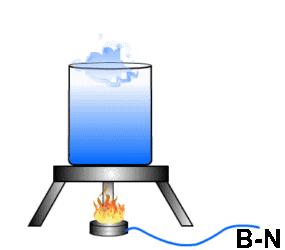
تسخين الماء في كأس: الطاقة ترفع الحرارة، وعند الغليان تتحول إلى حرارة كامنة للتبخر.
Heating water in a beaker: the energy raises the temperature, and at boiling it becomes latent heat of vaporization.
📘 الحرارة الكامنة
📘 Latent heat
- الحرارة الكامنة للانصهار \(L_f\): الطاقة اللازمة لتحويل \(1\ \mathrm{kg}\) من الصلب إلى سائل عند درجة الانصهار. للجليد \(L_f=334\ \mathrm{kJ/kg}\).Latent heat of fusion \(L_f\): the energy needed to convert \(1\ \mathrm{kg}\) from solid to liquid at the melting point. For ice \(L_f=334\ \mathrm{kJ/kg}\).
- الحرارة الكامنة للتبخر \(L_v\): الطاقة اللازمة لتحويل \(1\ \mathrm{kg}\) من السائل إلى غاز عند درجة الغليان. للماء \(L_v=2260\ \mathrm{kJ/kg}\).Latent heat of vaporization \(L_v\): the energy needed to convert \(1\ \mathrm{kg}\) from liquid to gas at the boiling point. For water \(L_v=2260\ \mathrm{kJ/kg}\).
\[Q=m\,L_f\qquad Q=m\,L_v\]
وأثناء التحول تبقى درجة الحرارة ثابتة.
During the change the temperature stays constant.
تسخين قطعة جليد عند \(-20^\circ\mathrm{C}\)
Heating a piece of ice at \(-20^\circ\mathrm{C}\)
لدينا جليد (حالة صلبة) عند \(-20^\circ\mathrm{C}\) سخّناه بقدرة ثابتة وراقبنا درجة حرارته وحالته. تمر المادة بخمس مراحل:
We have ice (solid) at \(-20^\circ\mathrm{C}\) heated with a constant power while its temperature and state are monitored. The material goes through five stages:
| المرحلةStage | ما يحدثWhat happens | درجة الحرارةTemperature | الطاقةEnergy |
|---|---|---|---|
| 11 | تسخين الجليدheating the ice | \(-20\to0^\circ\mathrm{C}\)\(-20\to0^\circ\mathrm{C}\) | \(Q_1=m\,c_{ice}\,\Delta T\)\(Q_1=m\,c_{ice}\,\Delta T\) |
| 22 | انصهار الجليد (صلب + سائل)melting the ice (solid + liquid) | ثابتة 0°Cconstant 0°C | \(Q_2=m\,L_f\)\(Q_2=m\,L_f\) |
| 33 | تسخين الماءheating the water | \(0\to100^\circ\mathrm{C}\)\(0\to100^\circ\mathrm{C}\) | \(Q_3=m\,c_w\,\Delta T\)\(Q_3=m\,c_w\,\Delta T\) |
| 44 | تبخر الماء (سائل + غاز)vaporizing the water (liquid + gas) | ثابتة 100°Cconstant 100°C | \(Q_4=m\,L_v\)\(Q_4=m\,L_v\) |
| 55 | تسخين البخارheating the steam | \(100\to120^\circ\mathrm{C}\)\(100\to120^\circ\mathrm{C}\) | \(Q_5=m\,c_{steam}\,\Delta T\)\(Q_5=m\,c_{steam}\,\Delta T\) |
💡 شرح إضافي: كيف أقرأ المنحنى؟
💡 Extra explanation: how do I read the graph?
- الأجزاء المائلة هي التسخين: ميل المنحنى \(\dfrac{\Delta T}{\Delta t}=\dfrac{P}{mc}\) فكلما كبرت السعة الحرارية صار الميل أقل (الماء أقل ميلًا من الجليد والبخار).The sloping parts are heating: the slope is \(\dfrac{\Delta T}{\Delta t}=\dfrac{P}{mc}\), so the larger the specific heat the smaller the slope (water has a smaller slope than ice and steam).
- الأجزاء الأفقية هي التحول: الطول الأفقي يدل على الطاقة \(Pt=mL\)، ولذلك يكون جزء التبخر أطول بنحو سبع مرات من جزء الانصهار لأن \(L_v\approx6.8L_f\).The horizontal parts are phase changes: the horizontal length shows the energy \(Pt=mL\), so the vaporization part is about seven times longer than the fusion part because \(L_v\approx6.8L_f\).
- إذا كانت القدرة ثابتة \(P\) فالطاقة المعطاة \(Q=Pt\). ففي المحاكاة التالية \(P=208\ \mathrm{J/s}\)، أي كل ثانية نعطي المادة \(208\ \mathrm{J}\).If the power \(P\) is constant the energy supplied is \(Q=Pt\). In the simulation below \(P=208\ \mathrm{J/s}\), i.e. every second we give the material \(208\ \mathrm{J}\).
🧪 تجربة 3: منحنى تسخين الجليد: الحرارة الكامنة
🧪 Experiment 3: Heating curve of ice: latent heat
نسخّن كتلة من الجليد عند \(-20^\circ\mathrm{C}\) بقدرة ثابتة \(208\ \mathrm{J/s}\) (كل ثانية نعطيها 208 جول). حرّك شريط الزمن وراقب: ترتفع الحرارة، ثم تثبت أثناء الانصهار (الحرارة الكامنة \(L_f\))، ثم ترتفع حتى الغليان وتثبت أثناء التبخر (\(L_v\))، ثم يسخن البخار. الطاقة المعطاة \(Q=Pt\). احسب الطاقة المطلوبة للمرحلة المختارة وتحقق.
We heat a mass of ice at \(-20^\circ\mathrm{C}\) with a constant power of \(208\ \mathrm{J/s}\) (every second we give it 208 J). Move the time slider and watch: the temperature rises, then stays constant during melting (latent heat \(L_f\)), then rises to boiling and stays constant during vaporization (\(L_v\)), then the steam heats up. The energy supplied is \(Q=Pt\). Calculate the energy needed for the chosen stage and check.
احسب الطاقة اللازمة لصهر \(0.20\ \mathrm{kg}\) من الجليد عند \(0^\circ\mathrm{C}\). (\(L_f=334\ \mathrm{kJ/kg}\))
Find the energy needed to melt \(0.20\ \mathrm{kg}\) of ice at \(0^\circ\mathrm{C}\). (\(L_f=334\ \mathrm{kJ/kg}\))
احسب الطاقة اللازمة لتحويل \(0.10\ \mathrm{kg}\) من الجليد عند \(-20^\circ\mathrm{C}\) إلى بخار عند \(120^\circ\mathrm{C}\)، ثم الزمن بقدرة \(208\ \mathrm{J/s}\). (\(c_{ice}=2090\)، \(c_w=4186\)، \(c_{steam}=2010\)، \(L_f=334\ \mathrm{kJ/kg}\)، \(L_v=2260\ \mathrm{kJ/kg}\))
Find the energy needed to turn \(0.10\ \mathrm{kg}\) of ice at \(-20^\circ\mathrm{C}\) into steam at \(120^\circ\mathrm{C}\), then the time with a power of \(208\ \mathrm{J/s}\). (\(c_{ice}=2090\), \(c_w=4186\), \(c_{steam}=2010\), \(L_f=334\ \mathrm{kJ/kg}\), \(L_v=2260\ \mathrm{kJ/kg}\))
أُضيف \(0.05\ \mathrm{kg}\) من الجليد عند \(0^\circ\mathrm{C}\) إلى \(0.25\ \mathrm{kg}\) من الماء عند \(40^\circ\mathrm{C}\) في وعاء معزول. احسب درجة حرارة المزيج النهائية.
\(0.05\ \mathrm{kg}\) of ice at \(0^\circ\mathrm{C}\) is added to \(0.25\ \mathrm{kg}\) of water at \(40^\circ\mathrm{C}\) in an insulated container. Find the final temperature of the mixture.
الحرارة الكامنة للانصهار هي الطاقة اللازمة لتحويل المادة من:
The latent heat of fusion is the energy needed to convert a material from:
أثناء انصهار الجليد (جليد + ماء معًا) تكون درجة حرارته:
During the melting of ice (ice and water together) its temperature:
الطاقة اللازمة لصهر \(0.2\ \mathrm{kg}\) من الجليد عند \(0^\circ\mathrm{C}\) (\(L_f=334\ \mathrm{kJ/kg}\)):
The energy needed to melt \(0.2\ \mathrm{kg}\) of ice at \(0^\circ\mathrm{C}\) (\(L_f=334\ \mathrm{kJ/kg}\)):
الطاقة اللازمة لتبخير \(0.1\ \mathrm{kg}\) من الماء عند \(100^\circ\mathrm{C}\) (\(L_v=2260\ \mathrm{kJ/kg}\)):
The energy needed to vaporize \(0.1\ \mathrm{kg}\) of water at \(100^\circ\mathrm{C}\) (\(L_v=2260\ \mathrm{kJ/kg}\)):
في منحنى تسخين الجليد تمثل الأجزاء الأفقية:
In the heating curve of ice the horizontal parts represent:
📚 ملخص الدرس
📚 Lesson Summary
| المفهومConcept | العلاقةRelation |
|---|---|
| السعة الحرارية النوعيةSpecific heat capacity | \(c=\dfrac{Q}{m\Delta T}\ ;\ \mathrm{J/(kg\cdot K)}\)\(c=\dfrac{Q}{m\Delta T}\ ;\ \mathrm{J/(kg\cdot K)}\) |
| الطاقة الحراريةHeat | \(Q=mc\Delta T=mc(T_f-T_i)\)\(Q=mc\Delta T=mc(T_f-T_i)\) |
| الاتزان الحراريThermal equilibrium | \(c_Am_A(T_f-T_{iA})=-c_Bm_B(T_f-T_{iB})\)\(c_Am_A(T_f-T_{iA})=-c_Bm_B(T_f-T_{iB})\) |
| المسعرCalorimeter | \((c_wm_w+C)(T_f-T_w)=-c_xm_x(T_f-T_x)\)\((c_wm_w+C)(T_f-T_w)=-c_xm_x(T_f-T_x)\) |
| الانصهار والتبخرFusion and vaporization | \(Q=mL_f\ ,\ Q=mL_v\ (T\ \text{constant})\)\(Q=mL_f\ ,\ Q=mL_v\ (T\ \text{constant})\) |
| القدرة والطاقةPower and energy | \(Q=Pt\)\(Q=Pt\) |
⚠️ أخطاء شائعة
⚠️ Common mistakes
- استعمال درجة الحرارة النهائية بدل الفرق \(\Delta T=T_f-T_i\) في \(Q=mc\Delta T\).Using the final temperature instead of the difference \(\Delta T=T_f-T_i\) in \(Q=mc\Delta T\).
- استعمال \(Q=mc\Delta T\) أثناء تحول الطور؛ الصحيح \(Q=mL\) لأن الحرارة ثابتة.Using \(Q=mc\Delta T\) during a phase change; the correct relation is \(Q=mL\) because the temperature is constant.
- الخلط بين الجرام والكيلوجرام (\(c\) و\(L\) في الجداول لكل \(\mathrm{kg}\)).Mixing up grams and kilograms (\(c\) and \(L\) in the tables are per \(\mathrm{kg}\)).
- نسيان إشارة الطاقة المفقودة (سالبة) عند كتابة معادلة الاتزان، أو نسيان ثابت المسعر \(C\).Forgetting the sign of the lost energy (negative) in the equilibrium equation, or forgetting the calorimeter constant \(C\).
- إهمال التحقق من أن كل الجليد ينصهر قبل حساب درجة حرارة المزيج.Not checking that all the ice melts before calculating the final temperature of the mixture.
🧪 اختبر نفسك: امتحان من 20 سؤالاً
🧪 Test Yourself: a 20-Question Exam
أنهِ الدرس بالاختبار التفاعلي التالي؛ أسئلته تجمع بين الفهم والحساب وتغطي جميع أقسام الدرس.
Finish with the interactive exam below; its questions mix understanding with calculation and cover every section of the lesson.
اختبار السعة الحرارية النوعية وتحولات المادة Specific Heat and Phase Changes Quiz
20 سؤالاً - السعة الحرارية النوعية، الاتزان الحراري، والحرارة الكامنة 20 Questions - Specific Heat, Thermal Equilibrium and Latent Heat
• عدد الأسئلة: 20 سؤالاً
• مدة الاختبار: 30 دقيقة
• لا يمكنك تغيير إجاباتك أو إعادة الاختبار إلا بعد 24 ساعة من التسليم.
• تأكد من إجاباتك قبل التسليم! 📌 Important Instructions:
• Number of questions: 20 questions
• Quiz duration: 30 minutes
• You cannot change your answers or retake the quiz for 24 hours after submission.
• Make sure of your answers before submitting!