الزخم والدفع في حياتنا: التصادمات، الكرة، القذف، الوثب… كلها تطبيقات لنظرية الدفع والزخم.
Momentum and impulse in our lives: collisions, balls, throwing, jumping… all are applications of the impulse–momentum theorem.
🎯 نواتج التعلم
🎯 Learning Outcomes
بعد دراسة هذا الدرس ستكون قادرًا على أن:
After this lesson you will be able to:
- تعرّف الزخم \(\vec P=m\vec v\) وتحدّد اتجاهه ووحدته.Define momentum \(\vec P=m\vec v\) and state its direction and unit.
- تشتقّ نظرية الدفع والزخم \(\vec F\Delta t=\Delta\vec P\) من قانون نيوتن الثاني.Derive the impulse–momentum theorem \(\vec F\Delta t=\Delta\vec P\) from Newton’s second law.
- تحسب الدفع بقوة ثابتة ومن المساحة تحت منحنى القوة والزمن لقوة متغيرة.Calculate the impulse of a constant force and, for a variable force, from the area under the force–time curve.
- تفسّر دور زمن التأثير في تقليل القوة (الوسادة الهوائية وغيرها).Explain the role of the contact time in reducing the force (airbags and the like).
- تطبّق حفظ الزخم في التصادم والارتداد بإشارات صحيحة.Apply conservation of momentum to collisions and recoil with correct signs.
🚀 من القوة إلى تغيّر السرعة
🚀 From Force to a Change of Velocity
عندما نؤثر بقوة على جسم قابل للحركة خلال فترة زمنية معيّنة فإن متجه سرعته يتغير: إما مقدار السرعة أو اتجاهها أو الاثنان معًا.
When we apply a force to a movable body for a certain time its velocity vector changes: its magnitude, its direction or both.
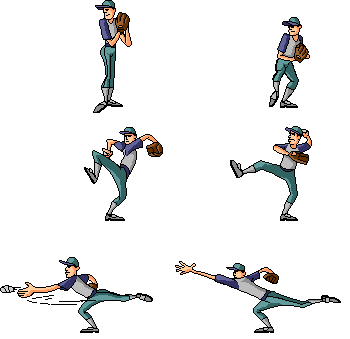
رمي الكرة: قوة اليد تؤثر خلال زمن قصير فتتغير سرعة الكرة.
Throwing a ball: the force of the hand acts for a short time and changes the speed of the ball.
📐 نظرية الدفع والزخم
📐 The impulse–momentum theorem
📌 الاشتقاق من قانون نيوتن الثاني
📌 Derivation from Newton’s second law
\[\vec F=m\vec a=m\,\frac{\vec v_f-\vec v_i}{\Delta t}\ \Rightarrow\ \vec F\,\Delta t=m\vec v_f-m\vec v_i=\Delta\vec P\]
\[\vec J=\vec F\,\Delta t=\vec P_f-\vec P_i=\Delta\vec P\]
الدفع \(J\) هو حاصل ضرب متوسط القوة المؤثرة في زمن تأثيرها، ووحدته \(\mathrm{N\cdot s}\) وتكافئ \(\mathrm{kg\cdot m/s}\). والدفع يساوي التغير في الزخم.
The impulse \(J\) is the product of the average force acting on a body and the time it acts, with unit \(\mathrm{N\cdot s}\) equal to \(\mathrm{kg\cdot m/s}\). The impulse equals the change in momentum.
⚠️ المتجهات
⚠️ Vectors
الدفع والزخم كميتان متجهتان: يجب اختيار اتجاه موجب وكتابة إشارة كل سرعة. والتغير في الزخم هو (النهائي − الابتدائي) وليس العكس.
Impulse and momentum are vector quantities: choose a positive direction and write the sign of each velocity. The change in momentum is (final − initial), not the other way round.
📈 الدفع بقوة ثابتة
📈 Impulse with a Constant Force
إذا كانت القوة ثابتة فإن الدفع \(J=F\Delta t\)، وهو يساوي المساحة تحت منحنى (القوة – الزمن) وهي مستطيل قاعدته \(\Delta t\) وارتفاعه \(F\).
If the force is constant the impulse is \(J=F\Delta t\), which equals the area under the force–time graph: a rectangle of base \(\Delta t\) and height \(F\).
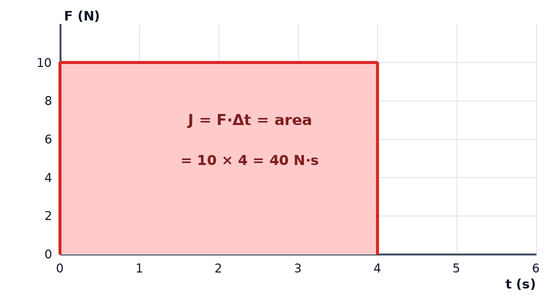
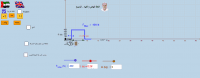
الدفع بقوة ثابتة يساوي مساحة المستطيل: \(J=10\times4=40\ \mathrm{N\cdot s}\).
The impulse of a constant force equals the area of the rectangle: \(J=10\times4=40\ \mathrm{N\cdot s}\).
قوة ثابتة \(10\ \mathrm{N}\) أثّرت لمدة \(4\ \mathrm{s}\) على جسم كتلته \(2\ \mathrm{kg}\) كان ساكنًا. أوجد الدفع والتغير في الزخم والسرعة النهائية.
A constant force of \(10\ \mathrm{N}\) acts for \(4\ \mathrm{s}\) on a \(2\ \mathrm{kg}\) body initially at rest. Find the impulse, the change in momentum and the final velocity.
وحدة الدفع \(\mathrm{N\cdot s}\) تكافئ:
The unit of impulse \(\mathrm{N\cdot s}\) is equivalent to:
🧪 جرّب بنفسك: الدفع بقوة ثابتة
🧪 Try It Yourself: Impulse with a Constant Force
🧪 تجربة 1: قوة ثابتة تؤثر على عربة: الدفع والزخم
🧪 Experiment 1: A Constant Force on a Cart: Impulse and Momentum
اختر القوة \(F\) والكتلة \(m\) وزمن التأثير \(\Delta t\) ثم اضغط «أثّر بالقوة»: تؤثر القوة خلال \(\Delta t\) فقط ثم تتحرك العربة بسرعة ثابتة. المساحة المظللة تحت منحنى \(F\) هي الدفع \(J\) وتساوي زخم العربة النهائي.
Choose the force \(F\), the mass \(m\) and the time \(\Delta t\) then press “Apply the force”: the force acts for \(\Delta t\) only and then the cart moves at constant speed. The shaded area under the \(F\) curve is the impulse \(J\) and equals the cart’s final momentum.
〰️ الدفع بقوة متغيرة
〰️ Impulse with a Variable Force
في معظم الحالات (التصادمات، الضرب بمضرب) لا تبقى القوة ثابتة. عندئذٍ يساوي الدفع المساحة تحت منحنى القوة–الزمن أيًّا كان شكله، ونجد متوسط القوة من \(F_{avg}=\dfrac{J}{\Delta t}\).
In most cases (collisions, hitting with a bat) the force is not constant. Then the impulse equals the area under the force–time curve whatever its shape, and the average force is \(F_{avg}=\dfrac{J}{\Delta t}\).
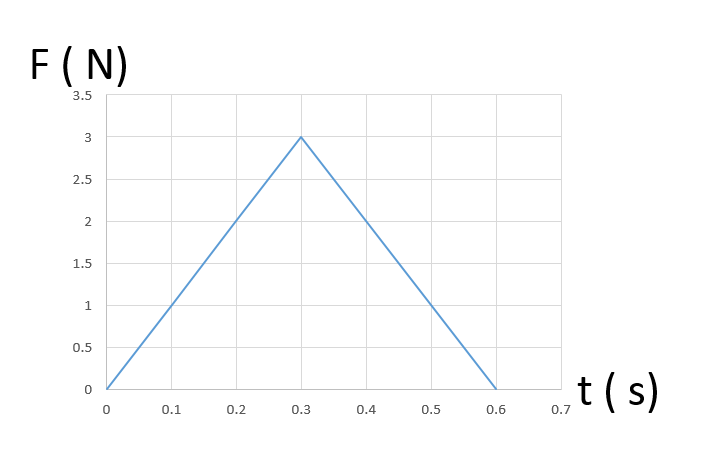
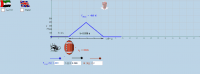
العلاقة بين القوة المؤثرة على عربة صغيرة والزمن: مثلث قاعدته \(0.6\ \mathrm{s}\) وارتفاعه \(3\ \mathrm{N}\).
The force on a small cart against time: a triangle of base \(0.6\ \mathrm{s}\) and height \(3\ \mathrm{N}\).
الخط البياني يبين القوة على عربة صغيرة مع الزمن (مثلث: من \(0\) إلى \(3\ \mathrm{N}\) عند \(0.3\ \mathrm{s}\) ثم يعود إلى \(0\) عند \(0.6\ \mathrm{s}\)). أوجد التغير في الزخم ومتوسط القوة.
The graph shows the force on a small cart against time (a triangle: from \(0\) to \(3\ \mathrm{N}\) at \(0.3\ \mathrm{s}\) then back to \(0\) at \(0.6\ \mathrm{s}\)). Find the change in momentum and the average force.
🧮 تقنيات حساب المساحة (شرح إضافي)
🧮 Techniques for finding the area (extra)
• مستطيل: \(F\times\Delta t\) • مثلث: \(\tfrac12\times\)القاعدة\(\times\)الارتفاع • شبه منحرف: \(\tfrac12(a+b)h\) • شكل مركّب: اجمع المساحات. ويُعدّ الجزء تحت محور الزمن دفعًا سالبًا (قوة عكسية).
• rectangle: \(F\times\Delta t\) • triangle: \(\tfrac12\times\)base\(\times\)height • trapezoid: \(\tfrac12(a+b)h\) • composite: add the areas. A part below the time axis is a negative impulse (a reversed force).
بيّن التجربة السابقة أن العربة كتلتها \(0.3\ \mathrm{kg}\) وكانت ساكنة. ما سرعتها بعد انتهاء القوة؟
In the previous experiment the cart has mass \(0.3\ \mathrm{kg}\) and was at rest. What is its speed after the force ends?
قوة تتغير خطيًا من صفر إلى \(20\ \mathrm{N}\) خلال \(0.5\ \mathrm{s}\). الدفع:
A force rises linearly from zero to \(20\ \mathrm{N}\) in \(0.5\ \mathrm{s}\). The impulse is:
🧪 جرّب بنفسك: القوة المتغيرة
🧪 Try It Yourself: A Variable Force
🧪 تجربة 2: قوة متغيرة: المساحة تحت المنحنى
🧪 Experiment 2: A Variable Force: the Area under the Curve
اختر شكل منحنى القوة (مثلث، مستطيل، شبه منحرف، نصف جيب) وقيمتها العظمى والمدة والكتلة ثم اضغط «أثّر بالقوة». يرتسم منحنى القوة ومعه الدفع التراكمي وهو المساحة المتراكمة؛ وعند نهاية القوة يساوي \(\Delta P\).
Choose the shape of the force curve (triangle, rectangle, trapezoid, half-sine), its peak value, the duration and the mass then press “Apply the force”. The force curve is drawn together with the cumulative impulse, the accumulating area; when the force ends it equals \(\Delta P\).
🏀 الزخم (كمية الحركة)
🏀 Momentum
الزخم هو حاصل ضرب كتلة الجسم في متجه سرعته، وهو كمية متجهة اتجاهها اتجاه السرعة:
Momentum is the product of a body’s mass and its velocity vector; it is a vector in the direction of the velocity:
📌 الزخم
📌 Momentum
\[\vec P=m\,\vec v\qquad [\,\mathrm{kg\cdot m/s}\,]\]
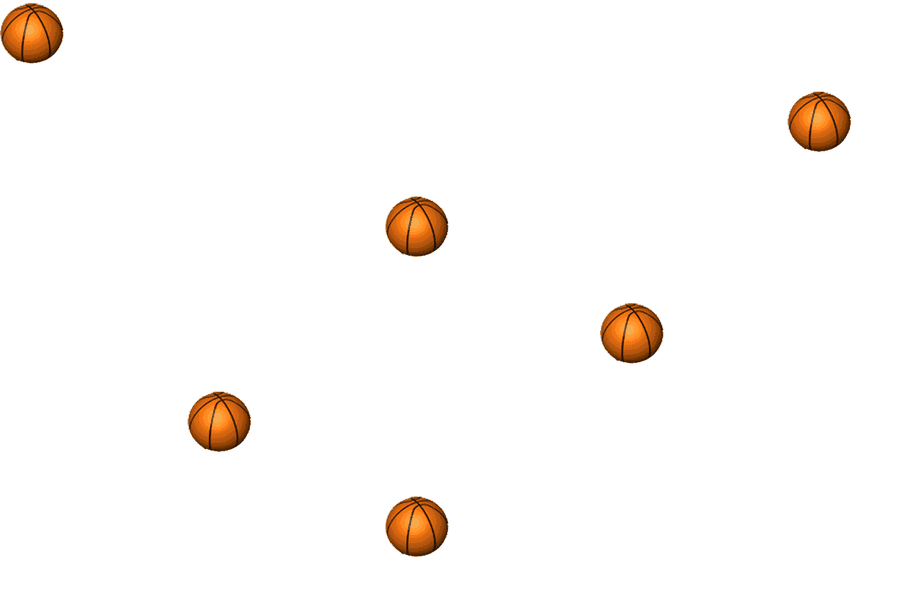
كرة السلة: كتلة كبيرة وسرعة صغيرة نسبيًا.
The basketball: a large mass and a relatively small speed.
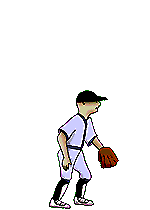
كرة البيسبول: كتلة صغيرة وسرعة كبيرة.
The baseball: a small mass and a large speed.
أيّهما أصعب إيقافًا: كرة السلة أم كرة البيسبول؟ كرة السلة أكبر كتلة وقد تكون سرعة البيسبول كبيرة جدًا؛ لا نستطيع الحكم قبل أن نعرف الكتلة والسرعة.
Which is harder to stop: a basketball or a baseball? The basketball has the greater mass and the baseball may be very fast; we cannot decide until we know the mass and the speed of both.
🔢 مقارنة بالأرقام (شرح إضافي)
🔢 A comparison with numbers (extra)
كرة سلة \(0.6\ \mathrm{kg}\) بسرعة \(5\ \mathrm{m/s}\): \(P=3\ \mathrm{kg\cdot m/s}\). كرة بيسبول \(0.145\ \mathrm{kg}\) بسرعة \(40\ \mathrm{m/s}\): \(P=5.8\ \mathrm{kg\cdot m/s}\). الأصعب إيقافًا هنا كرة البيسبول لأن زخمها أكبر (تحتاج دفعًا أكبر).
A \(0.6\ \mathrm{kg}\) basketball at \(5\ \mathrm{m/s}\): \(P=3\ \mathrm{kg\cdot m/s}\). A \(0.145\ \mathrm{kg}\) baseball at \(40\ \mathrm{m/s}\): \(P=5.8\ \mathrm{kg\cdot m/s}\). Here the baseball is harder to stop because its momentum is greater (it needs a larger impulse).
كرة بيسبول \(0.145\ \mathrm{kg}\) بسرعة \(40\ \mathrm{m/s}\) نحو اليمين. زخمها (اليمين موجب):
A \(0.145\ \mathrm{kg}\) baseball moves at \(40\ \mathrm{m/s}\) to the right. Its momentum (right positive) is:
💥 الاصطدام بجدار: تغيّر الزخم والإشارات
💥 Hitting a Wall: the Change in Momentum and the Signs
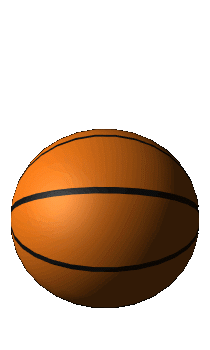
كرة تصطدم بالأرض وترتدّ: الزخم يغيّر اتجاهه فيكون التغير أكبر من الزخم نفسه.
A ball hits the ground and rebounds: the momentum reverses so the change is greater than the momentum itself.
كرة كتلتها \(0.5\ \mathrm{kg}\) اصطدمت بالأرض بسرعة \(10\ \mathrm{m/s}\) وارتدّت بسرعة \(10\ \mathrm{m/s}\). أوجد التغير في الزخم (الأعلى موجب).
A \(0.5\ \mathrm{kg}\) ball hits the ground at \(10\ \mathrm{m/s}\) and rebounds at \(10\ \mathrm{m/s}\). Find the change in momentum (upward positive).
⚠️ فخّ شائع
⚠️ A common trap
لو كتبنا \(\Delta P=0.5\times10-0.5\times10=0\) بإهمال الإشارة لكان خطأ. الارتداد يعني انعكاس الاتجاه فتتضاعف قيمة التغير: \(|\Delta P|=2mv\).
Writing \(\Delta P=0.5\times10-0.5\times10=0\) and ignoring the sign would be wrong. A rebound means the direction reverses so the change doubles: \(|\Delta P|=2mv\).
في اختبار تحمّل السيارات: سيارة كتلتها \(1000\ \mathrm{kg}\) تتحرك بسرعة \(30\ \mathrm{m/s}\) اصطدمت بجدار وتوقفت خلال \(5\ \mathrm{s}\). أوجد القوة المتوسطة التي أثّر بها الجدار.
In a car durability test a \(1000\ \mathrm{kg}\) car moving at \(30\ \mathrm{m/s}\) hits a wall and stops in \(5\ \mathrm{s}\). Find the average force exerted by the wall.
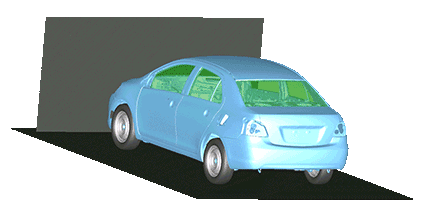
سيارة تصطدم بجدار وتتوقف.
A car hits a wall and stops.
سيارة كتلتها \(1000\ \mathrm{kg}\) تتحرك نحو الشرق بسرعة \(20\ \mathrm{m/s}\). رأى السائق طفلًا يعبر الطريق ففرمل حتى توقفت خلال \(6\ \mathrm{s}\). أحسب التغير في الزخم والقوة.
A \(1000\ \mathrm{kg}\) car moves east at \(20\ \mathrm{m/s}\). The driver sees a child crossing and brakes to a stop in \(6\ \mathrm{s}\). Find the change in momentum and the force.
كرة \(0.2\ \mathrm{kg}\) ارتدّت عن جدار: بسرعة \(+5\ \mathrm{m/s}\) قبل الاصطدام و\(-5\ \mathrm{m/s}\) بعده. التغير في زخمها:
A \(0.2\ \mathrm{kg}\) ball rebounds from a wall: \(+5\ \mathrm{m/s}\) before the impact and \(-5\ \mathrm{m/s}\) after it. Its change in momentum is:
🛡️ لماذا الوسادة الهوائية؟
🛡️ Why an Airbag?
لنفس التغير في الزخم (الدفع نفسه) تكون القوة \(F=\dfrac{\Delta P}{\Delta t}\): إطالة زمن التصادم تقلّل القوة. لهذا تُستعمل الوسائد الهوائية ومنطقة الانعصار في السيارة والأرضيات المطاطية وثني الركبتين عند القفز.
For the same change in momentum (the same impulse) the force is \(F=\dfrac{\Delta P}{\Delta t}\): lengthening the collision time reduces the force. That is why airbags, crumple zones, rubber floors and bending the knees on landing are used.
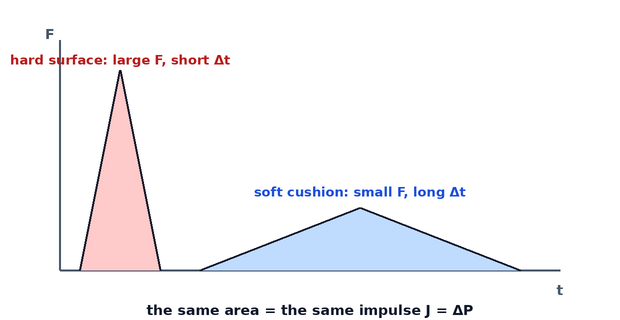
المساحتان متساويتان (الدفع نفسه) لكن السطح الصلب يعطي قوة كبيرة في زمن قصير والوسادة قوة صغيرة في زمن طويل.
The two areas are equal (the same impulse) but a hard surface gives a large force in a short time while a cushion gives a small force over a long time.
سائق كتلته \(70\ \mathrm{kg}\) يتحرك بسرعة \(15\ \mathrm{m/s}\) يتوقف في تصادم. قارن القوة المتوسطة إذا توقف في \(0.02\ \mathrm{s}\) (بدون وسادة) أو في \(0.2\ \mathrm{s}\) (بوسادة).
A \(70\ \mathrm{kg}\) driver moving at \(15\ \mathrm{m/s}\) is stopped in a crash. Compare the average force if he stops in \(0.02\ \mathrm{s}\) (no airbag) or in \(0.2\ \mathrm{s}\) (with an airbag).
الغرض من الوسادة الهوائية في السيارة:
The purpose of a car’s airbag is to:
🧪 جرّب بنفسك: التصادم بجدار
🧪 Try It Yourself: Hitting a Wall
🧪 تجربة 3: كرة تصطدم بجدار: القوة وزمن التلامس
🧪 Experiment 3: A Ball Hits a Wall: Force and Contact Time
اختر كتلة الكرة وسرعتها ومعامل الارتداد \(e\) وزمن التلامس \(\Delta t\) (سطح صلب = زمن قصير، وسادة = زمن طويل) ثم اضغط «اقذف». التغير في الزخم يبقى نفسه، لكن متوسط القوة يتغير مع \(\Delta t\).
Choose the mass and speed of the ball, the coefficient of restitution \(e\) and the contact time \(\Delta t\) (hard surface = short time, cushion = long time) then press “Throw”. The change in momentum stays the same but the average force changes with \(\Delta t\).
🚗 اختبار التصادم: صلب أم وسادة؟
🚗 Crash Test: Rigid or Cushioned?
🧪 تجربة 4: اختبار تصادم: جدار صلب أم وسادة هوائية؟
🧪 Experiment 4: Crash Test: a Hard Wall or an Airbag?
سيارتان متماثلتان بسرعة واحدة: الأولى تصطدم بحاجز صلب والثانية بحاجز يمتص الصدمة (وسادة). اضغط «ابدأ الاختبار» وقارن زمن التوقف والقوة المتوسطة والتباطؤ بوحدة \(g\) على السائق: التغير في الزخم نفسه لكن القوة مختلفة.
Two identical cars at the same speed: the first hits a rigid barrier and the second a shock-absorbing barrier (cushion). Press “Start the test” and compare the stopping time, the average force and the deceleration in \(g\) on the driver: the change in momentum is the same but the force differs.
🔗 حفظ الزخم
🔗 Conservation of Momentum
إذا تصادم جسمان فالقوتان المتبادلتان متساويتان ومتعاكستان (قانون نيوتن الثالث) وفي الزمن نفسه، فيتغير زخماهما بمقدارين متساويين وباتجاهين متعاكسين:
If two bodies collide the mutual forces are equal and opposite (Newton’s third law) and act for the same time, so their momenta change by equal amounts in opposite directions:
📌 حفظ الزخم
📌 Conservation of momentum
\[\vec F_1\Delta t=-\vec F_2\Delta t\ \Rightarrow\ \Delta\vec P_1=-\Delta\vec P_2\ \Rightarrow\ \vec P_{i1}+\vec P_{i2}=\vec P_{f1}+\vec P_{f2}\]
يصحّ هذا في نظام مغلق معزول (لا قوى خارجية ولا تفاعل مع الوسط). ومع المتجهات: السرعة نحو اليمين موجبة ونحو اليسار سالبة.
This holds in a closed, isolated system (no external forces and no interaction with the surroundings). With vectors: a velocity to the right is positive and to the left is negative.
كرة كتلتها \(1\ \mathrm{kg}\) ساكنة اصطدمت بها كرة كتلتها \(0.5\ \mathrm{kg}\) بسرعة \(15\ \mathrm{m/s}\) نحو اليمين، فتحركت الكبيرة بسرعة \(10\ \mathrm{m/s}\) نحو اليمين. أوجد سرعة الصغيرة بعد التصادم.
A \(1\ \mathrm{kg}\) ball at rest is hit by a \(0.5\ \mathrm{kg}\) ball moving at \(15\ \mathrm{m/s}\) to the right, and the big ball moves at \(10\ \mathrm{m/s}\) to the right. Find the velocity of the small ball after the collision.
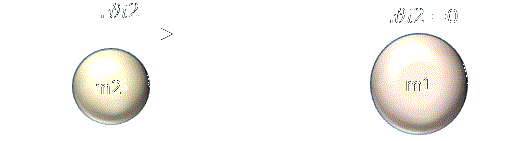
شكل المثال 8: الكرة الصغيرة تصطدم بالكبيرة الساكنة.
Example 8: the small ball hits the stationary big ball.
🚀 الارتداد
🚀 Recoil
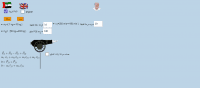
في مدفع يطلق قذيفة: الزخم الكلي قبل الإطلاق صفر فيجب أن يبقى صفرًا: \(0=m_1v_{f1}+m_2v_{f2}\Rightarrow v_{f2}=-\dfrac{m_1v_{f1}}{m_2}\) أي يرتد المدفع بعكس اتجاه القذيفة وبسرعة أصغر لأن كتلته أكبر.
In a cannon firing a shell the total momentum before firing is zero so it must stay zero: \(0=m_1v_{f1}+m_2v_{f2}\Rightarrow v_{f2}=-\dfrac{m_1v_{f1}}{m_2}\), i.e. the cannon recoils opposite to the shell, at a smaller speed because its mass is larger.
مدفع يطلق قذيفة فيرتد في الاتجاه المعاكس.
A cannon fires a shell and recoils in the opposite direction.
مدفع كتلته \(500\ \mathrm{kg}\) أطلق قذيفة \(2\ \mathrm{kg}\) بسرعة \(250\ \mathrm{m/s}\). سرعة ارتداده:
A \(500\ \mathrm{kg}\) cannon fires a \(2\ \mathrm{kg}\) shell at \(250\ \mathrm{m/s}\). Its recoil velocity is:
🧪 جرّب بنفسك: الدفعان المتبادلان
🧪 Try It Yourself: the Mutual Impulses
🧪 تجربة 5: تصادم عربتين: دفعان متساويان ومتعاكسان
🧪 Experiment 5: A Collision of Two Carts: Equal and Opposite Impulses
اختر الكتلتين والسرعتين ومعامل الارتداد ثم اضغط «أطلق». خلال التلامس تؤثر كل عربة على الأخرى بقوتين متساويتين ومتعاكستين في الزمن نفسه، فتكون مساحتا نبضتي القوة (الدفعان) متساويتين ويتغير الزخمان بمقدارين متساويين وعكسيين.
Choose the two masses, the two velocities and the coefficient of restitution then press “Launch”. During contact each cart acts on the other with equal and opposite forces for the same time, so the areas of the two force pulses (the impulses) are equal and the momenta change by equal and opposite amounts.
🧪 تجربة 6: تدريب: الدفع والزخم
🧪 Experiment 6: Practice: Impulse and Momentum
مسائل عشوائية: الدفع، السرعة النهائية، مساحة مثلث القوة، متوسط القوة عند التوقف، وحفظ الزخم. احسب واكتب الجواب (مع الإشارة) ثم اضغط «تحقّق».
Random problems: the impulse, the final speed, the area of a triangular force, the average force when stopping and conservation of momentum. Work it out, enter the answer (with its sign) and press “Check”.
✅ ملخص الدرس
✅ Lesson Summary
| الموضوعTopic | العلاقةRelation | الفكرةIdea |
|---|---|---|
| الزخمMomentum | \(\vec P=m\vec v\) | متجه، \(\mathrm{kg\cdot m/s}\)vector, \(\mathrm{kg\cdot m/s}\) |
| نظرية الدفع والزخمImpulse–momentum | \(\vec F\,\Delta t=\Delta\vec P\) | الدفع = التغير في الزخمimpulse = change in momentum |
| قوة متغيرةVariable force | \(J=\text{area under }F\text{–}t\) | \(F_{avg}=J/\Delta t\)\(F_{avg}=J/\Delta t\) |
| الوسادةCushioning | \(F=\dfrac{\Delta P}{\Delta t}\) | زمن أطول → قوة أقلlonger time → smaller force |
| حفظ الزخمConservation of momentum | \(\sum\vec P_i=\sum\vec P_f\) | نظام مغلق معزولclosed, isolated system |
🧪 اختبر نفسك: امتحان من 20 سؤالاً
🧪 Test Yourself: a 20-Question Exam
أنهِ الدرس بالاختبار التفاعلي التالي؛ أسئلته تجمع بين الفهم والحساب وتغطي جميع أقسام الدرس.
Finish with the interactive exam below; its questions mix understanding with calculation and cover every section of the lesson.
اختبار الزخم والدفع Momentum and Impulse Quiz
20 سؤالاً - الدفع والزخم، المساحة تحت منحنى القوة، التصادم مع جدار، وحفظ الزخم 20 Questions - impulse and momentum, area under the force curve, collision with a wall and conservation of momentum
• عدد الأسئلة: 20 سؤالاً
• مدة الاختبار: 30 دقيقة
• لا يمكنك تغيير إجاباتك أو إعادة الاختبار إلا بعد 24 ساعة من التسليم.
• تأكد من إجاباتك قبل التسليم! 📌 Important Instructions:
• Number of questions: 20 questions
• Quiz duration: 30 minutes
• You cannot change your answers or retake the quiz for 24 hours after submission.
• Make sure of your answers before submitting!
🔗 محاكيات GeoGebra للاستعانة بها عند اللزوم
🔗 GeoGebra Simulations to Use When Needed
اضغط «تشغيل» لتعمل المحاكاة هنا داخل الدرس؛ ويمكن للطالب الرجوع إليها لتجربة الفكرة بطريقة أخرى.
Press “Run” to run the simulation right here inside the lesson; the student can use it to try the idea in another way.