🎯 نواتج التعلم
🎯 Learning Outcomes
بعد دراسة هذا الدرس ستكون قادرًا على أن:
After this lesson you will be able to:
- تعرّف الكينماتيكا وأنواع الحركة (خطية ودورانية وتذبذبية).Define kinematics and the types of motion (linear, rotational, oscillatory).
- تميّز بين الموقع والمسافة والإزاحة وتحسبها.Distinguish and calculate position, distance and displacement.
- تحسب السرعة المتجهة المتوسطة واللحظية والسرعة القياسية، وتقرؤها من الرسم البياني.Calculate the average and instantaneous velocity and the speed, and read them from the graph.
- تحسب التسارع المتوسط واللحظي وتقرؤه من رسم السرعة–الزمن.Calculate the average and instantaneous acceleration and read it from the velocity–time graph.
- تطبّق معادلات الحركة بتسارع ثابت على السقوط الحر والمقذوف الرأسي.Apply the equations of motion with constant acceleration to free fall and the vertical projectile.
🏃 الكينماتيكا وأنواع الحركة
🏃 Kinematics and Types of Motion
الكينماتيكا فرع من الميكانيكا يصف الحركة الفيزيائية للأجسام دون النظر إلى الكتل أو القوى المسبّبة لها، وعكسه علم الديناميكا. والحركة هي انتقال جسم أو نقطة مادية من مكان إلى آخر في زمن معين.
Kinematics is the branch of mechanics that describes the motion of bodies without regard to the masses or the forces that cause it; its counterpart is dynamics. Motion is the transfer of a body or a point mass from one place to another in a given time.
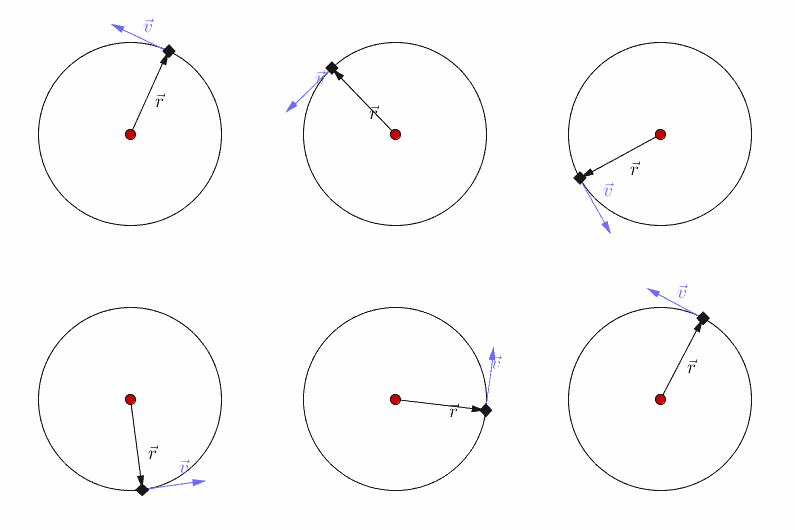
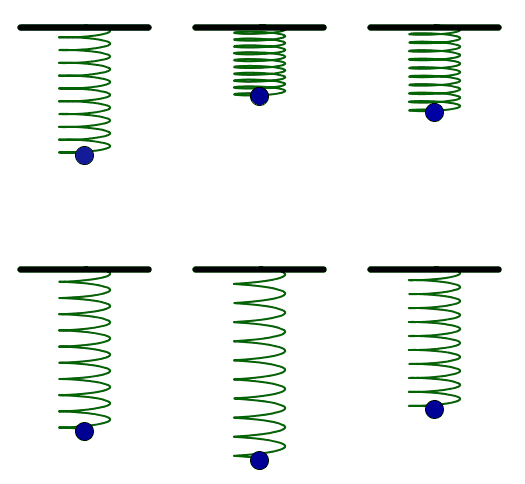
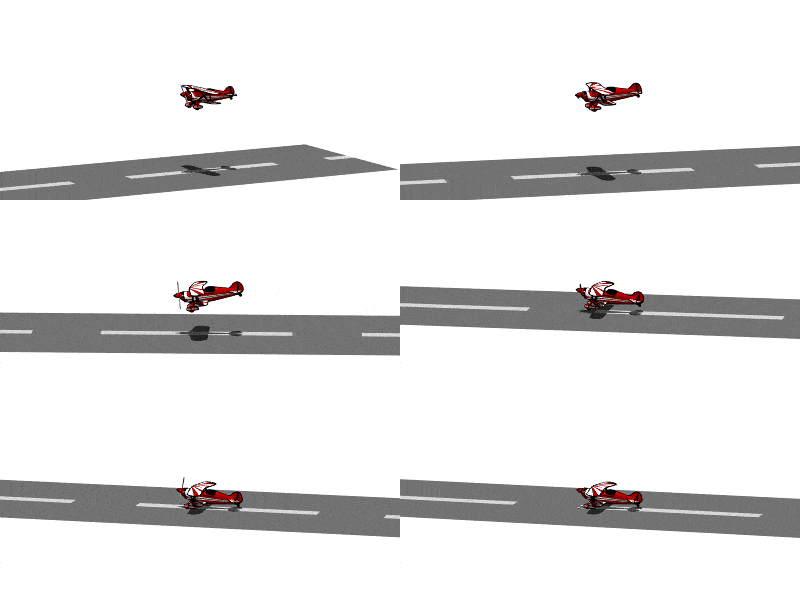
وتُصنَّف حركات الأجسام إلى ثلاثة أنواع: الحركة الدورانية (حول محور)، والحركة التذبذبية (ذهابًا وإيابًا حول موضع اتزان)، والحركة الخطية (على خط مستقيم) وهي موضوع هذا الدرس.
Motions are classified into three types: rotational motion (about an axis), oscillatory motion (back and forth about an equilibrium position), and linear motion (along a straight line), which is the subject of this lesson.
📍 الموقع
📍 Position
لا يمكن وصف حركة جسم إلا بالنسبة إلى نقطة مرجعية نعدّها ثابتة تسمى نقطة الأصل داخل إطار مرجعي متفق عليه. ويسمى بعد الجسم عن هذه النقطة الموقع \(x\)، وهو كمية متجهة: موجب إلى يمين نقطة الأصل وسالب إلى يسارها.
A body’s motion can only be described relative to a reference point that we consider fixed, called the origin, within an agreed reference frame. The distance of the body from this point is its position \(x\), a vector quantity: positive to the right of the origin and negative to its left.

المواضع \(-20\ \mathrm m\) و\(+80\ \mathrm m\) و\(+150\ \mathrm m\) بالنسبة إلى نقطة الأصل.
Positions \(-20\ \mathrm m\), \(+80\ \mathrm m\) and \(+150\ \mathrm m\) relative to the origin.
📏 المسافة والإزاحة
📏 Distance and Displacement
المسافة كمية قياسية موجبة تعبّر عن طول المسار الذي قطعه الجسم فعلًا. والإزاحة كمية متجهة هي الفرق بين الموضع النهائي والابتدائي، وهي أقصر مسافة بين البداية والنهاية. وحدة كل منهما في النظام الدولي المتر (m).
Distance is a positive scalar quantity expressing the length of the path the body actually travelled. Displacement is a vector quantity equal to the difference between the final and initial positions, the shortest distance between start and end. Their SI unit is the metre (m).
📌 الإزاحة
📌 Displacement
\[\Delta x=x_f-x_i\]
إذا تحرك الجسم نحو اليمين كانت الإزاحة موجبة، وإذا تحرك نحو اليسار كانت سالبة.
If the body moves to the right the displacement is positive, and if it moves to the left it is negative.
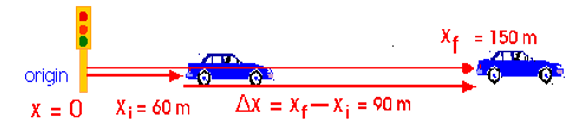
\(\Delta x=x_f-x_i=150-60=+90\ \mathrm m\): إزاحة موجبة.
\(\Delta x=x_f-x_i=150-60=+90\ \mathrm m\): a positive displacement.
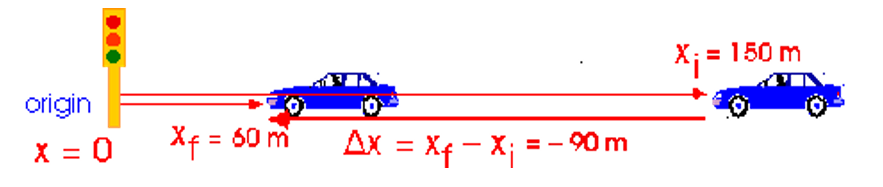
\(\Delta x=x_f-x_i=60-150=-90\ \mathrm m\): إزاحة سالبة.
\(\Delta x=x_f-x_i=60-150=-90\ \mathrm m\): a negative displacement.
تحركت سيارة حسب المسار \(A\Rightarrow B\Rightarrow C\Rightarrow D\) في الشكل (مواضعها \(x_A=0,\ x_B=150,\ x_C=80,\ x_D=-20\ \mathrm m\)). أوجد المسافة المقطوعة والإزاحة.
A car follows the path \(A\Rightarrow B\Rightarrow C\Rightarrow D\) in the figure (positions \(x_A=0,\ x_B=150,\ x_C=80,\ x_D=-20\ \mathrm m\)). Find the distance travelled and the displacement.

المسار \(A\Rightarrow B\Rightarrow C\Rightarrow D\).
The path \(A\Rightarrow B\Rightarrow C\Rightarrow D\).
🧪 جرّب بنفسك: المسافة والإزاحة
🧪 Try It Yourself: Distance and Displacement
🧪 تجربة 1: المسافة والإزاحة على خط مستقيم
🧪 Experiment 1: Distance and Displacement on a Straight Line
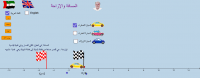
اختر موضع البداية ونقطة الرجوع والموضع النهائي، وقارن بين المسافة (موجبة دائمًا) والإزاحة (متجهة قد تكون سالبة).
Choose the start, the turning point and the final position and compare the distance (always positive) with the displacement (a vector that may be negative).
تحرك أحمد حسب المسار \(A\Rightarrow D\Rightarrow B\Rightarrow C\) في الشكل (\(A\) إلى \(D\) مسافة \(140\ \mathrm m\)، ثم \(40\ \mathrm m\) إلى \(B\)، ثم \(140\ \mathrm m\) رجوعًا إلى \(C\)). احسب المسافة والإزاحة.
Ahmed moves along \(A\Rightarrow D\Rightarrow B\Rightarrow C\) in the figure (\(A\) to \(D\) is \(140\ \mathrm m\), then \(40\ \mathrm m\) to \(B\), then \(140\ \mathrm m\) back to \(C\)). Find the distance and displacement.
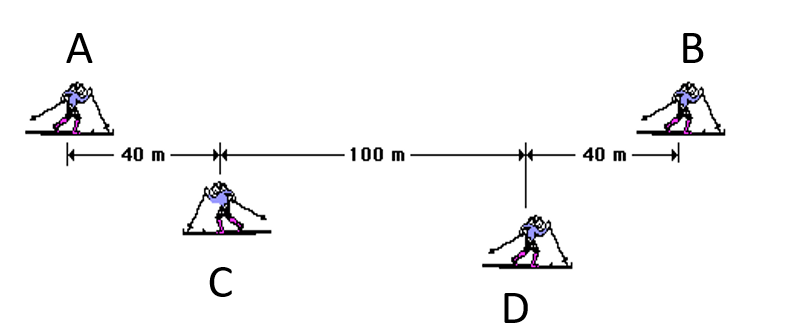
مسار أحمد: \(A\Rightarrow D\Rightarrow B\Rightarrow C\).
Ahmed’s path: \(A\Rightarrow D\Rightarrow B\Rightarrow C\).
تنبيه
Note
يمكن اختيار نقطة الأصل في أي مكان؛ فتتغير قيمة المواضع لكن الإزاحة \(\Delta x\) لا تتغير.
The origin can be chosen anywhere; the positions change but the displacement \(\Delta x\) does not.
📈 التمثيل البياني للموقع مع الزمن
📈 The Position–Time Graph
في سباق جري التُقطت صور متتالية لعدّاء كل ثانيتين ورُسمت العلاقة بين الموقع والزمن:
In a running race successive photos of a runner were taken every two seconds and the position–time relationship was drawn:
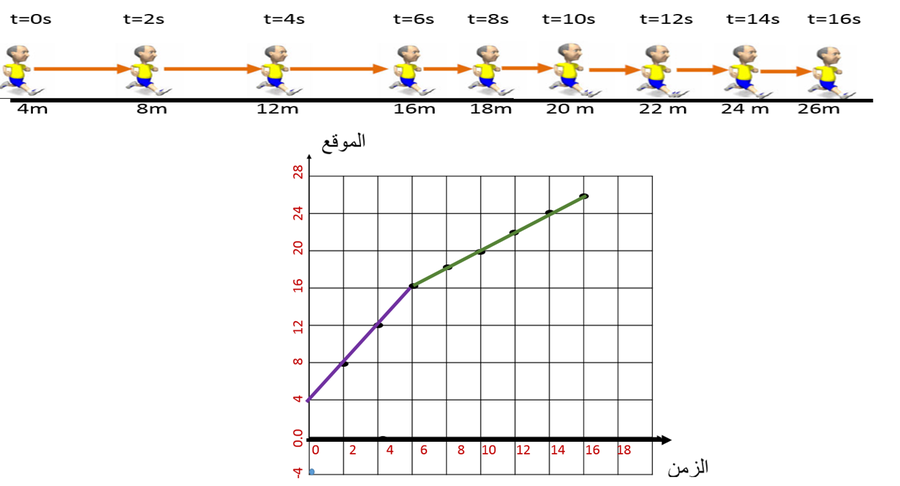
مواضع العداء كل \(2\ \mathrm s\) والخط البياني للموقع مع الزمن.
The runner’s positions every \(2\ \mathrm s\) and the position–time graph.
من أي موقع بدأت دراسة حركة العداء وأين انتهت؟ كم المسافة والإزاحة؟ ولماذا تغيّر ميل الخط؟
From which position did the study of the runner’s motion start and where did it end? What are the distance and displacement? Why did the slope of the line change?
سؤال: قام راشد بالحركة ورُسم الخط البياني لموقعه بمرور الزمن. صِف كيف تغيّر موقعه واحسب المسافة والإزاحة.
Question: Rashid moved and the graph of his position over time was drawn. Describe how his position changed and calculate the distance and displacement.
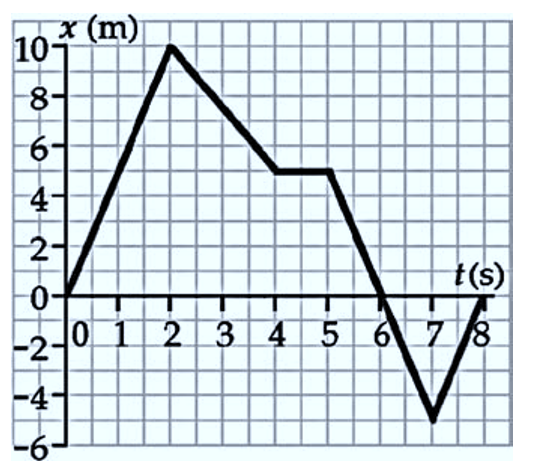
الخط البياني لموقع راشد مع الزمن.
The position–time graph of Rashid.
صِف حركة راشد واحسب المسافة والإزاحة خلال \(8\ \mathrm s\).
Describe Rashid’s motion and calculate the distance and displacement over \(8\ \mathrm s\).
➡️ السرعة المتجهة المتوسطة
➡️ Average Velocity
السرعة المتجهة المتوسطة كمية متجهة تساوي إزاحة الجسم خلال وحدة الزمن، واتجاهها هو اتجاه الإزاحة. فإذا قطع الجسم إزاحات متساوية في أزمنة متساوية قلنا إنه يتحرك بسرعة منتظمة، وإلا فسرعته متغيرة.
Average velocity is a vector quantity equal to the displacement per unit time, in the direction of the displacement. If the body covers equal displacements in equal times its velocity is uniform; otherwise it is changing.
📌 السرعة المتجهة المتوسطة
📌 Average velocity
\[\vec v_{avg}=\frac{x_f-x_i}{t_f-t_i}=\frac{\Delta x}{\Delta t}\]
وحدتها \(\mathrm{m/s}\). وهي ميل القاطع الواصل بين نقطتين على الرسم البياني للموقع مع الزمن.
Its unit is \(\mathrm{m/s}\). It is the slope of the secant joining two points on the position–time graph.
تحرك أحمد حسب المسار \(A\Rightarrow B\Rightarrow C\Rightarrow D\) خلال \(3\ \mathrm{min}\) فكان موضعه النهائي \(140\ \mathrm m\) من البداية. احسب السرعة المتجهة المتوسطة.
Ahmed moves along \(A\Rightarrow B\Rightarrow C\Rightarrow D\) in \(3\ \mathrm{min}\) ending \(140\ \mathrm m\) from the start. Find his average velocity.
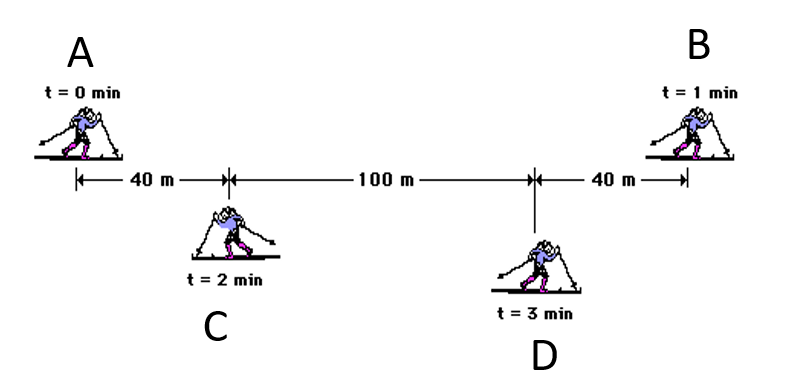
أحمد عند \(A\) في \(t=0\) وعند \(D\) في \(t=3\ \mathrm{min}\).
Ahmed at \(A\) at \(t=0\) and at \(D\) at \(t=3\ \mathrm{min}\).
من الرسم البياني: ارسم قاطعًا يمرّ بالنقطتين عند \(t=4\ \mathrm s\) و\(t=6\ \mathrm s\) واحسب ميله:
From the graph: draw a secant through the points at \(t=4\ \mathrm s\) and \(t=6\ \mathrm s\) and calculate its slope:
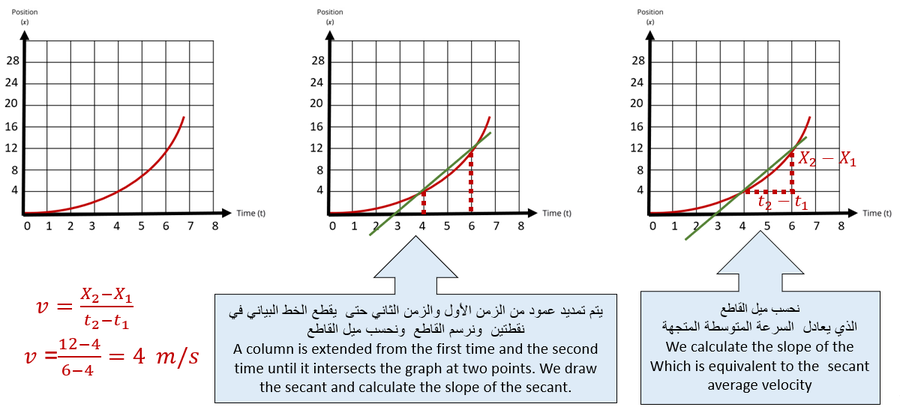
ميل القاطع بين \(t=4\ \mathrm s\) و\(t=6\ \mathrm s\): \(v=\dfrac{12-4}{6-4}=4\ \mathrm{m/s}\).
The slope of the secant between \(t=4\ \mathrm s\) and \(t=6\ \mathrm s\): \(v=\dfrac{12-4}{6-4}=4\ \mathrm{m/s}\).
⚡ السرعة اللحظية
⚡ Instantaneous Velocity
السرعة اللحظية هي سرعة الجسم في لحظة معينة؛ وهي نهاية السرعة المتوسطة عندما يؤول الزمن إلى الصفر، أي مشتقة الموقع بالنسبة للزمن، وتمثّل ميل المماس للرسم البياني للموقع مع الزمن.
Instantaneous velocity is the velocity at a particular instant; it is the limit of the average velocity as the time interval tends to zero, i.e. the derivative of position with respect to time, and it is the slope of the tangent to the position–time graph.
📌 السرعة اللحظية
📌 Instantaneous velocity
\[v_x=\lim_{\Delta t\to0}\frac{\Delta x}{\Delta t}=\frac{dx}{dt}\]
🧪 جرّب بنفسك: القاطع والمماس
🧪 Try It Yourself: the Secant and the Tangent
🧪 تجربة 2: السرعة المتوسطة واللحظية من الرسم البياني
🧪 Experiment 2: Average and Instantaneous Velocity from the Graph
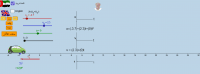
الرسم البياني لموقع دراجة \(x=-2t^2+15t+4\). القاطع الأخضر ميله السرعة المتوسطة، والمماس الأحمر ميله السرعة اللحظية.
The position graph of a bicycle \(x=-2t^2+15t+4\). The green secant’s slope is the average velocity and the red tangent’s slope the instantaneous velocity.
تحدّد موقع دراجة بالمعادلة \(x=-2t^2+15t+4\) (بالمتر والثانية). احسب سرعتها عند \(t=4\ \mathrm s\).
The position of a bicycle is \(x=-2t^2+15t+4\) (metres, seconds). Find its velocity at \(t=4\ \mathrm s\).
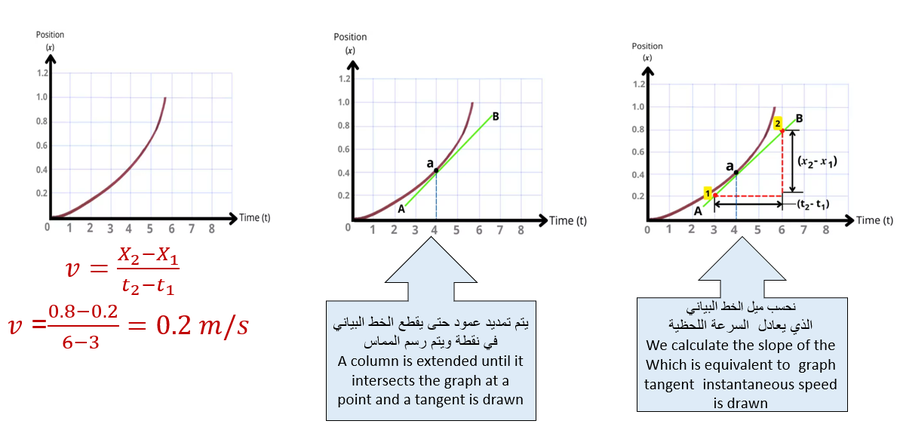
نرسم مماسًا للمنحنى عند اللحظة المطلوبة ونحسب ميله: \(v=\dfrac{0.8-0.2}{6-3}=0.2\ \mathrm{m/s}\).
Draw a tangent to the curve at the required instant and find its slope: \(v=\dfrac{0.8-0.2}{6-3}=0.2\ \mathrm{m/s}\).
🚀 السرعة القياسية
🚀 Speed
السرعة (القياسية) هي المسافة المقطوعة خلال وحدة الزمن، وهي كمية قياسية لا اتجاه لها: \(v=\dfrac{S}{t}\) وحدتها \(\mathrm{m/s}\). أما السرعة المتجهة المتوسطة فتعتمد على الإزاحة فقد تكون صفرًا أو سالبة.
Speed is the distance travelled per unit time, a scalar quantity with no direction: \(v=\dfrac{S}{t}\), unit \(\mathrm{m/s}\). The average velocity, however, depends on the displacement and may be zero or negative.
يبيّن الرسم موقع دراجة مع الزمن. احسب سرعتها خلال \(18\ \mathrm s\) وقارنها بسرعتها المتجهة المتوسطة.
The graph shows the position of a bicycle against time. Find its speed over \(18\ \mathrm s\) and compare it with its average velocity.
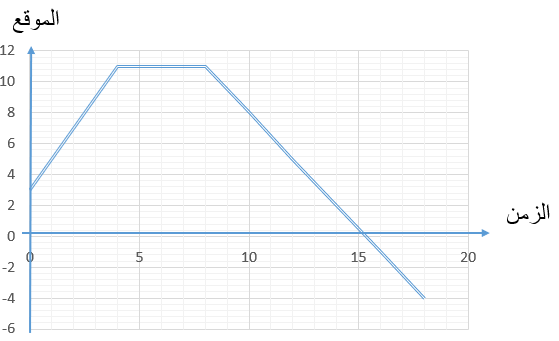
الرسم البياني لموقع الدراجة خلال \(18\ \mathrm s\).
The bicycle’s position graph over \(18\ \mathrm s\).
أي من الكميات التالية قد تكون سالبة؟
Which of the following may be negative?
🔁 التسارع (العجلة)
🔁 Acceleration
التسارع المتوسط معدل تغيّر السرعة المتجهة خلال فترة زمنية، وهو كمية متجهة، ووحدته \(\mathrm{m/s^2}\). والتسارع اللحظي هو نهاية التسارع المتوسط عندما يؤول الزمن إلى الصفر، أي مشتقة السرعة، وهو أيضًا المشتقة الثانية للموقع:
Average acceleration is the rate of change of velocity over a time interval, a vector quantity of unit \(\mathrm{m/s^2}\). Instantaneous acceleration is its limit as the interval tends to zero, i.e. the derivative of velocity, and also the second derivative of position:
📌 التسارع
📌 Acceleration
\[\vec a_{avg}=\frac{\Delta\vec v}{\Delta t}\]
\[a_x=\lim_{\Delta t\to0}\frac{\Delta v}{\Delta t}=\frac{dv}{dt}=\frac{d}{dt}\frac{dx}{dt}=\frac{d^2x}{dt^2}\]
🧪 جرّب بنفسك: التسارع من منحنى السرعة
🧪 Try It Yourself: Acceleration from the Velocity Curve
🧪 تجربة 3: التسارع اللحظي من رسم السرعة–الزمن
🧪 Experiment 3: Instantaneous Acceleration from the Velocity–Time Graph
سيارة معادلة موقعها \(x=12-10t^2+t^3\). حرّك اللحظة وراقب ميل مماس منحنى السرعة؛ فهو التسارع اللحظي.
A car with position equation \(x=12-10t^2+t^3\). Move the instant and watch the slope of the tangent to the velocity curve; it is the instantaneous acceleration.
معادلة موقع سيارة \(x=12-10t^2+t^3\). أوجد تسارعها عند \(t=5\ \mathrm s\).
The position equation of a car is \(x=12-10t^2+t^3\). Find its acceleration at \(t=5\ \mathrm s\).
من رسم السرعة–الزمن: التسارع المتوسط ميل القاطع، والتسارع اللحظي ميل المماس:
From the velocity–time graph: average acceleration is the slope of the secant and instantaneous acceleration the slope of the tangent:
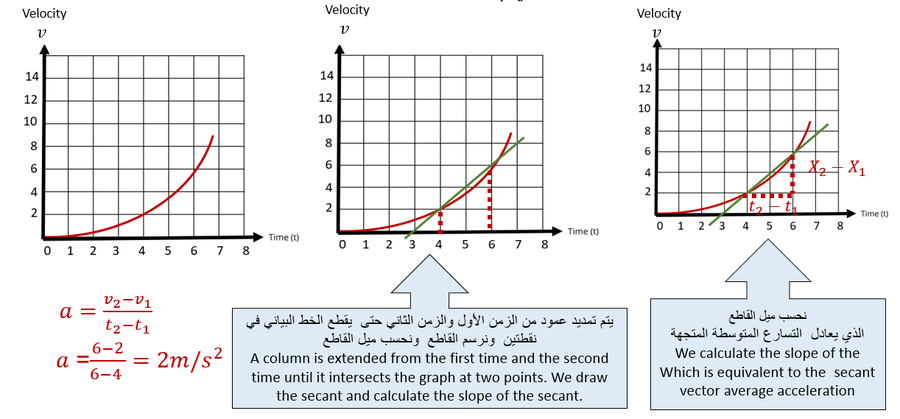
التسارع المتوسط بين \(t=4\) و\(t=6\ \mathrm s\): \(a=\dfrac{6-2}{6-4}=2\ \mathrm{m/s^2}\).
Average acceleration between \(t=4\) and \(t=6\ \mathrm s\): \(a=\dfrac{6-2}{6-4}=2\ \mathrm{m/s^2}\).
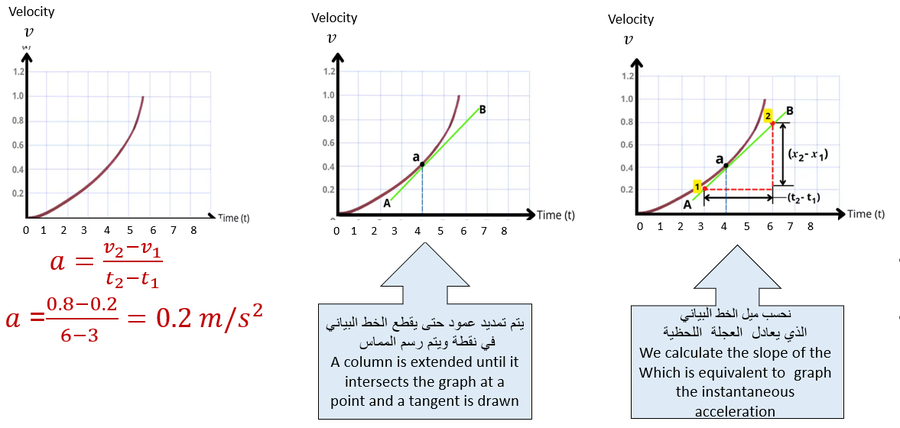
التسارع اللحظي ميل المماس: \(a=\dfrac{0.8-0.2}{6-3}=0.2\ \mathrm{m/s^2}\).
Instantaneous acceleration is the tangent slope: \(a=\dfrac{0.8-0.2}{6-3}=0.2\ \mathrm{m/s^2}\).
🧮 معادلات الحركة
🧮 Equations of Motion
قد يتحرك الجسم بسرعة ثابتة (\(a=0\)) أو بسرعة متغيرة بانتظام (تسارع ثابت لا يساوي صفرًا):
A body may move with constant velocity (\(a=0\)) or with uniformly changing velocity (a constant non-zero acceleration):
| الحالةCase | المعادلاتEquations |
|---|---|
| سرعة ثابتة \(a=0\)Constant velocity \(a=0\) | \(x_f=x_i+vt\)\(x_f=x_i+vt\) |
| سرعة متغيرة بانتظام \(a\neq0\)Uniformly changing velocity \(a\neq0\) | \(v_f=v_i+at\) \(v_f^2=v_i^2+2a(x_f-x_i)\) \(x_f=x_i+v_it+\tfrac12at^2\) \(x_f=x_i+\tfrac12(v_f+v_i)t\)\(v_f=v_i+at\) \(v_f^2=v_i^2+2a(x_f-x_i)\) \(x_f=x_i+v_it+\tfrac12at^2\) \(x_f=x_i+\tfrac12(v_f+v_i)t\) |
🧪 جرّب بنفسك: معادلات الحركة
🧪 Try It Yourself: the Equations of Motion
🧪 تجربة 4: معادلات الحركة بتسارع ثابت
🧪 Experiment 4: Equations of Motion with Constant Acceleration
اضبط السرعة الابتدائية والتسارع والزمن؛ الإزاحة هي المساحة تحت خط السرعة، وتتحقق معادلة \(v_f^2=v_i^2+2a\Delta x\). الزر الأول يضبط مثال الطائرة.
Set the initial velocity, the acceleration and the time; the displacement is the area under the velocity line and \(v_f^2=v_i^2+2a\Delta x\) holds. The first button sets the plane example.
طائرة تلامس أرض المدرج بسرعة \(45\ \mathrm{m/s}\) وتقطع \(540\ \mathrm m\) حتى تتوقف. أوجد متوسط تسارعها والزمن حتى تتوقف.
A plane touches the runway at \(45\ \mathrm{m/s}\) and travels \(540\ \mathrm m\) before stopping. Find its average acceleration and the time to stop.
سيارة تتحرك من السكون بتسارع \(2\ \mathrm{m/s^2}\) لمدة \(5\ \mathrm s\). الإزاحة:
A car starts from rest with acceleration \(2\ \mathrm{m/s^2}\) for \(5\ \mathrm s\). The displacement:
🍎 السقوط الحر
🍎 Free Fall
السقوط الحر حركة جسم يُترك من السكون ويتحرك بتأثير وزنه وحده مع إهمال مقاومة الهواء. وتتسارع الأجسام الساقطة بتسارع الجاذبية \(g\) نفسه مهما اختلفت كتلتها، فتصل إلى الأرض في اللحظة نفسها إذا سقطت من الارتفاع نفسه. ويختلف \(g\) من جرم سماوي إلى آخر.
Free fall is the motion of a body released from rest and moving under its weight alone, neglecting air resistance. Falling bodies accelerate with the same gravitational acceleration \(g\) whatever their mass, so they reach the ground at the same instant if dropped from the same height. \(g\) differs from one world to another.
📌 معادلات السقوط الحر
📌 Equations of free fall
\[g=-9.81\ \mathrm{m/s^2},\quad v_i=0\]
\[v_f=-gt,\qquad v_f^2=-2g(Y_f-Y_i),\qquad Y_f=Y_i-\tfrac12gt^2\]
وللتجربة: \(a=\dfrac{2\Delta Y}{t^2}\) تعطي قيمة \(g\) من زمن السقوط وارتفاعه.
In an experiment \(a=\dfrac{2\Delta Y}{t^2}\) gives \(g\) from the fall time and height.
🧪 جرّب بنفسك: السقوط الحر في عوالم مختلفة
🧪 Try It Yourself: Free Fall on Different Worlds
🧪 تجربة 5: السقوط الحر على أجرام مختلفة
🧪 Experiment 5: Free Fall on Different Worlds
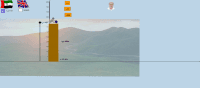
اختر الجرم السماوي وارتفاع السقوط وحرّك الزمن أو اضغط تشغيل. جميع الأجسام تسقط بالتسارع نفسه على الجرم الواحد مهما كانت كتلتها.
Choose the world and the drop height, then move the time or press play. All bodies fall with the same acceleration on a given world whatever their mass.
يسقط جسم سقوطًا حرًا من ارتفاع \(20\ \mathrm m\) على الأرض. أوجد زمن السقوط وسرعة الاصطدام.
A body falls freely from a height of \(20\ \mathrm m\) on Earth. Find the fall time and the impact speed.
تُسقَط كرة حديدية وريشة في الفراغ من الارتفاع نفسه. أيهما تصل أولًا؟
An iron ball and a feather are dropped in vacuum from the same height. Which arrives first?
⬆️ المقذوف الرأسي
⬆️ The Vertical Projectile
حركة الأجسام التي تتحرك إلى أعلى أو إلى أسفل تحت تأثير الجاذبية تسمى المقذوف الرأسي. فإذا قُذف جسم إلى أعلى بسرعة ابتدائية تناقص مقدار سرعته حتى ينعدم عند أقصى ارتفاع، ثم يبدأ بالسقوط. ويبقى التسارع ثابتًا \(-g\) طوال الحركة حتى عند القمة؛ أما السرعة فتتغير مقدارًا واتجاهًا.
The motion of bodies moving up or down under gravity is called the vertical projectile. If a body is thrown upward with an initial velocity its speed decreases until it vanishes at the maximum height, and then it starts to fall. The acceleration stays constant at \(-g\) throughout, even at the top; the velocity changes in magnitude and direction.
📌 معادلات المقذوف الرأسي
📌 Equations of the vertical projectile
\[v_f=v_i-gt,\qquad v_f^2=v_i^2-2g(Y_f-Y_i),\qquad Y_f=Y_i+v_it-\tfrac12gt^2\]
\[H=\frac{v_i^2}{2g},\qquad t_{up}=\frac{v_i}{g},\qquad T_{total}=\frac{2v_i}{g}\]
🧪 جرّب بنفسك: المقذوف الرأسي
🧪 Try It Yourself: the Vertical Projectile
🧪 تجربة 6: المقذوف الرأسي
🧪 Experiment 6: The Vertical Projectile
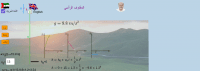
اقذف جسمًا إلى أعلى بسرعة ابتدائية \(v_i\) وحرّك الزمن أو اضغط تشغيل: تتناقص السرعة بمعدل \(g\) حتى تنعدم عند القمة ثم يعود.
Throw a body upward with an initial speed \(v_i\) and move the time or press play: the speed decreases at the rate \(g\) until it vanishes at the top, and then it returns.
قُذف جسم رأسيًا إلى أعلى بسرعة \(30\ \mathrm{m/s}\). أوجد أقصى ارتفاع وزمن الوصول إليه وزمن الرحلة الكلي (\(g=9.81\)).
A body is thrown vertically upward at \(30\ \mathrm{m/s}\). Find the maximum height, the time to reach it and the total flight time (\(g=9.81\)).
عند أقصى ارتفاع لمقذوف رأسي تكون السرعة والتسارع:
At the maximum height of a vertical projectile the velocity and acceleration are:
🎲 تدرّب
🎲 Practice
🧪 تجربة 7: تدرّب: مسائل الحركة في بعد واحد
🧪 Experiment 7: Practice: Motion in One Dimension Problems
مسائل عشوائية بأرقام مختلفة. احسب واكتب الجواب ثم اضغط «تحقّق».
Random problems with different numbers. Work it out, enter the answer and press “Check”.
📊 جدول ملخص العلاقات
📊 Summary of the Relations
| الكميةQuantity | العلاقةRelation |
|---|---|
| الإزاحةDisplacement | \(\Delta x=x_f-x_i\)\(\Delta x=x_f-x_i\) |
| السرعة المتوسطةAverage velocity | \(v_{avg}=\Delta x/\Delta t\)\(v_{avg}=\Delta x/\Delta t\) |
| السرعة اللحظيةInstantaneous velocity | \(v=dx/dt\)\(v=dx/dt\) |
| السرعة القياسيةSpeed | \(v=S/t\)\(v=S/t\) |
| التسارعAcceleration | \(a=dv/dt=d^2x/dt^2\)\(a=dv/dt=d^2x/dt^2\) |
| تسارع ثابتConstant acceleration | \(v_f=v_i+at,\ v_f^2=v_i^2+2a\Delta x\)\(v_f=v_i+at,\ v_f^2=v_i^2+2a\Delta x\) |
| السقوط الحرFree fall | \(t=\sqrt{2h/g},\ v=gt\)\(t=\sqrt{2h/g},\ v=gt\) |
| المقذوف الرأسيVertical projectile | \(H=v_i^2/2g,\ T=2v_i/g\)\(H=v_i^2/2g,\ T=2v_i/g\) |
🧪 اختبر نفسك: امتحان من 20 سؤالاً
🧪 Test Yourself: a 20-Question Exam
أنهِ الدرس بالاختبار التفاعلي التالي؛ أسئلته تجمع بين الفهم والحساب وتغطي جميع أقسام الدرس.
Finish with the interactive exam below; its questions mix understanding with calculation and cover every section of the lesson.
اختبار الحركة في بعد واحد Motion in One Dimension Quiz
20 سؤالاً - الكميات المتجهة والقياسية، فيثاغورس، قانون جيب التمام، تحليل المتجهات والمحصلة بالمركبات 20 Questions - vector and scalar quantities, Pythagoras, the law of cosines, resolving vectors and the resultant by components
• عدد الأسئلة: 20 سؤالاً
• مدة الاختبار: 30 دقيقة
• لا يمكنك تغيير إجاباتك أو إعادة الاختبار إلا بعد 24 ساعة من التسليم.
• تأكد من إجاباتك قبل التسليم! 📌 Important Instructions:
• Number of questions: 20 questions
• Quiz duration: 30 minutes
• You cannot change your answers or retake the quiz for 24 hours after submission.
• Make sure of your answers before submitting!
🔗 محاكيات GeoGebra للاستعانة بها عند اللزوم
🔗 GeoGebra Simulations to Use When Needed
اضغط «تشغيل» لتعمل المحاكاة هنا داخل الدرس؛ ويمكن للطالب الرجوع إليها لتجربة الفكرة بطريقة أخرى.
Press “Run” to run the simulation right here inside the lesson; the student can use it to try the idea in another way.