🎯 نواتج التعلم
🎯 Learning Outcomes
بعد دراسة هذا الدرس ستكون قادرًا على أن:
After this lesson you will be able to:
- تكتب متجهات الموقع والسرعة والتسارع في بعدين وثلاثة أبعاد وتشتقها من معادلات الموقع.Write the position, velocity and acceleration vectors in two and three dimensions and derive them from the position equations.
- تحلّل حركة المقذوف المثالي إلى حركة أفقية منتظمة وحركة رأسية بتسارع \(-g\).Resolve ideal projectile motion into uniform horizontal motion and vertical motion with acceleration \(-g\).
- تحسب أقصى ارتفاع وزمن التحليق والمدى وسرعة الارتطام.Calculate the maximum height, the time of flight, the range and the impact speed.
- تحلّ مسائل المقذوف الأفقي والمقذوف من مرتفع.Solve problems on horizontal projectiles and projectiles launched from a height.
- تفهم السرعة النسبية وتجمع متجهات السرعة (قارب في نهر).Understand relative velocity and add velocity vectors (a boat in a river).
📍 متجهات الموقع والسرعة والتسارع
📍 Position, Velocity and Acceleration Vectors
عندما يتحرك الجسم في بعدين أو ثلاثة أبعاد يكون موقعه متجهًا له ثلاث مركبات ديكارتية، وكلٌّ من السرعة والتسارع مشتقة المتجه الذي قبله بالنسبة للزمن:
When a body moves in two or three dimensions its position is a vector with three Cartesian components, and each of velocity and acceleration is the time derivative of the one before it:
📌 المتجهات الثلاثة
📌 The three vectors
\[\vec r=(X,Y,Z)=X\hat x+Y\hat y+Z\hat z\]
\[\vec v=\frac{d\vec r}{dt}=\frac{dX}{dt}\hat x+\frac{dY}{dt}\hat y+\frac{dZ}{dt}\hat z\;,\qquad v_x=\frac{dX}{dt},\ v_y=\frac{dY}{dt},\ v_z=\frac{dZ}{dt}\]
\[\vec a=\frac{d\vec v}{dt}=\frac{dv_x}{dt}\hat x+\frac{dv_y}{dt}\hat y+\frac{dv_z}{dt}\hat z\;,\qquad a_x=\frac{dv_x}{dt},\ a_y=\frac{dv_y}{dt},\ a_z=\frac{dv_z}{dt}\]
متجه السرعة يكون دائمًا مماسًا للمسار، أما التسارع فيشير إلى جهة تغيّر السرعة.
The velocity vector is always tangent to the path, while the acceleration points in the direction of the change of velocity.
🔄 تغيّر السرعة المتجهة والتسارع
🔄 Change of Velocity and Acceleration
تغيّر مقدار السرعة أو اتجاهها أو كليهما يولّد تسارعًا. ولإيجاد جهة التسارع نرسم \(\vec v_1\) و\(\vec v_2\) من نقطة واحدة ثم نطرح: \(\Delta\vec v=\vec v_2-\vec v_1\) وهو يوازي \(\vec a\):
A change in the magnitude of the velocity, its direction or both produces acceleration. To find its direction draw \(\vec v_1\) and \(\vec v_2\) from one point and subtract: \(\Delta\vec v=\vec v_2-\vec v_1\), which is parallel to \(\vec a\):
\[\vec a=\frac{\Delta\vec v}{\Delta t}=\frac{\vec v_2-\vec v_1}{t_2-t_1}\]

طرح متجهي السرعة \(\vec v_2-\vec v_1\) يعطي اتجاه التسارع.
Subtracting the velocity vectors \(\vec v_2-\vec v_1\) gives the direction of the acceleration.
🦌 مثال: الغزال في الحديقة
🦌 Example: the Gazelle in the Garden
يجري غزال في بعدين حيث \(X(t)=0.5t^2+12t+15\) و\(Y(t)=-0.3t^2+6t+20\) (بالمتر والثانية). جرّب الزمن بنفسك ثم احسب عند \(t=8\ \mathrm s\):
A gazelle runs in two dimensions with \(X(t)=0.5t^2+12t+15\) and \(Y(t)=-0.3t^2+6t+20\) (metres, seconds). Try the time yourself, then calculate at \(t=8\ \mathrm s\):
🧪 تجربة 1: موقع الغزال وسرعته وتسارعه
🧪 Experiment 1: The Gazelle: Position, Velocity and Acceleration
حرّك الزمن \(t\) وراقب موقع الغزال \(\vec r\) وسرعته \(\vec v\) (مماسة للمسار) وتسارعه \(\vec a\) من معادلتي \(X(t)\) و\(Y(t)\).
Move the time \(t\) and watch the gazelle’s position \(\vec r\), its velocity \(\vec v\) (tangent to the path) and its acceleration \(\vec a\) from \(X(t)\) and \(Y(t)\).
احسب موقع الغزال وسرعته وتسارعه عند \(t=8\ \mathrm s\) مع الاتجاهات.
Find the position, velocity and acceleration of the gazelle at \(t=8\ \mathrm s\) with their directions.
🏀 حركة المقذوفات المثالية
🏀 Ideal Projectile Motion
المقذوف المثالي جسم يُقذف بسرعة ابتدائية ثم يتحرك تحت تأثير وزنه وحده، مع إهمال مقاومة الهواء والرياح ودوران الجسم، فتكون حركته في بعدين. ومن الأسهل دراسة الحركة على كل محور على حدة لأن المحورين مستقلان:
An ideal projectile is launched with an initial speed and then moves under its weight alone, neglecting air resistance, wind and spin, so its motion is two-dimensional. It is easiest to study each axis separately because the two axes are independent:
📌 مركبتا السرعة الابتدائية
📌 Components of the initial velocity
\[v_{0x}=v_0\cos\theta\qquad v_{0y}=v_0\sin\theta\]
المحور الأفقي: لا تسارع (\(a_x=0\)) فالسرعة ثابتة. المحور الرأسي: تسارع \(a_y=-g=-9.81\ \mathrm{m/s^2}\).
Horizontal axis: no acceleration (\(a_x=0\)) so the speed is constant. Vertical axis: acceleration \(a_y=-g=-9.81\ \mathrm{m/s^2}\).
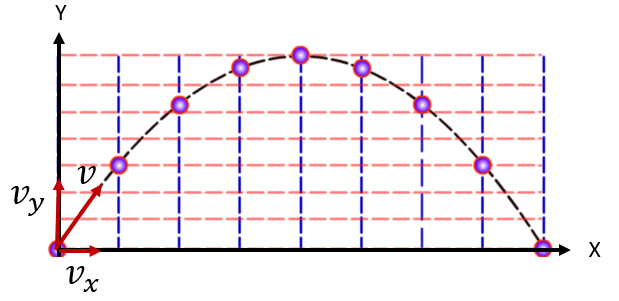
الصور المتتالية متساوية الأزمنة: المسافات الأفقية متساوية والرأسية متغيّرة.
Equal-time snapshots: equal horizontal spacing and changing vertical spacing.
🧪 جرّب بنفسك: المقذوف بزاوية
🧪 Try It Yourself: the Projectile at an Angle
في التجربة الأصلية يسجّل الطالب الإزاحة كل \(0.5\ \mathrm s\) ثم يحسب السرعة الرأسية من العلاقة \(v_y=\dfrac{2\,\Delta y}{t}-v_{0y}\) المستنتجة من متوسط السرعة. وهنا تجد التجربة التفاعلية، ومحاكاة GeoGebra في آخر الصفحة.
In the original experiment the student records the displacement every \(0.5\ \mathrm s\) and calculates the vertical speed from \(v_y=\dfrac{2\,\Delta y}{t}-v_{0y}\), derived from the average velocity. Here is the interactive experiment, and the GeoGebra simulation is at the end of the page.
🧪 تجربة 2: المقذوف المثالي بزاوية
🧪 Experiment 2: The Ideal Projectile at an Angle
اضبط السرعة والزاوية وارتفاع القذف، وحرّك الزمن أو اضغط تشغيل. الدوائر الرمادية كل \(0.5\ \mathrm s\)؛ ولاحظ أن \(v_x\) ثابتة و\(v_y\) تتناقص.
Set the speed, angle and launch height, then move the time or press play. The grey dots are every \(0.5\ \mathrm s\); notice that \(v_x\) is constant and \(v_y\) decreases.
📈 الرسمان البيانيان للسرعة والزمن
📈 The Velocity–Time Graphs
المحور X: السرعة الأفقية ثابتة فالخط مستقيم أفقي، وميله هو التسارع \(a=0\).
The X axis: the horizontal speed is constant, so the line is horizontal and its slope, the acceleration, is \(a=0\).
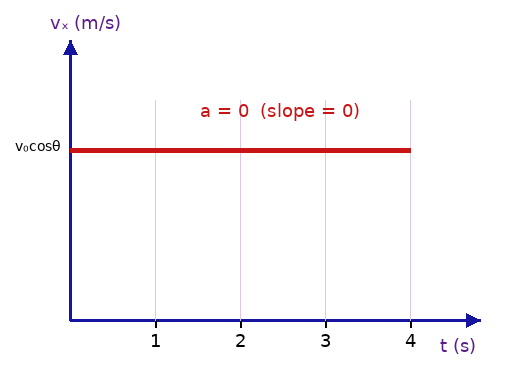
السرعة الأفقية ثابتة والميل يساوي صفرًا.
The horizontal speed is constant and the slope is zero.
📌 معادلة الحركة على المحور الأفقي
📌 Equation of motion on the horizontal axis
\[X=v_0\cos\theta\;t\]
المحور Y: السرعة الرأسية تتناقص خطيًا بميل ثابت \(-g\)؛ تنعدم عند أقصى ارتفاع ثم تصبح سالبة أثناء الهبوط.
The Y axis: the vertical speed decreases linearly with a constant slope \(-g\); it is zero at the maximum height and then becomes negative on the way down.
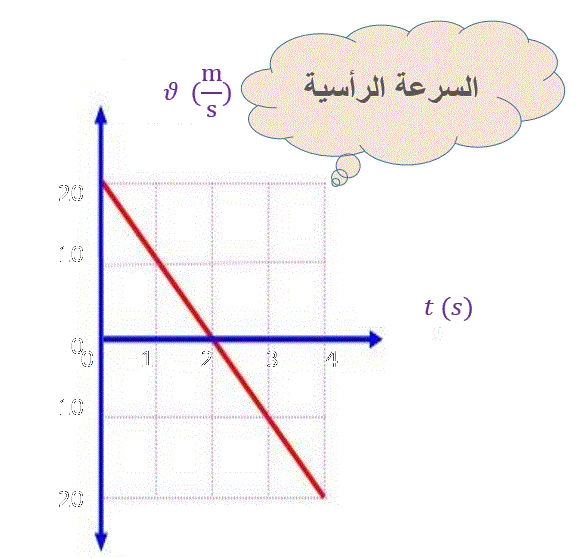
السرعة الرأسية تتناقص بميل ثابت \(-g\).
The vertical speed decreases with a constant slope \(-g\).
📌 معادلات الحركة على المحور الرأسي
📌 Equations of motion on the vertical axis
\[v_{fy}=v_0\sin\theta-gt\]
\[v_{fy}^2=(v_0\sin\theta)^2-2g\,\Delta y\]
\[\Delta y=v_0\sin\theta\;t-\tfrac12gt^2\]
📌 ملاحظات هامة ومسار القطع المكافئ
📌 Important Notes and the Parabolic Path
ملاحظات
Notes
- زمن التحليق يساوي ضعف زمن الوصول إلى أقصى ارتفاع (عند القذف والعودة إلى المستوى نفسه).The time of flight equals twice the time to reach the maximum height (when returning to the same level).
- أكبر مدى أفقي عندما تكون زاوية الإطلاق \(45^\circ\).The greatest range is for a launch angle of \(45^\circ\).
- عند أقصى ارتفاع تنعدم السرعة الرأسية وتبقى الأفقية فقط.At the maximum height the vertical velocity is zero and only the horizontal one remains.
- قذيفتان تصلان إلى المدى نفسه إذا كان مجموع زاويتيهما \(90^\circ\).Two projectiles have the same range if their launch angles add up to \(90^\circ\).
ولإثبات أن المسار قطع مكافئ نحذف الزمن بين معادلتي الموقع:
To prove the path is a parabola we eliminate time between the two position equations:
\[X=v_0\cos\theta\;t\ \Rightarrow\ t=\frac{X}{v_0\cos\theta}\]
\[Y=Y_0+v_0\sin\theta\;t-\tfrac12gt^2\ \Rightarrow\ Y=Y_0+\tan\theta\;X-\frac{g}{2v_0^2\cos^2\theta}X^2\]
وهي معادلة قطع مكافئ من الشكل \(Y=C+bX+aX^2\) بمعامل سالب لـ \(X^2\) (فتحته إلى الأسفل).
This is a parabola of the form \(Y=C+bX+aX^2\) with a negative coefficient of \(X^2\) (opening downward).
يركل لاعب كرة بسرعة \(25\ \mathrm{m/s}\) بزاوية \(33.1^\circ\) فوق الأفقي من مسافة \(40.6\ \mathrm m\) عن المرمى. هل وصلت الكرة إلى المرمى أم تجاوزته؟ وإذا كان ارتفاع العارضة \(2\ \mathrm m\) فهل دخلت المرمى؟
A player kicks a ball at \(25\ \mathrm{m/s}\) at \(33.1^\circ\) above the horizontal from \(40.6\ \mathrm m\) away from the goal. Does the ball reach the goal or pass it? If the crossbar is \(2\ \mathrm m\) high, does it go in?
أي من العلاقات التالية تعطي مسار المقذوف؟
Which relation gives the path of a projectile?
🎚️ السرعة عند أي نقطة من المسار
🎚️ The Velocity at Any Point of the Path
لكل نقطة على المسار مركبتا سرعة: أفقية ثابتة \(v_x=v_0\cos\theta\)، ورأسية \(v_y\) تتغير بحسب الزمن أو الارتفاع. ومنهما تُحسب السرعة الكلية واتجاهها (وهي مماسة للمسار):
Every point on the path has two velocity components: a constant horizontal one \(v_x=v_0\cos\theta\) and a vertical one \(v_y\) that changes with time or height. The total speed and its direction (tangent to the path) follow from them:
\[v=\sqrt{v_x^2+v_y^2},\qquad \tan\alpha=\frac{v_y}{v_x}\]
⛰️ أقصى ارتفاع ومدى المقذوفات
⛰️ Maximum Height and Range
📌 القذف من الأرض إلى الأرض
📌 Ground-to-ground launch
\[H=Y_0+\frac{(v_0\sin\theta)^2}{2g},\qquad v_{fy}=0\]
\[T=\frac{2v_0\sin\theta}{g},\qquad R=\frac{v_0^2}{g}\sin2\theta\]
إذا كانت \(Y_0\neq0\) فنحسب زمن الوصول من \(\Delta Y=v_0\sin\theta\,t-\tfrac12gt^2\) (معادلة تربيعية في \(t\)) ثم \(X=v_0\cos\theta\,t\).
If \(Y_0\neq0\), find the time from \(\Delta Y=v_0\sin\theta\,t-\tfrac12gt^2\) (a quadratic in \(t\)) and then \(X=v_0\cos\theta\,t\).
🧪 جرّب بنفسك: الزاويتان المتتامتان
🧪 Try It Yourself: Complementary Angles
🧪 تجربة 4: المدى والزاويتان المتتامتان
🧪 Experiment 4: Range and Complementary Angles
المسار الأزرق للزاوية \(\theta\) والأخضر للزاوية \(90^\circ-\theta\) والرمادي المتقطع لـ \(45^\circ\) بالسرعة نفسها.
The blue path is for \(\theta\), the green for \(90^\circ-\theta\) and the dashed grey for \(45^\circ\), all at the same speed.
مدفع على تل ارتفاعه \(50\ \mathrm m\) أطلق قذيفة بسرعة \(83\ \mathrm{m/s}\) بزاوية \(40^\circ\). احسب أقصى ارتفاع عن الأرض، وزمن الوصول إلى الأرض، والمدى الأفقي، وسرعة الارتطام.
A cannon on a \(50\ \mathrm m\) hill fires a projectile at \(83\ \mathrm{m/s}\) at \(40^\circ\). Find the maximum height above the ground, the time to reach the ground, the horizontal range and the impact speed.
قُذف جسم من الأرض بسرعة \(20\ \mathrm{m/s}\) بزاوية \(30^\circ\). أقصى ارتفاع يصل إليه (\(g=9.81\)):
A body is launched from the ground at \(20\ \mathrm{m/s}\) at \(30^\circ\). The maximum height it reaches (\(g=9.81\)):
🏢 المقذوف الأفقي
🏢 The Horizontal Projectile
في المقذوف الأفقي تكون السرعة الابتدائية أفقية فقط: \(v_x=v_0\) و\(v_{0y}=0\). والحركة الرأسية سقوط حر، لذلك لا يتأثر زمن السقوط بالسرعة الأفقية.
In a horizontal projectile the initial velocity is purely horizontal: \(v_x=v_0\) and \(v_{0y}=0\). The vertical motion is free fall, so the fall time does not depend on the horizontal speed.
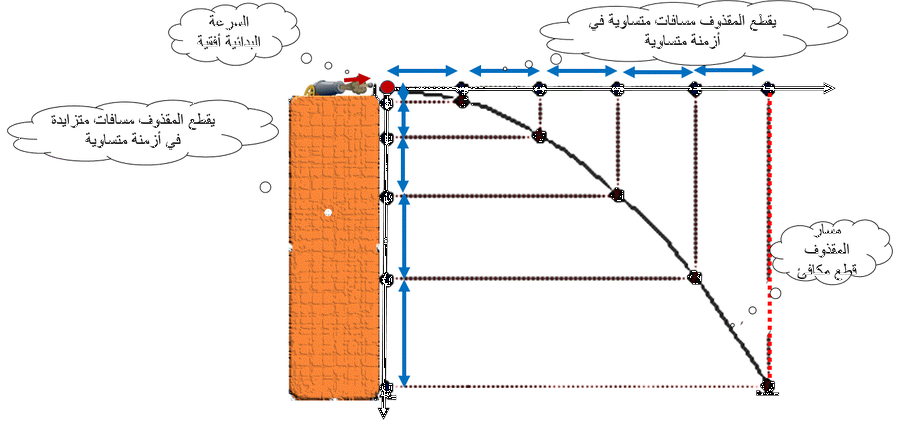
المقذوف الأفقي: مسافات أفقية متساوية في أزمنة متساوية ومسافات رأسية متزايدة.
Horizontal projectile: equal horizontal distances in equal times and growing vertical distances.
📌 معادلات المقذوف الأفقي
📌 Equations of the horizontal projectile
\[X=v_0\,t\]
\[v_{fy}=-gt,\qquad v_{fy}^2=-2g\,\Delta y,\qquad \Delta y=-\tfrac12gt^2\]
\[T=\sqrt{\frac{2h}{g}},\qquad v=\sqrt{v_0^2+2gh}\]
🧪 جرّب بنفسك: المقذوف الأفقي
🧪 Try It Yourself: the Horizontal Projectile
🧪 تجربة 3: المقذوف الأفقي من مبنى
🧪 Experiment 3: The Horizontal Projectile from a Building
قذيفة تُطلق أفقيًا من ارتفاع \(h\). غيّر \(h\) و\(v_0\) وراقب زمن السقوط والمدى وسرعة الارتطام.
A projectile fired horizontally from a height \(h\). Change \(h\) and \(v_0\) and watch the fall time, the range and the impact speed.
نُصب مدفع على سطح مبنى ارتفاعه \(50\ \mathrm m\) وأطلق قذيفة أفقيًا بسرعة \(90\ \mathrm{m/s}\). احسب سرعة ارتطامها بالأرض.
A cannon on top of a \(50\ \mathrm m\) building fires a projectile horizontally at \(90\ \mathrm{m/s}\). Find its impact speed.
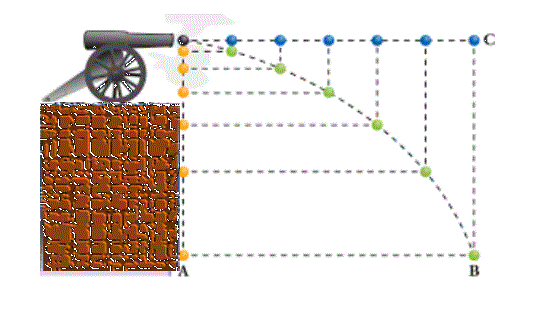
مدفع على سطح مبنى يُطلق قذيفة أفقيًا.
A cannon on a building fires a projectile horizontally.
قذفت كرتان أفقيًا من ارتفاع واحد بسرعتين مختلفتين. أيهما تصل الأرض أولًا؟
Two balls are thrown horizontally from the same height at different speeds. Which reaches the ground first?
🌬️ حركة المقذوفات الواقعية
🌬️ Real Projectile Motion
أهملنا في المقذوف المثالي مقاومة الهواء ودوران الجسم. أما في الواقع فمقاومة الهواء تعاكس الحركة وتقلّل المدى الأفقي وأقصى ارتفاع، ودوران المقذوف قد يحرفه عن مستوى مساره فتصبح الحركة ثلاثية الأبعاد (ككرة القدم المقوّسة).
In the ideal projectile we neglected air resistance and spin. In reality air resistance opposes the motion and reduces both range and maximum height, and spin can deflect the projectile out of its plane so the motion becomes three-dimensional (like a curved football).
🚗 السرعة النسبية
🚗 Relative Velocity
السرعة النسبية هي سرعة جسم بالنسبة إلى جسم آخر. فإذا تحرك جسمان في اتجاه واحد بدت السرعة أقل، وإذا تحركا في اتجاهين متعاكسين بدت أكبر. ولذلك يجب أن نحدد دائمًا: بالنسبة إلى من؟
Relative velocity is the velocity of a body with respect to another body. If two bodies move in the same direction the speed looks smaller, and if they move in opposite directions it looks larger. So we must always state: relative to what?
مثال: أحمد في السيارة
Example: Ahmad in the Car
- أحمد يقود سيارة نحو الشرق بسرعة \(20\ \mathrm{m/s}\).Ahmad drives a car east at \(20\ \mathrm{m/s}\).
- سرعته بالنسبة إلى السيارة: \(\vec v_{AC}=0\).His velocity relative to the car: \(\vec v_{AC}=0\).
- سرعته بالنسبة إلى الطريق: \(\vec v_{Ae}=20\ \mathrm{m/s}\) شرقًا.His velocity relative to the road: \(\vec v_{Ae}=20\ \mathrm{m/s}\) east.
- سرعة الأرض بالنسبة إليه: \(\vec v_{eA}=20\ \mathrm{m/s}\) غربًا.The Earth’s velocity relative to him: \(\vec v_{eA}=20\ \mathrm{m/s}\) west.
📌 قاعدة جمع السرعات النسبية
📌 The rule for adding relative velocities
\[\vec v_{B/e}=\vec v_{B/R}+\vec v_{R/e}\]
🧪 جرّب بنفسك: قارب في نهر
🧪 Try It Yourself: a Boat in a River
🧪 تجربة 5: قارب في نهر: السرعة النسبية
🧪 Experiment 5: A Boat in a River: Relative Velocity
غيّر سرعة القارب وسرعة النهر واتجاه توجيه القارب (من الشرق عكس عقارب الساعة)، وراقب محصلة السرعة وزمن العبور والانجراف على الضفة.
Change the boat speed, the river speed and the heading of the boat (from east, anticlockwise), and watch the resultant velocity, the crossing time and the drift along the bank.
اتجه قارب نحو الشمال بسرعة \(20\ \mathrm{m/s}\) في نهر يجري نحو الشرق بسرعة \(5\ \mathrm{m/s}\). أوجد سرعة القارب بالنسبة لمراقب على الضفة.
A boat heads north at \(20\ \mathrm{m/s}\) in a river flowing east at \(5\ \mathrm{m/s}\). Find the boat’s velocity relative to an observer on the bank.
سيارتان تسيران في اتجاهين متعاكسين بسرعتين \(20\) و\(30\ \mathrm{m/s}\). سرعة إحداهما بالنسبة للأخرى:
Two cars move in opposite directions at \(20\) and \(30\ \mathrm{m/s}\). The speed of one relative to the other:
🎲 تدرّب
🎲 Practice
🧪 تجربة 6: تدرّب: مسائل الحركة في بعدين
🧪 Experiment 6: Practice: Motion in Two Dimensions Problems
مسائل عشوائية بأرقام مختلفة. احسب واكتب الجواب ثم اضغط «تحقّق».
Random problems with different numbers. Work it out, enter the answer and press “Check”.
📊 جدول ملخص العلاقات
📊 Summary of the Relations
| الموضوعTopic | العلاقةRelation |
|---|---|
| السرعة والتسارعVelocity and acceleration | \(\vec v=d\vec r/dt,\ \vec a=d\vec v/dt\)\(\vec v=d\vec r/dt,\ \vec a=d\vec v/dt\) |
| مركبتا السرعة الابتدائيةInitial components | \(v_{0x}=v_0\cos\theta,\ v_{0y}=v_0\sin\theta\)\(v_{0x}=v_0\cos\theta,\ v_{0y}=v_0\sin\theta\) |
| المحور الأفقيHorizontal axis | \(X=v_0\cos\theta\,t\)\(X=v_0\cos\theta\,t\) |
| المحور الرأسيVertical axis | \(v_y=v_0\sin\theta-gt\)\(v_y=v_0\sin\theta-gt\) |
| أقصى ارتفاعMaximum height | \(H=Y_0+(v_0\sin\theta)^2/2g\)\(H=Y_0+(v_0\sin\theta)^2/2g\) |
| المدى (من الأرض إلى الأرض)Range (ground to ground) | \(R=v_0^2\sin2\theta/g\)\(R=v_0^2\sin2\theta/g\) |
| المقذوف الأفقيHorizontal projectile | \(T=\sqrt{2h/g},\ v=\sqrt{v_0^2+2gh}\)\(T=\sqrt{2h/g},\ v=\sqrt{v_0^2+2gh}\) |
| السرعة النسبيةRelative velocity | \(\vec v_{B/e}=\vec v_{B/R}+\vec v_{R/e}\)\(\vec v_{B/e}=\vec v_{B/R}+\vec v_{R/e}\) |
🧪 اختبر نفسك: امتحان من 20 سؤالاً
🧪 Test Yourself: a 20-Question Exam
أنهِ الدرس بالاختبار التفاعلي التالي؛ أسئلته تجمع بين الفهم والحساب وتغطي جميع أقسام الدرس.
Finish with the interactive exam below; its questions mix understanding with calculation and cover every section of the lesson.
اختبار الحركة في بعدين وثلاثة أبعاد Motion in Two and Three Dimensions Quiz
20 سؤالاً - الكميات المتجهة والقياسية، فيثاغورس، قانون جيب التمام، تحليل المتجهات والمحصلة بالمركبات 20 Questions - vector and scalar quantities, Pythagoras, the law of cosines, resolving vectors and the resultant by components
• عدد الأسئلة: 20 سؤالاً
• مدة الاختبار: 30 دقيقة
• لا يمكنك تغيير إجاباتك أو إعادة الاختبار إلا بعد 24 ساعة من التسليم.
• تأكد من إجاباتك قبل التسليم! 📌 Important Instructions:
• Number of questions: 20 questions
• Quiz duration: 30 minutes
• You cannot change your answers or retake the quiz for 24 hours after submission.
• Make sure of your answers before submitting!
🔗 محاكيات GeoGebra للاستعانة بها عند اللزوم
🔗 GeoGebra Simulations to Use When Needed
اضغط «تشغيل» لتعمل المحاكاة هنا داخل الدرس؛ ويمكن للطالب الرجوع إليها لتجربة الفكرة بطريقة أخرى.
Press “Run” to run the simulation right here inside the lesson; the student can use it to try the idea in another way.